Introduction
Menegazzia A. Massal. is one of the most conspicuous and species-rich genera of macrolichens in the cool temperate regions of former Gondwanaland, with areas of diversity in southern South America, New Zealand, Tasmania, eastern Australia and montane New Guinea (James & Galloway Reference James and Galloway1992; Bjerke Reference Bjerke2005; Galloway Reference Galloway2007). Together with genera such as Bunodophoron and Pseudocyphellaria, it forms a major component of the epiphytic flora of Nothofagus forests, as well as extending into moist, cold, treeless environments (Kantvilas & Jarman Reference Kantvilas and Jarman1999). The genus is also widely distributed throughout the Northern Hemisphere and the tropics, although there its degree of speciation is comparatively very small.
Although first introduced by Massalongo (Reference Massalongo1854) to accommodate the widespread Northern Hemisphere species, M. terebrata (Hoffm.) A. Massal., the genus was not widely accepted for many decades. Thus in the course of the discovery and description of the diverse lichen floras of Southern Hemisphere regions, especially from the mid-19th to the early 20th century, many species of Menegazzia were published by such well known lichenologists as J. Müller Argoviensis, J. Stirton and A. Zahlbruckner, but invariably as species of Parmelia. It was not until the pivotal paper of Santesson (Reference Santesson1942) that a large number of taxa were transferred to Menegazzia and the genus became generally accepted. Although dealing primarily with southern South American species, Santesson (op. cit.) studied a wide range of material and accounted for many names based on specimens from other regions, including Tasmania and New Zealand. He also discussed extensively the morphology of the genus and essentially laid out the framework by which species are characterized to this day; for example, numbers of ascospores per ascus, presence of soredia, morphology of the soralia and morphology of the diagnostic perforations.
In the later years of the 20th century, the widely recognized specialist on the genus was the British lichenologist, P. W. James. Through several excursions to Menegazzia-rich regions, notably Patagonia, New Zealand and Tasmania, James greatly increased the knowledge and herbarium holdings of the genus. In particular, he came to appreciate the critical role of secondary chemistry in species delineation, as well as the numerous examples of ‘species pairs' (Poelt Reference Poelt1970) in the genus. James went on to complete major accounts of Menegazzia for New Zealand (James Reference James and Galloway1985), Australia (James & Galloway Reference James and Galloway1992) and New Guinea (James et al. Reference James, Aptroot, Diederich, Sipman and Sérusiaux2001). Meanwhile the knowledge of South American taxa was extended in a series of papers, chiefly authored by M. Adler, J. Bjerke, S. Calvelo and A. Elvebakk, with a synopsis of taxa published by Bjerke (Reference Bjerke2005); an updated account for New Zealand was published by Galloway (Reference Galloway2007). Additions to the genus in Australasia have also been published by Bjerke (Reference Bjerke2004a), Elix et al. (Reference Elix, Bawingan, Lardizaval and Schumm2005) and Elix (Reference Elix2007a, b; Reference Elix2008). Thus today there is a sound body of literature on the genus for the Southern Hemisphere, as well as several significant regional accounts for the Northern Hemisphere; for example, for Japan and East Asia (Bjerke Reference Bjerke2004b; Moon et al. Reference Moon, Kurokawa and Kashiwadani2006), Malesia (Bjerke & Sipman Reference Bjerke and Sipman2007), Taiwan (Aptroot et al. Reference Aptroot, Lai and Sparrius2003) and Tibet (Bjerke & Obermayer Reference Bjerke and Obermayer2005). On the basis of this literature, the number of species described in the genus exceeds 75 (J. Bjerke, pers. comm.).
Contemporary study of the genus in Tasmania commenced with Peter James' first visit in 1963. Through a fruitful correspondence with the Tasmanian resident lichenologist, the late Geoff Bratt (1931–1977), large numbers of collections were amassed and are housed today in London's Natural History Museum (BM) and in the Tasmanian Herbarium (HO). The author's introduction to the genus likewise developed out of a correspondence with Peter James, which also saw large numbers of collections accumulated and several new taxa discovered. The first five of these were published in Kantvilas & James (Reference Kantvilas and James1987), and four others followed in James & Galloway (Reference James and Galloway1992). The latter paper represents a synthesis of James' work on the Australian species. The author has continued his personal interest in the genus since then, adding two further new species (Kantvilas & Louwhoff Reference Kantvilas and Louwhoff2004; Lumbsch et al. Reference Lumbsch, Ahti, Alterman, Amo de Paz, Aptroot, Arup, Bárcenas Peña, Bawingan, Benatti and Betancourt2011). In addition, twelve Tasmanian species were illustrated in Kantvilas & Jarman (Reference Kantvilas and Jarman1999) where a key to 21 species found in Tasmanian rainforest was also provided.
The aim of the present paper is to bring together the rather dispersed and partly unpublished information on the genus in Tasmania into a single work. Seven new species are described. Several other records are deleted for Tasmania or reduced to synonymy. All names previously applied in Tasmania that are pertinent to the genus are also accounted for. Perhaps most importantly, comprehensive descriptions of all species, based directly on Tasmanian collections, have been compiled de novo. This is considered critical because it remains to be seen whether the same name can be correctly applied to species that occur in Australia, Tasmania, New Zealand and South America. The result is an account of 30 taxa in Tasmania, of which 12 are endemic, demonstrating the central position this attractive lichen genus holds in the catalogue of Tasmania's biodiversity.
Materials and Methods
The study is based chiefly on collections in the Tasmanian Herbarium (HO), with reference to critical holdings in other herbaria, especially the Natural History Museum (BM). The study is Tasmanian in focus and based on more than 30 years of collecting and field observations by the author throughout Tasmania, as well as on the extensive collections of the late G. C. Bratt and P. W. James. This material was investigated in the context of the author's field experience and collections from mainland Australia: south-western Western Australia, south-eastern South Australia including Kangaroo Island, Victoria, the coastal ranges of New South Wales, especially in Nothofagus moorei forests, and Mt Bellenden Ker, Queensland. Material from New Zealand and southern South America was studied at the Natural History Museum, London, and also sourced from elsewhere, especially Michigan State University (MSC: collections of H. Imshaug and co-workers) and via J. Bjerke, Norwegian Institute for Nature Research. Limited field work was also undertaken in New Zealand and the holdings of the Allan Herbarium (CHR) studied briefly. In all, more than 1200 specimens were studied in detail.
Only a selection of specimens studied (up to five per species) is cited. I have attempted to include the oldest specimen found, as well as those represented in more than one herbarium.
Routine chemical analysis of all specimens was undertaken using standard methods of thin-layer chromatography (Orange et al. Reference Orange, James and White2001); solvent A was the preferred medium. A small number of critical extracts was confirmed by J. A. Elix, Canberra, using high performance liquid chromatography (Elix et al. Reference Elix, Giralt and Wardlaw2003). All fertile material was sectioned and dimensions of ascospores given in the descriptions are based on at least 50 observations each and presented in the format: smallest measurement–mean–largest measurement; single outlying values are given in parentheses. Hand-cut apothecial and thallus sections were routinely mounted in water for observation and measurement, but subsequently eluted with 15% KOH or ammoniacal erythrosin for further examination.
Illustrations of the general habit of each species are provided at the same scale in order to convey a sense of relative size. Where appropriate, more detailed close-up images are also used to illustrate particular features.
Nomenclature of rainforest types referred to in ecological discussions follows Jarman et al. (Reference Jarman, Kantvilas and Brown1994).
Major characters of Menegazzia
Thallus
The thallus of Menegazzia is invariably foliose and lobate, with the largest species (e.g. M. pertransita) being up to or in excess of 30 cm wide, whereas the smallest (e.g. M. minuta) may never exceed 1·5 cm. The upper surface is variously coloured a shade of grey, yellow, green or chestnut brown but in older specimens or ones from exposed habitats, the cortical and algal layers become discontinuous and the upper surface may be streaked or blotched with black. The photobiont is a unicellular green alga with globose cells 10–18 µm diam. Pruina or maculae may be present in some taxa but are of limited taxonomic value, at least in Tasmania. Exceptions are M. subpertusa, which has characteristic pruinose lobe apices, and the M. nothofagi group, which has constant and very conspicuous maculae. The lower surface is glossy black and erhizinate, and attachment to the substratum is either direct or via bulbous bulges of the lower cortex.
The texture of the thallus varies from relatively robust and leathery (e.g. M. pertransita) to exceedingly brittle and fragile (e.g. M. elongata, M. inactiva and their relatives, or the M. nothofagi group). This feature can be useful for distinguishing certain species.
The upper surface is typically perforate but a small number of species (e.g. M. eperforata) lack perforations, whereas in some others (e.g. M. ramulicola) the perforations are very scant. On the other hand, in M. myriotrema, the perforations may be so numerous that the whole thallus is a lace-like reticulum of contiguous perforations. Size of the perforations is highly variable in most species, seemingly influenced by habitat, and should be used in delimiting species only with extreme caution. For example, in species with a wide ecological amplitude, such as M. platytrema, individuals from drier environments tend to have smaller perforations than those from wetter sites. In contrast, the shape of the perforations is usually a critical species character. In some species, the margins of the perforations may be flush (level) with the upper surface or turned inwards. In others, they are level or markedly elevated to form a short cylinder or volcano shape.
The thallus is invariably hollow. The medullary cavity is byssoid and whitish in most species when young, but may soon become discoloured grey or black, with or without a retained sparse cobweb of white hyphae. In some species, the medullary cavity may be pigmented a shade of orange or yellow, and the nature of the pigments is a critical species character (see ‘chemistry’ below).
There are several types of branching and lobe shape. Most species have lobes that are cylindrical in parts and somewhat flattened elsewhere, especially towards the apices. The lobes branch at relatively acute angles, overlap tightly in the thallus centre and radiate palmately towards the margins where the apices are usually laterally contiguous and discrete. In other species, notably M. subbullata and M. elongata, the lobes are highly inflated, very fragile and with constricted axils; their arrangement is often rather random and determined largely by the character of the substratum. For example they may be scattered along the length of a twig or more organized into a rosette on a broader trunk or branch. In M. neozelandica, M. abscondita, M. inactiva and M. kantvilasii, the lobes tend to be inflated, diverge almost at right-angles with rounded axils, and loosely interweave throughout. These branching types and thallus shapes may differ in only a subtle way, but with experience, they assist greatly in the recognition of species.
Soredia
The presence or absence of soredia is a critical species character. The different morphologies of the soralia were first discussed in detail by Santesson (Reference Santesson1942) and his general scheme has been applied and developed by subsequent authors (e.g. Bjerke & Elvebakk Reference Bjerke and Elvebakk2001). Several key types of soralia are distinguishable. Vesicular soralia are globose or helmet-shaped structures that arise on the upper surface and burst open to develop soredia; Mengazzia globulifera and M. caesiopruinosa provide excellent examples. Laminal soralia may be rather diffuse or distinctly convex but are not associated with the perforations, although they sometimes form a hole through to the medullary cavity; Menegazzia subpertusa, M. caliginosa and M. sanguinascens provide good examples of this form. Then there are soralia that are associated with the perforations; these are best seen in M. neozelandica, where the perforations are elevated in short, volcano-like cylinders and become sorediate on the margins, typically in a crescent-shape.
Apothecia
Apothecia are of the typical Parmeliaceae type, with a well-developed thalline margin and a cupular excipulum. The thalline margin may be entire or radially cracked, or with pseudocyphellae-like pores. The epithecium is invariably some shade of brown or reddish brown and, in some species such as those of the M. platytrema group, it is inspersed with a dense layer of minute crystals that fluoresce in polarized light and dissolve fleetingly yellowish in KOH. Other species, such as M. corrugata, have a non-granular epithecium. This is a consistent taxonomic character.
The paraphyses are typically up to 2 µm thick, highly branched and anastomosed and form a dense reticulum. They may have somewhat capitate and/or pigmented apices, but this feature is rather variable and appears related to some degree to the age of specimens and the exposure of their habitat. Asci are relatively broadly ellipsoid to clavate, with a prominent, amyloid tholus, rather fuzzy, barrel-shaped masse axiale and a conical ocular chamber (see also Thell et al. Reference Thell, Mattsson and Kärnefelt1995). Asci are either 8-spored or 2-spored, but in the former, up to 4 spores may be aborted. The number of spores per ascus is the fundamental character for infra-generic division of the genus. The two-spored group, subgenus Dispora, is by far the most diverse in Tasmania (and elsewhere). There are several examples of asexually reproducing species in which apothecia are unknown and their infra-generic affinities can only be inferred from their relationships with other fertile taxa. For example, M. kantvilasii, M. abscondita and M. inactiva could be presumed to belong to subgenus Dispora because of their close similarity to M. neozelandica. On the other hand, M. globulifera probably belongs to subgenus Octospora because it is clearly related to the 8-spored, South American endemic, M. cincinnata (Ach.) Bitter.
Ascospores
Ascospores are invariably simple and broadly ellipsoid to subglobose with a thick wall that can be seen to be two-layered using standard light-microscopy. Most ascospores are hyaline but may become brownish with age. There is a marked difference in spore size between 8-spored and 2-spored taxa, but within each group, ascospore sizes are rather similar. Size varies markedly depending on age and stage of development, and, in many sections, one may encounter only relatively young, very thick-walled spores or occasional, over-mature, brownish spores. Any observed size difference between species should be treated with extreme caution and should not be used to differentiate species. Statistically significant numbers of observations and measurements are mandatory for any discussion of relative size differences between species.
Pycnidia
Pycnidia are immersed in the upper surface of the thallus, their location marked by black specks that comprise the ostiole and a narrow rim of discoloured cortical tissue. They are very abundant in some species, such as M. platytrema, M. pertransita and their relatives, where they contribute to the blotched and speckled appearance of the thallus. However, in other species, notably M. nothofagi, M. inactiva and their allies, they have not been observed. Conidia vary from filiform to narrowly fusiform, and fall within the size ranges of 5·5–11·0 µm long and 0·5–1·5 µm wide. Although small size differences have been observed between species, this character is of limited taxonomic application.
Chemistry
This is the critical character for delimiting species of Menegazzia, to the extent that routine thin-layer chromatography is almost mandatory for confirming the identity of many species, certainly in the absence of extensive field experience. With respect to cortical chemistry, all grey, greenish or chestnut brown species contain atranorin, although often only in the most trace amounts. Only the yellow M. globulifera contains usnic acid.
Orange or yellow pigments occur in numerous species of Menegazzia and can be critical for species delineation. Secalonic acid-type compounds give a suffused yellow colour, are K− and occur in M. pertransita. Intensely orange-yellow skyrin reacts K+ purple, UV+ orange and is found in M. jamesii. Then there are K+ purple, UV+ orange emodin-type pigments that occur in M. caliginosa and the New Zealand endemic M. foraminulosa (Kremp.) Bitter. Isopigmentosin, which is UV+ orange, but is best detected on a TLC plate where it gives a vivid UV+ yellow reaction, is found in several species including M. subbullata, M. endocrocea and M. elongata, and in the Australian species, M. grandis P. James and M. lordhowensis Elix. Finally there is a suite of as yet unidentified pigments found in M. athrotaxidis, which are detected on TLC plates as up to three, slow-moving UV+ orange spots.
The most common medullary chemosyndrome in Tasmanian Menegazzia is stictic acid, associated with some or all of a suite of biosynthetically-related compounds that include constictic acid, cryptostictic acid, menegazziaic acid and peristictic acid, some or all often only in trace concentrations, as well as minute traces of norstictic acid and 3-O-methylconsalazinic acid. However, there is consistent variation between the presence or absence of particular accessory compounds, such as lecanoric acid, in some taxa. The major medullary chemosyndromes found in Tasmanian species are:
Ia. Stictic acid syndrome (M. aeneofusca, M. caesiopruinosa, M. corrugata, M. eperforata, M. hypogymnioides, M. kantvilasii, M. neozelandica, M. nothofagi, M. platytrema, M. subpertusa, M. subtestacea).
Ib. Stictic acid syndrome, plus unknown orange pigments (M. athrotaxidis).
Ic. Stictic acid syndrome, plus echinocarpic acid and emodin pigments (M. caliginosa).
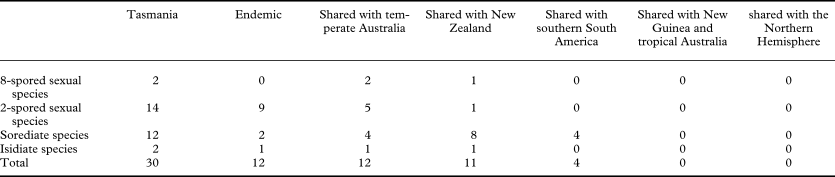
Table 1.Distribution patterns of the Tasmanian species of Menegazzia

Id. Stictic acid syndrome, plus isopigmentosin and lacking menegazziaic acid (M. elongata, M. endocrocea, M. subbullata).
Ie. Stictic acid syndrome, plus lecanoric acid (M. myriotrema, M. ramulicola).
IIa. Norstictic and connorstictic acids (M. norstictica, M. sanguinascens).
IIb. Norstictic and connorstictic acids plus lecanoric acid (M. tarkinea).
III. Caperatic acid (M. abscondita, M. confusa).
IVa. Protolichesterinic and lichesterinic acids, plus skyrin (M. jamesii).
IVb. Protolichesterinic and lichesterinic acids, plus secalonic acid (M. pertransita).
IVc. Protolichesterinic and lichesterinic acids (M. minuta).
V. Lecanoric acid (M. globulifera).
VI. Fumarprotocetraric acid (M. petraea).
VII. Unknown fatty acids (M. inactiva).
VIII. Alectoronic acid (M. ultralucens).

Distribution patterns
Menegazzia in Tasmania occurs predominantly as an epiphyte in cool temperate rainforest, wet eucalypt forest and adjacent subalpine or alpine plant communties. Only four of the 30 species are exclusively saxicolous. However, two chiefly corticolous taxa (M. subpertusa and M. nothofagi) commonly occur on rocks as well, and some others (e.g. M. subtestacea) may do so rarely. Very few species are found in dry sclerophyll woodland in low rainfall areas; these are M. subpertusa, M. caesiopruinosa and M. endocrocea, although even these are frequently restricted to marginally moister microhabitats.
With 40% of the Tasmanian species endemic to the island, Menegazzia displays a remarkable level of endemism, unmatched by any other sizeable Tasmanian lichen genus. The figure is even more noteworthy given that Menegazzia is a conspicuous macrolichen that has received considerable attention from collectors and taxonomists in many regions of the world, and so the level of Tasmanian endemism is not simply a product of skewed collecting effort. Geographical patterns amongst the Tasmanian species are summarized in Table 1. Not surprisingly, the greatest number of shared species is with temperate mainland Australia and New Zealand. Only three species occur across the whole austral cool temperate zone and are shared by Tasmania, New Zealand and Southern South America. All are sorediate and are most likely a product of long-distance dispersal rather than an example of a relict Gondwanan distribution. A fourth species, M. sanguinascens, occurs in South America and Tasmania and is also sorediate.
There is a noteworthy paucity in Tasmania of 8-spored species. These include the non-sorediate M. jamesii and M. pertransita, plus the sorediate M. caliginosa, which, in Tasmania, is not known to form apothecia. In contrast, New Zealand has at least six 8-spored, non-sorediate species (Galloway Reference Galloway2007; G. Kantvilas, unpublished observations) whereas South America also has only three (Bjerke Reference Bjerke2005). Given that 8-spored asci appear to be the ‘default’ state in most lichenized ascomycetes, the 2-spored state could be considered a derived character. These data suggest that the speciation of Menegazzia in Tasmania may be a relatively recent phenomenon and one that has occurred since the evolution of the 2-spored state and the separation of Australia-Tasmania from New Zealand.
Key to the species
1 Thallus sorediate or isidiate, with or without apothecia ... 2
Thallus neither sorediate nor isidiate, usually with apothecia ... 16
2(1) Thallus isidiate ... 3
Thallus sorediate ... 5
3(2) Thallus perforate; isidia in coralloid clusters that rupture or abrade and become sorediate ... M. nothofagi
Perforations absent; isidia knob-like or resembling elongate lobules ... 4
4(3) Upper surface olive-brown; medulla K−, P− (protolichesterinic acid); isidia knob-like and resembling minute lobules; very rare and inconspicuous, forming tiny thalli <1·5 cm wide on twigs ... M. minuta
Upper surface pale olive-green to greyish green, brownish to black-brown at margins and apices; medulla K+ yellow, P+ orange (stictic acid); isidia soon becoming elongate and cylindrical; thallus typically forming rosettes up to 8 cm wide on trunks ... M. eperforata
5(2) Upper surface yellow (usnic acid); soralia mostly in laminal, helmet-shaped vesicles; medulla C+ red (lecanoric acid); ± restricted to higher altitudes ... ... M. globulifera
Upper surface a shade of grey or grey-green (atranorin); soralia in vesicles, pustules, at the margins of perforations or occurring directly on the upper surface; medullary reactions various but never C+ red ... 6
6(5) Lobes mostly ≤1 mm wide; upper surface brownish green to grey-green, conspicuously white maculate, especially towards the lobe apices; soralia typically congested in the thallus centre, derived from inflated, subglobose to elongate vesicles that become abraded; widespread and common on rocks and trees ... ... M. nothofagi
Lobes mostly >1·5 mm wide; upper surface a shade of pale grey, not conspicuously maculate; soralia scattered and various (laminal, vesicular or pustular) ... 7
7(6) Medulla and soralia K−, P− ... 8
Medulla and soralia K+ yellow or yellow→red, P+ orange ... 10
8(7) Medulla KC−, UV− (fatty acids); lobes typically very fragile and inflated ... 9
Medulla KC+ red, UV+ white (alectoronic acid); lobes relatively robust, not markedly inflated ... M. ultralucens
9(8) Containing caperatic acid; medulla in the throat of the perforations and elsewhere sometimes patchily pale orange ... M. abscondita
Containing four unidentified fatty acids; medulla near the perforations white ... ... M. inactiva
10(7) Internal wall of medullary cavity orange-yellow, K+ purple, UV+ orange (emodin pigments); medulla containing echinocarpic acid ... M. caliginosa
Internal wall of medullary cavity white to blackened, never orange and K+ purple; echinocarpic acid absent ... 11
11(10) Lobes inflated, noticeably constricted in sausage-like segments and at the axils, usually unorientated, dispersed or imbricate; medulla containing isopigmentosin, visible as a strongly UV+ yellow spot on developed TLC plates; common at high elevations ... M. subbullata
Lobes inflated or not, never sausage-like, typically forming radiating rosettes; medulla lacking isopigmentosin ... 12
12(11) Soralia developing from globose, helmet-shaped vesicles; common in low rainfall areas, especially near the coast ... M. caesiopruinosa
Soralia various, but never in helmet-shaped vesicles ... 13
13(12) Margins of perforations conspicuously turned upwards and developing crescent-shaped soralia ... 14
Margins of perforations ± flush with the thallus surface, generally not sorediate; soralia mostly laminal, scattered and convex ... 15
14(13) Soralia arising from abraded, scattered pustules which become sorediate and resemble perforations ... M. kantvilasii
Pustules absent and all soralia developed at the margins of elevated perforations ... M. neozelandica
15(13) Medulla K+ yellow (stictic acid complex); very common and widespread on bark, wood and rocks ... M. subpertusa
Medulla K+ yellow→red (norstictic acid); very rare ... M. sanguinascens
16(1) Asci 8-spored ... 17
Asci 2-spored ... 18
17(16) Medullary cavity at the lobe apices white with flecks of a bright yellow, K+ purple pigment (skyrin); very rare in Tasmania ... M. jamesii
Medullary cavity white or suffused yellowish, K− or K+ reddish brown (secalonic acid); very common and widespread, especially in rainforest ... M. pertransita
18(16) Upper surface predominantly brownish, olive-brown, blackish brown or mottled grey-brown ... 19
Upper surface predominantly pale grey to greenish grey, with brownish tints restricted mainly to lobe apices ... 22
19(18) Lobes mostly 1·5–3·5 mm wide, mostly somewhat ‘puffy’ and inflated; apothecia with a swollen pedicel, conical to hemispherical; very common on the twigs of shrubs at high altitudes ... M. subtestacea
Lobes mostly <1·5 mm wide, not inflated; apothecia soon flat and discoid (sometimes absent); on rocks ... 20
20(19) Medulla P+ red, K− (fumarprotocetraric acid); a rare species recorded from alpine conglomerate ... M. petraea
Medulla P+ orange, K+ yellow (stictic acid) ... 21
21(20) Lobes lacking perforations, with apices flattened and concave; a rare species recorded from alpine quartzite and conglomerate ... M. hypogymnioides
Lobes perforate, with apices inflated to slightly flattened, not concave; widespread and common on various rock types ... M. aeneofusca
22(18) Perforations very numerous and forming a lace-like network; lobes mostly 0·5–1·0 mm wide, usually markedly flattened to concave at the apices ... ... M. myriotrema
Perforations sparse to abundant, scattered and not forming a lace-like network; lobes much broader, with apices inflated or only slightly flattened ... 23
23(22) Medulla P− (caperatic acid) ... M. confusa
Medulla P+ orange (stictic or norstictic acids) ... 24
24(23) Medulla K+ yellow→red (norstictic acid) ... 25
Medulla K+ yellow (stictic acid) ... 26
25(24) Medulla containing additional lecanoric acid; thallus compact, with very sparse perforations; very rare, on twigs ... M. tarkinea
Lecanoric acid absent; thallus forming neat, radiating rosettes, typically with numerous perforations; widespread on trunks and branches; ... M. norstictica
26(24) Margin of apothecia 0·5–1·5 mm wide, grossly inflated, corrugated and often obscuring the disc; lobes typically very wide (to 6 mm), inflated and conspicuously wrinkled; found mostly in highland areas ... M. corrugata
Margin of apothecia 0·2–0·5 mm wide, not inflated, entire, crenulate or radially cracked, with the disc clearly exposed; lobes typically 1–4 mm wide, smooth or only slightly wrinkled ... 27
27(26) Medulla containing isopigmentosin (visible as strongly UV+ yellow spots on developed TLC plates); lobes inflated; hymenium not inspersed ... 28
Medulla lacking isopigmentosin, although other orange, UV+ orange pigments may be present; lobes cylindrical, not inflated; hymenium inspersed with KOH-soluble granules ... 29
28(27) Lobes forming sausage-like segments with markedly constricted axils, generally unorientated, dispersed or imbricate; an epiphyte in wet forest, especially at higher elevations ... M. elongata
Lobes not markedly constricted at the axils, generally in neat or irregular rosettes; restricted to granite rocks on coastal pinnacles ... M. endocrocea
29(27) Medulla containing three orange, UV+ orange pigments; margins of perforations flush with the thallus surface or slightly upturned; restricted to highland areas, mostly on conifers ... M. athrotaxidis
No pigments present; margins of perforations flush or turned slightly inwards ... 30
30(29) Medulla containing lecanoric acid in addition to stictic acid; thallus with very sparse perforations, typically very compact and enveloping twigs ... M. ramulicola
Lecanoric acid absent; thallus usually with abundant perforations, typically forming neat rosettes ... M. platytrema
The Species
Menegazzia abscondita Kantvilas sp. nov
MycoBank No.: MB563445
Menegazziae inactivae similis sed acidum caperaticum continenti et cavitate medullosa saepe disperse pallide aurantiaca differt.
Typus: Tasmania, Gordon River Road, 42°49′S 146°17′E, 340 m alt., on roadside young Nematolepis squamea at edge of regenerating wet eucalypt forest, 9 November 2010, G. Kantvilas 272/10 & J. Jarman (HO—holotypus).
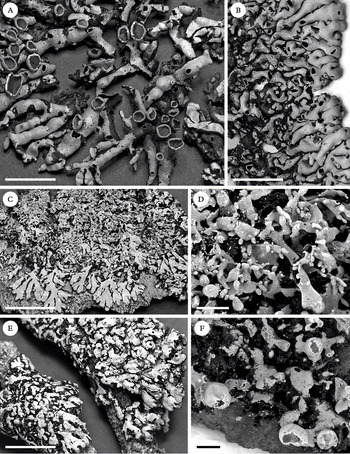
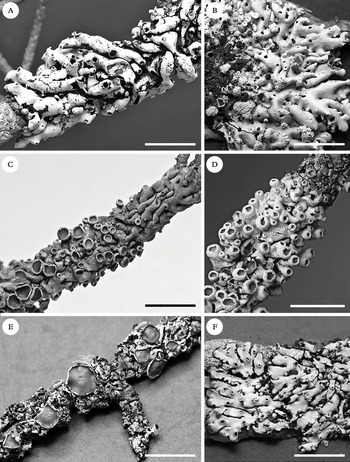
(Fig. 1A & B)
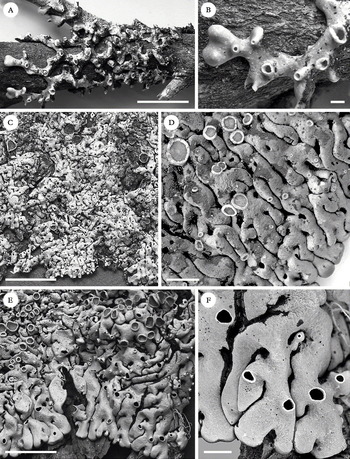
Tasmanian Menegazzia species. A, M. abscondita habit; B, M. abscondita detail, showing inflated lobe with cylindrical, marginally sorediate perforations; C, M. aeneofusca habit; D, M. aeneofusca detail, showing sparsely perforate lobes and apothecia; E, M. athrotaxidis habit; F, M. athrotaxidis detail, showing perforations with a slightly upturned collar. Scales: A, C, E = 10 mm; B, D, F = 2 mm.

Thallus loosely adnate, extremely brittle and fragile, forming irregular colonies to c. 6 cm wide comprising rather disorganized, scattered lobes, sorediate. Lobes 1–3 mm wide, markedly inflated and cylindrical, with widely diverging, irregularly branched main lobes and shorter laterals arising almost perpendicularly, loosely imbricate to separate± throughout; apices discrete. Upper surface ± perforate, pale grey to pale greenish grey, here and there blotched or lined with black along the lobe margins, matt, epruinose, faintly maculate towards the lobe apices, smooth. Perforations very sparse, roundish, 0·1–1·0 mm wide, arising at the apices of cylindrical or inflated, flat-topped vesicles 1–3 mm wide and markedly elevated (to 2·5 mm) above the thallus surface, usually with the margins turned inwards when young but soon becoming torn and sorediate. Medullary cavity mostly byssoid and white, becoming discoloured grey to brownish black in older lobes, typically patchily pale orange in the throat of the perforations. Soralia numerous, ragged and torn, developing on the inner surface of the elevated, flaring perforations, typically crescent-shaped and not extending around the entire circumference of the perforation; soredia whitish to pale greenish grey, farinose to coarsely granular.
Apothecia and conidia not known.
Chemistry. Atranorin, caperatic acid; medulla K−, KC−, C−, P−, UV−. The orange pigment does not give any reaction to K or UV light; nor could it be detected on TLC plates.
Etymology. The specific epithet, meaning ‘hidden', refers to the cryptic nature of this species and recalls the effort required to collect sufficient material upon which to base its description.
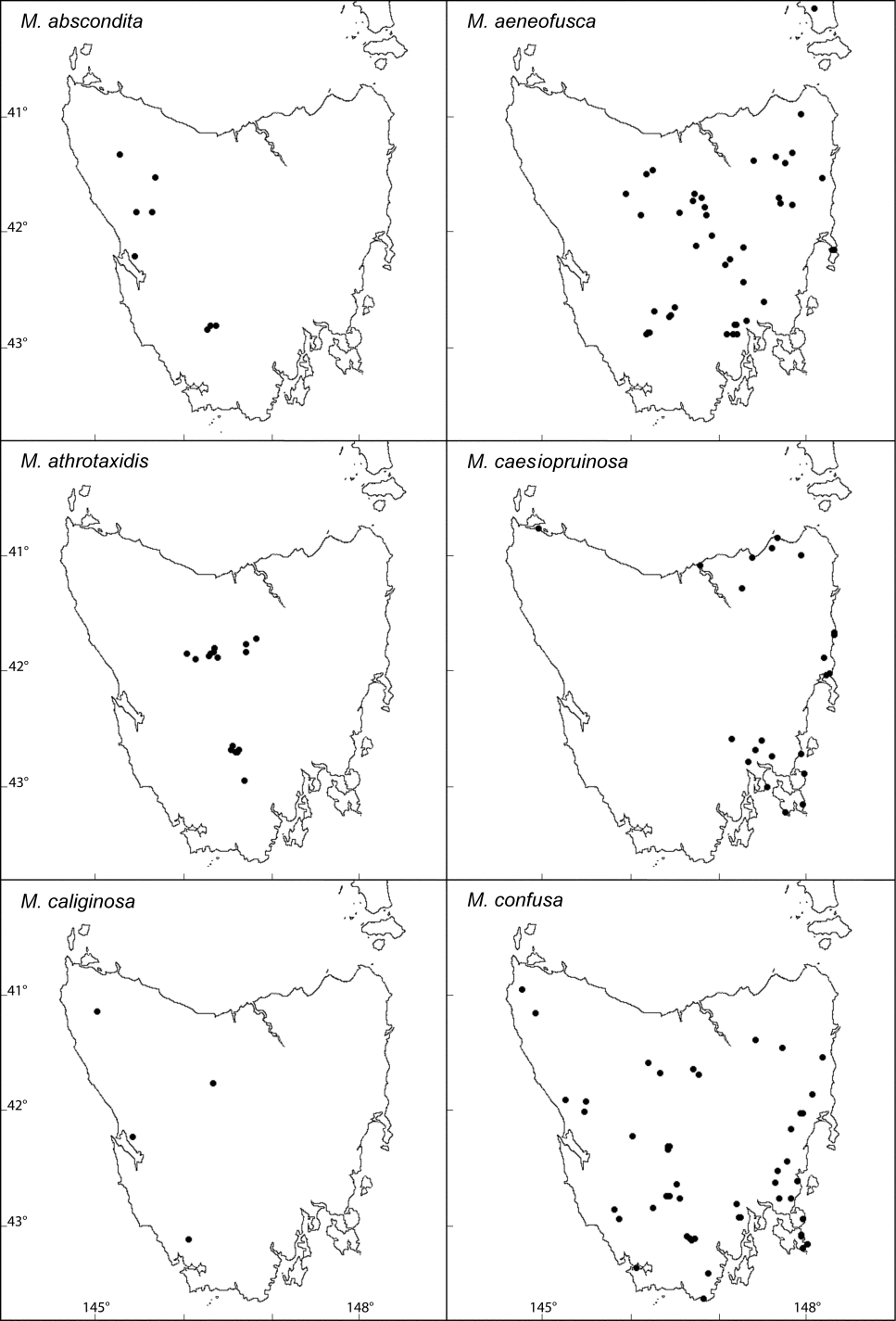
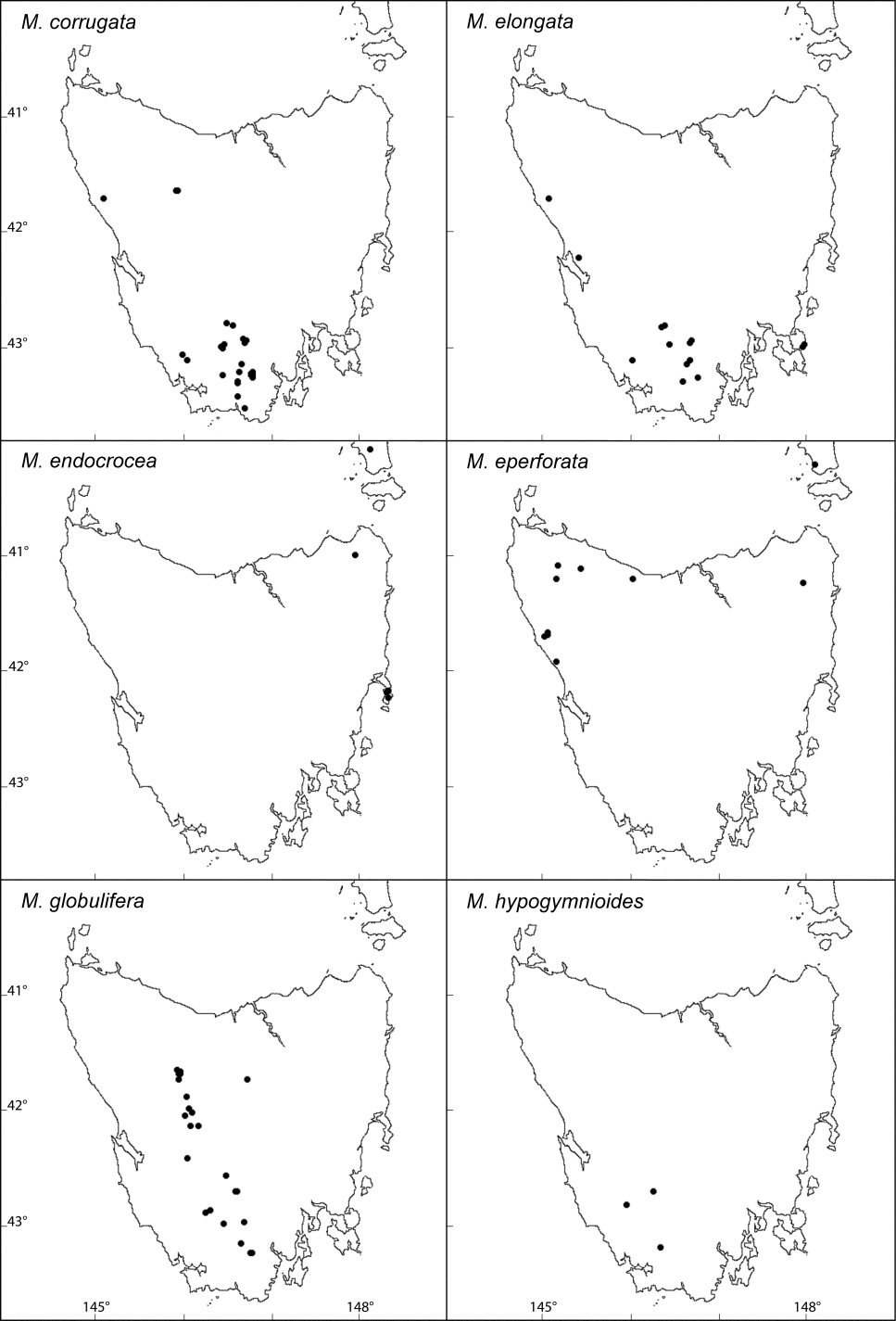
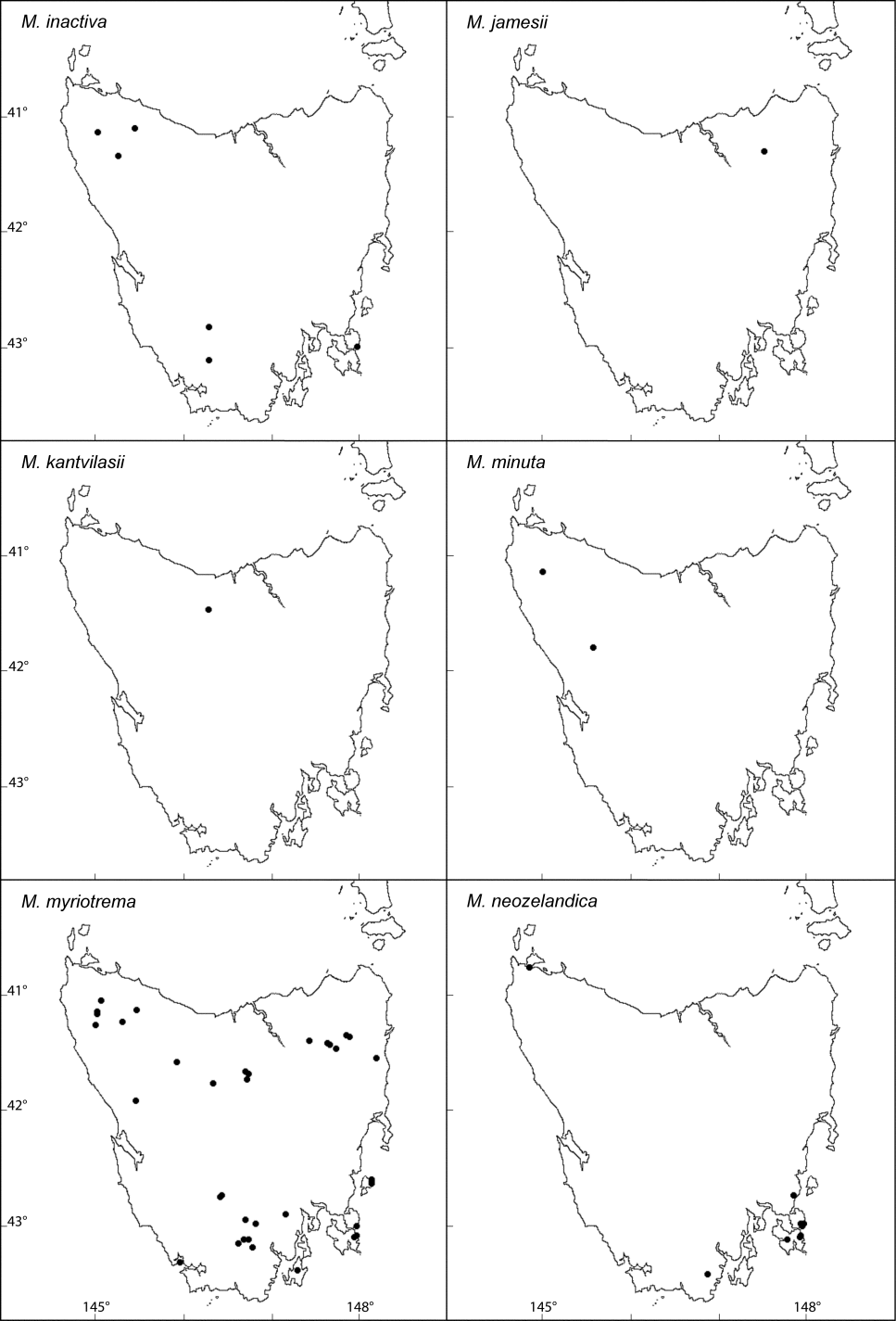
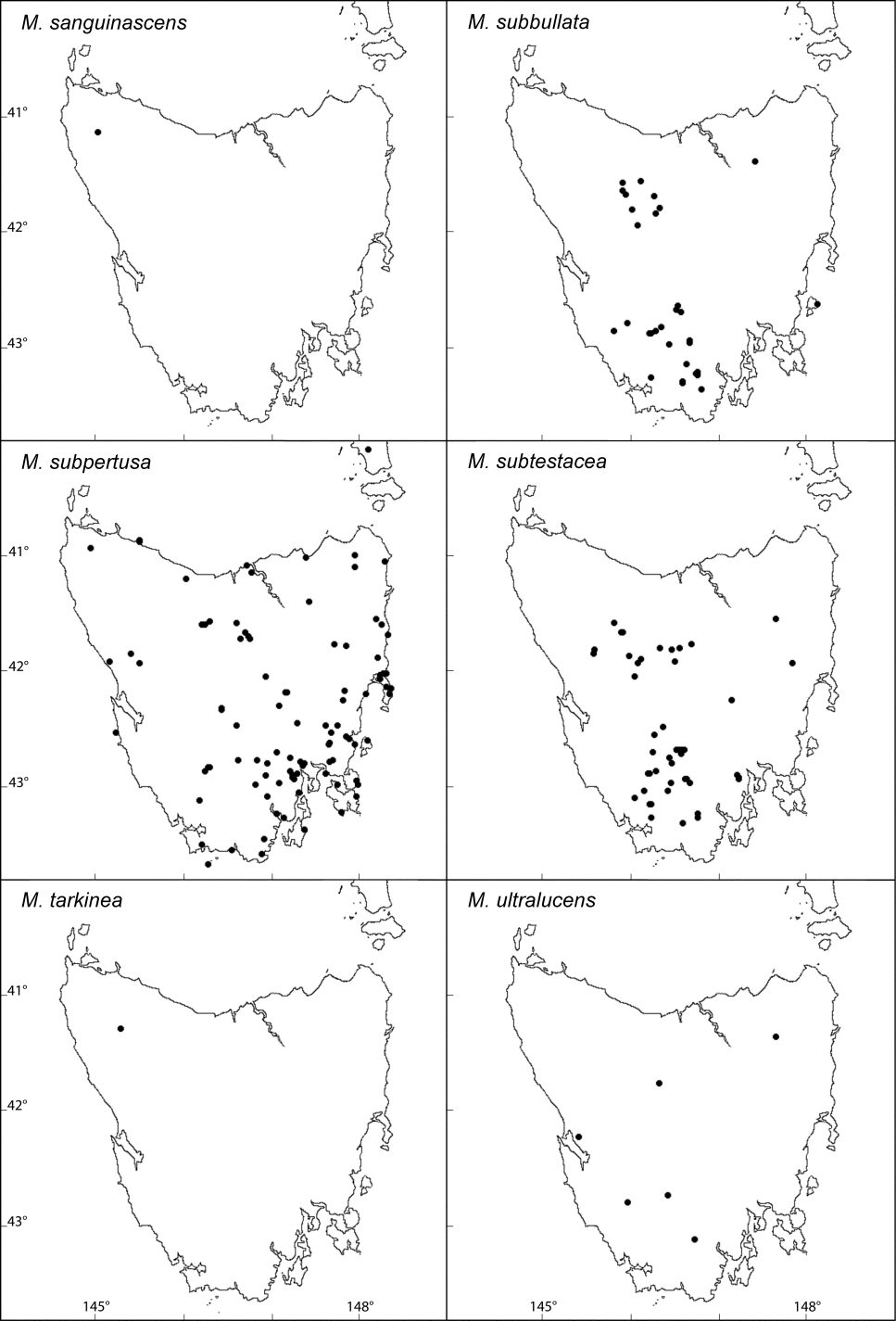
Distribution and ecology. This is an apparently very rare species in Tasmania, known from only a few localities in western, high rainfall, forested areas at low to middle elevations (Fig. 2). Most collections are from young saplings, especially of Nematolepis squamea (Labill.) Paul G. Wilson (Rutaceae), at the edge of rainforest, wet eucalypt forest and heathland, a distribution suggesting it is probably a rare canopy species that is found at low heights only in forest gaps or margins. Nowhere is it common and most collections have been fortuitous and gleaned from amongst collections of other species. A targeted search, directed towards collecting sufficient material for a type specimen, required extensive examination of scores of saplings simply to collect a handful of thalli. Menegazzia abscondita is mostly associated with a diverse community of mainly crustose lichens such as Cliostomum praepallidum (Müll. Arg.) Kantvilas & Fryday, Coccotrema cucurbitula (Mont.) Müll. Arg., Fuscidea australis Kantvilas, Megalaria melaloma (C. Knight) Kantvilas, Ramboldia brunneocarpa Kantvilas & Elix and R. laeta (Stirt.) Kalb et al., as well as with incipient thalli of species of Usnea and Menegazzia. Recently this new species was also found in New Zealand, growing on saplings of Nothofagus solandri var. cliffortioides (Hook.f.) Poole.
Distribution of Menegazzia species in Tasmania. I.

Remarks. This is an unusual species that combines several uncommon characteristics. It is most closely related to M. inactiva, which has similar erect, cylindrical or vesicular projections that become perforate and then ragged and sorediate. However, that species differs chemically, although the difference is in the fatty acids present and requires chromatography for detection. With experience, one may also discern subtle morphological differences between the two species: M. inactiva tends to have more disorganized, more inflated lobes and lacks orange pigmentation in the medullary cavity. Other Tasmanian species with vesicular soralia include M. caesiopruinosa and M. globulifera, but both have rounded, helmet-shaped vesicles and also differ chemically. The unusual chemistry of M. abscondita is also found in the fertile, esorediate species M. confusa.
Selected specimens examined. Tasmania: near Confidence Saddle, 41°50′S 145°27′E, 440 m alt., 1974, G. C. Bratt 74/117 (HO); Gordon Road, c. 8 km W of Boyd River, 42°51′S 146°15′E, 350 m alt., 1981, G. Kantvilas 155/81 (HO); Romney Marsh, 41°32′S 145°40′E, 1986, G. Kantvilas 156/86 (HO); c. 3 km S of Teepookana, 42°13′S 145°26′E, 220 m alt., 1990, G. Kantvilas 609/90 (HO); Savage River Pipeline Road, N. of Donaldson River, 41°20′S 145°16′E, 460 m alt., 1990, G. Kantvilas 262/90 p.p. (HO).—New Zealand: Canterbury, Craigieburn Range, 43°06′42″S 171°42′30″E, 1200 m alt., 2010, G. Kantvilas 340/10 (CHR, HO).
Menegazzia aeneofusca (Müll. Arg.) R. Sant
Ark. Bot. 30A(11): 13 (1942).—Parmelia aeneofusca Müll. Arg., Flora 66: 77 (1883); type: [Australia] The Grampians, Victoria, G. Sullivan (holotype—G).
(Fig. 1C & D)
Thallus typically tightly adnate, forming rosettes to c. 10 cm wide, sometimes with the centre missing and only the peripheral lobes present, lacking soredia or isidia. Lobes 0·5–1·5(–1·8) mm wide, cylindrical to somewhat flattened, densely branched and imbricate at the centre of the thallus and sometimes congested with tiny secondary lobes, at the margins palmately radiating, contiguous; apices inflated or slightly flattened. Upper surface perforate, typically chestnut brown or blackish brown, but increasingly pale greyish or olive-grey when in shade, matt to glossy, epruinose, emaculate, smooth to slightly wrinkled, especially at the lobe tips. Perforations sparse to numerous, roundish, 0·1–0·5 mm wide, with margins flush with the thallus surface or slightly turned inward. Medullary cavity on the upper side byssoid, white or discoloured grey to black in older lobes, on the lower side grey to black.
Apothecia scattered, to 4 mm wide, sessile to subpedicellate, mostly flat and discoid when mature; thalline margin 0·05–0·2 mm thick, not inflated, smooth and entire, or with occasional radial cracks; disc glossy orange-brown to brown, concave at first, later plane, undulate only when old. Hymenium 100–120 µm thick, orange-brown in the upper part and inspersed with granules that fluoresce in polarized light and turn yellowish and dissolve in KOH; asci 2-spored; paraphyses with apices sometimes persistently brownish, to 4 µm thick. Ascospores ovate to broadly ellipsoid, (26–)30–37·8–48 × 20–25·5–32(–36) µm.
Conidia filiform, 6–8 × 0·5 µm.
Chemistry. Atranorin, stictic acid, constictic acid, cryptostictic acid (trace), menegazziaic acid (trace), peristictic acid (trace), norstictic acid (trace), 3-O-methylconsalazinic acid (trace), plus additional traces of related compounds; medulla K+ yellow, P+ orange, C−, KC−, UV−.
Distribution and ecology. This species is widespread and common throughout Tasmania on rocks (Fig. 2), where it is typically part of a rich association of macrolichens dominated by Parmelia signifera Nyl., Usnea torulosa (Müll. Arg.) Zahlbr., Xanthoparmelia mougeotina (Nyl.) D. J. Galloway and species of Umbilicaria. Although mostly collected at higher altitudes, especially in alpine heathland, it extends into the lowlands where it is restricted to fire-protected faces or crevices of large rock outcrops in open eucalypt forest. It has been recorded from all rock-types including dolerite, granite, conglomerate and metamorphosed Precambrian sediments. This species is also known from mainland Australia and New Zealand.
Remarks. In its typical form and saxicolous habitat, this species is easily recognized by its brownish, relatively narrow, esorediate, sparsely perforate lobes in combination with its chemical composition. A further distinguishing character for M. aeneofusca is its highly adnate, flattened, rosette-like thallus and the very flat, discoid apothecia. Similar saxicolous species with which it may be confused are M. petraea, which is identical morphologically but contains fumarprotocetraric acid, and M. hypogymnioides, which contains stictic acid and associated compounds but which has elongate, eperforate lobes with flattened, concave apices. However, several normally corticolous species may sometimes occur on rocks, especially on the highly siliceous quartzites and conglomerates of Tasmania's west, and these can cause some confusion with M. aeneofusca. For example, both M. subtestacea, which is similarly chestnut brown, and M. platytrema, a typically pale grey species, are 2-spored, contain stictic acid and may be found on rock. Both of these taxa have lobes up to 4 mm wide or more, far wider than those of M. aeneofusca, have rather conical apothecia and a more loosely adnate, irregularly-shaped thallus. Further descriptions of M. aeneofusca are provided by James (Reference James and Galloway1985) and James & Galloway (Reference James and Galloway1992). The status in Tasmania of M. castanea, the sorediate counterpart of M. aeneofusca, is discussed below.
Selected specimens examined. Tasmania: Mt Penny West, 42°02′S 146°56′E, 1134 m alt., 1969, G. C. Bratt 69/179 & K. M. MacKay (HO); Brown Mountain, 42°36′S 147°31′E, 790 m alt., 1991, G. Kantvilas 272/91 (HO, M); Story's Creek Road, 41°42′41″S 147°41′ 58″E, 500 m alt., 2001, G. Kantvilas 721/01 & J. Jarman (HO); summit of Cathcart Bluff, 41°47′S 146°51′E, 1140 m alt., 2001, G. Kantvilas 903/01 (HO); Flinders Island, saddle at head of Leventhorpe Gully, 40°04′S 148°05′E, 330 m alt., 2007, G. Kantvilas 64/07 (HO).
Menegazzia athrotaxidis Kantvilas sp. nov
MycoBank No.: MB563446
Menegazziae platytremae similis et item non sorediata, ascis bisporis et acidum sticticum continens sed foraminibus marginibus leviter elevatis et pigmenta tria, aurantiaca, ignota, etiam in M. chrysogastra observata continenti differt.
Typus: Tasmania, Mt Field National Park, “The Pine Forest”, c. 2 km SE of Lake Emmett, 42°38′S 146°33′E, 980 m alt., on Athrotaxis cupressoides in open montane rainforest, 29 March 1990, G. Kantvilas 149/90 (HO—holotypus).
(Fig. 1E & F)
Thallus loosely to tightly adnate, usually forming rather neat rosettes to c. 10 cm wide or enveloping foliage twigs, lacking soredia or isidia. Lobes 1·0–3·5(–4·0) mm wide, cylindrical to somewhat flattened, sparsely dichotomously branched, imbricate, congested and convoluted at the centre of the thallus, at the margins palmately radiating, contiguous; apices inflated or slightly flattened. Upper surface perforate, grey-white to cream-white, often blackened or suffused brownish along the lobe margins and at the apices, matt to glossy, epruinose, mostly emaculate but with faint, effigurate maculae near the apices, smooth when young but increasingly wrinkled, dimpled or somewhat ridged in older lobes. Perforations sparse to numerous, roundish, 0·5–1·0(–1·5) mm wide, with margins with a slightly upturned collar or flush with the thallus surface. Medullary cavity byssoid and white in younger lobes, occasionally faintly pale orange on the upper side at the lobe apices, soon becoming mottled white-grey to blackened in older parts but here and there with a sparse, white, cobweb-like hyphae.
Apothecia typically numerous, scattered or rather clumped, to 4(–5) mm wide, initially subpedicellate and slightly conical, later becoming flat; thalline margin 0·1–0·5 mm thick, not inflated, mostly smooth and entire, sometimes crenulate, more rarely with occasional radial cracks or pseudocyphellae-like small holes; disc matt or glossy, yellowish brown to dark brown, concave when young, becoming plane to undulate when older. Hymenium 110–140 µm thick, orange-brown in the upper part and inspersed with minute granules that fluoresce in polarized light and dissolve in KOH; asci 2-spored; paraphyses with apices mostly unpigmented, rarely brown, 2–4 µm thick. Ascospores ovate to broadly ellipsoid, (36–)40–48·3–58(–60) × 22–30·2–36 µm.
Conidia filiform, 6–10(–11) × 0·5 µm.
Chemistry. Atranorin, stictic acid, cryptostictic acid (± trace), constictic acid (±), menegazziaic acid (± trace), peristictic acid (± trace), 3-O-methylconsalazinic acid (± trace), norstictic acid (trace) plus three unknown pigments reacting UV+ orange on developed TLC plates; medulla K+ yellow, P+ orange, C−, KC−, UV−.
Etymology. The specific epithet refers to the preference of this species for the bark of the Tasmanian endemic conifer, Athrotaxis cupressoides D. Don (Cupressaceae).
Distribution and ecology. Menegazzia athrotaxidis is known only from the central highlands of Tasmania (Fig. 2), where it is restricted to subalpine to alpine elevations. It shows a remarkable predilection for the Tasmanian endemic conifer Athrotaxis cupressoides, to the extent that all but two of the 16 specimens available occur on that host. Of the odd specimens, one was collected from the endemic conifer Microstrobos niphophilus Garden & Johnston, and the other was from an unusual, outlying, high altitude tree of Bedfordia salicina DC. (Asteraceae), which has papery bark similar to that of Athrotaxis. Curiously the lichen has not been collected from A. selaginoides D. Don, which often co-occurs with A. cupressoides. Also noteworthy is that whereas the related M. platytrema may occur at the same sites as M. athrotaxidis, it is only rarely found on Athrotaxis and grows mostly on other trees and shrubs. Athrotaxis cupressoides is an extremely fire-sensitive tree. It forms infrequent extensive stands on the Central Plateau but is mostly found as occasional trees fringing alpine lakes and tarns. Lichens commonly found associated with M. athrotaxidis include Hypogymnia lugubris (Pers.) Krog, Leifidium tenerum (Laurer) Wedin, Usnea oncodes Stirt. and U. xanthopoga Nyl.
Remarks. This species is morphologically very similar to M. platytrema and its allies, from which it can be distinguished unequivocally only by chromatographic methods. However, its distinctive ecology (see below) offers a valuable hint to its identity, as do the frequently slightly upturned margins of the perforations. Like M. platytrema, M. athrotaxidis is characterized by an esorediate thallus of pale grey lobes, 2-spored asci, an inspersed hymenium and a stictic acid-dominated chemistry. It differs from that species chiefly by the presence of three unidentified pigments that can be detected on developed TLC plates as strongly UV+ orange spots. Based on a chromatographic comparison of extracts from herbarium specimens, these pigments appear to be the same as those described by Bjerke (Reference Bjerke2005) from the South American sorediate species M. chrysogaster Bjerke & Elvebakk. However, whereas in M. chrysogaster the pigments are visible (in the medullary cavity) to the naked eye, in M. athrotaxidis they almost invariably require chromatography to be detected.
Selected specimens examined. Tasmania: Mt Field NP, Lake Dobson, 42°41′S 146°35′E, 1963, P. W. James (BM, HO); Lake Fenton, 42°40′S 146°37′E, 1973, G. C. Bratt 73/90 (HO); Pine Lake, 41°49′S 146°42′E, 1200 m alt., 1986, A. Moscal 13424 (HO); Long Tarns, 41°47′E 146°21′E, 1270 m alt., 2010, G. Kantvilas 35/10 (HO); Lake Skinner, 42°56′S 146°41′E, 970 m alt., 2010, G. Kantvilas 266/10 (HO, TROM).
Menegazzia caesiopruinosa P. James
In G. Kantvilas & P. W. James, Lichenologist 19: 25 (Reference James and Galloway1987); type: Tasmania, Brown Mountain Road, near Campania, 42°35′S 147°29′E, 220 m alt., on Acacia mearnsii in dry sclerophyll woodland, 22 March 1981, G. Kantvilas 207/81 (holotype—HO!; isotype—BM!).
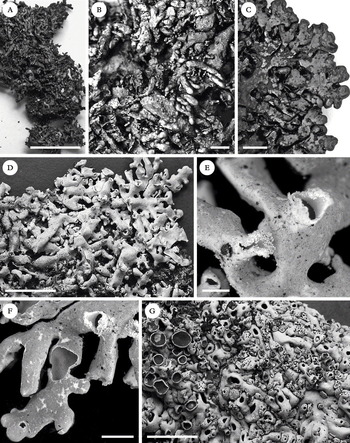
(Fig. 3A & B)
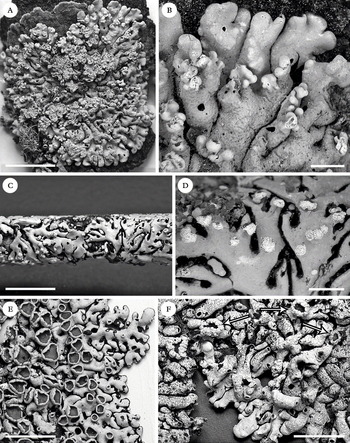
Tasmanian Menegazzia species. A, M. caesiopruinosa habit; B, M. caesiopruinosa detail, showing helmet-shaped vesicles that rupture and become sorediate; C, M. caliginosa habit; D, M. caliginosa detail, showing laminal, rounded soralia; E, M. confusa habit; F, M. corrugata habit, showing cylindrical perforations and apothecia with intensely swollen margins (arrows). Scales: A, C, E, F = 10 mm; B, D = 2 mm.

Thallus tightly adnate, forming irregular rosettes 2–5 cm wide, sorediate. Lobes (1·0–)1·5–3·0 mm wide, ± cylindrical to somewhat flattened, much branched and imbricate at the centre of the thallus, at the margins palmately radiating; apices inflated, ± toe-like and discrete. Upper surface perforate, pale grey to pale greenish grey, matt but often glossy dark brown-grey along the margins and at the apices of young lobes, sometimes faintly maculate here and there and very finely white-pruinose, especially at the lobe apices and on laminal vesicles, smooth to faintly wrinkled in older parts. Perforations occasional, roundish, 0·2–1·0 mm wide, with margins flush with the thallus surface or slightly turned inward. Medullary cavity byssoid, white, becoming discoloured grey to black with sparse, white, cobweb-like hyphae in older lobes. Soralia scattered or crowded, developing on the inner surface of roundish or convoluted, helmet-shaped, shortly-stalked vesicles 0·5–1·5(–2·0) mm wide that tear open and become abraded; soredia whitish to pale greenish grey, farinose to coarsely granular, occasionally spreading across the thallus.
Apothecia very rare, not seen in Tasmanian specimens, reported as 2–3 mm wide; asci 2-spored; ascospores 40–50 × 25–35 µm (James & Galloway Reference James and Galloway1992).
Conidia not found.
Chemistry. Atranorin, stictic acid, constictic acid, cryptostictic acid (trace), menegazziaic acid (trace), peristictic acid (trace), norstictic acid (trace), 3-O-methylconsalazinic acid (trace), plus additional traces of related compounds; medulla K+ yellow, P+ orange, C−, KC−, UV−.
Distribution and ecology. This species is occasional to locally frequent in dry, lowland areas of eastern Tasmania, especially near the coast (Fig. 1). It occurs mostly on the bark of subdominant trees and shrubs such as Bursaria, Allocasuarina and Acacia in open, dry sclerophyll woodland, heathland and degraded pasture, where it is frequently associated with Menegazzia subpertusa, Austroparmelina pseudorelicina (Jatta) A. Crespo et al., Flavoparmelia rutidota (Hook.f. & Taylor) Hale and Usnea inermis Motyka. More rarely it may occur on wood and rock. It is also known from mainland Australia only.
Remarks. This very distinctive species is recognized by the helmet-shaped vesicles that give rise to the soredia; such vesicles are also known from the alpine M. globulifera, which is smaller, yellow and contains usnic and lecanoric acids. Other Tasmanian species with soredia arising in vesicular pustules include M. kantvilasii, a species likewise containing stictic acid but with wider, irregularly interwoven lobes with constricted axils, and M. abscondita and M. inactiva, both of which have highly inflated, fragile lobes and contain fatty acids. Menegazzia caesiopruinosa frequently occurs together with M. subpertusa, a grey, sorediate species with identical chemistry, but which differs by having soredia that arise directly from the upper surface of the lobes. Further descriptive data are given by James & Galloway (Reference James and Galloway1992).
Selected specimens examined. Tasmania: Blackmans Lagoon, 40°55′S 147°36′E, 1969, G. C. Bratt 69/967 & J. A. Cashin (HO); Moulting Lagoon, 42°01′S 148°13′E, 1970, G. C. Bratt 70/334 & G. Degelius (HO); Campania, 42°40′S 147°25′E, 80 m alt., 1980, G. Kantvilas 505/80 (BM, HO); Flinders Island, mouth of North-East River, 39°44′S 147°57′E, 2 m alt., 2007, G. Kantvilas 97/07 (HO); Cape Frederick Hendrick, 42°52′S 147°58′E, 130 m alt., 2009, G. Kantvilas 334/09 (HO).
Menegazzia caliginosa P. James & D. J. Galloway
In D. J. Galloway, New Zealand J. Bot. 21: 194 (1983); type: New Zealand, Canterbury, Craigieburn Forest Park, track from Information Centre to Lyndon Saddle, 1000–1100 m alt., on bark of Nothofagus solandri var. cliffortioides, September 1981, P. W. James (holotype—BM!; isotype—CHR).
(Fig. 3C & D)
Thallus tightly adnate, typically very brittle and fragile, forming irregular rosettes to 8 cm wide, or occasionally comprising small, scattered clumps of lobes intermixed with other species, sorediate. Lobes 1–3 mm wide, cylindrical to somewhat flattened, sparingly dichotomously branched but frequently with small, lateral lobules, radiating and contiguous at the centre of the thallus, discrete at the periphery; apices slightly inflated to flattened. Upper surface perforate, pale greenish grey with distinctly blackened margins, glossy, sometimes faintly maculate at the apices, epruinose, smooth to very faintly wrinkled in older parts. Perforations sparse, roundish, 0·2–1·0 mm wide, with margins flush with the thallus surface or slightly turned inward. Medullary cavity byssoid, whitish or discoloured grey to black in older lobes, with a thin, ± continuous layer of pale orange, K+ purple pigment on the upper and lower surfaces. Soralia scattered, numerous, laminal, rounded and convex, to 1 mm wide, developing directly on the thallus surface and not associated with perforations; soredia whitish, typically farinose.
Apothecia rare, not seen in Tasmanian specimens, reported as 3–4 mm wide; asci 8-spored; ascospores 28–35 × 15–18 µm (James Reference James and Galloway1985).
Conidia not found.
Chemistry. Atranorin, stictic acid, echinocarpic acid, cryptostictic acid (± trace), constictic acid, menegazziaic acid (± trace), plus additional traces of related compounds and two orange-yellow pigments: 7-chloroemodin and flavo-obscurin B1; medulla K+ yellow, P+ orange, C−, KC−, UV−; pigmented areas K+ purple, UV+ orange.
Distribution and ecology. This is a very rare species in Tasmania, known from only a few scattered locations, chiefly in the west of the island (Fig. 2), where it grew on canopy twigs in cool temperate rainforest. Nowhere is the species common and all collections were made fortuitously from fallen canopy branches on the forest floor. It is also known from New Zealand and from mainland Australia (Victoria) where it is very rare and known only from a single collection.
Remarks. Menegazzia caliginosa is well characterized by its very distinctive chemistry, notably the presence of echinocarpic acid plus pigments [also found in the non-sorediate, New Zealand endemic M. foraminulosa (Kremp.) Bitter], and by its greenish, rather flattened lobes with distinct black margins and convex, white, laminal soralia. The emodin pigments are best observed in younger parts of the thallus. Further descriptive data are given by James (Reference James and Galloway1985), James & Galloway (Reference James and Galloway1992) and Kantvilas & Louwhoff (Reference Kantvilas and Louwhoff2004). Aspects of the delimitation of this species are yet to be resolved, as I have collected specimens in New Zealand that accord with M. caliginosa in every respect except that they lack echinocarpic acid.
Specimens examined. Tasmania: Sumac Road, Spur 2, S of Arthur River, 41°08′S 145°02′E, 170 m alt., 1981, G. Kantvilas 293/91 (BM, HO); Little Fisher River, 41°45′S 146°20′E, 820 m alt., 1984, G. Kantvilas 702/84 (BM, HO); c. 3 km S of Teepookana, 42°13′S 145°26′E, 220 m alt., 1990, G. Kantvilas 610/90 (HO); Green Head, 43°06′S 146°04′E, 750 m alt., 1991, G. Kantvilas 76/91 (HO).
Menegazzia confusa P. James
In G. Kantvilas & P. W. James, Lichenologist 19: 26 (Reference James and Galloway1987); type: Tasmania, Lake Leake Road, 42°01′S 147°57′E, 380 m alt., on Exocarpos cupressiformis in dry sclerophyll forest, 24 October 1980, G. Kantvilas 467/80 (holotype—HO!; isotype—BM!).
(Fig. 3E)
Thallus loosely to tightly adnate, forming irregular rosettes to c. 12 cm wide, lacking soredia or isidia. Lobes 1·5–4·0 mm wide, ± cylindrical to somewhat flattened, occasionally a little inflated and ‘puffy', sparsely dichotomously branched, imbricate and congested at the centre of the thallus, at the margins palmately radiating, discrete or contiguous; apices inflated or slightly flattened. Upper surface perforate, grey-white, cream-white to pale greenish grey, matt to glossy, often blackened along the lobe margins, epruinose, emaculate, smooth to slightly wrinkled in older lobes. Perforations sparse to numerous, roundish, 0·4–1·5(–2·5) mm wide, with margins flush with the thallus surface or slightly turned inward. Medullary cavity byssoid and white, especially in younger lobes, becoming mottled white-grey to blackened in older parts.
Apothecia scattered, sometimes numerous and congested in the thallus centre, to 5(–10) mm wide, sessile to subpedicellate; thalline margin 0·2–0·5 mm thick, not inflated, smooth and entire, or crenulate and with occasional radial cracks or pseudocyphellae-like holes; disc glossy orange-brown to brown, typically persistently concave, occasionally becoming plane when old. Hymenium 100–140 µm thick, orange-brown in the upper part and inspersed with minute granules that fluoresce in polarized light and turn yellowish and dissolve in KOH; asci 2-spored; paraphyses with apices not markedly capitate, unpigmented, to 2–4 µm thick. Ascospores ovate to broadly ellipsoid, (26–)32–42·5–54(–58) × 18–26·2–32(–34) µm.
Conidia filiform to narrowly fusiform, 6–8 × 0·5–1 µm.
Chemistry. Atranorin, caperatic acid (either compound sometimes only in trace amounts); medulla K−, P−, C−, KC−, UV−.
Distribution and ecology. Menegazzia confusa is widespread and common at low to middle elevations in Tasmania (Fig. 2). Although mostly collected in sclerophyll woodlands in lower rainfall areas where it occurs on subdominant trees and shrubs, it is equally common in wet forests including rainforest, where it is confined chiefly to the canopy. This species occurs exclusively on bark, forming tight rosettes encircling twigs and small branches, or spreading rosettes on trunks. It is typically part of a very species-rich association of lichens, dominated by Parmelia tenuirima Hook. f. & Taylor, Pertusaria pertractata Stirt., Japewiella pruinosula (Müll. Arg.) Kantvilas, Ramboldia laeta, Austroparmelina pseudorelicina, Ramalina inflata Hook. f. & Taylor and species of Menegazzia, Hypogymnia and Usnea. Menegazzia confusa is also known from mainland Australia.
Remarks. This species is easily recognized by the relatively large, esorediate thallus containing caperatic acid, and by the 2-spored asci. It is morphologically ± identical to M. platytrema and M. norstictica, both of which differ chemically and are readily separated from M. confusa by a means of a medullary P-test (they are both P+ orange). Also similar is M. athrotaxidis, which is likewise P+ orange, contains orange pigments, and has somewhat elevated perforations. Menegazzia pertransita contains fatty acids (lichesterinic acid, medulla P−), but differs by having 8-spored asci. In general, M. confusa and M. pertransita are unlikely to be confused in the field, with the former being generally larger, more inflated and with larger apothecia. Moreover, M. pertransita usually has some hints of yellowish, secalonic acid pigments in its otherwise white medullary cavity. Further descriptive data are given by James & Galloway (Reference James and Galloway1992).
Selected specimens examined. Tasmania: Liffey Falls, 41°41′S 146°47′E, 480 m alt., 1964, J. A. Cashin 1209 (HO); Welcome Swamp, 40°57′S 144°48′E, 30 m alt., 1970, G. C. Bratt 70/450 (HO); Hospital Creek Nature Reserve, 42°45′S 147°49′E, 155 m alt., 1986, A. Moscal 13145 (HO); South Sister, near summit, 41°32′S 148°10′E, 800 m alt., 2004, G. Kantvilas 368/04 (HO); Bluff River Gorge, 42°31′S 147°40′E, 100 m alt., 2010, G. Kantvilas 83/10 (HO).
Menegazzia corrugata P. James
In P. W. James & D. J. Galloway, Fl. Australia 54: 312 (1992); type: Tasmania, Lake Skinner, 42°56′S 146°42′E, on Eucryphia milliganii in subalpine heathland, 960 m alt., 4 April 1980, G. Kantvilas 81/80 (holotype—HO!; isotype—BM!).
(Fig. 3F)
Thallus typically loosely adnate, forming irregular rosettes to c. 8 cm wide or small pulvinate clumps encircling twigs, lacking soredia or isidia. Lobes (1·5–)2·0–6·0 mm wide, markedly inflated and cylindrical, slightly constricted here and there, rather sparsely dichotomously branched but also occasionally with small, toe-like, lateral lobes, loosely imbricate and congested at the centre of the thallus, at the periphery usually palmately radiating; apices discrete or contiguous. Upper surface perforate, grey-white or cream-white, matt or glossy, commonly streaked or speckled with black, especially along the lobe margins, epruinose, emaculate, markedly wrinkled except in the youngest lobes. Perforations scattered, occasional, round, 0·5–1·5 mm wide, cylindrical or cone-like and elevated significantly above the thallus surface. Medullary cavity byssoid, white in younger lobes, becoming black in older parts.
Apothecia scattered, to 5(–7) mm wide, shortly pedicellate; thalline margin 0·5–1·5 mm thick, grossly inflated, crenate and wrinkled, almost enclosing and obscuring the disc when young; disc dull orange-brown to brown, typically persistently concave. Hymenium 100–150 µm thick, orange-brown in the upper part, occasionally K+ grubby brown, not inspersed; asci 2-spored; paraphyses with apices 2–6 µm thick, typically unpigmented but occasionally brown. Ascospores ovate to broadly ellipsoid, occasionally becoming brownish, (37–)40–53·7–66 × (20–)22–33·0–40 µm.
Conidia filiform, 7·0–8·5 × 0·5 µm.
Chemistry. Atranorin (± trace), stictic acid, cryptostictic acid, constictic acid, menegazziaic acid (trace), norstictic acid (trace), 3-O-methylconsalazinic acid (trace), plus additional traces of related compounds; medulla K+ yellow, P+ orange, C−, KC−, UV−.
Distribution and ecology. Menegazzia corrugata is endemic to Tasmania where it is locally common in western parts of the island, especially in the Southern Ranges (Fig. 5). It is typically found at alpine to subalpine elevations where, associated with species of Hypogymnia, Menegazzia and Usnea, it occurs on twigs and small branches in open scrub and woodland, as well as in the canopy of cool temperate rainforest. However, in rainforest communities of the implicate type, it extends into the lowlands as an uncommon twig species.
Remarks. Menegazzia corrugata is one of the most distinctive members of the genus in Tasmania, easily recognized by the broad, grossly inflated, wrinkled lobes and apothecial margins. On small branches and twigs it forms pulvinate clumps of disorganized, sausage-like lobes, but on larger branches and trunks, it develops neat, ± circular rosettes. The most similar species, and one with which it is frequently associated, is M. elongata, but that taxon has smooth, unwrinkled lobes, a non-inflated apothecial margin and contains the pigment isopigmentosin (UV+ yellow on developed TLC plates). Although like many other taxa, M. corrugata contains the stictic acid chemosyndrome, its chemistry is nevertheless rather distinctive: the concentration of cryptostictic acid is high and peristictic acid is absent, whereas both of these compounds are usually present in trace amounts in most other stictic acid-containing species. Although commonly found with abundant apothecia, M. corrugata generally seems to produce relatively few, well-formed ascospores. Further descriptive data are given by James & Galloway (Reference James and Galloway1992). In earlier accounts of Tasmanian lichens (e.g. Kantvilas & James Reference Kantvilas and James1987), this species was referred to as M. bullata (Stirt.) Bitter [syn. M. stirtonii (Zahlbr.) Kantvilas & Louwhoff], a New Zealand endemic taxon containing norstictic acid and having 8-spored asci (see below).
Selected specimens examined. Tasmania: Lake Hartz, 1963, P. W. James (BM, HO); Lake Judd forest, 42°59′S 146°25′E, 640 m alt., 1973, G. C. Bratt 73/903 (HO); Badger Creek, S of Greystone Bluff, 43°06′S 146°02′E, 280 m alt., 1989, G. Kantvilas 63/89 (HO); 4 km N of Precipitous Bluff, 43°25′30″S 146°36′30″E, 730 m alt., 1990, G. Kantvilas 106/90 (HO); Weindorfers Forest, 41°38′S 145°56′E, 1040 m alt., 1992, G. Kantvilas 474/92, J. Jarman & B. Fuhrer (HO).
Menegazzia elongata P. James
In P. W. James & D. J. Galloway, Fl. Australia 54: 312 (1992); type: Tasmania, western shore of Lake Dobson, Mt Field National Park, 1040 m alt., 6 March 1981, L. Tibell 11139 (holotype—BM!; isotype—UPS).
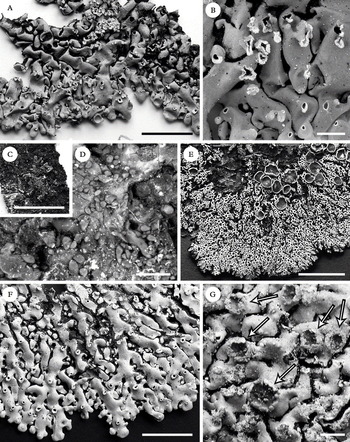
(Fig. 4A)
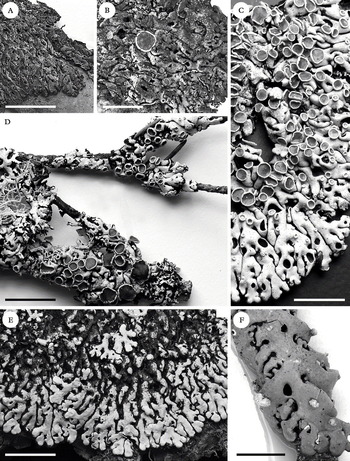
Tasmanian Menegazzia species. A, M. elongata habit, showing sausage-shaped, constricted lobes; B, M. endocrocea habit; C, M. eperforata habit; D, M. eperforata detail, showing eperforate, maculate lobes and knob-like to cylindrical isidia; E, M. globulifera habit; F, M. globulifera detail, showing globose vesicles that rupture and become sorediate. Scales: A–C, E = 10 mm; D = 1 mm; F = 2 mm.

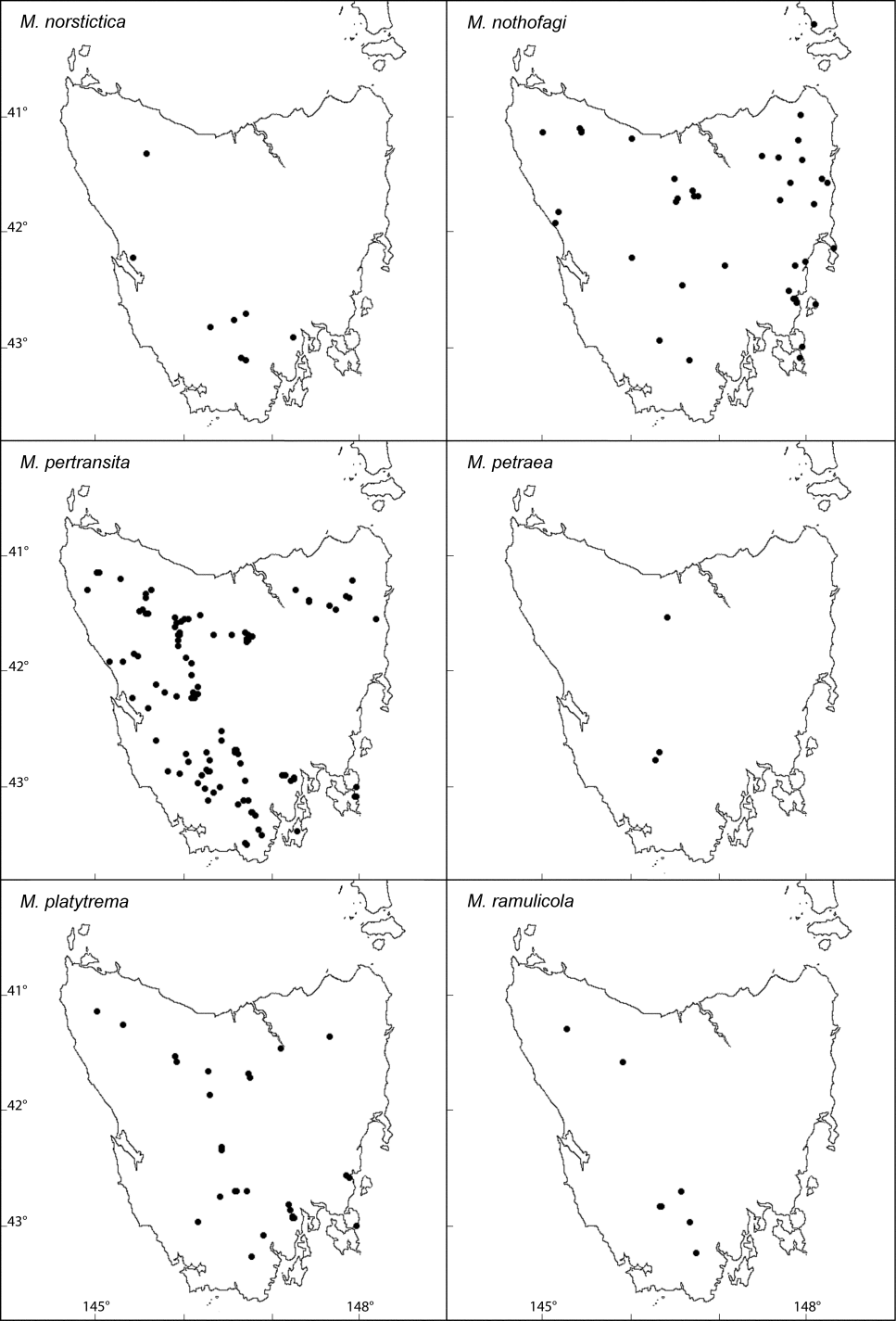
Distribution of Menegazzia species in Tasmania. II.

Thallus loosely adnate, very brittle and fragile, forming irregular rosettes to c. 8 cm wide or, more commonly, occurring as irregular clumps of loosely imbricate or scattered, disorganized lobes, lacking soredia or isidia. Lobes 1·5–3·0(–4·0) mm wide, markedly inflated, sausage-like, conspicuously constricted in elongated segments and at the axils, rather sparsely dichotomously branched, as well as with short, lateral lobes that arise ± perpendicularly to the main lobes, loosely imbricate and radiating from the centre of the thallus; apices typically discrete. Upper surface perforate, grey-white or pale greenish grey, glossy, commonly streaked with black, especially along the lobe margins, epruinose, emaculate, smooth throughout. Perforations scattered, occasional, round, 0·5–1·0 mm wide, with margins flush with the thallus surface or somewhat elevated, sometimes with a black rim. Medullary cavity byssoid, faintly yellowish at the lobe apices, generally white in younger lobes, becoming black in older parts.
Apothecia scattered or clustered centrally, to 3·5(–5·0) mm wide, shortly pedicellate, rather obconical when young; thalline margin 0·2–0·5 mm thick, not inflated, smooth and entire, or a little crenulate when old; disc orange-brown to brown, concave when young, later becoming ± plane. Hymenium 110–150 µm thick, orange-brown in the upper part, not inspersed; asci 2-spored; paraphyses with apices 2–4 µm thick, occasionally pigmented brown. Ascospores ovate to broadly ellipsoid, occasionally becoming brownish, (38–)40–52·2–64(–66) × 26–33·2–40 µm.
Conidia filiform to narrowly fusiform, 5–6 × 0·5–1·0 µm.
Chemistry. Atranorin (trace), stictic acid, cryptostictic acid (trace), peristictic acid (trace), constictic acid, plus the pigments isopigmentosin A and isopigmentosin B, which appear as UV+ yellow spots on developed TLC plates; medulla K+ yellow, P+ orange, C−, KC−, UV+ faint orange-pink at the lobe apices. This species does not contain menegazziaic acid.
Note on type. The main portion of the type collection studied by Peter James for the description of this species has not been located, but is not in MEL (P. Milne, pers. comm.) as stated in the protologue. Fragments of the collection have been located in BM (H. Thüss, pers. comm.) and UPS (A. Nordin, pers. comm).
Distribution and ecology. Menegazzia elongata is endemic to Tasmania. It is relatively uncommon and found mainly at alpine to subalpine elevations, especially in the south-west (Fig. 5), where it occurs in heathland, woodland and cool temperate rainforest. However, as with several other predominantly highland lichens, it may also be found in lowland forests, albeit very rarely. It grows mostly on twigs and small-diameter branches and trunks of many tree and shrub species, typically associated with species of Hypogymnia, Usnea, Parmelia and Menegazzia.
Remarks. Menegazzia elongata is best recognized by its fragile, highly inflated, constricted, sausage-like lobes. Its unusual chemistry, which includes isopigmentosin and lacks menegazziaic acid, is identical to that of two other Tasmanian species, M. subbullata and M. endocrocea, the New South Wales species, M. grandis, and the Lord Howe Island endemic, M. lordhowensis. The yellow pigments are usually concentrated in the tips of the youngest lobes, giving the otherwise whitish byssoid medulla a faintly orange-yellowish hue that fluoresces orange-pink in UV light; older parts of the thallus often lack pigment entirely. It is the fertile, esorediate counterpart of M. subbullata, which differs mainly by the presence of soredia. These two taxa frequently occur together and may require great care to separate. Also a little similar, and likewise sympatric, is M. corrugata, which differs by its wrinkled upper surface, its markedly inflated, wrinkled apothecial margin, and by its different chemistry. Menegazzia endocrocea is unlikely to be confused with M. elongata because it is saxicolous in dry coastal areas, and lacks constricted lobes. For additional descriptive data see James & Galloway (Reference James and Galloway1992).
Selected specimens examined. Tasmania: Lake Skinner Track, 800 m alt., 1981, G. Kantvilas 186/81 (BM, HO); Lake Sydney, 720 m alt., 1982, G. Kantvilas 293/82A (HO); MacGregor Peak, 42°59′S 147°57′E, 570 m alt., 1989, G. Kantvilas 5/89 (HO); c. 3 km S of Teepookana, 42°13′S 145°26′E, 220 m alt., 1990, G. Kantvilas 608/90 (HO); c. 2 km N of Frodshams Pass, 42°48′S 146°24′E, 600 m alt., 1997, G. Kantvilas 140/97 (HO).
Menegazzia endocrocea Kantvilas
In H. T. Lumbsch et al. Phytotaxa 18: 85 (2011); type: Australia, Tasmania, Mt Cameron, 40°59′S 147°56′E, on granite outcrops in heathland, 550 m alt., 5 July 1995, G. Kantvilas 42/95 & P. Crittenden (holotype—HO!; isotype—BM!).
(Fig. 4B)
Thallus rather loosely adnate, forming neat to irregular rosettes to 10 cm wide, or occurring as scattered, smaller clumps of lobes, lacking soredia and isidia. Lobes (1·0–)1·5–3·0(–4·0) mm wide, inflated, cylindrical, ± dichotomously branched, only slightly constricted at the axils, densely imbricate but generally lacking secondary lobules at the centre of the thallus, at the margins palmately radiating, contiguous; apices somewhat decumbent. Upper surface perforate, pale grey to cream-grey, pale brownish grey at the lobe apices, smooth, matt, emaculate, often patchily discoloured blackish in older or abraded portions, lightly whitish-pruinose, especially in younger parts. Perforations numerous, scattered, roundish to broadly ellipsoid, 0·5–1·7 mm wide, with margins usually flush to the surface or, occasionally, raised and the perforations appearing volcano-like. Medullary cavity black and often with a sparse cobweb of whitish hyphae in older lobes, faintly pale orange in younger lobes and towards the lobe apices.
Apothecia scattered, 1–4 mm wide, roundish, subpedicillate; thalline margin initially thick and inrolled, later to c. 0·1–0·3 mm wide, mostly smooth and entire or with occasional radial cracks and crenulations; disc reddish brown, undulate, often eroded. Hymenium 90–140 µm thick, reddish brown in the upper part, not inspersed, becoming fuscous brown in KOH; asci 2-spored; paraphyses with apices capitate, brown, 3–8 µm thick. Ascospores subglobose to broadly ellipsoid, sometimes brownish when over-mature, (38–)40–51·5–66(–72) × (24–)28–34·8–44(–56) µm.
Conidia narrowly fusiform, 6–8 × 1·0–1·2 µm.
Chemistry. Atranorin (trace), stictic acid, cryptostictic acid (trace), peristictic acid (trace), constictic acid, plus the pigments isopigmentosin A and traces of isopigmentosin B and isopigmentosin C (pigments determined by J. A. Elix using HPLC), which appear as UV+ yellow spots on developed TLC plates; medulla K+ yellow, P+ orange, C−, KC−, UV+ faint orange-pink at the lobe apices. Menegazziaic acid is absent in this species.
Distribution and ecology. Perhaps one of the most striking features of this species is its habitat ecology. Whereas most species of the genus are epiphytes and occur in high rainfall areas, or at least in locally moist habitats, Menegazzia endocrocea is restricted to the relatively dry east coast of Tasmania and the islands of Bass Strait (Fig. 5); it occurs exclusively on Devonian granite, typically in sheltered, fire-protected crevices on rocky, heathy summits overlooking the sea. It is rarely abundant and most thalli are small and very fragmented, suggesting a relict distribution and a species in decline.
Remarks. Additional data, including an illustration of this species, are given in Lumbsch et al. (Reference Lumbsch, Ahti, Alterman, Amo de Paz, Aptroot, Arup, Bárcenas Peña, Bawingan, Benatti and Betancourt2011). There are numerous esorediate, 2-spored species of Menegazzia in the Tasmanian flora, just as there are species containing stictic acid, but few combine these features with relatively broad lobes and the presence of the pigment isopigmentosin, as seen in M. endocrocea. The highland, epiphytic species, M. elongata, is chemically identical, but differs in having constricted, sausage-like lobes. Also somewhat similar is M. corrugata, which has a wrinkled thallus, a very thick, inflated, corrugated apothecial margin, and differs chemically. An identical chemistry is also found in M. lordhowensis (Elix Reference Elix2007a). Like M. endocrocea, this species has a non-inspersed hymenium and 2-spored asci, but differs by having narrower, more congested, rather greenish lobes with abundant white maculae and smaller, sparser perforations.
Selected specimens examined. Tasmania: Mt Amos, 42°09′S 148°18′E, 480 m alt., 1991, G. Kantvilas 289/91 (HO); Mt Freycinet, 42°13′S 148°18′E, 600 m alt., 1995, G. Kantvilas 151/95 (HO); Mt Dove, 42°09′S 148°18′E, 485 m alt., 1995, G. Kantvilas 135/95 (HO); Mt Mayson, 42°10′S 148°17′E, 400 m alt.,1997, G. Kantvilas 328/97 (HO); Flinders Island, Mt Leventhorpe summit, 40°04′S 148°06′E, 500 m alt., 2007, G. Kantvilas 48/07 (HO).
Menegazzia eperforata P. James & D. J. Galloway
In D. J. Galloway, New Zealand J. Bot. 21: 194 (1983); type: New Zealand, South Auckland, Hunua Range, Mangatangi Valley, on bark of Agathis australis, 1976, I. L. Barton (holotype—BM!).
(Fig. 4C & D)
Thallus tightly adnate, very brittle and fragile, typically forming rather neat rosettes to c. 8 cm wide, isidiate. Lobes 0·5–1·0(–1·5) mm wide, rather flattened and undulate, densely imbricate and congested with numerous small lobes and lobules at the centre of the thallus, at the margins dichotomously branched and palmately radiating; apices discrete, concave, often ± ascending. Upper surface eperforate, pale olive-green to greyish green, brownish or blackish brown along the margins and apices, glossy, epruinose, with whitish, effigurate maculae, especially in younger parts. Medullary cavity byssoid, persistently white on the upper surface, black with a few white, cobweb-like hyphae on the lower surface. Isidia laminal and marginal, rarely apical, typically very numerous and scattered but often crowded in the centre of the thallus, perpendicular to the thallus or decumbent, at first rather knob-like but soon becoming elongate, cylindrical, sometimes swollen to resemble small lobes, to 1·5 mm long and 0·13–0·25 mm wide, simple or branched, in the latter case with axils constricted.
Apothecia and conidia not known.
Chemistry. Atranorin, stictic acid, constictic acid, menegazziaic acid (trace), cryptostictic acid (± trace), peristictic acid (± trace), 3-O-methylconsalazinic acid (trace), plus additional traces of related compounds; medulla K+ yellow, P+ orange, C−, KC−, UV−.
Distribution and ecology. Menegazzia eperforata has a very localized distribution in Tasmania, occurring mainly in lowland callidendrous rainforest and mature, eucalypt-dominated mixed forest in the north-west and north-east of the island (Fig. 5). Although found on a variety of tree and shrub species, by far its preferred habitat is the rough, rather dry, flaky bark of mature, straight Nothofagus cunninghamii (Hook.) Oerst. trunks in moderately sunny forest gaps. Here it is part of a relatively species-poor lichen community dominated by Pseudocyphellaria glabra (Hook.f. & Taylor) C.W. Dodge, P. multifida (Nyl.) D. J. Galloway & P. James, Menegazzia nothofagi and species of Micarea. Menegazzia eperforata is also known from Flinders Island in Bass Strait, New Zealand, the eastern Australian mainland and Lord Howe Island.
Remarks. Menegazzia eperforata is a most distinctive species on account of its eperforate lobes, a feature that is very uncommon in the genus as a whole but also found in two Tasmanian endemic taxa, M. minuta and M. hypogymnioides. The former differs from M. eperforata in its smaller size, olive colour, dispersed lobes and chemical composition (fatty acids); the latter is chemically identical to M. eperforata but lacks isidia and has elongate lobes more reminiscent of a species of Hypogymnia, and occurs exclusively on rocks. Menegazzia eperforata is closely related to M. nothofagi, which likewise has a very brittle thallus of olive-green, maculate lobes but differs in having perforations and soredia that arise in vesicular, isidia-like soralia. Further descriptive data are provided by James (Reference James and Galloway1985) and James & Galloway (Reference James and Galloway1992). There is a closely related, undescribed taxon in the montane rainforests of New South Wales that closely resembles M. eperforata but has scattered perforations.
Selected specimens examined. Tasmania: Corinna, Pieman River, 41°39′S 145°05′E, 80 m alt., G. Kantvilas 2/82 (BM, HO); Weldborough Pass, 41°13′S 147°57′E, 500 m alt., 1985, G. Kantvilas 137/85 (BM, HO); Tayatea Bridge, 41°04′S 145°12′E, 100 m alt., 1985, G. Kantvilas 141/85 (BM, HO); The Gnomon, 41°11′S 146°02′E, 490 m alt., 1991, G. Kantvilas 224/91 (HO); Flinders Island, Mt Strzelecki, 40°12′S 148°05′E, 710 m alt., 2006, G. Kantvilas 42/06 (HO).
Menegazzia globulifera R. Sant
Ark. Bot. 30A (11): 30 (1942); type: Tierra del Fuego, Estancia Carmen, Puesto Millaldeo, 16 January 1929, H. Rovainen (holotype—S).
(Fig. 4E & F)
Thallus tightly adnate, typically very brittle and fragile, forming irregular rosettes or pulvinate clumps to c. 5 cm wide, or occasionally comprising scattered clumps of lobes, sorediate. Lobes 1·0–1·5(–2·5) mm wide, cylindrical or more typically somewhat flattened, rather irregularly branched at broad angles with often-constricted axils, frequently also with small, lateral, toe-like lobules, loosely imbricate to congested at the centre of the thallus, but usually ± discrete at the periphery; apices somewhat flattened to concave. Upper surface perforate, pale yellow or greenish yellow, glossy, markedly glossy black at the margins and brown to brown-black at the lobe apices, usually faintly maculate here and there, epruinose, smooth. Perforations sparse, roundish, 0·2–0·4 mm wide, with margins flush with the thallus surface or slightly elevated. Medullary cavity byssoid, white, becoming discoloured grey to black with a thin cobweb of white hyphae in older lobes. Soralia scattered, laminal, arising at the edges of elevated perforations or, more typically, developing from elevated, globose, helmet-shaped vesicles 0·5–2·0(–3·0) mm wide that rupture and become sorediate on the inner surface; soredia whitish, farinose to coarsely granular.
Apothecia not known.
Conidia 5·5–6·5 × 0·5 µm.
Chemistry. Usnic and lecanoric acids; medulla K−, C+ red, KC+ red, P−, UV−.
Distribution and ecology. This species is widespread and common in western and central Tasmania at subalpine and alpine elevations (Fig. 5). It forms small thalli, associated with a diverse community that includes Austroblastenia pauciseptata (Shirley) Sipman, Coccotrema cucurbitula, Hypogymnia lugubris, Mycoblastus campbellianus (Nyl.) Zahlbr., Pertusaria truncata Kremp., P. novaezelandiae Szatala and Usnea capillacea Motyka, on twigs and young branches in alpine scrub and low rainforest. It has not been recorded from the north-eastern highlands of the island. It is also known from southern South America and New Zealand.
Remarks. Menegazzia globulifera is one of the most distinctive and unmistakeable Tasmanian members of the genus on account of its yellow colour and helmet-shaped, vesicular soralia. It is the only yellow species in the Tasmanian flora although other yellow, esorediate, fertile species occur in southern South America (Bjerke Reference Bjerke2005). Similar soralia are found in M. caesiopruinosa, a grey species containing stictic acid that grows in dry areas. The general morphology of the thallus suggests a close relationship to members of the M. nothofagi group. Further descriptive data on M. globulifera are provided by Santesson (Reference Santesson1942), James (Reference James and Galloway1985), James & Galloway (Reference James and Galloway1992) and Bjerke (Reference Bjerke2005).
Selected specimens examined. Tasmania: Waterfall Valley Hut, 41°43′S 145°57′E, 900 m alt., 1966, G. C. Bratt & J. A. Cashin 3701(HO); Pelion Gap Track, 41°52′S 146°02′E, 1000 m alt., 1972, G. C. Bratt 72/1258 (HO); Lake Dobson, 42°41′S 146°35′E, 1030 m, 1981, G. Kantvilas 620/81 & P. James (BM, HO); summit of Mt Riveaux, 43°08′S 146°39′E, 845 m alt., 2000, G. Kantvilas 115/00 (HO); Coal Hill, 42°02′S 146°01′E, 1190 m alt., 2005, G. Kantvilas 99/05 (HO).
Menegazzia hypogymnioides Kantvilas sp. nov
MycoBank No.: MB563447
Lobis plerumque elongatis, olivaceo-brunneis, eperforatis insignis, adspectu primo speciei Hypogymniae similis sed acidum sticticum continens et Menegazziae eperforatae affinis a qua isidiis destitutis differt.
Typus: Tasmania, Clear Hill, 42°41′S 146°16′E, 1190 m alt., on conglomerate boulders in alpine heathland, 13 April 1996, G. Kantvilas 28/96 (HO— holotypus).
(Fig. 6A–C)
Tasmanian Menegazzia species. A, M. hypogymnioides habit; B, M. hypogymnioides detail, showing imbricate, elongate, eperforate lobes; C, M. hypogymnioides detail, showing concave, flattened lobe apices; D, M. inactiva habit, showing the broadly diverging branching pattern; E, M. inactiva detail, showing cylindrical, marginally sorediate perforations; F, M. inactiva detail, showing maculate upper surface; G, M. jamesii habit. Scales: A, D, G = 10 mm; B, E = 1 mm; C, F = 2 mm.

Thallus loosely adnate, very brittle and fragile, forming small, irregular rosettes to c. 2–5 cm wide that sometimes coalesce into more extensive patches, lacking soredia or isidia. Lobes 0·4–1·0(–1·5) mm wide, linear-elongate, cylindrical to somewhat flattened, ± dichotomously branched with the axils often constricted, and with frequent small, toe-like, lateral lobules, loosely imbricate and jumbled together at the centre of the thallus, usually discrete and diverging at the margins; apices flattened and concave. Upper surface essentially eperforate, mottled olive-brown to black-brown, rarely a little greyish, also with extensive black streaks and blotches, glossy, emaculate, epruinose, smooth. Perforations absent or extremely rare and mostly resembling irregular tears in the upper surface.
Medullary cavity byssoid, white, soon becoming discoloured grey to black with a thin cobweb of white hyphae in older lobes.
Apothecia and conidia not known.
Chemistry. Atranorin (minor), stictic acid, cryptostictic acid, constictic acid, menegazziaic acid (trace), norstictic acid (trace), peristictic acid (trace), 3-O-methylconsalazinic acid (trace); medulla K+ yellow, P+ orange, C−, KC−, UV−.
Etymology. The specific epithet is derived from the superficial appearance of the new lichen to a small species of Hypogymnia.
Distribution and ecology. Menegazzia hypogymnioides appears to be restricted to the bleak, highly siliceous mountain peaks of south-western Tasmania where it occurs on alpine boulders, usually in sheltered microhabitats (Fig. 5). It is known from Ordovician conglomerate and Precambrian quartzite. It appears to be very rare and, despite extensive searches, has been recorded very infrequently.
Remarks. With its elongate, eperforate, rather spidery lobes, M. hypogymnioides is more reminiscent of a Hypogymnia species than a Menegazzia. Hypogymnia lugubris (Pers.) Krog, for example, produces similarly dark, discoloured thalli when growing on rocks in exposed, alpine habitats. However, beyond superficial impressions, there is nothing to suggest that the new species is not a Menegazzia, and in fact it is more likely to be confused with M. aeneofusca, which occurs in similar habitats but is clearly perforate, albeit sometimes very sparsely, and forms adnate, circular thalli. In fact for some time, I considered that M. hypogymnioides was simply an aberrant, eperforate form of M. aeneofusca, but after studying multiple collections of both, I have concluded that two taxa are involved. The chemistry and general appearance of M. hypogymnioides and, in particular, the flattened, concave lobe apices suggest affinities to the M. nothofagi group, especially to M. eperforata, and indeed, one specimen was located amongst older herbarium collections that had been determined as the latter, chiefly on account of the lack of perforations. However, M. eperforata is never alpine, never saxicolous and also has abundant isidia.
Specimens examined. Tasmania: Mt Scorpio, 1000 m alt., 1984, G. Kantvilas 713/84 (HO); Mt Sprent, 42°48′S 145°58′E, 1059 m, 1984, G. Kantvilas 567/84 (HO).
Menegazzia inactiva P. James & Kantvilas
In G. Kantvilas & P. W. James, Lichenologist 19: 25 (Reference James and Galloway1987); type: Tasmania, Sumac Road, Spur 2, south of Arthur River, 41°08′S 145°02′E, 170 m alt., on Tasmannia lanceolata in rainforest, 24 November 1980, G. Kantvilas 674/80 (holotype—HO!; isotype—BM!).
(Fig. 6D–F)
Thallus loosely adnate, extremely brittle and fragile, forming irregular colonies to c. 10 cm wide along twigs or small branches, sorediate. Lobes 1–3 mm wide, markedly inflated and ± cylindrical, with widely diverging, irregularly branched main lobes and shorter laterals arising almost perpendicularly, loosely imbricate ± throughout; apices discrete, inflated. Upper surface perforate, pale grey to pale greenish grey, only rarely blotched or lined with black along the lobe margins, matt, epruinose, usually faintly maculate towards the lobe apices, mostly smooth. Perforations sparse, roundish, 0·5–1·0 mm wide, markedly elevated above the thallus surface in cylindrical or cone-like projections, usually with a small collar and the margins turned inwards when young. Medullary cavity byssoid and white for the most part, becoming discoloured grey to brownish black in older lobes. Soralia numerous, ragged and torn, developing on the inner surface of the apices of the lobes, at the margins of the perforations or on lobule-like, laminal vesicles 1–3 mm wide; soredia whitish to pale greenish grey, farinose to coarsely granular.
Apothecia and conidia not known.
Chemistry. Atranorin and four unknown fatty acids, reported by James & Galloway (Reference James and Galloway1992) as belonging to the murolic acid complex; medulla K−, C−, KC−, P−, UV−.
Distribution and ecology. Menegazzia inactiva is uncommon and very localized in Tasmania (Fig. 8). It was locally abundant at the type locality, which was logged in the 1980s. It has not been recorded in that area since, although it has been found at several other localities, but is always represented by only small, fragmentary thalli. It is a twig species of rainforest, wet eucalypt forest and wet scrub at essentially low altitudes. At the type locality it grew in rainforest on the twigs of undershrubs and low branches of trees in sunny forest gaps, associated with Mycoblastus campbellianus, Coccotrema cucurbitula and species of Usnea. Elsewhere it has been found on young trees at forest margins, especially along roadsides, or on the twigs of fallen canopy branches. The species has also been reported from New Zealand by Galloway (Reference Galloway2007), but this record is yet to be confirmed.
Remarks. This species is characterized by the combination of an extremely fragile, inflated, grey thallus, an unusual chemistry and the striking mode of soredial development. It is closely related to M. abscondita, from which it can be distinguished unequivocally solely by chemical means. In both species, the soredia develop in any of several ways: typically they arise in laminal, cylindrical or inflated vesicles that become torn open; or they arise at the apices of the lobes, which bulge and tear, not unlike the vesicles; thirdly, the soralia may be associated with the cylindrical, elevated perforations. All three methods essentially lead to the same distinctive appearance: of tubular thalline structures (lobes, vesicles or perforations) with torn apices and peeled back, ragged margins dissolving into soredia. Further descriptive data are given by James & Galloway (Reference James and Galloway1992). This species is morphologically somewhat similar to M. wandae Bjerke, a Chilean endemic containing thamnolic acid (Bjerke Reference Bjerke2001).
Specimens examined. Tasmania: Savage River Pipeline Road, 41°20′S 145°16′E, 460 m alt., 1990, G. Kantvilas 262/90 (HO); Keith River Road on banks of Dip River, 41°06′S 145°27′E, 250 m alt., 1992, G. Kantvilas 87/92, B. Fuhrer & J. Jarman (HO); Junction Creek, 43°06′S 146°17′E, 200 m alt., 2006, G. Kantvilas 436/06 (HO); MacGregor Peak, 42°59′S 147°57′E, 550 m alt., 2010, G. Kantvilas 15/10 (HO).
Menegazzia jamesii Louwhoff & Kantvilas
In G. Kantvilas & S. Louwhoff, Lichenologist 36: 104; type: Australia, Victoria, Mt Donna Buang, c. 20 km N of Warburton, near summit car park, 37°42′S 145°41′E, c. 1200 m alt., in wet sclerophyll forest dominated by Nothofagus cunninghamii, Eucalyptus regnans and Acacia, on remains of Acacia tree, May 1993, S. Louwhoff 44 (holotype—BM!; isotypes—HO!, MEL!).
(Fig. 6G)
Thallus tightly adnate, forming irregular rosettes to 10–20(–30) cm wide, lacking soredia or isidia. Lobes 1–4 mm wide, cylindrical to rather angular in cross-section, at the centre of the thallus densely imbricate, contorted and rather twisted or ridged, with numerous interwoven secondary lobes and lobules, at the margins palmately radiating, ± dichotomous, discrete or contiguous; apices inflated. Upper surface perforate, dull pale greenish grey with a bluish hue when fresh and moist, greyish white to cream when dry, matt to glossy, epruinose, emaculate, smooth to weakly wrinkled. Perforations numerous, round to irregularly oval, 0·5–1·5(–3·0) mm wide, with margins flush with the thallus surface or turned inward, sometimes markedly so. Medullary cavity on the upper surface byssoid and white, usually sparsely and irregularly streaked or speckled with patches of a coarse, bright yellow to yellow-orange, K+ purple pigment, especially at the lobe apices and beneath the apothecia, on the lower side becoming mottled white-grey to blackened in older parts with sparse, white cobweb-like hyphae.
Apothecia scattered or clustered, usually numerous, to 2–7(–9) mm wide, sessile to subpedicellate; thalline margin 0·1–0·2 mm thick, not inflated, mostly smooth and entire, or with occasional radial cracks, becoming a little scabrous when old; disc matt, orange-brown to pale brown, concave when young, becoming plane to undulate when older. Hymenium 110–140 µm thick, orange-brown in the upper part, not inspersed; asci 8-spored but usually with 2 or more spores aborted during development; paraphyses with apices not capitate, unpigmented, to 2–3 µm thick. Ascospores broadly ellipsoid, 24–29·9–35 × 16–19·7–24 µm.
Conidia filiform, 6–8 × 0·8 µm.
Chemistry. Atranorin, lichesterinic acid (±) and protolichesterinic acid, sometimes together with additional fatty acids, plus the yellow pigments, pigmentosin A and skyrin; medulla K−, C−, KC−, P−, UV−; pigmented areas K+ purple. The chemistry of this species is discussed in more detail by Kantvilas & Louwhoff (Reference Kantvilas and Louwhoff2004).
Distribution and ecology. This species is locally abundant in the wet forests of southern and eastern Victoria, but is very rare in Tasmania where it is known from a single collection in the island's north (Fig. 8). It was recorded from an old, solitary Nothofagus cunninghamii tree in grassland that is being invaded by Leptospermum.
Remarks. This species is characterized by the 8-spored asci, the presence of the lichesterinic acid chemosyndrome and the yellow, K+ purple pigment (skyrin) in the medullary cavity. It is easily confused with M. pertransita, which differs mainly by the lack of K+ purple pigment (often replaced by the suffused pale yellowish secalonic acid that reacts K−). There are additional, albeit subtle, morphological differences between the two taxa: M. jamesii is more coarse, bulkier and more inflated, the lobes are more markedly congested, twisted, contorted and ridged, and the thalline margin tends to be less tough and scabrous. In the field, when growing together, the two species are usually easily distinguished. The differences between the two taxa are discussed in considerable detail by Kantvilas & Louwhoff (Reference Kantvilas and Louwhoff2004).
Specimen examined. Tasmania: summit ridge of Mt Scott, 41°18′S 147°31′E, 965 m alt., 2002, G. Kantvilas 229/02 (HO).
Menegazzia kantvilasii P. James
In P. W. James & D. J. Galloway, Fl. Australia 54: 313 (1992); type: Mt Roland Track from Claude Road, 41°27′S 146°17′E, on Pittosporum bicolor in rainforest, 600 m alt., 2 April 1985, G. Kantvilas 140/85 (holotype—HO!; isotype—BM!).
(Fig. 7A & B)
Tasmanian Menegazzia species. A, M. kantvilasii habit; B, M. kantvilasii detail, showing soralia developing at the margins of elevated perforations and from torn pustules; C, M. minuta habit; D, M. minuta detail, showing eperforate lobes with laminal isidia; E, M. myriotrema habit; F, M. neozelandica habit; G, M. neozelandica detail, showing conical, pedicellate apothecia (arrows) with crenulate, sorediate margins. Scales: A, C, E, F = 10 mm; B, G = 2 mm; D = 1 mm.

Distribution of Menegazzia species in Tasmania. III.

Thallus loosely to tightly adnate, forming irregular rosettes to c. 10 cm wide, sorediate. Lobes 1·5–3·0 mm wide, mainly ± cylindrical, a little puckered and ridged, main lobes ± dichotomously branched, with numerous short laterals diverging at wide angles and the axils ± constricted, contiguous, loosely interwoven or tightly congested centrally, ± discrete at the periphery; apices inflated or dimpled and flattened. Upper surface perforate, pale grey to pale greenish grey ± throughout, discoloured brown-black only at the lobe apices and axils, glossy, epruinose, emaculate, smooth to weakly wrinkled and dimpled. Perforations numerous, roundish, 0·2–1·0 mm wide, at first slightly elevated above the thallus surface with the margins turned inwards, later becoming cylindrical, with the margins reflexed, lacerate and sorediate. Medullary cavity byssoid and white, especially near the lobe apices, becoming mottled white-grey to blackened with a sparse cobweb of white hyphae in older parts. Soralia scattered, abundant, developing mainly from vesicular pustules c. 0·7–1·2 mm wide that tear, peel back and become sorediate on the inner surface of the margins, also developing at the margins of the perforations and then rather crescent-shaped and hooded; soredia whitish to pale greenish grey, coarsely granular.
Apothecia and conidia not known.
Chemistry. Atranorin, stictic acid, cryptostictic acid (trace), constictic acid, menegazziaic acid (trace), norstictic acid (trace), 3-O-methylconsalazinic acid (trace); medulla K+ yellow, P+ orange, C−, KC−, UV−.
Distribution and ecology. Menegazzia kantvilasii is a very rare Tasmanian endemic known only from the type collection (Fig. 8). It grew on the smooth bark of Pittosporum bicolor Hook. in a steep, narrow gully supporting a relict patch of cool temperate rainforest.
Remarks. This is a poorly known species, characterized by the presence of soredia derived from pustules, and by the presence of the stictic acid chemosyndrome. It is allied to M. neozelandica, which displays a very similar gross morphology of inflated, widely diverging, interwoven lobes (as distinct from the palmately radiating forms seen, for example, in M. subpertusa and M. caesiopruinosa). However, M. neozelandica differs in having soralia that do not develop in pustules but arise solely from the margins of the perforations. Menegazzia kantvilasii is also very similar to the New South Wales endemic, M. grandis, which, although significantly larger in all parts (lobes and overall thallus), has an identical growth form and mode of soredial development but differs chemically in that it contains isopigmentosin and lacks menegazziaic acid. Further data are provided by James & Galloway (Reference James and Galloway1992) who also allude to the similarity of M. kantvilasii to the South American species, M. magellanica, a matter discussed futher by Bjerke (Reference Bjerke2001, Reference Bjerke2005). However, in my view, the growth form and lobe shape of M. magellanica suggest that this species has a closer affinity to some forms of M. subpertusa than to M. kantvilasii.
Menegazzia minuta P. James & Kantvilas
In G. Kantvilas & P. W. James, Lichenologist 19: 24 (Reference James and Galloway1987); type: Tasmania, Sumac Road, Spur 2, south of Arthur River, 41°08′S 145°02′E, 170 m alt., occasional on Eucryphia lucida in rainforest, 19 May 1981, G. Kantvilas 331/81 (holotype—HO!; isotype—BM!).
(Fig. 7C & D)
Thallus very tightly adnate, extremely brittle and fragile, forming irregular rosettes or clumps of disorganized lobes to c. 1·5 cm across, isidiate. Lobes 0·3–0·6(–1·0) mm wide, flattened and barely hollow in cross-section, irregularly branched with the axils somewhat constricted, imbricate and congested with numerous small lobes and lobules overlapping each other at the centre of the thallus, at the periphery divergent and rather spidery; apices discrete, flat and adnate. Upper surface eperforate, olive-brown, glossy, especially at the lobe apices, epruinose, emaculate. Medullary cavity byssoid, persistently white on the upper surface, black with a few white, cobweb-like hyphae on the lower surface. Isidia laminal and marginal, scattered, typically becoming crowded in the centre of the thallus, decumbent, at first rather knob-like but soon becoming flattened and resembling minute lobules.
Apothecia and conidia not known.
Chemistry. Atranorin, protolichesterinic acid and lichesterinic acid; medulla K−, C−, KC−, P−, UV−.
Distribution and ecology. Menegazzia minuta is one of Tasmania's rarest lichens. It grows on sooty mould-infested canopy limbs of Eucryphia lucida (Labill.) Baill. in cool temperate rainforest in the north-west of the island (Fig. 8). At the type locality, it was discovered in the course of an investigation of canopy floras during logging operations – it has not been found there since. At the second locality, it was recorded on a fallen tree crown; this site falls within a mineral-rich region that has been surveyed extensively for M. minuta without success.
Remarks. This is an extremely inconspicuous species, characterized by the glossy olive-brown thallus of minute, spidery lobes, densely beset with lobule-like isidia. Superficially it resembles a tiny species of Melanelia. It is perhaps related to Menegazzia eperforata, which is likewise isidiate and eperforate, although that species is much larger, highly conspicuous, green to olive-green and contains stictic acid. Further descriptive data are provided by James & Galloway (Reference James and Galloway1992).
Specimen examined. Tasmania: Murchison Hwy, S of Tullah, 41°47′S 145°36′E, 300 m alt., 1983, G. Kantvilas 2/83 (HO, TROM).
Menegazzia myriotrema (Müll. Arg.) R. Sant
Ark. Bot. 30A(11): 13 (1942).—Parmelia myriotrema Müll. Arg., Bull. Herb. Boissier 4: 91 (1896); type: Tasmania, Mt Wellington, F. R. M. Wilson 1731 (holotype—G).
Menegazzia retipora (Stirt.) Bitter, Hedwigia 40: 172 (1901).—Parmelia retipora Stirt., Trans. Proc. New Zealand Inst. 32: 80 (1900); type: Tasmania, May 1892, Mrs Heywood McEwen 36 (holotype—BM!).
Menegazzia prototypica P. James, in P. W. James & D. J. Galloway, Fl. Australia 54: 314 (1992); type: Tasmania, Projection Bluff, 41°43′S 146°42′E, on Nothofagus cunninghamii in rainforest, 17 March 1982, G. Kantvilas s.n. (holotype—HO!).
?Parmelia pertusa var. coskinodes F. Wilson, Pap. Proc. R. Soc. Tasm. 1892: 175 (1893); type: Tasmania, Mount Arthur, Tasman Peninsula, W. A. Weymouth (n.v.).
(Fig. 7E)
Thallus typically tightly adnate, forming rosettes to c. 5 cm wide or elongate colonies enveloping twigs for up to 10 cm, sometimes rather eroded and moribund in the centre, lacking soredia or isidia. Lobes 0·5–1·0(–1·5) mm wide, rather flattened, densely branched, imbricate and sometimes congested with tiny secondary lobes at the centre of the thallus, at the margins palmately radiating; apices discrete, usually concave, sometimes slightly ascending. Upper surface perforate, pale grey to greenish grey, occasionally somewhat olive-grey or greyish brown at the lobe apices and blackish along the lobe margins, glossy, epruinose, mostly smooth, rarely with whitish, effigurate maculae at the lobe apices. Perforations typically very numerous and forming a lace-like network, roundish or slightly elongate, sometimes ± slit-like near the lobe apices, 0·1–0·5(–0·7) mm wide but very variable in size and large and small perforations adjacent, margins flush with the thallus surface or turned inward. Medullary cavity byssoid and white on the upper side, black with a few cobweb-like, white hyphae on the lower side.
Apothecia scattered or clustered in the centre of the thallus, to 2·0(–4·5) mm wide, sessile to subpedicellate, mostly flat and discoid when mature; thalline margin 0·1–0·2 mm thick, not inflated, smooth and entire, or crenulate and with occasional radial cracks; disc glossy orange-brown to brown, concave at first, later ± plane. Hymenium 100–150 µm thick, orange-brown in the upper part and inspersed with granules that fluoresce in polarized light and turn yellowish and dissolve in KOH; asci 2-spored; paraphyses with apices 3–4 µm thick, typically unpigmented. Ascospores broadly ovate, rarely subglobose, 34–43·6–54 × (20–)22–29·1–36 µm.
Conidia filiform, 6–7 × 0·5 µm.
Chemistry. Atranorin, stictic acid, lecanoric acid, cryptostictic acid (± trace), constictic acid, menegazziaic acid (± trace), norstictic acid (trace), peristictic acid (± trace), 3-O-methylconsalazinic acid (trace), plus additional traces of related compounds; medulla K+ yellow, P+ orange, C−, KC−, UV−; although lecanoric acid is consistently present, its concentration is not sufficient to yield a C+ red reaction.
Notes on types. Wilson's type of Parmelia pertusa var. coskinodes, collected by the prolific Tasmanian bryologist William Weymouth, has not been located and, like many other Wilson specimens, has presumably been lost (see Filson Reference Filson1976). However, the description (“smaller, glaucous, riddled with perforations, sometimes merely reticulate”: Wilson Reference Wilson1893) strongly suggests it is identical to M. myriotrema.
Distribution and ecology. Menegazzia myriotrema is widespread in Tasmanian cool temperate rainforest (Fig. 8), where it occurs in the forest canopy, on twigs and small branchlets, associated with species of Usnea and Hypogymnia, Pannoparmelia angustata (Pers.) Zahlbr., Menegazzia pertransita and a rich assemblage of crustose lichens dominated by Coccotrema cucurbitula, Fuscidea australis, Ochrolechia weymouthii Jatta, Mycoblastus campbellianus and Pertusaria species. More rarely it extends into wet eucalypt forest and wet scrub where it occurs on young branches of understorey shrubs. It is also known from cool temperate rainforest in Victoria.
Remarks. With its tiny lobes and typically abundant perforations that form a delicate lace-like pattern, this is one of the most distinctive and beautiful members of the genus. Although its chemical composition is the stictic acid chemosyndrome, also found in many other Australasian species, it consistently contains lecanoric acid as well, a compound with only a sporadic occurrence in the genus. An identical chemistry is found in M. ramulicola but, with its broader lobes and sparse perforations, that species is unlikely to be confused with M. myriotrema. The latter has several other noteworthy features: the perforations are very variable in shape and form, ranging from slit-like to oval to round; although the ascospores of all Menegazzia species are broadly ellipsoid to ovate, in this species they are particularly so, with some tending to be subglobose. Further descriptive data are provided by James & Galloway (Reference James and Galloway1992).
It was only after considerable consideration that I decided to synonymize M. prototypica with M. myriotrema. This taxon was based on only two specimens (cited by James & Galloway Reference James and Galloway1992) and a further specimen assigned here was also examined by P. W. James. The cited differences (op. cit.), that M. prototypica lacks “lattice-like perforations” and has “± distinct, incomplete white spotting” (presumably maculae) are neither consistently present in what has been called prototypica, nor consistently absent in M. myriotrema s. str., and are readily explained by habitat considerations. The type specimen of M. prototypica is a moribund individual from within the shaded rainforest interior, and displays features consistent with a canopy species that has become shaded. The same applies to the other specimens. Furthermore, all putative specimens of M. prototypica contain lecanoric acid, also present in M. myriotrema. In his original description, P. W. James regarded M. prototypica as the fertile counterpart of the M. nothofagi group. In the light of the taxonomy proposed here, I agree that the closest relatives of M. myriotrema lie in this aggregate, but would consider that the relationship is rather more complex: there are too many differences between M. myriotrema and, for example M. nothofagi and M. eperforata, such as the presence of lecanoric acid and the generally emaculate lobe apices, to suggest that a simple ‘species pair’ in the sense of Poelt (Reference Poelt1970) is involved. Seemingly more closely related is the Malesian endemic, M. sabahensis Bjerke & Sipman, which is virtually identical morphologically but is sorediate; it differs further by lacking lecanoric acid (Bjerke & Sipman Reference Bjerke and Sipman2007).
Selected specimens examined. Tasmania: Mt Dundas, 41°54′S 145°28′E, 1893, L. Rodway 38 (HO); Fools Tarn Track, 42°53′S 147°09′E, 1000 m alt., 1965, G. C. Bratt & J. A. Cashin 2594 (HO); Julius River, 41°09′S 145°02′E, 120 m alt., 1980, G. Kantvilas 697/80 (HO); northern slopes of Ben Nevis, 41°24′S 147°37′E, 1100 m alt., 1994, G. Kantvilas 137/94 (HO); Pruana Road, 41°07′S 145°29′E, 320 m alt., 1992, G. Kantvilas 492/92, B. Fuhrer & J. Jarman (HO).
Menegazzia neozelandica (Zahlbr.) P. James
In P. W. James & D. J. Galloway, Fl. Australia 54: 313 (1992).—Parmelia neozelandica Zahlbr., Cat. lich. univ. 6: 53 (1929); type: New Zealand, near Wellington, J. Buchanan (holotype—BM!).
Menegazzia circumsorediata R. Sant., Ark. Bot. 30A (11): 14 (1942); type: New Zealand, Southland, Fiordland, Deep Cove, Doubtful Sound, on Coprosma propinqua, 4 March 1927, G. Einar & Greta Du Rietz 2075:1 (holotype—S).
(Fig. 7F & G)
Thallus loosely adnate, forming irregular rosettes to c. 15 cm wide, sorediate. Lobes 1–3 mm wide, rather inflated, mainly ± cylindrical or sometimes rather folded, dimpled and ridged, irregularly to dichotomously branched with branches diverging at wide angles and the axils ± rounded, contiguous to loosely imbricate, sometimes tightly interwoven centrally but ± discrete at the periphery; apices inflated or slightly flattened and dimpled. Upper surface perforate, pale grey to pale greenish grey ± throughout, only rarely discoloured grey-brown at the lobe apices or along their margins, glossy, epruinose, sometimes with scattered, blotch-like, whitish maculae, especially at the lobe apices, smooth, occasionally with longitudinal or transverse cracks in the cortex. Perforations sparse, roundish, 0·3–1·0 mm wide, elevated above the thallus surface in short cylindrical or cone-like bulges, with the margins turned inwards when young but soon becoming reflexed and sorediate. Medullary cavity byssoid and white throughout. Soralia scattered, occasional, developing at the margins of the perforations and elevated above the thallus surface, mostly crescent-shaped and only partially extending around the circumference of the perforation, occasionally annular, rarely also laminal; soredia whitish to pale greenish grey, farinose to coarsely granular.
Apothecia rare, to 3 mm wide, ± conical and shortly pedicellate; thalline margin 0·2–0·5 mm thick, crenulate, becoming sorediate; disc matt, orange-brown to dark brown, concave. Hymenium 110–150 µm thick, orange-brown in the upper part, not inspersed; asci 2-spored; paraphyses with apices not capitate, unpigmented, to 2–3 µm thick. Ascospores broadly ellipsoid, sometimes ± oblong, becoming brownish when old, (36–)40–49·7–66 × 20–29·9–38 µm.
Conidia not found.
Chemistry. Atranorin, stictic acid, cryptostictic acid (trace), constictic acid, menegazziaic acid (trace), norstictic acid (trace), 3-O-methylconsalazinic acid (trace), plus traces of additional related compounds; medulla K+ yellow, P+ orange, C−, KC−, UV−.
Distribution and ecology. Menegazzia neozelandica has a broad austral distribution and is also known from New Zealand and southern South America. It is uncommon in Tasmania where it occurs in lowland areas in wet forests, typically dominated by old-growth eucalypts. It commonly grows on the trunks of the smooth-barked understorey tree Pomaderris apetala Labill. (Rhamnaceae) and is locally abundant in the forests of the south-east (Fig. 8). It is commonly associated with species of Parmelia and Hypogymnia, as well as with Megaloblastenia marginiflexa (Hook.f. & Taylor) Sipman, Megalospora pulverata Kantvilas, Megalaria melaloma and Thelotrema lepadinum (Ach.) Ach.
Remarks. With a sorediate thallus and medullary chemistry comprising the stictic acid chemosyndrome, Menegazzia neozelandica has several potentially confusing species in the Tasmanian flora. However, it has a very distinctive appearance that should ensure it is seldom misidentified. The form and arrangement of its lobes is diagnostic: rather ridged and folded, broadly diverging with rounded axils, irregularly overlapping in the centre of the thallus like strands of a coarse mat. The development of the soralia at the margins of elevated perforations is likewise diagnostic. In these ways, it is readily distinguished from M. subpertusa, which has narrower lobes that mostly radiate palmately from the centre of the thallus, perforations that are flush with the thallus surface, and laminal soralia. Fertile material of M. neozelandica is seldom encountered in Tasmania, but the pedicellate apothecia with a relatively thick, sorediate margin are distinctive. The most similar species to M. neozelandica is M. kantvilasii, which has a very similar general morphology, but soralia that are derived from laminal pustules. Further descriptive data on the species are given by James & Galloway (Reference James and Galloway1992), and by Santesson (Reference Santesson1942) and James (Reference James and Galloway1985) (as M. circumsorediata).
Selected specimens examined. Tasmania: Creekton Road, 43°24′S 146°53′E, 90 m alt., 1966, G. C. Bratt & J. A. Cashin 3367 (HO); Bun Hill, Forestier Peninsula, 42°58′S 147°56′E, 320 m alt., 1989, G. Kantvilas 375/89 (HO); Denium Hill, Robbins Island Track, 40°45′S 144°53′E, 5 m alt., 1993, G. Kantvilas 144/93 & J. A. Elix (HO); Mt Clark, 43°06′S 147°47′E, 450 m alt., 2001, G. Kantvilas 1359/01 (HO); Sandspit River, 42°43′S 147°51′E, 170 m alt., 2010, G. Kantvilas 96/10 (HO).
Menegazzia norstictica P. James
In P. W. James & D. J. Galloway, Fl. Australia 54: 313 (1992); type: Victoria, Mt Donna Buang, on boles of trees near summit, 26 February 1963, P. W. James (holotype—MEL; isotype—BM!).
(Fig. 9A)
Tasmanian Menegazzia species. A, M. norstictica habit; B, M. nothofagi habit; C, M. nothofagi detail, showing clusters of coralloid, isidia-like vesicles; D–E, M. nothofagi detail, showing maculate lobes and inflated vesicles that become torn and sorediate; F, M. pertransita habit; G, M. pertransita detail, showing clustered apothecia. Scales: A, B, F = 10 mm; C, E, G = 4 mm; D = 1 mm.

Thallus loosely to tightly adnate, generally forming rather neat rosettes to c. 8 cm wide, lacking soredia or isidia. Lobes 1·0–3·5 mm wide, ± cylindrical, sparsely dichotomously branched, sometimes also with short, toe-like laterals, imbricate and congested at the centre of the thallus, at the margins palmately radiating, discrete or contiguous; apices inflated or slightly flattened. Upper surface perforate, grey-white, cream-white to pale greenish grey, sometimes blackened along the lobe margins and at the apices, matt to glossy, epruinose, mostly emaculate but sometimes with faint, effigurate maculae near the lobe apices, smooth when young but increasingly wrinkled, dimpled or somewhat ridged in older lobes. Perforations sparse to numerous, roundish, 0·3–1·5 mm wide, with margins flush with the thallus surface or slightly turned inward. Medullary cavity mostly black, with occasional, white, cobweb-like hyphae.
Apothecia scattered, to 5 mm wide, sessile to subpedicellate; thalline margin 0·2–0·4 mm thick, not inflated, smooth and entire, or crenulate and with occasional radial cracks; disc matt or glossy, pinkish brown to brown, concave when young, becoming plane to undulate when older. Hymenium 130–160 µm thick, orange-brown in the upper part and inspersed with minute granules that fluoresce in polarized light and turn yellowish and dissolve in K; asci 2-spored, sometimes with one spore aborted; paraphyses with apices not capitate, unpigmented, to 2–3 µm thick. Ascospores ovate to broadly ellipsoid, 40–50·3–60 × (20–)22–28·6–36 µm.
Conidia filiform to narrowly fusiform, 5·0–6·5 × 0·5–0·8 µm.
Chemistry. Atranorin, norstictic acid and connorstictic acid; medulla K+ yellow→red, P+ orange, C−, KC−, UV−.
Distribution and ecology. In Tasmania, M. norstictica is restricted to high rainfall areas of the south and west (Fig. 10) and is the least common member of the M. platytrema aggregate. It nevertheless occcurs in a similarly wide range of habitats, including wet sclerophyll forest and rainforest, where it is an epiphyte on smooth bark, typically on understorey trees in well-lit habitats. There it is typically associated with species of Parmelia, Hypogymnia, Usnea and Pertusaria. In addition to Tasmania, this species has previously been recorded from the south-eastern Australian mainland (Victoria, New South Wales). It is reported here for the first time from Western Australia.
Distribution of Menegazzia species in Tasmania. IV.

Remarks. Together with Menegazzia platytrema and M. confusa, M. norstictica forms an aggregate of species characterized by a rosette-forming thallus with palmately radiating, esorediate lobes and 2-spored asci. It is separated from these species solely by its medullary chemistry. Interestingly, its apothecial thalline margin appears to be invariably smooth or at best a little cracked, and never displays the pseudocyphellae-like holes so often seen in M. platytrema and M. confusa; however, this observation may be due to the smaller number of specimens available for study. Further descriptive data are provided by James & Galloway (Reference James and Galloway1992).
Norstictic acid as a major metabolite is an uncommon occurrence in Menegazzia in Tasmania. It also occurs in the sorediate M. sanguinascens, known in Tasmania from only a single specimen. Norstictic acid together with lecanoric acid is found in the Tasmanian endemic, M. tarkinea, likewise represented by a single specimen only. A specimen ascribable to M. norstictica from East Gippsland, Victoria, contains additional unidentified UV+ orange pigments and may represent a distinct taxon.
Selected specimens examined. Tasmania: Organ Pipes, Mt Wellington, 42°54′S 147°14′E, 1060 m alt., J. E. S. Townrow 46 (HO); near Parrawe, 41°19′S 145°35′E, 420 m alt., 1973, G. C. Bratt 73/398 (HO); track to Lady Barron Falls, 42°42′S 146°42′E, 250 m alt., 1973, G. C. Bratt 73/518 (HO); c. 3 km S of Teepookana, 42°13′S 145°26′E, 220 m alt., 1990, G. Kantvilas 613/90 (HO); W of Tomalah Creek, 43°05′S 146°39′E, 245 m alt., 2000, G. Kantvilas 168/00 (HO).—Australia: Western Australia: Beedelup Falls, 34°25′S 115°52′E, 1967, G. C. Bratt 67/447 (HO).
Menegazzia nothofagi (Zahlbr.) P. James & D. J. Galloway
In D. J. Galloway, New Zealand J. Bot. 21: 194 (1983).—Parmelia nothofagi Zahlbr., Denkschr. Akad. Wiss. Wien math.-naturwiss. Kl. 104: 360 (1941); type: New Zealand, Wellington, Raetihi, c. 600 m, on Nothofagus menziesii, J. E. Attwood A34 (holotype—W; isotype—CHR!).
(Fig. 9B–E)
Thallus tightly to loosely adnate, very brittle and fragile, typically forming rather neat rosettes to c. 10 cm wide, sometimes in more extensive colonies of several coalescing thalli, or occasionally consisting of rather dispersed lobes amongst bryophytes, mostly ± sorediate. Lobes 0·5–1·0(–1·5) mm wide, rather flattened and undulate, densely imbricate and congested with numerous small lobes and lobules at the centre of the thallus, at the margins dichotomously branched and palmately radiating; apices discrete, concave or, more rarely, swollen and bulbous, often ± ascending. Upper surface perforate, pale olive-green to greyish green, brownish or blackish brown along the margins and apices, glossy, epruinose, usually with abundant, whitish, effigurate maculae, especially in younger parts. Perforations scattered, usually abundant, roundish or elongate, sometimes ± slit-like, 0·1–0·5 mm wide but variable in size and large and small perforations adjacent, with margins flush with the thallus surface or turned inward. Medullary cavity byssoid, persistently white on the upper surface, black with a few white, cobweb-like hyphae on the lower surface. Soralia laminal and ± marginal, typically congested in the centre of the thallus, developing from inflated, subglobose, elongate or coralloid-branched isidia-like vesicles 0·1–0·5(–1·0) mm wide, sometimes in elevated, convoluted clusters to 2·5 mm wide, that rupture or become abraded; soredia sparse, coarse, whitish or concolorous with the thallus.
Apothecia and conidia not known.
Chemistry. Atranorin, stictic acid, cryptostictic acid (trace), constictic acid, menegazziaic acid ( ± trace), peristictic acid (± trace), 3-O-methylconsalazinic acid (trace), plus additional traces of related compounds; medulla K+ yellow, P+ orange, C−, KC−, UV−.
Distribution and ecology. Menegazzia nothofagi is widespread and common in Tasmania and displays a wide ecological amplitude (Fig. 10). It is occasional in rainforest, where it grows in the canopy or on the relatively dry trunks in sunny forest gaps. It is also found in relict wet forest and scrub dominated by Atherosperma or Notelaea, in fire-protected gullies, shaded hillsides or cloud-shrouded low summits in the eastern and northern parts of the island. However, most commonly it is encountered in eucalypt woodland where it grows on shaded, moist rock faces in fire-protected situations. This species is also known from New Zealand and the south-eastern Australian mainland.
Remarks. Menegazzia nothofagi is a most distinctive species, characterized by its small, olive-tinged, maculate lobes with soralia developing from abraded, swollen vesicles. These characters ally it to M. eperforata, which has an identical general morphology but differs in lacking perforations and vesicles, but having isidia. The production of soralia in this species is very variable. The vesicles may be simple, bulbous outgrowths that rupture, peel back and abrade. Alternatively they may become very elaborately convoluted, with coralloid branches and extensions that resemble isidia; in such cases they sometimes remain largely intact and do not develop soredia. Additional descriptive data are provided by James (Reference James and Galloway1985) and James & Galloway (Reference James and Galloway1992).
Selected specimens examined. Tasmania: Catagunya, 42°27′S 146°36′E, 175 m alt., 1975, G. C. Bratt & K. M. MacKay 75/400 (HO); summit of Byatts Razorback, 41°34′S 147°49′E, 1010 m alt., 2002, G. Kantvilas 208/02 (HO); South Sister, near the summit, 41°32′S 148°10′E, 800 m alt., 2004, G. Kantvilas 316/04 (HO); Flinders Island, Mt Strzelecki, 40°12′S 148°05′E, 710 m alt., 2006, G. Kantvilas 43/06 (HO); Buxton River, 42°15′S 147°59′E, 30 m alt., 2008, G. Kantvilas 256/08 (HO).
Menegazzia pertransita (Stirt.) R. Sant
Ark. Bot. 30A (11): 12 (1942).—Parmelia pertransita Stirt., Proc. Phil. Soc. Glasg. 10: 294 (1877); type: New Zealand, near Wellington, J. Buchanan (holotype—BM!).
Menegazzia weindorferi (Zahlbr.) R. Sant., Ark. Bot. 30A (11): 12 (1942).—Parmelia weindorferi Zahlbr., Ann. Mycol. 4: 489 (1906); type: Tasmania, ad corticem arborum frondosarum in monte Roland, G. Weindorfer (A. Zahlbruckner: Lichenes Rariores Exsiccati n. 95) (syntype—BM!).
(Fig. 9F & G)
Thallus generally tightly adnate, forming regular rosettes to 10–20 cm wide, sometimes coalescing to form very extensive, widespreading patches, lacking soredia or isidia. Lobes 1·0–3·0(–3·5) mm wide, ± cylindrical, at the centre of the thallus very densely imbricate and contorted, with numerous interwoven secondary lobes, lobules and toe-like laterals, at the margins usually palmately radiating, ± dichotomous, discrete or contiguous; apices usually inflated. Upper surface perforate, dull pale greenish grey with a bluish hue when fresh and moist, greyish white to cream when dry, frequently streaked with black along the lobe margins and thallus centre, or speckled black with abundant pycnidia, matt to glossy, epruinose, emaculate, smooth to weakly wrinkled. Perforations numerous, round to irregularly oval, 0·5–1·5(–2·0) mm wide, with margins typically turned inward, sometimes markedly so. Medullary cavity on the upper surface byssoid and white, at the lobe apices often with a suffused, pale yellowish, K− pigment, on the lower side becoming mottled white-grey to blackened in older parts with sparse, white cobweb-like hyphae.
Apothecia scattered or clustered centrally, usually numerous, to 2·0–4·0(–4·5) mm wide, typically subpedicellate, conical when young, later ± persistently cupulate, rarely discoid; thalline margin 0·1–0·3 mm thick, usually rather tough, brittle and cartilaginous, not inflated, mostly smooth and entire, or with occasional radial cracks, becoming scabrous and sometimes brownish when old; disc matt, orange-brown to pale brown, mostly persistently concave. Hymenium 110–150 µm thick, orange-brown in the upper part, not inspersed; asci 8-spored; paraphyses with apices typically not capitate, unpigmented, to 2–5 µm thick. Ascospores broadly ellipsoid, (24–)28–31·9–38 × 14–19·9–22(–26) µm.
Conidia filiform, 6–8 × 0·5 µm.
Chemistry. Atranorin, lichesterinic acid and protolichesterinic acid, often with additional pale yellow pigments (eumitrins or secalonic acid derivatives); medulla K−, C−, KC−, P−, UV−; pigmented areas K− or ± weak reddish brown. The chemistry of this species is discussed in more detail by Kantvilas & Louwhoff (Reference Kantvilas and Louwhoff2004).
Distribution and ecology. This species is widespread and common in Tasmania (Fig. 10), where it is often the dominant and most conspicuous epiphyte on young branches and trunks in cool temperate rainforest. Whereas in taller, more closed forests it is restricted to the canopy, in more open forests, especially at higher altitudes, it may extend along the entire length of the trunks and major branches, associated with Pertusaria truncata, Pannoparmelia angustata and species of Parmelia, Hypogymnia and Usnea. It is similarly widespread and common in New Zealand and Victoria.
Remarks. Menegazzia pertransita is a very distinctive species, characterized readily by the broad, esorediate, palmately spreading thallus, the 8-spored asci and the presence of fatty acids in the medulla. The most closely related species is M. jamesii, which is rare in Tasmania and differs chiefly by the presence of the bright orange-yellow, K+ purple pigment, skyrin, in the medullary cavity of the lobe apices. The medulla of Menegazzia pertransita is also often pigmented yellowish, but the pigment is chiefly secalonic acid, which is pale, suffused and reacts K−. The nature of the pigments in these two species is discussed in detail by Kantvilas & Louwhoff (Reference Kantvilas and Louwhoff2004). In practice, M. pertransita is more likely to be confused with some of the other, relatively broad-lobed, esorediate taxa, such as M. platytrema and its allies. These species are readily distinguished by their 2-spored asci, inspersed hymenium and their chemical composition (stictic, norstictic or caperatic acids). However, with experience, the identification of M. pertransita is possible in the field and does not require chemical tests or apothecial sections. The morphology of this species is very distinctive, especially the congested, intertwining lobes with numerous toe-like laterals, the high degree of black speckling from the abundant pycnidia, the definite bluish hue of the upper surface and the cupulate apothecia with a markedly scabrid, tough and brittle margin. Furthermore, M. platytrema lacks yellowish pigmentation in the medulla, nor does it form extensive expanses where contiguous thalli fuse together to clothe entire canopy branches and young trunks. Further des criptive data are provided by James (Reference James and Galloway1985), James & Galloway (Reference James and Galloway1992; as M. weindorferi) and Kantvilas & Louwhoff (Reference Kantvilas and Louwhoff2004).
For many years, this species was referred to in Australian and Tasmanian literature as M. weindorferi, a name reduced to synonymy by Kantvilas & Louwhoff (Reference Kantvilas and Louwhoff2004). This taxonomy has not been accepted by Galloway (Reference Galloway2007) in his most recent account of New Zealand lichens. Having studied large numbers of herbarium specimens from Tasmania and New Zealand, and observed the species in the field in both regions, I remain confident that only a single species is involved. There are subtle differences between populations and the yellowish pigmentation is stronger in New Zealand populations than it is in Tasmanian ones, but such differences are blurred and continuous. The suggestion by Kantvilas & Louwhoff (Reference Kantvilas and Louwhoff2004) that this species may be conspecific with M. wilsonii (Vain ex Räs.) Bjerke has since been discounted by Bjerke (Reference Bjerke2005); Menegazzia wilsonii is a smaller, much more delicate species.
Selected specimens examined. Tasmania: Mt Field, 1963, P. W. James (BM, HO); Hartz Forestry Tower, 43°12′S 146°46′E, 760 m alt., 1965, G. C. Bratt & J. A. Cashin 2190 (BM, HO); Montezuma Falls Track, 41°51′S 145°30′E, 320 m alt., 1974, G. C. Bratt 74/74 (HO); Quamby Bluff, 41°39′S 146°42′E, 850 m alt., 1980, G. Kantvilas 144/80 (BM, HO); Sumac Road, Spur 2, 41°08′S 145°02′E, 170 m alt., 1980, G. Kantvilas 662/80 (BM, HO).
Menegazzia petraea Kantvilas sp. nov
MycoBank No.: MB563448
Menegazziae aeneofuscae similis et item saxicola, esorediata, thallo potius brunneo et ascis bisporis sed acidum fumarprotocetraricum continenti differt.
Typus: Tasmania, summit of Gog Range, 41°31′S 146°26′E, 720 m alt., on conglomerate boulders in scrubby heathland, 27 October 1996, G. Kantvilas 61/96 (HO—holotypus).
(Fig. 11A & B)
Tasmanian Menegazzia species. A, M. petraea habit; B, M. petraea detail, showing congested lobes and apothecia; C, M. platytrema habit; D, M. ramulicola habit; E, M. sanguinascens habit; F, M. sanguinascens detail, showing convex, laminal soralia. Scales: A, C, D, E = 10 mm; B, F = 4 mm.

Thallus tightly adnate, forming rather irregular, incomplete rosettes to c. 5 cm wide, lacking soredia or isidia. Lobes 0·5–1·5 mm wide, cylindrical to slightly flattened, densely branched, imbricate and congested with tiny secondary lobes at the centre of the thallus, at the margins irregularly radiating; apices usually contiguous, inflated or flattened and concave. Upper surface perforate, pale to dark grey-brown or mottled black and chestnut brown or blackish brown due to gaps in the upper cortex, olive towards the apices, mostly glossy, epruinose, emaculate, smooth to slightly wrinkled. Perforations numerous, roundish, 0·1–0·5 mm wide, with margins flush with the thallus surface or slightly turned inward. Medullary cavity byssoid and white, becoming discoloured grey to black in older lobes.
Apothecia scattered, to 3 mm wide, subpedicellate, cupulate to discoid when mature; thalline margin 0·05–0·2 mm thick, not inflated, smooth and entire, or with occasional radial cracks; disc glossy orange-brown to brown, concave to plane. Hymenium 100–140 µm thick, orange-brown in the upper part and inspersed with granules that fluoresce in polarized light and turn yellowish and dissolve in KOH; asci 2-spored; paraphyses with apices mostly unpigmented, 3–4 µm thick. Ascospores ovate to broadly ellipsoid, occasionally subglobose, frequently brownish when mature, 30–39·4–48(–60) × 20–26·5–34 µm (very few mature ascospores found).
Conidia filiform, 5–7 × 0·5 µm.
Chemistry. Atranorin, fumarprotocetraric acid, protocetraric acid (trace), succinprotocetraric acid (trace); medulla K−, P+ red, C−, KC−, UV−.
Etymology. The specific epithet refers to the species growing on rock ('petraeus') and also alludes to the name of Peter James, who has made sigificant contributions to the study of Menegazzia and first noted the unusual chemical composition of this species.
Distribution and ecology. Menegazzia petraea is endemic to Tasmania, where it grows on boulders of Ordovician conglomerate in alpine heathland. It appears to be very rare, and extensive sampling of brown, saxicolous Menegazzia at numerous localities almost invariably revealed only the morphologically identical M. aeneofusca (Fig. 10).
Remarks. This new species is morphologically identical to M. aeneofusca, with which it often grows, and can be distinguished solely by the presence of fumarprotocetraric (rather than stictic) acid. This chemosyndrome is relatively uncommon in the genus, and does not occur in any other Tasmanian species, but occurs in M. conica, a grey, broader lobed, corticolous species from the rainforests of New South Wales and in the sorediate M. hypernota Bjerke from New Zealand.
Specimens examined. Tasmania: Ragged Range, 42°45′S 146°18′E, 420 m alt., 1972, G. C. Bratt & J. A. Cashin 72/938, 72/939 (HO); The Thumbs, 42°39′S 146°18′E, 1080 m alt., G. C. Bratt & K. M. Mackay 73/48 (HO).
Menegazzia platytrema (Müll. Arg.) R. Sant
Ark. Bot. 30A(11): 13 (1942).—Parmelia platytrema Müll. Arg., Flora 70: 60 (1887); type: Victoria, Gippsland, Mt Ellery, Walther (holotype—G).
Menegazzia fertilis P. James, in P. W. James & D. J. Galloway, Fl. Australia 54: 312 (1992); type: Western Australia, Tramway Trail, 10 km N of Pemberton, 140 m alt., on Pinus sp. in open eucalypt forest, 25 October 1982, J. A. Elix 10719 & L. H. Elix (holotype—CANB; isotype—HO!).
(Fig. 11C)
Thallus loosely to tightly adnate, enveloping twigs or, more commonly, forming rather neat rosettes to c. 10 cm wide, lacking soredia or isidia. Lobes 1·0–3·5(–4·0) mm wide, cylindrical to somewhat flattened, sparsely dichotomously branched, imbricate, congested and convoluted at the centre of the thallus, at the margins palmately radiating, discrete or contiguous; apices inflated or slightly flattened. Upper surface perforate, grey-white, cream-white to pale greenish grey, sometimes suffused brownish in exposed situations, often blackened along the lobe margins and at the apices, matt to glossy, epruinose and emaculate except at the very tips where sometimes very lightly pruinose and with faint, effigurate maculae, smooth when young but increasingly wrinkled, dimpled or somewhat ridged in older lobes. Perforations sparse to numerous, roundish, 0·3–1·5(–2·0) mm wide, with margins flush with the thallus surface or slightly turned inward. Medullary cavity byssoid and white, especially in younger lobes, becoming mottled white-grey to blackened in older parts.
Apothecia scattered, sometimes numerous and congested in the thallus centre, to 4(–6) mm wide, initially subpedicellate and rather conical, later becoming flat and sessile; thalline margin 0·2–0·5 mm thick, not inflated, smooth and entire, or crenulate and with occasional radial cracks, not infrequently with pseudocyphellae-like small holes; disc matt or glossy, pinkish or yellowish brown to brown, concave when young, becoming plane to undulate when older. Hymenium 110–150 µm thick, orange-brown in the upper part and inspersed with minute granules that fluoresce in polarized light and dissolve in K; asci 2-spored; paraphyses with apices not capitate, unpigmented, to 2–3 µm thick. Ascospores ovate to broadly ellipsoid, 40–49·3–60(–64) × 24–28·1–38 µm.
Conidia filiform, 6–7 × 0·5 µm.
Chemistry. Atranorin, stictic acid, cryptostictic acid (± trace), constictic acid (±), menegazziaic acid (± trace), peristictic acid (± trace), 3-O-methylconsalazinic acid (± trace), norstictic acid (trace) plus additional traces of related compounds; medulla K+ yellow, P+ orange, C−, KC−, UV−.
Distribution and ecology. Menegazzia platytrema is widespread in Tasmania and also known from mainland Australia (Fig. 10). In Tasmania, it is almost exclusively a corticolous or lignicolous species although elsewhere it was recorded from rocks. It has a wide ecological amplitude, ranging from the lowland to alpine elevations and occurring in open, dry sclerophyll forests, wet forests including cool temperate rainforest, and a range of heathland and scrub communities. In closed forests, it is restricted mainly to the canopy but, in more open vegetation, it is found on trunks, branches and twigs in exposed, sunny situations. It is most commonly encountered in open eucalypt forest where it colonizes the trunks and branches of subdominant trees such as Acacia. There it is typically associated with M. subpertusa, M. confusa, Pertusaria pertractata, Ramboldia laeta, Japewiella pruinosula, Megalaria melaloma and a rich assemblage of additional crustose lichens.
Remarks. Menegazzia platytrema is characterized by an esorediate thallus of pale grey, radiating lobes, 2-spored asci, an inspersed hymenium and a stictic acid-dominated chemistry. Together with M. confusa (caperatic acid), M. norstictica (norstictic acid), M. athrotaxidis (stictic acid plus UV+ pigments), M. ramulicola (lecanoric acid), the Lord Howe Island endemic, M. lordhowensis (stictic acid plus isopigmentosin) and the New South Wales endemic, M. conica (fumarprotocetraric acid), it forms an aggregate of species that can be distinguished with certainty only by their chemical composition. Whereas some of these species can all be identified using standard spot tests with K or P, the separation of M. athrotaxidis and M. ramulicola from M. platytrema is more problematic and requires chromatography, although ecological and morphological clues can aid their identification (see relevant sections).
This is a highly variable species. Some specimens, particularly those enveloping twigs, may have very narrow, congested lobes, whereas rosette-forming thalli, such as occur on logs or larger trunks and branches, tend to have broader, more loosely radiating lobes. Similarly, in wetter or shaded locations and/or at high altitudes, the species has broader, more inflated, loosely aggregated lobes, whereas in low rainfall or very exposed sites, the lobes tend to be more narrow, appressed and highly congested. In its more extreme forms, M. platytrema tends to intergrade with other taxa. For example, at higher altitudes, some specimens become darkened and discoloured, and may be difficult to distinguish from M. subtestacea, a distinctly chestnut brown lichen, albeit with an identical chemistry but with apothecia with markedly swollen pedicels, at least when young. Some extraordinarily broad-lobed, inflated specimens, also from higher altitudes, may intergrade with M. elongata, a species with a distinctive chemistry (isopigmentosin, no menegazziaic acid), constricted lobe axils, and with a hymenium that is not inspersed. There are also numerous herbarium specimens labelled as M. platytrema from low rainfall areas that have narrow, tightly adnate lobes; on close inspection these have been found to have incipient soralia and are in fact M. subpertusa.
Some of the chemical variation in the species is still unresolved. Routine chromatography of all available material enabled specimens containing either lecanoric acid or UV+ pigments (in addition to stictic acid) to be ascribed to separate taxa. However, no pattern in the sporadic absence of some of the compounds associated with stictic acid, notably menegazziaic, cryptostictic, constictic and peristictic acids, could be found. Thus although M. platytrema is a common, widespread and well-characterized species, it should be treated with some caution as it is commonly misidentified as other species of the genus and, as currently circumscribed, may include further cryptic taxa. Further descriptive data are given by James & Galloway (Reference James and Galloway1992).
The status of M. fertilis deserves special mention. This species was segregated from M. platytrema on the basis of its “narrower, regularly radiating lobes, thin, peltate apothecia with a thin exciple, and pale brown disc” (James & Galloway Reference James and Galloway1992). After study of scores of specimens of M. platytrema (from Tasmania and mainland Australia), all three specimens of M. fertilis cited by P. W. James (the type, one from New South Wales and a third from Tasmania), and additional M. platytrema-type specimens from south-western Western Australia near the type locality of M. fertilis, I can only conclude that they all fall comfortably within the range of variation of M. platytrema, and that the supposed distinguishing characters of M. fertilis are vague and inconsistent. The supposedly more compact form of M. fertilis is readily interpreted as a response to a drier habitat.
Also of interest is the status of the New Zealand species, M. aucklandica (Zahlbr.) P. James & D. J. Galloway. I have been unable to study the type (which is not held in CHR as generally cited, S. Gibb pers. comm.), but on the basis of very few specimens seen and the comprehensive description of James (Reference James and Galloway1985), this species is very close to, if not identical with, M. platytrema. Were further study to establish them as synonymous, this would have no nomenclatural implications for Australian lichenologists as ‘platytrema’ is the older name. Complicating the matter is that some New Zealand herbarium collections filed under M. aucklandica have 8-spored asci, contain norstictic acid and are M. stirtonii.
Selected specimens examined. Tasmania: Milles Track, 42°55′S 147°14′E, 800 m alt., 1964, G. C. Bratt & J. A. Cashin 1298 (BM, HO); Lake Pedder, 42°57′S 146°10′E, 1965, G. C. Bratt & J. A. Cashin 2749 (BM, HO); Tarraleah, 42°18′S 146°26′E, 600 m alt., 1980, G. Kantvilas 343/80 (BM, HO); Bermuda Road, 500 m alt., 1981, G. Kantvilas 421/81 (BM, HO); Five Road, Florentine Valley, 42°44′S 146°25′E, 1990, G. Kantvilas 314/90 & J. Jarman (HO).
Menegazzia ramulicola Kantvilas sp. nov
MycoBank No.: MB563449
Menegazziae myriotremae similis et item acidum lecanoricum et acidum sticticum continens sed lobis latioribus, 1–2·5 mm latis, et foraminibus paucis differt.
Typus: Tasmania, Lake Dobson, Mt Field National Park, 42°41′S 146°35′E, 1030 m alt., on Orites revoluta in subalpine woodland, 13 August 1981, G. Kantvilas 616/81 & P. James (HO—holotypus; BM—isotypus).
(Fig. 11D)
Thallus tightly adnate, typically enveloping twigs in extended colonies to c. 8 cm long, lacking soredia or isidia. Lobes 1·0–2·5 mm wide, cylindrical to rather flattened, densely imbricate and congested at the centre of the thallus, at the margins contiguous to discrete and free; apices inflated or slightly flattened. Upper surface perforate, pale grey-white to cream-white, sometimes a little suffused brownish in exposed situations, often blackened along the lobe margins and at the apices, and blotched or speckled with abundant black pycnidia, matt to glossy, epruinose, emaculate, smooth when young but increasingly wrinkled in older lobes. Perforations very sparse, scattered, roundish, 0·3–1·0 mm wide, with margins flush with the thallus surface or slightly turned inward. Medullary cavity byssoid and white, especially in younger lobes, becoming mottled white-grey to blackened, with sparse, white, cobweb-like hyphae in older parts.
Apothecia typically numerous and congested in the thallus centre, to 2–3(–4) mm wide, initially subpedicellate and rather conical, later becoming flat and sessile; thalline margin 0·1–0·2 mm thick, not inflated, smooth and entire, or crenulate, very rarely with occasional radial cracks or pseudocyphellae-like holes; disc matt or glossy, orange-brown to brown, concave when young, at length becoming plane to undulate. Hymenium 110–150 µm thick, orange-brown in the upper part and inspersed with minute granules that fluoresce in polarized light and dissolve in K; asci 2-spored; paraphyses with apices not capitate, unpigmented, to 2–4 µm thick. Ascospores ovate to broadly ellipsoid, (30–)34–40·8–50 × (18–)20–25·0–34 µm.
Conidia filiform, 6–8 × 0·5–0·8 µm.
Chemistry. Atranorin (trace), stictic acid, lecanoric acid, cryptostictic acid (± trace), constictic acid (±), menegazziaic acid (± trace), peristictic acid (± trace), 3-O-methylconsalazinic acid (trace), plus additional traces of related compounds; medulla K+ yellow, P+ orange, C−, KC−, UV−; although lecanoric acid is consistently present, it is not in sufficient concentrations to yield a C+ red reaction.
Etymology. The specific epithet refers to the typical habitat of this species being on young twigs (Latin: ramuli).
Distribution and ecology. This is an uncommon or perhaps overlooked species, found on twigs and young branches, usually on shrubs at highland elevations (Fig 10). It is also frequently found at the margins of wet forest where it colonizes the twigs of young saplings. It is typically closely associated with Coccotrema cucurbitula, Mycoblastus campbellianus, and species of Hypogymnia and Usnea.
Remarks. Menegazzia ramulicola is a small species with a very compact growth form, tightly enveloping twigs. So few are the perforations that, in some cases, it initially recalls a species of Hypogymnia, especially with its centrally clustered apothecia and the marginal lobes that may be quite separate and free of the substratum. Specimens of this species were originally subsumed within a broad concept of M. platytrema, and their distinctiveness was not appreciated. However, they clearly did not belong in M. platytrema on account of their chemistry, which includes lecanoric acid, a good taxonomic marker in Menegazzia, and a compound that does not occur in M. platytrema. On closer scrutiny, morphological distinguishing characters also became evident: perforations are very few and the thalline apothecial margin is thinner and almost always entire. The closest affinities of this species are with M. myriotrema, which has an identical chemistry and apothecia, but differs by having narrower lobes with very abundant perforations that form a lace-like network. Even so, identifying M. ramulicola is not easy, and whilst a combination of ecological and morphological data offers some clues, an unequivocal determination requires chemical analysis. Also very similar to M. ramulicola and distinguished solely by its chemistry is the rare M. tarkinea, which contains norstictic and lecanoric acids. Another twig-encircling species occurring at high elevations is M. subtestacea, but this differs from M. ramulicola by its suffused brownish, broader, inflated lobes and by the lack of lecanoric acid.
Selected specimens examined. Tasmania: Lake Skinner, 960 m alt., 1981, G. Kantvilas 191/81 (BM, HO); Lake Osborne Track, 43°13′S 146°45′E, 820 m alt., 1981, G. Kantvilas 536/81 & P. James (BM, HO); Savage River Pipeline, 41°17′S 145°18′E, 480 m alt., 1990, G. Kantvilas 245/90 (HO); Doherty's Cradle Mountain Hotel, 41°34′S 145°56′E, 830 m alt., 2003, G. Kantvilas 436/03 (HO); Gordon River Road near Boyd Lookout, 42°49′S 146°22′E, 580 m alt., 2010, G. Kantvilas 161/10 (HO, TROM).
Menegazzia sanguinascens (Räs.) R. Sant
Ark. Bot. 30A (11): 28 (1942).—Parmelia sanguinascens Räs., Ann. Bot. Soc. Zool.-Bot. Fenn. ‘Vanamo' 2, 1: 18 (1932); type: Tierra del Fuego, Fiordo de Agostini, 1929, H. Roivainen (lectotype, fide Santesson Reference Santesson1942—H).
(Fig. 11E & F)
Thallus tightly adnate, sorediate. Lobes 1–3 mm wide, ± cylindrical, sparsely dichotomously branched, also with short, toe-like laterals; apices discrete, inflated or slightly flattened. Upper surface perforate, pale grey to pale greenish grey, glossy, emaculate, epruinose, smooth to faintly wrinkled in older parts. Perforations sparse, roundish, 0·5–1·5 mm wide, with margins flush with the thallus surface or slightly turned inward. Medullary cavity byssoid and white at the lobe apices, soon becoming discoloured grey to black with sparse, cobweb-like white hyphae in older lobes. Soralia laminal, not associated with the perforations, rounded and convex to ± capitate, 1·0–1·5 mm wide, not forming a cavity into the medulla; soredia whitish to pale greenish grey, sometimes slightly discoloured brownish, granular to farinose.
Apothecia not seen in the Tasmanian specimen, reported as 1–2 mm wide; asci 2-spored; ascospores 40–55 × 22–35 µm (Bjerke & Elvebakk Reference Bjerke and Elvebakk2001).
Conidia not found.
Chemistry. Atranorin, norstictic acid and connorstictic acid; medulla K+ yellow→red, P+ orange, C−, KC−, UV−.
Distribution and ecology. This is the first report of this southern South American species from Australasia. The name has previously been misapplied to other taxa, notably M. subpertusa in the case of Macquarie Island records (Kantvilas & Seppelt Reference Kantvilas and Seppelt1992). The single small Tasmanian specimen is from the canopy twigs of Tasmannia lanceolata (Poiret) A.C. Smith in rainforest (Fig. 13).
Remarks. The combination of soralia and norstictic acid are diagnostic for this species. The only other species in the Tasmanian flora with norstictic acid are esorediate and fertile. The single Tasmanian specimen of M. sanguinascens is very small and insufficient for an extensive description; for this see Adler & Calvelo (Reference Adler and Calvelo1996; as M. norsorediata) and Bjerke (Reference Bjerke2005). It is very similar to the common and widespread M. subpertusa, which differs by containing the stictic acid chemosyndrome.
Specimen examined. Tasmania: Sumac Road, Spur 2, south of Arthur River, 41°08′S 145°02′E, 170 m alt., 1981, G. Kantvilas 681/81 (HO).
Menegazzia subbullata P. James & Kantvilas
In G. Kantvilas & P. W. James, Lichenologist 19: 25 (Reference James and Galloway1987); type: Tasmania, Lake Dobson, Mt Field National Park, 42°41′S 146°35′E, 1030 mm alt., on Microstrobos niphophilus in coniferous heath, 13 August 1981, G. Kantvilas 645/81 & P. James (holotype—BM!; isotype—HO!).
(Fig. 12A)
Tasmanian Menegazzia species. A, M. subbullata habit; B, M. subpertusa habit; C, M. subtestacea habit; D, M. subtestacea, showing young ± cylindrical apothecia with swollen pedicels; E, M. tarkinea habit; F, M. ultralucens habit. Scales: A–F = 10 mm.

Distribution of Menegazzia species in Tasmania. V.

Thallus loosely adnate, brittle and fragile, typically occurring as irregular clumps of loosely imbricate or scattered, disorganized lobes enveloping twigs, more rarely forming rosettes to c. 8 cm wide, sorediate. Lobes 1·5–3·0(–4·0) mm wide, markedly inflated, sausage-like, constricted in elongated segments and at the axils, rather sparsely dichotomously branched as well as with short, lateral lobes that arise ± perpendicularly to the main lobes, loosely imbricate and radiating from the centre of the thallus; apices inflated, typically discrete, sometimes free of the substratum. Upper surface perforate, grey-white or pale greenish grey, usually glossy, commonly streaked with black, especially along the lobe margins, brownish at the lobe apices, epruinose, mostly emaculate but sometimes with effigurate white maculae at the apices, smooth ± throughout. Perforations scattered, occasional, round, 0·5–1·0(–1·5) mm wide, with margins flush with the thallus surface or, more commonly, rather cylindrical and elevated but with margins nevertheless turned inwards, sometimes with a black rim. Medullary cavity byssoid, generally white in younger lobes, becoming black in older parts, rarely pale yellowish at the very apices. Soralia laminal or arising at the inner surface of the margins of the perforations, initially globose, to 1·5(–2·0) mm wide, sometimes spreading across the thallus surface; soredia coarsely granular, white or discoloured grey-black.
Apothecia uncommon, clustered centrally, to 3 mm wide, shortly pedicellate, conical; thalline margin 0·2–0·5 mm thick, inflated, crenulate; disc orange-brown to brown, concave. Hymenium 100–120 µm thick, orange-brown in the upper part, not inspersed; asci 2-spored; paraphyses with apices 2–4 µm thick, occasionally pigmented brown. Ascospores subglobose to ovate to broadly ellipsoid, 30–39·4–50(–55) × 20–27·7–36(–40) µm.
Conidia not seen.
Chemistry. Atranorin (trace), stictic acid, cryptostictic acid (trace), peristictic acid (trace), constictic acid, plus the pigments isopigmentosin A and isopigmentosin B, which appear as UV+ yellow spots on developed TLC plates; medulla K+ yellow, P+ orange, C−, KC−, UV−. This species does not contain menegazziaic acid.
Distribution and ecology. This Tasmanian endemic species is widespread at alpine altitudes (Fig. 13) where it is a common epiphyte of twigs and small branches of shrubs and low trees in heathland and woodland. It is typically found enveloping twigs. It is commonly associated, and indeed closely intertwined, with M. elongata and M. corrugata. More rarely it is found in the rainforest canopy or in wet scrub, but usually at higher elevations or on exposed pinnacles.
Remarks. Menegazzia subbullata is a very distinctive species, characterized by the inflated, sausage-like sorediate lobes and its distinctive chemistry that includes the pigment isopigmentosin. It is chemically identical to two esorediate Tasmanian species, M. endocrocea and M. elongata. James & Galloway (Reference James and Galloway1992) considered M. subbullata to be the sorediate counterpart of the latter, with the two forming a ‘species pair’ in the sense of Poelt (Reference Poelt1970). However, although sharing many features, the relationship between the two taxa is, in my opinion, a little more complex. Apothecia are very scarce in M. subbullata, but they have an inflated, crenate thalline margin more akin to that of M. corrugata. Furthermore, although mature ascospores were difficult to find in M. subbullata, they appear to be substantially smaller and generally more subglobose than those of M. elongata.
Selected specimens examined. Tasmania: Hartz Lake, 43°14′S 146°46′E, 950 m alt., 1963, P. W. James (BM, HO); Twisted Tarn, 41° 40′S 145°58′E, 1120 m alt., 1967, G. C. Bratt & J. A. Cashin 67/552 (HO); Mt Wedge, 42°51′S 146°18′E, 1140 m alt., 1981, G. Kantvilas 884/81 (HO); Mt Barrow, 41°23′S 147°25′E, 1200 m alt., 1983, G. Kantvilas 80/83 (HO); Mt Norold, 43°15′S 146°15′E, 950 m alt., 1994, G. Kantvilas 16/94 (HO).
Menegazzia subpertusa P. James & D. J. Galloway
In D. J. Galloway, New Zealand J. Bot. 21: 195 (1983); type: New Zealand, Wellington, Rangitikei Gorge, on Leptospermum, 17 June 1980, J. K. Bartlett (holotype—BM!).
(Fig. 12B)
Thallus tightly adnate, usually forming rather neat, circular rosettes to 8 cm wide, sorediate. Lobes 1·0–2·5 mm wide, ± cylindrical, sparsely dichotomously branched, typically imbricate and/or contiguous at the centre of the thallus but occasionally quite separate and divergent, sometimes with abundant, short, toe-like laterals, palmately radiating; apices discrete, sometimes rather inflated. Upper surface perforate, pale grey to pale greenish grey, sometimes discoloured dark greyish in exposed situations, mainly matt but glossy dark brown-grey along the lobe margins and apices, frequently faintly maculate and very finely white-pruinose, especially towards the lobe apices, smooth to faintly wrinkled in older parts. Perforations occasional, roundish, 0·3–1·0(–1·2) mm wide, with margins flush with the thallus surface or slightly turned inward. Medullary cavity byssoid and white at the lobe apices, soon becoming discoloured grey to black with sparse, cobweb-like white hyphae in older lobes. Soralia very variable, sparse and scattered, or very abundant and crowded, laminal, not associated with the perforations or only very rarely so, occasionally subapical on short lateral lobes, initially rounded and markedly convex, (0·5–)1·0–2·0 mm wide, becoming more diffuse or coalescing with age and abrasion, in time forming a cavity into the medulla; soredia whitish to pale greenish grey, granular to farinose.
Apothecia occasional to abundant, to 4·5(–6·0) mm wide; thalline margin 0·2–0·5 mm thick, not inflated, smooth and entire, or crenulate and with radial cracks and/or pseudocyphellae-like small holes, sometimes becoming abraded or sorediate; disc matt or glossy, pinkish or yellowish brown to brown, concave when young, becoming plane to undulate when older. Hymenium 110–130 µm thick, orange-brown in the upper part and inspersed with minute granules that fluoresce in polarized light and turn yellowish and dissolve in K; asci 2-spored; paraphyses with apices not capitate, unpigmented, to 2–3 µm thick. Ascospores ovate to broadly ellipsoid, (30–)34–43·1–51 × 18–25·2–30(–32) µm.
Conidia narrowly fusiform, 6–7 × 0·8–1·0 µm.
Chemistry. Atranorin, stictic acid, cryptostictic acid (± trace), constictic acid (±), menegazziaic acid (± trace), peristictic acid (± trace), 3-O-methylconsalazinic acid (± trace), norstictic acid (trace), plus additional traces of related compounds; medulla K+ yellow, P+ orange, C−, KC−, UV−.
Distribution and ecology. This is one of the most common species of the genus in Tasmania, especially in lower rainfall areas (Fig. 13). It occurs mostly at low elevations in open areas, on rocks, the bark of trees and shrubs, and on wood. Most commonly it is found on subdominant trees in open eucalypt forests, associated with Austroparmelina pseudorelicina, Usnea molliuscula Stirt., U. inermis Motyka and numerous crustose lichens, or on exposed rocks, including dolerite, granite and various sedimentary types, where it is commonly associated with species of Parmelia, Parmotrema and Xanthoparmelia. In coastal areas, it colonizes small shrubs and boulders in littoral scrub. In wetter areas it becomes far less common, although it may still be found in scrub at wet forest margins, in the forest canopy, and on emergent trees in buttongrass moorland. This species is widespread in southern mainland Australia, New Zealand and southern South America. It is also abundant on Macquarie Island where it has previously been recorded as M. sanguinascens (Kantvilas & Seppelt Reference Kantvilas and Seppelt1992; Bjerke Reference Bjerke2004c).
Remarks. Menegazzia subpertusa is characterized by the combination of palmately radiating lobes, laminal soredia that are mostly neither associated with perforations nor derived from pustules, 2-spored asci and the stictic acid chemosyndrome. It is by far the most common and easily recognized of the sorediate species in Tasmania, but it can also be highly variable. Two chemically identical, sorediate species are M. kantvilasii and M. neozelandica, both of which have broader, widely divergent, intertwined lobes, markedly rounded lobe axils, and soredia that arise in distinct laminal pustules in the former and on the margins of the perforations in the latter. Also chemically identical is M. caesiopruinosa, a species with which M. subpertusa often occurs, but one which differs clearly by having the soredia formed in helmet-like vesicles.
Soredial development in M. subpertusa is variable, to such an extent that it is possible that further subdivision of this taxon may be possible with further study. However, in the present work, despite extensive examination of a large number of specimens, I have not been able to define any consistently clear-cut morphodemes, a conclusion also reached by Bjerke (Reference Bjerke2004c) who discussed and illustrated the morphology of soralia in Macquarie Island specimens. The most common form is where the soralia are strongly convex, roundish and scattered along the lobes, the soredia are relatively coarse, and no hole into the medullary cavity is developed. Less commonly, but very distinctively, the soredia may develop at the apices of short, occasionally somewhat upturned lobes. Such soralia may appear ± stalked and eventually develop a hole through to the medulla; in such specimens, it may seem that the soralia are associated with elevated perforations whereas in fact they are not. In cases where such specimens are only small and do not display all the typical morphological features of M. subpertusa, they may be confused with M. neozelandica. Then there are some relatively broad-lobed specimens where the soredia spread irregularly along the lobes and onto the margins of the apothecia. Most enigmatic are certain specimens where the soralia appear to be derived from laminal bulges that become lacerate, abraded and develop coarse soredia. These ‘bulges' are not pronounced vesicles of the form found in M. kantvilasii. However, they are highly reminiscent of soralia of the South American species M. magellanica R. Sant., which differs from M. subpertusa by having slightly wider, flatter, more maculate lobes and more distinct, marginally pruinose zones at the apices (see also Bjerke Reference Bjerke2004c). Such specimens are retained in M. subpertusa.
Unlike most of the other sorediate species of the genus, apothecia are commonly encountered in M. subpertusa. Sterile, intensely sorediate specimens with sparse to abundant apothecia, and fertile specimens where the soredia are very scant and limited to an odd lobe or apothecial margin, are equally abundant. In Menegazzia, ascospore size does not tend to vary greatly from species to species, except when comparing 2-spored versus 8-spored taxa. Nevertheless, the ascospores of M. subpertusa are consistently smaller than those of the other species studied. Further data on M. subpertusa are provided by Bjerke (Reference Bjerke2004c), James (Reference James and Galloway1985) and James & Galloway (Reference James and Galloway1992).
Selected specimens examined. Tasmania: Woods Quoin, 42°17′S 147°05′E, 1000 m alt., 1972, G. C. Bratt & J. A. Cashin 72/385 (HO); Cape Tourville, 42°08′S 148°20′E, 100 m alt., 1973, G. C. Bratt 73/300 (HO); Grass Tree Hill, 42°47′S 147°21′E, 400 m alt., 1981, G. Kantvilas 732/81 & P. James (BM, HO); Platform Peak, 42°41′S 147°03′E, 650 m alt., 1984, A. Moscal 7903 (HO); South Sister, near summit, 41°32′S 148°10′E, 800 m alt., 2004, G. Kantvilas 305/04 (HO).
Menegazzia subtestacea Kantvilas sp. nov
MycoBank No.: MB563450
Menegazziae testaceae similis et item lobis testaceis vel castaneis, esorediatis, perforatis, ascis bisporis sed lobis latioribus, ad 4·5 mm latis, modo acidum sticticum et substantias consociatas continenti et acida hyposticticum, hyposalazinicum hypoconsticticumque destituta differt.
Typus: Tasmania, Crater Peak, 41°39′S 145°56′E, 1200 m alt., on Orites revoluta in alpine heath, 16 February 1984, G. Kantvilas 305/84 & P. W. James (HO—holotypus; BM—isotypus).
?Parmelia pertusa var. montana F. Wilson, Pap. Proc. R. Soc. Tasm. 1892: 175 (1893); type: Mount Wellington, on twigs of shrubs at summit (n.v.).
(Fig. 12C & D)
Thallus typically loosely adnate, encircling twigs up to c. 10 cm long, more rarely forming rosettes to c. 15 cm wide on rocks, lacking soredia or isidia. Lobes (1·0–)1·5–3·5(–4·5) mm wide, cylindrical, a little inflated, sparsely dichotomously branched, loosely imbricate or tightly congested centrally; apices usually discrete and inflated. Upper surface perforate, usually dark chestnut brown, in shaded situations sometimes mottled pale grey, pale yellowish brown or brown-grey, often blackened here and there, especially along the lobe margins and at the apices, matt to glossy, epruinose, emaculate, smooth when young but increasingly wrinkled or somewhat ridged in older lobes. Perforations sparse, roundish, 0·2–1·0 mm wide, with margins usually flush with the thallus surface or occasionally slightly elevated. Medullary cavity byssoid and white, especially in younger lobes, soon becoming black in older parts.
Apothecia scattered, to 5(–9) mm wide, pedicellate, initially cylindrical with the pedicel markedly swollen, later flaring and becoming conical or hemispherical, at length ± peltate; thalline margin 0·2–0·5 mm thick, not inflated, entire or crenulate and mostly persistently smooth and lacking radial cracks or pseudocyphellae-like holes, in older apothecia often rather angular and turned upwards; disc glossy red-brown to dark brown, concave when young, becoming plane to undulate when older. Hymenium 120–170 µm thick, orange-brown in the upper part and inspersed with minute granules that fluoresce in polarized light and dissolve in KOH; asci 2-spored; paraphyses with apices usually capitate and brown-pigmented, to 2–6 µm thick. Ascospores ovate to broadly ellipsoid, (36–)40–50·8–64 × 24–32·7–40 µm.
Conidia filiform, 6·5–8·5 × 0·5–0·8 µm.
Chemistry. Atranorin, stictic acid, cryptostictic acid (± trace), constictic acid (±), menegazziaic acid (± trace), peristictic acid (± trace), 3-O-methylconsalazinic acid (± trace), norstictic acid (trace) plus additional traces of related compounds; medulla K+ yellow, P+ orange, C−, KC−, UV−.
Etymology. The specific epithet refers to this species previously being included within, and being confused with, M. testacea.
Distribution and ecology. Menegazzia subtestacea is a widespread species in Tasmania, occurring almost exclusively at alpine altitudes (Fig. 13). Its typical habitat is on the twigs of alpine shrubs such as species of Orites, Nothofagus, Epacris, Tasmannia and Richea, where it forms elongate thalli, tightly encircling the twigs and young branches. More rarely it is found in the canopy of low rainforest trees such as Nothofagus or Eucryphia. On the Precambrian, metamorphic peaks of the south-west, it is also found directly on rocks, forming rather neat rosettes in slightly sheltered aspects.
Notes on types. Wilson's type of Parmelia pertusa var. montana could not be located. However, his description, which cites “fusco rufous or fuscous or black laciniae… etc” (Wilson Reference Wilson1893) of a lichen growing on twigs is almost certainly referring to M. subtestacea. This species is abundant on alpine shrubs at that same locality today.
Remarks. The taxon described here was previously referred to as M. testacea by James & Galloway (Reference James and Galloway1992). However, the name M. testacea was based on a specimen from Auckland Island and should be applied only to New Zealand populations which differ from M. subtestacea by containing hypostictic, hyposalazinic and hypoconstictic acids in addition to the suite of stictic acid-related compounds. The application of these compounds as sound taxonomic markers has been well established in other lichen genera (e.g. Xanthoparmelia, Phlyctis and Nephroma: Moroney et al. Reference Moroney, Ronaldson, Wilkins, Green and James1981; White & James Reference White and James1988). They are constant in New Zealand populations (Galloway Reference Galloway1983; James Reference James and Galloway1985) but absent in Tasmanian specimens. Furthermore, M. testacea is rather smaller and more delicate, with lobes seldom broader than 2·5 mm and typically considerably narrower; indeed it is morphologically rather similar to M. ramulicola and M. tarkinea. In contrast, in M. subtestacea, the lobes may be as broad as 4·5 mm and are typically rather “puffy” and inflated. Also somewhat similar is the South American species, M. megalospora (Räsänen) R. Sant., but this species likewise has narrower lobes as well as significantly larger ascospores, 60–98 × 32–60 µm (Bjerke Reference Bjerke2005).
In its typical form, M. subtestacea is easily recognized, occurring in alpine areas on twigs and having a characteristically chestnut brown thallus and relatively broad, shortly pedicellate apothecia that are frequently turned up at the margins. When young, the pedicels are markedly swollen, although this is less obvious in older apothecia. In some situations, this species may be difficult to separate from M. platytrema mainly because, in shaded or sheltered environments, the thallus of M. subtestacea becomes paler grey and smaller, and the lobes narrower and congested, whereas in exposed situations, M. platytrema may become discoloured brownish. In such instances, other more subtle characters need to be considered. In this account, I have examined a large number of specimens and concluded that, in M. subtestacea, usually a hint of the brownish coloration can be detected in some part of the thallus, that the young apothecia consistently have very distinctively swollen pedicels, and that the apothecial margin tends to remain smooth and entire, and does not develop cracks and holes as does that of M. platytrema. Furthermore, the apothecia of M. subtestacea develop from ± cylindrical to ± hemispherical-conical to ultimately having their margins rather folded inwards; in contrast, the apothecia of M. platytrema rapidly develop their typically flat form. In addition, the paraphyses of M. subtestacea are often brown-capitate, although this character is not always consistent.
Another common, brownish, highland species is M. aeneofusca, which occurs exclusively on rock. Although in most instances, habitat ecology alone easily separates these species (M. subtestacea is usually corticolous), they are also very distinct morphologically, with M. aeneofusca having narrower, flatter, uninflated lobes and flat, discoid apothecia without a swollen pedicel.
Selected specimens examined. Tasmania: end of Hartz Road, 43°13′S 146°46′E, 1050 m alt., 1966, G. C. Bratt & F. N. Lakin 3055 (HO); Lake Skinner, 42°57′S 146°41′E, 960 m alt., 1981, G. Kantvilas 196/81 (BM, HO); Mt Norold, 43°15′S 146°15′E, 1994, J. Jarman s.n. (HO); Clear Hill, 42°41′S 146°16′E, 1190 m alt., 1996, G. Kantvilas 29/96 (HO); Lots Wife, 42°57′S 146°28′E, 1090 m alt., 2000, G. Kantvilas 462/00 (HO).
Menegazzia tarkinea Kantvilas sp. nov
MycoBank No.: MB563451
Menegazziae myriotremae similis et item acidum lecanoricum continens sed foraminibus paucis et adiectum acidum norsticticum vicem acidi stictici continenti differt.
Typus: Tasmania, Savage River Pipeline Road, 41°17′S 145°18′E, 480 m alt., on young regrowth of Nothofagus cunninghamii at rainforest edge, 25 May 1990, G. Kantvilas 245/90A (HO—holotypus).
(Fig. 12E)
Thallus tightly adnate, forming an extended colony to c. 6 cm long enveloping a twig, lacking soredia or isidia. Lobes 1·0–2·5 mm wide, cylindrical to rather flattened, densely imbricate and congested ± throughout; apices contiguous or separate, inflated or slightly flattened. Upper surface perforate, pale grey-white, suffused brownish or speckled black in patches, especially along the lobe margins and at the apices, matt, epruinose, emaculate, smooth but increasingly wrinkled in older lobes. Perforations very sparse, scattered, roundish, 0·2–0·5 mm wide, with margins flush with the thallus surface or slightly turned inward. Medullary cavity byssoid and white in younger lobes, becoming mottled white-grey to blackened with sparse, white, cobweb-like hyphae in older parts.
Apothecia scattered, to 6 mm wide, ± subpedicellate, soon markedly flat and discoid; thalline margin 0·1–0·4 mm thick, not inflated, smooth and entire, or crenulate and with occasional radial cracks; disc matt or glossy, orange-brown to brown, concave when young, becoming plane to undulate. Hymenium 90–110 µm thick, orange-brown in the upper part and inspersed with minute granules that fluoresce in polarized light and dissolve in K; asci 2-spored; paraphyses with apices not capitate, unpigmented, to 2–3 µm thick. Ascospores ovate to broadly ellipsoid, rarely well developed, 40–52 × 28–34 µm.
Conidia not found.
Chemistry. Atranorin, lecanoric acid, norstictic acid and connorstictic acid; medulla K+ yellow→red, P+ orange, C−, KC−, UV−; although lecanoric acid is consistently present, it is not in sufficient concentrations to yield a C+ red reaction.
Etymology. The specific epithet refers to the occurrence of this species in the forested region of north-western Tasmania known as The Tarkine.
Distribution and ecology. This species is known from a single specimen, collected from the twig of a young Nothofagus cunninghamii sapling regenerating along a roadside at the edge of tall callidendrous rainforest. Although this suggests it may be a rainforest canopy species, it has not been found in the course of extended studies of canopy flora that have been conducted by the author in the general area (Fig. 13).
Remarks. Menegazzia tarkinea is morphologically very similar to M. ramulicola, sharing with that species a very compact growth form, tightly enveloping its twig substratum, very few perforations and a thin apothecial thalline margin. It is distinguished from that species, and indeed from all other known species of the genus, by its unique chemistry. Despite this species being represented by a single specimen only, I believe its chemical composition deserves recognition at species rank in the same way as M. platytrema and M. norstictica are considered distinct. Although the specimen has abundant, well-developed apothecia, very few mature ascospores were observed and most asci observed contained only undifferentiated ascoplasm.
Menegazzia ultralucens P. James & D. J. Galloway
In D. J. Galloway, New Zealand J. Bot. 21: 195 (1983); type: New Zealand, Auckland Islands, Rose Island, Observation Point, on Myrsine scrub, 8 January 1963, P. W. James (holotype—BM!).
(Fig. 12F)
Thallus tightly adnate, forming rather irregular small rosettes to c. 8 cm wide, sorediate. Lobes (1·0–)1·5–3·0 mm wide, ± cylindrical, with main lobes sparingly dichotomously branched and small lateral lobules arising at right-angles, generally loosely imbricate ± throughout, sometimes discrete, with axils sometimes rather constricted; apices inflated or somewhat flattened, discrete. Upper surface perforate, pale grey to pale greenish grey, mostly matt but glossy dark brown-grey to black at the margins and lobe apices, emaculate, epruinose, smooth. Perforations sparse, roundish, 0·2–0·8 mm wide, with margins flush with the thallus surface when young, later becoming somewhat elevated and the margins slightly turned upward. Medullary cavity byssoid and white at the lobe apices, elsewhere discoloured grey to black with occasional cobweb-like white hyphae. Soralia scattered, mostly laminal or at the apices of lateral lobes, occasionally at the sides of perforations, initially convex, roundish, 0·4–1·5 mm wide, later becoming rather coarse and ragged as the thallus surface erodes and secondary, gaping, elevated, sorediate perforations develop; soredia whitish to pale greenish grey, farinose to coarsely granular, occasionally spreading across the thallus.
Apothecia very rare, not seen in Tasmanian specimens, reported as being to 4 mm wide; asci 2-spored; ascospores 45–53 × 28–31 µm (James & Galloway Reference James and Galloway1992).
Conidia not known.
Chemistry. Atranorin and alectoronic acid; medulla K− C−, KC+ red, P−, UV+ white.
Distribution and ecology. This is a very uncommon species in Tasmania, known from only a handful of widely scattered, rather fortuitous collections (Fig. 13). It occurs exclusively in cool temperate rainforest where it colonizes canopy twigs, typically intermixed with other species of Menegazzia as well as with species of Hypogymnia and Usnea. The species is also known from New Zealand.
Remarks. This species is readily recognized in the Tasmanian flora by its unique chemical composition. The few Tasmanian specimens are rather fragmentary and poorly developed, but all suggest a growth form of rather disorganized lobes and, when well developed, coarse soralia elevated on rather torn perforations. Additional descriptive data are provided by James (Reference James and Galloway1985) and James & Galloway (Reference James and Galloway1992). In contrast to the Tasmanian material, most (but not all) New Zealand specimens studied contained additional α-collatollic acid.
Selected specimens examined. Tasmania: Five Road, Florentine Valley, 42°43′S 146°26′E, 450 m alt., 1980, G. Kantvilas 284/80 (HO); Serpentine River, 42°47′S 145°59′E, 460 m alt., 1981, G. Kantvilas 147/81 (BM, HO); Little Fisher River, 41°45′S 146°20′E, 820 m alt., 1982, G. Kantvilas 297/82 (HO); c. 3 km S of Teepookana, 42°13′S 145°26′E, 220 m alt., 1990, G. Kantvilas 611/90 (HO); Tahune Bridge, 43°06′S 146°44′E, 50 m alt., 2007, G. Kantvilas 16/07 (HO).
Deleted species for Tasmania
Menegazzia bullata (Stirt.) Bitter
Hedwigia 40: 267 (1901).
This name is a synonym of M. stirtonii (Zahlbr.) Kantvilas & Louwhoff, and was misapplied in earlier Tasmanian literature and in herbarium collections to M. corrugata. It is a New Zealand endemic species, characterized by norstictic acid and 8-spored asci (see Kantvilas & Louwhoff Reference Kantvilas and Louwhoff2004).
Menegazzia castanea P. James & D. J. Galloway
In D. J. Galloway, New Zealand J. Bot. 21: 194 (1983); type: New Zealand, Otago, Old Man Range, on sheltered side of schist outcorp, 1200 m, 1 February 1963, P. W. James (holotype—BM!).
This species was recorded for Tasmania by James & Galloway (Reference James and Galloway1992) on the basis of a single small collection made in 1980 by the author from moist dolerite boulders in lowland, dry sclerophyll woodland in eastern Tasmania. Re-examination of the original material, a return visit to the original locality to study the population again, and extensive comparisons with collections from a large number of similar sites, suggest that this collection is unequivocally M. nothofagi. Menegazzia castanea has coarsely granular soredia that originate in pustule-like soralia on the upper surface of the thallus and gradually spread and coalesce. In contrast, in M. nothofagi, soredia develop at the margins of swollen, laminal vesicles that burst, peel back and abrade. These vesicles may be relatively simple or, in some cases, become elaborately branched and nodular before bursting (see Fig. 9C). It is such a nodulose specimen that was mis-identified as M. castanea. The form, though eye-catching, is not infrequent and when studied in the field, can be seen to intergrade into ‘typical’ forms of M. nothofagi. Furthermore, it is of the typical greyish green colour of M. nothofagi, as well as having the distinctly maculate lobe apices characteristic of the entire M. nothofagi group. The habitat of the contentious specimen is also consistent with that of M. nothofagi, which, in Tasmania, is frequently found on rocks in moist microhabitats in sclerophyll woodlands. In contrast, M. castanea is regarded by James (Reference James and Galloway1985) as an alpine or subalpine species. Thus M. castanea should be deleted from the Tasmanian checklist. It does, however, occur on Macquarie Island as supported by the specimens cited below.
Selected specimens examined. Tasmania: Macquarie Island: Handspike Corner, 54°30′S 158°57′E, 10 m alt., 1995, R. D. Seppelt 19515 (CANB, HO); Mawson Point, 54°30′S, 158°57′E, 80 m alt., 1981, R. D. Seppelt 11612 (CANB, HO); Douglas Point, 54°30′S, 158°57′E, 35 m alt., 1981, R. D. Seppelt 11823 (HO); Bauer Bay, 54°33′S 158°52′E, 150 m alt., 1981, R. D. Seppelt 11644 (HO); Petrel Peak, 54°46′S 158°47′E, 190 m alt., 1981, R. D. Seppelt 11998 (HO).
Menegazzia terebrata (Hoffm.) A. Massal
Neag. Lich.: 3 (1854).
This principally Northern Hemisphere species is listed for Tasmania in much of the early literature under its various synonyms (e.g. M. diatrypa, M. pertusa). It has been recorded in South America, albeit at tropical latitudes (Bjerke Reference Bjerke2005) so its occurrence in Tasmania should not be dismissed without consideration. However, no specimens have been located and it appears that the name has been misapplied to several Menegazzia species, in particular M. subpertusa.
Menegazzia testacea P. James & D. J. Galloway
In D. J. Galloway, New Zealand J. Bot. 21: 195 (1983); type: New Zealand, Auckland Island, Observation Hill, on dead twigs of Neopanax, 15 January 1963, P. W. James 1163 (holotype—BM!).
This species is characterized by a frequently brownish thallus of narrow (< 2·5 mm), esorediate lobes, 2-spored asci and by the presence of hypostictic, hyposalazinic and hypoconstictic acids, in addition to the usual suite of stictic acid-related compounds (Galloway Reference Galloway1983; James Reference James and Galloway1985). These additional compounds appear as bright red spots on developed TLC plates. The species is endemic to New Zealand and its associated islands. Tasmanian populations under this name are chemically and morphologically different and are treated here as a distinct species, M. subtestacea (see above).
For their hospitality during my visits and/or loan of critical specimens, I thank Jarle Bjerke (Tromsø), Alan Fryday (Lansing), Sue Gibb (Christchurch), Pina Milne (Melbourne) and Holger Thüss (London). Jarle Bjerke is also thanked for helpful discussion on various aspects of the work. Jack Elix assisted with many chemical problems, in particular the identification of critical compounds. Dalia Howe assisted with routine chromatography and with the arduous task of curating and databasing the vast numbers of specimens examined in this study. A special thank you is extended to Jean Jarman who photographed all of the species and painstakingly prepared the plates that illustrate this paper. For the technological wizardry that produced the distribution maps, I thank Lyn Cave, Dalia Howe and Jean Jarman. The assistance and companionship of friends and colleagues with the fieldwork that underpins this project, in particular Brigitte de Villiers, Jean Jarman and Ken Felton, is gratefully acknowledged.