Introduction
Trichinella spp., the causative agents of human and animal Trichinella infection, are widespread in the wildlife of Slovakia. Red foxes are the main reservoir animals and play the prime role in the maintenance of the Trichinella sylvatic cycle. According to a long-term survey in Slovakia, the prevalence of infection in red foxes increased significantly from 4.9% in 2000 to 20.5% in 2007, and the overall prevalence today is 10–12%. Trichinella britovi is the predominant species circulating in the territory of Slovakia; while T. spiralis and T. pseudospiralis occur only sporadically (Hurníková & Dubinský, Reference Hurníková and Dubinský2009, Reference Hurníková and Dubinský2011). Trichinella larvae have also been detected in other carnivorous animals: martens, polecats, bears and lynx (Hurníková et al., Reference Hurníková, Chovancová, Bartková and Dubinský2007). The high number of Trichinella-infected foxes and martens, along with their urbanization, may represent an important link for parasite transmission into the domestic cycle. Various other species of hosts may play a secondary role in maintaining the infection. Antolová et al. (Reference Antolová, Reiterová and Dubinský2006, Reference Antolová, Reiterová, Stanko and Dubinský2007) detected anti-Trichinella antibodies in 4.8% of 2092 small mammals and 1.3% of 1035 wild boars investigated.
Human trichinellosis is quite rare in Slovakia. Only a few individual human cases are reported each year, and sporadic outbreaks related to the consumption of wild boar meat or pork from pigs fed with the offal of wild boars have been registered since the 1960s (Ondriska et al., Reference Ondriska, Pochybová, Kultan, Smiesna, Lesnáková, Danová, Mihalková, Duliková, Kuchtová, Liška and Streharová2000; Reiterová et al., Reference Reiterová, Kinčeková, Šnábel and Dubinský2007a; Paraličová et al., Reference Paraličová, Kinčeková, Schréter, Jarčuška, Dubinský, Porubčin, Pavlínová and Kristián2009; Dubinský et al., Reference Dubinský, Sokol, Dvorožňáková, Štefančíková, Reiterová, Kinčeková, Švrček and Ďurove1998). Nevertheless, the largest outbreak of trichinellosis occurred in 1998 and was related to the consumption of dog meat. In total, 336 persons were infected after consumption of smoked sausages in the village Valaská in the central part of Slovakia. In this locality, traditional pork sausages with the addition of wild boar and dog meat are prepared once a year during the February folk festival. Throughout the epidemiological survey, T. britovi larvae were confirmed in the sausages, in five dogs and in several micromammals caught in the outbreak focus. Additionally, anti-Trichinella antibodies were detected in 66.7% of the 60 dogs investigated (Dubinský et al., Reference Dubinský, Štefančíková, Kinčeková, Ondriska, Reiterová and Medveďová2001a). The above-mentioned case pointed to the possible pathway of Trichinella transmission to humans via the consumption of unconventional foods (e.g. meat of domestic carnivores). The outbreak of the disease in 1998 occurred in a highly endemic area, with long-term average prevalence in red foxes above 17% and infected wild boars being reported regularly (Hurníková & Dubinský, Reference Hurníková and Dubinský2011). The high seroprevalence in dogs from the village implies that dogs might be suitable sentinel animals for monitoring Trichinella infection in wildlife.
The aim of our study was to determine the seroprevalence of Trichinella infection in domestic dogs in various regions of Slovakia.
Materials and methods
Collection and examination of serum samples
Up to 439 serum samples from dogs, obtained from veterinary practitioners, were analysed. The samples originated in all regions of Slovakia and co-operating veterinarians were asked to choose dogs randomly. Most of the samples were acquired from clinically healthy animals; only a few dogs showed unspecific signs, such as lethargy or lack of appetite. The dogs' owners were asked to fill out a questionnaire on the subjects of the age, gender, weight, utilization and housing conditions of the animals. Out of 439 questionnaires, only 341 were completed fully and revealed the following data: the age of the dogs varied between 8 months and 11 years; 242 of them were males and 171 females; 273 came from rural areas and 273 lived in an urban space. According to weight, the dogs were classified as extra-small (up to 5 kg), small (5–10 kg), medium (10–25 kg) and large (25–50 kg). Based on utilization, the majority of them (149) were pets (companion dogs); the others were categorized as guard (130), military (48) or hunting dogs (14), and we were not able to classify 98 dogs from information given in the questionnaire.
Enzyme-linked immunosorbent assay (ELISA)
The enzyme-linked immunosorbent assay (ELISA) was used for the detection of anti-Trichinella antibodies. Trichinella spiralis larval somatic antigen was prepared according to the method of Reiterová et al. (Reference Reiterová, Dubinský, Klimenko, Tomašovičová and Dvorožňáková1999) with some modifications. Microtitre plates were coated with antigen containing 1.25 μg/ml protein diluted in carbonate buffer (pH 9.6). Serum samples (diluted 1:100) were placed on plates in a volume of 100 μl per well. Anti-dog IgG immunoglobulin (anti-dog IgG-peroxidase antibody produced in rabbits; Sigma-Aldrich, St. Louis, Missouri, USA) diluted 1:30,000 in a volume of 100 μl was used as a conjugate. Trichinella-positive and Trichinella-negative sera from foxes (kindly provided by Dr Karsten Nöckler, Bundesinstitute für Risikobewertung, Berlin, Germany) were used as controls. The cut-off value was calculated according to OD values of positive and negative controls, and samples with OD values higher than 50% of OD values of positive controls were considered positive.
Western blots (WB)
Altogether 56 ELISA-positive samples, three randomly chosen ELISA-negative samples, and a Trichinella-positive and a Trichinella-negative vulpine serum were also tested by the Western blot method according to Reiterová et al. (Reference Reiterová, Kinčeková, Šnábel, Marucci, Pozio and Dubinský2007b), with some modifications. Somatic T. spiralis antigens were separated on 12% sodium dodecyl sulphate (SDS) polyacrylamide gel under reducing conditions and then transferred on to nitrocellulose membrane in Tris–glycine buffer, using Bio-Rad Trans-Blot Cell (Bio-Rad, Milan, Italy). After blotting, the membranes were cut into strips, blocked and incubated with serum samples and controls (diluted 1:50) for 1 h at 37°C. Afterwards, the strips were washed three times with phosphate-buffered saline (PBS)–Tween 20 and incubated with anti-dog IgG (whole molecule) peroxidase conjugate (Sigma-Aldrich) diluted 1:500 for 1 h at 37°C. After incubation the strips were washed again and the bands were visualized using 4-chloro-1-naphthol and 0.03% hydrogen peroxide. The banding patterns were compared with positive and negative controls and a molecular weight marker. WB was used as a confirmatory test on the ELISA-positive samples, and only samples also positive in WB were considered to be seropositive.
Data analysis
Logistic linear regression analysis at 95% confidence level was performed and the odds ratio (OR) was calculated in order to estimate the epidemiological association between variables included in the study (age, gender, breed size, form of housing) and seropositivity to Trichinella. All statistical analyses were conducted using Statistica 6 Base (2001; StatSoft, Inc., Tulsa, Oklahoma, USA).
Results
Of 439 dogs tested, 56 (12.8%, 95% confidence interval (CI) 9.7–15.9) were classified as ELISA and Western blot seropositive. On the Western blot, all 56 ELISA-positive samples and Trichinella-positive control serum were characterized by specific bands located between 37 and 84 kDa with the presence of a 42–48 kDa fraction. Three ELISA-negative serum samples, as well as a negative fox serum, tested negative in WB.
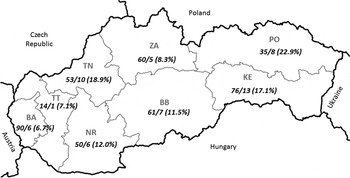
The highest seropositivity was recorded in dogs from eastern Slovakia, in the Prešov (22.9%) and Košice (17.1%) regions, and also from the Trenčín region (18.9%) situated in the north-western part of the country (fig. 1). In the other parts of the country seropositivity for Trichinella spp. in dogs varied between 6.7% and 12.0%.
Regional distribution of dogs seropositive for Trichinella spp. in Slovakia; number of dogs examined/number of dogs positive (seroprevalence in %). Regions: BA, Bratislava; TT, Trnava; TN, Trenčín; NR, Nitra; BB, Banská Bystrica; ZA, Žilina; PO, Prešov and KE, Košice.

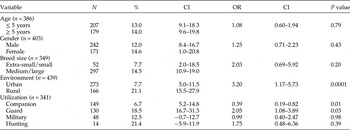
Neither the age of the dogs nor the gender were shown to be a significant factor for trichinellosis (P > 0.05). Dogs of medium- and large-sized breeds showed a higher occurrence of anti-Trichinella antibodies (14.5%) compared with extra-small and small dogs (7.7%; OR = 2.03, 95% CI 0.69–5.92), but the difference was not significant (P = 0.20). On the other hand, seropositivity to Trichinella spp. was detected significantly more often (P = 0.0001) in dogs kept in rural areas (21.1%) when compared with animals living in towns or suburban localities (7.7%; OR = 3.20, 95% CI 1.17–5.73). Of the 149 companion dogs, 130 guard dogs, 48 military dogs and 14 hunting dogs included in the survey, the lowest seroprevalence was found in companion dogs (6.7%). In the group of guard dogs seroprevalence reached 18.5%. Trichinella antibodies were observed in 6 of 48 military dogs and 3 of the 14 hunting dogs were also seropositive (table 1).
Seroprevalence (%) of Trichinella infections in dogs, relative to age, gender, breed size, environment and utilization; N, number of dogs examined; 95% CI, 95% confidence intervals; OR, odds ratio.

Discussion
The work presented here revealed that 12.8% of the dog population in Slovakia was seropositive to Trichinella spp. Seropositive animals were found to be positive by both ELISA and WB. Generally, the somatic antigen used in the study shows high sensitivity (84.8–100%) and is able to detect antibodies at an earlier phase of infection than the excretory–secretory (E/S) antigen (Kapel et al., Reference Kapel, Webster, Lind, Pozio, Henriksen, Murrell and Nansen1998; Reiterová et al., Reference Reiterová, Dubinský, Klimenko, Tomašovičová and Dvorožňáková1999). On the other hand, the specificity of this antigen is lower (68.5–91.8%) (Poletaeva & Kraskovskaia, Reference Poletaeva and Kraskovskaia1995; Hassan et al., Reference Hassan, El-Moghazy and Toaleb2010; Tattiyapong et al., Reference Tattiyapong, Chaisri, Vongpakorn, Anantaphruti and Dekumyoy2011) than that of the E/S antigen. Therefore, a second, more specific WB test was used to confirm the seropositivity of animals. The immunoblot pattern with somatic T. spiralis antigen showed the presence of protein bands of 37 kDa and 42–48 kDa fractions and a band of molecular weight of approximately 84 kDa. Protein antigenic components of 37 kDa in muscle larva somatic extracts were also observed by Homan et al. (Reference Homan, Derksen and van Knapen1992) when tested on pig and human serum samples. Broader fractions of 43–47 kDa were recorded in persons with confirmed trichinellosis during the disease outbreak in Slovakia, as well as in experimentally infected pigs (Turčeková et al., Reference Turčeková, Borošková, Tomašovičová, Reiterová and Kinčeková1997; Reiterová et al., Reference Reiterová, Kinčeková, Šnábel, Marucci, Pozio and Dubinský2007b). Similar fractions (36–45 kDa) were detected in Trichinella-positive dog sera by Vu Thi et al. (Reference Vu Thi, De, Praet, Claes, Gabriël and Dorny2013), who also recorded bands with molecular weights of 55 and 62 kDa. The latter authors used E/S T. spiralis antigen and, like the present study, they did not find any difference between ELISA and WB seropositivity.
Of 149 companion dogs, 130 guard dogs, 48 military dogs and 14 hunting dogs included in the survey, the lowest seroprevalence was found in companion dogs (6.7%), followed by military (12.5%) and guard dogs (18.5%). Although only 14 hunting dogs were examined, the high seropositivity in this group (21.4%) suggests a high infection risk among animals that may have direct contact with hunted game or may be fed with game offal. A high risk of infection with Trichinella spp. in hunting dogs was also confirmed in the study of Gómez-Morales et al. (Reference Gómez-Morales, Selmi, Ludovisi, Amati, Fiorentino, Breviglieri, Poglayen and Pozio2016), in which the authors reported very high seropositivity (49.2%) to Trichinella in 384 hunting dogs.
The highest seroprevalence was detected in dogs from the Prešov (22.9%), Košice (17.1%) and Trenčín (18.9%) regions. The first two of these districts are historically endemic areas, where the prevalence of Trichinella infection in red foxes reached 26.78% and 20.07%, respectively, and infected wild boars are also reported regularly (Hurníková & Dubinský, Reference Hurníková and Dubinský2011). The Trenčín region is considered to be a new focus for Trichinella spp. occurrence, as no positive animals were detected between 2000 and 2002, sporadic positive findings occurred in 2003 and 2004, and prevalence over 15% was detected in 2006 and 2007 (Hurníková & Dubinský, Reference Hurníková and Dubinský2009). A relatively high seroprevalence (12.0%) was also detected in dogs from the Nitra region, where the prevalence in foxes is low (1.18%); however, a human outbreak occurred in 2001 in the Komárno district following the consumption of pork from backyard pigs fed with game offal (Reiterová et al., Reference Reiterová, Kinčeková, Šnábel, Marucci, Pozio and Dubinský2007b), and several infected wild boars have been recorded in recent years (State Veterinary and Food Administration, pers. comm.). In the Banská Bystrica region in central Slovakia, an area considered to be a long-term endemic area with 17.9% of foxes being infected with Trichinella on average, a total of 11.5% of dogs tested seropositive. The largest human outbreak of trichinellosis also occurred in this region, in the village of Valaská where, traditionally, sausages from wild boar and dog meat are made during the carnival season at the end of February. This tradition was established here in the 1930s, but only after the outbreak of trichinellosis in 1998 (when dog meat was confirmed as the source of the infection) did Slovak society and the responsible authorities become aware that this practice is still ongoing (Dubinský et al., Reference Dubinský, Štefančíková, Kinčeková, Ondriska, Reiterová and Medveďová2001a). The finding of 66.67% seropositivity in 60 dogs examined after the outbreak in Valaská (Dubinský et al., Reference Dubinský, Sokol, Dvorožňáková, Štefančíková, Reiterová, Kinčeková, Švrček and Ďurove1998), as well as the seropositivity detected in two dogs and a cat during the human disease outbreak in Komárno district in 2001 (Dubinský et al., Reference Dubinský, Kinčeková, Reiterová, Tomašovičová, Holková, Ondriska and Klobušický2001b) suggest the epidemiological importance of domestic dogs as a potential source of infection when entering the food chain.
Despite the fact that the consumption of dog meat is not common in European countries, several food scandals broke out when evidence emerged on the addition of dog meat to meals in restaurants and also in semi-finished food products distributed by supermarkets (according to various global and regional news services). In European Union countries dog is not legally considered a food animal; hence, no mandatory testing is performed on dog meat. However, in several European countries (or regions) the traditions of dog-meat consumption still persist, e.g. in several parts of Russia (especially in the Siberia and Kamchatka regions) (Ozeretskovskaya et al., Reference Ozeretskovskaya, Mikhailova, Sabgaida and Dovgalev2005) or in Swiss regions of Lucerne, Appenzell and Jura during festive seasons (BBC, 2014).
On the other hand, the consumption of dog meat is not always connected with traditions or habits, and is sometimes due to the shortage of other food supplies. For instance, in Slovakia, some members of Roma ethnic minority groups have used the consumption of meat from dogs, cats and other non-food animals during the periods of extreme hunger (Stoličná, Reference Stoličná2009). These practices still persist in some Roma people, although the majority of them refuse and condemn it (Horváthová, Reference Horváthová and Adamová2007). Thus, the high percentage of seropositive dogs in endemic regions of eastern Slovakia, where the majority of the Slovak Roma community lives, might represent a potential risk for human infections.
Recent epidemiological studies aimed at surveys of Trichinella infection in dog populations are rather scarce. In Finland, where the prevalence of sylvatic trichinellosis is generally high, 7.3% of examined dogs were classified as positive when investigated using ELISA (Oivanen et al., Reference Oivanen, Nareaho, Jokela, Rikula, Gamble and Sukura2005). Ozeretskovskaya et al. (Reference Ozeretskovskaya, Mikhailova, Sabgaida and Dovgalev2005) reported four human outbreaks of trichinellosis with dog meat as the source of the infection in Russia between 1998 and 2002. A naturally high occurrence of canine Trichinella infection was recorded in Greenland. Using the digestion method, Trichinella larvae were isolated from muscle samples of 11.0% of sled dogs, with great regional differences in prevalence, between 2.5% and 67% (Møller, Reference Møller2007). One older study from the Macedonia region in northern Greece confirmed antibodies to T. spiralis in the sera of 4.3% of 1000 dogs (Frydas et al., Reference Frydas, Alexakis and van Knapen1995). In Kosovo, on the Balkan Peninsula, T. britovi was detected in 16% of stray dogs, using the digestion method and polymerase chain reaction (PCR) (Watier-Grillot et al., Reference Watier-Grillot, Vallée, Lacour, Cana, Davoust and Marié2011). Only a few studies focusing on canine infection have been carried out in Asia. In China, canine Trichinella infection varied between 5.35% and 8.43% in 11 provinces reported to be endemic (Cui et al., Reference Cui, Wang and Xu2011), and in Vietnam, the first serological studies confirmed an overall seroprevalence of 4.0% in dogs from the north-western part of the country (Vu Thi et al., Reference Vu Thi, De, Praet, Claes, Gabriël and Dorny2013).
As with our results, all of the above-mentioned studies indicate that the dog population in Europe is at relatively high risk of Trichinella infection. Fortunately, consumption of dog meat as a part of culinary or cultural tradition is not very common in this part of the world, in comparison with Asia. Despite the fact that this kind of meat is usually prepared under high temperatures and is well-cooked before consumption, several outbreaks have confirmed dog meat as a source of Trichinella infection among Europeans. Although canine Trichinella infection is not of great epidemiological and medical significance in Europe, our results showed that dogs do play a role in the transmission of Trichinella spp., and the prevalence in this host species correlates with the prevalence in red foxes as a wildlife reservoir. As wildlife samples can be difficult to access, whether due to protection and restricted hunting or problematic sampling in some countries, dogs could serve as convenient sentinel animals to monitor the incidence of Trichinella infection for seroepidemiological surveys.
Acknowledgements
The authors are grateful to PD Dr Karsten Nöckler and the Bundesinstitute für Risikobewertung in Berlin, who kindly provided Trichinella-positive and Trichinella-negative control serum samples from foxes.
Financial support
This research was supported by the Slovak Grant Agency VEGA, project No. 2/0127/13 (0.2) and by the project ‘Centre of Excellence for Parasitology’ (code ITMS: 26220120022), supported by the Research and Development Operational Programme funded by the European Regional Development Fund (0.8).
Conflict of interest
None.
Ethical standards
The authors assert that all procedures contributing to this work comply with the ethical standards of the relevant national and institutional guides on the care and welfare of animals.