1. Introduction
By the early 1600s, an increasing number of isolated marine reptile remains found in England attracted the attention of naturalists and the popular press. These ‘curios’ were variously interpreted – although invariably misidentified – as the remnants of fishes or crocodiles and sometimes even whales or humans (e.g. Verstegan, Reference Verstegan1605; Lhwyd, Reference Lhwyd1699; Scheuchzer, Reference Scheuchzer1708; Stukely, Reference Stukely1719). The true nature of these fossils remained enigmatic until Joseph and Mary Anning discovered the first reasonably complete specimens of ichthyosaurs and plesiosaurs in southern England at the beginning of the nineteenth century.
Mary Anning (1799–1847) is recognized as the first female palaeontologist and one of the pioneers of this science in Europe. She became famous following her discoveries during 1811–1844 of the first almost complete specimens of ichthyosaurs and plesiosaurs in the marine strata of the Lower Jurassic of Lyme Regis, her native town. Mary and her older brother Joseph learned fossil collecting along the Dorset cliffs and beaches (which were already famous for their exceptional fossil richness and diversity) from their father. Both Mary and Joseph continued the family fossil business after their father's death (Torrens, Reference Torrens1995).
While Mary Anning unearthed fossils along the southern English coast, the French palaeontologist Georges Cuvier published a series of articles including one on the famous skull of ‘le grand animal fossile des carrières de Maestricht’ (Cuvier, Reference Cuvier1808), now known as Mosasaurus hoffmanni Mantell, Reference Mantell1829, and the first mosasaur to be named (see Bardet & Jagt, Reference Bardet and Jagt1996 for details). During the following years, Georges Cuvier purchased several marine reptile skeletons found by Mary Anning near Lyme Regis, which are now kept in the palaeontological collections of the Muséum National d'Histoire Naturelle (Paris). Most of these were studied by Cuvier himself. Surprisingly, and despite the fact that the history of these specimens was discussed by Taquet (Reference Taquet2003), most of them were not subsequently re-examined. The aim of this study is therefore to provide both a historical review and appropriate re-descriptions of some of the material found by Mary Anning, subsequently studied by Georges Cuvier. The importance of these specimens is then discussed in the light of our current knowledge of Jurassic marine reptiles and the history of French vertebrate palaeontology.
2. Materials
2.a. Institutional abbreviations
GPIT – Geologisch-Paläontologisches Institut und Museum, Universität Tübingen, Germany; IRSNB – Institut Royal des Sciences Naturelles de Belgique, Bruxelles, Belgium; MNHN – Muséum National d'Histoire Naturelle, Paris, France; NHMUK – Natural History Museum, London, UK.
2.b. Geological setting and stratigraphy
All of the material described here was discovered within the lower part of the Lias Group (Lower Jurassic) sequence of shale and limestone beds exposed close to Lyme Regis, referred to as the Blue Lias. The lower Lias Group consists mostly of laminated black shale and mudstone beds that are often organic rich and interpreted as reflecting near-shore subanoxic to anoxic marine conditions (Wignall & Hallam, Reference Wignall, Hallam, Tyson and Pearson1991). This setting is the main reason behind the exceptional concentration and preservation of the Lyme Regis fauna (Lord & Davis, Reference Lord and Davis2010), within which marine reptiles are well represented.
The ‘Lias’ rock at Lyme Regis was quarried from the sea ledges in the early nineteenth century, mostly for cement making, an activity that provided numerous opportunities for fossil hunting. Most of the well-provenanced ichthyosaurian and plesiosaurian remains from the Dorset coast are Sinemurian in age (e.g. Temnodontosaurus platyodon, Obtusum Zone, McGowan, Reference McGowan1994; Plesiosaurus dolichodeirus, Raricostatum Zone, Storrs, Reference Storrs, Callaway and Nicholls1997). However, the stratigraphic origins of the specimens described here were not specified by Cuvier. The reptile-bearing Lower Lias strata near Lyme Regis span the Hettangian – lower Pliensbachian interval (Cope et al. Reference Cope, Getty, Howarth, Morten and Torrens1980; Benton & Spencer, Reference Benton and Spencer1995). As a result, the exact geological ages of Cuvier's material are therefore unknown.
2.c. History of the specimens
As Taquet (Reference Taquet2003) mentioned, Georges Cuvier noted that his predecessors who were interested in studying extinct animals experienced two kinds of difficulties: the random nature of fossil occurrences and the infancy of comparative anatomy, which was then lacking sufficiently complete collections for comparisons. To overcome these difficulties and gather the scientific data necessary for his work, Cuvier offered an ingenious deal to his correspondents: in exchange for unpublished data, casts and original fossil remains, he could exchange information that he had in the form of documents, books and casts (Taquet, Reference Taquet2003). Cuvier addressed these requests to many European colleagues. Despite his regular correspondence with Sir Everard Home (since 1800), Cuvier had to wait until the end of the conflict between France and the United Kingdom and the Congress of Aix-la-Chapelle, ending the military occupation in 1818, to go to England (Taquet, Reference Taquet2003).
In 1818, Cuvier went to Oxford and London where he met Home. Cuvier took the opportunity to examine the remains of an ichthyosaur (not yet recognized as such at that time) that had been previously described by Home (Reference Home1814). This specimen, the first partially complete ichthyosaur skeleton ever found, was unearthed by Joseph and Mary Anning in 1811. Cuvier found the remains intriguing and described them as follows:
‘Nous voici arrivés à ceux de tous les reptiles, et peut-être de tous les animaux fossiles, qui ressemblent le moins à ce que l'on connoît, et qui sont le plus faits pour surprendre le naturaliste par des combinaisons de structures qui, sans aucun doute, paroîtroient incroyables à quiconque ne seroit pas à portée de les observer par lui-même [. . .]’ (Cuvier, Reference Cuvier1824, p. 445). ‘We have come to those of all reptiles, and perhaps of all fossil animals, which resemble the least to what is known, and which are the most able to surprise the naturalist by combinations of structures that, without any doubt, seem incredible to anyone who would not be able to observe them by himself’ (author translation).
He also noted that other as yet undocumented vertebrate fossils (including plesiosaur remains that he had observed in the Royal College of Surgeons) had been unearthed in England. From 1818 to 1824 Cuvier followed all the discoveries of new marine reptiles in England with great attention, especially those made in Lyme Regis by the Anning family. He rapidly managed to obtain casts and fine specimens of these marine reptiles, which formed an integral basis for Chapter V of his ‘Recherches sur les Ossemens fossiles’ (Cuvier, Reference Cuvier1824).
In 1819 the Annings were in considerable financial difficulties (Torrens, Reference Torrens1995). They were rescued by the generosity of the fossil collector and former Life Guards officer Lieutenant-Colonel Thomas James Birch (1768–1829), who arranged for the sale of his personal collection, largely purchased from the Annings, in Bullock's Museum in London (Torrens, Reference Torrens1995). The Bullock's auction took place in May 1820, during which Cuvier bought several beautiful pieces for the Muséum National d'Histoire Naturelle (Taquet, Reference Taquet2003, p. 43). Little information is available about the price of these specimens. MNHN AC 9862 is known to have been purchased for £14.14, and femur (which could not be located in the MNHN collections) for £1.10 (Mantell, Reference Mantell1846; Torrens, Reference Torrens1979). Cuvier described and figured some of these specimens in his famous ‘Recherches sur les Ossemens fossiles’ (MNHN AC 9862, 9866, 9937, 9950, 9951 and 9935; Figs 1, 2; Cuvier, Reference Cuvier1824). However, only five of these specimens could be found in the collections of the MNHN of Paris. The specimen MNHN AC 9935 should therefore be temporarily considered as lost.
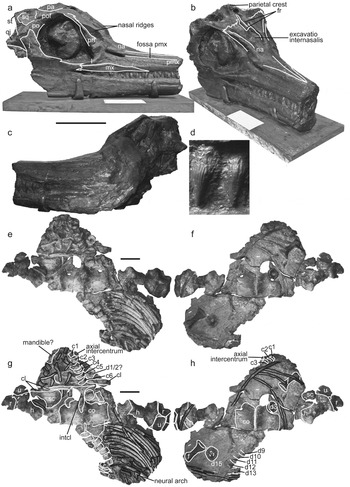
MNHN AC 9862, Ichthyosaurus cf. communis from the Lower Lias of England; skull in (a) right lateral view, (b) oblique view, (c) left lateral view and (d) close-up of the teeth. MNHN AC 9937, Leptonectes tenuirostris from the Lower Lias of England; post-cranial skeleton in (e, g) ventral view and (f, h) dorsal view. Abbreviations: c – cervical vertebra; co – coracoid; d – dorsal vertebra; f – femur; fr – frontal; h – humerus; intcl – interclavicle; j – jugal; l – lacrimal; mx – maxilla; na – nasal; pa – parietal; pmx – premaxilla; po – postorbital; pof – postfrontal; prf – prefrontal; qj – quadratojugal; r – radius; sc – scapula; sq – squamosal; st – supratemporal; u – ulna. Scale bars: 10 cm.

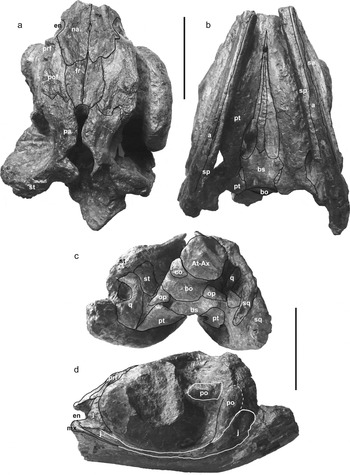
MNHN AC 9866, cf. Leptonectes from the Lower Lias of England, skull in (a) dorsal view, (b) ventral view, (c) posterior view and (d) left lateral view. Abbreviations: a – articular; At-Ax – atlas–axis complex; bo – basioccipital; bs – basisphenoid; co – occipital condyle; en – external naris; fr – frontal; j – jugal; l – lacrimal; mx – maxilla; na – nasal; op – opistotic; pa – parietal; po – postorbital; pof – postfrontal; prf – prefrontal; pt – pterygoid; q – quadrate; sa – surangular; sp – splenial; sq – squamosal; st – supratemporal. Scale bars: 10 cm.

One partial ichthyosaur skull bought by Cuvier (MNHN AC 9862; Fig. 1a–d) was previously described and figured by Home (Reference Home1819 a, b). In his description, Home (Reference Home1819 a) thanked De la Beche and Birch for procuring material, which allowed him to correct some errors that the ‘imperfect state of the first specimens’ had led him to commit. From the observation of MNHN AC 9862, Home attributed the ‘aperture’ (external nares) he had described and delineated in his first paper to taphonomic artefacts. The absence of external nares is one of the pieces of evidence used by Home (Reference Home1819 b) to state that this animal – for which he proposed the name Proteosaurus – was intermediate between fishes and lizards. When Cuvier re-examined this specimen, after having prepared it adequately, he confirmed that the supposed breaks were actually the external nares, and also found the parietal foramen.
In December 1823, Mary Anning found an almost 3-m-long animal with a small head that is now recognized as the first partial plesiosaur skeleton. In March 1824, Cuvier received a letter from Georges Cumberland including a sketch of the specimen (Taquet, Reference Taquet2003). The strange and unexpected proportions (long neck v. short head) of this new animal led him to suspect that it might be a composite. He advised Conybeare to make sure that this was not the case. He also said:
‘Cette découverte, en ce cas, surpasse toutes celles que l'on a faites jusqu'ici, et il n'y a rien de si monstrueux que l'on ne doive s'attendre à voir sortir des carrières du Lias' (letter from Cuvier to Conybeare, Reference Conybeare1824). ‘This discovery, in this case, surpasses all those that have been made so far, and there is nothing more monstrous that one could expect to see coming from the Lias quarries' (author translation).
A few days later, he received letters from Buckland and Conybeare including anatomical details, drawings, an engraving of the specimen from Buckland and a sketch made by Mary Morland (Buckland's wife-to-be) from Mary Anning's own drawings. They managed to convince Cuvier that this specimen was a genuine find. From that moment forward, Cuvier treated Mary Anning as a legitimate and respectable fossil collector and cited her name in his publications (e.g. Cuvier, Reference Cuvier1824, p. 473).
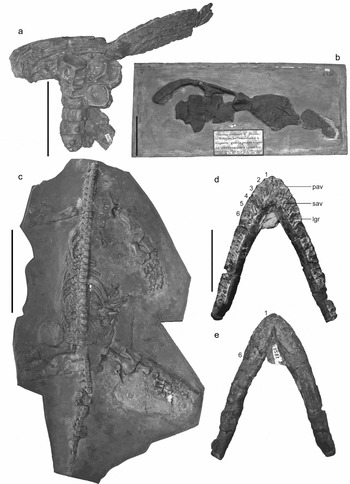
In order to acquire new specimens for the MNHN, Cuvier decided to send the French geologist Constant Prévost (1787–1856) to Great Britain for an official geological trip, supported by the administration of the museum. In May 1824, Prévost was received by the famous British geologist Charles Lyell and embarked on a long geological trip through England with him. They went to Lyme Regis, probably in June 1824, and met Mary Anning. Slightly before his arrival, Royal Navy Captain Waring (an amateur palaeontologist) discovered a plesiosaur specimen (Anonymous, 1824, p. 92; Taquet, Reference Taquet2003, p. 58) that was subsequently bought by Mary Anning for £3 (Gosselet, Reference Gosselet1896 cited by Taquet, Reference Taquet2003). During his stay at Lyme Regis, Prévost bought this plesiosaur (MNHN AC 8592; Fig. 3c–e) from Mary Anning for £10 and sent it to Paris (Taquet, Reference Taquet2003). It is the second partially complete plesiosaur specimen ever discovered. The history of MNHN AC 8592 shows that Mary Anning was not only a skilful palaeontologist, but also a keen businesswoman. It was probably sold after some preparation in order to increase the attractiveness of the specimen and to sell it for a higher price.
(a) MNHN AC 9950, Ichthyosaurus sp. from the Lower Lias of England, post-cranial remains. (b) MNHN AC 9951, Ichthyosaurus sp. from the Lower Lias of England, post-cranial remains. (c) MNHN AC 8592, Plesiosaurus dolichodeirus from the Lower Lias of England, post-cranial skeleton. (d, e) MNHN AC 8581, Plesiosaurus dolichodeirus from the Lower Lias of England, mandible in (d) dorsal and (e) ventral view. Abbreviations: lgr – lateral groove; pav – primary alveoli; sav – secondary alveoli. Scale bars: (a, b) 10 cm, (c) 50 cm and (d, e) 5 cm.

In 1825, Cuvier published a third edition of his ‘Discours sur les révolutions de la surface du globe’. This was the opportunity for him to include the engraving of his plesiosaur from Mary Anning (Cuvier, Reference Cuvier1825, pl. III, fig. 1). He also added to the engraving the head and neck of the first complete specimen of Plesiosaurus, as published by Conybeare (Reference Conybeare1824), then bought by the Duke of Buckingham and later given to the British Museum of Natural History (now NHMUK PV OR22656). MNHN AC 8592 has been on display in the Gallery of Palaeontology since 1898. It was recently described extensively by Vincent & Taquet (Reference Vincent and Taquet2010). Prévost also presented the partial mandible of a plesiosaur (MNHN AC 8581; Fig. 3d, e), presumably found associated with MNHN AC 8592, to the MNHN. This bone was figured by Gaudry (Reference Gaudry1890, fig. 270), but does not appear in Cuvier's (Reference Cuvier1825) book. The existence of this specimen was unknown to Vincent & Taquet (Reference Vincent and Taquet2010) when they re-described MNHN AC 8592 and has therefore never been described appropriately, a task undertaken here (see Section 3).
3. Description
3.a. Ichthyosaurs
Systematic Palaeontology
Ichthyosauria Blainville, Reference Blainville1835
Parvipelvia Motani, Reference Motani1999
b
Neoichthyosauria Sander, Reference Sander2000
Leptonectidae Maisch, Reference Maisch1998
Leptonectes McGowan, Reference McGowan1996
Leptonectes tenuirostris (Conybeare, Reference Conybeare1822)
Referred specimen: MNHN AC 9937, a partial post-cranial skeleton including 20 presacral vertebrae, ribs, pectoral girdle, both humeri, ulnae, radii and femora (Fig. 1e–h). Cuvier has figured the ventral aspect of the specimen. The dorsal view is figured and described here for the first time.
Remark: MNHN AC 9937 was referred to Ichthyosaurus by Cuvier (Reference Cuvier1824, p. 105, pl. XXX, fig. 1).
Description: The specimen MNHN AC 9937 mainly comprises postcranial remains, but indeterminate bones located just anterior to the atlas–axis complex could correspond to the mandible. The atlas–axis complex is sutured, with the conical axial intercentrum preserved disarticulated next to it. In addition to the atlas and axis, four typically pentagonal cervical and 14 rounder dorsal vertebrae are preserved in ventral view.
The pectoral girdle comprises the almost-complete coracoids, clavicles, interclavicle and the right scapula. The latter is a short robust element consisting of a strap-like shaft and flared extremities. The ventral end is curved and broadly expanded. The dorsal end is not preserved. Ventrally, the scapula expands into a large facet for the reception of the coracoid. Its anterior border is straight while its posterior border is curved, unlike the condition seen in Temnodontosaurus, Ichthyosaurus and Stenopterygius (Maisch & Matzke, Reference Maisch and Matzke2000 a; Caine & Benton, Reference Caine and Benton2011). A large, flat acromial process is present anteriorly as in Stenopterygius (Johnson, Reference Johnson1979), ophthalmosaurids (Maxwell & Druckenmiller, Reference Maxwell and Druckenmiller2011; Fischer et al. Reference Fischer, Maisch, Naish, Liston, Kosma, Joger, Krüger, Pardo-Pérez, Tainsh and Appleby2012), Leptonectes (McGowan & Milner, Reference McGowan and Milner1999; McGowan & Motani, Reference McGowan, Motani and Sues2003) and Excalibosaurus (McGowan, Reference McGowan2003). The coracoid is a broad plate-like element with wide anterior and posterior notches. The intercoracoid facet is thick and ellipsoidal. The scapular facet is small and faces anterolaterally while a larger facet, facing laterally, corresponds to the coracoidal contribution to the glenoid cavity. Anteriorly, a deep and narrow notch is present as in Eurhinosaurus (Maisch & Matzke, Reference Maisch and Matzke2000 a). It is clearly narrower than that observed in I. communis and Temnodontosaurus sp. (McGowan & Motani, Reference McGowan, Motani and Sues2003). The clavicles are slightly disarticulated, but the right clavicle follows the edge of the scapula up to its distal end. The anterior and posterior margins extend parallel to each other and become narrower medially. Unlike other specimens of Ichthyosaurus (Maisch & Matzke, Reference Maisch and Matzke2000 a), the interclavicle is markedly T-shaped with a long and slender median bar.
Both incomplete forelimbs are preserved in approximately their natural positions, although the right forelimb is preserved on the opposite side (i.e. dorsally) compared to the rest of the elements preserved on the block in ventral view. The shaft of the humerus is long, constricted and concave anteriorly and posteriorly. The humerus is markedly expanded distally; it therefore differs from that of Eurhinosaurus, Suevoleviathan and I. communis (Maisch & Matzke, Reference Maisch and Matzke2000 a), Malawania (Fischer et al. Reference Fischer, Appleby, Naish, Liston, Riding, Brindley and Godefroit2013) and some species of Temnodontosaurus (Martin et al. Reference Martin, Fischer, Vincent and Suan2012). Its deltopectoral crest is robust. Distally, the radial and ulnar facets are subequal in size. The radius is sub-hexagonal and broader than long. It is notched at the midpoint of its preaxial edge, as in Leptonectes, Temnodontosaurus, Eurhinosaurus and Stenopterygius (Maisch & Matzke, Reference Maisch and Matzke2000 a; McGowan & Motani, Reference McGowan, Motani and Sues2003). The radius is marginally wider than the ulna. The ulna is hexagonal in outline and bears a prominent humeral articular facet. The radius and ulna enclose a foramen; similar spatia interossea are only present in Triassic ichthyosaurs and Leptonectes tenuirostris (Godefroit, Reference Godefroit1992; Maisch & Matzke, Reference Maisch and Matzke2000 b), although some specimens referred to as Temnodontosaurus have been reported with an anterior notch on the ulna (McGowan, Reference McGowan1996).
The femora have a short and narrow shaft, being longer than wide, as in many non-ophthalmosaurid parvipelvians (Martin et al. Reference Martin, Fischer, Vincent and Suan2012), and expand at both extremities. The anterior and posterior margins are concave. Its proximal facet is rounded, whereas its distal end is concave without separate tibial and fibular facets.
Identification: The presence of a large acromial process of the scapula, of a spatium interosseum enclosed by the radius and the ulna and the general shape and proportions of the propodials of MNHN AC 9937 is a combination of features unique to Leptonectes tenuirostris (McGowan & Motani, Reference McGowan, Motani and Sues2003).
cf. Leptonectes
Referred specimen: MNHN AC 9866, a three-dimensionally preserved skull, consisting of the posterior half of the cranium preserved from the posterior margin of the naris (Fig. 2 a–d).
Remark: MNHN AC 9866 was referred to Ichthyosaurus intermedius by Cuvier (Reference Cuvier1824, p. 456, pl. XXIX, figs 2–5).
Description: The maxilla forms the ventral border of the external naris as in some specimens of Stenopterygius triscissus (Godefroit, Reference Godefroit1993 b, Reference Godefroit1994; McGowan & Motani, Reference McGowan, Motani and Sues2003; Maisch, Reference Maisch2008), Leptonectidae (Maisch & Matzke, Reference Maisch and Matzke2000 b) and Suevoleviathan disinteger (Maisch, Reference Maisch2001). A great part of the posterior portion of the nasal is preserved. There is no processus narialis, unlike the condition seen in Stenopterygius cf. quadriscissus (Maisch & Ansorge, Reference Maisch and Ansorge2004). Posteriorly, the nasal overlaps the prefrontal laterally and contacts the frontal posteromedially. The frontals do not split the nasal medially in contrast to Leptonectes tenuirostris (Maisch & Matzke, Reference Maisch and Matzke2000 a, Reference Maisch and Matzke2003) and Stenopterygius (e.g. Motani, Reference Motani2005; Caine & Benton, Reference Caine and Benton2011). The lacrimal appears less extensive than that of I. communis (Maisch & Matzke, Reference Maisch and Matzke2000 b). Dorsally, the lacrimal contacts the prefrontal but is separated from the nasal by a process of the prefrontal, as in Leptonectes tenuirostris and Ichthyosaurus breviceps (Maisch & Matzke, Reference Maisch and Matzke2000 b, Reference Maisch and Matzke2003). The jugal is slender and elongate. Its anterior end extends up to the level of the external naris as in Temnodontosaurus, but unlike the condition observed in Ichthyosaurus, Stenopterygius and Suevoleviathan (Maisch & Matzke, Reference Maisch and Matzke2000 a). Its posterior end is thick and excluded from the orbital margin by the postorbital as in Suevoleviathan, I. intermedius and I. communis (Maisch & Matzke, Reference Maisch and Matzke2000 a). The frontal contacts the nasal anteriorly, the prefrontal laterally and the parietal posteriorly. It forms the anterior margin of the parietal foramen. The parietal foramen is noticeably bilobed and consists of a broad and teardrop-shaped anterior portion and a larger well-rounded posterior extension bordered by the parietals. A similar structure (albeit much smaller) has been described in ‘Ichthyosaurus zetlandicus’ Seeley, Reference Seeley1880 and in the Albian ophthalmosaurid Athabascasaurus (Druckenmiller & Maxwell, Reference Druckenmiller and Maxwell2010). However, in both cases the parietal foramen does not reach the impressive extension of MNHN AC 9866. The Late Jurassic ophthalmosaurid Palvennia hoybergeti (Druckenmiller et al., Reference Druckenmiller, Hurum, Knutsen and Nakrem2012) also possesses an enlarged parietal foramen; the taxonomic value of this feature is currently unknown. The postorbital is poorly preserved. It is wide and forms the posterodorsal and posterior margin of the orbit. The anterior extremities of the medial and lateral rami of the supratemporal are uncertain. The ventral ramus is massive at its dorsal end, but poorly preserved. On the left side, it articulates with the opisthotic ventromedially. The dorsal portion of the quadrate articulates with the supratemporal. The occipital condyle is relatively flat and is offset from the body of the basioccipital by a narrow, shallow groove. The extracondylar area of the basioccipital is well developed, as in non-ophthalmosaurid ichthyosaurs (Motani, Reference Motani1999 b). The opisthotic forms a broad contact with the basioccipital medially. Its morphology is difficult to discern. The interpterygoid vacuities are well developed with the medial margin of the pterygoid slightly concave.
The incomplete sclerotic ring is preserved in articulation, filling the entire vacuity of the orbit as in juvenile ichthyosaurs (Fernández et al. Reference Fernández, Archuby, Talevi and Ebner2005; Kear & Zammit, Reference Kear and Zammit2013) and adult leptonectids (e.g. Huene, Reference Huene1951; Maisch & Matzke, Reference Maisch and Matzke2000 b, Reference Maisch and Matzke2003; McGowan, Reference McGowan2003; McGowan & Motani, Reference McGowan, Motani and Sues2003; Maisch & Reisdorf, Reference Maisch and Reisdorf2006; Reisdorf, Maisch & Wetzel, Reference Reisdorf, Maisch and Wetzel2011). The orbit appears large relative to skull size; the jugal and postorbital bones are reduced and slender, as in Leptonectidae (e.g. Maisch & Matzke, Reference Maisch and Matzke2003) and Hauffiopteryx (Maisch, Reference Maisch2008; Caine & Benton, Reference Caine and Benton2011) and unlike the condition seen in Temnodontosaurus (e.g. McGowan & Motani, Reference McGowan, Motani and Sues2003), Suevoleviathan (Maisch, Reference Maisch2001) and Ichthyosaurus (Maisch & Matzke, Reference Maisch and Matzke2000 a). The mandible is large and appears unreduced compared to the upper jaw, unlike in Excalibosaurus and Eurhinosaurus (McGowan, Reference McGowan2003).
Identification: Close comparisons with the ichthyosaurs from the Lower Jurassic of Europe indicate that MNHN AC 9866 does not belong to the following genera. (1) Temnodontosaurus species possess a nasal that extends far above the orbit to meet the parietal (Maisch et al. Reference Maisch, Reisdorf, Schlatter and Wetzel2008), contrasting with MNHN AC 9866 in which the nasal is clearly separated from the parietal by the prefrontal and frontal. (2) Ichthyosaurus species possess a contact between the lacrimal, the prefrontal and the nasal dorsally (except I. intermedius; Maisch & Matzke, Reference Maisch and Matzke2000 a). The nasal does not contact the lacrimal in MNHN AC 9866. Moreover, the jugal does not extend up to the level of the external naris anteriorly in Ichthyosaurus (Maisch & Matzke, Reference Maisch and Matzke2000 a). This condition is clearly present in MNHN AC 9866. (3) Among leptonectids, Eurhinosaurus possesses a foramen parietal bordered by the nasal (Maisch & Matzke, Reference Maisch and Matzke2003), a condition not observed in MNHN AC 9866. MNHN AC 9866 closely resembles leptonectids and especially Leptonectes because of the relatively large orbit and sclerotic ring, maxilla forming the ventral border of the naris, long parietal-prefrontal contact and retention of an unreduced mandible. However, the peculiar shape of the parietal foramen has never been described in any other ichthyosaur taxa except in the Late Jurassic ophthalmosaurid Palvennia hoybergeti (Druckenmiller et al. Reference Druckenmiller, Hurum, Knutsen and Nakrem2012). MNHN AC 9866 could therefore belong to a new taxon; more material and/or a thorough re-evaluation of the cranial features of Liassic ichthyosaurs are needed to confirm or refute this hypothesis.
Thunnosauria Motani, Reference Motani1999
b
Ichthyosauridae Gray, Reference Gray1825
Ichthyosaurus De la Beche & Conybeare, Reference De la Beche and Conybeare1821
Ichthyosaurus communis De la Beche & Conybeare, Reference De la Beche and Conybeare1821
Ichthyosaurus cf. communis
Referred specimen: MNHN AC 9862, a large skull lacking the anterior half of the rostrum and left posterolateral side (Fig. 1a–d).
Remark: MNHN AC 9862 was referred to Proteosaurus by Home (Reference Home1819 a, p. 215, pl. XIII) and Ichthyosaurus communis by Cuvier (Reference Cuvier1824, p. 456, pl. XXIX, fig. 1).
Description: The premaxilla lacks a conspicuous fossa praemaxillaris, as in Ichthyosaurus intermedius (Maisch, Reference Maisch1997 b), but forms a deep sulcus anterior to the naris. A processus supranarialis is present, forming the anterior half of the dorsal margin of the naris. The posterior extent of the premaxilla ventral to the naris is unknown, as the suture with the lacrimal is not preserved.
The maxilla has a low dorsoventral lateral exposure and does not contribute to the edge of the naris, unlike in Stenopterygius ‘longifrons’ (equivalent to triscissus; Godefroit, Reference Godefroit1993 a, Reference Godefroit1994; McGowan & Motani, Reference McGowan, Motani and Sues2003; Maisch, Reference Maisch2008; although some specimens of S. triscissus lack this feature; Caine & Benton, Reference Caine and Benton2011), Suevoleviathan disinteger (Maisch, Reference Maisch2001) and Leptonectidae (Maisch & Matzke, Reference Maisch and Matzke2000 a). The anterior part of the maxilla is quite reduced in lateral view, extending a few centimetres anterior to the level of the naris unlike the elongated process found in Temnodontosaurus (Godefroit, Reference Godefroit1993 b; McGowan & Motani, Reference McGowan, Motani and Sues2003; personal observation of V.F. on NHMUK PV OR2003, NHMUK PV R1158 and NHMUK PV R1157).
The nasal is long and prominent, the latter feature probably a result of diagenetic transverse compression of the skull. Nevertheless, the nasal forms a long anteroposterior ridge laterally. Medially, the nasals form a narrow yet deep excavatio internasalis, as in all neoichthyosaurians (Maisch & Matzke, Reference Maisch and Matzke2000 a). This sulcus probably also extends onto the frontal, and appears very similar to that described in a large specimen referred to Ichthyosaurus communis (SMF 46; Maisch et al. Reference Maisch, Reisdorf, Schlatter and Wetzel2008). As in the latter species (e.g. Godefroit, Reference Godefroit1996), the posterior part of the nasal of MNHN AC 9862 forms an extensive fan-shaped sheet that covers – rather than articulating in the same plane as – the prefrontal, the frontal and the postfrontal. The state of preservation does not permit us to assess the presence or absence of an internasal foramen.
The lacrimal, the prefrontal and the postfrontal are poorly preserved and appear to have been restored to some extent; accordingly, these elements will not be described here. As seems to be the case in most non-ophthalmosaurid parvipelvians (e.g. McGowan & Motani, Reference McGowan, Motani and Sues2003; Maisch et al. Reference Maisch, Reisdorf, Schlatter and Wetzel2008), the frontal has a reduced dorsal exposure and is lanceolate. It is unclear whether it participates in the parietal foramen or not.
The dorsal surface of the parietal is concave, forming a prominent parietal crest. Anteromedially, the parietal has a large, round parietal foramen. This region is poorly preserved so it is impossible to know if the prefrontal contacts the parietal as described in Ichthyosaurus and Stenopterygius triscissus by Motani (Reference Motani2005).
Three bones are present in the lateral part of the temporal region of MNHN AC 9862: the supratemporal, the postorbital and the squamosal, arranged as in Ichthyosaurus communis (Maisch & Matzke, Reference Maisch and Matzke2000 b) and Stenopterygius cf. quadriscissus (Maisch & Ansorge, Reference Maisch and Ansorge2004). The postorbital is anteroposteriorly long compared to Leptonectidae (Motani, Reference Motani1999 b; Maisch & Matzke, Reference Maisch and Matzke2003). It contacts the supratemporal anteromedially and is covered posterodorsally by a thin bone layer. We interpret this bony sheet as the squamosal, as it bears close resemblance in shape and position to that of Ichthyosaurus communis (Maisch & Matzke, Reference Maisch and Matzke2000 b) and to a lesser extent that of Temnodontosaurus platyodon (McGowan, Reference McGowan1994) and Temnodontosaurus trigonodon (Maisch & Hungerbühler, Reference Maisch and Hungerbühler2001). Although the suture between the supratemporal and the squamosal cannot be adequately identified dorsally, it is apparently present anteriorly and posterodorsally. The shape of the squamosal differs from that of Suevoleviathan spp. (Maisch, Reference Maisch1998, Reference Maisch2001), Leptonectes (Maisch & Matzke, Reference Maisch and Matzke2003) and Eurhinosaurus (Huene, Reference Huene1951), where it is markedly elongated dorsoventrally.
The posterior part of the jugal is thick, appearing much more robust than in Ichthyosaurus breviceps and I. conybeari (McGowan, Reference McGowan1974 b) and some specimens of Ichthyosaurus communis, such as GPIT 1796/1 (Maisch & Matzke, Reference Maisch and Matzke2000 b; Lomax, Reference Lomax2010; Bennett et al. Reference Bennett, Barrett, Collinson, Moore-Fay, Davis and Palmer2012). The Bonnert specimen of I. communis (IRSNB R145, Belgium; Godefroit, Reference Godefroit1996) possesses a jugal similar to that of MNHN AC 9862, however. The quadratojugal is raised dorsally with respect to the rest of the postorbital and does not contact the jugal extensively, creating an embayment as in most non-baracromian ichthyosaurs with the exception of Shastasaurus pacificus (Sander et al. Reference Sander, Chen, Cheng and Wang2011), T. trigonodon (Maisch & Hungerbühler, Reference Maisch and Hungerbühler2001), Suevoleviathan spp. (Maisch, Reference Maisch1998, Reference Maisch2001) and ‘Ichthyosaurus zetlandicus’ (Seeley, Reference Seeley1880; referred to Stenopterygius by Huene, Reference Huene1922 and to Temnodontosaurus by Maisch, Reference Maisch1997 a who later considered it as probably belonging to a new genus; Maisch, Reference Maisch2010).
The mandible is poorly preserved and lacks any noteworthy features. In contrast to the premaxilla, the dentary possesses a continuous fossa dentalis, as in Ichthyosaurus breviceps (Massare & Lomax, Reference Massare and Lomax2013). The teeth are robust and conical, unlike in Leptonectidae (e.g. Huene, Reference Huene1922; Motani, Reference Motani1999 b), Stenopterygius and Hauffiopteryx (e.g. Fraas, Reference Fraas1891; Godefroit, Reference Godefroit1994). The crown is textured by deep apicobasal ridges and lacks carinae, unlike in T. platyodon (Godefroit, Reference Godefroit1993 b), T. eurycephalus (personal observation by V.F. on holotype NHMUK R1157) and some specimens of T. trigonodon (Theodori, Reference Theodori1843; Fraas, Reference Fraas1891). All apicobasal ridges on the crown continue to the root, deepening and diverging basally. This peculiar tooth ornamentation is only found in Ichthyosaurus communis (Massare, Reference Massare1987; Godefroit, Reference Godefroit1996; Maisch & Matzke, Reference Maisch and Matzke2000 b) and some specimens of Temnodontosaurus (Godefroit, Reference Godefroit1993 b). Within the genus Ichthyosaurus, the absence of a smooth ‘neck’ between the crown and the root (most probably an acellular cementum ring; see Maxwell, Caldwell & Lamoureux, Reference Maxwell, Caldwell and Lamoureux2011, Reference Maxwell, Caldwell and Lamoureux2012 for a detailed analysis of ichthyosaur teeth) differs from I. intermedius (Maisch, Reference Maisch1997 b), I. breviceps (personal observation by V.F. on NHMUK PV OR39263) and Pliensbachian specimens of Ichthyosaurus (Lomax, Reference Lomax2010; Bennett et al. Reference Bennett, Barrett, Collinson, Moore-Fay, Davis and Palmer2012).
Identification: Because the taxonomy of Early Jurassic ichthyosaurs is based traditionally on phenetic ratios and forefin architecture (McGowan, Reference McGowan1974 a, Reference McGowan b , Reference McGowan1979; Appleby, Reference Appleby1979; McGowan & Motani, Reference McGowan, Motani and Sues2003; Maxwell, Reference Maxwell2012), skull features have received comparatively less attention (but see McGowan, Reference McGowan1973; Maisch, Reference Maisch1997 b, Reference Maisch and Hungerbühler2001, Reference Maisch and Matzke2002; Maisch & Hungerbühler, Reference Maisch and Hungerbühler1997; Maisch & Matzke, Reference Maisch and Matzke2002; Motani, Reference Motani2005; Maisch et al. Reference Maisch, Reisdorf, Schlatter and Wetzel2008). Accordingly, autapomorphic cranial features have rarely been identified. However, a combination of traits permits preliminary differentiation of taxa. These ‘shared' character states were detailed in the description above, so only a summary in the form of a differential diagnosis is provided here.
MNHN AC 9862 differs from Leptonectidae, Stenopterygius, Hauffiopteryx typicus, Ichthyosaurus breviceps, Ichthyosaurus conybeari and Ichthyosaurus intermedius in having a robust rostrum and large teeth with deep and continuous apicobasal striations. The ornamentation of the teeth and the shape of the squamosal differ from the condition seen in Suevoleviathan (Maisch, Reference Maisch1998). The lack of carinae differs from Temnodontosaurus platyodon (Godefroit, Reference Godefroit1993 b), Temnodontosaurus trigonodon (Theodori, Reference Theodori1843) and Temnodontosaurus eurycephalus (personal observation by V.F. on holotype NHMUK R1157). The possession of an embayment between the jugal and the quadratojugal differs from Temnodontosaurus trigonodon (Maisch & Hungerbühler, Reference Maisch and Hungerbühler2001), Stenopterygius (Godefroit, Reference Godefroit1993 a, Reference Godefroit1994; Maisch & Ansorge, Reference Maisch and Ansorge2004) and Suevoleviathan (Maisch, Reference Maisch2001). While the poorly known taxa Temnodontosaurus acutirostris (Maisch & Matzke, Reference Maisch and Matzke2000 a; Maisch, Reference Maisch2010), Temnodontosaurus crassimanus (McGowan & Motani, Reference McGowan, Motani and Sues2003; Maisch, Reference Maisch2010) and Temnodontosaurus nuertingensis (Maisch & Hungerbühler, Reference Maisch and Hungerbühler1997) cannot be ruled out of the list of possibilities except on the basis of size and stratigraphic age differences, we consider the close resemblance between MNHN AC 9862 and Ichthyosaurus communis as sufficient evidence for an assignment to this taxon. However, as this identification is made by default, we refer this specimen to Ichthyosaurus cf. communis.
Ichthyosaurus sp
Referred specimens: MNHN AC 9950, a partial axial skeleton with complete ?left forefin (Fig. 3a); MNHN AC 9951, a partial shoulder girdle with nearly complete left forefin (Fig. 3b).
Remark: MNHN AC 9950 was referred to Ichthyosaurus by Cuvier (Reference Cuvier1836, p. 105, pl. XXX, figs 2, 3).
Description: MNHN AC 9950: Ten thoracic centra are preserved. The diapophyses and parapophyses are prominent and are set in a median position, suggesting they originate from the middle trunk region. Fragmentary ribs are preserved. Some fragments possess the typical thunnosaurian groove (Sander, Reference Sander2000) that gives the rib an eight-shaped cross-section. The forefin (presumably the left one) is nearly complete, but the humerus and the epipodial row are poorly preserved and covered by the centra. The forefin is similar to that of Ichthyosaurus: (1) it has a ‘latipinnate’ architecture (two digits arise from the intermedium; McGowan, Reference McGowan1974 b); (2) secondary digital bifurcation occurs (Motani, Reference Motani1999 a) from the metacarpal of the third digit and from the third phalange of the second (leading-edge) digit, giving a total of six digits; and (3) all elements are polygonal and closely fitting. Unlike most baracromians (Stenopterygius cayi, S. aalensis and ophthalmosaurids; Motani, Reference Motani2005; Fischer et al. Reference Fischer, Masure, Arkhangelsky and Godefroit2011, Reference Fischer, Maisch, Naish, Liston, Kosma, Joger, Krüger, Pardo-Pérez, Tainsh and Appleby2012; Maxwell, Fernández & Schoch, Reference Maxwell, Fernández and Schoch2012), MNHN AC 9950 possesses flattened paddle elements. This is not an effect of diagenesis since the specimen appears to be preserved in three dimensions.
MNHN AC 9951: Both coracoids are preserved. As in Ichthyosaurus and some shastasaurids (Nicholls & Manabe, Reference Nicholls and Manabe2001), the coracoid possesses large anterior and posterolateral notches, giving it the shape of a fan. The transverse bar of the interclavicle is short and rounded, as in some Ichthyosaurus specimens (personal observation by V.F. on NHMUK material). Both clavicles are present but lack distinguishing or remarkable features. As in MNHN AC 9950, the forefin is typical for Ichthyosaurus. The humerus is short and stout, as in Excalibosaurus, Eurhinosaurus (McGowan, Reference McGowan2003) and Suevoleviathan (Maisch, Reference Maisch1998). A wide crest, presumably the deltopectoral crest, is present as in thunnosaurians (McGowan & Motani, Reference McGowan, Motani and Sues2003). The radius and the ulna are large, pentagonal and lack a spatium interosseum, unlike in Leptonectes tenuirostris (e.g. Godefroit, Reference Godefroit1992). Two digits arise from the intermedium (‘latipinnate’ architecture). A supplementary ‘internal' digit is present between the second and third digit, starting at the level of carpals. A supplementary posterior digit is also present, giving a total of six digits at the level of metacarpals. The forefin is markedly long, as in some specimens of Ichthyosaurus (Motani, Reference Motani1999 a; McGowan & Motani, Reference McGowan, Motani and Sues2003). The fourth natural digit possesses more than 21 phalanges.
Identification: The combination of a ‘latipinnate’ architecture of both forefins and of a secondary digital subdivisions is unique for Ichthyosaurus (Motani, Reference Motani1999 a). However, all species currently within this genus share a similar forefin architecture (e.g. McGowan & Motani, Reference McGowan, Motani and Sues2003). One exception is Ichthyosaurus conybeari, where notches on the leading edge of the forefin are present (McGowan & Motani, Reference McGowan, Motani and Sues2003) unlike in MNHN AC 9950 and MNHN AC 9951. However, the presence of notches appears related to ontogeny in ichthyosaurs, being considered by Johnson (Reference Johnson1977) as an adult feature. Because it is difficult to assess the ontogenetic age of MNHN AC 9950 and MNHN AC 9951, this criterion cannot be used here. Accordingly, both specimens are referred to Ichthyosaurus sp.
3.b. Plesiosaurs
Systematic Palaeontology
Sauropterygia Owen, Reference Owen1860
Plesiosauria Blainville, Reference Blainville1835
Plesiosauroidea Gray, Reference Gray1825
Plesiosauridae Gray, Reference Gray1825
Plesiosaurus De la Beche & Conybeare, Reference De la Beche and Conybeare1821
Plesiosaurus dolichodeirus De la Beche & Conybeare, Reference Conybeare1824
Referred specimen: MNHN AC 8592, a partial postcranial skeleton (Fig. 3c); and MNHN AC 8581, a partial mandible (Fig. 3d, e).
Remark: MNHN AC 8592 was referred to Plesiosaurus by Cuvier (Reference Cuvier1825, p. 357, pl. III, fig. 1) and MNHN AC 8581 to Plesiosaurus dolichodeirus by Gaudry (Reference Gaudry1890, p. 191, fig. 279).
Description: MNHN AC 8592: A partial skeleton preserved in articulation and comprising an almost entire post-cranium lacking most of the neck. It includes 56 vertebrae, most of the pectoral and pelvic girdles and most of the limbs. A full description was provided by Vincent & Taquet (Reference Vincent and Taquet2010).
MNHN AC 8581: A mandible including the nearly complete left and right dentaries. Because the preserved fragments of the left and right dentary are of equal length, it is reasonable to believe that they disarticulated from the posterior elements of the mandibular ramus rather than being fractured at this point. No teeth are preserved in association with this specimen. Nineteen alveoli are discernable on each dentary. The first six alveoli are the largest. The mandibular symphysis is 2.3 cm long and occupies between two and four tooth positions. Primary and secondary alveoli and the lateral groove are well developed in the anterior region of the jaw. The lateral groove and the primary alveoli become indistinct behind the position of the last enlarged tooth in each ramus (the sixth one).
Identification: MNHN AC 8592 was referred to Plesiosaurus dolichodeirus by Storrs (Reference Storrs, Callaway and Nicholls1997) and Vincent & Taquet (Reference Vincent and Taquet2010). In MNHN AC 8581, the lower jaw symphysis is not reinforced and resembles the simple symphysis seen in Plesiosaurus dolichodeirus (Storrs, Reference Storrs, Callaway and Nicholls1997) and Plesiopterys wildi (O’Keefe, Reference O'Keefe2004). The mandible is slightly constricted at the level of the sixth dentary tooth as in Futabasaurus (Sato, Hasegawa & Manabe, Reference Sato, Hasegawa and Manabe2006). This mandible is morphologically similar to that found in the more complete specimens of Plesiosaurus dolichodeirus as proposed by Gaudry (Reference Gaudry1890) who referred it to this taxon. Examination of the former catalogue of the fossil vertebrates in the MNHN collections (Anonymous, unpub. report, 1861) revealed that MNHN AC 8581 ‘se trouvait avec le squelette, plus bas indiqué, donné par Mr. Constant Prévost; No. 8592’ (‘was found with the skeleton, indicated below, given by Mr. Constant Prévost; No. 8592’, author translation). Despite the ambiguous phrasing, MNHN AC 8581 and 8592 might therefore have belonged to the same individual. This is congruent with the anatomy and the proportions of these two specimens.
4. Discussion
The mosasaur skull that Cuvier had extensively described some years before (Cuvier, Reference Cuvier1808) was one of the few fossil of marine reptiles that he had at his disposal when he wrote the first edition of his ‘Recherches sur les Ossemens fossiles' (Cuvier, Reference Cuvier1812). The discovery and description of the first fairly complete plesiosaurs and ichthyosaurs from England (De la Beche & Conybeare, Reference De la Beche and Conybeare1821) and the purchase of marine reptiles from the Dorset coast allowed him to complete his inventory by adding, in his new edition of the ‘Recherches sur les Ossemens fossiles’ (1824), a fifth chapter entitled De l'Ichthyosaurus et du Plésiosaurus. Cuvier realized that the new fossil reptiles had major implications for our understanding of the distant past: their unexpected combination of anatomical structures, inferred lifestyle and the associated faunal successions provided a perfect illustration to his revolutions of the globe.
‘Ce qu'il est impossible de ne pas reconnoître comme une vérité désormais constante, c'est cette multitude, cette grandeur et cette variété surprenante des reptiles qui habitoient les mers ou qui couvroient la surface du globe à cette époque antique où se sont déposées les couches vulgairement désignées par le nom beaucoup trop restreint de terrains du Jura; dans des lieux et des pays immenses où non seulement l'homme n'existoit pas, mais où, s'il y avoit des mammifères, ils étoient tellement rares, qu'à peine peut-on en citer un ou deux fragments' (Cuvier, Reference Cuvier1824, p. 486–487). ‘What is impossible not to acknowledge as steady truth anymore, is this multitude, this greatness and this surprising variety of reptiles which inhabited the seas or that covered the globe at this antique time where layers designated by the too restricted name of terrain of Jura were deposited; in places and immense countries where not only man did not existed, but where, if there were mammals, they were so rare that we can just mention one or two fragments' (author translation).
Georges Cuvier was not only interested in comparative anatomy but also in the succession of species on Earth. Well before the Cenozoic fossil mammals, ichthyosaurs, plesiosaurs and mosasaurs were not only additional witnesses of the Earth's antiquity, but also served as a fundamental basis for elaborating and supporting his – then ground-breaking – catastrophist theories (see Bardet & Jagt Reference Bardet and Jagt1996, p. 587–588 for details). Among other things, Cuvier argued from the existence of Mesozoic marine reptiles to conclude his ‘Discours sur les révolutions de la surface du globe’ that:
‘Ce qui est certain, c'est que nous sommes maintenant au moins au milieu d'une quatrième succession d'animaux terrestres, et qu'après l'âge des reptiles, après celui des paleotheriums, après celui des mammouths, des mastodontes et des megatheriums, est venu l'âge où l'espèce humaine, aidée de quelques animaux domestiques, domine et féconde paisiblement la Terre” (Cuvier, Reference Cuvier1825, p. 353). ‘What is certain is that we are now in the midst of at least the fourth succession of terrestrial animals, and that after the age of reptiles, after that of paleotheriums, after that of mammoths, mastodons and megatheriums, came the age when the human species, aided by a few domestic animals, dominates and fecondate peacefully the Earth’ (author translation).
The marine reptile specimens acquired by Cuvier during the Bullock auction are all ichthyosaurs. This is not surprising, since most large vertebrate remains from Lyme Regis belong to this group (Lord & Davis, Reference Lord and Davis2010; Vincent, Reference Vincent2012). The ichthyosaurs found by Mary Anning that were available for Cuvier's anatomical studies belong to two different genera: the basal neoichthyosaurian Leptonectes and the basal thunnosaurian Ichthyosaurus. Eight genera are currently known from the Lower Jurassic (Ichthyosaurus, Leptonectes, Eurhinosaurus, Excalibosaurus, Suevoleviathan, Stenopterygius, Hauffiopteryx and Temnodontosaurus; Maisch & Matzke, Reference Maisch and Matzke2000 a), of which three are recognized in the lower Lias Group (Ichthyosaurus, Leptonectes and Temnodontosaurus). During Cuvier's time there was only a single recognized genus from the Lower Jurassic (Ichthyosaurus) with four constituent species, I. tenuirostris, I platyodon, I. communis and I. intermedius, that were known from the Lower Lias. Subsequently, I. tenuirostris and I platyodon were placed in Leptonectes and Temnodontosaurus, respectively. The specific diversity of the lower Lias Group ichthyosaurs was therefore already established at that time. On the contrary, Cuvier and his contemporaries knew only one plesiosaur species (Plesiosaurus dolichodeirus); this was far from reflecting the lower Lias Group plesiosaur diversity along the Dorset coast, which is currently represented by four genera (Plesiosaurus, Archaeonectrus, Anningasaura and Attenborosaurus) and as many species.
The Muséum National d'Histoire Naturelle in Paris possesses many other marine reptile remains from Lyme Regis. Most of them were presented by Buckland and Conybeare. Buckland often visited Lyme Regis during his vacations and was frequently seen hunting fossils together with Mary Anning. It therefore appears likely that some of these remains may have been found by both of these famous fossilists, and then sent to Cuvier by Buckland. Accordingly, these specimens (currently under study) likely constitute another part of Mary Anning's legacy to French vertebrate palaeontology.
Acknowledgements
We warmly thank R. Allain and V. Pernègre (Muséum national d'Histoire naturelle, Paris) for providing access to the collections of the MNHN. Special thanks are due to V. Pernègre for rediscovering and skilfully restoring MNHN AC 9937. We also thank S.D. Chapman and P.M Barrett (Natural History Museum, London) for providing access to the collections of NHMUK and J.A. Massare, D.R. Lomax and W.R. Wahl for fruitful discussions and observations on Ichthyosaurus during V.F.'s stay at the NHMUK. We are very grateful to H.S. Torrens (Keele University, UK) for numerous discussions and for helping with important historical information. J.F. and P.V. are grateful to M. Evans (New Walk Museum and Art Gallery, Leicester, UK) and M.A. Taylor (University of Bristol, UK) for historical discussions. We thank B.P. Kear (Uppsala Universitet, Sweden) for helpful comments and inviting us to contribute to this special issue. We are grateful to M.J. Benton (University of Bristol, UK), P.M. Barrett (Natural History Museum, London, UK) and an anonymous reviewer for helpful comments that greatly improved the quality of this paper. P.V. acknowledges financial support from the Alexander von Humboldt Foundation. V.F. is an Aspirant du Fond National de la Recherche Scientifique (F.R.S.-FNRS).
Declaration of interest
None.