I. INTRODUCTION
Materials with good thermal and electrical conductivity, excellent room temperature strength and hardness, and great strength at elevated temperatures have attracted considerable interest in recent years. Pure copper exhibits high electrical and thermal conductivities, but it has some distinct shortcomings, such as low hardness and low tensile and creep strengths. There are two main methods for enhancing copper’s mechanical properties: the first is age hardening, which is prone to precipitate coarsening at high temperatures that dramatically reduces the material’s strength, and the second is to introduce a second phase (ceramic particles or fibers) into the copper matrix, which then has the ability to retain most of its properties on exposure to high temperatures. Reference Zhang, Tian, Volinsky, Chen, Sun, Chai, Liu and Liu1,Reference Song, Liu, Tian, Dong and Xing2
Copper matrix composites are widely used as the matching materials of current-carrying friction pairs in rail transport bow net systems, motor excitation systems, high voltage dynamic/static contacts, electromagnetic gun orbits, microelectronics, and electrical control systems. Reference Guo, Song, Liang, Wang and Zhang3–Reference Rajkovic, Popovic and Jovanovic6 These copper composites can be strengthened by the addition of dispersed particles, such as Al2O3, SiO2, SiC, TiB2, and MgO. The MgO/Cu composite has potential applications in electric contacts, where it is possible to form a good interface between face-centered cubic lattice MgO particles and the Cu matrix. As part of a Cu matrix, the MgO particles have a density of 3.58 g/cm3, a melting point of 3125 K, and exhibit a slightly small difference in the coefficient of thermal expansion with the Cu matrix. Currently, very little is known about the MgO/Cu composite, and most research on it has been focused on its fabrication and microstructure. Reference Wang and De Hosson7–Reference Muller, Shashkov, Benedek, Yang, Silcox and Seidman9 Wang Reference Wang and De Hosson7 prepared Cu–MgO using Cu–Mg flakes wrapped in a copper foil and oxidized at 1223 K for 5 h in a mixture of Cu2O, Cu, and Al2O3 powders in an evacuated quartz tube. Varga Reference Varga, Molnár, Mulas, Mohai, Bertóti and Cocco8 fabricated Cu–MgO samples via high-energy ball milling by treating copper or copper oxides with magnesium or magnesium oxide. Muller Reference Muller, Shashkov, Benedek, Yang, Silcox and Seidman9 studied the interface between MgO particles and the Cu matrix (named the MgOp/Cu interface) produced by internal oxidation using electron energy loss spectroscopy with an atomic-sized electron beam. However, very little is known about the effects of the interface binding state of the MgOp/Cu interface on the electrical performance of the MgO/Cu composite.
In this investigation, powder metallurgy and internal oxidation were used to fabricate MgO/Cu composites. Then, the arc erosion resistance of the two composites was tested using a JF04C electrical composite system, and the erosion mechanism was analyzed based on observations of the erosion surface of the MgO/Cu composites. In addition, the MgOp/Cu interface in the MgO/Cu composites was characterized by transmission electron microscopy (TEM) and scanning electron microscopy (SEM). The purpose of this study was to clarify the relationship between the interfacial bonding state of the MgOp/Cu interface and the arc erosion of the MgO/Cu composites. The research presented here can provide a reference for the design of Cu matrix composites and future applications of the MgO/Cu composites.
II. EXPERIMENTAL PROCEDURES
A. Fabrication of MgO/Cu composites
The MgO/Cu composites with a 1.0% volume fraction of MgO particles were prepared by either internal oxidation or powder metallurgy as described below.
-
(i) The synthetic process for preparing the MgO/Cu composite by internal oxidation consisted of ① Cu–Mg alloy preparation. The Cu–0.24 wt% Mg alloy for internal oxidation was prepared by high purity oxygen-free Cu (≥99.95%) combining with electrolytic magnesium (≥99.90%) in a vacuum induction furnace. The resulting melts were cast into bars 16 mm in diameter and 150 mm in length. ② Internal oxidation. To prevent an oxide scale from forming at the surface, the Cu–Mg alloy bars were packed in a powder mixture of 30% Cu2O, 20% Cu, and 50% Al2O3 and sealed in an evacuated copper container. The Cu2O and Cu powders provide oxygen pressure for internal oxidation, while the Al2O3 powder can prevent the Cu powder from sticking to Cu–Mg alloy bars during the sintering process. The container was heated at 1173 K for 20 h, and then the bars were removed from the container and cooled in air. After this treatment, a MgO/Cu composite layer with MgO particles dispersed in a copper matrix formed on the surface of the bars. The MgO particle content in the MgO/Cu composite was 1.0 vol% (1.0 vol% MgO/Cu). The chemical reaction during internal oxidation can be expressed as the following:
 $${\rm{C}}{{\rm{u}}_2}{\rm{O}}\buildrel {{\rm{Heated}}} \over \longrightarrow 2{\rm{Cu}} + 1{\rm{/}}2{{\rm{O}}_2}\quad .$$
 $$2{\rm{Mg}} + {{\rm{O}}_2}\buildrel {{\rm{Heated}}} \over \longrightarrow 2{\rm{MgO}}\quad {\rm{.}}$$
During the reaction, the Cu2O powder decomposes into oxygen atoms, the oxygen atoms adsorb onto the Cu–Mg alloy surface, and MgO particles are generated from the chemical reaction of oxygen and magnesium. These MgO particles are then dispersed into the Cu matrix and a MgO/Cu composite is formed on the surface layer of the Cu–Mg alloy.
-
(ii) The powder metallurgy method for synthesizing the MgO/Cu composite consisted of ① powder mixing. The Cu powder (99.95% pure, average particle size 75 μm) and nanometric MgO powder (99.5% pure, average particle size 50 nm) were combined in a ratio of 99:1 (volumetric fraction) and mixed for 8 h in a V-shaped blender. ② Cold pressing and sintering. The mixed powders were then pressed into a compact with a diameter of 50 mm at a pressure of 1100 MPa. The green compacts were subsequently sintered at 1173 K for 1 h in a HYAQ/FC pressure bell-type furnace under a hydrogen atmosphere. ③ Hot deformation. Finally, the sintered compact was hot extruded into Φ16 mm at 1123 K and 850 MPa.
The microstructures of these two MgO/Cu composites were characterized using a JEM2100 TEM and JSM-5610LV SEM (JEOL Ltd., Tokyo, Japan). The electrical conductivity was measured using a D60K electrical conductivity gauge (Xiamen Xin Bote Science and Technology Co., Ltd., Xiamen, China). The microhardness of the composites was measured with an MH-3 hardness tester (Zhongyi Guoke (Beijing) Technology Co., Ltd., Beijing, China) under a load of 980.7 mN and a 30 s holding time as well.
B. Arc erosion resistance test
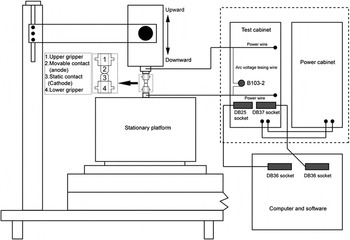
Specimens prepared as described above were processed into an anode and a cathode with a diameter of 3.8 mm and a length of 6 mm by wire electrical discharge machining. The samples’ arc erosion resistance was investigated using a JF04C electrical contact material testing system (Kunming Guiyan Caxa Technology Co., Ltd., Kunming, China) with the anode as the movable contact and the cathode as the stationary contact, as shown schematically in Fig. 1. The electrical contact tests were performed 5000 times at a resistive load with a DC voltage of 25 V and a current of 15 A under a pressure of 0.2 N with an operation frequency of 60 times per minute. The maximum gap between the cathode and anode was 2 mm, and during the electrical contact test, the anode moved downward until it contacted the cathode and then moved upward. The data of arc duration and energy were automatically collected by the JF04C electrical contact material testing system. The mass loss of the contacts before and after arc erosion was determined by measuring the arc erosion using a BS210S photoelectric analytical balance (Sartorius Scientific Instruments (Beijing) Co., Ltd., Beijing, China). The relative transfer mass was determined by the difference of the anode and cathode mass after the electrical contact test. The arc erosion rate was then calculated based on the mass loss of the contacts as shown in formula (3). The morphology of the MgO/Cu composites after arc erosion was characterized using a JSM-5610LV SEM (JEOL Ltd., Tokyo, Japan).
Schematic of the JF04C electric testing system.

The arc erosion rate can be calculated as follows:
 $$\delta = {{\Delta m} \mathord{\left/ {\vphantom {{\Delta m} W}} \right. \kern-\nulldelimiterspace} W}\quad ,$$
where δ is the arc erosion rate of the contact, Δm is the relative transfer mass loss of the contacts, and W is the arc energy.
III. RESULTS AND DISCUSSION
A. Characterization of MgOp/Cu interfaces in MgO/Cu composites
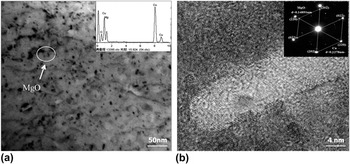
Figure 2 shows the morphology of the MgO phase in the 1.0 vol% MgO/Cu composite fabricated by internal oxidation, and Fig. 2(a) clearly shows uniform dispersal of 5–10 nm MgO particles in the Cu matrix. The calibration results of the electron diffraction pattern indicate that the white regions with black circles are the MgO phase, while the gray regions are the Cu matrix [Fig. 2(a)]. The interfaces between the MgO phase and the Cu matrix were also characterized by TEM, as shown in Fig. 2(b). The interfaces between the MgO phase and the Cu matrix are well joined and both have the same face-centered cubic crystal structure of the Cu matrix and the MgO phase, where the angle of the crystal plane is 60°. The lattice parameters of the Cu matrix and the MgO phase are 0.1278 nm and 0.14891 nm, respectively. The degree of mismatch on the interface of the Cu matrix and the MgO phase was calculated as 14% using the interface mismatch degree formula, Reference Tian and Zhang10–Reference Speight14 suggesting there are semicoherent interfaces between the Cu matrix and the MgO phase.
Morphology of MgO phase in 1.0 vol% MgO/Cu composites (a) MgO particles dispersed in Cu matrix and (b) interface of MgOp/Cu.

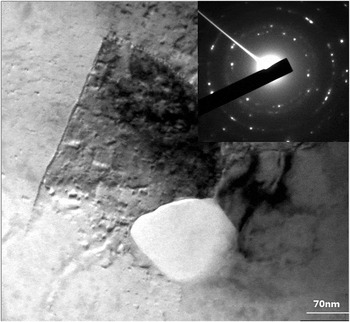
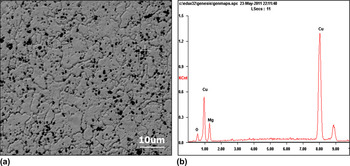
Figure 3 shows the interface between the MgO phase and the Cu matrix of the 1.0 vol% MgO/Cu composite prepared by powder metallurgy. The white round regions of the MgO phase are nearly 100 nm in size. Compared with the 1.0 vol% MgO/Cu composites prepared by internal oxidation [Fig. 2(b)], it is clear that the interface between the Cu matrix and the MgO particles in this preparation is incoherent and suffers from interface pollution. The reason for this is that, powder metallurgy introduces the MgO particles into the Cu matrix by external addition, and this affects the mechanical properties and electrical conductivity of the MgO/Cu composites. In Fig. 4, the SEM and EDS images of the 1.0 vol% MgO/Cu composites fabricated by powder metallurgy show the MgO phase as small black regions and the Cu matrix as gray regions. While the MgO particles in this composite are also uniformly dispersed within the crystal or at the grain boundary of the Cu matrix, the microstructure is loose and less coherent.
Morphology of MgO particles in the 1.0 vol% MgO/Cu composite fabricated by powder metallurgy.

Microstructure of MgO particles in MgO/Cu composites fabricated by powder metallurgy (a) the SEM image and (b) the EDS image.

B. Effect of the MgOp/Cu interfacial bonding state on the hardness and electrical conductivity of MgO/Cu composites
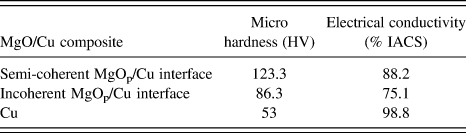
As shown in Table I, the hardness and electrical conductivities of the 1.0 vol% MgO/Cu composites containing a semicoherent MgOp/Cu interface are higher than those of the composites possessing an incoherent MgOp/Cu interface: in fact, the hardness of the composites with a semicoherent MgOp/Cu interface (123.3 HV) is 42.87% higher than that with an incoherent MgOp/Cu interface (86.3 HV). In addition, the electrical conductivity of the composites with a semicoherent MgOp/Cu interface is 17.4% higher compared with those bearing an incoherent MgOp/Cu interface.
Hardness and electrical conductivity of 1.0 vol% MgO/Cu composites.

According to the Madsen rule, Reference Tatar and Özdemir15,Reference Roig and Schoutens16 the resistance of metallic materials arises from their imperfect internal microstructure. The MgOp/Cu interfaces of the MgO/Cu composite prepared by internal oxidation possess semicoherent interfaces, where the atoms and misfit dislocations are arranged periodically [Fig. 2(b)]. A semicoherent MgOp/Cu interface in a copper matrix has a weaker electron scattering effect than an incoherent MgOp/Cu interface, which leads to higher electrical conductivity of the composites with a semicoherent MgOp/Cu interface (Table I). In addition, the introduction of MgO particles destroys the integrity of the copper matrix lattice, which can enhance electron scattering and further decrease the electrical conductivity of the copper matrix. Therefore, the electrical conductivities of both the semicoherent MgOp/Cu interface and incoherent MgOp/Cu interface in 1.0 vol% MgO/Cu composites are lower than those of copper.
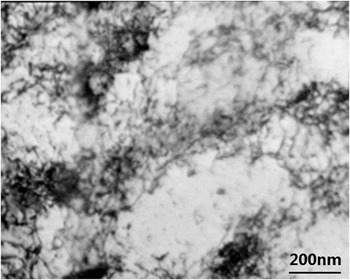
In the MgO/Cu composites with fine MgO particles, the nanoparticles improve the hardness of the composites by hindering the plastic formation. The effect of the Orowan strengthening mechanism Reference Song, Liu, Tian, Dong and Xing2,Reference Ruihua, Kexing, Shuguo, Xiaofeng, Jianxin and Xiuhua17 means that the second phase in the form of the dispersed particles can serve as a source of dislocation and can also exert a pinning effect on dislocations and grain boundaries during deformation. Figure 5 shows the TEM image of the MgO/Cu composite prepared by internal oxidation after 20% cold deformation. It can be seen that the presence of MgO particles can cause the pinning effect of particles on the movement (migration) of boundaries. The well-distributed MgO particles, which are fine and hard with high thermal and chemical stability, are insoluble in the copper matrix. Functioning as dislocation sources, these particles are able to increase the density of dislocations and block the movement of dislocations on grain boundaries and on subboundaries thereby improving the hardness of the MgO/Cu composites. Reference Song, Liu, Tian, Dong and Xing2,Reference Shojaeepour, Abachi, Purazrang and Moghanian18–Reference Song, Xing, Dong, Liu, Tian and Cao21
TEM image of the MgO/Cu composite prepared by internal oxidation after 20% cold deformation.

C. Effect of the MgOp/Cu interfacial bonding state on arc erosion resistance of MgO/Cu composites
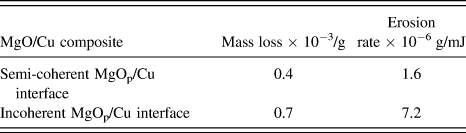
Table II shows the mass loss and arc erosion rate of the 1.0 vol% MgO/Cu composites with a semicoherent and incoherent MgO/Cu interface. Both the mass loss and arc erosion rate of the 1.0 vol% MgO/Cu composite with a semicoherent MgO/Cu interface are less than those of the 1.0 vol% MgO/Cu composite with an incoherent MgO/Cu interface. While the mass loss and arc erosion rate of the incoherent MgOp/Cu interface are 0.7 × 10⁻³ g and 7.2 × 10⁻⁶ g/mJ, the mass loss and arc erosion rate of the semicoherent MgOp/Cu interface are 0.4 × 10⁻³ g and 1.6 × 10⁻⁶ g/mJ, approximately 57% and 22.22% of the incoherent MgO/Cu interface, respectively. As shown in Tables I and II, the variations of mass loss and arc erosion rate of the 1.0 vol% MgO/Cu composites are contrary to the hardness and electrical conductivities of the 1.0 vol% MgO/Cu composites, in which the 1.0 vol% MgO/Cu composites with a higher hardness and electrical conductivities have lower mass loss and arc erosion rate. Thus, the 1.0 vol% MgO/Cu composites with a semicoherent interface have better arc erosion resistance for the higher hardness and electrical conductivities.
The erosion rate and mass loss of 1.0 vol% MgO/Cu composites.
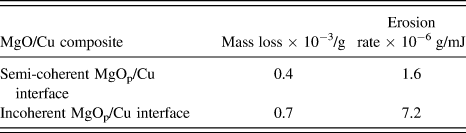
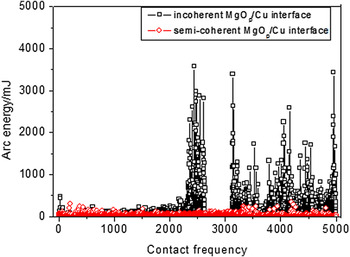
Figure 6 shows the arc energy of the 1.0 vol% MgO/Cu composites with different interface characteristics as a function of the operation time. The arc energy of the 1.0 vol% MgO/Cu composites with a semicoherent MgOp/Cu interface is lower than that of the 1.0 vol% MgO/Cu composites with an incoherent MgOp/Cu interface. While the arc energy of both 1.0 vol% MgO/Cu composites fluctuates during the first 2000 measurements, the arc energy of the composites with an incoherent MgOp/Cu interface increases dramatically during the final 3000 tests, exhibiting a large fluctuation. This indicates that the arc erosion resistance of the composites with a semicoherent MgOp/Cu interface is more stable than that with an incoherent MgOp/Cu interface.
Arc energy of the 1.0 vol% MgO/Cu composites with different interface characteristics.

This observation can be explained as follows: MgO is an insulating ceramic material while Cu is a good electrical conductor but exhibits poor thermal stability in MgO/Cu composites. Wang et al. Reference Wang, Liang, Yang and Fan22,Reference Wang, Liang, Yang and Fan23 suggest that the phase with a low electron work function is the weak dielectric phase, which emits a limited number of electrons. Hence, the arc is easy to concentrate on the area surrounding the MgO particles, and the interface combining the MgO particles and the Cu matrix is important for the arc erosion resistance of the MgO/Cu composites. For the 1.0 vol% MgO/Cu composites prepared by internal oxidation, the semicoherent interface can enhance the bonding strength of the MgO particles and Cu matrix, and the well-bonded interface in the MgO/Cu composite improves the molten viscosity during arcing and decreases the splash of the molten Cu. This is supported by the images of the composite surface erosion morphologies shown in Fig. 7.
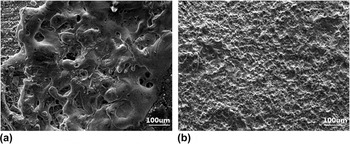
Erosion morphologies of cathodes for MgO/Cu composites prepared by (a) powder metallurgy and (b) internal oxidation.

Figures 7(a) and 7(b) show the morphology of the 1.0 vol% MgO/Cu composite surfaces after arc erosion as a function of 5000 operation times. While large, deep erosion pits form on the contact surface of the 1.0 vol% MgO/Cu composites with incoherent MgOp/Cu interfaces, the erosion pits are shallower and more well distributed for the composites with semicoherent MgOp/Cu interfaces. The boundaries between the erosion pits in both these composites are obscure.
D. The electric erosion mechanism of MgO/Cu composite
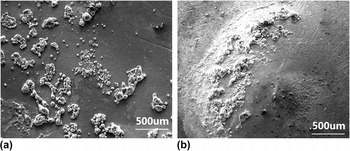
For the electric arc erosion procedure, melting and gasification of the contactor material are the main phase transition processes involved in erosion. Reference Li, Wang, Guo, Yang and Liang24 With the arc heat flux and rising temperature, the molten metal on the contact surface flows in, driving the arc force, producing liquid splashing, and causing large amounts of material loss. In Fig. 8, the surface morphology of the 1.0 vol% MgO/Cu composite fabricated by powder metallurgy after arc erosion reveals copper melting and liquid splashing induced by the arc heat generated at a high temperature that adheres to the sample surface after cooling and solidification.
Erosion surface morphologies of 1.0 vol% MgO/Cu composites fabricated by powder metallurgy (a) cathode and (b) anode.

In the MgO/Cu composite, the dispersed MgO particles and molten copper formed a decentralized system, and Cu is preferentially evaporated during arcing because its boiling point (1356 K) is far below that of MgO (>3125 K). More energy can be released from the surface of MgO/Cu composites with semicoherent MgOp/Cu interfaces because of the well-bonded interface of MgO particles and the copper matrix, resulting in a lower temperature on the erosion surface of MgO/Cu composites with incoherent MgOp/Cu interfaces, and the decrease of the arc energy seen in Fig. 6. Because of its weak interfacial bonding force, it is much easier for MgO/Cu composites with incoherent MgOp/Cu interfaces to be evaporated than MgO/Cu composites with semicoherent MgOp/Cu interfaces during arcing. As seen in Fig. 2, internal oxidation fabrication results in a semicoherent interface between the Cu matrix and the MgO phase of a 1.0 vol% MgO/Cu composite, where the MgO particles and copper matrix are intimately mixed and misfit dislocations are arranged periodically. Therefore, a 1.0 vol% MgO/Cu composite with semicoherent MgOp/Cu interfaces experiences a higher arc erosion resistance than that of a 1.0 vol% MgO/Cu composite possessing incoherent MgOp/Cu interfaces.
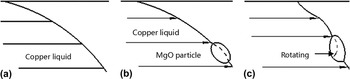
To clarify the arc mechanism of MgO/Cu composites, the dispersed MgO particles can be considered to be suspended in molten copper during the arc erosion procedure (Fig. 9). For comparison, the molten copper matrix without dispersed ceramic particles is shown in Fig. 9(a). The flow of the MgO particles can occur in two different ways when there are dispersed MgO particles in the molten copper matrix. If the force applied to the particles is uniform and they move forward without rotation through a small velocity gradient, the fluid viscosity is increased [Fig. 9(b)]; conversely, if an uneven force is applied, the particles will move forward with rotation [Fig. 9(c)]. During the arc erosion procedure, the fluid flow is partly stored in the MgO particles, which decreases the shearing rate and increases the fluid viscosity of the molten copper matrix; both types of forces will increase the friction resistance of the molten copper matrix, which can reduce liquid metal splashing and material loss of the MgO/Cu composites (Table II).
The flow of molten copper and the dispersed MgO particles (a) molten copper, (b) MgO particles in the molten copper without rotation, and (c) MgO particles in the molten copper with rotation.

IV. CONCLUSIONS
Overall, these results suggest that the MgOp/Cu interfacial bonding state has important effects on the arc erosion resistance of MgO/Cu composites; moreover, the bonding state is largely dependent on the method used to prepare the composite. Internal oxidation results in a semicoherent interface with a 14% mismatch degree between the Cu matrix and the MgO phase in MgO/Cu composites. The electrical conductivity and hardness of these composites are 123.3 HV and 88.2% IACS, which are 42.87% and 17.44% higher, respectively, than those of composites with an incoherent MgOp/Cu interface produced by powder mixing.
We also found that the 1.0 vol% MgO/Cu composites with a semicoherent interface exhibit a low arc erosion rate and small fluctuations of arcing energy. During arcing, a phase transformation occurs from solid to liquid, and the MgO particles dispersed in the molten copper prevent the copper matrix from splashing and enhance the arc erosion resistance of the MgO/Cu composites. Dispersed MgO particles with a high melting point also improve the arc erosion resistance of Cu matrix composites.
ACKNOWLEDGMENTS
This research is supported by the National Natural Science Foundation of China (No. 51605146 and No. U1502274), the International Scientific and Technological Cooperation Project of Henan Province (No. 172102410046), Key Science and Technology Program of Henan Province (No. 172102410046), and the fund of the Guangdong Provincial Key Laboratory for Technology and Application of Metal Toughening (GKL201601).