


In Australia, health curriculum minimum standards were developed in response to the NAHS report which appealed to tertiary institutions to include culturally appropriate and relevant academic content and clinical experience when designing courses relating to the health sciences (Aboriginal & Torres Strait Islander Commission, 1989). The emphasis on Indigenous health as a high priority reflects the current poor health status of Indigenous populations in comparison to non-Indigenous populations and the urgent need to address issues which may directly and/or indirectly impact on the health status of Indigenous Australians (Australian Bureau of Statistics [ABS], 2007; Calma, Reference Calma2006; Couzos & Murray, Reference Couzos and Murray2000; Smith, Reference Smith2005).
The ABS states that Indigenous life expectancy is approximately 17 years less than non-Indigenous Australians (ABS, 2007). The high incidence of Indigenous morbidity and mortality results from mainly preventable causes related to lifestyle factors, social determinants of health and accessibility and acceptability of health services (ABS, 2007; Smith, Reference Smith2005). Social determinants that impact on the health of the majority of Indigenous populations include poor socioeconomic status, high rates of unemployment, limited education, poor nutrition and lack of access to essential health services (Calma, Reference Calma2006; Hetzel, Reference Hetzel2000; Nelson, Allison, & Copely, Reference Nelson, Allison and Copely2006; Saggers, Reference Saggers1993; Smith, Reference Smith2005). These factors are further exacerbated by under or nonuse of existing mainstream health services, and/or compliance to health care interventions, which is largely attributable to the lack of access to culturally appropriate health care services (McGrath, Patton, Haleiwa, & Rayner, Reference McGrath, Patton, Holewa and Rayner2006; Saggers, Reference Saggers1993; Smith, Reference Smith2005; Wong, Haswell-Elkins, Tamwoy, McDermott, & d'Abbs, Reference Wong, Haswell-Elkins, Tamwoy, McDermott and d'Abbs2005).
The development of more appropriate health services is imperative in helping alleviate the poor health status of Indigenous people worldwide, including in Australia. The importance of self-determination in health care delivery has been highlighted by the National Aboriginal Community Controlled Health Organisation (NACCHO, 2013) which has been promoting a model of health care delivery initiated and controlled by local Indigenous communities since its inception in 1975 (NACCHO, 2013). Research suggests that effective health service delivery, specifically in relation to Indigenous populations, begins with bridging the cultural divide between Indigenous people and health professionals (Hetzel, Reference Hetzel2000; Saggers, Reference Saggers1993; Smith, Reference Smith2005).
The practice of ‘cultural safety’ involves achieving flexibility and open mindedness when treating clients from cultures different from one's own, and being culturally sensitive to the political, historical and social forces which may negatively impact on the health and welfare of individuals because of their cultural backgrounds (Gray & McPherson, Reference Gray and McPherson2005; Nursing Council of New Zealand, 1996; Papps & Ramsden, Reference Papps and Ramsden1996). ‘Cultural competence’ is defined as a form of competency which is refined through the development of cultural awareness, sensitivity and safety. While no clear definition exits, to become culturally competent and safe means more than just the accumulation of knowledge and skill about other cultures. It involves attitudinal change, growth and maturity through an ongoing process of personal reflection (Forwell, Whiteford, & Dyck., Reference Forwell, Whiteford and Dyck2001; Gray & McPherson, Reference Gray and McPherson2005; Tremethick & Smit, Reference Tremethick and Smit2009). The foundation for developing culturally competent health practitioners begins with education at an undergraduate level (Flavell, Thackarah, & Hoffman, Reference Flavell, Thackrah and Hoffman2013; Forwell et al., Reference Forwell, Whiteford and Dyck2001; Gray & McPherson, Reference Gray and McPherson2005; Nash, Meiklejohn, & Sacre, Reference Nash, Meiklejohn and Sacre2006).
In meeting the challenge of creating a culturally competent health workforce, the NAHS report has outlined minimum standards for health curricula and included themes around Indigenous history; culture, self and diversity; Indigenous societies, cultures, impact of medical and allied health professions; population health; models of health care delivery and clinical presentations and disease (Aboriginal & Torres Strait Islander Commission, 1989). In 2004, the CDAMS Indigenous Health Curricula Framework (Phillips Reference Phillips2004) was developed to provide medical schools with a clear set of guiding principles, content areas and pedagogical approaches to promote integration of Indigenous content across their curricula. Approaches included the delivery of content by Indigenous staff and partnerships with Indigenous communities (Phillips, Reference Phillips2004). More recently, an initiative by Universities Australia has seen the publication of a ‘Nation Best Practice Framework for Indigenous Cultural Competency’ which aims to assist in the embedding of cultural competency in the wider higher education sector (Universities Australia 2011). This framework targets pathways for enabling increased numbers of Indigenous students and staff at tertiary institutions as well as equipping non-Indigenous graduates with knowledge and skills required to provide effective service to Indigenous communities. Consequently, many Australian tertiary institutions are developing institutional wide responses to the inclusion of Indigenous content, with ‘Indigenous Studies’ now emerging as an expanding and discrete discipline (Barney, Shannon & Nakata, Reference Barney, Shannon and Nakata2014; Norman, Reference Norman2014).
However, the incorporation of Indigenous content into health education curricula can be problematic. Due to differences in Western and Indigenous perspectives, it is not possible just to ‘plonk (Indigenous content) into a curriculum unproblematically’ (Nakata, Reference Nakata2007, p8). Navigating the ‘cultural interface’— the contested space between Western and Indigenous knowledge systems — requires careful consideration and design of a sequential programme that presents Indigenous perspectives rather than an ‘add on’ or token inclusion of content ‘about’ Indigenous culture (Nakata Reference Nakata2011, p7). A danger of teaching ‘about’ culture is that is can create a view of culture that is static and stereotypical. Furthermore, as Indigenous Australians are one of the most underrepresented groups in Australian tertiary institutions, Indigenous content is often taught by non-Indigenous academics, lessening opportunities for incorporation of Indigenous perspectives (Norman Reference Norman2014).
Several approaches to inclusion of Indigenous perspectives into health related curriculum have been proposed including the creation of a compulsory unit taught in partnership with Indigenous community members across all health disciplines (Flavell et al., Reference Flavell, Thackrah and Hoffman2013; Kickett, Hoffman & Flavell, Reference Kickett, Hoffman and Flavell2014), embedded immersion experiences for both academics and students (Dury, Linn & Thompson, Reference Dury, Lin and Thompson2013; Tremethick & Smit, Reference Tremethick and Smit2009) and ‘integrated’ curriculum content that may be incidental or deliberate. A lack of consistency and a lack of evaluation of effectiveness are key criticisms of current practice.
Occupational therapy is an allied health profession concerned with promoting health and wellbeing across a wide spectrum of the lifespan, contexts and conditions. Occupational therapists work to enable people to participate in the activities of daily life (World Federation of Occupational Therapists, 2011). To deliver holistic and client centred occupational therapy services to Indigenous Australians, clinicians must understand the unique link between history, Indigenous identity and subsequent occupational needs (Hetzel, Reference Hetzel2000; Saggers, Reference Saggers1993). Implications for occupational therapy practice include the professional obligation and responsibility to develop specific personal and professional ‘culturally safe’ skills to ensure engagement with Indigenous people through mutual respect and understanding. The practice of client centred and holistic health care acknowledges the historic power imbalances within the therapist–client relationship and aims to correct this. (Gray & McPherson, Reference Gray and McPherson2005; Papps & Ramsden, Reference Papps and Ramsden1996). There is little research specifically relating to the inclusion of Indigenous themes in undergraduate occupational therapy curricula and in relation to Indigenous populations and occupational therapy practice generally.
This study set out to determine the amount, type and effectiveness of current Indigenous content in an occupational therapy curriculum at an Australian regional university and the progress in meeting the NAHS minimum standards (Aboriginal & Torres Strait Islander Commission, 1989). The study also sought to explore academic teaching staff perceptions and experiences in relation to the inclusion and delivery of Indigenous themes. Findings of this research will identify potential barriers to effective integration of Indigenous perspectives into health curricula.
Method
A sequential mixed method approach was used which involved the collection of both quantitative and qualitative data (Creswell, Reference Creswell2009). This design was chosen as it is well suited to address the complexity of the study focus (Creswell, Reference Creswell2009). Quantitative data were collected initially by a survey followed by in-depth interviews of some survey participants.
Survey Design & Recruitment
The survey aimed to provide frequency data in addition to gathering descriptive information to assist with building a detailed profile of the current occupational therapy course curriculum in relation to the inclusion of Indigenous content. The survey used closed-choice questions including Likert scales (rated from 1–7). Likert scales were used in relation to how adequately trained academic staff believed they were to deliver Indigenous content; how confident they felt delivering Indigenous content; how prepared they felt in delivering Indigenous content; how important they believed it was to include Indigenous course content in occupational therapy curriculum; how much they believed students benefitted from including Indigenous content in curriculum; and to what degree they believed cultural content in course curriculum would enhance student development of cultural competence. Opportunity was provided for open ended responses allowing participants to expand their responses in their own words. The survey was piloted to refine questions before distribution.
A purposive sampling method was used and 33 academic staff were identified for recruitment. These staff were from several different disciplines, including occupational therapy, physiotherapy, sports and exercise science, public health and speech pathology, and were employed to teach into the occupational therapy curriculum on a full-time, part-time or casual basis. Participants were initially recruited via an interdepartmental email informing them of the research subject matter and inviting their participation. The participants were then forwarded the survey for completion and an anonymous collection point arranged. A follow-up email was sent to participants three weeks following distribution. The survey yielded a completion response rate of 67 per cent (total n = 21).
Qualitative Interview Design & Recruitment
Following an initial analysis of data from the survey, seven participants were selected from the survey participants via a maximal variation sampling method which aimed to capture a diversity of characteristics, experience and opinions (Patton, Reference Patton2002). Interview participants were sent an email inviting participation. Five participants agreed to be interviewed. The purpose of the interview was to explore in more depth the diverse variations in emerging themes from the survey data. The researcher utilised in-depth, open ended questions to encourage the interview participants to explore their personal experiences of delivering indigenous course content and reflect on aspects they found relevant. Interviews also explored possible initiatives for improvement to current Indigenous course content within occupational therapy curriculum. Interviews took approximately 30 minutes to complete and were recorded and transcribed verbatim.
Ethics approval was received from the university prior to participant recruitment. Informed consent confirming participant confidentiality was obtained from all survey and interview participants.
Data Analysis
Surveys — Closed Question Data Analysis
The Statistical Package for Social Sciences (SPSS), Version 13 was used for quantitative data analysis. The descriptive statistics were used to explore the numerical and categorical characteristics and the corresponding summary statistic and measure of dispersion was examined. Graphical displays were also explored using bar graphs of specific and relevant descriptive statistics. With survey data, Likert scales were collapsed into sections to reflect positive or negative aspects of the perceptions to each question; negative aspects being rated Likert 1–3, Likert 4 being deemed average or neutral and Likert 5–7 being rated positive.
Qualitative Survey & Interview Data Analysis
Thematic coding was used to identify similar themes within the qualitative responses to open-ended survey responses. A cross case analysis method was used to organise, describe and summarise interview data and incorporated data from observation and field notes. Further analysis of interview data was undertaken by formulating a cross-classifying matrix, which identified, classified and summarised dominant thematic statements (Patton, Reference Patton2002).
Methodological Issues
Surveys
Self-selection bias may have occurred given the 67 per cent response rate. Participants may have taken part in the research because they held previous positive or negative preconceived opinions and/or influencing experiences in relation to the research topic. Despite missing 33 per cent of the overall target group, there was an adequate response rate for subject coordinators from within the occupational therapy programme (77 per cent of all subject coordinators participated). Therefore, survey data provided an accurate opinion of those who influence curriculum development and have contributed to the inclusion of Indigenous course content.
Qualitative Interviews
The sampling method ensured views reflected the diversity of experience and skill of the target group. As there is potential for conflict in the ‘contested space’ of Western and Indigenous knowledge interface (Nakata, Reference Nakata2011), it is acknowledged that participants may have felt uncomfortable expressing personal views. In order to limit bias and researcher influence and enhance the trustworthiness of the data the researcher took great care to ensure the research questions were not of a leading or limiting nature. The study is further strengthened through the use of multiple methods of data collection and analysis (Patton, Reference Patton2002).
Findings
Demographics
The professional backgrounds and disciplines of research participants varied as did the level of skill and experience. The survey participants included educators from occupational therapy [n = 9, 43 per cent]; physiotherapy [n = 5, 24 per cent]; sports and exercise science [n = 2, 9 per cent] and ‘other’ [n = 5, 24 per cent; speech pathology and various public health disciplines). The years the participants were first professionally registered ranged from 1971 to 2005 and the time employed at the regional university ranged from 1.5 months to 7 years. Employment status consisted of 20 per cent tutor/casual; 50 per cent lecturer; 25 per cent senior lecturer and 5 per cent ‘other’ (academic advisor; research fellow; fieldwork coordinator). Fifty-five percent of all participants stated that they were subject coordinators.
The five interview participants consisted of educators with professional backgrounds in public health, occupational therapy and physiotherapy. The participants were chosen based on variations in age, skill, experience and professional backgrounds.
Summary of Findings
Analysis of data from surveys and interviewers revealed the following themes:
-
1. The lack of confidence and preparedness of educators related to lack of Indigenous cultural training and/or experience.
-
2. Educators recognition of the importance of including Indigenous content in occupational therapy curriculum because of:
-
• the geographical location and rural and remote context of the regional university in this study;
-
• the contribution to the development of student cultural competence; and
-
• the need to address the current poor health, barriers to health care access and health inequalities experienced by many Indigenous individuals and populations.
-
-
3. The need for a strategic and planned approach to Indigenous curriculum development to:
-
• ensure a coordinated and integrated delivery of Indigenous themes and concepts across subjects over the four year curriculum.
-
• increase the sophistication of Indigenous themes to coincide with the development of student maturity and cultural competence.
-
Theme 1: Lack of Confidence and Training of Educators
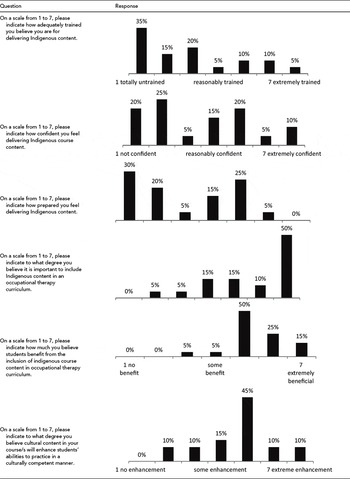
Seventy percent of survey participants recorded feeling less than ‘reasonably trained’ (Likert rated 1–3) in delivering Indigenous course content. Fifty percent of survey participants indicated that they were less than ‘reasonably confident’ (Likert rated 1–3) in delivering Indigenous course content and 55 per cent stated that they believed they were less than ‘reasonably prepared’ (Likert rated 1–3) to deliver Indigenous course content (Table 1).
NAHS Suggested Minimum Standards of Indigenous Content about which Participants Felt Most and Least Informed
The qualitative interviews highlighted that educators felt that they were less confident in delivering Indigenous content, as they were not from Indigenous backgrounds. Participants stated that they would either require assistance from Indigenous teaching staff when delivering the content, or recommended that Indigenous themes be taught solely by an independent Indigenous educator. As one lecturer stated:
I feel like that sometimes I have delivered Indigenous content, and in the back of my mind I would be saying “I don't think I am the right person to be doing this. . . you have got to have someone with really good knowledge and experience in that area. (P 1).
Participants discussed how cultural training would increase not only their knowledge and skills but also their confidence when delivering Indigenous themes to students. One participant thought that cultural training:
. . .should be part of our induction that you go over the cultural awareness training in your first year and it is offered a couple of times a year. . . I think [this] should be mandatory, particularly as a faculty our direction is getting towards at risk populations and underserved populations. . . (P 3).
The development of cultural competence through ongoing life experience and professional experience was also identified by participants as an important component in confidence when delivering Indigenous content. Participants stated that it was difficult to understand, and therefore deliver Indigenous themes, especially in relation to cultural differences, when they had little or no first-hand experience working with Indigenous communities and individuals.
. . .It wasn't until I got a job with a [government health service] and went to a cross cultural course, and then became a cross cultural facilitator that I started to ‘get it’ and understand why it was so important to know about the cultural stuff and how you apply that to your teaching or your work or your interactions with Indigenous people. . .(P 4).
“. . .I think it would be very hard to talk about Indigenous issues . . .unless you had actually been out there, seen it, worked in it and have an understanding. . .” (P 3).
Theme 2: Importance of Indigenous Content in Occupational Therapy Curriculum
Ten undergraduate subjects within the occupational therapy curriculum were identified as including Indigenous content (from 30 available over the four year course curriculum). Possible Indigenous content was also identified in clinical/fieldwork placement subjects and the honours subjects; however, the amount was dependent on the specific placement or project. Survey questions also aimed to specify the amount and type of NAHS ‘minimum standards’ content (Aboriginal & Torres Strait Islander Commission, 1989) being taught. All relevant Indigenous content areas were identified by participants as being present. The minimum standards content most frequently identified were culture self and diversity (24 per cent), population health (20 per cent) and models of health care delivery (20 per cent). The least often identified minimum standards content included Indigenous history (12 per cent), clinical presentations and disease (12 per cent) and Indigenous societies, cultures (12 per cent).
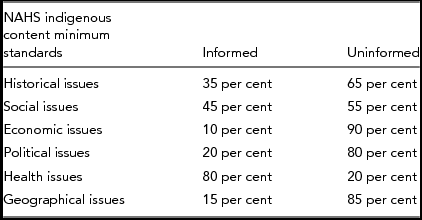
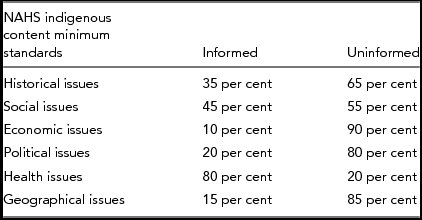
Eighty percent of survey participants indicated they were most informed about Indigenous health issues, in comparison to the rest of the identified issues. Participants felt least informed about economic issues (90 per cent), geographical (85 per cent) and political issues (80 per cent; Table 1).
Seventy-five percent of survey participants indicated that they believed it was more than ‘reasonably important’ (Likert 5–7) to include Indigenous content in the curriculum. The geographic location of the regional university and its role in providing a rural and regional health workforce was identified as an important consideration regarding the inclusion of Indigenous content (Table 2).
Participant Perspectives on Indigenous Cultural Content an Occupational Therapy Curriculum (Collated Responses to Likert Scales)

Ninety percent of participants indicated that they felt there would be more than ‘some benefit’ (Likert 4–7) for students from the inclusion of Indigenous content in the curriculum (Table 2). Sixty-five percent believed that, with the inclusion of Indigenous content, there would be more than ‘some enhancement’ (Likert 5–7) in students’ abilities to practice in a culturally competent manner (Table 2).
Theme 3: Strategic and Coordinated Delivery of Indigenous Content
Survey results showed the most commonly used teaching modalities were discussion (used nine separate times), case studies (used eight separate times), tutorials (used seven separate times) and lectures (used seven separate times; Table 3).
Teaching Methods used to Deliver Indigenous Content Across Four Years of an Occupational Therapy Curriculum

Open-ended interview questions probed two approaches to the inclusion of Indigenous content; ‘embedding’ or ‘stand-alone’ content. Four out of five interview participants thought that the inclusion of Indigenous content should be embedded throughout the curriculum, as opposed to delivering a one off stand-alone subject which incorporates Indigenous themes. There was a general consensus amongst interview participants that a strategic approach to the delivery of Indigenous content was needed to ensure a coherent and cohesive integration over the four year curriculum. As one participant identified, such an approach would:
. . .make sure we are not repeating what other people do. [Currently] it comes down to individual lecturer priority I think rather than a proper staged more strategic approach, which it should have. (P 4).
Embedding Indigenous content also allowed for a progression of knowledge over time as students mature. Scaffolding content over four years would minimise students becoming unnecessarily overwhelmed with the confronting nature of the themes. It would also support students to develop self-reflection and awareness of own beliefs and assumptions over time assisting in the development of cultural competence, rather than a focus on simply ‘passing a subject’.
. . . it (Indigenous content) needs to be considered in all those different subjects. . . because I think students - if it is just put in one subject, like the health promotion subject, students think ‘oh yeah I've done that, ok I have passed that subject’, and don't think about it until they go out and practice and then realize . . .its importance. I think if it is embedded throughout it would be better. (P 2).
Mapping the progression of cultural content throughout the curriculum was identified as an important step to assist with this embedding.
. . . what I think you need to do is a mapping exercise, so it's just basically looking at every single subject offered within each program and identifying what content is delivered and how it is delivered whether it is linked to any assessment. . . and then identifying the gaps where it needs minimum standards and finding the spot where it should go. . . (P 1)
Participants also discussed alternative models for delivering Indigenous course content including cultural immersion experiences, cultural awareness days and student fieldwork experience with Indigenous individuals and communities.
Discussion
Research suggests that effective health service delivery in relation to Indigenous populations begins with bridging the cultural divide between Indigenous people and health professionals (Hetzel et al., Reference Hetzel2000; Smith, Reference Smith2005 and Nelson et al., Reference Nelson, Allison and Copely2006) and self-determination and control by Indigenous communities (NACCHO, 2013). It is therefore imperative that the foundation for developing culturally competent health practitioners begins with appropriate education at university level (Forwell et al., Reference Forwell, Whiteford and Dyck2001; Gray & McPherson, Reference Gray and McPherson2005; Nash et al., Reference Nash, Meiklejohn and Sacre2006; Pope-Davis, Preito, Whitaker, & Pope-Davis, Reference Pope-Davis, Preito, Whitaker and Pope-Davis1993). Health educators have a responsibility to develop course curriculum that ensures culturally safe skills are acquired before graduate students undertake employment with Indigenous individuals and populations (Forwell et al., Reference Forwell, Whiteford and Dyck2001; Nash et al., Reference Nash, Meiklejohn and Sacre2006; Pope-Davis et al., Reference Pope-Davis, Preito, Whitaker and Pope-Davis1993).
Preparing the Educators
This study identified that non-Indigenous educators did not view themselves as the best people to be delivering Indigenous content and lacked confidence and experience. Participants indicated that they felt most informed about Indigenous health issues and less knowledgeable about other identified social determinants of health. Participants consistently acknowledged the importance of including Indigenous content, as well as an interest in and willingness to learn more about Indigenous issues in order to improve their knowledge in relation to Indigenous populations.
This willingness aligns well with the identified need within health related tertiary education for non-Indigenous academic staff to build the necessary skills and confidence to teach Indigenous content in a culturally respectful way (Flavell et al., Reference Flavell, Thackrah and Hoffman2013). An important first step in developing cultural competent health practitioners is to provide educators with the necessary cultural competence training, education and support to effectively and confidently deliver Indigenous themes to students throughout the curriculum (Dury, Lin & Thompson, Reference Dury, Lin and Thompson2013; Nash, et al., Reference Nash, Meiklejohn and Sacre2006; Pope-Davis et al., Reference Pope-Davis, Preito, Whitaker and Pope-Davis1993).
Participants in this study suggested staff training days as ways to address their lack of confidence with Indigenous content material. There is little research available about how best to prepare culturally competent health educators. Dury, Lin and Thompson (Reference Dury, Lin and Thompson2013) investigated the impact of situated learning immersion for academics in a remote area of Western Australia and found the experience encouraged critical reflection and resulted in increased knowledge and changes in teaching practice. They concluded that situated learning experiences suited the multilayered nature of learning and understanding this area requires and highlighted the need for research into how best to prepare non-Indigenous educators to deliver Indigenous content.
Incorporating Indigenous Perspectives
A positive finding of this study was that the curriculum audit showed that all relevant areas of Indigenous content as outlined by the NAHS ‘minimum standards’ were identified as being taught. While identifying that teachers need good resources for developing Indigenous content, Nakata (Reference Nakata2011) cautions that Indigenous content does not equate to Indigenous perspectives which are ‘about more than content’ and related to Indigenous narratives (p 7). The CDAMS Framework recommends learning experiences and interactions with Indigenous people as a key pedagogical strategy in curriculum development for medical programmes and also suggests including Indigenous people in the design, delivery and evaluation of curriculum content (Phillips Reference Phillips2004). The importance of giving Indigenous people control over health services is stressed by the National Aboriginal Community Controlled Health Organization (NACCHO, 2013) and control over curriculum information and content would align with this intent. The inclusion of Indigenous perspectives have been successfully implemented in health sciences courses through partnering with Indigenous lecturers, tutors and community members (Flavell et al., Reference Flavell, Thackrah and Hoffman2013).
Although survey results showed that the most commonly used teaching modalities were discussion, case studies, lectures and tutorials, the qualitative interviews indicated that educators believe that the inclusion of experiential learning experiences would benefit the development of student cultural competence and allow for opportunities of self-reflection. Some of the learning initiatives suggested were cultural immersion experiences which include the implementation of compulsory cultural awareness programs run by Indigenous people who would share Indigenous cultural traditions including language, communication, food and customs with undergraduate students. The use of cultural immersion techniques has led to moderate to large gains in student knowledge and comfort with different cultures (Caffrey, Neander, Markle & Stewart, Reference Caffrey, Neander, Markle and Stewart2005; Tremethick & Smit, Reference Tremethick and Smit2009).
An Integrated Curriculum
Participants suggested that the inclusion of Indigenous content in current curriculum may be improved by introducing an integrated approach to curriculum development. Such an approach would include embedding Indigenous themes throughout the curriculum, as opposed to offering a stand-alone subject. Nakata (Reference Nakata2011) supports an approach where the inclusion of Indigenous content is planned and sequential so that students accumulate an increasing and deepening knowledge and understanding. Waitere-Ang (Reference Waitere-Ang, Adams, Openshaw and Hamer2005) cautions against an approach in which intercultural content is added to a curriculum without a deep engagement with the material as this does not challenge students’ existing beliefs and attitudes. The use of a threshold concept framework has also been suggested as a way to conceptualise and address Indigenous content and perspectives (Page, Reference Page2014). A threshold concept framework deals with knowledge that is often ‘troublesome’ involving difficult or challenging concepts but if worked through is transformative for the student (Page, Reference Page2014).
Incorporating Indigenous content to coincide with both the sophistication of Indigenous themes and the development of student maturity and capacity to understand them, has also been suggested by research participants. A study by Gray and McPherson (Reference Gray and McPherson2005) supports this suggestion and highlights that experience and maturity are important for the development of attitudinal changes necessary for the achievement of cultural safety. Embedding content throughout a four year undergraduate degree also allows for ongoing opportunities for self-reflection by students and is a key component in the development of cultural competency.
Initiatives suggested by participants in this study are advocated and described by models of cultural curriculum development such as ‘The Cross, Bazron, Dennis and Isaacs Model’ (Campinha-Bacote, Reference Campinha-Bacote2002). This model outlines five interdependent constructs within the curriculum: cultural awareness; knowledge; skill; encounters and cultural desire (Campinha-Bacote, Reference Campinha-Bacote2002). Participation in experiences embedded in the curriculum, provides graduates the opportunity progressively develop cultural proficiency (Campinha-Bacote, Reference Campinha-Bacote2002). In ‘The Yapunyah Project’, undertaken by Nash et al. (Reference Nash, Meiklejohn and Sacre2006), aspects of this existing model, along with their own research, were used to revise curriculum across four separate schools within a faculty at Queensland University of Technology, Australia, in order to enhancing the cultural competence of their graduates. The National Best Practice Framework for Indigenous Cultural Competency (Universities Australia, 2011) also provides a model, adapted from one used with Native American social workers, as a starting point for mapping indigenous content across a curriculum. This model highlights the need for cumulative learning experiences over extended periods of time rather than ‘ad hoc’ workshops (p 251).
While there is increasing literature relating to the development of cultural competency in health students generally, there is little research specifically relating to the inclusion of Indigenous themes in undergraduate occupational therapy curriculum. This omission is particularly concerning given the social justice and human rights philosophies that underpin occupational therapy practice (Australian Association of Occupational Therapists, 2005). A recent paper has advocated for the need for the occupational therapy profession to have a more coordinated effort to work more effectively with Indigenous Australians through practice guidelines, education, research and improved collaboration (Nelson et al., Reference Nelson, Gray, Jensen, McKintosh, Oke, Thomas and Paluch2011). The literature from other health professions and innovative projects, such as ‘The Yapunyah Project’(Nash et al., Reference Nash, Meiklejohn and Sacre2006), provide good direction for the development of a coherent, integrated and planned approach to embedding Indigenous content in partnership with Indigenous academics, tutors and competent educators and graduates in occupational therapy is indicated.
Conclusions
The development of culturally competent health practitioners is an ongoing process which begins with student orientation and experience (Forwell et al., Reference Forwell, Whiteford and Dyck2001; Gray & McPherson, Reference Gray and McPherson2005; Nash et al., Reference Nash, Meiklejohn and Sacre2006; Pope-Davis et al., Reference Pope-Davis, Preito, Whitaker and Pope-Davis1993). Facilitation of culturally competent course curriculum ensures that culturally safe skills are acquired before graduates undertake employment with Indigenous individuals and populations (Forwell et al., Reference Forwell, Whiteford and Dyck2001; Nash et al., Reference Nash, Meiklejohn and Sacre2006; Pope-Davis et al., Reference Pope-Davis, Preito, Whitaker and Pope-Davis1993). It is important for all health professionals to have background knowledge of aspects of Indigenous health, culture, history and society which may affect professional communication and interactions with Indigenous people.
This study was undertaken in order to determine the amount, type and effectiveness of current Indigenous content in an occupational therapy programme at an Australian regional university, from the perspective of academic teaching staff. Findings showed that although all the Indigenous content areas from the ‘minimum standards’ were covered in the curriculum, significant improvements could be made. Findings illustrate the need for cultural competence training for educators, partnering with Indigenous people to ensure Indigenous perspectives are heard, the strategic planning for an integrated embedding of Indigenous cultural content and inclusion of a variety of learning experiences including immersion in cultural/clinical experiences. Future research is indicated in investigating and evaluating the most effective practices for cultural competency development in both educators and students.
About the Authors
Belinda Melchert undertook this research as part of an Honours Degree in Occupational Therapy. She is currently working as an occupational therapist in North Queensland, Australia.
Professor Marion Gray is currently the Associate Dean of Research for the Faculty of Science, Health, Education and Engineering and Discipline Leader of Occupational Therapy and Leader for the Cluster for Health Improvement at the University of the Sunshine Coast, Queensland. She undertook her undergraduate study in occupational therapy before undertaking postgraduate study in ethics and public health all in Otago, New Zealand. Prof Gray completed her postdoctoral training in environmental epidemiology at the Armed Forces Institute of Pathology in Washington DC before taking up a teaching and research position for five years at James Cook University, followed by the University of the Sunshine Coast. Her research interests include allied health education and practice, Indigenous health, chronic disease management and prostate cancer epidemiology, diagnosis and treatment.
Professor Adrian Miller is of the Jirrbal people of North Queensland and is the Professor of Indigenous Research at Griffith University leading the Indigenous Research Network. His previous appointments include Professor and Head of School at Southern Cross University's College of Indigenous Australian Peoples, Senior Lecturer at James Cook University, Founding Head of the Department of Indigenous Studies at Macquarie University and Deputy Head of School at James Cook University's School of Indigenous Australian Studies. Professor Miller has a research track record in competitive grants with both ARC and NHMRC grant schemes.