I. INTRODUCTION
Recently, much attention has been focused on ferroelectric materials with high pyroelectric effect and their applications. Infrared detectors made using ferroelectric materials are widely used in fire alarms, thermal imaging, and intruder detectors because of their high temperature stability, high sensitivity, and low cost.Reference Jin, Auner, Naik, Schubring, Mantese, Catalan and Micheli1–Reference Liu, Li, Wu, Wang, Di, Lin, Zhao, Luo and Neumann3 As we know, temperature dependence of either polarization or relative permittivity of ferroelectrics can be used for the infrared detectors. The former effect is referred to the traditional pyroelectric detector and the latter one is for dielectric bolometer.Reference Wu, Li, Zhu, Liu and Zhang4–Reference Watton and Todd6 Compared with the pyroelectric materials in the first mode, those in the dielectric mode can operate near the transition temperature, and the transition temperature can also shift with the variation in applied electric field.Reference Yoon, Hwang and Kang7 In this mode, the pyroelectric coefficient can be written asReference Whatmore8

where D is the dielectric displacement, T is the temperature, P s is the spontaneous polarization, E is the applied electric field, ε 0 is the permittivity of free space, and ε r is the permittivity of pyroelectric materials. From the pyroelectric equation, it can be known that to achieve a high pyroelectric coefficient, the slope of the dielectric peak must be very steep near Curie temperature under a dc bias field.
Lead zirconate stannate titanate (PZST) has been identified as a promising pyroelectric material because its dielectric constant shows a sharp maximum at the Curie point and the dielectric peak is steeper under a dc bias field.Reference Yang and Payne9 However, high Curie temperature strongly limits its widespread application. Tuflin et al.Reference Tuflin, Shvartsman, Kaleva and Politova10 and Cross and coworkersReference Park, Markowski, Yoshikawa and Cross11 reported that when Ba2+ ions replaced some of the Pb2+ ions in PZST, the Curie temperature decreased with the increase in Ba2+ concentration. So this provides a possibility for preparing infrared detectors with high pyroelectric response and low Curie temperature. However, this dielectric response came across a problem that when Ba2+ concentration is enough high, the dielectric constant would decrease obviously, and the dielectric peak would also display broadening, which is bad for the improvement of pyroelectric response.Reference Zhang, Xu, Feng and Yao12–Reference Ujma, Handerek, Paweeczyk and Dmytrow13 In previous works, we found that for Pb0.97La0.02(Zr0.70Sn0.15Ti0.15)O3 ceramics, when A-site is modified with 10 and 17% Ba2+, the maximal pyroelectric coefficients are 14,000 and 2500 μC/m2K, and the corresponding pyroelectric peaks are 85 and 18 °C, respectively. However, the Curie temperature of the former is too high, and the pyroelectric coefficient of the latter is too low. The disadvantage limits the application of the materials. In this article, to achieve high pyroelectric coefficient and low Curie temperature, we demonstrated a mixed (Pb0.87−0.07xBa0.10+0.07x)La0.02(Zr0.7Sn0.15Ti0.15)O3 ceramics, and the dielectric and pyroelectric properties of this kind of mixed ceramics were also studied.
II. EXPERIMENTAL PROCEDURE
A conventional ceramic process was used to prepare (Pb0.87−0.07xBa0.10+0.07x)La0.02(Zr0.7Sn0.15Ti0.15)O3 (x = 0, 0.35, 0.65, 0.75, 1) ceramics. PbO, BaCO3, La2O3, TiO2, ZrO2, and SnO2 with the purity of over 99% were used as starting materials. Pb0.87La0.02Ba0.1(Zr0.70Sn0.15Ti0.15)O3 and Pb0.80La0.02Ba0.17(Zr0.7Sn0.15Ti0.15)O3 powders were prepared at first. These two kinds of powder were ball milled for 4 h and then calcined in sealed Al2O3 crucibles at 900 °C for 3 h, separately. After calcinations, they were weighed according to the above mentioned stoichiometric formula and were ball milled again for 4 h. The dried mixtures were added with polyvinyl alcohol (PVA) as a binder for granulation and pressed to form 15-mm diameter and 0.8-mm thickness disks. After burning off the PVA, the pellets were sintered at 1200–1240 °C for 3 h with a double crucible method in air. Silver paste was fired on both sides of the samples at 550 °C for 10 min as electrodes.
The dielectric properties with variation in temperature and dc bias field were measured at 1-kHz frequency using a LCR analyzer (HP 4192; Hewlett Packard Ltd., Palo Alto, CA). The pyroelectric behavior was determined by a modified Byer-Roundy method.Reference Chen, Yao and Cross14 For this method, the sample in series with a dc bias field was connected to a picoammeter Keithley 6485 (Keithley Instruments Inc., Cleveland, OH) and was heated in a temperature chamber. The temperature increased at a speed of 2 °C/min, which could be achieved under process control. Pyroelectric coefficient, which was proportional to the current, could be measured directly.
III. RESULTS AND DISCUSSION
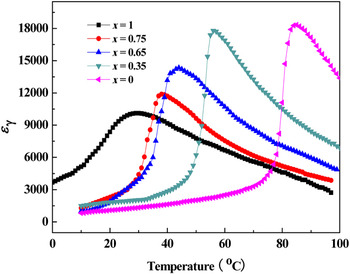
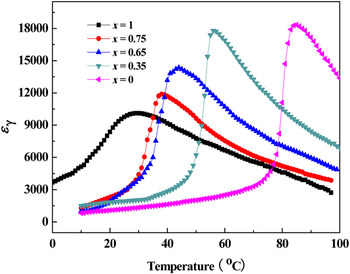
Figure 1 shows the variation in the dielectric constant of (Pb0.87−0.07xBa0.10+0.07x)La0.02(Zr0.7Sn0.15Ti0.15)O3 specimens as a function of temperature and Pb0.80La0.02 Ba0.17(Zr0.70Sn0.15Ti0.15)O3 content. With the amount of Pb0.80La0.02Ba0.17(Zr0.7Sn0.15Ti0.15)O3 increasing from 0 to 1, the temperature of the dielectric maximum (T max) decreases from 85 to 25 °C and the dielectric constant at T max decreases from 19,000 to 10,000.
Dielectric constant of (Pb0.87−0.07xBa0.10+0.07x)La0.02(Zr0.7Sn0.15Ti0.15)O3 specimens as a function of temperature and Pb0.80La0.02 Ba0.17(Zr0.75Sn0.15Ti0.15)O3 content.
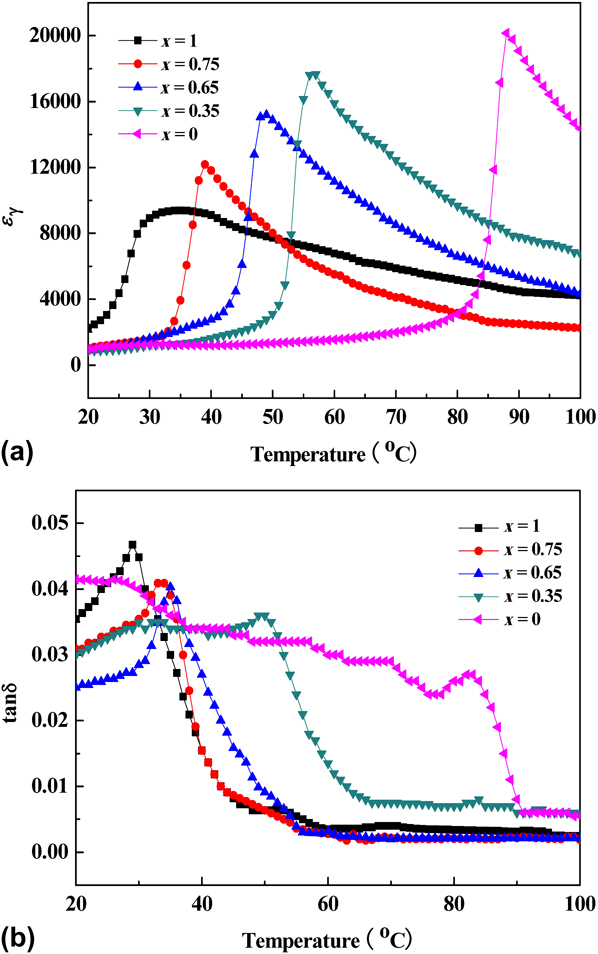
The dielectric constant and dielectric loss of (Pb0.87−0.07xBa0.10+0.07x)La0.02(Zr0.7Sn0.15Ti0.15)O3 ceramics with the variation in temperature and Pb0.80La0.02Ba0.17(Zr0.7Sn0.15Ti0.15)O3 content under a 400 V/mm dc bias field are shown in Figs. 2(a) and 2(b), respectively. The maximum dielectric constant increases and the dielectric peak becomes steeper under a 400 V/mm dc bias field when x is less than 1. However, for x = 0, 0.35, 0.65, and 0.75, when a 400 V/mm dc bias field is applied, the dielectric constant of the specimens decreases. These responses can be modeled using a standard phenomenological theory via free energy (G) expansion of the transitionReference Zhong15:


(a) Dielectric constant and (b) dielectric loss of (Pb0.87−0.07xBa0.10+0.07x)La0.02 (Zr0.7Sn0.15Ti0.15)O3 ceramics with the variation in temperature and Pb0.80La0.02Ba0.17(Zr0.7Sn0.15Ti0.15)O3 content under a 400 V/mm dc bias field.
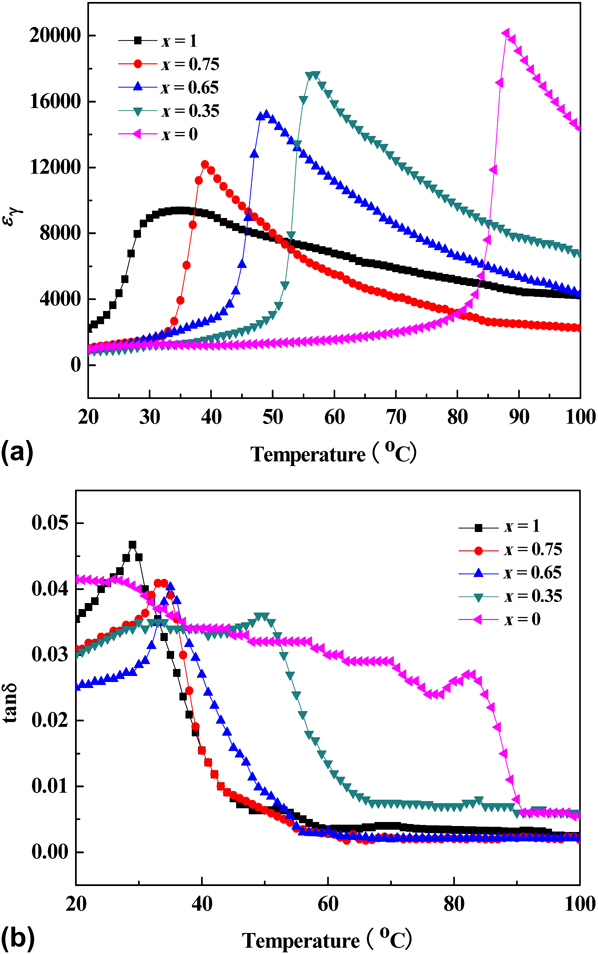
where P sc is the spontaneous polarization at T c. Under no field, α 0 = (ε 0C)−1, where C is the Curie constant. The coefficients of α, β, and γ are dependent on the order of phase transition. Previous results have indicated that when the amount of Ba2+ is less, the ceramics undergo a first-order phase transition.Reference Ujma, Handerek, Paweeczyk and Dmytrow13, Reference Pokharel and Pandey16 It has been known that for the first-order transition, α > 0, β < 0, and γ > 0. When bias field E > 0, the field-induced dielectric constant and the transition temperature both increase with the increasing of E. However, with the increase in Ba2+ amount, the ceramics gradually become relaxor ferroelectric and undergo a second-order phase transition. For the second-order transition, α > 0, β > 0, and γ > 0, according to Eq. (1), with the increasing of E, the field-induced dielectric constant would decrease and the transition temperature would increase. Figure 2(b) shows the dielectric loss against the content of Pb0.80La0.02 Ba0.17(Zr0.7Sn0.15Ti0.15)O3. Dielectric loss shows little variation with the content, which is below 0.75. However, when the content increases to 1, the loss increases slightly.
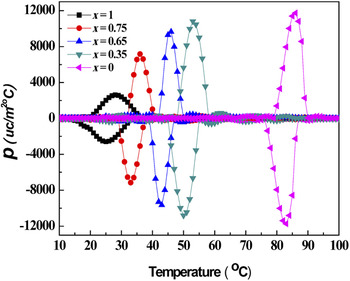
Figure 3 shows the reversible response of (Pb0.87−0.07xBa0.10+0.07x)La0.02(Zr0.7Sn0.15Ti0.15)O3 ceramics as a function of temperature and Pb0.80La0.02Ba0.17(Zr0.70Sn0.15Ti0.15)O3 content under a 400 V/mm dc bias field. With the amount of Pb0.80La0.02Ba0.17(Zr0.7Sn0.15Ti0.15)O3 increasing from 0 to 1, the maximum pyroelectric coefficient decreases from 12,000 to 2500 μC/m2K. Moreover, the shift in pyroelectric peaks with temperature during heating and cooling processes is about 2 °C, which is due to the thermal hysteresis. From the figure, it can be also seen that although the Curie temperature of (Pb0.87−0.07xBa0.10+0.07x)La0.02(Zr0.7Sn0.15Ti0.15)O3 ceramics with x = 0.65 is only a little higher than that of the ceramics with x = 1, the maximum pyroelectric coefficient increases slightly. This is due to the fact that the dielectric constant of the specimens with x = 0.65 is higher and that the dielectric peak is steeper under a dc bias field.
Pyroelectric coefficient of (Pb0.87−0.07xBa0.10+0.07x)La0.02(Zr0.7Sn0.15Ti0.15)O3 ceramics with the variation in temperature and Pb0.80La0.02Ba0.17(Zr0.70Sn0.15Ti0.15)O3 content under a 400 V/mm dc bias field. The upward and downward curves represent the heating and cooling processes, respectively.
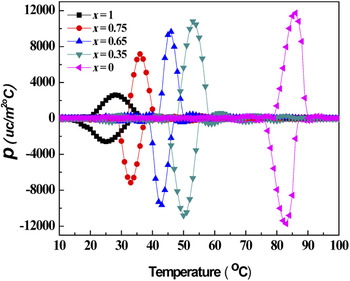
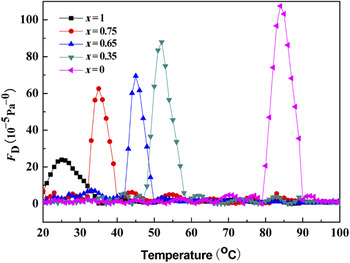
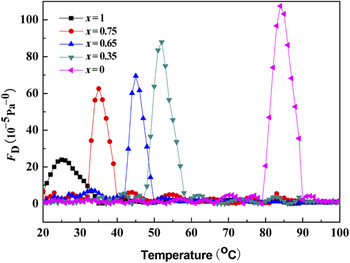
Figure 4 shows the figure of merit of (Pb0.87−0.07xBa0.10+0.07x)La0.02(Zr0.7Sn0.15Ti0.15)O3 ceramics as a function of temperature and Pb0.80La0.02 Ba0.17(Zr0.70Sn0.15Ti0.15)O3 content under a 400 V/mm dc bias field. With the amount of Pb0.80La0.02Ba0.17(Zr0.7Sn0.15Ti0.15)O3 increasing from 0 to 1, the temperature of the maximum figure of merit decreases from 85 to 25 °C and the maximum figure of merit decreases from 108 × 10−5 to 25 × 10−5 Pa−0.5.
Figure of merit of (Pb0.87−0.07xBa0.10+0.07x)La0.02 (Zr0.7Sn0.15Ti0.15)O3 ceramics with the variation of temperature and Pb0.80La0.02Ba0.17(Zr0.70Sn0.15Ti0.15)O3 content under a 400 V/mm dc bias field.
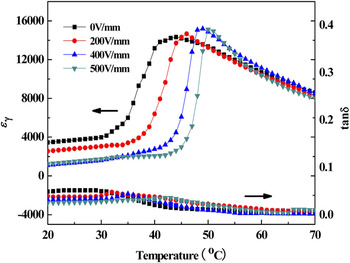
The dielectric constant and dielectric loss of (Pb0.87−0.07xBa0.10+0.07x)La0.02(Zr0.7Sn0.15Ti0.15)O3 specimens with x = 0.65 as a function of temperature and applied dc bias field are shown in Fig. 5. The maximum dielectric constant increases and the dielectric loss decreases as the dc bias field increases. The good dielectric constant slope and low dielectric loss up to 500 V/mm suggest that specimens with reasonable pyroelectric responsivity can be expected.
Dielectric constant and dielectric loss of (Pb0.87−0.07xBa0.10+0.07x)La0.02(Zr0.7Sn0.15Ti0.15)O3 specimens with x = 0.65 as a function of temperature and applied dc bias field.
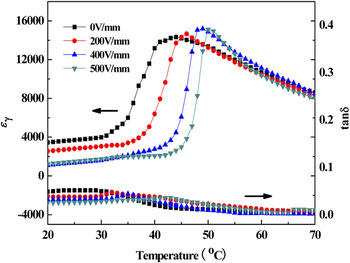
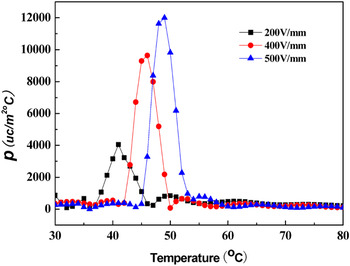
Figure 6 shows the pyroelectric coefficient of (Pb0.87−0.07xBa0.10+0.07x)La0.02(Zr0.7Sn0.15Ti0.15)O3 specimens with x = 0.65 as a function of temperature and applied dc bias field. The specimens under a 500 V/mm dc bias field show the maximum value of 12,200 μC/m2K at Curie temperature. This is due to the fact that the dielectric constant–temperature curve of the specimen under a 500 V/mm dc bias field displays a sharp shape near the Curie temperature.
Pyroelectric coefficient of (Pb0.87−0.07xBa0.10+0.07x)La0.02 (Zr0.7Sn0.15Ti0.15)O3 specimens with x = 0.65 as a function of temperature and applied dc bias field.
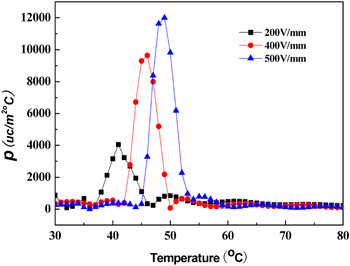
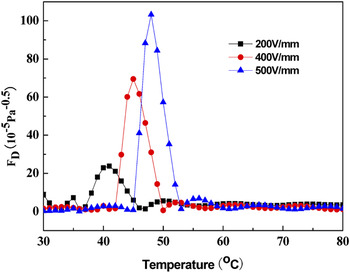
Figure 7 shows the figure of merit of (Pb0.87−0.07xBa0.10+0.07x)La0.02(Zr0.7Sn0.15Ti0.15)O3 specimens with x = 0.65 as a function of temperature under various dc bias field. The figures of merit were calculated using the following equationReference Whatmore8:

Figure of merit of (Pb0.87−0.07xBa0.10+0.07x)La0.02(Zr0.7Sn0.15Ti0.15)O3 specimens with x = 0.65 as a function of temperature and applied dc bias field.
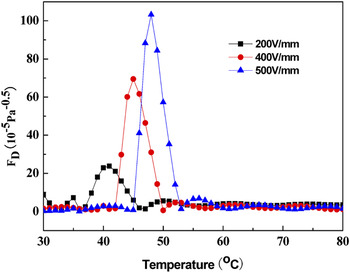
where p is the pyroelectric coefficient, C v is the heat capacity, ε 0 is the permittivity of free space, ε r is the permittivity of pyroelectric material, and tan δ is the dielectric loss. From the figure, it can be seen that the figure of merit increases with the increase in dc bias field. The specimen under 500 V/mm bias field shows a maximum value of 106 × 10−5 Pa−0.5, which is about five times higher than that of convention phase transition materials (Ba, Sr)TiO3,Reference Kang, Han, Lee and Song17 because of its high pyroelectric coefficient.
IV. CONCLUSIONS
(Pb0.87−0.07xBa0.10+0.07x)La0.02(Zr0.7Sn0.15Ti0.15)O3(0 ≤ x ≤1) specimens have been fabricated, and their dielectric and electric field–induced pyroelectric properties were studied. When the content of Pb0.80La0.02Ba0.17(Zr0.7Sn0.15Ti0.15)O3 is less than 0.75, the dielectric constant increased and the dielectric peak became steeper under a dc field; hence, the pyroelectric coefficient is high. However, when the content is 1, the pyroelectric coefficient decreased drastically as the dc bias reduced the dielectric constant and broadened the dielectric peak. The specimens with x = 0.65 show good application prospects for infrared detectors. The Curie temperature is 45 °C, and the maximum pyroelectric coefficient and figure of merit under a 500 V/mm dc bias field are 12,200 μC/m2K and 106 × 10−5 Pa−0.5, respectively.
ACKNOWLEDGMENTS
The authors thank Analytical and Testing Center of Huazhong University of Science and Technology. This work has been supported by the Graduate Student Creational Fund (HF-08-08-2011-185).