Introduction
Old age is a developmental life-stage that entails many changes that could influence peoples’ wellbeing. Although studies on coping have traditionally focused on how recent stressful life events might impact individuals’ ability to maintain wellbeing, it is possible that past stressful life events, and the resources used by people to deal with them, might also impact individuals’ current wellbeing and life satisfaction (Martin and Martin Reference Martin and Martin2002).
Life satisfaction, a cognitive component of subjective wellbeing, has been defined as a positive global evaluation that people make about their lives, comparing achieved goals with previous expectations (Diener Reference Diener1984; Veenhoven Reference Veenhoven1984). Although this evaluation focuses on recent circumstances, it also entails a lifespan assessment (Diener, Oishi and Lucas Reference Diener, Oishi and Lucas2003; Krause Reference Krause2004; Schilling Reference Schilling2006; Street and Burge Reference Street and Burge2012). According to Cummins et al. (Reference Cummins, Eckersley, Pallant, Van Vugt and Misajon2003), the global evaluation of life satisfaction is very abstract and thus it cannot provide information about what aspects of life contribute to the sense of wellbeing. Apart from global life satisfaction, domain-specific life satisfaction can be used to ascertain how people assess their lives. Domain-specific life satisfaction entails the assessment of different life aspects, such as health, social relations, achievements or standard of living (Cummins et al. Reference Cummins, Eckersley, Pallant, Van Vugt and Misajon2003; International Wellbeing Group 2013). Some of these specific domains are subjective assessments of objective aspects of society, such as standard of living and security, while others refer to subjective assessments of personal characteristics such as relationships with other people, feeling part of the community and religion. Correlations between the different specific domains of life satisfaction have been found. Satisfaction with standard of living strongly and positively correlates with satisfaction with health (Alfaro, Valdenegro and Oyarzún Reference Alfaro, Valdenegro and Oyarzún2013; Tiliouine, Cummins and Davern Reference Tiliouine, Cummins and Davern2006), with future security and with achievements (Alfaro, Valdenegro and Oyarzún Reference Alfaro, Valdenegro and Oyarzún2013; Yiengprugsawan et al. Reference Yiengprugsawan, Seubsman, Khamman, Lim and Sleigh2010). Satisfaction with community connectedness correlates with satisfaction with personal safety (Tiliouine, Cummins and Davern Reference Tiliouine, Cummins and Davern2006). Satisfaction with personal relations correlates with satisfaction with personal safety (Alfaro, Valdenegro and Oyarzún Reference Alfaro, Valdenegro and Oyarzún2013). Finally, satisfaction with spirituality and religion positively correlates with satisfaction with standard of living (Yiengprugsawan et al. Reference Yiengprugsawan, Seubsman, Khamman, Lim and Sleigh2010).
Apart from its cognitive component, subjective wellbeing also has an affective element that includes positive and negative affect. The cognitive and affective components, that are independent factors, form the tri-dimensional structure of subjective wellbeing (Diener Reference Diener1984; Diener and Lucas Reference Diener, Lucas, Lewis and Haviland-Jones2000; Diener et al. Reference Diener, Wirtz, Tov, Kim-Prieto, Choi, Oishi and Biswas-Diener2009; Rodríguez-Fernández and Goñi Reference Rodríguez-Fernández and Goñi2011).
Of all the subjective wellbeing components, negative affect is by far the most interesting one for gerontological literature. Negative affect has been defined as an emotional state that includes emotions such as anxiety, anger, fear or guilt (Watson, Clark and Tellegen Reference Watson, Clark and Tellegen1988). This construct is a subjective component of the behavioural inhibition system that is responsible for avoiding or escaping from negative stimuli (Carver and White Reference Carver and White1994).
In addition, negative affect is negatively correlated with life satisfaction (Rodríguez-Fernández and Goñi Reference Rodríguez-Fernández and Goñi2011; Siedlecki et al. Reference Siedlecki, Tucker-Drob, Oishi and Salthouse2008) and also with general subjective wellbeing (Yilmaz and Arslan Reference Yilmaz and Arslan2013). Since life satisfaction is an indicator of good social, psychological and physical functioning (Tomás, Meléndez and Navarro Reference Tomás, Meléndez and Navarro2008) and it is associated with a lower mortality risk (Collins, Glei and Goldman Reference Collins, Glei and Goldman2009; Kimm et al. Reference Kimm, Sull, Gombojav, Yi and Ohrr2012; St John, Mackenzie and Menec Reference St John, Mackenzie and Menec2015), research on negative affect and life satisfaction, and the resources that might moderate the link between them, is particularly relevant for understanding wellbeing in old age.
On the other hand, in old age individuals have to face many losses at a physical, cognitive or social level, and it would be logical to expect that these losses might lead to an increase in negative affect and a decrease in life satisfaction. There is some evidence that as we approach death there is an increase in negative affect (Schilling, Wahl and Wiegering Reference Schilling, Wahl and Wiegering2013). However, many other studies that have investigated negative affect through lifespan have found a decrease in negative affect as we grow older (e.g. Carstensen et al. Reference Carstensen, Pasupathi, Mayr and Nesselroade2000; Raes et al. Reference Raes, Bruyneel, Loeys, Moerkerke and De Raedt2013; Stone et al. Reference Stone, Schwartz, Broderick and Deaton2010). With respect to life satisfaction, there is no agreement in the literature concerning how the changes people have to face during their lifespan affect this construct. Some studies have found that life satisfaction scores are stable throughout the lifespan (Fernández-Ballesteros, Zamarrón and Ruiz Reference Fernández-Ballesteros, Zamarrón and Ruiz2001; Kunzmann, Little and Smith Reference Kunzmann, Little and Smith2000; Lucas and Gohm Reference Lucas, Gohm, Diener and Suh2000; Schilling Reference Schilling2006), while others have found a decrease in life satisfaction in people aged 65 years and older (Mroczek and Spiro Reference Mroczek and Spiro2005), and even an increase in life satisfaction in people aged 85 years and older (Meléndez, Tomás and Navarro Reference Meléndez, Tomás and Navarro2008).
It is possible that the internal resources that older people count on might mitigate the impact that stressful life events have on negative affect and on life satisfaction (Martin and Martin Reference Martin and Martin2002). Among these resources, some authors list locus of control or perceived control beliefs as an important factor that might buffer the effect of challenging circumstances (Diehl and Hay Reference Diehl and Hay2010; Martin and Martin Reference Martin and Martin2002; Skinner and Zimmer-Gembeck Reference Skinner, Zimmer-Gembeck and Folkman2011).
Perceived control beliefs refer to the beliefs about the cause of success or failure (Levenson Reference Levenson and Lefcourt1981). Locus of control can be internal – when one believes that she or he is causing the results, or external – when one believes success or failure depends on external circumstances. Locus of control is a relatively stable personality characteristic, however, it can change depending on the life events that an individual experiences (Martin and Martin Reference Martin and Martin2002). Thus, it is possible that past stressful life events could be linked to differences in locus of control and in other internal resources.
On the other hand, control beliefs are associated with a decrease in stress levels (Feuerstein, Labbe and Kuczmierczyk Reference Feuerstein, Labbe and Kuczmierczyk1986; Lachman, Neupert and Agrigoroaei Reference Lachman, Neupert, Agrigoroaei, Schaie and Willis2011). For example, experiencing personal control beliefs reduces the endocrine response to stress (Seeman and Robbins Reference Seeman and Robbins1994). In addition, control beliefs are related to subjective and emotional wellbeing (Reis et al. Reference Reis, Sheldon, Gable, Roscoe and Ryan2000). The perception of control over one's life as a whole increases global subjective wellbeing and domain-specific life satisfaction (Quadros-Wander, McGillivray and Broadbent Reference Quadros-Wander, McGillivray and Broadbent2013). Additionally, Gerstorf et al. (Reference Gerstorf, Heckhausen, Ram, Infurna, Schupp and Wagner2014) found that life perception of control diminishes the decline of wellbeing at the end of life.
Control beliefs can also be related to the affective component of subjective wellbeing. People reporting low control over their life circumstances show higher levels of negative affect, which in turn also increases when they face daily stressors (Diehl and Hay Reference Diehl and Hay2010). Moreover, personal control over desirable outcomes is associated with a higher positive affect and wellbeing, while perceiving that others have control over one's life increases negative affect (Kunzmann, Little and Smith Reference Kunzmann, Little and Smith2002). Furthermore, internal control beliefs moderate the impact that number of illnesses has on life satisfaction (Berg et al. Reference Berg, Hassing, Thorvaldsson and Johansson2011). Meanwhile, external control beliefs are linked to high levels of anxiety and depression (Gallagher, Bentley and Barlow Reference Gallagher, Bentley and Barlow2014; Ghorbani et al. Reference Ghorbani, Krauss, Watson and LeBreton2008) and are considered a risk factor for wellbeing (Kunzmann, Little and Smith Reference Kunzmann, Little and Smith2002). Thus, considering the impact that locus of control beliefs have on negative affect and on life satisfaction, it is possible that these beliefs might modify the association between past life events and subjective wellbeing in old age.
Consequently, the aim of this study was to explore the influence of past stressful life events on control beliefs and the joint effect of these two factors on negative affect and on domain-specific life satisfaction using a structural equation model (SEM). Since in this study the sample includes people age 50 years and older, age is also included in the analyses.
Method
Participants
In this study, the Ageing in Spain Longitudinal Study database, Pilot Survey (ELES-PS), was analysed. This cross-sectional study, which was the first wave of the Spanish longitudinal study, was conducted in 2011 with community-dwelling individuals aged 50 years old or older living in Spain (Teófilo et al. Reference Teófilo, González, Díaz-Veiga and Rodríguez2011). The survey was drafted as a representative study and participants were selected on a national geographical basis. The sample design consisted of a stratified multi-stage cluster of first-stage units by autonomous region and size of habitat (⩽10,000 inhabitants, 10,001–100,000, 100,001–500,000 and >500,000), randomly selected proportional to its population aged 50 years or older. Second-stage units (households) were selected randomly from a database of households with telephones by census tract. An individual was also randomly selected in each household (last sampling unit) with post-stratification by sex and age decade (50–59, 60–69, 70–79 and 80–89 years). Further details on the study's sampling and design characteristics are provided by Rojo-Pérez et al. (Reference Rojo-Pérez, Fernández-Mayoralas, Rodríguez-Rodríguez, Forjaz, Rodríguez-Blázquez, Prieto-Flores, Rojo-Abuin and Martínez-Martin2012).
The database of the ELES-PS project contains a total sample of 1,747 people (Teófilo et al. Reference Teófilo, González, Díaz-Veiga and Rodríguez2011). However, 216 individuals refused to continue with the interview after phase one was completed and 131 people refused to continue with the interview after phase two was completed, thus the response rate was 80.14 per cent. Due to the fact there are these missing values in some of the variables we decided to study a sub-sample of 1,177 individuals from the present study. These were the participants who had completed all the instruments that explored all the constructs we analysed in the current study.
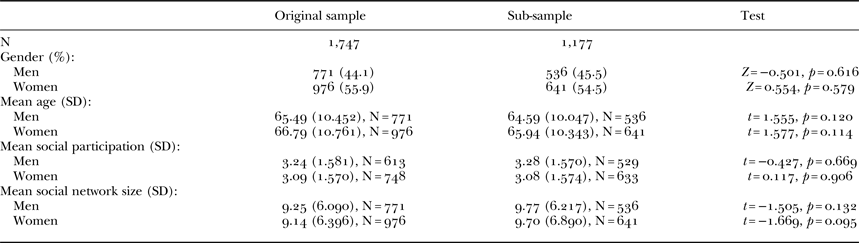
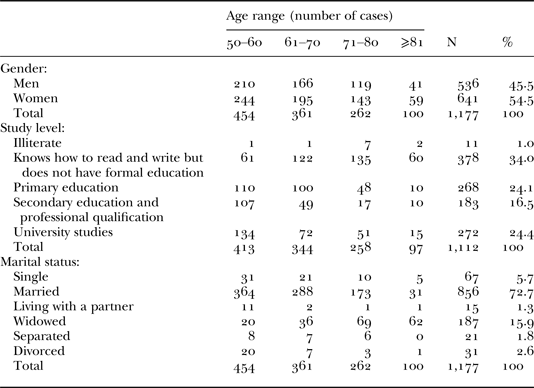
This sub-sample represented 67.4 per cent of the total sample and, in order to determine that there were no differences between the sample analysed in this study and the total ELES-PS sample that could influence the results, we analysed the differences regarding four socio-demographic variables, as shown in Table 1. These variables were gender, age, social network size (calculated as the sum of family members and friends with whom participants have contact) and social participation (calculated based on the monthly participation in seven types of activities: cultural, educational, social, travels, activities that are carried out at home, activities that are carried out in the neighbourhood and participation in associations). No significant differences were found between the participants we included in the current study and the total sample of the ELES-PS database in terms of gender, age, social network size and social participation. The mean age of the sub-sample we have analysed in this study was 64.89 year old (standard deviation (SD) = 10.20), and 54.5 per cent of the participants were women. The description of the sample from this study can be seen in Table 2.
Differences by gender, age, social participation and social network size between the original Ageing in Spain Longitudinal Study database, Pilot Survey sample and the sample from this study

Notes: Test has been performed using ‘ttesti’ and ‘prtesti’ commands implemented in Stata software. SD: standard deviation.
Sample description by age ranges

Procedure
The questionnaire was developed following the model of instruments used in other longitudinal studies carried out in other countries. First, households were randomly selected from the telephone directory. Sampled households were then screened by telephone for the presence of at least one person 50 years old or older in residence. If the inhabitants of the household did not agree to take part, the reasons for refusal were written down and a new household from the same area was contacted. If inhabitants of the household were 50 years old or older and agreed to participate in the study, data collection took place in three phases. In the first phase telephone interviews were conducted and participants gave informed consent to participate in the study. Then, in the second phase, the community nurses visited the participants to take biomedic samples and administer the Mini-Mental State Examination (MMSE) (Folstein, Folstein and McHugh Reference Folstein, Folstein and McHugh1975; Lobo et al. Reference Lobo, Saz and Marcos2002). If the MMSE reached preset thresholds of 24 points, the participant was provided with a self-administered questionnaire to complete. Additionally, for participants who scored below 24 on the MMSE it was suggested that a proxy responder be present for the subsequent home visit. Finally, the third phase consisted of a face-to-face interview carried out by an expert interviewer that administered the questionnaire using a computer. In this second home visit the self-administered questionnaire was retrieved and, if the participant had been unable to complete the questionnaire, the interviewer assisted in its completion at that moment. The first telephone interviews started in October 2010 and the data collection was finalised in September 2011. More information about the research procedure can be consulted in Teófilo et al. (Reference Teófilo, González, Díaz-Veiga and Rodríguez2011).
Instruments
The complete questionnaire developed for the ELES-PS project is available (in Spanish) on the ELES website (http://proyectoeles.es/). It collected information about the following dimensions: demographic characteristics, living conditions and quality of life, psycho-social aspects and functioning, health, social network and social participation, and economic and environmental aspects (Teófilo et al. Reference Teófilo, González, Díaz-Veiga and Rodríguez2011). However, in this section only the instruments that have been analysed in this research are described. These instruments are included under the heading emotional functioning and belong to the psycho-social functioning dimension of the ELES-PS questionnaire.
Stressful past events
This questionnaire was constructed ad hoc and included a list of ten stressful events developed by the project team. Participants were asked whether they had suffered any of the situations from the list during their lifecourse and what their age was when the stressful event happened. Stressful events included were: living in a house without basic living conditions, suffering from a serious illness or disability, divorce/separation, starvation, job loss/unemployment/dismissal, forced change of housing or city of residence, having fought in a war, having lived through the war without fighting and having experienced domestic violence/abuse. The variable was calculated by summing up the number of past stressful life events.
Perceived control
The Perceived Personal Control Over Desirable Outcomes sub-scale was employed. This is a sub-scale of the Internality, Powerful Others, and Chance scale developed by Levenson (Reference Levenson and Lefcourt1981; see Kunzmann, Little and Smith Reference Kunzmann, Little and Smith2002) that evaluates the degree to which a person feels that he or she has control over the expected results. The Perceived Personal Control Over Desirable Outcomes sub-scale comprised three Likert-type items (i.e. ‘When I get what I want, it's usually because I worked hard for it’) with five answering options (from 1 = total agreement to 5 = total disagreement). The score can be obtained by summing up the three items and it can range from 3 to 15 points. A higher score indicates an internal locus of control on the expected outcomes, or the belief that one can control expected results or cause them. No information on this sub-scale's psychometric properties are available from previous studies.
Negative affect
In order to evaluate negative emotions, the Negative Feelings sub-scale was used. This sub-scale was extracted from the Scale of Positive and Negative Experience (SPANE) by Diener et al. (Reference Diener, Wirtz, Tov, Kim-Prieto, Choi, Oishi and Biswas-Diener2009). The complete inventory contains 12 Likert-type items (i.e. ‘Afraid’) with five answering options (from 1 = almost never to 5 = very frequently, always). The items are grouped in two sub-scales: positive feelings (SPANE-P) and negative feelings (SPANE-N). The final score of each sub-scale, which can range from 6 to 30, is obtained by summing up each one of the six items that compose each one of these two sub-scales. In addition to the sub-scale scores, a global score of the SPANE can be obtained by subtracting the score of the SPANE-N from the score of the SPANE-P. In the current study only the six items corresponding to SPANE-N were used. This sub-scale shows good values of reliability, with a Cronbach's alpha coefficient of 0.80 (Diener et al. Reference Diener, Wirtz, Tov, Kim-Prieto, Choi, Oishi and Biswas-Diener2009), and of 0.72 for the Spanish version of the scale that was used in previous studies (Jiménez, Izal and Montorio Reference Jiménez, Izal and Montorio2016). In addition, adequate convergent validity values were obtained with measures of wellbeing, life satisfaction and happiness (Diener et al. Reference Diener, Wirtz, Tov, Kim-Prieto, Choi, Oishi and Biswas-Diener2009).
Domain-specific life satisfaction
This construct was measured using the Personal Wellbeing Index scale (PWI; Cummins et al. Reference Cummins, Eckersley, Pallant, Van Vugt and Misajon2003). This instrument assesses satisfaction with different life domains, such as standard of living, health, achievements, personal relations, personal safety, community connectedness and future security. The scale contains seven items (i.e. ‘How satisfied are you with your standard of living?’) and an additional one that evaluates satisfaction with spirituality and religion (International Wellbeing Group 2013) that has 11 answering options (from 0 = no satisfaction at all to 10 = completely satisfied). The PWI scale allows the analysis of the global score for each individual item. If the global score is analysed the score ranges from 0 to 100. The Spanish version of the scale, that has been adapted to older adults, forms a single factor that has good psychometric properties, with a Cronbach's alpha coefficient of 0.88 and a correlation of 0.50, with global life satisfaction measured with a single item (Rodríguez-Blázquez et al. Reference Rodríguez-Blázquez, Frades-Payo, Forjaz, Ayala, Martínez-Martín, Fernández-Mayoralas and Rojo-Pérez2011). In this research, the exploratory factor analysis showed that, contrary to previous studies that used the PWI and identified only one dimension, there were two factors that explained 55.6 per cent of the variance. We have called these two factors internal and external life satisfaction. Internal life satisfaction comprised aspects such as satisfaction with standard of living, with health, with achievements and with future security. External life satisfaction included satisfaction with personal relations, with personal safety, with community connectedness and with religiosity.
Data analysis
Descriptive analyses and mean differences tests to ascertain whether there were differences between the total ELES-PS sample and the sample from this study were carried out using the Stata software (version 14.2).
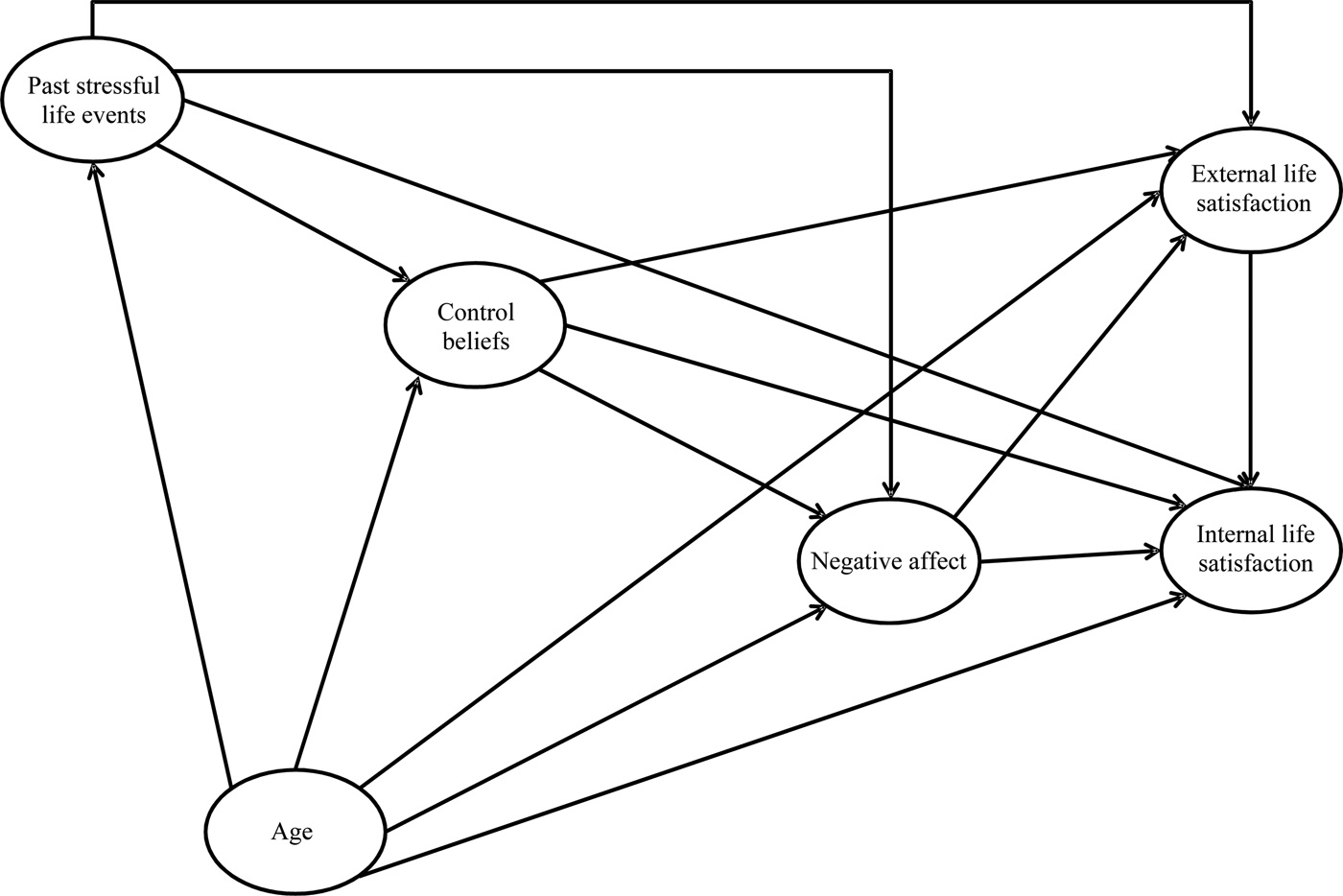
In order to estimate the model shown in Figure 1, the partial least squares (PLS) technique was used and the analyses were performed using version 3.2.4 of the SmartPLS software (Ringle, Wende and Becker Reference Ringle, Wende and Becker2015). This analysis is a type of SEM that uses an approach based on components. In comparison to other software such as LISREL or Mplus, that also allow structural equation modelling and are based on the covariance, the PLS technique is mainly orientated at predictive causal analysis and it is based on the variance. The PLS technique is adequate for this research because this technique is useful mainly for exploratory predictive research that is not aimed at finding evidence for causal relationships (Chin Reference Chin and Marcoulides1998). Furthermore, the conceptual basis on which some of the hypotheses that need to be contrasted in this research are based is not fully developed. In this case, the PLS technique is especially appropriate for exploratory or early stage research (Chin Reference Chin and Marcoulides1998; Hair, Ringle and Sarstedt Reference Hair, Ringle and Sarstedt2011; Hair et al. Reference Hair, Sarstedt, Pieper and Ringle2012; Jöreskog and Wold Reference Jöreskog and Wold1982). Since the PLS-SEM technique does not assume normal distribution of the sample, in order to determine the statistical significance of the estimated parameters the non-parametric bootstrap procedure was used (Davison and Hinkley Reference Davison and Hinkley1997). For this reason, following the recommendation by Hair et al. (Reference Hair, Hult, Ringle and Sarstedt2017), we relied on the bias-corrected and accelerated method to perform bootstrapping with 5,000 bootstrap samples. The use of this strategy for bootstrapping overcomes criticism from Rönkkö and Evermann (Reference Rönkkö and Evermann2013) which states that PLS can be used for testing null hypotheses about path coefficients (Henseler et al. Reference Henseler, Dijkstra, Sarstedt, Ringle, Diamantopoulos, Straub, Ketchen, Hair, Hult and Calantone2014).
General model to be tested.

Results
Validity and reliability of the measurement scales
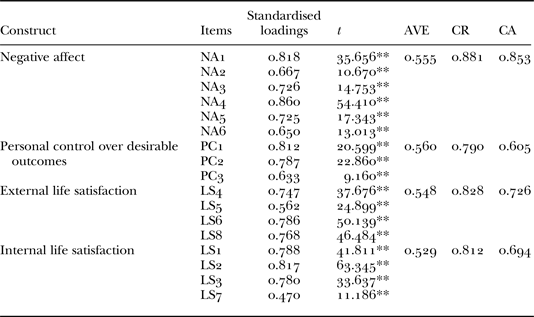
Before interpreting the model, the validity and the reliability of the measurement scales used in the proposed model have to be evaluated. With respect to the reliability of the scales, recommendations by Hair et al. (Reference Hair, Hult, Ringle and Sarstedt2017) were followed, thus the Cronbach's alpha (CA), the Construct Reliability (CR) and the Average Variance Extracted (AVE) were calculated. As can be seen in Table 3, CA values higher than 0.6 were obtained for all the scales used in this study. Although a minimum value of 0.7 is usually required for good reliability (Peterson Reference Peterson1994), a value of 0.6 for CA is acceptable for exploratory studies (Peterson Reference Peterson1994; Robinson, Shaver and Wrightsman Reference Robinson, Shaver, Wrightsman, Robinson, Shaver and Wrightsman1991). As shown in Table 3, the CR and the AVE indicators for all the scales used in this study surpass the minimum values required for the CR and the AVE indicators of 0.7 and 0.5, respectively (Fornell and Larcker Reference Fornell and Larcker1981; Hair et al. Reference Hair, Hult, Ringle and Sarstedt2017). On the other hand, the standardised loadings (higher than 0.5 and ideally of at least 0.7) that are statistically significant indicate good convergent validity of the items that measure the different constructs (Hair et al. Reference Hair, Hult, Ringle and Sarstedt2017). Thus, results obtained after estimating the model indicate that the measurement scales were valid and reliable.
Validity and reliability coefficients of the measurements scales

Notes: AVE: Average Variance Extracted. CR: Construct Reliability. CA: Cronbach's alpha.
Significance level: ** p < 0.01 (two-tailed).
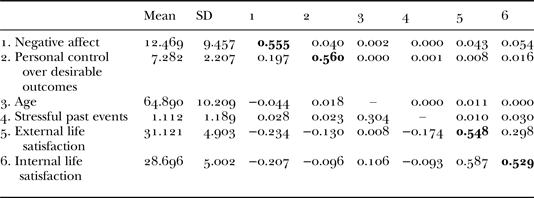
In order to determine the discriminant validity, we followed the criteria suggested by Fornell and Larcker (Reference Fornell and Larcker1981), according to whom good discriminant validity can be assumed when the square root of the AVE values of each construct is higher than the correlation with any other construct (Hair et al. Reference Hair, Hult, Ringle and Sarstedt2017). As can be seen in Table 4, the values of the square root of the AVE for each one of the constructs – that are presented on a diagonal – have higher values than the rest of the boxes, thus the constructs measured in this study can have good discriminant validity.
Discriminant validity of the measurement scales

Notes: On the diagonal (bold values) the Average Variance Extracted is presented, below the diagonal correlations among variables are presented and above the diagonal the shared variances (squared correlations) are presented. SD: standard deviation.
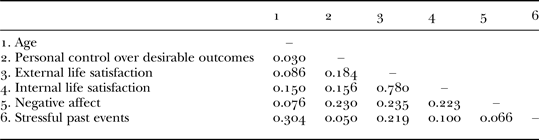
Because recent research suggests that the AVE statistic is over-estimated in PLS-SEM (Rönkkö and Evermann Reference Rönkkö and Evermann2013) and points to a potential weakness in the most commonly used discriminant validity criterion, we assess the heterotrait–monotrait ratio of the correlations as suggested by Henseler, Ringle and Sarstedt (Reference Henseler, Ringle and Sarstedt2015). As shown in Table 5, none of the calculated values is greater than 0.9, so we can assume good discriminant validity.
Heterotrait–monotrait ratio of correlations

Finally, to determine to what extent the composite factor model fits the data, we calculated the Standardised Root Mean Square Residual (SRMR), which measures the squared discrepancy between the observed correlation and the model-implied correlation, and the Root Mean Square residual covariance (RMStheta). Simulations performed suggest that the SRMR and RMStheta statistics are capable of identifying a range of model misspecifications (Henseler et al. Reference Henseler, Dijkstra, Sarstedt, Ringle, Diamantopoulos, Straub, Ketchen, Hair, Hult and Calantone2014). Because SRMR = 0.071 and RMStheta = 0.13, we can conclude that the model fits the data well.
Analysis of the proposed model
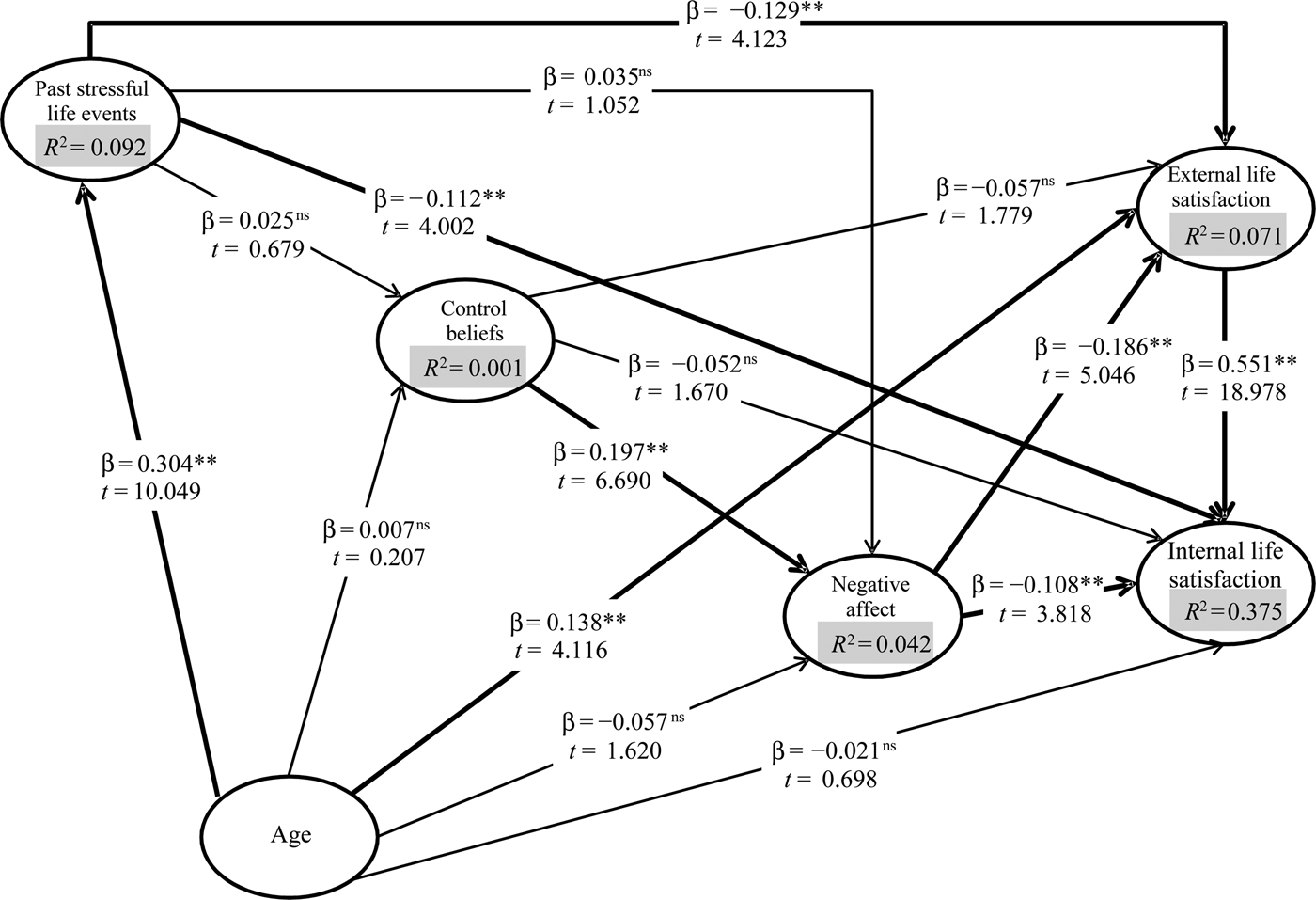
After the validity and reliability of the measurement scales were verified, the structural model analysis was performed. The results of this analysis can be seen in Figure 2. The proposed model explained 37.5 per cent of the variance in internal life satisfaction. Likewise, of all the analysed relationships, external life satisfaction, negative affect and the number of past stressful life events, were significant predictors of internal life satisfaction. External life satisfaction was positively related to internal life satisfaction, while both the number of past stressful life events and negative affect were negatively associated with internal life satisfaction.
Standardised coefficients for the estimated structural model.

With respect to external life satisfaction, the number of past stressful life events, age and negative affect had an impact on this type of life satisfaction and together these factors explained 7.1 per cent of the variance in external life satisfaction. Age was positively related to external life satisfaction, which suggests that external life satisfaction increases with age. Nevertheless, the number of past stressful life events and negative affect were inversely linked to this type of life satisfaction. In this manner, a higher number of stressful past life events or higher scores in negative affect decrease external life satisfaction.
On the other hand, age and the number of past stressful life events were positively associated, so older age was linked to a higher number of past stressful life events. Meanwhile perceived control beliefs was linked only to negative affect and explained 4.2 per cent of its variance.
Discussion
The aim of this research was to explore the impact of past stressful life events and locus of control on two components of subjective wellbeing, namely domain-specific life satisfaction and negative affect. In this study, we identified two types of domain-specific life satisfaction: internal and external life satisfaction. Internal life satisfaction included satisfaction with health, with standard of living, with achievements and with future security. External life satisfaction comprised satisfaction with personal relations, personal safety, community connectedness and spirituality.
A direct effect of past stressful life events and control beliefs were found on both participants’ negative affect and life satisfaction. More specifically, internal life satisfaction was associated with having experienced a lower number of past stressful life events, with a high score of external life satisfaction and with a low score of negative affect.
In the following sections, the effect of number of past stressful life events and of control beliefs on each subjective wellbeing component is discussed.
Influence of past stressful events on wellbeing
As previously stated, the number of past stressful life events was linked to both internal and external life satisfaction. Past stressful life events had a negative impact on life satisfaction; a higher number of past stressful life events was linked to lower life satisfaction scores. However, although in both cases these links were significant, the standardised coefficients were low, thus results should be interpreted cautiously.
Despite the fact that the assessed stressful life events were not recent, they still seemed to be associated with significant differences in older adults’ life satisfaction. Previous studies have shown that recent stressful life events are linked to lower life satisfaction scores (Krause Reference Krause2004). Although in the present study the stressful life events were experienced by the participants a long time ago during their lifespan, they are critical circumstances. Having been fighting in a war or having lived through a war without fighting, having experienced domestic violence/abuse, or suffered from a serious illness or disability are all very stressful events that have many detrimental effects at both the physical and psychological level, accordingly it is not surprising that these circumstances are related to life satisfaction long after they have occurred. These results are consistent with the hypothesis that life satisfaction depends on recent circumstances and on the whole lifespan (Diener, Oishi and Lucas Reference Diener, Oishi and Lucas2003; Krause Reference Krause2004; Schilling Reference Schilling2006; Street and Burge Reference Street and Burge2012).
On the other hand, despite finding a negative relationship between the number of past stressful life events and life satisfaction, life satisfaction scores neither decrease through the lifespan nor start decreasing in old age, as has been found by previous studies (Mroczek and Spiro Reference Mroczek and Spiro2005). In this study, age was not linked to satisfaction with standards of living nor with health that both belong to internal life satisfaction. However, in the current study age was positively linked to satisfaction with community connectedness, or with personal relations, aspects that belong to external life satisfaction. External life satisfaction scores progressively increased as age increased. Thus, internal life satisfaction is a variable that might be stable through the lifespan, while external life satisfaction might progressively increase in old age. This might indicate that, as they grow older, individuals tend to value more positively some domains of their lives such as personal relations, belonging to a community, and the feeling of security and protection that entails being part of a social network. However, as the present study uses a cross-sectional design, this should be further tested in longitudinal studies.
With regards to negative affect, the emotional component of subjective wellbeing, contrary to our expectations, was not associated with the number of past stressful life events. A possible explanation would be that, contrary to what happens with life satisfaction, the emotional components of subjective wellbeing are determined by recent circumstances, hence past stressful life events have no influence once enough time has passed. It is also possible that the lack of association between past stressful life events and negative affect might be due to the fact that negative affect is stable through the lifespan. In this study, we found no association between age and negative affect. Also, as shown by previous studies, negative affect even decreases at older ages (Carstensen et al. Reference Carstensen, Pasupathi, Mayr and Nesselroade2000; Raes et al. Reference Raes, Bruyneel, Loeys, Moerkerke and De Raedt2013; Stone et al. Reference Stone, Schwartz, Broderick and Deaton2010).
Importance of individual resources: control beliefs
With respect to personal resources, in this research control beliefs were assessed. This variable was considered an internal resource that could buffer the impact that stressful past events might have on older adults’ wellbeing. Results show that control beliefs had a positive direct effect on negative affect. Scoring higher in internal control, or believing that one is responsible for the expected results, was associated with higher scores in negative affect. If elderly people consider themselves responsible for what happens in their life, especially of negative events, it is possible that they might experience more negative emotions. Nevertheless, in previous research, Kunzmann, Little and Smith (Reference Kunzmann, Little and Smith2002) found a negative association between control beliefs and negative affect, although the effect of control beliefs was not significant. Due to this, more research to clarify this association is needed, and to determine whether control beliefs have the same effect on negative affect when positive or negative results are expected.
On the other hand, control beliefs did not have a significant effect on either internal or external life satisfaction. Results from the current study are contrary to findings from previous studies that had identified positive associations between perceived control and older adults’ life satisfaction (Gerstorf et al. Reference Gerstorf, Heckhausen, Ram, Infurna, Schupp and Wagner2014; Quadros-Wander, McGillivray and Broadbent Reference Quadros-Wander, McGillivray and Broadbent2013). The differences between our findings and the previous literature could be explained by differences in the design, the samples studied and the instruments used to measure life satisfaction.
Hence, considering the findings from this study, control beliefs are a personal resource that play a relevant role but only for the emotional component of subjective wellbeing. This positive association between control beliefs and negative affect might be explained by a tendency of individuals with internal control beliefs to blame themselves for negative circumstances that they might face and due to it their negative affect would also increase. If an individual firmly believes that she or he is responsible for the good circumstances that she or he encounters, it is also possible that when they have to deal with unpleasant circumstances they equally feel responsible for these circumstances and, in this way, negative emotional states such as sadness or annoyance might also increase. However, this statement is only speculative and it needs to be tested in future studies.
To sum up, this study provides evidence for explaining adaptation to stressful life events through the lifespan and for predicting successful ageing and subjective wellbeing, both a result of this adaptation process.
Nevertheless, there are several limitations to this investigation that are worth mentioning. Firstly, a cross-sectional design was used, thus the effect that age had on life satisfaction and other inferences could have been a consequence of having included in the sample people from different cohorts. Furthermore, the sample did not include institutionalised older adults; hence results from this study cannot be applied to this elderly group. Secondly, the effect of other socio-demographic variables such as participants’ gender and educational level was not controlled for. Since these co-variables could have an influence on participants’ life satisfaction and negative affect it would be interesting for future studies to control for the effect of these variables.
In addition, some important external resources of elderly people, such as social and financial resources, have not been included in the analysis presented in this study. Because social and economic resources have been previously found to be important for the adaptation process (Cho, Martin and Poon Reference Cho, Martin and Poon2013, Reference Cho, Martin and Poon2015) and for successful ageing, future research should include social and economic resources together with control beliefs and other internal resources.
Finally, with regards to the effect of past stressful life events, the age when the events took place was not controlled for in the analysis we performed, consequently, depending on the age each situation took place, some of the situations that we analysed could be recent influences instead of past influences. Also, some of the events that were included in the past stressful life events questionnaire describe war-related experiences; however, some of the sample were born after the war, so these participants have not directly experienced such past events. Furthermore, because some of the past life events might have occurred a long time before the interview, it is possible that participants might not have remembered the past life events accurately. Therefore, future studies that analyse the impact of stressful life events should include in the analysis the age when the situation took place. In addition, the level of perceived stress that each situation might cause should also be considered and a wider range of possible past stressful life events should be studied. In order to minimise recall bias when studying past stressful life events, a well-structured and validated instrument that contains detailed questions about each stressful event should be used. Participants should also be given sufficient time to recall each stressful event.
However, despite these limitations, results from this study are relevant for gerontological research and practice because it highlights the significance of early life events for older adults’ wellbeing and their opportunity to age successfully. The study has also identified different patterns of associations between control beliefs and different subjective wellbeing components. In addition, this study has been developed in the Spanish context and with a representative sample of people aged 50 years and older. This is particularly valuable because information on the role of stressful past events and how control beliefs influence wellbeing of older people in the Spanish context is sparse, although it has been studied in other cultural contexts such as in North America (Cho et al. Reference Cho, Martin and Poon2013, Reference Cho, Martin and Poon2015; Martin and Martin Reference Martin and Martin2002). Because different cultural settings might determine varied patterns of successful ageing and different resources that contribute to wellbeing maintenance (Cho et al. Reference Cho, Martin and Poon2015; Clarke and Smith Reference Clarke and Smith2011; Karasawa et al. Reference Karasawa, Curhan, Markus, Kitayama, Love, Radler and Ryff2011), we believe it was important to test the effect of internal resources and past stressful events in different cultural contexts.
Acknowledgement
The ELES pilot study was carried out by the Research Group on Ageing (GIE-CSIC) and the Matia Instituto Gerontologico and financed by the ‘Acciones Complementarias 2009’ Programme of the Spanish Ministry of Science and Innovation (CSO2009-06637-E/SOCI; CSO2009-06638-E/SOCI; CSO2009-08645-E/SOCI), the SAIOTEK 2009 Programme of the Basque Government and the ‘Obra Social Caja Madrid’ Foundation.