Introduction
Produce auctions have historically been an important market channel for fruits and vegetables in Europe and North America (McEhelny, Reference McEhelny1916). The USDA reported the existence of ‘fruit and produce auctions’ in New York as early as 1827 (Miller and Hauck, Reference Miller and Hauck1925). These early auctions primarily functioned as an intermediary between ‘country assemblers,’ distributors and retailers in large cities (McEhelny, Reference McEhelny1916). Produce was often citrus and other fruit including grapes and apples (McEhelny, Reference McEhelny1916). Most auctions did not accept ‘direct consignments’ from farmers themselves (McEhelny, Reference McEhelny1916). These auctions were promoted as price equalizers but functioned with little or no control from producers (McEhelny, Reference McEhelny1916). Although these sales may have brought some transparency to wholesale pricing, they declined as ‘consolidation and competition’ in the marketplace increased (Tourte and Gaskell, Reference Tourte and Gaskell2004). Today the dominant global horticultural auction model is the Dutch Flower auction, common in the Netherlands, that involves timing clocks and remote international bidding for ornamental crops such as vegetative annuals (Tourte and Gaskell, Reference Tourte and Gaskell2004). In this paper, we will focus on a different farmer-led auction effort, originating in the Northeast USA for wholesale, locally grown fruits and vegetables.
To enhance rural livelihoods, rural economies and to increase small farm viability requires models that would allow for many farms to participate and supply fruits and vegetables in volume beyond retail options such as CSAs and farmers’ markets. To scale-up a sustainable model ‘requires wholesaling food that creates a “middleman” and that removes the direct relationship between farmer and consumer’ (Johnson et al., Reference Johnson, Fraser and Hawkins2016). Furthermore, by bringing producers, consumers and production closer together geographically this resocializing and respatializing food distribution will bring higher quality food and investment in local agriculture resulting in greater rural resilience and development (Johnson et al., Reference Johnson, Fraser and Hawkins2016).
Produce auctions, an intermediated market channel for fruits and vegetables, have proven successful in allowing small-scale farms to participate in wholesale economies all while increasing the supply of local, fresh fruits and vegetables; an aspect that is critically important to the participants at these auctions. Buyers reported in case studies of two Canadian produce auctions that they could buy higher quality produce at Old Order Mennonite auctions than through conventional supply chains (Johnson et al., Reference Johnson, Fraser and Hawkins2016). In Massachusetts, the buyers articulated the ‘highly favorable’ perception of ‘local’ that may be best described as fresh and quality (Lockeretz, Reference Lockeretz1986). In Pennsylvania, Tubene and Hansen also found that auction managers cited regional (local) production and sales as critical to the auction model (Tubene and Hanson, Reference Tubene and Hanson2002).
The first produce auction of this type was developed by Amish and Mennonite farmers in Lancaster County Pennsylvania in 1984 (Vekaufhause, Reference Vekaufhause2003) and has since spread to over 70 auctions in ten states and the province of Ontario (Yoder et al., Reference Yoder, Schrock, Yoder and Yoder2015). The auction is a physical aggregation point where fresh fruits and vegetables from many different farms are offered for sale to the highest bidder. The auction charges the seller (the farmer) a commission to cover the auction's operating expenses (Bergefurd, Reference Bergefurd2011). Most auctions are governed by a Board of Directors, generally comprised farmers themselves along with other community/industry members (Tourte and Hanson, Reference Tourte and Gaskell2004). The auction employs a staff including managers, auctioneers and employees that oversee operations. As an intermediated market site, auctions provide the service of attracting buyers, collecting payment and providing weekly income for the farmer, freeing them to focus on production and packing (Pena, Reference Pena1996). Tubene and Hansen in their Pennsylvania-based survey found produce auctions to be a viable market for small farmers as the auctions provide both production scale and networking opportunities to participate in the wholesale economy (Tubene and Tubene, Reference Tubene and Hanson2002).
To stay current with regulatory and market-based requirements, continuing education is important for produce auction participants. In an Ohio study of a produce auction, farmers’ reported a need for education on food safety and compliance with federal regulations (Bergefurd, Reference Bergefurd2011). In this study, 97.1% of the Amish and Mennonite produce farmers did not use the Internet as a source of farming information and 83.3% did not belong to a formal farm organization, therefore, education needs to be tailored to Amish and Mennonite populations (Bergefurd, Reference Bergefurd2011).
Community values inherent to these populations contribute to the success of produce auctions as an intermediated market. Shonkwiler describes how an Old Order Mennonite production auction redistributed market power to participants (otherwise limited by restricted technology access); and allowed the group to maintain an agriculturalist identity critical to their culture (Shonkwiler, Reference Shonkwiler2014). The presence of a produce auction was cited as an immigration factor for Plain Sects (Shonkwiler, Reference Shonkwiler2014). In New York, this may explain and encourage the ongoing population growth of this cultural group. Raymond Yoder, an Amish farmer from Ohio, states that having a majority of shareholders be farmers is preferred to keep operational procedures within ‘local church standards’ (Yoder et al., Reference Yoder, Schrock, Yoder and Yoder2015). This community-specific attitude is supported by Schrock who states that ‘[the auction] gives the young family at the far end of the community the same marketing opportunity as the well-established family on the main road’ (Yoder et al., Reference Yoder, Schrock, Yoder and Yoder2015).
This paper describes the evolution of produce auctions in New York State, highlighting their importance for the participants (sellers and buyers) as well as associated economic benefits to the surrounding rural communities. Using data collected via surveys conducted by face-to-face interviews with participants of the Seneca Produce Auction, we discuss the impact of the produce auction on participating sellers and buyers. Through our interviews and surveys, we delve into farm impacts through a series of questions examining changes in produce production, use of Cornell Cooperative Extension (CCE) as a resource, and the adoption of good agricultural practices (GAPs) on the farm. We also delve into buyer impacts through a series of questions examining the benefits to buying at the auction, the change in business operations, business expansion and the amount of patronization at other Seneca County businesses.
New York State produce auctions
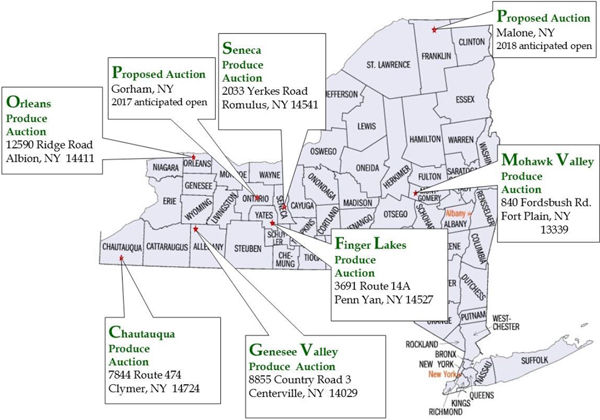
As produce auctions in the Northeast USA have been developed almost exclusively within the context of the Plain Populations (Amish and Old Order Mennonite), it follows that New York would see significant development of this market channel. New York State has seen a rapid increase in Plain Populations over the last two decades. In the five years prior to 2016, New York State ranked highest in Amish population growth (by percent) with the highest increase in total Amish church districts (Young Center, 2016) of any state. An estimated New York State Amish population of 18,360 ranked 4th nationally behind Pennsylvania, Ohio and Indiana. These figures do not include Old Order Mennonites, a horse-and-buggy culture established in the 1970s (Reid, Reference Reid2015) in the rural central portion of New York State today with over 600 households. These Old Order Mennonites created the Finger Lakes Produce Auction, the first in New York State, in the year 2000. Currently, there are six active produce auctions in the state with two additional auctions planned to open by 2018 (Fig. 1). All of these auctions are located and operated within Amish and/or Mennonite contexts.
Locations of 8 (current and anticipated) New York State Produce Auctions.

For this study, the project team chose a more recently established produce auction as it facilitated the early collection of economic data as farmers and buyers in a rural New York county responded to the establishment of a new, alternative market channel. The Seneca Produce Auction was founded in 2013 by Amish farmers in Seneca County, central New York State. The auction was incorporated, a Board of Directors was formed, and shares to support the auction were sold. A building was constructed and the auction now operates in Romulus, NY. Auctions are held on Tuesday and Friday mornings from late April through mid-June when the auction switches to Monday, Wednesday and Friday mornings through mid-November.
Within the regional produce market context, the auction serves as an aggregation point for local produce that is purchased by area buyers and distributed throughout the Finger Lakes region by way of farm stands, farm stores, farmers’ markets, and local grocery stores. Produce auction participants include sellers and buyers. The Seneca Produce Auction defines two types of sellers to be either, local growers or non-local-consigners. To qualify as a local grower, the seller must grow to produce within a 14 county region, as specified by the Board of Directors. A non-local-consignor grows their produce outside of that 14 county regions. The produce auction presents produce from these two types of sellers separately and marks the lots as either ‘local produce’ or as ‘shipped-in.’ For buyers, there is no restriction on who may participate as a buyer at the auction.
Methods
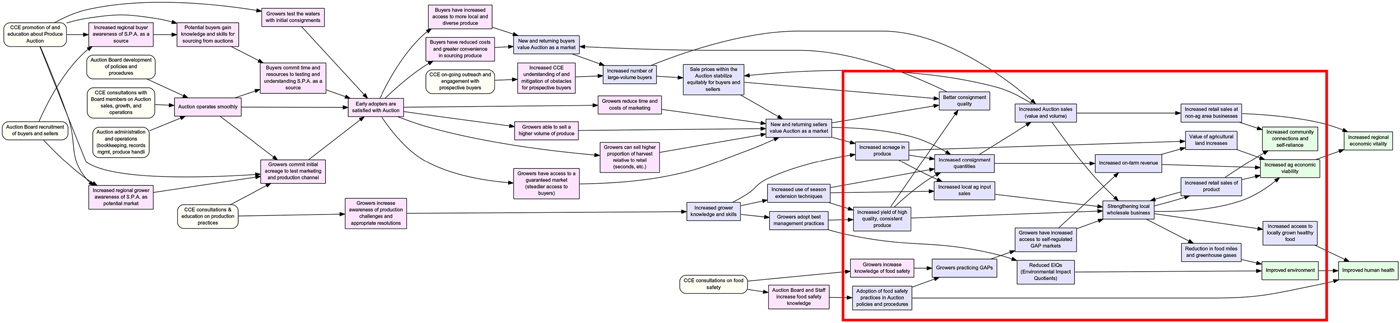
To date, little work has researched the economic impact of produce auctions on farms, the communities in which auctions are located, or the businesses of those who buy at the auction. Working with the Cornell Office for Research Evaluation (CORE), logic and pathway models were developed to describe the Seneca Produce Auction (Fig. 2). The logic and pathway models were developed using a software called Netway, developed by CORE through National Science Foundation grants. Originally limited to Cornell University program staff, it is now publicly available at www.evaluationnetway.com. To evaluate the economic impact of produce auctions on agriculture and local businesses projected within this model, the project team interviewed 18 of the top sellers (farmers) and buyers at the Seneca Produce Auction in Romulus, NY. During an interview conducted on May 23, 2017, David Stoltzfus reported to Derek Simmonds that the 18 top sellers interviewed represented at least 75% of the Seneca Produce Auction's total sales. Interview questions were developed by the project team with a review from CORE to assess mid- and long-term outcomes of a produce auction and approved by the Cornell Institutional Review Board for Human Participants (Fig. 3).
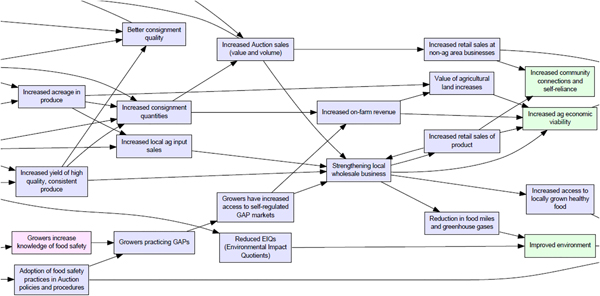
Pathway model describing inputs, outputs and outcomes (short, mid and long term) of the Seneca Produce Auction. The red square highlights the mid- and long-term outputs and outcomes where the project team focused.

Mid- and long-term outputs and outcomes the project team focused. The area contained within the red square in Figure 2.

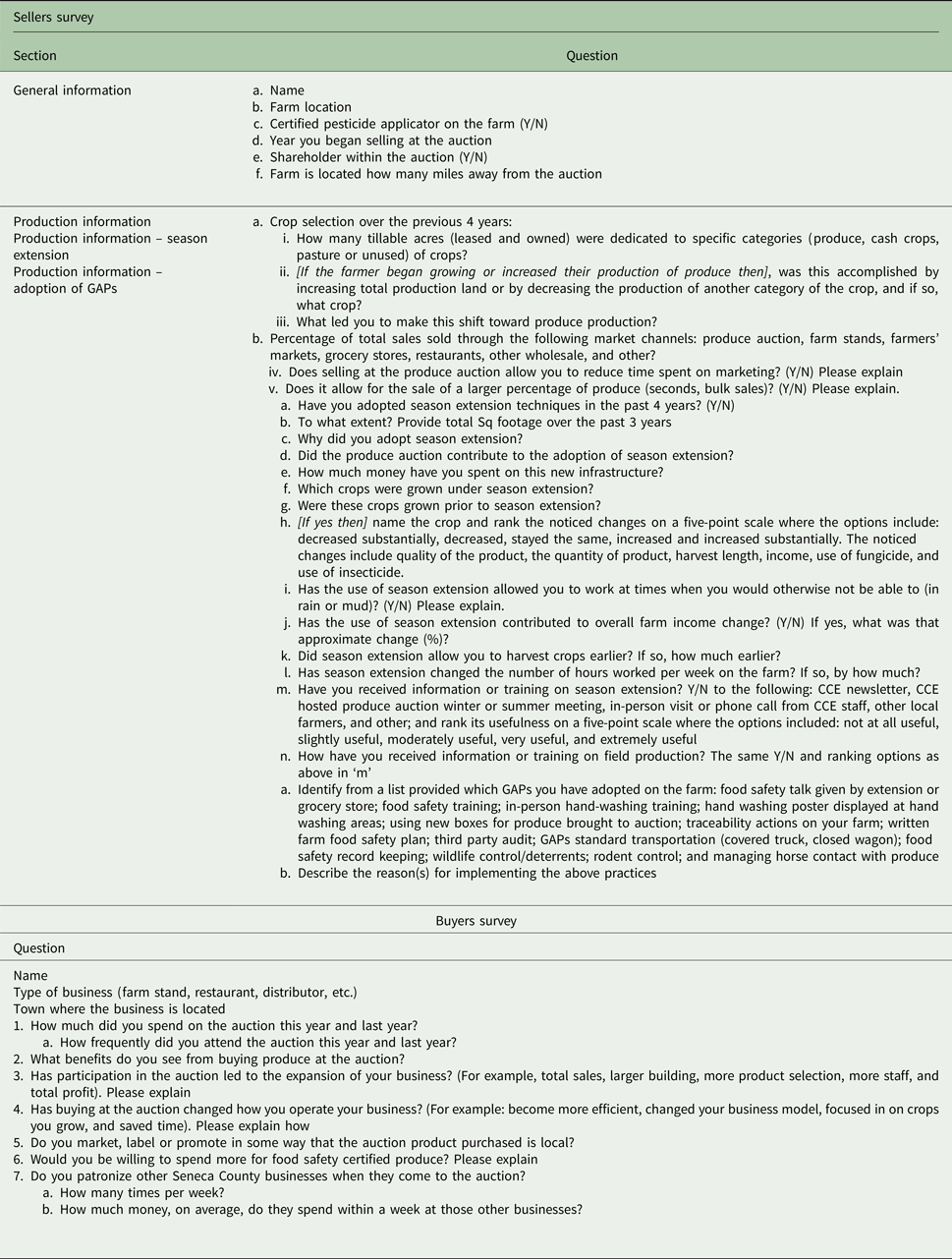
The farmer survey contained two broad sections, ‘General Information’ and ‘Production Information’ totaling 28 questions and was developed to assess the on-farm impact (Table 1). The ‘General Information’ section showed whether or not the farms were ‘local farmers’ as defined by the auction as well as their level of experience with the auction. At the time of survey administration, the Seneca Produce Auction was only in its second year of operation, so farmers would have only been selling, at most, for 2 years. The ‘Production Information’ section asked about certain aspects of the farmers’ production practices over the previous 3–4 years. These look-back questions were asked to understand how agriculture in the region had been changing and to determine whether or not it was as a result of farmers selling at the produce auction. The ‘crop selection’ questions were asked specifically to determine whether produce production increased in the region over the course of the previous 4 years, and, if so, if it was as a result of the new market opportunity at the produce auction. Furthermore, these questions were asked to determine if this increase led to additional lands being brought into production and/or a shift away from other crop categories. The ‘market channel’ questions were asked to better understand the motivations of a farmer to shift sales away from a variety of markets toward the produce auction.
Summary of sellers and buyers surveys. Not the exact language used in surveys but summarized and condensed to fit within table

The ‘Production Information’ section of the survey contained two subsections, ‘season extension’ and ‘adoption of GAPs.’ The ‘season extension’ questions were included to better understand the perception that as farmers shifted their market channels to the produce auction they would reduce the variety of crops grown and specialize in growing a larger quantity of a smaller variety of crops. Additionally, it was thought that the farmer would invest in season extension infrastructure to support the improved quality of these fewer crops. Also, the cost of production within season extension infrastructure is different from the cost of production in an open field. This dedication to perfecting the growing practices of their few select cops by the farmers that sell at the auction benefits both the farmers and the auction. The high-quality produce receives a higher price on the auction floor and the buyers know they can expect a quality product when they buy at the auction. The ‘season extension’ section asked a series of questions to better understand this. Additionally, this section aimed to determine how season extension structures affected the farm's efficiency, income and timeframe for growing produce. The final series of questions in this section were asked to document the amount that farmers use CCE as a resource for information or training on season extension or field production.
Finally, the adoption of GAPs, can occur for many reasons, including but not limited to, market demand (buyers asking them to), consumer demand (consumers asking them to), presentation improvement (selling produce in new and clean boxes, transporting produce in a covered wagon to prevent dust and horse hair from collecting on the produce, etc.), personal commitment to produce a safe product, etc. The series of questions on GAPs adoption were asked to understand if produce auction farmers had adopted GAPs, and, if so, why.
The buyer surveys contained one section totaling seven questions that were developed to assess the impact on produce buyers and their businesses, to understand the purchasing trends among the top buyers at the auction over time and to better understand what attracts a buyer to purchasing through an auction, as opposed to other markets. In the business ‘expansion’ and ‘operation’ questions, ‘focused in on crops you grow’ was provided as an example since some of the buyers at the auction operate farm stands or farm stores and historically stocked those stands and stores by personally growing all the produce themselves. With the development of a produce auction, the dual farmer/farm stand/store operators were reducing the number of crops being personally grown, focusing on growing only a few crops, and then supplementing their farm stands or stores with produce bought at the auction. This idea is discussed above in the farmer survey section and is important to discuss again in the buyer survey section since in some cases, the farmer and buyer is the same person and therefore this specialization in crop production also changes how they operate their business. The final question looking at the buyers’ businesses was, if they market, label or promote in some way that the auction product purchased is local. Given the growing demand for locally grown food, this question was developed to understand if buyers valued and promoted this to their customers.
As discussed above, the farmer survey asked about the adoption of GAPs and so to understand the importance of these practices to the buyers, the ‘GAPs’ question was included in the buyer survey. Finally, the ‘patronize other Seneca County businesses’ questions were asked to learn about the business activity of the buyers within the local community when they come into town to attend the auction.
The largest consignors and buyers were identified by the Seneca Produce Auction office staff and contact information provided to the project team. Surveys were administered in person at the auction over a period of 3 weeks in September and October 2014 by project team members. It is common for farmers to bring their produce to the auction and then remain there during auction activities to converse with other farmers and members of the community. It was during this time that project team members talked to farmers and completed surveys. Similarly, buyers will arrive at the auction when it opens and remain until the close of the auction but their bidding activities are only needed when the auctioneer reaches the item they would like to buy. It was during these down times for the buyers that the project team members completed the buyer surveys.
Results
Responses from the surveys produced both quantitative and qualitative results. Quantitative results were entered into a Microsoft Excel spreadsheet and averaged. Qualitative results were summarized into a Microsoft Word document and reviewed for similar or common answers. The results described below are derived from key themes that emerged from the responses.
Farm impacts: changes in produce production
The surveys asked a series of questions on how farming practices had changed as a result of the produce auction and were then able to calculate increased economic activity. There is an increase in acreage (or season extension footage) devoted to production associated with auction participation when comparing current levels to pre-auction participation levels. All surveyed farmers increased total acreage and/or season extension square footage devoted to produce with 66% citing the existence of the auction as the reason for the shift. Farmers demonstrated a commitment to additional inputs beyond current farming practices once an auction was developed, and 88% of farmers increased farming costs when devoting additional acreage and season extension footage to growing produce. The shift in production from field crops to open field produce represents an increase of input costs. This escalation of economic activity is seen in the farmer's need to purchase additional seed, transplants, fertilizer and equipment for the production of fruits and vegetables. This, in addition to other costs such as labor, supplies and packaging are all primarily purchased in local stores and markets, creating a multiplier effect to the local economy from the existence of the produce auction. The remaining farmers were not growing any crops before starting to grow produce. Prior to the existence of the auction, this acreage had been devoted to field crops such as hay. Of the farmers that increased acreage in produce, 11% cited this change because produce has a higher return per acre than traditional commodities.
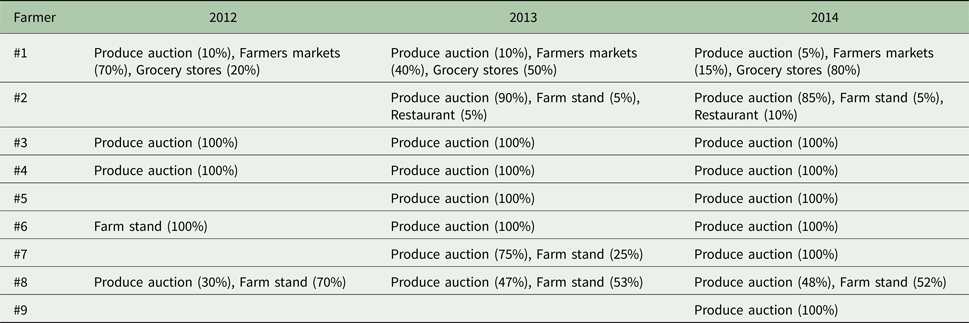
A significant benefit to farmers is that the auction reduced their time spent on marketing, and allowed them to market a larger percentage of their products than would have been possible at retail outlets. The farmers that cited the existence of the auction as being the reason for their shift in market channels to selling 100% to the auction or increasing their percentage to the auction explained that the auction is a good and ready market that does not require any marketing on their part. Additionally, all of these farmers confirmed that use of the auction reduced their time spent on marketing, and allowed them to sell a larger percentage of their products since the auction serves as a market that allows farmers to sell grade A and seconds (reducing waste in the field and in the packing house). Also, the auction allows the farmers to pick what is ready the morning of the market and with multiple auctions per week the farmer is not waiting and missing the opportunity to pick ripe produce. Farmers reported that it takes less time to pack larger volumes of produce for the auction compared to keeping a road stand stocked or packing small quantities for a farmers’ market in addition to the time needed to sell at the farmers’ market or staff a road stand. The percentage of sales at the auction either stayed the same (already at 100%) or increased over time for 78% of farmers. The benefit that the auction reduced the farmer's time spent on marketing is confirmed in Table 2 which summarizes that those farmers that shifted their market channel to the produce auction and away from another channel all shifted away from either a farmers’ market or road stand.
Percentage of market distribution by year

Only 22% of farmers showed a slight decline in the percentage of sales to the auction with increases in the grocery store and restaurant sales. In these cases, farmers had achieved GAPs requirements required of existing buyers (grocery stores and restaurants). With this requirement met, these farmers were able to expand upon existing sale arrangements. These trends are shown in Table 2.
Farm impacts: CCE as a resource
CCE was used as a resource by 100% of farmers. This resource is accessed through a number of channels, including CCE newsletter, produce auction winter and/or summer meeting, in-person visits from CCE staff and phone calls with CCE staff.
Farm impacts: food safety
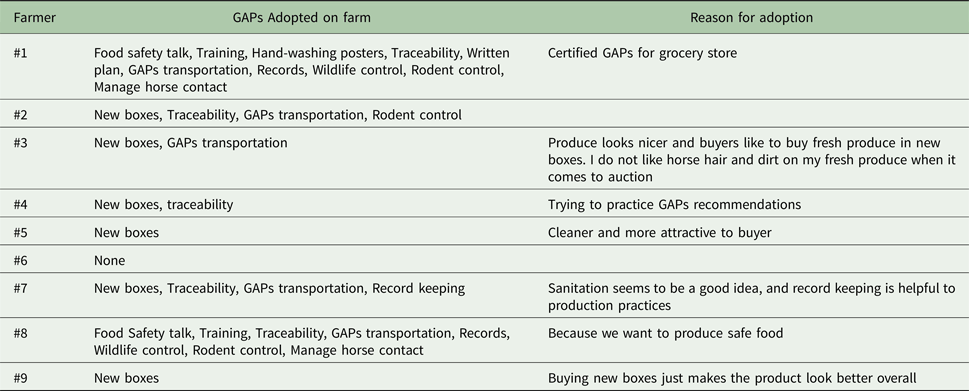
While not required to sell at the auction, 88% of sellers have adopted GAPs, with some becoming GAPs certified and other practicing GAPs but not seeking certification. Those that were GAPs certified became so because they sold to other market channels that required a third-party audit and certification. The GAPs practices adopted ranged among growers from having only attended a food safety talk to having taken all the steps necessary to successfully pass a third-party audit. Most common, with an 88% adoption rate, is the use of new boxes for packing produce. Although sellers explained that the motivation for using new boxes was to improve the presentation of their products to buyers and that food safety was a secondary benefit. Those using a covered wagon transportation source represent 55% of farmers who explained that a covered wagon prevents dust, debris and horse hair from coming into contact with the product during transportation to the auction. They also explained that it helps to maintain product temperature by preventing the summer sun from shining directly on produce during transport and by helping to maintain the quality of the product. The reasons cited by farmers on why they implemented some GAP practices on their farms varied as illustrated in Table 3.
GAP practices adopted by farm and the reason for adoption

Buyer impacts
When comparing the amount of money spent at the auction by each individual buyer between the years of 2013 and 2014, 15 reported an increase in their spending, and 3 reported that they spent roughly the same amount. Also, the frequency of buying at the auction increased from 2013 compared to 2014. Three buyers reported that they increased their attendance at the auction from 2013 to 2014, with all others staying the same.
Buyer impacts: benefits to buying at the auction
All buyers reported that buying at the produce auction benefits them in some way. Most importantly to all the buyers is that the produce is local and, therefore, 100% of the buyers’ label or promote that the produce is ‘local’, from ‘Seneca County’, or ‘Grown in NY’. This is something that consumers ask for and the reason why buyers label auction produce as local. Also important to buyers is that the auction offers access to very fresh produce and that it is of high quality since most items are picked/harvested within a day of the auction. Buyers appreciate the competitive pricing and find that they can often purchase the product considerably cheaper than through other sources. Therefore, they can lower retail prices for the customers and maintain the same or better margins. Finally, the buyers report a benefit from the flexibility they have when buying produce at the auction. They are able to pick out exactly what they want since they have the opportunity to peruse the produce before the auction. Important to note, when asked if buyers would pay more for food safety certified produce, the majority responded ‘no.’ Some qualified that with comments that consumers are not asking for food safety at this time but if their consumers start to demand food safety, then buyers noted that they would be willing to pay more.
Buyer impacts: operation of business
Frequent themes from all the buyers are that buying at the auction saves them time and money since attending the auction is a more efficient use of their time and it is convenient to buy all their products in one location. Of the buyers surveyed, 55% operate farm stands and 22% sell produce at farmers’ markets, which used to be supplied completely by produce grown on their own farms. Buying from the auction allows these buyers to reduce the amount of produce they are growing and therefore gives them additional time to focus on their business. Where multiple family members used to be involved in growing produce for the farm stand and farmers’ markets, now only one or two family members spend time growing produce and the others have time to focus on their markets. It also allows these buyers to grow only one or two crops well and then supplement the remaining produce needs from the auction. Specializing in one or two crops allows for these buyers to have a quality product that they supplement with quality auction product. The remaining buyers represent grocery stores, restaurants and distributors.
The variety of the produce sold at the auction provides a convenient one-stop location for buyers to find the many types of products they need. This means that they do not have to source from many individual farmers to meet their produce needs, which would require the coordination of many schedules and payments. The auction occurs on a regular selling and payment schedule providing the buyers with consistent timing and payment.
Buyer impacts: expansion of business
Most buyers (66%) reported that they are able to expand their business operations since the auction carries a large selection and many varieties of produce. They are now able to carry a larger stock which has resulted in more total sales as well as providing a wider variety of produce. Access to produce through the auction has led buyers to change their business operation, saving them time and allowing them to operate more efficiently.
Buyers reported having expanded their business by offering a larger selection of produce. The longer shelf-life of the fresh produce purchased at the auction allows grocery store buyers to purchase items they normally do not sell and gauge customer demand, which may result in produce remaining on the store self for longer. Similarly, the farmers who are also buyers reported being able to sell a wider variety of produce (i.e. fruit) than they could before the auction since they are now able to supplement what they grow with auction produce.
One buyer reported the creation of a business opportunity. He used to only sell the product at farmers’ markets but has become a distributor; buying at the auction and then selling the product to grocery stores.
Buyer impacts: patronize other Seneca County businesses
The presence of the auction benefits unrelated businesses in the county since 75% of buyers reported that they patronize another local business weekly when they come to the auction. Additionally, one farmer reported that he has connected with other individuals who attend the auction and has begun to do business with them. Those who patronize other Seneca County businesses do so weekly, if not twice weekly, and on average, spend US$61.25 per week, totaling US$1653 over the course of the auction season.
Discussion and conclusion
Farmers in the northeast could be at a disadvantage in wholesale marketing channels given small farm size and cost of production when there is competition from larger producers in geographies with superior production conditions and economic efficiency. However, it appears that consumer demand for local (often associated with more ‘fresh’) food and the auction's aggregation function of this local food allows small northeast farms to compete in the wholesale economy. In our study, the buyers emphasized this consumer demand for local food and cited the availability of high-quality, local product as the greatest benefit of the auction and their primary reason for attending.
As the auction market channel continues to grow, buyer and consumer education on the benefits of local auctions is important. To attract additional buyers and remain competitive, auction houses need to meet market-based food safety requirements. While the current buyer cohort does not require any adoption of food safety practices, auction houses and growers will need to adopt food safety practices in order to attract additional buyers that do have such requirements. These additional buyers are likely to pay higher prices for local produce that also meet these food safety standards. Also, they will likely represent a diversity of buyer that currently do not buy through the auction, for example, institutions and grocery store chains. Additionally, auction houses, as well as farmers, will need to stay current with federal food safety regulations. As these auctions are based in horse-and-buggy communities, education needs to be tailored to Amish and Mennonite populations. Therefore, a personalized educational delivery that includes on-farm instruction is critical to the continued success of this market channel.
Community values inherent to these populations contribute to the success of produce auctions as an intermediated market. The farmers that converted acreage away from pasture or hay to grow more produce cited that their primary reason for doing was to help and participate in the auction with the secondary reason being that produce has a higher return per acre.
The produce auction is a good and ready market for its participants and has a positive economic impact on the communities where it is located. In order for the auction to grow and expand, sellers will need to commit additional acreage to growing produce and the number of buyers regularly participating needs to increase. When attracting new buyers, auction houses need to understand their buyers’ food safety and produce needs. Extension will play a key role in educating the growers to meet these buyer needs. Given the community values of the populations that operate produce auctions, the benefits of participating articulated by sellers and buyers, the demand for local, fresh product, and with continuing education to participants on production, regulatory and market-based information produce auctions will continue to be a growing and successful wholesale market.