Introduction
South Asia is a key region, not only for questions of hominin dispersal but also for understanding local prehistoric trajectories, chronologies and patterns of human adaptation to specific geographical and ecological contexts (Blinkhorn & Petraglia Reference Blinkhorn and Petraglia2017). Analyses of stratigraphic contexts, raw material usage and lithic techniques suggest both broad similarities and regional variability in Palaeolithic cultures in this area (Pappu Reference Pappu2001; Blinkhorn & Petraglia Reference Blinkhorn and Petraglia2017). Recent studies have generated significant shifts in Palaeolithic chronologies, with implications for our understanding of the nature and timing of population migrations. The Acheulian is dated to ~1.07–1.7 Ma from Attirampakkam in Tamil Nadu, southern India, with the possibility of similar age ranges at other sites in the Indian subcontinent (Gaillard et al. Reference Gaillard, Mishra, Singh, Deo and Reza2010; Pappu et al. Reference Pappu, Gunnell, Akhilesh, Braucher, Taieb, Demory and Thouveny2011: 1596). Recently obtained dates suggest transitions to the early Middle Palaeolithic occurring ~385 ka, with the phase at Attirampakkam continuing to 172 ka, and to c. 74 ka at Jwalapuram in Andhra Pradesh, southern India (Petraglia et al. Reference Petraglia2007: 114; Akhilesh et al. Reference Akhilesh, Pappu, Rajapara, Gunnell, Shukla and Singhvi2018: 97). The earliest microblade assemblages in India date to c. 45–35 ka (Mishra et al. Reference Mishra, Chauhan and Singhvi2013: e69280). Debates range from an earlier arrival of modern humans—potentially with Middle Palaeolithic technology (e.g. Petraglia et al. Reference Petraglia2007)—to later dispersals with microblades (e.g. Mishra et al. Reference Mishra, Chauhan and Singhvi2013). There are potential issues, however, when correlating genetic research with the archaeological data (e.g. Mellars et al. Reference Mellars, Gori, Carr, Soares and Richards2013).
A key issue is that much Indian prehistoric research derives primarily from studies of surface sites (James & Petraglia Reference James, Petraglia, Camps and Chauhan2009), some of which may represent palimpsests of multiple cultural phases due either to sediment erosion (Mishra Reference Mishra2007) or long-term occupation. Despite criticisms of the validity of studying surface sites (e.g. Bailey Reference Bailey2007), these contexts are critical for understanding the prehistoric record in India.
Transitions in India from the Acheulian to Middle Palaeolithic and from the Middle Palaeolithic to Late/Upper Palaeolithic phases have been debated, with continuity between different cultural phases noted by some scholars (e.g. Misra Reference Misra, Misra and Bellwood1985; Petraglia et al. Reference Petraglia2007; Akhilesh et al. Reference Akhilesh, Pappu, Rajapara, Gunnell, Shukla and Singhvi2018). Others, however, argue for the sudden appearance of new technologies and differing hominin species (e.g. Mellars et al. Reference Mellars, Gori, Carr, Soares and Richards2013; Mishra et al. Reference Mishra, Chauhan and Singhvi2013). In India, problems of cultural categorisation are twofold. The first is the poor chronological resolution for sites in India, due to a paucity of available dates (Paddayya et al. Reference Paddayya, Blackwell, Jhaldiyal, Petraglia, Fevrier, Chaderton, Blickstein and Skinner2002; Petraglia et al. Reference Petraglia2007; Pappu et al. Reference Pappu, Gunnell, Akhilesh, Braucher, Taieb, Demory and Thouveny2011; Mishra et al. Reference Mishra, Chauhan and Singhvi2013). The second issue lies in the overwhelming reliance on ‘index-tool types’, such as bifaces equated solely with the Acheulian or Levallois, and blade components identified exclusively with the Middle and Late Palaeolithic (for a review, see Joshi Reference Joshi2018: 11). As bifaces continue into the Middle Palaeolithic and blade technologies endure from the Late Acheulian and Middle Palaeolithic onwards (Misra Reference Misra, Misra and Bellwood1985; Akhilesh et al. Reference Akhilesh, Pappu, Rajapara, Gunnell, Shukla and Singhvi2018), the type-tool approach is somewhat unreliable. It is essential, therefore, to consider the entire assemblage and reduction sequences represented (Akhilesh et al. Reference Akhilesh, Pappu, Rajapara, Gunnell, Shukla and Singhvi2018; see the online supplementary material (OSM)).
This study concerns stratified and surface site contexts in part of the Wainganga Basin, India, addressing questions related to long-term behavioural changes from the Acheulian to the Late Palaeolithic. The distribution of sites, their stratigraphic context, taphonomy and lithic technological strategies are examined. This region has a long research history (R.V. Joshi Reference Joshi1964; P.B. Joshi Reference Joshi2018: 5), with numerous Palaeolithic sites documented, and excavations at an Acheulian and microlithic site at Papamiya-ki-tekadi (Maharashtra) (Ota Reference Ota1993–1994). Despite this, numerous questions related to stratigraphic contexts and lithic assemblages remain unanswered.
The study area
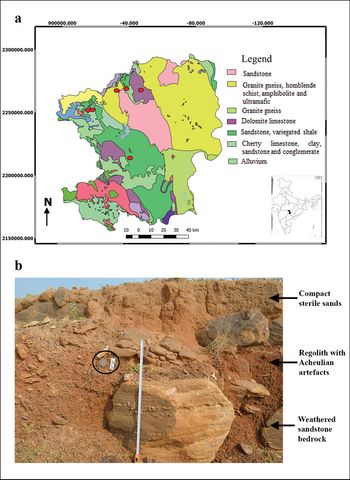
The study region is located in the Wainganga River Basin of central India (Figure 1a–b) (19°30′−21°44′ north, 78°15′−80°00′ east; elevation: 275–305m asl, 1200–1500mm of annual rainfall), extending over a 19 696km2 area. The major geological formations are Archaean, Vindhyan, Gondwana and Deccan traps (Geological Survey of India 1993, 2000) (Figure 2a & 3a–b), which represent the sources of raw materials used by prehistoric populations. Quartzite from the Vindhyan formation, for example, was used during the Acheulian, while chert from the Deccan traps and Kamthi formations were exploited during the Late Palaeolithic (Joshi Reference Joshi2018: 68 & 82). The region is drained by the Wainganga River and its tributaries. Quaternary sediments comprise a range of fluvial deposits and regoliths (sediment resulting from the in situ weathering of the bedrock) within which sites have been identified.
The study region in the Wainganga Basin, India, showing the distribution of Palaeolithic sites within: a) Nagpur; b) Chandrapur districts (1: Bhojapur; 2: Telang Kheri; 3: Bhatala; 4: Temburda; 5: Ramdegi) (DEM modified after Geological Survey of India 1993).

Context of Acheulian sites in the study region showing: a) sites plotted with respect to geological formations (modified after Geological Survey of India 1993); b) stratified contexts at Bhatala, within a regolith derived from sandstones of the Kamthi formation (black circle shows in situ Acheulian artefact) (scale: 0.1m).

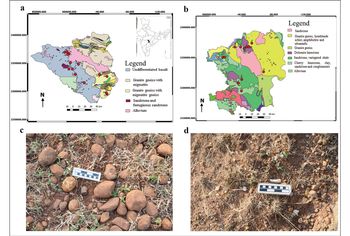
Context of Late Middle Palaeolithic to Late Palaeolithic sites in the study region, showing: a–b) sites plotted with respect to geological formations (modified after Geological Survey of India 1993, 2000); c) artefacts in regolith dominated by core stones derived from the basalt of Deccan trap (scale: 0.1m); d) artefacts in regolith derived from sandstones of the Kamthi formation (scale: 0.1m).

Methodology
An area of 4136km2 was surveyed to identify previously recorded sites and discover new sites and raw material sources. The survey included documenting site areas and artefact densities, categorised as low (less than 2/m2), medium (greater than 2/m2 and less than 5/m2) and high (greater than 5/m2). Systematic transect surveys to sample artefacts were conducted at key sites (see Joshi Reference Joshi2018: 19) characterised by higher artefact densities. To investigate site formation, a gridded survey was conducted at the artefact-rich site of Telang Kheri, where all artefacts, along with sediment and natural clast samples, were collected. The clast samples were subjected to thin-section analysis at the Savitribai Phule Pune University to establish provenance. Lithic analysis was conducted to reconstruct the changing chaîne opératoire over time (see Joshi Reference Joshi2018: 20) and supplemented by experimental knapping to investigate blade debitage.
Results
A total of 34 sites were investigated in a low-relief landscape developed on the surface with the least erosion (Figure 1a–b). Palaeolithic sites are located primarily on hilltops and pediment surfaces, in the context of regoliths derived from weathered bedrock. Local geological variations influence the composition of the regoliths (see the OSM) (Taylor & Eggleton Reference Taylor and Eggleton2001). Few sites are found in fluvial contexts.
The stratigraphic context of Palaeolithic sites
Acheulian
Stratified Acheulian sites (n = 6) concentrate in the southern part of the study region, in areas characterised by Kamthi and Talchir formations comprising sandstones and shales. Two notable stratified sites are Bhatala and Temburda, distinguished by their high artefact densities. Artefacts occur within a regolith derived from the weathered sandstone bedrock of the Kamthi formation (Geological Survey of India 1993), associated with quartz and silicified shales. The artefacts are in the top 0.8–1.4m of this regolith (Figure 2b) and lie below yellowish-brown indurated surface sands containing microblades. Elsewhere in the region, Acheulian artefacts are found within a regolith derived from coarse, ferruginous quartzitic sandstones at Papamiya-ki-tekadi, and shale bedrock of the Talchir formation at Adegaon. Overall, Acheulian artefacts are found within regoliths, and it is hypothesised that regolith development is contemporaneous with the Acheulian (Joshi Reference Joshi2018: 65).
Middle Palaeolithic
Possible early Middle Palaeolithic artefacts were collected from the regolith derived from basalt and sandstone, or from the alluvial fill near the Wainganga riverbank (n = 5 sites). These are distinguished from the Acheulian and Late Palaeolithic by the presence of extreme patination, and technological traits. Further research is required to investigate these artefacts’ source and context, and the reasons for the extreme patination.
Late Middle Palaeolithic to Late Palaeolithic
The late Middle Palaeolithic to Late Palaeolithic (henceforth LMP-LP) assemblages (n = 24 sites) represent a considerable span of time, and are spread across the entire region. They are found in two different regolithic contexts: on the surfaces of weathered basalt of the Deccan traps (Figure 3c) and in weathered sandstones of the Kamthi and Talchir formations (Figure 3d). The former regolith is characterised by cobble-sized core stones with clasts of chert and chalcedony, capped by dark brown soil. To investigate the integrity of sites in this context and for systematic sampling of artefacts, a 2 × 2m grid was laid out at Telang Kheri (the entire site measures some 400 × 200m). A total of 170 artefacts (within 2 × 2m grid: n = 38; outside of the grid: n = 132) were collected, along with natural core stones. The analysis shows that artefacts range from 20–40mm (24 artefacts less than 20mm in length were also present), whereas the naturally occurring weathered basalt core stones are >40mm in length. This suggests a lack of sorting by fluvial or other processes. Other sites also demonstrate a lack of sorting by size; this and the presence of artefacts less than 20mm in length, as well as their unabraded state, point to the high integrity of surface occurrences.
Lithic assemblages
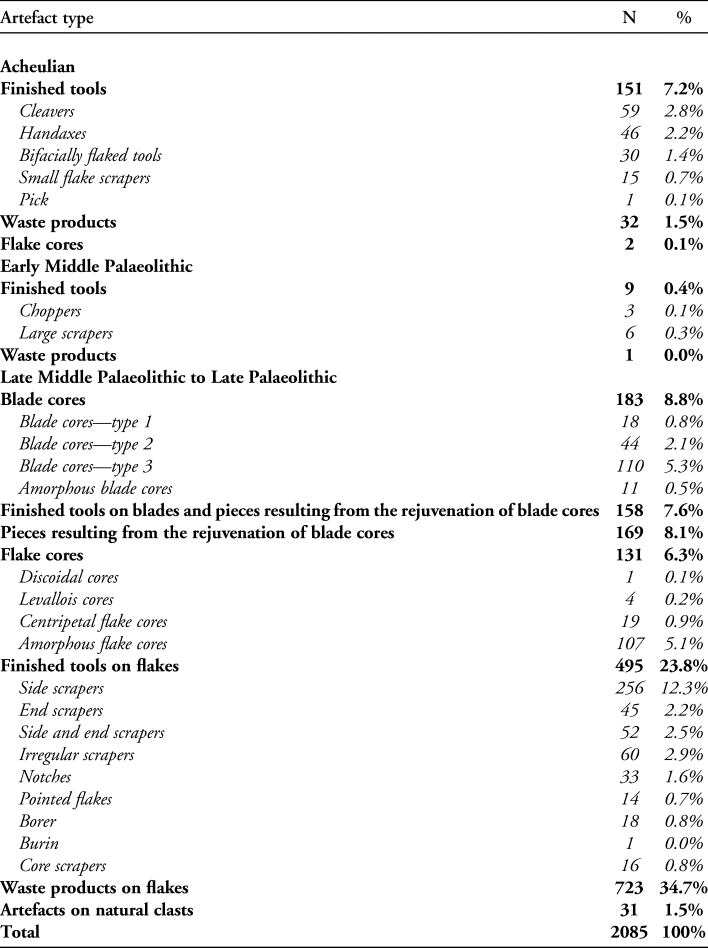
A total of 2085 artefacts were collected from the study region (see Table S1), of which 185 are Acheulian, 10 are early Middle Palaeolithic and 1890 are LMP-LP.
Acheulian lithic assemblages
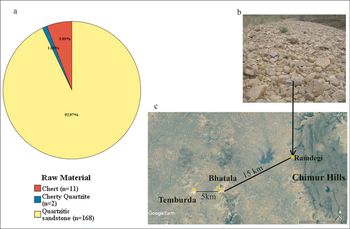
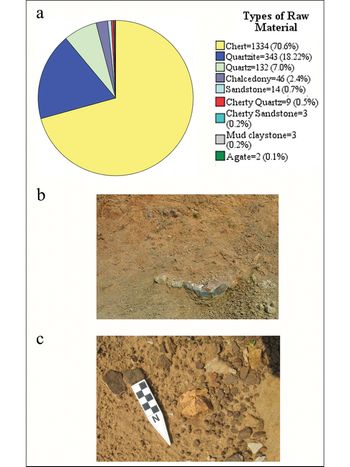
Quartzitic sandstone is the dominant raw material (Figure 4a). While chert occurs locally at Bhatala (length: approximately 100mm), artefacts made from chert are less than 100mm in length; provenance analyses (Joshi Reference Joshi2018: fig. 4.3) show that this variety of chert was not local, although sources have yet to be identified. Local sandstones were probably unsuitable for flaking and were thus not used. The principal source of quartzitic sandstone (clasts of approximately 0.3–0.5mm in length and suitable for detaching the large flakes preferred by Acheulian hominins) (Sharon Reference Sharon2007) (Figure 4b–c) lies in the Vindhyan formation in the Chimur Hills (approximately 15km from Bhatala). Provenance studies (see the OSM) also indicate that a quartzitic sandstone artefact found at Bhatala is comparable with sources of the same material from nearby Ramdegi in the Chimur Hills (Figure 4c). Both samples are consistent with Kamathi sandstone. It is notable that the Acheulian site of Bhatala lacks large or giant cores, suggesting that preliminary stages of quarrying, initial flake detachment and the shaping of large artefacts took place elsewhere—potentially close to raw material sources (quarry sites are yet to be identified). While most artefacts are patinated, the majority (89.2 per cent) are unabraded. Waste products comprise predominantly non-cortical flakes (mean dimensions: 54 × 51 × 20mm), suggestive of later stages in biface production.
Raw material sources used by Acheulian hominins showing: a) predominant use of quartzitic sandstone at the sites of Bhatala and Temburda; b) raw material sources at Ramdegi in the form of clasts (scale: 10km, Google, CNES/Airbus; Digital Globe 2019); c) location of raw material sources at Ramdegi comprising quartzitic sandstone clasts in the outliers of the Chimur Hills, in relation to the sites of Bhatala and Temburda.

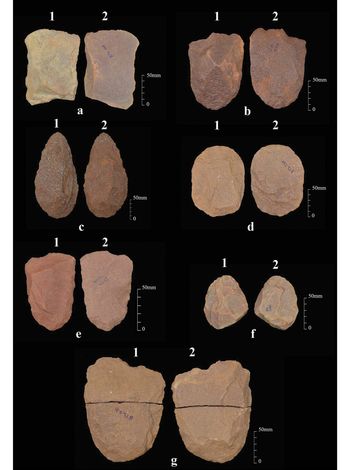
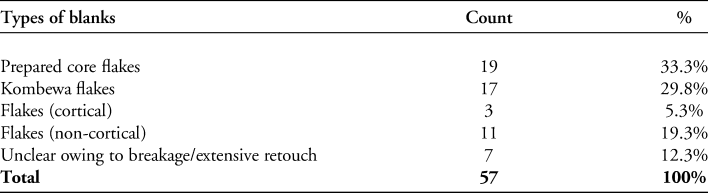
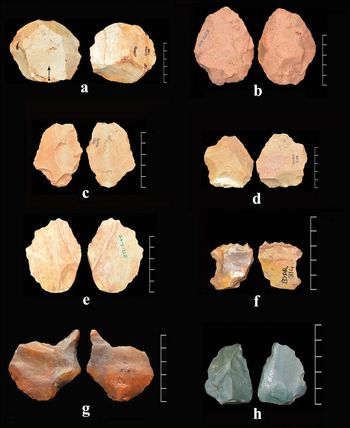
The predominant Acheulian tools are bifaces, most of which are cleavers (Table 2). Of these, 20.3 per cent are broken, most frequently along the mesial (Figure 5g) and proximal ends. The cleavers are made primarily on so-called Kombewa flakes (a debitage technique) (Sharon Reference Sharon2007: 45) and prepared core flakes. Their proportions are 29.8 per cent Kombewa flakes (Figure 5a) and 33.3 per cent prepared core flakes (Figure 5b); other blanks are unclear owing to extensive retouch or breakage (Table 1). Most cleavers are non-cortical (89.8 per cent), with approximately 12 dorsal and seven ventral shaping scars, the latter face being relatively unworked. Butts are predominantly round (34 per cent), while cleaver shapes are usually parallel (59.3 per cent), as also indicated by shape diagrams (following Roe Reference Roe, Leakey and Roe1994; see Joshi Reference Joshi2018: fig. 4.7). The cleaver edge length is approximately 74.4mm, with angles ranging between 35 and 50°. Cleavers range from 81–172mm in length, 57–131mm in breadth, and 22–53mm in thickness. Kombewa cleavers are slightly larger than other types. A few (n = 21) are diminutive cleavers (less than 100mm in length) (Figure 5e). Following standard definitions (Sharon Reference Sharon2007), the cleavers reflect mainly Tixier types 3 and 6.
Acheulian artefacts showing: a) cleaver on Kombewa flake; b) cleaver on a prepared core flake; c–d) handaxes; e) diminutive cleaver; f) diminutive handaxe; g) breakage on a cleaver's working edge and mesial part (scale: 50mm) (note: 1 = dorsal face; 2 = ventral face) (Joshi Reference Joshi2018: 4.vii, 4.xi, 4.xii, 4.xvi).

Cleaver blank types from all Acheulian sites.

Frequency distribution of artefact types (in bold) and subtypes (italicised) with respect to different cultural phases in the Wainganga River Basin, India.
Most handaxes are on flakes (52.3 per cent) and cobbles (13.6 per cent), others being on unidentifiable blanks, due to extensive flaking on both faces. Handaxes are predominantly non-cortical (65.2 per cent). In general, apexes are convergent or pointed; eight exemplars are broken. The butts are mainly rounded (80.4 per cent), while shapes are lanceolate (30.4 per cent) (Figure 5c), ovate (Figure 5d) and double pointed (see Joshi Reference Joshi2018: fig. 4.12). Modification of the butt—possibly for grasping or hafting—is evidenced in eight tools, although this is subject to debate (see Joshi Reference Joshi2018: 75). Flake scars average around 13–16 on faces 1 and 2 respectively. The dimensions of these tools indicate that, irrespective of blank types, there is a preference for handaxes ranging between 77 and 120mm (51.2 per cent) and 120 and 200mm (37.2 per cent) in length. A thickness to breadth (Th:B) ratio with a mean of 0.5 suggests some degree of refinement, although the range falling between 0.3 and 0.7 suggests a lack of standardisation.
Early Middle Palaeolithic assemblage
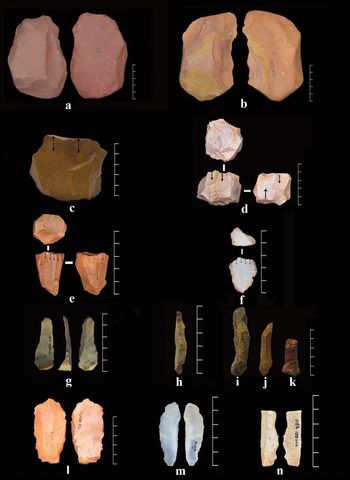
A few artefacts (scrapers and choppers) (see Figure 6a–b) are distinct from the preceding Acheulian because either large flake technologies or blade-reduction sequences are absent. These artefacts are few (n = 10; mean dimensions: 96.4 × 75.1 × 27.9mm), heavily patinated and weathered, and occur in surface contexts. They are tentatively assigned to the early Middle Palaeolithic, but further analysis of their source and context is required.
Lithic artefacts from the study region showing: a–b) early Middle Palaeolithic artefacts. Late Middle Palaeolithic to Late Palaeolithic artefacts showing: c) blade-core type 1; d) blade-core type 2; e–f) blade-core type 3; g) outrepassé; h) crested blade; i–k) pieces resulting from the management of blade cores; l) scraper; m) unretouched blade; n) backed blade (black arrows indicate the direction of removals; all scales: 50mm) (note: 1 = dorsal face; 2 = ventral face) (Joshi Reference Joshi2018: 5.i, 5.vi, 5.vii, 5.x, 5.xi).

LMP-LP assemblage
The principal raw material is chert (Figure 7a), which occurs locally in the form of chunks (length: approximately 200mm) eroding from the inter-trappean beds in Deccan traps, and as nodules and blocks in Gondwana areas (Figure 7b–c). Provenance studies (see the OSM) demonstrate that locally available chert was used to make tools at Bhojapur and Telang Kheri. Quartzites occur in both locations in the form of chunks and cobbles, although they are not part of the local geological formation and are therefore manuports from a yet unknown source. Most artefacts are unabraded (93.8 per cent). It is notable that 1.9 per cent of the artefacts show a double patination suggestive of tool reuse. Two major reduction sequences were noted in this phase.
Raw material use in Late Middle Palaeolithic to Late Palaeolithic (LMP–LP) sites showing: a) raw material types with a predominance of chert; b) chert sources for LMP–LP artefacts in the intertrappean at the site of Bhojapur; c) chert sources for LMP–LP artefacts in the Kamthi formation at the site of Bhatala (scale: 50mm) (Joshi Reference Joshi2018: 5.iv).

Blade-core reduction sequences
The reduction sequences can be read from blade cores, retouched/unretouched blades and pieces resulting from the rejuvenated blade cores (n = 510) (Table 2). The blade cores are divided into three major categories based on the nature and technique of blade removals, the degree of standardisation, the morphology of the cores and potential chronology (Figure 6c–f). Type 1 blade cores (mean dimensions: 75 × 57 × 43.6mm) are amorphous in shape, lack standardisation and have large flake-blades detached. They have 3–4 blade removals per core (blade-scar dimensions range from 28.2 × 19.2mm to 44.6 × 21.4mm), and single (38.9 per cent) or multiple (27.7 per cent) platforms. Type 2 blade cores (mean dimensions: 46 × 36 × 27mm) are tabular in shape, with non-standardised blade removals and with an average of seven removals (blade-scar dimensions range from 21.9 × 13mm to 25.8 × 11.4mm). These cores have single (38.6 per cent) or multiple (31.8 per cent) platforms comprising opposed and right-angle platforms. Type 3 consists of micro-blade cores (mean dimension: 33 × 24 × 17mm) with multiple, standardised blade removals and a distinct core morphology (pyramidal/columnar). Blade detachments range from 2–16 per core (blade-scar dimensions range from 20–40mm; mean: 20.7 × 7.9mm). Cores are mainly non-cortical (48.2 per cent), with less than 50 per cent cortex present on the remaining cores. Single (58.2 per cent) and opposed (23.6 per cent) platforms are common, indicating that the cores were sometimes rotated to maximise use.
Pieces resulting from the rejuvenated blade cores indicate various stages of core reduction and include remnants of blade scars on their faces. The majority are end-struck flakes (78.3 per cent). Among these, it is important to note the presence of crested-ridge blades, a platform rejuvenation flake and a plunging or outrepassé flake (created by removing a full-length flake with a very concave lower face and a distally thickened face (Inizan et al. Reference Inizan, Reduron-Ballinger, Roche and Texier1999: 150)) (Figure 6g–k). Finished/retouched shaped tools are mainly on pieces resulting from the rejuvenation of blade cores (58.9 per cent) and blades (38.9 per cent). These comprise a range of scrapers, backed blades and unretouched but possibly utilised blades (Figure 6l–m). A total of 25 blades are broken. Tools on blade blanks (mean length dimensions: 29.8 × 12.6 × 4.7mm) fall into two groups: large blades (greater than 40mm in length) and microblades (20–40 mm in length). Backed microblades (Figure 6n) are another very small but significant category (mean length dimensions: 25.8 × 9.6 × 4.2mm). Finished tools on pieces resulting from the rejuvenation of blade cores are dominated by scrapers (mean length dimension: 40.2 × 23.1 × 10.1mm) for which scalar retouch predominates (68.6 per cent). Cortex is mostly absent (less than 25 per cent).
Experimental blade manufacture
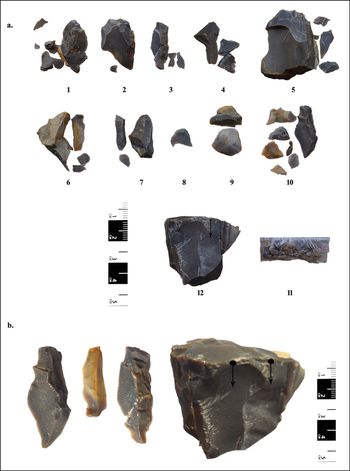
Experimental knapping was undertaken to replicate blade cores of type 2. Six experiments were carried out on chert nodules (Joshi Reference Joshi2018: 100). Soft antler hammers and hard stone hammers (quartzite and granite) were used in four experiments, while a hard hammer alone was used in two. A total of six blades were removed from four cores together with 39 flakes and 140 pieces resulting from the rejuvenated blade cores. When identifiable, dorsal flake-scar patterning was unidirectional (30.8 per cent), bidirectional (2.2 per cent) or multidirectional (26 per cent). This resembles patterning observed on some archaeological flake assemblages, in which unidirectional (39.4 per cent) and multidirectional scar patterns dominate (58.7 per cent). Experimental flakes range in length from 20–40mm, while the archaeological flake assemblages average 39.8mm. The experimental cores (81.8 × 68.5 × 60.7mm) were minimally reduced on account of the relatively novice knapping, as compared to the far greater reduction of archaeological blade cores (46 × 36 × 27mm) of type 2. The experimental blades (approximately 40mm in length), however, fall within the range of archaeological blades (mean: 29.8mm). Generally, experimental blades exhibit fewer (one or two) dorsal ridges than their archaeological counterparts. This is due to less reduction of the former type compared to the archaeological blades. These experiments indicate that flake removals were part of the blade-core reduction (Figure 8a–b). Thus, although some of the archaeological flakes may have come from blade reduction, the majority probably did not; instead they were the product of a separate flake-core reduction sequence.
Experimental knapping showing: a) debitage arising from blade reduction (1, 4, 9 & 11); flakes (2, 5 & 7); blades (3, 6 & 10); platform-trimming flake (8) and reduced blade core (12); b) blades and reduced blade core (the black arrows show the final blade scar) (courtesy of the Sharma Centre for Heritage Education) (Joshi Reference Joshi2018: 5.xxii).

Flake-core reduction sequences
Flake-core-reduction sequences can be inferred from 1376 artefacts, including flake cores and associated debitage. Flake cores (mean dimensions: 58 × 46.6 × 30.9mm) are mainly amorphous, although a small but significant component includes prepared cores (Figure 9a–b) (Table 2). Most finished tools (mean dimensions: 44.3 × 37.3 × 14.7mm) are on end-struck flakes (n = 344) and are predominantly non-cortical (66.6 per cent). Side-scrapers dominate the assemblage (53 per cent), followed by side and end scrapers, end scrapers, notches, borers and pointed flakes (Figure 9c–h), all of which commonly exhibit scalar retouch. Waste products are mainly cortical and non-cortical flakes, along with a sizeable proportion of less than 20mm-long flakes. Overall, the flakes have plain striking platforms, and flake terminations are mainly feathered. When present, bulbs are prominent (see Joshi Reference Joshi2018: 95). Some natural pieces were also retouched (mean dimension: 63.4 × 50.6 × 27.1mm), often using scalar retouch.
Late Middle Palaeolithic to Late Palaeolithic artefacts showing: a) preferential Levallois core (the black arrow shows the direction of removal); b) amorphous flake core; c–e) scrapers; f) notch; g) borer; h) point (all scales: 50mm) (note: 1 = dorsal face; 2 = ventral face) (Joshi Reference Joshi2018: 5.xiii, 5.xiv, 5.xv).

Discussion
The research presented here documents an extended occupation sequence in the Wainganga River Basin, beginning with the Acheulian, followed by a Middle Palaeolithic phase, and culminating in a potential LMP–LP phase. Microblade assemblages were noted at a few sites, potentially representing a chronologically later cultural phase.
Distinct variability is noted in the distribution of sites belonging to different cultural phases. Acheulian sites are found in the southern part of the study region—primarily in regolith deposits derived from Gondwana formations, close to raw material sources that are suitable for large flake production. As these sites are deeply buried, their number is underestimated, as sites are only recorded when discovered during modern quarrying or through other erosional activities. In contrast, LMP–LP sites are distributed across the region. They are found primarily on the surface, eroding out of regoliths derived from the weathering of basalt and sandstone. Site-formation studies clearly indicate the high integrity of such sites.
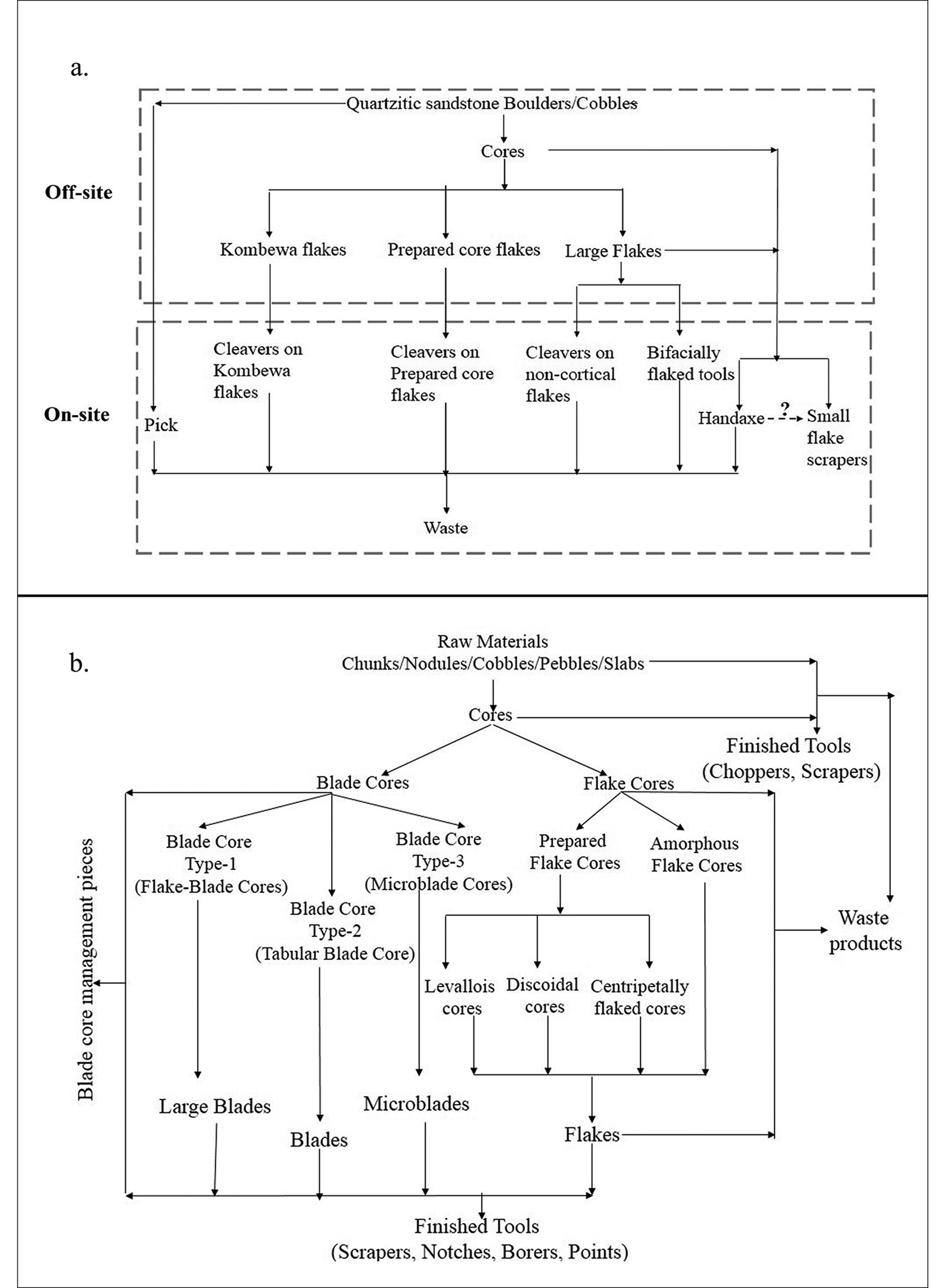
The Acheulian is typical of the ‘Large Flake’ stage of the Acheulian (Sharon Reference Sharon2007). Its reduction sequence is characterised by the absence of primary reduction stages. Thus, large and giant cores, and associated debitage resulting from their reduction, are absent at Acheulian sites in our area (Figure 10a). This suggests the transport of complete or part-finished tools to the sites, from distances of around 15km. Such incomplete reduction sequences are suggestive of predetermined strategies of mobility (Goren-Inbar & Sharon Reference Goren-Inbar and Sharon2006). In the case of bifaces, preferred tools include cleavers. A preference for Kombewa cleavers indicates a degree of planning, a knowledge of fracture mechanics and efficient knapping skills (Sharon Reference Sharon2007). In this respect, the preference for cleavers is similar to other western and central Indian sites where cleavers dominate the assemblage, such as Chirki, Bhimbetka and Tikoda (Corvinus Reference Corvinus1983; Misra Reference Misra, Misra and Bellwood1985; Ota & Deo Reference Ota, Deo, Deo and Paddayya2014). A notable feature in the present research is the high percentage of edge-damaged bifaces, which is indicative of intensive usage.
Schematic diagram showing reduction sequences: a) Acheulian; b) Late Middle Palaeolithic to Late Palaeolithic (Joshi Reference Joshi2018: 4.xx, 5.xxiii).

Although much fewer in number, the early Middle Palaeolithic artefacts were recovered in the same surface contexts as those of the LMP–LP sites. They differ markedly from the preceding Acheulian and the succeeding Late Palaeolithic material culture in terms of patination, dimensions and technology. It is possible that most early Middle Palaeolithic sites in the study region are deeply buried and await discovery. Reworked lithics from river gravel at the site of Nagardhan were alternately termed Acheulian and early Middle Palaeolithic, based on the presence of diminutive bifaces, scrapers and choppers (Joglekar Reference Joglekar2017; Joglekar & Imchen Reference Joglekar and Imchen2018). Considering, however, that diminutive bifaces are noted in the Indian Middle Palaeolithic (Akhilesh et al. Reference Akhilesh, Pappu, Rajapara, Gunnell, Shukla and Singhvi2018), and that the dominant raw material (quartz) for these artefacts (Joglekar Reference Joglekar2017) differs from that (quartzitic sandstone) at Acheulian sites in the region, the Nagardhan tools could perhaps represent a Middle Palaeolithic phase. A note published recently by Joglekar and Imchen (Reference Joglekar and Imchen2018) concerning the presence of these tools in contexts overlying historic-period deposits must be considered in any further discussion of this site.
The LMP-LP sites are mainly surface sites found in the regolith derived from weathered basalt and sandstone. These sites are important, as they suggest the repeated use of specific locations through time, although they may be palimpsests. The lithic assemblages may represent a long time span, marking a transitional phase between the late Middle Palaeolithic and the Late Palaeolithic, characterised by the co-existence of blade- and flake-reduction sequences (Figure 10b), and continuing into a phase where microblade technology was well developed. The absence of stratified sequences and of absolute dates precludes further chronological precision. Small-flake tools are found together with a dominant blade component, a sparse Levallois presence (one core per site and no Levallois flakes), along with microblades and a few backed blades. Locally available raw materials, especially chert, were exploited. Limited evidence for potential tool reuse is suggested by differential tool patination.
Inter-site variability in artefact types is negligible, although, due to the absence of local material sources, sites in the pediment zones have few cores and waste. This contrasts with assemblages from hilltop sites, located close to sources of raw material, characterised by a higher percentage of cores and waste. Blades are far less frequent than cores, suggesting the blades were taken elsewhere, although no sites with a dominant blade component were noted in the region. Variability in dimensions shows that flake cores and finished tools on flakes are slightly larger than the blade component.
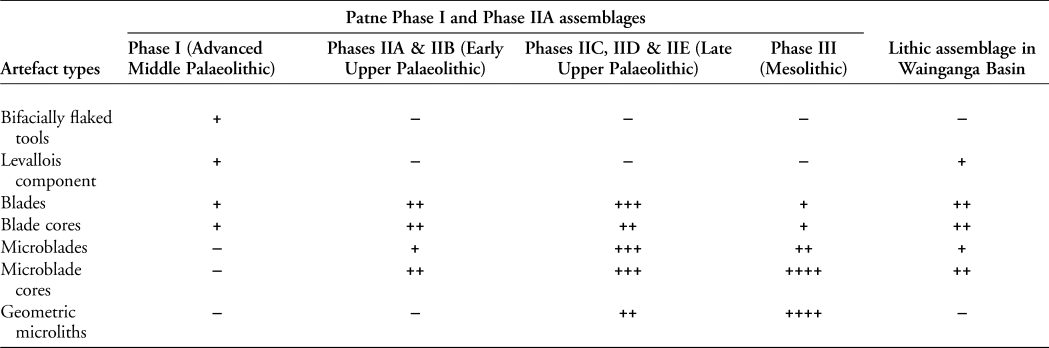
Patne is the closest site to our study region (approximately 400km to the west) with a well-excavated stratigraphic sequence. Similarities with our region are noted in tool types, dimensions and reduction strategies, in Patne Phases I (dated to c. 40 ka), IIA (dated to c. 35–10 ka, i.e. Middle to Upper Palaeolithic) and IIB (Upper Palaeolithic) (Sali Reference Sali1989). This allows for a degree of precision in establishing a relative chronology for the surface scatters in our study region (Table 3). A continued dearth of Levallois and flake elements into the Late/Upper Palaeolithic or Late Stone Age is observed at many other sites in India and Africa (Misra Reference Misra, Misra and Bellwood1985; Diez-Martin et al. Reference Diez-Martín, Domínguez-Rodrigo, Sánchez, Mabulla, Tarriño, Barba, Prendergast and Luque2009; Joshi Reference Joshi2018; Leder Reference Leder2018). In India, the nature of transitions between prehistoric cultural phases is widely debated, particularly for the transition from the Middle Palaeolithic to the Late Palaeolithic. Currently, the two leading hypotheses regarding the development of the Late Palaeolithic in South Asia are:
• Cultural continuity from the Middle Palaeolithic to Late/Upper Palaeolithic, characterised by gradual development, possibly on a regional scale (Petraglia et al. Reference Petraglia2009).
• Replacement theory, implying the dispersal of modern human populations with a microblade technology and replacement of earlier, archaic hominin species, creating a discontinuity between the Middle Palaeolithic and the Late/Upper Palaeolithic (Mellars et al. Reference Mellars, Gori, Carr, Soares and Richards2013; Mishra et al. Reference Mishra, Chauhan and Singhvi2013).
Characteristics of Late Middle Palaeolithic to Late Palaeolithic assemblages from the Wainganga Basin compared to artefacts from excavations at the site of Patne (Sali Reference Sali1989). Symbols indicates proportions of artefact types: + = low percentage; ++ = medium percentage; +++ = very high percentage; – = absent.
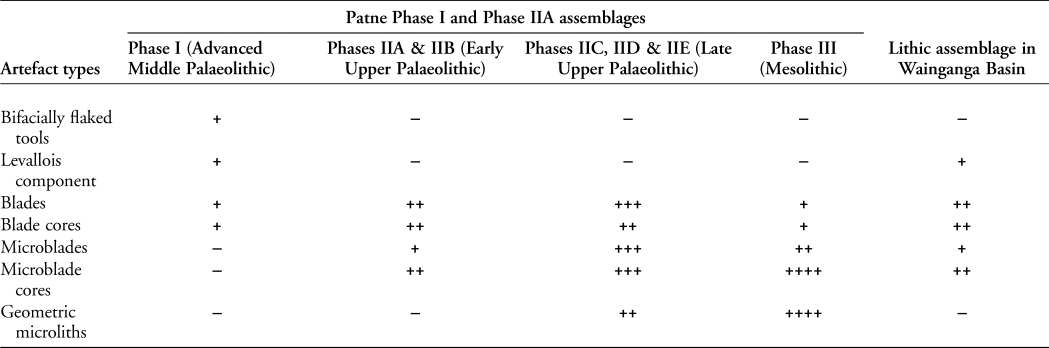
The surface assemblages in the study region span a LMP-LP phase characterised by the presence of both flake- and blade-reduction streams. This suggests long-term occupation on a stable land surface, including processes of transition characterised by the presence of typical Middle Palaeolithic artefacts that may be found in deeply stratified contexts. The causes of either continuity or occasional breaks in occupation are at present unclear, although a suitable environment and local raw material availability would be a reason for long-term occupation in the region. The absence of hominin fossils in the Indian archaeological record complicates interpretations about whether population replacement, brought about by the arrival of new groups bearing microlithic technologies, occurred before 45 ka (Mellars et al. Reference Mellars, Gori, Carr, Soares and Richards2013; Mishra et al. Reference Mishra, Chauhan and Singhvi2013), whether long-term, continuous occupation began far earlier (Petraglia et al. Reference Petraglia2009; Akhilesh et al. Reference Akhilesh, Pappu, Rajapara, Gunnell, Shukla and Singhvi2018), or whether we are seeing a combination of these scenarios. Surface assemblages, therefore, may represent a period marking the transition between the Middle and Late Palaeolithic, continuing into a phase characterised by well-developed microblade technology. The absence of stratified sequences and of absolute dates preclude further chronological refinement.
The present study emphasises the diversity of prehistoric cultural sequences across South Asia, including continuity in certain technologies cutting across phases, and highlights the possibilities of examining questions related to transition, change and evolution based on cultural preferences in different regions, raw materials and lithic strategies adopted by successive populations.
Acknowledgements
I thank S.N. Rajaguru for his help in interpreting geomorphology; K. Akhilesh (Director of the Sharma Centre for Heritage Education) for his help in experimental knapping; M. Kale of Savitribai Phule Pune University for his help in thin section analysis; and the Nagpur circle of the Archaeological Survey of India for providing the necessary permissions for the field survey. This research was funded by the Indian Council of Historical Research and Nehru Trust. This work formed part of my doctoral research, and I thank S. Pappu and S.B. Ota for their guidance.
Supplementary material
To view supplementary material for this article, please visit https://doi.org/10.15184/aqy.2020.32