Introduction
A family history of schizophrenia is the strongest single indicator of individual schizophrenia risk. In any study of risk factors for schizophrenia it is therefore essential to include family history of schizophrenia as a potential confounder. Also there is mounting evidence that gene–environment interactions may be important in schizophrenia aetiology, and, since molecular genetic studies have not identified single major genes that determine a major fraction of the genetic liability for schizophrenia, it has been suggested that indirect measures of liability such as, for example, a family history of psychosis may be preferable compared with the inclusion of single nucleotide polymorphisms or haplotypes in studies of gene–environment interactions (Van Os et al. Reference Van Os, Rutten and Poulton2008).
There is, however, no general consensus as to which measure of familial risk that would be the most relevant to include as a confounder or interacting risk factor. A large majority of schizophrenia patients have no first-degree relatives with the disease (Gottesman, Reference Gottesman1991; Mortensen et al. Reference Mortensen, Pedersen, Westergaard, Wohlfahrt, Ewald, Mors, Andersen and Melbye1999), and it seems unlikely that this large majority of patients should not have a genetic liability. Therefore, a family history of schizophrenia alone is most probably a very imprecise measure of genetic risk. High-risk studies of offspring of mothers with schizophrenia have documented an increased occurrence of other disorders considered to be part of the schizophrenia spectrum, but it is not clear if there is an increased occurrence of other disorders among relatives (Parnas et al. Reference Parnas, Cannon, Jacobsen, Schulsinger, Schulsinger and Mednick1993). For example, the classical adoption study by Kety et al. (Reference Kety, Rosenthal, Wender, Schulsinger, Rosenthal and Kety1968) did not find a higher occurrence of other disorders among the biological parents of schizophrenic adoptees than among the biological parents of controls. Similarly Onstad (Reference Onstad, Skre, Edvardsen, Torgersen and Kringlen1991) did not find an excess of disorders outside of the schizophrenia spectrum amongst the first-degree relatives of twin probands with schizophrenia. The statistical power in these studies to detect any association with disorders other than schizophrenia was limited, however.
On the other hand, several studies have found an increased occurrence of other disorders among first-degree relatives of patients with schizophrenia. Some have suggested a possible genetic overlap with affective disorders in general or bipolar affective disorder and schizo-affective disorder (Cardno et al. Reference Cardno, Rijsdijk, Sham, Murray and McGuffin2002; Laursen et al. Reference Laursen, Labouriau, Licht, Bertelsen, Munk-Olsen and Mortensen2005; Maier et al. Reference Maier, Hofgen, Zobel and Rietschel2005; Craddock et al. Reference Craddock, O'Donovan and Owen2006; Owen et al. Reference Owen, Craddock and Jablensky2007; Lichtenstein et al. Reference Lichtenstein, Yip, Bjork, Pawitan, Cannon, Sullivan and Hultman2009), and, for example, DISC1 has been associated with schizophrenia, bipolar disorder and broader categories of mental disorders (Chubb et al. Reference Chubb, Bradshaw, Soares, Porteous and Millar2008).
However, it is presently unclear how many, and which, disorders that are most relevant to include if family history of mental disorders is to be used as an indicator of liability that is relevant as a confounder and/or interacting factor in studies of possible environmental risk factors such as, for example, urbanicity of place of birth, low birth weight, or other suspected risk factors.
We wanted to assess to which extent the familial disease susceptibility could be better captured by expanding the family history phenotypes to include the broader range of other mental disorders, using a large population-based cohort. We wanted to evaluate if a continuous measure of familial risk could enhance confounder control when studying other risk factors for schizophrenia. Since one of the most consistent associations found with schizophrenia risk is the relation to urbanicity (Mortensen et al. Reference Mortensen, Pedersen, Westergaard, Wohlfahrt, Ewald, Mors, Andersen and Melbye1999; Pedersen & Mortensen, Reference Pedersen and Mortensen2001; Pedersen, Reference Pedersen2006), we chose to assess our measure of familial risk as a confounder in relation to this variable.
The diagnostic expansion of family histories vastly increases the number of possible combinations of different disorders in different relatives and most studies will not have sufficient power to model these associations in any detail. This problem might be remedied if one could measure familial liability on a continuous scale. We therefore modelled schizophrenia risk based upon a large model including a parameter for all informative combinations of mental disorders in a mother, father and sibling and calculated a continuous measure based upon each individual's predicted familial relative risk for developing schizophrenia.
Method
Study population
We used data from the Danish Civil Registration System (CRS) (Pedersen et al. Reference Pedersen, Gøtzsche, Møller and Mortensen2006). The Danish CRS was established in 1968, where all people alive and living in Denmark were registered. Among many other variables, it includes information on CRS-number, sex, date of birth, continuously updated information on vital status, and CRS-number of parents. The CRS-number is used as a personal identifier in all national registers enabling accurate linkage between registers. Our study population included all persons born in Denmark between 1 January 1955 and 30 June 1991, who were alive at their 15th birthday, whose fathers were born in Denmark, and whose mothers were born in Denmark after 1 April 1935 (1.74 million people). The latter restriction ensured complete information on all siblings through parental identity (Pedersen et al. Reference Pedersen, Gøtzsche, Møller and Mortensen2006).
Assessment of schizophrenia and mental illness in parent or sibling
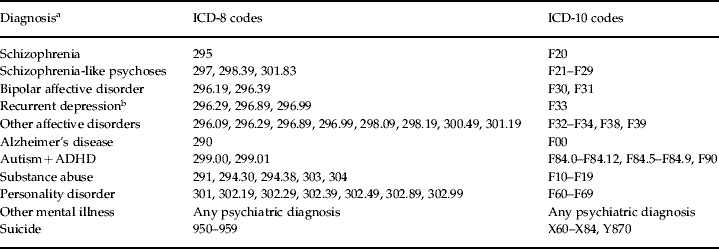
The study population and their mothers, fathers and siblings were linked with the Danish Psychiatric Central Register (Munk-Jørgensen & Mortensen, Reference Munk-Jørgensen and Mortensen1997), which was computerized in 1969. The Danish Psychiatric Central Register contains data on all admissions to Danish psychiatric in-patient facilities, and, from 1995, information on out-patient visits to psychiatric departments was included in the register. At present the register includes data on approximately 630 000 persons and 2.7 million contacts. From 1969 to 1993, the diagnostic system used was the Danish modification of International Classification of Diseases, 8th revision (ICD-8) (WHO, 1967), and, from 1994, the diagnostic system used was the International Classification of Diseases, 10th revision (ICD-10) (WHO, 1992). Cohort members were classified as cases if they had been admitted to a psychiatric hospital or had been in out-patient care with a diagnosis of schizophrenia (ICD-8 code 295 or ICD-10 code F20). Date of onset was defined as first day of first contact (in- or out-patient) with a diagnosis of schizophrenia. Parents and siblings were categorized with a history of schizophrenia, schizophrenia-like psychoses, bipolar affective disorder, recurrent depression, other affective disorders, substance abuse, personality disorder, Alzheimer's disease, autism, attention deficit hyperactivity disorder (ADHD), or other mental disorders, respectively, if they had been admitted to a psychiatric hospital or in out-patient care with one of these diagnoses (Table 1). However, due to lack of power, diagnoses for siblings do not include Alzheimer's disease, and the diagnoses for parents do not include autism or ADHD. This study was approved by the Danish Data Protection Agency.
Classification of a history of mental disorder or suicide in a parent or sibling

ICD-8, Danish modification of International Classification of Diseases, 8th revision; ICD-10, International Classification of Diseases, 10th revision; ADHD, attention deficit hyperactivity disorder.
a Diagnoses are not mutually exclusive, i.e. a parent or sibling may have more than one diagnosis.
b Onset was defined as the second admission that occurred at least 8 weeks after last discharge with these ICD codes.
Assessment of suicide in a parent or sibling
The vast majority of suicides occur in individuals suffering from mental disorders, although some of these individuals will never have been treated for their disorder (Henriksson et al. Reference Henriksson, Aro, Marttunen, Heikkinen, Isometsa, Kuoppasalmi and Lonnqvist1993). Therefore the study population and their mothers, fathers and siblings were linked with the Danish Register of Causes of Death (Juel & Helweg-Larsen, Reference Juel and Helweg-Larsen1999) to obtain information on a history of suicide in a parent or sibling (Table 1).
Assessment of urbanization
As in previous studies (Mortensen et al. Reference Mortensen, Pedersen, Westergaard, Wohlfahrt, Ewald, Mors, Andersen and Melbye1999; Pedersen & Mortensen, Reference Pedersen and Mortensen2001; Pedersen, Reference Pedersen2006), municipalities in Denmark were classified according to degree of urbanization by Statistics Denmark (1997) : capital, capital suburb, provincial city, provincial town, or rural areas.
Study design
A total of 1 745 970 people were followed from their 15th birthday until onset of schizophrenia, death, emigration from Denmark, or 30 June 2006, whichever came first.
Statistical analyses
The relative risk of schizophrenia was estimated by Poisson regression (Breslow & Day, Reference Breslow and Day1987; SAS Institute Inc., 2004). All relative risks were adjusted for calendar year, age and its interaction with sex, calendar year, and history of mental illness and suicide in parents and siblings were treated as time-dependent variables (Clayton & Hills, Reference Clayton and Hills1993). All other variables (sex and place of birth) were treated as fixed variables. In addition we adjusted for a slight change in the age- and sex-specific incidence during the study period. Confidence limits were calculated by Wald's test (Clayton & Hills, Reference Clayton and Hills1993). The adjusted-score test (Breslow, Reference Breslow1996) suggested that the regression models were not subject to over-dispersion. As Cox regression is very computer intensive for large studies, we used Poisson regression as an approximation (Andersen et al. Reference Andersen, Borgan, Gill and Keiding1997).
Model selection
The purpose of the study is to describe the full range of the different diagnoses for parents and siblings and their impact on the risk of developing schizophrenia. To mimic these associations as closely as possible, we considered a model allowing for different risks for each disorder, that these risks differ according to the affected family member, that these risks account for clustering of the various diseases within the same family member (e.g. a father with schizophrenia tends to have other diseases as well), and that the individual diseases also tend to cluster within families (e.g. schizophrenia clusters in families). In detail, we a priori chose a model including 10 variables indicating presence or absence of diagnoses in a mother (10 parameters), 10 variables indicating presence or absence of diagnoses in a father (10 parameters), 10 variables indicating presence or absence of diagnoses in a sibling (10 parameters), all two-factor interactions between the 10 diagnoses in a mother (45 parameters), all two-factor interactions between the 10 diagnoses in a father (45 parameters), all two-factor interactions between the 10 diagnoses in a sibling (45 parameters), all two-factor interactions between the same diagnoses in mother and father (10 parameters), all two-factor interactions between the same diagnoses in mother and sibling (nine parameters), and all two-factor interactions between the same diagnoses in father and sibling (nine parameters). The model selected a priori includes 193 parameters. However, among those, 24 two-factor interactions between any psychiatric illness and a specific psychiatric illness in the same person were redundant (i.e. reducible to the main effects of the specific diagnoses), three two-factor interactions between other affective disorders and recurrent depression in the same person were redundant, and due to limited power 30 two-factor interactions based on less than five cases of schizophrenia were excluded. Therefore, the final model includes 136 parameters describing the association between the full range of diagnoses in a parent or sibling and the later risk of developing schizophrenia. An additional 94 parameters were used to adjust for age and its interaction with sex and calendar year.
To compare the results of the detailed model, we also used a model classifying mothers, fathers and siblings hierarchically with a history of schizophrenia, schizophrenia-like disorders, or other mental disorders (nine parameters), respectively, as we have done in previous studies (Pedersen & Mortensen, Reference Pedersen and Mortensen2001). Similarly, we also classified mothers, fathers and siblings with a history of schizophrenia as previously (Mortensen et al. Reference Mortensen, Pedersen, Westergaard, Wohlfahrt, Ewald, Mors, Andersen and Melbye1999).
Continuous familial relative risk
Based on the 136 parameters describing histories of mental illness in a mother, father and sibling we calculated the total familial risk of schizophrenia for each individual and time-point. The statistical log-linear model with these 136 parameters is identical to the statistical model including the logarithm of each individual's total familial relative risk of schizophrenia as a continuous variable, except that the variation of the total familial risk is ignored. The procedure suggested corresponds to a trend variable using the estimated relative risks as scores. In terms of confounder adjustment for a history of mental illness in a first-degree relative, one may interchangeably include the dichotomized variables (n=136) indicating presence or absence of a history of mental disorder in a mother, father and sibling, or the continuous familial relative risk single parameter.
Attributable risk
The population attributable risk (PAR) is an estimate of the fraction of the total number of cases of schizophrenia in the population that would not have occurred if the risk could have been reduced to that of the category with no psychiatric family history, defined as above. This estimation was carried out as described by Bruzzi et al. (Reference Bruzzi, Green, Byar, Brinton and Schairer1985).
Results
In this population-based cohort of 1 745 970 people born in Denmark between 1955 and 1991, a total of 9324 people were diagnosed with schizophrenia during the 28 million person-years of follow-up from their 15th birthday to 2006.
Relative risk estimates
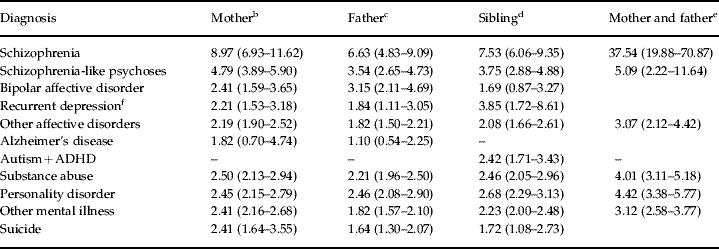
Selected parameter estimates for our model are shown in Table 2. Cohort members with no history of suicide or psychiatric contact in a parent or sibling were chosen as the reference category. As expected, the highest relative risk was associated with combinations of exposure where a first-degree relative had been diagnosed with schizophrenia. This was followed by other diagnoses in the schizophrenia-like disorder category. However, all other categories of mental disorder among first-degree relatives were associated with increased risk, with Alzheimer's disease as the only exception. In contrast, there was no single diagnostic category associated with a decreased risk.
Adjusted relative risks of schizophrenia for selected categories of diagnoses in a parent or sibling compared with persons with no history of suicide or psychiatric contact in a parent or siblingFootnote a

ADHD, Attention deficit hyperactivity disorder.
Values are given as relative risk (95% confidence interval).
a All relative risks were adjusted for calendar year, age and its interaction with sex. We only show estimates based on at least five cases.
b Estimates indicate the relative risk of schizophrenia for a person whose mother only has the diagnosis in question and whose father and siblings have no history of any of the diagnoses.
c Estimates indicate the relative risk of schizophrenia for a person whose father only has the diagnosis in question and whose mother and siblings have no history of any of the diagnoses.
d Estimates indicate the relative risk of schizophrenia for a person who only has a history of the diagnosis in question in a sibling and whose mother and father have no history of any of the diagnoses.
e Estimates indicate the relative risk of schizophrenia for a person whose mother and father only have the disease in question and whose siblings have no history of any of the diagnoses.
f The relative risk associated with recurrent depression includes the effect of other affective disorders. Recall that people with recurrent depression by definition have a diagnosis of other affective disorder.
Population distribution of familial relative risk
To describe the population distribution of the familial relative risk and to assess the impact of family history of mental disorder and suicide on schizophrenia risk in the general population, we plotted the individual's familial relative risk against the fraction of person-years exposed in the general population (Fig. 1). With regard to the detailed model (thin line), 16.6% of the person-years (roughly corresponding to the same proportion of the individuals in the study population) were exposed to a familial relative risk above 1.0, 14.6% of the population were exposed to a familial relative risk above 2.0, 1.9% of the population were exposed to a familial relative risk above 4.79 (corresponding to the relative risk associated with a history of schizophrenia-like psychoses in the mother) and 0.4% of the population were exposed to a familial relative risk above 8.97 (corresponding to the relative risk associated with a history of schizophrenia in the mother).
Three different models for familial relative risk for schizophrenia in relation to the distribution of exposed person-years in the Danish population. RR, Relative risk.

We have also shown the estimates from a simpler model used in publications from our group where family history is categorized into schizophrenia, schizophrenia-like disorders, and any other disorder in a hierarchical fashion (Pedersen & Mortensen, Reference Pedersen and Mortensen2001). As will be seen, the familial relative risk distribution of person-years exposed is very similar to that of the detailed and far more complex model. Finally, we show the familial relative risk estimates from a simpler model, i.e. the one used in our first paper using these population data where we only included family history of schizophrenia (Mortensen et al. Reference Mortensen, Pedersen, Westergaard, Wohlfahrt, Ewald, Mors, Andersen and Melbye1999). Not surprisingly, this shows a far smaller fraction of the population's person-years as exposed, but also the relative risk estimates are slightly smaller. When the detailed model is transformed into PARs, we see that the fraction of schizophrenia cases that can be attributed to family history of mental disorder and suicide is 27.1% (results not shown). However, the PAR that is due to family histories that include schizophrenia is 6.0% (results not shown) and the PAR that is due to family histories that include schizophrenia and schizophrenia-like psychoses is 9.8% (results not shown). In other words, the PAR due to family histories that do not include schizophrenia or related disorders is far larger than the PAR related to disorders that traditionally have been associated with familial schizophrenia risk.
Potential confounding by family history
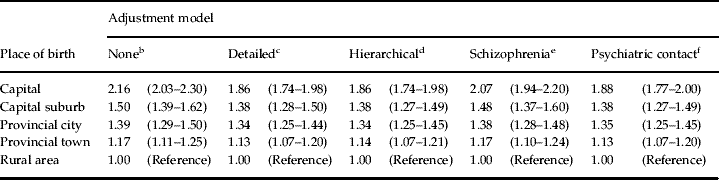
When looking at family history as a confounder in relation to urbanization of place of birth, the results are shown in Table 3. By comparing the column with no adjustment for family history with the one adjusted for the detailed model, we see that there is confounding. In particular, the estimates for the capital and capital suburbs are reduced. The simpler hierarchical model yielded almost identical results. However, in the model only adjusting for schizophrenia, estimates with more residual confounding are seen. A model just adjusting for any family history of psychiatric treatment contact performs better than the model only including familial schizophrenia, and almost as well as the most detailed model, in terms of confounder control. A reduction of the relative risk associated with being born in the capital from 2.16 to 1.86 may not seem very impressive, and perhaps this indicates that genetic stratification only contributes little to the risk associated with urbanization. The point here, however, is that whatever indication there is of confounding or genetic stratification is almost completely confined to the models that include familial disorders other than schizophrenia.
Adjusted relative risk of schizophrenia according to urbanization of place of birthFootnote a

Values are given as relative risk (95% confidence interval).
a All relative risks were adjusted for calendar year, age and its interaction with sex.
b No adjustment for history of mental illness and suicide in a parent or sibling.
c Detailed adjustment for history of mental illness and suicide in a parent or sibling.
d Adjustment for history of schizophrenia, schizophrenia-like psychoses or psychiatric contact in a parent or sibling (classified hierarchically).
e Adjustment for history of schizophrenia in a parent or sibling.
f Adjustment for history of a psychiatric contact in a parent or sibling.
Discussion
Our study has a number of key findings. First, in the general population, schizophrenia risk is not only associated with schizophrenia or disorders that traditionally have been shown to be associated with schizophrenia, but with almost any disorder leading to psychiatric hospitalization or out-patient contact. Second, although the strongest association was with schizophrenia and related disorders, the majority of the large proportion of the schizophrenia occurrence was associated with psychiatric family histories that did not include schizophrenia or schizophrenia spectrum disorders. Third, our example looking at the association with urbanization of place of birth showed that failure to take the broader family history of mental disorders into account in epidemiological studies may result in residual confounding.
The idea of developing a continuous measure of familial or genetic liability to schizophrenia has previously been presented by Pak Sham and other researchers at the Institute of Psychiatry (P. Sham, personal communication; McDonald et al. Reference McDonald, Bullmore, Sham, Chitnis, Wickham, Bramon and Murray2004), and a similar idea for combining risks for coronary heart disease associated with individual single nucleotide polymorphisms into one score has been presented by Morrison et al. (Reference Morrison, Bare, Chambless, Ellis, Malloy, Kane, Pankow, Devlin, Willerson and Boerwinkle2007). We believe, however, that our study is the first to attempt to describe the familial association with the broader range of mental disorders in detail in a large population-based sample.
Several explanations of our findings could be hypothesized. First, there could be a bias towards diagnosing individuals with first-degree relatives with schizophrenia with the same disorder if the family history was known to the clinician. This would result in a bias where this association with schizophrenia was very strong, and would also bias downward any association with other disorders. Our findings of an association with schizophrenia in first-degree relatives are of the same magnitude as those associations that have been found in most studies, and therefore do not support this as an important source of error. Also, to the extent that this bias is operating it would tend to bias any association with disorders outside the traditional concept of schizophrenia spectrum disorder towards the null, meaning that the associations we report for these disorders would be true but underestimated.
Our findings may seem to contradict the large number of classical family studies of schizophrenia (e.g. Baron et al. Reference Baron, Gruen, Rainer, Kane, Asnis and Lord1985; Gershon et al. Reference Gershon, DeLisi, Hamovit, Nurnberger, Maxwell, Schreiber, Dauphinais, Dingman and Guroff1988; Kendler et al. Reference Kendler, McGuire, Gruenberg, Ohare, Spellman and Walsh1993a–Reference Kendler, McGuire, Gruenberg, Spellman, Ohare and Walshc) that emphasize the familial association with schizophrenia, and possibly other psychoses or schizotypal or paranoid personality disorders, but find little support for an increased occurrence of other disorders, e.g. anxiety disorders, and varying results for alcoholism among relatives of schizophrenia patients (Kendler & Gardner, Reference Kendler and Gardner1997).
It is, however, important to note several methodological differences between our study and these studies. First, our sample is a total national sample of the population, with complete ascertainment of the patients treated in psychiatric departments. Most family studies, with notable exceptions as the Roscommon study (Kendler et al. Reference Kendler, McGuire, Gruenberg, Ohare, Spellman and Walsh1993a), have been samples of consecutive patients or other ‘samples of convenience’ which may introduce selection bias. In several studies cases have been screened to exclude co-morbid disorders such as substance use, and also controls have in many studies been screened to exclude individuals with any mental disorder. Finally, the very labour-intensive procedures involved in the recruiting and diagnosing of cases, controls and relatives has often led to sample sizes that yield limited power to estimate the frequency of specific disorders.
On the other hand, our use of routine clinical diagnoses could generate spurious associations with other diagnoses if family members suffering from schizophrenia were erroneously diagnosed with these other disorders. However, if, for example, the increased risk associated with psychiatric contact in the mother was to be explained by misdiagnosed schizophrenia in the mother, then a total of approximately 22 000 mothers should suffer from schizophrenia but not being diagnosed. Such a large number is unrealistic given that the total number of women diagnosed with schizophrenia in Denmark since 1970 is approximately 9000 (Pedersen, Reference Pedersen2006). This by no means excludes misclassification between diagnostic categories in our study, and we cannot exclude that some of the association with, for example, parental substance-use disorders to some extent is explained by, for example, misclassified parental affective disorders. If this hypothetical example were true it would imply that the association with affective disorders was underestimated whereas the association with substance use was overestimated. It would, however, not change the conclusion that much of the familial risk is associated with disorders outside the traditional schizophrenia spectrum. Therefore we do believe that the association between the broader range of familial psychopathology and schizophrenia risk is valid, and that studies should not restrict themselves to relying on a family history of schizophrenia as an indicator of familial risk.
The only familial diagnosis that was not associated with schizophrenia risk in our study was dementia. This is in line with the findings of no association with Alzheimer's disease by Heun et al. (Reference Heun, Kockler and Ptok2002).
Our analyses are limited to mental disorders that had led to in- or out-patient treatment in specialized psychiatric settings. We therefore cannot know to which extent schizophrenia is related to, for example, anxiety, depression or substance-use disorders not leading to specialized treatment. We find that it is plausible that this associated risk may not be as strong as the one found in our data, insofar that there is any correlation between severity of the psychiatric symptoms and the schizophrenia risk in the relative. Also, we find it plausible that there is an elevated rather than a reduced risk associated with this large proportion of mental disorders in the general population, and if this hypothesis were true then of course the familial risk of schizophrenia would vary across an even larger proportion of the population.
Which mechanisms might explain the statistical associations we find? First, a broad range of disorders may share different subsets of the same susceptibility genes that are associated with schizophrenia. Second, families in which a member has schizophrenia may share environmental risk factors for schizophrenia that are also associated with other disorders. Third, other disorders in a relative may directly lead to increased exposure to an environmental risk factor for schizophrenia. An example might be if, for example, substance use in a parent leads to intra-uterine exposure to alcohol or other psychoactive drugs that in some way disrupt brain development; or perhaps behavioural changes in relation to parental mental disorders expose offspring more to infections or other environmental risk factors. Although most of the familial aggregation of schizophrenia itself is probably due to shared genetic factors (Sullivan et al. Reference Sullivan, Kendler and Neale2003) this may of course not apply across the wider range of familial disorders, for example, the associations with substance use.
All these explanations remain hypothetical at this point, but it would seem evident from our findings that identification of the genetic and/or environmental factors explaining this association with these other mental disorders that have not been perceived to be associated with schizophrenia would be a crucial step in explaining the occurrence of schizophrenia in the general population.
Our study also has some implications for the general study of risk factors for schizophrenia. Of course, we cannot necessarily generalize our findings to populations other than Denmark or risk factors other than urbanization at birth. Determining the influence of psychiatric family history would be an open empirical question in any population in relation to any other risk factor. However, our results suggest that failure to take a broader history of psychiatric disorders into account could mean that estimates are subject to substantial residual confounding. In other words, failure to take familial mental illness into account may lead to spurious and erroneous associations with other risk factors. This is important, as most of the epidemiological literature to date has not taken this potential confounder into account. Also, and more surprisingly, our results suggest that it is actually more important to control for psychiatric history in general than schizophrenia specifically. Given the current interest in gene–environment interactions it is also important to note that most epidemiological studies claiming to document these interactions are based on narrow family histories of schizophrenia or psychosis, and therefore probably will have omitted most of the mental disorders associated with an increased familial risk of schizophrenia.
Building as detailed model as the one we presented here is not feasible in most cases. The scores we generated for our continuous model can be made available upon request, but using these scores in other study populations of course necessitates the assumption that our estimates are valid in other populations. It was therefore reassuring that the simpler model where one only took the separate hierarchical categories of schizophrenia, schizophrenia-like psychoses, and any other diagnoses into account performed almost identically compared with the much more complex detailed model, and that one might achieve substantial confounder control simply by assessing the broad category of any mental disorder.
However, it is also important to note that if some of the familial risk associated with the broader range of disorders is due to environmental exposures occurring more frequently in these families, then adjusting for family history may result in an ‘over-adjustment’ reducing a true association with the environmental factor under study. For example, if one is interested in the effects of intra-uterine exposure to psychoactive substances, but adjusts for the potential genetic confounding from psychiatric family history including a maternal history of substance-use disorders or other disorders where substance misuse is prevalent, then any true effect of the intra-uterine exposure may be diluted by the familial association mediated through this exposure. Therefore such familial environmental causes should be carefully considered before ascribing any familial risk to shared genes, especially when considering the broader range of familial disorders. With the rapidly growing number of datasets where genome-wide markers are available for thousands of patients and controls (e.g. Stefansson et al. Reference Stefansson, Rujescu, Cichon, Pietilainen, Ingason, Steinberg, Fossdal, Sigurdsson, Sigmundsson, Buizer-Voskamp, Hansen, Jakobsen, Muglia, Francks, Matthews, Gylfason, Halldorsson, Gudbjartsson, Thorgeirsson, Sigurdsson, Jonasdottir, Jonasdottir, Bjornsson, Mattiasdottir, Blondal, Haraldsson, Magnusdottir, Giegling, Moller, Hartmann, Shianna, Ge, Need, Crombie, Fraser, Walker, Lonnqvist, Suvisaari, Tuulio-Henriksson, Paunio, Toulopoulou, Bramon, Di Forti, Murray, Ruggeri, Vassos, Tosato, Walshe, Li, Vasilescu, Muhleisen, Wang, Ullum, Djurovic, Melle, Olesen, Kiemeney, Franke, Sabatti, Freimer, Gulcher, Thorsteinsdottir, Kong, Andreassen, Ophoff, Georgi, Rietschel, Werge, Petursson, Goldstein, Nothen, Peltonen, Collier, St Clair and Stefansson2008) it may eventually be possible to construct genome-based indices of risk (Wray et al. Reference Wray, Goddard and Visscher2008). Insofar as such indices can be combined with detailed information on environmental risk factors this could eventually lead to a situation where the relative roles of genes and environmental exposures can be determined empirically. Until such data are available, however, careful modelling of family history may be our best bet.
Conclusion
The risk of clinically diagnosed schizophrenia is associated with a family history of a much wider range of mental disorders than previously assumed. This association could be due to shared risk haplotypes, shared environmental exposures or combinations thereof. Irrespective of which mechanisms may explain our findings, these results do indicate that the familial aggregation of the broader range of mental illness is associated with an increased risk for schizophrenia, and may be an important source of bias and confounding in most studies of genetic and environmental causes of schizophrenia.
Acknowledgements
The study was supported by the Stanley Medical Research Institute.
Declaration of Interest
None.