Introduction
The prevalence of dementia and related progressive neurodegenerative disorders in Australia is on the rise (Australian Institute of Health and Welfare, 2012). These conditions are considered to be the greatest contributor to the burden of disability for older people (Rees, Reference Rees2009). Neuropsychiatric behaviors, also known as behavioral and psychological symptoms of dementia (BPSD), are common and often considered to be the greatest challenge in dementia care. BPSD often lead to increased healthcare costs, caregiver burden, and placement into permanent care facilities (Cerejeira et al., Reference Cerejeira, Lagarto and Mukaetova-Ladinska2012).
People who exhibit BPSD, which generate higher levels of caregiver burden, such as aggression and agitation, are more likely to be prescribed psychotropic medications (Chiu et al., Reference Chiu, Chen, Yip, Hua and Tang2006). Although pharmacological interventions are frequently used to manage these behaviors, they can lead to unwanted or adverse effects, an exacerbation of behaviors, or even add to mortality (Kar, Reference Kar2009). Secondary to the lack of efficacious pharmacological interventions (Ballard et al., Reference Ballard, Waite and Birks2006), there has been some focus on the development of non-pharmacological interventions to target different aspects associated with care and management in dementia (Brodaty and Arasaratnam, Reference Brodaty and Arasaratnam2012). The majority of non-pharmacological studies to date have had a focus on caregiver burden and coping (Sorensen et al., Reference Sorensen, Pinquart and Duberstein2002; Belle et al., Reference Belle2006; Brodaty and Donkin, Reference Brodaty and Donkin2009; Brodaty and Arasaratnam, Reference Brodaty and Arasaratnam2012), or on people with dementia already residing in care facilities (Chenoweth et al., Reference Chenoweth2009; Brodaty and Arasaratnam, Reference Brodaty and Arasaratnam2012). However, a large proportion of people with dementia live in the community, which lends to the need for increased research into community-based interventions (Callahan et al., Reference Callahan2012). In 2011, it was estimated that 70% of people with dementia in Australia were living in the community, with around 200,000 informal caregivers were involved in their care (Australian Institute of Health and Welfare, 2012). A recent meta-analysis investigating non-pharmacological community-based interventions with caregiver involvement found the majority of results across the studies to be positive (Brodaty and Arasaratnam, Reference Brodaty and Arasaratnam2012). Importantly, this study found no adverse side effects resulted from the non-pharmacological interventions reviewed.
The use of purposeful activity as a non-pharmacological intervention for people with dementia has shown promise for enhancing quality of life (QOL) and reducing behaviors such as agitation and depression (Brooker et al., Reference Brooker, Woolley and Lee2007). In particular, activities tailored specifically to a person's own interests and functional level generate greater levels of engagement (Kolanowski et al., Reference Kolanowski, Litaker and Buettner2005; Kolanowski et al., Reference Kolanowski, Litaker, Buettner, Moeller and Costa2011). The importance of engaging people with dementia based on their interests and roles was highlighted by Kitwood (Reference Kitwood1997). Kitwood (Reference Kitwood1997) commented on the importance of maintaining personhood by meeting the unique needs of each individual to be occupied, and that with occupation comes an enhanced sense of self-worth.
One promising study, which implemented the use of activity as an intervention, was a randomized controlled trial (n = 60) of the Tailored Activity Program (TAP) conducted in the United States (Gitlin et al., Reference Gitlin, Winter, Burke, Chernett, Dennis and Huack2008). The TAP intervention involves an occupational therapist (OT) working with both the caregiver and the person with dementia through tailoring activities (which could include leisure activities or activities of daily living (ADLs) depending on the individual) to the capacity, interests, and roles of the person with dementia. TAP also involves working closely with caregivers for effective implementation (Gitlin et al., Reference Gitlin2009). Another study in the Netherlands also demonstrated the potential benefits of a community-based OT intervention in people with dementia and their caregivers. This Dutch intervention involved OT visits to assess the person's abilities, train family caregivers in skills such as problem-solving and coping strategies, and to implement environmental and compensatory strategies to assist the person with dementia to engage in meaningful activities (Graff et al., Reference Graff, Vernooij-Dassen, Thijssen, Dekker, Hoefnagels and Olde-Rikkert2007). They found that OT improved the daily functioning of the person with dementia (p < 0.0001, as assessed using the process scale of the Assessment of Motor and Process Skills) while also reducing caregiver burden and providing caregivers with a better sense of control over their lives (p < 0.0001; Graff et al., Reference Graff, Vernooij-Dassen, Thijssen, Dekker, Hoefnagels and Olde-Rikkert2006; Reference Graff, Vernooij-Dassen, Thijssen, Dekker, Hoefnagels and Olde-Rikkert2007). These initial positive findings support further research into community-based and OT-based interventions for people living with dementia and their caregivers.
While both of these studies demonstrate the potential benefits for OT in the field of dementia, the outcomes of the Dutch study (Graff et al., Reference Graff, Vernooij-Dassen, Thijssen, Dekker, Hoefnagels and Olde-Rikkert2006) focused on QOL, health status, and mood whereas the TAP program focused on reducing behaviors associated with dementia, which, as aforementioned, are considered to be the most challenging and burdensome aspect of the disease. Therefore, TAP is an OT-based intervention program that shows particular promise within the field of dementia. TAP is novel as caregivers are actively involved in the TAP process from activity development in the beginning to activity simplification for future declines in function of the person with dementia, and generalization of strategies to other care contexts. Through this process, caregivers develop an increased sense of self-efficacy for addressing care issues with their family members. This involvement of both the caregiver and the person with dementia in the community is novel as the majority of non-pharmacological interventions in dementia have been in a residential setting, or involve only one half of the dyad (Zarit and Leitsch, Reference Zarit and Leitsch2001; Schulz et al., Reference Schulz, Martire and Klinger2005; Brodaty and Arasaratnam, Reference Brodaty and Arasaratnam2012).
The US TAP pilot demonstrated the increase in caregiver skills through the following: improved self-efficacy using activities, F(1,43) = 7.1, p = 0.011, Cohen's d = 0.74; increased mastery, F(1,43) = 6.7, p = 0.013, Cohen's d = 0.55; and greater use of simplification techniques, F(1,43) = 5.5, p = 0.023, Cohen's d = 0.71. Caregivers reported benefits of greater ability for the person to be engaged in activity and kept busy, thus leading to fewer hours in which the caregiver was doing things for the person, F(1,42) = 8.8, p = 0.005, Cohen's d = 1.14, or was “on duty,” F(1,42) = 15.8, p = 0.001, Cohen's d = 1.01 (Gitlin et al., Reference Gitlin, Winter, Burke, Chernett, Dennis and Huack2008; Reference Gitlin, Hodgson, Jutkowitz and Pizzi2010). For the person with dementia, this successful TAP pilot trial showed reductions in incidences of BPSD overall, F(1,41) = 7.58, p = 0.009, Cohen's d = 0.72, with significant reductions in specific behaviors of shadowing, F(1,4) = 58.9, p = 0.003, Cohen's d = 3.10, agitation, Wald X 2(1) = 6.0, p = 0.014, Cohen's d = 0.75, repetitive questioning, F(1,22) = 5.94, p = 0.023, Cohen's d = 1.22, and argumentation, Wald X 2(1) = 6.6, p = 0.010, Cohen's d = 0.77 (Gitlin et al., Reference Gitlin, Winter, Burke, Chernett, Dennis and Huack2008). Although a small-sampled pilot study, these initial results were very promising and thus support further study into TAP.
This trial will investigate the effectiveness and cost-effectiveness for TAP compared with the control group within an Australian population. To date, no such community-based intervention has been investigated in Australia, with most non-pharmacological interventions being tested within the residential care setting. The primary aim of this study is to determine the clinical and cost-effectiveness of TAP in reducing the burden of BPSD in persons with dementia and family caregivers. The primary hypothesis is that TAP will reduce the frequency of behavioral and psychological symptoms of dementia, including agitation, apathy, dysphoria/depression, sleep, and irritability/lability as measured on the revised Neuropsychiatric Inventory – Clinician rating scale (NPI-C) over four months in persons with dementia compared with the control group, who receive education on dementia. Secondary hypotheses are that (i) persons with dementia who receive TAP will have a reduced severity and frequency of all 14 domains of BPSD (NPI-C); (ii) caregivers who receive TAP will report reduced burden, decreased caring time, higher mastery in engaging the person with dementia in activities, and enhanced communication skills; (iii) TAP will be cost-effective; and (iv) persons with dementia who receive TAP will receive less psychotropic medication.
Methods
Study design
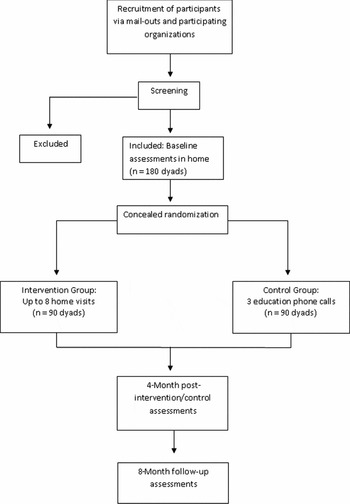
A two-group randomized parallel design clinical trial of 180 dyads is planned in Australia to evaluate the effectiveness of TAP compared with the control group. Once screened, eligible participants will undergo a baseline assessment. Following this, both participants will be either randomized to the TAP program or a control group receiving three educational phone sessions. A blinded research assistant will then conduct post-intervention assessments at four months, and follow-up assessments at eight months. No interaction with participants will occur between the post-intervention and follow-up assessment periods.
Recruitment and participants
Participants will be recruited from community organizations around Sydney via a mail-out strategy. Inclusion criteria for the person with dementia are that they must:
-
1. have a diagnosis of dementia;
-
2. have a score >3.31 on the Informant Questionnaire on Cognitive Decline for the Elderly (IQCode; Jorm and Jacomb, Reference Jorm and Jacomb1989);
-
3. be rated by the caregiver as having a frequency score of at least 2 or above on any item of the Neuropsychiatric Inventory (Cummings et al., Reference Cummings, Mega, Gray, Rosenberg-Thompson, Carusi and Gornbein1994) over the past month;
-
4. have conversational English;
-
5. be able to participate (independently or with some assistance) in at least two ADLs (e.g. bathing, dressing);
-
6. if on psychotropic medication, be on a stable dose for the past 60 days; and
-
7. if on dementia medication (Ebixa, Reminyl, Exelon, Aricept), be on a stable dose for the past 3 months.
Inclusion criteria for the caregivers are that they must:
-
1. report occurrence of one or more behaviors (e.g. apathy, passivity, disruptive behaviors) in person with dementia over the past month;
-
2. have conversational English;
-
3. be a family member aged at least 18 years and living with person with dementia, or have at least four days or 7 h per week contact;
-
4. be accessible by phone; and
-
5. indicate a willingness to learn use of activities.
Formal approval has been received from the local institutional Human Research Ethics Committee, and informed consent is to be obtained from the person with dementia and the caregiver involved in the study.
Randomization
Randomization into TAP or control group will occur after baseline assessment for each participant (see Figure 1). The randomization will be generated by an investigator external to the recruitment and the assessment process. Group allocation, where people will be assigned to either intervention or control groups, will involve the use of opaque envelopes for concealment, and be conducted by the OT interventionist who will not be involved in any of the post-intervention or follow-up assessment processes.
Process of randomization and flow of participants through the Australian TAP study.

Intervention
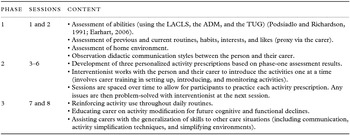
Participants in the intervention group will receive the TAP protocol involving up to eight contacts from a TAP-trained OT over a four-month period (Gitlin et al., Reference Gitlin2009). The OT interventionist has been trained in the TAP protocol, and fidelity checks to ensure appropriate adherence to the protocol will be conducted at regular two-month intervals. This approach to fidelity will be achieved via tele-conference with the interventionist and Professor Gitlin and her team, in which a few randomly selected de-identified cases will be discussed from beginning to end of their TAP participation. The TAP intervention process occurs over three phases, which are outlined in Table 1. The majority of these contacts will involve both the person with dementia and their caregiver. For a more detailed overview of TAP, see Gitlin et al. (Reference Gitlin2009).
Overview of the TAP intervention protocol phases from visits/contacts one to eight

Notes: LACLS = Large Allen's Cognitive Level Screen; ADM = Allen's Diagnostic Module; TUG = Timed Up and Go.
Activities will be specifically tailored to the person with dementia to match their abilities, interests, and roles, and may therefore vary greatly depending on each individual participant (e.g. gardening, folding laundry, painting, watching a special DVD). In TAP, the OT will write three specific activity prescriptions, including goals and implementation techniques, from which the caregiver (and sometimes person with dementia) will then choose the activity to be introduced first. The prescription will then be reviewed, and the activity is introduced with the OT and caregiver working together. In each session previous prescriptions will be reviewed, with any issues highlighted by the caregiver addressed through problem-solving with the OT. The process will be repeated for each activity, followed by sessions on activity simplification and generalization of strategies to end the intervention period. Activity simplification refers to modifying an activity, such as simplifying the activity itself or providing more prompting throughout activity engagement, to account for the declines that occur throughout the progression of dementia (Gitlin et al., Reference Gitlin2009). Caregivers are supplied with a “Caregiver manual” which contains practical information on activity, communication, behavioral management, and health and safety suggestions for both caregiver and person with dementia. The Australian TAP study will include a sub-cohort of persons who have frontotemporal dementia (FTD). For this group an amended version of the “Caregiver manual” will be supplied, which accommodates the unique symptomatology known for FTD (Piguet et al., Reference Piguet, Hornberger, Mioshi and Hodges2011; Raskovsky et al., Reference Raskovsky2011).
Control group
Participants in the control group will receive three telephone education sessions of around 20 min, each based on a general book dealing with dementia. These sessions, conducted by the same interventionist OT that conducts the TAP intervention sessions, will be with the caregiver, and will not involve the person with dementia. During these sessions, the OT and caregiver will have some discussion around specific chapters in the book about general dementia-related issues. These sessions are designed to control for the empathetic listening and dementia-related information received by participants in the intervention group, and are not intended to be an equivalent time in social contact to the TAP intervention sessions. Caregivers in the intervention group will receive a copy of the same book to control the TAP intervention as the only difference between the groups.
Data collection
Prior to baseline visits, caregiver participants will self-complete a range of baseline questionnaires covering information such as demographics, QOL, burden, stress, task management, caregiver confidence, and vigilance. Baseline assessments will then be completed by the research assistant in participant's home, taking approximately 1.5 h to complete. In-home baseline assessment will involve cognitive assessment of the person with dementia and the caregiver. Remaining assessments are about the person with dementia's behavior, function, resource utilization, and health, completed via proxy with the caregiver. The importance of evaluating anticipated intervention outcomes for both members of the dyad was discussed by Zarit and Leitsch (Reference Zarit and Leitsch2001), who highlighted that if an intervention was targeted at only one member of the dyad, still both would be impacted.
These same assessments will be completed post-intervention at four months, and again at eight-month follow-up in the participant's home by the same blinded research assistant. Additional assessment will include willingness to pay at eight months. Willingness to pay is a cost-effectiveness measure, and is further discussed under the “economic analysis” section of this paper. An appropriate number of baseline assessments will be conducted in tandem to allow for inter-rater reliability analysis of the NPI-C.
Outcome measures
The primary outcome measure of the study is the revised NPI-C to measure BPSD exhibited by the person with dementia. The NPI-C, developed from the original NPI (Cummings et al., Reference Cummings, Mega, Gray, Rosenberg-Thompson, Carusi and Gornbein1994) is based on caregiver report, and assesses the frequency (0 = never – 4 = very frequently) and severity (0 = none – 3 = marked: a major source of behavioral abnormality) of 14 behavioral domains, including delusions, hallucinations, agitation, aggression, dysphoria, anxiety, elation/euphoria, apathy/indifference, disinhibition, irritability/lability, aberrant motor disturbance, sleep disorders, appetite and eating disorders, and aberrant vocalizations (de Medeiros et al., Reference de Medeiros2010). Five of these domains have been highlighted as major outcomes of this study: apathy, agitation, dysphoria/depression, sleep, and irritability/lability. Based on previous experience and trials (Brodaty and Burns, Reference Brodaty and Burns2012), these five domains were highlighted as major outcomes as they were deemed most likely to respond to the intervention rather than the domains such as hallucinations and delusions. The NPI is a widely used tool; the NPI-C version used in this study has been shown to have sound validity and reliability, and allows for clinician judgment to support the caregiver's validity of rating (de Medeiros et al., Reference de Medeiros2010).
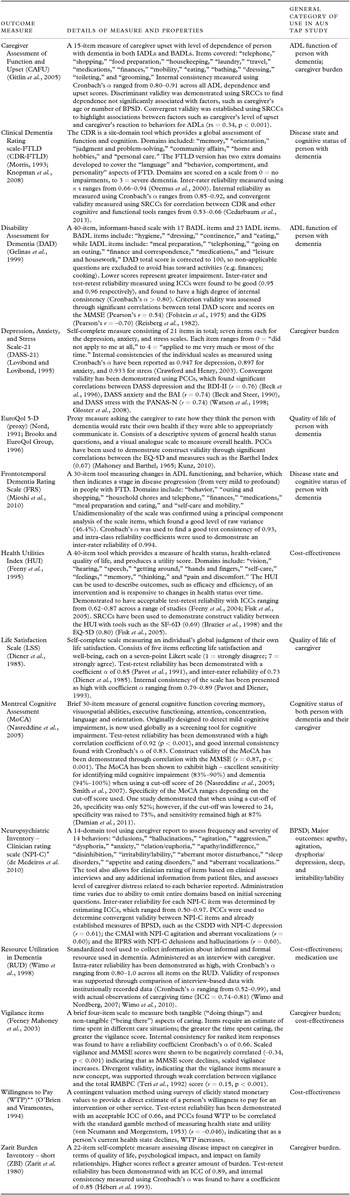
Secondary measures will assess all other behavioral domains on the NPI-C, as well as QOL, carer objective and subjective burden, disease state and cognitive status, and cost-effectiveness. All measures, including information on medication use, will be collected at baseline at four and eight months. The only exception being the “Willingness to Pay” cost-effectiveness measure, which is only collected at eight-month follow-up to ensure rater blinding at four months is maintained due to the use of separate intervention and control versions of this study. Table 2 provides an overview of the Australian TAP study outcome measures.
Overview of outcome measures used in the Australian TAP study

Notes: BADL = Basic Activities of Daily Living; IADL = Instrumental Activities of Daily Living; FTLD = Frontotemporal Lobar Degeneration; BPSD = Behavioral and Psychological Symptoms of Dementia; BDI-II = Beck Depression Inventory II; BDA = Beck Anxiety Inventory; BPRS = Brief Psychiatric Rating Scale; CMAI = Cohen–Mansfield Agitation Inventory; CSDD = Cornell Scale for Depression in Dementia; GDS = Global Deterioration Scale; MMSE = Mini-Mental State Examination; PANAS-N = Positive Affect Negative Affect Scale-Negative; RMBPC = Revised Memory and Behavior Problems Checklist; SF-6D = Short Form preference based measure of health; ICC = Intra-class Correlation Coefficient; PCC = Pearson Correlation Coefficient; SRCC = Spearman Rank Correlation Coefficients.
*Primary Outcome measure; **Collected at 8-month follow-up only to maintain rater blinding at 4 months due to use of separate intervention and control versions in the current study.
Economic analysis
The primary economic outcome of cost-effectiveness analysis will be used incrementally to evaluate differences in costs and health effects between TAP and control conditions (World Health Organization, Reference Edejer, Baltussen, Adam, Hutubessy, Acharya, Evans and Murray2003). Secondary economic outcomes will include cost per caregiver hour saved as measured by time spent “on duty” and time spent “doing things,” and caregiver's willingness to pay measured via a contingent valuation method (Oremus and Tarride, Reference Oremus and Tarride2008).
Statistical analysis
Between-group differences will be analyzed across outcome variables using general linear models of analysis of covariance (ANCOVA), using baseline measures as a covariate. Baseline measures, such as disease stage, psychotropic medication, and gender, will be analyzed univariantly with the difference score. Variables with significant associations (p < 0.2) will be included as covariates in the general linear model. Repeated measures of general linear models will be used to include all three time points across the study. Data will be analyzed using Statistical Package for Social Sciences (SPSS).
Sample size calculation
A total of 180 participant dyads (90 dyads per group) are required to be recruited into this randomized trial. The sample size calculation is based on a small effect size of f = 0.20 in the primary behavioral outcomes at four months, and adjusting for a 20% dropout/missing data rate. This sample size calculation is based on previous trials, which have used the NPI as an outcome measure (Feldman et al., Reference Feldman2001; Campbell et al., Reference Campbell2008). The estimated effect size for this study is calculated to give a power of 80%. The study currently has Department of Health and Ageing (DoHA) seeding funding (trial registration ACTRN12612001161819) for 60 participant dyads, and we will seek further funding to complete the full trial.
Discussion
The results of this study have the potential to inform the development of clinical guidelines for non-pharmacological management of BPSD exhibited by community-living people with dementia. Development of evidence-based non-pharmacological interventions in community dementia care settings is a need supported by a growing body of evidence (Brodaty and Arasaratnam, Reference Brodaty and Arasaratnam2012; Gitlin, Reference Gitlin2012; Górska et al., Reference Górska2013).
From a governmental economic perspective, it is favorable for people with dementia to remain at home with their family caregivers for as long as possible rather than being institutionalized (Brodaty and Donkin, Reference Brodaty and Donkin2009). A prospective study found that caregiver distress related to behaviors exhibited by the person with dementia was a significant predictor of placement into a care facility (de Vugt et al., Reference De Vugt, Stevens, Aalten, Lousberg, Jaspers and Verhey2005). The TAP pilot found that 86% of caregivers reported less upset with BPSD (Gitlin et al., Reference Gitlin2009), suggesting the potential for TAP to delay institutionalization. The cost-effectiveness of TAP was further suggested through a reduction in time spent caring, and through caregiver's willingness to pay for the intervention (Gitlin et al., Reference Gitlin2009), lending support to a trial of TAP as a potential community-based intervention for dementia management in an Australian setting.
Potential limitations for this Australian TAP study include difficulties with recruiting required number of participants to demonstrate effect and the confounding impact of any dementia interventions participants may be concomitantly involved in such as community care services. To address these issues, a research assistant will be employed throughout the study to ensure ongoing recruitment, participants will be excluded at the screening phase if they are involved in any other clinical trials, and any other involvement with community care services will be noted for analyses.
It is predicted that participation in the TAP intervention will improve outcomes for the person with dementia and their caregiver, such as improved QOL and delayed placement into care facilities. The basis of this is the benefit of purposeful activity, which has been shown to reduce certain behaviors in dementia within the context of care facility (Cohen-Mansfield, Reference Cohen-Mansfield2001; Marshall and Hutchinson, Reference Marshall and Hutchinson2001). The US TAP pilot has shown that these initial findings for the benefit of activity are translatable to the community context, and has also suggested the benefit for specifically tailored activities to the individual (Gitlin et al., Reference Gitlin, Winter, Burke, Chernett, Dennis and Huack2008). The Australian TAP project is a unique opportunity to replicate the original TAP pilot in a definitive and confirmatory trial and to extend its translation globally, while also addressing a significant gap in the current Australian community-support base for people living with dementia and their caregivers. The Australian TAP project will also provide new information about TAP, including an assessment of cost-effectiveness prospectively.
Conflict of interest
None.
Description of authors’ roles
C.M. O'Connor drafted the manuscript, and is the research project coordinator on the trial. L. Clemson led the development of the Australian TAP research protocol, contributed to conceptualization and study design, and contributed to the drafting of the manuscript. H. Brodaty jointly developed the Australian TAP research protocol, contributed to conceptualization and study design, and contributed to the drafting of the manuscript. Y.H. Jeon jointly developed the Australian TAP research protocol, contributed to conceptualization and study design, and contributed to the drafting of the manuscript. E. Mioshi jointly developed the Australian TAP research protocol, contributed to conceptualization and study design, and contributed to the drafting of the manuscript. L. Gitlin developed the TAP protocol, contributed to the Australian TAP research protocol, and to the drafting of the manuscript.
Acknowledgments
This study is funded by an Australian Department of Health and Ageing (DoHA) Seeding Grant (trial registration: ACTRN126120011611819). Laura N Gitlin developed the TAP program with a team of occupational therapists at Thomas Jefferson University, Philadelphia, USA.