It is well established that alcohol use in adolescence is a serious public health problem. Alcohol use frequently shows onset and rapid growth during adolescence (Duncan, Duncan, & Strycker, Reference Duncan, Duncan and Strycker2006). Almost one-half of eighth graders report initiation of alcohol use and 13% report heavy episodic drinking (Maggs & Schulenberg, Reference Maggs, Schulenberg and Galanter2006). Merikangas et al. (Reference Merikangas, He, Burstein, Swanson, Avenevoli and Cui2010) report that 6.4% of adolescents aged 13–18 years were diagnosed with alcohol abuse or dependence. Such use in middle school predicts alcohol abuse or dependence at age 21 years (Guo, Collins, Hill, & Hawkins, Reference Guo, Collins, Hill and Hawkins2000). Given the multitude of serious long-term consequences of alcohol abuse and dependence (Bossong & Niesink, Reference Bossong and Niesink2010; Broman, Reference Broman2009; Moore, Florsheim, & Butner, Reference Moore, Florsheim and Butner2007), a growing body of research has focused on identification of individual, parent, family, and peer influences on alcohol use during adolescence (Masten, Faden, Zucker, & Spear, Reference Masten, Faden, Zucker and Spear2008). However, there has been much less focus on familial influences on onset and patterns of alcohol experimentation in late childhood and early adolescence, despite the importance of understanding early factors that may pave the way for adolescent alcohol use (e.g., Zucker, Kincaid, Fitzgerald, & Bingham, Reference Zucker, Kincaid, Fitzgerald and Bingham1995). A better understanding of developmental precursors to adolescent use is critically needed to inform the development of preventive interventions.
Early adolescent alcohol use that is prior to peak onset age is highly relevant to developmental models of problematic alcohol use (Zucker, Reference Zucker2008). Studies of parental influences on alcohol use and problem use in adolescence and adulthood support the importance of socialization processes during childhood and preadolescence and children's early experiences using alcohol (see Zucker, Donovan, Masten, Mattson, & Moss, Reference Zucker, Donovan, Masten, Mattson and Moss2008). However, few studies have examined parent influences on alcohol use by early adolescence. Many American children are raised in a cultural context in which regular alcohol use is common among parents and relatives. In addition, parents may sanction children's minimal use in special circumstances (e.g., during a holiday meal), and use during adolescence often is considered a rite of passage (see Masten et al., Reference Masten, Faden, Zucker and Spear2008; Zucker et al., Reference Zucker, Donovan, Masten, Mattson and Moss2008). Thus, it is not always clear whether children's early experiences using alcohol, which by early adolescence are most likely to only range from a sip to a single alcoholic drink, can be considered nonnormative and which experiences with parents are problematic or present risk for future use. The parental influences that are usually considered are direct and relatively limited in scope, such as genetic factors or parental alcohol use. However, even these issues rarely have been examined in prospective intergenerational studies. Further, among parents who use alcohol, parental influences may vary from strict rules regarding no use of alcohol by their children to permissiveness or even encouragement of use. Prospective intergenerational studies are ideal for examining and untangling the effects of such factors on alcohol use in childhood to early adolescence.
The present study examines these intergenerational influences using a longitudinal data set involving three generations, the Oregon Youth Study (OYS) and the associated Three-Generational Study (3GS). The OYS boys, who were the original target participants, grew up in neighborhoods with higher than usual incidences of delinquency and were predominantly from lower- and working-class families. These boys showed relatively high levels of alcohol use in adolescence and later dependence or abuse (Capaldi, Feingold, Kim, Yoerger, & Washburn, Reference Capaldi, Feingold, Kim, Yoerger and Washburn2012; Capaldi, Stoolmiller, Kim, & Yoerger, Reference Capaldi, Stoolmiller, Kim and Yoerger2009). The present study involves these OYS boys and men, their children, and these children's mothers.
Direct and Indirect Effects of Parental Alcohol Use on Child Early Alcohol Use
Both alcohol and drug use are associated across generations (Bailey, Hill, Oesterle, & Hawkins, Reference Bailey, Hill, Oesterle and Hawkins2006; Pears, Capaldi, & Owen, Reference Pears, Capaldi and Owen2007); and adoption, twin, and extended-family designs have established that there is a strong heritable component to liability to substance use dependence in adults. However, shared environmental influences are relatively stronger in youth samples and at earlier stages of substance use (Dick, Reference Dick2011; Lynskey, Agrawal, & Heath, Reference Lynskey, Agrawal and Heath2010), highlighting the need to understand environmental pathways. Estimates of the magnitude and nature of intergenerational associations in substance use, as well as the mechanisms and factors that facilitate or disrupt familial transmission, have not yet been widely addressed. Such studies require prospective data and a developmental study design.
High levels of alcohol use by parents during their own adolescence may increase the likelihood that parents create a context for their future offspring that encourages alcohol use. The adolescent years are marked by high levels of growth in alcohol use (Capaldi et al., Reference Capaldi, Stoolmiller, Kim and Yoerger2009), and early onset of alcohol use and high use in adolescence predict higher levels of use in adulthood (Bonomo, Bowes, Coffey, Carling, & Patton, Reference Bonomo, Bowes, Coffey, Carling and Patton2004; Buchmann et al., Reference Buchmann, Schmid, Blomeyer, Becker, Treutlein and Zimmermann2009). Even if the parents' use is lower in adulthood than in adolescence, parents who were higher users in adolescence may be more tolerant of earlier onset of use and of use in general in their offspring. Further, they may be part of an extended network of family and friends who are relatively tolerant of early use of alcohol or who are higher level users themselves.
In our intergenerational studies of health-risking behaviors such as alcohol use, we posit that a specific process by which offspring may develop these behaviors is by observing and learning these behaviors directly from the parent (Cranford, Zucker, Jester, Puttler, & Fitzgerald, Reference Cranford, Zucker, Jester, Puttler and Fitzgerald2010). Any alcohol use by parents may increase the probability that children will experiment with alcohol, because of direct modeling and the availability of alcohol in the home (Chassin & Handley, Reference Chassin and Handley2006). Although modest parent alcohol use is culturally expected and not necessarily problematic, the likelihood that genetic and other risks for alcohol problems will be manifested depends in part on the extent to which the environment facilitates alcohol consumption. Our model thus accounts for a range of parental alcohol use patterns during the child's lifetime. Child exposure to problematic patterns of adult alcohol use, such as those resulting in noticeable intoxication, is likely to confer stronger risk for child experimentation for a number of reasons. These may include stronger parent genetic risk (Blum et al., Reference Blum, Nobel, Sheridan, Montgomery, Ritchie and Jagadesswaran1990; Covault, Gelernter, Hesselbrock, Nellissery, & Kranzler, Reference Covault, Gelernter, Hesselbrock, Nellissery and Kranzler2004); easy alcohol accessibility in the home (e.g., large amounts of alcohol that are not well controlled); modeling of abusive use by parents and other significant adults; and disruptions in caregiving, including monitoring (Cranford et al., Reference Cranford, Zucker, Jester, Puttler and Fitzgerald2010; Latendresse et al., Reference Latendresse, Rose, Viken, Pulkkinen, Kaprio and Dick2009; Masten et al., Reference Masten, Faden, Zucker and Spear2008). Thus, we expected child exposure to adult intoxication to be a potent mediator of the associations between parent self-reported alcohol use and child early alcohol use.
In addition to directly modeling alcohol use, parents may normalize the behaviors and make them seem appealing through their talk about these behaviors in front of or with their children (e.g., joking and telling anecdotes about use). Well before adolescence, children can identify alcoholic beverages, know cultural rules about use, and have increasingly positive (and less negative) expectations regarding cognitive and behavioral effects of use (Gaines, Brooks, Maisto, & Dietrich, Reference Gaines, Brooks, Maisto and Dietrich1988; Hipwell et al., Reference Hipwell, White, Loeber, Stouthamer-Loeber, Chung and Sembower2005; Miller, Smith, & Goldman, Reference Miller, Smith and Goldman1990). Children acquire this knowledge in part by listening to their parents talk. Parents' norms regarding alcohol use and parent–child discussions of these norms have also been found to predict children's later alcohol use norms, which in turn prospectively predicted their alcohol use (Brody, Flor, Hollett-Wright, & McCoy, Reference Brody, Flor, Hollett-Wright and McCoy1998; Brody, Ge, Katz, & Arias, Reference Brody, Ge, Katz and Arias2000). In the present study, we observed parent–child conversations about substances and recorded the frequency of parent encouragement or positive portrayals of alcohol use. In addition, whereas we anticipated few parents would expect or overtly approve of their child consuming an alcoholic beverage by early adolescence, we questioned whether parents' approval of their child using alcohol before reaching the legal drinking age (21 years) would increase risk for early use. Such parental expectations might tap acceptance of or resignation to the cultural view of underage drinking as a rite of passage. We expected such tacit approval to increase the likelihood of alcohol experimentation by early adolescence.
Discerning Alcohol-Specific Transmission Pathways for Alcohol Use
Intergenerational alcohol use transmission pathways may strongly overlap with or be inseparable from those involved in the transmission of conduct problems or antisocial behavior. There is evidence of overlap in the genetic influences associated with alcohol and other substance abuse or dependence with externalizing spectrum disorders (Hicks, Krueger, Iacono, McGue, & Patrick, Reference Hicks, Krueger, Iacono, McGue and Patrick2004). Undercontrolled and antisocial behavior also is a risk factor for alcohol use, both in adolescence and through early adulthood (Zucker, Reference Zucker2008), and conduct problems usually precede substance use (Dishion, Capaldi, & Yoerger, Reference Dishion, Capaldi and Yoerger1999; Duncan & Tildesley, Reference Duncan and Tildesley1996; Elliott, Huizinga, & Menard, Reference Elliott, Huizinga and Menard1989). There is evidence for shared psychosocial (Conger & Rueter, Reference Conger, Rueter and Brody1996; Thornberry & Krohn, Reference Thornberry, Krohn and Farrington2005) risk factors underlying the association between antisocial behavior and substance use, including poor parenting (e.g., low levels of monitoring) and deviant peer association (Latendresse et al., 2008; Pears et al., Reference Pears, Capaldi and Owen2007). Difficulties in inhibitory control, behavioral disinhibition, and risk aversion may represent common mechanisms underlying parent–child transmission of externalizing and substance use behaviors (e.g., Krueger et al., Reference Krueger, Hicks, Patrick, Carlson, Iacono and McGue2002; Pears et al., Reference Pears, Capaldi and Owen2007). Consistent with models of gene–environment interplay (see Rutter, Moffitt, & Caspi, Reference Rutter, Moffitt and Caspi2006), such parent dispositional risk common to both problems may be transmitted directly to children and may increase the likelihood that temperamentally at-risk offspring will be exposed to the very rearing environments (e.g., harsh and inconsistent parenting, poor supervision, and modeling) that further increase risk for both of these problem types. Thus, we sought to establish whether intergenerational transmission pathways for alcohol use were distinct from those involved in antisocial behavior. Understanding whether pathways to early alcohol use are shared or separate from those involved in antisocial behavior could have important implications for prevention and intervention with both types of behaviors.
Hypotheses and Research Questions
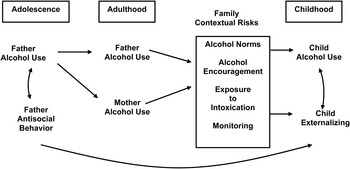
Two primary research questions were examined. The theoretical model and hypothesized pathways are summarized in Figure 1. First, we hypothesized that fathers' alcohol use during their own adolescence would predict their children's early alcohol use. It was expected that some, but not all, of the associations between parent and child alcohol use would be attributable to general developmental pathways that increase risk for problem behavior. Thus, we expected evidence for intergenerational associations in alcohol use to persist after accounting for fathers' antisocial behavior in adolescence and children's externalizing behaviors.
The theoretical model guiding the hypothesized pathways of intergenerational transmission of alcohol use.

Second, it was expected that fathers' alcohol use during adolescence not only would predict their children's early alcohol use, but also a number of individual and family environmental conditions that might support early and continued use by these children. It was expected that the effects of fathers' alcohol use in adolescence on children's early alcohol use would be primarily attributable to the later alcohol use of both fathers and mothers during their children's lives. That is, we predicted that fathers' alcohol use in adolescence would predict their continued alcohol use and that of their child's mother during adulthood. Parents' use in turn was expected to be associated with family risk for child alcohol use and with children's actual use by early adolescence. Specifically, we predicted that encouragement of and norms (i.e., approval of underage drinking) about early alcohol use, exposure to intoxicated adults, and levels of parental monitoring would mediate the associations between parent and child alcohol use.
Method
Participants
Children (n = 125) of 83 fathers and 91 mothers were used in the present study. These children's fathers were originally recruited as boys to the OYS, a community-based sample designed to study community, familial, and individual risk factors for delinquency. The OYS involved recruiting all boys in the fourth-grade classes of schools in neighborhoods with higher than average rates of delinquency in a medium-sized metropolitan area in the Pacific Northwest. Of those invited, 74% (n = 206) agreed to participate. The OYS participants were representative of the sample in the area at the time; 90% of the boys were White, and most were from families of low socioeconomic status (Hollingshead, Reference Hollingshead1975). At the first assessment (Wave 1), the boys were aged 9–10 years. Additional details on sample recruitment and characteristics can be found in Capaldi and Patterson (Reference Capaldi and Patterson1989). Participation rates were 94% or better at each of the yearly assessments following the boys and men from ages 9 to 33 years.
The 3GS recruited the offspring of the OYS men and these children's mothers (who might or might not still be in a romantic relationship with the father). Originally, all children and cohabitating stepchildren were allowed to participate. Because of subsequent budgetary limitations, recruitment was limited to only the first two biological children per pairing of an OYS man with a woman (i.e., OYS men who fathered children with more than one woman could have more than two children followed in 3GS). 3GS child assessments occur at ages 21 months (Time 1 [T1]) and ages 3 (Time 2 [T2]), 5 (Time 3 [T3]), 7 (Time 4 [T4]), 9 (Time 5 [T5]), 11 (Time 6 [T6]), and 13 (Time 7 [T7]) years. The study is ongoing as children are still being born to the OYS men. Thus, the total number (N) available for each wave is determined by the timing of the men's procreation. For the present study, the sample was limited to those offspring who were old enough for the child early alcohol use construct to have been assessed. As of December 2011, this resulted in N = 125 (58 male) children of 83 OYS fathers (51 with 1 child, 22 with 2 children, and 10 with 3 children) with 91 different biological mothers. Analytic adjustment for nonindependence is discussed below. Of the 125 participating children, 115 were biologically related to the OYS men, 9 were stepchildren, and 1 child was adopted. At 3GS T1, the children were 1.8 (SD = 0.3) years of age, and the fathers were 24.0 (SD = 1.8) and the mothers were 24.4 (SD = 3.4) years of age on average.
Procedures
Annual assessments of the OYS boys and men included structured interviews, standardized and internally designed questionnaires, parent and peer interaction tasks, telephone interviews, and in-home observations. The staff involved in interviewing, observing, or coding all completed rating forms on individuals and family interactions. Official records were consulted to gather arrest data. Assessments of children in the 3GS included standardized and internally developed self-, parent-, and partner-report questionnaires; structured interviews; and staff ratings of father– and mother–child interactions.
Measures
Construct development
Observed constructs were the mean composites of agent-specific and time-specific indicators. The indicators themselves often were formed as the mean of relevant items or subscales. Patterson and Bank (Reference Patterson and Bank1986) specified two criteria used to guide construct formation, which were used in the present study: items had to show acceptable internal consistency (α ≥ 0.60 and an item-total correlation ≥ .20), and scales had to converge with other scales or indicators assessing the same construct (i.e., indicator loadings ≥ 0.30 on a one-factor solution). However, scale items that violated these guidelines were retained if they were part of a standardized instrument or if the item was low base rate but face valid (e.g., having ever consumed alcohol at age 9 years).
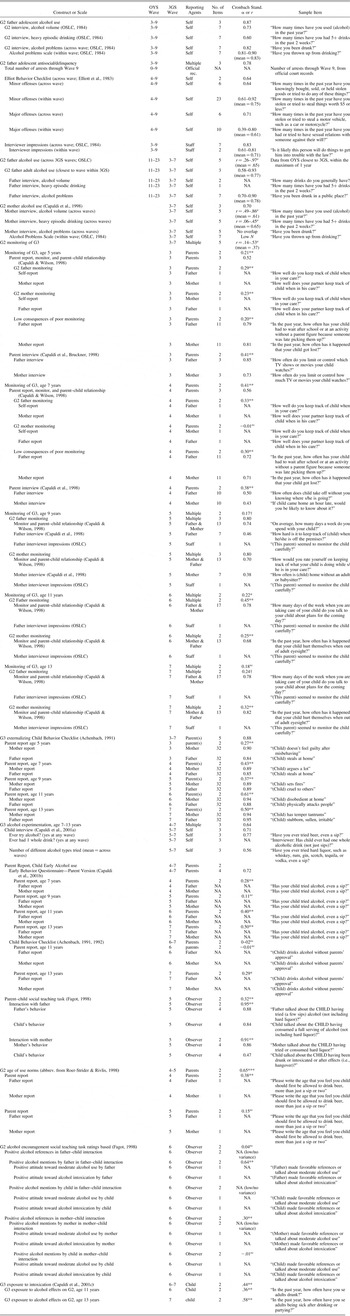
Space limitations and the large number of indicators and constructs preclude a detailed scale description here. Thus, specific scale formation statistics as well as example items are presented in Appendix A, and brief construct measures descriptions are given below. Further details are available from the authors upon request.
Father adolescent alcohol use
Fathers' alcohol use was measured prospectively at ages 11 through 17 years (OYS Waves 3–9). Three self-report indicators (volume, heavy episodic drinking, and alcohol problems) were calculated as the mean of each subscale across the waves, and then the mean of the three cross-wave indicators was taken to represent adolescent use. Items came from OYS interviews (Oregon Social Learning Center, 1984); the volume was calculated by multiplying the number of times alcohol was used in the past year by the usual amount of alcohol consumed on each occasion. Heavy episodic drinking was represented by a single item, “How many times have you had 5+ drinks in the past 2 weeks?” Alcohol problems were measured using a seven-item scale (e.g., “Have you ever thrown up from drinking?”, “Have you been drunk in a public place?”).
Father adolescent antisocial behavior
The construct score for fathers' antisocial behavior during adolescence was calculated as the average of three indicators. The first indicator was the total number of arrests through Wave 9 (age 17 years), which was calculated from official records provided by juvenile agencies in all areas where the boy had lived. For the second indicator, boys completed the self-reported Elliot Behavior Checklist (Elliott, Ageton, Huizinga, Knowles, & Canter, Reference Elliott, Ageton, Huizinga, Knowles and Canter1983) across Waves 4 through 9 (ages 12–17 years). Minor and major delinquent offenses were tapped by 23 and 10 items, respectively, that were averaged across the six time points, and then these two cross-wave mean scores were averaged. The third indicator was based on two items from ratings by interviewers at Waves 3 through 9 (ages 11–17 years); the two items were averaged within wave, and then these scores were averaged across the seven waves.
Father alcohol use in adulthood
Father alcohol use in adulthood was assessed during their child's lifetime and was calculated using the same items and construct development approach described for adolescent use. For 3GS T3 through T7, the alcohol use scales and variables from the closest OYS wave (within 12 months or less) to the 3GS time point in question were identified. Volume, heavy episodic drinking, and alcohol problems scales were averaged within each time point, and then these means were averaged across all time points to form the construct.
Mother alcohol use in adulthood
Mothers were interviewed at each 3GS time point (T3 to T7) using an instrument that contained the same alcohol use questions asked of the father (Capaldi, Pears, Wilson & Bruckner, Reference Capaldi, Pears, Wilson and Bruckner1998). The construct was formed in the same way as the father alcohol use in adulthood construct.
Parental monitoring
The parental monitoring measure was formed as the mean of standardized scores calculated at five time points (T3–T7). The indicators calculated at each time point were means of self-, partner, and when available, interviewer reports on questionnaires and interviews, including the Monitoring and Parent Child Relationship Questionnaire (Capaldi & Wilson, Reference Capaldi and Wilson1998), a Parent Interview (Capaldi et al., Reference Capaldi, Pears, Wilson and Bruckner1998), and Parent Interviewer Ratings (Oregon Social Learning Center, 1982–2007). Self- and partner-reported items included “If [this] child came home an hour late, would you be likely to know about it?” and “How well does your partner keep track of the child when [he or she] is in [his or her] care?” Interviewer items included, “This parent seemed to monitor the child carefully.”
Parental age of alcohol use norms
At 3GS T4 and T5, parents responded to a questionnaire (abbreviated from Roer-Strider & Rivlis, Reference Roer-Strider and Rivlis1998) from which a single item was drawn (“Please write the age that you feel your child should first be allowed to drink beer, more than just a sip or two.”). As expected, the measure was not normally distributed and very few parents reported approving of alcohol use before late adolescence; less than 6% of mothers and less than 14% of fathers approved of alcohol use prior to age 18 years. Most parents selected age 21 years or older at both waves (67% of mothers and 61% of fathers). Given the distribution of responses, each indicator was recoded so that ages less than 21 years were coded 1 and ages 21 years and over were coded 0. The mean of these mother and father binary variables at each wave were then calculated to form the construct.
Parental alcohol use encouragement
At T6 the child completed a social teaching task discussion separately with his or her mother and father. After a brief warm up (snack time and unstructured conversation), the parent and child were asked to spend 5 min discussing “. . . cigarettes, alcohol and drugs,” which could include issues such as if use is appropriate during adolescence. Trained raters later watched the interactions and completed ratings of parent and child behavior during the task. These included the following two items, rated for both the mother–child and father–child task using a 4-point scale (0 = not at all to 3 = quite a bit): “parent made favorable references or talked about moderate alcohol use” and “parent made favorable references or talked about alcohol intoxication.” The items were averaged for each parent and then these scores were averaged to form the construct. Seventeen percent of the tasks were rated by two raters. Agreement was 94%, showing high interrater reliability.
Child exposure to intoxication
An internally developed child self-report questionnaire (Capaldi, Pears, Wilson & Bruckner, Reference Capaldi, Pears, Wilson and Bruckner2001b) administered at ages 11 and 13 years included two items of relevance here: “In the past year, how often have you seen adults drunk?” and “In the past year, how often have you seen adults being sick after drinking or partying?” Children used a 3-point response scale (1 = never, 2 = sometimes, 3 = often). Responses were averaged within each time point, and then the means were averaged across the two time points to form the construct.
Child externalizing behavior
The 32-item externalizing behavior broadband scale of the parent-report Child Behavior Checklist (Achenbach, Reference Achenbach1991) was used as the measure of child externalizing behaviors, with the exception that one item (“Uses alcohol or drugs for nonmedical purposes”) was removed. Raw scales (sum of items) based on mother and father reports were standardized and averaged to represent child externalizing behavior at each of 3GS time points T3 through T7. The mean of these (again standardized) parent-report indicators across the five waves then was used as the construct.
Child early alcohol use
Alcohol use by early adolescence was formed as the mean of standardized indicators from three reporting agents: child self-report (ages 7–13 years), parent report (ages 5–13 years), and observer report (age 9 years). Self-reported alcohol use was formed as the mean of the following three indicators each asked at T5, T6, and/or T7: (a) whether (yes/no) the child had ever had any alcohol, even a sip; (b) whether the child had ever had one whole alcoholic drink; and (c) the number of different types of alcohol the child reported having tried (0 through 4 for beer, wine, coolers, and liquor, respectively).
Parent report on child alcohol use comprised the mean of two indicators. First, on the Early Behavior Questionnaire (Capaldi, Pears, Wilson, & Bruckner, Reference Capaldi, Pears, Wilson and Bruckner2001a), mothers and fathers separately answered “Has your child tried alcohol, even a sip?” (yes/no) at T4 through T7; the indicator was formed as the mean across time points of the average of mothers' and fathers' responses within each time point. Second, at time points T6 and T7, mothers and fathers each completed the alcohol use item described above from the Child Behavior Checklist; the indicator was formed by first averaging parent reports within each time point and then averaging these means across the two time points.
The third indicator of child alcohol use was based on observer ratings of the T6 parent–child social teaching task conducted separately for mother–child and father–child dyads. For each dyad, observers completed two four-item scales concerning whether the parent or child reported that the child had used alcohol.
Validation of the significance of the child early alcohol use measure
The child alcohol use outcome comprised alcohol experimentation and early use items at ages 7 to 13 years, rather than patterns of regular or problematic use. To establish whether elevations on this outcome could be considered precursors of early onset or problematic alcohol use, we examined whether similar alcohol use items measured for children's fathers (i.e., OYS boys/men) at comparable ages (from ages 9–10 to 13–14 years) were associated with the fathers' patterned or problematic use later in adolescence. Examining predictions from single items, it was found that boys who answered “yes” to “have you ever had alcohol, even a sip” by ages 13–14 years scored higher at ages 15–18 years on mean volume and frequency of alcohol consumption (r = .16, p < .05) and heavy episodic drinking (r = .15, p < .05), and they reported experiencing more negative consequences of alcohol use on average (r = .26, p < .001) compared to those who answered “no.” These associations were also significant for answers to “Have you ever had one whole (alcoholic) drink?” (r = .18, .42, and .27, respectively, p < .05). The findings support the association of the early alcohol use measures with later higher levels of use.
Data analyses
Path analyses were conducted using Mplus 6.1 (Muthén & Muthén, Reference Muthén and Muthén1998–2010) under the complex sample option, which modifies standard errors to account for nonindependence (in many cases) of children and their siblings clustered within families (Williams, Reference Williams2000). All variables except for parental monitoring were significantly skewed and thus transformed to more closely match a normal distribution and to reduce the influence of outliers. Then, prior to modeling, observed variables were standardized to the Z distribution for greater ease of interpretation.
Missing data
Complete data were available for all observed constructs for 98 (78.4%) of the child cases, and 92.8% (116) were missing only one variable. The lowest covariance coverage was between parental alcohol encouragement and age of alcohol use norms, with 81.6% of the sample having data on both variables. Full information maximum likelihood estimation has been shown to provide unbiased estimates when data are missing at random (Arbuckle, Reference Arbuckle, Marcoulides and Schumaker1996) and thus was used in the present study.
Results
Descriptive statistics
Relevant to the at-risk status of the OYS sample, the 83 fathers included in the present study had on average a lifetime history of five or more arrests. In adolescence, 54% of the fathers reported heavy episodic drinking, with 33% reporting such drinking in adulthood (during the childhoods of their offspring). At age 25 years, 28% of the men met criteria for alcohol dependence and a further 29% for alcohol abuse based on the Composite International Diagnostic Interview (World Health Organization, 1997).
Regarding the distribution of early alcohol use in the children, 33% reported having tried alcohol by age 9 years, and 85% reported such experimentation by age 13 years. At age 13 years, 25% of the sample reported having ever consumed a whole alcoholic drink.
Correlations among primary model variables
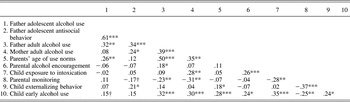
The correlation matrix for the 10 variables tested in the path models is shown in Table 1. Overall, the patterns show a number of significant intergenerational associations, with all but one predictor (father antisocial behavior in adolescence) significantly associated with early alcohol use by the child, at least at the .10 level. As hypothesized, fathers' alcohol use in adolescence predicted their own adult alcohol use, the parents' approval of their child's alcohol use before age 21 years, and the child's early use of alcohol (p = .06). It is surprising that the fathers' adolescent alcohol use was not significantly associated with the mothers' adult use or with the child's externalizing behaviors.
Correlations among study variables

Note: The p values of correlations were adjusted to account for the nonindependence of children within families.
†p < .10. *p < .05. **p < .01. ***p < .001.
Correlations also indicated a significant association between the mothers' and fathers' alcohol use in adulthood. Each was also associated with the children's early alcohol use, and each showed a pattern of associations with other family conditions potentially implicated in risk for the children's use. Specifically, both fathers' and mothers' alcohol use was negatively associated with monitoring of the child and was linked with parental approval of the child drinking alcohol before age 21 years. In addition, fathers' alcohol use was associated with parental encouragement of alcohol use, and mothers' use was correlated with child exposure to intoxicated adults.
In addition to the associations with parental use described above, child early use was associated with having seen adults intoxicated, parental encouragement, parental approval of underage alcohol use, child externalizing behaviors, and lower levels of parental monitoring. Of note, the pattern of associations supported separate consideration of these predictors rather than the formation of any higher order constructs.
Path models
Models 1 and 2: Accounting for general problem pathways in intergenerational transmission of early alcohol use
In the first path model (see Figure 2), we tested whether the significant association between father alcohol use in adolescence and child early alcohol use would persist after accounting for father antisocial behavior in adolescence and child externalizing behaviors. Problem-specific pathways were clearly supported. Nonsignificant paths from father antisocial behavior in adolescence to child early alcohol use and from father alcohol use in adolescence to child externalizing problems then were trimmed from the model. Again, after accounting for the associations between father alcohol use and antisocial behavior in adolescence (r = .69, p < .001) and a path from child externalizing behavior to child early alcohol use (β = 0.23, p < .05), father adolescent alcohol use predicted child alcohol use (β = 0.17, p < .05) but not externalizing behaviors; likewise, father adolescent antisocial behavior predicted child externalizing behaviors (β = 0.21, p < .05) but not alcohol use, model χ2 (df = 6) = 0.791, p = .99.
Path Models 1 and 2 of the associations between parent and child alcohol use, controlling for problem behavior pathways. G2, Group 2; G3, Group 3; TLI, Tucker–Lewis index; RMSEA, root mean square error of approximation; CI, confidence interval. For Model 1, χ2 (4) = 0.150, p = .9973; TLI = 1.482, RMSEA = 0.000 (90% CI = 0.000–0.000); N = 125 Three-Generational Study and 83 Oregon Youth Study. For Model 2, χ2 (13) = 7.207, p = .8912; TLI = 1.127, RMSEA = 0.000 (90% CI = 0.000–0.041); N = 125 Three-Generational Study and 83 Oregon Youth Study. †p < .10. *p < .05. **p < .01. ***p < .001.

In Model 2, alcohol use by both fathers and mothers during adulthood were added to Model 1. Neither father adolescent antisocial behavior nor father adolescent alcohol use were uniquely associated with his adult alcohol use, likely due to the moderate to strong association between these two predictors. Thus, given the focus of the modeling, the path from father adolescent antisocial behavior was trimmed; this step did not worsen model fit and yielded a model with a significant path from adolescent to adult alcohol use (β = 0.36, p < .001). The model, trimmed of nonsignificant paths (p > .10), is presented in Figure 2. As with the prior model, patterns did not indicate that the association between father and child alcohol use was explained by a common problem behavior pathway. The only exception to the alcohol-specific pathways was that mothers' adult alcohol use was predicted by the fathers' antisocial behavior, rather than by his adolescent alcohol use. Of particular interest was that both the mothers' (p < .05) and fathers' (p = .06) adult alcohol use contributed uniquely to child early alcohol use.
The direct path from father adolescent alcohol use to child alcohol use was not significant in this model, and father antisocial behavior did not explain additional variance in child early alcohol use. Thus, in the interests of parsimony and statistical power, subsequent models considered only the relations between parents' adult alcohol use and child early alcohol use and proposed family mediators of these associations.
Model 3: Family mediators of the intergenerational transmission of early alcohol use
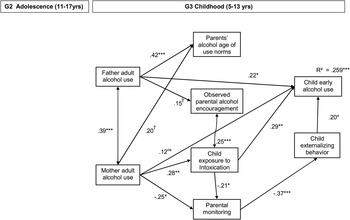
Next, the variables assessing contextual alcohol-related variables in the child's home environment and the mediational paths implied by the theoretical model (Figure 1) were added to the model that included both parents' alcohol use in adulthood and child externalizing behavior and early alcohol use. The final model, after trimming nonsignificant paths and allowing significant covariances suggested by consideration of model modification indices, is presented in Figure 3. A primary and unexpected conclusion drawn from this model is that several proposed mediators, namely, parental monitoring, alcohol use encouragement, and alcohol use norms, that had been significantly correlated with parent and/or child alcohol use were not significantly associated with child alcohol use in the final model and thus did not function as mediators of the associations between parent and child use. Exposure to adult intoxication was significantly associated with child early alcohol use and partially mediated the effect of mothers' alcohol use on child use (indirect effect β = 0.08, p < .05), suggesting one transmission mechanism. Finally, even in the presence of other predictors, significant effects of fathers' alcohol use and child externalizing behaviors persisted as uniquely associated with child alcohol use.
Path Model 3 of the associations among parent alcohol use, proposed family context mediators, and children's early alcohol use. The total indirect association between mothers' and children's alcohol use (β = 0.11, p < .01); the specific indirect effect via exposure to intoxicated adults (β = 0.08, p < .05). G2, Group 2; G3, Group 3; TLI, Tucker–Lewis index; RMSEA, root mean square error of approximation; CI, confidence interval. χ2 (23) = 13.506, p = .9401; TLI = 1.113, RMSEA = 0.000 (90% CI = 0.000–0.016); N = 125 Three-Generational Study and 83 Oregon Youth Study. †p < .10. *p < .05. **p < .01. ***p < .001.

Discussion
In the present study, we used prospective data collected across approximately a 20-year period to test direct and mediated associations of parental alcohol use with their children's early use of alcohol. Overall, support was found for hypotheses about intergenerational pathways specifically for alcohol use and partial mediation of those pathways by alcohol-related family environment factors. Of particular note, maternal and paternal alcohol use both contributed to child early alcohol use. This is consistent with Cranford and colleagues' (2010) findings that maternal alcohol use and paternal alcoholism during middle childhood predicted drinking and intoxication in middle adolescence. Of note, the child's self-reported exposure to adults who were drunk or sick from alcohol use mediated the associations between parent and child use (the maternal association only). This measure likely tapped exposure to parents' excessive alcohol use, but it also may have indexed child contact with other intoxicated adult relatives and family friends, as well as a general adult culture of alcohol use. Based on these findings, mothers appear to be significant gatekeepers for this exposure. Future research should consider how multiple significant adults may influence children's early alcohol use and how modeling or other mechanisms account for these effects.
This evidence for the role of child exposure to adult intoxication was noteworthy. However, perhaps more striking was the lack of evidence that the other alcohol-specific family contextual factors (norms and encouragement) mediated the effects of parental alcohol use on child use. Although these null findings were surprising, they were not wholly inconsistent with prior work. For example, Cranford et al. (Reference Cranford, Zucker, Jester, Puttler and Fitzgerald2010) found that early adolescents' alcohol expectancies predicted later alcohol use and problem use outcomes but did not mediate the effects of parental alcohol use in middle childhood on these adolescent outcomes. Further, several essentially competing mediators were examined presently; and it seems that exposure to intoxication, which is seldom examined, is an important risk factor.
As expected, problems with undercontrol, oppositionality, and aggression, indexed here by the measures of antisocial and externalizing behaviors, showed continuity from fathers to children and were linked with alcohol use within each generation. Still, controlling for these across- and within-generation associations did not diminish the significant alcohol-specific path from father adolescent alcohol use to child early alcohol use.
Although the present study disentangled a pathway of early risk to offspring conferred by paternal alcohol use versus antisocial behavior in adolescence, it is not clear that the alcohol use risk transmission was distinct from a more general substance use risk pathway. Merikangas et al. (Reference Merikangas, He, Burstein, Swanson, Avenevoli and Cui2010), who found that 6.4% of adolescents aged 13–18 years were diagnosed with alcohol abuse or dependence, also found that 8.9% showed drug abuse/dependence. Overlapping problems are emphasized by the finding that 40% of youth with one disorder were also diagnosed with at least one other disorder. In addition, there is evidence of overlap in the genetic influences not only between externalizing disorders and alcohol abuse/dependence but also with abuse/dependence across drug classes (Hicks et al., Reference Hicks, Krueger, Iacono, McGue and Patrick2004). Low prevalence of marijuana and other drug use in the 3GS child sample precluded further parsing of the specificity of the alcohol transmission pathway. However, such tests require evaluation in other samples and, in the present sample, as the children mature and once the additional children in the 3GS reach relevant ages.
Some may question the practical or clinical significance of the early alcohol use patterns observed here, given the presence of a cultural context in which minimal use may be sanctioned by some or many parents. Although findings may vary for other populations, in the present sample of children of fathers from at-risk backgrounds, the pattern of associations supported the conclusion that children's early experiences with alcohol use may be indicative of future risk for alcohol use problems. Specifically, fathers' alcohol use during their own late childhood and early adolescence was linked with their later problem use across adolescence, as well as later problematic individual and family circumstances. Furthermore, fathers' adolescent use showed evidence of continuity into adulthood. Finally, early alcohol use in their children was associated with externalizing behaviors, child exposure to adult drunkenness, and low parental monitoring, which is associated with a host of child problem outcomes. Thus, there was consistent evidence that early alcohol use, as measured here, was actually associated with problematic antecedent, concurrent, and subsequent behavioral and contextual conditions.
This study had several strengths. First, our test of the intergenerational association between fathers' alcohol use during their adolescence and that of their offspring is unusual in the field because it is prospective and concerns fathers' influences, which have been considered less often in relation to child outcomes. Second, our capacity to account for general pathways of transmission of problem behaviors (e.g., from father antisocial behavior to child externalizing behaviors) increases our confidence in the internal validity of the models of alcohol use transmission. Third, our measurement strategy, which emphasized multiple informants (e.g., child, father and mother) and assessment methods (e.g., questionnaire, interview, observation task), was an asset, particularly with respect to the child outcome. Fourth, our rates of recruitment of the 3GS child sample and long-term retention of both the parents and children across multiple decades are additional strengths of the study.
The study also had some limitations. First, because we did not measure mothers' alcohol use patterns during adolescence, important maternal intergenerational influences on child early alcohol use could not be examined in the model. Second, although parent alcohol use in adulthood, theorized family mediators of transmission, and the child early alcohol use outcome constructs were enriched by repeated measurements, the relatively low base rates of the outcome and limited variance in some of the predictors forced us to limit our modeling to concurrent associations. Thus, although many of the alternative temporal sequences seem unlikely (e.g., that child early alcohol use at ages 7–9 years influence parent alcohol use patterns), we must be cautious regarding the inferences we make about these pathways. Third, the relatively small sample size and approach to trimming nonsignificant paths meant that our design may have lacked sufficient statistical power to represent some transmission pathways. Fourth and finally, the father sample primarily comprised European American men from working-class families, and the child sample was similarly limited in terms of ethnic and socioeconomic diversity; thus, some findings may not be broadly generalizable and require replication.
Future research should address the above limitations. In more general terms, we hope to spur future work aimed at understanding where alcohol-specific and general problem behavior pathways overlap to explain parent–child alcohol use transmission. First, considering additional alcohol-specific family contextual mediators of parent–child alcohol use transmission and of the association between exposure to intoxication and childhood use would be fruitful. Specifically, the independent and mediating influences of the availability and accessibility of alcohol and the exposure and encouragement from nonparent adult (relatives and friends) and sibling models should be evaluated. Second, testing how child alcohol schemas, beliefs, and expectancies mediate identified family contextual influences on child alcohol use would be a clear next step. Third, given the prominence of peer contexts of alcohol use in adolescence studies, how parental alcohol use and alcohol-specific family factors influence childhood selection into deviant peer contexts should be examined.
Much of this work can be accomplished using short-term developmental studies and using constructs and modeling strategies that are already widely considered in the alcohol literature (Zucker et al., Reference Zucker, Donovan, Masten, Mattson and Moss2008). However, the small number of intergenerational studies with prospective data across adolescence in one generation and outcome data for a second generation also stand to make unique contributions to future research in this area. In particular, we suggest that the wealth of information on alcohol use patterns across adolescence (Blozis, Feldman, & Conger, Reference Blozis, Feldman and Conger2007; Capaldi et al., Reference Capaldi, Stoolmiller, Kim and Yoerger2009) be used to determine whether patterns of onset and heterogeneity in course and co-occurrence with problem behavior over time in one generation may improve the prediction of congruent patterns of use in the next generation and, if so, what family contextual factors explain such linkages.
The findings from this study support several conclusions. First, it is well known that higher levels of alcohol consumption and problematic use during adolescence are associated with negative physical and psychological health outcomes for individuals (Capaldi, Stoolmiller, Clark, & Owen, Reference Capaldi, Stoolmiller, Clark and Owen2002), and there is growing evidence of the negative consequences of these patterns for adjustment within romantic relationships (Foran & O'Leary, Reference Foran and O'Leary2008). The present findings extend our understanding of the developmental reach of this risk to the family of procreation, namely, that adolescent alcohol use predicts the formation of a family of procreation context that promotes alcohol use in their offspring by early adolescence. Part of this family context involves partnering with a woman who is more likely to be using alcohol and using more of it. Second, the adult alcohol use patterns of mothers and fathers each were uniquely associated with children's experimentation. This has implications for preventive interventions aimed at reducing or delaying alcohol use. It suggests outcomes may be improved if both parents receive intervention. In addition, both mothers and fathers may be motivated to change their behavior by understanding that their influences on the family alcohol risk environment are uniquely important. Third, intergenerational associations in alcohol use do not appear to be better explained by the powerful intergenerational and within-person influences of problem behaviors. Again, this has implications for the design of preventive interventions. Much of the power of prevention comes from the notion that a multitude of negative developmental outcomes can be prevented by targeting a common cause (Beets et al., Reference Beets, Flay, Vuchinich, Snyder, Acock and Li2009; Dishion & Patterson, Reference Dishion, Patterson, Cicchetti and Cohen2006). These findings suggest that in the case of early alcohol use, general preventative approaches may need to be augmented with problem-specific interventions, such as parental education regarding modeling, limiting access to alcohol, and the need to shield youth from exposure to adult intoxication.
Items and indicators used to develop study constructs

Note: OYS, Oregon Youth Study; 3GS, three generational study; OSLC, Oregon Social Learning Center; G2, Generation 2 (boys/men recruited to OYS and the mothers of their children), G3, Generation 3 (offspring of G2 mothers and fathers). For internal consistency, alphas were used when three or more items were being considered and correlations were used when two items were considered.
aThe constituent indicators are indented below constructs, and constituent items are indented below indicators. Listwise N was too small to conduct tests of reliability.
*p < .05. **p < .01.