1. Introduction
The palaeogeographic relationship between the palaeo-Pacific Mexican continental margin (Sierra Madre Terrane) and the subsequent accretion of the intra-oceanic arc and basinal volcanosedimentary successions of the Guerrero Arc and Arperos Basin (Guerrero Terrane) has been the subject of several studies since the terrane concept was applied in Mexico (Campa & Coney, Reference Campa and Coney1983; Coney & Campa, Reference Coney and Campa1984). Tectonostratigraphic relationships between sediments derived from volcanic sources of the Guerrero Terrane and siliciclastic sediments derived from sources of the palaeo-Pacific continental margin were best documented south of the Trans-Mexican Volcanic Belt (TMVB), where the contact relationships between the Guerrero and Mixteca terranes are exposed (Elías-Herrera & Ortega-Gutiérrez, Reference Elías-Herrera and Ortega-Gutiérrez1998; Elias-Herrera, Sánchez-Zavala & Macías-Romo, Reference Elías-Herrera, Sánchez-Zavala and Macías-Romo2000; Ortíz-Hernández, Acevedo-Sandoval & Flores-Castro, Reference Ortíz-Hernández, Acevedo-Sandoval and Flores- Castro2003; Centeno-García, Reference Centeno-García, Anderson, Nourse, McKee and Steiner2005; Levresse et al. Reference Levresse, Tritlla, Deloule and Pinto-Linares2007; Talavera-Mendoza et al. Reference Talavera-Mendoza, Ruiz, Gehrels and Valencia2007; Martini, Solari & López-Martínez, Reference Martini, Solari and López-Martínez2014; Silva-Romo et al. Reference Silva-Romo, Mendoza-Rosales, Campos-Madrigal, Centeno-García and Peralta-Salazar2015). Directly north of the TMVB, the suture zone between the Guerrero and Sierra Madre terranes has been characterized in terms of composition and provenance of strata (Lapierre et al. Reference Lapierre, Ortiz, Abouchami, Monod, Coulon and Zimmermann1992; Freydier et al. Reference Freydier, Martinez, Lapierre, Tardy and Coulon1996, Reference Freydier, Lapierre, Briqueu, Tardy, Coulon and Martínez1997, Reference Freydier, Lapierre, Ruiz, Terry, Martínez and Coulon2000; Martini et al. Reference Martini, Ferrari, López-Martínez, Cerca-Martínez, Valencia, Serrano-Durán, Kay, Ramos and Dickinson2009, Reference Martini, Mori, Solari and Centeno-García2011, Reference Martini, Fitz, Solari, Camprubí, Hudleston, Lawton, Tolson, Centeno-García, Aranda-Gómez, Tolson and Molina-Garza2012). Further north, the contact between these tectonostratigraphic domains is mostly covered by Cenozoic volcanic rocks. However, scattered outcrops of volcanosedimentary and siliciclastic strata have been generally correlated with similar petrotectonic assemblages from the south-eastern area of the Guerrero Terrane (Centeno-García et al. Reference Centeno-García, Ruíz, Coney, Patchett and Ortega-Gutiérrez1993; Centeno-García & Silva-Romo, Reference Centeno-García and Silva-Romo1997; Silva-Romo et al. Reference Silva-Romo, Arellano-Gil, Mendoza-Rosales and Nieto-Obregón2000).
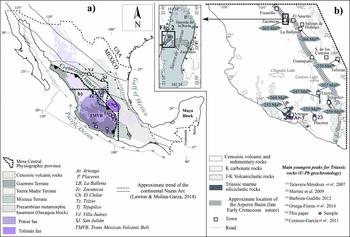
Upper Triassic siliciclastic strata in central Mexico have been commonly considered as the basement underlying the Cretaceous intra-oceanic sequences of current western Mexico, which include the Arperos Basin and Guerrero Terrane. These siliciclastic successions are interpreted as part of submarine fan systems developed on the western palaeo-Pacific margin of Pangaea. Submarine fans were fed by large fluvial systems which transported sediment supplied by continental sources (Centeno-García & Silva-Romo, Reference Centeno-García and Silva-Romo1997; Silva-Romo et al. Reference Silva-Romo, Arellano-Gil, Mendoza-Rosales and Nieto-Obregón2000; Barboza-Gudiño et al. Reference Barboza-Gudiño, Zavala-Monsiváis, Venegas-Rodríguez and Barajas-Nigoche2010; Miller et al. Reference Miller, Soloviev, Prokopiev, Toro, Harris, Kuzmichev and Gehrels2013; Ortega-Flores et al. Reference Ortega-Flores, Solari, Lawton and Ortega-Obregón2014; Silva-Romo et al. Reference Silva-Romo, Mendoza-Rosales, Campos-Madrigal, Centeno-García and Peralta-Salazar2015). In the palaeo-Pacific margin of equatorial Pangea, the El Alamar and La Mora river systems transported detritus westwards from peri-Gondwanan/Laurentian and peri-Gondwanan/South American sources to feed the Late Triassic submarine fans Potosí fan and Tolimán fan, respectively (Centeno-García and Silva-Romo, Reference Centeno-García and Silva-Romo1997; Silva-Romo et al. Reference Silva-Romo, Arellano-Gil, Mendoza-Rosales and Nieto-Obregón2000; Barboza-Gudiño et al. Reference Barboza-Gudiño, Zavala-Monsiváis, Venegas-Rodríguez and Barajas-Nigoche2010; Ortega-Flores et al. Reference Ortega-Flores, Solari, Lawton and Ortega-Obregón2014; Silva-Romo et al. Reference Silva-Romo, Mendoza-Rosales, Campos-Madrigal, Centeno-García and Peralta-Salazar2015), located in central Mexico (Fig. 1a). South of the TMVB, Upper Triassic siliciclastic submarine deposits are represented by the Arteaga Complex in which the low-grade metamorphic rocks known as Arteaga, part of Tejupilco, Río Placeres and Tzizio schists are included (Centeno-García et al. Reference Centeno-García, Ruíz, Coney, Patchett and Ortega-Gutiérrez1993; Elías-Herrera, Sánchez-Zavala & Macías-Romo, Reference Elías-Herrera, Sánchez-Zavala and Macías-Romo2000; Talavera Mendoza et al. Reference Talavera-Mendoza, Ruiz, Gehrels and Valencia2007; Martini et al. Reference Martini, Ferrari, López-Martínez, Cerca-Martínez, Valencia, Serrano-Durán, Kay, Ramos and Dickinson2009; Martini, Solari & López-Martínez, Reference Martini, Solari and López-Martínez2014). Similar strata were reported in the NE Guerrero Terrane, near the city of Zacatecas, and were interpreted as Late Triassic in age based on their ammonite content (Burckhardt, Reference Burckhardt1906). This depositional age was, however, somewhat uncertain due to the poorly preserved fossils and because the successions are deformed. Additionally, younger rocks were either included in the Zacatecas Formation (Burckhardt, Reference Burckhardt1906; Monod & Calvet, Reference Monod and Calvet1992) or the Zacatecas Formation was included in younger assemblages of the Guerrero Terrane (Escalona-Alcázar et al. Reference Escalona-Alcázar, Delgado-Argote, Weber, Núñez-Peña, Valencia and Ortiz-Acevedo2009, Reference Escalona-Alcázar, Delgado-Argote, Nebel, Velasco-Tapia, Weber and Núñez-Peña2014).
(a) Tectonic map of Mexico showing the main tectonostratigraphic features discussed in the text and the location of the study areas. The inset shows a simplified geologic map of the Zacatecas area. (b) Regional map of southern and central-western Mexico showing the exposures of Upper Triassic rocks and their U–Pb maximum depositional ages. Volcanosedimentary and carbonate strata of the Guerrero and Sierra Madre terranes are shown. The black rectangle in (b) indicates the Sierra de Zacatecas, where the study area is located.

Given these uncertainties, in this paper we present new data including structural, petrography and sandstone provenance, as well as U–Pb detrital zircon analyses of Mesozoic siliciclastic and volcaniclastic samples from the vicinity of Zacatecas in central Mexico, in order to characterize the possible westwards extension of the Triassic siliciclastic successions of the Sierra Madre Terrane and their subsequent relationships with the Cretaceous arc-related and basinal strata of the Guerrero terrane. Furthermore, comparison of petrographic and zircon populations is made between the Zacatecas Formation and Triassic rocks reported east of the study area and south of the TMVB, in order to correlate possible depositional environments. The nature of the basement underlying Upper Jurassic – Lower Cretaceous strata in central and western Mexico is of great significance to understanding the extensional, spreading and accretionary processes in continental margins associated with subduction zones. The siliciclastic and volcanogenic strata of the Zacatecas area record these processes through Mesozoic time when the western margin of the central part of Pangaea changed from continental-sourced sediments to intra-oceanic basinal and arc-derived detritus (e.g. Freydier et al. Reference Freydier, Lapierre, Ruiz, Terry, Martínez and Coulon2000; Centeno-García, Guerrero-Suastegui & Talavera-Mendoza, Reference Centeno-García, Guerrero-Suástegui, Talavera-Mendoza, Draut, Clift and Scholl2008; Martini et al. Reference Martini, Mori, Solari and Centeno-García2011; Martini, Solari & López-Martínez, Reference Martini, Solari and López-Martínez2014).
2. Geological setting
The Zacatecas area is located in the Mesa Central physiographic province of central Mexico (Fig. 1a, b). In the Zacatecas area, a boundary between two Mesozoic tectonostratigraphic terranes has been inferred: (1) the Sierra Madre Terrane, which is part of nuclear Mexico and contains a stratigraphic record that has been related to the break-up of Pangea and opening of the Gulf of Mexico (Campa & Coney, Reference Campa and Coney1983; Centeno-García, Guerrero-Suastegui & Talavera-Mendoza, Reference Centeno-García, Guerrero-Suástegui, Talavera-Mendoza, Draut, Clift and Scholl2008); and (2) the Guerrero Terrane, made up of arc and basinal volcanosedimentary successions that were accreted to the Mexican continental margin during Cretaceous time (Martini et al. Reference Martini, Mori, Solari and Centeno-García2011; Martini, Solari & López-Martínez, Reference Martini, Solari and López-Martínez2014). The stratigraphy of the Sierra Madre Terrane consists of Palaeozoic sedimentary and metamorphic rocks overlain by Upper Triassic continent-derived turbidites and fluvial successions, which are in turn overlain by Lower–Middle Jurassic volcanosedimentary assemblages of the Nazas arc and Upper Jurassic – Cretaceous dominantly carbonate strata (Campa & Coney, Reference Campa and Coney1983; Ruiz, Patchett & Ortega-Gutiérrez, Reference Ruiz, Patchett and Ortega-Gutiérrez1988; Barboza-Gudiño et al. Reference Barboza-Gudiño, Ramírez-Fernández, Torres-Sánchez and Valencia2011; Trainor, Nance & Keppie, Reference Trainor, Nance and Keppie2011).
In contrast, the Guerrero Terrane consists of Upper Jurassic – Lower Cretaceous dominantly mafic to intermediate volcanosedimentary successions and intrusive bodies that are interpreted as representing an intra-oceanic arc and related basinal assemblages of the extensional Arperos back-arc basin (Talavera-Mendoza & Guerrero-Suástegui, Reference Talavera-Mendoza and Guerrero-Suástegui2000; Elías-Herrera, Sánchez-Zavala & Macías-Romo, Reference Elías-Herrera, Sánchez-Zavala and Macías-Romo2000; Talavera-Mendoza et al. Reference Talavera-Mendoza, Ruiz, Gehrels and Valencia2007; Centeno-García, Guerrero-Suástegui & Talavera-Mendoza, Reference Centeno-García, Guerrero-Suástegui, Talavera-Mendoza, Draut, Clift and Scholl2008; Centeno-García et al. Reference Centeno-García, Busby, Busby and Gehrels2011). These volcanosedimentary successions unconformably overlie a pre-Jurassic basement that is heterogeneous in age and composition. In the southern and central Guerrero Terrane (Zihuatanejo sub-terrane of Centeno-García, Guerrero-Suástegui & Talavera-Mendoza, Reference Centeno-García, Guerrero-Suástegui, Talavera-Mendoza, Draut, Clift and Scholl2008; Centeno-García et al. Reference Centeno-García, Busby, Busby and Gehrels2011), the basement consists of Upper Triassic greenschist-facies deformed metaturbidites that were derived from Palaeozoic and Precambrian rocks of the Mexican continental mainland and were deposited on an oceanic crust (Arteaga Complex, Centeno-García et al. Reference Centeno-García, Ruíz, Coney, Patchett and Ortega-Gutiérrez1993) or thinned continental crust (e.g. Tejupilco and Placeres schists, Elías-Herrera & Ortega-Gutiérrez, Reference Elías-Herrera and Ortega-Gutiérrez1998; Elias-Herrera, Sánchez-Zavala & Macías-Romo, Reference Elías-Herrera, Sánchez-Zavala and Macías-Romo2000; M. Elías-Herrera, unpub. PhD thesis, Univ. Nacional Autónoma de México, 2004). In the northern Guerrero Terrane, the basement is represented by Palaeozoic metamorphic rocks of the El Fuerte Complex (Keppie et al. Reference Keppie, Dostal, Miller, Ortega-Rivera and Roldán-Quintana2007; Centeno-García, Guerrero-Suástegui & Talavera-Mendoza, Reference Centeno-García, Guerrero-Suástegui, Talavera-Mendoza, Draut, Clift and Scholl2008; Vega-Granillo et al. Reference Vega-Granillo, Salgado-Souto, Herrera-Urbina, Valencia-Gómez and Vidal-Solano2011).
3. Methods
This work includes compiled geological mapping, field structural data measurement and sampling for U–Pb dating and petrographic analysis. A measurement of stratigraphic sections was not possible because the pervasive deformation inhibits the unravelling of the strata sequence. Sampling was undertaken in areas where there is debate regarding the composition and depositional ages of the Mesozoic deformed successions.
3.a. Sampling
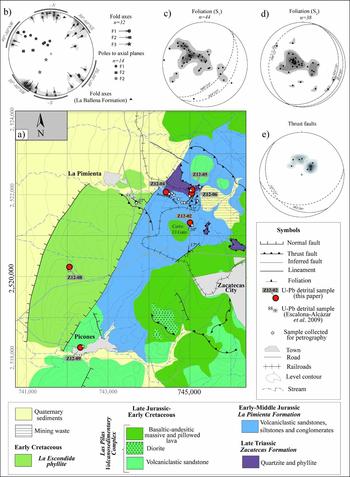
Nineteen unweathered sandstone samples were collected for petrographic analysis. Four hundred points were counted for each sample using the Gazzi–Dickinson method (Gazzi, Reference Gazzi1966; Dickinson, Reference Dickinson1970) and the 0% cut-off proposed by Ingersoll et al. (Reference Ingersoll, Bullard, Ford, Grimm and Pickle1984) for polycrystalline quartz grains. Grain parameters (Dickinson, Reference Dickinson1970; Zuffa, Reference Zuffa and Zuffa1985; Critelli, Le Pera & Ingersoll, Reference Critelli, Le Pera and Ingersoll1997) are defined in Supplementary Table S1, whereas raw and recalculated point-count data are presented in Supplementary Table S2 (supplementary material available at http://journals.cambridge.org/geo). Sample locations are given in Figure 2a.
(a) Geological map of the study area (modified from Monod & Calvet, Reference Monod and Calvet1992; Escalona-Alcázar et al. Reference Escalona-Alcázar, Delgado-Argote, Weber, Núñez-Peña, Valencia and Ortiz-Acevedo2009) showing the stereographic nets of structures affecting the Mesozoic strata of western Sierra de Zacatecas. The location of U–Pb detrital samples is indicated. (b) Stereographic projection showing the orientation of fold axes and poles to axial planes. (c) Poles to first foliation planes (S1). (d) Poles to second foliation planes (S2). (e) Thrust fault planes.

3.b. U–Pb geochronology of detrital zircons
Six samples of quartz-rich sandstone were collected west of Zacatecas City for detrital zircon analysis in order to constrain the maximum depositional ages and their provenance by means of U–Pb zircon geochronology. Three of these six samples were collected along the arroyo El Bote (Fig. 2a), whereas the three remaining samples are distributed on different portions of the study area.
Sample preparation included standard techniques such as crushing, grinding to less than 500 µm and density separation on the Wilfley table. Zircon grains were randomly handpicked from the dense fraction and then mounted in epoxy resin, which was polished for prior cathodoluminescence (CL) imaging, performed with an ELM-R3 luminoscope (Marshall, Reference Marshall1988) to identify the zircon internal structures. Finally, the mount was cleaned with HNO3 to remove surface common Pb contamination and other impurities before analysis.
U–Pb detrital zircon analyses were performed at the Laboratorio de Estudios Isotópicos (LEI), Centro de Geociencias, UNAM, using laser ablation inductively coupled plasma mass spectrometry (LA-ICP-MS; e.g. Solari et al. Reference Solari, Gómez-Tuena, Bernal, Pérez-Arvizu and Tanner2010). One hundred zircon grains for each sample were micro-sampled in situ, either their cores or rims, using a laser beam diameter of 23 µm, a constant fluence of 6 J cm–2 and employing the Plešovice standard zircon (Sláma et al. Reference Sláma, Košler, Condon, Crowley, Gerdes, Hanchar, Horstwood, Morris, Nasdala, Norberg, Schaltegger, Schoene, Tubrett and Whitehouse2008) as reference material and 91500 (Wiedenbeck et al. Reference Wiedenbeck, Allé, Corfu, Griffin, Meier, Oberli, Von Quadt, Roddick and Spiegel1995) as a secondary standard zircon for reproducibility control. The NIST 610 SRM glass is used for trace-element composition recalculation. Data reduction and error calculation/propagation were performed employing the Iolite software (Paton et al. Reference Paton, Woodhead, Hellstrom, Hergt, Greig and Maas2010) and the VizualAge data reduction scheme of Petrus & Kamber (Reference Petrus and Kamber2012). Concordia diagrams were constructed using the Isoplot (v. 3.7) macro for Excel (Ludwig, Reference Ludwig2008).
The 206Pb/238U ages were considered for younger (<1 Ga) zircons and the 207Pb/206Pb ages were used for older (>1 Ga) zircons (e.g. Gehrels, Valencia & Ruiz, Reference Gehrels, Valencia and Ruiz2008; Gehrels, Reference Gehrels, Busby and Azor2012) to plot the statistical visualization diagrams as Kernel density estimator (KDE) and probability density plot (PDP), which in turn were graphed employing the Density plotter software of Vermeesch (Reference Vermeesch2012). Zircon grains with greater than 30% normal and less than –5% reverse discordance, and those with anomalous behaviour of U concentration versus ages or with anomalous chondrite-normalized rare Earth element (REE) patterns, were considered unreliable and were excluded from further interpretation (these anomalies could be related to Pb loss or to inadvertent analysis of solid inclusions in zircon grains). The sample coordinates are indicated in Supplementary Table S3 (available at http://journals.cambridge.org/geo) and its location is shown in Figure 2a.
4. Geological framework of the Zacatecas area
The study area is located on the western flank of the Sierra de Zacatecas (Fig. 1b), which constitutes a horst bounded by two major Cenozoic normal faults (Nieto-Samaniego et al. Reference Nieto-Samaniego, Ferrari, Alaniz-Alvarez, Labarthe-Hernández and Rosas-Elguera1999; Aranda-Gómez et al. Reference Aranda-Gómez, Molina-Garza, McDowell, Vasallo-Morales, Ortega-Rivera, Solorio-Mungía and Aguillón-Robles2007; Tristán-González et al. Reference Tristán-González, Torres-Hernández, Labarthe-Hernández, Aguillón-Robles and Yza-Guzmán2012). Four Mesozoic lithostratigraphic units are exposed in this area (Fig. 2a); their siliciclastic or volcaniclastic composition suggests different sources and origin.
4.a. Zacatecas Formation
Metamorphosed rocks exposed along the Arroyo El Bote (also known as Arroyo Talamantes or La Pimienta) were first described and informally included in the Zacatecas Formation by Burckhardt (Reference Burckhardt1906). According to his descriptions, this formation is composed of two members: the lower member includes black sericitic slates, conglomerate and quartzite, characterized by the lack of fossil content; the upper member includes black siliceous slates interbedded with quartzite, sandstone containing bivalves and ammonites of Triassic age (Gutiérrez-Amador, Reference Gutiérrez-Amador1908). Greenstones and tuffs were also included in this member. Based on differences in the stratigraphy and lithologic composition, subsequent authors subdivided the Zacatecas Formation sensu Burckhart into three or more stratigraphic units. McGehee (Reference McGehee1976) proposed five stratigraphic units for the metamorphic sequence of western Sierra de Zacatecas based on the geometry and composition of the rocks, where he suggested decreasing depositional ages towards the west. Ransom et al. (Reference Ransom, Fernández, Simmons and Enciso-De La Vega1982) referred the metamorphic rocks to La Pimienta Phyllite and divided them into seven stratigraphic units, according to structural and compositional features. Monod & Calvet (Reference Monod and Calvet1992) proposed the reorganization of Triassic units west of Zacatecas and they defined three tectonostratigraphic units: La Pimienta Formation which includes tuff and volcaniclastic sandstone; El Bote Formation characterized by alternation of quartzite and phyllite; and El Ahogado Formation which consists of quartzite and black fossiliferous slate. The Late Triassic depositional age of this formation was suggested on the basis of the presence of ammonites (Juvavites sp., Sirenites sp., Clionites sp. and Trachyceras sp.). However, due to the poor fossil preservation and the structural complexity of the area, this palaeontological age has been considered controversial. Escalona-Alcázar et al. (Reference Escalona-Alcázar, Delgado-Argote, Weber, Núñez-Peña, Valencia and Ortiz-Acevedo2009) reported Early Cretaceous U–Pb detrital zircon ages from a sample located near La Pimienta town (Fig. 2a), which they considered part of Zacatecas Formation. However, this unit does not correspond to the same metamorphic strata described by Burckhardt (Reference Burckhardt1906).
In this paper we consider the Zacatecas Formation, which is poorly exposed in Arroyo El Bote (Fig. 2a), as a succession of dark grey to black slates and lustrous grey phyllite interlayered with grey or brown quartzite and subordinated metaconglomerate. Phyllite intervals, which are more predominant than quartzite layers, exhibit well-defined foliation planes as a result of the sericite and muscovite growth, whereas the quartzite locally shows a banded appearance. Quartzite strata usually do not exceed 15 cm in thickness. The granulometry of this psammitic fraction ranges from very fine to medium grained. Primary sedimentary structures such as laminations and stratification are locally preserved. In addition to greenschist metamorphism, these rocks were affected by significant tectonic deformation; this makes it difficult to determinate the polarity and original thickness of the succession, as well as the stratigraphic relationships with overlaying rocks. However, it is possible to identify changes in the composition to separate the Zacatecas Formation from other lithostratigraphic units.
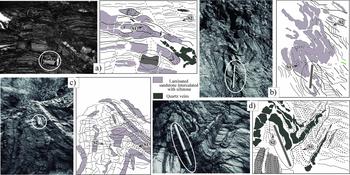
Three shortening phases are recognized in the Zacatecas Formation. The first deformation phase (D1) is expressed by NE30°–60°SW-striking and both NW and SE plunge axes isoclinal folding (F1, Fig. 2b) and NW–SE-trending shearing planes, which are nearly parallel to foliation planes (S1, Fig. 2c) and to the fold axial planes (Fig. 3a, b). The second deformation phase (D2) exhibits roughly N–S-striking open folds (F2, Fig. 2b) and predominantly N-plunging axes. Foliation planes (S2, Fig. 2d) are consistent with F2 axial planes (Fig. 3b). The third deformation phase (D3) includes NW40°–80°SE-striking recumbent folds (F3, Fig. 2b) and NW–SE-striking top-to-the-NE thrust faults (Fig. 2e).
Photographs of representative structures observed in the field. (a) Zacatecas Formation affected by S1 and S2 foliations (scale: 4 cm). (b) Zacatecas Formation showing a tight fold and S1 and S2 foliations (scale: 13 cm). (c) Fold in La Pimienta Formation and associated axial plane cleavage (scale: 9 cm). (d) La Pimienta Formation affected by folding and shear zones (scale: 13 cm).

The structural and compositional features of the Zacatecas Formation of the Guerrero Terrane suggest a possible correlation with Upper Triassic rocks of La Ballena Formation of the Sierra Madre Terrane, and with metamorphic rocks of the Arteaga Complex in the Guerrero terrane (Centeno-García et al. Reference Centeno-García, Ruíz, Coney, Patchett and Ortega-Gutiérrez1993; Centeno-García & Silva-Romo, Reference Centeno-García and Silva-Romo1997; Silva-Romo et al. Reference Silva-Romo, Arellano-Gil, Mendoza-Rosales and Nieto-Obregón2000; Centeno-García, Guerrero-Suástegui & Talavera-Mendoza, Reference Centeno-García, Guerrero-Suástegui, Talavera-Mendoza, Draut, Clift and Scholl2008).
4.b. La Pimienta Formation
La Pimienta Formation was proposed by Monod & Calvet (Reference Monod and Calvet1992) as a deformed and greenschist-facies metamorphosed unit consisting of fine- to coarse-grained volcaniclastic metasandstones, which crop out east of La Pimienta town and along the El Álamo and El Bote creeks. This formation was considered the lowermost stratigraphic unit of the Triassic Zacatecas Formation.
La Pimienta Formation is exposed along a NE–SW-oriented area, including Arroyo El Bote (Fig. 2a). Upstream of Arroyo El Bote, La Pimienta Formation consists of grey and brown, fine-grained metasandstone with well-developed foliation intercalated with thick intervals of greenish, medium- to coarse-grained metasandstone beds of 20–30 cm in thickness. Structurally above, this succession includes shale rhythmically intercalated with brown metasandstone beds of less than 10 cm thick, an interval of 7 m of altered tuffs and a 3 m thick clast-supported conglomerate with sub-rounded and moderately sorted clasts. Clasts in this conglomerate are predominantly of sandstones and rarely quartz. All of the succession is affected by greenschist-facies metamorphism, hydrothermal alteration and tectonic deformation.
The rocks of La Pimienta Formation have been affected by three shortening phases. The D1 deformation is expressed by NW–SW-striking and NE-plunging tight folds (F1), and NE–SW-striking foliation planes (S1, Fig. 2b, d). The D2 deformation is recognized as c. N–S-striking and predominantly N-plunging open folds (F2) with S2 axial plane foliations (Fig. 3c, d). The D3 deformation includes NW–SE-trending folds as well as top-to-the-NE thrusts.
La Pimienta Formation is correlative in composition and age to volcaniclastic sandstones of the latest Triassic – Middle Jurassic Nazas continental arc exposed in the Sierra Madre Terrane (Barboza-Gudiño, Tristán-González & Torres-Hernández, Reference Barboza-Gudiño, Tristán-González and Torres-Hernández1998; Silva-Romo et al. Reference Silva-Romo, Arellano-Gil, Mendoza-Rosales and Nieto-Obregón2000; Bartolini, Lang & Spell, Reference Bartolini, Lang, Spell, Bartolini, Buffler and Blickwede2003; Barboza-Gudiño et al. Reference Barboza-Gudiño, Orozco-Esquivel, Gómez-Anguiano and Zavala-Monsivais2008; Lawton & Molina-Garza, Reference Lawton and Molina-Garza2014).
4.c. Las Pilas Volcanosedimentary Complex
Dominantly volcanic and hypabyssal rocks are exposed in the south-eastern and western parts of the study area (Fig. 2a). They were initially reported by Burckhardt (Reference Burckhardt1906) and Gutiérrez-Amador (Reference Gutiérrez-Amador1908), who referred to them as diabasic rocks and considered them as Triassic in age. Furthermore, Centeno-García & Silva Romo (Reference Centeno-García and Silva-Romo1997) included these rocks in a volcanic and volcaniclastic succession, which they named La Borda Formation. Recently, Escalona-Alcázar et al. (Reference Escalona-Alcázar, Delgado-Argote, Weber, Núñez-Peña, Valencia and Ortiz-Acevedo2009, Reference Escalona-Alcázar, Delgado-Argote, Nebel, Velasco-Tapia, Weber and Núñez-Peña2014) described this volcanosedimentary succession in detail, which was included in the Zacatecas Group, assigning it to an Early Cretaceous age on the basis of U–Pb zircon geochronology.
Las Pilas Volcanosedimentary Complex includes intrusive and extrusive igneous rocks. The intrusive rocks consist of dioritic laccoliths and mafic dykes and sills, which exhibit similar composition but variable abundance of phenocrysts of plagioclase, clinopyroxene, olivine and scarce quartz contained in a microcrystalline or cryptocrystalline groundmass (Escalona-Alcázar et al. Reference Escalona-Alcázar, Delgado-Argote, Weber, Núñez-Peña, Valencia and Ortiz-Acevedo2009). The intrusive rocks share similar mineralogy with the volcanic successions, predominantly consisting of andesitic and basaltic lavas of massive or pillow structure. Intrusive and volcanic rocks have been affected by hydrothermal alteration, resulting in minerals such as epidote, chlorite, sericite and calcite, which can selectively or pervasively replace the original mineral components. Volcanic rocks are intercalated with greenish volcaniclastic matrix-rich sandstone, tuff, radiolarian chert, shale and pelagic limestone (Centeno-García & Silva-Romo, Reference Centeno-García and Silva-Romo1997). The Las Pilas Volcanosedimentary Complex exhibits low-grade metamorphism, which is most evident in the pelitic intervals where the foliation planes are well defined by aligned sericite minerals resulting in a slaty appearance.
At least two shortening phases are recognized in the rocks of Las Pilas Volcanosedimentary Complex. The less competent rocks show c. N–S-striking S2 foliation planes associated with D2, whereas the competent rocks exhibit shearing. D3 deformation is expressed as top-to-the-NE thrusts.
A Late Jurassic – Early Cretaceous age has been assigned to Las Pilas Volcanosedimentary Complex (Escalona-Alcázar et al. Reference Escalona-Alcázar, Delgado-Argote, Weber, Núñez-Peña, Valencia and Ortiz-Acevedo2009, Reference Escalona-Alcázar, Delgado-Argote, Nebel, Velasco-Tapia, Weber and Núñez-Peña2014). The volcanosedimentary succession of the Las Pilas Complex has been correlated with the volcaniclastic rocks of the Chilitos Formation exposed in the Fresnillo area and with massive and pillow lavas from El Saucito area (Fig. 1b), where these volcaniclastic successions could define the most eastern exposures of the Guerrero Terrane (Centeno-García & Silva-Romo, Reference Centeno-García and Silva-Romo1997; Mortensen et al. Reference Mortensen, Hall, Bissig, Friedman, Danielson, Oliver, Rhys, Ross and Gabites2008). Additionally, Las Pilas Volcanosedimentary Complex has similarities in age and composition with the Guerrero terrane-derived volcaniclastic assemblage reported by Martini et al. (Reference Martini, Mori, Solari and Centeno-García2011, Reference Martini, Fitz, Solari, Camprubí, Hudleston, Lawton, Tolson, Centeno-García, Aranda-Gómez, Tolson and Molina-Garza2012) and Martini, Solari & López-Martínez (Reference Martini, Solari and López-Martínez2014) for the oceanic-floored Arperos Basin.
4.d. La Escondida Phyllite
La Escondida Phyllite is an informal name assigned to the succession of foliated rocks which are exposed west of the study area (Fig. 2a). La Escondida Phyllite was previously included in the Upper Triassic metamorphic rocks (Burckhardt, Reference Burckhardt1906; Ransom et al. Reference Ransom, Fernández, Simmons and Enciso-De La Vega1982; Monod & Calvet, Reference Monod and Calvet1992). La Escondida Phyllite consists of thin to medium strata of monotonous alternation of fine- to medium-grained metasandstone interbedded with greyish phyllite. This siliciclastic unit has well-developed NW–SE-striking subhorizontal foliation planes defined by sericite, with minor muscovite. The foliation planes are cut by subparallel shear planes.
5. Results
5.a. Metasandstone petrography
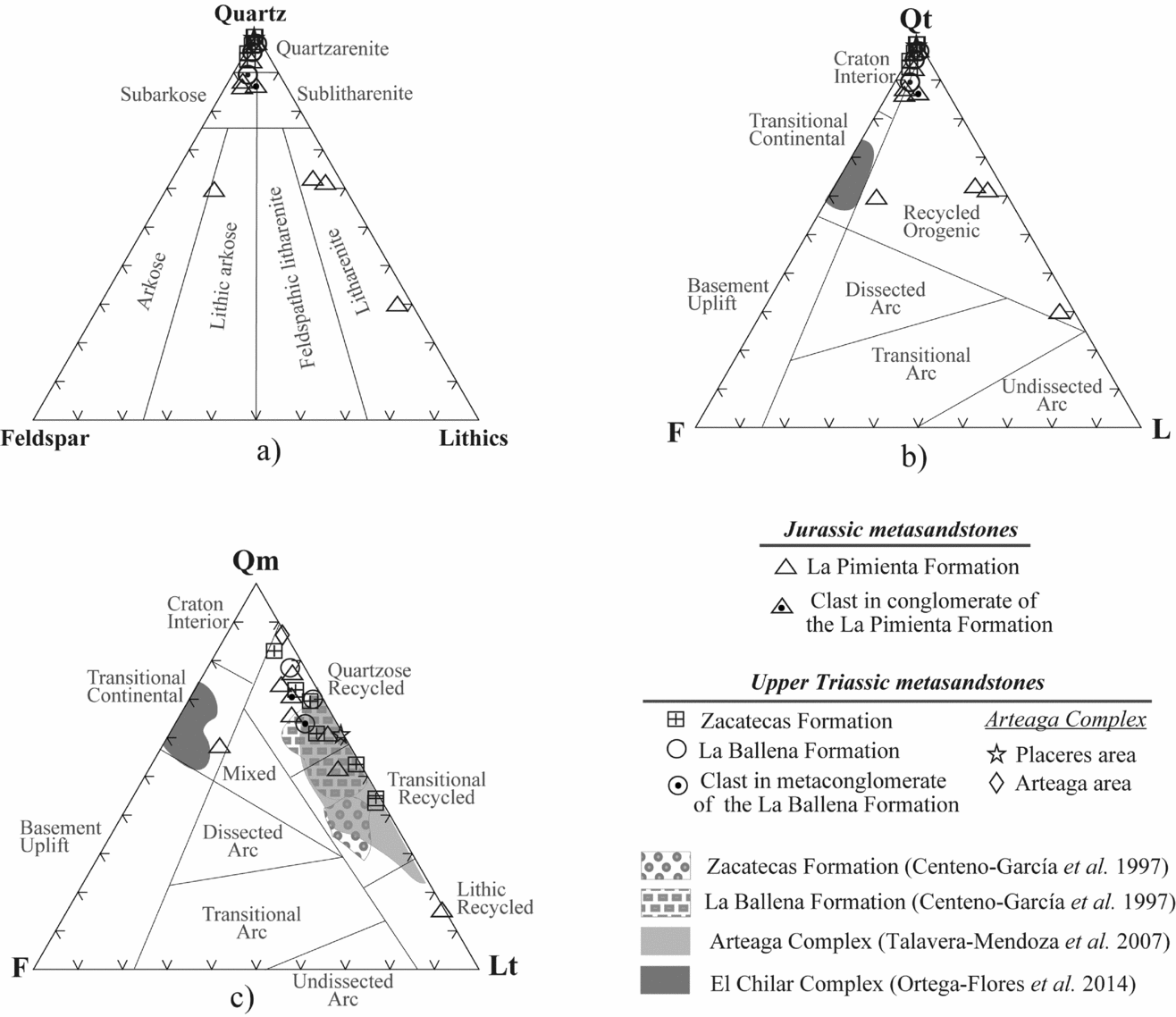
Triassic metasandstones from the Zacatecas and La Ballena formations, as well as from the Arteaga Complex, are compositionally similar. They consist of moderately sorted, fine- to coarse-grained quartzarenites (Fig. 4a). The main framework components include, in decreasing order, sub-rounded grains of monocrystalline quartz (50–80%), polycrystalline quartz (20–45%) and feldspar (0–5%) (Fig. 4b, c). Subordinate lithic grains of sandstone, shale and schist were also identified in sandstones from the Zacatecas and La Ballena formations. Monocrystalline quartz grains commonly show undulose extinction, whereas the polycrystalline quartz grains locally exhibit subgrains and foliation planes. Muscovite is commonly developed along the foliation planes of finer-grained metasandstone.
(a) Folk (Reference Folk1974) classification diagram for Zacatecas and La Pimienta formations; (b) QtFL; and (c) QmFLt ternary diagrams showing the sandstone composition of the Zacatecas, La Ballena and La Pimienta formations and Arteaga Complex. Provenance fields after Dickinson (Reference Dickinson and Zuffa1985).

Metasandstones from La Pimienta Formation include poorly to moderately sorted, medium- to coarse-grained subarkoses, lithic arkoses and litharenites (Fig. 4a). In order of abundance, framework grains in sandstones from the La Pimienta Formation are composed of monocrystalline quartz (13–75%), polycrystalline quartz (2–20%), volcanic lithic fragments (2–69%) and plagioclase (4–30%) (Fig. 4b, c). Volcanic lithic fragments include microlitic, vitric and felsitic grains partially altered to clay minerals. Most monocrystalline quartz grains have slightly undulose to straight extinction, and assimilation embayments suggesting a volcanic origin. Subordinate sedimentary and metamorphic grains were also recognized. Muscovite, biotite, zircon and opaque minerals are accessory components of La Pimienta Formation metasandstones.
Point counting carried out in a sandstone clast of a conglomerate on the La Pimienta Formation indicates a similar composition to metasandstones of the Zacatecas Formation (Fig. 4a).
Two samples of matrix-rich, very fine- to medium-grained litharenites of the Upper Jurassic – Lower Cretaceous Las Pilas Volcanosedimentary Complex consist of angular to subangular monocrystalline quartz grains, volcanic lithic grains, plagioclase and subordinated polycrystalline quartz dispersed in a pseudo-matrix composed of finely crystalline muscovite and sericite. The volcanic lithic grains show partial or whole recrystallization to clay minerals, which makes the discrimination of volcanic lithic types difficult. However, lathwork and microlitic grains were nevertheless recognized. The framework grains and the minerals of the matrix define the well-developed foliation planes. Because of their high matrix content, these metalitharenites were excluded from modal analysis to avoid bias in terms of provenance.
One sample of La Escondida Phyllite consists of domains of fine- to medium-grained and very fine-grained quartzite. The finer fraction of the quartzite consists of sub-rounded and elongated monocrystalline quartz, muscovite, sericite and probably limonite, all of which define the foliation planes. The coarser fraction includes dominantly sub-rounded monocrystalline quartz and scarce muscovite. Opaque minerals such as hematite and other iron oxides are present in the accessory components.
5.b. U–Pb detrital zircon geochronology
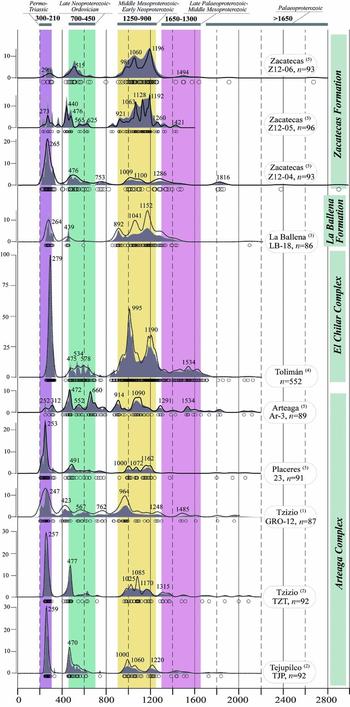
Three samples from the Zacatecas Formation (Z12-04, Z12-05 and Z12-06) and two samples from the Arteaga Complex (Ar-3 and 23) yielded four main zircon populations. The three remaining samples from the Zacatecas area contain five (Z12-02), six (Z12-09) and seven Z12-08) well-defined zircon populations, as well as some scattered zircon grains.
5.b.1. Zacatecas Formation
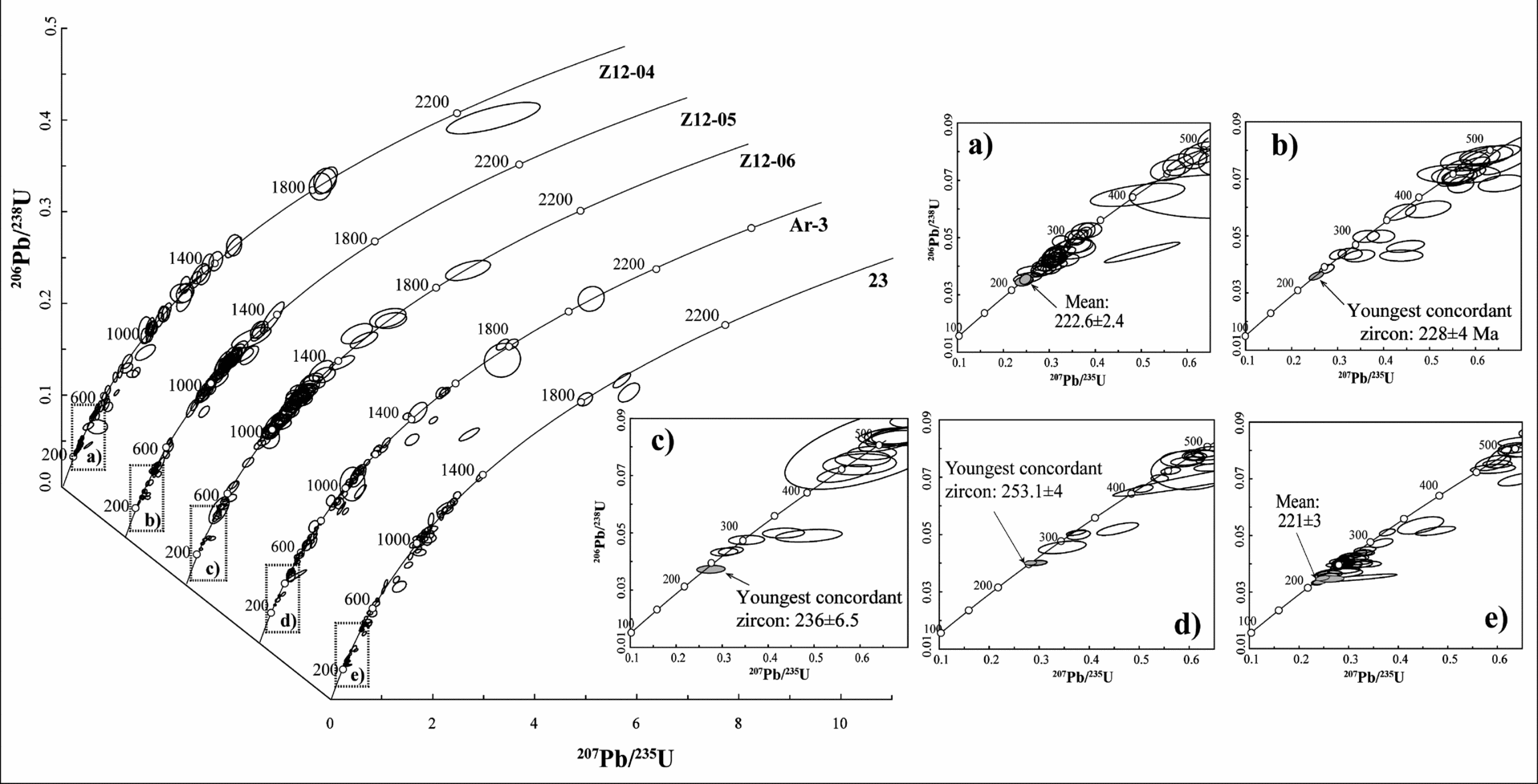
Samples Z12-04, Z12-05 and Z12-06 are quartzarenites collected from Arroyo El Bote, c. 1.2 km to the east of the town of La Pimienta (Fig. 2a). These samples yielded abundant pinkish, colourless and amber, rounded to sub-rounded, detrital zircons ranging in size from 60 to 200 µm. Cathodoluminiscence (CL) images show oscillatory and concentric zoning (Corfu et al. Reference Corfu, Hanchar, Hoskin, Kinny, Hanchar and Hoskin2003). Detrital zircons in the three analysed samples (Z12-04, n = 93; Z12-05, n = 96; and Z12-06, n = 93) yielded concordant to slightly discordant ages in the range 2906– 220 Ma (Fig. 5). The samples contain similar populations with age ranges of 1650–1300 Ma (7% for Z12-04, 4% for Z12-5 and 4% for Z12-06), 1250–900 Ma (18% for Z12-04, 60% for Z12-05 and 65% for Z12-06), 700–450 Ma (17% for Z12-04, 12% for Z12-05 and 16% for Z12-06) and 300–210 Ma (32% for Z12-04, 8% for Z12-05 and 5% for Z12-06), as well as scattered zircon grains predominantly older than 1650 Ma. Sample Z12-04 yields a younger cluster defined by three zircon grains overlapping in age at 222.6±2.4 Ma (mean square of weighted deviates, MSWD = 0.7; Fig. 5a).
U–Pb concordia diagrams for all detrital zircon analyses of the Zacatecas Formation (Z12-04, Z12-05 and Z12-06) and Arteaga Complex (Ar-3 and 23). Data-point error ellipses are 2σ. (a–e) Enlargements of U–Pb concordia diagrams for zircons grains younger than 500 Ma.

5.b.2. Arteaga Complex
Sample Ar-3 is a quartzarenite collected 15 km south of the town of Arteaga in the Guerrero Terrane (Fig. 1b). This sample yielded predominantly rounded and sub-rounded colourless and amber zircons that vary in size from 50 to 100 µm. Cathodoluminiscence images of the crystals show sector zoning, oscillatory and concentric zoning developed around xenocrystic cores, and patchy zoned zircons (Corfu et al. Reference Corfu, Hanchar, Hoskin, Kinny, Hanchar and Hoskin2003). One hundred detrital zircons were dated, 89 of which produced acceptable ages (Fig. 5) in the range 2120–253 Ma. Zircon populations are similar to those samples in Zacatecas Formation. Scattered zircon grains older than 1650 Ma represent 9% of the total, and the remaining zircon grains were divided into populations with age ranges of 1650–1300 Ma (8%), 1250–900 Ma (30%), 700–450 Ma (30%) and 300–210 Ma (4%). A maximum depositional age for this sample was not obtained because the younger zircon grains do not form a cluster. However, the younger zircon grain yielded an age of 253.1±4 Ma (Fig. 5d).
Sample 23 is quartzarenite collected 6 km NW of the town of Placeres in the Guerrero Terrane (Fig. 1b). This sample yielded colourless and amber, rounded, sub-rounded and euhedral zircons ranging from 50 to 150 µm in size. Cathodoluminescense images of the crystals show oscillatory zoning around xenocrystic cores, concentric and oscillatory-zoned zircons (Corfu et al. Reference Corfu, Hanchar, Hoskin, Kinny, Hanchar and Hoskin2003). Ninety-one zircon grains produced acceptable ages in the range 2050–211 Ma (Fig. 5). Similar to sample Ar3 and those documented in the Zacatecas Formation, sample 23 exhibits zircon grains with age ranges of 1650–1300 Ma (1%), 1250–900 Ma (30%), 700–450 Ma (18%) and 300–210 Ma (40%). Zircon grains older than 1650 Ma constitute 3% of the total. A maximum depositional age of 221±3 Ma was obtained by a cluster of three zircons overlapping in age at 2σ (Fig. 5e).
5.b.3. La Pimienta Formation
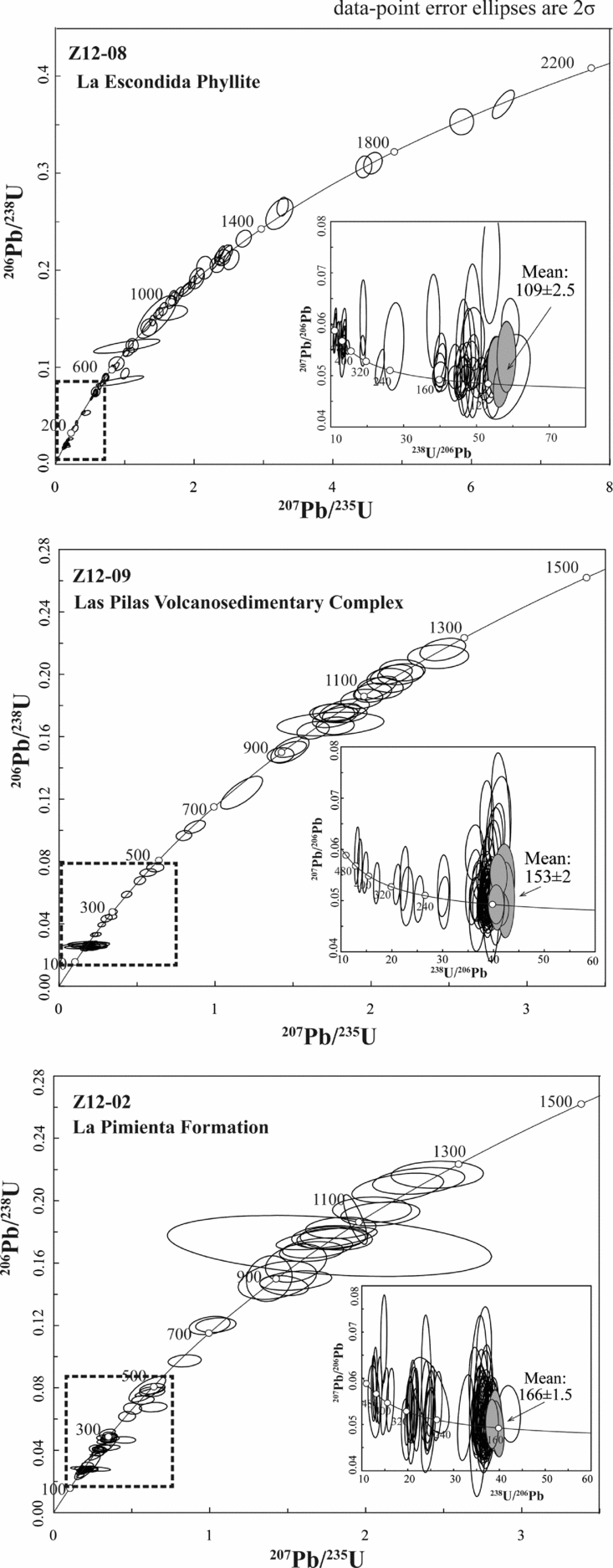
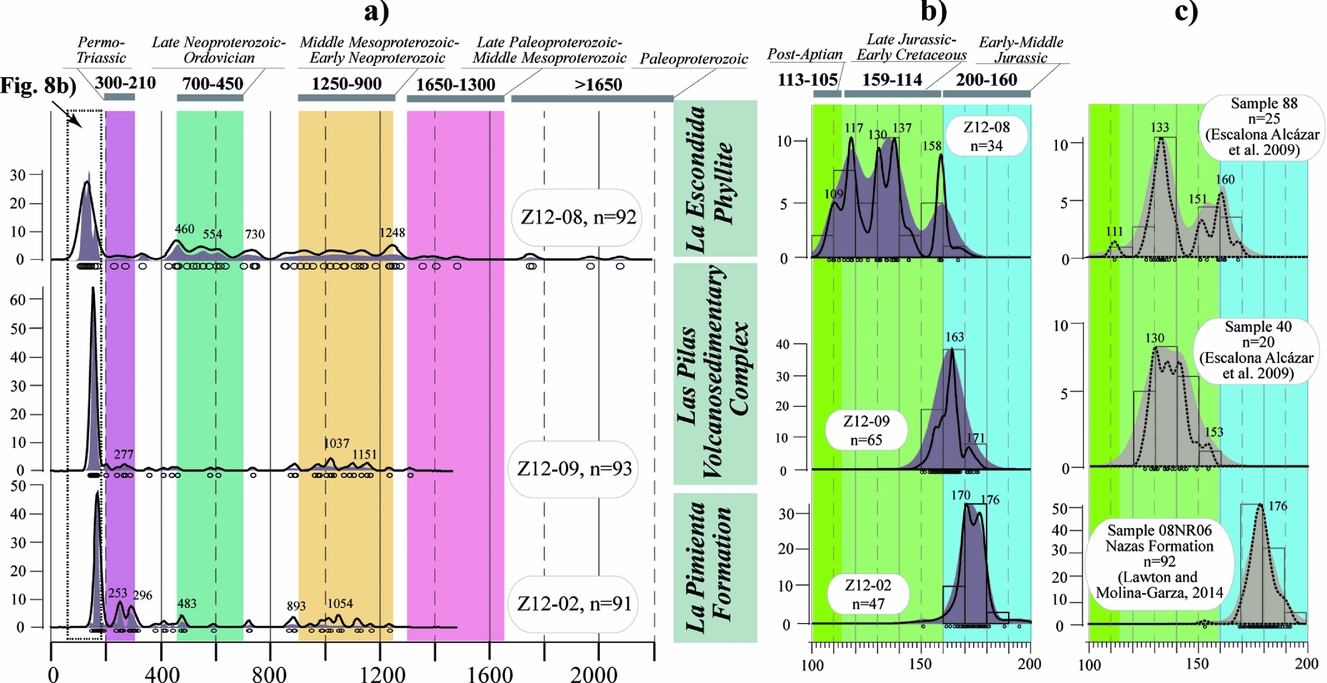
Sample Z12-02 is a metalitharenite collected in the proximity of the Cerro El Gato (Fig. 2a). This sample yielded dominantly colourless, euhedral and sub-rounded zircons ranging in size from 70 to 150 µm. The zircons display concentric and oscillatory zoning, sometimes around xenocrystic cores, in cathodoluminiscence images (Corfu et al. Reference Corfu, Hanchar, Hoskin, Kinny, Hanchar and Hoskin2003). Ninety-one zircon grains produced acceptable ages in the range 1250–161 Ma (Fig. 6). Moreover, this sample also shows one slightly discordant zircon grain with an age of 150 Ma. However, this zircon is the only Late Jurassic grain and its young age may be due to Pb loss. The older populations exhibit zircon grains with age ranges of 1250–900 Ma (17%), 700–450 Ma (7%) and 300–210 Ma (14%); the youngest and dominant population has ages in the range 200–160 Ma, which constitutes 50% of total grains. The youngest and concordant overlapping zircon grains yielded maximum depositional ages of 166±1.5 Ma (MSWD = 0.44)
U–Pb Concordia diagrams for Jurassic and Cretaceous sandstones. Data-point error ellipses are 2σ. The insets show Tera–Wasserburg plots for zircons younger than 450 Ma.

5.b.4. Las Pilas Volcanosedimentary Complex
Sample Z12-09 is a metalitharenite collected in the town of Picones (Fig. 2a). This sample yielded colourless, euhedral and sub-rounded zircons that vary in size from 60 to 150 µm. Detrital zircon grains display dominantly concentric, sector zoning or oscillatory zoning around xenocrystic cores (Corfu et al. Reference Corfu, Hanchar, Hoskin, Kinny, Hanchar and Hoskin2003). Ninety-three zircon grains yielded ages that vary from 1335 to 150 Ma (Fig. 6). Zircon populations constitute grains with age ranges of 1650–1300 Ma (1%), 1250–900 Ma (20%), 750–400 Ma (4%), 300–210 Ma (7%), 200–160 Ma (45%) and a younger population of ages 159–114 Ma, which represents 18% of total grains. The younger zircons overlapping in age at 2σ indicate a maximum depositional age of 153±2 Ma (MSWD = 0.48).
5.b.5. La Escondida Phyllite
Sample Z12-08 is a quartzarenite collected 3 km west of the city of Zacatecas (Fig. 2a). This sample yielded dominantly colourless, euhedral and sub-rounded zircon grains ranging in size from 60 to 120 µm. Zircon grains display concentric, oscillatory and sector zoning around xenocrystic cores. U–Pb analyses yielded 92 acceptable ages that vary from 2082 to 107 Ma (Fig. 6). Three major populations are defined by groups of zircon grains in the ranges 1250–900 Ma (21%), 700–450 Ma (18%) and 159–114 Ma (27%), whereas the Permo-Triassic and Jurassic populations are subordinate clusters constituting 2% and 7%, respectively. The youngest zircon population (113–105 Ma) constitutes 4%. A maximum depositional age of 109±2.5 Ma (MSWD = 0.31) was calculated using the three youngest zircons overlapping in age at 2σ.
6. Zircon provenance
6.a. Palaeoproterozoic zircons (2100–1650 Ma)
Uncommon Palaeoproterozoic zircon grains are present in most of the samples from the Zacatecas area. Six, four and two zircons grains are contained in samples Z12-04, Z12-08 and Z12-06, respectively (Figs 7, 8). Subordinate Palaeoproterozoic zircon populations were reported in Triassic sandstones of central and NE Mexico from the Sierra Madre Terrane (Barboza-Gudiño et al. Reference Barboza-Gudiño, Zavala-Monsiváis, Venegas-Rodríguez and Barajas-Nigoche2010) and Palaeozoic metamorphic rocks of NE Mexico (Nance et al. Reference Nance, Fernández-Suárez, Keppie, Storey, Jeffries, Linnemann, Nance, Kraft and Zulauf2007; Barboza-Gudiño et al. Reference Barboza-Gudiño, Ramírez-Fernández, Torres-Sánchez and Valencia2011). Potential source rocks for these Palaeoproterozoic zircon grains may be represented by the Amazon Craton Provinces (Tassinari & Macambira, Reference Tassinari and Macambira1999) or by younger clastic successions derived from the Amazon Craton Province, as a second-grade recycling process.
Kernel density estimator (KDE, black curve) and probability density plots (PDP, grey shaded areas) for Triassic detrital zircons. Zircon populations are shown with shaded bars. Numbers on top of the KDE curves indicate the mean age of the main peaks in Ma. The open circles represent the ages for each zircon. Data from (1) Talavera-Mendoza et al. Reference Talavera-Mendoza, Ruiz, Gehrels and Valencia2007, (2) Martini et al. Reference Martini, Ferrari, López-Martínez, Cerca-Martínez, Valencia, Serrano-Durán, Kay, Ramos and Dickinson2009, (3) Barboza-Gudiño Reference Barboza-Gudiño and Elitok2012, (4) Ortega-Flores et al. Reference Ortega-Flores, Solari, Lawton and Ortega-Obregón2014 and (5) this paper.

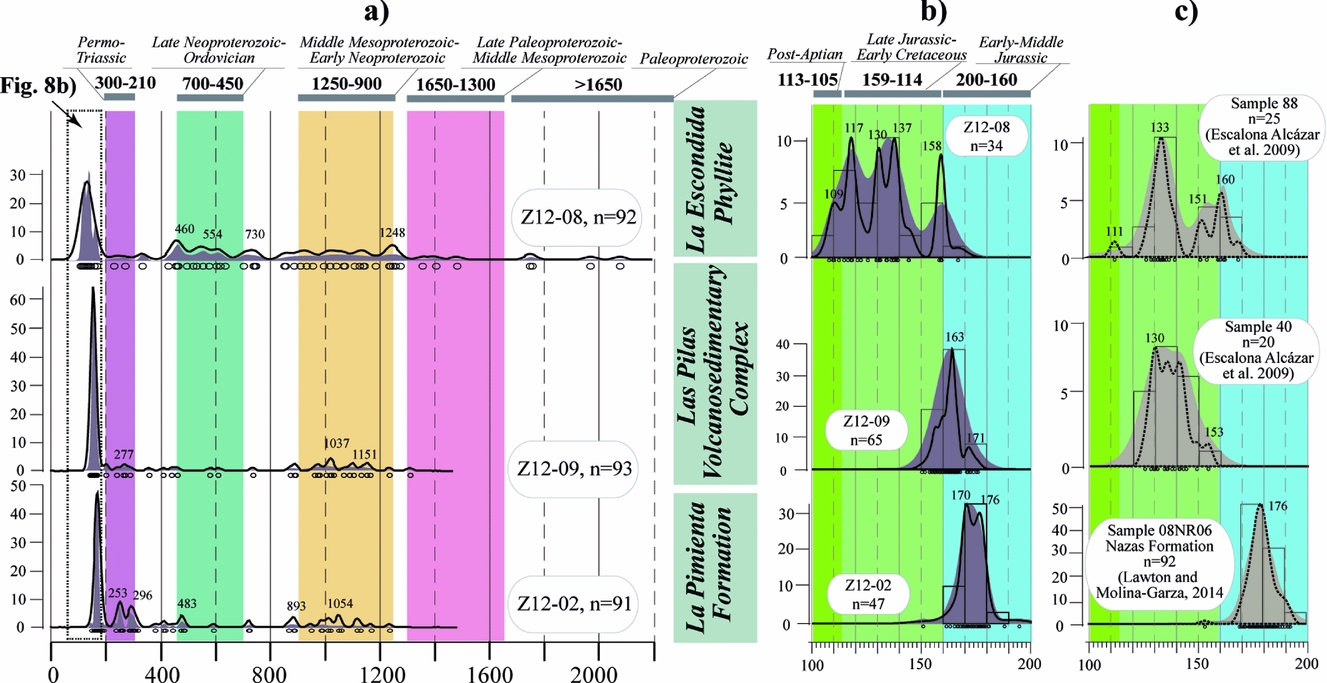
Kernel density estimator (KDE, black curve) and probability density plots (PDP, grey shaded areas) for Jurassic and Cretaceous sandstones of the Zacatecas area. (a) All the zircon grains. (b) Zircon grains younger than 200 Ma. (c) Comparison of zircon grains younger than 200 Ma from other correlative samples of similar ages.
6.b. Late Palaeoproterozoic – middle Mesoproterozoic zircons (1650–1300 Ma)
The late Palaeoproterozoic – middle Mesoproterozoic zircon population is present in all analysed samples from the Zacatecas Formation defining subordinate clusters. This population is absent from the La Pimienta Formation, whereas in the Las Pilas Volcanosedimentary Complex it is represented by only three grains (Fig. 8). As for most of the sandstones deposited during Late Triassic time, the Zacatecas Formation is considered to represent part of a submarine fan derived by continental sources (Centeno-García & Silva-Romo, Reference Centeno-García and Silva-Romo1997; Silva-Romo et al. Reference Silva-Romo, Arellano-Gil, Mendoza-Rosales and Nieto-Obregón2000; Centeno-García, Reference Centeno-García, Anderson, Nourse, McKee and Steiner2005). A possible source for the late Palaeoproterozoic – middle Mesoproterozoic zircons may be represented by the Huiznopala Gneiss of NE Mexico (Lawlor et al. Reference Lawlor, Ortega-Gutiérrez, Cameron, Ochoa-Camarillo, López and Sampson1999; Weber et al. Reference Weber, Scherer, Mezger and Ruiz2011), which could be related to the Río Negro – Juruena Province of the Amazonian Craton (Ortega-Flores et al. Reference Ortega-Flores, Solari, Lawton and Ortega-Obregón2014).
6.c. Middle Mesoproterozoic – early Neoproterozoic zircons (1250–900 Ma)
The most conspicuous zircon population in samples Z12-05 and Z12-06 is of middle Mesoproterozoic – early Neoproterozoic age, whereas zircon grains are less abundant in sample Z12-04 of the Zacatecas Formation of the Guerrero Terrane. La Pimienta, Las Pilas Volcanosedimentary Complex and La Escondida Phyllite also contain this zircon population, although in smaller proportions. Rocks with middle Mesoproterozoic – early Neoproterozoic ages constitute the metamorphic basement of eastern and southern Mexico, namely Oaxaquia (Ortega-Gutiérrez, Ruiz & Centeno-García, Reference Ortega-Gutiérrez, Ruiz and Centeno-García1995; Keppie et al. Reference Keppie, Dostal, Cameron, Solari, Ortega-Gutiérrez and Lopez2003; Solari et al. Reference Solari, Keppie, Ortega-Gutiérrez, Cameron, Lopez and Hames2003; Weber et al. Reference Weber, Scherer, Schulze, Valencia, Montecinos, Mezger and Ruiz2010, Reference Weber, Scherer, Mezger and Ruiz2011; Trainor, Nance & Keppie, Reference Trainor, Nance and Keppie2011). Is highly probable that crystalline basement was exposed during Triassic time, as suggested by continental Upper Triassic sandstones deposited directly above in NE Mexico (Ochoa-Camarillo, Buitrón & Silva, Reference Ochoa-Camarillo, Buitrón and Silva1998; B. Ortega-Flores, unpub. MSc. thesis, Univ. Nacional Autónoma de Mexico, 2011). In this context, the Zacatecas Formation zircon grains may have been directly derived from this basement high, whereas the Grenvillian zircon grains from La Pimienta Formation and Las Pilas Volcanosedimentary Complex are possibly derived by subsequent recycling of lower Mesozoic rocks.
6.d. Late Neoproterozoic – Ordovician zircons (700–450 Ma)
Late Neoproterozoic – Ordovician zircon grains are contained in all samples of the Zacatecas Formation, with principal peaks at 460 Ma, 480 Ma, 550 Ma and 625 Ma. A minor peak at c. 480 Ma was documented in the La Pimienta Formation, whereas Las Pilas Volcanosedimentary Complex exhibits a decrease in grains with similar ages. Sample Z12-08 of La Escondida Phyllite produced peaks near 460 Ma and 560 Ma. Magmatic zircons with Pan-African ages have been reported in peri-Gondwanan terranes (Maya, Chortis and Florida blocks; e.g. Martens, Weber & Valencia, Reference Martens, Weber and Valencia2010; Solari et al. Reference Solari, Gómez-Tuena, Ortega-Gutiérrez and Ortega-Obregón2011, Reference Solari, García-Casco, Martens, Lee and Ortega-Rivera2013) which were previously located between Gondwana and Laurentia before the break-up of Pangea. In this context, the Maya Block (which was NE of the area at this time) could be a plausible source of zircons with Pan-African ages.
6.e. Permo-Triassic zircons (300–210 Ma)
The youngest zircon population for Zacatecas Formation defines age peaks at 265 Ma, 273 Ma and 296 Ma for samples Z12-04, Z12-05 and Z12-06, respectively. La Pimienta Formation also includes this zircon population and records two age peaks at 253 Ma and 296 Ma (Fig. 8a). Metalitharenites from Las Pilas Volcanosedimentary Complex display a minor peak at 277 Ma in sample Z12-09, but this population is practically absent in the sample Z12-08 of La Escondida Phyllite (Fig. 8a). Zircon grains with Permo-Triassic ages are included in all Upper Triassic sandstones from northern, north-eastern, central and south-western Mexico (Talavera-Mendoza et al. Reference Talavera-Mendoza, Ruiz, Gehrels and Valencia2007; Martini et al. Reference Martini, Ferrari, López-Martínez, Cerca-Martínez, Valencia, Serrano-Durán, Kay, Ramos and Dickinson2009; Barboza-Gudiño et al. Reference Barboza-Gudiño, Zavala-Monsiváis, Venegas-Rodríguez and Barajas-Nigoche2010; Centeno-García et al. Reference Centeno-García, Busby, Busby and Gehrels2011; Barboza-Gudiño, Reference Barboza-Gudiño and Elitok2012; Ortega-Flores et al. Reference Ortega-Flores, Solari, Lawton and Ortega-Obregón2014) (Fig. 1b). These ages are associated with the onset of continental arc-related magmatism along the western edge of Pangea, prior to its fragmentation (Pindell & Dewey, Reference Pindell and Dewey1982; Sedlock, Ortega-Gutiérrez & Speed, Reference Sedlock, Ortega-Gutiérrez, Speed, Sedlock, Ortega-Gutiérrez and Speed1993; Dickinson & Lawton, Reference Dickinson and Lawton2001). The magmatism took place during ~280–230 Ma (Pindell & Dewey, Reference Pindell and Dewey1982; Dickinson & Lawton, Reference Dickinson and Lawton2001; Cochrane et al. Reference Cochrane, Spikings, Gerdes, Ulianov, Mora, Villagómez, Putlitz and Chiaradia2014). Exposures of this continental arc have been documented in eastern Mexico (Torres et al. Reference Torres, Ruiz, Patchett, Grajales, Bartolini, Wilson and Lawton1999) and Maya block (Weber et al. Reference Weber, Schaaf, Valencia, Iriondo and Ortega-Gutiérrez2006), which was supposedly located NE of the study area during this time (Keppie, Reference Keppie2004; Weber et al. Reference Weber, Schaaf, Valencia, Iriondo and Ortega-Gutiérrez2006, Reference Weber, Valencia, Schaaf and Ortega-Gutiérrez2009).
6.f. Early–Middle Jurassic zircons (200–160 Ma)
Early–Middle Jurassic zircons define two prominent age peaks at 176 Ma and 170 Ma in the sample Z12-02 of La Pimienta Formation (Fig. 8b). In Las Pilas Volcanosedimentary Complex, sample Z12-09 shows a major peak at 163 Ma and a minor peak at 171 Ma, whereas sample Z12-08 contains only one zircon grain in this age range. Lower and Middle Jurassic volcanic rocks have been documented NNE of the Zacatecas area in the Villa Juárez anticline and Sierra de San Julián (Fig. 1a) (Pantoja-Alor, Reference Pantoja-Alor, Córdoba, del Arenal, Rodríguez-Torres and Segura1972; Silva-Romo et al. Reference Silva-Romo, Arellano-Gil, Mendoza-Rosales and Nieto-Obregón2000; Lawton & Molina-Garza, Reference Lawton and Molina-Garza2014), and east of the study area in La Ballena area (Fig. 1a, b) (Barboza-Gudiño, Tristán-González & Tórres-Hernández, Reference Barboza-Gudiño, Tristán-González and Torres-Hernández1998; Silva-Romo et al. Reference Silva-Romo, Arellano-Gil, Mendoza-Rosales and Nieto-Obregón2000; Barboza-Gudiño et al. Reference Barboza-Gudiño, Orozco-Esquivel, Gómez-Anguiano and Zavala-Monsivais2008; Barboza-Gudiño, Reference Barboza-Gudiño and Elitok2012; Zavala-Monsiváis et al. Reference Zavala-Monsiváis, Barboza-Gudiño, Velasco-Tapia and García-Arreola2012). They consist of volcaniclastic successions interpreted as an Early–Middle Jurassic continental arc named the Nazas arc. The Early–Middle Jurassic zircon population included in sample Z12-02, which represents c. 50% of the total analysed grains, may indicate contemporaneous volcanic activity related to the Nazas arc in Zacatecas area. Moreover, detrital zircon ages of La Pimienta Formation define a peak age (176 Ma) comparable to that reported by Lawton & Molina-Garza (Reference Lawton and Molina-Garza2014) for a sample of ignimbrite of the type Nazas Formation, near the town of Villa Juárez (Fig. 1a). Although sample Z12-09 similarly includes 45% of the 200–160 Ma aged zircon population, it also contains zircon grains younger than 160 Ma. An explanation is that these sandstones could have recycled detritus from La Pimienta Formation.
6.g. Late Jurassic – Early Cretaceous zircons (159–114 Ma)
The Late Jurassic – Early Cretaceous zircon population of La Escondida Phyllite (sample Z12-08) defines four main age peaks at 158, 137, 130 and 117 Ma, whereas the zircon population of Las Pilas Volcanosedimentary Complex has an age peak at 157 Ma (Fig. 8b). Upper Jurassic – Lower Cretaceous volcanic and intrusive rocks are widely exposed in the Guerrero Terrane of western Mexico (Talavera-Mendoza et al. Reference Talavera-Mendoza, Ruiz, Gehrels and Valencia2007; Mortensen et al. Reference Mortensen, Hall, Bissig, Friedman, Danielson, Oliver, Rhys, Ross and Gabites2008; Centeno-García, Guerrero-Suástegui & Talavera-Mendoza, Reference Centeno-García, Guerrero-Suástegui, Talavera-Mendoza, Draut, Clift and Scholl2008; Martini et al. Reference Martini, Ferrari, López-Martínez, Cerca-Martínez, Valencia, Serrano-Durán, Kay, Ramos and Dickinson2009, Reference Martini, Mori, Solari and Centeno-García2011; Centeno-García et al. Reference Centeno-García, Busby, Busby and Gehrels2011). The most plausible sources for zircons in metasandstones of Las Pilas Volcanosedimentary Complex and La Escondida Phyllite are therefore those assemblages from the Guerrero Terrane. Although this zircon population is not the most abundant, the presence of Early Cretaceous zircon grains establishes a clear relationship with detritus partially derived from the Guerrero Terrane.
6.h. Albian zircons (113–105 Ma)
Albian zircons of La Escondida Phyllite do not define a prominent peak. However, four zircon grains are present in sample Z12-08. Albian volcanosedimentary rocks containing this zircon population have been reported in the westernmost Guerrero Terrane (Centeno-García et al. Reference Centeno-García, Busby, Busby and Gehrels2011) where the zircon grains define a prominent peak at 109.5 Ma. Albian volcaniclastic successions have been associated with the Zihuatanejo arc of the Guerrero Terrane (Talavera-Mendoza et al. Reference Talavera-Mendoza, Ruiz, Gehrels and Valencia2007; Martini et al. Reference Martini, Ferrari, López-Martínez and Valencia2010). Albian zircon grains contained in metasandstone of La Escondida Phyllite therefore have a possible source in volcanosedimentary rocks of the Guerrero Terrane. However, the abundance of quartz in sample Z12-08 as well as the uncommon occurrence of volcanic components suggests that these volcanic sources were poorly exposed during late Early Cretaceous time in the Zacatecas area.
7. Discussion
Mesozoic siliciclastic and volcaniclastic successions of western Sierra de Zacatecas record tectonic events along the palaeo-Pacific continental margin of North America. The distribution of Triassic sedimentary deposits has important implications for the interpretations of the evolution of western Mexico, where extensional and accretionary processes along the convergent margin have led the continental growth. Our data document new information about the structural and petrographic features and U–Pb zircon ages for Mesozoic successions, sourced from both the continental margin of the Sierra Madre Terrane and the intra-oceanic arc of the Guerrero Terrane.
The oldest unit exposed in the study area is the Upper Triassic Zacatecas Formation. Metasandstones of the Zacatecas Formation are compositionally mature, predominantly composed of monocrystalline and polycrystalline quartz and have a similar composition to sandstones from La Ballena Formation and Arteaga Complex (Fig. 4b, c). The quartzose composition and the scarce plagioclase, commonly less than 5%, suggest recycling of continental sources; this is supported by the U–Pb detrital zircon ages, indicating that the Zacatecas Formation was mainly derived from sources in Oaxaquia, the Maya Block and the Permo-Triassic continental arc (Fig. 7). In general, the Triassic successions exposed in the Sierra Madre Terrane are richer in Grenvillian zircons than those from the Arteaga Complex which underlies the Guerrero Terrane (Centeno-García et al. Reference Centeno-García, Ruíz, Coney, Patchett and Ortega-Gutiérrez1993). This difference is possibly due to the distance from the Grenvillian sources, which were far from the site of Arteaga deposition; this is also suggested by the decrease of the sandstone grain size compared to Upper Triassic sandstones closer to the continent. The Pan-African zircon population is present in metasandstones of the Zacatecas Formation and the Arteaga Complex, but this zircon population is practically absent from metasandstones of La Ballena Formation. This could be indicative of local variations in the sediment supply related to the nature of the local palaeo-drainage. The Permo-Triassic zircon population is also present in all samples, although it is slightly reduced in the metasandstones of the Arteaga Complex as well as in two samples of the Zacatecas Formation. This is indicative of the variations in the availability of Permo-Triassic sources, which subsequently controlled the amount of detritus being recycled in these metasandstones.
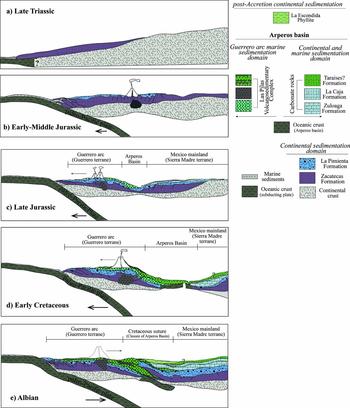
Much has been discussed about the existence of a large submarine fan developed along the western edge of nuclear Mexico during the Late Triassic time, when it acted like a passive margin (Fig. 9a) (Centeno-García & Silva-Romo, Reference Centeno-García and Silva-Romo1997; Silva-Romo et al. Reference Silva-Romo, Arellano-Gil, Mendoza-Rosales and Nieto-Obregón2000; Centeno-García, Reference Centeno-García, Anderson, Nourse, McKee and Steiner2005; Barboza-Gudiño et al. Reference Barboza-Gudiño, Orozco-Esquivel, Gómez-Anguiano and Zavala-Monsivais2008, Reference Barboza-Gudiño, Zavala-Monsiváis, Venegas-Rodríguez and Barajas-Nigoche2010). This submarine fan, termed the Potosí Fan (Silva-Romo et al. Reference Silva-Romo, Arellano-Gil, Mendoza-Rosales and Nieto-Obregón2000), was fed by dominantly siliciclastic detritus derived from cratonic sources of equatorial Pangea, when volcanic sources were absent as indicated by the quartz-rich sandstone composition. All the marine Upper Triassic siliciclastic turbidites have been grouped into the Potosí Fan (Centeno-García, Reference Centeno-García, Anderson, Nourse, McKee and Steiner2005), interpreted as corresponding to its different facies or environments (Silva-Romo et al. Reference Silva-Romo, Arellano-Gil, Mendoza-Rosales and Nieto-Obregón2000; Barboza-Gudiño et al. Reference Barboza-Gudiño, Zavala-Monsiváis, Venegas-Rodríguez and Barajas-Nigoche2010; Barboza-Gudiño, Reference Barboza-Gudiño and Elitok2012). Recent studies (Ortega-Flores et al. Reference Ortega-Flores, Solari, Lawton and Ortega-Obregón2014; Silva-Romo et al. Reference Silva-Romo, Mendoza-Rosales, Campos-Madrigal, Centeno-García and Peralta-Salazar2015) have suggested the possibility that the Upper Triassic turbidites belong to different submarine fans. In fact, in the Tolimán area (Fig. 1b) a small submarine fan, named Tolimán Fan (Ortega-Flores et al. Reference Ortega-Flores, Solari, Lawton and Ortega-Obregón2014), was fed by another drainage system (La Mora fluvial system; Silva-Romo et al. Reference Silva-Romo, Mendoza-Rosales, Campos-Madrigal, Centeno-García and Peralta-Salazar2015) which supplied detritus from the Amazonian Craton, combined with source rocks broadly documented as Grenvillian, Pan-African and Permo-Triassic. The Tolimán Fan includes arkosic sandstones (El Chilar Complex; Fig. 4b, c) similar to those reported in NE Mexico (Barboza-Gudiño et al. Reference Barboza-Gudiño, Zavala-Monsiváis, Venegas-Rodríguez and Barajas-Nigoche2010), but also includes zircon grains ranging in age from 1650 Ma to 1300 Ma (Fig. 7). In this context, the turbidite successions of the Zacatecas Formation and Arteaga Complex are quartz-rich metasandstones and they contain subordinate late Palaeoproterozoic – early Mesoproterozoic zircon grains; this suggests greater affinity with the Potosí Fan, representing the most external or distal facies as indicated by the decrease in the grain size and the occurrence of chert (Centeno-García & Silva-Romo, Reference Centeno-García and Silva-Romo1997; Silva-Romo et al. Reference Silva-Romo, Arellano-Gil, Mendoza-Rosales and Nieto-Obregón2000). The Tolimán Fan is therefore restricted to the SW part of the Sierra Madre Terrane, where it is covered by extensive Cenozoic volcanic rocks. However, it was possibly exposed during Late Jurassic time as it is recycled in the quartzarenite and dominantly felsic volcaniclastic successions of the Sierra de los Cuarzos area located in the Sierra Madre Terrane (Fig. 1b; Palacios-García & Martini, Reference Palacios-García and Martini2014).
Tectonostratigraphic interpretation for the Zacatecas area. (a) Deposition of the Upper Triassic metaturbidites of Zacatecas Formation. (b) Deposition of Middle Jurassic continental arc-related La Pimienta Formation over Upper Triassic metaturbidites of the Zacatecas Formation. (c) During Late Jurassic time, the incipient opening of Arperos Basin allowed the early deposits of Las Pilas Volcanosedimentary Complex (LPVSC) on the SW side of the basin to recycle part of the upper Middle Jurassic rocks (La Pimienta and Zacatecas formations), progressively including detritus from the Guerrero arc. (d) Once the Arperos Basin was completely opened the LPVSC received detritus only from the Guerrero arc on the western side, whereas the carbonate rocks were deposited on the eastern side. (e) During Albian time, the Guerrero Terrane was accreted to Sierra Madre Terrane and La Escondida Phyllite was deposited, containing detrital zircons from both Guerrero and Sierra Madre terrane sources.

During the Early–Middle Jurassic break-up of Pangea, the continental arc volcanism took place along the western margin of Pangea. Continental extensional arc volcanism coeval with continental red sandstone strata has been documented from the SW North American Craton, continuing into north, central, NE and SE Mexico (Pantoja-Alor, Reference Pantoja-Alor, Córdoba, del Arenal, Rodríguez-Torres and Segura1972; Barboza-Gudiño, Tristán-González & Tórres-Hernández, Reference Barboza-Gudiño, Tristán-González and Torres-Hernández1998; Busby-Spera, Reference Busby-Spera1988; Silva-Romo et al. Reference Silva-Romo, Arellano-Gil, Mendoza-Rosales and Nieto-Obregón2000; Blickwede, Reference Blickwede, Bartolini, Buffler and Chapa2001; Barboza-Gudiño et al. Reference Barboza-Gudiño, Orozco-Esquivel, Gómez-Anguiano and Zavala-Monsivais2008; Rubio-Cisneros & Lawton, Reference Rubio-Cisneros and Lawton2011; Busby, Reference Busby, Busby and Azor2012; Zavala-Monsiváis et al. Reference Zavala-Monsiváis, Barboza-Gudiño, Velasco-Tapia and García-Arreola2012; Lawton & Molina-Garza, Reference Lawton and Molina-Garza2014). Volcaniclastic rocks exposed west of the city of Zacatecas are comparable in composition and detrital zircon signature with volcaniclastic successions associated with the continental Nazas arc. During deposition of the volcaniclastic sandstone of La Pimienta Formation, there was a clear decrease in sediment influx derived from Gondwanan sources as indicated by the decrease of Amazonian detrital zircons. Locally however, the rocks of the Zacatecas Formation (which underlies La Pimienta Formation) were recycled (Fig. 9b), at least in the earlier deposits of La Pimienta Formation. This is supported from the fact that part of La Pimienta Formation is a quartz-rich succession and shares a similar composition to the Zacatecas Formation. Furthermore, a conglomerate in La Pimienta Formation includes metasandstone clasts derived from the Zacatecas Formation. This implies that the Upper Triassic turbidites were exposed through a horst-graben system related to rifting (Busby, Reference Busby, Busby and Azor2012; Lawton & Molina-Garza, Reference Lawton and Molina-Garza2014), as also indicated by the inherited zircon population in sample Z12-02 where 50% of the zircon grains range from Grenvillian to Permo-Triassic in age. It is possible that the supply of epiclastic sediments ceased when the Nazas arc was fully established and the Upper Triassic rocks of the Zacatecas Formation were covered, whereas the volcaniclastic sediment, associated with the continental arc, was dominant. The inference is further supported by the observation that some metasandstones of La Pimienta Formation show an increased content of volcanic lithic grains, volcanic quartz and vitric matrix.
Whereas the rifting processes were dominant in the east of nuclear Mexico, the palaeo-Pacific margin was subject to compressive and transpressive tectonic processes. Transpressional tectonics could be related to the reorganization of the peri-Gondwanan blocks as result of the break-up of Pangaea (Anderson, McKee & Jones, Reference Anderson, McKee and Jones1991; Sedlock, Ortega-Gutiérrez & Speed, Reference Sedlock, Ortega-Gutiérrez, Speed, Sedlock, Ortega-Gutiérrez and Speed1993) or the oblique subduction (Silver & Anderson, Reference Silver and Anderson1974). Transpressional faults were active during Late Jurassic time (Anderson, McKee & Jones, Reference Anderson, McKee and Jones1991; McKee, Jones & Anderson, Reference McKee, Jones, Anderson, Bartolini, Wilson and Lawton1999), and could have originated from compressional structures (D1) documented in the Zacatecas and La Pimienta formations; the latter demonstrate a NW–SE–shortening direction, a similar orientation to that of the transpressional structures.
Late Jurassic – Early Cretaceous developments were dominantly influenced by the subduction processes along the palaeo-Pacific margin. According to the tectonic models, during the middle Mesozoic evolution of the western Mexican margin (Freydier et al. Reference Freydier, Martinez, Lapierre, Tardy and Coulon1996, Reference Freydier, Lapierre, Briqueu, Tardy, Coulon and Martínez1997, Reference Freydier, Lapierre, Ruiz, Terry, Martínez and Coulon2000; Martini et al. Reference Martini, Mori, Solari and Centeno-García2011, Reference Martini, Fitz, Solari, Camprubí, Hudleston, Lawton, Tolson, Centeno-García, Aranda-Gómez, Tolson and Molina-Garza2012), the extensional back-arc Arperos Basin was a morphotectonic element interposed between the Guerrero Terrane and Mexican mainland (Fig. 9c, d) as a result of extensional processes in the upper continental plate derived from roll back of the subducted slab. During earlier stages, this basin was developed above upper Middle Jurassic strata (Fig. 9c) and directly over newly formed oceanic crust in the later stages (Fig. 9d). The influx of sediments to the NE margin of the basin was of continental provenance (Sierra Madre Terrane) and predominantly carbonate sedimentation (Centeno-García & Silva-Romo, Reference Centeno-García and Silva-Romo1997; Silva-Romo et al. Reference Silva-Romo, Arellano-Gil, Mendoza-Rosales and Nieto-Obregón2000; Barboza-Gudiño et al. Reference Barboza-Gudiño, Zavala-Monsiváis, Venegas-Rodríguez and Barajas-Nigoche2010), whereas sediment derived from the volcanic-arc assemblages of the Guerrero Terrane were deposited along the SW side of the basin. In this scenario the volcaniclastic successions of the Las Pilas Volcanosedimentary Complex represent the western margin of the Arperos basin, whereas carbonated rocks constitute the eastern edge of this basin. The lowest intervals of the Las Pilas Volcanosedimentary Complex have matrix-rich sandstones with an increase in the plagioclase content, but with a significant amount of zircon grains potentially derived from the Nazas arc (sample Z12-09; Fig. 8). This is indicative of continental sources recycled during Late Jurassic time, and is possibly related to the early extension stage of the basin. The upper intervals of Las Pilas Volcanosedimentary Complex are characterized by the emplacement of the pillow basalts, deposition of volcaniclastic sandstone and radiolarian chert, which together with zircon grains of age 160–150 Ma suggest that the Arperos Basin resulted in the complete separation of the Guerrero arc (Guerrero Terrane) from Mexico mainland (Sierra Madre Terrane) during Early Cretaceous time.
During late Early Cretaceous time, the back-arc Arperos Basin was closed as a result of shallowing of the subducted slab (Martini et al. Reference Martini, Mori, Solari and Centeno-García2011; Fig. 9e). The Albian La Escondida Phyllite (sample Z12-08) shows quartz enrichment and the predominance of Lower Cretaceous as opposed to Upper Jurassic zircon grains. La Escondida Phyllite therefore suggests a subsequent deposition to the accretion of the Guerrero Terrane to Mexico mainland (Sierra Madre Terrane; Fig. 1a). The accretionary process is probably related to the second phase of deformation (D2) of the Mesozoic successions in Zacatecas area, where rocks from the Guerrero and Sierra Madre terranes were juxtaposed. The increase of zircon grains in Grenvillian and Pan-African populations and the siliciclastic composition suggest that La Escondida Phyllite contained recycled detritus from the Mexican mainland as well as the Guerrero Terrane when the Upper Triassic – Lower Cretaceous strata were uplifted and exposed (Fig. 9d). Finally, all Mesozoic strata of western Sierra de Zacatecas show evidence of a third shortening event (D3), resulting in structures such as NE-directed thrust faults and folds. According to the involved rocks and the structure orientations, this tectonic event is considered to be related to the Laramide Orogeny which has been documented as Late Cretaceous in age (English, Johnston & Wang, Reference English, Johnston and Wang2003; English & Johnston, Reference English and Johnston2004).
8. Conclusions
Structural geology, petrography and U–Pb detrital zircon data from Mesozoic strata exposed in the western Sierra de Zacatecas document the Mesozoic evolution of a piece of palaeo-Pacific continental margin of equatorial Pangea. This was rifted from the Mexican continental mainland as a result of slab roll-back, causing the onset of an extensional continental arc. Lower–Middle Jurassic volcanogenic rocks of La Pimienta Formation, which are correlative with successions from the continental Nazas arc, were deposited in an extensional regime and floored by siliciclastic continental-sourced metasandstones of the Zacatecas Formation. La Pimienta Formation records felsic volcanic activity, as indicated by its volcaniclastic components, as well as recycling of the underlying Upper Triassic siliciclastic rocks. A major change of clastic composition is recorded during Late Jurassic – Early Cretaceous time when the back-arc basin (Arperos Basin) was floored by oceanic substrate as a result of progressive extensional processes due to roll-back of the palaeo-Pacific slab. The submarine volcanic rocks, oceanic-floor sediments and dominantly arc-derived detritus of Las Pilas Volcanosedimentary Complex document a clear separation from continental Mexico and the dominant influence of the volcanic arc (Guerrero Terrane) on the western margin of the back-arc basin, whereas carbonate sedimentation took place on the eastern side of the basin. The change from roll-back to shallowing of the palaeo-Pacific slab during late Early Cretaceous time caused the closure of the oceanic-floored crust back-arc basin. Subsequently, the previously rifted parts of the continental margin were accreted to form a suture belt by closure of the Arperos Basin. The accretionary event resulted in uplift and erosion of mixed-source rocks and sediments with both continental and arc-derived origins, which were then deposited on the new continental margin as La Escondida Phyllite.
Acknowledgements
We acknowledge the Programa de Apoyo a Proyectos de Investigación e Innovación Tecnológica of UNAM (PAPIIT-DGAPA IN100911 and IN102414), which funded this research. We thank Paola Botero Santa for help with fieldwork. The authors thank Minerva Elizabeth Martínez Alba for assistance with the preparation of some samples. We thank Juan Tomás Vázquez Ramírez for preparation of the thin-sections. We thank Manuel Albarrán Murillo for assistance with mineral separation. Carlos Ortega Obregón provided technical assistance in the Laboratorio de Estudios Isotópicos (LEI), Centro de Geociencias. Tim Lawton is also acknowledged for discussions on petrography and English language editing. The authors would also like to thank Cathy Busby and Michelangelo Martini for their reviews, which led to the improvement of the manuscript.
Supplementary material
To view supplementary material for this article, please visit http://dx.doi.org/10.1017/S0016756815000977.