Introduction
The ability to accurately recognize emotional facial expressions facilitates our understanding of the intentions, feelings, and reactions of others, which is necessary for adaptive social functioning in interpersonal situations (Carr & Lutjemeier, Reference Carr and Lutjemeier2005). The neuropeptide oxytocin (OXT) has been found to play a central role in the regulation of social behavior and social cognition (Heinrichs, von Dawans, & Domes, Reference Heinrichs, von Dawans and Domes2009) and has generally been associated with a range of prosocial behaviors, including increased trust (Kosfeld, Heinrichs, Zak, Fischbacher, & Fehr, Reference Kosfeld, Heinrichs, Zak, Fischbacher and Fehr2005), and generosity (Zak, Stanton, & Ahmadi, Reference Zak, Stanton and Ahmadi2007). Because the ability to decode another’s facial expressions is necessary for social interaction and has been linked to prosocial behaviors, it is perhaps not surprising that OXT has been shown to improve the recognition of emotional facial expressions (for review, see Shahrestani, Kemp, & Guastella, Reference Shahrestani, Kemp and Guastella2013).
Nevertheless, there appear to be inconsistencies across studies. While some studies report that OXT selectively improves the recognition of certain emotions, for example happiness (Marsh, Yu, Pine, & Blair, Reference Marsh, Yu, Pine and Blair2010) and fear (Fischer-Shofty, Shamay-Tsoory, Harari, & Levkovitz, Reference Fischer-Shofty, Shamay-Tsoory, Harari and Levkovitz2010), others report that OXT results in a general improvement in facial emotion recognition across emotions (Shahrestani et al., Reference Shahrestani, Kemp and Guastella2013), or indeed that OXT does not enhance recognition accuracy but instead improves the threshold at which emotions are recognized (Lischke, Berger, et al., Reference Lischke, Berger, Prehn, Heinrichs, Herpertz and Domes2012). In addition, there are now several examples of OXT increasing antisocial behaviors, including increased envy or gloating following relative financial loss or gain (Shamay-Tsoory et al., Reference Shamay-Tsoory, Fischer, Dvash, Harari, Perach-Bloom and Levkovitz2009), and increased interpersonal violence inclinations in those prone to physical aggression (DeWall et al., Reference DeWall, Gillath, Pressman, Black, Bartz, Moskovitz and Stetler2014; for review, see Beery, Reference Beery2015). As a result, it is important that studies not only examine the conditions under which OXT appears to result in increased prosocial or antisocial behavior, but also explore the mechanisms underlying these effects.
It has previously been suggested that because the eye-region contains the most relevant cues for accurate emotion detection, an increase in attention to the eye-region can improve emotion recognition (Schyns, Petro, & Smith, Reference Schnys, Petro and Smith2009). Consequently, it has been proposed that one mechanism through which OXT may promote enhanced emotion recognition is through increasing attention to the eye-region of faces. Consistent with this proposal, a study by Guastella, Mitchell, and Dadds (Reference Guastella, Mitchell and Dadds2008) found that participants who received OXT spent more time fixating upon the eye-region of neutral faces during a free gaze task, and returned more frequently to this area, compared to participants receiving placebo.
Although this study did not consider different emotions, Guastella et al. suggested that OXT has a direct influence on the ability to understand the emotions of others. It has also been shown that OXT enhances the ability to infer emotions from subtle cues around the eye-region (Domes, Heinrichs, Michel, Berger, & Herpertz, Reference Domes, Heinrichs, Michel, Berger and Herpertz2007), alters eye-gaze toward the eye-region of faces in individuals with autism spectrum disorder, while performing a gender-judgement free gaze task (Andari et al., Reference Andari, Duhamel, Zalla, Herbrecht, Leboyer and Sirigu2010), and increases gaze toward the eye-region of emotional expressions during an emotion classification task (Gamer, Zurowski, & Buchel, Reference Gamer, Zurowski and Buchel2010).
Furthermore, one study reported that OXT differentially modulates visual attention toward social signals of positive approach and threat (Domes, Steiner, Porges, & Heinrichs, Reference Domes, Steiner, Porges and Heinrichs2013), and other studies have reported that OXT has no effect on eye-gaze toward static faces (Domes et al., Reference Domes, Lischke, Berger, Grossmann, Hauenstein, Heinrichs and Herpertz2010) or static scenes (Lischke, Gamer, et al., Reference Lischke, Gamer, Berger, Grossmann, Hauenstein, Heinrichs and Domes2012). Although these studies differ in terms of the type of task performed by participants and did not explicitly assess the link between eye-gaze and emotion recognition, they provide inconsistent support for the commonly assumed notion that OXT may improve emotion recognition by increasing attention to socially relevant stimuli, in this case the eye-region.
To our knowledge, the only study to assess this link directly is the one reported by Lischke, Berger, et al. (Reference Lischke, Berger, Prehn, Heinrichs, Herpertz and Domes2012), who found that, while OXT improved the threshold for recognition (participants on OXT recognized emotions at lower intensities), eye-gaze and overall accuracy were unaffected. This study was conducted using dynamic faces, changing from low to high intensity. The authors suggested that the eye-region may be less salient in dynamic faces compared to static faces, and that attention may be captured more by the eyes in static faces because the eyes are assumed to be the most informative part of the face (Adolphs, Baron-Cohen, & Tranel, Reference Adolphs, Baron-Cohen and Tranel2002). Indeed, it has been shown that the relative importance of the eyes reduces when using dynamic faces (e.g., Vo, Smith, Mital, & Henderson, Reference Vo, Smith, Mital and Henderson2012). A key next step would, therefore, be to determine whether OXT alters eye-gaze to static emotional faces.
In response to recent reviews that have been critical of the quality and rigor of OXT research (Churchland & Winkielman, Reference Churchland and Winkielman2012; Leng & Ludwig, Reference Leng and Ludwig2016; Walum, Waldman, & Young, Reference Walum, Waldman and Young2016), we aimed to replicate previous findings of the effects of OXT on facial emotion recognition using a larger sample. Furthermore, a between-subject design was used in the only study so far to examine OXT, eye-gaze, and emotion recognition (Lischke, Berger, et al., Reference Lischke, Berger, Prehn, Heinrichs, Herpertz and Domes2012). Given large variations in individual responsivity to OXT across participants (Daughters et al., Reference Daughters, Manstead, Hubble, Rees, Thapar and van Goozen2015), we considered it important to explore the effects of OXT using a within-subjects design and to take measures of saliva OXT levels to ensure that the nasal sprays had the intended effect on OXT levels.
To this end, we compared facial emotion recognition across the six basic emotions, using a double-blind, within-subjects, randomized control trial of intranasal OXT. An additional aim was to explore the mechanism by which OXT affects facial emotion recognition by measuring eye-gaze. To achieve these aims, participants completed a facial emotion recognition task using medium intensity, whole, static faces while their eye movements were tracked with an eye-tracker. Saliva samples were taken and analyzed to ensure that OXT levels were elevated in the OXT condition.
In line with evidence suggesting OXT enhances prosocial behavior, and consistent with evidence from Shahrestani et al. (Reference Shahrestani, Kemp and Guastella2013), we hypothesized that OXT would generally enhance facial emotion recognition across emotions and in particular lead to improvements in the recognition of happiness and fear. We further expected OXT to increase attention to the eye-region of faces and that this would be related to improvements in facial emotion recognition.
Methods
Participants
Forty healthy male students (M age=20.98; SD=4.55) from Cardiff University participated in this experiment in return for course credit or £40. Participants took part in two 3-hr study sessions, with a 2-week interval between each session (for practical reasons seven participants had to be tested at later dates; the longest interval between the two sessions was 35 days). The order in which they received OXT or placebo nasal spray was randomized and counterbalanced, with researchers and participants remaining blind to this order. The decision to examine OXT in male participants was taken for two reasons: (1) the effects of OXT have been shown to differ in males and females, meaning grouping across genders would not be appropriate (Domes et al., Reference Domes, Lischke, Berger, Grossmann, Hauenstein, Heinrichs and Herpertz2010; Kirsch et al., Reference Kirsch, Esslinger, Chen, Mier, Lis, Siddhanti and Meyer-Lindenberg2005); and (2) administering OXT to females entails additional ethical and logistical considerations (e.g., controlling for menstrual cycle phase and/or pregnancy).
Ethical Statement
The study was approved by both the School of Psychology Ethics Committee at Cardiff University, and by the Research and Development Office at Cardiff and Vale University Health Board. Participants were cleared to participate in the study by a medical professional (co-author A.R.) and gave written informed consent at each testing session. They were fully debriefed after the second session. They completed medical pre-screening forms and signed statements of health before leaving each testing session. All participants had normal or corrected-to-normal vision, and none of them reported a history of neurological or mental health disorder, or severe allergic reactions. Participants were asked to refrain from alcohol in the 24 hr before each study session and from smoking cigarettes or drinking caffeine 2 hr before each study session.
Measures and Materials
Emotion recognition
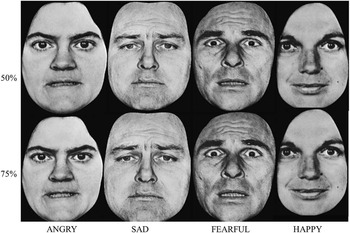
Emotion recognition was tested using a shortened version of the Facial Emotion Recognition (FER) task (Bowen, Morgan, Moore, & van Goozen, Reference Bowen, Morgan, Moore and Van Goozen2014). The shortened test consisted of 78 slides taken from the Ekman and Friesen (Reference Ekman and Friesen1975) facial affect battery, representing the six basic emotions (happiness, anger, fear, sadness, disgust, and surprise) and neutral faces. Equal numbers of male and female targets appear in the photo stimuli; each emotion is expressed at two medium intensities (50% and 75%) in the slides. Only medium intensity facial expressions were examined to reduce the risk of ceiling and floor effects associated with high (100%) and low (25%) intensity facial expressions (see Bowen et al., Reference Bowen, Morgan, Moore and Van Goozen2014, for data on 25% and 100% intensities). The hair and background of the image was masked so that only the facial features remained (see Figure 1).
Example stimuli selected from Bowen et al. (Reference Bowen, Morgan, Moore and Van Goozen2014).

The question “What emotion is this person showing?” accompanied the target image, along with numbered options from 1 to 7. The options were (from 1 to 7) “happiness,” “sadness,” “fear,” “anger,” “disgust,” “surprise,” and “neutral.” Percentage correct recognition scores for each emotion at each intensity level were calculated. Reliability for the overall accuracy score was satisfactory (Cronbach’s alpha=0.68), as was test–retest reliability (r=0.68, assessed by comparing participants’ first and second session scores, regardless of drug order).
Eye-tracking
Participants were positioned approximately 60–65 cm from a laptop computer and a 9-point calibration was performed. The quality of calibration was checked; if there were no data for one or more points, or if calibration quality was poor, calibration at those points was repeated. This process was completed for a maximum of three calibration attempts, at which point it was unlikely that calibration would improve further. Seven participants were excluded due to poor calibration quality. Calibration was followed immediately by the facial stimuli.
Eye movements were recorded with a portable Tobii X2-60 compact eye-tracker sampling at 60 Hz with a screen resolution of 1920×1080. This equipment is robust to changes in head position, negating the need for a chin rest. An I-VT fixation filter with a minimum fixation criterion of 60 ms sampled the average raw data of both eyes to produce information on eye positions and duration. Eye-gaze validity was checked using a sample rate percentage that gives an estimate of the quality of the eye-tracking in a recording by providing a percentage score of successfully-recorded data.
Three participants whose validity fell below 70% (range=14–44%), meaning eye-tracking data were not available for more than 30% of the recording, were excluded from the final analysis. For the remaining participants, validity ranged from 73–96% (M=90%). The 10 excluded participants did not differ from those whose eye-tracking data were retained with respect to performance on the FER task (overall accuracy: included=75.2%; excluded=74.4%; p>.05), age (included=21; excluded=23; p>.05), or drug order [six received OXT first, four received placebo nasal spray (PL) first].
Saliva Samples
Participants produced four saliva samples during each session: at baseline, and 30, 60, 90 min after OXT/placebo administration. These were analyzed to measure saliva OXT at each of these time points. Saliva analyses revealed the OXT nasal sprays were successful in increasing OXT levels: Mean saliva oxytocin concentration (in pg/mL) for all participants 30 min after administration was 999.5 during OXT and 37.5 during PL (see Daughters et al., Reference Daughters, Manstead, Hubble, Rees, Thapar and van Goozen2015). When participants excluded from the eye-tracking analysis were removed mean saliva OXT concentration after 30 min was 1129.6 during OXT and 39.2 during PL. There were no significant differences in OXT concentrations between those included and excluded from the eye-tracking analysis (p>.05)
Procedure
Participants self-administered 24 IU (three 4 IU puffs per nostril) of synthetic OXT or an independently manufactured PL that chemically matched the OXT spray for all compounds, except OXT. Both sprays were manufactured by St Mary’s Pharmaceutical Unit, Cardiff (http://www.wales.nhs.uk/sites3/home.cfm?orgid=828). A doctor was present during administration, and for the subsequent 15 min. After a 30-min wait period to allow the drug to take effect, participants completed the FER task.
The FER, as described above, was presented immediately after calibration was completed. Each face was presented in a set of three slides. The first was a noise screen that was used to prevent any visual carryover effects from the previous slide; the second contained a fixation cross to control for participants’ starting eye position; the final slide contained the face stimulus. The noise and fixation cross screens were displayed for 1 s each. The face stimuli were presented for as long as it took participants to select the emotion they judged the face to be showing. This is important because it enabled us to examine improvements in facial emotion recognition both in terms of accuracy and in terms of time spent processing the emotional stimuli.
Once an emotion had been selected, the next set of three slides was presented. During the second session, participants completed an identical version of the FER, but with the facial stimuli presented in a different order. The use of a randomized and counterbalanced drug order combined with a change in stimulus presentation order and a minimal delay of 2 weeks between sessions mitigated any concerns about potential training effects associated with using identical versions of the same task.
After completing the tasks, participants were debriefed about the aims of the study and asked to indicate which spray they thought they had received during each session, and how confident they were of this. Participants could not accurately report, above chance levels, during which session they received OXT (23 guessed correctly) χ2(1)=0.9; p=.34Footnote 1 . Moreover, participants who identified the correct spray order indicated that they were less certain of that order than those who reported the incorrect order (Correct M=3.8; Incorrect M=5.7), t(38)=2.35, p=.024.
Data Analyses
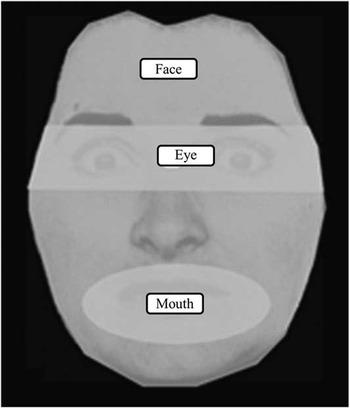
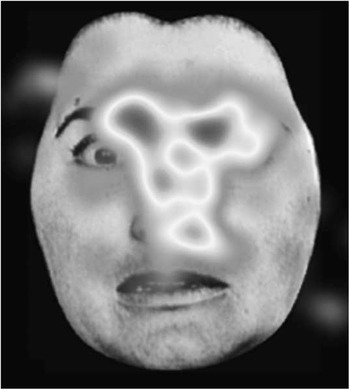
Tobii analysis software was used to analyze eye movements, which allowed areas of interest (AOI) to be created and a variety of summary reports generated. The eyes were grouped into one area. A second AOI was created around the mouth, and a third around the face as a whole to allow for analysis to be generated purely on the basis of when participants were looking at the face (see Figure 2, for example AOIs). Eye-gaze was analyzed for the duration of time participants fixated each face. Percentage dwell-time (the sum of the duration of all fixations to an area of interest divided by the total duration of time spent looking at the face) for each AOI was calculated (for an example of a heat map reflecting total fixation duration in an example face, see Figure 6).
Example face showing eye and mouth areas of interest (AOIs).

The percentage of time spent looking at the eye (Cronbach’s alpha=0.96; test–retest reliability; r=0.79) and mouth regions (Cronbach’s alpha=0.95; test–retest reliability; r=0.75) was subtracted from that of the whole face to produce a percentage of time spent looking at the rest of the face (Cronbach’s alpha=0.87; test–retest reliability; r=0.72). The mean time spent looking at each face was also recorded as a measure of the time spent processing a face before a response was made (face processing time) (Cronbach’s alpha=0.95; test–retest reliability; r=0.80).
Analyses were carried out using SPSS 20 (SPSS Inc., Chicago, IL). The principal analyses reported below are analyses of variance. Where the assumption of sphericity was violated, Greenhouse-Geisser corrections were applied. Where follow-up tests were required, Bonferroni corrections were used. Effect sizes were calculated as partial eta squared (ηp 2).
Results
Within-subjects analyses of variance (ANOVAs) were used, with Drug (OXT or PL), Emotion (happiness, sadness, fear, anger, disgust, and surprise), and Intensity (50% or 75%) as factors. Separate analyses were carried out for the dependent variables of recognition accuracy and face processing time.
Recognition Accuracy
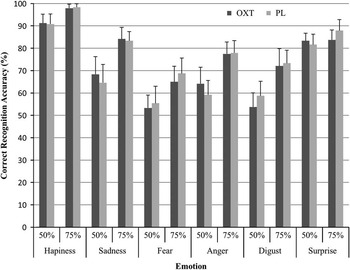
Recognition accuracy scores for six emotions during OXT or PL at 75% and 50% intensities are presented in Figure 3. There was a significant main effect of Emotion, F(3.86, 150.6)=48.35, p<.001, ηp 2=.55; the recognition of happiness was the most accurate (M=94%; SD=7), followed by the recognition of surprise (M=84%; SD=8), sadness (M=75%; SD=15), anger (M=70%; SD=14) and disgust (M=64%; SD=6); recognition of fear (M=61%; SD=15) was the least accurate. A significant Emotion × Intensity interaction, F(3.9, 150.78)=6.16, p<.001, ηp 2=.14, revealed that recognition accuracy was significantly greater for happiness, fear, sadness, disgust and angry faces when the intensity was higher (75%) (all ps<.001), but there was no significant difference as a function of intensity for surprise faces (p=.058). There was no significant effect of Drug, F(1,39)=0.11, p=.74, ηp 2=.00, and no interaction between Drug and Emotion, F(3.99, 155.73)=0.93, p=.45, ηp 2=.02, Drug and Intensity F(1,39)=1.31, p=.26, ηp 2=.03, or Drug, Emotion, and Intensity, F(3.88, 151.47)=0.66, p=.62, ηp 2=.02.
Mean recognition accuracy scores as a function of Emotion, Drug, and Intensity. Error bars indicate +2 SE.

Face Processing Time
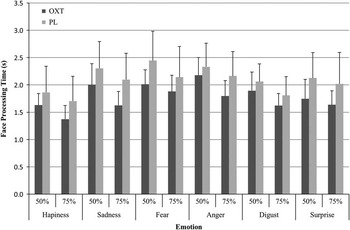
The effect of OXT administration on the time spent processing the face is shown in Figure 4. There was a main effect of Emotion, F(5,145)=7.58, p<.001, ηp 2=.21, reflecting the fact that happiness recognition was fastest (M=1.64; SD=0.9), followed by disgust (M=1.85; SD=0.6), surprise (M=1.88; SD=0.8) and sadness (M=2.01; SD=1.0). The longest face processing time was for the recognition of fearful (M=2.12; SD=1.0) and angry faces (M=2.12; SD=0.9). A main effect of Intensity, F(1,29)=20.04, p<.001, ηp 2=.41, revealed that lower intensity faces required more face processing time (M=2.05; SD=0.9), compared to higher intensity faces (M=1.82; SD=1.0). There was a marginally significant main effect of Drug, F(1,29)=3.70, p=.06, ηp 2=.11, but no interaction between Drug and Emotion, F(2.37, 68.72)=0.56, p=.60, ηp 2=.02, Drug and Intensity, F(1, 29)=0.66, p=.42, ηp 2=.02 or Drug, Emotion and Intensity, F(3.68, 106.69)=0.73, p=.56, ηp 2=.03.
Mean face processing time as a function of Emotion, Drug, and Intensity. Error bars indicate +2 SE.

Eye-Gaze
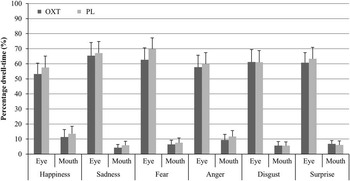
To examine the effect of OXT administration on visual attention, a four-way (Drug × Emotion × Intensity × AOI) repeated measures ANOVA was conducted. This analysis revealed that the overall dwell-time to the eye or mouth regions was unaffected by OXT administration [main effect Drug: F(1,29)=2.84, p=.10, ηp 2=.09; by the interaction between Drug and Emotion: F(2.93, 85.19)=2.18, p=.10, ηp 2=.07; the interaction between Drug and AOI: F(1,29)=0.51, p=.48, ηp 2=.02; the interaction between Drug and Intensity F(1,29)=0.98, p=.33, ηp 2=.03; the three-way interaction between Drug, Emotion, and AOI: F(2.62, 76.0)=0.85, p=.46, ηp 2=.03; the three-way interaction between Drug, Intensity, and AOI: F(1,29)=0.26, p=.61, ηp 2=.01; and the four-way interaction between Drug, Emotion, Intensity, and AOI: F(3.32, 96.20)=0.30, p=.85, ηp 2=.01].
A significant Emotion × AOI interaction, F(3.37, 97.68)=18.86, p<.001, ηp 2=.39, reflected the fact that participants spent proportionally more time fixating on the eye-regions of sad (M=66%; SD=20) and fearful faces (M=66%; SD=19), followed by those of surprised (M=62%; SD=16), disgusted (M=61%; SD=20), and angry faces (M=59%; SD=20). Percentage of time fixating upon the eye-region was lowest for happy faces (M=55%; SD=19). By contrast, participants spent a greater proportion of time fixating upon the mouth region of happy faces (M=12%; SD=13), followed by angry (M=11%; SD=10), fearful (M=7%; SD=8), surprised (M=6%; SD=6), and disgusted faces (M=6%; SD=6). Percentage of time spent fixating on the mouth region was lowest for sad faces (M=5%; SD=6). The main effect of AOI, F(1, 29)=165.2, p<.001, ηp 2=.85, revealed participants spent significantly more time looking at the eye-region (M=61.64%; SD=18), compared to the mouth region (M=7.85%; SD=7).
There was no main effect of intensity, F(1,29)=.001, p=.973, ηp 2=.00, but the interaction between Intensity and AOI was significant, F(1,29)=8.85, p=.006, ηp 2=.23. Follow-up analyses revealed that participants spent proportionally more time looking at the mouth-region of 75% intensity faces than at the mouth-region of 50% intensity faces (M=7.1% vs. M=8.6%; p=.001), but there was no difference in dwell time to the eye-region across intensities (p=.07). Because the Intensity variable had little effect on the overall patterns, the data have been collapsed across intensities to aid in the visual comparison of eye-gaze data shown in Figure 5.
Mean percentage dwell-time as a function of Emotion, AOI, and Drug. Error bars indicate +2 SE.

Heat map reflecting total fixation duration in an example face (with red indicating higher concentration of fixations and green indicating lower concentration of fixations).

Association between Gaze to the Eye-Region, Emotion Recognition, Response Time, and Saliva OXT Levels
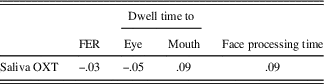
We computed separate Pearson’s correlation analyses between mean dwell-time to the eye region, emotion recognition accuracy and face processing time for the OXT and PL conditions. We found no evidence of an association between emotion recognition performance and dwell-time to the eye-region (OXT, r=.23; PL, r=–.14), face processing speed (OXT, r=.14; PL, r=–.09) or gaze toward the eyes (OXT, r=.25; PL, r=–.06), in either the OXT or PL condition (all ps>.05). Finally, within those who received PL first (n=22) overall recognition accuracy scores between the first and second (=OXT) session were highly correlated (r=.716; p<.001). The correlations between individual saliva OXT concentrations and FER accuracy, dwell time, and processing time were all non-significant (ps>.05) (Table 1).
Inter-correlations between saliva OXT concentrations 30 min after administration and key performance variables

Note. Pearson’s R. FER=Facial Emotion Recognition, OXT=oxytocin.
Discussion
We examined whether OXT affects facial emotion recognition and, if so, whether improvements were related to altered eye-gaze to socially relevant stimuli in static images. Using medium intensity emotional faces, we found that OXT did not improve facial emotion recognition accuracy across emotions. This is inconsistent with our hypothesis that OXT would enhance emotion recognition across emotions, particularly for happiness and fear, and is also inconsistent with previous research (e.g., Shahrestani et al., Reference Shahrestani, Kemp and Guastella2013).
Despite inconsistency in previous studies as to whether OXT selectively enhances recognition accuracy for certain emotions (i.e., fear or happiness) or whether it improves recognition in general, studies have typically found that OXT does result in some improvement in recognition accuracy. Indeed, in their recent meta-analysis Shahrestani et al. (Reference Shahrestani, Kemp and Guastella2013) concluded that OXT enhances the recognition accuracy of basic emotions, with specific effects for the recognition of happiness and fear. The authors went on to discuss the effect of OXT in specific situations, and this may help explain the discrepant findings from the current study. For example, additional findings from the meta-analysis suggest that different stimulus exposure times could account for discrepancies.
Under implicit recognition conditions (<300 ms), OXT enhances recognition of happy and angry expressions. Given these expressions are generally recognized faster and more efficiently (Fox et al., Reference Fox, Lester, Russo, Bowles, Pichler and Dutton2000; Leppänen & Hietanen, Reference Leppänen and Hietanen2004), it is reasonable to conclude that OXT has effects at shorter stimulus durations but not with longer exposure times, where ceiling effects may occur. Because our study had no limit on exposure time, this may explain why we did not find improvements in the accurate identification of happy faces, but instead found some evidence (albeit marginally significant) that participants receiving OXT required less time to process the face.
By contrast, Shahrestani et al. (Reference Shahrestani, Kemp and Guastella2013) found that for fearful expressions that tend to require more time to recognize and are generally harder to detect, OXT administration appears to have greater enhancing effects under longer durations of exposure (>300 ms). This is not borne out by our findings, particularly regarding fear, where we found no improvements in facial emotion recognition accuracy independent of the specific emotion. It should be noted that in our study the average exposure time across emotions was 1930 ms, with 2118 ms for fear, which is considerably longer than the 300 ms that Shahrestani et al. (Reference Shahrestani, Kemp and Guastella2013) refer to as a long exposure time. This may help to explain why, instead of OXT improving the accuracy of facial emotion recognition, it resulted in participants requiring less time to process the facial stimuli. Importantly, there was no relationship between face processing time and recognition, which suggests that OXT reduced the time required to process the face before an emotion was recognized without compromising accuracy.
This finding is similar to that of Lischke, Berger, et al. (Reference Lischke, Berger, Prehn, Heinrichs, Herpertz and Domes2012), who demonstrated that OXT reduced the threshold at which participants recognized an emotion, rather than enhancing the accuracy per se. Conversely, Fischer-Shofty et al. (Reference Fischer-Shofty, Shamay-Tsoory, Harari and Levkovitz2010) found no effect of OXT on processing speed, but instead a selective effect of OXT on the enhancement of fear recognition. Given that both the current study and Lischke et al. used whole face stimuli, which have been shown to result in greater recognition accuracy compared to the eyes-only stimuli (Valla, Maendel, Ganzel, Barsky, & Belmonte, Reference Valla, Maendel, Ganzel, Barsky and Belmonte2013) used by Fischer-Shofty et al., it is possible that OXT enhances recognition when task difficulty is high, but enhances efficiency when difficulty is low. Domes et al. (Reference Domes, Heinrichs, Michel, Berger and Herpertz2007) previously demonstrated that OXT improved facial emotion recognition performance for difficult test items, but not for easy ones; how this relates to efficiency is unknown. Future studies should address how accuracy and processing speed interact across tasks of varying difficulty.
It is commonly suggested that improvements in facial emotion recognition associated with OXT are related to increased attention to the eye-regions of faces. However, evidence to support an effect of OXT on eye-gaze is mixed (e.g., Andari et al., Reference Andari, Duhamel, Zalla, Herbrecht, Leboyer and Sirigu2010; Domes et al., Reference Domes, Lischke, Berger, Grossmann, Hauenstein, Heinrichs and Herpertz2010, Reference Domes, Steiner, Porges and Heinrichs2013; Gamer et al., Reference Gamer, Zurowski and Buchel2010; Guastella et al., Reference Guastella, Mitchell and Dadds2008; Lischke, Gamer, et al., Reference Lischke, Gamer, Berger, Grossmann, Hauenstein, Heinrichs and Domes2012). Moreover, in the only study to date to address the link between eye-gaze and improved facial emotion recognition explicitly (Lischke, Berger, et al., Reference Lischke, Berger, Prehn, Heinrichs, Herpertz and Domes2012), there was no effect of OXT on eye-gaze. The authors suggested this may have been due to the eye-region being less salient in the dynamic stimuli used in their study.
Nevertheless, we observed similar results using static images. Specifically, we found that OXT did not result in increased fixations on the eye-region of faces across emotions. This is in contrast to previous studies which suggest OXT is associated with greater dwell-time to the eyes (Andari et al., Reference Andari, Duhamel, Zalla, Herbrecht, Leboyer and Sirigu2010; Guastella et al., Reference Guastella, Mitchell and Dadds2008). As previously mentioned, Lischke et al. suggested it is possible that their discrepant findings were due to the use of dynamic stimuli, because Guastella et al. (Reference Guastella, Mitchell and Dadds2008) and Andari et al. (Reference Andari, Duhamel, Zalla, Herbrecht, Leboyer and Sirigu2010) used static faces. Our findings suggest that this is not the case.
Interestingly, another difference between studies is that Guastella et al. and Andari et al. both examined eye-gaze in response to neutral faces, which required participants to passively view the faces or make gender or gaze direction judgments about them, whereas both Lischke et al. and the current study examined eye-gaze while participants were making emotional judgments. It is, therefore, possible that the effects of OXT are dependent on task requirements. Because the eye-region affords important information during emotional judgments, healthy participants are likely to have a preference for this area, whereas OXT may have more of an influence on where people look during passive viewing, or for tasks where the eye-region is less informative or less salient (e.g., gender judgments).
As a caveat, it should also be noted that Gamer et al. (Reference Gamer, Zurowski and Buchel2010) found evidence that OXT altered eye-gaze during an emotional judgment task, but this was specifically in relation to OXT increasing the number of times participants shifted their gaze toward the eye-region, rather than percentage dwell-time to the region. Given that Gamer et al. presented stimuli for 150 ms, these findings suggest that OXT is involved in the initial allocation of attentional resources, with the effect of OXT on eye-gaze becoming less relevant as stimulus exposure time increases. We recommend that future studies examine initial eye-gaze to stimuli presented for shorter durations to examine whether percentage dwell-time to the eyes differs at lower exposure times.
What is evident from the studies that have examined eye-gaze changes following OXT administration, across a range of visual stimuli and tasks, is that the effects of OXT on eye-gaze are inconclusive (e.g., Andari et al., Reference Andari, Duhamel, Zalla, Herbrecht, Leboyer and Sirigu2010; Domes et al., Reference Domes, Lischke, Berger, Grossmann, Hauenstein, Heinrichs and Herpertz2010, Reference Domes, Steiner, Porges and Heinrichs2013; Gamer et al., Reference Gamer, Zurowski and Buchel2010; Guastella et al., Reference Guastella, Mitchell and Dadds2008; Lischke, Gamer, et al., Reference Lischke, Gamer, Berger, Grossmann, Hauenstein, Heinrichs and Domes2012). Perhaps more importantly, the present results confirm findings from the only other study that directly examined the effect of OXT on the relationship between eye-gaze and facial emotion recognition. Taken together, these results indicate that there is no evidence that OXT improves facial emotion recognition by altering eye-gaze toward socially relevant information, in this case the eye-region. In addition to replicating the findings of Lischke et al. using static stimuli, the current study also has the advantage of using a within-subject design.
The current findings highlight the need to consider other mechanisms that may be responsible for the effects of OXT on behavior. One mechanism requiring further exploration is pupil dilation. A recent study by Prehn et al. (Reference Prehn, Kazzer, Lischke, Heinrichs, Herpertz and Domes2013) suggests that, rather than OXT increasing visual attention to the eye-regions, enhanced recognition could be related to changes in pupil dilation, which can be used as a sensitive and reliable indicator of cognitive resource allocation and emotional arousal (Bradley, Miccoli, Escrig, & Lang, Reference Bradley, Miccoli, Escrig and Lang2008).
Specifically, better emotion recognition after OXT administration was accompanied by increased pupil dilation across emotions, which the authors attributed to an increased recruitment of attentional resources. This is consistent with OXT increasing attention toward socially relevant stimuli. However, the authors failed to address other possible explanations for the increase in pupil dilation. For instance, pupil dilation represents a measure not only of attentional resources but also of increased arousal, in particular sexual arousal (Rieger & Savin-Williams, Reference Rieger and Savin-Williams2012). It has also been previously demonstrated that OXT increases the perceived attractiveness of faces (Theodoridou, Rowe, Penton-Voak, & Rogers, Reference Theodoridou, Rowe, Penton-Voak and Rogers2009). Taken together, these findings suggest it is possible that the increase in task-related pupil dilation observed in study by Prehn et al. was related to an increase in the perceived attractiveness of the stimuli, rather than attentional resources.
Leknes et al. (Reference Leknes, Wessberg, Ellingsen, Chelnokova, Olausson and Laeng2012) found similar results in a study examining evaluations of explicit and hidden happy and angry expressions. They demonstrated that administered OXT enhanced evaluations of facial expressions and led to greater pupil dilation during the identification of subtle and hidden emotional expressions. Although this study only examined angry and happy faces, it controlled for facial attractiveness, thereby eliminating this as a possible explanation for changes in pupil response. Moreover, Leknes et al. found that participants with lower emotional sensitivity and poorer baseline performance showed greater OXT-induced recognition improvement, in addition to a larger change in pupil dilation. In contrast, when emotional sensitivity was already high, OXT resulted in little or no improvement. Along similar lines, Bartz et al. (Reference Bartz, Zaki, Bolger, Hollander, Ludwig, Kolevzon and Ochsner2010) found that OXT improved empathic accuracy only for participants who rated themselves as less socially proficient, as measured by the Autism Spectrum Quotient. The authors suggested that administered OXT increases the salience of social cues and benefits individuals who are generally less well tuned to social information, but does not benefit individuals who are more socially adept. Although our sample was too small to examine this issue properly, when we examined the effect of OXT separately in participants who scored in the bottom or top half on the FER test during the placebo condition, this analysis suggested that OXT significantly increased overall FER accuracy in low performers [Wilcoxon’s signed rank test; Mdn (SD): OXT= 73.6 (7.8), PL=70.8 (5.2); Z=2.0; p=.04], whereas it decreased performance in high performers [Mdn (SD): OXT=78.5 (8.7), PL=81.2 (5.5); Z=2.1; p=.04]. These preliminary findings add further weight to the suggestion that OXT may have greater effects in individuals with lower baseline emotion recognition accuracy.
Limitations
It should be noted that we used only stimuli with emotional–social content, and face processing time was generally faster in all emotions in the OXT condition. Therefore, it is presently unclear whether OXT has an emotion-specific advantage or affects processing speed in general. To disentangle this, future studies should examine response times in relation to non-social and non-emotional tasks, while also considering traits such as confidence and risk taking. Given that we have demonstrated that facial emotion accuracy was not compromised as a result of faster response times, it is unlikely that an increase in impulsivity as a result of OXT can explain the findings. However, a decrease in response time may be explained by OXT increasing participants’ confidence in their decisions or resulting in them taking more risks and thus responding faster. Both possibilities are worth exploring.
Given that Shahrestani et al. (Reference Shahrestani, Kemp and Guastella2013) suggested that discrepancies in the effect of OXT on facial emotion recognition could, in part, be related to different stimulus exposure times across studies, it could be considered a limitation of our study that we did not control for the amount of time participants viewed each facial stimulus. We took this decision because previous studies reported inconsistent findings on the effect of OXT on the accuracy and response time of emotional judgments. Not constraining exposure time provided us with additional insight into facial emotion recognition and enabled us to measure the time participants chose to attend to a face before making a response.
It is possible that our non-significant findings for emotion detection accuracy were due to lower task difficulty compared to studies that restricted viewing time to a shorter duration. Nevertheless, happiness, sadness, fear, anger, and disgust accuracy scores were significantly higher at 75% intensity than at 50% intensity. Given that the effect of OXT was consistent across intensities, this suggests that even when there was room for improvement (at 50% intensity), OXT had no effect on recognition accuracy. Similarly, the mean recognition accuracy across emotions in the placebo condition was 75% (SD=8.3), with the variance in scores ranging from 55.5% to 90%, further demonstrating that ceiling performance had not been reached.
The absence of a time constraint had the additional consequence that we were unable to analyze the number of fixations participants made to the eye and mouth regions, which is a common measure used in combination with dwell-time in eye-gaze studies, because this would have been confounded by the duration of time participants spent attending to the facial stimuli. Given that dwell-time is the most commonly reported eye-gaze measure within the OXT literature, this is not a major limitation of the current research, but corroboration with a measure of the number of fixations to the areas of interest would add to the strength of the findings. It is also worth addressing the number of participants whose data were excluded from this analysis because they failed the initial calibration test. Despite technical advice to the contrary, our experience with Tobii eye-tracking equipment suggests that the device is not suitable for use with participants who wear glasses; of the seven participants who failed the calibration process, six required glasses to complete the task.
Participants in the OXT condition showed a trend toward requiring less time to process emotional faces. This effect was only marginally significant but of moderate effect size, suggesting that it is quite likely that our study was underpowered to adequately detect effects. This has been a criticism of OXT studies in general, with Walum et al. (Reference Walum, Waldman and Young2016) suggesting that a sample size of more than 300 participants is needed to achieve sufficient power, compared to the average of 49 participants (between-subjects) used in previous studies. Although not achieving the sample size suggested by Walum et al., our study was an improvement on previous studies, particularly given that it benefitted from the use of a within-subject design and confirmed that OXT levels were indeed higher in the OXT condition.
Nevertheless, it is clear that more needs to be done to ensure that OXT studies are sufficiently powered to detect significant effects. Given the challenges of running large-scale OXT studies, this may involve replication of previous findings, cross-laboratory collaborations, or further exploration of the effects of OXT within populations who may be more susceptible to the effects of oxytocin, for example participants with autism.
It should also be noted that we only examined the effect of OXT in males. This was for practical and ethical reasons. Evidence indicates that gender differences in emotion recognition exist and that OXT modulates the neural circuitry involved in face processing in men and women differentially. For example, while it has been demonstrated that OXT decreases amygdala activity in response to fear in men (Kirsch et al., Reference Kirsch, Esslinger, Chen, Mier, Lis, Siddhanti and Meyer-Lindenberg2005), it appears to increase amygdala activity to similar stimuli in women (Domes et al., Reference Domes, Lischke, Berger, Grossmann, Hauenstein, Heinrichs and Herpertz2010). Additionally, women are more accurate than men in recognizing medium intensity facial expressions (Hoffmann, Kessler, Eppel, Rukavina, & Traue, Reference Hoffmann, Kessler, Eppel, Rukavina and Traue2010). Consequently, our results may not be generalizable to women.
Finally, although we screened participants before testing for the presence of any mental health disorder we did not specifically screen for social cognitive disorders such as social anxiety, which may have allowed for a more detailed profile of the differential effect OXT has on different individuals to be examined.
Conclusion and Clinical Implications
In summary, our study using a high functioning, healthy, male sample provides preliminary evidence that OXT reduces the time required to process emotional expressions, but does not improve the accuracy of emotion recognition. Importantly, our results counter the commonly proposed, but rarely tested, notion that the improvement in emotion recognition associated with OXT is the result of an increased attention to the eye-region; we replicated findings from previous studies using dynamic stimuli that OXT does not alter eye-gaze when making emotional judgments. Taken together with previous findings, these results suggest that OXT affects eye-gaze differentially, depending on task requirements.
When participants are required to make emotional judgments about faces where the salience of the eye region is high, visual attention to the eye-region is unaffected by OXT; however, when participants perform tasks where the eye-region is less salient, OXT appears to increase attention to the eyes. These findings highlight the need for research to explore the differential effects OXT appears to have on different tasks. Given that the current study was conducted using normal, relatively socially adept individuals, it worth considering how these findings might be different for individuals, such as those with autism or antisocial behavior, who have problems recognizing emotions in others, and in voluntarily attended to the eye-region of others.
Acknowledgments
Dr. Hubble, Ms. Daughters, Dr. Manstead, Dr. Rees, Dr. Thapar, and Dr. van Goozen reported no competing interests. The authors confirm that all conditions and data exclusions, including the reasons for these exclusions, have been reported. Sample size was determined based on the number of participants used in previous key studies. This work was funded in part by an Economic and Social Research Council grant (ES/J500197/1) awarded to the first and second author and by a Wellcome Trust Seedcorn Grant awarded to SHMvG and AT. We thank Dr. Andrew Lansdown and Dr. Anil Narayanaswamy for their medical supervision during the study. We also thank the management team and staff at the Clinical Research Facility at the University Hospital of Wales where this research was conducted.