Introduction
Families living with dementia have generally been placed in a siloed care environment that is specific to the diagnosis rather than one sensitive to the requirements of the whole family (Brodaty and Donkin, Reference Brodaty and Donkin2009; Gelman and Greer, Reference Gelman and Greer2011). Internationally, there is increasing recognition of mental health services’ need to change their focus from clinical diagnosis and management to one that is centered on the needs of service users, their families, and carers (Beresford et al., Reference Beresford, Nettle and Perring2010; McDaid and Delaney, Reference McDaid and Delaney2011; Tew et al., Reference Tew, Ramon, Slade, Bird, Melton and Boutillier2012). The mismatch between clinical models of care for dementia and the wider needs of the family are amplified in those living with YOD. In Australia it has been estimated people living with YOD, under the age of 65 years, make up 6% to 9% of all those living with dementia (Australian Institute of Health and Welfare, 2012). Norwegian data suggests that one-third of people diagnosed with YOD have a family member under 18 years when the disease process begins, taking in to account the often lengthy delays in diagnosis (Barca et al., Reference Barca, Thorsen, Engedal, Haugan and Johannessen2014).
Parents living with YOD who have young people or children, experience unique stresses due to a reliance on services and resources that do not holistically meet their family needs (Denny et al., Reference Denny2012; Roach et al., Reference Roach, Keady and Bee2012). Within a more socially orientated model of care, there have been calls for the emotional impact on all the family members to be addressed (Barca et al., Reference Barca, Thorsen, Engedal, Haugan and Johannessen2014; Hutchinson et al., Reference Hutchinson, Roberts, Kurrle and Daly2014). In a model of care focused around a diagnostic label, it is perhaps not surprising that clinicians reported that finding out information about the family members was not valued clinically nor was it regarded as influential in planning (Roach et al., Reference Roach, Keady and Bee2012). Subsequently, service providers are overlooking young people who are at increased risk of experiencing emotional distress and may require mental health services when caring for a parent who is living with YOD (Hutchinson et al., Reference Hutchinson, Roberts, Kurrle and Daly2014). The young family members frequently report being unnoticed by service providers and despite being significantly impacted over an often lengthy period of time, there are few offers of emotional and social support (Gelman and Greer, Reference Gelman and Greer2011; Svanberg et al., Reference Svanberg, Spector and Stott2011; Johannessen and Moller, Reference Johannessen and Moller2013). These young carers belong to a much larger group of young carers who are at greater risk of developing mental health issues than their peers (Australian Institute of Heath and Welfare, 2011). Studies that reviewed the impact of different parental illnesses on children have similar findings to those of families living with YOD. They highlighted age, gender, length of time living at home, coping ability of the young people and family members as being influential in managing their parents’ illness (Barca et al., Reference Barca, Thorsen, Engedal, Haugan and Johannessen2014). For example, young people who have a parent living with multiple sclerosis were three times more likely to experience psychological distress than the general population (Pakenham and Bursnall, Reference Pakenham and Bursnall2006).
Isolation, financial hardship and parental disharmony are common themes for young carers in general (Mayberry et al., Reference Mayberry, Ling, Szakas and Reupert2005). Many young carers live in single parent families, often adding to their burden of caring particularly if they are the principal carers (Smyth et al., Reference Smyth, Cass and Hill2011b; McAndrew et al., Reference McAndrew, Warne, Fallon and Moran2012). All aspects of young carers’ lives need to be considered in planning inclusive services (Pakenham and Bursnall, Reference Pakenham and Bursnall2006). Enhanced social support, information about the parents’ diagnosis, adequate finances and good family relationships help to shield the young people from developing psychosocial issues (Pakenham and Bursnall, Reference Pakenham and Bursnall2006; Bogosian et al., Reference Bogosian, Moss-Morris and Hadwin2010; Barca et al., Reference Barca, Thorsen, Engedal, Haugan and Johannessen2014).
Generally, young carers do not seek help and support because of a fear of “unwanted scrutiny and intervention from social support services” and “fear of stigma” (Smyth et al., Reference Smyth, Blaxland and Cass2011a, p. 2). This suggests that society is failing to acknowledge and meet the needs of these young people leading to social exclusion and discrimination (Hutchinson et al., Reference Hutchinson, Roberts, Kurrle and Daly2014). In addition, concerns with confidentiality and trust are further barriers for young people in seeking help and connecting with appropriate services (Gulliver et al., Reference Gulliver, Griffiths and Christensen2010).
Stigma is commonly associated with people living with dementia and has been defined as a sign of disgrace or discredit, which sets a person apart from others (Byrne, Reference Byrne2000). Transferring stigma to significant others associated with particular illnesses is of real concern. This can contribute to the “hidden nature” of young carers failing to be recognized in their role by others and themselves (Smyth et al., Reference Smyth, Blaxland and Cass2011a, p. 10). This challenging notion where the rights for citizenship and respect within society are significantly impacted, adds to the distress of the families (Alzheimer's Australia NSW, 2010; Tew et al., Reference Tew, Ramon, Slade, Bird, Melton and Boutillier2012). Stigma by association has contributed to societal disablement of the whole family and further marginalization (Tew et al., Reference Tew, Ramon, Slade, Bird, Melton and Boutillier2012). Additionally, prevailing societal views of dementia being a progressive, terminal disease of old age have also contributed to young peoples’ experiences of disablement and marginalization in these families (Alzheimer's Australia NSW, 2010; Hutchinson et al., Reference Hutchinson, Roberts, Kurrle and Daly2014).
Given this socially constructed disablement of young people living with a parent with dementia, the question arises as to what extent these young people can engage with enabling strategies, to help them become empowered to overcome this disablement.
There are two promising strands of inquiry in providing a theoretical perspective from which to envision potential enabling strategies. The first involves a concept drawn from social psychology. Connectedness within a young person's social world through the building of positive relationships may help them to form linkages and networks that promote resilience, through a sense of belonging (Kawachi and Berkman, Reference Kawachi and Berkman2001; Mayberry et al., Reference Mayberry, Ling, Szakas and Reupert2005; Tew et al., Reference Tew, Ramon, Slade, Bird, Melton and Boutillier2012). Connectedness is at the heart of the theory of communities of practice (Wenger, Reference Wenger2000). This theory is increasingly being used to envisage how communities of practice can work on improving specific aspects of health and social services. Robinson and Cottrell (Reference Robinson and Cottrell2005) described “strategies that health professionals and their colleagues in multi-agency, multi-professional teams use to overcome barriers and to strengthen team cohesion” working cooperatively for the benefit of young people and families (Robinson and Cottrell, Reference Robinson and Cottrell2005, p. 1). The second strategy recognizes individual empowerment as described by Masterton and Owen (Reference Masterton and Owen2006). Being empowered requires positive person centered associations to be developed and encourages individuals to be part of the decision making process (Masterton and Owen, Reference Masterton and Owen2006). These young people are thought to need recognition in their own right while responding to the changes in the family circumstances and dealing with marginalization in society (Thomas et al., Reference Thomas, Stainton, Jackson, Cheung, Doubtfire and Webb2003).
Theoretical framework
The social model of disability maintains that “disability” is socially constructed, and it is this rather than the impairment which results in societal disablement (Barnes and Mercer, Reference Barnes and Mercer2011). The social model promotes the difference between impairment and disability such that “impairment is the functional limitation within the individual caused by physical, mental or sensory impairment. Disability meanwhile, is the loss or limitation of opportunities to take part in the normal life of the community on an equal level with others due to physical and social barriers” (Barnes, Reference Barnes1992, p. 20).
The social model of disability concept is continually being developed and theorized in many contexts. More recently, the social model has been explored from a mental health perspective as an alternative to the medical model. The medical model can amplify the stigma connected with mental health service users (Mulvany, Reference Mulvany2000; Beresford, Reference Beresford, Barnes and Mercer2004; Beresford et al., Reference Beresford, Nettle and Perring2010). The social model demonstrates the link between mental distress and experiences of oppression and inequality (Tew, Reference Tew2002). Tew (Reference Tew2002) suggest that social factors particularly “major social trauma,” may increase the risk of breakdown or distress through stigmatization and discrimination (Tew, Reference Tew2002, p. 148). The opposite association is equally plausible, that stigmatization and discrimination may be the reason for the original mental distress in the first place.
A social model perspective calls for a shift from individualization of distress to considering the role of society with regards to the economic, cultural, and environmental barriers in relation to families with mental illness and dementia (Gilliard et al., Reference Gilliard, Means, Beattie and Daker-White2005; Tew et al., Reference Tew, Ramon, Slade, Bird, Melton and Boutillier2012).
In this context, we first set out to explore what are the lived experiences of young people having a parent with YOD from the perspective of the social model of disability. Second we explored influencing factors that could enable these young people to be included and supported within their community
Methods
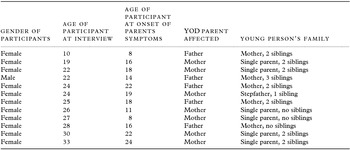
The first author collected data through semi-structured interviews with purposively sampled participants who had been informed of their parent's diagnosis of YOD. In the course of identifying potential participants to be interviewed, some fell outside the age sample criteria aligned with the WHO definition of young people between 10 to 24 years. They described their retrospective experience of living with a parent with YOD. Table 1 illustrates some demographic detail about the participants’ ages at the time of the interview and the time of the events they were recalling. The authors agreed to include these older participants in the study because of their rich experience and level of wisdom gained with maturity. Data was collected also through a focus group of four participants, previously interviewed, to validate the emerging themes.
Participant information (n = 12)

Flexible, in depth, semi-structured interviews were conducted with the participants’ in a range of settings (Ritchie et al., Reference Ritchie, Lewis, Nicholls and Ormston2013). Data was generated through sharing their stories and facilitated by nine prompt questions related to their experiences of daily living, their interaction in the community, and services they had or thought they should have received. Probing questions helped contribute to richer understanding of the participants’ stories (Ritchie et al., Reference Ritchie, Lewis, Nicholls and Ormston2013).
Following institutional ethical approval from the University of Sydney, Alzheimer's NSW and Young Carers NSW agreed to advertise the research and participants were invited into the study. Participants were encouraged to ask questions before the written consent and interview. Data was de-identified prior to analysis and reporting. An additional consent form was completed by a guardian or parent without YOD for the young person aged between 10 and 16 years. During and after the interview the interviewer carefully considered the emotional impact on the young people. Each participant received an extensive contact list of useful support organizations.
Data analysis
Individual interviews were recorded and transcribed verbatim. A detailed thematic analysis was conducted using framework analysis (Ritchie et al., Reference Ritchie, Spencer and O’Connor2003). The framework analysis involved all authors coding three transcriptions each, then negotiating and discussing coding framework. At the foreground of the coding was identifying the socio-cultural underpinnings of the experiences, interactions, and interventions that influenced the young peoples’ ability to rise above social marginalization. We reported from the perspectives of the young people in the families using the theoretical lens of the social model of disability as a framework (Hutchinson et al., Reference Hutchinson, Roberts, Kurrle and Daly2014). Further analysis of the dataset highlighted emergent themes which resonated with key concepts within this particular framework. Additional comparisons, linking, and mapping of emergent themes were conducted by moving between the raw data, emergent themes, and the theoretical literature, in order to clarify and negotiate understandings among all authors. This negotiated framework was applied by a single author to the whole dataset (Hutchinson et al., Reference Hutchinson, Roberts, Kurrle and Daly2014). QSR NVivo version 10 was used as the qualitative data management software for the analysis (NVivo, 2012).
Findings
From our analysis three main themes emerged; invisibility, which described the marginalization of these young people within society; connectivity depicting how they interacted with their social world and the impact of this interaction on them; and being empowered, which illustrated enabling strategies to increase control over their lives and achieving a balance between acceptance and adaptability to changing circumstances. In order to maintain the participants’ anonymity we used pseudonyms to protect their identity.
Invisibility
Our theme of invisibility supported three sub themes of isolation, neglect, and subsequent perceptions of marginalization. Most participants felt a lack of recognition, understanding, and support of their roles within their family, by other family members, friends, and community.
Isolation
Isolation described how participants felt separated from their usual social environment due to the changed family circumstances with the parent's diagnosis of YOD and the consequential social exclusion. Combined with experiencing the prevailing societal view of dementia affecting the older generation, young people often felt unrecognized and unsupported. This feeling of isolation also occurred within the family because of other family members, often unintentionally, dealing with their own issues, in the context of the response of the wider community. Carol described her perception thus;
Everyone is going through their own private crisis and mine's just one of them, like it's just extra stuff for them to deal with and I don't want to put that on them.
Young people avoided burdening other family members, hiding their own concerns, fears and needs. Other research has noted this lack of opportunity for young people to safely share their own experiences as a contributing factor to their loneliness and lack of support (Allen et al., Reference Allen, Oyebode and Allen2009; Gelman and Greer, Reference Gelman and Greer2011; Hutchinson et al., Reference Hutchinson, Roberts, Kurrle and Daly2014). Sam “pulled a pretty good disguise” when he was at school to avoid drawing attention to himself;
With everyone kind of busy . . . . I could present well in most circumstances and kind of be whatever you want me to be or at least look like you wanted me to be.
Maintaining a level of secrecy offered protection from the scrutiny and stigma experienced outside the home and was a consistent theme in the data. Some participants felt the threat of separation from their family by authorities was a real concern especially in their younger years.
Neglect
This theme describes the ways in which participants faced physical, emotional, and societal neglect in differing social contexts. Their ability to cope and respond to changing family circumstances depended on the support available within the family, from health and service providers, and their own community. Chris faced challenges juggling school, paid work, and caring for her mother with limited finances for bills and food due to her mother's inability to manage finances. In desperation, she temporarily secured extra finances by asking;
. .mum to get me a packet of cigarettes. . . .With that packet I’d sell them to other kids at school and I’d make money. . .I’d maybe buy a couple of cigarettes and then buy bread and milk and spaghetti and stuff-groceries. . .I guess these are the financial impacts of having a parent with dementia, is that you don't have the things your friends have.
Chris normalized their poverty by suggesting this was a direct outcome of having a parent living with dementia. From a social model perspective, Chris's case demonstrates society's failure to provide adequate support for her family. This leads ultimately to the neglect of a fundamental human right regarding the meeting of basic needs.
Being an only child of her mother living with YOD, Bec reported some nutritional concerns. Her mother would cook something “the dog wouldn't even eat” which was compounded by hygiene issues as her mother fed the animals with the same plates and cutlery as they used. This ultimately resulted in Bec, unsupervised, preparing family meals at 11 years of age. In addition, her mother's alcohol dependency habits, contributed further to the neglect and stress she experienced at home. Neglected by her extended family and support services, Bec had a breakdown in year 12 at school, developing “bad depression and self-harming.” At the time her GP suggested she moved into a “safe environment” but having no financial assistance or alternative care for her mother, this was not an option.
The situations described by both Chris and Bec resonated with the reported experiences of young people living with a parent with mental health issues where their own mental health declined on account of being largely unsupported (Patel et al., Reference Patel, Flisher, Hetrick and McGorry2007).
Perceptions of marginalization
Stigma and marginalization are commonly recognized as impacting people living with dementia, but little consideration has been documented about the effect on other family members, particularly a younger member. Chris described the “big turning point” at 11 years old when her friend's mother:
Told a couple of the other mothers that my mum was a bit different and she thought she might have been smoking marijuana. She said my mum was sick. . . . . .then suddenly no one was allowed at my house anymore. . . .then asking questions about why she was different was difficult.
Having a mother labeled in this way excluded her from friendships and as a consequence, she faced discrimination and marginalization in the community. Henderson and Thornicroft (Reference Henderson and Thornicroft2009) had also concluded that such socially constructed discrimination and exclusion related to mental health disorders can be worse than the illness. It was the social constructed disability that forced people such as Chris, to the outer margins of society.
Young people observed discriminatory behavior around dementia, which they did not perceive in families living with other diagnostic labels such as cancer. The differing reactions of others to dementia and cancer were described by Chloe;
There's this real shame around Alzheimer’s. No one wants to talk about it; no one wants to acknowledge it. Everyone wants to say ‘she's fine’: there's such denial. Where with dad it's much more, ‘how's your dad, how's chemo’ and ‘oh you poor things’.
In summary, our research theme of invisibility could be considered a manifestation of the lived experiences of the young people through their experiences of isolation, neglect and marginalization. Our data showed many examples where the young people “struggle quietly on their own” or describe “feeling alone”. Other researchers have also reported invisibility among young carers in general, which is secondary to negative societal attitudes to their caring role within the family (Moore and McArthur, Reference Moore and McArthur2007; Rose and Cohen, Reference Rose and Cohen2010).
Connectivity
The theme of connectivity was explored through the sub themes related to the ways in which the young carers interacted with family and friends, health and service providers, and education. Through a process of connectivity young carers’ accessed support as relationships were formed between people who need to talk or between people who need help and people who can offer help (Wenger, Reference Wenger2000). Negotiation of social barriers through engagement and relationship building by concerned others can aid in the formation and maintenance of the young people's social bonds.
Family and friends
Positive connections with family and friends can alleviate some young peoples’ concerns caring for a parent through this mutual support by significant others. Sonia alluded to the conflict of a mother–daughter role reversal where she as a young person felt she was parenting her mother. At the same time Sonia was thankful for her sister's support;
I feel like I have a teenage daughter. . . . .thank god I have my sister because we can talk about it together.
However, as is often seen within families living with YOD, connectedness can be difficult to maintain especially through familial conflict. Sam described “a big conflict in the family” which affected relationships between two of his siblings and his mother, who was the primary carer for his father. This conflict resulted in both brothers not communicating well with their mother over many years along with developing ongoing anxiety issues. The observation that stressful situations can disrupt families and friendships leading to further loss of potential support networks for young carers in general (Mayberry et al., Reference Mayberry, Ling, Szakas and Reupert2005; Pakenham, Reference Pakenham2012), also applies to YOD families too.
Carol used a metaphor of connection in social media discussion groups to emphasize her sense of disconnection in the social world.
. . . . .no one [is] keeping the thread of where you are and how you are going.
Paradoxically, connections with her peers were helpful for Carol since they provided a degree of normalcy.
Friends provide me with relief precisely because they are not going through the same thing as me and they can provide distraction or they cannot remind me of it.
Whilst family and peer connectedness is important for promoting the kind of resilience that Carol showed, there is often reluctance for young people to seek support from peers. This is often due to their general lack of understanding of having a parent living with YOD. However, the maintaining of a meaningful relationship with at least one person is widely acknowledged as being important. It is known to help with the overall adjustment and the emotional well-being of young people (Mayberry et al., Reference Mayberry, Ling, Szakas and Reupert2005; Pakenham and Bursnall, Reference Pakenham and Bursnall2006).
Health and service providers
Health and service providers are not known for engaging particularly well with the whole family, across a range of ages, where a member is living with dementia (Gelman and Greer, Reference Gelman and Greer2011; Barca et al., Reference Barca, Thorsen, Engedal, Haugan and Johannessen2014; Hutchinson et al., Reference Hutchinson, Roberts, Kurrle and Daly2014). Loren experienced a sense of failed connection with service providers where no realistic options for support were considered for the family or her mother, yet alone provided.
. .the biggest stress that I have with this is that we don't know where to go. What we had, well we had three and a half years of trying to get it done and then after it was diagnosed it was a bit anti-climactic because it was diagnosed and then we were just kind of left standing there with the diagnosis and you don't know what to do with it.
Receiving a clinical diagnosis of YOD left many families feeling disempowered and disconnected from health professionals often working within silo-based services, and perceived them as failing to acknowledge the impact on the whole family. One particular GP failed to engage and understand Carol's situation;
I was just so shocked. She said like well this is the sort of thing you’re going to be dealing from now on and you’re your mum's only sort of resource. . . . . .I just remember thinking like God it’s. . . . you’re not giving me much options here.
On the other hand Loren reported the benefit of having a YOD key worker assigned to her family, which is an Australian federally funded government initiative. This key worker accessed and negotiated with a range of potential service providers.
She was pretty much pivotal – I wouldn't be sitting here talking to you guys (young person focus group) if she wasn't involved at all because we’d still be sitting around. . . . .They’re trained in early onset dementia and she knows exactly what you need to do and she knows everything about it.
Loren confirms the importance of being connected to relevant support and information as found by Allen et al., (Reference Allen, Oyebode and Allen2009). The contrary to this was health and service providers’ lack of knowledge of YOD friendly services left many of our participants largely disconnected and unsupported in a highly vulnerable situation, also reported by Allen et al., (Reference Allen, Oyebode and Allen2009).
Education
For young carers in general, school is widely recognized as a place where they can behave as children and experience respite away from their concerns about their parent's illness (Rose and Cohen, Reference Rose and Cohen2010; Maynard et al., Reference Maynard, Patterson, McDonald and Stevens2013). Schools or education facilities can potentially provide stability when family life is unpredictable. For Chris being recognized as a carer by one teacher led her to the belief that:
It was the most stable thing in those years when I was a teenager, was to have that high school.
Nevertheless, the routine recognition of young carers within the school environment remains problematic. This is particularly noted in our research due to the prevailing societal view of dementia as a condition of older age therefore young people in schools are rarely considered to be in anyway involved. Despite support from her teacher, Chris experienced exclusion by her peers similar to other young carers who have reported difficulty forming friendships at school (Rose and Cohen, Reference Rose and Cohen2010). Chris felt alienated from school being labeled a “trouble maker” due to her unexplained absences. She found it hard to express her concerns, acting out in response to the challenges faced, typical of other young carers (McAndrew et al., Reference McAndrew, Warne, Fallon and Moran2012).
Participants living with a parent with YOD felt a sense of stability and purpose in a learning environment alongside school support, both practical and emotional, was particularly important and protective of their mental health. This is similar to the experience of young carers who have parents living with other forms of disability (Gilligan, Reference Gilligan2000; Rose and Cohen, Reference Rose and Cohen2010; McAndrew et al., Reference McAndrew, Warne, Fallon and Moran2012).
In summary, our research theme of connectivity demonstrated the importance of young people maintaining or developing relationships with significant people within their social world. It is well established that there is a relationship between social isolation and a reduced sense of emotional well-being (Kawachi and Berkman, Reference Kawachi and Berkman2001). This was supported by our participants who reported the overall lack of engagement particularly related to their age and parent's diagnosis of YOD, added to their vulnerability and social exclusion. As a result, failed connectivity contributed to issues of adjustment and emotional distress for many.
Being empowered
Being empowered consisted of two sub themes of self-efficacy and collaboration. Empowerment is described as the observable change in oneself and the interaction with the environment (Tew et al., Reference Tew, Ramon, Slade, Bird, Melton and Boutillier2012) around the young person.
Self-efficacy
Self-efficacy refers to the confidence in one's ability to behave in a certain way or to create a preferable outcome (Bandura, Reference Bandura1977) and is strongly associated with the individual's sense of empowerment (Wallerstein, Reference Wallerstein1992). Having a sense of direction and purpose can instill confidence and hope for the future. Once Chris acknowledged herself as a “carer” she applied for financial recognition of her role, realizing that “I need a plan.” A new approach was considered;
It wasn't so much my thinking of them (services) doing me a favour. It was my thinking of; this is something she's (her mum) entitled to.
Her self-belief and self-efficacy was enhanced when she no longer viewed support as something that had to be earned but rather as a human right. During this process of reflection, she achieved greater confidence through these new insights. The greater confidence that self-efficacy creates alters the way people “feel, think and act” (Singh and Udainiya, Reference Singh and Udainiya2009, p. 2). Stephanie meanwhile described the importance of meeting other young people in a group situation who had managed similar challenges;
. .that other kids my age have been through some really horrible, horrible things. But they got through it and they came out the other side fine. It's always motivational when we’re having a crisis.
This group was perceived by Stephanie and others as “the biggest lifesaver in the world”. This justifies Bandura (Reference Bandura1993) views on the importance of shared experiences and witnessing other similar young people overcome their challenges as provides the impetus to succeed in challenging situations. For Bec, eventual success in organizing residential care for her mother gave her a sense of purpose and direction to her life. She had time to look after herself as she no longer lived:
. . .out of a bag, eating MacDonald’s. I’ve lost 16 kgs since I don't have to go down there. I can do sport, I exercise every day and I can plan my meals out. It's just so much better.
Bec demonstrated how the advantages of obtaining permanent care for her mother helped her reshape her life; improve her own health and emotional well-being. Sam noted that self-recognition of his “dad's illness being a contributing factor” to his own deteriorating emotional status helped him to change his attitude to be “more genuine” to others. In turn they encouraged him to source some crucial emotional support.
Collaboration
Involving young people to work in partnership with organizations is important in drawing on the “perspectives, insight and expertise” of the young people (Hagen et al., Reference Hagen, Collin, Metcalf, Nicholas, Rahilly and Swainston2012, p. 1; McAndrew et al., Reference McAndrew, Warne, Fallon and Moran2012). Ann comments on her willingness to share her stories.
I’m happy to talk to everyone or anyone who will listen. I’ve given lectures at . . . University for the med students.’
Opportunities for sharing real life experiences can raise awareness and understanding of the impact of YOD within the community. Carol emphasized whilst dealing with her parent's “death sentence” policy makers need to develop some “structure of support” to help people like her.
Giving doctors more of a sense of the avenues out there to refer people when they get that diagnosis. Seems just generally a bit of a blind spot, on peoples’ radar, especially early onset.
A collaborative advocacy approach, raising public awareness of YOD and its impact on young carers, was sought by some participants. Service providers can potentially collaborate and translate the service models that have been successful within cancer and youth mental health services in supporting young people and their families (CanTeen, 2014; Montague et al., Reference Montague, Varcin and Parker2014).
Our data highlight that whilst having a parent with YOD is a constant in the young person's life, gaining self-confidence and a sense of direction through creating personal goals or having a purpose can be empowering. Being informed, knowing their rights, and having access to necessary resources about YOD can empower young people's self-advocacy, support their own well-being, and promote inclusion (Rose and Cohen, Reference Rose and Cohen2010; Hutchinson et al., Reference Hutchinson, Roberts, Kurrle and Daly2014).
Discussion
Three themes emerged from our data illustrating the influence society has on the lived experiences of young people and the complex interplay with their social world. The socially constructed disablement experienced by young people in families having a parent with YOD have left many feeling marginalized and disempowered, which society has an obligation to address.
The first theme of invisibility identified young peoples’ experiences of isolation, neglect and marginalization similar to young carers of parents living with a range of mental illnesses. Current services did not respond to the whole families’ needs and therefore did not take a social model approach to service design. Further limitations in knowledge and access to age appropriate services within the dementia sector contributed to young carer social exclusion and isolation. In some cases, failure of access to the necessary support led to economic hardship, where issues of neglect arose. According to the social model, this is a societal issue not an individual concern specific to a diagnosis, and therefore should be managed appropriately (Barnes, Reference Barnes1992; Oliver, Reference Oliver2009; Barnes and Mercer, Reference Barnes and Mercer2011).
Our findings of the relationship between invisibility and mental health issues in young people in families with YOD have not been considered before. There are similarities with the findings of Patel et al., (Reference Patel, Flisher, Hetrick and McGorry2007) in that living with parents with a mental health disorder as well as social disadvantage is strongly associated with developing mental health disorders in young people. So raising the awareness about young peoples’ experiences of marginalization in families with YOD is imperative in terms of negating isolation, neglect, and subsequent perceptions of marginalization.
The second theme of connectivity explored the repercussions of failed engagement within their social world and highlighted the significance of fostering social connectedness safeguarding them against life's challenges. Although being connected to the family was preferred by most participants, maintaining a significant relationship with at least one person was recognized as important in terms of adjustment and emotional well-being. Appropriate early health professional engagement with young people, as observed similarly within the mental health sector, is fundamental in the recognition of their rights in these families, connecting them to necessary social support and beneficial for their psychological well-being (Kawachi and Berkman, Reference Kawachi and Berkman2001; Patel et al., Reference Patel, Flisher, Hetrick and McGorry2007). This is also true for the education sector where engagement can provide some form of stability within an unpredictable world. Participants in this research pointed out the disparity in being acknowledged in a school environment as a young carer, due to the lack of public awareness about YOD impacting young people.
The third theme of being empowered explored the development of self-confidence and the role of self-efficacy. Being empowered supported young people's ability to be more in control of their future and assisted them in determining and accepting what they could or could not be in control of. However, the process of empowerment encouraged the breaking down of social barriers and permitted individual's development of positive and meaningful relationships, focused on their needs. Importantly, young people often want to speak up and should be encouraged to do so. Being involved in the process of policy development will ultimately affect the future of families impacted by YOD.
Implications
This new research considers the social model of disability (Barnes and Mercer, Reference Barnes and Mercer2011) as a theoretical framework to help in the understanding of how society contributes to the experiences faced by young people in families living with YOD. From this perspective the parent's diagnosis is not the only reason for the young people feeling overwhelmed within the family. The failure of society in recognizing individual needs, and supporting accordingly, contributes significantly to disempowering and marginalizing individuals (Aldridge and Becker, Reference Aldridge and Becker1999; Gelman and Greer, Reference Gelman and Greer2011; Hutchinson et al., Reference Hutchinson, Roberts, Kurrle and Daly2014).
The social model of disability focuses attention on the real barriers and problems faced within these families from the perspective of living with a parent with YOD. Their socially constructed disablement is a social issue rather than an individual or family concern. This theory helps in recognizing that the present isolation and crises experienced within families can be exacerbated by the “way services are designed and delivered” (Gilliard et al., Reference Gilliard, Means, Beattie and Daker-White2005, p. 582). However, the social model of disability not only demonstrates societal issues but guides researchers and health service providers down a pathway for social change for families and people living with YOD. This is a social change that is seen more commonly within the physical disability sector and more recently the mental health sector (Beresford, Reference Beresford, Barnes and Mercer2004; Oliver, Reference Oliver2009; Barnes and Mercer, Reference Barnes and Mercer2011). Integrated healthcare and support services need to be tailored to individual needs, enabling young peoples’ connection to appropriate support and organizations through the practice of routine engagement with the whole family.
Gilliard et al., (Reference Gilliard, Means, Beattie and Daker-White2005) described a “conspiracy of silence” surrounding a family member with dementia as being common due to societal stigma (Gilliard et al., Reference Gilliard, Means, Beattie and Daker-White2005, p. 580). Unsurprisingly Alzheimer's Australia reported that young people try to cope with their parents’ diagnosis without the involvement of others in an effort to maintain their parent's respect and dignity (Alzheimer's Australia NSW, 2010). The corollary to this is that recognition and support of young carers irrespective of parent's diagnosis can reduce experiences of marginalization as observed in other discriminated groups (Robson, Reference Robson2004). This emphasizes the importance of dealing with issues of labeling and stigma promoting inclusion of all family members to begin creating more equity within society. Rose and Cohen (Reference Rose and Cohen2010) exposed inequality depending on diagnostic labels. They noted that young carers of family members with cancer did not experience the same amount of “invisibility, shame, and stigma reported by young carers of adults with mental health difficulties” (Rose and Cohen, Reference Rose and Cohen2010, p. 480). This suggests that support networks need to address individual needs rather than being diagnosis specific which can lead to a greater sense of individual empowerment for young carers. This is particularly important within dementia services as there is a prevailing focus on the aged care model of care.
Maintaining social connectedness is valuable for overcoming social barriers creating resilience and empowerment. The authors agree with other studies that being connected with support specific to need could potentially prevent or reduce family breakdown, alleviate anxieties and stress, and maintain connections with their social world (Allen et al., Reference Allen, Oyebode and Allen2009; Gelman and Greer, Reference Gelman and Greer2011; Hutchinson et al., Reference Hutchinson, Roberts, Kurrle and Daly2014). Without a positive relationship the accumulation of negativity in these young people's lives can have a ripple effect into adulthood if this process is not addressed and social change is not fostered (Gilligan, Reference Gilligan2000). So meaningful connectivity needs to be fostered to help individuals become empowered but this will be limited without the accompanying social change (Masterton and Owen, Reference Masterton and Owen2006).
Taking a social model perspective, the dementia sector should be more actively engaged with young people in order to counteract marginalization and advocate for social change and equity in access to services. Maynard et al., (Reference Maynard, Patterson, McDonald and Stevens2013) have emphasized the importance of communication and connection to resources and support opportunities that can enable families to plan effectively for the future and deal with the ongoing grief and eventual loss of a parent. The idea of health and social care practitioners and policy makers engaging and collaborating with young people in families within the dementia sector is relatively new. As reported elsewhere knowledge from youth organizations demonstrated young people's contribution to social change is valuable and empowering (Robinson and Cottrell, Reference Robinson and Cottrell2005; Hagen et al., Reference Hagen, Collin, Metcalf, Nicholas, Rahilly and Swainston2012). In accord with Patel et al., (Reference Patel, Flisher, Hetrick and McGorry2007) there is a need for health professionals to develop a ‘particular style’ and skill to engage young people which unfortunately is often lacking (Patel et al., Reference Patel, Flisher, Hetrick and McGorry2007, p. 7). Many young people do not have a regular GP and a common barrier to seeking help is stigma, embarrassment and an expectation of managing on their own. Training for health professionals can help in this regard.
From a social model perspective, there appears to be many shortcomings in policies where these young people have been in effect disabled by a society that is not inclusive. The social model of disability demands campaigning and advocating for inclusion and equality and for the young people to be acknowledged as experts in their own right, both as carers and service users. Promoting self-efficacy of young people to achieve a level of mastery by adapting and adjusting to the specific situations they find themselves in is important. Through the practice of connectivity mediated by the process of engagement leads to empowerment (Masterton and Owen, Reference Masterton and Owen2006) that could promote change to enhance their futures.
Furthermore the social model of disability stresses the responsibilities of society to respect individual needs, and shifting the focus for services design and delivery away from a medical model to a social model (Beresford et al., Reference Beresford, Nettle and Perring2010; Barnes and Mercer, Reference Barnes and Mercer2011). Professional support is pivotal to families living with YOD but not routinely adopted. There is a need for more cooperation across sectors, between services and health workers, to effectively manage and support these families having had appropriate interdisciplinary training (Gray et al., Reference Gray, Robinson and Seddon2008; Barca et al., Reference Barca, Thorsen, Engedal, Haugan and Johannessen2014). In the Australian context, further development of the YOD key worker could provide a vital negotiator between the young people and relevant services which otherwise can be challenging to navigate.
There is an opportunity for young people living with a parent with YOD to have greater connectivity by embracing technology. For example, social media usage within youth mental health sector opens up possibilities for reducing stigma, promoting help seeking behavior, and developing more innovative ways to responding and connecting to individuals (Christensen, Reference Christensen2014; Kauer et al., Reference Kauer, Mangan and Sanci2014). The dementia sector could potentially maximize their reach by harnessing new technologies creating flexibility in practice and thinking.
It is important to contemplate all the opportunities that currently exist for collaboration, translation of service and support frameworks from other health, service, and education sectors where the complexity and powerful influences of society have been considered to some extent. Using the social model of disability as a framework calls for service providers to move away from silo based, diagnostic specific services and adopt a more integrated approach which encourages partnership with service users in planning and designing services.
Limitations
Our findings represent the views of a small group of young people who volunteered for the study. We acknowledge that females were over represented in our sample however this reflects Australian data which suggests females over 18 years tend to be more likely to report being a young carer confirming the gender difference (Smyth et al., Reference Smyth, Cass and Hill2011b). Only six people were from the 10–24 age groups, at the time of interview, although data was obtained retrospectively from older participants reflecting on their younger years.
Conclusion
The current plight of young people living with a parent of YOD encourages a fundamental shift to a social approach to service design and delivery addressing individual needs within these families. Using the social model of disability as a framework can help in the development of enabling strategies that encourage and maintain social connections. Cross sectorial collaboration and cooperation with service users, incorporating technology opportunities, is essential to promote social inclusion, societal acceptance, and empowerment of individual family members. Family's impacted by YOD, feel that dementia can no longer remain within silo-based services and must now embrace specific individual requirements building new ways of working together.
Conflict of interest
None
Description of authors’ roles
K Hutchinson designed the study, collected the data, analyzed the data and wrote the paper. C Roberts designed the study, supervised the data collection, analyzed the data and assisted in writing of the paper. M Daly analyzed the data and assisted in writing the paper. C Bulsara analyzed the data and assisted in the writing of the paper. S Kurrle designed the study, supervised the data collection and assisted in writing the paper.
Acknowledgments
Thank you to the NHMRC Partnership Centre for Dealing with Cognitive and Related Functional Decline in Older People (CDPC) for the research masters scholarship supporting this research study.