Introduction
Eating disorders in pregnancy are poorly understood but warrant attention. Epidemiological data from our group suggest, first, that eating disorders during pregnancy are reasonably common, with prevalence estimates ranging between 0.1% (eating disorder not otherwise specified-purging disorder; EDNOS-P) to 4.8% (binge eating disorder; BED) (Bulik et al. Reference Bulik, Von Holle, Hamer, Knoph Berg, Torgersen, Magnus, Stoltenberg, Siega-Riz, Sullivan and Reichborn-Kjennerud2007). Second, pregnancy is a high-risk period for the onset of BED, occurring at a rate of 1.1 per 1000 person-weeks (Bulik et al. Reference Bulik, Von Holle, Hamer, Knoph Berg, Torgersen, Magnus, Stoltenberg, Siega-Riz, Sullivan and Reichborn-Kjennerud2007). Eating disorder symptoms during pregnancy are more prevalent among those with a recent or past history of eating disorders (Micali et al. Reference Micali, Treasure and Simonoff2007a). Over a quarter of pregnant women with eating disorders purge and 11% report dieting for weight loss at 32 weeks (Micali et al. Reference Micali, Treasure and Simonoff2007a). Offspring of women with eating disorders are at higher risk for birth complications including perinatal mortality, premature birth, low birth weight and birth defects (Bulik et al. Reference Bulik, Sullivan, Fear, Pickering and Dawn1999; Sollid et al. Reference Sollid, Wisborg, Hjort and Secher2004; Micali et al. Reference Micali, Simonoff and Treasure2007b). Persistence of eating disorders beyond pregnancy may increase child vulnerability through risk factors associated with the expression of illness. Mothers with and without eating disorders self-report different feeding styles, with restrictive feeding styles and infant feeding problems more common among mothers with eating disorders characterized by binge eating (Reba-Harrelson et al. Reference Reba-Harrelson, Von Holle, Hamer, Torgersen, Reichborn-Kjennerud and Bulik2010). Indeed, mothers with eating disorders express concern about knowing how to feed their children appropriately (Mazzeo et al. Reference Mazzeo, Zucker, Gerke, Mitchell and Bulik2005). Positively, pregnancy appears to be a ‘window’ for the remission of bulimia nervosa (BN) (Bulik et al. Reference Bulik, Von Holle, Hamer, Knoph Berg, Torgersen, Magnus, Stoltenberg, Siega-Riz, Sullivan and Reichborn-Kjennerud2007). Recognition of eating disorders before and during pregnancy is a necessary first step to engaging individuals in treatment and parenting-based interventions to improve eating disorder and obstetric outcomes and promote healthy child development.
Research on the course of eating disorders through pregnancy originated in the 1980s and has typically used retrospective reports or small prospective samples with clinical or at-risk participants (e.g. Lacey & Smith, Reference Lacey and Smith1987; Tiller & Treasure, Reference Tiller and Treasure1998; Blais et al. Reference Blais, Becker, Burwell, Flores, Nussbaum, Greenwood, Ekeblad and Herzog2000; Crow et al. Reference Crow, Keel, Thuras and Mitchell2004; Koubaa et al. Reference Koubaa, Hallstrom, Lindholm and Hirschberg2005; Rocco et al. Reference Rocco, Orbitello, Perini, Pera, Ciano and Balestrieri2005). Although valuable clinical data had accumulated, an epidemiological perspective on the prevalence and course of eating disorders in pregnancy was absent, meaning that there were no reliable estimates of the percentage of women who experience, develop or remit from eating disorders during pregnancy, which is essential to guide research, health planning and service provision.
To address this, Bulik et al. (Reference Bulik, Von Holle, Hamer, Knoph Berg, Torgersen, Magnus, Stoltenberg, Siega-Riz, Sullivan and Reichborn-Kjennerud2007) examined data from an ongoing prospective population-based pregnancy cohort study that was approximately halfway toward the goal of recruiting 100 000 pregnancies, the Norwegian Mother and Child Cohort Study (MoBa; Magnus et al. Reference Magnus, Irgens, Haug, Nystad, Skjaerven and Stoltenberg2006). We provided estimates of eating disorder prevalence pre-pregnancy, and rates of incidence, continuation and remission of eating disorders during pregnancy. Eating disorders, either new or continuing, were common. At 6 months prior to pregnancy, the prevalence was 0.1% for anorexia nervosa (AN), 0.7% for BN, 3.5% for BED and 0.1% for EDNOS-P. During pregnancy, estimates were 0.2% (BN), 4.8% (BED) and 0.1% (EDNOS-P). A prominent and somewhat unexpected finding was the relatively high prevalence of BED onset (1.7%) which was more probable among women with lifetime and psychosocial adversities (Knoph Berg et al. Reference Knoph Berg, Bulik, Von Holle, Torgersen, Hamer, Sullivan and Reichborn-Kjennerud2011). Full or partial remission during pregnancy was the most common course for BN and EDNOS-P, but BED had a high continuance rate.
The findings of the study by our group (Bulik et al. Reference Bulik, Von Holle, Hamer, Knoph Berg, Torgersen, Magnus, Stoltenberg, Siega-Riz, Sullivan and Reichborn-Kjennerud2007) are significant, yet unconfirmed, due primarily to methodological practicalities that impede progress in the external validation of these findings, notably, the need for a large population sample to ensure adequate statistical power. The first reason why it is important to replicate prevalence and course estimates is that it would be damaging to the community if health planning and policy were misaligned with community need on the basis of unreproducible scientific evidence, and ultimately disparaging to academic enterprise. Second, given the absence of widespread data on the prevalence of eating disorders in pregnancy, all large-scale field data at present have substantial implications for health research.
Hence, the purpose of this study was to internally validate the statistical modeling of incidence, remission and continuation used in the first study. Furthermore, it is important to note that validation of modeling is distinct from other types of validation such as validation of a data collection instrument. Internal validation of a statistical model entails an assessment of the ability of a certain model to accurately predict outcomes. In this particular case, we evaluate the performance of models predicting rates of continuation, remission and incidence across eating disorder subtypes.
We hypothesized that the models would internally validate given evidence of the stability of eating disorder prevalence in Norway (Zachrisson et al. Reference Zachrisson, Vedul-Kjelsås, Götestam and Mykletun2008). Given the context, we chose a split sample approach with model recalibration to determine if observed estimates in the latter half of the sample were similar to predicted estimates. Outcomes from this analysis can provide evidence towards reproducibility of the original model and its findings – a critical yet rare process (Altman et al. Reference Altman, Vergouwe, Royston and Moons2009). At the time of publication of the original estimates (Bulik et al. Reference Bulik, Von Holle, Hamer, Knoph Berg, Torgersen, Magnus, Stoltenberg, Siega-Riz, Sullivan and Reichborn-Kjennerud2007), data collection from the cohort sample was incomplete. The MoBa goal of recruitment of more than 100 000 pregnancies (recruited from 1999 to 2009) is now completed, enabling us to conduct a statistical approach to validation.
Method
Participants
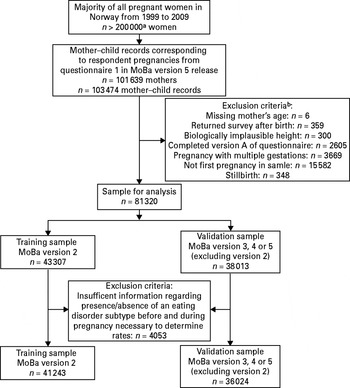
This study is nested within the MoBa study, which is conducted by the Norwegian Institute of Public Health (Magnus et al. Reference Magnus, Irgens, Haug, Nystad, Skjaerven and Stoltenberg2006). The total sample comprised 77 267 pregnant women with valid MoBa data (version 5, release May 2010). Participants were split into a ‘training’ sample (n = 41 243) based on participants in the MoBa version 2 dataset (released April 2006) of the original study and a ‘validation’ sample (n = 36 024) comprising individuals in the MoBa version 5 dataset who were not in the original study (Bulik et al. Reference Bulik, Von Holle, Hamer, Knoph Berg, Torgersen, Magnus, Stoltenberg, Siega-Riz, Sullivan and Reichborn-Kjennerud2007) (Fig. 1). The total sample is less than the overall MoBa cohort, as inclusion criteria (below) were necessary to enhance internal validity; participant flow is depicted in Fig. 1. The split approximately halved the cohort across time, creating in essence a temporal validation. It should also be noted that the ‘training’ sample and the ‘validation’ sample are recruited from overlapping but to some extent different parts of the total population of Norway.
Participant flow to achieve final analysis sample. MoBa, The Norwegian Mother and Child Cohort Study. a Extrapolated from the reported 38.5% participation rate (http://www.fhi.no). b Criteria not mutually exclusive.

The Medical Birth Registry of Norway (MBRN) monitors trends in birth and administrates a complete nationwide registry with consecutive registration of all births with gestational age >16 weeks since 1967; notification of births to MBRN is compulsory for physicians and midwives. MoBa is a nationwide prospective population-based pregnancy cohort study that recruited pregnant women via postal invitation before an ultrasound appointment in week 17–18 of pregnancy in Norway between 1999 and 2009 (Magnus et al. Reference Magnus, Irgens, Haug, Nystad, Skjaerven and Stoltenberg2006), and 38.5% of invited women consented to participate (http://www.fhi.no/moba-en). The cohort now includes 108 000 children, 90 700 mothers and 71 500 fathers. Approval for this research was granted by appropriate regional committees, the Norwegian Data Inspectorate and the Institutional Review Board of the University of North Carolina at Chapel Hill.
Inclusion criteria for this study were women with a first pregnancy during the study period, singleton birth and live birth. Exclusion criteria were a missing pregnancy identification number precluding data linking, completion of the pilot version of the questionnaire, weight <30 or >300 kg before and during pregnancy, height <1 m, women who returned the MoBa survey after birth, missing responses precluding assessment of eating disorder caseness, and a missing age value.
Measures
The MoBa questionnaire 1 (http://www.fhi.no/dokumenter/1f32a49514.pdf) contained items on eating disorders and behaviors that were previously used for studies of eating disorders in the Norwegian Institute of Public Health Twin Panel (Harris et al. Reference Harris, Magnus and Tambs2002; Reichborn-Kjennerud et al. Reference Reichborn-Kjennerud, Bulik, Kendler, Røysamb, Maes, Tambs and Harris2003, 2004a, b). Items were designed to operationalize Diagnostic and Statistical Manual of Mental Disorders, fourth edition (DSM-IV) criteria for AN, BN and EDNOS (APA, 1994). Questions for binge eating addressed eating an unusually large amount of food with an accompanying sense of loss of control and respondents were instructed to distinguish between pregnancy-related nausea and vomiting and self-induced vomiting as a compensatory method. Respondents included in this study completed questionnaire 1 at a median of 17.1 weeks gestation (interquartile range 15.9–18.9 weeks and range 4.0–42.1 weeks).
Eating disorder classifications
Algorithms in the original study (Bulik et al. Reference Bulik, Von Holle, Hamer, Knoph Berg, Torgersen, Magnus, Stoltenberg, Siega-Riz, Sullivan and Reichborn-Kjennerud2007) constructed from questionnaire 1 items were used to define eating disorder diagnoses: broadly defined AN, defined as meeting DSM-IV criteria for AN [with the exception of amenorrhea and also endorsing a body mass index (BMI) <19.0 kg/m2 at the time of low weight]; broadly defined BN (endorsing at least weekly frequency of binge eating and purging and categorized as BN any type, BN purging type, BN non-purging type); broadly defined BED (binge eating at least weekly in the absence of compensatory behaviors); and EDNOS-P (purging at least weekly in the absence of binge eating). Due to practical difficulties in determining low weight in the presence of pregnancy-related weight gain, AN was assessed prior to pregnancy only. BN, BED and EDNOS-P were assessed for both 6 months prior to pregnancy (retrospective assessment) and at the time of survey completion. Self-reported weight and height were used to calculate BMI pre-pregnancy and BMI at the time of assessment.
Diagnostic classifications pre-pregnancy comprised the categories of AN, BN purging type, BN non-purging type, BN any type, BED, EDNOS-P, and ‘missing’. These classifications were also applied during pregnancy, with the exception of AN due to the difficulties noted earlier.
If an individual had a missing response on one criterion but scored positively on all other criteria for a diagnosis, a classification of ‘missing’ was assigned; otherwise, no eating disorder was indicated. The BN any type includes BN purging and non-purging types as well as an additional category of people; this category was assigned when individuals met criteria for BN including endorsing non-purging compensatory behaviors (i.e. fasting and exercise) but had missing values for the purging items (i.e. laxatives and self-induced vomiting).
Definition of remission, incidence and continuation
Remission described individuals who experienced an eating disorder pre-pregnancy and had no eating disorder during pregnancy. For BN, remission described an absence of both binge eating and compensatory behaviors during pregnancy. Partial remission pertained to individuals with BN pre-pregnancy who reported ongoing binge eating but the absence of compensatory behaviors during pregnancy. Continuation described individuals who presented with the same eating disorder pre- and during pregnancy. Incidence referred to onset of a broadly defined eating disorder when none was present in the 6 months prior to pregnancy.
Statistical analysis
We used two different methods to internally validate the statistical models used in the original analysis. The first method is model calibration, which provides information regarding accuracy of the predicted rates from the ‘training’ sample. The second method is the bootstrap estimate of bias, which indicates whether estimates from the entire version 5 dataset differ from the true population estimates. Given that the MoBa dataset does not include the entire population of Norwegian pregnancies between 1999 and 2009, estimate bias in the models is possible. In the original study (Bulik et al. Reference Bulik, Von Holle, Hamer, Knoph Berg, Torgersen, Magnus, Stoltenberg, Siega-Riz, Sullivan and Reichborn-Kjennerud2007) regression models estimated rates of eating disorder remission, continuation and incidence during pregnancy by diagnosis type; also, measures of association between sociodemographic measures and BED incidence were defined and discussed.
The split samples were used to calculate calibration statistics (Steyerberg et al. Reference Steyerberg, Borsboom, van Houwelingen, Eijkemans and Habbema2004; Steyerberg, Reference Steyerberg2009). The calibration method is a multi-step procedure estimating the degree to which parameter estimates from a ‘training’ sample predict observed values in the ‘validation’ sample. Regression coefficients are first estimated using the original models with the ‘training’ data. Next, a linear combination of those coefficients and any relevant covariables from the ‘validation’ dataset – the linear predictor – comprise the only covariate in the final calibration model with response values from the ‘validation’ dataset. Considering the specification of generalized linear regression models, an offset is also used with the linear predictor. For an intercept-only calibration, the updated alpha (α:intercept) should approximate zero in the final model, thus providing evidence that the outcome value as predicted by the ‘training’ sample is no different from the observed response value from the ‘validation’ sample. For measures of rates, the α:intercept is reported for unadjusted results. Age-adjusted results in the original paper are a product of combinations of model coefficients and not eligible for the calibration procedure. For measures of association between sociodemographic variables and outcomes βoverall is reported, which ideally should approximate 1 in the final model. The unreliability U statistic and Brier score, as described in Steyerberg (Reference Steyerberg, Borsboom, van Houwelingen, Eijkemans and Habbema2004), indicate a measure of the overall model performance and miscalibration, respectively, in the context of the split sample validation design. The Brier score and U statistic approximate zero if updated estimates provide good fit. Simulations prior to calibration determined that a sample size of at least 500 was required to obtain at least 80% power to detect a 20% difference in rates from models using the proposed validation method (i.e. calibration α statistically significantly different from zero). BED is the only eating disorder that meets this sample size criterion, thus any failure to find a difference would be worthwhile noting for this particular eating disorder only.
A final measure of internal validity, the bootstrap estimate of bias (Efron & Tibshirani, Reference Efron and Tibshirani1993; Good, Reference Good2006), was applied to estimated rates for all eating disorder subtypes. The bootstrap sampling method generates samples with replacement from the original sample. We generated 1000 bootstrap samples and obtained model parameters from each sample. Rate estimates across the 1000 samples were averaged to obtain the mean, and the standard deviation of estimates was used to form the 95% confidence intervals (CIs) of the bootstrapped mean estimate. Estimate bias calculations are described; these are the original estimated mean in the observed sample subtracted from the bootstrap mean. A positive bias indicates that the original estimate is underestimating the true population value; conversely, a negative estimate indicates overestimation of the parameter. Bias much greater than the standard error of the estimated mean may indicate poor estimation (Efron & Tibshirani, Reference Efron and Tibshirani1993).
It should be noted that the models for EDNOS-P did not converge in more than 60% of the samples for the continuation and remission rates because of sparse cell counts. Incidence models frequently did not converge for BN purging and BN non-purging groups (68% and 38%, respectively). It should be noted that lack of convergence in this situation leaves at most 62% of the replications to form the estimated rates in the bootstrap estimate for those groups. The lack of convergence precluded any specification for the aforementioned combination of outcomes and groups in estimates presented in Table 6.
Data analysis was based on version 5 of the quality-assured MoBa data file released for research in 2010. The number of respondents in the ‘training’ sample from the MoBa version 5 dataset does not identically match those from the original version 2 dataset (Bulik et al. Reference Bulik, Von Holle, Hamer, Knoph Berg, Torgersen, Magnus, Stoltenberg, Siega-Riz, Sullivan and Reichborn-Kjennerud2007). There were >1900 pregnancy identification numbers not linked to a unique maternal identification number in the version 2 dataset, precluding identification of singleton births for these pregnancies; hence, these mothers were not incorporated into the original study sample.
Results
Sample demographics
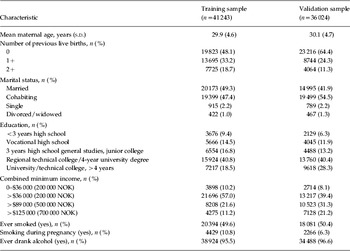
Table 1 presents the sociodemographic composition of the ‘training’ and ‘validation’ samples. The ‘validation’ sample appears to represent a more advantaged group with close to 10-point higher proportions with >4 years of university education and the two highest income thresholds, and had elevated primiparity (64.4 v. 48.1%) and cohabitation (54.5 v. 47.4%).
Sociodemographic characteristics of women in the MoBa ‘training’ and ‘validation’ samples

MoBa, Norwegian Mother and Child Cohort Study; s.d., standard deviation; NOK, Norwegian kroner.
Eating disorder prevalence
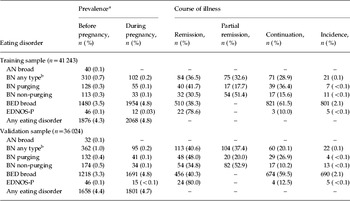
The prevalence of eating disorders before and during pregnancy, and frequencies of remission, incidence and continuation are shown in Table 2. In the 6 months before pregnancy, the prevalence ranged from 0.1% for AN to 3.5% for broad BED across both the ‘training’ and ‘validation’ samples. In both samples, the most common course of illness was continuation for BED (training: 62%, validation: 60%, total (data not shown): 61%), remission and/or partial remission for BN (training: 69%, validation: 78%, total: 74%) and remission for EDNOS-P (training: 79%, validation: 80%, total: 79%). Eating disorders during pregnancy were relatively common (occurring in one in every 21 women), and these were primarily BED (one in 23 women).
Prevalence and course of illness of broadly defined eating disorders during pregnancy in a Norwegian population-based pregnancy cohort (MoBa)

MoBa, Norwegian Mother and Child Cohort Study; AN, anorexia nervosa; BN, bulimia nervosa; BED, binge eating disorder; EDNOS-P, eating disorder not otherwise specified-purging disorder.
a Prevalence was determined from the full sample with 81 320 observations prior to exclusions regarding existent status before and during pregnancy required for rate calculation.
b BN any type includes BN purging, BN non-purging, and individuals who could not reliably be categorized as BN purging or non-purging due to missing data.
Remission, continuation and incidence
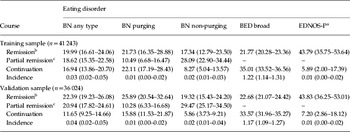
Table 3 shows age-adjusted rates of remission, incidence and continuation by sample across eating disorder subtypes. The remission rate was highest for EDNOS-P, followed by broad BED, and BN in both the ‘training’ and ‘validation’ samples. The incidence rate was highest for broad BED, at 1.22 (95% CI 1.14–1.31) and 1.17 (95% CI 1.09–1.27) per 1000 person-weeks for the ‘training’ and ‘validation’ samples, respectively.
Age-adjusted rates of remission, continuation and incidence of eating disorders in pregnancy in a Norwegian population-based pregnancy cohort (MoBa)

Data are given as per 1000 person-weeks (95% confidence interval).
MoBa, Norwegian Mother and Child Cohort Study; BN, bulimia nervosa; BED, binge eating disorder; EDNOS-P, eating disorder not otherwise specified-purging disorder.
a EDNOS-P rates, BN purging incidence, and BN non-purging incidence and continuation calculations except for BED were not age-adjusted due to small sample size.
b Remission indicates rate of no eating disorder at time of survey completion during pregnancy.
c Partial remission in BN indicates absence of compensatory behaviors during early pregnancy.
Validation models
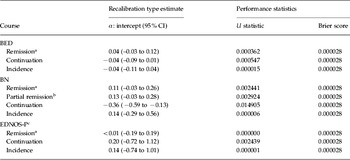
The validation analysis quantified differences between the split samples by comparing the observed rates in the ‘validation’ sample with the predicted rates from the ‘training’ sample (Table 4). A positive α estimate in the calibration model indicates that the observed rate in the ‘validation’ sample is higher than the predicted rate from the ‘training’ sample. For example, the α for BED remission was 0.04 (95% CI −0.03 to 0.12), indicating that the observed rate in the ‘validation’ sample was 4% higher than the rate in the ‘training’ sample. According to the calibration estimates for BED (see Table 4), the ‘validation’ sample had higher rates of favorable outcomes (remission) and lower rates of unfavorable outcomes (continuation and incidence) relative to the ‘training’ sample. The effects were mixed for BN (lower continuation rates and higher incidence in the ‘validation’ sample) and opposite effects were observed for EDNOS-P. All CIs spanned zero, with one exception for BN continuation, thus inferring no statistically significant differences in predicted and observed rates. Brier scores and U statistics were close to zero, indicating good model performance. Overall, the rate models were well calibrated and internally valid, as hypothesized (see Table 4).
Recalibration estimates and performance statistics for the recalibrated rate models of remission, continuation and incidence of eating disorders during pregnancy in a Norwegian population-based pregnancy cohort (MoBa)

MoBa, Norwegian Mother and Child Cohort Study; CI, confidence interval; BED, binge eating disorder; BN, bulimia nervosa; EDNOS-P, eating disorder not otherwise specified-purging disorder.
a Remission indicates rate of no eating disorder at time of survey completion during pregnancy.
b Partial remission in BN indicates absence of compensatory behaviors during early pregnancy.
c EDNOS-P and incidence calculations except for BED were not age-adjusted due to small sample size.
Characteristics associated with incidence
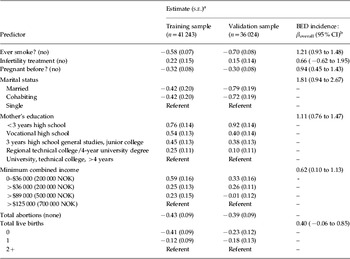
Exploratory analysis in the original paper (Bulik et al. Reference Bulik, Von Holle, Hamer, Knoph Berg, Torgersen, Magnus, Stoltenberg, Siega-Riz, Sullivan and Reichborn-Kjennerud2007) included measures of association between sociodemographic predictors and BED incidence. These measures were estimated for the ‘training’ and ‘validation’ samples and the differences between those estimates quantified (Table 5). The differences are not inconsequential as they exceed a 20% difference in the ‘validation’ v. the ‘training’ sample for half of the predictors including ‘ever smoke?’ (21% higher), ‘infertility treatment’ (34% lower), ‘minimum combined income’ (38% lower) and ‘total live births’ (60% lower). All 95% CIs for the βoverall estimate span 1, discounting any evidence that estimates from the ‘validation’ sample differ from the ‘training’ sample; there is one exception, which is ‘total live births’. The ‘validation’ sample indicates a 60% lower estimated association (βoverall 0.40, 95% CI −0.06 to 0.85) with incidence in the ‘validation’ sample than predictions based on the ‘training’ sample. In the ‘validation’ sample the estimates indicate lower incidence for the nulliparous relative to women with two or more live births, and the strength of that association is about half that of the ‘training’ sample (−0.23 v. −0.41).
BED incidence rates by sociodemographic characteristics

BED, Binge eating disorder; s.e., standard error; CI, confidence interval; NOK, Norwegian kroner.
a The two left columns show Poisson regression parameter estimates indicating the natural log of ratio of incidence rates for the predictor versus the referent in the ‘training’ and ‘validation’ samples.
b Calibration estimates for univariate models with ‘validation’ versus ‘training’ sample data predicting BED incidence by sociodemographic characteristics.
Bias estimates of rates from sample
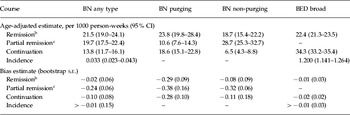
The bootstrap age-adjusted estimates of remission, continuation and incidence are shown in Table 6 with bias estimates (original estimated mean in the total dataset subtracted from the bootstrap mean). Negative bias suggests that the total MoBa cohort rate estimate is larger in the sample than a rate obtained from the entire population, and vice versa for positive bias estimates. Bias in almost all cases was negative. However, for some groups the standard errors were similar to the size of the bias, indicating substantial variability and little evidence to distinguish from a bias estimate of zero. Some exceptions were for remission bias estimates indicating evidence for upward bias in the MoBa cohort (i.e. overestimation), for example for BN purging (−0.29, s.e. = 0.09). For continuation, mostly negative bias estimates exceed the standard error for BN any type (−0.10, s.e. = 0.08) and BN purging (−0.28, s.e. = 0.10). There is no evidence for substantial bias for any incidence estimates as the bias is <0.01 and standard errors exceed the estimated bias.
Bootstrap age-adjusted rates of remission, continuation and incidence of eating disorders during pregnancy in a Norwegian population-based pregnancy cohort (MoBa)a

MoBa, Norwegian Mother and Child Cohort Study; BN, bulimia nervosa; BED, binge eating disorder; CI, confidence interval; s.e., standard error; EDNOS-P, eating disorder not otherwise specified-purging disorder.
a EDNOS-P and incidence calculations for BN purging and BN non-purging were not included because models did not converge for >30% of all the samples. Incidence calculations for BN any type were not age-adjusted due to small sample size.
b Remission indicates rate of no eating disorder at time of survey completion during pregnancy.
c Partial remission in BN indicates absence of compensatory behaviors during early pregnancy.
Discussion
Updating previously published models of remission, continuation and incidence of eating disorders in pregnancy established by our group (Bulik et al. Reference Bulik, Von Holle, Hamer, Knoph Berg, Torgersen, Magnus, Stoltenberg, Siega-Riz, Sullivan and Reichborn-Kjennerud2007) with a ‘validation’ sample via a parsimonious calibration approach indicates validity of the original predictions. With only one exception, all observed rates in the ‘validation’ sample did not differ from predicted rates in the ‘training’ sample. This was consistent with our expectations, given evidence of stable prevalence of eating disorders in Norwegian adults (Zachrisson et al. Reference Zachrisson, Vedul-Kjelsås, Götestam and Mykletun2008). Of note is that in spite of changes to the characteristics of the cohort over time (e.g. socio-economic status, primiparity, cohabitation), the basic findings of the original study were unchanged, providing evidence of generalizability. In estimates of bias, the story is mixed, with consistent negative bias suggesting more extreme estimates in the MoBa cohort than what might be found in the population. However, variability around these estimates does not provide conclusive evidence supporting this result. Lastly, validation of the exploratory aims estimating associations between sociodemographic predictors and BED incidence did not reveal significant departure from original estimates, but did indicate a level of variability around those estimates.
While validation was the focus of this study, some general findings are worthy of discussion. The prevalence of broadly defined eating disorders during pregnancy in the ‘validation’ sample was 4.7%, comparable with the prevalence estimate of 4.8% in the approximate first half of the MoBa cohort, as shown in the present and our previous study (Bulik et al. Reference Bulik, Von Holle, Hamer, Knoph Berg, Torgersen, Magnus, Stoltenberg, Siega-Riz, Sullivan and Reichborn-Kjennerud2007). These are likely to underestimate the true population prevalence given that other poorly defined EDNOS presentations could not be captured by the self-report methodology. The observed prevalence in this study is higher than the 0.5% prevalence of self-reported recent history of eating disorders in a UK pregnancy cohort (n = 12 254) (Micali et al. Reference Micali, Treasure and Simonoff2007a) and the point prevalence of 3.8–4.0% in the Norwegian adult female population (Götestam & Agras, Reference Götestam and Agras1995; Zachrisson et al. Reference Zachrisson, Vedul-Kjelsås, Götestam and Mykletun2008); the difference is probably explained by the lowering of binge/purge thresholds from ≤2 per week to ≤1 per week in the MoBa studies, the less strict weight criterion for AN in the MoBA studies, and the inclusion of AN and BN only and use of a single-item self-report in Micali et al. (Reference Micali, Simonoff and Treasure2007a). The lowered binge/purge thresholds are commensurate with those proposed for the fifth edition of DSM (DSM-5). The prevalence of eating disorders in this study, and eating disorder behaviors more generally among pregnant women, is alarmingly high; previous research shows that binge eating occurs among 17–44%, self-induced vomiting for weight control in 1–2%, and dieting in 3–37% (Fairburn & Welch, Reference Fairburn and Welch1990; Abraham et al. Reference Abraham, King and Llewellyn-Jones1994; Soares et al. Reference Soares, Nunes, Schmidt, Giacomello, Manzolli, Camey, Buss, Drehmer, Melere, Hoffman, Ozcariz, Manenti, Pinheiro and Duncan2009). The morbidity, heightened risk of birth complications and negative neonatal outcomes associated with eating disorders (Bulik et al. Reference Bulik, Sullivan, Fear, Pickering and Dawn1999; Sollid et al. Reference Sollid, Wisborg, Hjort and Secher2004; Micali et al. Reference Micali, Simonoff and Treasure2007b) make identification of eating pathology imperative.
Fewer than half of obstetricians/gynecologists (ob/gyn) assess eating disorder history, body image concerns, and eating disorder behaviors, despite assessing related constructs of body weight, BMI, exercise and dietary practices (Leddy et al. Reference Leddy, Jones, Morgan and Schulkin2009). Lack of training in identification of signs and symptoms, a perception that assessment falls outside the scope of practice, and lack of awareness of the consequences of eating disorders in pregnancy may explain this (Leddy et al. Reference Leddy, Jones, Morgan and Schulkin2009). Nevertheless, vigilance for potential signs and symptoms can be easily incorporated into routine ob/gyn practice, via screening questions posed to the individual and through assiduity to selected anthropometric, biochemical, dietary intake and clinical data, such as reproductive history (Nickols-Richardson, Reference Nickols-Richardson, Lammi-Keefe, Couch and Philipson2008).
Pregnancy appears to be a vulnerability window for the onset of some eating disorders, consistent with the findings of our former study (Bulik et al. Reference Bulik, Von Holle, Hamer, Knoph Berg, Torgersen, Magnus, Stoltenberg, Siega-Riz, Sullivan and Reichborn-Kjennerud2007) and case reports (Tiller & Treasure, Reference Tiller and Treasure1998). As found in Bulik et al. (Reference Bulik, Von Holle, Hamer, Knoph Berg, Torgersen, Magnus, Stoltenberg, Siega-Riz, Sullivan and Reichborn-Kjennerud2007), onset cases generally comprised BED, while BN and EDNOS-P onset was rare. Specific physical and psychological factors have a conjectured role in eating disorder onset during pregnancy (Tiller & Treasure, Reference Tiller and Treasure1998; Knoph Berg et al. Reference Knoph Berg, Bulik, Von Holle, Torgersen, Hamer, Sullivan and Reichborn-Kjennerud2008). For BED onset specifically, low maternal education, low combined income, a native language other than the official country language, lifetime adversities, anxiety and depression, low social support and weight concerns are putative vulnerability factors (Knoph Berg et al. Reference Knoph Berg, Bulik, Von Holle, Torgersen, Hamer, Sullivan and Reichborn-Kjennerud2011). Given that we are not well informed about BED prevention and that pregnancy is a risk period for mental illnesses (e.g. depression), attention to broad mental health-promoting mechanisms is advisable. Healthcare providers can help with social support, skills to manage stress, body image issues, and anxiety and depression. Moreover, given documented differences in nutrition during pregnancy in women with BED (Siega-Riz et al. Reference Siega-Riz, Haugen, Meltzer, Von Holle, Hamer, Torgersen, Knopf-Berg, Reichborn-Kjennerud and Bulik2008), nutritional counseling may play a valuable role in ensuring healthy balanced nutrition throughout pregnancy and the subsequent lactation period.
Of those with BN pre-pregnancy, 74% met criteria for remission or partial remission in early pregnancy. Improvement in binge–purge behaviors during pregnancy has been noted elsewhere (Lacey & Smith, Reference Lacey and Smith1987; Crow et al. Reference Crow, Keel, Thuras and Mitchell2004), along with a reduction in general health-risk behaviors, such as alcohol, tobacco and other drug use (Crow et al. Reference Crow, Keel, Thuras and Mitchell2004). Maternal desire for healthy fetal development appears to motivate behavioral change during pregnancy (Lemberg & Phillips, Reference Lemberg and Phillips1989). Previous studies have suggested that cognitive symptoms of BN (i.e. body dissatisfaction, weight concern) remain problematic or worsen during pregnancy (Crow et al. Reference Crow, Keel, Thuras and Mitchell2004; Micali et al. Reference Micali, Simonoff and Treasure2007a), even in the context of decreasing binge–purge, restricting and health-risk behaviors (Lemberg & Phillips, Reference Lemberg and Phillips1989; Crow et al. Reference Crow, Keel, Thuras and Mitchell2004) and binge–purge symptoms may return after childbirth (Crow et al. Reference Crow, Agras, Crosby, Halmi and Mitchell2008). Pregnancy potentially offers a window to neutralize barriers to help-seeking (e.g. shame, ambivalence about treatment) and enhance engagement in treatment.
This study has several limitations. First, low power to detect differences in outcomes for the BN and EDNOS-P groups is a significant limitation. However, given the dearth of data on the course of eating disorders during pregnancy, a decision was made to report all relevant information. Second, diagnostic measures involved self-report rather than clinical diagnostic interview, a practical preclusion due to the size of the sample; additionally the measure has not been psychometrically validated, but is based on DSM criteria. Third, the diagnostic criteria do not correspond directly to DSM-IV and may in fact be closer to DSM-5. Fourth, the overall prevalence of broadly defined eating disorders is conservative, given that the assessment of AN during pregnancy is methodologically compromised due to inability to assess the weight criterion; hence the prevalence of AN during pregnancy did not contribute to the overall prevalence estimate. Further, EDNOS generally is a heterogeneous and poorly defined diagnostic category. Although some broadly agreed presentations such as BED, EDNOS-P and subthreshold AN and BN were captured within this study, it was not possible to capture undefined presentations with the self-report method; hence, the observed overall prevalence of eating disorders probably underestimates the true population prevalence. Fifth, there may be selection bias in the recruitment into MoBa. The prevalences of eating disorder and eating disorder subtypes may differ between MoBa participants and the general Norwegian pregnant population, potentially influencing remission, continuation and incidence rates during pregnancy. Lastly, we make the assumption here that eating disorder rates remain the same over time and we have temporal validation. However, it could be the case that the validation models are spurious and there is a change over time paired with a bad model predictive ability, but, there is no way to confirm this.
The high prevalence of broadly defined eating disorders (primarily BED) among one in every 21 pregnant women and association between maternal eating disorders and birth complications (Bulik et al. Reference Bulik, Sullivan, Fear, Pickering and Dawn1999; Sollid et al. Reference Sollid, Wisborg, Hjort and Secher2004; Micali et al. Reference Micali, Simonoff and Treasure2007b) underscore the need for detection and treatment of eating disorders during pregnancy. Physicians, midwives and healthcare professionals play an important role in optimizing maternal and birth outcomes; therefore, knowledge of the potential serious consequences of eating disorders coupled with identification and management strategies are vital.
Acknowledgements
The Norwegian Mother and Child Cohort Study (MoBa; den norske Mor & barn-undersøkelsen) is supported by the Norwegian Ministry of Health and the Ministry of Education and Research, National Institutes of Health (NIH)/National Institute of Environmental Health Sciences (contract no NO-ES-75558), NIH/National Institute of Neurological Disorders and Stroke (grant no. 1 UO1 NS 047537-01), and the Norwegian Research Council FUGE (grant no. 151918/S10). We are grateful to all the participating families in Norway who take part in this ongoing cohort study.
Declaration of Interest
None.