Background
More than 85 per cent of North Americans age 65 and older report having at least one chronic condition (Buckwalter, Saltzman, & Brown, Reference Buckwalter, Saltzman and Brown2004). The nature of chronic illness as long-term, incurable conditions with potentially controllable symptoms that wax and wane necessitates patient self-management in the home environment, while remaining embedded within the context of the formal health care system. Most “sufferers” interact with health professionals for diagnosis, treatment prescription, evaluation, and monitoring. However, the individual balances the symptoms and consequences of the condition with the functional needs and priorities of daily life. Many individuals express the desire to maintain control over their health and view medicines – typically used in home and community settings – as a resource to achieve this goal (Lumme-Sandt & Virtanen, Reference Lumme-Sandt and Virtanen2002; Pound et al., Reference Pound, Britten, Morgan, Yardley, Pope and Daker-White2005).
This article describes our study in which we examined medicine use as self-reported by a cohort of older community-dwelling Canadians living with a specific chronic condition, osteoarthritis (OA), and discuss possible explanations for observed variations. The most common form of arthritis, OA is a disease primarily of middle or older age (Buckwalter et al., Reference Buckwalter, Saltzman and Brown2004), and affects approximately three million Canadians (Health Canada, 2003). Although the impact in terms of mortality is lower than other diseases such as cardiovascular disease and cancer, OA imposes a substantial burden to individuals, families, and society because of the associated long-term morbidity and disability (Health Canada, 2003). Treatment goals are to reduce symptoms, maintain or improve joint function, prevent or limit functional impairment, and maintain or improve overall quality of life (Bijlsma, Reference Bijlsma2002; Zhang et al., Reference Zhang, Moskowitz, Nuki, Abramson, Altman and Arden2008). Medication use is a central component of symptom management, specifically the use of oral analgesics including acetaminophen, non-steroidal anti-inflammatory drugs (NSAIDs), and opioids (Zhang et al., Reference Zhang, Moskowitz, Nuki, Abramson, Altman and Arden2007, Reference Zhang, Moskowitz, Nuki, Abramson, Altman and Arden2008, Reference Zhang, Nuki, Moskowitz, Abramson, Altman and Arden2010).
Practice guidelines recommend acetaminophen as the initial drug treatment for the management of mild to moderate OA-related pain (Zhang et al., Reference Zhang, Moskowitz, Nuki, Abramson, Altman and Arden2007, Reference Zhang, Moskowitz, Nuki, Abramson, Altman and Arden2008, Reference Zhang, Nuki, Moskowitz, Abramson, Altman and Arden2010). Acetaminophen – which can be purchased without a prescription at low cost – is associated with few adverse effects, drug-drug interactions or contraindications and is generally regarded by patients and health professionals as a “safe” medication (Courtney & Doherty, Reference Courtney and Doherty2002). Non-steroidal anti-inflammatory drugs (NSAIDs) are recommended when pain relief from acetaminophen is inadequate (Zhang et al., Reference Zhang, Moskowitz, Nuki, Abramson, Altman and Arden2008). Most NSAIDs are available by prescription only, although some low-dose preparations of ibuprofen and naproxen are available over the counter. NSAIDs are associated with substantial adverse effects such as gastropathy, including bleeding and perforated ulcers (Schlansky & Hwang, Reference Schlansky and Hwang2009; Wolfe, Lichtenstein, & Singh, Reference Wolfe, Lichtenstein and Singh1999) and dose-dependent renal toxicity (Sturmer, Elseviers, & De Broe, Reference Sturmer, Elseviers and De Broe2001). Concurrent use of certain drugs (e.g., angiotensin-converting enzyme inhibitors used to manage cardiovascular disease) increases the risk of serious adverse effects (Bouvy, Heerdink, Leufkens, & Hoes, Reference Bouvy, Heerdink, Leufkens and Hoes2003). Opioids (e.g., codeine, morphine, and acetaminophen combined with codeine) are potent analgesics and generally require physician prescription. Opioids are associated with multiple adverse effects including respiratory depression, nausea, constipation, dizziness, and sedation (Podichetty, Mazanec, & Biscup, Reference Podichetty, Mazanec and Biscup2003).
Advancing age may heighten safety concerns regarding the use of NSAIDs and opioids. Age-related physiological changes such as changes in renal function may render older persons more likely to experience serious adverse effects associated with the NSAIDs (Abernethy, Reference Abernethy1999; Griffin, Yared, & Ray, Reference Griffin, Yared and Ray2000; Langman, Reference Langman2003). Furthermore, the consequences of adverse effects may be particularly severe among elderly patients; for example, opioid-related dizziness may increase the risk of falling and hip fracture (Shumway-Cook, Ciol, Gruber, & Robinson, Reference Shumway-Cook, Ciol, Gruber and Robinson2005).
Gender may also be associated with differences in the pharmacological management of OA-related symptoms. A substantial body of literature suggests gender-based variation in health help-seeking and health care utilization (Green & Pope, Reference Green and Pope1999), in disease management (Arber et al., Reference Arber, McKinlay, Adams, Marceau, Link and O’Donnell2006; Borkhoff et al., Reference Borkhoff, Hawker, Kreder, Glazier, Mahomed and Wright2008; Fowler et al., Reference Fowler, Sabur, Li, Juurlink, Pinto and Hladunewich2007; Hawker et al., Reference Hawker, Wright, Coyte, Williams, Harvey and Glazier2000), and in interactions with health professionals (Foss & Sundby, Reference Foss and Sundby2003). Further, some research suggests that women are viewed as entering middle and old age at an earlier chronological age than men and that they experience more negative social consequences of age-related physical changes (Ellis & Morrison, Reference Ellis and Morrison2005; Sontag, Reference Sontag and Pearsall1997). A health professional’s decisions about optimal treatment of “old women” and “old men” may vary accordingly, irrespective of observable signs and symptoms of disease. In addition, women’s differential response to the symptoms of OA and their health help-seeking may result in different medical management strategies for women as compared to men.
In summary, the options for OA treatment require that effectiveness be balanced against drug safety, particularly in the context of co-morbid chronic conditions and heightened age-related risk. We hypothesize that the pharmacological management of OA – that is, likelihood of use of acetaminophen, NSAIDs, and opioid analgesics – is further differentiated by age and gender, when controlling for (a) severity of OA-related symptoms, (b) co-occurring chronic conditions, (c) self-rated health, (d) patient educational level, (e) social support availability, and (f) access and frequency of contact with a physician.
Methods and Materials
Data Source and Study Population
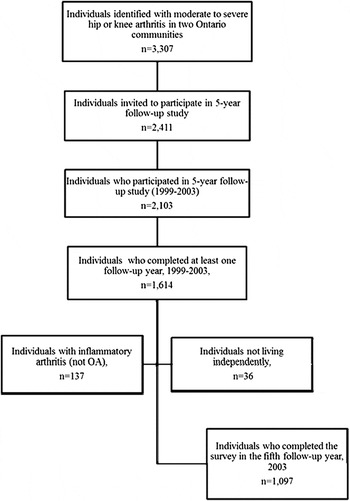
Analyses are based on data from Phase IV (1999–2003) of the Ontario Osteoarthritis Cohort Study: The Study of Arthritis in Your Community. The study design and recruitment strategy for this prospective, population-based cohort study are detailed elsewhere (Hawker et al., Reference Hawker, Wright, Coyte, Williams, Harvey and Glazier2000). The recruitment strategy established a cohort of 2,411 persons aged 55 and older with disabling hip or knee arthritis living in two Canadian communities: one urban (metropolitan Toronto) and one rural (in southwestern Ontario) (Hawker et al., Reference Hawker, Wright, Coyte, Williams, Harvey and Glazier2000). In 1999, these people were invited to participate in a five-year follow-up study (Hawker et al., Reference Hawker, Wright, Coyte, Williams, Harvey and Glazier2000). This article presents data from the fifth follow-up year (2003) including a sample of 1,097 individuals. Figure 1 presents a flow chart illustrating the construction of the study sample.
Flow chart illustrating the construction of the study population

Dependent Variables
Participants were surveyed regarding their use of medications to manage their OA symptoms. The interviewer read a list of OA-related drugs (plain acetaminophen; opioids, e.g., codeine; non-selective NSAIDs, e.g., diclofenac; Cox-2 inhibitor NSAIDs, e.g., celecoxib; ASA; glucosamine; and corticosteroids [intra-articular or oral]), and asked about current use. Individuals were defined as taking a particular drug if they responded positively to this question.
Independent Variables
The independent variables of primary interest were age and gender.Reference Abernethy1 Respondent age was categorized into two age groups (younger than 75 years, and 75 years and older) for descriptive purposes. In addition, a linear transformation of the continuous age variable was created (age minus 60), such that “age” indicated number of years over 60, and included in the multivariate regression models.
Arthritis symptoms and disability (pain and functional status) were assessed using the Western Ontario and McMaster Universities Osteoarthritis Index (WOMAC), with higher scores indicating higher levels of pain and disability (Bellamy et al., Reference Bellamy, Buchanan, Goldsmith, Campbell and Stitt1988).Reference Arber, McKinlay, Adams, Marceau, Link and O’Donnell2 For these analyses, we considered the pain and physical function components of the WOMAC separately to assess the independent and relative effect of each component on the dependent variables (i.e., the use of each drug type).
Information was collected regarding the number and specific type of chronic conditions, in addition to OA, for which the participants were receiving treatment or had consulted a physician during the past year. For these analyses, the reported number of co-morbid chronic conditions was categorized into: none, one, and two or more. In the fourth follow-up year (2002), participants were asked whether they consulted a general practitioner or a specialist (rheumatologist, orthopedic surgeon, or other specialist) for their OA and the number of annual visits to each physician type. A summary variable indicating the total number of annual visits to any physician was created on the basis of answers to the latter set of questions.
Participants were surveyed at cohort inception regarding their highest level of education attained and at each study year regarding living arrangement (alone vs. with others). For these analyses, education was defined as a dichotomous variable (less than completed high school vs. at least completed high school). The Gignac coping efficacy scale (Gignac, Cott, & Badley, Reference Gignac, Cott and Badley2000) was administered in 2003. This three-item, five-point Likert-type scale is designed to measure an individual’s perception of his or her ability to manage the symptoms and consequences of their condition, including pain, day-to-day problems, and emotional aspects.
Statistical Analyses
We generated descriptive statistics for the total sample, for women and men, for the two age groups, and for the two groups that did not complete the survey in 2003. Differences by gender and age group, and between participants who completed versus those who did not complete the survey in 2003,Reference Ballantyne, Gignac and Hawker3 were examined using chi-square tests for categorical variables, and independent t-tests and ANOVA tests as appropriate for continuous variables.
The effects of age and gender, and the relative effects of OA-severity and the other co-variates, were examined by fitting a series of binary logistic regression models for each dependent variable (i.e., acetaminophen, opioids, and NSAIDs). Age, sex, and the interaction term “age X sex” were the co-variates of primary interest for these analyses. The other independent variables were organized into a series of contextual blocks: OA severity (pain and disability scores) and use of the other drugs; medical context (the number of other chronic conditions and the number of physician visits); and social context (education, living arrangement, and coping efficacy score). Reference Bellamy, Buchanan, Goldsmith, Campbell and Stitt4 The blocks of co-variates were entered hierarchically into the model, with age and sex in the first block, followed by the “age X sex” term and then the subsequent blocks of co-variates. The “age X sex” term was significant for acetaminophen only, and was excluded for NSAIDs and opioids. The interaction term was interpreted according to published guidelines (Jaccard, Reference Jaccard2001). Missing data (n = 83) reduced the sample size for the logistic regression models to 1,016. Analyses were performed using SPSS Version 15.0 (SPSS Inc., Chicago, IL).
We hypothesized that the likelihood of use of each of the three medication types would be positively associated with arthritis severity as measured by the WOMAC pain and WOMAC physical function scales. We further hypothesized that after we adjusted for the disease context (i.e., arthritis severity), age and gender would impact medication use such that:
1. Acetaminophen use would be
a. positively associated with age, and
b. positively associated with female sex.Reference Bijlsma5
2. NSAID and opioid use would be
c. negatively associated with age.
Results
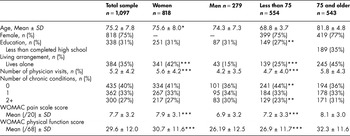
The demographic, medical, and social profiles of the total sample, by gender and by age (less than 75 and 75 and older) are shown in Table 1. Consistent with the demographic profile of advanced OA, the majority of participants were women. Compared with male participants, female cohort members were somewhat older, more likely to live alone, and reported, on average, higher levels of OA-related pain and disability. There were no statistically significant differences by sex in the number of co-morbid conditions. Women and men were similarly likely to report consulting a physician regarding their OA-related symptoms, but women reported on average, more physician visits. Compared with younger participants, a larger percentage of those aged 75 and older lived alone, reported the lowest level of education, and reported having two or more chronic conditions in addition to OA. The oldest participants reported, on average, higher pain and disability scores.
Descriptive statistics for independent variables by sex and age group (less than 75 years and 75 years and older)

* p < .05; ** p < .01; *** p < .001 indicates statistically significant difference by gender or age group.
SD = standard deviation
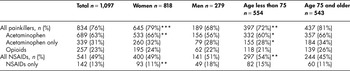
The medication use profiles of the total sample, by gender, and by age are shown in Table 2. Two thirds of participants reported taking acetaminophen and about one third (31%) reported exclusive use of this medication. Respectively, one half and one quarter of participants reported taking NSAIDs and opioids. More women than men reported taking any painkiller – in particular, acetaminophen. There was no statistically significant difference by sex in the use of opioids or any NSAID, although more women than men reported exclusive NSAID use. Compared with younger participants, a larger proportion of those aged 75 and older reported taking any painkiller, whereas a smaller proportion reported NSAID use.
Frequency and percentage of use of OA-related medications in 2003 for the total sample, and by gender and by age

* p < .05; ** p < .01; *** p < .001 indicates statistically significant difference by gender or age group, two-tailed.
Logistic Regression
Acetaminophen
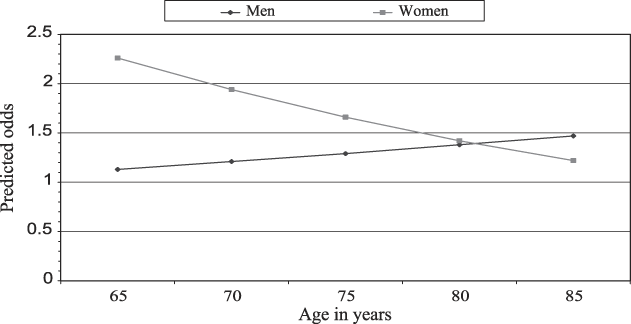
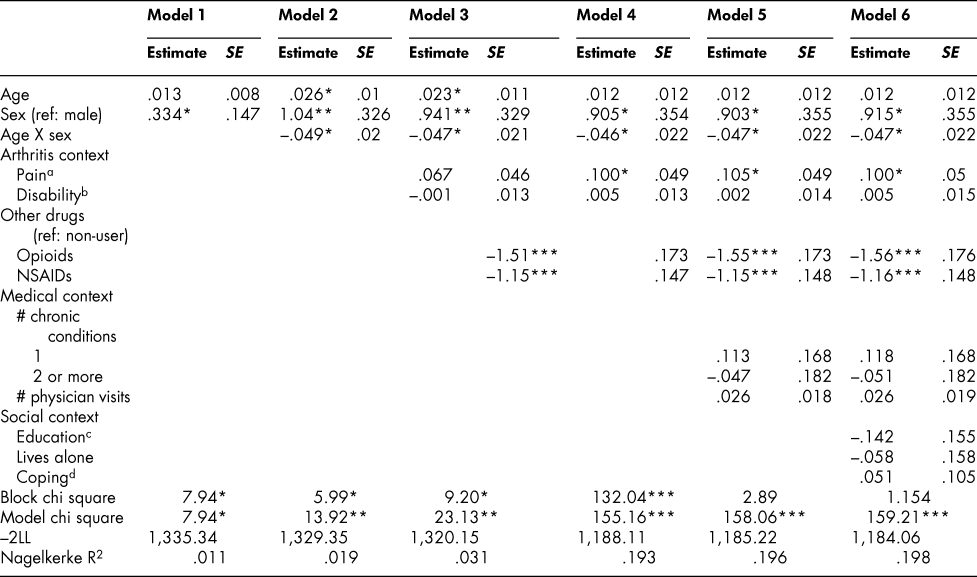
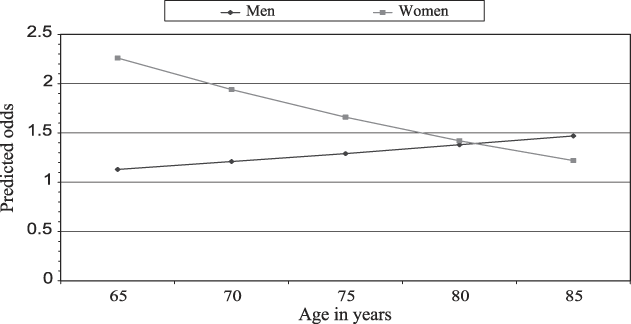
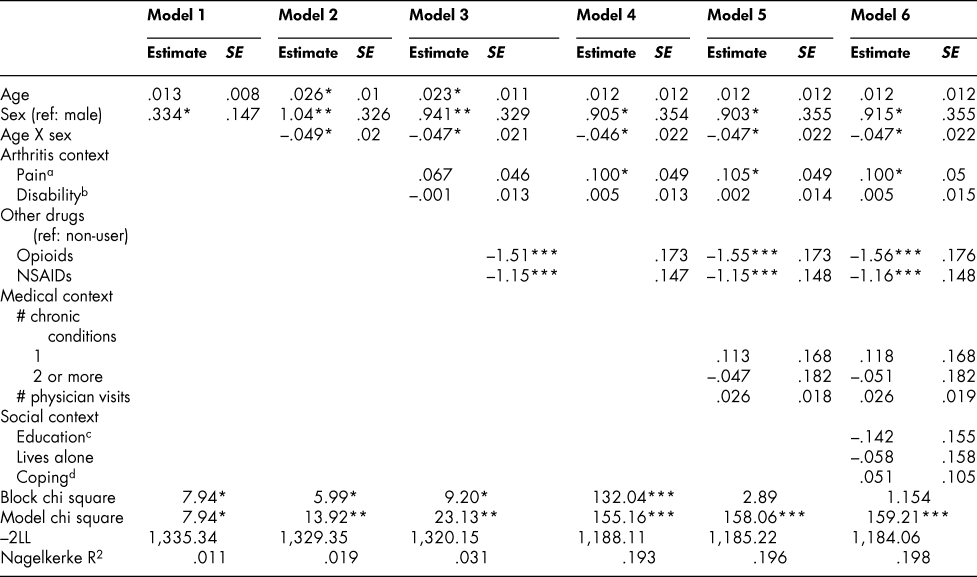
Table 3 demonstrates the effect of adding successive blocks on the relationship between age and sex on likelihood of acetaminophen use. Women were more likely than were men to report acetaminophen use, but this effect varied with age. The effect of being female compared to being male on increasing the likelihood of taking acetaminophen decreased by about 5 per cent every year of age older than 60 years, ( = –.047, p = .036). Figure 2 illustrates the effect of age and sex on the likelihood of taking acetaminophen and demonstrates that at ages younger than 80 years, women are more likely than men to take acetaminophen.Reference Bijlsma5 This effect is consistent regardless of use of the other drugs.
The effect of age and sex on likelihood of taking acetaminophen
The likelihood of reporting acetaminophen use was positively associated with OA-related pain and negatively associated with use of opioids and NSAIDs. An increase of one unit on the WOMAC pain scale was associated with an increased likelihood of taking acetaminophen of 1.105 ( = .100, p = .044). Compared with non-users, those who reported taking opioids were about 80 per cent less likely to report taking acetaminophen (
 = –1.56, p < .001) and those who reported NSAID use were about 70 per cent less likely to report acetaminophen use (
 = –1.16, p < .001).
Logistic regression model examining the effect of age and sex on likelihood of taking acetaminophen, adjusting for arthritis severity, including use of other drugs; medical context; and social context
a Womac pain scale score
b Womac physical function scale score
c reference: less than completed high school
d Gignac coping scale score
* p < .05; ** p < .01; *** p < .001, 2-tailed
–2LL = –2 Log Likelihood
SE = standard error
Opioids
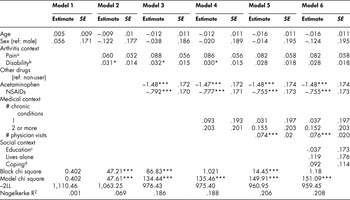
Table 4 demonstrates the effect of adding successive blocks on the relationship between age and sex and likelihood of opioid use. Neither age nor sex was significantly associated with likelihood of taking opioids. The likelihood of opioid use was positively associated with the number of physician visits and negatively associated with acetaminophen and NSAID use. Likelihood of opioid use increased by a factor of 1.08 for every physician visit ( = .076, p < .001). Compared with non-users, acetaminophen users were almost 80 per cent less likely to take opioids (
 = –1.48, p < .001); NSAID users were about half as likely to take opioids (
 = –.755, p < .001).
Adjusting for all co-variates, the likelihood of opioid use was not significantly associated with either measure of OA severity. However, opioid use was positively associated with the WOMAC physical function scale score before adjusting for physician visits ( = .030, p = .028) and the addition of the pain and physical function scale scores contributed significantly to model fit (χ2 = 47.21, df = 2, p < .001). The pain and the physical function scores contributed significantly to the variance explained when entered independently into the model (data not shown), but only the physical function score retained statistical significance (until adjusting for physician contact) when both measures were included in the model.
Logistic regression model examining the effect of age and sex on likelihood of taking opioids, adjusting for arthritis severity, including use of other drugs; medical context; and social context

a Womac pain scale score
b Womac physical function scale score
c reference is less than completed high school
d Gignac coping scale score
* p < .05; ** p < .01; *** p < .001, 2-tailed
–2LL = –2 Log Likelihood
SE = standard error
Non-steroidal Anti-inflammatory Drugs
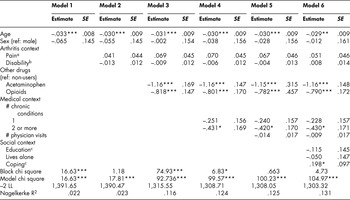
Table 5 demonstrates the effect of the addition of successive blocks on the relationship between age and gender and likelihood of NSAID use. Adjusting for all other co-variates, the likelihood of taking NSAIDs was negatively associated with increasing age; each year of age greater than age 60 was associated with a decrease in the likelihood of taking NSAIDS of about three per cent ( = –.029, p = .002). Gender was not significantly associated with likelihood of taking NSAIDs.
The likelihood of taking NSAIDs was negatively associated with the presence of two or more chronic conditions and with the use of the other two drugs. Participants who reported two or more conditions were about one third less likely to report NSAID use than those with no co-morbid conditions ( = –.430, p = .012). Compared with non-users, acetaminophen users were about 70 per cent less likely to report NSAID use (
 = –1.16, p < .001) and opioid users were about one half as likely to take NSAIDs (
 = –.790, p < .001).
The likelihood of NSAID use was positively associated with the perception of ability to cope with OA-related symptoms, as measured by the Gignac coping scale. The odds of taking NSAIDs increased by a factor of 1.22 ( = .198, p = .042) for each unit on the Gignac coping scale.
The likelihood of NSAID use was not significantly associated with either measure of arthritis severity. The addition of the WOMAC pain and WOMAC physical function scale scores did not significantly contribute to model fit (model χ2 = 1.18, df = 2, p = .555).
Logistic regression models evaluating the effect of age and sex on likelihood of taking NSAIDs, adjusting for arthritis severity, including use of other drugs, medical context, and social context

a Womac pain scale score
b Womac physical function scale score
c reference is less than completed high school
d Gignac coping scale score
* p < .05; ** p < .01; *** p < .001, 2-tailed
–2LL = –2 Log Likelihood
SE = standard error
Discussion
The objectives of this study were to illustrate and discuss potential explanations for observed variation in the use of OA-related medicines reported by patients from a community sample. We consider that, given the different prescription status or access to acetaminophen, NSAIDS, and opioids, this observed variation reflects decision making by both a patient who can self-manage OA and a health professional – who must consider the relative harms/benefits offered by different medication options for its treatment. We specifically hypothesized that “old age” and gender would be associated with variation in the use of acetaminophen, NSAIDS, and opioids, when disease, medical, and social contexts are accounted for. Our expectations are, generally, borne out in our results.
First, the finding that the level of OA-related pain is associated with use of the non-prescribed acetaminophen, after adjusting for the use of the (usually) prescribed medicines (i.e., opioids and NSAIDs), suggests that some individuals use this potentially self-selected drug to manage symptoms over and above the use of prescribed drugs. This finding also provides evidence that some individuals may seek to gain control of their symptoms by self-managing their treatment using a “safer” alternative to opioids and NSAIDs.
Second, the finding that the presence of two or more co-morbid conditions was associated with decreased likelihood of NSAID use suggests that health professionals seek to balance safety concerns and effective OA symptom management. When prescribing NSAIDS, physicians must take into consideration the evidence concerning NSAID use in the presence of co-morbid conditions and related medications associated with heart disease (Whelton, Reference Whelton1999), hypertension (Pope, Anderson, & Felson, Reference Pope, Anderson and Felson1993), renal disease (Whelton, Reference Whelton1999), and peptic ulcer disease (Lewis et al., Reference Lewis, Langman, Laporte, Matthews, Rawlins and Wiholm2002). Patients may also participate in decision making, choosing the least risky options (including non-treatment) when co-morbid conditions are perceived to be more serious, as found in previous qualitative research (Ballantyne, Gignac, & Hawker, Reference Ballantyne, Gignac and Hawker2007). The finding that use of opioids – considered by patients to be “powerful medicines” (Ballantyne et al., Reference Ballantyne, Gignac and Hawker2007; Sale, Gignac, & Hawker, Reference Sale, Gignac and Hawker2006) but without the contraindications associated with NSAIDs – is not related to the presence of multiple co-morbidities supports the interpretation that physicians’ safety concerns influence the lower rate of NSAID use among persons with multiple co-morbid conditions.
Third, while arthritis severity contributes to the explained variance in opioid use in our data, this relationship becomes non-significant with the addition of the number of physician visits, and the likelihood of use increases with each additional physician visit. These findings suggest that there is a threshold of pain and disability beyond which individuals seek expert care and is consistent with the views expressed by many individuals with chronic illness that they rely on health professionals when their problems exceed their ability to self-manage (Lumme-Sandt & Virtanen, Reference Lumme-Sandt and Virtanen2002). Having sought physician assistance, the frequency of contact determines the likelihood of prescription of the opioid; the more frequent the visits, the more likely it is that the individual reports taking opioids, regardless of the level of pain and disability.
Fourth, our findings offer partial support for the hypothesis that “age matters” with respect to the pharmacological management of OA. After adjusting for other factors, advancing age was associated with a decreased likelihood of taking NSAIDs, suggesting differential drug treatment by age. One explanation is that both physicians and patients view NSAIDs as “unsafe” for use in older persons, based on the belief that advancing age inherently increases the likelihood of experiencing drug-related adverse effects. That the age effect is independent of the presence of additional chronic conditions, with the consequent concerns and contraindications, suggests that some safety concerns are related to advancing age, regardless of the level of therapeutic burden.
The absence of an age effect for opioid use suggests that age is not salient for concerns regarding opioid-related problems. One interpretation is that opioids and NSAIDs are viewed differently. Opioids (analgesics) may be seen as a resource to manage pain, whereas NSAIDs may be understood as “treatment” of arthritic joints; it may be seen to be reasonable and desirable to manage symptoms regardless of age. Further, the harmful effects associated with opioids, including risk of dependence, constipation, and respiratory depression may be understood to be less age dependent than those associated with NSAIDs and the risks manageable by limiting the dose or frequency of opioid use, that is, by restricting use to times of “real need”. On balance, therefore, the risks associated with the opioids may be deemed worthwhile, regardless of patient age.
Fifth, a gender-age relationship is observed in our findings. Specifically, age is associated with acetaminophen use, but in the context of gender. Until about age 80, women are more likely than are men to manage their symptoms with acetaminophen, either alone or in combination with prescribed medicines. That is, at ages younger than about 80, exclusive acetaminophen users and those who supplement NSAIDs or opioids with acetaminophen are more likely to be women than to be men. Whether the individual chooses to use acetaminophen based on self-monitoring alone, or on physician recommendation remains unclear; however, that this relationship persists regardless of the number of physician visits implies that frequency of physician contact does not affect whether or not the individual uses acetaminophen.
This finding may reflect women’s greater involvement in health surveillance, care, and professional help-seeking than men’s, as is documented in the literature (Green & Pope, Reference Green and Pope1999; O’Brien, Hunt, & Hart, Reference O’Brien, Hunt and Hart2005; Tudiver & Talbot, Reference Tudiver and Talbot1999; van Wijk & Kolk, Reference van Wijk and Kolk1997). Alternatively, this finding may reflect the gendered nature of “aging”, in particular, that the narrative characterizing old age as synonymous with natural decline and increasing frailty is applied differentially to women and men. Women may be perceived by others – including health professionals – and may perceive themselves to be “old” at younger ages than men (Arber et al., Reference Arber, McKinlay, Adams, Marceau, Link and O’Donnell2006; Sontag, Reference Sontag and Pearsall1997). Therefore, the strictures around medicine use among older persons may be deemed relevant at a younger age for women than for men; thus, women and their physicians may rely on the “safer” alternative, acetaminophen, either alone or to supplement lower doses of riskier NSAIDs and opioids.
There are some limitations to this study. Most importantly, this study was based on survey-derived data, not in-depth interviews. While we theorize the decision-making process related to medicine use, we acknowledge that we cannot determine an individual’s motivations for these decisions, or fully understand the complex negotiations that may take place during this process. Second, the analyses are based on a particular cohort of individuals living in the Canadian province of Ontario where residents age 65 and older have universal access to prescription drug coverage and physician care, and may not be applicable to populations living in jurisdictions where access to both medicines and physicians is limited by costs. Furthermore, even within Ontario and other Canadian provinces with similar policies, individuals living in remote areas may have limited access to medical care, and the conclusions drawn from this study’s population may not be applicable to populations in more remote and rural areas.
Finally, medicine-use profiles for OA patients in the study are incomplete. For example, dose information was not collected; therefore, it was not possible to determine whether individuals were taking adequate doses of their OA medicines or whether they were rationing medicines. Information was not collected regarding the use of other medicines that might be taken to manage chronic pain, such as low-dose anti-depressants or anti-epileptic agents (Dworkin et al., Reference Dworkin, O’Connor, Backonja, Farrar, Finnerup and Jensen2007); therefore, we may not have a complete picture of all the prescription medicines used to manage chronic pain in this population. In addition, information was only collected for OA-related medicines; therefore, we do not have data regarding drugs used to manage other chronic conditions that might present specific contraindications to NSAID use.
These limitations notwithstanding, we conclude that our findings illustrate the medication options that are available to older adults with OA and their health care providers, and demonstrate that individuals and their health care providers exercise discretion regarding these choices. In particular, the relationship between higher OA-related pain and use of the non-prescribed acetaminophen, after adjusting for use of physician-mediated NSAIDs and opioids, can be interpreted as suggesting that individuals seek to self-manage their symptoms. The findings also demonstrate that factors other than the severity of disease-related symptoms are related to variations in medicine use in this population. In particular, age and age in the context of gender appear to be important for medication-related decision making.