


Introduction
Cognitive behavioural therapy (CBT) is recommended for psychosis as highlighted in the National Institute of Clinical Excellence guidelines (NICE, Reference Meyer, Miller, Metzger and Borkovec2014). This usually takes the form of one-to-one sessions, the aims of which can be defined as ‘reducing distress, increasing confidence and reengaging in activity … initially the therapist and patient develop a shared understanding, with the focus on what is maintaining the current problems and what can immediately be changed … the clinician plays a collaborative role: drawing up a list of goals with the patient’ (Freeman, Reference Freeman, Dunn, Startup, Pugh, Cordwell, Mander, Cernis, Wingham, Shirvell and Kingdon2013). Historically this intervention has used psychological models that inform and illustrate our understanding of the development of psychosis and the maintenance of its symptoms, e.g. Morrison (Reference Jacobson and Truax2001). In more recent years, research has begun to dismantle the umbrella term of ‘psychosis’ into specific problems: Freeman (Reference Isham, Grafahrend, Nickless, Pugh, Pleasants, Smedley, Freeman and Mulligan2016) argues that experiences such as grandiosity, hearing voices and paranoia are different from one another, with different causes. Thus the focus has shifted to considering these as individual experiences rather than symptoms of psychosis, and as such more targeted models and interventions are beginning to be developed. Of note is the work of Freeman (Reference Isham, Grafahrend, Nickless, Pugh, Pleasants, Smedley, Freeman and Mulligan2016), who has researched the maintenance factors involved in persecutory delusions, one of which is worry.
Research has shown that the majority of those with persecutory delusions have levels of worry that are similar to those with generalized anxiety disorder (GAD) (Startup et al., Reference Mundt, Marks, Shear and Greist2007), and high worry predicts greater paranoia in both those with psychosis and the general population (Freeman et al., Reference Freeman2012; Startup et al., Reference Mundt, Marks, Shear and Greist2007). Worry is believed to be linked to persecutory delusions as it ‘brings implausible fearful ideas to mind, keeps them there, and exacerbates the distress’ (Freeman, Reference Isham, Grafahrend, Nickless, Pugh, Pleasants, Smedley, Freeman and Mulligan2016, p. 687). The relationship is also likely to work both ways with greater paranoia also increasing levels of worry (Freeman, Reference Isham, Grafahrend, Nickless, Pugh, Pleasants, Smedley, Freeman and Mulligan2016).
In the Worry Intervention Trial (WIT), Freeman et al. (Reference de Souza Costa and De Paula2015) investigated whether using CBT to reduce worry would also reduce persecutory delusions in patients with psychotic disorders. They conducted a parallel, single-blind, randomized controlled trial (RCT). They randomly assigned 150 eligible participants to either a 6-session, one-to-one worry-reduction CBT intervention completed over 8 weeks added to standard care, or standard care alone. They concluded that long-standing delusions were significantly reduced by a brief intervention targeting worry.
Evidence from the Hearing Voices Groups movement suggests that there is value in the shared experience of attending a group and being in a safe context in which to share experiences (Ruddle et al., Reference Morrison2011). In a recent feasibility study, Isham et al. (Reference Green, Freeman, Kuipers and Bebbington2018) assigned 13 participants to an 8-week worry group or a control. They adapted the manual from the WIT trial (Freeman et al., Reference de Souza Costa and De Paula2015) to a group format, and concluded that the group was feasible and showed positive outcomes in worry; however, there were no changes in paranoia and outcomes in delusional beliefs were not maintained at follow-up. They suggest that the effects are perhaps not as strong as in one-to-one interventions. However, it is important to note that this was a feasibility study and was not statistically powered to detect changes.
The current study aimed to build on the evidence of the effectiveness of targeting worry in paranoia from the WIT trial, and see whether it is feasible and acceptable for this to be delivered in a group format. A secondary aim is to look at potential impact on symptoms, functioning and quality of life.
Method
Design
This study was a feasibility and acceptability study; as part of this a preliminary case series was used. National Health Service (NHS) ethics approval was not needed as this was evaluating routine clinical practice; approval was granted by the trust service evaluation and audit team. Measures were completed as part of routine clinical practice for the group being evaluated and all participants gave written consent for their data to be used anonymously for this service evaluation and were deemed by their clinician to have capacity to give informed consent.
Setting
The group was delivered within a NHS community mental health team (CMHT) for adults with severe and enduring mental health problems and the Early Intervention in Psychosis (EIP) team. The psychosis treatment pathway offers evidence-based interventions in a one-to-one and family setting. The group was developed and facilitated by a CBT Therapist (L.W.) and Clinical Psychologist (H.C.), both of whom have specialist CBT training and experience in working with people with psychosis, including training on the delivery of a worry intervention for paranoia.
Intervention
A 7-week programme was developed following the components and structure reported in the WIT trial (e.g. understanding, overcoming and staying ahead of worry). One component of the original WIT manual, Emotional Processing and Metacognitive Awareness, was omitted as it was not included in the pilot by Isham et al. (Reference Green, Freeman, Kuipers and Bebbington2018) and was felt by the current facilitators that it would take too long and not work well in a group format. The WIT manual was given to each group member. Each session lasted two hours, with a short break half way through. It followed the following format: homework, check-in from last week, main topic of the session, homework setting and considering barriers to practice/homework. A brief telephone call was made to each participant every week between group sessions to check in with homework and address any arising issues.
Procedure
Participants were referred by the CMHT and EIP teams. The inclusion criteria were: a primary diagnosis of psychosis with evidence of persecutory beliefs and significant worry. Specific examples of worry and the impact on function were given in the assessment; however, no standardized measure was used for screening.
Exclusion criteria were: a primary diagnosis of personality disorder, and current alcohol or substance dependency. Each suitable participant was seen by one of the facilitators for a pre-group assessment to discuss practicalities and assess their ability to attend and participate in the group. Eligible participants met one of the researchers who were separate from the facilitators to complete consent forms and pre-group, post- and follow-up questionnaires.
Participants were asked to complete an evaluation feedback form at the end of the group. This was anonymous: participants did not have to put their name on it and they gave the form back to a researcher who did not facilitate the group. This consisted of two Likert scales to rate how helpful they found the worry group and how easy it was to follow what was being discussed (see Appendix 1). Free text boxes were presented for the following questions:
What was the most helpful part about the group?
What could we improve about the group?
How did you find talking about worry and paranoia in a group with other people?
Is there anything else you want to say?
Participants were offered £10 per time point to cover their expenses. The following data are from the first two of these groups that were run.
Measures
The following measures were administered pre-, post- and at 3-month follow-up (Cronbach’s alpha for current sample pre-group are given).
Psychotic-Symptoms Rating Scale (PSYRATS) – Delusion scale
(Haddock et al., Reference Fresco, Mennin, Heimberg and Turk1999) This is a 6-item clinician-rated measure of severity of delusional beliefs via categories such as ‘Disruption to life caused by beliefs’; α = .74.
Penn State Worry Questionnaire (PSWQ)
(Meye et al., Reference Isham, Grafahrend, Nickless, Pugh, Pleasants, Smedley, Freeman and Mulligan1990) This is a 16-item self-report measure of intensity, duration and distress associated with worry such as ‘My worries overwhelm me’; α = .90.
Green et al. Paranoid Thoughts Scale (GPTS)
(Green et al., Reference Freeman, Dunn, Startup, Pugh, Cordwell, Mander, Cernis, Wingham, Shirvell and Kingdon2008) This is a 32-item self-report measure of two dimensions of paranoid thinking: social reference and social persecution. An example item is ‘People have been checking up on me’; α = .95
Choice of outcome in CBT for psychoses – short form (CHOICE)
(Greenwood et al., Reference Freeman, Stahl, McManus, Meltzer, Brugha, Wiles and Bebbington2010) This is an 11-item self-report measure developed to ask people what they want to address in CBT for psychosis, for example ‘Positive ways of relating to people’; α = .92.
Work and Social Adjustment Scale (WSAS)
(Mund et al., Reference Keetharuth, Brazier, Connell, Bjorner, Carlton, Taylor Buch, Rickets, McKendrick, Browne, Croudace and Barkham2002) This is a 5-item self-report measure asking people how their problems affect their daily functioning such as work and leisure, etc. Example questions include ‘Because of my problem my home management is impaired’; α = .57.
The Recovering Quality of Life (REQOL) – 10 item version
(Keetharuth et al., Reference Haddock, McCarron, Tarrier, Faragher and Tarrier2018) This is a self-report measure that assesses the quality of life for people with a range of mental health problems. Questions include ‘I felt hopeful about my future’; α = .89
Participant characteristics
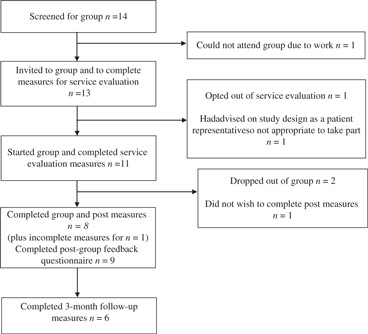
Figure 1 displays a flow diagram of the recruitment of participants into the study. Fourteen people were initially screened for the group of whom eleven started the group and completed pre questionnaires. Of these, eight then completed the group and post measures and six completed follow-up measures. Two of the participants (both of whom completed the group) were also undergoing one-to-one CBT for psychosis at the same time as attending the group. A further one completer started the assessment/formulation stage of therapy in between post-group and follow-up measures being completed.
Flow diagram of participation in group

Of the 11 participants who took part in the group and service evaluation, two participants were under the EIP service. The group was 73% female (n = 8), ages ranged from 17 to 60 years, with a mean age of 46 years. The sample was 90% White ethnicity (n = 10) and 9.1% (n = 1) Asian ethnicity. In terms of diagnosis, four had a diagnosis of schizophrenia, two psychotic depression, two first episode psychosis, one delusional disorder, one schizoaffective disorder and one with a current diagnosis of post-psychotic personality changes and a past diagnosis of schizophrenia. Three of the 11 participants had co-morbid diagnosis of personality disorder traits or substance use. Pre-scores on the PSWQ ranged from 41 to 77 out of 80, and 5/8 participants scored above the cut-off of 65 recommended for detecting GAD (Fresco et al., Reference Fresco, Mennin, Heimberg and Turk2003).
Statistical analysis
The only missing data were for the CHOICE, where two questions were missing for one individual each. For these the mode response for that measure for that client was used and the total scale score was calculated as normal. The sample size was too small for statistics such as t-tests or a multiple analysis of variance to detect changes in measures from pre-therapy to post-therapy. The Reliable Change Index (RCI) (Jacobson and Truax, Reference Greenwood, Sweeney, Williams, Garety, Kuipers, Scott and Peters1991) is useful with small sample sizes as it looks at individual changes in scores (Zahra and Hedge, 2010). The RCI is calculated by dividing the changes in scores by the standardized difference (in this case calculated using the standard deviation and Cronbach’s alpha in the current sample pre-group); this then gives a change score needed to reach corresponding to a standardized z-score of less than –1.96 or above 1.96 of which less than 5% would be likely to occur by chance and therefore likely represents a reliable change rather than error (de Souza Costa and De Paula, Reference Freeman2015). An online calculator was used for the current study (https://www.psychoutcomes.org/OutcomesMeasurement/ReliableChangeIndex).
Results
Group attendance
Of the 11 participants who took part in the service evaluation and started the group, two dropped out of the group. One of these attended two of the first three sessions and then no further sessions. The group facilitators reported that they were highly anxious in the first session and said they felt daunted by the homework and being called in between sessions. In another session they appeared distracted, and they then went abroad for several weeks. The second participant who dropped out attended the first two sessions and then no further sessions. The facilitators reported they were highly anxious in the first session and were not able to take in the content; they also reported being physically ill one week.
For the nine participants who completed the group, two attended all seven sessions, five attended 6/7 sessions, one attended 5/7 sessions and one participant attended 4/7 sessions. Thus the mean number of sessions attended for completers was 5.1/7.
Participant feedback
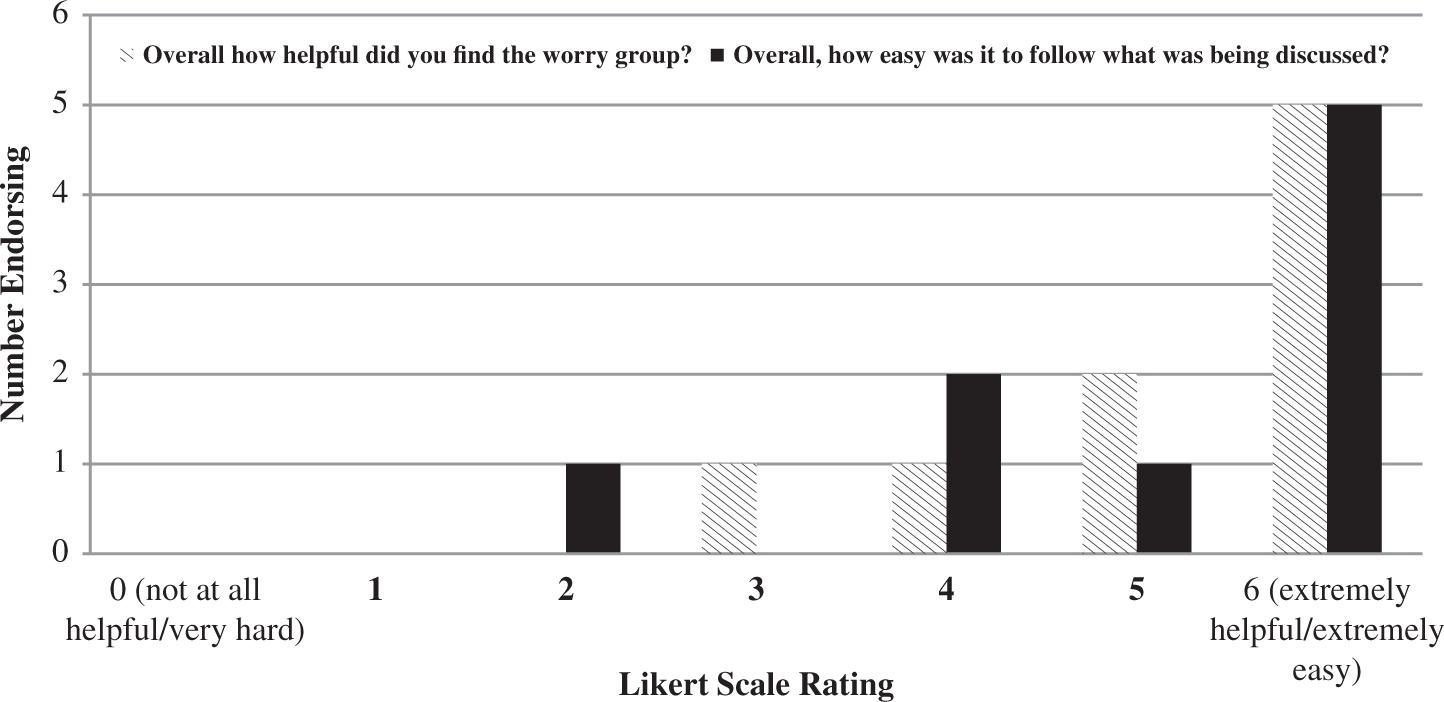
Participants were asked to complete a feedback questionnaire. Figure 2 shows that most participants rated the group as easy to follow and helpful.
Quantitative post-group feedback.

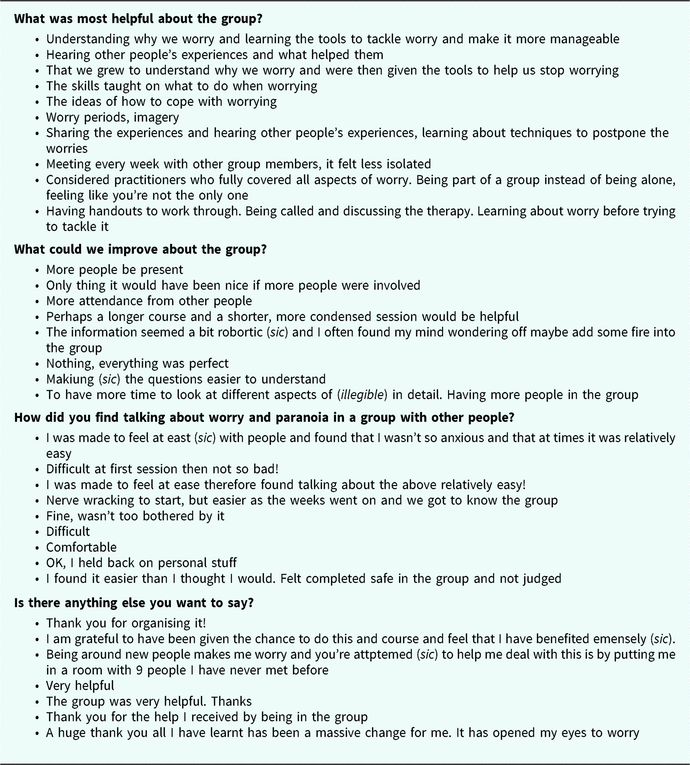
Table 1 displays qualitative feedback from nine participants about what was most helpful about the group, what could be done to improve the group, how they found talking about worry and paranoia with other people in a group, and any other comments. The comments were largely positive, with most saying that learning skills to reduce worry and learning from other people’s experiences was helpful.
Qualitative post-group feedback (exact quotes from the nine participants, each bullet points represents a different participant)

Facilitator feedback on running the group
Informal feedback from the group facilitators was that worry periods were established and worries were able to be postponed for all participants who completed the group. This was done in week 3 (introducing worry periods) and then followed up in week 4 (boosting worry periods). The group problem-solved barriers to worry periods in group discussion. Between-session telephone calls were well received by participants and the facilitators believe they helped keep participants on track and helped with the therapeutic relationship and therefore engagement; they were also used to help check in about worry periods. The facilitators also felt that normalizing the universality of experiences was important, in line with the participant feedback.
Reliable change in scores
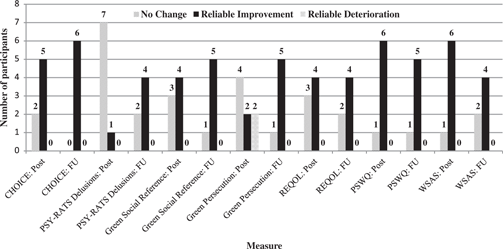
Figure 3 displays the results for the RCI; these compare changes in scores from pre-group to post-group and pre-group to follow-up. This shows there was a reliable change in worry scores (PSWQ) for the majority of completers and just over half of those who started the group, and this was largely maintained at follow-up. Severity of delusional beliefs measured by PSYRATS reduced for only one individual by the end of the group; however, more had improved at follow-up. Overall scores on the Green et al. Paranoia Scale reveal improving gains from end of group to 3-month follow-up. On the social persecution cognitions scale, two individuals initially deteriorated before an improvement at follow-up. In terms of quality of life and daily functioning, there were reliable improvements as measured by the CHOICE, REQOL and WSAS at both post-treatment and follow-up.
Reliable Change Index results post and follow-up for completers.

Discussion
This study aimed to see whether a worry intervention for paranoia is feasible and acceptable when delivered in a group format; a secondary objective was a preliminary test of potential clinical changes via a case series. The findings support the evidence generated by Freeman et al. (Reference de Souza Costa and De Paula2015) in their large-scale RCT using the worry intervention in individual therapy, and tentatively suggest that this intervention is feasible to run in a group setting as evidenced by informal facilitator feedback, positive participant feedback and a relatively low drop-out rate.
There was reliable change in worry scores for the majority of participants and this was largely maintained at follow-up, in line with the findings of the group intervention of Isham et al. (Reference Green, Freeman, Kuipers and Bebbington2018). Severity of delusional beliefs reduced for only one individual at post-treatment although the majority improved at follow-up. In contrast, Isham et al. (Reference Green, Freeman, Kuipers and Bebbington2018) found that delusional beliefs changes were not maintained at follow-up. This difference may be due to the control group in the Isham et al. study compared with a case series here. However, it is important to note that due to the design and small sample size, as well as some participants having one-to-one therapy at the same time, the clinical effectiveness of the group cannot be determined from the current study.
This trend for maintaining or improving on gains from end of group to 3-month follow-up is echoed in the Green Paranoia scale where reliable change increased to follow-up, and indeed for persecution cognitions there was an initial deterioration for two individuals before an improvement at follow-up. This indicates that the gains from the group are perhaps ongoing, and that processing and consolidation of skills learnt continues after the group has finished. It might also be that the nature of the group is essentially exposure, which for some might lead to an initial increase of paranoid cognitions before they start to reduce. There was also reliable change for the CHOICE and REQOL post-treatment follow-up, suggesting that reduction in worry may have led to a wider improvement in quality of life for some. The WSAS also showed improvements, suggesting a positive impact on functioning; however, the internal reliability of this measure appeared to be low in the current sample so the results should be interpreted with caution. Also, as previously stated, the clinical effectiveness is uncertain in the current study.
The drop-out rate was 18% (n = 2), slightly higher than that reported by Freeman et al. (Reference de Souza Costa and De Paula2015) of 9/73 for individual therapy (12%). The current number of sessions attended of 5/7 is comparable to Isham et al. (Reference Green, Freeman, Kuipers and Bebbington2018) who reported an average of 5.7 out of 8 sessions. However a larger sample size is required to fully ascertain levels of drop-out.
Offering the intervention in a group format was considered to be the most helpful aspect of the group by many participants in terms of reducing isolation, learning from others and sharing experiences with others. Four out of the nine also identified that a greater number of participants would have improved the group. The feedback indicated that although several were initially anxious about talking about worry and paranoia in the group, this was not sustained and they became comfortable in the group environment. In fact seven out of the nine respondents did not report any difficulty with this beyond the first session. This may seem counterintuitive given the nature of the client group; however, it suggests that the group environment might be more than just a non-specific effect: it might act as exposure, and a valuable opportunity for members to test out their fears and predictions about being around others.
It is important to note that one participant reported not understanding why the facilitators thought a group would help with paranoia. The group format may have been a factor for those who did not initially engage but there are no data available for this. It is also worth considering that although some participants asked for a larger group at the end of the seven sessions, this may have increased anxiety in the first session and led to higher levels of initial disengagement: the two participants who dropped out appeared to be highly anxious in the first couple of sessions. Thus a group setting may be challenging for some and lead to drop-out. Being able to identify those who are likely to find the group setting hard and help prepare them may improve engagement.
This study is limited by a small sample size and no control group, with mostly White ethnicity. There was also no standardized measure of worry used for screening and thus what constituted a significant worry might have been somewhat subjective and open to the clinicians’ interpretation; however, scores on the PSQ were relatively high with many scoring above the cut-off for GAD. The feedback may be impacted by being paid for participation; however, this feedback was collected independently and anonymously of the group facilitators. Two participants were also undergoing individual CBT whilst attending the group, so the potential clinical improvements for these individuals cannot be attributed solely to the group.
There is also the possibility of non-specific factors such as the effect of peer support here. Future research could compare the effectiveness of a group with an individual worry intervention, and compare individual worry work with group worry work with a non-CBT group intervention to determine the relative contribution of non-specific factors such as social support to outcomes. An RCT is needed to fully assess clinical effectiveness and compare outcomes to treatment as usual. It is also possible that those who did not finish the group or were lost at follow-up might not have benefited so much from the group, thus in future an intent to treat analysis would be necessary. However, this preliminary case series has indicated that delivering worry-based CBT for psychosis as a group is both feasible and acceptable. This may be useful in services as part of a ‘stepped care’ pathway for those with psychosis or as a preliminary intervention for those waiting for one-to-one CBT.
Acknowledgements
Thanks to service users for taking part and for colleagues for referring to the group. Thank you to Emma Perry who assisted in data collection, and Dr Louise Isham who advised on setting up the group. Thank you to the service user representative who helped us plan this study, and to the advice received from Dr Katherine Newman-Taylor of the University of Southampton.
Financial support
This study was supported with funding from a Team Research Award from Health Education England Wessex.
Conflicts of interest
The authors have no conflicts of interest with respect to this publication.
Ethical statement
The authors assert that all procedures contributing to this work comply with the ethical standards of the American Psychological Association. NHS ethics approval was not needed as this was evaluating routine clinical practice; approval was granted by the trust service evaluation and audit team. All participants gave written consent for their data to be used for this service evaluation.
Key practice points
(1) CBT targeting worry may reduce distress in psychosis. Previous research has suggested that this may be feasible in a group format.
(2) The current case series examined feasibility and acceptability and outcomes for 11 participants who attended a worry group.
(3) Drop-out rates were acceptable (2/11).
(4) Qualitative feedback suggested that the group was helpful and that discussing worry about others in a group was beneficial.
(5) The majority of those who completed the group, and just over half of those who started the group, showed reliable improvements in worry which were maintained in follow-up.
(6) There appeared to be improvements in distress and quality of life.
Appendix 1. Feedback form
Evaluation of Worry Group
You do not need to give your name on this form
1) Overall, how helpful did you find the worry group? (Please circle)
0 1 2 3 4 5 6
(0 = not at all helpful 6 = extremely helpful)
2) Overall, how easy was it to follow what was being discussed? (Please circle)
0 1 2 3 4 5 6
(0 = not at all helpful 6 = extremely helpful)
3) What was the most helpful part about the group?

4) What could we improve about the group?
5) How did you find talking about worry and paranoia in a group with other people?
6) Is there anything else you want to say?
Thank you for taking the time to complete this form




Comments
No Comments have been published for this article.