


2.1 Introduction
As artificial intelligence (AI) evolves at an unprecedented pace, the need for effective governance has emerged as a global imperative. This has become particularly pertinent in four legislative orders, the European Union (EU), the United Kingdom (UK), China, and the United States of America (USA); each embodying distinct regulatory philosophies rooted in divergent socio-political values and priorities. These territories are key loci for AI development and leadership, as legal orders across the entire world begin to grapple with the challenges of AI. The regulation of AI is especially critical in the domain of law enforcement, where a complex institutional landscape is increasingly interwoven with data-driven processes (Kreissl and von Laufenberg, Reference Buckley, Arner and Zetzsche2022). Across jurisdictions, law enforcement practices typically centre on suspect identification, future threat assessment, resource allocation, and crime prevention. These aims interconnect a wide range of actors, from forensic specialists and street officers to financial crime investigators and community-based responders, whose work increasingly relies on AI-enabled tools and digital data processing. These practices and actor collaborations reflect a sociotechnical policing system, wherein global AI regulations intersect with organisational routines and structures.
Understanding these developments necessitates an interdisciplinary lens on how regulatory approaches not only reflect geopolitical priorities but also shape justice in digitalised societies. This chapter introduces initial relevant AI regulatory frameworks in the EU, UK, China, and the USA as of April 2025, and their implications for AI-enabled law enforcement tools (Section 2.2). It provides a comparative analysis of nascent regulatory approaches towards the controversial law enforcement solutions of predictive policing, generative AI, facial recognition, and biometrics with a focus on risk and transparency (Section 2.3) and explores the operational challenges to investigative work that impact on law enforcement practices internationally (Section 2.4).
2.2 AI Regulation and Law Enforcement in the EU, the UK, China, and the USA
2.2.1 The EU and UK
The EU is engaged in a comprehensive effort to regulate impactful technologies, covering personal data, AI, digital services, and digital markets. Its approach takes into account both a commitment to safeguarding fundamental rights as well as the promotion of its internal market. Its efforts have global influence, with data protection regulation as far away as Brazil and California taking inspiration from EU legislation. This demonstrates the EU’s capacity to shape international regulatory norms through the extraterritorial impact of its legal standards, the so-called Brussels effect. In contrast, the UK, whilst broadly retaining EU law in relation to data protection following its departure from the EU, has pursued a more flexible, innovation-oriented regulatory model that delegates rule-making authority to sector-specific regulators in relation to AI. Whilst the EU emphasises legal certainty and uniformity across the Union, the UK is taking a different path creating different impacts, including for law enforcement.
Regulation of AI systems for law enforcement use in the EU is primarily shaped by Regulation (EU) 2024/1689 laying down harmonised rules on artificial intelligence, or, as it is more commonly known, the EU AI Act (AIA), which is designed to regulate technological issues, especially those presented by AI and complement the existing data protection legislation (Nash et al., 2024); in the case of processing by police, the Law Enforcement Directive (LED) where processing of personal data is for the ‘prevention, investigation, detection or prosecution of criminal offences’ (Article 1(1), LED). Both pieces of legislation take a risk-based approach. As with the General Data Protection Regulation (GDPR), the LED requires a higher standard of compliance for those processing special category personal data or engaging in high-risk processing (Article 9, GDPR; Article 10, LED). The AIA prohibits systems deemed to present unacceptable risk (Article 5, AIA) and requires conformity assessments of systems presenting high risks (Chapter III, Section 2, AIA).
For law enforcement-related activities, the following are prohibited: the use of AI to predict the risk of criminal offences based solely on personality traits/characteristics without human intervention; untargeted scraping of facial images for facial recognition databases; and real-time biometric identification in public spaces (unless for searching for victims of specified crimes or missing persons, preventing an imminent threat to life or terrorist attack, or localising a suspect for law enforcement purposes) (Article 5, AIA). Under national laws implementing the LED, EU Member States are required to prohibit automated decision-making creating adverse legal effects (unless there are appropriate safeguards provided (Article 11, LED)).
High-risk AI systems in the law enforcement area are specified as: AI systems for assessing the risk of someone becoming a victim of crime; polygraphs or similar tools; AI systems for evaluating the reliability of evidence; AI systems for assessing the risk of (re-)offending not solely on the basis of profiling, or to assess personality traits and characteristics or past criminal behaviour; AI systems for profiling in the course of detecting, investigating, or prosecuting crimes (Annex III (6), AIA). Under the LED, high-risk data processing would require a data protection impact assessment to be conducted (Article 27, LED).
The preambles of both pieces of legislation indicate that they are fundamentally intended to protect people, and their data, from harm whilst enabling commercial gains from AI to be seized. Almeda et al. (Reference Almeda, Garrett and Zuboff2021) note that citizens expect the use of policing technologies to be different according to what is acceptable in different situations. An example of this is seen in the AI Act where real-time remote biometric identification systems are prohibited except in certain circumstances (Article 5, AIA). Yet, as Lynskey (Reference Lynskey2019) notes in relation to data protection legislation, some of the protections can be more illusory than real. As law enforcement interacts with the public in ways that interact with their rights regularly, particular attention should be paid to law enforcement use of AI. This is especially the case where innocent people suspected of a crime could be subject to serious and significant impacts whilst having done nothing wrong.
It is worth noting that the AIA will have effects beyond the EU, including in the UK, for several reasons. First, the AIA has extraterritorial effect (Article 2, AIA) and where, for example, UK police use an AI system in a cross-border investigation and outputs are used within the EU, or there are persons affected by that use of an AI system within the EU, then that use of AI would come under the AIA. Further, the European Committees for Standardisation (CEN) and for Electrotechnical Standardisation (CENELEC) have accepted a request from the European Commission to develop standards supporting the implementation of the AIA. The British Standards Institution remains a member of CEN-CENELEC, and so compliance with the AIA will be integrated into British standards for AI systems (CEN-CENELEC, Reference Aziz and Andriansyah2025). Finally, because of Brexit, Northern Ireland is subject to some EU rules under the Windsor Framework. The EU could propose the AIA applies in Northern Ireland (Article 13(4), European Union and United Kingdom, Reference Bello and Harvey2019). If the UK government agreed to this, then the Police Service of Northern Ireland would be subject to the AIA in its operations.
In contrast to the EU, the UK is prioritising innovation in its approach to AI regulation. Rather than risk-based legislation with specific requirements for different sectors, the UK has developed a principles-based framework that will inform legal compliance across sectors (Department for Science, Innovation and Technology, 2024, para.10). Instead of developing UK AI legislation, the UK’s ninety regulators such as the Information Commissioner’s Office, Ofcom, and the Financial Conduct Authority will be able to provide guidance on AI use within their areas of oversight, with central functions for risk monitoring, coordination, and multi-agency advisory services (Department for Science, Innovation and Technology, 2024, paras.16, 19). As Finocchario (Reference Finocchiaro2024) notes, a sectoral approach has advantages in being able to respond to sector-specific issues and avoid unnecessarily onerous bureaucracy in lower-risk contexts. However, the UK government has been clear that, in relation to general purpose AI models, where compliance with voluntary measures is ineffective or existing legal powers are unsuccessful in dealing with risks and opportunities, targeted legislation could be introduced. For highly capable narrow AI and Agentic AI, the UK government will continue to monitor developments (Department for Science, Innovation and Technology, 2024, paras. 65–67).
With respect to law enforcement, the UK government has praised the Chief Scientific Advisor for Policing’s Covenant for Using AI in Policing. This provides principles for AI users in law enforcement that operationalise them to the UK policing context; for example, the transparency principles show that manufacturers might be required to provide expert evidence in open court (National Police Chiefs’ Council, 2023). However, as the GDPR and LED were brought into UK law prior to Brexit, policing in the UK is subject to substantially the same rules under Part 3 of the Data Protection Act 2018 as EU Member States are in their implementations of the LED. As such, whilst there is no substantive AI legislation covering law enforcement, or any sector, there are relevant data protection provisions that still apply.
2.2.2 China
China has implemented a range of regulations and policies to govern the use of AI, particularly in sensitive domains such as national security and public safety (Roberts et al., Reference Roberts, Cowls, Morley, Taddeo, Wang and Floridi2021). These regulatory frameworks serve China’s endeavours both domestically and internationally. Domestically, these regulations address ethical and security concerns, through mechanisms such as algorithm audits and content moderation (Lucero, Reference Lucero2019). Internationally, these regulations aim to position China as a global leader in AI technology, not only in its development and deployment but also in AI governance, establishing regulatory precedents for other nations (Dorwart et al., Reference Banks2025).
China’s AI regulatory framework is structured on three key pillars. First, existing regulations target specific applications or manifestations of AI technology, such as recommendation algorithms, deep synthesis, and generative AI. The Regulations on the Management of Algorithm Recommendations for Internet Information Services, enacted in March 2022, govern platforms that use recommendation algorithms, such as the social media whose data is often used for investigative purposes. They require algorithm providers to ensure that content aligns with ‘mainstream value orientations’ while preventing the dissemination of politically undesirable content (Sheehan, Reference Sheehan2023). The Administrative Provisions on Deep Synthesis, effective January 2023, target AI-generated synthetic content, including deepfakes, and voice cloning. They mandate that AI-generated content be clearly labelled to distinguish it from non-AI content, that providers take steps to mitigate misuse, and enforce measures to ensure AI-generated material adheres to government policies.
In response to the rise of generative AI technologies, China further introduced the Interim Measures for the Management of Generative AI in August 2023 (China Law Translate, Reference Bag2023). These regulations aim to provide a balance between innovation and security (Article 3) and mandate that generative AI services undergo ex ante security assessments, making China the first country to impose a licensing requirement for such technologies (Zhang, 2024). Concurrently, the regulations impose data privacy protections to regulate the collection and use of training data in AI systems, prevent the creation of discrimination (Article 4, paragraph 2), and safeguard physical and psychological well-being (Article 4, paragraph 4).
Although China has yet to implement AI-specific administrative regulations, two major laws – the Network Data Security Regulation (effective from 1 January 2025) and the Online Protection of Minors Regulation (effective since 1 January 2024) – address key AI-related issues such as data privacy, algorithmic discrimination, cybersecurity, and content moderation. To supplement these overarching frameworks, China adopts a technology-contextual regulatory approach through laws that target specific sectors including finance, biometrics, and autonomous driving to facilitate more adaptive oversight of AI applications (Wang et al., Reference Wang, Zhu, Wang, Di and Zhu2025).
In its second pillar, the government has established specialised regulatory tools, such as algorithm filing requirements and security self-assessments, to monitor AI systems (Dorwart et al., Reference Banks2025). Similar to the algorithm recommendation regulation, deep synthesis and generative AI providers are required to register their products by filing the algorithm with the Cyberspace Administration of China (CAC). The algorithm filing requires a wide range of documents and other information, including basic information for the filing entity, security self-assessments, algorithm mechanism review, technology ethics review, information release review, data security, personal information protection, and emergency response (Dorwart et al., Reference Banks2025). The CAC periodically publishes a list of filed algorithms, but the announcement includes only limited details, such as the name of the algorithm, its intended area of use and primary function, the filing number, and the filing entity. China’s AI filing process appears to address not only the technical and operational dimensions of AI, but also its broader societal implications (Mao and Shi-Kupfer, Reference Mao and Shi-Kupfer2021).
Third, China employs an iterative legislative approach, allowing regulators to refine existing policies in response to emerging AI-related challenges (Zhang, 2024). For example, the Model AI Law (MAIL) proposed by the Chinese Academy of Social Sciences presents an adaptable governance framework for AI in China. It emphasises core values, such as safety, transparency, fairness, and human oversight, and adopts a risk-based ‘negative list’ approach, which imposes strict controls on high-risk AI activities while enabling low-risk innovations to proceed with minimal regulatory interference, aiming to strike a balance between effective oversight and technological development.
In preparing to introduce its Artificial Intelligence Law (Scholarly Draft Proposal), China is expected to unify AI governance under a single regulatory framework. While the details are still under discussion at the time of writing, the draft law proposes a broader definition of AI as ‘technology that utilises computers to simulate human intelligent behaviour for use in prediction, recommendation, decision-making, or content generation, among other specialised or general purposes’ (Article 97). By embracing a more open definition and promoting international cooperation, while ensuring foreign AI services comply with domestic rules (Lucero, Reference Lucero2019), the law seeks to regulate key elements of AI development (e.g. transparency, explainability, intellectual property), safeguard user rights (e.g. fairness), and define developer obligations (e.g. liability, security). It also supports digital literacy, green development, and includes exemptions for scientific research and open-source AI. The draft replaces the negative list with a notification-based system, allowing AI development without pre-approval. Compliance is required only once AI is classified as ‘critical’, promoting early innovation while maintaining safety and accountability through targeted oversight at later stages.
This multi-tiered regulatory structure has significant implications for law enforcement and public security. Prior to the draft AI law, China developed targeted measures for the use of AI in law enforcement, such as the Measures for the Administration of Public Security Organs’ Use of Facial Recognition Technology, which set rules for the collection, storage, and use of facial recognition data, directly impacting the use of AI in policing (Roberts et al., Reference Roberts, Cowls, Morley, Taddeo, Wang and Floridi2021). The 2025 National Security Law further extends provisions affecting the use of AI technologies for national security and public safety. Sector-specific regulations, such as those governing autonomous driving, facial recognition, and genomic research may also influence the use of AI by law enforcement agencies. The draft AI law complements these existing regulations in two ways. First, the definition of AI in the law suggests that crime analytics and relevant AI-enabled law enforcement tools may be included. Second, Article 81 of the draft law explicitly refers to combating crime, emphasising international cooperation in law enforcement and justice, and preventing the misuse of AI technology by terrorist, extremist, and transnational organised crime groups.
This evidence indicates convergence between the AIA and China’s proposed AI regulations in terms of ethical principles and human-centric governance. While interpretations of these principles may differ in each jurisdiction, they both emphasise fairness, transparency, and the protection of individual rights, integrating data protection frameworks into AI oversight. Each regime also mandates security measures, such as audits, vulnerability assessments, and human oversight, adopts a joint AI standards model (Wang et al., Reference Wang, Zhu, Wang, Di and Zhu2025), and addresses cross-border cooperation for combating AI-related crimes and AI-enabled law enforcement. Although the EU adopts a horizontal, risk-based legal framework, China employs a risk-informed approach grounded in administrative guidance. Chinese classifications include prohibited practices and assessments of public opinion impact and social mobilisation capacity. Unlike the EU’s legally binding structure, China’s legal framework consists of non-binding best practices and strategic documents, such as the Ministry of Science and Technology’s code of practice for AI ethics.
2.2.3 The USA
The USA is a global centre of technological innovation, but its moves towards AI regulation have been inconsistent and the prospect of comprehensive national legislation is remote. Consequently, substantial AI policy efforts in the USA have chiefly taken place at the executive and state level. Within Congress, debates on development rules, institutional roles, the funding of research, and the enticement of expertise have accompanied the rising public profile of AI in recent years, with patches of bipartisan agreement on issues such as precluding AI from nuclear warfare decisions (Matthews, Reference Matthews2023). A lack of consensus has nonetheless stymied broader efforts, with pitches such as the Algorithmic Accountability Act (Gongress.Gov, 2023) languishing at committee stage prior to the disruption of administrative turnover. White & Case (2024) stated in December 2024 that 120 bills focused on AI, machine learning, or related issues were under congressional consideration as of the close of that session, when their prospects of passing will have diminished.
A handful of American federal legislation has passed. The most significant is the 2020 National Artificial Intelligence Initiative Act, which coordinated and assigned AI oversight and development throughout federal agencies. This involved the commission of studies, programmes, and committees through bodies like the National Science and Technology Council and Department of Energy, as well as the establishment of a National AI Initiative Office. A similar emphasis is evident in the 2020 AI in Government Act, which mandated the creation of an AI Center of Excellence within the General Services Administration to drive adoption across government. Acknowledgements of the potential of AI for defence and aviation applications were entrenched in the National Defense Authorization Act for Fiscal Year 2019 and the 2024 Federal Aviation Administration Reauthorization Act, respectively, both of which called for reviews of prospective AI opportunities. Also of note is the 2022 CHIPS and Science Act, which aimed to bolster US semiconductor production, science investment, data centre technologies, and AI expertise with around 280 billion USD in new funding (Taylor, 2023), championing American global AI competitiveness (Stanford University Human-Centred Artificial Intelligence, 2022). A final congressional signal came in the closing days of the Biden Administration, when the bipartisan House Task Force on Artificial Intelligence (2024) issued a report on the principles that should underpin further national legislation. Its sixty-six key findings and eighty-five recommendations include seven foundational principles: identify AI issue novelty; promote AI innovation; protect against AI risks and harms; empower government with AI; affirm the use of a sectoral regulatory structure; take an incremental approach; keep humans at the centre of AI policy. These principles tend to prioritise the empowerment of innovation and industry, in a way that is consistent across a piecemeal American regulatory landscape.
Executive Orders (EOs) permit US presidents to redirect the executive branch by fiat, circumventing congressional gridlock to enact change at the price of a volatile federal picture. Donald Trump’s 2019 EO on ‘Maintaining American Leadership in Artificial Intelligence’ proposed five principles, centred around American leadership on technology development, technical standards, workforce training, public trust, and the international promotion of American AI (Executive Office of the President, 2019). Following this, Joe Biden signed an EO on the ‘Safe, Secure, and Trustworthy Development and Use of Artificial Intelligence’ in 2023, which constitutes the most comprehensive AI regulations advanced in the USA and outlined the administration’s stance (Executive Office of the President, 2023). The Order codified earlier guidelines, demanding transparency from AI companies and a raft of standards and measures such as the need to watermark AI-generated content (Ryan-Mosley and Heikkilä, Reference Chugani2023). The Order tasked the National Institute of Standards and Technology to set standards for the testing of accuracy and bias in AI systems but opted for voluntary compliance rather than mandatory adherence. Federal agencies were again directed to develop structures to harness AI, and to safeguard workers’ rights, civil rights, and consumer privacy, while the Trump Order’s calls for global leadership and skills development are reinforced. A returning President Trump revoked the Biden Order, although he spared another relevant Biden EO on AI data centres and energy infrastructure (Shepardson, Reference Shepardson2025) and one driving the use of AI for the purposes of ‘Strengthening and Promoting Innovation in the Nation’s Cybersecurity’ (Executive Office of the President, Reference Berger2025).
Trump’s replacement EO (‘Removing Barriers to American Leadership in Artificial Intelligence’) comprehensively undoes its predecessor, tasking federal bodies to review any actions taken downstream of Biden’s EO, but is sparse in its own right. It advocates leadership, security, and innovation in general terms, and decries ‘ideological bias or engineered social agendas’. A pair of Office of Management and Budget memoranda in April Reference Berger2025 set guidelines for the implementation of the Trump EO throughout executive agencies, making it somewhat more concrete (Nandivada and Haan, 2025). This effective abolition of federal guidance has created concerns about data harvesting, surveillance, cybersecurity, and bias; ethical and regulatory considerations on which the US has effectively ceded influence to its global competitors (Kimery, Reference Brown2025). The AI Risk Management Framework issued by the National Institute of Standards and Technology (2023) may be of use to wary developers, with an overview of risks and principles (such as transparency and explainability) that would be recognisable to EU regulators.
Space does not permit a full overview of regulation at the US state level, with more than forty states having introduced AI bills since 2023 (White & Case, 2024); indicating the fractured regulatory landscape that characterises the US model. The first expansive AI legislation (SB24-205 Consumer Protections for Artificial Intelligence) came from Colorado in May 2024, with an emphasis on consumer protections and algorithmic discrimination from the date of its enactment in February 2026 (Colorado General Assembly, 2024). The bill requires impact assessment and risk management from developers, incentivising adherence as a presumptive rebuttal to future legal challenges, and mandates transparency and human appeal processes (‘if technically feasible’) to protect consumer rights (Colorado General Assembly, 2024). The bill is the first US measure to directly target high-risk AIs and, with a start date ahead of the AIA’s full implementation, it is arguably the first comprehensive AI regulation in the world (Rice, Lamont, and Francis, Reference Rice, Lamont and Francis2024). The California model has been more sectoral but is of particular interest given California’s dominance of tech industries. Assembly bills have targeted deepfake generation, the mimicking of deceased figures’ voices or appearances without the permission of their estates, the need to label AI content in healthcare settings or on large online platforms, and the need for ‘high-level’ transparency over training data sets (White & Case, 2024). A wider bill, the Safe and Secure Innovation for Frontier Artificial Intelligence Models Act (California Legislative Information, Reference Avgouleas and Seretakis2024), was passed by the state legislature in late Reference Avgouleas and Seretakis2024 but subsequently vetoed by Governor Gavin Newsom, sparing leading tech companies from an array of requirements focused on the most dangerous AI prognostications (Loring and Lee, Reference Cardao-Pito2024). Elsewhere, the consumer protections and disclosure model of Utah’s S.B. 149 Artificial Intelligence Amendments (Utah State Legislature, 2024), the rigid risk restrictions proposed in the Texas Responsible AI Governance Act (TRAIGA), and New York’s early efforts to prevent discriminatory AI hiring processes (Ryan-Mosley, Reference Chowdhary and Chowdhary2023) typify the plurality of American AI regulation at the state level.
This diversity is replicated across the law enforcement landscape, where the capacity of AI to assist and expand (or replace) human processes has been embraced by American policing (Ezeh, Widgery, and Canada, Reference Ezeh, Widgery and Canada2025). AI use cases have involved the automation of investigative processes, such as speech or facial recognition, anonymisation and redaction, as well as predictive policing and real-time biometrics (of the types expressly proscribed by the EU) (Congressional Research Service, 2023). Concerns over the ethics, privacy, and reliability of these tools, in applications from report writing (Ferguson, Reference Ferguson2024; Lewis, Reference Lewis2024; Almeida, Shmarko, and Lomas, Reference Auer, Böhme, Clark and Demirag2022) to gunshot detection (Joh, Reference Joh2024), are prevalent but the direction of travel is clear. The US Department of Justice (2024) outlines AI innovations across surveillance and identification, forensics, predictive policing and risk assessment, and recommends cautious, targeted use, while the US Department of Homeland Security (Reference Cotter2024) AI Roadmap lauds technical advances to flag suspicious vehicles at borders, identify the victims of sexual exploitation, or streamline emergency response and airline security processes. The DHS (Reference Cotter2024) AI Use Case Inventory lists 199 tools as of its July 2025 update. Across the US law enforcement spectrum, investigators are routinely assisted via generative text efficiencies, virtual assistants to streamline analysis, virtual reality training techniques, case prioritisation and management tools, and rapid data analysis (US Treasury Department, 2024). In the American regulatory landscape, AI-enabled law enforcement tools do not require additional or mandatory oversight. This absence of explicit scrutiny distinguishes the USA from the EU, UK, and China, where regulatory frameworks are evolving to address the specific risks posed by such technologies.
2.3 Comparative Overview of AI in Law Enforcement
This section provides a comparative overview of the regulatory frameworks and practical approaches to AI deployment in law enforcement across the EU, UK, China, and the USA, using three contentious applications – generative AI, predictive policing, and facial recognition with real-time biometrics – as illustrative case studies.
Generative AI refers to systems capable of autonomously producing new content, such as text, images, music, code, and video, by analysing large datasets and identifying underlying patterns (Farber and Vyas, 2025; Madiega, Reference Madiega2023). Generative AI is increasingly applied in law enforcement, supporting digital forensics by reconstructing crime scenes, generating chronological incident reports and providing insights into communication patterns in criminal investigations, for example (Nikolakopoulos et al., Reference Nikolakopoulos, Evangelatos, Veroni, Chasapas, Gousetis, Apostolaras, Nikolopoulos and Korakis2024; Sakshi and Wadhwa, Reference Sakshi and Wadhwa2023). It can reconstruct missing or altered evidence (Zhao et al., 2021), and improve digital evidence evaluation, language interpretation, and forensic linguistics, which, in turn, facilitates conceptual comprehension and criminal network analysis (Emehin et al., Reference Emehin, Emeteveke, Adeyeye and Akanbi2024). In financial fraud investigations, it enables near-instantaneous anomaly detection and flagging, predictive modelling, and fraud prevention through advanced data analytics (Emehin et al., Reference Emehin, Emeteveke, Adeyeye and Akanbi2024). Generative AI can assist in drafting primary documents for international police cooperation, translating reports, prioritising cases (Meijer and Wessels, 2019), and developing public communication tools (Dubravova et al., Reference Barabas, Dubber, Pasquale and Das2024). It can create realistic simulations for training purposes, including cyberattack scenarios (Emehin et al., Reference Emehin, Emeteveke, Adeyeye and Akanbi2024), but also present security challenges. It can be exploited for evidence fabrication, deepfake creation, cyberattacks, and data forgery, which led to the emergence of ‘Generative AI-led Crime as a Service’ (CaaS) (Matejic and Wilson, Reference Matejic and Wilson2024). This involves deceptive and coercive tactics, introducing new criminal threats to policing.
Predictive policing is the term for using statistical patterns and software to anticipate offending, and thus guide police decision-making and resource allocation (Meijer and Wessels, 2019). This is based on the assumption that crime events can be predicted from the analysis of historical data about crime, augmented with information from other sources. Recognition of temporal and spatial pattern of crime, based on algorithms, trained with large data sets, including police documents, is the underlying technology here. These technologies have been treated with scepticism, with recent scholarship suggesting that much more evidence is needed of the efficacy of big data analytical algorithms; despite their administrative allure for governments and LEAs (Almasoud and Idowu, Reference Almasoud and Idowu2024; Lee, Bradford, and Posch, Reference Burrell2024). Even where predictive policing models are effective, concerns around the replication of biased policing patterns, their misleading aura of objectivity, and legitimacy considerations endure (Pearsall, Reference Chataut, Nankya and Akl2010). The campaign group Liberty (Reference Camargo2019) differentiates predictive policing into mapping programmes, where areas are monitored based on historic crime, and individual risk assessments, where the prospect of offending or victimisation at the personal level is assessed. They express ethical concerns about the data quality, human error, discrimination, and obscurantism of these systems for the public and LEAs employing them.
Facial recognition technology (FRT) and real-time biometrics present a novel change for police and their ability to evaluate those they encounter. Previously, an individual officer needed to recognise and remember information about a person of interest, probably because they had interacted with them as part of their specialist investigatory area (e.g. an officer investigating drug crime may know local dealers). Now, however, such information could be available to all police officers in a jurisdiction for a variety of different reasons, presenting a change in how police interact with the public.
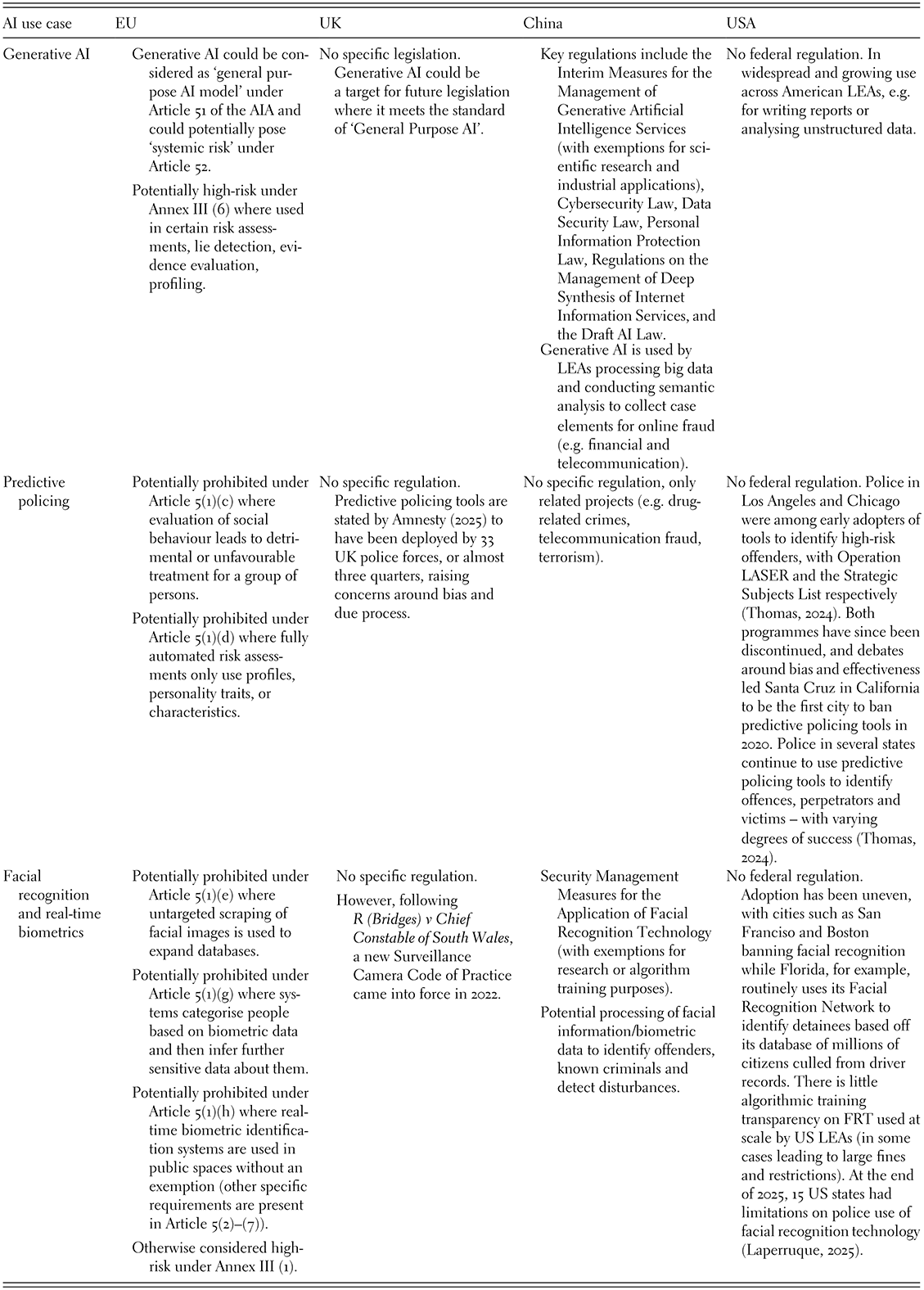
There are obvious utilities for such systems in locating wanted criminals, but also clear privacy and ethical concerns. As people are unable to easily opt out of their data being captured, control of personal data falls to the data controllers, most likely the police. Where such tools are used legitimately and lawfully, this still allows for police to know much more about individuals than they would otherwise do. This could not only feel invasive but can also lead to self-censorship where people feel they are being watched (Penney, Reference Chaudhary, Khurana, Ayalasomayajula and Singh2022). Where safeguards are missing or inadequate, there is a plain risk of mass surveillance. Additionally, facial recognition and biometric analysis tools have been demonstrated to be less accurate when recognising people from ethnic minority backgrounds (Leslie, Reference Leslie2020). As such, whilst these tools can be presented as functioning in a particular way, the actual results are often very different (Raji et al., Reference Chen, Van Khoa, Teoh, Nazir, Karuppiah and Lam2022). Table 2.1 presents the applicable regulations for each case study per country, with key context on their stances towards AI in policing.
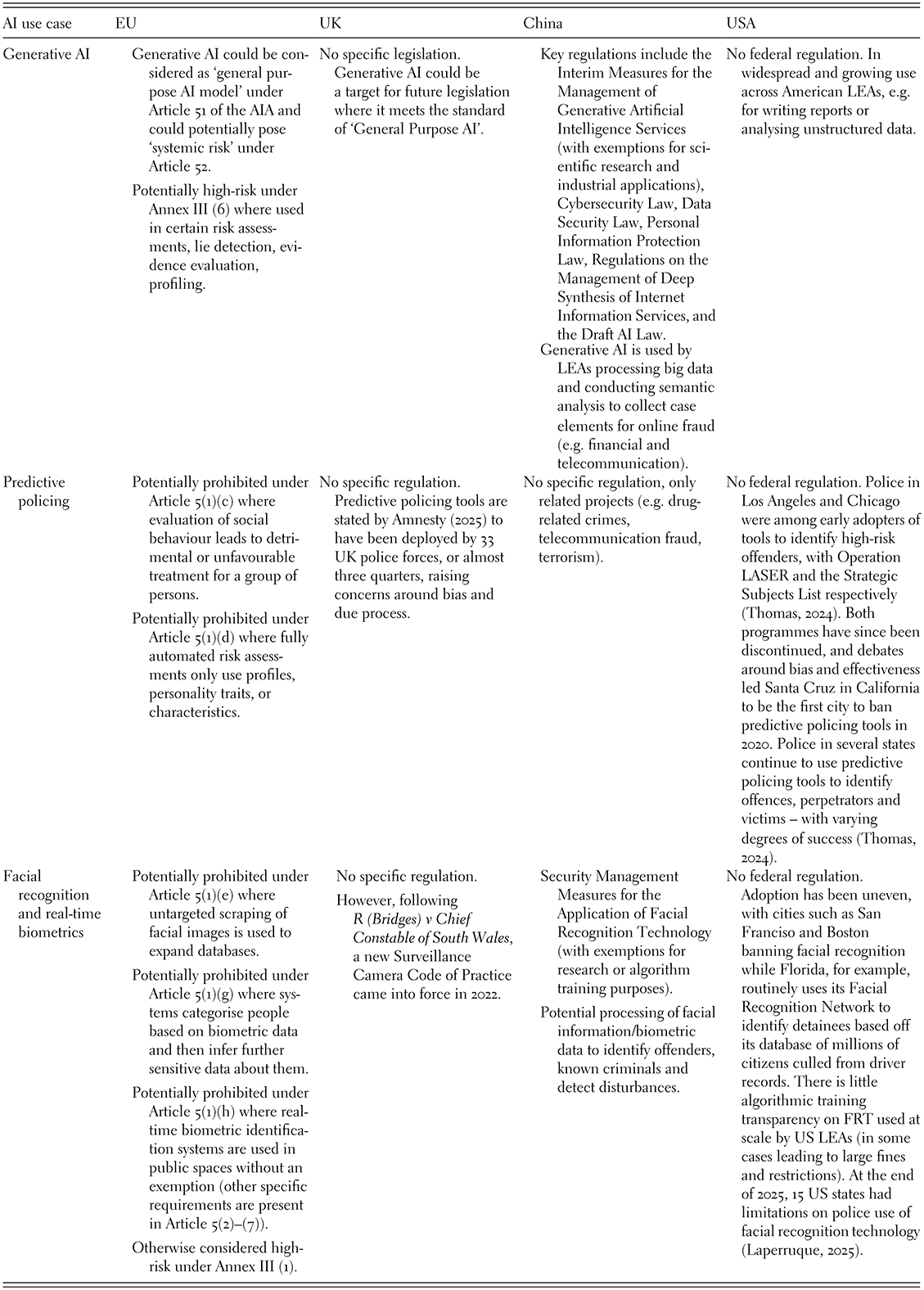
The analysis suggests that AI governance is deeply contextual, shaped by the distinct epistemic, political, and cultural infrastructures of each jurisdiction. That is, differences in political and power dynamics, socio-cultural environments and organisational structures dynamically determine how ethical principles are interpreted and embedded within AI regulatory frameworks for law enforcement, and more broadly. The EU’s emphasis on human rights and risk mitigation is evident in its AIA, underpinning a precautionary regulatory approach through its tiered, risk-based AI deployment for critical domains such as policing. The US approach is more fragmented, favouring innovation and private sector leadership in the absence of centralised oversight of the deployment of AI-enabled law enforcement solutions – with the UK erring towards this model. By contrast, China’s governance model is positioned to develop regulatory approaches that are anticipatory and centralised, aligning AI regulation with state-led objectives that prioritise technological advancement for social governance and economic competitiveness. These variations are reflected in the ethical discourse and, therefore, decision-making in relation to the use of AI-enabled law enforcement tools. While the EU conceptualises ethics as a legally binding moral imperative, China integrates ethical considerations within a broader state governance narrative, and the US approaches ethics as a decentralised and often negotiable set of values mediated by industry and civil society. Addressing the challenges of AI law enforcement tools should be sensitive to these contextual factors, which determine the interpretative repertoire of international regulatory frameworks.
2.4 Challenges and Concerns for Law Enforcement
The governance approaches in the EU, US, UK, and China establish distinct normative baselines that frame the permissible scope of AI use in policing, the thresholds for accountability, and the weight given to civil liberties versus public order. These contextualised ethical-legal ecosystems form the backdrop against which specific operational concerns emerge. For example, there is a considerable body of research on the detrimental effects and threats related to datafied, algorithmic models of social analysis and their implementation by state and private (corporate) actors (see, for instance, Crawford, Reference Crawford2021; Eubanks, Reference Eubanks2018; O’Neil, Reference O’Neil2017; Wiggins and Jones, 2023). Some of these criticisms, when seen through the lens of law enforcement, take on very specific shape and are intertwined with regulatory and ethical complexities that comprise law enforcement-specific variations of these more general themes.
The first challenge that is well-established across different contexts refers to the quality of data used by AI-empowered law enforcement tools. Each activity of an LEA staff member creates a documentary trail, and these documents connect along a kind of value chain; starting from the police collecting data to produce information that is summarised in a report. This feeds into further investigation by the public prosecutor, to finally end up before a court where the indicted person stands trial. Transforming these trails from traditional paper files into an electronic format produces a wide variety of more or less easily accessible databases that can be used to train AI-empowered analysis tools to identify suspicious patterns. The quality of the results depends on the quality of the data used to train the tools. Any bias or blank spot in the original data will be present (if not reinforced) in the tool’s performance. The need for bias detection and mitigation can be universally identified, but specific regulatory processes that address its sociotechnical dimensions within law enforcement remain overlooked (see Chapter 5 for a discussion in the context of the AIA).
Second, AI-empowered tools can add to the cognitive overload of LEA staff by producing a redundant amount of information that can be hard to effectively handle. For example, in prominent cases of terrorist attacks in recent years (from the Boston bombers to terrorist attacks in Brussels, Berlin, and Paris), offenders had been on the radar of LEAs but, due to a lack of human resource coordination, the initial investigative leads were not followed up comprehensively. This is a fundamental problem that all forms of large-scale dragnet operations need to address (Kreissl, Reference Browne, Abedin and Chowdhury2017). A general regulatory shift towards safeguarding human oversight over AI-enabled law enforcement tools and context-specific human resources may need to account for AI literacy and mitigation measures towards these emerging outcomes, especially in critical security domains.
Third, the underlying assumptions of algorithmic reasoning that uses statistically construed risk categories while ignoring the idiosyncratic features of the individual case have become an international debate, as demonstrated in sentencing guidelines. There are rarely any independent evaluation studies, based on rigid standards of scientific research, to assess the underlying risk perceptions and impact of these models. To determine whether a decline in the registered crime rate in an urban environment can be causally attributed to the implementation of predictive crime management tools is almost impossible, as long as not all relevant data (and the algorithms for their analysis) are made available for independent academic research (Meijer and Wessels 2019; Strikwerda, Reference Strikwerda2021). Commercial providers of such tools tend to showcase success stories from the police departments that have introduced their solutions, but whether these marketing narratives would stand a closer critical look is hard to determine as long as the key information is publicly inaccessible. This challenge points to algorithmic and procurement transparency and a need for independent evaluation before AI deployment as a normative practice.
2.5 Conclusion
The global divergences in regulatory approaches to AI shown in this chapter and the inherently complex nature of AI-empowered policing challenge regulatory frameworks for AI-enabled law enforcement tools. Our analysis suggests that this requires a dynamic approach to risk management that accounts for the socio-cultural and legal specificities of the respective jurisdictions. While transparency remains a foundational principle, particularly in exposing the decision-making processes of AI systems in policing (Pasquale, 2015), it should be combined with a nuanced understanding of local norms, expectations, civil liberties, and organisational structures that may also facilitate international regulatory and operational collaborations. Given the high-stakes implications of AI use in law enforcement, including potential infringements on privacy and disproportionate impacts on marginalised communities, the deployment of AI in policing merits context-aware AI governance models that are likely to secure the legitimacy of AI interventions and the protection of fundamental rights in each societal setting.

 Open access