

The appeal of ethnonationalist populist parties and leaders seems to have increased exponentially in the past decade, from the Vox Party in Spain, Jair Bolsonaro in Brazil, Victor Orban in Hungary to Donald Trump in the United States, and a number of others. The economic crisis, which in many countries left deep scars, produced lingering anger. Populist sentiments accompanied this anger (Rhodes-Purdy et al. Reference Rhodes-Purdy, Navarre and Utych2020) and may have hastened the rise of ethnonationalist populists. These movements and leaders “seek to advance what they see as the interests and culture of their country’s ethno-cultural majority,” endorsing outgroup prejudice in the process (Goodwin Reference Goodwin2019).
Yet, there is considerable scholarly disagreement regarding the connection between economic turmoil and ethnonationalism: the most prominent recent study of the rise of ethnonationalist politics finds a limited role for economics and instead points to conflict over cultural change as the proximate cause (Inglehart and Norris Reference Inglehart and Norris2019). Our question in this article is: is there a connection between major economic threats and the activation of prejudice, that is, negative outgroup attitudes? If so, what is the mechanism connecting economics and prejudice towards outgroups? Does prejudice against any and all marginalized ethno-racial groups increase uniformly during economic crises, or do people target their prejudice to specific outgroups—such as members of opposing political movements? And finally, why does prejudice seem to increase among partisans of conservative parties (Bermeo and Bartels Reference Bermeo and Bartels2014), while members of left-leaning parties seem to move in the opposite direction, more stridently supporting culturally egalitarian policies (Schram and Fording Reference Schram and Fording2021)?
Drawing on emotions theories in both politics and psychology (Albertson and Gadarian Reference Albertson and Gadarian2015; Brader Reference Brader2006; Jost Reference Jost2019; Lerner and Keltner Reference Lerner and Keltner2000; Marcus et al. Reference Marcus, Neuman and Mackuen2000), we argue that the connection between economic crises and targeted prejudice operates through emotional responses: economic threats cause individuals to respond with anger, anxiety, or both, and these emotional responses influence the expression of outgroup prejudice. In other words, it is not the economic threat per se that causes increasing prejudice, but rather, prejudice rises due to the emotions that the economic threat triggers. Based on existing findings in the literature on emotions and political attitudes (Albertson and Gadarian Reference Albertson and Gadarian2015; Marcus et al. Reference Marcus, Neuman and Mackuen2000), we argue that emotions do not generate new prejudices, but rather intensify and increase the salience of negative attitudes toward groups an individual is already predisposed to dislike. This means that prejudice will not rise uniformly among all members of the majority group.
Although a number of factors may influence attitudes toward perceived outgroups, we focus here on the role of partisanship. The Republican Party in the United States has embraced social narratives that blame racial and ethnic minorities for social problems; as examples, one can point to the racialized rhetoric around welfare spending (Gilens Reference Gilens1999), hostility toward immigration (Nassar Reference Nassar2020; Utych Reference Utych2018), anti-Islamic rhetoric (Jacobs et al. Reference Jacobs, Boukes and Vliegenthart2019), electoral politics within the United States (Buyuker et al. Reference Buyuker, D’Urso, Filindra and Kaplan2021; Hale Reference Hale2020; Nelsen Reference Nelsen2021), support for democracy (Miller and Davis Reference Miller and Davis2021), and racial appeals generally (Christiani Reference Christiani2021). The Democratic Party, conversely, has moved toward greater acceptance of and attention to the demands of racial and ethnic minorities as these groups have become an increasingly important part of the party’s social coalition (Black Reference Black2004). Given this, we expect negative emotions arising from economic trauma to increase prejudice against ethnic and racial minorities only among conservatives and Republicans because they primarily define their partisan membership against these groups.Footnote 1
We test this theory using 2 experiments. In these studies, we focus on ethnocentrism or generalized prejudice towards racial and ethnic outgroups. In each study, we compared the effect of treatments intended to provoke a sense of threat arising from negative economic outcomes. We then used OLS to estimate the effect of these treatments on our measures of prejudice (ethnocentrism). We use interactions to estimate the effects of these treatments among conservatives/Republicans and liberals/Democrats separately.Footnote 2 Finally, we used mediation analysis to analyze whether negative emotions (anger and anxiety) were the mechanism underlying these effects. We find that economic trauma did significantly increase ethnocentrism, but (as expected) only among conservatives or Republicans. Furthermore, we found these effects to be substantially mediated through anger, but not anxiety.
The paper makes two key contributions. First, it demonstrates that economic threat has an asymmetric effect on outgroup prejudice for Democrats/liberals and Republicans/conservatives. Second, it moves beyond theories of social identity and partisanship (Mason Reference Mason2018) to engage with theories of emotions and their effects on outgroup prejudice. We show that emotions and specifically anger mediate the effect of economic threat on outgroup prejudice.
1. Economic threat and prejudice
Previous research has found a link between economic threatFootnote 3 and prejudice. Realistic group conflict theory has long held that competition over economic resources can lead to outgroup prejudice, but only toward the group(s) one perceives as competitors (Campbell 1965). This conflict need not be a real conflict. Perceived conflict by a group member can produce similar effects (Sherif Reference Sherif1977). Realistic group conflict theory focuses on attitudes towards one’s ingroup and socially designated outgroups and that these interactions are affected by relationships, real or perceived, with other groups in society (Sherif and Sherif Reference Sherif and Sherif1964). Scholars have applied this approach to prejudice against marginalized minorities, including Muslims (Jacobs, Boukes and Vliegenthart Reference Jacobs, Boukes and Vliegenthart2019), African Americans (Krosch and Amodio Reference Krosch and Amodio2014), and Asian Americans (Butz and Yogeeswaran Reference Butz and Yogeeswaran2011).
Inglehart and Norris (Reference Inglehart and Norris2017) propose one mechanism that explains the link between competition for resources and outgroup prejudice, arguing that the culprit is authoritarian values. Specifically, in this view, prolonged economic insecurity increases the prevalence of authoritarian values and behaviors over time. Since authoritarianism is correlated with ethnocentrism, this process leads to an uptick in outgroup prejudice (Altemeyer Reference Altemeyer1981).
These works argue that a positive correlation exists between economic threat and prejudice, with the former usually assumed to cause the latter, but these works have not provided a satisfactory mechanism connecting the two. For one, there is a major divide between the RGCT approach, which assumes materialistic motivation, and the approach adopted by Inglehart and Norris (Reference Inglehart and Norris2017, Reference Inglehart and Norris2019) which finds that values, beliefs, and identities are the proximate cause of prejudice. Yet Ingelhart and Norris’ backlash thesis has its own difficulties: most crucially, its mechanisms (increased authoritarianism and generational conflict) are far too slow to explain the rapid surge of ethnonationalist populism that occurred immediately after the Great Recession. Authoritarianism is primarily a product of childhood socialization (Altemeyer Reference Altemeyer1981). The change in prevalence of authoritarianism between generations takes decades to develop as new generations mature while older generations shrink. Even if one accepts that the salience of authoritarianism or generational divides may increase rapidly, these findings have recently been challenged and the empirical evidence for such activation is thus lacking (Schäfer Reference Shafer2021). It is difficult to explain a candidate like Donald Trump, a figure who would have been unthinkable as a major party candidate even ten years prior to his ascension, using these mechanisms. Neither can either of these approaches satisfactorily explain why conservatives would move toward prejudice at the same time liberals moved decisively in the opposite direction, more firmly and unabashedly embracing policies and concepts like structural racism that were politically fraught not long ago.
2. Our approach: the affective political economy of prejudice
To overcome this impasse, we propose emotions as the link between economics and prejudice. Emotions can change attitudes much more quickly than the mechanisms outlined above, which is consistent with the dynamism exhibited by ethnonationalist movements. The theory of affective intelligence divides emotions into a dispositional system, where individuals rely on their pre-existing beliefs, and a surveillance system, where individuals seek and learn new information to alleviate their concerns (Marcus et al. Reference Marcus, Neuman and Mackuen2000). According to affective intelligence theory, anger and anxiety can have distinct behavioral consequences. Anger triggers the dispositional system, but anxiety tends to trigger the surveillance system (Marcus et al. Reference Marcus, Neuman and Mackuen2000). These emotional responses often occur automatically before any conscious processing of one’s situation (Marcus et al. Reference Marcus, Neuman and Mackuen2000; Rolls Reference Rolls2005).
When individuals feel economically threatened, they may respond in one of two ways. On the one hand, they often search for someone to blame, whether correctly or incorrectly (Kunovich Reference Kunovich2013). As a result, economic threat (real or perceived) can lead individuals to be more aggressive and punitive towards groups they dislike or distrust due to “spill-over” punitivism. This means that a punitive impulse aroused by one circumstance tends to transfer outside that circumstance, making an individual more punitive in other areas of their social environment, until the need to punish is satisfied (Goldberg et al. Reference Goldberg, Lerner and Tetlock1999). On the other hand, they may feel uncertainty about the situation and its resolution, including their own economic future, producing anxiety (Calvo and Castillo Reference Calvo and Castillo2001). In short, individuals may respond to economic crises with anger, anxiety, or both (Na et al. Reference Na, Lee and Kim2010). There is considerable debate in the literature about whether anxiety (Kessler et al. Reference Kessler, Mummendey, Funke, Brown, Binder, Zagefka, Leyens, Demoulin and Maquil2010; Riek et al. Reference Riek, Mania and Gaertner2006) or anger (DeSteno et al. Reference DeSteno, Dasgupta, Bartlett and Cajdric2004; Esses et al. Reference Esses, Medianu and Lawson2013; Utych Reference Utych2018) is the most important discrete emotion for explaining rising prejudice.
2.1. Anxiety as the primary motivator
Anxiety is consistently associated with more negative evaluations of outgroups (Riek et al. Reference Riek, Mania and Gaertner2006). Given this, some scholars favor anxiety as the primary emotional driver of outgroup prejudice. Works using this approach argue that anxiety arouses a cognitive bias towards threatening information (i.e. individuals seek out, pay more attention to, and better remember threatening information) and a desire to ensure safety (Albertson and Gadarian Reference Albertson and Gadarian2015, 2014; Jost Reference Jost2019). Due to this bias, we can expect anxiety to make individuals perceive members of outgroups as more threatening than they might when they are not anxious (Van Zomeren et al. Reference Van Zomeren, Fischer and Spears2007). Intergroup anxiety (i.e. anxiety that is linked to a given ethno-racial outgroup) emerged as one of the strongest predictors of prejudice toward Muslims (Hodson et al. Reference Hodson, Hewstone and Swart2013; White et al. Reference White, Duck and Newcombe2012) and Syrian refugees more specifically (Koc and Anderson Reference Koc and Anderson2018). Along with general negativity, anxiety decreases empathy toward outgroups (Arceneaux Reference Arceneaux2017). Finally, anxious people have a heightened desire for safety. When disliked outgroups become associated with danger, anxious people are willing to support restrictive policies in the name of safety (Albertson and Gadarian Reference Albertson and Gadarian2015).
Others examine anxiety and aggression in concert, noting that each can have an effect on negative intergroup attitudes. Anxiety can lead to aggression in situations where conflict is unavoidable (Bandura and Walters Reference Bandura and Walters1959), perhaps mirroring perceptions of conflict among groups in times of economic crisis. After 9/11, Americans who perceived future threat were more supportive of aggressive military action (Huddy et al. Reference Huddy, Feldman, Taber and Lahav2005). This relates to the emotion of fear aggression, most commonly studied in the context of domesticated animals. This fear aggression can predict instances of desire for aggression towards outgroups one is engaged in conflict with, provided the conflict is ongoing (Spanovic et al. Reference Spanovic, Lickel, Denson and Petrovic2010). Overall, anxiety tends to open individuals to new ideas, which would suggest that underconditions of anxiety people may develop prejudices towards new groups.
Scholars disagree on how anxiety and prejudice are linked. Appraisal theories predict that anxiety can trigger an increase in prejudice towards any group (Jost Reference Jost2019), essentially arguing that any threat that causes anxiety should make individuals wary of outgroups, regardless of their predispositions. By contrast, AIT (Marcus et al. Reference Marcus, Neuman and Mackuen2000) argues that anxiety produces a specific cognitive state, one in which motivation plummets and individuals to cease action and instead seek out more information among the traits related to this cognitive state are a decreased reliance on heuristics and a willingness to question old beliefs and ideas. Given this, AIT adherents expect prejudice to decrease in response to anxiety, at least towards groups to whom a person is predisposed to have negative attitudes; prejudice may increase towards other groups (Vasilopoulos et al. Reference Vasilopoulos, Marcus and Foucault2018).
2.2. Anger as the primary motivator
Other scholars, especially those in intergroup threat theory camp (Stephan and Mealy Reference Stephan and Mealy2011), tend to favor anger as the more relevant emotion for predicted prejudice. Specifically, anger increases aggression and motivation (i.e. a desire to take action) while also causing individuals to rely more heavily on their pre-existing biases; in other words, anger will interact with existing systems of ideas and attitudes to produce increases in targeted prejudice (Brader Reference Brader2006; Marcus et al. Reference Marcus, Neuman and Mackuen2000; Valentino et al. Reference Valentino, Hutchings, Banks and Davis2008, Reference Vasilopoulos, Marcus and Foucault2018). When individuals feel disgusted, an emotion closely related to anger, they tend to show increased prejudice towards gays, but only when their predispositions encourage those beliefs (Gadarian and van der Vort Reference Gadarian and van der Vort2018). This literature suggests that, unlike anxiety, anger intensifies existing ideas and habits of mind, which would suggest that anger may amplify prejudice towards groups one is predisposed to dislike. In short, neuroprocessing approaches like AIT predict not only that anger will increase prejudicial attitudes but further predicts that the effect of anger will find different targets depending on a majority group members’ prior prejudices. In effect, anger activates existing biases and negative attitudes, exacerbating them and giving them increased salience and emotional intensity. Anger can lead to a reliance on one’s predispositions, which leads to a desire for increased punishment of those who offend and violate one’s deeply held values (Brader and Marcus Reference Brader and Marcus2014; Steele et al. Reference Steele, Rovenpor, Lickel and Denson2019; Sunstein and Kahneman Reference Sunstein and Kahneman2007).
3. The role of partisan/ideological identities
Recent research has demonstrated that partisanship serves as a strong and durable social identity (Huddy et al. Reference Huddy, Mason and Aaroe2015). The strength of this identity has led to a recent rise in affective polarization (Iyengar et al. Reference Iyengar, Sood and Lelkes2012; Mason Reference Mason2018), which includes increasing emotional responses both positively towards one’s own party and especially negatively towards the out-party (Abramowitz and Webster Reference Abramowitz and Webster2016). Importantly, in recent years, ideology and partisanship have become more closely linked, with conservatives more likely to identify as Republicans and liberals more likely to identify as Democrats (Levendusky Reference Levendusky2009).
This increase in affective polarization has led individuals to more strongly process their attitudes towards groups in society through a partisan lens (Mason Reference Mason2018). Partisanship predicts a host of political attitudes and behaviors, and serves as a driver of discrimination (Engelhardt and Utych Reference Engelhardt and Utych2020; Iyengar and Westwood Reference Iyengar and Westwood2015). It is not surprising that research has also shown that partisanship and ideology drive prejudice, with conservatives more likely to report negative attitudes towards racial and ethnic outgroups than liberals (Kinder and Kam Reference Kinder and Kam2009). Because of this, our predictions of how emotions influence prejudicial attitudes are conditional upon partisanship and ideology—as individuals see the world through a partisan or ideological lens, they are likely to have pre-existing attitudes towards groups in society that differ along these lines.
Although existing attitudes and beliefs can spring from a number of sources, we argue that ideology and partisanship are the most relevant for our purposes here. Although there are important differences between the two, ideology and party loyalty both provide individuals with narratives regarding social allies and enemies, that is, which groups an individual can trust and which groups should arouse suspicion. The role of these factors in shaping the relationship between emotions and prejudice has been documented in existing research, although none have applied the logic to the economic issue as we do here. In addition, anger tends to predict increased support for authoritarian beliefs, but only among those who are ideologically on the right, or supporters of parties on the right (Vasilopoulous et al. Reference Vasilopoulos, Marcus and Foucault2018).
Specifically, AIT predicts that anger would increase prejudice against minority groups among conservatives and rightists, but not liberals/leftists, because conservatives tend to have more ethnocentric (Kinder and Kam Reference Kinder and Kam2009) and negative racial attitudes (Tesler Reference Tesler2016). Anxiety should have the opposite effects of those described if AIT is correct. While the differences between approaches on the role of anger are fairly subtle, the differences in the effects of anxiety are much starker. For example, a liberal in the US who believes firmly in racial egalitarianism may become more prejudiced toward minorities, while a conservative with ethnocentric leanings may become less prejudiced when anxious, as anxiety breaks the reliance on accepted heuristics.
4. Hypotheses
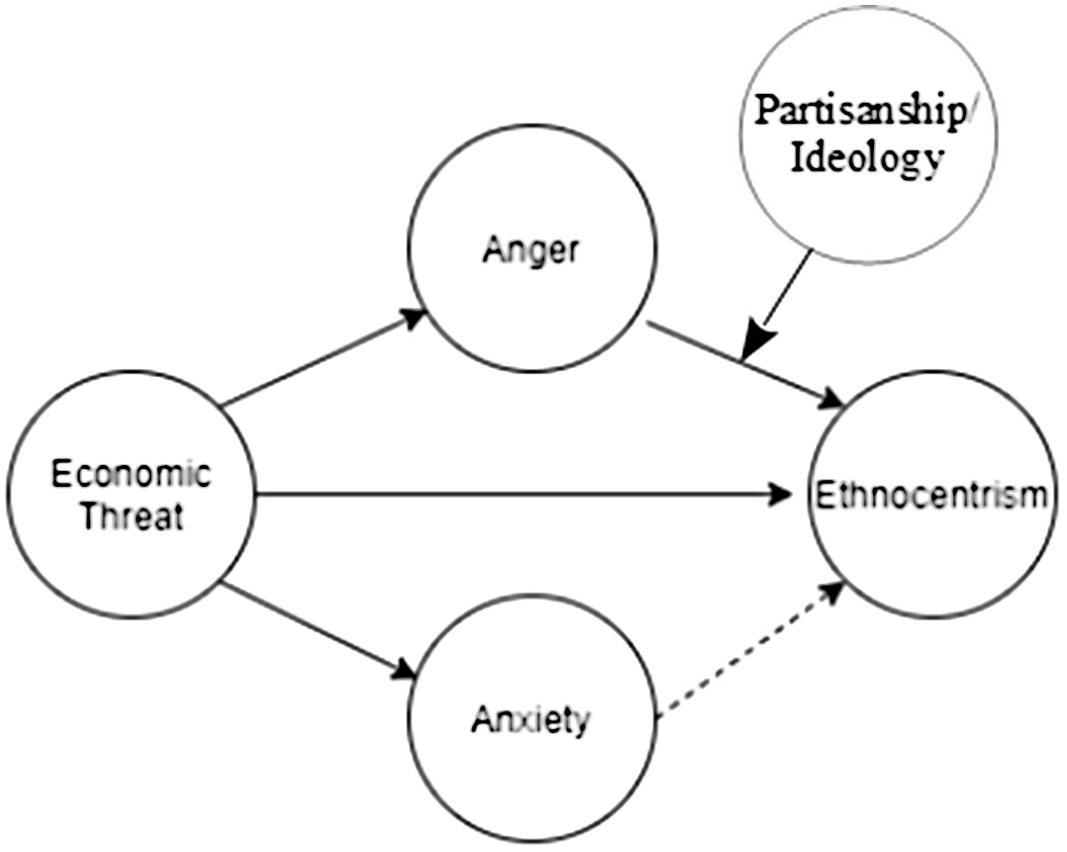
Figure 1 shows our expectations in a path diagram.Footnote 4
Theory flow chart

To summarize, we predict that exposure to economic threat will provoke negative emotions, specifically anxiety (as the threatening change in economic circumstance triggers an information search) and anger (as individuals assign blame to others for the poor economic outcomes). These emotions, in turn, influence prejudice. However, the influence of anger will be shaped by pre-existing ideas and narratives about which social groups are one’s enemies and which are one’s allies, especially those that form part of a person’s partisan or ideological worldview. While we do not necessarily believe this applies only to Republicans or conservatives, given our strategy of testing ethnocentrism as our dependent variable, in the current study we expect only Republicans or conservatives to respond this way. If intergroup threat theory is correct, anger and anxiety should both cause negative attitudes towards marginalized groups regardless of an individual’s prior partisan or ideological loyalties (although individuals may have different base levels of prejudice due to these factors, meaning a liberal and conservative would both be more prejudiced when angry or anxious, but the latter would still be more prejudiced on average than the former).
4.1 Experimental design and results—study 1
To test our predictions, we conducted an experimentFootnote 5 on 702 adult US residents recruited via Amazon’s Mechanical Turk (Mturk).Footnote 6 We include only Caucasian respondents who do not identify as Latinx, leaving 478 respondents for experimental analyses. We include only white respondents because, while people of color and Latinx people certainly have negative attitudes towards other ethnic and racial groups (Krupnikov and Piston Reference Krupnikov and Piston2016), the nature of racial and ethnic hierarchies makes it unlikely that their attitudes are shaped in the same way as those of Caucasians (see Kinder and Kam Reference Kinder and Kam2009).
Data were collected on February 27, 2020, and the total survey took respondents, on average, less than 5 minutes to complete.Footnote 7 The entire exercise took approximately eight to ten minutes for most respondents. To ensure quality control, we used both automated attention checks (including a requirement that respondents spend a minimum of 45 seconds on the writing exercise), and we eliminated respondents whose open-ended responses were nonsensical or egregiously short (less than twenty characters).
To simulate the effects of exposure to economic threat, we asked respondents to do one of three writing exercises: writing about a time when the economic situation of the country made them anxious (Econ. Threat, Anxious), or angry (Econ. Threat, Angry), or about a time when they felt the economic situation of the country was not going well (Econ. Threat, Neutral). The control condition asked respondents to write about brushing their teeth.Footnote 8 After these writing exercises, participants were first asked questions about their emotional responses using the PANAS-M Footnote 9 measure, a modified version of positive and negative affect measures (Rhodes-Purdy et al. 2021), and then a series of questions about their social and political attitudes. Most respondents wrote answers of two to three sentences.
This measurement strategy is important. While theory suggests that threat should produce relatively more anxiety, and grievance relatively more anger, these treatments are not designed to evoke only one emotion (and, anger and anxiety are likely to co-occur in individuals who have been made to feel one emotion or the other). The PANAS-M provides a more cognitively difficult response task that has been shown to considerably reduce correlations between anger and anxiety (Rhodes-Purdy et al. Reference Rhodes-Purdy, Navarre and Utych2020). This occurs especially in situations where treatments may evoke different emotions in different individuals, making the PANAS-M an ideal measure of emotional response for our study. Of course, this limits our ability to measure emotions only to conscious self-reports. While the PANAS-M tends to provide more reliable estimates of anger and anxiety than traditional PANAS measures (Rhodes-Purdy et al. Reference Rhodes-Purdy, Navarre and Utych2020), we are limited in ability to measure emotions only to what respondents are willing or able to report consciously. We use CFA techniques to measure emotional response to the stimuli, with two relevant dimensions: anger and anxiety.Footnote 10 . We create an index of anger using respondent ratings of their feelings as “angry,” “mad,” “furious,” and “outraged.” We measure anxiety using respondent ratings of their feelings as “anxious,” “afraid,” and “nervous.” While these emotional responses have good measurement properties, they also have face validity—the words related to anger are words we use to describe the emotion of anger, and the words related to anxiety are words we use to describe the emotion of anxiety. We use multiple indicators for each emotion to improve precision of our measures.
We operationalize negative intergroup attitudes as ethnocentrism using two measures. The first was constructed using feeling thermometers towards African Americans, Latinx people, Muslims, and Asians. Each feeling thermometer was reversed (so that higher scores indicate negative attitudes) and then subtracted from each respondent’s feeling thermometer for Whites; this allows us to account for the tendency of some people to like or dislike all groups equally, which would not qualify as an intergroup attitude unless the person’s attitudes towards other groups differ from their feelings toward their own group. We then averaged the deviated thermometers to get a single measure of ethnocentrism. The second measure involved a series of questions about the perceived trustworthiness, industriousness, and intelligence of the same groups, except Asians, as prior results from earlier studies associated with this project have indicated that specific attitudes towards this group do not reflect ethnocentrism well, and model fit indices showed that including anti-Asian attitudes caused serious issues with model estimation. We then specified a second-order CFA, with an ethnocentrism factor loading on latent negative attitude factors toward each group, which in turn loaded on observed responses to the items mentioned earlier. For the sake of brevity, and since results are consistent across the two measures, we report results using the first measure only.
While baseline levels of ethnocentrism vary across individuals, we do not have pre-post-treatment measures of ethnocentrism, due to concerns about anchoring of responses. As such, we focus on evaluating these changes based on average changes between experimental groups. Given that our theory relies on predispositions, we use ideology as a proxy for how individuals are predisposed towards ethnocentric attitudes. With ideology and partisanship driving worldviews, especially related to prejudice (Tesler Reference Tesler2016), we expect this threat to heighten prejudice primarily among conservatives. This does not mean, of course, that liberals cannot be ethnocentric. In our sample, we find conservatives to be more ethnocentric than liberals (mean of 0.36 for conservatives, mean of –0.19 for liberals), and there is significant variation within each ideological category. This echoes findings from Kinder and Kam (Reference Kinder and Kam2009), which finds that conservatives tend to be more ethnocentric, but many liberals still express ethnocentric attitudes.
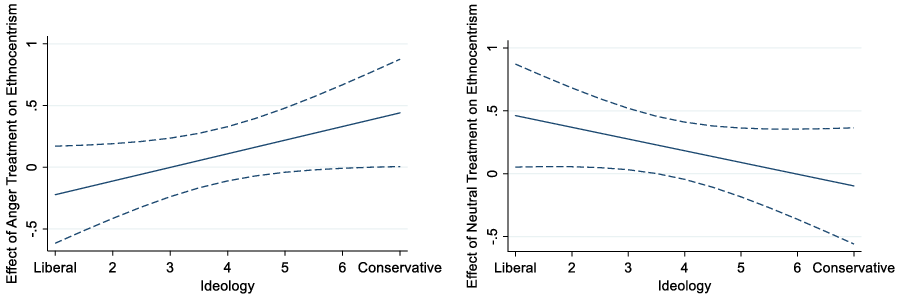
We then conducted three regressions; the first is an OLS regression of ethnocentrism on the treatments, where no significant treatment effects were observed, and thus, we do not report these results. Next, we repeated the first regression, but this time we specified treatment effects moderated by ideology (a seven-point liberal-conservative scale). The effect of the anxiety treatment was not significant at any point in the range of ideology, the moderating variable. However, the treatment effects of the anger and neutral variables were significant at some values of the moderator; graphs of the marginal effects of those treatments are included in Figure 2.
Model 1: Marginal effects of anger and neutral economic treatments on ethnocentrism

The effect of the anger treatment was significant among those who identified as “conservative” or “extremely conservative”; the effect of the neutral treatment was significant among those with scores of one to three (i.e. less than moderate). These results are consistent with our hypotheses that exposure to economic threat will increase outgroup prejudice, mediated through unpleasant emotions, but the significant moderation of the treatment effect by ideology would not be consistent with intergroup threat theory. Our hypothesis that anxiety is the primary mechanism which generates negative intergroup attitudes is not supported.
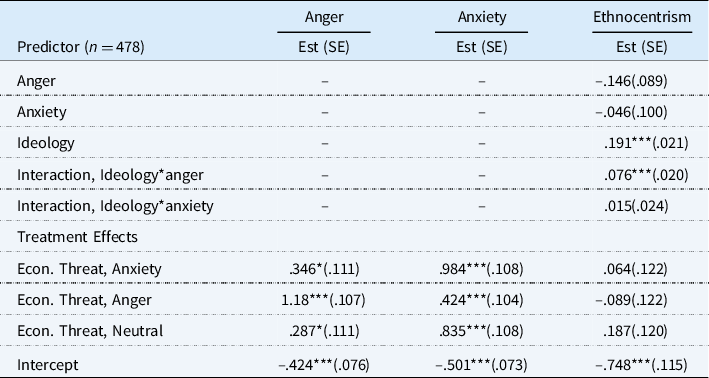
The last analysis was a seemingly unrelated regression (SUR) model, wherein we simultaneously estimated the influence of the treatments on anger and anxiety, and the influence of anger and anxiety, moderated by ideology, on ethnocentrism. We elect to use SUR because when conducting regressions that share a set of predictors, chances are high that the error terms will be correlated, in which case OLS is not asymptotically efficient. SUR is therefore a bit more precise because it takes the correlated errors into account when producing estimates (Kmenta and Gilbert Reference Kmenta and Gilbert1968). Results are presented in Table 1.
Analyses of treatment effects on emotions and ethnocentrism

*=sig. at .05 level; **=sig. at .01 level; ***=sig. at .001 level.
Despite the null results obtained when regressing ethnocentrism on the treatment effects, it is clear from the results in Figure 2 that the results did influence ethnocentrism; however, because conservatives and liberals responded to different versions of the economic threat treatment, the effects are masked unless we take the moderating influence of ideology into account. As predicted by AIT (and consistent with results we obtained when analyzing the PSAS data), conservatives expressed significantly more ethnocentrism when exposed to economic threat, but only when that threat was presented in terms that primed anger. Liberals, on the other hand, only responded to the neutral threat.
The results for liberals are more difficult to interpret than those for conservatives, but Table 1, wherein we included anger and anxiety, helps clarify what the data suggest. Including the emotions in the model show that the effect of the Economic Threat/Anger treatment observed among conservatives disappears when anger is included as a control variable, but anger strongly influenced ethnocentrism among conservatives. Liberals, however, did not become significantly more ethnocentric in response to either anger or anxiety, but the influence of the emotionally neutral treatment remained. We can only speculate as to why the lack of an emotional effect suggests that some cognitive effect is in play. It is possible that liberals were affected more by social desirability bias and perhaps when given the neutral treatment, which did not guide respondents to respond with any particular emotion, they were faced with a more cognitively difficult task that mitigated this bias.
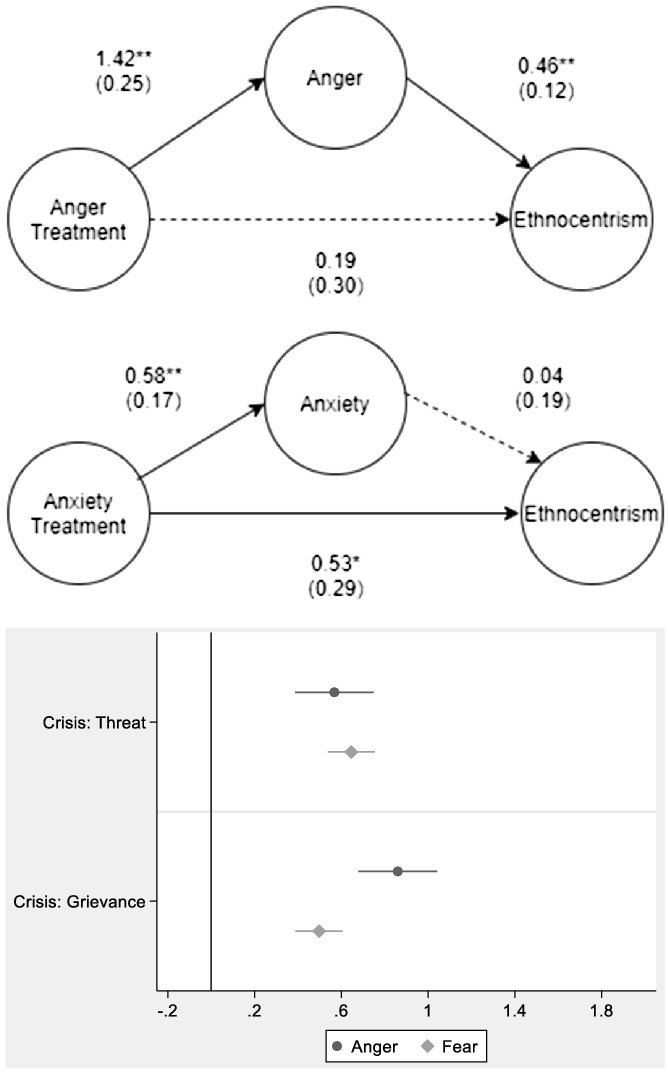
Since our model predicts that the effects of the experimental treatments are mediated by emotional responses, we turn to a formal mediation analysis. We conduct mediation analyses according to Imai et al. (Reference Imai, Keele and Tingley2010). As we only have clear expectations about conservative respondents, and conservative respondents’ attitudes seem to be the only ones moved by emotional response, we present analyses for conservative respondents only in Figure 3.
Effect of Treatments on Ethnocentrism, Mediated Through Emotions. Conservative Respondents (Through Anger). Note: Results are OLS coefficients using Average Causal Mediation Estimation (ACME) per Imai, Hicks and Tingley (Reference Imai, Keele and Tingley2010). ** p < .05, * p < .10

These resultsFootnote 11 show that anxiety is doing little work as the treatment effects remain nearly identical when examining the full and reduced models when anxiety is used as a mediator. However, when examining these differences for anger, we see that an emotional response of anger in the anger treatment mediates the effect of the treatment on ethnocentric attitudes. This suggests that anger itself, rather than any artifact from the anger prime, is the driving causal mechanism behind how economic threat can make conservative respondents express greater levels of ethnocentrism. In terms of our hypotheses, these data support AIT, while intergroup threat theory is not supported. It should be said that AIT’s predictions regarding anxiety are not supported by these data. It is possible that anxiety plays a more complex role than a simple reading of AIT would predict; for example, anxiety may have an indirect effect on negative attitudes by causing anger (Jost Reference Jost2019).
4.2 Experimental design and results—study 2
To provide further confidence in these findings, we conducted a survey experiment using an online research panel, Forthright, maintained by Bovitz, Inc., a U.S.-based market research firm. The Forthright panel provides a diverse sample that approximates the demographics of the United States as described by the Census. A total of 800 adult U.S. residents were recruited to participate in this study. Due to issues with one of our treatment videos,Footnote 12 we retain only those who participated in the relevant treatment and control conditions, leaving a total sample of 596 respondents, collected in April 2019. We used an attention check, in the form of a question directing respondents to give a specific answer mixed among substantive questions, to further screen out inattentive respondents. We also excluded respondents who, based on the amount of time they had the screen with the video open, could not have watched the whole video.
Participants were randomly assigned to view one of four videos, which were each about 2 minutes in length. The control condition involved watching a video of a man making a sandwich wrap. The economic crisis: threat condition video was a video of a family harmed by the 2008 financial crisis, using text placards emphasizing concerns related to the ongoing threat of another crisis, while minimizing blame attribution. The economic crisis: grievance video was the same as the threat video, but used text placards emphasizing attributional concerns, placing blame on those responsibleFootnote 13 while minimizing future threat. Emotions are measured using the PANAS-M, as in Study 1.
We use videos in this treatment to examine whether our effects are consistent using a different cognitive task. In the writing task, we guide respondents to write about a particular emotion, but there is likely considerable variance in the strength of the treatment between individuals—some individuals may write about a particularly intense event, while others may write about something more benign. Here, we focus on the text placards to guide individuals to a certain emotion. This gives us a bit more control over what, exactly, is defined as threat or grievance for each individual respondent.
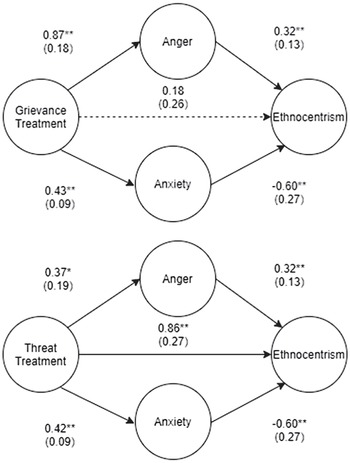
First, we present evidence that the treatments were effective at inducing emotional responses, as shown in Figure 4. All treatment groups report higher levels of anxiety and anger Footnote 14 than the control group. The grievance group reports significantly higher levels of anger than anxiety. However, the threat groups report roughly equal levels of anxiety and anger; they report slightly more anxiety, but this difference does not approach even generous levels of statistical significance. Importantly, the threat group reports higher levels of anxiety than the grievance group and the grievance treatment produces higher levels of anger than the threat treatment.
Anger, Anxiety and Ethnocentrism (Conservatives—Study 2). Note: Coefficients are OLS coefficients with standard errors in parenthesis. ** p < .05, * p < .10

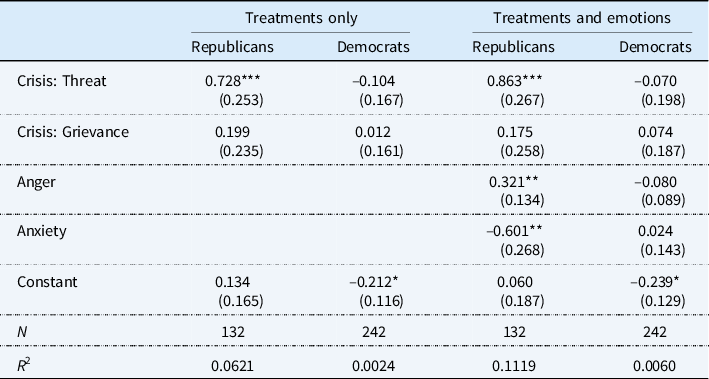
Next, we examine how the treatments, and emotional responses, influence attitudes towards outgroups. Footnote 15 These analyses are based heavily on racial outgroups, as Democrats are most closely aligned with black and Hispanic individuals (Mason and Wronski Reference Mason and Wronski2018). As such, we ask standard batteries to measure ethnocentrism to get at groups Republicans are generally predisposed to see as outgroups. Ethnocentrism measures one’s preference for their racial ingroup, compared to racial outgroups (Kinder and Kam Reference Kinder and Kam2009). We measure ethnocentrism by comparing average ratings of one’s racial ingroup to three racial outgroups on dimensions of hardworking vs. lazy, intelligent vs. unintelligent, and trustworthy vs. untrustworthy. Footnote 16 Results of these analyses, broken down by respondent partisanship, Footnote 17 are presented in Table 2, and Figures 4 and 5.
Anger, anxiety and ethnocentrism (Study 2)

Table entries are OLS coefficients with standard errors in parentheses. Analyses restricted to white respondents only. * p < 0.1, ** p < 0.05, *** p < 0.01.
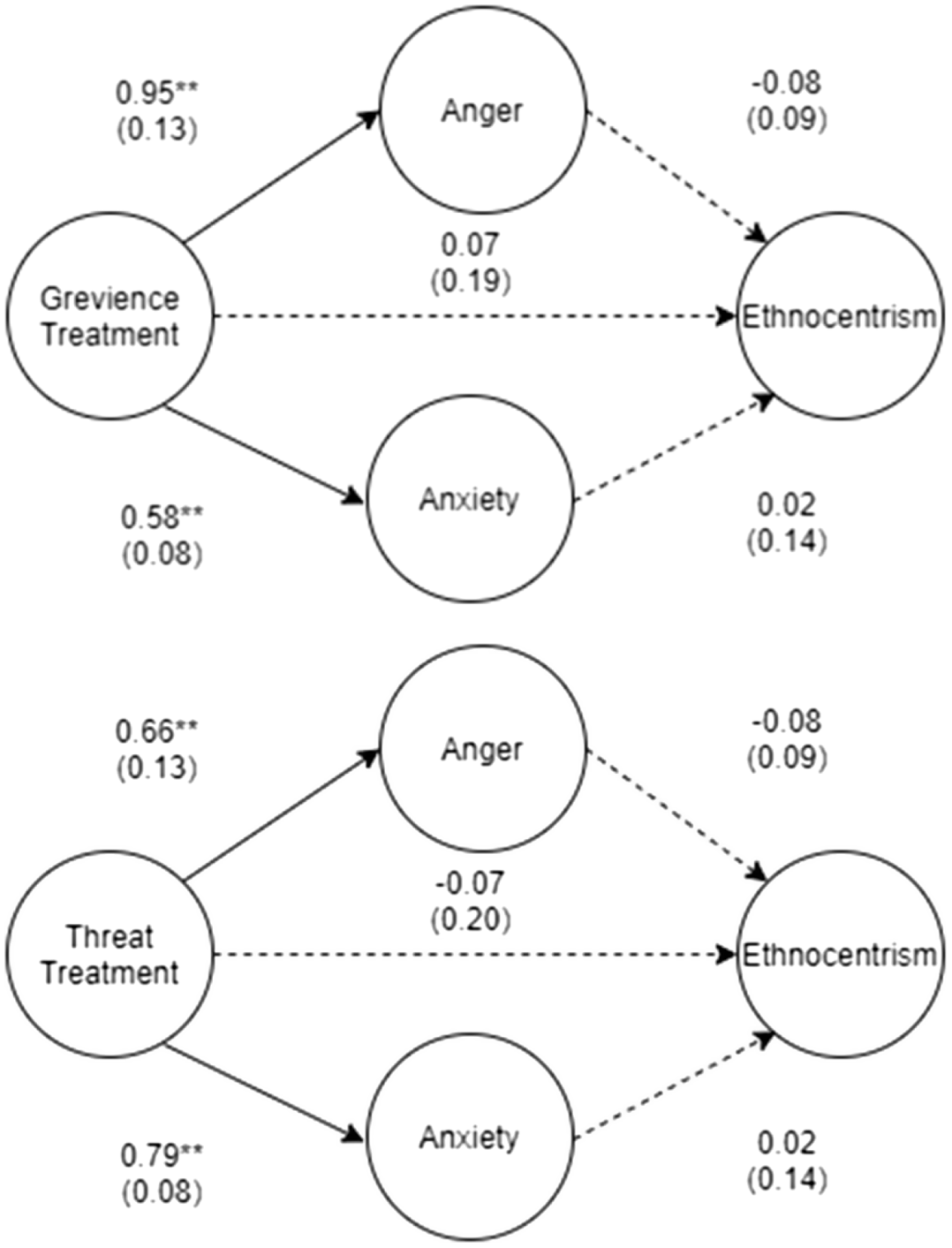
Anger, Anxiety and Ethnocentrism (Liberals—Study 2)

For Republicans, the threat treatment produced a significant predicted increase in ethnocentrism, but these effects do not emerge among Democrats. This is an important distinction, as Republicans tend to have higher levels of general ethnocentrism than Democrats, and Democrats should be less likely to view racial outgroups negatively (Kinder and Kam Reference Kinder and Kam2009). When adding in the effects of emotional responses to treatments, however, we see some different results. Democrats again are generally unaffected by the treatments or emotions, with point estimates close to zero. Republicans, however, offer ethnocentric attitudes differently, depending upon their emotional response. Republicans who are angry report higher levels of ethnocentrism, while Republicans who are afraid report lower levels of ethnocentrism. That is, the threat treatment appears to operate not through the increase in anxiety, but through its related increase in self-reported anger. This aligns well with an affective intelligence theory of emotional responses—anger makes individuals rely on their predispositions, such as attitudes that align with their partisanship, while anxiety makes individuals less reliant on these pre-existing beliefs (Marcus et al. Reference Marcus, Neuman and Mackuen2000).
To further increase confidence in these results, we conduct a similar study to Study 2, which we focus on in the appendix. Using a mechanical turk sample, we find similar substantive effects to the effects we find in study 2, suggesting that these effects replicate across multiple samples at multiple points in time.Footnote 18
5. Conclusions
We find evidence that priming economic insecurity can increase prejudicial attitudes through emotional response. While economic troubles predict an increase in both anger and anxiety, only anger serves to increase prejudicial attitudes and only towards groups one is predisposed to be prejudiced towards. This provides a more nuanced explanation of why economic troubles and prejudice seem to rise simultaneously: to the extent that economic troubles make individuals angry, it will serve to heighten pre-existing prejudice. Of course, these null results for Democrats and liberals may be explained by other factors—one is that these individuals may not respond emotionally to the treatments. However, we do find that the treatments are effective at increasing anger and anxiety among liberals and Democrats, though the target of these emotional responses may not be the same as in conservatives and Republicans. Additionally, liberals and Democrats may be responding expressively, essentially muting their response due to a desire to show positive attitudes towards outgroups. We cannot adjudicate between these explanations with our current data and encourage future researchers to examine these effects on groups that liberals may be predisposed to dislike, such as anti-abortion activists or white nationalist groups.
This aligns well with an affective intelligence theory of emotions, which suggests that anger causes individuals to rely more on their predispositions, while anxiety causes them to seek out new information and rely less on their predispositions (Marcus et al. Reference Marcus, Neuman and Mackuen2000). Anger can increase prejudice and anxiety can decrease it when these prejudices align with one’s core ideological values. Of course, these results do not exclude competing explanations, such as an explanation that anxiety produces anger, which in turn influences attitudes (Jost Reference Jost2019). Since we measure these emotions simultaneously, and they remain correlated at non-trivial levels, this explanation is possible, though it appears that anger is the important driving force behind prejudice.
This work speaks to real-world political events. While observers of ethnonationalist politics often pit arguments of “economic anxiety,” used generally to refer to concern about one’s economic situation, against prejudice as predictors of support for the ethnonationalist right we provide an explanation that allows both to operate. Economic crises can make citizens angry, perhaps driving them to search for someone to blame or punish. This in turn influences their prejudicial attitudes, but only when such prejudice is in line with their predispositions.
While we focus here specifically on economic threat, to examine the rise of ethnonationalist politics in the wake of the Great Recession, a rise that is all too often blamed solely on “economic anxiety,” we believe this may transfer to other types of threat. Indeed, other work has shown that emotions are a vital connection to threat and generalized attitudes (Albertson and Gadarian Reference Albertson and Gadarian2015). It is easy to imagine the economic crisis in the wake of COVID-19—this was not merely an economic crisis, but was an economic crisis deeply connected with a public health crisis. In this situation, individual responses may differ. Some citizens may feel primarily anxious—about the uncertainty of the duration and depths of the economic crisis, or about their own personal or familial risk of contracting a novel and deadly virus. Other citizens may feel primarily angry—about the government’s response to COVID-19 and its public health and economic impacts (of course, citizens can be angry or anxious because they feel the government has done too little, while others can feel this way because they believe the government has done too much). And many citizens are likely to feel both of these emotions simultaneously, as we find they do thinking of purely economic threats. This framework can extend nicely to all areas of threat, and we encourage scholars to use this framework to examine the puzzle of rising prejudicial attitudes in the wake of crisis.
Of course, this work is not without limitations. While we find that emotions serve as an important predictor of how economic crises influence prejudice, they are not the only explanation. There are likely many mechanisms operating at once, and we encourage future work to better disentangle these to provide a more holistic story of how economic crises can influence prejudicial attitudes. Additionally, we only examine this using an experimental test, which is by nature artificial. This allows us to test causal mechanisms well (since economic crises cannot be experimentally manipulated), but leaves questions about how economic crises influence attitudes in the real world. However, we have minimal concerns about this generalizability, as previous work has found similar effects of economic crises on attitudes in both experimental and observational settings (Rhodes-Purdy et al. Reference Rhodes-Purdy, Navarre and Utych2020).
Overall, we find significant support for the argument that economic crises can cause a rise of prejudice through emotional responses, but importantly argue that these prejudices must have some basic root in one’s worldview to be influenced by emotions. These findings can help explain why ethnonationalist leaders seem to rise in response to economic crises—not because of the economic downturns, per se, but because of the strong emotional reactions these crises generate.
Supplementary material
To view supplementary material for this article, please visit https://doi.org/10.1017/rep.2021.32