Introduction
An average of 10.6% of births worldwide occurs preterm (prior to 37 weeks of gestation), Reference Chawanpaiboon, Vogel and Moller1 with most preterm babies born moderately/late preterm, between 32 and 36 weeks of gestation. Reference Goldenberg, Culhane, Iams and Romero2,3 There is now a growing body of research linking preterm birth with the development of chronic disease. Reference Luu, Katz, Leeson, Thebaud and Nuyt4 In particular, there is substantial evidence of elevated blood pressure (a major cause of glomerular injury and renal pathology) in children and adults born preterm. Reference de Jong, Monuteaux, van Elburg, Gillman and Belfort5–Reference Edwards, Watkins and Kotecha8 Furthermore, preterm birth has been linked to long-term vulnerability to renal disease Reference Carmody and Charlton9,Reference Sutherland, Ryan, Black and Kent10 with both glomerular hypertrophy (indicative of glomerular hyperfiltration) and glomerulosclerosis reported in renal biopsy case studies following preterm birth. Reference Ikezumi, Suzuki and Karasawa11–Reference Koike, Ikezumi and Tsuboi13 In addition, population-based studies conducted in Japan Reference Hirano, Ishikura and Uemura14 and Sweden Reference Crump, Sundquist, Winkleby and Sundquist15 have determined preterm birth to be a significant risk factor for chronic kidney disease.
The exact mechanisms leading to the induction of hypertension and susceptibility to renal disease in people born preterm are currently unknown, but likely originate in early life. The normal development and maturation of glomeruli in the kidneys begins in early gestation and continues into childhood. Reference Ryan, Sutherland and Flores16–Reference Thony, Luethy, Zimmermann, Laux-End, Oetliker and Bianchetti18 Abnormalities in postnatal glomerular development have been previously observed in the kidneys of human Reference Sutherland, Gubhaju and Moore19,Reference Rodriguez, Gomez, Abitbol, Chandar, Duara and Zilleruelo20 and baboon Reference Gubhaju, Sutherland, Yoder, Zulli, Bertram and Black21,Reference Sutherland, Gubhaju, Yoder, Stahlman and Black22 neonates born preterm. Studies in a sheep model of preterm birth, where the lambs were delivered very preterm and ventilated after birth, have additionally shown that preterm birth is associated with a reduction in glomerular capillary length, surface area and total renal filtration surface area in the immediate period after birth (postnatal day 3). Reference Sutherland, Ryan, Dahl, Albertine and Black23 Similarly, a reduction in glomerular capillary density has been observed in preterm ventilated lambs at 21 d after birth. Reference Staub, Dahl and Yost24 If the reduction in total renal filtration surface area persists into postnatal life, this has the potential to elevate blood pressure due to sodium retention within the bloodstream, leading to increased blood volume. Reference Fong, Denton, Moritz, Evans and Singh25,Reference Brenner, Garcia and Anderson26 Consequently, hyperfiltration of glomeruli can lead to glomerulosclerosis and the loss of glomeruli, thus further reducing renal filtration surface area and resulting in diminished renal function. Reference Fong, Denton, Moritz, Evans and Singh25,Reference Brenner, Garcia and Anderson26 It is likely that reductions in glomerular capillary growth early in life may be directly linked to the aetiology of hypertension and glomerulosclerosis in individuals born preterm.
To date, there have been no studies to our knowledge that have examined the impact of preterm birth on renal and glomerular morphology, nor glomerular capillarisation, in adulthood. It is unknown whether the reduced glomerular capillary growth observed early in life in preterm neonates Reference Sutherland, Gubhaju and Moore19,Reference Rodriguez, Gomez, Abitbol, Chandar, Duara and Zilleruelo20,Reference Sutherland, Ryan, Dahl, Albertine and Black23,Reference Staub, Dahl and Yost24 persists into postnatal life. Therefore, the aim of this study was to compare glomerular capillary length and surface area, and the morphology of the kidneys, in preterm and term-born sheep in early adulthood (14.5 months of age). Our findings are highly relevant to preterm-born individuals given that the majority (over 80%) of preterm infants are born moderately/late-preterm. Reference Goldenberg, Culhane, Iams and Romero2,3 We chose specifically to examine male offspring, given that males are more vulnerable than females to preterm birth Reference De Matteo, Ishak, Hanita, Harding and Sozo27–Reference Ingemarsson30 and to developing renal disease in early adulthood. Reference Evans, Fryzek and Elinder31–Reference Neugarten and Golestaneh33
Methods
Animal studies
All experimental procedures were approved by the Monash University Animal Ethics Committee (MMCA-2011/01) and complied with the National Health and Medical Research Council of Australia Code of Practice for the care and handling of animals for scientific purposes. The animal studies have previously been described in detail. Reference Nguyen, De Matteo, Harding, Stefanidis, Polglase and Black34 In brief, time-mated Border Leicester × White Suffolk pregnant ewes were randomly assigned to deliver either at term (147 d of gestation) or preterm (132 d; ~0.9 of gestation). Birth was induced in all ewes by intravenous administration of the progesterone inhibitor epostane (50 mg; Sanofi-Synthelabo, NSW, Australia) 2 d prior to preterm delivery or 1 d prior to term delivery; all births were vaginal deliveries. Ewes selected to deliver preterm were also administered 11.4 mg of betamethasone (Celestone Soluspan; Schering-Plough, NSW, Australia) intramuscularly at 48 and 24 h prior to birth. Soon after delivery, transcutaneous oxygen saturation levels (SaO2) of the lambs were measured and the lambs were placed under a heat lamp alongside the ewe for monitoring. One of the 6 (17%) singleton male term lambs and three of the 6 (50%) singleton male preterm lambs randomly selected for this study had low (<80%) SaO2 and were treated with supplemental oxygen and continuous positive airway pressure (CPAP) via a face mask (Neopuff; Fisher and Paykel Healthcare, New Zealand) until SaO2 stabilised (all within 30 min of delivery). The preterm and term lambs were housed with the ewes until weaning at 12 weeks of age and then were kept in natural grass paddocks. They were euthanised in early adulthood at 14.5 months ± 1 week of age. At necropsy, the left kidney was excised, weighed and perfusion-fixed with 10% formalin. Researchers were blinded to the experimental groups during all renal analyses.
Tissue sampling, sectioning and staining
The 12 sheep kidneys were cleaned of connective tissue, and each was then cut into 16 pieces; they were first cut longitudinally in the central plane and then cut transversely through the hilum, with each resulting quarter then cut into four equal pieces. Eight pieces (two opposing pieces from each quarter of the kidney) were then selected. Using a razor blade slicing device, the eight sampled kidney pieces were sliced at a 2 mm thickness and were sampled using a smooth fractionator approach Reference Gundersen35,Reference Sutherland, Vojisavljevic and Black36 to obtain two sets of 8–10 slices of tissue per kidney for analysis.
One set of sampled tissue was embedded in paraffin, sectioned at 5 µm and stained with picrosirius red (for the assessment of interstitial collagen) and period acid Schiff (PAS; for the assessment of glomerulosclerosis).
From the second set of sampled tissue, four pieces were selected at random for each kidney. A 1 mm wide strip of tissue was then cut from the cortex of each tissue slice and divided equally into three parts, representing the inner, mid and outer regions of cortex (a total of 12 cubes of cortex from each kidney). Reference Sutherland, Ryan, Dahl, Albertine and Black23 The tissue cubes were post-fixed in osmium tetroxide, embedded in epon araldite and were sectioned at 1 µm. Sections were then stained with toluidine blue for the assessment of glomerular capillary morphology.
Quantification of interstitial collagen
In picrosirius red-stained sections, three images of the medulla and three of the cortex were randomly taken for each of the 8–10 sampled pieces of tissue per kidney using a 20× lens. Image analysis software (ImageJ v1.44p; NIH, USA) was used to calculate the area of collagen (red staining) per image, and the average percentage of interstitial collagen in the cortex and medulla was then determined. Areas of capsular, glomerular and perivascular collagen were excluded.
Assessment of glomerulosclerosis
PAS-stained sections were viewed with a 20× lens using Image Pro Plus (v6.2 Media Cybernetics; Rockville, MD, USA). Each piece of tissue (8–10 per kidney) was systematically sampled, in 1 mm increments, along the x and y axes. At each field of view, every glomerulus was assessed and scored between stages 1 and 4 based on the level of glomerulosclerosis (percentage of glomerular tuft with dark magenta staining). Reference Sutherland, O’Reilly and Kenna37,Reference Sutherland, Beland, Lukaszewski, Cloutier, Bertagnolli and Nuyt38 The glomerulosclerosis index was then calculated for each kidney. Reference Sutherland, Beland, Lukaszewski, Cloutier, Bertagnolli and Nuyt38
Imaging and stereological analysis of glomerular morphology
Between one and three glomeruli (depending on the number present) per toluidine blue-stained section of inner, mid and outer cortex (an average of 30 glomeruli per kidney) were randomly chosen for the assessment of glomerular morphology using an unbiased method. Each glomerulus was imaged in segments using a 100× oil-immersion lens; the images were labelled with a calibrated scale bar and then merged using Adobe Photoshop CC (v2015.0.1; Adobe Systems Inc, San Jose, CA, USA). Each image showed a complete cross section of a renal corpuscle, comprising a glomerular tuft surrounded by Bowman’s space and capsule. Only renal corpuscles with a visible glomerular tuft were assessed.
Assessment of renal corpuscle and glomerular volume
A 15 × 15 mm orthogonal grid was superimposed over each image. The boundaries of the Bowman’s capsule and glomerular tuft were traced, and the number of grid points overlaying the glomerular tuft (Pglom) and the entire renal corpuscle (Pcorp) were counted. Assuming glomerular sphericity, and that the cross section analysed provided the mean cross-sectional area, mean renal corpuscle volume (Vcorp) and glomerular volume (Vglom) were then determined using the following Weibel and Gomez equation Reference Sutherland, Ryan, Dahl, Albertine and Black23,Reference Sutherland, Vojisavljevic and Black36,Reference Weibel and Gomez39 :
 $${\rm{Volume }}\;\left( {{\rm{m}}{{\rm{m}}^{\rm{3}}}} \right){\rm{ = }}{\left( {{\rm{P \;x \;a}}\left( {\rm{p}} \right)} \right)^{{\rm{1}}{\rm{{\hbox {\hbox {\hbox {\hbox {\hbox {\hbox {\hbox {\hbox {\hbox .}}}}}}}}}5}}}}{\rm{x }}\left( {{\rm{1}}{\rm{{\hbox {\hbox {\hbox {\hbox {\hbox {\hbox {\hbox {\hbox {\hbox .}}}}}}}}}38/1}}{\rm{{\hbox {\hbox {\hbox {\hbox {\hbox {\hbox {\hbox {\hbox {\hbox .}}}}}}}}}01}}} \right)$$
where P is the number of points on tissue (Pglom or Pcorp) and a(p) (mm2) is the area associated with each point on the grid ((length of grid square/magnification) × (width of grid square/magnification)).
Assessment of glomerular capillary length and surface area
Within each glomerular tuft, the boundaries of the capillary lumens were also traced. The number of capillary profiles (traced lumens) within the glomerulus (Q-) and the number of times that the boundaries of the capillaries intersected with the horizontal and vertical lines of the orthogonal grid (Icap) were counted. Reference Sutherland, Ryan, Dahl, Albertine and Black23,Reference Sutherland, Vojisavljevic and Black36 Capillary length (mm) per glomerulus was then calculated by multiplying Vglom (equation above) by the capillary length density per glomerulus (Lvcap, glom) Reference Sutherland, Ryan, Dahl, Albertine and Black23,Reference Sutherland, Vojisavljevic and Black36 :
 $${\rm{Lvcap\;{\hbox\comma }\; glom }}\;\left( {{\rm{mm/m}}{{\rm{m}}^{\rm{3}}}} \right){\rm{ = (2 \times Q \hbox- )/(}}{{\rm{P}}_{{\rm{glom}}}}{\rm{ \times a}}\left( {\rm{p}} \right){\rm{)}}$$
 $${\rm{Total \;capillary \;length \;per \;glomerulus }}\;\left( {{\rm{mm}}} \right){\rm{ = }}{{\rm{V}}_{{\rm{glom}}}}{\rm{ \times Lvcap\hbox\comma \;glom}}$$
Capillary surface area per glomerulus was determined by multiplying Vglom by capillary surface area density per glomerulus (Svcap, glom) Reference Sutherland, Ryan, Dahl, Albertine and Black23,Reference Sutherland, Vojisavljevic and Black36 :
 $${\rm{Svcap\hbox\comma \;glom }}\;\left( {{\rm{m}}{{\rm{m}}^{\rm{2}}}{\rm{/m}}{{\rm{m}}^{\rm{3}}}} \right){\rm{ = (2 \times }}{{\rm{I}}_{{\rm{cap}}}}{\rm{)/(}}{{\rm{P}}_{{\rm{glom}}}}{\rm{ \times 2 \times d)}}$$
 $${\rm{Total \;capillary \;surface \;area \;per glomerulus }}\;\left( {{\rm{m}}{{\rm{m}}^{\rm{2}}}} \right){\vskip 18pt\hskip-125pt\;{{\rm{ = }}\;{{\rm{V}}_{{\rm{glom}}}}{\rm{ \times Svcap\hbox\comma \;glom}}}}$$
where d is the distance between gridlines (15 mm) divided by the magnification of the image.
Each of the above calculations was performed for each individual glomerulus; then, the average total capillary length and surface area of glomeruli per region (inner, mid and outer cortex) were determined for each kidney.
Statistical analysis
Statistical analyses were performed using GraphPad Prism (v7.01; GraphPad Software, CA, USA). Data were analysed using unpaired two-tailed Student’s t-tests, or repeated-measures two-way analysis of variance (ANOVA), and are shown as the mean ± SEM. The two-way ANOVA included the factors preterm birth (PPreterm), region of cortex (PRegion) and their interaction (PP*R) and was followed by a Sidak’s post-hoc test where appropriate. Statistical significance was accepted at p < 0.05.
Results
Body and kidney weights
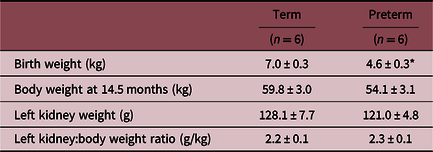
At birth, the sheep born preterm were significantly lighter than those born at term. By 14.5 months of age, however, there was no difference in body weight or absolute and relative left kidney weights between groups (Table 1).
Body weight and kidney weight of preterm and term-born sheep

Data shown as mean ± SEM.
* p < 0.0001 versus term group.
Renal corpuscle and glomerular volumes
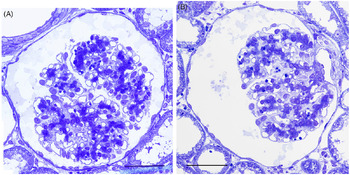
Representative images of renal corpuscles from the adult term and preterm sheep kidneys are shown in Fig. 1. Renal corpuscle volume was significantly larger in the sheep born preterm compared to those born at term, with no difference in size across the three regions of cortex (Fig. 2A). There was no significant difference between groups in glomerular tuft volume (Fig. 2B), with the ratio of glomerular to renal corpuscle volume significantly reduced in the preterm-born sheep compared to the terms (Fig. 2C). There was also a significant region effect, with post-hoc analysis showing that this ratio was significantly greater for renal corpuscles in the outer region of the cortex compared to the inner region across both groups (p = 0.006).
Images of toluidine blue-stained renal corpuscle cross sections from the mid renal cortex of (A) a 14.5-month-old sheep born at term, representing a higher ratio of glomerular tuft:renal corpuscle volume compared to (B) a 14.5-month-old sheep born preterm, which exhibits an enlarged Bowman’s space. Scale bars = 50 µm.

Renal corpuscle volume (A), glomerular volume (B) and glomerular:renal corpuscle volume ratio (C) in the kidneys of 14.5-month-old sheep born at term (n = 6; black bars) and preterm (n = 6; white bars). Data shown as mean ± SEM. Assessed by two-way ANOVA with the factors preterm birth (PPreterm), region of cortex (PRegion) and their interaction (PP*R).

Glomerular capillary length and surface area
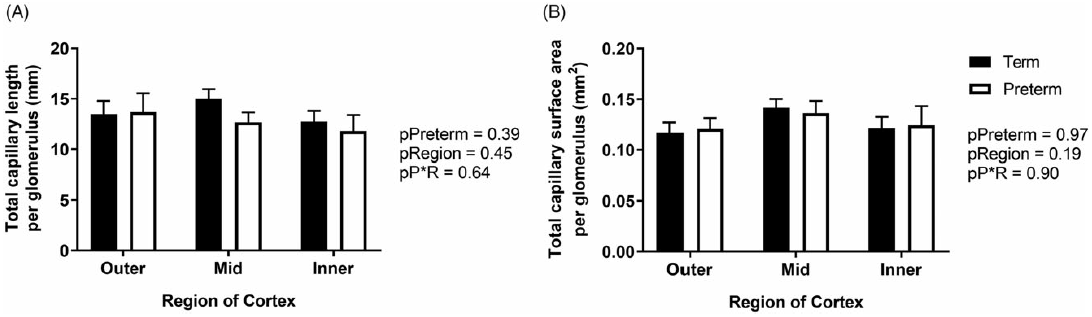
There was no significant difference in total capillary length per glomerulus between groups, and total capillary length did not differ by cortical region (Fig. 3A). Similarly, there was no difference between the preterm and term sheep in total capillary surface area per glomerulus, and across both groups, capillary surface area did not significantly differ between the regions of cortex (Fig. 3B).
Total capillary length (A) and total capillary surface area (B) per glomerulus, of 14.5-month-old sheep born at term (n = 6; black bars) and preterm (n = 6; white bars). Data shown as mean ± SEM. Assessed by two-way ANOVA with the factors preterm birth (PPreterm), region of cortex (PRegion) and their interaction (PP*R).

Interstitial collagen and glomerulosclerosis
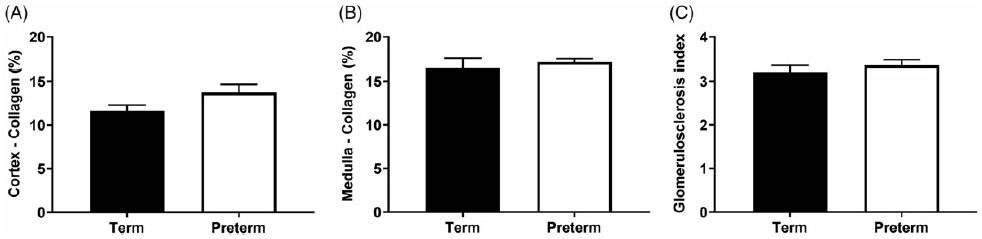
The percentage of interstitial collagen in the cortex and medulla was not significantly different between the adult term and preterm sheep kidneys (Fig. 4A–4B). Furthermore, there was no difference in the glomerulosclerosis index between groups (Fig. 4C).
The percentage tissue area of collagen in the renal cortex (A) and medulla (B), and the glomerulosclerosis index (C) of 14.5-month-old sheep born at term (n = 6; black bars) and preterm (n = 6; white bars). Data shown as mean ± SEM.

Discussion
Preterm birth is a complex and multi-phenotypic syndrome Reference Barros, Papageorghiou and Victora40 that can have lifelong consequences for renal and cardiovascular health. This is the first study to our knowledge that has comprehensively examined the long-term effects of preterm birth on renal morphology and on the structure of glomerular capillaries. Using a clinically relevant large animal model, we found that preterm-born male offspring were smaller at birth, but there were no differences in body weight or kidney weight in early adulthood (14.5 months of age). Encouragingly, there was no evidence of increased interstitial fibrosis or glomerulosclerosis within the kidneys of the preterm-born sheep, and also no evident impact of preterm birth on total glomerular capillary length or surface area per glomerulus. Notably, however, although there was no glomerular hypertrophy within the preterm kidneys, there was significant hypertrophy of the renal corpuscles, the consequence of a dilated Bowman’s space in many of the renal corpuscles within the renal cortex. The cause and functional impact of renal corpuscles with a dilated Bowman’s space is currently unknown, and this is an important area for future research.
Although lambs born preterm were significantly smaller at birth compared to term-born lambs, by adulthood there was catch-up in body weight, with no difference in body weights between groups at 14.5 months of age. People born preterm often exhibit attenuated body growth postnatally Reference Dusick, Poindexter, Ehrenkranz and Lemons41,Reference Johnson, Wootton, Leaf and Jackson42 and remain lighter and shorter in adulthood. Reference Batista, Silva, Barbieri, Simoes and Bettiol43,Reference Roberts, Cheong and Opie44 The impact on body growth is more apparent with increased severity of prematurity at birth. Reference Clark, Thomas and Peabody45 In addition, differences in body weight postnatally often decrease over time, as a result of catch-up in body growth. Reference Batista, Silva, Barbieri, Simoes and Bettiol43,Reference Roberts, Cheong and Opie44 This is a finding also observed in our preterm lamb model, as described previously. Reference Nguyen, De Matteo, Harding, Stefanidis, Polglase and Black34 In the present study, kidney growth did not appear to be affected following moderate preterm birth and was proportional with body weight, with no difference in absolute kidney weight or kidney weight to body weight ratio between the preterm and term-born sheep in adulthood. Over recent years, there have been a number of clinical ultrasound studies reporting on the long-term growth of the kidneys following preterm birth; the majority describe attenuated postnatal kidney length and/or volume relative to age-matched people born at term. Reference Kwinta, Klimek and Drozdz46–Reference Starzec, Klimek, Grudzien, Jagla and Kwinta50 As with body weight, the impact of preterm birth on kidney growth becomes more pronounced with decreasing gestational age at birth. Reference Zaffanello, Brugnara and Bruno51
Negative impacts of preterm birth on glomerular structure and capillary growth have previously been described in both human preterm neonates Reference Sutherland, Gubhaju and Moore19,Reference Rodriguez, Gomez, Abitbol, Chandar, Duara and Zilleruelo20 and large animal models early in life. Reference Gubhaju, Sutherland, Yoder, Zulli, Bertram and Black21–Reference Staub, Dahl and Yost24 It is therefore imperative to determine whether these adverse impacts persist into adulthood. Encouragingly, we found no evidence of increased levels of interstitial renal fibrosis or glomerulosclerosis in the kidneys of preterm-born sheep. Likewise, there was no effect of preterm birth on glomerular size, with no differences in glomerular or renal corpuscle volume across the different regions of the cortex (inner, mid and outer). Of concern, however, there was overall a significant increase in the volume of the renal corpuscles in the preterm kidneys. The observed increase in renal corpuscle volume, but no change in glomerular tuft volume, is indicative of a hypertrophied Bowman’s space in the renal corpuscles of the preterm-born sheep, and this was clearly apparent when examining the histological sections.
The cause of the Bowman’s space enlargement is currently unknown. An enlarged Bowman’s space in the renal corpuscles of preterm kidneys (human and baboon) has previously been observed in the neonatal period. Reference Sutherland, Gubhaju and Moore19–Reference Sutherland, Gubhaju, Yoder, Stahlman and Black22 This is unlikely linked to the findings in the current study, however, given that in the neonatal kidneys, the hypertrophy of Bowman’s space was usually associated with grossly abnormal (shrunken) glomeruli, whereas the glomeruli appeared to be of a normal size in the adult preterm sheep kidneys. Furthermore, this Bowman’s space enlargement has not been previously observed in preterm sheep models in early life. Reference Sutherland, Ryan, Dahl, Albertine and Black23,Reference Staub, Dahl and Yost24 In clinical studies, an increase in renal corpuscle size has been shown to be associated with factors such as low nephron number, obesity, hypertension and ageing, likely as a consequence of glomerular hyperfiltration. Reference Sasaki, Tsuboi and Haruhara52,Reference Tobar, Ori and Benchetrit53 This process occurs concomitantly with glomerular hypertrophy, with the ratio between glomerular and renal corpuscle size shown to be tightly maintained in both hypertrophied and non-hypertrophied glomeruli. Reference Sasaki, Tsuboi and Haruhara52 In the current study, however, the ratio between glomerular volume and renal corpuscle volume was perturbed in the preterm sheep kidneys in adulthood, with no overt evidence of disease, nor stressors such as obesity, Reference Nguyen, De Matteo, Harding, Stefanidis, Polglase and Black34 hypertension Reference Mrocki, Nguyen and Lombardo54 or low nephron number Reference Sutherland, Ryan, Dahl, Albertine and Black23 in this model. Therefore, it is conceivable that the observed enlargement of the Bowman’s space, and thus build-up of ultrafiltrate, may instead relate to downstream tubular dysfunction, for example, tubular constriction or impaired filtrate reabsorption. Concerningly, the resultant increase in hydrostatic pressure in the Bowman’s space is likely to diminish glomerular filtration rate, and it may be speculated that this is an early sign of progressive pathology that will worsen with age. The exact cause of the dilated Bowman’s space within the renal corpuscles of the preterm kidneys, and the consequences for renal function in adulthood, should be addressed in future studies.
We examined renal corpuscle morphology across the inner, mid and outer regions of the cortex. During development, nephrons are formed in concentric layers, with the most mature situated in the inner cortex and most immature in the outer cortex of the kidneys. Reference Osathanondh and Potter55 There also remains, from development through adulthood, variance in the anatomy and function of nephrons across the cortex regions, such as differences in the length and location of tubules within the cortex and medulla, urine concentrating function, proximity to arteries and blood flow distribution. We found in this study that there were no significant regional differences in overall renal corpuscle size, glomerular tuft size or capillary growth. This corresponds to findings in the kidneys of human adults, with studies showing that there is normally very little variation in glomerular size across cortical regions in healthy kidneys. Reference Puelles, Zimanyi and Samuel56 We did, however, find a significant regional effect on the ratio of glomerular tuft volume to renal corpuscle volume, with a significantly higher ratio in the outer cortical renal corpuscles compared to those in the inner cortex. The reduction in this ratio from outer to inner cortex was evident in both the term and preterm groups, suggesting this is a normal feature of renal anatomy in the young adult sheep. To our knowledge, the glomerular to renal corpuscle volume ratio has not previously been examined across the different cortical regions, so it is unknown if this is an anatomical feature common across mammalian species.
Interestingly, there was no effect of preterm birth on capillary length or surface area per glomerulus in adult sheep. Reduced glomerular capillary length and surface area per glomerulus have previously been described in preterm lambs soon after birth Reference Sutherland, Ryan, Dahl, Albertine and Black23 ; however, in that study, lambs born slightly earlier (130 d gestation) than in the present study (132 d gestation) received mechanical ventilation for 72 h after birth. Conversely, in the current study, only half of the preterm lambs were exposed to non-invasive CPAP after delivery, and only for a short time (<30 min). Hence, the difference in findings between the two studies likely relates to the exposure of the lambs to mechanical ventilation with supplemental oxygen after birth; indeed, even in term-born lambs, mechanical ventilation has been shown to reduce postnatal glomerular capillary growth. Reference Sutherland, Ryan, Dahl, Albertine and Black23 Alternatively, it is conceivable that there is also reduced capillary growth in the early period after birth in the kidneys of lambs born moderately preterm at 132 d of gestation, which then becomes normalised in later life. Given the functional significance of glomerular capillary structure on renal filtration and renal filtration surface area, Reference Fong, Denton, Moritz, Evans and Singh25,Reference Brenner, Garcia and Anderson26 it is important in future studies to further explore the causes for the differences between the studies and to determine the long-term effects of early life ventilation on glomerular structure.
In this study, the lambs were born moderately preterm (~0.9 of gestation), which reflects the demographic of the majority of survivors of preterm birth in the human population. It is expected that nephrogenesis would have been completed at the time of delivery in our sheep model Reference Gimonet, Bussieres, Medjebeur, Gasser, Lelongt and Laborde57 and this would also be the case in many human babies born moderately preterm. In human infants, nephrogenesis is completed around 36 weeks of gestation, with recent studies reporting that nephrogenesis can cease as early as 32 weeks of gestation but can be still ongoing in some infants at 37 weeks of gestation. Reference Ryan, Sutherland and Flores16,Reference Sutherland, Gubhaju and Moore19 It is likely that if nephrogenesis was ongoing at the time of birth, then there may be more deleterious effects on renal and glomerular structure that may then persist into adulthood. It is therefore important in future studies to address the long-term impact of very and extremely preterm birth, when nephrogenesis is still ongoing, on kidney structure in adulthood. The exposure of the sheep to antenatal steroids prior to preterm delivery is another factor which needs to be taken into account when evaluating the findings of this study, as its impact cannot be separated from that of preterm delivery itself in this model. Furthermore, a limitation of this study was that only the kidneys of male sheep were examined. At this time point in early adulthood (and while the sheep are in good health), we would not expect there to be any substantial differences in renal morphology between sexes. In any future studies, however, it would be important to examine the trajectory of any sex differences in the setting of ageing and other renal stressors, such as hypertension.
In conclusion, the findings of this clinically relevant study show minimal impacts of moderate preterm birth on the kidneys in adult sheep, with no adverse impact on glomerular capillary length or surface area. The hypertrophy of Bowman’s space in the renal corpuscles of the preterm kidneys is of concern, however, particularly as the sheep have no other risk factors for kidney disease. It is therefore imperative in future studies to determine the cause, functional consequences and long-term progression of this pathological change in preterm kidneys in early adulthood.
Acknowledgements
The authors acknowledge Monash Histology Platform, Monash University, for the provision of equipment, training and technical support. The authors also wish to thank the animal house staff at Monash Animal Services (Clayton and Gippsland Campuses), Monash Medical Centre Animal Facility and the Large Animal Facility at the Department of Physiology, Monash University, for their care of the animals. The authors would also like to thank Natasha Blasch and Dr Shanti Diwakarla for their assistance in the care of the animals.
Financial Support
This work was supported by National Health and Medical Research Council of Australia (NHMRC; grant number 1011354), an NHMRC and National Heart Foundation Research Fellowship (GRP, grant number 1105526) and the Victorian Government’s Operational Infrastructure Support Program. MRS was the recipient of a NHMRC CJ Martin Early Career Research Fellowship, and VBN was the recipient of a Monash University Department of Anatomy and Developmental Biology postgraduate scholarship.
Conflicts of Interest
None.
Ethical standards
The authors assert that all procedures contributing to this work comply with the ethical standards of the relevant national guides on the care and use of laboratory animals (National Health and Medical Research Council of Australia Code of Practice for the care and handling of animals for scientific purposes) and has been approved by the institutional committee (Monash University Animal Ethics Committee).