1. Introduction
Many researchers in the world study ball lightning. One of the main problems in the ball lightning physics is the problem of determining the structure and state of its matter. Ball lightning is one of the strangest and least studied extreme forms of matter, which has attracted the attention of researchers for two centuries. There are a large number of hypotheses and theories, the authors of which are trying to explain the properties of ball lightnings observed in electrical discharges during thunderstorms. It should be noted that the number of theoretical physicists writing about ball lightning is greatly exceeds the number of physicists who perform actual experiments on its generation to obtain real information. A process of creating models for ball lightning is much easier and cheaper than conducting experiments, because this requires a laboratory, equipment, and an experimental setup. The experimenter must not only have experience of working with sources of high voltage, but also the desire to work in contact with a very wide spectrum of electromagnetic radiation. Discussion is always easier than doing a specific work. Therefore, there are a large number of ball lightning models that have been created as a result of observations and/or reasoning in an office. Scientists judge the state of research in the physics of ball lightnings by the publications that appear in the scientific literature. The quality of the created models of ball lightnings is determined by the level of understanding of plasma physics and electric discharges in gaseous medium that is possessed by the authors of the models. The models very often are created by people who do not have enough knowledge and elementary experience in physics. The reliability of the publications of the scientific results obtained has a significant impact on the scientific and technological progress in the world. It is evident that erroneous publications can have a negative impact on progress by slowing it down. Reliable data on the ball lightning physics can only be obtained with the help of experiments performed in a physical laboratory. The results obtained in this way differ significantly from the speculative results obtained in the office through reasoning and analysis. The authors of a review (Shmatov & Stephan Reference Shmatov and Stephan2019) believed that experimental results of Oreshko (Reference Oreshko2015) required additional studies. This article was written with their wishes in mind.
The purpose of this article is to adequately explain the physics of ball lightning, which is ‘a small window to another world,’ as noted by the Nobel Prize laureate, Kapitsa (Reference Kapitsa1955).
2. Lifetime of objects consisting of charged particles in nature
As is known, there is a large difference between the lifetimes of existence of space and laboratory (or Langmuir) plasmas. Cosmic plasma exists in nature for billions of years, while laboratory plasma exists for a very short time. The long lifetime of the rarefied cosmic plasma is explained by the fact that the possibility of a recombination process is sharply reduced owing to the large distance between charged particles, which is many times greater than the Debye screening length. The laboratory plasma, obtained in electrical discharges, in contrast to rarefied cosmic plasma, is destroyed in a time approximately equal to the characteristic time of electron–ion recombination without a constant supply of energy to it.
There is also a wide range of instabilities in laboratory plasma. The instabilities existing in the laboratory plasma arise from the presence of electric and magnetic fields as well as gradients of density and temperature. The instability associated with the separation of charges was discovered not only in gas discharge plasma (Mylnikov & Napartovich Reference Mylnikov and Napartovich1975) but also in magnetically confined plasmas (Oreshko Reference Oreshko1991). This instability is called a domain instability and it is caused by the appearance in the plasma of electric domains with a strong field. The domain instability was first discovered in semiconductor solid-state plasma by Nobel laureate Gunn (Reference Gunn1963) and is responsible for the abnormal plasma transfer to the chamber walls of experimental facilities (Oreshko Reference Oreshko2012a, Reference Oreshko2019). Hereinafter, an electric domain should be understood as a quasi-neutral system in total, which consists of a region (layer) with an excess negative charge and a region (layer) with an excess positive charge. The distance between these two regions of the electric domain exceeds the Debye screening length. The difference between an electric domain and a double layer lies in the presence of a strong electric field and a high speed of motion, which exceeds a value of  ${10^7}\;\textrm{cm}\;{\textrm{s}^{ - 1}}$ (Oreshko Reference Oreshko1991). Quasi-neutral electric domains formed in the plasma cannot be contained by means of a magnetic field, because their total charge is equal to zero. The presence of an excess of charges of the same sign and an absence of charges of the opposite sign in the structural elements of an electric domain sharply reduce the possibilities of recombination and is a reason for their long existence. According to the author's model, ball lightning and an emitting star have the structure of a spherical electric domain with a strong field (Oreshko Reference Oreshko2007b, Reference Oreshko2015).
In structural elements of ball lightning, there is a closed-ring current of electrons in the core and relativistic protons in the outer shell (Oreshko, Oreshko & Mavlyudov Reference Oreshko, Oreshko and Mavlyudov2019). This current creates a poloidal magnetic field (i.e. a magnetic dynamo), the presence of which was discovered experimentally (Oreshko Reference Oreshko2009, Reference Oreshko2015). The circular closed current of particles in the outer shell arising from the ambipolar electric field drives the core into rotational motion in the direction of rotation of the outer shell. The minimum values of the magnetic field induction take place in the central part of the ball lightning. The magnetic dynamo exists in the stars and ball lightnings (Oreshko & Mavlyudov Reference Oreshko and Mavlyudov2016). It was shown that a ball lightning is a structural miniature analog of a star (Oreshko Reference Oreshko2007a, Reference Oreshko2014, Reference Oreshko2015). Note that the presence of a magnetic field was registered in a laboratory during the passage of the produced ball lightning from the generation zone to the ceiling of the laboratory in experiments (Oreshko Reference Oreshko2009) and that the magnetic field promoted the confinement of the particles of the core inside of the ball lightning (Oreshko Reference Oreshko2015). This is the only way to explain the long existence of spherically symmetric structures: both ball lightnings and emitting stars. It should be noted that the generation of a magnetic dynamo and also a number of other experiments on plasma processes and phenomena have been performed at the Wisconsin Plasma Astrophysics Laboratory – WiPAL (Forest et al. Reference Forest, Flanagan, Brookhart, Clark, Cooper, Désangles, Egedal, Endrizzi, Khalzov and Li2015) and MDPX (Thomas et al. Reference Thomas, Konopka, Artis, Lynch, Leblanc, Adams, Merlino and Rosenberg2015).
3. Investigation of the plasma in the zone of ball-lightning generation
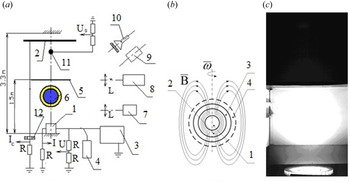
Following the results obtained by Abrahamson & Dinnis (Reference Abrahamson and Dinnis2000) to generate the ball lightning, it is necessary to have Si, SiO, or SiC nanoparticles that oxidize at a rate suitable to explain the life of ball lightning. However, at the ‘Prometheus’ installations, ball lightnings are generated in the air – at normal atmospheric pressure. In the high-voltage experiments of the author, the energy in the capacitive storages is in the range from 10 to 60 kJ, and the maximum value of the current in the discharges using the experimental facility ‘Prometheus’ is equal to 480 kA. The parameters of the facilities are typical for a facilities type of plasma focus. The brightness of the plasma glow in the discharge is always higher than the brightness of the glow of the resulting ball lightning. Therefore, the ball lightning in the discharge can be visually better observed with the help of a blue-light filter owing to the very high brightness of the plasma created in the discharge and the possibility of damage to the eyes. A ball lightning is very well observed in the zone of its generation in the area of obstacles such as a solid-body sheet, tank with water, or on the ceiling during an experiment. Because the accumulated energy in the capacitive storage goes to heating of the matter in the gaseous discharge, in the first approximation from the balance equation  $Q = m{c_p}\Delta T$, the temperature of the formed plasma can be found. The exact value of the maximum temperature in the discharge was obtained using a spectrometer, AvaSpec. The experiments for the investigation of the spectral composition of the plasma were carried out at normal atmospheric conditions using the ‘Prometheus’ experimental facility. The scheme of the experiments is given in figure 1(a). The stored energy in a capacitive storage equaled 11.25 kJ. The charging voltage equaled 15 kV. The charge in the energy storage was 1.5 C.
(a) The scheme of experiments on ball lightning research. (b) The scheme of the ball lightning structure. (c) Optical images of the ball lightning of 90 cm in diameter in the installation ‘Prometheus’ with a stored energy of 20 kJ. Designations in (a): 1 - spheretron; 2 - collector; 3 - capacitive energy storage; 4 - commutation unit; 5 – solid-state sheet; 6 - ball lightning; 7 - electron-optical camera FastCam-5; 8 - electron-optical converter EP-15; 9 - spectrometer AvaSpec; 10 - detector of microwave radiation with teflon absorber; 11 - probe for measuring the potential; 12 - Rogowski loop; L- lens. Designations in (b): 1 - core; 2 - intermediate layer; 3 - outer spherical shell; 4 - halo;  $\boldsymbol{B}$ - lines of induction of the poloidal magnetic field;
 $\boldsymbol{\omega }$ - angular velocity (of closed-ring current of relativistic protons).

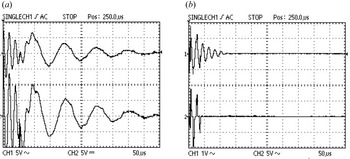
A high voltage pulse duration equaled 450 μs. A standard set of diagnostic methods was used for electrotechnical measurements in the experiments (Oreshko Reference Oreshko2015, Oreshko et al. Reference Oreshko, Oreshko and Mavlyudov2019). The voltage applied to spheretron (discharge device) electrodes and the potential of the probe were measured by an ohmic divisor, and the pulse current and current from a collector by means of a shunt and of a Rogowski loop, respectively. The probability of the appearance of ball lightning in the discharges at the ‘Prometheus’ experimental facilities was equal to 0.99. The only reason for failure of the experimental setup during its start-up was a breakage of the thick copper wires, which can occur from the high current in the previous discharge. Typical wave fronts of voltage and current in a discharge are shown in figure 2(a). Typical wave fronts of potential from a probe and current from a collector are given in figure 2(b). The presence of a potential of alternating polarity from the probe and current from the collector (figure 2b) at the contact of ball lightning with the probe and with the collector gave sufficient grounds to believe that ball lightning consists of positively and negatively charged particles. The presence of local bursts on the voltage oscillogram, which correlated with the shelves on the current oscillogram, arising from the transition of some electrons into layers of excess negative charge, indicated the existence of flat electric domains with a strong field in the discharge.
(a) Typical voltage wave fronts (upper trace-1) and current (lower trace-2) in a spheretron. (b) The wave fronts of the potential from a probe (upper trace-1) and the current from collector (lower trace-2).

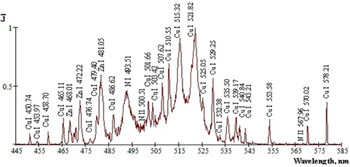
Measurements of the spectral composition of the plasma formed in the discharge to determine its temperature and spectral composition were carried out in experiments using an AvaSpec spectrometer. Microlenses were used to collect the optical radiation from the ball lightning generation zone. The spectral distribution of the plasma radiation intensity during the generation of laboratory ball lightning is shown in figure 3. As a result of the optical measurements, strong lines of Cu and Zn were found in the spectrum, which were typical for the material of the spheretron electrodes. The spheretron is a device for receiving the ball lightning (Oreshko Reference Oreshko2015).
The spectral distribution of plasma radiation intensity in the region of ball-lightning generation in the laboratory.

To make figure 3 more readable, part of the spectrum of 585–670 nm is not shown. The identification of spectral lines also led to an unexpected result: the presence of oxygen lines was not recorded. Such lines are typical for ordinary electrical discharges in air. Because in the spheretron an electric discharge is conducted in the vapor of the electrode materials, some lines in the spectra were quenched. Therefore, there were very weak nitrogen lines at the wavelengths of 500.5 nm and 568 nm that could be identified. The spectrum also contained strong nitrogen lines N I at 491.494 nm and 493.51 nm in a complex superposition of spectral lines in the wavelength range of 489.6–494.7 nm. The problem with registration of these lines was previously discovered in experiments in which the presence of a so-called ‘strange’ radiation was established (Urutskoev, Liksonov & Tsinoev Reference Urutskoev, Liksonov and Tsinoev2000). The use of the method of relative intensities with spectral lines of copper Cu I at 510.55 and 529.25 nm has shown that the plasma temperature in the area of ball-lightning generation does not exceed 1.5 eV. It should be noted that this is the temperature of plasma in the zone of the generation of ball lightning. In contrast to Cen, Yuan & Xue (Reference Cen, Yuan and Xue2014), there were no lines of silicon, calcium, and iron observed in the spectrum which are necessary for the generation of a ball lightning according to the model (Abrahamson & Dinnis Reference Abrahamson and Dinnis2000). Experiments to create large ball lightning show that it can be produced in any gas medium (Oreshko Reference Oreshko2006, Reference Oreshko2007b). It should also be noted that the use of spectrometry methods can only be applied to the halo of a ball lightning where electron transitions in atoms or ions occur. In the core and in the outer spherical shell, such transitions are practically absent owing to the structure of these elements. Therefore, the luminosity intensity of a ball lightning is low. Structural elements of a ball lightning (core and outer shell) appear as a result of the separation of ions and electrons in plasma in the generation zone by means of crossed electric and magnetic fields (Oreshko Reference Oreshko2015). The energy of protons in the outer shell of a ball lightning should not be identified as the energy of plasma ions in the generation zone. In the resulting ball lightning, the azimuthal energy of protons of the outer shell, according to results of measuring of potential by means of a probe on the laboratory ceiling, was 20 MeV (Oreshko et al. Reference Oreshko, Oreshko and Mavlyudov2019). This difference is explained by the fact that the formation of structural elements of a ball lightning is carried out by means of the crossed variable electric and magnetic fields (Oreshko Reference Oreshko2015, Oreshko et al. Reference Oreshko, Oreshko and Mavlyudov2019) with help from which the charged particles acquire a significant value of energy. Thus, the assumption in the review by Shmatov & Stephan (Reference Shmatov and Stephan2019) that in the high-current high-voltage electric discharges, Oreshko (Reference Oreshko2015) obtained ‘light-emitting regions accompanied by intense radio-wave radiation’ is very far from reality.
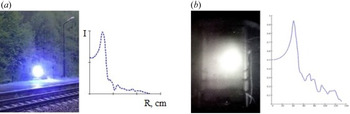
Analyses of the structure of ball lightning observed in electrical discharges during a thunderstorm (figure 4a) and the structure of ball lightning obtained in the laboratory (figure 4b), by studying the distribution of the intensity of their glow using the Scion Image program and subsequent Radon inversion, showed that ball lightning consists of a less bright luminous core, which is surrounded by a brighter luminous outer shell. The ball lightning had a halo that adjoined the outer shell. The fact that when a ball lightning obtained in the laboratory comes into contact with a collector or the probe installed under the ceiling (see typical wave fronts in Oreshko Reference Oreshko2015), the signal polarity is always positive, indicates that the outer shell consists of positive charges – protons (Oreshko et al. Reference Oreshko, Oreshko and Mavlyudov2019). Thus, there is no difference between the structure of a natural ball lightning and the ball lightning obtained in the laboratory (Oreshko Reference Oreshko2007b, Reference Oreshko2015).
Distribution of intensity glow I along the radius R of natural (a) and laboratory (b) obtained ball lightnings.

The ball lightnings, obtained at the ‘Prometheus’ devices, have good spherical symmetry, consist of structural elements with excess volume charges, have clear boundaries, extremely high penetrating ability (super-passability), and create their own magnetic field with minimal induction in the center – a magnetic dynamo (Oreshko Reference Oreshko2009, Oreshko & Mavlyudov Reference Oreshko and Mavlyudov2016), i.e. have all the properties of natural ball lightning observed in the atmosphere.
4. Relativistic ball lightning generated in electrical discharge
The experimental results obtained on the passage of the ball lightning through thick solid-state sheets produced from metal (Oreshko Reference Oreshko2011, Reference Oreshko2012b), as well as the measurement of potential and detection of a nuclear photoeffect during the generation of ball lightning (Oreshko et al. Reference Oreshko, Oreshko and Mavlyudov2019), provide sufficient evidence that the ball lightning is a relativistic object. Previously, the term ‘absorbing filter’ was used in experiments on the passage of ball lightning through solid-state objects. However, this term is not correct because of the lack of absorption of the ball lightning during its passage through the metal sheets.
In the model of the ball lightning as an electric domain of a spherical shape, the ball lightning consists of the core with an excess negative charge and an outer shell with an excess positive charge (Oreshko Reference Oreshko2006, Reference Oreshko2007b, Reference Oreshko2015). This model was created on the basis of experimental results on the generation of micro-ball lightning (Oreshko Reference Oreshko2003, Reference Oreshko2004), which enabled obtaining a large ball lightning (Oreshko Reference Oreshko2006, Reference Oreshko2007b, Reference Oreshko2015) in the laboratory as a result of creating their structural elements by means of crossed  $\boldsymbol{E} \times \boldsymbol{B}$ fields (Oreshko Reference Oreshko2015). These experiments gave grounds to believe that spherically symmetric structures, stars and ball lightnings, have a long lifetime because they are spherical electric domains (Oreshko Reference Oreshko2006, Reference Oreshko2007a, Reference Oreshko2007b, Reference Oreshko2011, Reference Oreshko2014). A schema of the relativistic ball lightning of the electric domain type is given in figure 1(b). There may be an intermediate thin layer between the core and the outer shell, which is probably a rarefied medium. Electric breakdown of the structural elements of ball lightning in the presence of a superstrong electric field is prevented by the fact that its core is in the region of minimum values of the induction of the poloidal magnetic field
 $\boldsymbol{B}$. Also, one cannot deny the influence of the possible presence of a rarefied medium on the absence of breakdown.
The maximum diameter of the received ball lightning is equal to 94 cm (Oreshko & Mavlyudov Reference Oreshko and Mavlyudov2016). Charged particles in the structural elements of such ball lightnings move in a circle with a relativistic speed (Oreshko et al. Reference Oreshko, Oreshko and Mavlyudov2019). Inside the ball lightning, after its formation, the movement of electrons and ions has a mutually coordinated character because of the presence of a poloidal magnetic field. Ball lightning, in the absence of its movement in air space, owing to the absence of charged particles of the opposite sign in the elements of its structure, has no bremsstrahlung energy losses. Owing to the absence of particles of the opposite sign, the state of superconductivity is also achjeved. However, during the drift of ball lightning in air, particles of neutral air enter it. The entry of the neutral particles is accompanied by their ionization both with the help of a strong electric field and as a result of collisions of the ball lightning particles with neutral atoms. The drift of the ball lightning in air is also accompanied by weak radiation in the optical range, hard photons, and bremsstrahlung.
The ball lightning is a material object that stores energy within itself during the process of its generation. There is no influence and further supply of energy to the previously formed ball lightning from the environment. The ball lightning can be obtained only as a result of separation of charged particles in a plasma-vortex jet using strong crossed electric and magnetic fields (Oreshko & Mavlyudov Reference Oreshko and Mavlyudov2011, Oreshko Reference Oreshko2015, Oreshko et al. Reference Oreshko, Oreshko and Mavlyudov2019) and the presence of a plasma pressure gradient. The resulting ball lightning has an ideal spherical shape that only stars have (Oreshko Reference Oreshko2007b, Reference Oreshko2015). The assumption that all celestial bodies arise as a result of vortex movements was first expressed by R. Decartes (in: Stanford Encyclopedia of Philosophy 2017). It should be noted that the mechanism of the ball-lightning generation based on microwave radiation was described for the first time by Oreshko (Reference Oreshko2006).
Microwave radiation arises from an electric discharge at the breakdown stage, which is accompanied by the passage between the electrodes of the current-plasma channel – the leader (Oreshko Reference Oreshko2003, Reference Oreshko2004, Reference Oreshko2006). The leader has a flat (more precisely, elliptical) electric domain with a strong field at its head part. The periodic appearance and destruction of an electric domain is accompanied by the generation of microwave radiation in the direction that is perpendicular to the direction of the movement of the leader. Generation of plasma jets in the electric discharges, in the upper atmosphere and in outer space, occurs with the help of electromagnetic waves, which capture and accelerate charged particles. The destruction of the electric domain in the leader's head can be explained only by the fact that during the movement, the space charge is periodically neutralized owing to the entry of neutral particles into its region. The mechanism of electric breakdown in discharges based on an electric domain with a strong field was developed on the basis of a number of experimental results obtained by the author and has a theoretical justification (Oreshko Reference Oreshko2001, Reference Oreshko2003, Reference Oreshko2004, Reference Oreshko2006, Reference Oreshko2010, Reference Oreshko2019). The stepped character and branching of linear lightning, i.e. the presence of kinks in its trajectory during discharge in the atmosphere between the cloud and the ground, can be explained only as a result of the destruction of the flat electric domains in the leader's head.
It should be noted that electric domains with a strong field, which exist in semiconductors and gas-discharge plasmas, are analogs of the electric oscillator of Nobel laureate G. Hertz. Microwave radiation was recorded in electrical discharges (Oreshko Reference Oreshko2003, Reference Oreshko2004, Reference Oreshko2010) and a theoretical explanation for this phenomenon was given by Oreshko (Reference Oreshko2006). This radiation arises from the generation of electrical domains at the head of the leader, which moves between the electrodes. With the help of a transverse electromagnetic wave, a vortex plasma jet is generated. The charged particles in crossed fields  $(\boldsymbol{E} \times \boldsymbol{B})$ during the ball lightning formation acquire significant kinetic energy, which is typical for particles in cyclotrons – E = 20 MeV (Oreshko et al. Reference Oreshko, Oreshko and Mavlyudov2019). Consequently, the structural elements of ball lightning have a significant rotational moment. Thus, ball lightning is a energy storage of spherical shape. It also makes sense to clarify the main types of ball lightning energy, which earlier were given by Oreshko (Reference Oreshko2015). In the field of generation, the total energy of the ball lightning is the sum of:
1. kinetic energy of relativistic electrons and protons which rotates in a circle of structural elements;
2. capacitive component owing to the strong electric field between the core and the outer shell;
3. inductive component owing to the poloidal magnetic field created by rotating charges;
4. thermal energy owing to the presence of particle temperature.
The energy of the ball lightning cannot exceed the energy that it receives in the process of its formation from the energy storage. It is also known that in nature, there are no external sources to support ball lightning during its existence. During drift of the ball lightning in the air, there is a dissipation of energy of charged particles owing to their elastic and inelastic interaction with molecules and neutral atoms of air that enter into the ball lightning during its motion. There are also energy losses of charged particles to synchrotron radiation. The interaction of the particles of ball lightning with molecules and atoms of air during drift leads to the generation of ozone and the appearance of a halo around the outer shell. In addition to the presence of high conductivity in the structural elements, the ball lightning has the property of superpassability (Oreshko Reference Oreshko2015). Owing to the effect of converting the energy of the poloidal magnetic field into kinetic energy, as the ball lightning enters a dense environment (including a solid body), the energy of protons becomes sufficient to generate pions (Oreshko et al. Reference Oreshko, Oreshko and Mavlyudov2019). The decay of pions leads to the appearance of muons, muonic neutrino, and antineutrino. The presence of muons is confirmed not only by signals of variable polarity from the probe for measuring the potential, which was installed under the ceiling, but also by the appearance of a black ball lightning after passing through a dense medium (Oreshko & Oreshko Reference Oreshko and Oreshko2016).
Owing to the fact that a ball lightning has the structure of a spherical electric domain with strong electric and magnetic fields, which consists of an outer shell with surplus positive charge (protons) and a core with surplus negative charge (electrons):
1. the processes of recombination slow down sharply owing to the absence of electrons in the region of the outer shell and the deficiency of ions in the region of the core;
2. the absence of atoms and ions in structural elements and the absence of electron level transitions leads to a significant decrease in the emissive power of the ball lightning in the visible range of the spectrum;
3. the absence of particles of the opposite sign in the structural elements ensures a high conductivity and the absence of bremsstrahlung losses;
4. closed-ring current of relativistic protons creates a poloidal magnetic field, owing to which:
(a) particles of the core cannot move in the radial direction – to the region of the increasing poloidal magnetic field;
(b) electrical breakdown between the core and the outer shell becomes impossible; and
(c) the strength of the radial electric field can reach large values (owing to the lack of air between the core and the outer shell, as well as owing to the magnetic field, which increases in the radial direction);
5. it is a spherical high-density energy storage and the kinetic energy of protons in its outer shell is sufficient to carry out the nuclear reactions.
The stability of such ball lightning in the first approximation is achieved owing to the fact that the force of electrostatic attraction between its structural elements is balanced by the force arising from centripetal acceleration. However, as a result of the loss of energy by particles at some point in time, the sum of all forces in the equatorial plane of the ball lightning becomes nonzero. At this moment, owing to the imbalance of forces, an electrical breakdown occurs between the core and the outer spherical shell of the ball lightning, which is accompanied by a sharp sound arising from the shock wave and the appearance of quasi-neutral plasma, which recombines very quickly. A similar process also occurs when a star collapses and its elements acquire significant impulse during its collapse. Thus, the lifetime of the ball lightning is determined by the rotational moment that it receives during its generation, as well as the loss of energy of its particles owing to collisions with the environmental particles and synchrotron radiation. The bremsstrahlung is absent inside of the ball lightning and does not affect its lifetime. It should also be noted that the specific energy losses of a star in rarefied outer space are much less than the energy losses of ball lightning in the air. The high speed of a ball lightning in the area between the generation zone and the ceiling of the laboratory ( ${5}\cdot 10^{8}\ \textrm{cm}\ {\textrm{s}^{- 1}}$; Oreshko Reference Oreshko2007b) is reached owing to the fact that its formation occurs with the help of crossed alternating electric and magnetic fields. In nature, only plasma jets, which form between the tips of spiral arms in the Galaxy, have a higher speed. However, these jets propagate in a very rarefied medium, in contrast to the plasma jet, which move in the air and where the ball lightning is generated. In laboratory experiments, ball lightning disappears upon entering the ceiling or upon contact with a grounded collector plate mounted on the ceiling. The ceiling height in the laboratory is insufficient to reduce the axial component of the ball lightning energy to a value at which it drifts in space, tracking the potential distribution, as noted by Lowke (Reference Lowke1996). The laboratory is located at the University. To measure the lifetime of a ball lightning, it is necessary that it be generated in a deserted area. The model of ball lightning as a spherical electric domain is created on the basis of the results that were obtained in experiments. This is the only way to give a correct explanation for the phenomenon of ball lightning. A number of studies also confirm the fact that ball lightning is a relativistic high-energy object (Nikitin et al. Reference Nikitin, Bychkov, Nikitina and Velichko2014, Schedrin Reference Schedrin2018, Netchitailo Reference Netchitailo2019, Oreshko et al. Reference Oreshko, Oreshko and Mavlyudov2019).
5. Generation of large ball lightning
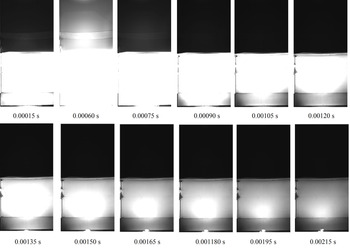
Large ball lightnings were also obtained at the experimental installation ‘Prometheus’. An image of the ball lightnings with diameters of 90 cm which stand in the space between a spheretron from below and a solid-state sheet (aluminum) from above is given in figure 1(c). The diameter of the disk in the device for production of the ball lightning (a spheretron) in the lower part of figure 1(c) is equal to 70 cm. The use of the FastCam-5 electron-optical camera made it possible to obtain a series of frames of a ball-lightning generation during one start-up of the experimental setup. This camera is only sensitive in the black-white part of the spectrum. However, this did not prevent us from obtaining interesting results. When particles and crossed fields were fed into the region of the ball lightning formation from two sources at the initial stage of the discharge, a high-energy ball lightning was formed, which passed through solid sheets of aluminum and plexiglass installed above the generation zone (see figure 5 [t = 0.00060 s)], and then, a large diameter ball lightning appeared in the region between the spheretron and the aluminum sheet – see figure 5 (t = 0.00105 s). The large ball lightning, in contrast to the initially obtained high-energy small ball lightning, passed through the solid sheets and gradually decreased in diameter in the area of its generation for some time before destruction – see figure 5 (from t = 0.00105 s to t = 0.00215 s). The total accumulated energy in the two capacitive storages was equal to 20 kJ. The low duration of the existence of the large ball lightning in this experiment was explained by the low efficiency of energy transfer owing to the high inductance of the old-type capacitors in the energy storages.
Video frames (from left to right) of high-energy (see t = 0.00060 s) and large (after frame t = 0.00105 s) ball lightning standing between a spheretron and an aluminum sheet, obtained by means of an electron-optical camera ‘FastCam-5’ during one start-up of the experimental facility.

At the moments of time of t = 0.00030 s and t = 0.00045 s, the images were absent owing to the influence of very strong electromagnetic interference during the generation of the high-energy ball lightning on the electronics of the electron-optical camera. Therefore, these two frames are not shown. The maximum diameter of the large ball lightning was 94 cm. Energy storage devices based on high-current capacitors with low inductance are required to increase the lifetime of a large ball lightning from milliseconds to seconds. The lifetime of a large ball lightning (see figure 5) is much longer than the typical electron–ion recombination time. It should be noted that to determine the lifetime of high-energy laboratory ball lightning, it is necessary to carry out its generation outside the laboratory, i.e. in an open air space. However, there is currently no way to conduct such an experiment.
The ability of the high-energy laboratory ball lightning to pass through sheets of a solid-state body gives reason to believe that their lifetime is close to the typical lifetime of natural ball lightnings observed in thunderstorms.
6. Conclusions
A qualitative description of a relativistic model of ball lightning, which is a spherical electric region with strong fields, is given. This model of ball lightning is based on the results from experiments on the generation of micro-ball lightnings and large ball lightnings, obtained at the laboratory by the author. Spectroscopic measurements in the zone of the ball-lightning generation make it possible to determine the temperature of the plasma. The reason for the low emissive power in the optical range typical for atmospheric ball lightning is explained by the absence of electron transitions in the outer proton-containing shell. Explanation is also given for the absence of an electrical breakdown between the structural elements of the ball lightning at a very high voltage and its destruction at the moment when the resulting force becomes nonzero.
The experimental results of the author of this article differ significantly from a large number of hypotheses, scenarios, and models of other scientists who have published a large number of articles. This article is the response to the need for additional studies on previously received results (Oreshko Reference Oreshko2015), as was noted by the review of Shmatov & Stephan (Reference Shmatov and Stephan2019), as well as the response to ignoring the results on micro-wave radiation (Oreshko Reference Oreshko2003, Reference Oreshko2004, Reference Oreshko2006, Reference Oreshko2010) in the review. The ball lightning obtained by the author of this article cannot be a ‘region of highly excited light-emitting air’, as the authors of the review suggest (Shmatov & Stephan Reference Shmatov and Stephan2019). The long absence of an experimental confirmation of the nonrelativistic model (Shmatov Reference Shmatov2003, Reference Shmatov2015a) does not give the authors sufficient grounds for distorting the experimentally obtained results of other authors in their review (Shmatov & Stephan Reference Shmatov and Stephan2019). The nonrelativistic hypothetical model (Shmatov Reference Shmatov2003, Reference Shmatov2015a) also requires experimental confirmation based on ready-made scenarios published by Shmatov (Reference Shmatov2015b). Good conditions for testing of the nonrelativistic model of the ball lightning are available at the Ioffe Institute where the model creator works.
Many breakthrough technologies can be created for humanity based on the use of the ball lightning at normal conditions. One of the possible applications of a large laboratory produced ball lightning is its use as an active zone in spheromak-type reactors. It is possible that this will greatly simplify the design and reduce the number of problems typical for existing spheromaks. The complete lack of funding and the presence of unreasonable restrictions do not allow the author of this article to perform such interesting experiments, including experiments on the interaction of ball lightning with a deuterium-tritium containing medium (Oreshko, Oreshko & Mavlyudov Reference Oreshko, Oreshko and Mavlyudov2018). The developed methods of producing ball lightning and the obtained results can be applied for practical purposes after testing under normal conditions with funding.
Acknowledgements
The author would like to thank Professors C.B. Forest, R.L. Merlino, and Drs V.S. Netchitailo and A.V. Bogomolov for helpful discussions, comments, and interest to the work. I also express my gratitude to T.B. Mavlyudov for help with the spectroscopic measurements.
Editor Cary Forest thanks the referees for their advice in evaluating this article.
Funding
This research did not receive any specific grants or financial support from funding agencies in the state, commercial or non-profit sectors, and therefore this article may not be subject to any sanctions or restrictions by either state, private organizations, or individuals.