In the current economic and social context, innovation provides a clear competitive advantage for both, organizations (De Dreu, Reference De Dreu2006; Eisenbeis, Knippenberg, & Boerner, 2008) and countries (OECD, 2007). For this reason, an increasingly pressing concern is to identify which factors at the individual, group and organizational levels make it possible to develop and foment innovation. Team work has been highlighted as one of the key strategies for developing innovation (Anderson, De Dreu, & Nijstad, Reference Anderson, De Dreu and Nijstad2004;). Although a growing number of organizations have decided to structure the work in work teams in order to increase their capacity for innovation and development (Anderson & West, Reference Anderson and West1998; González-Romá, Reference González-Romá2008), few studies have analyzed innovation in work teams (Anderson et al., Reference Anderson, De Dreu and Nijstad2004, Eisenbeiss et al., 2008).
Research carried out at the group level has tried to determine which group processes foster innovation (González-Romá, Reference González-Romá2008). Among these processes, teams’ innovation climate has been highlighted. Innovation climate refers to the degree to which the generation of new ideas is encouraged within teams and these ideas are well-received, and the amount of support and resources offered for their implantation. Teams in which the generation of new ideas is encouraged, and the necessary resources are offered to put them into effect, would be expected to be more innovative (West, Reference West2002). Previous research seems to confirm this relationship (Kazama, Foster, Hebl, West, & Dawson, Reference Kazama, Foster, Hebl, West and Dawson2002).
The importance of innovation climate as a precursor of innovation in work teams poses a new research question: what are the main factors related to the development of innovation climate in teams?. Leadership has been identified as one of the key factors (González-Romá, Reference González-Romá2008). Based on the Leader-Member Exchange (LMX) theory (Graen & Uhl-Bien, Reference Graen and Uhl-Bien1995), the relationships between leadership and the psychological (i.e. individual) climate of innovation have been analyzed, obtaining significant and positive relationships between the two variables (Dunegan, Tierney, & Duchon, Reference Dunegan, Tierney and Duchon1992; Scott & Bruce, Reference Scott and Bruce1994).
However, although LMX theory clearly has a group nature, the majority of the research has been conducted at the individual or dyadic level (Henderson, Liden, Glibkowski, & Chaudhry, Reference Henderson, Liden, Glibkowski and Chaudhry2009). In this sense, some studies have pointed out the need to develop new research that identifies the consequences of the quality of the leader-member relationship at higher levels of analysis (Henderson et al., Reference Henderson, Liden, Glibkowski and Chaudhry2009; Schyns, Reference Schyns2006). The purpose of the present study is to contribute to the development of the leader-member exchange theory at the team level. To do so, we analyze the relationship of two group indicators of this interchange (the mean leader-member exchange quality on the team, and the degree of intra-group differentiation in these relationships) with team innovation climate.
Leader-member exchange and innovation climate
Leader-member exchange theory (LMX) considers that leaders establish different leadership relationships with each of their followers (high or low quality relationships) instead of establishing a general leadership style (Liden & Graen, Reference Liden and Graen1980). High quality leader-member relationships are defined as those in which leaders offer their followers greater resources, confidence, support, autonomy and decision-making latitude (Dansereau, Graen, & Haga, Reference Dansereau, Graen and Haga1975; Graen & Uhl-Bien, Reference Graen and Uhl-Bien1995). Previous research has not only verified the existence of differentiated dyads in work groups, but it has also studied the characteristics of leader-member relationships, as well as the process through which they develop. Individual-level meta-analyses point out that high quality relationships are related to positive work outcomes, such as greater performance, job satisfaction and organizational commitment (Gerstner & Day, Reference Gerstner and Day1997), as well as organizational citizenship behaviors (Ilies, Nahrgang, & Morgeson, Reference Ilies, Nahrgang and Morgeson2007).
Recently, LMX research has focused on the group level of analysis (Le Blanc & González-Romá, 2012; Naidoo, Scherbaum, & Goldstein, Reference Naidoo, Scherbaum, Goldstein, Graen and Graen2008; Schyns & Day, Reference Schyns and Day2010), responding to various authors who defended the need to consider leader-member relations as a system of interdependent or interwoven dyadic relationships in work networks (Graen & Scandura, Reference Graen, Scandura, Staw and Cummings1987; Graen & Uhl-Bien, Reference Graen and Uhl-Bien1995), rather than as a set of independent dyads. This perspective leads to the proposal that when leaders develop high quality relationships with all their followers, better group results are achieved (Graen, Novak, & Sommerkamp, Reference Graen, Novak and Sommerkamp1982; Graen & Uhl-Bien, Reference Graen and Uhl-Bien1995). That is, at the group level the optimal situation would be defined by high mean LMX quality along with low differentiation in the levels of quality of these relationships within the team, referred to as LMX excellence (Schyns & Day, Reference Schyns and Day2010).
The scant existing research on the relationship between LMX and innovation has focused on the individual level, showing the existence of significant positive relationships between the two constructs (Dunegan et al., Reference Dunegan, Tierney and Duchon1992; Sanders, Moorkamp, Torka, Groeneveld, & Groeneveld, Reference Sanders, Moorkamp, Torka, Groenveld and Groenveld2010; Scott & Bruce, Reference Scott and Bruce1994; Reference Scott and Bruce1998). However, the influence of the leader-member exchange at the group level on the shared perception of innovation climate has not been analyzed. On the other hand, as the studies carried out have been cross-sectional, it is not possible to make inferences about the causality of the relationships.
The fact that LMX research carried out at the individual level has shown significant positive relationships between this construct and innovation climate leads to the expectation that LMX at the group level is also related to teams’ innovation climate. The development of a team innovation climate requires that team members feel backed and supported by their organizations and leaders when making and implementing new proposals. Likewise, developing an innovation climate requires that teams obtain the necessary resources, both tangible and intangible, to innovate (González-Romá, Reference González-Romá2008). Therefore, one could expect that, just as occurs at the individual level, high mean levels of LMX in work teams would lead to higher levels of innovation climate:
Hypothesis 1: The mean quality of teams’ leader-member interactions at time 1 will show a positive relationship with teams’ innovation climate at time 2.
Although its correlates and influences are still not clear, the consideration of LMX at a group level of analysis has incorporated, together with the mean LMX, the concept of differentiation in the quality of the relations. The degree of differentiation is understood as “set and outcome of dynamic and interactive exchanges that occur between leaders and members, the nature of which (transactional versus social exchange) may differ across dyads within a work group” (Henderson et al., Reference Henderson, Liden, Glibkowski and Chaudhry2009, p. 519). That is, it refers to the degree to which the leader establishes different relationships, in terms of quality, with each of the members of his/her team. A high level of differentiation indicates that there is a large difference in how the different members of the group perceive their relationship with the leader. A low level of differentiation indicates that all the members of the team perceive the quality of their relationship with the leader in a similar way. Recently, various studies have analyzed the influence of LMX differentiation on different team processes and results (Boies & Howell, Reference Boies and Howell2006; Henderson, Wayne, Shore, Bommer, & Tetrick, Reference Henderson, Wayne, Shore, Bommer and Tetrick2008; Le Blanc & González-Romá, 2012; Schyns, Reference Schyns2006), in some cases finding positive effects of the differentiation and in other negative ones. As Henderson et al. (Reference Henderson, Liden, Glibkowski and Chaudhry2009) suggest, a variety of factors can be interacting with the LMX differentiation between teams (perceptions of justice in the group regarding the LMX differentiation, individual levels of LMX in the group, etc.) to explain certain individual, group and organizational results. In the same sense, Schyns and Day (Reference Schyns and Day2010) point out that a key question is to determine in what conditions this differentiation produces positive results and in what conditions it does not. Therefore, it may not be enough to pay attention to the mean quality of the relationships and the level of differentiation as separate variables; instead, their interaction may be what is influencing group processes and results.
Some previous studies that have analyzed the moderator role of LMX differentiation in the relationships between the mean LMX level and group results have obtained varied findings, in some cases contrary to the hypotheses formulated, as in the case of Boies and Howell (Reference Boies and Howell2006). Specifically, they found that the relationships between the teams’ mean LMX, on the one hand, and group strength and intra-group conflict, on the other, were stronger when the level of LMX differentiation was higher. However, in another study, Le Blanc and González-Romá (2012) analyzed the moderator role of LMX differentiation in the relationship between teams’ mean LMX and their commitment and performance. Unlike in the study by Boies and Howell (Reference Boies and Howell2006), the results obtained were congruent with the hypotheses proposed, indicating that the relationship was stronger when the level of differentiation was lower.
The moderator effect of LMX differentiation can be understood in terms of the concept of situational strength by Mischel (Reference Mischel1973). Strong situations are those in which all the members of a group interpret their surroundings in a similar way, which produces similar expectations about the appropriate responses in these surroundings, reducing their variability. In contrast, in weak situations there is a high level of ambiguity in the interpretation of the environment, which produces greater variability in the appropriate responses (González-Romá, Peiró, & Tordera, Reference González-Romá, Peiró and Tordera2002; Mischel, Reference Mischel1973; Ostroff & Bowen, Reference Ostroff, Bowen, Klein and Kozlowski2000). Therefore, in teams with low LMX differentiation (strong situations), LMX quality will foster consistent innovation climates: teams with high mean LMX will have high scores on innovation climate, while teams with low mean LMX will have low scores on innovation climate. However, in teams with high LMX differentiation (weak situations), the variability in the interpretations of the team’s innovation environment will be greater, which will impede predicting the innovation climate. Thus, the relationship between the mean LMX and the innovation climate will be greater when LMX differentiation is low than when it is high. Therefore, we propose the following hypothesis:
Hypothesis 2: The degree of differentiation in LMX shown by work teams at time 1 will moderate the positive relationship between the mean quality of LMX in teams at time 1 and teams’ innovation climate at time 2, so that the lower the differentiation, the stronger this relationship will be.
Method
Sample and procedure
The present study consisted of a field study with a longitudinal design. Data were collected at two points in time (time 1 and time 2) separated by one year. The data were obtained from the responses to a questionnaire administered to the members of different teams who worked in a regional healthcare service. The participation of all the teams belonging to this service was requested. To collect information, a letter was sent to the Provincial Health Delegation soliciting their collaboration. Later a similar letter was sent to the directors of the health districts, and each of the teams was visited. These teams were made up of healthcare professionals and administrative staff. In each of them, a doctor played the role of coordinator. A sample of 536 subjects belonging to 33 work teams was obtained. We controlled for the stability of the work team coordinator between time 1 (T1) and time 2 (T2), as not all of the teams maintained the same coordinator at both data collection moments. Specifically, 17 teams maintained the same coordinator, 7 teams changed coordinators, and for 9 teams we have no information in this regard. These last 9 teams were excluded from the analyses, and coordination stability was introduced as a control variable. This process yielded a sample of 413 subjects belonging to 24 work teams.
Sixty percent of the subjects at T1 were women. The mean age was 36.5 years (SD = 7.5). Mean professional experience was 12.1 years (SD = 6.9). Regarding the age of the organization, the average was 8.6 years (SD = 6.1), and in the case of the age of the team, the mean was 4.6 years (SD = 3.1). The mean team size was 28.2 subjects (SD = 13.98).
Measures
One of the first questions that must be dealt with in a multi-level study is to specify the level of theory and the process that relates this level to the level at which the data are obtained (Kozlowski & Klein, Reference Kozlowski, Klein, Klein and Kozlowski2000). In this case, the level of theory, specified in the introduction, was the group or team level. Regarding the relationship between the data collection level and the level of theory, when data are collected at the individual level to test group level hypotheses, a consensus model of composition is generally considered. In this type of model, the individual scores of those teams with low levels of intra-team variability are aggregated at the group level. The LMX theory is based on the supposition that the quality of the leader-member relationships varies considerably within the groups; therefore, in these groups a high level of agreement on the LMX scores would not be expected. Consequently, it would be inappropriate to follow a direct consensus model to obtain a group indicator of LMX quality, as this model requires a high level of intra-group agreement to justify the aggregation (Henderson et al., Reference Henderson, Liden, Glibkowski and Chaudhry2009). In the present study, we follow an additive composition model to obtain a team-level indicator of LMX quality. In these models,
“the meaning of the higher level construct is a summation [or average] of the lower level units, regardless of the variance among these units. … The typical operational combination process is a simple sum or average of the lower level scores on the lower level variable to represent the value on the higher level variable” (Chan, Reference Chan1998, p. 236).
On the other hand, to obtain an LMX differentiation indicator, we followed a dispersion model. In these models, “the essence of dispersion composition is in specifying the nature of the higher level construct represented by dispersion along some lower-level variable” (Chan, Reference Chan1998, p. 240). LMX differentiation was operationalized by means of the average deviation index (Burke, Finkelstein, & Dusig, Reference Burke, Finkelstein and Dusig1999) shown by each team in LMX scores.
Individuals’ leader-member exchange (LMX) quality This variable was measured using the leader-member exchange (LMX) scale developed by Scandura and Graen (Reference Scandura and Graen1984). This scale is made up of seven items (e.g., “To what degree do you think your coordinator is capable of understanding your problems and needs?”). These items were answered using a scale with four alternative responses. Given that on the original scale high scores indicate low levels of LMX, the response scale was inverted for a better comprehension of the results. Thus, after the transformation, high scores indicate high levels of LMX. The reliability analyses (Cronbach’s α coefficient) showed an internal consistency coefficient of .88 at time 1.
Teams’ leader-member exchange (LMX) quality As mentioned above, this variable was operationalized by averaging team members’ scores on the LMX scale following an additive model of composition.
LMX differentiation This variable is defined as the degree of intra-team dispersion on the team members’ evaluations of the quality of their exchange relationship with the leader. The degree of intra-team dispersion was operationalized using the average deviation index (ADM(J)) for each work team (Burke et al., Reference Burke, Finkelstein and Dusig1999). This index is obtained by calculating the average absolute deviation of each group member’s LMX score from the group LMX mean. It can be considered a within-group dispersion measure (Burke, et al., Reference Burke, Finkelstein and Dusig1999). High scores on ADM(J) regarding LMX indicate high levels of intra-team disagreement or differentiation in the quality of the team members’ relationships with their leader. Low scores indicate high levels of agreement or low differentiation.
Team innovation climate The innovation climate scale used is part of a questionnaire developed by the international research group FOCUS (First Organisational Climate/Culture Unified Search), see van Muijen et al. (Reference van Muijen, Koopman, De Witte, De Cock, Susanj, Lemoine and Tunipseed1999) for a detailed description; and González-Romá et al. (Reference González-Romá, Tomás, Peiró, Lloret, Espejo, Ferreres and Hernández1996) for the Spanish version. The innovation climate scale is composed of 12 items with six response choices (1 “never”; 6 “always”). Examples of the items are: How often does the team look for new development opportunities in their setting?; How often do they encourage new ideas about the organization of the work?; How often does the external environment require changes in your work? The internal consistency coefficient (Cronbach’s α coefficient) was .73 at time 1 and .79 at time 2.
Before aggregating the scores at the team level, we evaluated the intra-unit level of agreement on innovation climate. The mean of the ADM(J) values for the 24 teams was .88 in time 1 and .75 in time 2. In this case, the criterion for evaluating these results was c/6 = 1, with c being the number of alternatives of the response scale (Burke et al., Reference Burke, Finkelstein and Dusig1999). Furthermore, the ICC1 and ICC2 intraclass correlation indices (Bliese, Reference Bliese, Klein and Kozlowski2000) were calculated. The levels of ICC1 found were .04 for the innovation climate at time 1 and .06 for innovation climate at time 2. Although these indices are not especially high, previous studies have reported similar levels. Thus, for example, Bliese (Reference Bliese, Klein and Kozlowski2000) reports that in their studies with data from different groups and garrisons of the US Army, they typically obtained ICC(1) values between .05 and .20. Regarding the ICC(2), the values ranged from .32 to .37 for innovation climate at time 1 and time 2, respectively. These values indicate that the reliability of the means is low, which increases the difficulty of detecting relationships between variables using the groups’ means. In spite of the possible difficulties in detecting these relationships, we felt it was appropriate to continue with the analyses for two reasons. The first is that theoretically innovation climate has been defined at a group level of analysis. The second reason is that the AD indicated a high level of agreement among the group members, and an analysis of variance showed significant differences in innovation climate at time 2(F = 1, 59, p < .05), which supports the existence of a high level of between-groups discrimination on the innovation climate means.
Control variables The control variable introduced was the teams’ mean innovation climate at time 1 (to control the effects of the temporal stability on the dependent variable) and the stability in the teams’ coordination between time 1 and time 2. Given that the latter is a variable with two categories, a dummy variable was created “Stability of the coordination”, with two values: 1 (with no change in coordinator) and 0 (with a change in coordinator).
Analyses
All the analyses were performed at the group level. To test the hypotheses proposed, hierarchical regression analysis was used. In the first step, the control variables were introduced in the regression model: the stability in the teams’ coordination between time 1 and time 2 and the teams’ innovation climate measure at time 1. In the second step, the teams’ mean LMX at time 1 was introduced as the predictor variable. In the third step, the degree of LMX differentiation of the teams at time 1 was introduced. Finally, in the fourth step, the interaction term between the teams’ LMX mean and their LMX differentiation was introduced to test the moderation hypothesis. The criterion in the regression analysis variable was teams’ innovation climate at time 2.
Results
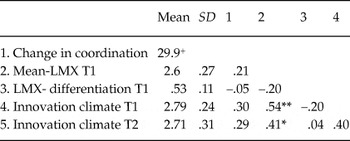
In the first place, it should be pointed out that the existence of a significant positive correlation between teams’ average LMX at time 1 and innovation climate at time 2 (r = .41, p < .05; see Table 1) is congruent with Hypothesis 1. However, this relationship was not observed in the regression analysis.
Correlations, means and standard deviations of the study variables

Note:
N = 24. ** p < .01; * p < .05; + Percentage of teams where the coordinator changed.
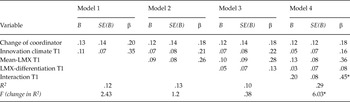
Regarding the regression analyses (see table 2), The results obtained offer empirical support for the second hypothesis proposed; that is, they support the moderator role of LMX differentiation at time 1 in the relationship between mean LMX quality at time 1 and innovation climate at time 2. The introduction of the interaction term in the regression equation produced a statistically significant increase in the percentage of explained variance (see step 4, β = .20, ΔR 2 = .19, p < .05).
Regression analysis for testing the moderator role of LMX-differentiation

Note:
Criterion variable: team innovation climate at time 2. *p < .05.
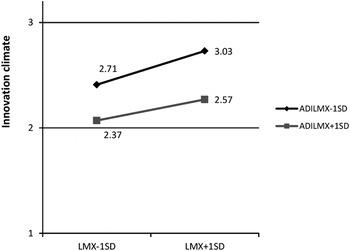
To interpret the meaning of the interaction, we represented it (see Figure 1). LMX-1SD indicates low levels of mean LMX quality (one standard deviation below the sample mean), and LMX +1SD indicates high levels. Likewise, ADILMX-1SD indicates low levels of LMX differentiation in the team, and ADILMX+1SD indicates high levels. As Figure 1 shows, the line representing the relationship between mean LMX at time 1 and innovation climate at time 2 is steeper when LMX-differentiation is low than when it is high. The most functional situation for innovation climate occurs when LMX-differentiation is low and LMX quality is high. These results showed support for hypothesis 2.
Interaction between mean LMX quality and LMX differentiation.
Note: LMX: teams’ LMX mean at time 1; ADILMX: teams’ LMX differentiation at time 1; SD: standard deviation. Criterion variable: team innovation climate at time 2.

Discussion
The purpose of the present study was to contribute to developing the leader-member exchange theory (LMX) at the group level. To this end, we investigated the relationship shown by two group indicators of this exchange (the mean quality of leader-member exchanges within teams, and the degree of intra-group differentiation in these relationships) with team innovation climate. The results obtained offer empirical support for one of the hypotheses formulated, indicating that the interaction between mean LMX quality and LMX differentiation is related to change in innovation climate in teams over time. Thus, teams with low differentiation and high mean LMX quality (what Schyns & Day (Reference Schyns and Day2010) call situations of LMX excellence) are those that show a better innovation climate. These results suggest that as far as leaders are capable of developing high quality relations with all their collaborators (high mean LMX with low intra-group differentiation), they will contribute to developing a high innovation climate in their teams.
Taking into account innovation’s strategic value for organizations, and that innovation climate is a relevant antecedent of innovation, the present study shows the importance of leadership for the development of a psychosocial context that encourages and facilitates innovation (González-Romá, Reference González-Romá2008). According LMX theory, the support, resources, confidence and autonomy that the team members receive from their leader seem to play a relevant role in developing group climates oriented toward innovation, where the generation of new ideas is encouraged (that is, creativity), and their implementation is facilitated and supported. Although no direct relationship was found between mean LMX quality and innovation climate, the interaction effect found between mean LMX quality and LMX differentiation, together with results from previous research carried out at the individual level, which showed positive and significant relationships between LMX and the psychological climate of innovation (Dunegan et al., Reference Dunegan, Tierney and Duchon1992; Scott & Bruce, Reference Scott and Bruce1994, Reference Scott and Bruce1998; Sanders et al., Reference Sanders, Moorkamp, Torka, Groenveld and Groenveld2010), suggest that the quality of the leader-member exchange is important at both the individual and team levels of analysis.
Recent theoretical reviews of the LMX theory have shown the need to consider LMX differentiation in order to gain a more complete view of the role played by the leader-member exchange at the group level (Henderson et al., Reference Henderson, Liden, Glibkowski and Chaudhry2009; Schyns & Day, Reference Schyns and Day2010). In this sense, the present study contributes to the development of the LMX theory, pointing out the moderator role of LMX-differentiation in understanding the relationship between teams’ LMX and innovation climate. The results obtained show that in those teams in which there is less differentiation, the relationship between mean LMX and innovation climate is stronger. In contrast, a high differentiation attenuates the positive relationship between the team’s mean LMX and its innovation climate. In this way, in studying LMX at the group level, it is relevant to consider not only the mean LMX level, but also the degree of LMX differentiation in teams.
The results are congruent with the concept of LMX excellence proposed by Schyns and Day (Reference Schyns and Day2010), which points to an interaction between the mean levels of LMX and the degree of LMX differentiation in teams. Specifically, they propose that the most beneficial situation for teams is one in which there is a high LMX mean and a low differentiation, that is, situations where leaders develop high quality relationships with all the members of the team. Although diverse limitations (time, resources, availability, etc.) can keep team leaders from reaching a situation of LMX excellence, the results presented here and those obtained by other researchers (e.g., Le Blanc & González-Romá, 2012) indicate that this excellence represents a desirable situation. Thus, Le Blanc and González-Romá (2012) observed that teams with high LMX means and low differentiation presented higher levels of commitment to the team and performance. The results obtained in the present study, together with those from the Le Blanc and González-Romá study (2012), support the role of LMX differentiation as a moderator, compared to studies that obtained unexpected results that contradicted the study hypothesis (e.g., Boies & Howell, Reference Boies and Howell2006).
These results have a clear practical implication. The training of team leaders, directors and supervisors should be an instrument for: 1. highlighting the importance of developing high-quality relationships with all of the team members for the proper functioning of teams and the well-being of their members, and 2. providing techniques and strategies to achieve these high-quality relationships in situations where there may be various kinds of restrictions (time, resources, etc.).
The present study also has some limitations that should be mentioned. First, the sample was small, given that it was only possible to count on 24 teams. Furthermore, these teams were made up of healthcare professionals, so that the results cannot be generalized to other types of teams. Future studies should extend the analyses carried out to other types of teams. They should also explore the relationship between the quality of the leader-member exchange in teams and the quantity and quality of the innovations they implement, testing the mediator role of innovation climate. Finally, in addition to the variables controlled in the present study (the stability of leaders in the group between the two measurement times), other variables could be influencing the results obtained. Aspects such as the length of time the leader has spent in this role should be taken into account in future studies.
In spite of these limitations, the present study shows that LMX theory at the group level still has many contributions to make in increasing our knowledge about how leadership influences the states, processes and results of work teams.