Introduction
Lichens are often the first organisms to colonize bare rock or soil following disturbance, probably because of their tolerance to desiccation and high temperatures. In most ecosystems, lichens become shaded out by higher plants at later stages in the succession, suggesting that they modify their microhabitat by facilitating soil formation. However, lichens remain important components of climax communities in high stress environments, and also within high stress micro-niches within ordinary habitats such as tree bark and rock faces. It has long been recognized that lichens participate in rock weathering, either by physical means or by the production of organic acids and chelating agents (Chen et al. Reference Chen, Blume and Beyer2000). However, it is unclear whether lichens play a significant role in lignocellulose and humic substance transformations in soils formed later in a succession. In free-living fungi, the three main classes of enzymes involved in organic matter turnover are phenol oxidases, cellulases and peroxidases (Baldrian Reference Baldrian2008). Lichens from the order Peltigerales are active producers of the phenol oxidases laccase and tyrosinase (Zavarzina & Zavarzin Reference Zavarzina and Zavarzin2006), and tyrosinases also occur in some non-Peltigeralean lichens (Beckett et al. Reference Beckett, Minibayeva and Liers2012). Furthermore, cellulase activity has been well documented in several species, for example Evernia prunastri and Peltigera canina (Yagüe & Estévez Reference Yagüe and Estévez1988a , Reference Yagüe and Estévez b ; de los Rios et al. Reference de los Ríos, Ramírez and Estévez1997), and probably occurs in almost all lichens. However, very little information is available on the occurrence and roles of peroxidase activity in lichens; such information will be important to understand the carbon dynamics of soils in lichen-rich habitats.
Peroxidases (EC 1.11.1.x) are a large family of enzymes that occur in all organisms. The enzymes catalyze one-electron oxidation of a variety of compounds, often phenolics, using H2O2 or organic hydroperoxides (R-OOH) as electron-accepting co-substrata (Welinder 1992). Peroxidases typically metabolize a similar range of phenolics as laccases, but possess higher affinities and redox potentials as a result of the involvement of H2O2 (Hofrichter et al. Reference Hofrichter, Ullrich, Pecyna, Liers and Lundell2010). Only basidiomycetes possess genuine Class II or secretory fungal peroxidases, which include the lignin-degrading enzymes manganese peroxidase (MnP), lignin peroxidase (LiP) and versatile peroxidase (VP). While these enzymes appear to be absent from the Ascomycetes (Morgenstern et al. Reference Morgenstern, Klopman and Hibbett2008), these fungi contain other non-Class II peroxidases such as the heme-thiolate peroxidases and, at least based on sequences in databases, dye-decolorizing peroxidases (“DyPs”) (Hofrichter et al. Reference Hofrichter, Ullrich, Pecyna, Liers and Lundell2010). However, DyPs have not yet been shown to be natively expressed in Ascomycetes. Low, non-specific guiaicol oxidizing capacity can occur in crude lichen extracts (Kranner et al. Reference Kranner, Zorn, Turk, Wornik, Beckett and Batic2003; Laufer et al. Reference Laufer, Beckett and Minibayeva2006). However, Liers et al. (Reference Liers, Ullrich, Hofrichter, Minibayeva and Beckett2011) recently showed that the ‘jelly’ lichens Leptogium and Collema possess readily detectable heme peroxidase activities. The enzyme from Leptogium was designated LsaPOX, and occurs natively as a homo-dimer with a molecular mass of c. 80 kDa. The enzyme can oxidize classic peroxidase substrata such as 2,6-dimethoxyphenol and ABTS in the presence of H2O2. Interestingly, it can also metabolize difficult to oxidize phenols, including non-phenolic methoxylated aromatics such as veratryl alcohol, providing evidence that lichens play a role in lignocellulosic carbon turnover.
To understand the significance of lichen peroxidases in carbon turnover, and more generally in lichen biology, it will be important to determine in which lichen taxa the enzyme occurs. The main aim of the present study was to survey a range of lichens for peroxidase activity. As our results confirmed the presence of peroxidase in non-jelly lichens, we used electrophoresis to characterize the enzyme in representative species from five genera. Furthermore, to test whether peroxidases play a role in desiccation tolerance in lichens, we compared activities in dry and rehydrated thalli.
Materials and Methods
The species of lichens examined in this study and their collection localities are listed in Table 1. Specimens were collected from the field either dry or hydrated. If hydrated, they were allowed to dry slowly between sheets of newspaper. Lichens were stored refrigerated at 4°C for up to two weeks before use. In all cases, large collections of lichens were made, and the thalli used were randomly sampled from those that appeared most healthy. Desiccated lichens (typically 1 g dry mass) were thoroughly ground in 50 mM phosphate buffer pH 7 using a little aluminium oxide to facilitate grinding, and centrifuged at 5000 g for 20 min. Laccase activity was estimated by following the oxidation of 0·3 mM 2,2-azino-bis(3-ethylthiazoline-6-sulfonate) (ABTS) at 420 nm (A420=36 mM–1 cm–1) in 50 mM sodium acetate buffer pH 4·5 (Eggert et al. Reference Eggert, Temp, Dean and Eriksson1996). Peroxidase activity was estimated as the stimulation of the rate of ABTS oxidation following the addition of 0·1 mM H2O2 (Liers et al. Reference Liers, Ullrich, Hofrichter, Minibayeva and Beckett2011). To test whether enzyme activities are affected by water stress, replicate lichen samples were then slowly rehydrated by storage at 10°C in darkness, in air at 100% RH for 24 h, followed by storage for a further 24 h under the same conditions, but on wet non-cellulosic cloth. Hydrated lichens were then ground and laccase and peroxidase activities measured as for desiccated lichens. In addition, surface enzyme activities were measured in hydrated material. In species with large lobes, 6 mm discs were cut from the thalli, and in others thalli were cut into 1 cm strips. Discs or thallus strips were stored as above for at least 12 h before an experiment to minimize any effect of mechanical disruption on enzyme activity (Beckett & Minibayeva Reference Beckett and Minibayeva2003), and then used immediately. To test laccase activity, five replicates of 50 mg fresh mass were gently shaken in ABTS solution as above for 5 min, absorbance measured, and then peroxidase activity was estimated as stimulation of ABTS oxidation following the addition of 0·1 mM H2O2. All activities were expressed as units g–1 dry mass.
The molecular masses and the number of isoforms of peroxidases were tested electrophoretically in crude extracts of the thalli of Collema flaccidum, Leptogium saturninum, Lobaria scrobiculata, Pseudocyphellaria gilva and Sticta sublimbata, as described by Liers et al. (Reference Liers, Ullrich, Hofrichter, Minibayeva and Beckett2011). A modified method of Laemmli (Reference Laemmli1970) was followed using native PAGE polyacrylamide gels (5, 10, 11 and 12%). To estimate approximate molecular masses, protein standards (BioRad) were always run with samples, and visualized using Coomassie Blue. Activity staining was done in sodium acetate buffer (0·25 M, pH 5·0) containing glycerol (10%) and o-dianisidine (2 mM) for laccases, and additionally with H2O2 (2 mM) for peroxidases.
Results
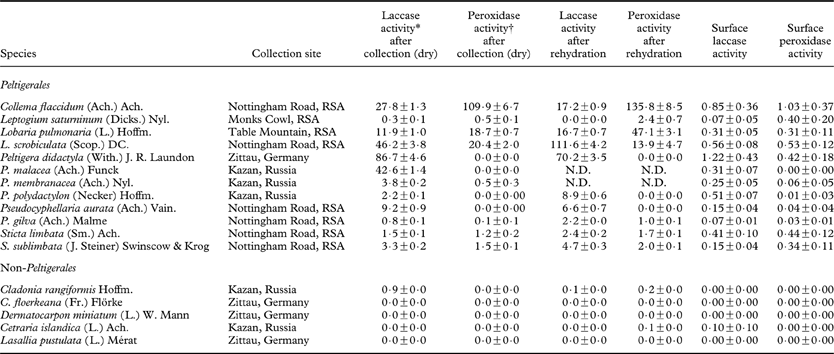
The laccase and peroxidase activities of the lichens tested are given in Table 1. Although considerable variation in actual activities occurred between species, Peltigeralean lichens contained high laccase activities, while non-Peltigeralean lichens displayed no or low laccase activity. Readily detectable peroxidase activity occurred within Collema, Leptogium, Lobaria, Pseudocyphellaria gilva and Sticta, but was almost absent in Peltigera and Pseudocyphellaria aurata, and in the four non-Peltigeralean genera tested. Rehydration had no consistent effect on laccase activities, while peroxidase activities, with the exception of Lobaria scrobiculata, were up-regulated in hydrated material. Subsequent investigations revealed that in L. scrobiculata, peroxidase activities significantly increased 8 days after rehydration (data not shown). Measurements of surface enzyme activities indicated that, on average, 4% and 11% of the total laccase and peroxidase activities, respectively, occurred on the cell wall.
Total laccase and peroxidase activities (units g–1 dry mass) in a range of lichen species after collection (dry), following rehydration, and the surface activities of hydrated thalli. Data given ± standard deviation, n=5 preparations (total activities) or individual replicates (surface activities). N.D.=not determined.
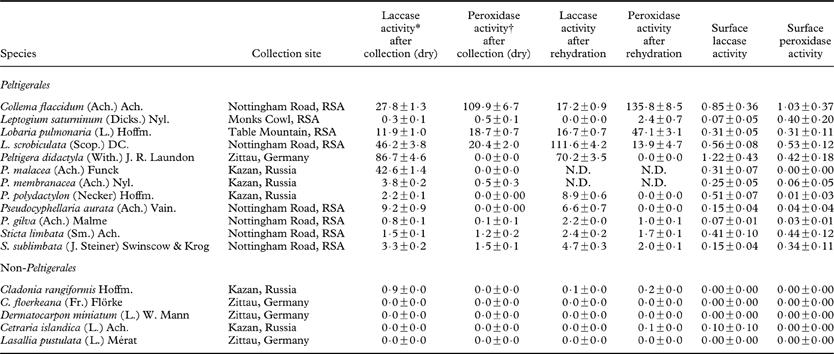
* laccase activity was measured with 0·3 mM ABTS at pH 4·5 in 50 mM sodium acetate
† peroxidase activity was measured as the stimulation in the rate ABTS oxidation following the addition of 0·1 mM H2O2.
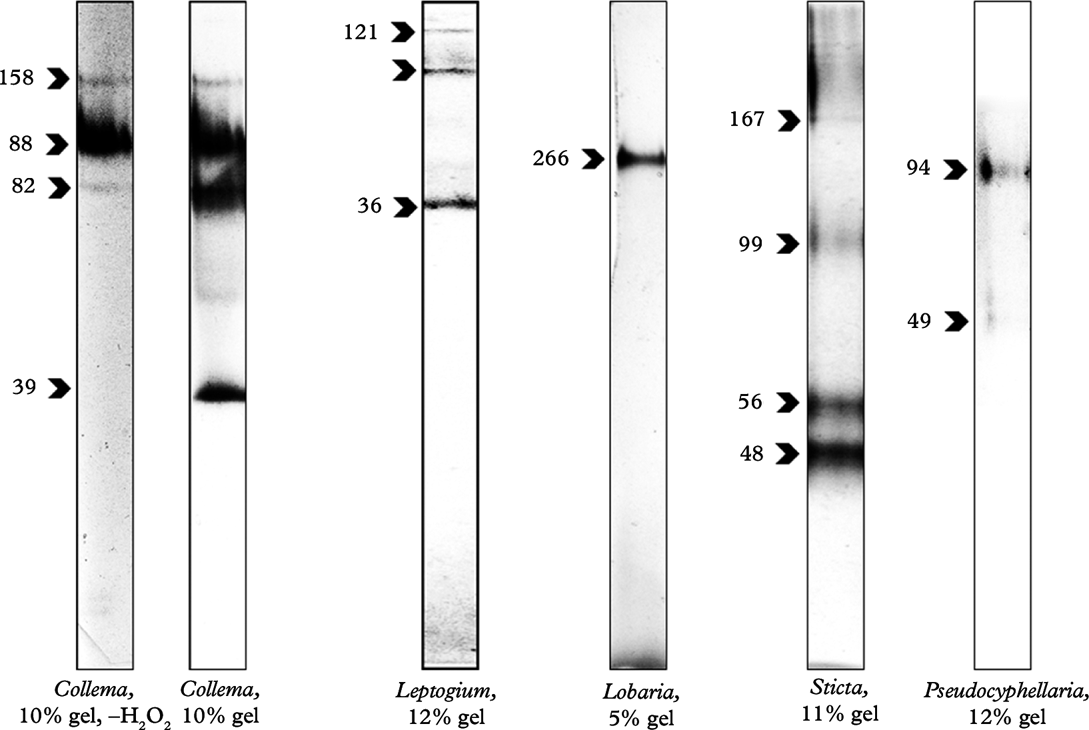
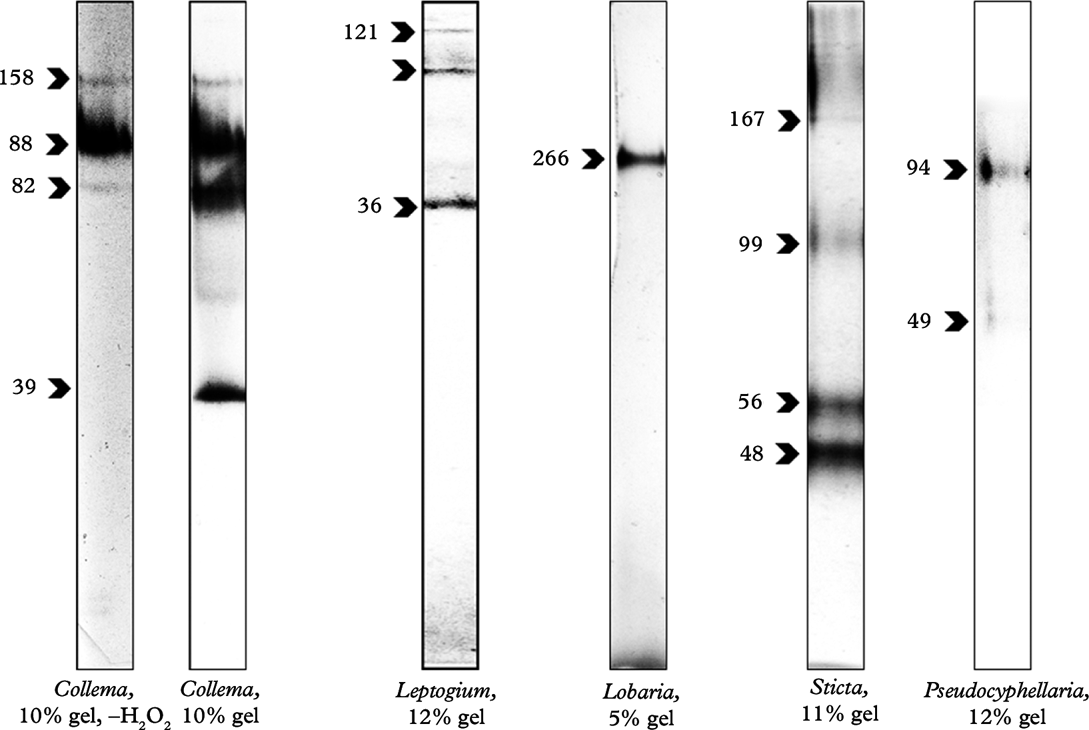
Figure 1 presents an electrophoretic survey of the peroxidases from five species. In Collema flaccidum, a strongly staining laccase with a molecular mass of c. 88 kDa was rapidly visualized in the absence of H2O2, but in other species laccases were either absent (Leptogium saturninum) or visualized extremely slowly (Lobaria scrobiculata, Pseudocyphellaria gilva and Sticta sublimbata) and therefore did not interfere with the visualization of peroxidase bands. In Collema and Leptogium, peroxidases occurred as apparent monomers with a mass of c. 40 kDa, but dimers and larger molecular mass oligomers also occurred. In Lobaria, a single isoform was present with a mass of c. 270 kDa. Sticta contained two peroxidase isoforms with masses of c. 48 and 56 kDa, but oligomeric forms also occurred. The main isoform in Pseudocyphellaria gilva was probably dimeric with a molecular mass of c. 94 kDa, although trace amounts of a c. 49 kDa isoform were also present.
Visualization of peroxidase isoforms from Collema flaccidum, Leptogium saturninum (Liers et al. Reference Liers, Ullrich, Hofrichter, Minibayeva and Beckett2011), Lobaria scrobiculata, Sticta sublimbata and Pseudocyphallaria gilva using native polyacrylamide gels. Enzymes were visualized with o-dianisidine and H2O2, and estimates of molecular masses were obtained by running molecular mass markers stained using Coomassie brilliant blue G250.
Discussion
This survey is the first to characterize the distribution of natively expressed peroxidases within lichens, and shows that activity occurs in at least five genera (Table 1). A significant amount of activity occurs in the cell wall, and activity usually increases considerably following rehydration. There are no obvious reasons for the large variation in activity that occur between species. Similarly, it is uncertain why peroxidase activity is absent from some Peltigeralean genera such as Peltigera, and indeed from the non-Peltigeralean species tested here. Interestingly, laccase activity in species that possess peroxidase activity (Collema flaccidum, Leptogium saturninum, Lobaria pulmonaria, L. scrobiculata, Pseudocyphellaria gilva, Sticta limbata and S. sublimbata) is on average less than half that of species lacking peroxidases (Peltigera didactyla, P. malacea, P. membranacea, P. polydactylon and Pseudocyphellaria aurata) (13 units g–1 dry mass compared with 29 units g–1 dry mass) (Table 1). Possibly, species with lower laccase activity use peroxidases to generate additional oxidizing power. While peroxidase activities in lichens were first demonstrated in gelatinous species (Liers et al. Reference Liers, Ullrich, Hofrichter, Minibayeva and Beckett2011), results presented here show that activity occurs more widely in the Peltigerales.
Nature of lichen peroxidases
As discussed in the Introduction, while Ascomycetes appear to lack classical Class II peroxidases (Morgenstern et al. Reference Morgenstern, Klopman and Hibbett2008), they do contain heme-thiolate peroxidases and, based on sequence data, potentially DyPs (Hofrichter et al. Reference Hofrichter, Ullrich, Pecyna, Liers and Lundell2010). However, protein purification and partial sequencing of the peroxidase from Leptogium show that LsaPox is completely unrelated to bacterial and fungal DyPs (Liers et al. Reference Liers, Ullrich, Hofrichter, Minibayeva and Beckett2011). Rather, the enzyme has strong similarities with putative proteins/peptides of unknown function from non-lichenized Ascomycetes (e.g. Penicillium marneffei and Neosartorya fischeri). Electrophoretic evidence presented here suggests that, as in Leptogium, the peroxidases from Collema, Pseudocyphellaria and Sticta occur as an oligomeric series, while Lobaria contains a single, high molecular mass form (Fig. 1). Oligomerization occurs in some microbial peroxidases and catalases such as bacterial catalase–peroxidases (KatGs, Welinder Reference Welinder, Penel, Gaspar and Greppin1992; Chelikani et al. Reference Chelikani, Fita and Loewen2004), manganese catalases (Barynin et al. Reference Barynin, Whittaker, Antonyuk, Lamzin, Harrison, Artymiuk and Whittaker2001), and bacterial and fungal DyPs (e.g. Anabaena sp., Ogola et al. Reference Ogola, Kamiike, Hashimoto, Ashida, Ishikawa, Shibata and Sawa2009; Shewanella oneidensis, Zubieta et al. Reference Zubieta, Joseph, Krishna, McMullan, Kapoor, Axelrod, Miller, Abdubek, Acosta and Astakhova2007; Hofrichter et al. Reference Hofrichter, Ullrich, Pecyna, Liers and Lundell2010). The significance of oligomerization for the functioning of redox enzymes is uncertain. Given the common tendency of the lichen peroxidases to form oligomers, and that the lichens containing these peroxidases all belong to the same order (Peltigerales), it seems probable that the enzymes studied here are related. In future, we plan to study the evolution of these peroxidases, and whether they differ from previously described peroxidase families in aspects such as reaction mechanisms and heme-pocket architecture.
Roles of peroxidases in lichen metabolism
As for other organisms (Passardi et al. Reference Passardi, Cosio, Penel and Dunand2005), peroxidases probably play many roles in lichen biology. First, they probably function as conventional H2O2 scavenging enzymes to detoxify harmful ROS, known to be produced during desiccation stress (Weissman et al. Reference Weissman, Garty and Hochman2005). The much higher activities present in hydrated material compared to desiccated material (Table 1) suggest that ROS scavenging activities cause deactivation of the enzyme as the thallus dries, but that activity is restored during rehydration (Table 1). Secondly, drawing analogies with free-living fungi, it seems likely that lichen peroxidases are involved in the breakdown of complex carbohydrates, probably in conjunction with laccases. In general, both peroxidases and laccases metabolize similar substrata but, because they use H2O2, peroxidases can metabolize more recalcitrant compounds. LsaPox can oxidize non-phenolic model lignin compounds with redox potentials as high as c. 1·5 V (Liers et al. Reference Liers, Ullrich, Hofrichter, Minibayeva and Beckett2011), indicating that lichen peroxidases can directly attack lignin-like molecules. Breakdown may be assisted by ROS produced by extracellular redox cycling mediated by peroxidases. Briefly, in free-living fungi, peroxidases can catalyze the conversion of extracellular hydroquinones to quinone radicals, which then spontaneously form quinones, producing O2 .– or other radicals as by-products (Gómez-Toribio et al. Reference Gómez-Toribio, García-Martín, Martínez, Martínez and Guillén2009a , Reference Gómez-Toribio, García-Martín, Martínez, Martínez and Guillén b ). Hydroquinones can be regenerated from the quinones using a plasma membrane quinone reductase. Peltigeralean lichens possess the phenolics needed for extracellular redox cycling to occur (Zagoskina et al. Reference Zagoskina, Nikolaeva, Lapshin, Zavarzina and Zavarzin2011) and also, as shown here, extracellular peroxidases (Table 1). ROS such as O2 .– produced by redox cycling in free-living fungi can participate in delignification processes (Guillén et al. Reference Guillén, Munoz, Gómez-Toribio, Martínez and Martínez2000). While lignin degradation confers no energetic benefits to lichens, it will expose cellulose that may be utilized as a carbon supply. Yagüe & Estévez (Reference Yagüe and Estévez1988a , Reference Yagüe and Estévez b ) suggest that lichens can produce all the enzymes needed for direct cellulose degradation. Furthermore, recent studies on free-living fungi indicate that, as for lignin, cellulose breakdown can also be facilitated by ROS production (Martinez et al. Reference Martinez, Challacombe, Morgenstern, Hibbett, Schmoll, Kubicek, Ferreira, Ruiz-Duenas, Martinez and Kersten2009). The debate concerning the extent to which lichens can live saprophytically has long fascinated lichenologists (Estévez Reference Estévez, Vicente, Brown and Legaz1985). Interestingly, within the genus Conotrema, the same fungus species forms a lichen on bark, but can grow as a saprophyte on wood (Hawksworth Reference Hawksworth2005). The implication is that some lichen fungi may have retained the capacity to synthesize enzymes needed to live without their symbionts. Therefore, a potential role for peroxidases is to increase carbon supply to the thallus by degrading host tissues or plant residues in the soil, allowing a saprophytic lifestyle that may be beneficial in periods of limited photosynthesis.
Conclusions
Results presented here clearly show that in lichens peroxidase activity is not confined to gelatinous genera such as Collema and Leptogium, but also occurs in Lobaria, Pseudocyphellaria and Sticta. In future work we will characterize these peroxidases in more detail by, for example, determining their structure and phylogenetic relationship with other peroxidases. While the enzymes may function as conventional peroxidases and assist with ROS scavenging during stress, it seems likely that their high redox potential enables them to play a role in lignocellulosic carbon turnover. Understanding this role will be essential in recognizing the significance of lichens in carbon cycling in stressed habitats.
The University of KwaZulu Natal, the NRF (South Africa), the European Union (integrated project Peroxicats) and the Russian Foundation for Basic Research (No. 11-04-93962) are all thanked for financial support. We are grateful to Shuttleworth Weaving, Nottingham Road, South Africa for allowing us to collect lichens on their premises.