Introduction
Vestibular migraine is a common and increasingly more recognised central vestibular disorder characterised by episodes of vertigo and disequilibrium lasting minutes to days with associated migraine headaches or migraine-equivalent symptoms.Reference Neuhauser and Lempert1 Patients often also complain of neurological and cognitive symptoms such as ‘brain fog’ and altered motor and sensory function.Reference Liu, Locklear, Sharon, Lacroix, Nguyen and Rizk2 In a study examining results of the 2008 National Health Interview Survey, it was found that in respondents who had dizziness (11.9 per cent), 23.4 per cent met criteria for vestibular migraine, representing 2.7 per cent of the general population.Reference Formeister, Rizk, Kohn and Sharon3 As a result of overlap with other vestibular disorders such as Ménière's disease, vestibular migraine has only recently received acceptance as a distinct clinical entity, with most recent diagnostic criteria being established in 2012.Reference Liu and Xu4,Reference Lempert, Olesen, Furman, Waterston, Seemungal and Carey5
Although the specific aetiology of vestibular migraine remains undefined,Reference Hsu, Wang and Fuh6–Reference Furman, Marcus and Balaban9 it encompasses symptoms caused by central nervous system dysfunction, dysregulated response to peripheral stimuli or some combination of both.Reference Espinosa-Sanchez and Lopez-Escamez8–Reference King, Wang, Priesol and Lewis10 However, the specific role of the peripheral vestibular system in the causation and natural history of vestibular migraine is uncertain. Studies have shown that caloric stimulation can induce migraines in even normal patient populations,Reference Seemungal, Rudge, Davies, Gresty and Bronstein11 while others have demonstrated improvement in migraines with low grade vestibular stimulation.Reference Wilkinson, Ade, Rogers, Attix, Kuchibhatla and Slade12 Migraines are believed to involve dysregulation of the trigeminal vascular system, which may provoke under-perfusion and end-organ damage of labyrinthine structures.Reference Furman, Marcus and Balaban9,Reference Akerman, Holland and Goadsby13–Reference Vass, Shore, Nuttall and Miller15 Some believe this may be a contributing factor to the development of Ménière's disease.Reference Liu and Xu4 In a cluster analysis examining the phenotypes of patients with Ménière's disease, a clinical subgroup of patients encompassing 15 per cent of Ménière's disease patients was found to have comorbid migraine in all cases.Reference Frejo, Martin-Sanz, Teggi, Trinidad, Soto-Varela and Santos-Perez16
Although most patients with vestibular migraine have normal vestibular function outside of acute attacks, a subset of 8–25 per cent of patients have abnormal responses on calorimetry.Reference Kang, Lee, Yang, Ahn, Chung and Park17–Reference Neff, Staab, Eggers, Carlson, Schmitt and Van Abel21 This portion of patients may represent progression of normal disease, alternative phenotypes of vestibular migraine or simply cases where unidentified vestibular comorbidities are present.Reference Furman, Marcus and Balaban9,Reference Kang, Lee, Yang, Ahn, Chung and Park17 Kang et al.Reference Kang, Lee, Yang, Ahn, Chung and Park17 showed that such patients were more likely to require prolonged medical therapy than those without abnormal vestibular function testing. However, no other studies have examined the clinical implications of abnormal vestibular testing in vestibular migraine. Therefore, we aimed to examine the impact of objective abnormal vestibular function on patient-reported quality of life in patients with vestibular migraine and to determine how it affects response to treatment.
Materials and methods
This study was approved by the Medical University of South Carolina institutional review board, and the Equator Network Strengthening the Reporting of Observational Studies in Epidemiology (‘STROBE’) guidelines were reviewed and followed. A retrospective chart review was performed to search for patients presenting to our multidisciplinary, vestibular-focused, neurotology clinic with definite vestibular migraine and who had caloric testing between August 2016 and March 2019. Definite vestibular migraine was diagnosed using the 2012 consensus guidelines.Reference Lempert, Olesen, Furman, Waterston, Seemungal and Carey5 Those with a history of or concurrent Ménière's disease based on 2015 consensus criteriaReference Lopez-Escamez, Carey, Chung, Goebel, Magnusson and Mandala22 were excluded. Those with prior ear surgery or anatomical abnormalities of the temporal bones were also excluded.
Patients with vestibular migraine were treated with a common algorithm. Initially, one of several migraine medications are prescribed (venlafaxine, nortriptyline, topiramate, propranolol or verapamil) based on anticipated tolerance of side effects. Magnesium is prescribed to those who cannot take other medications (e.g. pregnancy). Physical therapy evaluations were conducted by a vestibular-trained physical therapist at the end of clinic visits, and patients were referred for vestibular rehabilitation if deemed appropriate.
Although the senior author manages many vestibular migraine patients, very few undergo vestibular testing. Caloric testing was performed typically to rule out possible vestibular hypofunction and to direct vestibular rehabilitation focus. Some patients had vestibular testing prior to their initial appointment. Others may have had positive head impulse tests or nystagmus after head-shake, or histories concerning for uncompensated hypofunction after a potential acute vestibular injury. Those with symptoms that were suspicious for third-window pathology, notably phonophobia, which is prevalent in vestibular migraines, were referred for vestibular evoked myogenic potential testing. Usually, rotary chair testing and video head-impulse testing were performed along with caloric testing when possible. Therefore, not all vestibular migraine patients received the full gamut of vestibular testing.
All caloric tests were performed within six months of the initial clinic visit with the Micromedical Spectrum VisualEyes Spectrum VNG (Interacoustics, Eden Prairie, USA) using bithermal irrigation. Relative vestibular reduction was calculated as: right cool + right warm − left cool − left warm divided by right cool + left cool + right warm + left warm. Patients were stratified as those with significant hypofunction (relative vestibular reduction more than 25 per cent) and those with normal or minimal hypofunction (relative vestibular reduction less than 25 per cent). Because most patients did not consistently undergo full vestibular testing with other modalities, the results of available vestibular evoked myogenic potential, video head-impulse testing and rotary chair tests will be presented but will not be analysed as primary outcomes.
Patient-reported quality of life and treatment response were assessed using the Dizziness Handicap Inventory.Reference Jacobson and Newman23 The Dizziness Handicap Inventory has been shown to be valid and reliable, has been translated into 14 languages and is the most widely used survey of self-reported impairment from dizziness.Reference Jacobson and Newman23,Reference Mutlu and Serbetcioglu24 It has also been shown to correlate well with balance testing as well.Reference Jacobson, Newman, Hunter and Balzer25 Data were collected pre- and post-treatment. Dizziness Handicap Inventory scores were analysed by total, domain and individual item scores. Data on subjective symptoms were tabulated for pre-treatment, but post-treatment symptom data were heterogeneous and reliable analyses could not be performed.
Statistics
All statistics were performed using SPSS® (version 25) statistical software. Chi-square and the student t-test were used where appropriate, and Cohen's d with 95 per cent confidence intervals (CIs) are reported for effect size as d (lower CI, upper CI). Pearson correlations were calculated and reported as r (lower CI, upper CI). Means are reported as mean ± standard deviation.
Results
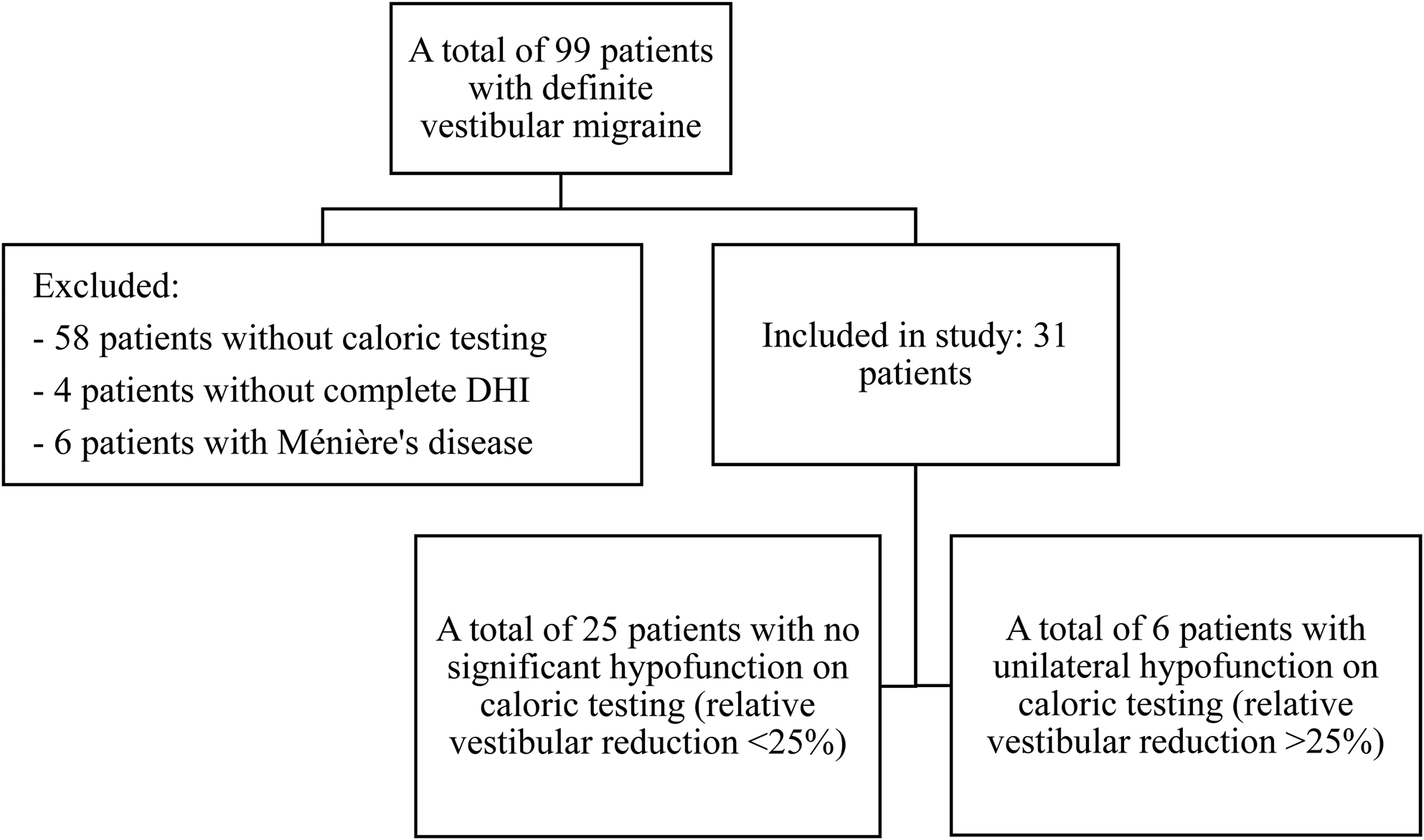
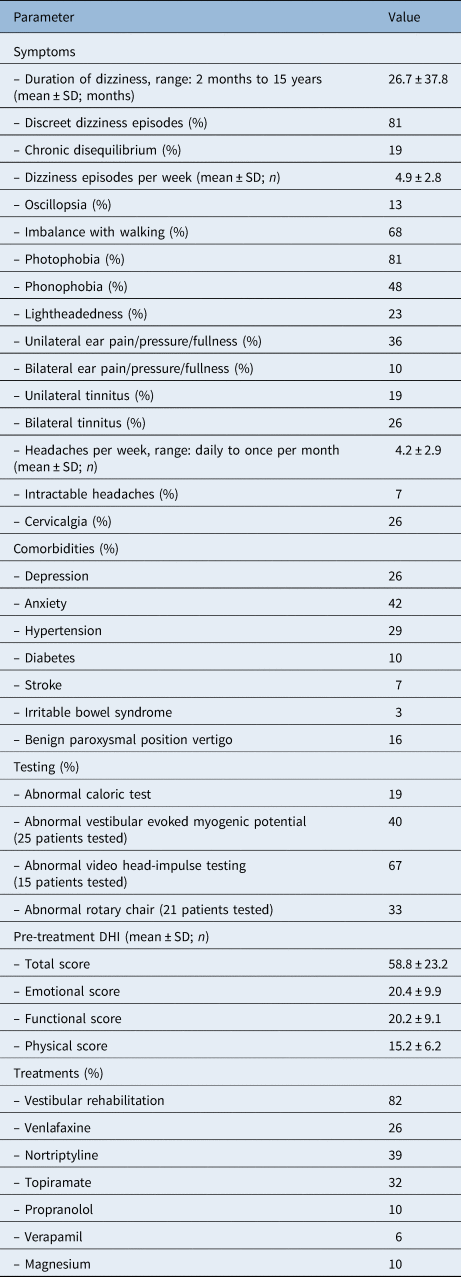
A flowchart of patients included in the study is shown in Figure 1. Of a total of 31 patients included in this study, 26 (83.9 per cent) were female, 24 (77.4 per cent) were white (6 black, 1 Hispanic) and the mean age was 48.7 ± 20.0 years (range, 17–86 years). Twenty-two (71.0 per cent) patients returned for follow up, with a mean follow up time of 9.1 ± 8.1 months (range, 1.4–27.8 months), and 9 (29.0 per cent) patients did not return for follow up after the first visit (6 did not return, 2 were discharged with follow up as needed and 1 was referred to local ENT). Other patient characteristics, including symptoms, comorbidities, testing results and initial Dizziness Handicap Inventory scores are summarised in Table 1. Of note, on caloric testing, the mean relative vestibular reduction was 15.1 ± 15.6 per cent (range, 0–52 per cent), with 12 (38.7 per cent) patients having right relative weakness and 14 (45.2 per cent) patients having left relative weakness. Six (19.4 per cent) patients had relative vestibular reduction more than 25 per cent (range, 35–52 per cent).
Flowchart for patient selection. DHI = Dizziness Handicap Inventory

Patient characteristics

SD = standard deviation; DHI = Dizziness Handicap Inventory
Treatments and response
Of the 22 patients who returned for follow up, 18 (81.8 per cent) underwent vestibular rehabilitation and 21 (95.5 per cent) patients received venlafaxine, nortriptyline, amitriptyline, venlafaxine, topiramate, propranolol, verapamil, magnesium or a combination of these medications.
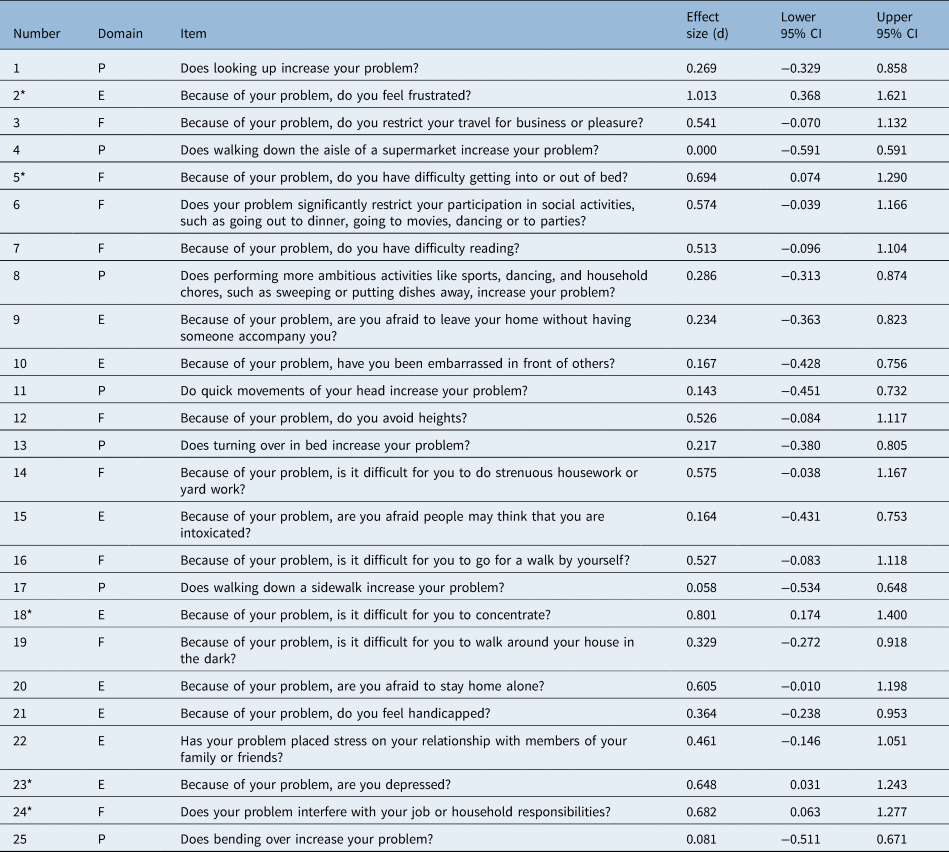
Overall, 17 (77.3 per cent) of the 22 patients who returned for follow up reported subjective improvement in dizziness. Frequency of dizziness episodes improved significantly from a mean of 4.8 ± 3.0 to a mean of 1.4 ± 2.0 per week (d = 1.338 (95 per cent CI, 0.450, 2.141)). Mean Dizziness Handicap Inventory score for all patients was 58.8 ± 23.2 at the first visit and 46.1 ± 26.8 at the last follow up, resulting in a mean improvement of 15.2 ± 29.6 points (d = 0.623 (95 per cent CI, 0.007, 1.216)). There were significant mean score decreases for the emotional (d = 0.635 (95 per cent CI, 0.019, 1.229)) and functional (d = 0.769 (95 per cent CI, 0.143, 1.367)) domains, but not the physical domain (d = 0.227 (95 per cent CI, −0.370, 0.815)). Effect size for the decrease in score for each individual item of the Dizziness Handicap Inventory is shown in Table 2.
Improvement in individual items of the Dizziness Handicap Inventory after treatment in all patients

*Significant effect size. CI = confidence interval; P = physical; E = emotional; F = functional
Relationship between vestibular function and dizziness handicap
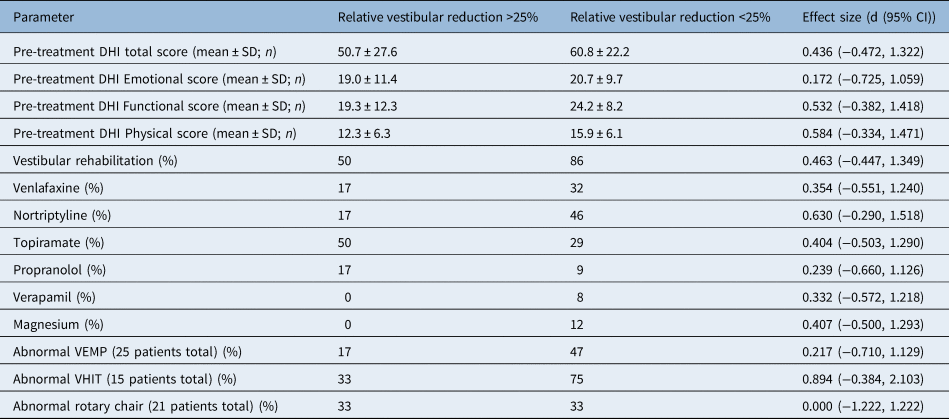
Baseline characteristics comparing patients with and without significant caloric asymmetry are shown in Table 3. Dizziness Handicap Inventory scores, treatment regimen and vestibular testing results did not differ between the two groups.
Baseline characteristics comparing patients with and without caloric asymmetry

CI = confidence interval; DHI = Dizziness Handicap Inventory; SD = standard deviation; VEMP = vestibular evoked myogenic potential; VHIT = video head-impulse testing
Dizziness Handicap Inventory total and domain scores
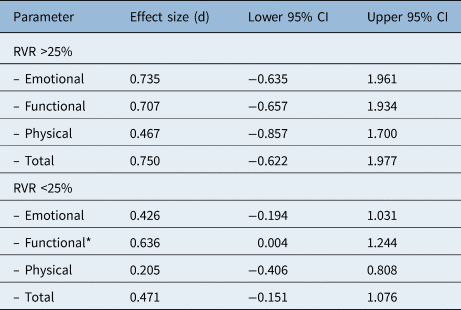
The relative vestibular reduction more than 25 per cent group did not experience any significant improvement in Dizziness Handicap Inventory total score or any of the domain scores. On the other hand, the relative vestibular reduction less than 25 per cent group did experience a significant improvement in Dizziness Handicap Inventory functional domain score but did not experience significant improvement in total of other domain scores (Table 4). The relative vestibular reduction more than 25 per cent and relative vestibular reduction less than 25 per cent groups did not differ significantly from each other in terms of improvement in Dizziness Handicap Inventory total (d = 0.054 (95 per cent CI, −1.031, 1.136)) and domain scores (emotional: d = 0.043 (95 per cent CI, −1.042, 1.125), functional: d = 0.050 (95 per cent CI, −1.035, 1.132) and physical: d = 0.066 (95 per cent CI, −1.021, 1.147)). Relative vestibular reduction percentage did not correlate significantly with initial or change in Dizziness Handicap Inventory total score or any domain scores.
Improvement in Dizziness Handicap Inventory scores for patients with and without caloric asymmetry

*Significant effect size. CI = confidence interval; RVR = relative vestibular reduction
Dizziness Handicap Inventory individual item scores
On the initial visit Dizziness Handicap Inventory, patients with relative vestibular reduction more than 25 per cent scored significantly better on item 1 (physical domain: ‘Does looking up increase your problem?’) compared with those with relative vestibular reduction less than 25 per cent (d = 1.287 (95 per cent CI, 0.310, 2.198)). Relative vestibular reduction percentage also correlated significantly with scores for items 1 (r = −0.417 (95 per cent CI, −0.074, −0.672)) and 8 (physical domain: ‘Does performing more ambitious activities such as sports, dancing, household chores (sweeping or putting dishes away) increase your problems?’; r = −0.499 (95 per cent CI, −0.176, −0.725)). The negative values for the correlation coefficients indicate that greater unilateral weakness on caloric tests correlated with better scores on items 1 and 8 before treatment.
The relative vestibular reduction more than 25 per cent group did not show any significant improvement in score for any individual item on the Dizziness Handicap Inventory except item 18 (emotional domain: ‘Because of your problem, is it difficult for you to concentrate?’; d = 2.123 (95 per cent CI, 0.398, 3.435)). The relative vestibular reduction less than 25 per cent group did not show any significant improvement on any individual item except for item 14 (functional domain: ‘Because of your problem, is it difficult for you to do strenuous housework or yard work?’; d = 0.706 (95 per cent CI, 0.070, 1.316)) and item 24 (functional domain: ‘Does your problem interfere with your job or household responsibilities?’; d = 0.638 (95 per cent CI, 0.006, 1.247)). There was no significant difference between the relative vestibular reduction less than 25 per cent and relative vestibular reduction more than 25 per cent groups in terms of change in score for any individual item. However, relative vestibular reduction percentage correlated significantly with change in item 10 score (emotional domain: ‘Because of your problem have you been embarrassed in front of others?’; r = 0.510 (95 per cent CI, 0.112, 0.767)), meaning that greater unilateral weakness correlated with less improvement, specifically on item 10.
Discussion
Our data suggest that the presence of decreased vestibular function in patients with vestibular migraine impacts patient-reported quality of life in response to common therapies. We found that although patients overall had an improvement in mean Dizziness Handicap Inventory score after treatment, only those with normal vestibular function had an improvement in the functional domain while those with decreased vestibular function did not. The lack of a significant difference comparing improvement in Dizziness Handicap Inventory total and domain scores between the two groups directly suggests either the difference is small or that a larger cohort is needed for analysis.
There is a paucity of literature describing the impact of peripheral vestibular dysfunction on quality of life and treatment response in vestibular migraine. Kang et al.Reference Kang, Lee, Yang, Ahn, Chung and Park17 described a group of patients with vestibular migraine, 19 per cent of whom had abnormal caloric responses. They found that this subset was more likely to require continued medical migraine prophylaxis at six months compared with those patients without abnormal caloric responses. Their findings are consistent with our results, but they did not comment on any specific metric of symptom control. Here we show that there is a significant difference in patient-reported quality of life, suggesting that those patients who had decreased vestibular function required prolonged medication possibly due to a lack of improvement in dizziness handicap.
The reason that unilateral vestibular weakness could lead to less responsiveness to therapy is uncertain. These patients did have a significant improvement in one item of the emotional domain of the Dizziness Handicap Inventory, ‘Because of your problem, is it difficult for you to concentrate?’, which was absent in those patients with normal vestibular function. Some studies have shown that bilateral vestibulopathy may actually lead to a decrease in balance-related anxiety compared with those with unilateral vestibular disorders such as Ménière's disease.Reference Decker, Limburg, Henningsen, Lahmann, Brandt and Dieterich26 The theory is that intact vestibular function is necessary for the development of anxiety related to vertigo due to reciprocal pathways involving the vestibular system, central amygdaloid nucleus, the infralimbic and insular cortex and the hypothalamus.Reference Balaban and Thayer27,Reference Balaban, Jacob and Furman28
Although patients with vestibular migraine appeared to have higher levels of anxiety than those with bilateral vestibulopathy, comparisons between patients with differential vestibular function within vestibular migraine were not performed.Reference Decker, Limburg, Henningsen, Lahmann, Brandt and Dieterich26 Perhaps, along the same vein, peripheral vestibular weakness in patients with vestibular migraine suppresses the balance–anxiety pathway, which then leads to decreased negative input from the peripheral vestibular system to the central nervous system with each episode of vertigo or imbalance. Thus, patients with vestibular dysfunction may be protected from frequent insults to emotional control systems and be more susceptible to vestibular migraine medications and treatment in some areas.
Our data suggest that patients with vestibular migraine with decreased vestibular function may have a propensity toward more emotional or functional symptoms than physical vestibular symptoms compared with their normal vestibular function counterparts. Those with decreased vestibular function may be less prone to suffer from the physical effects of vestibular migraine because of decreased input to the central nervous system from the peripheral vestibular system or decreased central sensitivity to peripheral vestibular signals, akin to the pathways above describing the relationship between vestibular function and anxiety. Another explanation may be that those with vestibular hypofunction have compensated for and are less bothered by physical symptoms. This is evidenced by the lack of abnormal findings in other vestibular tests in those with more than 25 per cent caloric asymmetry compared with those with normal caloric results.
Patients with vestibular migraine and vestibular hypofunction may be more directly managed by the central regulation provided by vestibular migraine medications. Liu et al.Reference Liu, Renk, Rauch and Xu29 showed that patients with Ménière's disease and migraine did not have as much functional improvement after gentamicin injections compared with those with Ménière's disease alone. In fact, some patients had triggering of migraine and vestibular migraine symptoms. The conclusion was that decreasing vestibular function unmasked functional problems. This relates to our study as it suggests that patients with impaired vestibular function may have more functional causes of their distress and thus can be better served by targeting those areas.
Relative vestibular reduction percentage correlated with reduced improvement on item 10 of the Dizziness Handicap Inventory, ‘Because of your problem have you been embarrassed in front of others?’, which may be related to catastrophising thought processes. Catastrophising is usually described in relation to pain, where a psychological reaction of helplessness or hopelessness is elicited through exaggerated thoughts about the magnitude of pain. In migraine patients, catastrophising has been shown to be related to impaired functioning and quality of life.Reference Holroyd, Drew, Cottrell, Romanek and Heh30 We can only speculate, but the discussion of the various domains of quality of life that can be affected in patients with vestibular migraine, namely physical, functional, emotional and cognitive, implies a need for a better instrument than the Dizziness Handicap Inventory to assess the progress of vestibular migraine patients more specifically and comprehensively.
The Dizziness Handicap Inventory has been validated in benign positional paroxysmal vertigo, acoustic neuroma resection and chemical ablation procedures for Ménière's disease, but not for vestibular migraine.Reference Jacobson and Newman23,Reference Shaia, Zappia, Bojrab, LaRouere, Sargent and Diaz31–Reference Badke, Pyle, Shea and Miedaner33 Our finding that, in all patients, only the emotional and functional domains of the Dizziness Handicap Inventory had significant improvement argues that the physical domain items in the Dizziness Handicap Inventory may not be well-suited for the vestibular migraine population. The Dizziness Handicap Inventory may also fail to address other factors notable to migraineurs, such as cognitive impairment. It has been reported that in a variety of vestibular disorders, including vestibular migraine, the Dizziness Handicap Inventory consistently failed to identify cognitive dysfunction that was uncovered by the Cognitive Failure Questionnaire.Reference Liu, Locklear, Sharon, Lacroix, Nguyen and Rizk2 A more comprehensive instrument would require psychometric analyses of how vestibular migraine patients perform on specific items of the Dizziness Handicap Inventory as well as on other relevant cognitive and psychiatric inventories. Of note, the minimal change in Dizziness Handicap Inventory score for a clinical difference has been cited to be 18 points, which is slightly more than the mean difference (15.2 points) that we found in our cohort.Reference Jacobson and Newman23 The significance of this is uncertain given that we did notice that most patients (77 per cent) reported subjective improvement on follow up.
The subset of patients with vestibular migraine and documented vestibular dysfunction may represent a group with undiagnosed comorbid vestibular disorders or a different phenotype of vestibular migraine.Reference Liu and Xu4,Reference Puledda, Messina and Goadsby34 They may also represent patients with vestibular migraine who have progressed to peripheral end-organ damage. Pathophysiology of vestibular migraine is uncertain, but some authors have postulated that vestibular migraine and Ménière's disease may have a common pathophysiology or represent a spectrum of the same disease.Reference Liu and Xu4 The trigeminovascular system is believed to be one site of migraine focus in vestibular migraine and has also been shown to have the ability to regulate cochlear blood supply.Reference Vass, Shore, Nuttall and Miller15 Therefore, it is possible that vestibular migraine vasoactivity may cause peripheral end-organ damage over time.
• Vestibular migraine is a common cause of dizziness that does not currently have a ‘gold standard’ for treatment
• Prognosis of vestibular migraine with different types of treatment and the factors contributing to different outcomes of treatments has not been well studied
• This study provides one potential factor, namely vestibular hypofunction as evidenced on caloric testing, which may help in predicting treatment outcomes
The limitations of this study include a small sample size and the biases of a retrospective review. Caloric testing was our main outcome for vestibular function in this cohort, and caloric testing was performed at various time points within a six-month period from initial evaluation. However, given the chronicity of symptoms in this population, the specific timing of caloric function testing should not significantly alter the results. There may be a selection bias given that only those who had caloric testing were included. This may have left out patients with peripheral vestibular dysfunction who did not have enough concerning signs or symptoms to provoke vestibular testing. This may also hinder generalisability of our results to the whole vestibular migraine population. Obtaining full vestibular evaluation (video head-impulse testing, vestibular evoked myogenic potentials, caloric testing and rotary chair testing) in vestibular migraine patients prospectively may clarify the extent to which peripheral vestibular hypofunction impacts response to treatment. Nevertheless, even in this small cohort, a noticeable difference in treatment response was obtained between patients with and without caloric asymmetry, suggesting that these patients may need to be managed differently.
Data availability statement
Research data from this study will not be available for the public. However, researchers may reach out to the corresponding author if they are interested in seeing the raw data. This research was not preregistered with any entity. No analysis plan was preregistered with any entity.
Competing interests
None declared