Across a sequence of battles, surrender and desertion can cascade through an army, undermining unit resolve and hastening a military's disintegration.Footnote 1 During the Battle of Sailor's Creek in the US Civil War, eight Confederate generals and 7,700 troops surrendered to the Union army, following a string of similar events in the Appomattox Campaign. Analogous episodes occurred during the Italian campaign of World War II, Israel's conquest of the Sinai Peninsula in 1967, and recently the fall of Ramadi, Fallujah, and Mosul to the Islamic State in Iraq.
Decisions to raise the white flag of surrender have consequences far beyond the battlefield. Besides the obvious—loss of territory and shifts in the local balance of power—surrender reduces the costs of war for the opponent, making conquest easier and military action more attractive. It is difficult to signal resolve, deter aggression, or compel the opponent to stop fighting if one's own troops will not fight. Surrender is also individually costly—many political authorities consider it high treason, and establish political-military institutions to prevent it. Given the gravity of such decisions, the choice to lay down one's arms is not trivial. Why do soldiers surrender en masse in some battles, but not others?
We argue that battlefield surrender emerges from a collective-action problem within military organizations. Battlefield success requires that soldiers fight as a unit rather than flee, but individual decisions to fight depend on whether soldiers expect their comrades to do the same. When they receive information about recent acts of surrender—within the same army, or in other armies fighting the same opponent—soldiers expect their own unit's resolve to be low, and become less likely to fight. These dynamics are not unlike those driving the diffusion of labor strikes, protests, and insurgency: actors learn from the experience of others and update their beliefs about what their comrades will do in similar situations. Where no recent precedent exists, surrender is unlikely to occur.
Using a new battle-level data set of all conventional wars from 1939 to 2011, we show that surrender is indeed contagious across battles. Soldiers are much more likely to surrender to the enemy if other soldiers have done so recently. This effect holds after we account for alternative explanations of surrender, like military effectiveness and expectations of high losses. We also consider the role of principal-agent dynamics in this process and show that low expectations of punishment by commanders make soldiers’ collective-action problem even worse.
This study advances our understanding of surrender in several ways. On a theoretical level, existing research has highlighted the importance of battlefield resolve for the onset, conduct, and outcome of war, but has left these life-and-death decisions mostly unexplained. International conflict literature has traditionally treated the military as a unitary actor, and a direct, cohesive extension of the state.Footnote 2 More direct examinations of battlefield surrender have studied this phenomenon largely in the context of war termination, investigating how surrender affects higher-order political decisions, but not why surrender occurs in the first place.Footnote 3 Other works have attributed surrender to macro-level institutional features,Footnote 4 like regime type, state-society relations, and treaty membership—most of which are relatively static and cannot explain why units from the same military behave differently across battles.
Compounding these theoretical challenges is the reliance of most previous empirical research on highly aggregated, macro-level data, with entire conflicts—rather than individual battles—as units of analysis. This macro-level perspective has conflated the concept of battlefield surrender with war termination, limiting our understanding of how battle dynamics influence decisions to capitulate, and why battlefield surrender occurs in the first place. With a handful of exceptions,Footnote 5 political scientists have mostly avoided looking below the aggregate level of war, in large part because of the selection problems and limited scope of existing battle-level data sets.Footnote 6 Despite the recent proliferation of “micro-comparative” studies of civil war, similarly disaggregated data have been mostly absent from research on conventional war. As a result, quantitative scholars continue to treat wars as unitary black-box events, and qualitative approaches continue to dominate research on surrender.Footnote 7
We build on this previous work by conceptualizing battlefield surrender as a collective-action problem, and test the validity of this perspective with new battle-level data. Our core finding—that surrender can have a cascade effect—challenges macro-level explanations by showing that information about previous battles, rather than the attributes of states fighting them, drive decisions to surrender.Footnote 8 To this end, our collective-action approach provides a more comprehensive understanding of battlefield dynamics than existing rational choice approaches, which assume soldiers in the same army act independently from each other.Footnote 9 Finally, our findings open a new empirical frontier for research on intrawar bargainingFootnote 10 by treating resolve not as an exogenous cause of war termination but as an outcome of primary theoretical interest.
Surrender As a Collective-Action Problem
Existing research on surrender in battle assumes that soldiers want to survive, and make rational decisions according to the costs and benefits of fighting versus surrendering.Footnote 11 Previous theoretical models, however, assume individualistic utility calculations, and overlook group dynamics that exist in war. From an individual standpoint, fighting is costly. These costs may be outweighed by the benefits of battlefield success, but success is impossible if many soldiers abandon the fight. Surrender, of course, is also not costless. Militaries harshly punish insubordination and desertion, and opponents often do not treat prisoners well. Yet in deciding to fight or flee, soldiers also consider what others are likely to do. If they expect others to flee, they will view success as less likely and opt to surrender rather than die fighting. As an American paratrooper in World War II recalled, “Once fear strikes, it spreads like an epidemic, faster than wildfire. Once the first man runs, others soon follow.”Footnote 12
The choices soldiers make on the battlefield are part of a broader class of collective-action problems that drive participation in conflict, violence, and other contentious politics. In a typical threshold model of collective action, a group of individuals decides whether or not to participate in an activity (e.g., riot, strike, protest), depending on how many others are already participating.Footnote 13 Most such models have explored the dynamics of initial mobilization, since groups involved in civil conflict and protest often lack extensive organizational structures initially. These “start-up” challenges are less of a concern for military units in battle where the state has already overcome initial mobilization problems and is instead seeking to maintain resolve in the face of outside pressure.
The pre-existence of an organizational structure settles the mobilization challenge, but also adds a layer of complexity highlighted by principal-agent models: the soldiers’ collective-action problem unfolds in a hierarchical context where principals seek to maintain control over their agents’ behavior. Yet when agents are part of an organized group and rely on each other's coordinated actions to improve their chances of success and survival, the principal-agent dynamic alone may not fully explain the agents’ choices.Footnote 14 In addition to the threat of punishment from above, soldiers face a more proximate and variable danger on the battlefield, the scope of which depends on whether they expect others to fight or flee. Each choice implies a safety in numbers. A standard principal-agent framework overlooks these collective-action dynamics.
Although many studies have considered how social movements expand and transform, questions of how and why groups decline have traditionally received less consideration in the literature.Footnote 15 Several recent efforts have used global games to model the cohesiveness of a group's actions in the face of external coercion.Footnote 16 These models examine incentives to manipulate information to either prevent or enable an uprising,Footnote 17 and the effect of information flows on coordination problems facing both dissidents and the regime.Footnote 18
The central insight of the collective-action literature—that information about past collective action drives future collective action—implies a diffusion process, where the occurrence of a new event in one context alters the probability of a similar event happening elsewhere.Footnote 19 In the context of decisions by commanders and troops in war, such processes typically involve the transfer of information from one battle to another and the updating of prior beliefs about the wisdom of a given action. As armed actors consider the choices before them—the most basic of which is to continue fighting or surrender—they draw lessons from this previous experience. Initially uncertain about the appropriateness of a given action to their situation (i.e., surrender), soldiers examine how previous battles developed, and the decisions people fighting in them made. If surrender has been widespread, this uncertainty declines because soldiers come to expect similar dynamics in the current case and adjust their own behavior. These information cascades are missing from most existing individualistic rationalist accounts of surrender.
Despite an abundance of empirical research on conflict diffusion, no study has yet examined battlefield surrender as a dynamic, self-reinforcing process.Footnote 20 By analyzing these phenomena in a diffusion framework, we can potentially account for the endogenous dynamics of learning and updating of beliefs based on prior experience in battles, explain how such processes emerge, and predict if a given case of surrender is likely to spark a general breakdown of war-fighting resolve.
Theoretical Expectations
We assume that a military unit's resolve in battle depends on its ability to fight effectively as a team toward some predefined objective.Footnote 21 Soldiers within the unit can choose either to fight (i.e., contribute an individual effort to the battle and support other soldiers), or abandon (i.e., surrender, desert, or defect).Footnote 22 Each battle can result in one of two states: success, in which a critical mass of soldiers fights and the military maintains its organizational resolve and effectiveness, or failure, where organizational resolve breaks down and a critical mass of soldiers choose to abandon.Footnote 23 In this sense, “success” and “failure” are conceptually distinct from military “victory” and “defeat,” but are not completely orthogonal.Footnote 24 Crucially, if enough battles end in “failure” because a critical mass of soldiers abandoned, then political leaders may need to negotiate an end to hostilities on unfavorable terms.
The payoffs to fighting and abandoning are different under the two states. If a soldier chooses to fight when a sufficiently large proportion of others also fight (“success” state), the soldier pays some personal cost for fighting, but also receives a positive benefit for maintaining resolve and contributing to the effort. If instead he chooses to fight and most others abandon (“failure” state), he receives no positive benefit, but still pays the cost of fighting. If the soldier abandons, in either state, he receives no positive benefit, and pays a different kind of cost, which may include punishment by commanders, harsh treatment as a prisoner of war, or both.
In deciding to fight or abandon, soldiers make inferences about the battle's likely state, using surrender rates in past battles as a noisy signal about their own unit's resolve. If soldiers see that many of their comrades surrendered in recent battles, they will reason that a “failure” state is likely in the current battle, and that payoffs from fighting under these circumstances are likely to be worse than if one abandoned. If past surrender rates were low, soldiers will instead expect a “success” state, where payoffs to fighting are considerably higher. As more battles occur, soldiers receive more information, update their priors, and converge in their beliefs. Thus, we can establish the following testable hypothesis:
H1
Battlefield surrender is increasing in the amount of information soldiers receive about high rates of surrender in previous battles.
Alternative Explanations
While past surrender may influence battlefield decisions, soldiers may also look to other types of information to assess whether their comrades will fight or flee. We now survey ten explanations advanced by past research on combat motivation, and consider their implications for our theoretical model and empirical analysis. These explanations range from small-group dynamics within individual units to macro-level national institutions. As independent causes of surrender, many of these explanations compete with each other. As we argue, however, nearly all of these explanations are consistent with the collective-action framework, either in influencing expectations of resolve or in shaping individual incentives in battle.
Alternative Explanation 1: Mutual Surveillance
Expectations of battlefield resolve depend on the observability of battlefield behavior—the ability of commanders to monitor and direct their troops, and of soldiers to monitor each other.Footnote 25 For this purpose, in part, soldiers have historically fought in tightly grouped, closed tactical formations.Footnote 26 Besides an increased volume of fire, tight formations make abandonment more costly and more visible compared to dispersed formations, where soldiers are more isolated and unable to observe each others’ actions.Footnote 27 Although combat tactics have evolved away from tight formations, the mechanism at play—mutual surveillance between soldiers—has imperfect counterparts on the modern, dispersed battlefield.Footnote 28 The development of two-way radios and modern communications equipment in the twentieth century, for instance, has allowed isolated groups on the battlefield to coordinate and share information, while giving commanders greater visibility over their actions. Depending on the direction and pace of this technological diffusion—and its consequences for communications capabilities in battle—we may expect different baseline rates of surrender for different combatants in different wars.
In the context of the collective-action model, mutual surveillance affects soldiers’ coordination problems. Increased surveillance lowers information uncertainty and improves coordination, but the effect of this coordination on surrender could conceivably be in either direction. For example, while tight formations can provide visual assurances that others will fight, direct observation of troops abandoning the battlefield could swiftly lead to organizational breakdown. Similarly, increased communication among dispersed soldiers could make it easier to coordinate both fighting and surrendering as a group.
Alternative Explanation 2: Training and Discipline
Some military scholars attribute surrender to problems of military discipline and training. Here, expectations of battlefield resolve stem not from operational experience but organization-wide standards and procedures. Where military training and discipline are rigorous, “prowess and personal courage all but disappear beneath an armor-plated routine.”Footnote 29 Where these qualities are lacking, surrender becomes pervasive.
Historically, the emphasis on training and discipline emerged out of efforts to improve battle outcomes. Drawing inspiration from Roman tactics, Maurice of Nassau introduced a series of reforms to Dutch military training in the late sixteenth century, emphasizing smaller units, constant drills, and a clear operational chain of command. These reforms enhanced control over soldiers’ actions in battle, decreasing uncertainty over decisions to fight or flee. Whereas medieval “crowd” armies relied on mass and individual talents to win battles,Footnote 30 Maurice showed that a smaller, more professional army could consistently defeat a much larger force. Other armies soon took notice and adopted similar tactics and procedures, which they passed on to their institutional successors.Footnote 31
One limitation of military discipline as a cause of battlefield surrender is that discipline tends to vary mostly at the national or organizational level, and—given the time needed to implement new training standards—it changes relatively slowly. While discipline may explain variation in surrender across combatants and across wars, it may be too static to explain variation across individual battles.
Alternative Explanation 3: Social Cohesion
Following World War II, leading social science explanations of combat motivation attributed battlefield resolve to the strength of within-unit social bonds.Footnote 32 According to this view, soldiers are less likely to flee if strong bonds of mutual trust and loyalty exist between them and their comrades, and more likely to flee if they are socially isolated.Footnote 33 As in the collective-action model, mutual expectations about what others will do in battle are central to the social cohesion story. Where the approaches diverge is on the origins of these expectations: within-group social structures drive expectations in the social cohesion school, not information on recent behavior by other units and groups.
While this literature speaks mainly to the internal dynamics of small units, one empirical implication is that recruitment methods matter: surrender should be less likely where units consist of volunteers rather than conscripts.Footnote 34 In volunteer armies, interpersonal relationships are generally less conflictive, and within-unit social integration is greater.Footnote 35 In armies staffed by long-service professionals, soldiers may therefore expect a higher baseline of resolve.
Alternative Explanation 4: Ideological Cohesion
One challenge to the social cohesion perspective is that unit composition can change dynamically through combat and attrition, yet soldiers often continue to fight—even after initial unit social structures collapse. Drawing on the experience of World War II, Bartov advances an alternative explanation for combat motivation, attributing surrender not to mutual expectations of battlefield behavior but to the ideology instilled within soldiers by political authorities.Footnote 36 Where this indoctrination is more extreme and uncompromising (e.g., German troops opposing the Soviet army on the Eastern Front of World War II), soldiers should expect higher resolve in their army and will therefore be more reluctant to surrender.
The empirical implication of the ideological cohesion school is straightforward: surrender rates should increase as ideological cohesion breaks down. The problem is that, in war, state ideology tends to change slowly, if at all. While ideological differences may help explain variation between countries and between wars, changes in political ideology may not occur frequently enough to explain organizational breakdown within war. For example, there was no coinciding shift in the Nazi regime's ideology when Wehrmacht troops began surrendering en masse in 1945.
Alternative Explanation 5: Aggregate Military Power
While we can group several of the previous explanations under the general rubric of “troop quality,” rates of surrender may also depend on aggregate preponderance in capabilities, and more general perceptions of the balance of power. At the macro level, bargaining models of war—both the “costly lottery”Footnote 37 and “costly process”Footnote 38 variants—assume that the probability of military victory follows the dyadic balance of power. A lopsided balance should therefore increase resolve expectations in the more powerful army. Conversely, soldiers in weaker armies should anticipate that more of their comrades will lay down their arms rather than fight a hopeless battle.
Alternative Explanation 6: Offensive Advantages
One criticism of macro-level preponderance is that a smaller force can concentrate its strength at the weak point of the adversary, creating local superiority despite aggregate disadvantage. As a result, macro-level perceptions of the balance of power may have little bearing on battle-level outcomes. This insight lies at the core of literature on offensive advantagesFootnote 39 and the “3:1 rule.”Footnote 40 Within wars, attackers generally begin battles with numerical superiority to offset the challenges of fighting defenders in prepared positions. As a result of local preponderance—and other first-mover advantages like speed, initiative, and surprise—expectations of resolve may be higher among attacking troops.
Alternative Explanation 7: Principal-Agent Problems
From the standpoint of military leadership, battlefield surrender represents a principal-agent problem:Footnote 41 commanders delegate direct orders to lower-ranking personnel but cannot perfectly observe that personnel's performance. To prevent surrender, commanders often institute harsh punishment for insubordination and desertion. During World War II, for instance, Stalin's order number 270 stated that Soviet personnel “who surrender to the enemy shall be considered malicious deserters, whose families are liable to be arrested.”Footnote 42 Soviet General Georgy K. Zhukov had a reputation for publicly executing deserting troops to deter others from fleeing. The implication for the collective-action framework is that where monitoring is less effective and punishment is less severe, soldiers’ incentives to surrender may be higher.
Commanders’ ability to monitor and punish subordinates depends on many things, including institutional factors like discipline and training, and tactical considerations like mutual surveillance. Empirically, one circumstance where principal-agent problems are arguably most acute is that of a breakdown in leadership: a commander who surrenders in battle is one who cannot effectively monitor or punish surrendering troops. To the extent that such principal-agent dynamics may help solve soldiers’ collective-action problem, we should expect higher troop-surrender rates in armies where senior officers had surrendered in recent battles.
Alternative Explanation 8: International Law
The expected costs of surrender depend not only on internal dynamics within one's own military, but also on the opponent's likely treatment of detainees. All else equal, soldiers are more likely to surrender if they believe the opponent will treat prisoners well.Footnote 43 One potentially informative signal of humane treatment is the ratification of treaties stipulating basic rights for wartime prisoners, like the Geneva Conventions.Footnote 44 Where the opponent has made such commitments under international law, soldiers may expect the cost of surrendering to be lower than that of fighting, and anticipate that fewer of their comrades will stay. Like other macro-level factors, however, treaty ratification is a relatively static variable, better suited for explaining cross-national variation than battle-level outcomes.
Alternative Explanation 9: Political Regime Type
Another national-level signal of humane treatment is political regime type.Footnote 45 Because of autocracies’ comparative lack of transparency, repressive institutions, and weaker records on human rights, soldiers may doubt these regimes’ commitments to protecting prisoners from abuse. For this reason, soldiers fighting against more democratic armies may expect more of their comrades to surrender, while those fighting against more repressive regimes may expect surrender to be rare. Yet regime type is another macro-level variable that typically remains constant over the course of a war. While it may explain why troops in some armies have different incentives for fighting than troops in other armies, it is less informative of why troops from the same country, fighting the same opponent, are more likely to surrender in some battles than others.
Alternative Explanation 10: Military Effectiveness
Finally, because troops often surrender, at least in part, because they are either losing or expect to lose, information about past surrender may simply be a proxy for broader conceptions of military effectiveness: whether one's army “won” or “lost” a battle, and how well others had fared against the same opponent. Because definitions of “winning” and “losing” tend to be subjective and battle specific,Footnote 46 quantitative measures of military effectiveness have tended to focus on relative casualties inflicted by each side. One example is the loss-exchange ratio (LER), or the number of enemy troops killed divided by the number of friendly troops killed.Footnote 47 In this case, if troops enter a battle knowing that others in their position have suffered significant casualties while inflicting little damage on the opponent, they may see success as unlikely. This expectation alone may be enough to make them lay down their arms.
These explanations highlight the extensive scholarly debate on the determinants of battlefield resolve. At their root is an inherent tension between a soldier's individual motivation to survive, and the physical danger of taking or defending some political objective through force. The question is why soldiers are sometimes able to overcome their survival instincts and other times not. Most of these approaches agree that the answer depends on what soldiers expect their comrades to do in battle: fight if they expect others to fight, flee if they expect others to flee.
The first nine explanations are not inconsistent with a collective-action framework. Mutual surveillance helps alleviate coordination problems in battle. Discipline, social cohesion, ideology, aggregate power, and attacker advantages all affect expectations of resolve. Principal-agent problems, international law, and political regime type shape individual incentives in various ways.
Despite this overlap, the collective-action perspective diverges from existing accounts in two important respects. First, unlike ideology, military discipline, regime type, and international law—which assume a relatively static set of expectations in an army over the course of a war—our model allows these expectations to either remain firm or change as soldiers receive more information about what others have done. Second, unlike unit cohesion and mutual surveillance—where surrender is primarily an intra-unit and intra-battle phenomenon—we allow these dynamics to extend across units and battles, with past surrender in one unit affecting future surrender in other units and even other countries’ armies.
In sum, the collective-action framework conceptualizes surrender as a process that unfolds endogenously across battles, depending on the dynamic flow of information. Competing with this approach, however, is the view that surrender is a by-product of military effectiveness: since soldiers observe information not just about surrender, but also about their military's general performance in battle, expectations of relative casualties could be driving decisions to surrender.
Data
To enable the empirical study of surrender, we developed a new battle-level data set of conventional wars composed of every major battle in interstate conflicts from 1939 to 2011. To overcome the selection problems present in CDB90/HERO and other previous battle data sets, we opted to collect data for the full population of interstate conflicts since and including World War II, using Correlates of WarFootnote 48 to enumerate the population of cases for which battle data were to be collected. For each interstate conflict, we assembled a chronological list of battles from historical encyclopedias.Footnote 49
Since wars are hierarchical enterprises conducted by hierarchical organizations, their disaggregation requires some nontrivial decisions about what constitutes an individual battle. For our purposes, we define a battle as a major engagement involving at least two opponents fighting over some clearly defined overarching military objective. This definition does not require disaggregation down to every skirmish between small units, since such actions are typically part of larger efforts. Rather, we collected data for discrete campaigns, disaggregating them further if they entailed multiple distinct operational objectives and are detailed as such in historical records. For example, we coded the Normandy D-Day landings by Allied forces on 6 June 1944 as a single battle, rather than dividing it into sub-objectives like the Gold, Juno, Sword, Omaha, and Utah Beaches. However, we include separate battles for Caen and St. Lô, since these D-Day objectives saw subsequent fighting distinct from the Normandy landings.Footnote 50
In all, our data include 597 battles from eighty-two conflicts, covering 83 percent of interstate conflicts in Correlates of War between 1939 and 2011.Footnote 51 We collected data for each battle participant, including each coalition member fighting on the attacking and defending sides, yielding a total sample size of 1,720 battle-dyads.Footnote 52
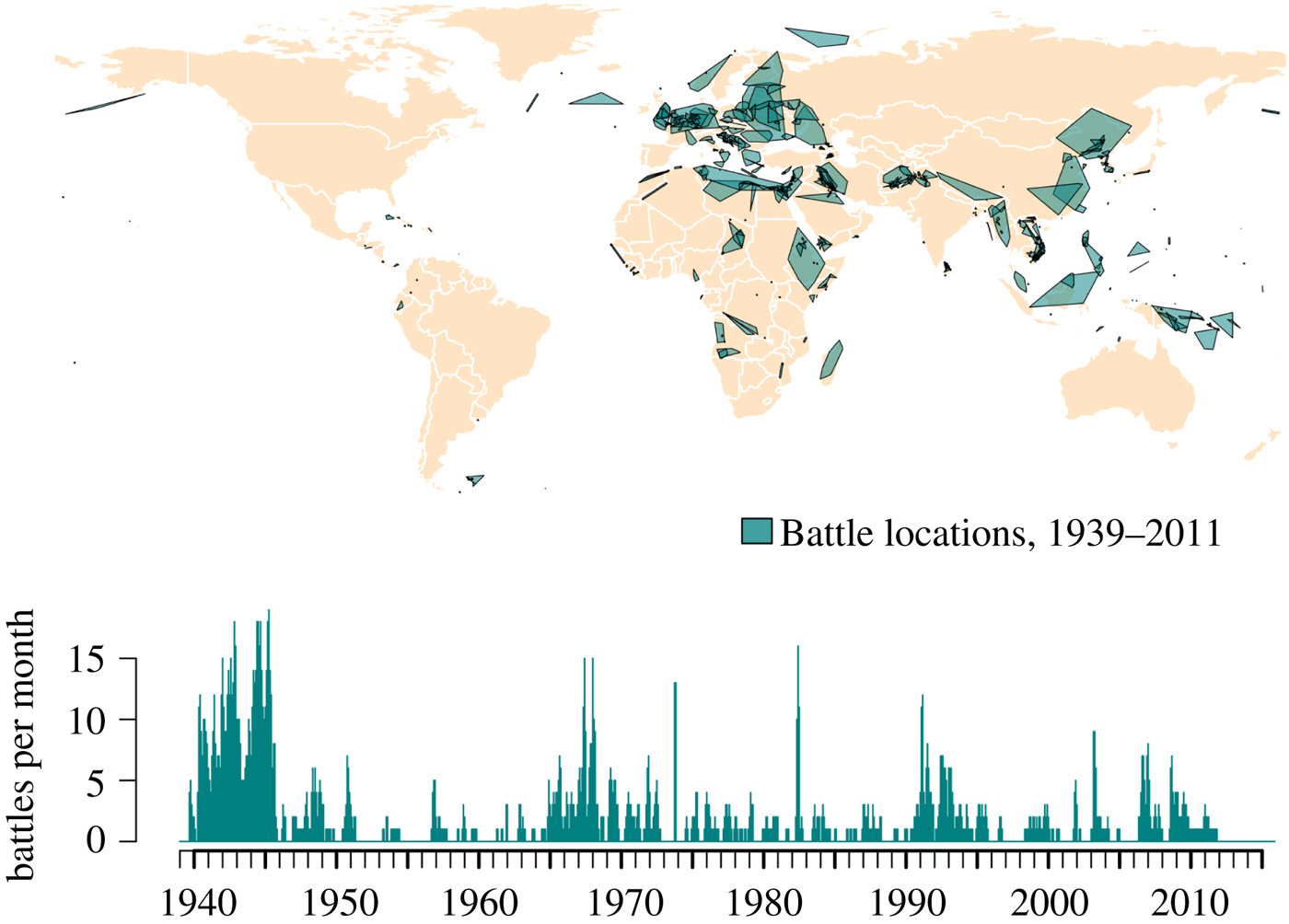
We collected location data for each battle from historical maps and military atlases, recording the geographic coordinates for the towns or geographic features where fighting took place. We used the distribution of these locations to construct convex hull polygons encompassing the largest extent of area over which forces were engaged.Footnote 53 Figure 1 illustrates the spatio-temporal distribution of battles in our data set. We used these data to calculate deployment distances to each battle, as well as the geographic size of the front, and the temporal sequence of events.
Spatio-temporal distribution of battles in data

We used Clodfelter as the primary source for data on battle participants, troop numbers and casualty statistics, including killed (KIA), wounded (WIA), missing in action (MIA), prisoners of war (POWs), defections, and desertions.Footnote 54 To capture military commanders’ influence on subsequent events, we coded separate binary variables as 1 if a flag officer (i.e., those ranked in the general or admiral grade or equivalent) surrendered, defected, or was captured or killed in battle.Footnote 55 In addition to raw counts of casualties and prisoners, we calculated the loss-exchange ratio (LER) for each battle participant (i.e., enemy casualties divided by friendly casualties)—a standard measure of relative attrition. To account for relative differences in personnel surrendering from smaller and larger formations, we created an ordinal measure of battle size.Footnote 56
To test alternative hypotheses proposed in past literature and control for other potential confounders, we supplemented this battle-level information with country-year-level variables from other sources. To account for political regime type, we used a modified version of the Polity index.Footnote 57 To account for perceptions of the overall balance of power, we measured relative military capacity, using the Composite Index of National Capabilities (CINC).Footnote 58 Because national-level measures of relative power potentially mask significant local imbalances, we included an indicator of which side is on the offensive, as well as a measure of the local force ratio at the start of the battle. We also created a dummy variable for a state's primary means of recruitmentFootnote 59—coded 1 if a state relied only on volunteers and 0 if it also relied on conscripts. Finally, we considered whether each side had ratified the Geneva Conventions.Footnote 60
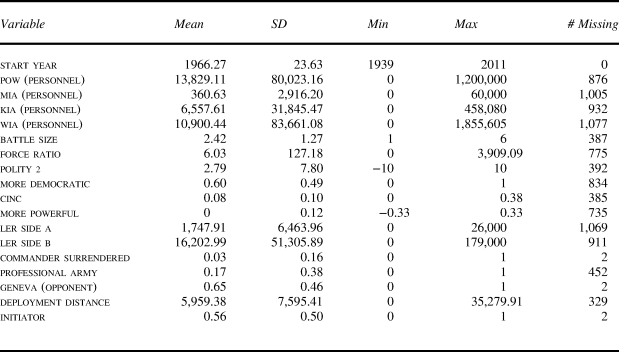
Table 1 lists the descriptive statistics for battle-level and country-level variables.
Descriptive statistics: Battle-combatant variables

Note: N = 1,720.
Data Analysis
We model the determinants of battlefield surrender as follows:
 $$y_{ijk} = \rho W(y) + \gamma Z_k + \beta X_{ij} + \alpha _i + \zeta _m + \theta _{\tau (k)} + u_{ijk}$$
Our unit of analysis is the battle-dyad, where m indexes the war (e.g., World War II), k indexes the battle (e.g., Stalingrad), i indexes the focal combatant (e.g., USSR) and j indexes the opponent (e.g., Germany). The dependent variable y ijk is the logged number of soldiers from combatant i who surrendered to opponent j in battle k.
The parameter of primary theoretical interest is ρ, which captures the influence of past surrender rates on surrender in the current battle. We specify the set of combatants and past battles that influence i's decision to surrender with an information flow network, W(y). We consider two types of information: instances of past surrender by combatant i to all opponents in war m (same combatant), and past surrender by all other combatants to opponent j during war m (same opponent). Following Zhukov and Stewart, we estimate the ρ coefficient in separate models for each diffusion measure.Footnote 61
We assume that soldiers place greater weight on more recent and geographically proximate cases of surrender. We specify the temporally weighted diffusion term as
 $$W(y)^{[{\rm same\; combatant}]} = \sum\limits_t^{\tau (k)} \displaystyle{{y_{i.t}} \over {{(1 + r)}^{\tau (k) - t}}}$$
 $$W(y)^{[{\rm same\; opponent}]} = \sum\limits_t^{\tau (k)} \displaystyle{{y_{.jt}} \over {{(1 + r)}^{\tau (k) - t}}}$$
where τ(k) is the start date of battle k, and t indexes the start dates of previous battles in war m, involving either the same combatant (eq. 2) or other combatants fighting opponent j (eq. 3).Footnote 62 The temporal discount rate is r ∈ (0, 1), with higher values placing a greater weight on more recent battles, and r = 0 placing equal weight on all past battles in war m. Because we do not have a strong prior on r, our empirical models automatically select values that minimize the Akaike Information Criterion (AIC). We also provide sensitivity analyses for all r ∈ (0, 1).
We specify the geographically weighted diffusion term as
 $$W(y)^{[{\rm same\; combatant}]} = \sum\limits_t^{\tau (k)} y_{i.t}\displaystyle{{d_k^{ - r}} \over {\sum\limits_t^{\tau (k)} d_k^{ - r}}} $$
 $$W(y)^{[{\rm same\; opponent}]} = \sum\limits_t^{\tau (k)} y_{.jt}\displaystyle{{d_k^{ - r}} \over {\sum\limits_t^{\tau (k)} d_k^{ - r}}} $$
where d k is the geographic distance, in kilometers, between battle k and all previous battles in war m, involving either combatant i (eq. 4) or other combatants fighting opponent j (eq. 5). The spatial discount rate, r ∈ (0, 1), is selected by AIC, with higher values assigning greater influence to past battles closer to k.
In addition to the information flow network, our model includes a set of battle-level (Z k) and dyad-level covariates (X ij). These include essential control variables like battle size, and variables needed to account for additional explanations of surrender, like recruitment (i.e., whether i has a professional army), regime type (i.e., whether i has a higher Polity2 score than j), and treatment of prisoners (i.e., whether j has ratified the Geneva Conventions), as well as controls for relative power (i.e., difference in CINC scores between i and j; local force ratio between i and j), offensive and defensive battles, logistics (i.e., i's deployment distance), and time (i.e., year in which the battle began). We also include fixed effects for each combatant (α i), war (ζ m), and season of the year (θ τ(k)), and an i.i.d. error term (u ijk). These fixed effects help us account for relatively static, macro-level drivers of surrender like ideology, discipline, and technological change from war to war.
Results
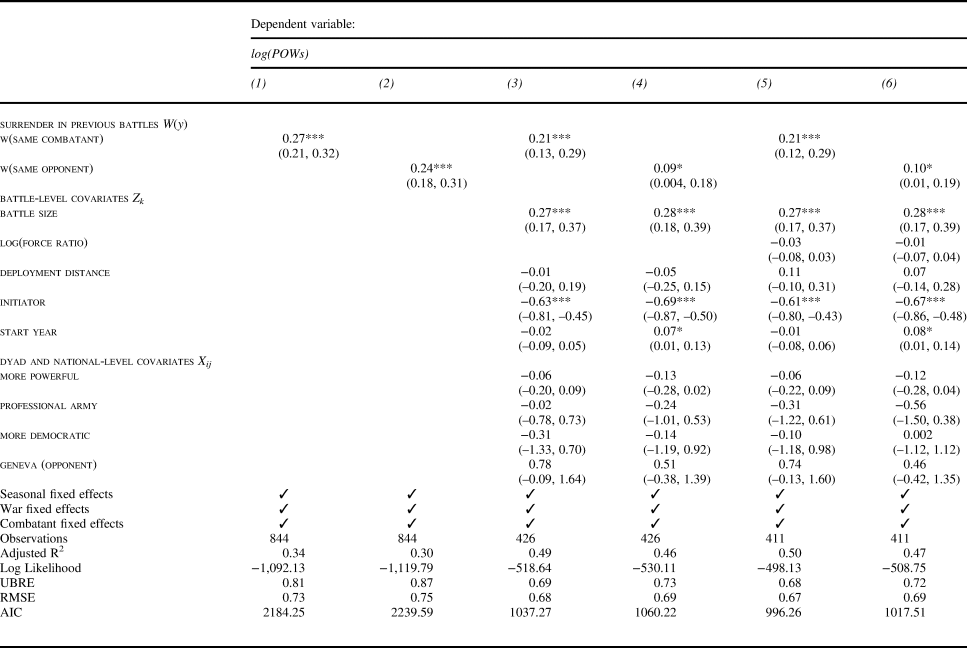
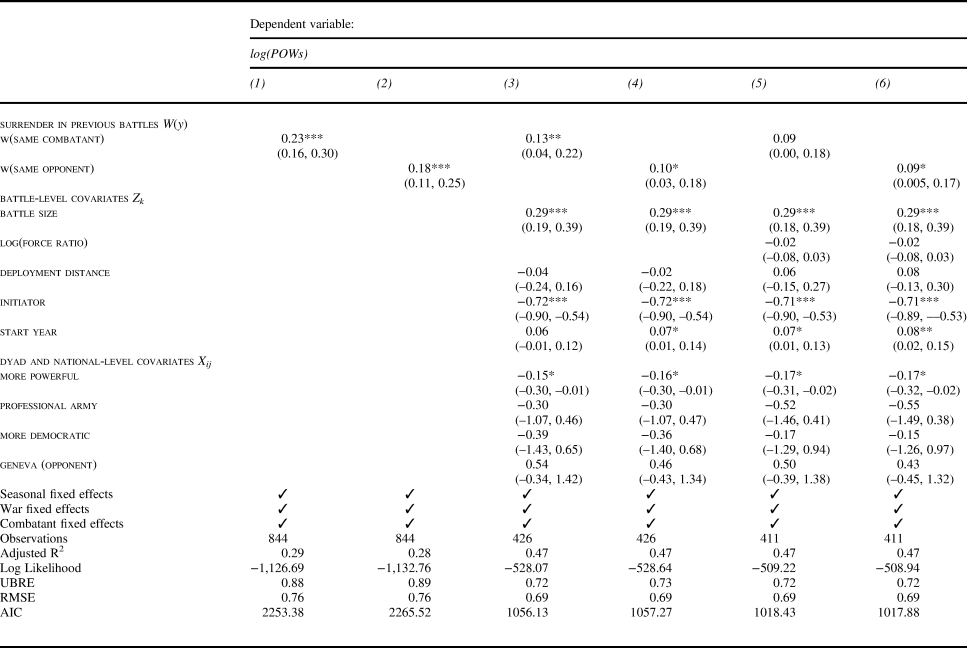
Tables 2 and 3 report the empirical determinants of surrender, with temporally and geographically weighted diffusion terms, respectively. The first two models in each table estimate the effect of information on past surrender by the same combatant (Model 1) and other combatants fighting the same opponent (Model 2). The remaining models incorporate battle-level and combatant-level covariates. Because parameter estimates are sensitive to scales of measurement, we report standardized coefficients—representing estimated standard deviation (SD) changes in the outcome following a standard deviation increase in the explanatory variable.
Determinants of battlefield surrender (temporal weights)

Notes: Standardized coefficients. 95% confidence intervals in parentheses. *p < .05; **p < .01; ***p < .001
Determinants of battlefield surrender (geographic weights)

Notes: Standardized coefficients. 95% confidence intervals in parentheses. *p < .05; **p < .01; ***p < .001.
Surrender is Contagious Across Battles
The analysis reveals strong evidence for our hypothesis: surrender is more intense following other recent cases of surrender. According to Model 1 in Table 2, a standard deviation increase in recently surrendered troops from the same army increases the logged number of troops surrendering in the current battle by .27 SD (95% confidence interval: .21, .32). This figure is slightly smaller, .24 SD (95% CI: .18, .31), for surrender from other armies fighting the same opponent (Model 2).
Parameter estimates are of similar relative magnitude for the geographically weighted diffusion measures in Table 3, which represent the influence of past surrender in nearby battles. A standard deviation increase in surrendering troops in spatially proximate battles produces a .23 SD rise (95% CI: .16, .30) in logged POWs if the surrendering troops were from the same army (Model 1), and a .18 SD increase (95% CI: .11, .25) if they were from armies fighting the same opponent.
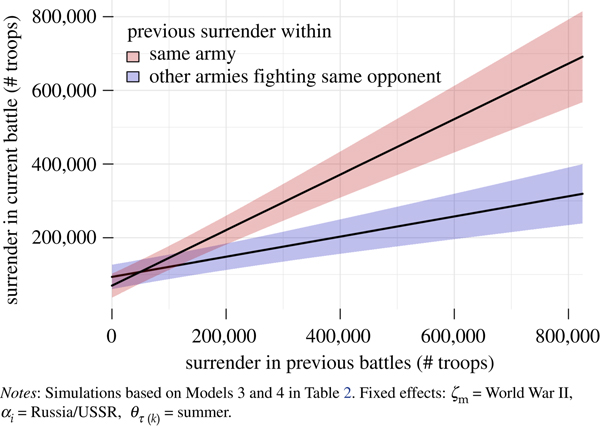
Figure 2 shows a graphical representation of this relationship through simulations based on Models 1 and 2 in Table 2 (temporal weights), with fixed effects for Russia/USSR fighting an average summer battle in World War II. Following a hypothetical increase from 0 to 300,000 recent prisoners of war from the same combatant—roughly equivalent to Soviet POW rates during the 1941 Battle of Smolensk—the expected number of surrendering troops rises by 330 percent per battle, on average (95% CI: 245, 560), from 68,880 to 296,556.Footnote 63 The rise is a smaller, but still formidable 139 percent (95% CI: 119, 182), from 92,768 to 222,161 per battle, following an identical increase in POWs among other armies fighting the same opponent.Footnote 64
Impact of past surrender on surrender in the current battle

A greater sensitivity of troops toward past surrender rates in their own army is not surprising. From a theoretical standpoint, signals soldiers receive through the same combatant network should be less noisy than those from the same opponent network. With pre-existing social networks, communication channels, and rumor mills, troops are likely to be better informed about the conduct of units within their own military than other countries’ armed forces—even if the latter are part of the same coalition. Troops may also see previous surrender within their army as a more indicative signal of how their own comrades will behave.
Contagion Effect Is Stronger If Soldiers Think Opponent Treats Prisoners Well
Are soldiers more likely to surrender to opponents who have signed treaties on the humane treatment of prisoners of war? The evidence here is more mixed. Tables 2 and 3 suggest that—if such an effect does exist—it cannot explain battle-level variation on its own. The coefficient for geneva (opponent) is statistically insignificant in Models 3 and 4.
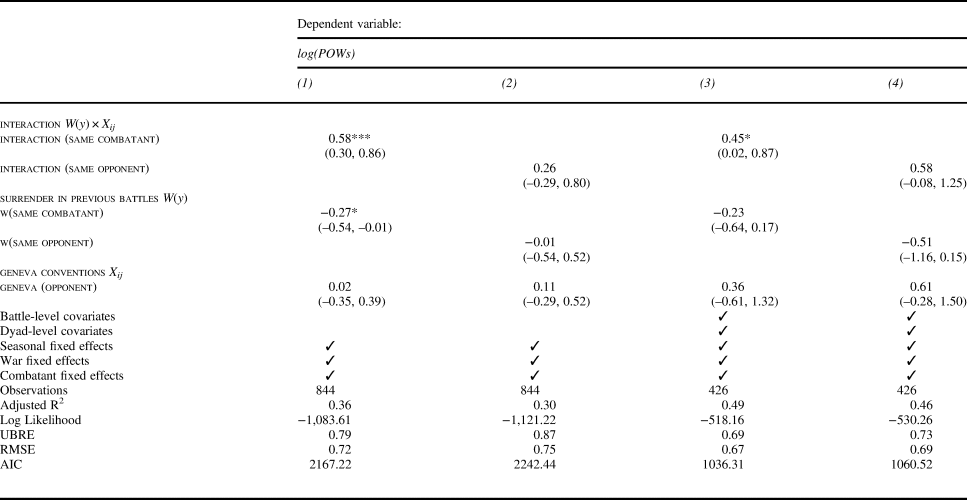
There is, however, tentative evidence for an interactive relationship between Geneva ratification and past surrender, supporting existing arguments that expectations of humane treatment increase surrender levels.Footnote 65 As Table 4 shows, the contagion effect is stronger if the opponent has ratified the Geneva Conventions. Here, a standard deviation increase in past surrender within the same army yields an increase of between .22 (Model 3) and .31 SD (Model 1). Where the opponent had not ratified (about 30 percent of cases), past surrender has no effect.
Interaction between past surrender and opponent's ratification of Geneva Conventions

Notes: Standardized coefficients reported, 95% CI in parentheses. *p < .05; **p < .01; ***p < .001
This apparent heterogeneity is not surprising, given the logic of collective action. Where the opponent has ratified the conventions, soldiers can reasonably expect the costs of surrender—narrowly defined as the probability of harm or death in captivity—to be relatively low. Where opponents have not ratified, soldiers are more uncertain about these costs, and are more hesitant to pay them. As a result, ratification of the Geneva Conventions can amplify the contagion effect.
Troops Are More Likely to Surrender If Senior Officers Recently Surrendered
Can some actions by military leaders potentially accelerate the tide of surrender? The role of principal-agent problems is difficult to empirically establish without battle-level data on monitoring and punishment of deserting troops. To the extent that more autocratic governments can institute more draconian forms of punishment than democracies,Footnote 66 we could assume that the costs of surrendering are higher in the armies of more repressive regimes. Yet the negative and insignificant coefficients on more democratic in Tables 2 and 3 are not what we would expect to find if such regimes succeeded in deterring troops from surrendering. Moreover, while regime type changes relatively slowly, commanders’ treatment of subordinates can vary greatly over the course of a war.
By way of an indirect test, we examined the impact of past surrender by commanders on surrender by rank-and-file troops in subsequent battles. Our reasoning here is that, when a commander has previously abandoned the battlefield, subordinates are likely to significantly discount the leadership's monitoring and punishment capacity. As a result, future commanders’ threats to punish insubordination, surrender, and desertion lose credibility. If surrender is indeed less likely where monitoring and punishment capacity is high, then we should expect it to be more likely where commanders have themselves recently surrendered.
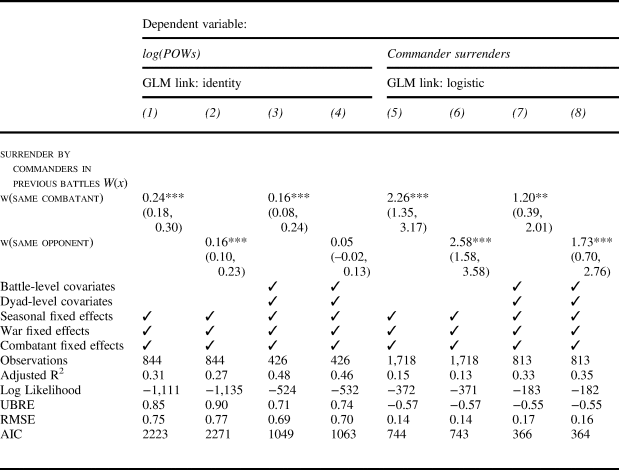
Table 5 reports the results of these additional analyses, with Models 1 to 4 estimating the impact of past surrender by commanders on surrender in the current battle by rank-and-file troops. These results confirm that soldiers are significantly more likely to surrender if commanders have recently done the same. A standard deviation increase in surrender by commanders within the same army yields an increase in the logged number of surrendering troops of between .16 (95% CI: 0.08, 0.24) and .24 SD (95% CI: 0.18, 0.30). Unsurprisingly, the actions of commanders in the soldiers’ own army have a more substantial impact than commanders surrendering from other armies fighting the same opponent.
The impact of past surrender by commanders

Notes: Standardized coefficients reported, 95% CI in parentheses. *p < .05; **p < .01; ***p < .001.
If surrender by commanders helps drive surrender by their troops, a natural question arises: why do commanders surrender? Our data suggest that the collective-action problems facing soldiers may be part of a broader problem in military organizations that reaches across ranks. As Models 5 to 8 in Table 5 show, commanders are more likely to surrender if other commanders have recently surrendered. In making this choice, commanders take cues not only from their own colleagues but also from other armies fighting the same opponent.
Macro-level State Characteristics Are Poor Predictors Of Surrender
While these results provide tentative evidence that surrender is contagious across battles, past surrender rates are, of course, not the only potential drivers of soldiers’ decisions. Unsurprisingly, surrender rates are higher in larger battles, where more troops are potentially at risk.Footnote 67 Surrender rates are also lower for attacking troops—potentially as a result of offensive advantages in numbers, speed, and surprise.
Consistent with other recent research, we find most other macro-level variables to be poor predictors of surrender.Footnote 68 Aggregate national power (more powerful), regime type (more democratic), and conscription (professional army) explain virtually none of the battle-level variation in surrender. The direction of these estimated effects is consistent with what we might expect from past literature. Fewer troops surrender from more materially capable armies. Armies staffed by long-service professionals are less likely to see higher rates of surrender than conscript armies. Troops are less likely to surrender if the opponent is less democratic than their home state. Once we account for battle-level factors like past surrender and battle size, however, these effects disappear.
Sensitivity Analysis
The evidence so far has been supportive of the collective-action model: troops are more likely to surrender if, based on recent battlefield experience, they expect others to do the same.
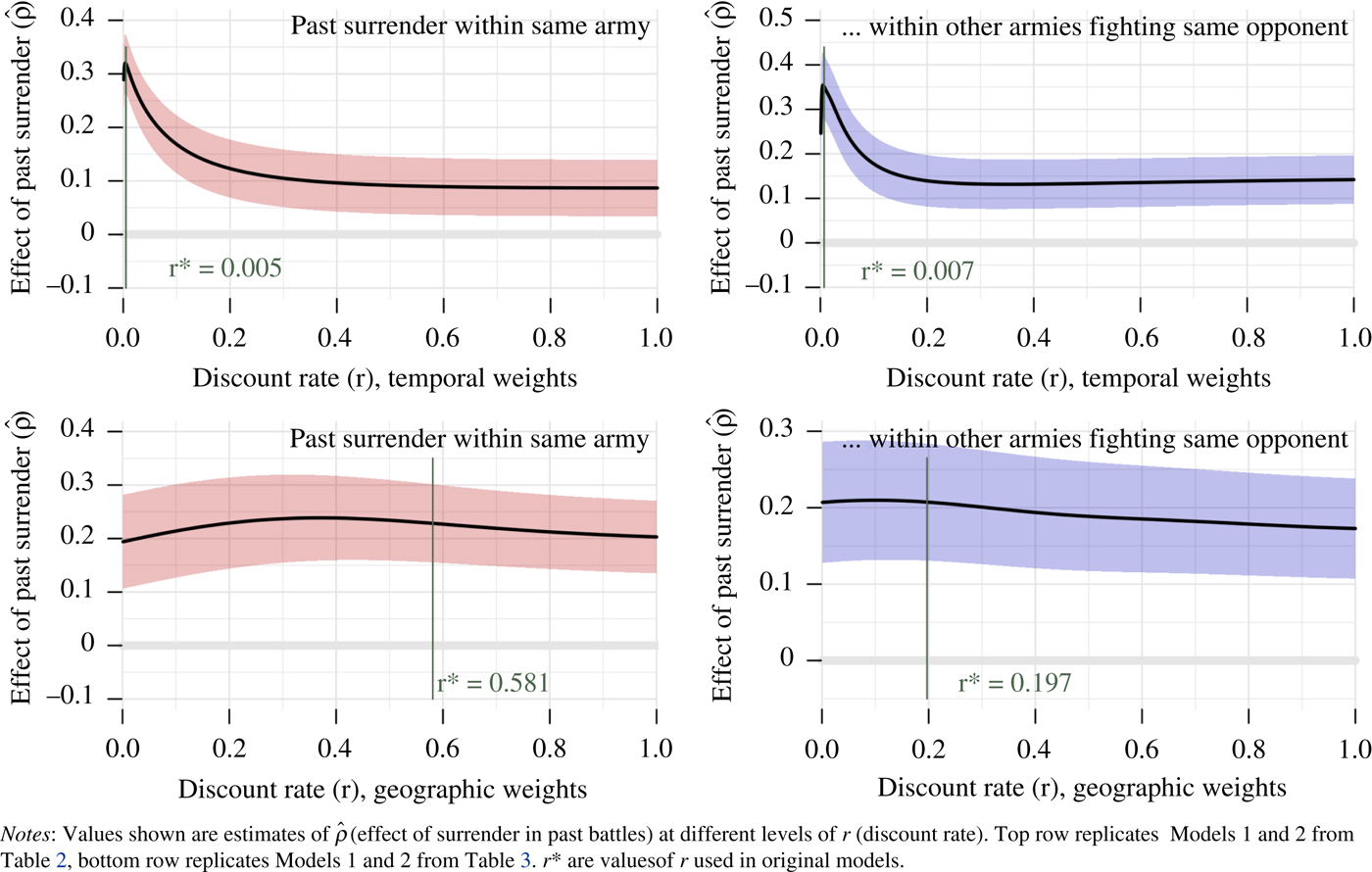
How sensitive are our results to soldiers’ discount rates (r in eq. 2 to 5)? In the preceding analyses, we used values of r that optimized AIC. As we show in Figure 3, these values were relatively low for temporal discount rates (r* = .005, .007 in Models 1 and 2 of Table 2) and intermediate for geographic discount rates (r* = .581, .197 for Models 1and 2 of Table 3). These choices have implications for the scope of our findings: Table 2 assumes that soldiers weighed recent and past battles about equally, while Table 3 assumes they focused on battles that occurred nearby.
How discount rate affects the contagion of surrender

To ensure that our findings hold under a broader set of time and geographic horizons, we replicated Models 1 and 2 in Tables 2 and 3 with values of r between 0 and 1. Figure 3 shows how estimates for  $\hat \rho $ gradually decrease and level off as r increases in the temporal weights models, while remaining steady in the geographic ones. Overall, however, the value of r does not fundamentally change our results. The impact of past surrender remains positive and significant in all four sets of models, regardless of how heavily one discounts long-ago events, or far-away battles.
Another potential objection to our analysis is that dynamics of surrender are different for ground battles than air and sea battles, but our data set pools these events together. Because modern sailors and airmen typically surrender after the destruction of their ship or aircraft, past surrender is less salient to their decisions.
To address this concern, we reran the models in Tables 2 and 3 with a restricted data sample that includes only land warfare. The results—which we omit here for space—are consistent with those we reported earlier. In the geographically weighted network, the contagion effect even increases, to .24 SD (95% CI: .17, 32) for the same combatant, and to .23 SD (95% CI: .16, .30) for other combatants fighting the same opponent. This increase makes intuitive sense: since it is more difficult for airmen and sailors to surrender mid-battle, keeping these battles in the sample should attenuate the estimated effect of past surrender.
Previous Surrender or Military Effectiveness?
Could more general expectations of military success be driving the contagion of surrender? So far, we have seen little evidence that troops surrender at lower rates to militarily weaker opponents. As Models 3 and 4 show, combatants with higher CINC scores than their opponents (more powerful) have few discernible advantages in this area. Yet because aggregate national capabilities do not vary across individual battles in a given year, they are a poor proxy for military effectiveness. Local numerical preponderance as measured by log(force ratio), meanwhile, has no apparent effect (Models 5 and 6).
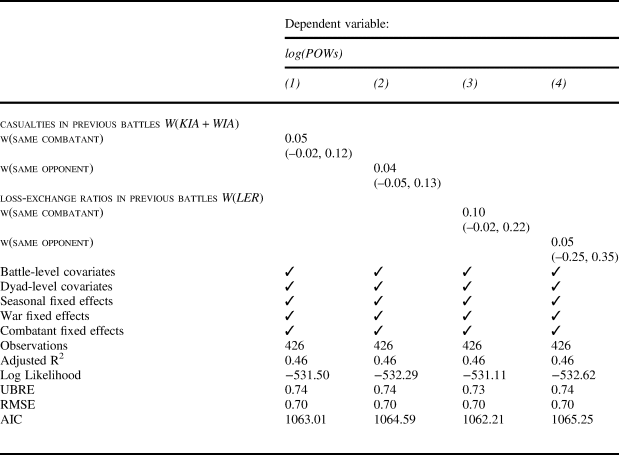
To more directly account for perceptions of battlefield success and failure, we reran our models with several “placebo” diffusion terms, capturing information about total dead and wounded in previous battles, and previous loss exchange ratios (i.e., enemy dead and wounded divided by friendly dead and wounded). Higher loss exchange ratios (LER) indicate superior military effectiveness in the narrow sense of being able to inflict heavy losses on the opponent with minimal casualties of one's own. If coefficient estimates on these placebo terms are positive, then the tendency to surrender may simply reflect expectations of higher losses, rather than any precedent set by previous surrendering troops.
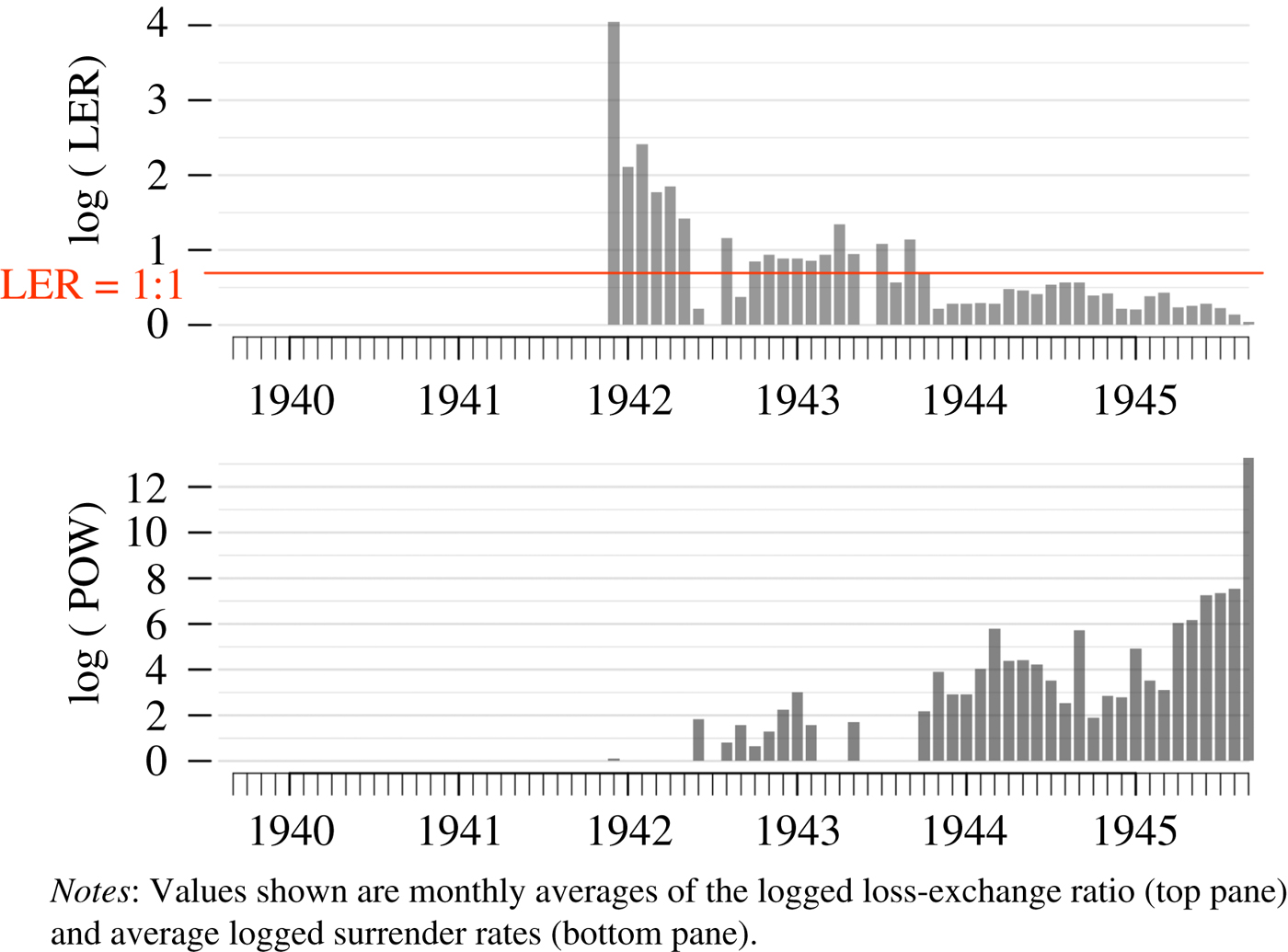
To illustrate this possibility, Figure 4 shows Japan's average monthly LER in World War II (logged), along with Japan's monthly surrender rates (logged). The plots suggest an inverse relationship. Early in the war, Japan's military effectiveness was high and surrender rates were low. Beginning in late 1943, LER dropped below parity (horizontal line), and surrender rates grew. From this picture, one may conclude that Japanese troops became more likely to surrender not as a result of cases of past surrender but because of an increasingly untenable military situation.
Japan's military effectiveness and surrender rates against US

Table 6 reports the results of our placebo tests. In each specification, the confidence interval on the diffusion coefficient covers 0. The high uncertainty around these placebo effects provides further evidence in favor of our preferred interpretation of the “past surrender” result. Surrender is neither more nor less likely in battles that, based on past experience, soldiers should expect to lose. Nor is the expectation of death by itself predictive of surrender. If political authorities wish to maintain the resolve of their armies in battle, these results indicate that they should worry less about how dangerous a combat environment is likely to be and more about recent precedents for mass surrender.
Placebo tests: Determinants of surrender

Notes: Standardized coefficients reported, 95% CI in parentheses. *p < .05; **p < .01; ***p < .001.
Payoff structure

Conclusion
Our results offer several contributions to research on interstate conflict. We demonstrate that battlefield surrender can be contagious because of a collective-action problem within military organizations. Success in battle requires that soldiers fight as a cohesive unit, but individual decisions to fight depend on whether soldiers expect their comrades to do the same. As troops learn of past decisions to surrender within their own army, they lose confidence in their unit's resolve and decide to flee rather than fight. This pattern is particularly acute if the expected costs of surrender are also low—either because troops believe the opponent will treat prisoners well, or because senior officers have recently surrendered, shaking the credibility of threats to punish desertion and surrender by the rank and file.
In addition to diffusion, we examined several alternative explanations of surrender. We found tentative, if mixed, support for a few factors that might affect the parameters of the collective action model—like international law, principal-agent problems, and offensive advantages. However, we found no evidence that surrender depends on political regime type, recruitment methods, or relative national power. Although data limitations prevent us from directly testing several other explanations—mutual surveillance, discipline, and ideology—we sought to at least account for them econometrically, through combatant and war fixed effects. We also demonstrated that it is information specifically on past surrender, rather than military effectiveness generally, that drives soldiers’ decisions.
The determinants of surrender are theoretically important because these life-and-death choices tend to resonate well beyond individual battles. Although previous research suggests that combatants acquire information about war-fighting resolve through battle outcomes, scholars often treat resolve as an exogenous cause of war termination. In our approach, by contrast, battlefield resolve is of primary theoretical interest. If wars are a continuation of political bargaining, reconciling informational asymmetries through the use of force, then understanding the mechanisms and processes influencing battlefield resolve is crucial for explaining and predicting bargaining outcomes. Our results illustrate that wartime resolve does not depend solely on political leaders’ assessment of probabilistic battlefield outcomes. Instead, military officers and their troops are the primary actors mutually influencing each other's behavior. Because soldiers’ choices in future battles depend on precedents set by others in the past, it is these cascading battlefield decisions that ultimately shape and constrain leaders’ choices.
Our study opens several future avenues of research. For example, although we have demonstrated that surrender can have a contagion effect across battles, we do not analyze how this process begins within battles, and what critical events must occur to jump-start surrender and its subsequent diffusion. While our focus has been on inter battle dynamics, a more explicit focus on intra battle behavior is needed to understand the conditions leading to initial organizational breakdown.
Further research is also needed to understand how different political-military institutions affect whether the diffusion process occurs, or whether it can be reversed. We know little about why some military organizations can absorb losses and adapt to changing circumstances, while others are unable to recover from battles in which soldiers surrendered en masse. By disaggregating wars into battles and stepping away from the classical approach of treating the military as a unitary actor, we can better understand how collective action dynamics affect battlefield outcomes and, ultimately, decisions to initiate, continue, or terminate war.
Appendix
This section formalizes the collective-action model of surrender, which we described qualitatively earlier. We develop a basic theoretical framework for a global game using Angeletos, Hellwig, and Pavan's game structureFootnote 69 and apply it to the domain of battlefield surrender. In the model, survival-oriented soldiers choose either to fight, thus increasing their unit's chances of success, or abandon. Soldiers’ decisions depend on what they expect others to do, based on private information and observation of previous battles. We begin by specifying a baseline static model, and then discuss the dynamic version separately.
The game unfolds as a series of battles in discrete time, indexed by t ∈ {1, 2, …, T}.Footnote 70 At t, each soldier i ∈ {1, 2, …, N} in an army simultaneously chooses to Fight (a it = 0) or Abandon (a it = 1). We denote the proportion of soldiers abandoning at time t as A t ∈ [0, 1].Footnote 71 The payoffs associated with fighting and abandoning depend on the resultant battle's state: success or failure. The state depends on whether the proportion of soldiers abandoning exceeds the army's level of organizational resolve, θ ∈ ℝ. We can interpret θ as the maximum level of abandonment an army can withstand while still being able to fight as a cohesive force.
If the abandonment rate is low (A t <θ), the battle will end in a success state, and each soldier who fights will receive payoff B. If, instead, abandonment rates are high (A t >θ), a failure state will occur, and each soldier who fights will receive a lower payoff η. A soldier who abandons will receive payoff z in the success state and v in the failure state. Payoffs z and v depend on both the level of punishment abandoning troops receive from their own army—which is particularly salient in the success state payoff, z—and the opponent's treatment of prisoners of war.
In a success state, soldiers prefer fighting to abandoning (z <B). In a failure state, they prefer abandoning to fighting (η<v). Soldiers also prefer successful fighting over abandoning in failure (v<B) and, by transitivity, prefer fighting in a success state to fighting in a failure state (η<B). The value of z relative to v can vary, based on expected punishment with one's own army and expected treatment by the opponent.
The relative cost of fighting for each soldier is 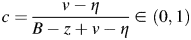 $c = \displaystyle{{v - \eta} \over {B - z + v - \eta}} \in (0,1)$.Footnote 72 This cost is increasing in the payoffs to surrendering, v and z. In line with previous research, we should expect v (and c) to be higher when opponents have ratified treaties on the humane treatment of prisoners. Armies who increase their opponents’ v therefore increase the relative cost of fighting against them, which makes abandoning more attractive. Similarly, we should expect z (and c) to be lower when an army can effectively punish its own surrendering troops. Consequently, armies who decrease z reduce the cost of fighting (since soldiers then avoid punishment), making fighting more attractive. Table 7 summarizes the payoff structure, with soldiers’ choices in the rows and the battle's state in the columns.Footnote 73
Static Equilibrium Analysis
Following Angeletos, Hellwig, and Pavan,Footnote 74 when θ is perfectly known by all soldiers, there are two pure strategy equilibria for θ ∈ (0, 1]: all soldiers fight (A t = 0 <θ) or all soldiers abandon (A t = 1 ≥ θ).Footnote 75 When θ is imperfectly known and there exists heterogeneous information about organizational resolve, the decision to fight or abandon depends on signals that each soldier receives. In this case, Nature draws an initial common prior,  $\theta {\rm \sim} N(\omega, \displaystyle{1 \over \alpha} )$, where α indicates the common prior's precision. Each soldier receives a private signal:
 $$x_i = \theta + {\rm \epsilon} _i$$
where  ${\rm \epsilon} _i{\rm \sim} N(0,\displaystyle{1 \over \beta} )$ indicates noise, i.i.d. across soldiers and independent of θ, and β describes the signal's precision.
Let  $\hat x \in {\rm {\opf R}}$ be a threshold, such that a soldier abandons when
 $x_i \le \hat x$. Given this threshold, the proportion of soldiers who abandon is decreasing in θ:
 $$A(\theta ) = Pr(x \le \hat x) = \Phi (\sqrt \beta (\hat x - \theta ))$$
where Φ is the CDF of the standard Normal distribution. This observation dovetails with previous research: the proportion of soldiers abandoning is decreasing in the level of organizational resolve, which is related to factors such as attacker advantages.
Organizational failure occurs when  $\theta \le \hat \theta $, where
 $\hat \theta $ solves
 $\theta = A(\hat \theta )$:
 $\hat \theta = \Phi (\sqrt \beta (\hat x - \hat \theta ))$.
The posterior of θ given x is distributed  $N\left( {\displaystyle{\beta \over {\beta + \alpha}} x + \displaystyle{\alpha \over {\beta + \alpha}} \omega, \displaystyle{1 \over {\beta + \alpha}}} \right)$. The resulting probability of failure is:
 $$Pr(\theta \le \hat \theta \vert x) = 1 - \Phi (\sqrt {\beta + \alpha} (\displaystyle{\beta \over {\beta + \alpha}} x + \displaystyle{\alpha \over {\beta + \alpha}} \omega - \hat \theta ))$$
This probability is decreasing in x. Consequently, a soldier will find it optimal to abandon when  $x \le \hat x$, where
 $\hat x$ solves
 $Pr(\theta \le \hat \theta \vert\hat x) = c {:}$
 $$1 - \Phi (\sqrt {\beta + \alpha} (\displaystyle{\beta \over {\beta + \alpha}} \hat x + \displaystyle{\alpha \over {\beta + \alpha}} \omega - \hat \theta )) = c$$
A monotone equilibrium  $(\hat x,\hat \theta )$ exists for all ω iff
 $\beta \ge \displaystyle{{\alpha ^2} \over {2\pi}} $.
Given a particular α, when β is smaller (i.e., private information is less precise), there are dominance regions where subsets of soldiers prefer one action over the other, depending on their individual value for x. However, as β → ∞, the threshold  $\hat \theta $ converges to θ ∞ ≡ 1 − c. When this occurs, the proportion of soldiers abandoning converges to 1 for all θ<θ ∞ and to 0 for all θ>θ ∞.
While this analysis describes only the static, one-shot version of the game, the same basic mechanisms operate in the dynamic model.Footnote 76
Dynamic Model
In each period t ≥ 1, each soldier receives a private and public signal about organizational resolve, θ. Furthermore, in t ≥ 2, each soldier also receives a public and private signal about soldiers abandoning in previous battles, A t−1. In the dynamic game, private information evolves over time as soldiers receive more information and update their beliefs. We specify these signals as follows:
 $$\hbox{Private},\theta {\rm :}\;x_{it} = \theta + {\rm \epsilon} _{it}$$
 $$\hbox{Public,}\theta {\rm :}\;z_t = \theta + \xi _t$$
 $$\hbox{Private},A_{t - 1}{\rm :}\;X_{it} = S(A_{t - 1},\upsilon _{it})$$
 $$\hbox{Public},A_{t - 1}{\rm :}\;Z_t = S(A_{t - 1},\zeta _t)$$
where εit and υit are idiosyncratic noise terms, ξ t and ζ t are common noise terms, and S:[0, 1] × ℝ → ℝ. Each of the noise terms is distributed normally with mean zero and variance specified as follows, independent of θ, serially uncorrelated, and i.i.d. across all i for private noise terms:Footnote 77
 $${\rm \epsilon} _{it}{\rm \sim} N(0,1/\eta _t^x )$$
 $$\xi _t{\rm \sim} N(0,1/\eta _t^z )$$
 $$\upsilon _{it}{\rm \sim} N(0,1/\gamma _t^x )$$
 $$\zeta _t{\rm \sim} N(0,1/\gamma _t^z )$$
The past period's signals condition posterior beliefs similarly to the static game.
Two cases illustrate the novelty of modeling the information structure in this way. First, consider a case where soldiers observe public and private signals only about the value for θ, but not the precise size of past levels of abandonment, A t. If a soldier observes that abandonment has occurred (without knowing the size), and sees that it did not lead to organizational failure, she will update her beliefs upward about the value for θ. In other words, by recognizing that the organization was able to sustain some unknown level of abandonment without total failure, the soldier comes to see that the army may be more resolved than previously believed, making future abandonment less likely. Consequently, when expected resolve is high, an army becomes more resilient against individual bouts of surrender.
In a second case, where soldiers also observe past levels of abandonment, A t−1, the dynamic changes. Here, separate signals about the proportion of soldiers abandoning in previous battles may counter the effect of knowing that the organization did not fail, based on the public signal about θ. When this happens, the likelihood that soldiers will abandon in the next battle can rise, potentially leading to a cascade effect across battles. These dynamics establish the microfoundations of the diffusion process posited by our main hypothesis: the flow of information from previous outcomes affects soldiers’ decisions in battle, and future surrender increases with information about past surrender.
Supplementary Material
Supplementary material for this article is available at <https://doi.org/10.1017/S0020818318000358>.