Aaron Copland's short instrumental work Quiet City (1940) originated as incidental music to an Irwin Shaw play of the same name. Staged by the New York based Group TheatreFootnote 1 for a brief run in April 1939, the play dramatized the internal conflicts of Gabriel Mellon, ‘a half-Jewish, middle-aged businessman […] who has rejected his liberal Jewish background and his youthful dream of becoming a poet, anglicized his name, married a wealthy socialite, and assumed the presidency of a large department store’.Footnote 2 Gabriel has recently been named the new United States ambassador to Finland and is preparing to leave his store and New York City for the five-year term of his appointment. But as he plans this next move into ever higher socioeconomic echelons, he is stabbed with the memories of his previous artistic aspirations and with a sense of responsibility to his perennially disenfranchised employees. Gabriel's alter-ego brother, David, is a jazz trumpeter, impoverished but full of nervous energy and smitten with love and idealism, representing everything Gabriel gave up to achieve his wealth and status. Gabriel actually believes he hears a trumpet playing at those moments when he is feeling equivocal about his past and present decisions.Footnote 3 The trumpet's call becomes a symbol for Gabriel's repressed sense of social responsibility, which, over the course of the play, is conflated with his once-forgotten hope of personal fulfilment.
Shaw intended the theme of this work to be ‘the troubled conscience of the middle class that cannot quite reconcile itself to its life in a distraught world’ – that is, the guilt borne by the bourgeoisie as its standard of living improves at the expense of the proletariat.Footnote 4 The play thus portrayed both Gabriel's own life of quiet desperation and the class struggles with which the productions of the left-leaning, depression-era Group Theatre typically dealt. The play was also full of subplots: Gabriel's father's troubles as a Jewish shopkeeper in an anti-Semitic neighbourhood, David's frustrated romance, and the individual challenges of eking out a living for various of Gabriel's employees and former friends, to name a few. Add to this expansive plot the blurring of the boundaries between the real and the imaginary, the cinematic juxtaposition of the present with numerous flashbacks, an enormous cast of minor characters, and a large number of scene and set changes, and it becomes easier to understand the production difficulties that led the Group Theatre to abandon Quiet City after only a handful of preliminary performances.
Copland's music was integral to the play's production. The trumpeting imagined by Gabriel at several points in the drama is described in Shaw's detailed stage directions (e.g., ‘The horn is muted, sounds little, and infinitely far, like a slight wind, musical, restless, dying’; elsewhere, ‘The horn suddenly sweeps up, mocking now, mischievous, erratic’Footnote 5), and Gabriel's interactions with it play a crucial role in defining his emotional and psychological state. One fantastical sequence involves Gabriel asking a policeman and then the mayor of New York City to silence the instrument, which has become in his mind the cry of the city's impoverished citizens. More broadly, Denise Von Glahn links the themes of the play to aspects of the later independent orchestral score to describe how the music evokes a sense of urban loneliness and an ‘overwhelming interiority’ specific to New York City at that time.Footnote 6
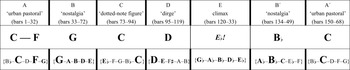
Formal divisions and pitch classes stressed in Quiet City (descriptive labels from Howard Pollack, Aaron Copland: the Life and Work of an Uncommon Man, 331–32).

It was shortly after the play's failure that Copland assembled from his musical cues – originally scored for two clarinets (doubling on bass clarinet and saxophone), trumpet, and piano – the well-known single-movement work for cor anglais, trumpet, and strings. Formally this musical Quiet City is a series of interconnected episodes. Howard Pollack goes so far as to describe it as a ‘suite’, though its constituent parts are continuous in performance. As Table 1 shows, it is cast in seven sections, the last two of which recapitulate the first two. The formal indications in quotation marks correspond to descriptive labels provided by Pollack for each section. He briefly catalogues an ‘urban pastoral’ evoking ‘the quiet city at night’, a ‘songful, expressive melody’ suggesting Gabriel's ‘nostalgia for his youthful aspirations’ (bar 33), ‘another lyrical section […] accompanied by a restless dotted-note figure’ (bar 73), a ‘dirge’ introduced ‘by a brief and strong duet’ (bar 95), a ‘stunning recapitulation of the nostalgia theme’ (Pollack here conflates the climax of the work with the subsequent return of the theme in question; that theme is restated at bar 134), and a return to the ‘opening city music’ (bar 150).Footnote 7
While the orchestral work retains explicitly only the title of the play, Copland's particular approach to large-scale pitch structure in the reforging of this music can be viewed as a metaphor for Gabriel's internal struggles. This analysis will show that the concert version of Quiet City is unified by means of a preoccupation with pentatonic collections at multiple levels. The members of the pentatonic collection that begins the piece are also projected as the most salient pitch classes of subsequent sections, bringing a middleground presentation of this collection closer to completion as the work progresses (as illustrated in the middle row of Table 1). This alignment of local and global levels is challenged, however, by other specific tonal issues that emerge in the first three episodes and culminate in the climax. In this reading the tidy correspondence between the opening and the piece-spanning pentatonic emphases represents Gabriel's carefully crafted social status and ascent; the tonal issues stand for his reminiscences of his idyllic, bohemian past and the growing temptations to return to that way of life. The climax is the apex of Gabriel's personal crisis, the moment when he must choose between contradicting views of himself and his place in the world. The work, in its approach to pitch structure, thus suggests a tonal drama that, while hardly portraying every narrative detail of the original play, nonetheless recalls elements of the theatrical drama that first inspired its raw materials.
After exploring the tonal intricacies of Copland's 1940 Quiet City, this essay surveys some details from the composer's sketches as he spliced together this concert work from portions of the play's musical cues. Familiarity with the tonal connections and correspondences linking the episodes of the orchestral work will clarify the significance of the changes that Copland introduced rather late in the compositional process. Specifically, after sketching out certain passages and sections, the composer adjusted their pitch levels in ways that allowed for the tonal organization described in this analysis to materialize – suggesting that he felt, in the absence of the theatrical context to which the source material was originally wedded, that a new tonal unity was needed for this music.
I
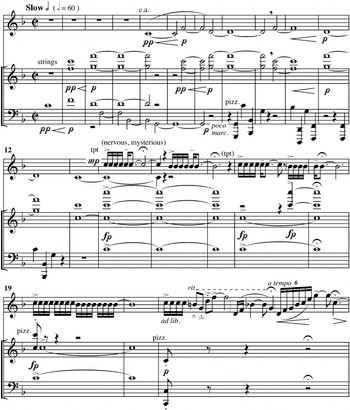
Quiet City begins with a tonal ambiguity that has consequences for the structure of the entire work. Example 1 shows that the opening hinges on a single pentatonic collection: {B♭–C–D–F–G}. However, no one member of this collection emerges as tonally supreme in the first twelve bars. The first two bars seem to point to F as a tonic with C as its fifth, but bar 3 immediately thwarts that impression with a widely spaced sonority introducing D and G. This is answered below by a descending perfect fifth from F to B♭, which immediately falls further to G. Lest the listener apprehend the strings as unfolding a G minor seventh chord, the cor anglais enters in bar 5 on an incongruous C, eliding with a resumption of the pattern that began the piece. At bar 8 the tonal ambiguity is reflected in a timbral inconsistency: the lower strings here resort to pizzicatos that disturb the slow-moving legato phrases above.Footnote 8 All the while the five pitch classes of the pentatonic collection are carefully controlled so that no one of them can assert itself as a clear pitch centre.
Aaron Copland, Quiet City, bars 1–21. © Copyright 1941. The Aaron Copland Fund for Music, Inc. Copyright renewed, Boosey & Hawkes, Inc., sole licensee. Reproduced by permission of Boosey & Hawkes Music Publishers Ltd.

While it helps to introduce the suppressed restiveness that typifies the play's protagonist, this opening on a tonally ambiguous pentatonic collection is structurally significant because the collection serves as the source for the most perceptually significant pitch classes of the entire work. The second row of Table 1 shows the most salient pitch classes of each section. Excluding the climactic section, which constitutes a special case, these pitch classes duplicate the {B♭–C–D–F–G} collection emphasized in the first few bars. While C provides the first and last clear pitch centres, conferring an additional sense of tonal unity, the tonally ambiguous deployment of this pentatonic collection at the opening suggests that the work is not so much about departure and return (from and to C) as about the unfurling of a single pentatonic collection across the piece. The members of this collection are the ‘safe’ places for Gabriel to tread; their reflection over the whole span of the work marks the tidy, uncluttered life he has built for himself, but the tonal uncertainty as the story opens hints at his ambivalence about that life.
Analysis of bar 21, trumpet part.

That tonal uncertainty dissolves at bar 13 as the strings converge on C in several octaves. At bar 14 the trumpet enters with a repeated-note declamation on C (suggesting Jewish liturgical chant).Footnote 9 After oscillating between C and its lower neighbour, B♭, in bars 14–20, the trumpet launches into a cadenza-like recitation in bar 21. Example 2 shows how this solo introduces a motivic emblem of the work and focuses briefly on G before returning at its conclusion to the unequivocal pitch centre of C. Bar 21 begins with the first minor-second-related pair of pitches heard thus far, C and B♮, before falling to G. These first three notes, C, B♮, and G, obliquely suggest  in G major. This suggestion is reinforced by the emphasis on G in the next phrase, though the true importance of this motive will emerge as it reappears throughout the work. The last phrase of bar 21 moves quickly through a G minor seventh chord and onto a C major triad, and brings the focus back onto C by lingering on the descending perfect fifth from G to C. To this listener the trumpet seems to turn briefly to a modally inflected G centricity and then to come back to C just as the cor anglais takes up the repeated-note incantation on C in the next bar (see Example 3 below). In any case the main musical significance of this recitative to the rest of the work is its introduction of the motive.
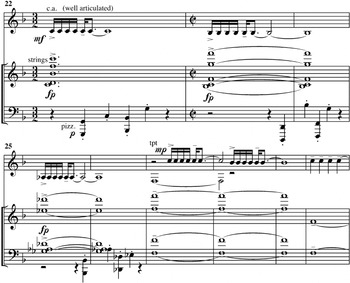
Copland, Quiet City, bars 22–30. © Copyright 1941. The Aaron Copland Fund for Music, Inc. Copyright renewed, Boosey & Hawkes, Inc., sole licensee. Reproduced by permission of Boosey & Hawkes Music Publishers Ltd.

Example 3 shows the passage following the trumpet recitative, which is characterized by a move to F centricity. The cor anglais now presents that repeated-note theme, supported by more complex sonorities in the strings. These chords remain within the governing {B♭–C–D–F–G} collection established in the first twenty-five bars of the work. A startling shift from this collection occurs in bars 25–6: the five pitch classes presented in these two bars form the ‘black-note’ pentatonic collection {G♭–A♭–B♭–D♭–E♭}. This contrasting collection quickly dissipates, and the cor anglais arrives together with the strings on F in bar 27. The result of bars 22–7 is a shift of centricity (analogous to that of bar 14) from C to F. By bar 27 the cor anglais has outlined  of F minor, and its landing on F is reinforced in several octaves by the strings. The subsequent entrance of the trumpet on C over the sustained Fs is thus
recontextualized to suggest
 of F, and this emphasis on F and the repeated-note theme continues unabated to the end of the urban pastoral a few bars later.
The black-note collection of bars 25–6 has ramifications beyond its mere reflection of the surrounding pentatonicism. As already seen in Table 1, the collection {B♭–C–D–F–G} governing the opening pastoral is also the source of the main pitch centres of the following sections of Quiet City. The only exception to this is the climactic section in bars 120–33. The internal tonal organization of this section is taken up below, but in summary it can be described as emphasizing five different pitch classes in rapid succession. What is striking is that the pitch content of bars 25–6 foreshadows all five of those stressed pitch classes; that is, the fourteen bars of the climax lend salience at different points to each member of the {G♭–A♭–B♭–D♭–E♭} collection. This opening episode thus not only introduces the most significant pitch centres of subsequent sections but also prefigures the climax's contrasting emphasis on the elements of the black-note collection.
By extension this section also might be read as a metaphor for the landscape of Gabriel's personal dilemma. As noted above, the slow-moving, pure pentatonicism reflects the relative stability of his affluent life, though its tonal ambiguity and the unsettling offbeat pizzicatos hint at his latent discontent. This pentatonicism is twice inhibited: first by the trumpet's – David's – introduction of the motive and then by the shift to the black-note collection at bar 25. The interruptive nature of the trumpet cadenza and its non-pentatonic motive suggest David's chattering, anti-establishment character, and this motive will initiate the following nostalgia section, with its suggestions of Gabriel's broodings about his own identity. Indeed, it will reappear throughout the work and become the thematic focus of the climax, the moment at which Gabriel must decide whether to follow his brother's example.
The black-note collection will take on parallel significance. Here it represents a burr in Gabriel's mind, a brief reminder of his previous life. At the climax it will challenge the supremacy of the governing {B♭–C–D–F–G} collection, offering him an alternative to his pleasant but ultimately meaningless existence.
II
Even as the first section of Quiet City presents in microcosm the tonal concerns of the entire work, it also begins the process of introducing the pitch centres of the {B♭–C–D–F–G} collection. C and F are the most emphasized pitch centres of the first urban pastoral, while G is suggested in a secondary way by the trumpet solo of bar 21. G subsequently becomes the main focus of the following nostalgia section, though it is not established as such until this section is well underway. Example 4 shows the opening of the nostalgia music.
Copland, Quiet City, bars 33–54. © Copyright 1941. The Aaron Copland Fund for Music, Inc. Copyright renewed, Boosey & Hawkes, Inc., sole licensee. Reproduced by permission of Boosey & Hawkes Music Publishers Ltd.

The cor anglais theme that begins this section seems to suggest as possible pitch centres A, B, and G. It begins with a repeated A, bar 35 includes a motive ending on A, and bar 37 gives A weight by repetition. An upward octave leap ends with a sustained B in bar 34, however, and the cor anglais concludes with an even longer B in bars 38–9. G is stressed in bars 34–5 via a perfect-fifth leap from G to D, and the second phrase ends on a held G in bar
36. The tonal focus of this music vacillates, turning the listener's attention to three different pitch classes in turn, thus reflecting Gabriel's ‘nostalgia for his youthful aspirations’.Footnote 10
The trumpet's response to the cor anglais beginning in bar 40 gradually clears away the preceding tonal ambiguity. The trumpet melody begins with a varied repetition of the cor anglais's three phrases (the similar first and third phrases are now made equivalent, and the motive of the second phrase is replaced with  in bar 42, momentarily giving more stress to A). Beginning at più forte in bar 46 the trumpet spins out a new extension of the cor anglais theme, crying out with an arresting G5, marked forte and approached as the root of a major triad. The strings answer in bar 49 with a three-chord cadential gesture that also emphasizes G in its outer registers. In addition to giving this section the clear centricity it has lacked up to this point, the trumpet's più forte extension makes exclusive use of a single pentatonic collection, sounding at least once every note of {G–A–B–D–E}. This emphasis on G continues beyond bar 49: the trumpet ends in bars 52–4 with an ascent from G to its fifth, D, and is answered by a near-repetition of the strings' cadence from bar 49.
The pentatonic collection {G–A–B–D–E} lurks behind much of this section. The strings' tetrachord in bars 34–7 is a subset of this collection, and the più forte trumpet phrase hinges on it. This collection also accounts for the three vaguely stressed pitch classes (A, B, and G) we noted in the opening cor anglais melody. In fact this nostalgia episode gives at least tentative emphasis, at different times, to each member of the {G–A–B–D–E} collection. The bottom row of Table 1 illustrates this: the nostalgia section accords G the greatest salience, but the other members of the {G–A–B–D–E} collection appear in bold face to reflect the focus, even if fleeting, that each receives in turn. Unlike other episodes outlined in Table 1, this section emphasizes every member of a particular pentatonic collection – only the climax exhibits a similar tonal approach. The consistency shared by all the episodes of Quiet City is that in every section the pitch centres emanate from pentatonic collections. Further, the pentatonic collection suggested by that subset of pitch centres also features prominently in the musical surface of that section: the members of {B♭–C–D–F–G} receive much attention in the urban pastoral, just as the members of {G–A–B–D–E} emerge repeatedly in the nostalgia section. Rather than being strictly pentatonic, the individual harmonies and melodies of Quiet City exhibit a pentatonic emphasis – and that emphasis emerges more strongly when we look to a higher architectural level, represented by the middle row of Table 1.
Copland, Quiet City, bars 55–72 (with analytical overlay). © Copyright 1941. The Aaron Copland Fund for Music, Inc. Copyright renewed, Boosey & Hawkes, Inc., sole licensee. Reproduced by permission of Boosey & Hawkes Music Publishers Ltd.

The conclusion of this nostalgia section, shown in Example 5, introduces a tonal anomaly with ramifications for the entire work. The analysis superimposed on this example shows in a cursory manner the emphasized pitch classes in this music and the continuing use of the motive. The pitch centricity of this passage is as murky as others already explored, though bars 59–64 focus vaguely on E through the sustained notes in trumpet and cor anglais, thus completing the {G–A–B–D–E} collection that spans the nostalgia section.Footnote 11 But
this new E focus is summarily disrupted at bar 65. In analogy to bars 50–51 and 57–8 one might expect the trumpet to proceed as shown in the top line of Example 6, thereby preserving the prevailing diatonic collection and E as the focal pitch class. Instead, Copland abruptly shifts out of the two-sharp collection on the downbeat of bar 65, and the first intervallic pattern of this bar suggests in E♭. The establishment of E♭ as the certain focus of this music, however, is itself clouded by the continuation in the trumpet, which involves perfect-fourth leaps between B♭ and F, G and C, and C and F in bars 65–7. After repeating the melodic emphasis on F in bar 69 (a repetition that further reduces any potential for E♭ centricity), the trumpet relinquishes the three-flat collection by introducing A♮ in bar 70 and finally comes to rest on G. As much as anything else in this passage this monophonic arrival on G suggests a modal cadence on that pitch class, thus recalling the main pitch centre of this nostalgia episode before beginning the next section of the work.
Recomposition of bars 64–5 compared with Copland's version.

These bars thus obliquely hint at the potential significance of E♭. E♭ is neither a member of the nostalgia section's {G–A–B–D–E} collection nor of the {B♭–C–D–F–G} collection that governs the piece. If adherence to the governing pentatonic collection represents Gabriel's stiff, well-regulated life, then this tentative turn towards E♭ – and away from the overriding pentatonic concerns of the rest of the section and the work – might be construed as his early contemplation of giving up the status of a middle-class executive and newly-appointed ambassador to return to his former identity as a poet and romantic. Through most of this section the nostalgia for that life is viewed at a distance, through the lens of overarching pentatonicism, but the fleeting E♭ focus near the section's conclusion makes that vision more immediate: here Gabriel seems really to wish ‘to lie down […] and wake up in 1928’, the year his own book of poetry was published.Footnote 12 Gabriel's latent desires are gradually awakened through the course of the play, much as the focus on E♭ (alongside other members of the black-note collection ) sharpens as Copland's concert work progresses.
III
The attention to E♭ increases in the following ‘dotted-note’ section, as shown in Example 7. Regardless of whether or not one perceives a brief moment of G centricity at bar 72 (as described above), the trumpet's G becomes in the C minorish music that follows at bar 73. The violins begin by emphasizing C along with its minor third, E♭, and the first sonority of this section is a second inversion C minor triad. From this point the individual string voices move by step through the three-flat collection until the second half of bar 74. B♮ is introduced here, producing an unusual sonority in Copland's harmonic vocabulary: a diminished seventh chord. This chord might function traditionally as  in C, though enharmonic respelling would also allow it to be apprehended as
 in E♭ (i.e., D–F–A♭–C♭). The following C minor seventh chord contains as a subset the E♭ major triad – in a sense this diminished seventh chord resolves to both C and E♭.Footnote 13
Copland, Quiet City, opening of the dotted-note section (bars 72–81). © Copyright 1941. The Aaron Copland Fund for Music, Inc. Copyright renewed, Boosey & Hawkes, Inc., sole licensee. Reproduced by permission of Boosey & Hawkes Music Publishers Ltd.

The tonal ambiguity between C and E♭ continues through much of Example 7. The strings' melodies are harmonized in parallel thirds, so that the agogic emphasis placed on E♭ in bars 78–9 is checked by support from C below (reinforced by one or another wind instrument) and by B♭ or F in the lowest register. Moreover, the texture of this passage is thick, especially after the dotted rhythms are abandoned at bar 77. Five different pitch classes often sound simultaneously, contributing to a pandiatonic haze from which no pitch class has an opportunity to emerge and clearly govern the music. The listener is left with a sense that E♭ and C are important in these bars, but to say that the music beginning at about bar 76 is ‘in’ E♭ or C belies its tonal ambiguity.
That ambiguity momentarily clears at bar 81 as the cor anglais sinks to G and the opening dotted-note figure begins anew, emphasizing C. The music that coincides with this return of clearer C centricity is a slightly shortened and varied repetition of bars 73–80; its tonal issues are the same as those of the beginning of the section. This reprise ends at bar 87.
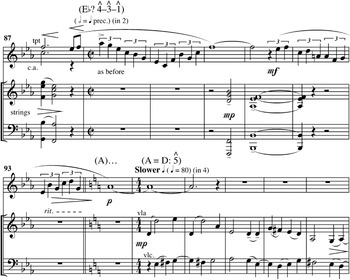
The tonal focus of this section of Quiet City might best be summarized as centred on C with E♭ competing for attention,Footnote 14 though at times there is little sense of pitch centricity on the surface. Just as in the preceding nostalgia section, E♭ again muddies the tonal waters. Its previous appearance simply conflicted with that section's {G–A–B–D–E} collection as well as with the governing collection of the piece as a whole. Here E♭ competes for tonal supremacy, contributing to the cloudy pandiatonicism pervading this section. It comes as no surprise, then, when the vaguely E♭-focused triplet melody from bars 65–72 is reprised at the end of this dotted-note section, beginning at bar 88 (see Example 8). This variation of the triplet melody still begins with in E♭ while again using perfect fourths and a sustained F to avoid unequivocally positing E♭ as a pitch centre. The trumpet makes one more reference to E♭ with a triadic outline in bar 93 before settling on A in bar 94. For a moment A appears
to function as a new tonic, approached modally – much like G in bars 71–2 – and sustained unaccompanied for an entire bar. Like G earlier, though, it is subsumed as of D as the dirge section starts at bar 95.
Copland, Quiet City, bars 87–99 with analytical notes. © Copyright 1941. The Aaron Copland Fund for Music, Inc. Copyright renewed, Boosey & Hawkes, Inc., sole licensee. Reproduced by permission of Boosey & Hawkes Music Publishers Ltd.

This growing E♭ emphasis, standing outside the tonal norms of the governing {B♭–C–D–F–G} collection, points to Gabriel's increasingly frequent introspections as the play progresses. After a decade as a businessman he is now approaching a personal crisis and considers whether to give up this way of life entirely: ‘When I was a young man I was no machine, no motor, no mask […]. I mean I have to find peace […]. I mean I’ve learned something tonight it took ten years to sink in. I mean I want to retire from this war.'Footnote 15 Elsewhere he reflects on the role of a department store executive: ‘Imagine that. A man attached to a market for underwear and toothpaste, a daily prison for six thousand souls.’Footnote 16 The protagonist's crisis of conscience, with regard to both his economic and social ascendancy above his former peers and his personal artistic aspirations, is symbolized by the growing insistence of E♭. He was once a published poet: should he now return to that bohemian identity and abandon all that he has built for himself?
IV
Pollack describes the short introduction to the dirge section at bar 95 as a ‘brief and strong duet’; this passage concludes with a cadential gesture on a D–A open fifth in bar 99 (see Example 8). The dirge rhythm is established just after this cadence and continues to the music of Example 9, which shows this pattern accompanying the return of the duet theme in the cor anglais at bar 105. The theme is here transposed and transformed to suggest E centricity, which the dirge accompaniment lightly supports with E minor triads in bars 105 and 108. In comparison to the emphasis on D at the opening (and closing) of the section, however, this attention to E as a pitch centre is relatively weak, contributing to a view of D as the dirge section's main tonal focus.
Copland, Quiet City, end of the dirge (bars 105–20). © Copyright 1941. The Aaron Copland Fund for Music, Inc. Copyright renewed, Boosey & Hawkes, Inc., sole licensee. Reproduced by permission of Boosey & Hawkes Music Publishers Ltd.

In fact the music begins almost immediately to turn back to D. The one-sharp diatonic collection is gradually replaced with the two-sharp collection (see the alternating C♮s and C♯s in bars 111–13), and the bass line descends from A1 to D1 in bars 113–17. Also at bar 117 the cor anglais and trumpet sound D5 in unison, and the trumpet follows with a series of fanfares stressing A, the fifth above D, in a prominent register. The remaining strings in bars 114–19 continue the dirge pattern with wider registers and leaps, reinforcing the growing grandeur of this passage as it leads to the climactic section at bar 120. The repeated D1s in the basses and the overwhelming trumpet timbre emphasizing A5 forcefully convey D centricity despite the large number of pitch classes sounding simultaneously at this point. D is the most emphasized pitch centre of the dirge section, thus continuing the presentation of members of the {B♭–C–D–F–G} collection as structural pitch centres over the course of the piece.
Pollack's epithet ‘dirge’ brings to mind the working-class poor depicted repeatedly in Shaw's play as victims of hard times and callous employers. Says one: ‘I’m so tired. My blood's tired goin' around and around, for nuthin'. There was a man [Gabriel] I knew when I was a kid, I thought he'd help me, but there was no room for me.'Footnote 17 Even so, the commentaries of Pollack and Von Glahn both identify a sense of emerging optimism in this music.Footnote 18 At the culmination of Shaw's play Gabriel's personal choice is symbolized as a managerial one: the truckers supplying his store have formed picket lines barring access to it, and he must decide whether to allow the strike to run its course – benefiting the lower class and ensuring his removal as president of the store – or to call in the police to break up the human barricade violently. The rhetorical role of the dirge is to move away from the introspection of the preceding music and towards the communal grandiloquence of the impending climax, the point at which Gabriel will decide his own fate and that of his employees.
V
As suggested earlier, the climactic section eschews the other sections' pattern of positing a main pitch centre that is a member of the {B♭–C–D–F–G} collection. Instead, the climactic section makes use of the black-note collection, {G♭–A♭–B♭–D♭–E♭}, as a source of potential pitch centres, touching on each of its members with varying levels of ambiguity as the section unfolds. Gabriel is here stepping outside the normal bounds of his businessman persona to revel in the possibilities awaiting him should he choose to shed that persona permanently. As he puts it to his socialite wife, ‘I’m going off to write on ledgers and pavements and the decks of tramp steamers. I'm going to be ruined and sing songs of the gas and electric companies and bums and Jews and despair and terrible tenderness. Also, I'm going to sleep nights. Today's poet, Gabriel Mellon.'Footnote 19
Copland, Quiet City, bars 120–33 (with analytical overlay). © Copyright 1941. The Aaron Copland Fund for Music, Inc. Copyright renewed, Boosey & Hawkes, Inc., sole licensee. Reproduced by permission of Boosey & Hawkes Music Publishers Ltd.

Example 10 shows the climax in its entirety. The opening bars of this Largamente make use of the motive to touch quickly on three different potential tonics. The strings' melody immediately presents in A♭, extended by a perfect fifth leap up to E♭, to become  . This melodic emphasis on A♭ is reflected in both the ostinato bass, which features the ascending fourth E♭–A♭, and the supporting chords in the strings' inner voices, which retain A♭ and E♭ as common tones throughout these first two bars. In bar 121, however, the triplet melody emerges. Its first two pitches, E♭ and F, first represent and
 of A♭; we might therefore expect the melody to progress up to
 on the downbeat of bar 122 by analogy with
bars 50–51 and 57–8 (see Examples 4 and 5 respectively). Instead, Copland replaces the expected A♭ at the start of bar 122 with G♭. This pitch class takes on the character of a new goal for the triplet melody's upward striving towards a tonic, and the anacrusis to bar 122 can thus be retrospectively reconstrued as
 in G♭. This G♭ is itself then reinterpreted as the
 of a potential in D♭. In the context of a piece that so often uses this pattern as (including as recently as two bars earlier), the listener might be tempted momentarily to favour D♭ over G♭ as pitch centre before the triplets continue with leaps that outline the G♭ major triad. While depending entirely on a single diatonic collection, these few bars take on the character of a tonal prism, rapidly reflecting focuses on three different pitch classes as the melody turns this way and that.
In fact the music sets its sights on yet another pitch class beginning in bar 123. The strings' triplet melody here settles on E♭, which is echoed twice by the trumpet in bars 124–6.Footnote 20 The trumpet returns to the triplet melody and its characteristic motive at bar 127. As it does so, the entire musical landscape is abruptly shifted to the three-flat diatonic collection, thus accommodating the G♮ of the trumpet's motive. As shown in Example 10, an E♭ focus is first suggested as early as bar 123 and becomes more certain when the three-flat collection takes hold in bar 127.
The motive, which had already been extended to 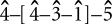 , is further lengthened with a prefix from bar 128 onwards. The resulting
 is the subject of intense melodic imitation leading to the height of the climax at bar 133. Beginning on the fourth beat of bar 128 the upper strings present the extended motive at a pitch level that, considered alone, would suggest B♭ centricity. The cor anglais imitates the upper strings at the same pitch level two beats later. The trumpet follows two beats after that, though at a pitch level that reinforces E♭ as tonic. The strings, trumpet, and cor anglais continue to sound this short melody canonically on E♭ and B♭ until the culmination of the section at bar 133, where the trumpet sings out B♭5 alone, leading into the restatement of the nostalgia music.
The climax thus stresses, at least tentatively, each pitch class of the black-note collection – the same foreign collection that we observed intruding on the opening urban pastoral. This grandiose music reaches beyond the confines of the governing collection but does so in a way that has already been intimated at the opening of the work. This particular transposition of the pentatonic collection, which at first constituted a striking but brief interruption of the overriding {B♭–C–D–F–G} of the opening music, now blossoms to become the preoccupation of the climax.
In contrast to its status as an intruder in the dotted-note and first nostalgia sections, E♭ is featured here as the most unequivocal pitch centre of the climax. Long melodic E♭s suggest this pitch class as a tonic as early as bar 123, and the three-flat collection introduces the return of the triplet melody, using , at bar 127. The melodic imitation closing this section focuses on E♭ and its fifth, B♭, and the trumpet, as the most prominent instrument, foregrounds the version of the motive focusing on E♭. Moreover, E♭ is not a foreigner in the group of pitch classes emphasized in the climactic section, for it is a member of the black-note collection. The tonal problem of E♭'s strangeness, in terms of its manifestations in previous sections, is here auspiciously reconciled.
The parallel to be drawn between the role of this climax in the tonal drama of the piece and Gabriel's personal strife is striking. The climax revels in the dreams and aspirations represented by Gabriel's former self – musically, E♭, the black-note collection, and the motive. The brilliant optimism of the climax rests in part on its projection of this idealistic E♭ – no longer as an outsider trespassing on the ground of the governing pentatonic collection,
but as the most strongly stressed member of the black-note collection. In the dramatic climax of Shaw's Quiet City Gabriel's brother exhorts him, ‘Take your pen in hand. Be today's poet, the Minnesinger of our time. Sing the songs of your own people, so that you can sleep in peace at night.’Footnote 21 While Gabriel is strongly attracted to this idealism – an idealism that he once held himself – he ultimately cannot bear giving up the social status and comforts he has accrued over the years. David sums up his brother's dilemma: ‘Security and a clear conscience are not closely meshed in the borough of Manhattan.’Footnote 22
The climax crests on the trumpet's soaring B♭ in bar 133; it is approached from below as the fifth of E♭, but it also leads into the reprise of the nostalgia music in the next bar. B♭ becomes the most prominent pitch class of this nostalgia reprise, thus completing the work's governing pentatonic collection. Moreover, B♭ is the only pitch class common to both the black-note collection and the governing collection, and thus serves as a fitting bridge between the aspirations represented in the climax and the nostalgia for those dreams in the following section. This B♭ is Gabriel's Rubicon: it marks the moment at which he gives up his artistic dreams – and the hopes of his brother and workers – and turns back to his present life as a ‘responsible’ businessman. The nostalgia music returns, now focused on B♭ and thus completing the governing collection. Gabriel's doorway out of his life of miserable conformity is now closed, the ambition to improve the lot of his poor employees gone.
VI
Despite the overwhelming way in which B♭ heralds the return of the nostalgia music at bar 134, B♭ centricity is not at all certain as this new section starts. B♭ is apprehended as of E♭ at the end of the climax. The cellos reinforce the elision of the trumpet's B♭ into the opening of this section, as shown in Example 11, but the opening is itself tonally vague, just like the opening of the earlier nostalgia section.
Copland, Quiet City, nostalgia reprise (bars 134–49). © Copyright 1941. The Aaron Copland Fund for Music, Inc. Copyright renewed, Boosey & Hawkes, Inc., sole licensee. Reproduced by permission of Boosey & Hawkes Music Publishers Ltd.

With the exception of the precise sizes of the first few melodic intervals, the music beginning at bar 134 remains for some time an upward semitone transposition of bar 33 onwards (see Example 4). Were this later section to continue as before, we would expect an eventual culminating focus on A♭, equivalent to that on G in bars 48–9. At bar 143, however, the cor anglais melody is aborted just as it completes a B♭ major arpeggio (compare the trumpet's A major arpeggio in bar 42). Following an unmetred silence the trumpet echoes this arpeggio, and then the two wind instruments alternate in octave leaps which emphasize the fifth degree of B♭. This truncation of the nostalgia music at the B♭ arpeggio and the extended attention given to the members of the B♭ triad lend focus to B♭. In fact B♭ is the most strongly emphasized pitch class of this section, as the reprise of the opening urban pastoral begins in bar 150 (immediately following Example 11).
The presentation of B♭ as the main pitch centre here completes the middleground {B♭–C–D–F–G} collection representing Gabriel's structured, predictable life. As the music
has traced the elements of this structure, it has provided sparks to kindle memories of and longings for his former, better self: the interpolation of the black-note collection in bars 25–6, the growing but uncertain stresses of the non-collectional E♭ in the first nostalgia and dotted-note sections, and (to a lesser extent) the appearances of the motive. The climax, through its overt focus on these elements, momentarily opened up this repressed idealism as a chance for him to change his ways, but he declined it. The opportunity represented by E♭ instead leads to B♭, the last pitch class of the governing collection; Gabriel and the music return to their melancholy ways.
Copland, Quiet City, conclusion (bars 162–8). © Copyright 1941. The Aaron Copland Fund for Music, Inc. Copyright renewed, Boosey & Hawkes, Inc., sole licensee. Reproduced by permission of Boosey & Hawkes Music Publishers Ltd.

Quiet City ends with a shortened version of the urban pastoral with which it began. This restatement takes place at its original pitch level, reinforcing a view of the structural role of its pitch collection. Example 12 displays the work's conclusion, beginning just after the ad lib music in the trumpet. The cor anglais doubles and sustains the upper notes of the string pizzicatos in bars 162–4, creating agogic emphasis on G as each subphrase tarries on that pitch class. Then in bar 165 the cor anglais acting alone reinterprets G as the fifth above C. These bars thus replicate the tonal emphases of the trumpet recitative immediately preceding them, and the music of Example 12 comprises a fitting close by restating the first juxtaposition of pitch emphases from the opening section so as to return to C, the first definite pitch centre of the piece.Footnote 23 By ending on the same pitch class, having reprised the first two episodes as its last and re-stressed the governing pentatonic collection, Copland's concert work leaves Gabriel where it found him: living a life with which he is not happy, nostalgic for his former self, but not quite uncomfortable or courageous enough to change. Shaw's play does much the same: Gabriel's last words to his brother, after having allowed the police to break up the workers' blockade, are, ‘I can't give you anything. You’ll have to take what you want.' He exits with his wife, ironically agreeing that ‘it's a quiet night’ even as ‘the trumpet swells’.Footnote 24 He has dejectedly decided to ignore its call.
VII
The tonal structure of Copland's piece for chamber orchestra explored above is independent of the original music that accompanied Shaw's play. We cannot know whether Copland conceived of the original dramatic cues for the play as a tonally united ‘work’, not only because he never commented on this aspect of his original music, but because his manuscripts leave unclear the precise relationship of some cues to the play. Those musical cues are preserved in the Aaron Copland Collection at the Library of Congress, but Copland's performance notes on his play script and manuscript score are vague (and sometimes illegible), making it difficult to identify with certainty the location originally intended for each cue.Footnote 25 Even if those cues taken together did manifest a large-scale tonal structure, that structure could certainly not have been maintained in its original form, as the composer omitted various numbers (as well as repetitions of numbers that he did include).Footnote 26 Whatever the tonal nature of the original collection of cues may have been – and whatever the composer's attitude towards it – his transformation of this music into a single-movement concert work allows us to watch him develop aspects of the large-scale tonal structure described in the foregoing analysis.
The trail of sketches connecting the incidental music to the 1940 Quiet City provides a unique opportunity to view Copland massaging pre-existing themes and episodes into what must have seemed to him to constitute a musical whole. I do not claim that he made a calculated attempt to effect this structure as he assembled the work, much less that he intended it to symbolize Gabriel Mellon's struggle. But it seems reasonable to speculate that, in the absence of the explicit dramatic context on which the cues had first depended, he felt it necessary to alter the music as he selected portions and stitched them together in order to achieve some sense of musical unity. Whether or not he actually made a conscious effort to portray Gabriel's internal conflicts in the large-scale design of the concert work, it is not difficult to imagine that the protagonist's character and the strife he experienced, which as a responsible composer Copland had certainly worked to assimilate in his efforts on the play, also coloured his thinking about the 1940 version. But, at the least, his sketches for the 1940 Quiet City show him introducing changes to the tonal orientation of several extracts after jotting them out, and these changes have bearings on the large-scale tonal design of the final work as set out above.
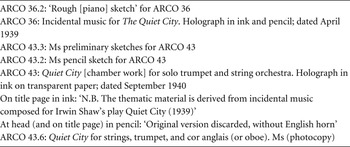
Abbreviated Library of Congress descriptions for selected Quiet City manuscripts (in chronological order).

Table 2 summarizes the compositional history of Quiet City as it is preserved in the Copland Collection at the Library of Congress. After the brief run of Shaw's play Copland first assembled an intermediate, stand-alone musical work for trumpet and strings. This version, which was never published, was almost immediately rearranged to include a cor anglais ‘for contrast and to give the trumpeter breathing spaces’, as Copland put it;Footnote 27 ARCO 43 and 43.6Footnote 28 thus present virtually the same music in different arrangements. Of interest to us are ARCO 43.3 and 43.2, the sketch work for the stand-alone Quiet City, manifested first as ARCO 43 and then as the well-known version of ARCO 43.6.
The extensive sketch history reveals the composer repeatedly changing the transposition levels of various passages throughout the work. These changes are manifested in two ways. First – and of lesser interest here – the transcription of a musical block from the play's incidental music (ARCO 36) to the sketches of ARCO 43.3 and 43.2 often included a transposition, usually to a lower pitch level. For instance, the cues of ARCO 36, containing forms of the urban pastoral and the nostalgia music, were originally cast as much as a perfect fourth higher than their ultimate pitch levels in ARCO 43 and 43.6, drawing a more piercing effect from the trumpet (and making the trumpet part substantially more difficult). The second brand of transposition to be observed in these sketches derives from marginalia Copland would add as or after he had worked out entire sections of the ‘suite’ in ARCO 43.3 and 43.2.
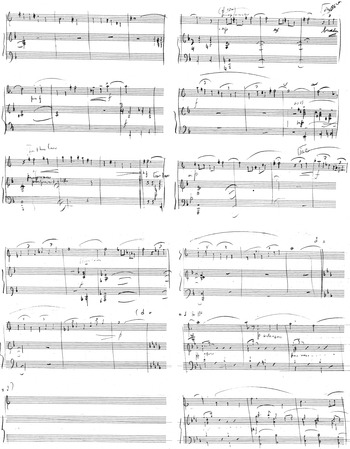
Figure 1, taken from ARCO 43.2, provides an initial example of these annotations. An excerpt of this sketch is diplomatically transcribed in Example 13. Throughout this sketch Copland's typical practice is to notate the trumpet part on the top staff in B♭ (i.e., with the intended sounding pitch a whole tone lower than written). It is striking, therefore, when he adds the indication ‘in C’ above the triplet passage beginning just before bar 65. This melody was originally intended in bar 65 to sound the motive in D♭ (rather than E♭), and thus to continue weakly positing a D♭ focus before leading to a new section with a five-flat key signature. But it would seem that, after working to the end of the nostalgia section and writing the key signature for the subsequent section (see Figure 1), Copland added the ‘in C’ indication at bar 64 and the words ‘1 tone lower’ (surely meaning ‘1 tone higher’Footnote 29) to the strings' music at bar 67 – in sum, transposing this music up a whole tone to point towards E♭ rather than D♭. As our explorations above suggested, E♭ has the consistent role of representing Gabriel's idealistic dreams in the finished work: it re-emerges in a similar recitative at the end of the following dotted-note section, and it is the focus of the climax. The whole-tone transposition of bars 65 (with anacrusis) to 72 also allows Copland to focus the subsequent dotted-note section on C and E♭, rather than B♭ and D♭, as reflected in the rewriting of the last three bars of the recitative and the new three-flat key signature shown in the last two
systems of Figure 1. Copland's adjustment of the pitch level here supports the role of E♭ in this tonal drama, allowing it to coalesce gradually across the span of the piece.
Elsewhere in Example 13 we can observe that Copland first intended bars 50–57 to sound a major second higher, projecting A rather than G as pitch centre. After first drafting this passage, he indicated that the trumpet should sound ‘1 tone lower’ at bar 50 and that the strings should follow suit at their next entry in bar 53. By transposing this material, Copland continues the emphasis on G established by the trumpet's più forte phrase of bars 46–9, making G the most prominent pitch class of the entire nostalgia section. This G emphasis is essential to the unfurling of the {B♭–C–D–F–G} collection that governs the piece's unique approach to tonal structure.
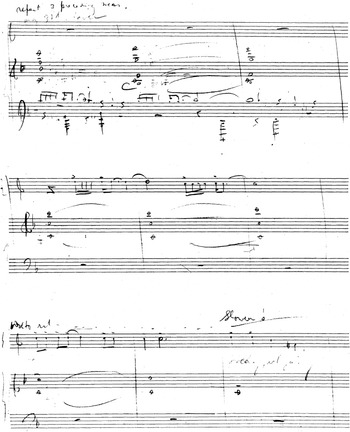
Figure 2 is an excerpt from ARCO 43.3, which I have transcribed as the upper systems of Example 14.Footnote 30 As noted above, this is the moment in the opening urban pastoral when the black-note collection is briefly invoked and F centricity is established. Remarkably, both of these tonal features are absent from Copland's sketch for this music. The first system of Example 14 shows that the sketch began with a three-bar echo of the nervous trumpet melody (which at this point was intended for solo cello, but was eventually given to the cor anglais). This echo is itself immediately repeated before the trumpet takes it up against octave Cs at the end of the passage. Copland goes so far as to indicate in the sketch ‘repeat 3 preceding measures’. In this version, the music is couched entirely in the governing collection, and the last trumpet entry is focused on C as before.
ARCO 43.2, pp. 8–11 (bars 42–78). Excerpts from the sketches of Quiet City by Aaron Copland are reproduced by permission of the Aaron Copland Fund for Music, Inc., copyright owner.

Transcription of ARCO 43.2, bars 50–72, compared with published score.

ARCO 43.3, excerpt that would become bars 22–9 of Quiet City. Excerpts from the sketches of Quiet City by Aaron Copland are reproduced by permission of the Aaron Copland Fund for Music, Inc., copyright owner.

Compositional history of bars 22–7 from Quiet City.

The composer would later return to this sketch page with a different pencil, amending ‘repeat 3 preceding measures’ to ‘repeat 3 preceding measures maj. 3rd lower’. System 2 of Example 14 encapsulates all the changes that Copland overlaid on this page with the new pencil, most of which are not clearly visible in the reproduction of Figure 2. He does in fact transpose the sustained chords and pizzicatos of the first three bars to generate the next three, though the cello/cor anglais motive does not abide by this transposition. The result of these changes is a three-bar digression from the governing pentatonic collection into the black-note collection. The foreshadowing of the climax's black-note collection, noted above as a feature of the work's tonal drama, was thus introduced after the relevant passage was already drafted.
In addition to this major-third transposition, the first two systems of Example 14 show that Copland replaced the subsequent cadence on C with a cadence on F. The trumpet entry in bar 28 (which would become bar 27 in the published score) is recast as of F, and F centricity persists to the end of the section. This focus on F is crucial from the perspective of the large-scale tonal organization, as this is the only place where F is articulated as a pitch centre. Copland's alteration of this cadence allows for all the members of the governing pentatonic collection to be represented as pitch centres over the course of the work. System 3 of Example 14 reproduces the final version of this passage as published. The ‘repetition’ has now been truncated so that it is no longer recognizable as such, and the cello/cor anglais
melody is further altered – but the brief emphasis on the black-note collection, like a flash of light in Gabriel's mind, remains, as does the F cadence.
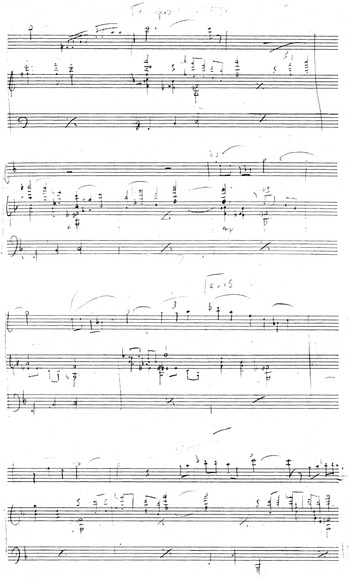
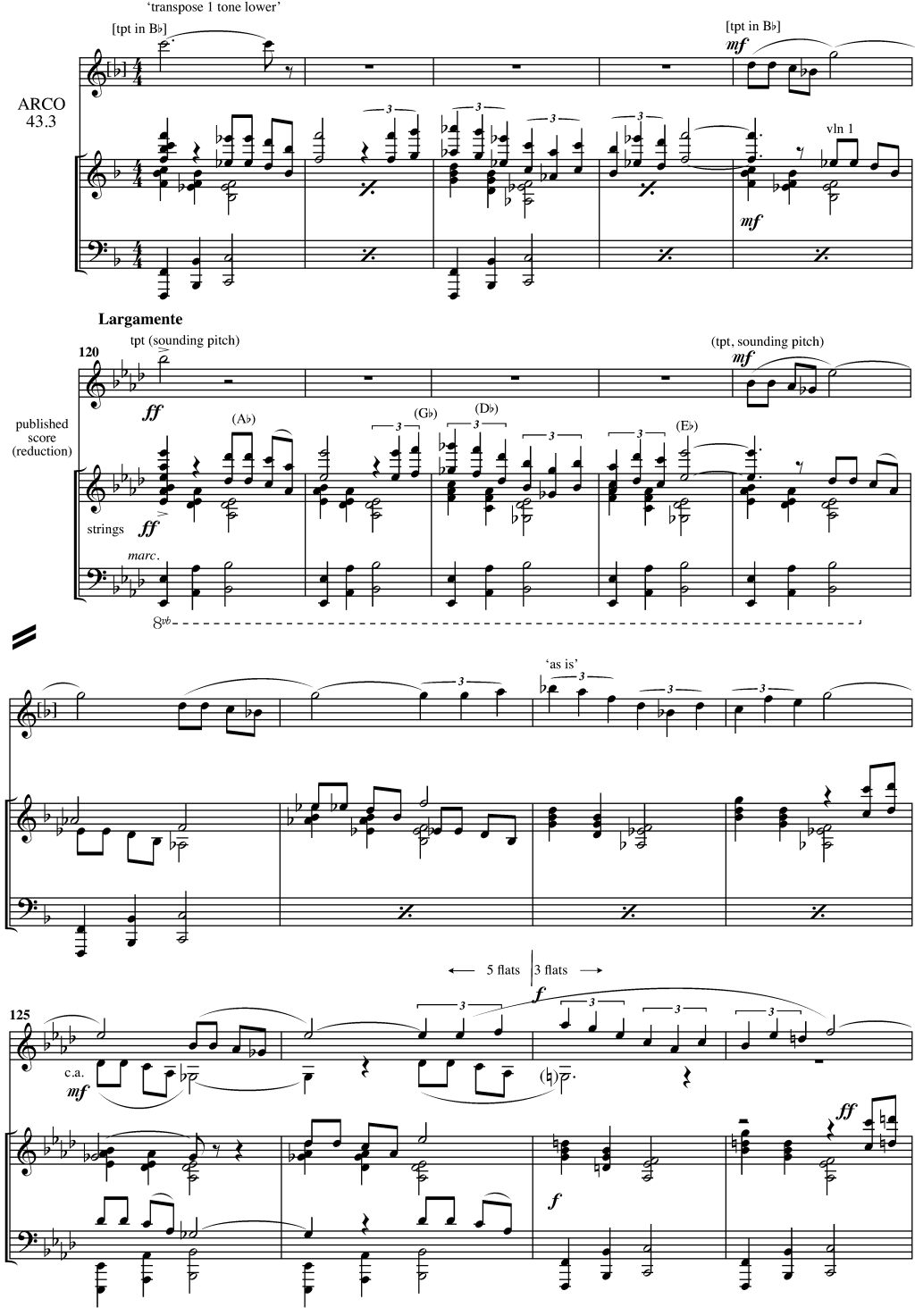
Example 14 shows that the use of the black-note collection in the urban pastoral, foreshadowing its appearance at the work's climax, was the result of a transposition of an already composed passage. The emphasis on members of the black-note collection in the climax itself is also the result of the composer's shifting the initial pitch level of ARCO 43.3. Figure 3 displays the first portion of the climax in this sketch; the upper system of Example 15 provides a transcription.
ARCO 43.3, excerpt that would become bars 119–32 of Quiet City. Excerpts from the sketches of Quiet City by Aaron Copland are reproduced by permission of the Aaron Copland Fund for Music, Inc., copyright owner.

Compositional history of bars 120–28 from Quiet City.
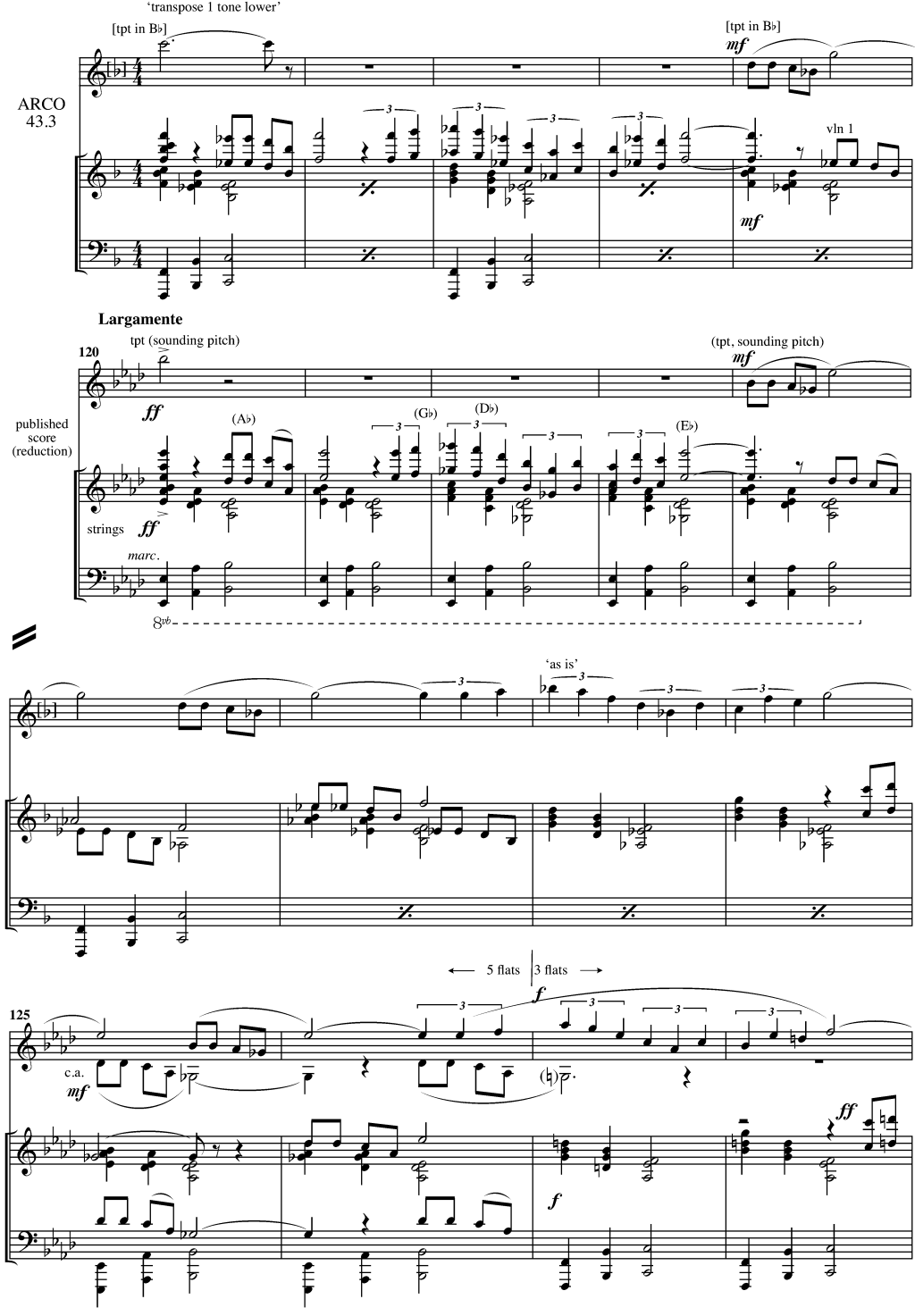
The lower system of Example 15, a reduction of these bars as they appear in the published score, indicates the pitch classes from the black-note collection that are given at least some passing emphasis, as described in the discussion of this passage above. The only member of the black-note collection not stressed here is B♭, but this pitch class will receive a great deal of emphasis later in the climax, as already shown. The ARCO 43.3 draft of this music, shown in the upper system, does not provide this same focus on the black-note collection. In this earlier version the first seven bars of the climax are cast a major second higher, creating tentative emphases now on B♭, E♭, A♭, and F. Three of these pitch classes are members of the black-note collection, of course, but B♭ and E♭ will steer the apex of this section anyway, and D♭ and G♭ are absent from this passage. As in the opening urban pastoral, here Copland returns to the sketch after completing the draft and adds the indications ‘transpose 1 tone lower’ at bar 120 and ‘as is’ at bar 127. This transposition creates the wrenching mid-phrase shift at bar 127 from a prevailing five-flat diatonic collection to three flats, drawing attention to the impending peak on E♭ and its fifth, B♭.Footnote 31 But equally important to this analysis is that the whole-tone shift of bars 120–26 allows for the remaining members of the black-note collection to emerge into the listener's consciousness. This alteration, together with the alteration made in the urban pastoral at the opening, creates a tonal connection spanning nearly the entire composition. The large-scale tonal approach highlighted in this analysis, and its parallels with the dramatic origins of Quiet City, would not exist had Copland not made these changes.
The sketches for many other works by Copland are also peppered with indications to transpose already completed passages ‘one tone higher’ or ‘major third lower’, for instance, creating new tonal juxtapositions that survive into the final products. As well as in Quiet City, such marginalia can be found in the sketch work for Appalachian Spring (1944), the Sonata for violin and piano (1944), the Third Symphony (1946), and the Twelve Poems of Emily Dickinson (1950). It was apparently part of Copland's modus operandi to transpose otherwise finished passages at late stages of composition. The above analytical reading shows that, at least in the case of Quiet City, those transpositions forge tonal correspondences and connections throughout the work. Study of contemporaneous works and their sketches may demonstrate that Copland's practice was to build ‘from the ground up’: by adjusting the pitch levels of musical blocks he had already written out discretely, he created large-scale tonal structures that were uniquely informed by the motives, pitch collections, or other components of those blocks.Footnote 32 The view of the composer's workshop represented by this perspective on Quiet City becomes all the more intriguing if the approach observed here can indeed be generalized to include other pieces.
When briefly chronicling the genesis of this piece in his autobiography, Copland himself seemed resigned to the obscurity of its origins: ‘Quiet City seems to have become a musical entity, superseding the original reasons for its composition.’Footnote 33 This comment suggests that the tonal structure of the work need not hinge on any correspondence to Shaw's play, and in fact the view of that structure espoused in this essay might easily be regarded without reference to the stage drama. Nonetheless, whether or not he intended to continue depicting Gabriel Mellon and his internal conflicts as he assembled the 1940 concert version, Copland's treatment of pitch centres and other musical events can also be viewed as symbolizing those conflicts and their development over the course of the play. In this way the stand-alone musical work carries forward in more abstract terms the psychological struggles Shaw intended for his protagonist. Copland's previous endeavours to portray those struggles must have influenced, at least indirectly, his efforts to salvage a musical product from his work on the failed Group Theatre production.
In stark contrast to Shaw's Quiet City, Copland's Quiet City was an immediate success and has remained in the repertory since its 1941 première. The play's troubles stemmed at least in part from its problematic mix of fantasy and realism. It is thus perhaps fitting that Shaw's dramatic aspirations, like Gabriel Mellon's poetic aspirations, survive only as a musical memory, in that artistic medium that is too specific for words.