Introduction
Non-alcoholic fatty liver disease (NAFLD) is emerging as one of the most common liver diseases in the Western world affecting as many as 30% of the adult western population (Bellentani et al. Reference Bellentani, Saccoccio, Masutti, Croce, Brandi, Sasso, Cristanini and Tiribelli2000; Browning et al. Reference Browning, Szczepaniak, Dobbins, Nuremberg, Horton, Cohen, Grundy and Hobbs2004; Zelber-Sagi et al. Reference Zelber-Sagi, Nitzan-Kaluski, Halpern and Oren2006; Baumeister et al. Reference Baumeister, Volzke, Marschall, John, Schmidt, Flessa and Alte2008). About 2–3% of the general population is also suspected of having non-alcoholic steatohepatitis (NASH), characterized by hepatic inflammation, which increases the risk for hepatic fibrosis, cirrhosis and hepatocellular carcinoma (Wong et al. Reference Wong, Wong, Choi, Chan, Li, Chan, Chim, Yu, Sung and Chan2010). NAFLD/NASH is closely associated with the metabolic syndrome (Bugianesi et al. Reference Bugianesi, Moscatiello, Ciaravella and Marchesini2010) and with poor nutritional and physical activity habits (Zelber-Sagi et al. Reference Zelber-Sagi, Ratziu and Oren2011).
Recent studies suggest that NAFLD is also associated with impaired mental well-being, and specifically with depression. NAFLD patients have been shown to have a decreased quality of life (QOL) (David et al. Reference David, Kowdley, Unalp, Kanwal, Brunt and Schwimmer2009), as manifested by worse physical and mental health scores, compared with an American population with and without chronic illness (Elwing et al. Reference Elwing, Lustman, Wang and Clouse2006; Newton et al. Reference Newton, Jones, Henderson, Kane, Wilton, Burt and Day2008). NAFLD patients have also been demonstrated to have a significantly increased lifetime risk for major depression and generalized anxiety disorder compared with controls (Elwing et al. Reference Elwing, Lustman, Wang and Clouse2006). However, the retrospective design of that study prevented inference regarding the direction of the association and did not account for the possible confounding effect of other affective states. Similarly, a study that looked at the rate of depression in patients with chronic liver disease showed the rate to be highest (30%) in hepatitis C virus (HCV), followed closely by NAFLD (27%) (Weinstein et al. Reference Weinstein, Kallman Price, Stepanova, Poms, Fang, Moon, Nader and Younossi2011). Another study assessed the psychosocial outcomes of children with NAFLD as compared with obese controls and found that children with NAFLD had higher levels of depression than obese controls (Kerkar et al. Reference Kerkar, D'Urso, Van Nostrand, Kochin, Gault, Suchy, Miloh, Arnon, Chu and Annunziato2013). Several recent abstracts, yet to be published in full, from international meetings have reported an association between NAFLD and psychological states such as depression, psychiatric illness and attention deficit hyperactivity disorders (Lee & Jonas, Reference Lee and Jonas2007; Sayuk et al. Reference Sayuk, El-Dirani, Elwing, Lustman, Lisker-Melman, Crippin and Clouse2007; Suzuki et al. Reference Suzuki, Binks, Wachholtz and Diehl2007). Specifically, Sayuk et al. (Reference Sayuk, El-Dirani, Elwing, Lustman, Lisker-Melman, Crippin and Clouse2007) reported an association between elevated transaminases and depression among NASH patients.
Given the high prevalence of depression (Simon et al. Reference Simon, Goldberg, Von Korff and Ustun2002) and its physiological manifestations such as the metabolic syndrome (Toker et al. Reference Toker, Shirom and Melamed2008) or cardiovascular morbidity and mortality (Lett et al. Reference Lett, Blumenthal, Babyak, Sherwood, Strauman, Robins and Newman2004), finding out the physiological antecedents of depression may help identify populations at risk. Nevertheless, no study to date has focused on liver enzymes, a marker of hepatocellular damage, as a risk factor for new-onset depressive symptoms.
The mechanisms governing the association between NAFLD/NASH and depressive disorders are poorly understood and complex (Elwing et al. Reference Elwing, Lustman, Wang and Clouse2006). The possible mechanisms include cytokine-mediated inflammation, activation of the hypothalamic–pituitary–adrenal (HPA) axis, and the effects of insulin resistance on neurotransmission. An accumulating body of evidence suggests that NASH is a chronic low-grade inflammatory state (Fujii & Kawada, Reference Fujii and Kawada2012). It has been postulated that several cytokines, including interleukin (IL)-1α/β, tumour necrosis factor-α and IL-6 are responsible for depressive changes in patients with inflammatory conditions (Raison et al. Reference Raison, Capuron and Miller2006). It was further shown in a mouse model that injection of these cytokines induces ‘sickness behavior’ that is similar to depressive symptoms in humans (Dantzer et al. Reference Dantzer, O'Connor, Freund, Johnson and Kelley2008). Indeed, these same cytokines were shown to be involved in the pathogenesis of NASH (Tilg, Reference Tilg2010). These cytokines may induce malfunctioning of the serotonergic neurotransmission in the brain, resulting in depression (Milaneschi et al. Reference Milaneschi, Corsi, Penninx, Bandinelli, Guralnik and Ferrucci2009; Dantzer et al. Reference Dantzer, O'Connor, Lawson and Kelley2011). Insulin resistance may also contribute to the diminished serotonergic activity in the central nervous system (Muldoon et al. Reference Muldoon, Mackey, Korytkowski, Flory, Pollock and Manuck2006; Herrera-Marquez et al. Reference Herrera-Marquez, Hernandez-Rodriguez, Medina-Serrano, Boyzo-Montes de Oca and Manjarrez-Gutierrez2011). Cortisol excess is often associated with insulin resistance and may result in a state resembling HPA axis hyperactivity also encountered in depression (Brown et al. Reference Brown, Varghese and McEwen2004; Cowen, Reference Cowen2010). Furthermore, adipokines (leptin, adiponectin and resistin) which are altered in NASH are also considered to be involved in the pathogenesis of depression (Taylor & Macqueen, Reference Taylor and Macqueen2010).
Liver function tests are commonly used to screen large populations for the presence of liver disease. Although elevated ALT is estimated to have low sensitivity and thus underestimates patients with NAFLD, NAFLD patients presenting with elevated ALT may represent patients with a higher inflammatory component (Fracanzani et al. Reference Fracanzani, Valenti, Bugianesi, Andreoletti, Colli, Vanni, Bertelli, Fatta, Bignamini, Marchesini and Fargion2008, Reference Fracanzani, Valenti, Bugianesi, Vanni, Grieco, Miele, Consonni, Fatta, Lombardi, Marchesini and Fargion2011; Kashyap et al. Reference Kashyap, Diab, Baker, Yerian, Bajaj, Gray-McGuire, Schauer, Gupta, Feldstein, Hazen and Stein2009). Compared with aspartate aminotransferase (AST) that is not specific to liver disease and is present in a wide variety of tissues, alanine aminotransferase (ALT) is present mostly in the liver and is more commonly used as a specific marker of hepatocyte damage (Pratt & Kaplan, Reference Pratt and Kaplan2000; Green & Flamm, Reference Green and Flamm2002). A recent report suggests that NASH/NAFLD is the most common cause of abnormal liver function in a primary care setting, accounting for more than a quarter of the patients (Armstrong et al. Reference Armstrong, Houlihan, Bentham, Shaw, Cramb, Olliff, Gill, Neuberger, Lilford and Newsome2012). Our aim was to explore whether elevated ALT, as a surrogate marker for NAFLD, predicts the incidence of depression in a large prospective cohort of employed men and women.
Method
Study sample and design
Study participants were 12 180 employed men and women, aged 20 to 69 years, referred for periodic health examination at the Tel-Aviv Sourasky Medical Center, Tel Aviv, Israel. Each patient underwent a baseline examination between 2003 and 2010 during which study participants were enrolled to the Tel-Aviv Medical Center Inflammation Survey cohort study, representing 92% of the center's examinees.
Participants were followed until 2010. The period between the baseline examination and follow-up ranged from 6 months to 8 years (median of 29 months). Follow-up data were obtained for 9622 participants (79% of the original sample). No follow-up data were available for the remaining sample owing to change of employer or health care provider.
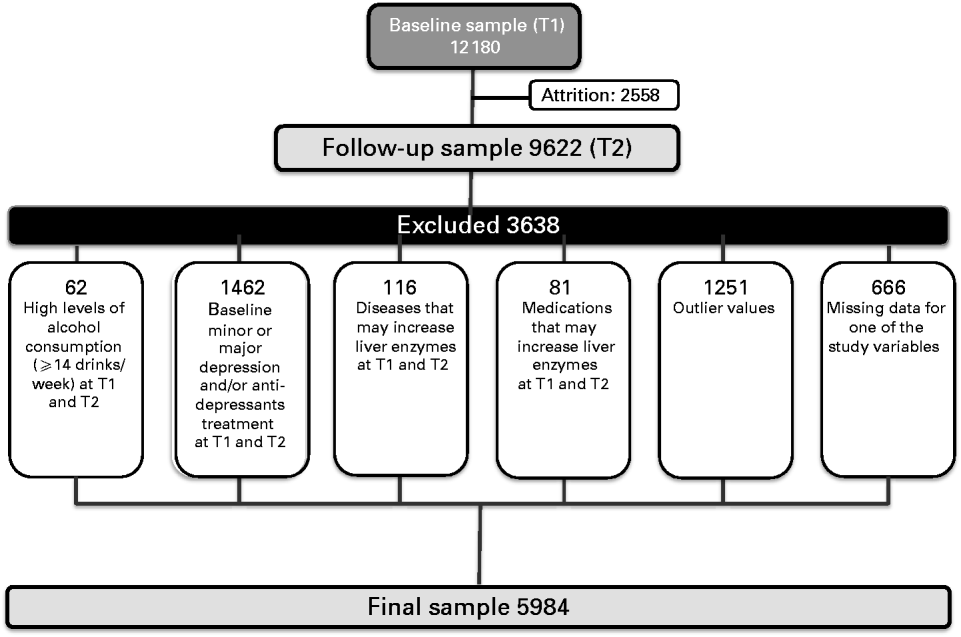
We excluded from our analysis participants with minor or major depression at baseline [according to the Patient Health Questionnaire (PHQ) score] or who were taking one or more of the following antidepressant medications: clomipramine, mianserin, escitalopram, citaloparm, duloxetine, tolterodine, bupropion, fluoxetine, imipramine, opipramol, dibenzepin, maprotiline, anafranil, pregabalin, trazodone, paroxetine, extract of hypericum perforatum, sertraline, lithium and reboxetine, regardless of the indication for the medication, either at baseline or during follow-up (n = 1462). In addition, we excluded participants with alcohol consumption ⩾14 drinks per week for both genders (n = 62), participants that had other diseases known to cause elevations of liver enzymes (e.g. celiac, history of jaundice, fever of unknown origin, inflammatory bowel disease, familial Mediterranean fever, systemic lupus erythematosis, history of Epstein–Barr virus, cytomegalovirus or fungal infections, osteoarthritis or gout or psoriasis treated with medications throughout the study period) (n = 116). We also excluded participants taking medications that are known to increase liver enzymes (e.g. steroids, immunosuppressant drugs and amiodarone) (n = 81). Participants with outlier values that were thought to imply measurement error or morbidities other than NAFLD (n = 1251), and participants with missing data for one of the study variables were also excluded (n = 666). Overall, the included participants were healthier and had a higher socio-economic status compared with the excluded participants.
The final sample consisted of 5984 healthy participants, representing a wide variety of occupations: high and low technology (28%), teaching or academia (21%), administration (21%), sales and services (7%), blue collar (15%) and health care (2%).
The study protocol was approved by the ethics committee of the Sourasky Medical Center and participants signed an informed consent form.
Measures
Depressive symptoms
Depressive symptoms were assessed by the eight-item PHQ (PHQ-8), an abbreviated version of the earlier nine-item PHQ (PHQ-9) measure of depression. This measure is a patient-oriented, self-administered instrument derived from the Primary Care Evaluation of Mental Disorders (PRIME-MD; Kroenke et al. Reference Kroenke, Strine, Spitzer, Williams, Berry and Mokdad2009). It lists eight potential symptoms of depression in accordance with the DSM-IV criteria. The validity of the PHQ-8 and PHQ-9, which are highly correlated (see Pressler et al. Reference Pressler, Subramanian, Perkins, Gradus-Pizlo, Kareken, Kim, Ding, Sauvé and Sloan2011), as a diagnostic and severity measure for depressive disorders has been confirmed in large clinical and non-clinical studies (Kroenke et al. Reference Kroenke, Strine, Spitzer, Williams, Berry and Mokdad2009). This measure has strong psychometric properties (Kroenke et al. Reference Kroenke, Spitzer, Williams and Löwe2010; Pressler et al. Reference Pressler, Subramanian, Perkins, Gradus-Pizlo, Kareken, Kim, Ding, Sauvé and Sloan2011) and high sensitivity and specificity for detecting depressive disorders (Kroenke et al. Reference Kroenke, Spitzer, Williams and Löwe2010). The PHQ-9 and the PHQ-8 have been used in several studies among Israelis (Hobfoll et al. Reference Hobfoll, Canetti-Nisim and Johnson2006, Reference Hobfoll, Canetti, Hall, Brom, Palmieri, Johnson, Pat-Horenczyk and Galea2011; Toker & Biron, Reference Toker and Biron2012) and a recent study, conducted among elders in Israel, concluded that the PHQ-9 has a sensitivity of 66.6% and specificity of 98.6% relative to the Structured Clinical Interview for DSM-IV (SCID-I) (Ayalon et al. Reference Ayalon, Goldfracht and Bech2010).
In the present study, three levels were used at follow-up: no or minimal symptoms (scores 0–9), minor depression (scores 10–14) and moderately severe or major depression (scores 15 and above).
Biochemical parameters
Biochemical parameters included fasting blood tests (12 h fast) of: serum lipids, glucose and high-sensitivity C-reactive protein (hs-CRP) as a marker of inflammation (Schillinger et al. Reference Schillinger, Exner, Amighi, Mlekusch, Sabeti, Rumpold, Wagner and Minar2003), serum ALT, AST and γ-glutamyl transpeptidase. Serum ALT levels were analysed by a commercially available ADVIA 1650 chemistry system (Siemens Healthcare Diagnostics Inc., USA). The upper limits of normal were defined as ⩾39 international units (IU) for men and ⩾35 IU for women (as defined by the Tel-Aviv Sourasky Medical Center laboratories) and analyses with ALT as a continuous variable were also performed.
Covariates
In the analysis we controlled for several factors that were found to be associated with either depression or ALT.
(1) Sociodemographic measures: age, gender and years of education;
(2) Other affective states: job burnout was assessed using the Shirom–Melamed Burnout Measure (Shirom, Reference Shirom, Cooper and Robertson1989, Reference Shirom, Quick and Tetrick2003), due to the reciprocal relationship found between burnout and depression in past studies (Toker & Biron, Reference Toker and Biron2012). Anxiety was measured based on validated questionnaires adapted from the Institute of Social Research, University of Michigan (French et al. Reference French, Caplan and Harrison1982);
(3) Life-style behaviors and health status: physical activity intensity based on self-reported hours of strenuous leisure time physical activity per week (Richardson et al. Reference Richardson, Kriska, Lantz and Hayward2004; Andersen et al. Reference Andersen, Harro, Sardinha, Froberg, Ekelund, Brage and Anderssen2006), self-rated health (DeSalvo et al. Reference DeSalvo, Bloser, Reynolds, He and Muntner2006), smoking status (current or not) and sleep disturbances based on a validated modified Brief Athens Insomnia Scale (AIS-5) (Soldatos et al. Reference Soldatos, Dikeos and Paparrigopoulos2000);
(4) Anthropometrics: weight and height were measured by a trained nurse, and body mass index (BMI; kg/m2) was calculated.
Statistical analysis
Statistical analyses were performed using SPSS version 19 (SPSS Inc., USA) software. Continuous variables are presented as mean values and standard deviations. To test differences in continuous variables between two groups the independent-samples t test was performed. Associations between nominal variables were performed with the Pearson χ 2 test and p for trend was calculated by the Mantel–Haenszel test. A multivariate logistic regression analysis was performed to test the adjusted association between ALT as a continuous or dichotomous variable and the incidence of minor or major depressive symptoms. All models were performed in steps starting with crude association, then adjusting for universal variables and then adding life-style parameters that may be confounders. To further elaborate on the association, potential mediators were entered into the model as job burnout, anxiety and sleep disturbances. For all analyses, p < 0.05 was considered statistically significant.
Results
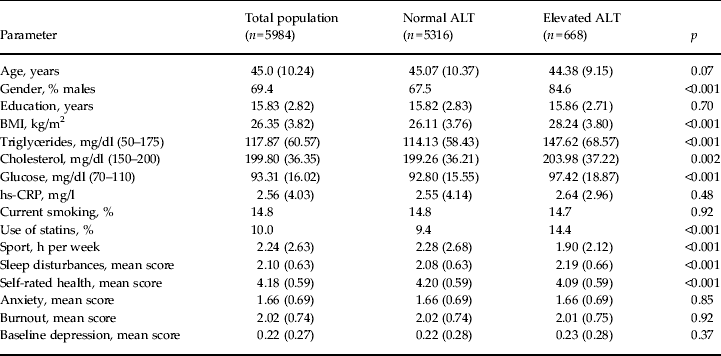
Main baseline characteristics of the study population and comparison between subjects with and without elevated levels of ALT (Table 1)
The final cohort included 5984 subjects: 4154 men and 1830 women (69.4% men, mean age 45.0, s.d. = 10.24 years). Of the participants, 11% (n = 668) had elevated levels of ALT, versus 5316 with normal ALT. A flowchart summary describing the exclusion of participants and the final sample is depicted in Fig. 1.
Flow chart of the study population.

Main baseline characteristics of the study population and comparison between subjects with and without elevated ALT
Data are given as mean (standard deviation) or as percentage.
ALT, Alanine aminotransferase; BMI, body mass index; hs-CRP, high-sensitivity C-reactive protein.
Subjects with elevated ALT had higher BMI, fasting serum glucose and lipids, were more likely to be men and users of statins. Subjects with elevated ALT performed less physical activity than those with normal ALT, had lower self-rated health scores along with higher sleep disturbances scores, but had similar anxiety and burnout scores.
There was no difference between groups in baseline levels of the depression score based on the mean score of the eight items.
Association between baseline ALT and incidence of minor depression (Table 2)
The cumulative incidence rate of minor depression was 3.8% (226/5984) in a median follow-up of 29 months (major depression included). Among subjects with elevated ALT at baseline, the incidence rate of minor depression was 6.3% as compared with 3.5% in those with normal ALT (p < 0.001). We assessed the association of ALT and depression using several models. ALT, both as a dichotomous variable (i.e. elevated above normal levels) and as a continuous variable, was a significant independent predictor for the development of minor depression. The predictive value was maintained following adjustment for universal variables and time of follow-up (model 2), biochemical parameters and use of statins (model 3) and health behavior (model 4). Adding subjective health and affective states parameters (sleep disturbances, self-rated health, anxiety and burnout as potential mediators; model 5) reduced the odds ratio (OR) for the association between elevated ALT and minor depression from 2.02 [95% confidence interval (CI) 1.40–2.92] to 1.78 (95% CI 1.22–2.61), but it remained highly significant (p = 0.003). Other variables that significantly predicted minor depression in the full multivariate model (model 5) were female gender (OR 2.38, 95% CI 1.75–3.22), use of statins (OR 1.62, 95% CI 1.07–2.44), serum glucose levels (OR 1.007, 95% CI 1.00–1.01), sleep disturbances (OR 2.15, 95% CI 1.72–2.70), anxiety (OR 1.30, 95% CI 1.07–1.59) and burnout (OR 1.45, 95% CI 1.20–1.76) as risk factors. In contrast, years of education (OR 0.90, 95% CI 0.86–0.95), self-rated health (OR 0.75, 95% CI 0.57–0.97) and time of follow-up between examinations (OR 0.98, 95% CI 0.97–0.99) were significant protective factors.
Multivariate analysis of the independent association between baseline ALT and minor depression

Data are given as odds ratio (95% confidence interval).
ALT, Alanine aminotransferase; IU, international units; BMI, body mass index.
a Model 2, adjusted for: age, gender, BMI, education level, time of follow-up.
b Model 3. All model 2 covariates plus: serum levels of triglycerides, cholesterol, glucose and use of statins.
c Model 4. All model 3 covariates plus health behavior: smoking status (current yes/no), physical activity (h/week).
d Model 5. All model 4 covariates plus subjective health and affective states parameters: sleep disturbances, self-rated health, anxiety and burnout.
Association between baseline ALT and incidence of major depression (Table 3)
The cumulative incidence rate of major depression was 1.4% (86/5984) in a median follow-up of 29 months. Among subjects with elevated ALT at baseline the incidence rate of major depression was 3.0% as compared with 1.2% in those with normal ALT (p < 0.001). ALT, both as elevated above the normal limit or as a continuous variable, was a significant independent predictor for the development of major depression. The predictive value was maintained following adjustment for universal variables and time of follow-up (model 2), biochemical parameters and use of statins (model 3) and health behavior (model 4). Adding subjective health and affective states parameters as potential mediators (model 5) reduced the OR for the association between elevated ALT and major depression from 3.13 (95% CI 1.82–5.40) to 2.61 (95% CI 1.49–4.58), but it remained highly significant (p = 0.001).
Multivariate analysis of the independent association between baseline ALT and major depression

Data are given as odds ratio (95% confidence interval).
ALT, Alanine aminotransferase; IU, international units; BMI, body mass index.
a Model 2, adjusted for: age, gender, BMI, education level, time of follow-up.
b Model 3. All model 2 covariates plus: serum levels of triglycerides, cholesterol, glucose and use of statins.
c Model 4. All model 3 covariates plus health behavior: smoking status (current yes/no), physical activity (h/week).
d Model 5. All model 4 covariates plus subjective health and affective states parameters: sleep disturbances, self-rated health, anxiety and burnout.
Other variables that significantly predicted major depression in the full multivariate model (model 5) were female gender (OR 2.17, 95% CI 1.35–3.49), smoking (OR 1.89, 95% CI 1.15–3.10), sleep disturbances (OR 2.11, 95% CI 1.48–3.01) and burnout (OR 1.54, 95% CI 1.15–2.06) as risk factors. In contrast, years of education (OR 0.90, 95% CI 0.83–0.97), self-rated health (OR 0.51, 95% CI 0.34–0.77) and time of follow-up between examinations (OR 0.98, 95% CI 0.97–0.99) were significant protective factors.
As NAFLD has been shown to be associated with inflammation, we studied the possible mediating role of hs-CRP, by adding it to all the models presented. This addition did not change the strength of the association with ALT, and no significant association was observed between CRP and major or minor depression (p ⩾ 0.17 in all models).
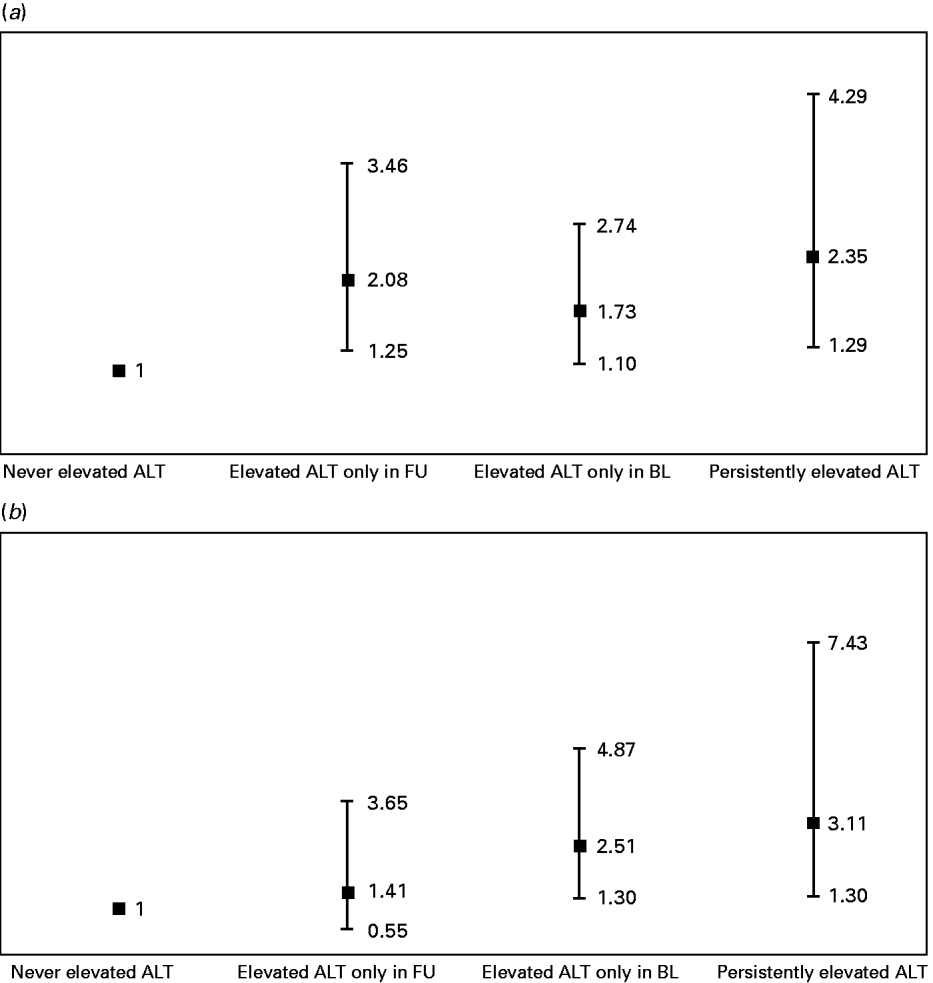
Risk for minor and major depression by ALT status both at baseline and follow-up (Fig. 2)
ALT status combined for both baseline and follow-up measurements was categorized into four groups: never elevated (as the reference group), elevated only at follow-up, elevated only at baseline and persistently elevated. For the prediction of minor depression, persistently elevated ALT was associated with a greater risk (OR 2.35, 95% CI 1.29–4.29) compared with elevation only at follow-up or at baseline (p for trend < 0.0001) adjusted for all variables in model 5 (Tables 2 and 3). Similarly, for the prediction of major depression, persistently elevated ALT was associated with a greater risk (OR 3.11, 95% CI 1.30–7.43) compared with elevation only at follow-up or at baseline (p for trend < 0.0003) adjusted for all variables in model 5.
Risk for minor (a) and major (b) depression by alanine aminotransferase (ALT) status at baseline (BL) and follow-up (FU). For both levels of depression the odds ratios (95% confidence intervals) presented are adjusted for all variables in model 5 (see Tables 2 and 3). The Mantel–Haenszel test was used to calculate p for trend: minor depression, p < 0.0001; major depression, p < 0.0003.
Discussion
Depression is a highly prevalent, multi-systemic chronic disorder that displays early age onset (Insel & Charney, Reference Insel and Charney2003; Moussavi et al. Reference Moussavi, Chatterji, Verdes, Tandon, Patel and Ustun2007; Richards, Reference Richards2011). In the present study, elevated ALT was a significant, independent predictor for the development of minor or major depression after adjustment for a wide range of potential confounders. ALT is a well-established marker of liver inflammation and hepatocellular injury. Even within the normal range, ALT predicts the development and regression of fatty liver (Omagari et al. Reference Omagari, Takamura, Matsutake, Ichimura, Kato, Morikawa, Nagaoka and Osabe2011). Elevated ALT levels were shown to have a predictive value in assessing insulin resistance in obese patients (Chen et al. Reference Chen, Chen and Lin2009) and in the incidence of diabetes (Nguyen et al. Reference Nguyen, Srinivasan, Xu, Chen, Hassig, Rice and Berenson2011).
Which mechanisms could account for our findings? First, NAFLD patients have a significantly lower QOL scores compared with patients with hepatitis B virus (HBV) or HCV (Dan et al. Reference Dan, Kallman, Wheeler, Younoszai, Collantes, Bondini, Gerber and Younossi2007) and reported a poorer health-related QOL compared with a healthy US population both on physical and mental health scores (David et al. Reference David, Kowdley, Unalp, Kanwal, Brunt and Schwimmer2009). The reason for this reduced QOL in NAFLD patients is unclear, especially since NAFLD is usually asymptomatic. However, fatigue is a common symptom in NAFLD patients (Newton et al. Reference Newton, Jones, Henderson, Kane, Wilton, Burt and Day2008), and they report low scores for vitality (David et al. Reference David, Kowdley, Unalp, Kanwal, Brunt and Schwimmer2009). Fatigue has been demonstrated to reduce QOL of patients with other types of liver disease (Younossi et al. Reference Younossi, Boparai, Price, Kiwi, McCormick and Guyatt2001; Stanca et al. Reference Stanca, Bach, Krause, Tandon, Freni, Gutierrez, Bodian, Lopez, Berk, Bodenheimer, Branch and Odin2005; Gutteling et al. Reference Gutteling, de Man, van der Plas, Schalm, Busschbach and Darlington2006; Swain, Reference Swain2006). Interestingly, in our study adjustment for sleep disturbances score and for burnout, that include elements of fatigue, did not attenuate the association significantly.
A second mechanism may be related to metabolic processes. The association of NAFLD with chronic metabolic diseases and cardiovascular complications may restrict our ability to define the specific role of liver damage in the development of depressive symptoms in these patients. Diabetes, the overt manifestation of insulin resistance, is prevalent among NAFLD patients. The prevalence of depression in diabetes is increased twofold compared with the general population (Anderson et al. Reference Anderson, Freedland, Clouse and Lustman2001; Silva et al. Reference Silva, Atlantis and Ismail2011). However, the association with depression remained significant even with adjustments for BMI, serum glucose, serum lipids and use of statins and health-related parameters such as smoking and physical activity. Thus, metabolic abnormalities are not likely to mediate this relationship. Furthermore, adjusting for the potential mediators of self-rated health and anxiety, which may be influenced by the fear of having liver disease or other chronic metabolic diseases, only modestly attenuated the association.
According to the ‘two-hit’ theory (Marchesini et al. Reference Marchesini, Brizi, Bianchi, Tomassetti, Bugianesi, Lenzi, McCullough, Natale, Forlani and Melchionda2001), NAFLD is a result of insulin resistance that leads to the accumulation of triglycerides within the hepatocytes followed by oxidative stress (Basaranoglu et al. Reference Basaranoglu, Kayacetin, Yilmaz, Kayacetin, Tarcin and Sonsuz2010). Depression has been demonstrated to be associated with both insulin resistances (Timonen et al. Reference Timonen, Laakso, Jokelainen, Rajala, Meyer-Rochow and Keinanen-Kiukaanniemi2005; Pearson et al. Reference Pearson, Schmidt, Patton, Dwyer, Blizzard, Otahal and Venn2010) and inflammation (Miller et al. Reference Miller, Freedland, Carney, Stetler and Banks2003; Raison et al. Reference Raison, Capuron and Miller2006; Dantzer et al. Reference Dantzer, O'Connor, Lawson and Kelley2011).
The association between ALT and depression may also involve inflammatory processes. In response to inflammation, innate immune cells produce pro-inflammatory cytokines that act on the brain to cause ‘sickness behavior’. When activation of the peripheral immune system continues, the ensuing immune signaling to the brain can lead to the development of symptoms of depression in vulnerable individuals (Dantzer et al. Reference Dantzer, O'Connor, Freund, Johnson and Kelley2008). Furthermore, increasing evidence indicates that cytokine/adipokine/chemokine-mediated inflammation may be an underlying mechanism leading to symptoms of depression, anxiety and fatigue (Lotrich et al. Reference Lotrich, El-Gabalawy, Guenther and Ware2011) that have all been described in NAFLD patients (Elwing et al. Reference Elwing, Lustman, Wang and Clouse2006; Newton et al. Reference Newton, Jones, Henderson, Kane, Wilton, Burt and Day2008). The mechanism by which cytokines induce depression can be explained by their ability to access the brain and to interact with pathophysiological domains relevant to depression and influence the synthesis, release, and reuptake of mood-relevant neurotransmitters, including serotonin, norepinephrine and dopamine (Anisman et al. Reference Anisman, Merali and Hayley2008; Miller, Reference Miller2009; Dantzer et al. Reference Dantzer, O'Connor, Lawson and Kelley2011; Lotrich et al. Reference Lotrich, El-Gabalawy, Guenther and Ware2011). Similarly, it has been suggested that diminished serotonergic activity in the central nervous system may mediate the association between insulin resistance and the development of depressive symptoms (Herrera-Marquez et al. Reference Herrera-Marquez, Hernandez-Rodriguez, Medina-Serrano, Boyzo-Montes de Oca and Manjarrez-Gutierrez2011).
There are several methodological limitations to our study. The first concerns the external validity of the study population that represents workers that are referred for periodic examinations and thus may be at a higher socio-economic level and healthier as compared with the general population. Future studies should confirm these observed associations in lower socio-economic status populations.
The major limitation of this study stems from the lack of imaging to confirm the presence of NAFLD. It has been demonstrated that assessing the prevalence of NAFLD based on elevated liver enzymes leads to gross underestimation when compared with ultrasonography (Zelber-Sagi et al. Reference Zelber-Sagi, Nitzan-Kaluski, Halpern and Oren2006) and that the normal range for ALT should be reduced in order to better detect NAFLD patients (Prati et al. Reference Prati, Taioli, Zanella, Della Torre, Butelli, Del Vecchio, Vianello, Zanuso, Mozzi, Milani, Conte, Colombo and Sirchia2002; Clark & Diehl, Reference Clark and Diehl2003; Browning et al. Reference Browning, Szczepaniak, Dobbins, Nuremberg, Horton, Cohen, Grundy and Hobbs2004; Bedogni et al. Reference Bedogni, Miglioli, Masutti, Tiribelli, Marchesini and Bellentani2005; Kariv et al. Reference Kariv, Leshno, Beth-Or, Strul, Blendis, Kokia, Noff, Zelber-Sagie, Sheinberg, Oren and Halpern2006). However, NAFLD patients presenting with elevated ALT may represent patients with NASH or with a higher NAFLD Activity Score (NAS) (Fracanzani et al. Reference Fracanzani, Valenti, Bugianesi, Andreoletti, Colli, Vanni, Bertelli, Fatta, Bignamini, Marchesini and Fargion2008, Reference Fracanzani, Valenti, Bugianesi, Vanni, Grieco, Miele, Consonni, Fatta, Lombardi, Marchesini and Fargion2011; Kashyap et al. Reference Kashyap, Diab, Baker, Yerian, Bajaj, Gray-McGuire, Schauer, Gupta, Feldstein, Hazen and Stein2009), which may be clinically more important. This misclassification bias in the diagnosis of NAFLD is non-differential, thus leading to underestimation of the true strength of the associations presented.
Another limitation is the absence of serologic tests to exclude chronic viral hepatitis. Several studies indicated that the prevalence of HCV in the Israeli adult population is as low as 0.9%, with its prevalence in Israeli-born individuals being 0.1% and reaching a peak of 5.7% in immigrants from central Asia (Sermoneta-Gertel et al. Reference Sermoneta-Gertel, Donchin, Adler, Baras, Perlstein, Manny, Shouval and Galun2001). The prevalence of chronic HBV infection among Jewish Israelis (99% of our study population) is very low, ranging from 0.44–0.85% in healthy blood donors (Bar-Shany et al. Reference Bar-Shany, Green, Slepon and Shinar1995) to 2% in the general population (Andre, Reference Andre2000). Most of our study population (73.8%) was born in Israel, and only 16% (108/668) of the subjects with elevated ALT were born in moderate or high endemic countries (central Asia and northern Africa). It is, therefore, reasonable to assume that most of the elevated ALT in that study population cannot be attributed to chronic viral hepatitis infection.
In summary, this prospective study indicates a temporal, dose–response, association between ALT and the development of depression even after a wide range of adjustments, and therefore marks treatment of NAFLD as a possible beneficial way for the prevention of depression. Assuming a causal relationship, based on the difference between the incidence rates in our study, the numbers needed to treat of persons with NAFLD-related elevated ALT in order to reduce one case of depression is 36 for minor depression and 56 for major depression. These results need to be confirmed by further prospective studies and clinical trials to translate the findings into clinical treatment implications.
Acknowledgements
This study was supported by grant no. 788/09 from the Israel Science Foundation, and by grant 2009/41/A from the Israel National Institute for Health Policy and Health Services Research.
S.Z.-S. conceived and designed the study, analysed the data and wrote the manuscript; S.T. designed the study, performed the data collection, analysed the data and wrote the manuscript; S.M. designed the study and conducted data collection; S.B. designed the study and conducted data collection; I.S. designed the study and conducted data collection; Z.H. and G.A. critically reviewed the manuscript; E.S. critically reviewed the manuscript; and O.S. developed the research hypothesis and wrote the manuscript. All authors read and approved the final manuscript.
Declaration of Interest
None.