Introduction
In the United States, suicide rates continue to be highest among late middle-aged and older adults compared to those of all other age groups. In 2010, suicide was the fourth leading cause of death in the 45–54 years age group, claiming 8,799 lives, and the eighth leading cause of death in the 55–64 years age group, claiming 6,384 lives (National Center for Health Statistics (NCHS), 2014). The 65+ years age group makes up 13% of the U.S. population but accounts for 16% of all suicides (NCHS). Death by suicide among older men is an especially significant public health problem in the U.S. and the world. The suicide rate of U.S. men aged 65+ years is almost seven times higher than that of U.S. women aged 65+ years (29.0/100,000 vs. 4.2/100,000 in 2010), and the rate among White men aged 85 years and older (50.8/100,000) is more than four times higher than the overall U.S. suicide rate (12.4/100,000). Older adults have higher rates of completed suicide than younger adults because they are more likely to (1) have serious intent to end their life and to formulate a lethal suicide plan, (2) have compromised health status making them more susceptible to injury or other harm from suicide attempts, and (3) own a gun or have prescription or over-the-counter medications that can be used to end their life (Conwell et al., Reference Conwell, Duberstein, Cox, Hermann, Forbes and Caine1998; Conwell et al., Reference Conwell, Duberstein and Caine2002; NCHS, 2014).
Risk factors for suicidal thoughts and behaviors among late middle-aged (50–64 years) and older (65+ years) adults include psychiatric disorders (especially depression and anxiety), alcohol and drug use disorders, poor physical health and functioning, chronic pain, poor social support/social connectedness, living alone, family problems, bereavement, financial strain, perceived burdensomeness, and a history of suicide attempts (Conwell et al., Reference Conwell, Van Orden and Caine2011; Jahn and Cukrowicz, Reference Jahn and Cukrowicz2011; Karch, Reference Karch2011; Almeida et al., Reference Almeida2012; Gilman et al., Reference Gilman2013; De Leo et al., Reference De Leo, Draper, Snowdon and Kõlves2013; Morin et al., Reference Morin, Wiktorsson, Marlow, Olesen, Skoog and Waern2013; Carter and Reymann, Reference Carter and Reymann2014; O’Riley et al., Reference O’Riley, Van Orden, He, Richardson, Podgorski and Conwell2014). Protective factors for suicide in the same age groups include being married, adaptive dispositional coping strategies, family connectedness and religiosity (participating in religious activities, placing importance on religious beliefs, and having moral or religious objections to suicide) (Nisbet et al., Reference Nisbet, Duberstein, Conwell and Seidlitz2000; Marty et al., Reference Marty, Segal and Coolidge2010; Dervic et al., Reference Dervic2011; Purcell et al., Reference Purcell, Heisel, Speice, Franus, Conwell and Duberstein2012; Rushing et al., Reference Rushing, Corsentino, Hames, Sachs-Ericsson and Steffens2013; Cole et al., Reference Cole, Bowling, Patetta and Blazer2014).
Despite previous research on risk and protective factors for suicide behavior, data on suicide attempts are far fewer and less reliable than completed suicides. Unlike completed suicides, there is no systematic surveillance mechanism in the United States to track suicide attempts (Garand et al., Reference Garand, Mitchell, Dietrick, Hijjawi and Pan2006). A recent study of 22, 444 emergency department (ED) visits for suicide-related injuries by patients aged 65+ years did estimate a population rate of 63 ED visits for suicide attempts per 100 000 individuals in this age group, with nearly half of all visits involving substance use (Carter and Reymann, Reference Carter and Reymann2014). To prevent suicide attempts and completions among late middle-aged and older adults, more research is needed about those who make suicide plans and attempt suicide compared to those who do not act on their suicidal thoughts. To address this need, the current study utilized multi-year, nationally representative epidemiologic survey data to identify correlates of making suicide plans and nonfatal suicide attempts among U.S. adults aged 50+ years during the preceding year. The correlates examined were sociodemographic factors, social support, health status, religiosity, psychiatric disorders, substance abuse or dependence, and mental health and substance abuse treatment use. Based on identified risk and protective factors for suicide behavior, the study hypotheses were: Among individuals aged 50+ years with serious suicidal thoughts, (1) suicide plans will be associated with unmarried status, non-working status, MDE, and mental health treatment use (Hypothesis 1); and (2) suicide attempts will be associated with unmarried status, lower religiosity, poorer physical health, MDE, and SUD (Hypothesis 2).
Methods
Data for this study came from the public use files of the 2008–2012 National Survey on Drug Use and Health (NSDUH). The annual NSDUH series measures the prevalence of substance use among the civilian, non-institutionalized, U.S. population aged 12 years or older (Inter-university Consortium for Political and Social Research (ICPSR), 2012). Questions about mental disorders, suicide, and mental health and substance abuse treatment are also asked of respondents aged 18 years and older. Survey respondents were interviewed in private at their place of residence using a combination of methods (audio computer-assisted self-interview (ACASI), computer-assisted personal interview, and computer-assisted self-interview). ACASI is used to provide respondents with a highly private and confidential means of responding to questions and to increase the level of honest reporting of illicit drug use and other sensitive behaviors (ICPSR, 2012).
To increase the study's power to detect low frequency events (e.g. suicide attempts), we combined five years of data. The survey sampling and data collection methods for the variables examined in this study were the same for all five years of the survey. The total number of respondents who completed the survey was 55,739 in 2008, 55,772 in 2009, 57,873 in 2010, 58,397 in 2011, and 55,268 in 2012. The present study focused on the 29,634 respondents aged 50+ years from 2008 to 2012; 18,443 were 50–64 years of age and 11,191 were 65+ years of age. (The NSDUH public use data sets do not provide chronological age to protect respondent anonymity and the privacy of responses.) NSDUH's multi-stage area probability sampling design made it unlikely that any duplication of survey respondents occurred in the pooled five years of survey data.
Measures
Past-year serious suicidal thoughts, suicide plans, and suicide attempts were assessed with the following three questions, respectively: “At any time in the past 12 months . . . including today, did you seriously think about trying to kill yourself?” (The data set did not elaborate on the meaning of “seriously.”); “During the past 12 months, did you make any plans to kill yourself?”; “During the past 12 months, did you try to kill yourself?” Responses to each question were yes ( = 1) or no ( = 0).
Sociodemographic variables included age group, gender, race/ethnicity, educational level, income, employment status, and marital status. In the absence of other family/social support variables in the NSDUH, marital status was used as a proxy.
Health status was measured with the number of diagnosed chronic illnesses (asthma, liver cirrhosis, diabetes, high blood pressure, heart disease, stroke, lung cancer, and pancreatitis).
Religiosity was measured with three items: (1) Frequency of religious service attendance (“During the past 12 months, how many times did you attend religious services? Please do not include special occasions such as weddings, funerals, or other special events in your answer.”); (2) importance of religious beliefs (“Your religious beliefs are a very important part of your life.”) on a 4-point scale from 1 = strongly disagree to 4 = strongly agree; (3) influence of religious beliefs on decision-making (“Your religious beliefs influence how you make decisions in your life”) on the same 4-point scale.
Past-year psychiatric disorders were represented by MDE that met Diagnostic and Statistical Manual of Mental Disorders, 4th edition (DSM-IV, American Psychiatric Association, 1994) criteria during the worst/most severe period of time, lasting two weeks or longer, in the past 12 months (yes = 1, no = 0) and anxiety disorder told by a doctor or other medical professional to the respondent in the past 12 months (yes = 1, no = 0). To describe the sample, we also report past-year, worst month serious psychological distress (SPD), measured with the six-item Kessler Psychological Distress Scale (K6; Kessler et al., Reference Kessler2003). Respondents were asked how frequently during the worst month in the preceding year they experienced “feeling nervous; feeling hopeless; feeling restless or fidgety; feeling so sad or depressed that nothing could cheer you up; feeling that everything was an effort; and feeling down on yourself, no good, or worthless.” Each item was rated on a 4-point scale (0 = none of the time to 4 = all of the time). A summed score of 13 or higher was considered as having had SPD. Cronbach's α for the K6 among the 50+ years age group was 0.91. Of those aged 50–64 years, 54.62% of those with MDE also had SPD, and 41.60% of those aged 65+ years who had MDE also had SPD.
Past-year substance misuse was measured with DSM-IV criteria for alcohol and illicit drug abuse and dependence. In the NSDUH, alcohol and marijuana abuse and dependence were assessed only if respondents reported use of the respective substance on more than five days in the preceding year, while all other illicit drug abuse and dependence were determined if any use was reported in the preceding year.
Past-year mental health and substance abuse treatment use included treatment from any venue/modality (e.g. hospital, other inpatient/residential setting, ED, prison/jail, doctor’s/private therapist's office, day treatment, self-help groups such as Alcoholics Anonymous or Narcotics Anonymous).
Analysis
All analyses were conducted with Stata/MP 13's svy function to account for NSDUH's multi-stage, stratified sampling design. Stata's subpop command was used for all analyses of subsamples to ensure that variance estimates incorporate the full sampling design. For the 5-year pooled data set for this study, adjusted person-level analysis weights were created by dividing the final person-level analysis weights by the number of years of combined data (five in the current study) following NSDUH guidelines for combining sampling weights across multiple survey years. All estimates presented in this study are weighted with the exception of sample sizes. Descriptive statistics (χ2 tests and t tests) were used to present sample characteristics by suicidal thoughts, suicide plans, and suicide attempts. Binary logistic regression analyses were used to test both hypotheses. Given the large number of potential covariates for the logistic regression model, we employed Hosmer et al. (Reference Hosmer, Lemeshow and Sturdivant2013) steps for judiciously selecting covariates; i.e. a variable selection decision is made at each step of the modeling process in order to produce the most parsimonious model which also results in numerical stability and generalizability of the results. The steps were: bivariate relationships between independent and dependent variables (i.e. suicide plans or attempts) were examined first; a multivariable model with all candidate covariates was fit; non-significant covariates (p > 0.20) were removed; and the reduced model was compared to the full model based on Wald-test results. Based on these steps, the following potential covariates were selected: income, employment status, marital status, importance of religious beliefs, MDE, anxiety disorder, mental health treatment, and alcohol/drug abuse or dependence. Substance abuse treatment was significantly associated with suicide attempts (see Results section), but it was not included in the logistic regression model due to the small number (n = 12) who received treatment and attempted suicide.
Results
Prevalence by age group
Of the 50+ years age group, 2.48% (n = 804, representing 2,401,383 individuals in the population) reported serious suicidal thoughts (3.03% for the 50–64 years age group and 1.66% for the 65+ years age group). The prevalence was lower than those for the 18–25 years age group (6.73%), 26–34 years age group (4.02%), and 35–49 years age group (4.04%) (χ2[4] = 1,174.47, p < 0.001). Of those who reported serious suicidal thoughts, 29.89% of the 50+ years age group and 23.02% of the 60+ years age group made suicide plans, compared to 29.93% in the 18–25 years age group, 25.66% in the 26–34 years age group, and 29.08% in the 35–49 age group (χ2[4] = 23.77, p < 0.001); and 12.10% (n = 68) in the 50+ years age group and 10.01% (n = 24) in the 60+ years age group attempted suicide, compared to 18.19% in the 18–25 years age group, 12.17% in the 26–34 years age group, and 10.40% in the 35–49 years age group (χ2[4] = 92.18, p < 0.001).
Characteristics of those who had serious suicidal thoughts
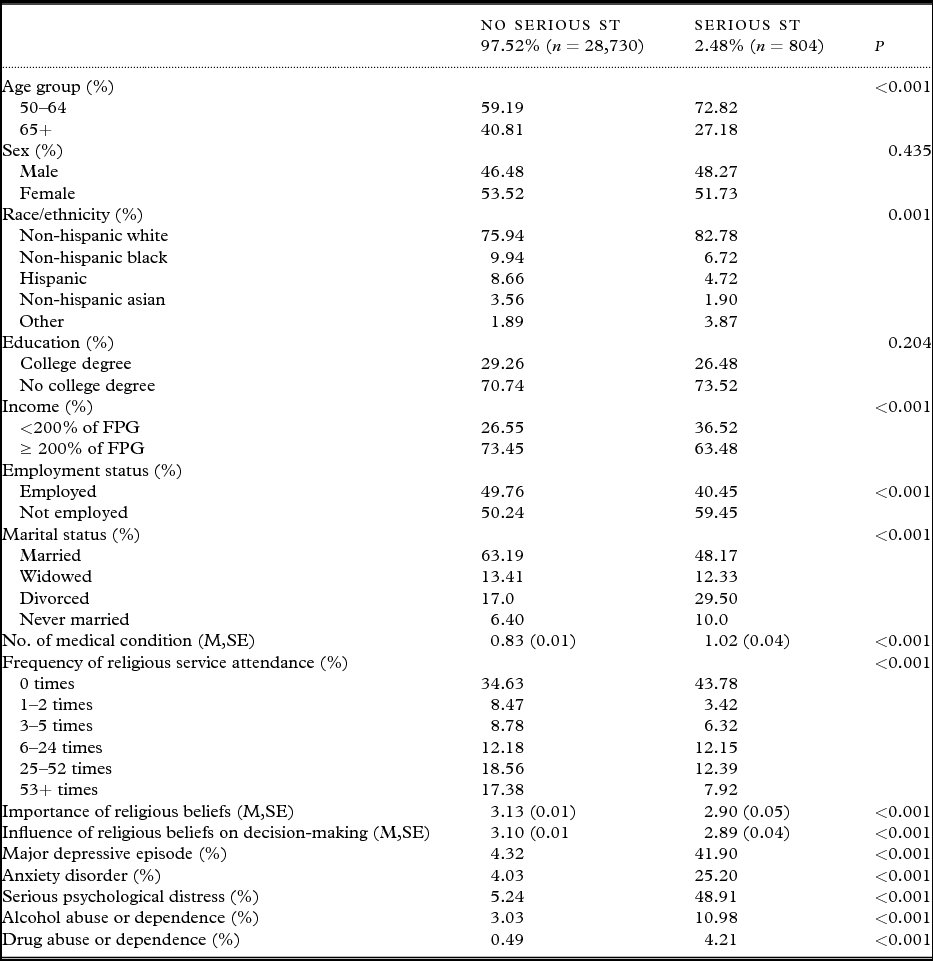
Individuals aged 50+ years who had serious suicidal thoughts did not differ from their age peers who did not have the thoughts with respect to gender and education; however, there were significant differences between the two groups in all other sociodemographic and clinical characteristics (see Table 1). Those who had serious suicidal thoughts were more likely to be in the 50–64 years age group than in the 65+ years age group, non-Hispanic White, not married, not employed, and had income less than 200% of the federal poverty threshold (FPT); they also had more chronic medical conditions, attended religious services less frequently, and rated the importance of religious beliefs lower. Of those with serious suicidal thoughts, 41.90%, 25.20%, and 48.91% met the DSM-IV criteria for past-year MDE, had anxiety disorder, and had SPD, respectively, compared to 4.32%, 4.03%, and 5.24% of those who did not have these thoughts, (χ2[1] = 2,031.29, p < 0.001 for MDE; χ2[1] = 737.92, p < 0.001 for anxiety disorder; χ2[1] = 2,302.74, p < 0.001 for SPD). Further analysis found that among those who had suicidal thoughts and MDE, 42.69% also had anxiety disorder and 84.06% had SPD. Of those who had serious suicidal thoughts, 10.98% met the DSM-IV criteria for alcohol abuse/dependence and 4.21% met the DSM-IV criteria for illicit drug abuse/dependence, compared to 3.03% and 0.49% of those who did not have these thoughts, respectively (χ2[1]) = 145.00, p < 0.001 for alcohol abuse/dependence; χ2[1] = 169.79, p < 0.001 for drug abuse/dependence).
Characteristics of individuals aged 50+ years by past-year serious suicidal thoughts (ST)

All statistics, with the exception of sample sizes, were weighted by NSDUH's adjusted person-level analysis weights. T tests were used to compare the number of medical conditions between those with serious ST and those without serious ST, and χ2 tests were used for all other variables.
Characteristics of those who made suicide plans and attempted suicide
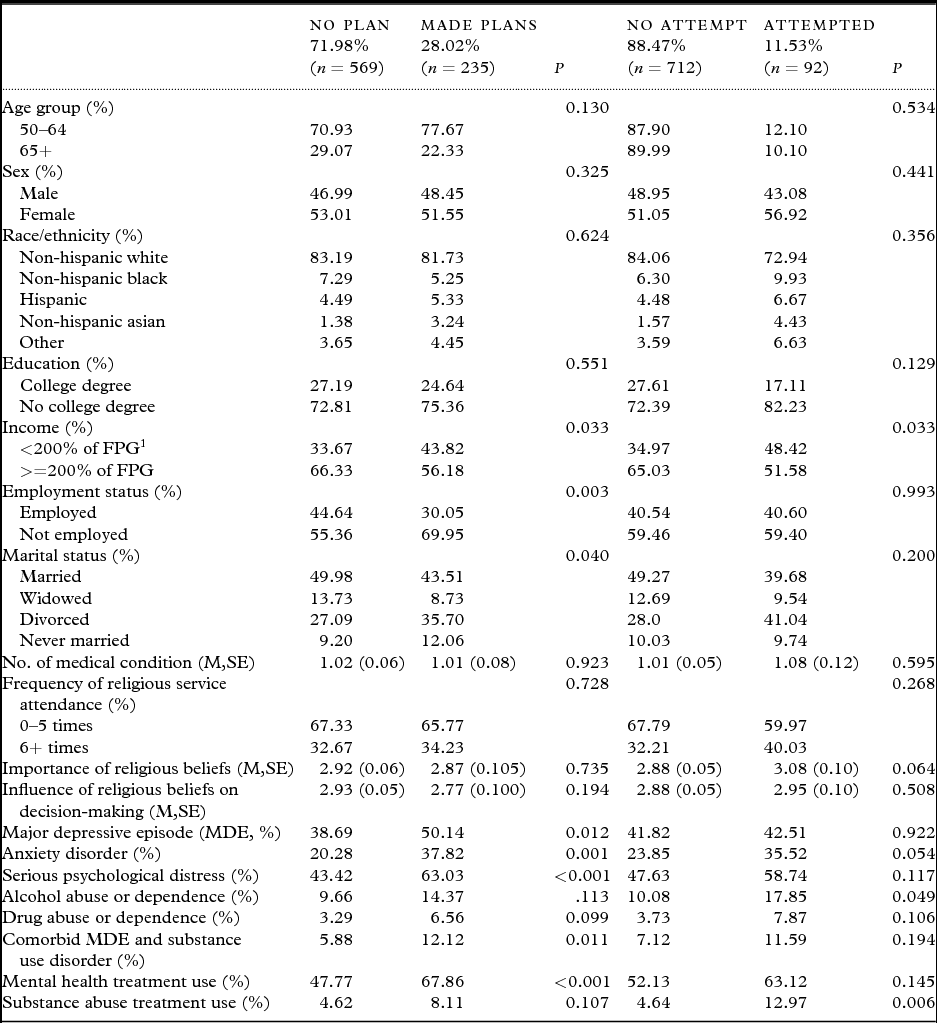
Of those aged 50+ years who had serious suicidal thoughts, 28.02% (n = 235) made suicide plans (see Table 2). Those who made plans did not differ from those who did not make plans (n = 569) by age group, gender, race/ethnicity, education, number of chronic medical conditions, religiosity indicators, alcohol and drug abuse/dependence, and substance abuse treatment. However, those who made plans were more likely to have income less than 200% of FPT (43.82% vs. 33.67%, χ2[1] = 7.20, p = 0.033), less likely to be employed (30.05% vs. 44.64%, χ2[1] = 14.32, p = 0.003), and more likely to have MDE (50.14% vs. 38.69%, χ2[1[ = 8.73, p = 0.012), anxiety disorder (37.82% vs. 20.28%, χ2[1] = 26.45, p = 0.001), and SPD (63.03% vs. 43.42%, χ2[1] = 24.97, p < 0.001) and to have received mental health treatment (67.86% vs. 47.77%, χ2[1] = 26.31, p < 0.001). The groups also differed by marital status; 43.51% of those who made plans were married, while 49.98% of those who did not make plans were married (χ2[3] = 10.10, p = 0.004). Further analysis (not shown in Table 2) also found that those who made plans were more likely to have comorbid MDE and anxiety disorder or MDE and SPD than those who did not make plans (47.06% vs. 32.55%, χ2[1] = 14.71, p = 0.011). Although the two groups did no differ with respect to SUD, those that made plans were more likely to have comorbid MDE and SUD (12.12% vs. 5.88%, χ2[1] = 8.94, p = 0.011).
Characteristics of individuals aged 50+ years with past-year serious suicidal thoughts by suicidal plan and suicide attempt

All statistics, with the exception of sample sizes, were weighted by NSDUH's adjusted person-level analysis weights. T tests were used to compare the number of medical conditions between those with serious ST and those without serious ST, and χ2 tests were used for all other variables.
aFederal poverty guidelines.
Table 2 also shows that 11.53% (n = 92) of those who had serious suicidal thoughts attempted suicide. Those who attempted suicide did not differ from those who did not (n = 712) with respect to age group, gender, race/ethnicity, education, employment status, marital status, number of chronic medical conditions, religious service attendance, importance of religious beliefs, influence of religious beliefs on decision-making, MDE, anxiety disorder, SPD, drug abuse/dependence, comorbid MDE and SUD, and mental health treatment. Age group separate analysis confirmed no gender differences in suicide attempts for either age group (10.79% for men and 13.26% for women, χ2[1] = 378.36, p = 0.530 for the 50–64 years age group; and 9.06% for men and 11.06% for women, χ2[1] = 282.66, p = 0.721 for the 65+ years age group). Further analysis confirmed no significant differences between those who attempted suicide and those who did not in rates of comorbid MDE and anxiety disorder or MDE and SPD (41.54% vs. 35.97%, χ2[1] = 1.09, p = 0.418). However, those who attempted suicide were more likely to have income less than 200% of FPT (48.42% vs. 34.97, χ2[1] = 6.40, p = 0.033), alcohol abuse/dependence (17.85% vs. 10.08%, χ2[1] = 5.06, p = 0.049), and received substance abuse treatment (12.97% vs. 4.64%, χ2[1] = 10.78, p = 0.006).
Correlates of suicide plans and attempts
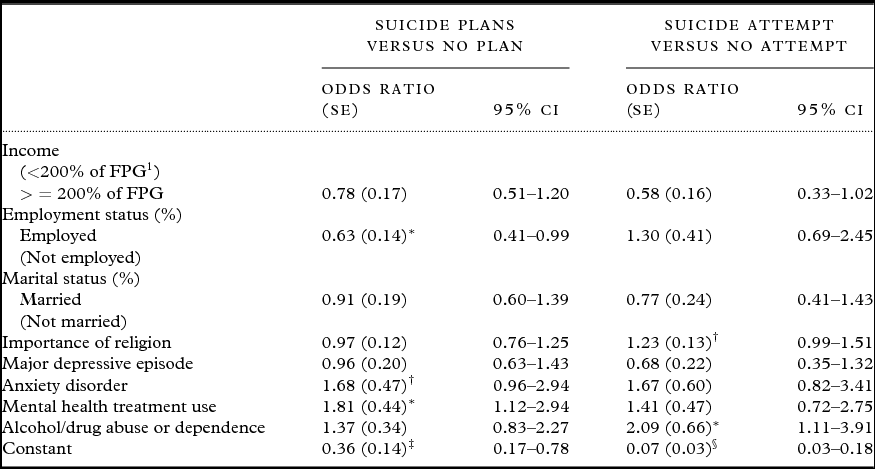
The only significant correlates of suicide plans among individuals aged 50+ years were employment status and mental health treatment (see Table 3). Being employed, as opposed to not employed or not in the labor force, was associated with decreased odds (OR = 0.63, 95% CI = 0.41–0.99) and mental health treatment use, as opposed to no use, was associated with increased odds (OR = 1.81, 95% CI = 1.12–2.94) of having made suicide plans. Anxiety disorder was marginally significantly associated with suicide plans (OR = 1.68, 95% CI = 0.96–2.94, p = 0.068). Table 3 also shows that substance abuse/dependence was the only significant correlate of suicide attempts. Those with SUD were more than twice as likely as those without SUD to have attempted suicide (OR = 2.09, 95% CI = 1.11–3.91). In addition, religiosity was marginally associated with the likelihood of having attempted suicide, with a one-point increase in the importance of religious beliefs being associated with a 23% increase in the likelihood of having made a suicide attempt (OR = 1.23, 95% CI = 0.99–1.51, p = 0.058). Further analysis using multiple logistic regression found no significant associations between suicide plans/attempts and alcohol use frequency, alcohol abuse/dependence separately from drug abuse/dependence, or comorbid mental health and substance use problems. Age group, gender, race, income, education, number of chronic medical conditions, and the frequency of religious service attendance were not significant correlates, either. In sum, contrary to our hypotheses, MDE and marital status were not associated with suicide behavior in the multivariate models.
Logistic regression results: correlates of suicide plans and suicide attempt

N = 804 for each model; Model statistics: F(8, 53) = 4.84, p < 0.001, for suicide plans, and F(8, 53) = 2.50, p = 0.022, for suicide attempt.
Covariates were chosen following Hosmer et al. (Reference Hosmer, Lemeshow and Sturdivant2013) modeling steps for parsimony, numerical stability, and generalizability of the results.
1Federal poverty guidelines.
§ p < 0.001.
‡ p < 0.01.
*p < 0.05.
† p < 0.07.
Discussion
The nearly 2.5% prevalence rate of serious suicidal thoughts among those aged 50+ years is lower than the rates in younger age groups. However, as expected, those who had serious suicidal thoughts had an extremely high prevalence of psychiatric disorders compared to those who did not have these thoughts. This study also found that more than one quarter of those with serious suicidal thoughts made suicide plans, and nearly 12% made nonfatal suicide attempts. The Centers for Disease Control (CDC, 2012) report one suicide for every 25 attempted suicides for all age groups, with completion rates higher among older adults due to higher lethality of their suicide attempts. If fatal attempts were included in our study, the attempt rate would be higher. Given the high rate of suicide attempts among older adults with serious suicidal thoughts, more attention is needed to identify those who have serious suicidal thoughts and prevent suicide attempts.
Although bivariate analyses indicated that those who made suicide plans also had a significantly higher rate of psychiatric disorders than those who did not make plans, multivariate analysis showed no association between MDE and suicide plans among those with serious suicidal thoughts. In addition, neither bivariate nor multivariate analyses showed an association between MDE and suicide attempts. A Canadian study of older adults found that although suicidal thoughts are associated with depression and anxiety disorders, many with suicidal thoughts did not meet the criteria for these clinical disorders (Corna et al., Reference Corna, Cairney and Streiner2010). Research and clinical care call for greater attention to subthreshold symptoms of depression and anxiety.
Mental health treatment was not associated with suicide attempts in bivariate or multivariate analyses, but it was the strongest correlate of suicide plans in this study. Nevertheless, nearly one-third of those who made plans had not used mental health treatment in the preceding year. Since the use of cross-sectional data prohibited establishing the temporal order between suicide plans and mental health treatment use, it is possible that some individuals accessed mental health treatment after an episode of suicide planning. This may represent a positive intervention and protection against future suicide planning and suggests that more effort be made to insure that individuals with suicidal thoughts receive mental health treatment as a deterrent to making suicide plans. SUD was a significant correlate of suicide attempts, suggesting that substance intoxication may have inhibited impulse control or been used to carry out suicide plans (Carter and Reymann, Reference Carter and Reymann2014). The co-occurrence of alcohol use disorders and depression is a late-life suicide risk factor, but most older adults who experience alcohol-related problems do not meet alcohol abuse or dependence criteria (Blow et al., Reference Blow, Brockmann and Barry2004). Thus, our study may have underestimated the role of substance use in late-life suicide plans and attempts.
Employment's significance as a deterrent to making suicide plans in our study may imply its protective effects in feeling useful, productive, and socially connected. Previous research showed that limited social connectedness is associated with suicidal ideation, nonfatal suicidal behavior, and suicide in later life (Fässberg et al., Reference Fässberg2012; Szanto et al., Reference Szanto2013). The marginal significance of religious beliefs in our study is also notable, especially since higher ratings were associated with higher odds of having attempted suicide. Again, the cross-sectional data set did not allow us to examine if suicide survivors may have become more religious following their suicide attempt. Rushing et al. (Reference Rushing, Corsentino, Hames, Sachs-Ericsson and Steffens2013) found that current religious practices did not predict reports of past suicide attempts, although church attendance, but not other religious involvement indicators, protected against current suicidal thoughts. Dervic et al. (Reference Dervic2011) also found that religiously affiliated, depressed, bipolar patients had more children and more family-oriented social networks than nonaffiliated patients and had fewer past suicide attempts and fewer suicides in first-degree relatives. However, another study found that older adults with high intrinsic religiosity reported greater death ideation, perhaps due to reduced fear of death (Jahn and Cukrowicz, Reference Jahn and Cukrowicz2011).
Research consistently shows that among middle-aged and older adults, men and Whites have higher suicide rates than women and racial/ethnic minorities, respectively, and suggests that prevention and intervention efforts should be targeted by gender and race/ethnicity. Thus, our finding of no significant differences by gender or race/ethnicity in both bivariate and multivariate analyses of suicide plans and attempts for the 50–64 and 65+ years age groups is surprising. Older men may have been less likely than older women to report their suicidal thoughts and behaviors. One Canadian study found that community-dwelling older men with suicidal thoughts were significantly less likely to use antidepressant medication (32.2%) and consult mental health services (48.9%) than their female counterparts (42.6% and 65.6%, respectively) (Vasiliadis et al., Reference Vasiliadis, Gagné, Jozwiak and Préville2013). Research is also needed to examine if older men, especially non-Hispanic White older men, may be overrepresented in completed suicides, as they are significantly more likely than younger age groups of both sexes and older women to use firearms (CDC, 2012).
The study has the following limitations stemming from data constraints: (1) All suicide-related data were self-reports and not based on validated screening/assessment tools; (2) the data set did not include a number of known risk or protective factors for suicidal thoughts and suicide behavior such as perceived social support, loneliness, chronic pain, hopelessness, and previous suicide attempts; and (3) cross-sectional data prohibited establishing the temporal order between suicidal thoughts/behavior and other variables examined, thus, only correlation, not causality, can be deduced.
Screening and treatment for risk factors as well as strengthening protective factors remain significant suicide prevention approaches (Lapierre et al., Reference Lapierre2011). Despite this study's limitations, the findings do provide information about some factors that may put middle-aged and older adults at risk for having serious suicidal thoughts, making suicide plans, and attempting suicide and present the following implications for clinical assessment and care: (1) The high rates of MDE, anxiety disorder, serious psychological disorder, alcohol abuse or dependence, and drug abuse or dependence among those who self-reported serious suicidal thoughts once again call attention to the importance of suicide risk assessment for middle-aged and older adults with mental health and/or SUDs. (2) The finding that more than 28% of those with serious suicidal thoughts made suicide plans also underscores the importance of targeted interventions for those at-risk. An important step needs to be improved access to mental health treatment, given that nearly one-third of suicide planners did not access mental health treatment either before or after the episode of planning. With rapidly increasing numbers of people in the 50+ years age group, treatment programs for this age group should be readily available and easily accessible. Formal and informal care systems need to be prepared to prompt older adults to get treatment. This study also suggests that work, volunteering, or other group activities that can provide a sense of worth and social connections are likely to provide protection from making suicide plans. (3) The finding that almost 12% of those with serious suicidal thoughts made nonfatal suicide attempts also highlights the importance of prevention, especially among those with SUDs. Along with mental health screening and treatment, screening and treatment for at-risk substance use are necessary.
Conflict of interest
None.
Description of authors’ roles
N. Choi and D. DiNitto conceptualized the study and jointly wrote the paper. N Choi did statistical analyses. C. N. Marti provided consulting for and review of statistical analyses.