How could the works of Augustine, one of the most prominent authorities in western Christendom, become forbidden reading in many Catholic areas in the second half of the sixteenth century? This unlikely situation was created by the first papal Index of forbidden books, issued under Pope Paul iv in 1559, which included a general ban on the works of Erasmus of Rotterdam, covering ‘all his comments, annotations, glosses, dialogues, letters, judgements, translations, books and writings, even if they contain absolutely nothing against or about religion’.Footnote 1 Since Erasmus was the most recent editor of Augustine's collected works (Basle 1528–9), an edition he proudly advertised as ‘the rebirth of this great doctor of the Church’, the ban ended, it would seem, the short life of the Erasmian Augustine.Footnote 2 This was clearly a confusing outcome, which baffled even the Jesuits. It prompted a local leader of the Society in Loreto, for instance, to inquire of his superior whether he was really supposed to hand Augustine over to the inquisitor.Footnote 3
This article explores the confessionalisation of Augustine in Reformation Europe. More specifically, it focuses upon the edition of his complete works prepared by a team of Catholic theologians from the University of Leuven, a text now often regarded as ‘the Saint Augustine of the seventeenth century’.Footnote 4 This monumental new edition was meant to replace that of Erasmus, whose anticlerical perspective and critical approach had caused so much controversy in Catholic circles. It was first published in ten folio volumes by Christopher Plantin in Antwerp in 1576–7, entitled Opera D. Aurelii Augustini Hipponensis episcopi et doctoris praecipui, tomis decem comprehensa: per theologos lovanienses ex manuscriptis codicibus multo labore emendata, et ab innumeris erroribus vindicata: illustrata praeterea eruditis censuris, et locupletata multis homiliis et aliquot epistolis eiusdem B. Augustini, antea non editis: cum indice tripartito (The works of the bishop and eminent scholar St Aurelius Augustine of Hippo, incorporated in ten volumes: corrected with much effort from manuscripts by the theologians from Leuven and restored from countless errors, furthermore elucidated and enriched with many sermons and some letters hitherto unpublished: with an index in three parts). This edition has been hailed by modern scholars as an important advance in philological standards in Augustine scholarship, and for good reason. Its statistics are impressive, both in terms of production and dissemination. According to Plantin, sixty-four theologians had collated over 160 manuscripts, supervised by ten editors. It was reprinted more than ten times, and was not superseded until the beginning of the eighteenth century, by the work of the Benedictine monks of St Maur (1679–1700).Footnote 5
Yet the aim of this article is not just to assess the influential presentation of Augustine in this edition, but in so doing to show how confessional divisions conditioned the development of textual scholarship and interacted with editorial practices in the second half of the sixteenth century. In this period, countering the Protestant threat was a prime concern for the Catholic Church, with the new, centralised reform programme of the Council of Trent (1563) as one of its most important instruments. Modern studies of its implementation, however, have revealed a rich regional diversity, dependent on specific political and social circumstances.Footnote 6 The Leuven theologians prepared their new Augustine in the wake of Trent, amid increasingly violent religious polarisation. On a scholarly level, they combined a rich tradition of Augustinian scholarship with a special relationship with Erasmus, who had briefly been a member of their theology faculty, but who had also repeatedly clashed with it.Footnote 7 Apart from such intellectual battles (and internal quarrels), the Leuven theologians witnessed iconoclasm and wars of religion. Simultaneously, as clerical authorities, they were supposed to be the agents of Tridentine reform. Indeed, it was this same faculty that was involved in the censorship of Erasmus' works.Footnote 8 How then did all this affect their presentation of Augustine?
To answer this question, it is necessary to examine the editorial strategy of the Leuven theologians, investigating in particular how they frame the text and attempt to direct its interpretation. The focus will therefore be on the paratexts surrounding Augustine's works, both those accompanying the main text (peritexts), such as prefaces and annotations, as well as comments relating to the edition which are physically separate (epitexts), such as relevant correspondence.Footnote 9 An analysis of these will show that the increasing confessional pressure had a neutralising, rather than a polarising impact on the textual presentation, and allowed for a surprising survival of the Erasmian Augustine. On a more general level, this examination thus seeks to further understanding of the use of humanist scholarship in a confessionalising world. For it was the renaissance of Augustine, more than that of Cicero and Virgil, or even Plato and Aristotle, that lies at the heart of the Reformation.
Augustine's contested authority in the Reformation
Historians of the Reformation have long acknowledged the central role of Augustine.Footnote 10 If it was ‘the explosive power of an idea’ that sparked the religious revolution of the sixteenth century, as Diarmaid MacCulloch recently put it, then this idea was in fact ‘a new statement of Augustine's ideas on salvation’.Footnote 11 However, Luther's opponents were equally informed by Augustinian thought, appealing in particular to his anti-Donatist ideas about obedience to the Church and the sacraments. Thus, over fifty years ago, B. B. Warfield could famously summarise the Reformation as the ‘ultimate triumph of Augustine's doctrine of grace over Augustine's doctrine of the Church’.Footnote 12
The theological prominence of the church Father is reflected in the dissemination of his works. Significantly, Augustine towers over all the other Fathers in the patristic anthologies, which appeared in hundreds of editions during the sixteenth-century. More than 60 per cent of the quotations collected in these books refer to him, or to texts attributed to him.Footnote 13 Such anthologies were often produced from a confessional perspective, claiming the church Father's authority for specific doctrinal positions. The market for comprehensive, scholarly editions of Augustine's works also increased considerably. In all, twenty-two opera omnia editions were published before the Maurist edition at the end of the seventeenth century, which derived from three separate editorial projects (Amerbach, Erasmus and the Leuven theologians), representing more than 20,000 copies.Footnote 14 Considering the cost of these multi-volume editions these print runs offer a tantalising glimpse of the demand for Augustine in the sixteenth century.
Compared to the highly focused anthologies, the opera omnia editions would seem less polemically charged. Yet the censorship of Erasmus' edition shows the extent to which Augustine's works had become contested terrain. Although Erasmus himself had claimed that he merely assumed ‘a schoolmaster's part’, and that he would leave ‘no personal trace’ in the edition, the prefaces, marginal notes and particularly the critical assessments of individual works had caused controversy ever since the publication of the edition by Froben.Footnote 15 Still, the practical implications of the ban should not be overrated. The ten folio volumes of Augustine's works were expensive books, which users would simply not easily discard. Moreover, the implementation of the various censorship policies was erratic. The Pauline index met with fierce resistance, after which the rules were softened and extensive privileges granted to the Jesuits. The subsequent Tridentine index (1564) limited the ban on Erasmus and ordered his religious works to be expurgated by theologians of the universities of Paris and Leuven. Some Italian inquisitors, however, still enforced the Pauline index and burned any work of Erasmus that they managed to find.Footnote 16 Meanwhile, the Erasmian Augustine had been reprinted five more times, in Paris and Lyon (1561–3 and 1573), Basle (1569) and Venice (1570, 1584).
Most research so far has focused on the Protestant reception of Augustine.Footnote 17 Especially influential is the work of Heiko Oberman, who tried to trace the origins of the Reformation by studying Luther's connections with an ‘Augustinian renaissance’ in the fourteenth century.Footnote 18 It suffices to note here that the concept of Augustinianism is geared primarily to his appropriation in early Reformation thought, especially on soteriology. Recent research, however, has revealed the limits of this Augustinian paradigm: Irena Backus and John Monfasani each demonstrated that Augustine does not appear to have held a central position in the areas of ecclesiology or humanist rhetoric, respectively.Footnote 19 It is increasingly clear, therefore, that Augustine was an important presence in the early modern world, but not a consistent, monolithic, so-called Augustinian, influence.Footnote 20 From this perspective, how did this, the first officially Catholic opera omnia edition, present Augustine?
Catholic claims in context
At first sight, the new Augustine may not appear strikingly different. The structure of the work closely followed that of its predecessor. It was divided into ten volumes and retained the distribution of works unchanged. It contained the traditional paratexts, including preliminaries (title pages, prefatory material and tables of contents), more than eighty censurae (critical assessments of individual works), marginal notes, and extensive indices. Compared to its predecessor, the number of censurae is approximately the same, but more consistently restricted to spurious works. Again like in Erasmus' work, they vary in form and length from a few words (for example ‘Non videtur Augustini’), to a substantial assessment. Yet apart from these similarities two important philological improvements can be noticed. The first was the relegation of spurious works to an appendix at the end of each volume, printed in smaller type. The second was the introduction of a section of castigationes, listing, per volume, all the manuscripts used for each of the works, and the available textual variants.
Moreover, the edition advertises itself as something different. In a ‘general censura’, printed before the title-page in the first volume, the royal censor and professor of theology Joannes Molanus (1533–85), who was also the chief editor of the edition, explains why readers should prefer this new edition of Augustine to ‘all previous ones’. First, because the editors worked from the oldest manuscripts and so purged the œuvre of ‘countless errors’. Second, because all ‘unqualified material’ of previous editions, such as censurae and annotations ‘to say nothing more’, was removed. Third, because the works were preceded by Augustine's own evaluation from the Retractationes, or else by that of ‘many theologians’, while spurious works were expertly assessed by a team of Leuven theologians.Footnote 21 Especially on the last two claims, Molanus sent out a clear confessional message: this is the authorised Augustine, freed not just of grammatical errors, but of heretical influences too.
In a subsequent introduction Molanus presents the scholars behind the edition, stressing their theological credentials. He first pays respect to the instigator of the project, the theology professor Thomas Gozaeus, who died in 1571, and then lists the ten editors who co-ordinated the collation of the manuscripts for each of the volumes by a group of, in total, sixty-four advanced students.Footnote 22 Most of the ten were young academics, in their late twenties when they embarked on the project, including three current professors at Leuven: Henricus Cuyckius (1546–1609), professor of ethics and also active as editor of Cassian (Antwerp 1578), was responsible for volume iii containing Augustine's didactic works. Henricus Gravius (1536–91), at the time professor regius of catechism, was in charge of the edition of the polemical, mostly anti-Pelagian works in volume vii. As general editor Molanus himself took on the final responsibility for judgements about authenticity. All other editors, Molanus emphasises, have degrees from the Leuven faculty of theology.Footnote 23 Surely these credentials should be enough to reassure the reader of the orthodox nature of the edition?
Yet the new version of Augustine does not seem to have satisfied everyone within the Catholic Church. The pope, for one, deemed yet another edition desirable and within fifteen years of the publication of the Leuven edition set up a project to replace it.Footnote 24 Due to poor organisation this edition never materialised, but the mere plan for it is remarkable. Why could Rome have wished for a new Augustine? In other words, how specifically Catholic is the scholarship of the Leuven theologians?
To answer this question the edition needs to be placed in the context of Catholic reform. The decrees of Trent offer two relevant parameters for the Catholicisation of patristic scholarship. First, the council confirmed the authority of the ecclesiastical tradition, which it judged as equal in importance to Scripture itself. Second, it emphasised the need for clerical education, and introduced the idea of seminaries for the preparatory training of priests. Here, pupils of ‘at least twelve years old’ were to receive a thorough education, based on humanist principles:
[T]hey shall learn grammar, singing, ecclesiastical computation, and the other liberal arts; they shall be instructed in sacred Scripture; ecclesiastical works; the homilies of the saints; the manner of administering the sacraments, especially those things which shall seem adapted to enable them to hear confessions; and the forms of the rites and ceremonies.Footnote 25
These ingredients of the Tridentine programme both stimulated and conditioned new patristic editions. The seminaries, for example, gave a new impulse to the market for learned books, as is exemplified in a recent study of the libraries of the parish clergy in an Italian diocese.Footnote 26
Apart from official measures for reform, however, the polarisation between the religious parties had long created an awareness of the confessional profile of patristic scholarship. In the eyes of many traditional Catholics the Basle editions, for example, and indeed Erasmus himself, had become suspect.Footnote 27 This is reflected in local attempts to suppress scholarly works through the indices of forbidden books. Yet, paradoxically, censorship also stimulated new scholarship. In Rome itself the increased demand for doctrinally sound patristic editions prompted several plans for a central institution to produce them. Perhaps the most famous of these was the foundation of a Typographia Vaticana in 1588 by Pope Sixtus v (himself the editor of a much criticised edition of Ambrose published in 1579). For Sixtus patristic scholarship served a militant purpose: to fight the heretics and their disastrous influence over sacred texts. Or, as an inscription at the entrance to the offices of the Typographica put it, ‘to restore the works of the holy fathers and to spread the Catholic faith over the entire world’.Footnote 28
This more aggressive patristic policy could leave a clear mark on the editorial presentation of individual authors. For example, in his edition of Jerome (1565), Mariano Vittori mounted a frontal attack on Erasmus, accusing him of philological laxity and heretical ideas. On the title-page itself Vittori claims to improve Erasmus' text in more than a thousand places and to correct the biography of his ‘deceitful’ predecessor.Footnote 29 Erasmus' edition of Augustine received only slightly milder criticism from the Jesuit Hieronymus Torrensis, whose anthology Confessio Augustiniana (1567) was meant to claim the church Father for the Catholic faith in response to similar actions by evangelical parties. According to Torrensis, Erasmus was an arrogant man with little respect for sacred texts and a rash judgement. This had led him to make serious mistakes in his edition. Torrensis provides a catalogue of examples (mostly concerning attributions), primarily, he claims, to warn those who follow Erasmus' critical judgement ‘as a strict rule’, which had made them ‘overly critical’ of Augustine's works.Footnote 30
The neutralising impact of confessionalism
Compared to the militant Catholicism of Vittori and Torrensis, the Leuven edition is remarkably restrained. Although Augustine was gratefully used in controversial theology by the various Protestant parties, the Leuven theologians do not seek to counter such appropriations.Footnote 31 For a start, the tone in the preliminaries is generally unpolemical, despite the stress on Catholic credentials. A case in point is Plantin's dedicatory letter to Cardinals Christophorus and Ludovicus Madruzzo (uncle and nephew), prince-bishops of Trent, who had together hosted the council.Footnote 32 Yet, without alluding to this event, Plantin's letter deals with the question of how to promote peace. Only two things can end the religious controversy, he believes, ‘the weight and authority of the Holy Scripture’ and ‘its reliable interpretation by the holy Fathers’. Having successfully furthered the former (with the publication of the Polyglot Bible in 1568–73), Plantin's business now aimed to concentrate on the Fathers.Footnote 33 This argument neatly confirms the official Tridentine line on the importance of the theological tradition, which the dedicatees would surely have recognised. Yet it does so in an unemphatic fashion, without expressing an exclusively Catholic identity or criticising Protestant positions.Footnote 34
Similarly, the rest of the preliminaries offer pragmatic information, rather than the spirited justifications typical of many patristic editions of the time.Footnote 35 There is no further reference to the ‘unqualified’ annotations of previous editions, mentioned in the general censura, nor any warnings against heterodox appropriations of Augustine. While in his other works Molanus shows himself an effective hagiographer and teacher of the Tridentine rules about sacred images (Leuven 1570), here he does not dwell on Augustine's importance for the Catholic Church.Footnote 36 Moreover, the edition does not include an introductory biography of the holy church Father, which would have given ample opportunity to celebrate the saint's Catholic credentials. As in the edition of Erasmus, the Vita of Possidius has to perform the task.
Apart from the preliminaries, the critical apparatus shows a similar moderation. In the censurae, for which Molanus claimed final responsibility, the most pervasive feature of Catholicisation is the priority given to the authority of ecclesiastical tradition over stylistic analysis.Footnote 37 For example, in defending the authenticity of De continentia, which Erasmus had wrongly declared spurious on stylistic grounds, the editors simply rely on the authority of the early Christian writers Bede and Eugyppius. Similarly, where Erasmus in his analysis of the Regula had conducted a stylistic and historical analysis, the Leuven theologians (who arrive at the same conclusion) highlight the attestations of the work by Bernard of Clairvaux and Hugh of St Victor.Footnote 38 Sporadically the reader is furthermore warned against heretical tendencies in some spurious works. The censura to De ecclesiasticis dogmatibus, for example, signals some passages ‘for which the reader should watch out’. Marginal notes subsequently flag the places where ‘something Pelagian seems to hide’.Footnote 39 Yet these scarce references are never explicitly directed at the Protestant threat. Pelagianism was in fact hardly an accusation that could be levelled against Lutherans or Calvinists.
An exception to this implicit form of Catholicisation, however, is Henricus Gravius' commentary on the anti-Donatist and anti-Pelagian works in the seventh volume. Gravius was the only editor who added his own annotationes to the text. Although he justified this by pointing to the complexity of the textual problems in these works, his notes also allowed him to help the reader with other matters, for instance by commenting on ‘dangerous’ passages, or by indicating those where Augustine provides arguments ‘against today's heresies’.Footnote 40 Indeed, the 300 densely-printed folio columns occasionally highlight material that could be used against Lutherans, Calvinists, Sacramentarians and Anabaptists.Footnote 41 Here the edition becomes an instrument to fight Protestant doctrine, deploying the Augustinian resources in the battle against the heretics. But it is a by-product of the principal aim of this commentary and an exception within the edition as a whole. This becomes especially clear when the presentational choices of the Leuven theologians are compared to those of Erasmus.
The survival of Erasmus
Molanus' remark about the deletion of ‘unqualified’ censurae clearly referred to Erasmus. Although the total ban on his works in the Pauline index was soon lifted, his works were still subject to systematic censorship in many parts of Europe. The 1569 and 1570 Antwerp indices of forbidden books, for example, included the editorial apparatus of his Augustine.Footnote 42 What exactly could have troubled the authorities in Erasmus' edition? Quite a number of things, as recent studies have suggested. The paratexts in his edition combined strong criticism of Augustine's style of writing and reasoning with warm praise for the bishop's pastoral talents, frequently contrasted to contemporary practices. Such criticism clearly went beyond a purely grammatical approach, and reflected Erasmus' theological perspective.Footnote 43
This is confirmed by the Index expurgatorius of 1571 which provides a list of all the prefatory remarks, marginal notes, censurae and index headings that were to be censored.Footnote 44 These reveal that Erasmus' anticlerical observations were found especially offensive. The controversial censura of the Regula, for example, was to be censored completely. Here Erasmus had suggested that the text had been written for women, rather than men, while furthermore arguing that Augustine had never considered himself a monk.Footnote 45 The list furthermore includes marginal notes of Erasmus that criticise Augustine's argument or draw a subversive parallel to contemporary practices.Footnote 46
This censorial review is closely connected to the project for a new edition. It was carried out by the Leuven faculty of theology, when Thomas Gozaeus, Molanus' predecessor, was professor and royal censor. Gozaeus came up with the plan for a new edition at precisely this period.Footnote 47 The Index itself was published by Christopher Plantin, who as royal typographer also had to monitor the confessional soundness of the publications in his region. In view of the timing of the new edition, it seems likely that the machinery of censorship, set up as part of the implementation of Trent, provided the decisive incentive to produce an altogether new edition.Footnote 48
Yet although the censorship regulations seem to have stimulated the new edition project, they also threatened to compromise scholarly standards, especially when Catholic scholarship was built on the work of a forbidden author. The case of Franciscus Lucas (1548/9–1619), one of the editors of the Leuven Bible and author of a collection of Notationes in sacra biblia (Antwerp 1580), illustrates how confessional pressure could easily lead to self-censorship. A Vatican librarian had warned him that several cardinals were unhappy with references to Erasmus in his annotations. But what else was he to do, Lucas wondered? If he ignored Erasmus' contribution, the text could seem unsubstantiated. If, however, he included Erasmus' findings without his name, he could be accused of foul play.Footnote 49
The editors of Augustine had to face similar confessional pressures. In view of Erasmus' intervention in the Augustinian canon, it was impossible for the Leuven theologians simply to ignore him. Molanus therefore acknowledges that Erasmus will appear ‘a number of times’ in the assessment of spurious works, but, he hastens to add, ‘more often the Indiculus of Possidius and references to Beda’. A subsequent acknowledgment of the important contribution of two other Augustinian scholars in Leuven further minimises the significance of Erasmus: manuscript notes by the theology professor Joannes Hessels (1522–66) on the first nine of the volumes, and of Erasmus' old friend and editorial assistant Martin Lipsius (†1555) on Augustine's Sermons in volume x.Footnote 50 At first sight the censurae to individual works confirm this idea. Throughout the edition Erasmus is mentioned only four times: twice to refute or correct him, and twice to agree with his judgement.Footnote 51
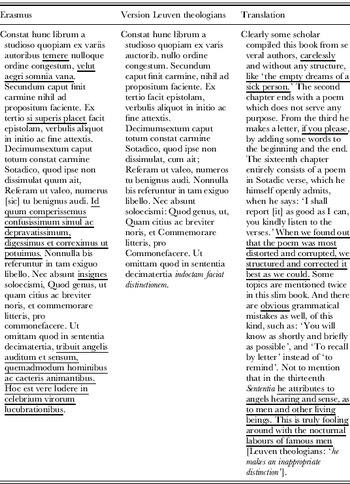
On closer inspection, however, Erasmus turns out to be much more of a presence. A comparison of both editions reveals that a substantial number of the censurae in the new edition are silently copied from those of Erasmus. Disregarding the single-line censurae, this is the case in at least twenty-seven of the more substantial assessments. Consequently, the motivation for declaring spurious certain works, such as De mirabilibus sacrae scripturae, De benedictionibus filiorum Iacob patriarchae, or De trinitate et unitate dei comes straight from Erasmus. Unsurprisingly, in copying the editors removed Erasmian flippancies and controversial remarks, but they reproduced large parts intact, frequently even preserving Erasmus' first person narrative. The censura to the spurious Viginti unius sententiarum liber 1 may serve as an example (see table 1).
Copying Erasmus: the censura to ‘Viginti unius sententiarum liber 1’
Passages taken from Erasmus' censura are underlined; Leuven additions are in italics.

The changes made by the Leuven theologians fall into three categories. First, and most prominent, they neutralised the critical language. Erasmus was prone to express his personal taste, in the case of Augustinian works especially in the negative. His strong reservations about Augustine's style, which he deems verbose, sometimes obscure and frequently unsophisticated, are automatically excluded from the new edition since the Leuven theologians mainly use the Retractationes, rather than separate censurae to introduce authentic works.Footnote 52 Thus, in the case of spurious works the aesthetic language has to be edited, resulting in the disappearance of lively Erasmian qualifications such as ‘a dull little preface’ (‘insulsa praefatiuncula’), ‘time-waster’ (‘ociosus’) or ‘pious chatter’ (‘pia loquacitas’).Footnote 53 To this category also belong expressions of appreciation for particular works, or complaints about the practice of pseudepigraphy in general.Footnote 54 Second, in some cases a tentative attribution is left out, while the rest of the censura remains the same.Footnote 55 Third, the Leuven theologians do not copy Erasmus' references to individual critical independence. Where Erasmus is keen to suggest that his judgement is not meant to ‘impede anyone to benefit from his own’, the Lovanienses more often make the opposite point, by relying on testimonia of Catholic authorities.Footnote 56
The silent use of Erasmus' edition was not limited to the censurae, but extended to the marginal notes, which were systematically copied. Again, controversial notes were removed. This could concern matters of taste such as Erasmus' repeated use of the Greek sklēron (harsh), or psychron (cold) when he found Augustine's argument too severe, or, in a case where he did not appreciate a highly rhetorical enumeration, the scathing observation (again in Greek) ‘Look how he is playing’. Occasionally, however, the Lovanienses edited out a more fundamental difference in scholarly perspective. An example of this can be found in De doctrina christiana, when Augustine defends the authority of the Septuagint by referring to the belief that it expresses a divinely inspired coherence. Here Erasmus' marginal note voiced disagreement: ‘Others put this down as nonsense’.Footnote 57 In view of the Tridentine confirmation of the holy status of the Vulgate, it is unsurprising that the Leuven editors removed Erasmus' observation.
Although filtered, the text of the Leuven theologians is largely framed by the marginal notes of Erasmus' edition. The notes that were retained consist of brief summaries of the argument, references to (mostly biblical) sources and occasional explanations and comments. Although the source references may not bear an indication of their Erasmian origin, the summaries and evaluations can provide decidedly humanistic guidance. In the Soliloquies, for example, a work that Erasmus, according to his censura, found surprisingly naive and tiresome to read, the Leuven theologians have removed the censura, but left the marginal comments where Augustine is criticised for his sophistry.Footnote 58 In De doctrina christiana the notes straightforwardly confirm contemporary humanistic values, such as ‘Greek and Hebrew are necessary for knowledge of the Scriptures’, ‘If Pagans expressed something well, it should not be rejected’, and similarly ‘If heretics expressed something well, they should be read, but carefully.’ Although these notes do not misrepresent Augustine's argument, they could have been phrased differently, especially considering their potentially subversive message for post-Tridentine Catholic theology.Footnote 59
The relative importance of the Erasmian guidance is increased by the fact that the Leuven theologians did not use the critical apparatus as an instrument to promote a more Catholic reading, let alone an anti-Reformed one. Their editorial approach to Erasmus' notes and censurae provides one example of this. Another indication is the absence of further commentaries or summaries (argumenta) of the texts. Apart from Gravius' notes on the anti-Pelagian works, the only exception is De civitate dei, where the reader is offered the learned commentary of Juan Luis Vives, originally prepared for Erasmus' edition, and now censored, as is reassuringly added on the title page, by the Leuven theologians.
On the whole, then, it would be inadequate to describe the Leuven edition as a specifically Catholic version of Augustine. This is not to say that the preliminary markers are incorrect: the text is purged of assumed heretical influences and the censurae are conscientiously in line with the ecclesiastical tradition. Paradoxically, however, the edition that was meant to replace Erasmus' reproduces large parts of the Erasmian paratext, even if in a censored version. With the exception of some notes in Gravius' commentary to volume vii, the edition as a whole does not place Augustine in a distinctly Catholic context.
Explanations for confessional neutrality
How, then, can this neutral presentation be explained? Why does an edition so conspicuously produced by Catholic theologians not employ its humanist techniques to address specifically Catholic needs? Two factors can be distinguished. First, the influence of the publisher stimulated brevity, efficiency and confessional moderation. To realise the project Christopher Plantin had assumed considerable financial risks. He had entered into an agreement with another publisher, Arnold Mylius from Cologne, who would share the costs in exchange for half of the print run.Footnote 60 All this took place in an extremely unstable economic climate. In 1576, when six volumes of the edition had been printed, the Spanish Fury caused havoc in Antwerp and nearly destroyed Plantin's entire business. He only just averted the danger by paying a sum of money that almost equalled the entire investment in the Augustine project.Footnote 61 It is understandable, therefore, that he was keen to finish the project and make it cost-effective.
Plantin catered to the confessionally mixed markets of England, France, the Low Countries and Germany.Footnote 62 He had produced exclusively Catholic works (for example, missals and breviaries) for the Spanish clergy, but by the end of the 1570s an aggressively Catholic Augustine could only limit its market potential. Although there is no proof that he exerted pressure on the editors to adapt the content of their work, there is an interesting parallel in the softening of Catholic criticism of Erasmus in Plantin's reprint of Vittori's Jerome (1578–9).Footnote 63 Moreover, we know that he urged the editors to finish the job as quickly as possible. Henricus Gravius, for instance, compared the rash publication of his notes to an abortion, and a decade later he again pointed the finger at Plantin to explain the many errors in the final result.Footnote 64
But the interests of the publisher alone cannot explain the silence over heretical appropriations of Augustine. For this the editors themselves were responsible too. Considering Molanus' background as royal censor, confessional timidity hardly seems a plausible motive. Rather, it is probable that avoiding open theological debate was part of a conscious editorial strategy. In this respect, the edition agrees with the moderate response of the Catholics in the Low Countries to Protestant provocations during the 1560s and 1570s. Recently, Judith Pollmann compared this ‘passive attitude’ to the violent actions of the French Catholics, suggesting that the behaviour of the clergy provides an important key to explain the contrasting responses.Footnote 65 She points out that many within the top rank of the Netherlandish clergy were reluctant to involve the population in theological discussions, which they saw as an undesirable concession to the Protestant agenda. The more radical Jesuits were not in a position to help galvanise a stronger, militant Catholic mentality since their movements in the Netherlands had long been curbed by the political authorities.
In this situation, the Latin edition of Augustine, obviously meant to educate the clergy in the orthodox Catholic tradition, could be largely silent about contemporary religious debates. The editors' unacknowledged use of Erasmus confirms this impression. In contrast to their Italian colleagues at this time, the Leuven theologians shunned an explicitly anti-Erasmian language. Molanus pursues this policy quite openly in his censorial statement in Plantin's edition of Vittori's Jerome. In fact, even among militant clergymen a pragmatic attitude to Erasmus can be noticed. Cornelius Jansenius (1510–74), professor at Leuven, delegate at Trent and bishop of Ghent, composed several polemical treatises in the vernacular. Still, his Latin Concordia, extremely influential in New Testament scholarship, makes pervasive use of Erasmus without explicitly mentioning him. The book received warm praise from Molanus in his censorial approbation of 1576.Footnote 66
Apart from a moderate Catholic culture, local politics seems to have affected the editorial strategy. Clerics who favoured an active, more militant, response to the Reformation were associated with a highly unpopular scheme for episcopal reform, enforced by the equally unpopular duke of Alva. The reorganisation of the bishoprics would affect local privileges and thus met with much resistance from ruling bishops and monasteries. Finally, in 1576, when the Leuven editors were finishing their project, developments in the Dutch revolt led Catholic authorities to modify their policies against Protestants. The so-called Pacification of Ghent united the Netherlandish provinces against the presence of Spanish troops, while pragmatically negotiating the religious differences. All this seriously delayed the implementation of the Tridentine reform programme.Footnote 67
Several of the Leuven editors were actively involved in these developments. As dean, Joannes Molanus, for example, was a driving force behind a secret letter from the theology faculty to Philip ii, asking him to replace Alva (1573). The letter was also signed by his colleague Henricus Gravius. Furthermore, Molanus and Gravius supported the Pacification of Ghent in a declaration issued by the faculty in December 1576.Footnote 68 Although these political developments provide no direct evidence for a specific editorial strategy on the part of the Leuven theologians for their Augustine, it does place its confessional profile in a helpful perspective. At this time, it seems, the Catholic theologians at Leuven had more important enemies to fight than the Protestants.
Recent studies of the impact of confessionalism on sixteenth-century humanism have pointed in different directions. Focusing on Reformation Germany, Erika Rummel concludes that by the second half of the sixteenth century, humanist ideals and techniques had come to serve confessional needs. The consequences were clear: ‘Now piety was classified and knowledge came in Catholic and Protestant hues.’Footnote 69 In her study of early modern patristics Irena Backus, however, argues that scholarship did not merely serve a confessional agenda. Indeed, a confessional drive often went together with a ‘genuine wish … to produce the best possible text’.Footnote 70 Investigation into editions of Augustine has confirmed that confessional sympathies indeed influenced textual scholarship, but in a different way, leading in fact to a more neutral result.
While the post-Tridentine Leuven theologians claim to offer an authoritatively Catholic version of Augustine, in practice their paratextual presentation is less ideologically charged than that of Erasmus. True, the editors stress the importance of the ecclesiastical tradition in their assessment of the authenticity of individual works and a few times warn the reader against ‘dangerous’ passages in spurious texts. Yet the correction of heretical appropriations of Augustine is not one of their central aims. Meanwhile, the theologians from the very faculty that was responsible for the censorship lists of Erasmus' works silently copy the marginal annotations from his controversial edition as well as many of his censurae. From this perspective, the edition of the Leuven theologians in fact seems thoroughly Erasmian. Partly the interests of the publisher may explain the lack of more explicit confessional guidance, but partly this seems to have been a conscious decision of theologians who were reluctant to let Protestant doctrine dictate the Catholic agenda.
What, finally, does this investigation reveal of the interaction between humanist scholarship and the Reformation? One thing is unsurprising: confessionalisation was to some degree a repressive mechanism for the production of scholarship. It could curtail curiosity, hinder innovation and induce self-censorship. As such it had a conservative impact, promoting continuity in the organisation of the editions and prompting scholars to avoid controversial issues. Less expected, perhaps, is the constructive impulse that confessional pressure gave. Authorities ordered new, safe editions to be made, and competition with heretical colleagues encouraged fresh critical scrutiny. This less straightforward, more dynamic picture of the confessionalisation of humanist scholarship can serve as a starting-point for new investigations into the consumption of these works by individual readers.