Congenital Cardiac Anomalies refer to a massive structural and functional malformation of the heart. This may accompany other additional malformation syndromes.Reference Botto and Correa1, Reference Lina and Ardingerb2 The universal prevalence of congenital cardiac anomalies is estimated at 8 per 1000 live born infants.Reference Hoffman and Kaplan3 The study reports show that congenital cardiac anomalies are the second most common birth defect in many countries.4, 5 Despite this fact, our previous study showed that the prevalence of congenital cardiac anomalies is the fifth most common one, indicating that many of the newborns with life-threatening cardiac anomalies are missed at the time of delivery or diagnosed later after birth.Reference Dastgiri, Imani, Kalankesh, Barzegar and Heidarzadeh6, Reference Knowles, Griebsch, Dezateux, Brown, Bull and Wren7 Early diagnosis and screening of congenital cardiac anomalies is vital because the lack of proper diagnosis of congenital cardiac malformation will result in a high risk of mortality in children and decrease life expectancy of newborn infants.Reference Quinlan8, Reference Moons, Sluysmans and De Wolf9 The study of missing frequency of congenital cardiac anomalies will be important in planning for prevention strategies, medical care, and surgical treatment of newborn babies.Reference Kovacheva, Simeonova and Velkova10, Reference Hoffman and Kaplan3 Infants with congenital cardiac diseases may not even be diagnosed until a paediatric cardiologist visits them for some other medical reasons.Reference Wren, Richmond and Donaldson11, Reference Abu-Harb, Hey and Wren12 The aim of this study was to estimate the missing frequency of congenital cardiac anomalies at the time of delivery or after birth.
Method
The study population was 185,650 births – 183,579 live births and 2071 stillbirths – in the Northwest region of Iran covered by the Tabriz Registry of Congenital Anomalies13 under the Tabriz University of Medical Sciences. A total of 451 children with congenital cardiac anomalies were studied in the region from 2000 to 2009. University hospitals in the area provide the study population with advanced facilities and equipments, medical care, surgical operation, and clinical follow-up.
Neonatal examinations consist of echocardiography, pulse oxymetry, and Doppler colour echocardiography. Newborn babies are routinely examined with common neonatal tests before their first discharge from the hospital.
The anomalies in this study were classified using the International Classification of Diseases coding system (Version 10). Two midwives and a nurse were recruited to carry out this classification in the Tabriz Registry of Congenital Anomalies programme. Hospital records, common hospital discharge forms, and paediatric discharge records were used as the data sources in this study.
The expected prevalence of congenital cardiac anomalies at birth was estimated for the study population using the Tabriz Registry of Congenital Anomalies data. This was then compared to the observed prevalence of congenital cardiac anomalies at the same place and time; 95% confidence intervals were calculated to assess the statistical significance of the data.
Results
A total of 185,650 births were recorded in the study area, including 183,579 live births (99.96%) and 2071 stillbirths (1.11%). During the study period, 451 cases with a primary diagnosis of congenital cardiac disease were identified and ascertained.
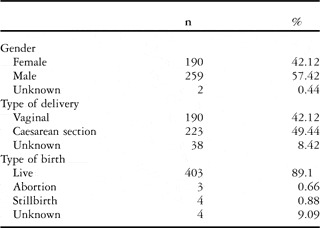
The main characteristics of study subjects, including gender, type of delivery, and type of birth, are presented in Table 1. Most of the cases were male (57.4%). The majority of infants were born live (89.1%). Caesarean section was the main type of delivery (49.4%) in children born with congenital cardiac disease.
Characteristic of the study subjects.

Total prevalence of congenital cardiac anomalies at birth was 9.2 per 10,000 births (95% confidence intervals: 7.8–10.6). Patent arterial duct (15%), atrial septal defect (12%), and ventricular septal defect (5%) accounted proportionally for about one-third of anomalies as the most common cardiac defects identified and recorded in the area. The expected total prevalence of congenital cardiac anomalies at birth was estimated at 24.2 per 10,000 births (95% confidence intervals: 22.1–26.5) at the same time and place. A comparison of the observed and expected prevalence rates indicated that 59.1% of children with congenital cardiac anomalies were not identified at birth (p-value less than 0.05). This proportion increased by 13% over the study period from 2000 to 2009 (p-value greater than 0.1).
Discussion
This was a cross-sectional study aimed at identifying the missing rate of congenital cardiac anomalies at birth in the Northwest region of Iran. We found a high proportion of children born with congenital cardiac anomalies with no diagnosis at birth because there was no paediatric cardiologist available in the gynaecology and obstetrics wards as a routine. If those infants with congenital cardiac anomalies are properly diagnosed soon after birth, we will be able to provide them with proper surgery and the essential medical care that they need. This will then result in longer survival for children born with congenital cardiac anomalies.
According to the study of Wren et al,Reference Wren, Richmond and Donaldson11 only 45% of infants with cardiac defects are identified as abnormal in neonatal examination and only 16% of infants with congenital cardiac abnormality could be recognised before discharge from the hospital.
This study had some advantages. First, it included a very large population consisting of 185,650 births during a decade. Second, it was carried out in three university hospitals, with advanced facilities and equipment, run by professional staff. Third, the data for this study came from the registry-based information of the Tabriz Registry of Congenital Anomalies system established in the region. Fourth, the data for this study included stillbirths as well as live births.
This study had some limitations too. First, it might have been affected by inter-observational bias. In some cases, for instance, there might be inconsistencies in identifying cases of congenital cardiac anomalies in the Tabriz Registry of Congenital Anomalies registry system. Second, we were unable to follow up the study subjects for more than 1 year. Third, since many cases of abnormalities and congenital cardiac diseases are usually recognised over the next few years after birth, there might have been an underestimation of the prevalence of congenital cardiac anomalies in the region. Fourth, some patients with undetermined anomalies might have been placed in a wrong category in the classifications of anomalies, resulting again in an underestimation of the prevalence of congenital cardiac anomalies.
Examination of infants born in the local hospitals is performed by neonatologists. As mentioned previously, it is not routine that the paediatric cardiologists attend in the delivery room. The role of neonatologists is therefore essential in identifying congenital cardiac anomalies at the time of birth.Reference Carvalho, Mavrides, Shinebourne, Campbell and Thilaganathan14 The proper use of colour Doppler cardiography will provide a good chance for identification of minor cardiac defects by trained neonatalogists.Reference Wren, Richmond and Donaldson15 Moreover, since the pulse oxymetry technique is not very complicated, it can be considered as a reliable method for these purposes by neonatologists too.Reference Koppel, Druschel and Carter16, Reference Chang, Rodriguez and Klitzner17
While there is no paediatric cardiologist attending at the time of birth, the application of these techniques and procedures by neonatologists may eventually result in longer survival and suitable medical care for infants born with congenital cardiac defects.Reference Garani and Cocchi18, Reference Sanders19
It is concluded that in order to diagnose and treat cardiac defects at an early stage and to enhance the life span of the patients, it is recommended that suitable training programmes and fellowships are offered for paediatric cardiologists and neonatologists. It is also recommended that paediatric cardiologists are present in obstetrics wards of the hospitals to minimise the missing cases of congenital cardiac anomalies at birth.
Acknowledgements
The authors thank the Tabriz Registry of Congenital Anomalies staff for their assistance in creating and collecting data for this study.