

This Focus Issue of the Journal of Materials Research contains articles in the broad area of de novo carbon nanomaterials. As an emerging area of research, the exploitation of this class of materials has set off enormous opportunities for innovation.Reference Geim and Novoselov1 More than 20 years ago, in the 1990s, carbon nanotubes were studied for their remarkable material properties (optical and mechanical, and others).Reference Saito, Fujita, Dresselhaus and Dresselhaus2–Reference Pugno5 More recently, the field has exploded to incorporate numerous applications for graphene,Reference Novoselov, Geim, Morozov, Jiang, Katsnelson, Grigorieva, Dubonos and Firsov6–Reference Liao, Lin, Bao, Cheng, Bai, Liu, Qu, Wang, Huang and Duan11 which can now be fabricated in large scales.Reference Kim, Zhao, Jang, Lee, Kim, Kim, Ahn, Kim, Choi and Hong12 Similarly, additional two-dimensional carbon allotropes, such as graphdiyne, and three dimensional nanocarbon architectures, such as graphene-nanotube architectures and graphene foam, have emerged and invoke remarkable properties of their own,Reference Hirsch13–Reference Cranford, Brommer and Buehler15, Reference Pop, Varshney and Roy21 several of which have been manufactured.Reference Ivanovskii16, Reference Lin, Penchev, Wang, Paul, Zhong, Jing, Ozkan and Ozkan22–Reference Wang, Guo, Penchev, Ruiz, Bozhilov, Yan, Ozkan and Ozkan24 In the past, controlling the architecture of a material was limited to the macroscale, but we are beginning to see the merger of the concepts of material and structure.
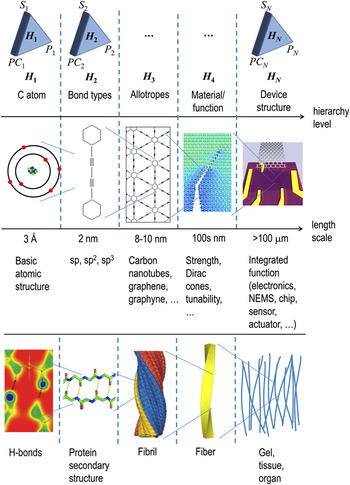
Carbon nanomaterials are exciting because of their remarkable diversity of mechanical, physical and chemical properties, which derive from the different allotropes including nanotubes, fullerenes, diamond, as well as graphene and its allotropes, with consequent applications in different fields such as nanoelectronics, optoelectronics, biosensors, drug delivery, energy conversion and storage. The paradigm of building complexity from a single type of atom (carbon with a variety of chemical bonds/structures it can form) by creating structural diversity at different scales is reminiscent of the means by which biological systems create functional materials, where the paradigm is to rely on simple amino acids to create a stunning diversity of proteins and related materialsReference Buehler17 (Fig. 1). The systematic exploitation of this concept of “hierarchical structuring” in the world of carbon materials is only at its beginning, but holds great promise.
Illustration of hierarchical design space of carbon materials from the atomic structure of carbon atoms to the integrated assembly in a device. The realization of multiple structural levels in de novo carbon materials is emerging as an exciting opportunity to create enhanced function at the macroscopic or device scale. Function emerges as a complex interplay of structure (S)-property (P)-process (PC) relationships that act at individual hierarchical levels (H 1…H N). Together, the material behavior is more than the sum of its parts and can be exploited for innovative applications. The lower part shows an analogy to protein materials, depicting a similar paradigm in multi-level structuring to create a certain material function (here, an example of an amyloid protein material is shown). Figure adapted from Ref. Reference Buehler20 with images from Ref. 15. The graphene device is based on Ref. Reference Chen, Jang, Xiao, Ishigami and Fuhrer7 and the image is taken from: http://www.newsdesk.umd.edu/images/scitech/graphene.gif. (color online)
A specific challenge is the linking of scales from the nano to the macro via the creation of hierarchical architectures using carbon nanomaterials as building blocks. Here, novel material properties emerge because of the synergistic interaction across the scales, where the properties of the union is more than the sum of its parts.Reference Buehler17–Reference Buehler20 This strategy provides access to a very broad set of functional properties that include switchability, tunability and mutability in the design of de novo carbon nanomaterials. Applications of such multi-scale engineered materials range from nanoelectronics to medicine to novel construction materials and could have wide implications to facilitate new technological innovations at the interface of materials science, engineering and biology.Reference Gao, Kong, Cui and Ozkan25–Reference Lin, Teweldebrhan, Ashraf, Liu, Jing, Yan, Li, Ozkan, Lake, Balandin and Ozkan30 This Focus Issue offers a snapshot of the state of the art in the manufacturing, synthesis, and modeling of carbon nanomaterials and related hierarchical architectures with understanding of energy, mechanical and physical properties.
Overall, twelve articles are featured in this Focus Issue, representing both experimentation and modeling. Topics include the growth of novel carbon nanostructures comprising hierarchical architectures of graphene flower-like morphologies of graphene sheets, and the presentation of new carbon nanotube materials. Such de novo carbon materials facilitate new technological innovations at the interface of materials science, engineering, and biology. Innovative approaches are described for fabricating energy storage devices such as supercapacitors, which are designed for very high power density applications. Supercapacitors offer a broad spectrum of applications for various power and energy requirements, and they are designed for large numbers of rapid charge and discharge cycles.
The combination of mechanical, thermal and physical properties for three-dimensional nanocarbon architectures is presented and discussed in several articles. Hierarchical architectures based on carbon nanomaterials are used in an application of pillared graphene nanostructures that provide exceptional thermal transport characteristics, showcasing a possible realization of this concept. These and other examples demonstrate that the manufacturing of such materials is not merely a theoretical concept, but holds real promise to change the way we think about materials design and incorporates a true bottom-up approach.
This collection of papers can only provide a brief overview of current materials innovations and issues being addressed, but will hopefully stimulate much further research activity. We are thankful to all authors and reviewers who contributed in the development of this Focus Issue, and hope that readers will enjoy the research and discussion presented. We also acknowledge the staff at the Materials Research Society and Cambridge University Press for their dedication and support.




