The following text presents inscriptions on various portable objects from Sidi Khrebish, which are additions to those in the chapter on inscriptions in Berenice i, 233–54. I have been particularly anxious to present the texts on pottery, including the potters’ stamps, since their potential contribution to the epigraphic record of a city is often forgotten.
I have had invaluable help from many colleagues, both those who have worked at Benghazi and others, to all of whom I am most grateful. From the long list I shall single out only one name, that of Philip Kenrick, who has typed the text for me (more than once) and with whom I have had vigorous discussions on various points. Section B (a) 3, concerning stamped texts in Latin contributed by him, must be understood as conforming in its presentation to the conventions used by ceramic specialists rather than to those used by epigraphists, as in the rest of the report.
A. Texts on portable objects of metal, stone and glass
This group consists of twelve inscribed missiles (nos. 1, 2)Footnote 1 and one inscribed glass gem (no. 3). The missiles in nos. 1, 2 are discussed at some length, mainly because of their potential contribution to the history of Berenice, but also because John Lloyd was much interested in them – it is unfortunate that he was unable to carry out his own ideas for evaluating themFootnote 2 and that what the epigraphist can offer is limited. The reader is asked to bear in mind that inscriptions on weapons are commonly brief and heavily abbreviatedFootnote 3 except on sling bolts. These may carry crudely picturesque messages for the enemy and/or abbreviated names of commanders, of units, possibly of makers; and in consequence epigraphic manuals tend to concentrate on them, saying little or nothing of texts on other weapons. It is also the case that excavation reports have often been summary on them, leaving items unrecorded or listed without adequate indication of find-spots, sizes, shapes, and weights. Practice is currently much improved, but more discussion is needed.
1. H387: bronze arrowheadFootnote 4
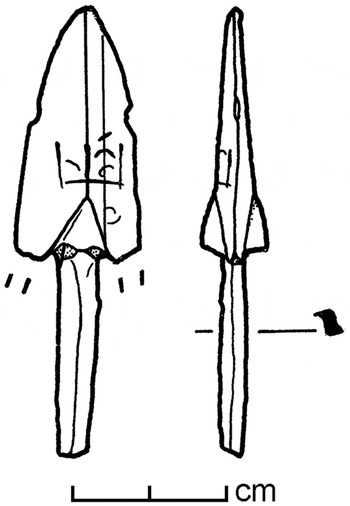
This is inscribed with a monogram which Lloyd read as ΒΕ (ΕΒ would also be possible, but is not known elsewhere or obviously explicable: see Figure 1).Footnote 5
Inscribed bronze arrowhead, no. H387. Scale 1:2.

Six examples of bronze arrowheads were found and three of iron, all sufficiently close to the city wall for the presence of weapons to be unsurprising (see Lloyd and Kenrick Reference Lloyd and Kenrick2014, 137 f., nos. H385–93). Unfortunately, there is nothing to show definitively whether they belonged to the defenders or were shot into the city by assailants. Lloyd judged from their find-spots and types that the bronze items (H385, 386, and, by analogy, 387, 389; on H388, 390 he left no comment) should be dated before the Christian eraFootnote 6 and the iron (H391; on H392, 393 there is no indication of his views) to the early second century AD.Footnote 7 Where an archaeological context is known, however, as for the inscribed item, it is complex, containing mainly material of the first, but also some of the third, century BC and, indeed, some of a markedly later date. The conclusion is open to discussion, therefore (see further below).
H387 is of a type said by D.E.L. Haynes (Reference Haynes1952) to be ‘the typical arrowhead of Cretan mercenary bowmen in the Hellenistic period’. He does not argue for this view in any detail, saying only that it is a type ‘unmistakably represented on the fourth-century coinage of various Cretan cities’. We should remember, however, that equipment thought of in antiquity as Cretan was also used by non-Cretans.Footnote 8 At the same time, Cretan bowmen did, undoubtedly, serve in Cyrenaica in the Hellenistic period – there is a vivid memorial of one in Epigram 37 of the Cyrenean poet Callimachus, who described him as dedicating his bow and quiver to Sarapis having left his arrows with the Hesperitae, that is, the citizens of Euhesperides; he had clearly been fighting in the area of Berenice in circumstances which have been variously interpreted.Footnote 9 I do not see an absolutely conclusive argument in favour of any one dating for them; the most that we can say with assurance seems to me to be that they fell within the writing lifetime of Callimachus (first into third quarter of the third century BC).Footnote 10
Six examples of this type of arrowhead, which carry what is clearly the same monogram, are now known. Haynes (Reference Haynes1952) had collected five, one credibly reported to have been found at Cyrene, one from Knossos and three from Egypt, none in a securely dated context. The example from Berenice under discussion adds a sixth.Footnote 11
Inscribed arrowheads are extremely rare. The only other examples that I know of were also cited by Haynes: a group of five found at Olynthus, all reading ΦΙΛΙΠΠΟ (retrograde), which have been reasonably taken to indicate the presence of a unit of bowmen attached to the person of Philip II, King of Macedon.Footnote 12
For the interpretation of the inscription on the arrowheads known to him, Haynes began with a close parallel on a Cyrenaican coin in the Ptolemaic Soter/Libya series of coins,Footnote 13 which he read as ΒΕ and took as ‘almost certainly the mint-mark of the town of Berenice’; but he concluded nevertheless that, on the arrowheads, ΒΕ referred to a Queen Berenice and not to the city of the Bereniceans – in fact to Berenice II, daughter of King Magas of Cyrenaica and wife of Ptolemy III of Egypt. Professor T.V. Buttrey, who has worked extensively on Cyrenaican coinage, kindly informs me (in a letter) that the inscription on the coin is placed in a position behind the head of Libya, which he believes to be without precedent for a Cyrenaican civic mint mark; so that too favours, although it does not prove, an allusion to the queen rather than to the city. It would appear, if so, to be implied that Berenice II had named troops especially associated with her (her bodyguard, presumably) in a manner which at least recalls those attributed to Philip II at Olynthus. This was perhaps a Ptolemaic retention of a Macedonian practice.
Haynes's arguments against a reference to the city on the arrowheads are not all valid,Footnote 14 but there can be no doubt that there is a strong case for seeing a reference to the queen here. The distribution of these inscribed arrowheads is much more satisfactorily related to soldiers of the Ptolemaic monarchy than to those of a small city on the western edge of the Ptolemaic kingdom. With that city Queen Berenice II had a special relationship, shown by its name as well as in the literary tradition that she provided its civic defences;Footnote 15 but her special position was not simply civic, since, as her father's heir, she brought the whole province of Cyrene under Ptolemaic control when she married Ptolemy III (see Laronde Reference Laronde1987, 382 f.). In any case, as Haynes has noted, she seems to have exercised viceregal powers in her husband's kingdom when he was engaged in war with Syria (Haynes Reference Haynes1952, 46).
I have to admit to a certain unease in proposing a date in the third century BC for the arrowhead. Is it, I wonder, worth asking how long after its original manufacture a bronze arrowhead might continue in use?
2. H394–416, ballista ballsFootnote 16
Altogether, 23 balls were found, of which 11 were inscribed.Footnote 17 They are of local limestone or sandstone,Footnote 18 of variable sizes and weights, all more or less globular and reasonably smooth on the surface, but not to the point of eliminating chisel marks. Since the marks of several different tools, including claw chisels, can be recognized on them, it is legitimate to suppose that we have the products of several different workmen, all probably, although not necessarily, contemporary. There is no obvious difference between the balls with letters and those without. On the lettered balls the letters are carefully cut, not scratched, and again the hands of several different workmen seem distinguishable. (Those of which photographs could be found are illustrated in Figure 2.)
Inscribed stone ballista balls (= Lloyd and Kenrick Reference Lloyd and Kenrick2014, fig. 17).

Find-spots are scattered, equally so for lettered and unlettered balls. A number were found near the Hellenistic tower in Area W (Berenice i, 43–45, 51–52), but none were far from the city wall, unless we count as such the large unlettered ball (H407), which was a casual find in the Funduq (Lloyd and Kenrick Reference Lloyd and Kenrick2014, 139). Their proximity to the city wall, and indeed their total number, strongly suggests that they were intended for military use (not, for example, as weights) and, in that case, presumably for use in defence, since they are not heavy enough to be effective in an attack on a city wall (Baatz Reference Baatz, Maloney and Hobley1983), and in any case, being of limestone and quite carefully prepared, are almost certainly of local workmanship. Their distribution overall, however, with a number found in domestic contexts, is clearly the result of post-war reuse. It recalls that of similar balls found at Pompeii, the only site for which there has been serious discussion of this matter,Footnote 19 where balls were quite widely dispersed for reuse in a variety of different ways, and sometimes partly or largely broken up for it.
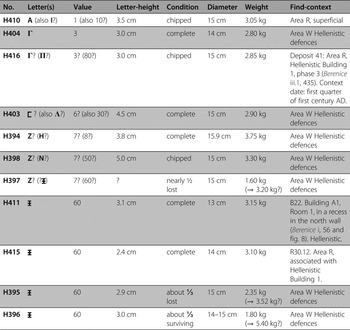
The facts about the lettered balls are shown in Table 1. It has not been possible to read all their letters with absolute certainty, both because of damage to some and because it is not always clear from which angle they should be viewed. It is also to be noted that where Lloyd reported one letter only on each of the lettered balls I thought that there might be two on a few, but this should be checked since it is very easy to imagine letters where there are only tool marks, and I was working very fast.Footnote 20 There is a significant element of uncertainty also in the weights and sizes listed, most importantly in the weights. All the balls have lost something of their original weight by wear and tear, some of them a considerable amount which can only be roughly estimated. In any case, ancient weights were not always as exact as we expectFootnote 21 so that, if the balls were intended to conform to one of the several ancient weight systems known, they may never have been more than approximations to the stated weight. Moreover, I suspect (from personal experience) that archaeologists do not always have scales of suitable quality available to them in the field. No figure here should be regarded as better than approximate.
Since it is possible, but not certain, that the letters on the balls were used as numerals (see below, page 80), Table 1 includes the numerical value of each letter and is ordered accordingly.
Inscribed stone balls.

Notes:
H410: I read AI
H403: I read  , but the letter is damaged and not quite certain. If there are two letters they are patently not to be taken together as Λ
= 36.
H397: the letter may be incomplete and if so could only be Ξ.
H396: Lloyd thought that the finds record may be inaccurate here (⅓ surviving or ⅓ missing?).
Where I thought that there might be two letters, they were not aligned, suggesting either that two different pieces of information were given, or that information on the same point was given on a second occasion, after a change of detail.
The balls raise several different problems:
1. Purpose
Used for defence, stones might be slung from slings, thrown or dropped by hand from towers and battlements, or projected from machines which are commonly described as ballistae or as catapults. The Benghazi balls are large for sling stones and more likely, therefore, to have been hand-propelled or projected from machines. For machine projection, balls needed to be approximately globular and fairly smooth surfaced in order not to damage the sliders, as well as available in groups of similar size and weight in order to be directed effectively at a specific target.Footnote 22 The Benghazi balls seem to meet the essential requirements, but they are lighter, for the most part, than the lightest which were listed as ammunition for machines by the technological writer Philon of Byzantium,Footnote 23 and that has seemed to some of my colleagues to favour the view that they were prepared for hand-throwing, not for machine projection. Defensive use of hand-propelled stones remained common and militarily important long after the invention of the machines,Footnote 24 and it was conducive of efficiency that they too should be rounded and smoothed on the surface, as well as available in groups of similar size and weight.Footnote 25 Nevertheless, the considerable care taken to prepare the Benghazi balls may seem beyond what one would expect in hand-thrown balls, and Vitruvius envisaged machine-thrown balls which were lighter than those listed by Philon,Footnote 26 and, indeed, lighter than some of the Benghazi balls. I believe that we should accept the possibility that they were intended to be shot from machines.
2. Date of production
The known find contexts are, of course, all subsequent to the original use and the apparently important connection between the balls and the Periods 1 and 2 defensive walls is bedevilled by the absence of unequivocal dates for either. (See Berenice i, 43–52. Lloyd made a case for associating the Period 2 construction with Inscription no. I.3, the Pirate Inscription, which I dated in 62/1 BC in Berenice i, 235.) The forms of the letters on the inscribed balls cannot be securely placed in time; I have the impression that none is earlier than the mid-second century BC, while Γ and (if rightly read) recall some Cyrenaican inscriptions of the Augustan period, but I do not feel sure of either diagnosis. If the letters represent figures – which is possible, but not certain (see below) – they are later than the replacement of the Cyrenean numerical system by the international Greek alphabetic system (in which alpha = 1, beta = 2, and so on) that was beginning in the late third century BC and is demonstrably complete in the second.Footnote
27
In the Greek-speaking world as a whole there is no attested example of the alphabetical system of numerals on stone balls earlier than the third quarter of the second century BC,Footnote
28
but, given the paucity of published evidence, that is not a secure indicator of earlier military practice.
There would be another clue if a system of weights used for the balls could be identified. That is a matter complicated by the number of systems that were used in antiquity and by difficulties arising from the imprecision over the weights of the balls (as noted above). A local system is unlikely to have survived the establishment of the Ptolemaic monarchy in Cyrenaica when one would expect that it would be replaced by the practice of Alexandria, which is thought to have been closely related to the Athenian system.Footnote 29 It is not immediately apparent that the Benghazi balls conform to that, so we might consider the Roman system. Lloyd noted that, if the Roman pound was used (he calculated it at 327.5 gm), the several balls in the 2.7–2.8 kg range would weigh 8–9 lbs. As he observed, that is not a weight listed for machine-propelled balls by Vitruvius,Footnote 30 but we need not suppose that Vitruvius listed all the weights that were in use. That the system might be Roman was also suggested to me by R.P. Duncan-Jones. Calculating c. 323 gm to the pound,Footnote 31 he suggested that nos. H403 and 404 could be slightly worn balls of approximately 9 lbs (2.907 kg), nos. H411 and 415 of 10 lbs (3.23 kg), no. H394 of 12 lbs (3.876 kg). This is obviously attractive. If right, it should indicate a date after Cyrenaica passed under Roman authority on the death of its last king in 96 BC. How much time we should allow after that before the widespread acceptance of a new system of weights, supposing that that did occur, is very uncertain.Footnote 32 We cannot count on this possibility at all firmly.
On other sites, dates have been proposed for balls on the assumption that they were made for use in a known siege, which gives possible but not always more than plausible ones. Lloyd thought that the Benghazi balls might have been associated with attacks on the city made in the years between 96 and 62/1 BC,Footnote 33 but the inscription which attests themFootnote 34 also reveals that the city was very ill-prepared for them. Since the city could even be said to have lacked a city wall at that time, it would be unlikely to have had machines for projecting balls, nor perhaps even balls prepared for hand-throwing. Of course, when the honorand of the text reorganised its defences he might have prepared balls against future hazards. Other possible occasions are known, for instance the period when Cyrenaica was held for Antony and Cleopatra against Octavian in the thirties and the Marmaric War of the reign of Augustus,Footnote 35 but we know so little of the history of the city that there may have been more, before as well as after 96 BC.
Taking into consideration all the points discussed above, we seem to me to have some grounds for thinking of a date in the first century BC, but none for any certainty.
3. The significance of the letters
While the majority of the balls found on Greek and Roman sites is uninscribed – as is very clearly illustrated at PergamonFootnote 36 – smaller numbers of lettered ones are known (though not always published) from many; among them are examples whose letters quite certainly signify weights. Thus two groups of balls of the fourth century BC – one found at Rhodes and attributed reasonably to the occasion of the siege of the city by Demetrius Poliorcetes in the late fourth century, the other at Cypriote Salamis with a terminus ante quem of 310/300 BCFootnote 37 – are marked with letters comprehensible on the acrophonic system of numerals (Π = πέντε, Δ = δέκα, and so on), their weights in minae corresponding at least approximately to them. The same is true of a small group found in a tower at Sounion in Attica,Footnote 38 and very probably of another on Delos;Footnote 39 a similar group found in association with fortifications at Piraeus was unfortunately not weighed.Footnote 40 The acrophonic system is comparatively easy to recognise. The alphabetic system (see above, page 79) presents us with letters which are less easily identifiable as numerals and, on a high proportion of lettered balls, it was this that was used – if, that is, they do signify numerals. At Tel Dor, however, a group of balls attributed to the siege of the city by Antiochus VII in 139 BC includes a few whose letters (if taken as figures on the alphabetic system) correspond well with their weights in minae.Footnote 41 They are at present, so their editor argued, the earliest attested instances of numerals on the alphabetic system to have been found on balls. It is possible that there are slightly earlier examples at Corinth, arguably associated with the Roman siege of the city in 146 BC, but these have never been weighed.Footnote 42
On the other hand, there are balls whose letters/figures certainly do not give their weights. The evidence comes from Wallsend on Hadrian's Wall in north England, where × appears on two balls, one of which weighs 390 gm and the other 820 gm. Their diameters are also divergent, one being 6.8 cm, the other 8.7–9.5 cm.Footnote 43
The letters on the Benghazi balls could, in principle, be interpreted as numerals on the alphabetic system, but, if that is what they are, it is not obvious that they relate to the weights of the balls. It is true that the two marked Γ (= 3) are roughly equivalent in weight, as are two of those marked H or Z (= 7 or 8), although the third is heavier; of the four certainly marked Ξ (= 60) two are close enough, a third rather heavier (but its weight is estimated, perhaps wrongly), the fourth very much heavier (unless there is a mistake in the record). The relationships between the groups, however, do not seem to make any sense. The ball marked A (= 1) is heavier than those marked Γ (= 3) and quite close to some of those marked Ξ (= 60); while balls marked H or Z (= 7 or 8) are as heavy as, or heavier than, those marked Ξ. I find it difficult to believe that we have figures indicative of weights and, in the light of the close similarity of all the diameters, we can hardly have figures indicative of size.
Where letters/figures on stone balls do not correspond to weights or sizes we have at present little basis for discussion of their meaning except for the inscriptions found on other military items such as arrowheads (see above, page 75). Since so many balls are unlettered, it may seem that the letters were not essential to the military use of the balls.Footnote 44 In that case, could makers’ marks be a possibility, or the initials of unit names, even of commanders’ names? On one of the Sounion balls, there was part of a personal name, which has been taken to be that of a magistrate,Footnote 45 but at Benghazi there seem to be more different letters than can naturally be explained as the initials of magistrates’ names (at least of contemporary ones). Since × on the Wallsend balls is almost certainly a figure, whatever it refers to, a suggestion that appears to me more attractive than any other that I have seen is that the letters are figures referring to numbered military positions or machines for which the balls were intended.Footnote 46 But, at present, I do not think that any suggestion can be considered more than a guess.
3. Glass gemstone (sealstone?)
Drawing of glass gemstone. Scale 1:1.

1.7 × 2.0 cm, 0.2 cm thick. Damaged below, inscribed in the mould on one face and showing two winged figures embracing (?) on the other (see Figure 3). Found in context G15.15, inv. 2797: to be published by Dr J. Price in her report on the glass from the site.
Letters c. 0.0035; for sigma.
εἷς घ-
εὺς Σ-
έ̣ρα-
π[ις]
L. 3, the first letter is drawn as incomplete but in a manner which suggests that it was epsilon rather than alpha (I have not seen the object, nor a photograph); if that is right, the text gives the Roman and not the Greek spelling of the god's name (as does the graffito published as no. I.6, vi), suggesting that this may express a personal cult rather than devotion to a local cult.
During the Roman period, Sarapis/Serapis became, for some, ‘the unique pantheistic deity’ (Tran Tam Tinh Reference Tran Tam Tinh and Haase1984, 1713f.). The formula used here expresses this concept and is known from a number of examples, especially on gems. It is sometimes accompanied by specific reference to the benefits he was believed to confer, as, for example, in Vidman (Reference Vidman1969) no. 363 (where it is followed by καλὴν τὴν ἡμέραν), and sometimes by the names of other deities conflated with him, for example, Helios (Vidman Reference Vidman1969, no. 389), Isis and Horus (Vidman Reference Vidman1969, no. 751), which may explain the figures on the reverse face here.
B. Inscriptions on major groups of ceramic objects
In the epigraphic section in Berenice i, the index on pages 251–54 included references to what was then known of unpublished inscriptions on fine wares, coarse wares, lamps, and glass. For glass, see now section A.3 above. When the coarse and fine wares were published (in Berenice ii and iii.1), some additional texts had been recognised and some of those included in the epigraphic index had been reread. It seems best to give here a complete list of all such texts with up-to-date references; inventory numbers have, of course, also been replaced by final publication numbers.
(a) Fine wares
References are to Philip Kenrick's catalogue in Berenice iii.1, in which vessels are identified by numbers in the form Bnnn and stamped marks on vessels are catalogued as Xnnn. The original inventory numbers (F.nnn) are supplied in parentheses if the items were included in the former list.
1. Stamped texts in Greek, applied during the process of manufacture
-
B168, p.113 = SEG 35 (1985) 1689. On the base of an ‘Ionian’ moulded bowl (raised lettering, in the mould; second or early first century BC):
ΑΡΚΕϹΙΑΛΟϹ Ἀρκεσίλαος
-
B169, p.113 = SEG 35 (1985) 1690. On the base of an ‘Ionian’ moulded bowl (raised lettering, retrograde, in the mould; second or early first century BC):
ΓΟΡΓΙ Γοργί(α)
-
X99, p.215 (not in SEG). In the centre of a plate in Italian Sigillata (first century AD):
ΠΥΛΑ Πυλά(δης or -δου)
OCK vessel no. 1692, type 1589: potter Pyla(des) of Pozzuoli (?)
-
X138, p.244 = SEG 35 (1985) 1692. In the centre of a small dish in Eastern Sigillata A (Tiberian?):
ΑΝΔΡΟΥ Ἀνδροῦ
-
X139, p.244 = SEG 35 (1985) 1691. On the base of a dish in Eastern Sigillata A (c. AD 40–70, found in a context of the mid-third century AD):
ΧΑΡΙϹ χάρις, to be taken as a motto.
The word XAPIC occurs very frequently amongst the stamps on Eastern Sigillata A and is presumed to represent a greeting or motto, rather than the name of a producer. See Hayes Reference Hayes1985, 11, and the examples from Antioch in Waagé Reference Waagé1948, figs. 19–21.
-
X140, p.244. In the centre of a large plate in Eastern Sigillata A (mid-first century AD):
ΧΑ[ΡΙϹ], in planta pedis.
Cf. the preceding.
-
X141, p.244. In the centre of a dish or plate in Eastern Sigillata A of the first century AD:
M, NI – or illiterate? (Stamps with an array of meaningless strokes are not uncommon.)
-
X142, p.255 = SEG 35 (1985) 1694. On the floor of a conical cup in Eastern Sigillata B1 (second quarter of first century AD?):
ΠΟΣΕΙ/ΔΩΝΙ/ΟΥ Ποσειδωνίου
-
X143, p.255 = SEG 35 (1985) 1693. On the floor of a cup in Eastern Sigillata B1 (first century AD):
ΣΙΔ/[…] Σιδ[…]
Names beginning thus exist (e.g. Σίδων, Σιδήριος), but are not otherwise attested on this ware. There should probably be three letters in line 2.
-
X154, p.300 = SEG 35 (1985) 1696. On the floor of a conical cup in Italian (possibly ‘Tripolitanian’) SigillataFootnote 47 (Augustan/Tiberian):
ΒΛΑϹΤΙ/ΜΟΥΝ For the Latin Blasti Mun(ati), but the combination of Greek letters with a Latin form (including the genitive case ending) is to be noted.
-
X155, p.300 = SEG 35 (1985) 1695. On the floor of a conical cup in ‘Tripolitanian’ Sigillata (Augustan/Tiberian):
CIN
Possibly Greek with ‘C’ for sigma, for Σιν( ), but it might be Latin. (The Gaulish name Cinnamus can surely be ruled out.)
-
X156, p.300 = SEG 35 (1985) 1697. In the centre of a large plate in ‘Tripolitanian’ Sigillata (Augustan/Tiberian):
ΕΡΙΠ̣ An abbreviated name, Ἐριπ( ) ?
Note that there are also Latin stamps on this ware (listed below, page 89).
2. Graffiti in Greek, scratched after firing; often, no doubt, marks of ownership
Graffiti on fine wares. Scale 1:1.

These are listed in Berenice iii.1, 415 f., and illustrated in fig. 77; see also Figure 4 here. The dates of the objects have been supplied by Philip Kenrick.
-
B22 (F.434) = SEG 35 (1985) 1698. On the rim of a lid in Black-Glazed B1 ware (third century BC?):
…]ΝΙΠΠΟΥ Perhaps [Με]νίππου, but cf. also [Μελα]νίππου.
-
B205.1 (F.80) = SEG 35 (1985) 1699. On the underside of a plate in Italian Sigillata (Augustan/Tiberian):
monogram AC? AE? TAX?
-
X28 (F.1476) = SEG 35 (1985) 1700. On the underside of a sherd from a stamped plate in Italian Sigillata (first half of first century AD):
ΦΙΛΕΡΩ[… Φιλέρω[τος
-
X57 (F.711) = SEG 35 (1985) 1701. On the underside of a stamped conical cup in Italian Sigillata (Tiberian or later):
monogram including A
-
X61 (F.1269) = SEG 35 (1985) 1702. On the underside of a stamped conical cup in Italian Sigillata (Tiberian or later):
MA (but this could be Latin)
-
X105 (F.1331) = SEG 35 (1985) 1703. On the underside of a stamped conical cup in Italian Sigillata (Tiberian or later):
ΕΥΞΕ Εὐξε (?), e.g. Εὔξενος
-
X117 (F.1267) = SEG 35 (1985) 1704. On the underside of a stamped conical cup in Italian Sigillata (Tiberian or later):
ΔΙΟΝΥϹΙΑϹ Διονυσίας
-
B319.2 (F.170) = SEG 35 (1985) 1705. On the underside of a flat-based dish in Eastern Sigillata A (c. 40 BC–AD 10):
ΑΤ̣[…
-
B421.3 (F.1280) = SEG 35 (1985) 1706. On the inner face of the foot-ring of a bowl in ‘Tripolitanian’ (=Campanian Orange) Sigillata (Augustan/Tiberian?):
ΑΡΤΕΜΙΔWΡW Ἀρτεμιδώρω
(F.1305) = SEG 35 (1985) 1707. On the outside of the wall of a conical cup in ‘Tripolitanian’ ( = Campanian Orange) Sigillata (Augustan/Tiberian?):
…]ΛΥΠΟΥϹ[…
Beneath the base is a criss-cross mark, possibly letters, XA?
-
B479.3 (F.278)=SEG 35 (1985) 1708. On the floor of a dish in Pompeian Red ware (first or second century AD vessel, largely complete but reconstructed from fragments found in separate contexts of the mid-third century):
ΑΠ Ἀπ(?)
The letters have been scratched twice.
-
B618 (F.673, not illustrated in Figure 4) = SEG 35 (1985) 1709. On the underside of a dish in African red slip ware (first half of third century AD, in mid-third-century context):
monogram
Not understood, potentially including Α, Π, Η, Υ, Χ, Ψ and Λ.
-
B621.1 (F.698, not illustrated in Figure 4) = SEG 35 (1985) 1710. On the underside of a dish in African red slip ware (early to mid third century AD):
ΛΟΥ Presumably for Λού(που)
(F.752, not illustrated in Figure 4) = SEG 35 (1985) 1711. On the underside of a dish in African red slip ware (early third century vessel and context):
ΠΑ Πα(?)
(F.254)=SEG 35 (1985) 1712. On the underside of a dish in African red slip ware (mid-third century vessel and context):
…]ΩΒΟΡΧΩ[… Perhaps …]ω Βόρχω[…
Borchos seems to be attested as a name.
-
B3.2 (see Figure 4: not previously published). On the underside of a fish plate in black-glazed A ware (vessel attributed to the third century BC):
A
-
B337.1 (see Figure 4: not previously published). On the underside of a small hemispherical cup in Eastern Sigillata A (vessel dated c. AD 70–120; the context spans the second to mid-third centuries AD):
M
3. Stamped texts in Latin, applied during the process of manufacture (by Philip Kenrick)
The following stamps are on Italian Sigillata of the first century AD. For the interpretation of the marks, see the second edition of the Corpus Vasorum Arretinorum (OCK), pages 10–12 and 15–19. The names may represent the craftsmen who made the vessels, the workshop managers or indeed the landowners on whose estates the potteries were located: we cannot always tell, nor can abbreviated names be expanded reliably. What we can say, to a greater or lesser extent, is that these stamps identify the products of different workshops, which we may be able to locate both geographically and chronologically. Their presence at Berenice serves to indicate both the extent of distribution that their products enjoyed and some of the sources from which the city drew its supplies of tableware during the relevant period. These stamps are listed in Berenice iii.1, 210–18, and in OCK, in which a few of the attributions have been changed; references to the illustrations in Berenice iii.1 are given below for convenience.
Ligatures in these stamps are frequent and may be complex: they are indicated in the list below by over-line bars.

On ‘Tripolitanian’ (now Campanian Orange) Sigillata (listed in Berenice iii.1, 300 f.; for the proposed change of name, see Kenrick Reference Kenrick1996, 43):

(b) Coarse wares
Catalogue numbers of the form Dnn refer to John Riley's catalogue in Berenice ii, 91–467.
1. Stamped texts in Greek on handles of Hellenistic amphorae, which are probably of local origin

2. Greek texts on Rhodian amphorae
Stamped texts on the handles give (a) the date by reference to an eponymous official and a month, and/or (b) a maker's name. Painted texts on the shoulder are variable in content and not always comprehensible.

The following six items were found in tombs at Selmani in 1973 (Dent, Lloyd, and Riley Reference Dent, Lloyd and Riley1977). The plates published with this article do not allow a useful check on the printed texts of nos. 2 and 4, but for the other items have allowed some improvements in the readings:
-
1. p.144 and pl. 55, no. 1. Circular stamps of the second century BC, first decade.
a ἐπὶ Καλλ(ι)κράτευς Πανάμου
b Δαμοκρά⟨ρα⟩τε[υς]
-
2. p.144, no. 2. Circular stamps, third century BC, last decade.
a ἐπὶ Θέστορος […
b Ἀι[..?..]νέα
-
3. p.144, no. 4. Oblong stamps, second century BC, third quarter. Retrograde.
a [ἐπὶ Ἀρχεμβρό]του Σμινθίου
b Ἕρμωνος
There are two possible Archembrotoi in the appropriate period and no means at present for choosing between them.
-
4. p.165 and pl. 55, no. 90. Oblong stamp, second century BC, second quarter. There is a caduceus above the letters.
IMA
Presumably an abbreviated name Ἰμα(?), but these are rare.
-
5. p.166 and pl. 55, no. 91. Circular stamp, second century BC, second half, perhaps early in the last quarter. Retrograde.
[ἐπὶ Ἀρισ]τονόμου Ἀρταμιτί(ο)υ
-
6. p.166 and pl. 55, no. 92. Fragment of a circular stamp, perhaps to be taken with no. 2 or 5. Second century BC, second half, perhaps early in the last quarter.
[Εἰ]/ρ̣ην/αίο[υ]
3. Stamped Greek texts on handles of Cnidian amphorae
Stamped texts may give (a) the date by reference to the name of an eponymous official and/or (b) a maker's name.

4. Stamped Greek texts on other Hellenistic amphorae
Usually, perhaps always, makers’ names.

5. Greek texts on Roman amphorae

6. Freehand Greek signatures cut into the moulds for frying pans (ER Cooking ware 6a) and appearing on the undersides of the vessels in relief
An Aegean, or at least east Mediterranean, origin was ascribed to these vessels by Riley. The readings originally suggested to him by myself are now to be tentatively revised as follows:

7. Greek texts on late Roman dolia

8. Freehand Greek texts inscribed prae cocturam on local Roman pot stands (MR Plain ware 9)

9. Other stamped inscriptions in Greek
The following three items belong to a class of vessels first identified by J.W. Hayes (Reference Hayes1971). Hayes subsequently published many examples from Saraçhane in Istanbul in greater detail (Reference Hayes1992, 8–9, with pls. 16–17). See also A.Ç. Türker's ‘Pottery vessels connected to the oil cult of Saint Nicholas at Myra’ (in Turkish), Adalya 8 (2005), 311–27.

10. Greek graffito on miscellaneous mid-Roman plain ware

11. Latin texts on amphorae

12. Stamped Latin texts on the rims of mortaria

13. Freehand Latin texts inscribed prae cocturam on the undersides of dishes in Pompeian Red ware (published in Berenice iii.1, 323–26)

These signatures (as they appear to be) are discussed most fully by S.L. Wynia in Töpfersignaturen auf Pompejanisch-roten Platten: quantité négligeable?, Berichten van der Rijksdienst voor het Oudheidkundig Bodermonderzoek 29 (1979), 425–32.
(c) Inscriptions on lamps
Catalogue numbers of the form C nnn refer to Donald Bailey's catalogue in Berenice iii.2, particularly pages 178–90, ‘Inscriptions and marks.’ The stamps in this section are generally listed in alphabetical order of name.
1. Names on Italian lamps
The inscriptions have been impressed into the archetype from which the lamp moulds were taken.

2. Names on Tunisian lamps
All the lamps in this group, except one, are Standard Tunisian Loeschcke (Reference Loeschcke1919) Type VIII lamps; all are of late Flavian to Antonine date. The inscriptions were stamped into the archetype.

3. Names on Cnidian lamps
Eight signatures from the workshop of Romanesis. See Berenice iii.2, 181.
4. Names on Corinthian and Athenian lamps
Lamps of Broneer (Reference Broneer1930) Type XXVII; the inscriptions are mostly cursive. They were probably incised into the archetype rather than into the lamp.

5. Names and inscriptions on Cyrenaican lamps
See Berenice iii.2, 183. Gamos appears to have been a local lampmaker of the second century AD.

6. Miscellaneous names and letters on imported lamps

7. Marks in planta pedis

8. Discus inscriptions
All on Italian lamps of the first century AD. See Berenice iii.2, 189.