INTRODUCTION
This study focused on teenagers facing the loss of a parent to cancer. A teenager losing a parent may experience several losses, starting at the time of diagnosis: the loss of a healthy parent, the loss of both parents’ emotional and physical availability, and the loss of normalcy in their own lives (Melcher et al., Reference Melcher, Sandell and Henriksson2015; Phillips, Reference Phillips2014). This may lead to feelings of loneliness during their parent's illness (Melcher et al., Reference Melcher, Sandell and Henriksson2015), which can linger for several years after the parent's death, stemming from a feeling of being alone in having these experiences and with no one else who could completely understand their situation (Karlsson et al., Reference Karlsson, Andersson and Ahlstrom2013). Studies suggest that teenagers experience more psychological distress than younger children dealing with parental cancer (Phillips, Reference Phillips2014), which may be related to teenagers having more developed cognitive and empathic abilities. This enables them to better understand the potential consequences of cancer and the parent's physical and emotional pain, as well as allowing them an awareness of death. They can also empathize with their parent's suffering, reflected in their wanting to care for and console the parent (Thastum et al., Reference Thastum, Johansen and Gubba2008). In addition, developmentally, adolescence is a time when they strive to become independent from parents and establish a sense of self. This puts the teenager in a significantly challenging situation: presented with the conflicting tasks of meeting their own needs and wishes to engage with the parent because of their illness and the need for a developmentally appropriate separation.
The death of a parent is considered one of the most stressful life events that a young person can experience (Pfeffer et al., Reference Pfeffer, Karus and Siegel2000). Stressors that may be experienced following the death include the loss of a sense of the world as a safe and predictable place, the presence of a distraught surviving parent, the loss of the deceased parent's psychological functions in the family, and reallocation of family roles (Ribbens McCarthy, Reference Ribbens McCarthy2006). Yet there has been limited research investigating teenagers’ experiences of a parent's recent death, and existing studies are often colored by parental influences (Phillips, Reference Phillips2014). To be able to attend to teenagers’ needs, it is important to gain more detailed information from them. The aim of our present study was to explore how teenagers reason about a parent's recent death and their life without that parent.
METHODS
Design
The study had a descriptive and interpretive design using qualitative content analysis (Graneheim & Lundman, Reference Graneheim and Lundman2004) and is one of two studies based on repeated interviews with 10 teenagers following the loss of a parent to cancer.
Setting
The study was performed at two specialist palliative care units that provided home care and inpatient care for patients with a diagnosis of advanced cancer. Both units were staffed by multidisciplinary teams that included physicians, nurses, physiotherapists, occupational therapists, and social workers, and both delivered services 24 hours a day.
Procedure and Participants
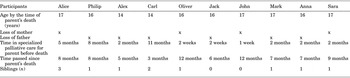
Digital patient records were employed to find eligible teenaged children of patients who had been cared for and had died at one of the care units during 2012. Information about the study and a request to participate were sent to 13 teenagers between 3 and 12 months after their parent's death. Initially, the surviving parent was approached, and if he or she gave consent, the request was sent as a personal letter to the teenager. A total of 10 teenagers, aged between 14 and 19 years (7 boys and 3 girls) agreed to participate (4 had lost their mother and 3 their father). Three of the deceased (1 woman and 2 men) were not the biological parent of the teenager but had shared household and family life and were thus regarded as parents for the purposes of the present study. The parents all had advanced cancer and received home care as well as inpatient care at various times (see Table 1). One parent died in a private home and nine in inpatient care. One of the authors provided both written and oral information via telephone to parents and teenagers about the aims of the study and the research methods to be employed. They were assured of confidentiality and about the condition of voluntary participation with a right to withdraw without explanation. Participating teenagers and their parents gave their written consent. The study procedure was conducted in accordance with the ethical standards of the Helsinki Declaration of 1975, as revised in 1983. Ethical approval was obtained from a regional ethical review board (2013/251–31/5).
Sociodemographic characteristics of the teenagers and the deceased parent

Data Collection
For data collection, individual interviews were chosen, and these were carried out from March to May of 2013. The interviews were informal and conducted as free-ranging conversations between one of the authors and a teenager, with a focus on the study objective. All teenagers were initially asked to relate their parent's illness (“Could you please tell me about your parent's illness?”). This was a natural opening question to steer the rest of the interview, which explored the teenager's life experiences throughout the parent's illness trajectory until and after their death. The questions related to the aim of the present study were, for example,
When and how did you realize that your parent was dying?
Who did and do you talk to about your parent's illness and death?
How was your life influenced during your parent's illness and after your parent's death?
All teenagers were interviewed twice to obtain rich data, which afforded an opportunity for both to reflect on and return to important matters. The first interview lasted between 30 and 50 minutes; the second one was often shorter and varied between 10 and 40 minutes. The time period between the two interviews varied from 1 to 4 weeks. Teenagers chose the location of the interview (two preferred their own home, and the rest came in to the palliative care unit, the workplace of the interviewer).
Data Analysis
Qualitative content analysis (Graneheim & Lundman, Reference Graneheim and Lundman2004) was utilized to analyze the interviews. They were transcribed verbatim and listened to again to confirm the transcribed text. The texts were read to gain an overall impression of their content and then divided into meaning units, bearing in mind the aim of the study. Meaning units were condensed without changing their central meaning and then coded. Codes were compared, and codes with similar content were gathered into three main groups, and the interpretation of these formed three themes. To illustrate these themes, quotations from the interviews, marked with fictional names, are used herein.
RESULTS
In the analysis, three themes were found representing teenagers’ reasoning about their parent's recent death.
Death Was the Worst Thing That Could Happen but Still, It Was a Relief for the Ill Parent and the Teenager
Most teenagers spoke in detail about the days leading up to and the exact day and hour of their parent's death. Even if all of them were satisfied with the care that had been provided for their parent and said they had trusted the health professionals to have done all they could to help the parent, they still remembered the parent's last moments in life as a distressing period, for both the parent and themselves. Some had chosen to be present despite their own sorrow and feelings of helplessness when watching the parent suffer from pain or other symptoms:
One wanted to really be there, but one knew all the time how helpless one was. One was not enough. One just wanted to help her, to ease her pain and so on. (Alice)
They took on the parent's suffering, and it was a real strain to witness the parent getting more and more marked by the illness, and they realized that there was no chance for the parent to recover:
One noticed that it was hard for her. She could not eat at the end, could not move, and could not open her eyes. (Alex)
It was hard to watch, to be close, or even to be present in the same room and feel the parent suffer:
It was horrible to see her suffer so much. She coughed. One saw that she faded away. Some days the medicine did not help, and she was not calm. She had severe problems breathing. (John)
Difficult memories would stick in their minds:
One remembers the last time, how bad she was and how much she suffered. One is angry at the disease, and one cannot help but feel helpless. That feeling remains. (Alice)
While wanting to be present and included, it was sometimes too painful to see the parent deteriorating and being changed by the illness:
I could not stand to be in the hospital. Had not quite realized how bad he was before. Now he was not really conscious, I thought it was really hard. (Anna)
The teenagers did not want a life for the parent that involved living with severe illness, and they wanted to remember the parent as he or she was before the cancer. Some teenagers escaped and chose not to be present during the parent's last days of life or at the moment of death:
It does not feel bad because I was not there. It would have been worse to see mother in the worst condition. I want to remember her as the one who could say goodbye, … as the one we left off— who said, “Goodbye, see you soon.” (John)
They reasoned about the parent's death in various ways. For some, the period of illness was worst:
It was horrible to have an ill mother. It could not have been worse. (Sara)
For some it was the actual death, and for others it was the immediate time after the death of the parent. The entire experience was so painful, and it was hard to express what the worst part was:
I'm not sadder now than when she was alive. But for various reasons, now that it hurts so much to miss her all the time, before because of the fear that she would die. (Alice)
Importantly, it was possible to get used to living with an ill parent, but the parent's death was the starting point for a new and totally unknown life situation. The teenagers expressed not having a clue about what would happen next and how life would continue for themselves and their family:
Just when she had died, we did not know how everything would be. It felt like everything would fall apart. (Jack)
Even if the parent's death was the worst thing that could ever happen, it was also somewhat of a relief. Unselfishly, they felt that death had relieved the parent from suffering and a life with severe illness:
I think that she is better off now because for the last months of her life she did not have it well. She has it much better now. There is no one who wants to stay in hospital as much as she [had to] and have that sort of disease. (John)
The teenagers were comforted by certain thoughts: that there was no chance for recovery and that it was better for the parent to die because she/he had suffered so much from the illness. They also felt that it was better for the parent not to be bedridden for too long or to spend any further time in hospital.
The parent's death was also a relief for the teenagers as they could let go of all the strain that was experienced during the illness and especially during the end-of-life period. This relief included feelings of having done everything they could for the parent and the rest of the family during the illness:
Now it feels good somehow. It feels okay, because mother did not have it well at the end while she was alive. No one should have to have that suffering. (John)
In a way, this could be seen as a time to return to their own teenage life, where they were able to go back to everyday life with school, friends, and activities:
I was back in school the day after she died. I sat there and talked as usual, and I thought it was good. I think I was feeling pretty good. (Oliver)
Talk or Silence
Importantly, all teenagers appreciated participating in the interview. It was to some extent painful to be reminded, but still a great relief to talk about the death of the parent and their own life without the parent. Some of them had not previously talked in such depth about this with anyone, while others had had more open communications within their families and with others. All teenagers showed up for a second interview, indicating a wish for continued conversation.
Teenagers managed their situations in different ways: some talked during the illness and after the death, while others did not want to talk. There were also those who did not have anyone they could talk with. Some teenagers talked within the family about the illness and its advancement and after the parent had died, and family members supported each other:
The important thing is that you have a good family cohesion. If you do not have a good relationship, it can become difficult. It is difficult to start talking if one has not done it previously.
It is easier to talk to one's own parents than anyone else.
We [Dad and I] have not needed to go somewhere else to talk. We have always had each other. We can talk about everything. We talked about that there was a risk that she would pass away. My dad and I talked. Mom might not have wanted to think about it. (John)
However, some teenagers did not talk with family members, and some also regretted not talking more when the parent was still alive:
She tried to talk, she [ill mother] was sad, but I could not handle it. Wish in retrospect that I had. But she was everything to me. My mom meant so much to me that I refused to realize. I was furious at her when she tried to talk to me. I felt like that: “You cannot say that, that is not okay.” Mom never said that she was dying until just before she would die. Then I could not talk to her. I became angry and left. She talked to my sister, which was fortunate. Wish in retrospect that I could have. (Sara)
Several teenagers received support from a school counselor or therapist:
Spoke to school counselor once a week. Great support, very good to talk about it sometimes. No one needs to solve. No need to comfort. I just need to talk about it without interruption. (Anna)
Some teenagers talked with friends:
It was wonderful to have a lot of friends when she had died. (Oliver)
Most of them did not talk with friends or at school, though. The reasons for not talking included not knowing how to talk about it and with whom, or not wanting to be treated differently. They did not want others to know, which allowed them to continue on as usual. Importantly, choosing not to talk allowed them to not think about it:
When no one [classmates] knew, I could talk about little things and not about It. I'd have probably been feeling worse if they had talked to me about it. (Anna)
Some teenagers sensed that they had not been told about the seriousness of the illness, and they felt they had been left out by the parents and/or the healthcare staff in not being included:
It was hard to never find out about anything, but understand that mom and dad do not want to say that they are ill. Wished that the parents had told me themselves and also that hospital staff had said something and told me how it was. (Sara)
My friends knew, but I did not have many friends then. Had had a crisis with friends and had no friends to talk to or do something with. So I was all alone. (Carl)
The Surviving Parent's Impact on Everyday Life
Many of the teenagers sympathized with the surviving parent's grief and worried very much about him or her as well as about the entire home situation. They consciously kept their own grief to themselves as they did not want to burden the grieving parent:
Dad was so upset straight after. It was hard that he was sad. Then I did not know who I should talk to. It felt so wrong, and then I also became sad. (Alex)
As a consequence, they were not supported in their own grieving and had to cope with difficult things on their own after their parent's death. Seeing the parent's grief could lead to feelings of loneliness and hopelessness and that the support they needed was not there for them:
When I see that Dad is sad, then it feels quite hopeless for me. (Alex)
It could actually mean that, instead of being supported and comforted by their parent, they themselves provided the support:
I tried to comfort her or make her think about something else. Understand that it's good to be sad and get it out, but not good to be sad all the time … I tried to console myself with that it will get better. It's the worst now. (Anna)
I was worried that my father would fall apart … I did not doubt him, but I was worried. It would be hard not to have his support, but he did it quite well. It was brave of him. (Alex)
I was worried about mother that she would become depressed, but not worried anymore. It just gets better and better. (Carl)
Nevertheless, some teenagers could grieve together with the surviving parent in common understanding and with openness. This seemed to have a positive impact:
Mom and I have a strong relationship, so it goes and it works very well. It's really hard with some things that my father did, but we manage it quite well. (Jack)
I feel great today. But it is largely thanks to that my dad and I have such a good relationship. (John)
Teenagers were forced to find new ways to cope with things in life and to find others to turn to when the parent was not there anymore:
It was especially hard in the beginning after she had died. Always used to tell her when something new had happened. Who would I now tell? (Oliver)
Memories of the parent were difficult to manage, and sometimes the best way to cope with this was to not think about them. This was easier when they were in school, doing things with friends or playing games, focusing on something else:
The thoughts come all the time when you are not doing anything. When one is out doing things, one does not think and one does not think about it at school. (Carl)
They were reminded of their parent at different times, especially in situations where the dead parent had previously played an important role:
Thinking of dad when doing something for the first time without him or when you need him. (Philip)
Some teenagers spoke in a somewhat hopeful manner:
It's very different. Some days you do not think at all about it … It gets better and better. (Alex)
Now we have more everyday life, and we make jokes and so on. Even though we get sad now, we know that it will pass. (Jack)
I think I'm happy now and that I live a pretty good life anyway. Gets a little less happy when I think of Mom. (Oliver)
They put an effort into keeping the dead parent in their mind but at the same time thinking about the future. It was perceived as helpful when there was a mutual approach in the family:
In the beginning [after the mom's death], one attempted to support each other all the time, but then you notice that things are getting better and better. Then one tries to let it go and not to remind each other and bring out the bad again. Then one should try to talk about positive things and try to look ahead instead. Of course, that one can talk about it if one wants to.
Now that one knows she is buried, one knows one has done everything possible to show that you loved her. She has a stone. You can go and visit her. One can make it a long process. One does not always have to be sad. (John)
When reasoning about a parent's death and life without the parent, new insights were reflected upon and expressed in different ways:
To be a teenager is to spend time with friends and argue [fight] with your parents. When you lose them, you realize that the fighting was not really worth it. It was nothing. (Oliver)
Two of the teenagers who had experienced additional traumas and losses in life confided during the interviews that after the parent's death they had been having suicidal thoughts:
I wondered why I should live if I did not have a mom and my family. Luckily, I have my boyfriend. I have had suicidal thoughts, but not for real. … Get angry at people who commit suicide. (Sara)
The following and final quotation mirrors the teenagers’ tremendous loss:
Parents are important. They love you no matter what you do, and they forgive everything. No one else does. When a parent passes away, there may be chaos of everything if one does not have the strength. (Sara)
DISCUSSION
Our study found that for 10 Swedish teenagers who had lost a parent to cancer during the previous year the worst thing that could happen was the death of the parent. Still, they found it a relief for both the parent and themselves. One way to understand the feeling of relief in connection with and shortly after a parent's death is to highlight the death as involving a series of events that occur before and after death rather than as the singular stressful event (Patterson & Rangganadhan, Reference Patterson and Rangganadhan2010). Accumulation of these stressful events—witnessing and trying to understand and interpret the consequences of a parent's intensive treatments and progressively deteriorating health, confronting the fear of losing a parent, changes in family life, and feelings of loneliness (Karlsson et al., Reference Karlsson, Andersson and Ahlstrom2013; Melcher et al., Reference Melcher, Sandell and Henriksson2015)—makes for a very stressful situation. Related to recent improvements in oncological treatments, many cancer patients live for several years with their illness, and studies have found that the recurrence of parental cancer is associated with high levels of distress in teenagers (Huizinga et al., Reference Huizinga, Visser and van der Graaf2005; Reference Huizinga, Visser and Zelders-Steyn2011) . Many teenagers become caregivers and support their ill parent and take on more responsibility, hoping to help the ill parent and the rest of the family (Beale et al., Reference Beale, Sivesind and Bruera2004; Melcher et al., Reference Melcher, Sandell and Henriksson2015; Sheehan & Draucker, Reference Sheehan and Draucker2011). These added family demands are stressful and also interfere with their regular lives (Kennedy & Lloyd-Williams, Reference Kennedy and Lloyd-Williams2009a). In sum, the final phase of a parent's illness is a time of significantly higher psychological distress, with higher levels of anxiety and depression in teenagers, than the period following the actual death (Siegel et al., Reference Siegel, Karus and Raveis1996).
Some of the teenagers in the present study sympathized with the surviving parent's grief and also worried about him or her, and therefore kept their own grief to themselves to avoid burdening the grieving parent. Other studies have acknowledged that bereaved young people are often encouraged by others to repress and deny their own grief and remain strong for the surviving parent (Devita-Raeburn, Reference Devita-Raeburn2009). We found that, as a consequence, some teenagers feel that they were left without support. This confirms the findings of other studies which found that teenagers avoid discussing their feelings in order to prevent the surviving parent from getting more upset, which may leave them without the necessary support and thereby increase their feelings of loneliness and anxiousness (Charles & Charles, Reference Charles and Charles2006; Shrier, Reference Shrier1980).
A number of the teenagers in our study talked about the illness and related issues within the family along the illness trajectory until and after the death in the context of experienced mutual support. It seemed that those teenagers who were more able to talk and grieve together with their surviving parent coped better with their situation. Cohesion and communication within the family have been shown to impact teenagers’ psychological distress. For example, being told about the illness or that the parent is dying has been shown to reduce the intensity of anxiety (Edwards & Clarke, Reference Edwards and Clarke2004; Nelson et al., Reference Nelson, Sloper and Charlton1994). Nevertheless, many children and teenagers are not told that their parent is dying of cancer. In addition, a recent study on parentally bereaved teenagers showed that most want to be told when the parent's death is near (Bylund-Grenklo et al., Reference Bylund-Grenklo, Kreicbergs and Uggla2015). Parents often have concerns about how to talk with their children about their advanced cancer, and many do not receive support on how to do this, and so they may fail to initiate discussions with their teenagers (Turner et al., Reference Turner, Kelly and Swanson2005). Some parents also consciously avoid discussions due to a wish to protect their children (Houldin & Lewis, Reference Houldin and Lewis2006; Kennedy & Lloyd-Williams, Reference Kennedy and Lloyd-Williams2009b). It has been suggested that families with lower levels of psychological distress could be partly explained by evidence that they talk more openly about the illness, express feelings, and solve problems together (Heiney et al., Reference Heiney, Bryant and Walker1997), that is, families with good communication and cohesion. Bereaved young adults have reported that their grieving process began as soon as they were told about the cancer diagnosis (Karlsson et al., Reference Karlsson, Andersson and Ahlstrom2013), and it has been suggested that this can have a positive effect on the experience of the illness trajectory toward death and the grief thereafter (Rini & Loriz, Reference Rini and Loriz2007). This emphasizes the importance of communication, which is also underlined by such legislation as the Swedish Health and Medical Services Act, in which children by law are considered equal to adults in terms of their right to information and support.
METHODOLOGICAL CONSIDERATIONS
Talking with teenagers about the death of a parent is an extremely sensitive matter. Thus, all the interviews were conducted by one of the authors who has had several years of experience in palliative care as a nurse and who is also a family therapist. Based on this experience, the interviewer endeavored to create a warm and safe atmosphere for participants. All teenagers were interviewed twice to offer them the opportunity to return to issues, and this offered a chance for both the teenagers and interviewer to reflect between interviews. It has to be acknowledged that it is possible that the participants, in light of their agreement to participate, represent a group of teenagers who are coping fairly well. One limitation of our study is the relatively large variation in terms of length of time after a parent's death (between 3 and 12 months) when interviews took place.
CONCLUSIONS AND CLINICAL IMPLICATIONS
The death of a parent is the worst thing that can happen to a teenager, and yet they still express relief for both the ill parent and themselves. Teenagers may withhold their grief from the surviving parent in order to not burden them and so do not receive the support they themselves may need. It appears as though the teenagers who were more likely to talk and grieve with their surviving parent coped better with their situation. One important clinical implication of our study is that healthcare professionals and palliative care teams need to be aware that parentally bereaved teenagers tend to take on a responsibility to support the grieving parent, when it is they who need and should receive support.
ACKNOWLEDGMENTS
The authors sincerely thank all of the teenagers who participated in this study for generously sharing their time and experiences. We are also grateful to Capio Geriatrics, the Bethelhemmet Foundation, and the Gålö Foundation for funding this project. The authors state that they have no conflicts of interest to declare.