1. Introduction
Language acquisition is often viewed as a process correlated with an increase in the mean length of utterance (MLU) by the child (going back to Brown Reference Brown1973). Nonetheless, one of the important components of adult linguistic competence is actually the ability to use short utterances when context so allows. This competence is perhaps at its most pronounced in the case of Non-sentential Utterances. Non-sentential Utterances (NSUs) are intuitively complete utterances that lack a verbal (more generally predicative) constituent. NSUs include ‘short answers’, and reprise utterances used to acknowledge or request clarification of prior utterances. Examples of these are provided in boldface in (1):
(1) A: Wasn't he refused the chair in Oxford?
B: Who?
A: Skeat. Wasn't he refused
B: That's Meak.
A: Oh Meak, yes. [London-Lund Corpus S.1.9, p. 245]
Estimates of the frequency of NSUs are somewhat variable, depending on the classificational criteria applied. Van de Weijer (2001) provides figures of 40%, 31%, and 30% respectively for the percentage of one-word utterances in the speech exchanged between adults and infant, adult and toddler, and among adults in a single Dutch-speaking family consisting of two adults, one toddler and one baby over two months. Fernández (Reference Fernández2006) cites a figure of 9% for the percentage of utterances lacking a verbal predicate, based on random sampling from (by and large) adult speech in the British National Corpus (BNC; Burnard Reference Burnard2000).Footnote 2
All approaches to first language acquisition, even strongly nativist ones, acknowledge the importance of the input to which the child is exposed. Given this and the ubiquity of NSUs in the input, it is noteworthy that there is hardly any work on NSUs in the area of language acquisition. The few studies that do exist (e.g. Bloom, Rocissano & Hood Reference Bloom, Rocissano and Hood1976, McTear Reference McTear1985, Ninio & Snow Reference Ninio and Snow1996) do not provide detailed analyses of their syntactic and semantic properties.Footnote 3 This possibly reflects the fact that, with a few isolated exceptions (e.g. Barton Reference Barton1988, Ginzburg & Sag Reference Ginzburg and Sag2000, Merchant Reference Merchant2002, Schlangen Reference Schlangen2003, Stainton & Elugardo Reference Stainton and Elugardo2004, Stainton Reference Stainton2005, Fernández Reference Fernández2006), there is a dearth of work even in the area of adult NSUs. Although the formal grammatical study of dialogue is an emerging field in theoretical and computational linguistics (see e.g. work presented at the SEMDIAL conferences (1997–) and the SIGDIAL conferences (2000–), and work in the EU project TRINDI), there has to date been no work applying the newly developed analytical tools of dialogue modelling to ontogenetic investigation.
In this paper we present the results of a corpus study of the emergence of certain classes of NSUs. The main source of data are four English speaking children; a smaller-scale study provides evidence from the speech of one Greek child. Our principal finding is the late short query effect: in both English and Greek subjects, the main classes of non-sentential queries (NSQs) are acquired much later than non-sentential answers (NSAs). At a stage when the child has productive use of sentential questions, and has mastered elliptical declaratives and the polar lexemes ‘yes’ and ‘no’, non-sentential queries are virtually absent. This happens despite the fact that such questions are common in the speech of the child's caregivers and that the contexts are ones which should facilitate the production of such NSUs.
We will argue that these results have significant implications for the grammatical analysis of NSUs and, more generally, for the issue of how context needs to be integrated with grammar. We will argue that these results provide support for a particular approach to the explication of NSU constructions, dialogue-oriented constructionism (e.g. Ginzburg & Sag Reference Ginzburg and Sag2000, Ginzburg Reference Ginzburg2009) over the approach of underlying sententialism, adopted in most generative linguistic work on ellipsis, wherein NSUs are underlyingly canonical sentences that (under conditions of contextual recoverability) involve unpronounced material. (See e.g. Ross Reference Ross1969, Morgan Reference Morgan, Kachru, Lees, Malkiel, Pietrangeli and Saporta1973, Chung, Ladusaw & McCloskey Reference Chung, Ladusaw and McCloskey1995, Merchant Reference Merchant2002.) In fact, we suggest that the lateshort query effect is problematic for any attempt to account for NSUs in terms of a generalized mechanism of phonological reduction (e.g. Schwarzschild Reference Schwarzschild1999), be it syntactically or semantically driven (the latter as in accounts derived from higher-order unification (Dalrymple, Pereira & Shieber 1991, Pulman Reference Pulman1997).
The paper is structured as follows: in section 2, we briefly survey the distribution of NSU constructions in adult English and possible grammatical explications thereof. In section 3, we describe results concerning the acquisition of NSUs, based on a corpus study of the Manchester Corpus of Child English. We discuss some possible pragmatic explanations for this data in section 4, explanations we believe do not fully explain the observed effect. We also briefly describe results concerning NSUs based on a corpus study of the Stephany Corpus of child Greek, which replicate closely the results for the Manchester Corpus. Finally, in section 5, we explain how the lateshort query effect can be modelled grammatically and sketch an explanation based on a metric which combines accessibility of contextual parameters and complexity of content construction.
Adult NSUs in dialogue
Distribution
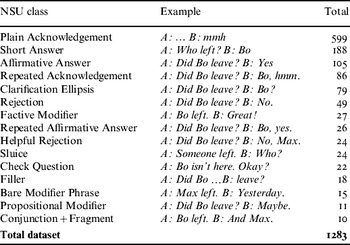
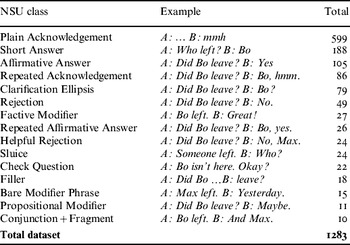
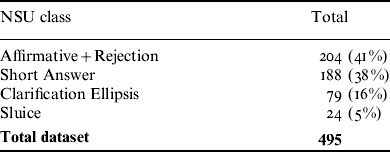
Fernández & Ginzburg (Reference Fernández and Ginzburg2002) developed a taxonomy of NSUs in the BNC. As reported in Fernández (Reference Fernández2006), this taxonomy was used to manually classify a randomly selected section of 200 speaker-turns from 54 BNC files. The examined sub-corpus contains 14,315 sentences. A total of 1,299 NSUs were found. Of these, 1,283 were successfully labelled according to the taxonomy, as illustrated below, the remaining 16 instances did not fall in any of the categories of the taxonomy and were labelled as ‘Other’. Table 1 shows the distribution of NSU categories in the aforementioned sub-corpus of the BNC.
NSUs in a sub-corpus of the BNC.
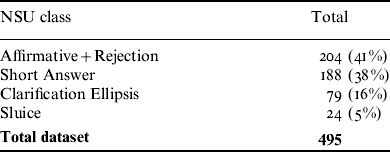
Our focus in studying the emergence of NSUs will be on five subclasses of NSUs, short answers, (plain and repeated) affirmative answers, (plain and helpful) rejection answers, clarification ellipsis, and sluicing, which constitute the majoritarian classes of NSUs used to query and answer. For subsequent comparative reference, table 2 lists the proportion of each class in this restricted sub-corpus.
Query/Answer NSUs.
Short answers
We use this term to designate elliptical answer-conveying responses to wh-questions, though the question can also potentially be elliptical, as in (2b):
- (2)
(a) A: Who's that?
B: My Aunty Peggy [last or full name]. My dad's sister. [G58, 33–35]Footnote 4
(b) A: What's plus three time plus three?
B: Nine.
A: Right. And minus three times minus three?
B: Minus nine. [J91, 172–176]
Affirmative+Rejection
The typical context of this superclass is a polar question, as in (3a). We include also answers to implicit polar questions, e.g. clarification ellipsis questions like (3b) and responses to assertions (3c). We do not include acknowledgements or acceptances such as (3d):
- (3)
(a) A: Did you bring the book I told you?
B: Yes./No.
(b) A: That one?
B: Yeah. [G4K, 106–107]
(c) A: I think I left it too long.
B: No no. [G43, 26–27]
(d) A: I've already done that.
B: To Nick's nose.
A: Yeah (laugh), to Nick's nose! [KPG]
We mention below some additional facts about the distribution and use of sluicing and clarification ellipsis, the two NSU types whose delayed emergence will be the central topic of the paper.
Sluicing
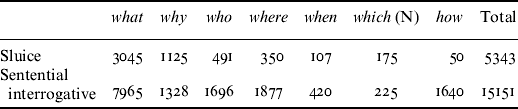
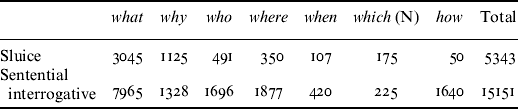
As indicated in table 3, sluices make up approx. 33% of all wh-interrogative queries in the BNC.Footnote 5
Total of sluices/sentential wh-interrogatives in the BNC.
Although there is a large generative literature on sluicing, it has almost without exception ignored the fact that bare wh-phrases are systematically ambiguous between at least three uses.Footnote 6
Direct
The utterer of the sluice understands the antecedent of the sluice without difficulty. The sluice queries for additional information that was explicitly or implicitly quantified away in the previous utterance.
- (4)
(a) A: Can I have some toast please?
B: Which sort? [KCH, 104–105]
(b) Caroline: I'm leaving this school.
Lyne: When? [KP3, 538]
Reprise
The utterer of the sluice cannot understand some aspect of the previous utterance which the previous speaker assumed as presupposed:
- (5)
(a) Geoffrey: What a useless fairy he was.
Susan: Who? [KCT, 1753]
(b) Pat: You might find something in there actually.
Carole: Where? [KBH, 1817]
Repetition
The sluice is used to ask for repetition of the previous utterance as a whole.
(6) June: Only wanted a couple weeks.
Ada: What?
June: Only wanted a couple weeks. [KB1, 3312]
2.1.1 Clarification ellipsis (CE)
This category is employed to classify reprise fragments which are used to clarify an utterance that has not been fully comprehended. Clarification requests (CRs) constitute approx. 4% of all dialogue moves in the BNC (Purver, Ginzburg & Healey Reference Purver2001) and this proportion is somewhat higher in task-oriented dialogue – Rodriguez & Schlangen (Reference Rodriguez, Schlangen, Ginzburg and Vallduví2004) cite a figure of 5.8% for the Bielefeld Corpus dealing with model plane construction. Clarification ellipses make up approx. 29% of all clarification requests in the BNC (Purver et al. Reference Purver, Ginzburg, Healey, Van Kuppevelt and Smith2001). As with sluicing, CEs are ambiguous between a number of readings, the two most prominent being the clausal confirmation reading and the intended content or constituent reading, illustrated in (7):
- (7)
(a) Marsha: Yeah that's it, this, she's got three rottweilers now
and …
Sarah: Three? (=clausal confirmation reading: Are you saying she's got THREE rottweilers now?)
Marsha: yeah, one died so only got three now.
(b) Tim: Those pink things that af after we had our lunch.
Dorothy: Pink things? (=intended content reading: What do you mean by saying ‘Pink things’?)
Tim: Yeah. Er those things in that bottle.
2.2 Explicating NSUs: with and without constructions
How should NSUs be incorporated into grammatical analysis? This depends to a large extent on how one resolves the issue of whether NSUs are to be assimilated to some other grammatical phenomenon such as phonological reduction or anaphora, or whether they are actually in some significant way sui generis. Theories that follow the former route we will dub unitarian theories; in such theories ellipsis resolution is associated with a single, typically extra-grammatical mechanism. Theories that follow the latter route are constructionist theories, in which NSUs are incorporated in the grammar as distinct constructions, which specify among other things the contextual characteristics which govern their use.
Within the unitarian approach is included the commonest generative approach, which we dub underlying (NSU) sententialism. On this view NSUs such as sluicing and short answers are analyzed as underlyingly sentential constructions. (For sluicing see e.g. Ross Reference Ross1969, Chung et al. Reference Chung, Ladusaw and McCloskey1995, Merchant Reference Merchant2002; for short answers see Morgan Reference Morgan, Kachru, Lees, Malkiel, Pietrangeli and Saporta1973, Merchant Reference Merchant2004.) On this view, which has attracted a variety of implementations, the grammar does not need to reify NSUs as such – no new rules or principles need to be posited for individual NSU constructions.Footnote 7 A non-grammatical module serves – under appropriate conditions – to recover material that is phonologically redundant and remains unpronounced. This type of approach accounts for parallelism phenomena that are exhibited by NSUs, such as the case parallelism between source and target pointed out by Ross for sluicing and by Morgan for short answers, using grammatical principles that apply to non-elliptical sentences.
A significantly distinct unitarian approach to the description of ellipsis constructions is the higher-order unification (HOU) approach pioneered in Dalrymple et al. (Reference Dalrymple, Pereira and Shieber1991) for VP ellipsis, and extended to short answers in Pulman (Reference Pulman1997) and to corrections in Gardent, Kohlhase & van Leusen (1996). On this view an ellipsis construction involves the recovery of a property from context such that when it is applied to the content of the ellipsis target, it resolves the interpretation of the elliptical construction. The property is recovered from context by using higher order unification to solve an equation that relates the target with its antecedent. In contrast to underlying sententialism, HOU approaches make no appeal to syntactic spelling out of linguistic material. However, in common with underlying sententialism, NSUs are viewed as arising from the application of a single generalized extra-grammatical mechanism. The HOU-based account offers a single mechanism that uniformly accounts for VP ellipsis, focus constructions and certain NSU constructions such as short answers and corrections. Another commonality is the absence of an explicit spelling out of an interface between grammar and context: neither account offers an explicit proposal about how the information required for contextual resolution actually emerges in context, how it is accessed, etc.
An alternative to such unitarian approaches that has emerged in recent years, inspired by developments in construction grammar (see e.g. Sag Reference Sag1997, Fillmore & Kay Reference Fillmore and Kay1999) and in the modelling of dialogue context (Ginzburg Reference Ginzburg and Lappin1996, Reference Ginzburg2009; Larsson Reference Larsson2002; Asher & Lascarides Reference Asher and Lascarides2003) is the approach of dialogue-oriented constructionism (see e.g. Ginzburg & Sag Reference Ginzburg and Sag2000, Schlangen Reference Schlangen2003, Ginzburg & Cooper Reference Ginzburg and Cooper2004, Purver Reference Purver2004, Fernández Reference Fernández2006). On this view NSUs are grammatical words (e.g. ‘yes’, ‘no’, ‘pardon’) or constructions (e.g. short answers, sluicing), where semantic composition is driven primarily by context rather than syntax. Concretely, in such words or constructions the main predicate is a contextual parameter resolved in a manner akin to indexical terms (‘I’, ‘you’, ‘here’, ‘now’) – in this case the relevant aspect of context is the discourse topic, known also as the maximal element in the contextual repository of Questions-Under-Discussion (QUD; see Van Kuppevelt 1995, Ginzburg Reference Ginzburg and Lappin1996, Roberts Reference Roberts, Toon and Kathol1996).Footnote 8 One motivation for pursuing a dialogue-oriented constructionist approach is the existence of various syntactic and semantic divergences between NSUs and their putative sentential correlates. (For such data concerning short answers and sluicing, see Ginzburg Reference Ginzburg, Bunt and Muskens1999, Ginzburg & Sag Reference Ginzburg and Sag2000, Stainton Reference Stainton2005; concerning CE see Ginzburg & Copper Reference Ginzburg and Cooper2004; for some counterarguments concerning short answers and sluicing see Merchant Reference Merchant2004, with further arguments pro in Ginzburg Reference Ginzburg2009). A particularly strong case in this respect can be built for NSUs oriented to metacommunicative uses such as CE. A syntactically sententialist analysis of the intended content reading of (8) is difficult to conceive of, whereas an analysis of the clausal confirmation reading would presuppose some version of the performative hypothesis (Levinson Reference Levinson1983):
(8) A: Did Bo leave?
B: Bo? (=Who do you mean ‘Bo’? Or: Are you asking if BO of all people left?)
In similar vein, Ginzburg & Cooper (Reference Ginzburg and Cooper2004) point out that an HOU-based analysis can be set up to derive the clausal confirmation reading of CE, but there is no apparent way of accommodating the intended content reading.
Incorporating dialogue context, including the context that arises in metacommunicative interactions such as grounding (Clark Reference Clark1996) and clarification interaction (Schegloff, Jefferson & Sacks Reference Schegloff, Jefferson and Sacks1977, Ginzburg & Cooper Reference Ginzburg and Cooper2004), in the grammatical component has enabled the development of analyses which cover the majority of classes of NSUs postulated in the taxonomy of Fernández & Ginzburg (Reference Fernández and Ginzburg2002).Footnote 9 Whether unitarian approaches like underlying sententialism and HOU can scale up to cover these phenomena, particularly metacommunicative interaction-oriented NSUs, remains an open issue.
We turn now to consider some patterns of the acquisition of NSUs, which could offer an additional means of choosing between unitarian and dialogue-oriented constructionist approaches to NSUs. Before actually doing so, we note one key entailment of unitarian approaches to NSUs. This is stated in (9) in two slightly different versions:
(9) Punctual NSU emergence:
(a) underlying sententialism version: Once a canonical (sentential) structure is acquired (declarative or interrogative sentential structures) and a mechanism for phonological elision exists, the corresponding NSUs (short answers, sluicing) are available to the grammatical system.
(b) higher-order unification version: Once the relevant semantic content types for antecedents have been acquired (wh-questions, quantified propositions) and the (higher order unification) resolution mechanism exists, the corresponding NSUs (short answers, sluicing, CE) are all available to the grammatical system.
Whereas punctual NSU emergence seems to be an intrinsic characteristic of both unitarian approaches, albeit in subtly distinct versions, it is not expected and would, therefore, be difficult to account for within dialogue-oriented constructionism. We will argue below that there are some indications that punctual NSU emergence in fact fails. This means that neither unitarian approach can be used to formulate a theory of the acquisition of NSUs. In contrast, we will use a version of dialogue-oriented constructionism to sketch such an account.
3. An asymmetry in the acquisition of NSUs
3.1 NSU distribution for two-year-olds
We conducted a study of NSUs in child English based on the Manchester Corpus in CHILDES (Theakston et al. Reference Theakston, Lieven, Pine and Rowland2001, Rowland et al. Reference Rowland, Pine, Lieven and Theakston2003), a longitudinal study of 12 monolingual English-speaking children between the ages of approximately two and three years. The children were engaged in normal play activities with their mothers at home and the hourly (audio) recordings took place on two separate occasions every three weeks. Our data comes primarily from the manual coding of a sub-corpus of the Manchester Corpus consisting of 25,060 turns (111,969 words). We studied the transcript files of four children: Aran, Becky, Carl, and Dominic, including at least six files per child (average size of file: 830 turns). The manual coding initially involved six files per child (Aran: files 12b, 13b, 16b, 18b, 20b, 22b covering age span 2 ; 3–2 ; 6; Becky: files 12b, 14b, 16b, 18b, 20b, 22b covering age span 2 ; 3–2 ; 7; Carl: files 16b, 20a, 25a, 28a, 31a, 34b covering age span 2 ; 1–2 ; 8; Dominic: files 16a, 20a, 24b, 28a, 32a, 34a covering age span 2 ; 4–2 ; 10.).Footnote 10 In each file the following categories were manually tagged and their numbers tallied: sentential answers (declaratives used to answer questions), sentential interrogatives (wh-interrogatives, polar and intonation interrogatives) and the five classes of NSUs listed in table 2 above.Footnote 11
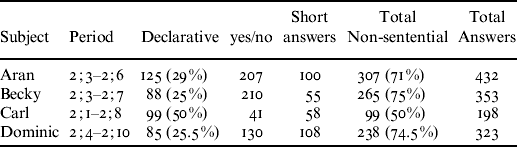
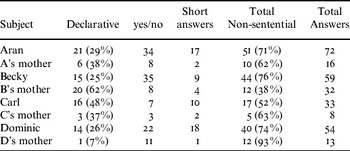
The period covered by our discussion in the current section is one where three of the four children (Aran, Becky, Carl) were at Brown's stage III (MLU 2.5–2.99) during the first half of this period and attained stage IV/V (MLU 3+) subsequently; Dominic correspondingly was at stage II (MLU 2–2.49) and subsequently attained stage III (see table 2 in Rowland et al. Reference Rowland, Pine, Lieven and Theakston2003). As table 4 demonstrates, there is significant evidence that short answers are by now acquired by all four subjects. Three of the four subjects show a preference for using NSUs over sentential answers, though the sentential option is clearly a robust option.
Distribution of senential/non-sentential answers for four children aged 2 ; 1–2 ; 10 in the Manchester Corpus.
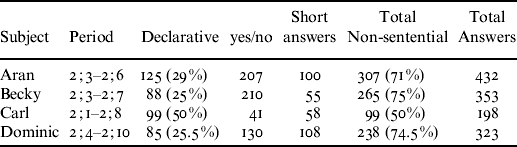
To exemplify this, (1) contains data from a single subject at 2 ; 4 and 2 ; 5, showing his mastery of short answers, which he uses with a variety of distinct wh-phrase antecedents, as well as yes/no; (2) exemplifies some sentential answers.
- (10)
(a) Mother: He's been eating the what? Aran: the bad food. (aran20b)
(b) Mother: Who ate it? Aran: Pippin. (aran20b)
(c) Mother: Where is it? Aran: In the box. (aran20b)
(d) Mother: What colour is that one? Aran: Green. (aran18b)
(e) Mother: What is it? Aran: A hen. (aran16b)
(f) Mother: Did you have one of these this morning? Aran: Yeah.
(g) Mother: Shall we move it? Aran: No. (aran20b)
- (11)
(a) Investigator: What is it? Aran: That is Bumbo. (aran18b)
(b) Mother: Where is the other shoe? Aran: It is lost. (aran16b)
(c) Mother: What have you got there? Aran: I have got a hair in my mouth. (aran16b)
(d) Mother: Oh is he climb-ing right to the top? Aran: He can't. (aran20b)
The data for sentential/non-sentential queries is entirely different: all subjects throughout this period use sentential queries productively, primarily wh-interrogatives. According to the criteria of Rowland et al. (Reference Rowland, Pine, Lieven and Theakston2003), all four children had acquired the wh-words ‘what’ and ‘where’ by the beginning of the period we studied, and two of the children (Aran and Becky) had also acquired ‘who’. Some examples from Aran are given in (12):
- (12)
(a) Where is Dolly? (aran16b)
(b) What is that? (aran16b)
(c) What did you have this morning? (aran20b)
(d) What does he eat? (aran20b)
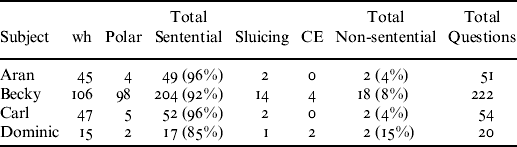
Nonetheless, as table 5 reveals, for three of the four subjects NSQs are almost entirely absent.Footnote 12 The different sentential/non-sentential distributions for answers vs. questions is of high statistical significance (Aran: p⩽.0001, χ2=86; Becky: p⩽.0001, χ2=241).
Distribution of sentential/non-sentential questions for four children in the Manchester Corpus (same period as table 4).

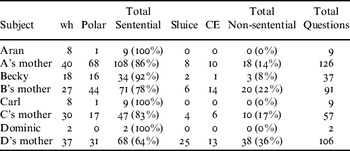
To what extent does this distribution reflect the input of NSUs available to the children? We manually coded the input provided by the children's mothers, based on the first and last file in the examined period (files 12b, 22b for Aran and Becky; 16b, 34b for Carl; 16a, 34a for Dominic). Tables 6 and 7 provide average figures per conversation for mothers and children. One obvious difference, a clear consequence of the fact that the mothers are in charge of keeping the conversation moving along, is that the mothers ask significantly more than they answer. Two of the mothers' answers are less NSU-oriented than the children's, Becky's and Aran's, though this is significant only in the case of Becky (χ2=10.53, p⩽.001), not Aran (χ2=.125, two-tailed p=.72). With Dominic and Carl's mothers the answer distribution is a bit harder to gauge given their sparseness, in both sentential and non-sentential forms.
Averaged distribution for answers per conversation of four children and their mothers in the Manchester Corpus (average over six conversations for the children, two for the mothers).
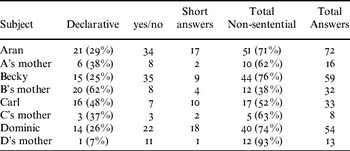
Averaged distribution for the questions per conversation of four children and their mothers in the Manchester Corpus (average over six conversations for the children, two for the mothers).
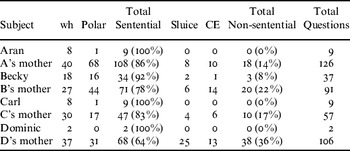
However, strikingly, for questions there is what seems to be a categorical difference: all the mothers use NSQs productively, whereas NSQs are almost entirely absent from Aran's, Carl's and Dominic's productions and rare for Becky (statistical significance for Becky vs. her mother: χ2=2.55, two-tailed p=.07.).
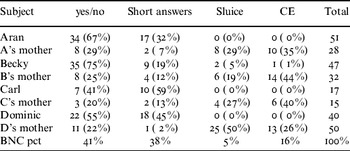
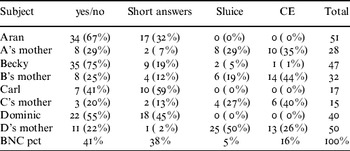
Table 8 shows the average NSU production in these conversations. It reveals that in fact all the mothers deviate quite substantially from the distribution evinced in our sub-corpus of the BNC (table 2 above), producing substantially higher proportions of NSQs.
Averaged distribution of NSUs per conversation for four children and their mothers in the Manchester Corpus, compared with proportion in BNC sub-corpus (average over six conversations for the children, two for the mothers).
3.2 Interim summary: two generalizations about NSU emergence
We can summarize the NSU data from the four children aged 2–2 ; 10 in the Manchester Corpus as follows:
- (13)
(a) Empirical Generalization 1: With short answers and sentential interrogatives acquired, non-sentential queries (sluicing and clarification ellipsis) are, on the whole, still absent.
(b) Empirical Generalization 2: NSQs are common in the speech of the child's caregivers.
In what follows, we will refer to (13a), Empirical Generalization 1, as the late short query effect, given that it indicates that NSQs are delayed with respect to a system that already provides for declarative NSUs and sentential interrogatives. The late short query effect is, as the reader may already suspect, our evidence against punctual NSU emergence. Significant work remains, however, in order to demonstrate that the late short query effect is not merely epiphenomenal.
4. Establishing the Late Short Query Effect
The late short query effect can be explained in two ways, either pragmatically or mechanistically. A pragmatic explanation sees the absence of NSQs as a consequence of two factors: (a) the contextual unavailability of antecedents for NSQs and/or (b) the semantic undesirability of the contents that NSQs express in the type of conversational interaction recorded in this corpus. A mechanistic explanation ties the absence of NSQs to the absence of appropriate linguistic/conversational competence. In this section we attempt to show that a pragmatic explanation is not sufficient. We need, therefore, to refute the two components of the pragmatic explanation:
(14) Contextual availability: Do children get the appropriate contexts for NSQs? Given an appropriate context, how likely is an NSQ to be produced?
(15) Semantic desirability: Do NSQs encode meanings children want to convey in the current setting?
semantic desirability is less of an issue for direct sluices since these convey questions which on the whole are no different from ones typically conveyed by sentential queries. But semantic desirabilityis an issue for NSUs expressing clarification requests, since prima facie it is not clear that children express clarification requests at this stage or, in principle, in the kind of interaction recorded in this corpus.
Thus, there are some clear empirical desiderata we need to establish in order to demonstrate the need for a mechanistic explanation of the late short query effect. What is needed is evidence for at least one of the following:
- (16)
(a) The child ignores the presence of triggering context for NSQs. Moreover, this happens with a likelihood which is significantly distinct from the corresponding behaviour of adult speakers.
(b) The child expresses clarification requests using non-elliptical constructions.
The following two sub-sections provide the requisite evidence. The final sub-section provides an additional supporting piece of evidence: data from a distinct corpus in a different language, the Stephany Corpus of Modern Greek, where the late short query effect is replicated.
4.1 Ignoring triggering context
There is clear evidence for the existence of contexts in which the child could produce an NSQ but does not. For each child we manually searched six files (21a–23b, Aran), (20a–22b, Becky), and (32a–34b, Carl and Dominic), collating all questions for both child and mother. From these we categorized as a potential NSQ context any case where either an NSQ was produced or in which a phonologically reduced version of the question that was actually produced could have been realized as an NSQ without significantly increasing ambiguity. (17a) is an example of a potential but unrealized NSQ, whereas (17b) is a case we did not categorize as a potential NSQ since the resulting NSQ (‘What?’) would have been very ambiguous:
- (17)
(a) Mother: Is it London bridge? Child: Yeah. Mother: Why is it London Bridge?↦Why?
(b) Child: I can build a church. Mother: You want to build what?
 What?
 What?
We start by discussing Aran and Becky's data. Examples from potential but unrealized NSQ contexts are given in (18) and (19):
- (18)
(a) Mother: Well where is the ship? Aran: I don't know where it is.
(aran21a)
↦I don't know where.
(b) Mother: Oh somebody has dressed dolly nicely, haven't they?
Aran: Who did it? (aran23b)
↦Who?
(c) Mother: He has got a hat on as well, hasn't he? Aran: Got a hat on. Aran: What has he got a hat on for? (aran23a)
↦What for?
- (19)
(a) Mother: He is crying. Becky: Why is he crying? (becky20b)
↦Why?
(b) Mother: I think you can put this one wherever you like, Becky in the picture. Mother: Put him next to that other mouse. Becky: Where does he go? (becky20b)
↦Where?
(c) Mother: There is a bag of something there, Becky. Becky: Where is bag? (becky20b)
↦Where?
(d) Mother: All gone. Becky: Are they all gone now? (becky20b)
↦All gone?
(e) Mother: Somebody has made something already, look. Mother: Haven't they? Becky: Who was that, Mum? (becky 21b)
↦Who?
(f) Mother: It goes anywhere. Becky: Does it go there? (becky 21b)
↦There?
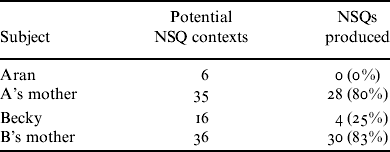
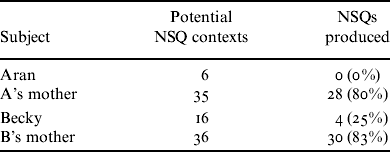
Note that the test used here is a conservative one that underestimates the potential for producing NSQs: it evaluates this potential merely from the pool of questions that were actually produced, ignoring other contexts where an NSQ could possibly have been produced. Moreover, it considers only the most direct phonologically reduced variant as a potential NSU in such a context. The results obtained are given in table 9. Aran avoids producing NSQs completely despite various opportunities; Becky's rate of exploitation is non-zero, although at least two of the NSQs she produces are repetitions – we cannot be certain that these are genuine cases of CE, particularly in light of the fact that in later files, discussed further below, where she has clearly mastered NSQ production, she eschews this construction. In contrast, both mothers exploit their opportunities for NSQs with a probability higher than 50%.Footnote 13
Rate of NSQ production given triggering context in files (21a–23b, Aran); (20a–22b, Becky).
We also searched for unexploited triggering contexts in Carl and Dominic's data. Given that they were generally far less advanced than Aran and Becky we used the final six files of the corpus (32a–34b). However, neither child provided evidence that would support or refute the existence of unexploited triggering contexts. Carl has three cases of repetition ‘What?’; one ‘What?’ which is simply used to indicate his presence, an effect that could equally well be attained by saying ‘Yes’; and one ‘Where?’, which might almost be dismissed as a false start. Dominic has one repetition ‘What?’ and one ‘What?’ used to indicate his presence. There are no other relevant sentential or non-sentential cases:Footnote 14
- (20)
(a) Mother: You've forgotten, haven't you? Carl: What? Mother: What is upstairs? Who is upstairs in the bed upstairs? Carl: What? (carl 32a)
(b) Mother: Where did you go yesterday? Carl: What? (carl 32a)
(c) Mother: Well I'll stick him under and you can dry him. There you go. Carl: Where? Where is he going? Mother: Here, Carl. Carl: Where? (carl 33a)
(d) Mother: Carl? Carl: What? (carl 33a)
(e) Mother: Where did you go yesterday? Carl: What? (carl 33a)
(f) Dominic: Vroom. Mother: Beware.
Dominic: What? (dominic 33b)
(g) Mother: Dominic. Dominic: What? (dominic 34a)
4.2 Semantic desirability
The data presented in the previous section makes it clear that the lack of NSQs is not a consequence of the unavailability of contexts in which an NSQ would be appropriate. The other component of an exclusively pragmatic explanation of the late short query effect is semantic desirability – whether the contents communicated by an NSQ is something that the child might have the desire to express. This is certainly an issue since the majoritarian function of NSQs is the posing of clarification requests (CRs). There is no question that children aged 2 ; 6 or thereabouts comprehend and respond appropriately to CRs (Garvey Reference Garvey, Ochs and Schieffelin1979, Gallagher Reference Gallagher1981). However, their own interest in and actual production of these is more in question, as is the influence on CRs of the task in which they are engaged during the conversations exemplified in the corpus.
We address the issue of semantic desirability in two ways. First, there is evidence that CRs are realized by non-NSQ utterances in the period we have been considering:
- (21)
(a) Investigator: That is the cow's udders. Becky: What is that? Investigator: Udders. (becky16b)
(b) Mother: In there? Becky: Where is xxx there. (becky22b)
(c) Becky: Can you make a spider for me? Mother: Can I make a spider? Mother: What? Mother: Another one? Becky: A green one. Mother: A green one this time. Mother: You've almost made him yourself, haven't you? Becky: xxx. Becky: What is it? Becky: What're you doing for me? (becky22b)
(d) Mother: I think you can put this one wherever you like, Becky in the picture. Mother: Put him next to that other mouse. Becky: Where does he go? (becky22b)
(e) Mother: Let us put panda in his car, should we? Aran: Where is his car? (aran 23b)
(f) Mother: Has he eaten you? Aran: What is he call [*]? Mother: He is called a tiger, isn't he? (aran21b)
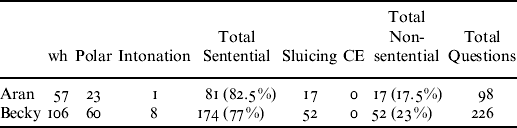
Our second argument relates to data from somewhat later productions of Aran and Becky. Table 10 contains the distribution of Aran and Becky's questions, as recorded in the files (aran28b,29b,30b (2 ; 8–2 ; 9), becky28b, 29b, 30b (2 ; 9–2 ; 10)).
Distribution of sentential/non-sentential questions for Aran and Becky at (2 ; 8–2 ; 9) and (2 ; 9–2 ; 10), respectively.
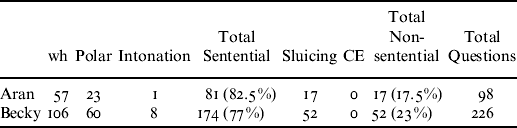
In terms of raw frequency this demonstrates significant production of NSQs by Aran and Becky, some examples of which are in (22) and (23):
- (22)
(a) Mother: She has got such a long fringe now. Mother: There we are. Becky: What fringe? (becky29b)
(b) Becky: I'm gonna [: going+to] speak you on the telephone. Becky: Oh. Becky: What are you doing? Mother: I'm not sure cows can use the telephone, Becky. Becky: What? [+SR] Becky: What did +/. [+IN] Mother: I don't think they can use the telephone. Becky: Why? Becky: What telephone? Mother: You just said I'm going to speak to you on the telephone. Becky: Who? Mother: The cow. Mother: This one. (becky29b)
- (23)
(a) Mother: Get me that top from over there please. Aran: Yes. Aran: Course. Aran: Which top? (aran28b)
(b) Mother: Well we're not going to play this game if you're going to be silly. Aran: Why? (aran28b)
(c) Mother: It has come off. Aran: Which one? Mother: Off this one. (aran28b)
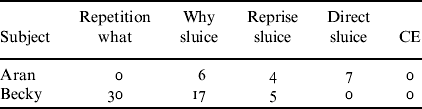
It is also worth noting the make-up of these NSQs, as exemplified and tabulated in table 11. More than half of Becky's relatively high frequency of NSQs (23%, see table 10) – higher proportionwise than three of the four adults recorded in table 7 – derives from ‘repetition “What?”’ and another third is made up of ‘why’ sluices. As we discuss in section 5, the contextual resolution of these sluices is more straightforward than either reprise or direct sluices. With Aran the distribution is more even. Most interestingly, it is worth noting that although both children do produce reprise sluices, which express CRs, there is complete absence of the CE construction. We discuss the relevance of this to the issue of how well parental input is correlated with order of acquisition in section 5.3.
Distribution of non-sentential questions for Aran and Becky at (2 ; 8–2 ; 9) and (2 ; 9–2 ; 10), respectively.
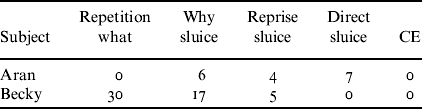
The data from the somewhat later productions of Aran and Becky indicates that there is nothing specific to the nature of the interactions occurring in this corpus which biases against the production of NSQs by the children. This suggests that the earlier absence of NSQs is due, in part at least, to insufficiently developed competence.
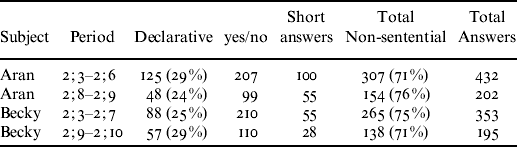
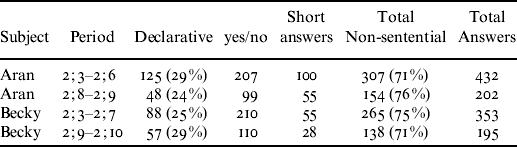
Finally, one additional argument can be made here, deriving from a comparison of the distribution of NSAs for Aran and Becky at this same stage vs. earlier stages of the same children. Table 12 shows that the distribution of NSAs over this period has not changed significantly, rising slightly for Aran by comparison with the period covered earlier (χ2=1.6, Fisher exact probability one-/two-tailed p=.1, p=.18, respectively). and falling slightly for Becky (χ2=.98, Fisher exact prob one-two-tailed p=.16, p=.31, respectively). This suggests that the increasing frequency of NSQs should not be attributed to a recently developed predilection for phonologically reduced forms.
Distribution of sentential/non-sentential answers for Aran and Becky at (2 ; 3–2 ; 6, 2 ; 8–2 ; 9) and (2 ; 3–2 ; 7, 2 ; 9–2 ; 10), respectively.
4.3 NSU emergence in Greek
In this section we suggest that the delayed emergence of elliptical queries is not due to language-specific factors: there is prima facie evidence that NSQs emerge late also in child Greek. This provides evidence that the late short query effect is both language- and task-independent of the specific conditions existing in the Manchester set-up.
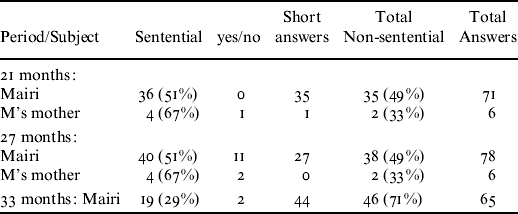
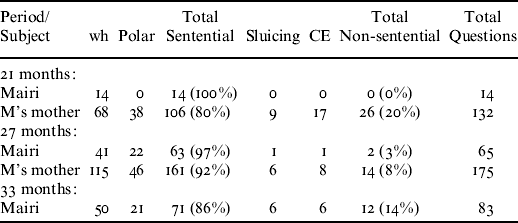
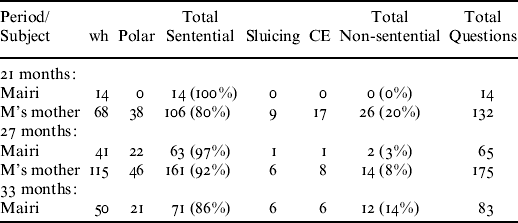
Our study of NSUs in child Greek is based on the Stephany Corpus in CHILDES (Stephany Reference Stephany and Slobin1995): four monolingual Greek-speaking children in free conversation with their caregiver and/or investigator observed at 1 ; 9–1 ; 11, 2 ; 3–2 ; 5, and 2 ; 9). We mention here solely the data from the child Mairi, the most intensely studied child in the corpus. Tables 13 and 14 provide data about her productions of NSAs and NSQs, respectively, at 21, 27, and 33 months.Footnote 15 The productions at 27 months are illustrative of the late short query effect: Mairi has mastery of NSAs and of sentential interrogatives, but produces virtually no NSQs. By 33 months, the situation has changed significantly: NSQs now constitute already 14% of her questions. This is another indication that the effect is developmentally grounded, not situation-/task-dependent. We also include data about Mairi's mother from the pre-NSQ period (21 and 27 months), data that indicates that Mairi's mother uses NSQs productively.
Distribution of sentential/non-sentential answers for Mairi and Mairi's mother in the Stephany Corpus (first file for each period of investigation).

Distribution of sentential/non-sentential questions for Mairi and Mairi's mother in the Stephany Corpus (first file for each period of investigation).
5. The Late Short Query Effect: theoretical explanation
In section 4 we sought to demonstrate that the late short query effect cannot be explained away pragmatically: the absence of NSQs from young children's productions is not merely a consequence of the contextual unavailability of antecedents for NSQs and/or the semantic undesirability of the contents NSQs express. In so far as this demonstration is successful, this suggests that a mechanistic explanation is required. It is not possible to give such an explanation within theories of NSUs such as underlying sententialism or higher-order unification given that, as we saw in section 2.2, each of these enforces a version of punctual nsu emergence: ellipsis resolution is pinned to a single mechanism, which, given the presence of requisite inputs (wh-interrogative sentences, quantified propositions and wh-phrase denotations), cannot prevent the corresponding NSUs (e.g. sluicing) being available in the linguistic system, contrary to what is desired. In what follows, we provide an account of the late short query effect using a dialogue-oriented construction grammar. Such an account comprises two components, given in (24).
- (24)
(a) Propositional NSUs and sentential interrogatives without NSQs: The specification of a grammar and contextual system in which short answers and sentential interrogatives co-exist without NSQs.
(b) The order of NSU acquisition: An explanation for the emergence of NSAs before NSQs.
Before turning to these in order, we provide a brief sketch of the grammatical and contextual analysis of NSUs which we presuppose.
5.1 Grammar and context for NSUs
As mentioned earlier, in dialogue-oriented constructionism, NSU words and constructions are akin to other indexical words and constructions, with the relevant contextual parameter being the discourse topic, or more technically the max-qud. For certain NSU constructions, an additional contextual parameter is an antecedent sub-utterance which specifies inter alia syntactic and/or phonological parallelism conditions for the fragment utterance. Intuitively, this parameter provides a partial specification of the focal sub-utterance, and hence it is dubbed the focus establishing constituent (FEC).Footnote 16 The FEC plays a role somewhat akin to the role played by the parallel element in higher-order unification-based approaches to ellipsis resolution.
Given this, the grammar and contextual processing of NSUs involves specifications such as described below.Footnote 17
• Polar lexemes
Context: For propositional lexemes such as ‘yes’ and ‘no’, the max-qud is a polar question p?, which is identical with the (content of the) interrogative utterance or derived from an assertion p:Footnote 18
- (25)
(a) A: Did Bo phone? B: Yes/No (=Bo phoned/didn't phone).
(b) A: Bo phoned. B: Yes/No (=Bo phoned/didn't phone).
(c) max-qud: ?Phone(b, t)
Grammar: ‘Yes’ is lexically specified as having a content identical with the proposition queried in max-qud. ‘No’ is used to negate when answering positive polar questions and to affirm when answering negative polar questions.Footnote 19 Hence, ‘no’ is lexically specified as denoting either the queried proposition in max-qud or its negation, whichever is negatively marked.
- (25)
• Short answers
• Context: The max-qud is a wh-question; the FEC in such a case is the sub-utterance of the wh-phrase:
- (26)
(a) A: Who phoned? B: Bo (=Bo phoned).
(b) max-qud: λx.Phone(x, t); FEC=‘Who’.
Grammar: Short answers are an instance of a construction in which max-qud is the predicate and the bare fragment is the argument; the construction enforces syntactic parallelism between the FEC and the fragment.Footnote 20
• Direct sluicingFootnote 21
• Context: The max-qud is a quantified polar question, entering into the context via assertion or querying; the FEC is the sub-utterance corresponding to the widest scoping quantificational NP:
- (27)
(a) A: A student phoned. B: Who? (=Which student phoned?)
(b) max-qud: ?∃x.Phone(x, t); FEC: ‘A student’.
Grammar: Direct sluices are an instance of a question-denoting construction.Footnote 22 The domain of the question is provided by the fragment whP, whereas the range of the question arises by a substitution operation on (the proposition queried in) max-qud: the fragment whP's variable is substituted in place of the FEC's variable. The construction enforces syntactic parallelism between the FEC and the fragment.Footnote 23
• Reprise sluicing/CEFootnote 24,Footnote 25
Context: The context for questions used in CRs arises via an accommodation process (a clarification context update rule) whose input is a partially understood utterance (Ginzburg & Cooper Reference Ginzburg and Cooper2004, Purver Reference Purver2004, Ginzburg Reference Ginzburg2009). For instance, the accommodation operation of parameter focussing gives rise to the contextual specification in (28a):
- (28)
(a) Input utterance: A: Did Bo leave?
(b) Context assuming the reference of ‘Bo’ cannot be fully resolved: max-qud: λx.Ask(A,?Leave(x)) (Who iis A asking if I left); FEC: ‘Bo’.
(c) Bo? (=Are you asking if BO [of all people] left?)/Who? (=Who are you asking if they left?)
(28) Grammar: An instance of the same construction as short answers, in combination with the construction used to form questions from propositional denotations.
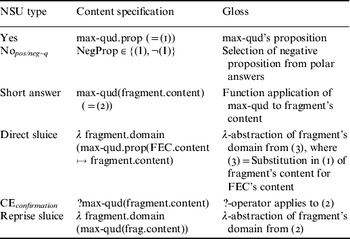
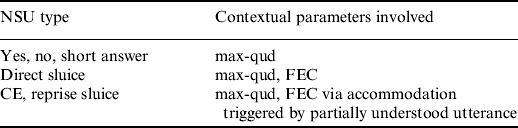
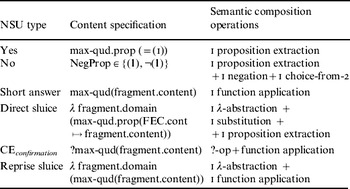
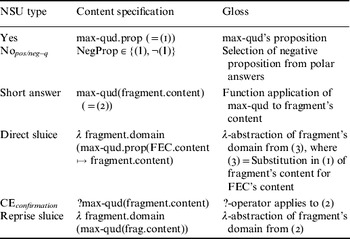
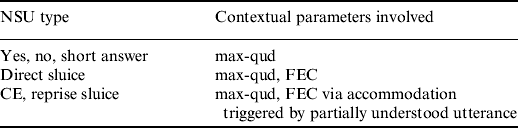
The semantic composition and contextual reference in the above NSU constructions can be summarized in tables 15 and 16.
Semantic composition for NSUs in a dialogue-oriented constructionist grammar.
Contextual parameters involved in NSU contents.
With this in hand, we can turn to describing the two components of our explanation of the late short query effect.
5.2 Propositional NSUs and sentential interrogatives without NSQs
Ginzburg & Sag (Reference Ginzburg and Sag2000) specify a grammar which accommodates inter alia sentential declaratives, sentential interrogatives, and the various NSU constructions discussed above – polar lexemes, short answers, direct and reprise sluices, and CE. In this grammar, as in other work in the Construction Grammar tradition, constructions are organized into a type hierarchy. This enables higher-level types to be posited which allows relevant cross-cutting generalizations to be captured. For our current purposes it is worth mentioning two relevant pieces of the construction hierarchy, that which concerns interrogatives and that which concerns NSUs.
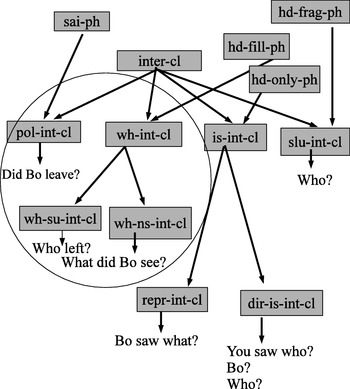
The hierarchy for interrogatives is displayed in figure 1.
Sketch of interrogatives type hierarchy from Ginzburg & Sag (Reference Ginzburg and Sag2000).

The most general interrogative type is the type inter-cl, whose defining characteristic is that such clauses denote questions. ‘Canonical filler-gap’ wh-interrogatives are governed by the type wh-int-cl, whose defining characteristic is that such clauses denote a question involving at least one abstraction, which emanates from the dislocated filler phrase. Direct sluices and reprise sluices are sub-types of a distinct branch of the interrogative hierarchy. slu-int-cl, the type on the basis of which direct sluices are analyzed, specifies how their semantics arises in the terms discussed above. It also specifies the semantic and syntactic parallelism between the fragment and the FEC; the syntactic part of this specification is shared with other NSU constructions and is captured in the NSU type hierarchy to be discussed shortly. Reprise sluices are instances of the type dir-is-int-cl, a type whose defining characteristic is the generation of question contents from daughters of proposition denoting heads and which also accommodates ‘intonation questions’ and non-reprise in situ wh-interrogatives.
The crucial point about a grammar organized in terms of a hierarchy like figure 1 is that its acquisition can be modelled in a straightforward monotonic way, as pointed out originally by Green (Reference Green2000) (see e.g. Goldberg Reference Goldberg1995, Tomasello Reference Tomasello2003). In our case a grammar without sluicing involves an interrogative hierarchy with only the circled branches. Acquiring the additional constructions involves a monotonic refinement of the hierarchy.
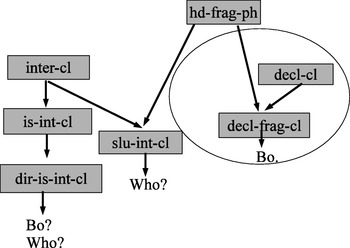
This applies equally to the hierarchy of NSUs, shown in figure 2. A general type here is hd-frag-ph, which specifies the afore-mentioned fragment-FEC parallelism. Short answers are instances of the type decl-frag-cl, which specifies the semantic construction combining max-qud and the fragment. Sluicing is an instance of the type slu-int-cl, as mentioned above. A grammar for NSUs without direct sluicing involves merely the circled branch in figure 2.
Sketch of NSU type hierarchy from Ginzburg & Sag (Reference Ginzburg and Sag2000).
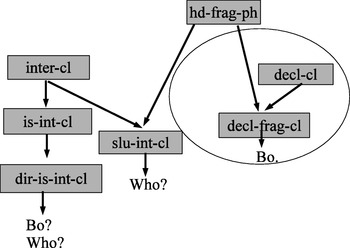
This concludes the first part of our explanation of the late short query effect: the specification of a grammar and contextual system in which short answers and sentential interrogatives co-exist without NSQs.
5.3 The order of NSU acquisition
We can now consider how semantic and contextual processing might play a role in the observed order of acquisition of NSUs, most specifically the fact that NSAs emerge before NSQs. We pursue an account of this in terms of a notion that combines semantic and contextual complexity, as will be explained shortly. There have been many accounts of the order of acquisition of lexical items and constructions that have appealed to some notion of complexity (see e.g. Brown & Hanlon Reference Brown, Hanlon and Hayes1970, Bloom, Merkin & Wooten Reference Bloom, Merkin and Wooten1982). There have also been recent alternative accounts of such phenomena in terms of input frequency (see e.g. Theakston et al. Reference Theakston, Lieven, Pine and Rowland2001, Rowland et al. Reference Rowland, Pine, Lieven and Theakston2003, and references therein). A glance at table 8 above indicates that at least the most simplistic input factor, the distribution of caregiver NSUs, is not well correlated with the order of NSU acquisition: the frequency of Aran's mother's NSUs – admittedly on the basis of a small sample – (CE⩾sluicing⩾yes/no⩾short answer) is precisely the opposite of the order of acquisition, while Becky's mother's (CE⩾yes/no⩾sluicing⩾short answer) is not much better. The most striking discorrelation concerns CE: as we noted in section 4.2, although both children do produce reprise sluices, which express CRs, there is complete absence of the CE construction. This contrasts sharply with the distribution evinced by their mothers: table 7 indicates that on average Becky's mother was producing 20 NSQs per conversation of which 14 were CE, whereas Aran's mother was producing 18 NSQs of which 10 were CE. We certainly do not rule out the existence of other possible factors relating to input which could play a major role, for instance the frequency of NSU triggering contexts presented to the child – though this is somewhat tricky to assess since, in principle, any utterance is a potential context for CE, which is acquired last of all NSUs.
When considering the semantic complexity of NSUs, there is a rather obvious notion that is worth considering, namely the complexity of the semantic operations involved in constructing the content, the semantic composition complexity. However, to the extent that this is a relevant factor, it clearly tells us only half the story since access to the contextual parameters also plays a crucial role in the semantic processing. Hence, our notion of complexity should also make reference to contextual accessibility. There are a number of ways that these notions could be combined. We assume a notion of complexity that gives priority to contextual complexity; only if the contextual complexity is equal is an appeal made to semantic composition complexity:
(29) C1⩽C2 iff either C1 has a simpler contextual background than C2, or C1 and C2 have equivalent contextual backgrounds but C1 is combinatorially simpler than C2.
Let us examine the notion of semantic composition complexity. In our case, the operations involved are: function application, λ-abstraction, proposition extraction, substitution, negation, and polar-questioning.Footnote 26
We evaluate this in terms of the operations involved in each construction type. Let us consider some examples: the content of ‘yes’ is specified in table 15 as arising by extracting the proposition from max-qud. The complexity of constructing ‘yes’, therefore involves one proposition extraction operation. Similarly, given the specification of short answer content in table 15, its complexity involves one function application operation. A direct sluice involves a propositional extraction, a λ-abstraction and a substitution. Its complexity involves, therefore, 1 proposition extraction+1 substitution+1 abstraction.
Table 17 lists the associated semantic composition complexity of the various NSU classes we have considered.
Semantic composition complexity for NSUs in a dialogue-oriented constructionist grammar.

If we use tables 17 and 16 to extract, respectively, semantic composition complexity and contextual accessibility, we can explain the fundamental order of emergence we have demonstrated in this paper:
(30) Non-sentential answers⩽Non-sentential questions: Short answers and yes/no have fewer contextual parameters than direct sluices and are also simpler combinatorially; short answers and yes/no have simpler contextual backgrounds than reprise sluices and CE.
6. Conclusions
Although non-sentential utterances are a pervasive feature of adult speech, their acquisition has to date not been the focus of much attention. In this paper we have presented findings about the order of acquisition of certain major types of NSUs, demonstrating the existence of the late short query effect, the absence of NSQs (sluicing and clarification ellipsis) at an acquisitional stage where a mechanism for NSUs is well established – short answers and yes/no are used productively – and sentential interrogatives have been acquired. We have attempted to demonstrate that this effect is not merely a pragmatic epiphenomenon, one that can be explained on the basis of either the contextual unavailability or semantic undesirability of NSQs. Moreover, we have shown that the emergence of NSQs is not correlated with increased use of other types of NSUs, as might be expected if the absence of NSQs were a consequence of the gradual emergence of a generalized mechanism of phonological reduction. Although our data is primarily based on English speaking children, we have presented some evidence suggesting that our conclusions hold also for Greek.
We believe that the late short query effect provides useful evidence in the ongoing debate concerning the nature of NSU constructions, and more generally the integration of context in grammar. It is not possible to give an account of this effect within theories of NSUs such as underlying sententialism or higher-order unification given that each of these enforces a version of punctual nsu emergence. In these theories ellipsis resolution is pinned to a single mechanism, which means that later emerging NSU types are available in the linguistic system given the presence of requisite inputs (wh-interrogative sentences, quantified propositions and wh-phrase denotations).
We have shown how the late short query effect can be modelled in an approach to grammar which integrates phonological/syntactic/semantic information with detailed specification of dialogue context. NSUs are treated as constructions, which inter alia carry a specification of the contextual conditions regulating their resolution. As discussed earlier, within this type of approach to the description of NSUs, detailed formal analysis of a very high proportion of NSU constructions has been attained. We have used these analyses as the basis of an explanation for the order of emergence of certain classes of NSU constructions, using a notion which combines semantic composition complexity and the accessibility to the contextual parameters. Scaling up this kind of explanation to the full range of NSU constructions is a challenge which we are currently pursuing.