INTRODUCTION
Despite the proverbial counsel to avoid the discussion of religion and politics both with strangers and at the extended family's holiday table, Americans have discussed matters of faith and government in concert since the republic's founding. Indeed, a slight majority of Americans go so far as to believe that churches ought to express their political views, crossing the traditional line between the separation of church and state (Pew Research Center for the People and the Press 2001; Jelen Reference Jelen2010Footnote 1). Despite any systematic individual dexterity with which Americans avoid joining these two topics in mixed (and even familial) company, people of faith are especially likely to talk politics with other members of their own faith communities (see Djupe and Gilbert Reference Djupe and Gilbert2009).Footnote 2
While examinations of religious believing, behaving, and belonging (the “three Bs”) typically focus on how these matters influence voting behavior and party identification, the purpose of this article is to compare how people of various religious orthodoxies and faiths think about the role of religion in society (Smidt et al. Reference Smidt, den Dulk, Froehle, Penning, Monsma and Koopman2010; Putnam and Campbell Reference Putnam and Campbell2010; Smidt, Kellstedt and Guth Reference Smidt, Kellstedt, Guth, Smidt, Kellstedt and Guth2009; Layman Reference Layman2001; Wald and Calhoun-Brown Reference Wald and Calhoun-Brown2007; Campbell Reference Campbell2007; Kellstedt and Green Reference Kellstedt, Green, Leege and Kellstedt1993). Our contribution to the understanding of the political views of the faithful is animated by the exploration of this issue via analysis of focus group interviews conducted with a variety of Christian faith communities within a mid-western urban area. We find substantial variation across denominations and religiosity regarding individuals’ beliefs about the role of religion in society that confirms, amplifies, and contradicts the “three Bs.”
While scholarship examining religious believing, behaving, and belonging does well in predicting political ideology, political partisanship, and some issue attitudes (see Smidt, Kellstedt and Guth Reference Smidt, Kellstedt, Guth, Smidt, Kellstedt and Guth2009), we are interested in understanding a broader construct: the role that American Christians prefer that religion plays in politics. Our use of focus group interviews allows us to shine a revealing light onto what has been a veritable “black box:” explaining how people of different faiths and levels of religious commitment, within Christian faiths, think about the intersection of religion and politics. To wit, our analyses provide evidence that the “Three Bs” perspective accurately explains the roles of religiosity and denominational affiliation in contemporary partisan politics while simultaneously demonstrating that there is considerable diversity — diversity that amounts to more systematic rather than random error — within Christian faith communities when it comes to how people of faith think about whether and/or how religion should intersect with politics. The former finding both validates and helps explain why there is great utility in the quantitative measures of religious traditionalism in contemporary religion and politics scholarship especially in terms of explaining political ideology and partisanship (Layman Reference Layman2001; Putnam and Campbell Reference Putnam and Campbell2010). The latter finding provides qualitative evidentiary support to those who challenge the supremacy of the “Three Bs” perspective (Djupe and Gilbert Reference Djupe and Gilbert2009; Davis and Robinson Reference Davis and Robinson1996; Smidt and Penning Reference Smidt and Penning1991; Wilcox, Jelen and Leege Reference Wilcox, Jelen, Leege, Leege and Armonk1993). In particular, our analysis suggests that those religious traditionalists and religious modernists whose attitudes about the role of religion in society are “against type” adhere closer to their particular denominational faith statements’ admonitions regarding the intersection of faith and political life. We believe our findings highlight the importance that denominational belief plays in political attitudes and to suggest ways in which future surveys could improve the empirical measurement of religious believing, behaving, and belonging in American politics.
AMERICAN POLITICS AND THE “THREE Bs”
While religious belief and religious affiliation are closely related to each other, it is religious affiliation, or belonging, that has been traditionally treated as the most important component in the relationship between politics and religion (Kleppner Reference Kleppner1987; Berelson, Lazarsfeld and McPhee Reference Berelson, Lazarsfeld and McPhee1954). As Smidt, Kellstedt and Guth (Reference Smidt, Kellstedt, Guth, Smidt, Kellstedt and Guth2009) point out in their excellent review of the “Three Bs” perspective; belonging is often operationalized more broadly as group affiliation or religious tradition with its requisite geographic, ethnic, denominational, or doctrinal ties. At the turn of the 20th century, religious affiliation was considered a strong predictor of partisanship, especially regarding membership in the New Deal coalition, which brought Catholics and religious minorities into the Democratic fold while non-southern white Protestants aligned with the Republican Party (Carmines and Layman Reference Carmines, Layman and Shafer1997). The civil rights movement added Black Protestants to the Democratic side of the aisle while southern whites began identifying with Republicans (Carmines and Stimson Reference Carmines and Stimson1989). In other words, “belonging” matters, but, as noted below, the importance of belonging is now “overlain” by religious differences within denominations (Smidt, Kellstedt and Guth Reference Smidt, Kellstedt, Guth, Smidt, Kellstedt and Guth2009).
Any review of traditional scholarship on faith and politics points out “believing” is also a central feature of the contemporary relationship (Stark and Glock Reference Stark and Glock1968; Hunter Reference Hunter1991; Jelen Reference Jelen1991).Footnote 3 Linking religious beliefs to politics, sociologists of religion have spent the last several decades arguing in favor of the “restructuring hypothesis:” that differences in belief among members of the same denomination have more important political consequences than differences between denominations (Hunter Reference Hunter1991; Wuthnow Reference Wuthnow1988). Taken further, we can understand that modern debates over religious theology might cross denominational lines and be better explained by beliefs that religious traditionalists — across denominations — hold dear as compared to those religious beliefs that religious modernists — across those same denominations — believe to be the truth. Doctrinal orthodoxy is typically used to conceptualize believing by combining different measures of beliefs about the veracity of the Bible and the existence of an afterlife into an index that analysts claim is crucial to one's acceptance of faith (Layman Reference Layman2001; Jelen Reference Jelen1989; Wilcox Reference Wilcox1990; Kellstedt and Green Reference Kellstedt, Green, Leege and Kellstedt1993). Although differences in orthodoxy demonstrate meaningful relationships with political measures, they tell us little about how individual belief translates into political preference. For example, what is it about being born again that translates into conservative political views? What is more, measures of believing rarely tap into particular beliefs held by specific denominations (but see Mockabee, Monson and Grant Reference Mockabee, Monson and Grant2001). For example, while Evangelical Christians, believe in a traditional definition for marriage, Evangelical Baptists and Evangelical Free Christians have divergent doctrinal perspectives on whether people should try to advance their religious beliefs into official public policy.Footnote 4
Despite the traditional importance ascribed to believing as it is currently measured, current leading accounts of the relationship between religion and politics argue that the contents of one's religious belief is less important than whether one is a member of a church and whether one has friends, co-workers, and the like from other religious affiliations (Putnam and Campbell Reference Putnam and Campbell2010). Religious “bridging,” they claim, best explains matters related to how religion, and especially religious tolerance, operates in American society. A third factor affecting how religion and politics work together is “behaving.” Two distinct kinds of behavior have earned scholarly attention: private devotionalism (e.g., praying at home) and ritual activity (e.g., going to church) (Leege, Wald and Kellstedt Reference Leege, Wald, Kellstedt, Leege and Kellstedt1993). Some scholars also include one's self-reported importance of religion in one's everyday life as a way to measure behaving. As noted above, recent scholarship investigating questions of faith and society argue that belief is not as important as behaving, and especially, belonging (Putnam and Campbell Reference Putnam and Campbell2010). Combining American National Election Studies (ANES) measures of believing, behaving, and belonging, Layman (Reference Layman2001) developed a measure of religious traditionalism that he used to illustrate how systematic differences in religious traditionalism across denominations is an important explanation for religious change in the American party system (see also Carmines and Wagner Reference Carmines and Wagner2006). From the 1970s to the late 1990s, religious traditionalists became more likely to identify as Republicans while religious modernists moved toward identification as Democrats.
Interestingly, the focus on this “great divide” typically measured these concepts from the point of view of a religious traditionalist, with questions about being born again or literal translations of the Bible. The 2008 American National Election Study seeks to cast a wider net in the search to understand how religion affects politics by adding questions that ask whether one has tried to be a good Christian; and, when trying to be one, is it more important to avoid sin or help others. Mockabee, Wald and Leege (forthcoming) show marked differences between Evangelical Protestants (56% avoiding sin) and Mainline Protestants and Roman Catholics (43% and 36% avoiding sin, respectively). What is more, their “communitarian” and “individual piety” measures predict party identification and “culture war” attitudes while the communitarian measure also is negatively correlated with conservative positions on social-welfare issues.
Turning from party identification, ideology, and issue attitudes to a direct focus on the role people prefer religion to play in society, Wilcox's (Reference Wilcox1993) research note on the public attitudes toward issues of church-state shows that while a one-dimensional model fits his data, a three-dimensional model suggests that some Americans draw distinctions between symbolic public displays of religion, teaching religion in schools, and using tax dollars to support religion. This analysis can tell us little about the sources of this attitude constraint, but it seems likely that this constraint is social in nature (Wilcox 1973, 175). Given that individuals don't have a monolithic view of how the separation of church and state should be implemented, it is plausible that systematic combinations of one's denominational affiliation, level of religious commitment, and political partisanship could influence preferences toward church-state relations. If it is the case that Americans’ preferences vary across specific issues related to the intersection of faith and politics, Wilcox's three-factor solution suggests that individuals may vary in terms of their broader views regarding the role of religion in society.
The “Three Bs” perspective is not without its critics. As proponents of the religious traditionalist perspective, McTague and Layman (Reference McTague, Layman, Smidt, Kellstedt and Guth2009, 356) note that some believe “our framework may be too narrow while another school of thought suggests that it may be too broad.” Leege et al. (Reference Leege, Wald, Krueger and Mueller2002) agree that the transmission of religious differences into political ones is a political process, but they argue this process involves a broad, cultural argumentation style that subsumes issue preference differences and the like. Meanwhile, others contend that the “Three Bs” perspective is tarnished with conceptual and measurement error that “may mask important variation that takes shape across individual congregations and religious communities” (Leege et al. Reference Leege, Wald, Krueger and Mueller2002, 356; Djupe and Gilbert Reference Djupe and Gilbert2006; Reference Djupe and Gilbert2009; Jelen Reference Jelen1992; Verba, Schlozman and Brady Reference Verba, Schlozman and Brady1995; Guth, Green, Smidt and Kellstedt Reference Guth, Green, Smidt and Kellstedt1997). Further, Smidt, Kellstedt and Guth (Reference Smidt, Kellstedt, Guth, Smidt, Kellstedt and Guth2009) proffer the important insight that scholars would be wise to examine each “B” independently from the other ones.
It is useful to consider the “Three Bs” perspective in the context of broader conversations in the American politics canon about ideological constraint. For Converse (1964), most citizens’ lack of attitudinal consistency and ideological constraint fell far short of matching what a political sophisticate should possess in a democratic society. On the other hand, Lane (Reference Lane1962) claimed that a preference for consistent, constrained ideological thinking was dogmatic and intolerant of change. Lane argued that while idiosyncratic, people have political beliefs that include core values and accept political institutions. Ideologies are “rationalizations of interests (sometimes not his own)” that act as moral explanations for beliefs and behaviors (Lane Reference Lane1962, 15–16). Interestingly, while the “Three Bs” construction and measurement is more a reflection of Lane's view of ideology, hypotheses and empirical results examining religious traditionalism's affect on partisanship, ideology, and vote choice are more Conversian. That is, despite Smith, Kellstedt and Guth's (2009) suggestion to analyze the components of the “Three Bs” separately, religious traditionalists and modernists are often treated as individuals whose constrained religious identity affects myriad items of political import.
We argue that religiosity may not be as constrained as it is treated to be in contemporary scholarship. Beyond random measurement error that is a part of any statistical endeavor, we believe that the cases in which individuals express a preference about religion's role in society that is “against type,” from a religious traditionalist/modernism perspective, may be explained by something that is not presently measured in religiosity/religious traditionalism scales: denominational affiliation. Denominations' faith statements vary widely with respect to how, and indeed whether, the ideas and beliefs encountered in church should manifest themselves in government. When individuals express views antithetical to their location on a religious traditionalism scale, we believe that their particular faith's view on the role of religion in society may help explain the disconnect; this is because typical classifications of religious affiliation by denomination confront differences in religious beliefs (i.e., the literal truth of the Bible, perspectives on the end of days, etc.) rather than differences in the role that religious beliefs should play in a democratic society in which church and state are constitutionally separated.
Thus, we take Smidt, Kellstedt and Guth's (2009) advice, employing qualitative methods (focus groups) to gain leverage on how belonging, belief, and behavior are independently related to Christians’ beliefs about the role of religion in society. Qualitative methods are especially well suited to this enterprise, especially since focus groups of existing adult Sunday School groups allow us to effectively hold “behaving” constant across denominations and “belonging” constant within them.
METHODS
We chose a qualitative focus group approach in order to facilitate a dynamic, nuanced discussion, rather than a static individual survey, to improve our understanding of the “causal process” regarding how people of faith think about the role of religion in society (Brady, Collier and Seawright Reference Brady, Collier, Seawright, Brady and Collier2004, 11–12). We also wished to interview intact, already established groups so we could capture the context of small groups as social networks as well as their interactions in a natural setting while still being able to control the line of questioning (Djupe and Gilbert Reference Djupe and Gilbert2009; Creswell Reference Creswell2008; Reference Creswell2003). Focus group research offers the twin advantages of regularly confirming findings from large-scale surveys while simultaneously “amplifying our understanding” of existing findings or contradicting them altogether (Saint-Germain, Bassford and Montano Reference Saint-Germain, Bassford and Montano1993, 363). In his review of the focus group literature in sociology, Morgan (Reference Morgan1996) notes that focus groups are also settings in which people are more willing to discuss sensitive issues candidly, of which religion and politics are often two.
Focus group discussions can “polarize” individuals’ attitudes, are not representative of the national population, and can be affected by the composition of the group and the moderator's skill (Sunstein Reference Sunstein2007; Reference Sunstein2009; Morgan Reference Morgan1988; Krueger Reference Krueger1988; Stewart and Shamdasani Reference Stewart and Shamdasani1990). Focus groups consisting of people who know each other can be problematic because of power dynamics or people may not fully explain themselves because their level of comfort, experience, and knowledge with the other participants does not require them to give comprehensive answers because their friends are already likely to know what they would say (Krueger Reference Krueger1988). Thus, the role of the moderator is crucial in following up on incomplete answers, seeking a wide range of comments, and creating an environment in which people are comfortable discussing sensitive issues.Footnote 5
For the sampling pool, we created a list of every Christian church in a mid-western urban area that had an entry in the online Yellow Pages. Each church was coded Evangelical, mainline, or Catholic, based upon denomination (Steensland et al. Reference Steensland, Park, Rengerus, Robinson, Wilcox and Woodberry2000). For non-denominational churches, we were able to locate online confessions of faith or church doctrinal statements and coded these Evangelical if there were mentions of biblical inerrancy and necessity of being born again (Wilcox and Larson Reference Wilcox and Larson2006; Smith Reference Smith1990; Layman Reference Layman2001; Wald and Calhoun-Brown Reference Wald and Calhoun-Brown2007). From this list, we randomly selected 20 churches, and over-sampled four additional Evangelical churches, as we expected a lower response rate (Szelenyi, Bryant and Lindholm Reference Szelenyi, Bryant and Lindholm2005). We sent letters to these 24 churches, detailing our project, purposefully requesting the participation of a small group and notifying them of a follow-up call (Creswell Reference Creswell2008). Within two weeks, we contacted all of the churches by phone and either received an additional contact within the church or the decision not to participate. Ultimately, we scheduled seven focus groups — two Evangelical and five mainline Protestant churches. The Catholic churches we contacted declined to participate.
All but one of our focus groups met on a Sunday morning either during the Sunday school hour or directly following the church service. Because these focus groups are part of a broader project, a variety of questions were posed to the groups, although the current study will focus on questions relating to the role of religion in society. In the spirit of conducting a mixed methods approach, each session began with participants completing a short demographic questionnaire (see King, Keohane and Verba Reference King, Keohane and Verba1995). The most important questions dealt with party identification (Democrat, Independent, or Republican); political ideology, social issues ideology, and economic issues ideology (1-to-5 scale); and religious traditionalism. To create a basic measure of religious traditionalism, we asked if the participant considered herself born again and how she viewed the Bible. We scaled each question from 1 (the least religiously traditionalist answer) to 3 (the most) and then added the two scores together (see Layman Reference Layman2001). Religious modernists were those who scored 2 or less on the scale, religious centrists scored 3 or 4 and religious traditionalists scored 5 or 6. We did not ask conventional questions related to behaving because our participants were clearly active members of their church — as evidenced by their presence in their Sunday school class or group.
Guided by a semi-structured interview protocol, discussions were led by one of the authors as the other took field notes.Footnote 6 The sessions lasted between 50 and 70 minutes and were recorded digitally, transcribed verbatim, and checked for accuracy. Following each focus group, the authors discussed general findings and took field notes with respect to emerging themes. These themes became the basis for many of the codes used to define sections of text in MaxQDA, a qualitative and mixed-methods software package, but other codes also emerged “in vivo” as the authors formally analyzed the transcripts (Creswell Reference Creswell2008).
DESCRIPTION OF THE SAMPLE
Most of the groups we interviewed were intact Sunday school classes. The other two groups were made up of participants invited specifically by our contacts; it was clear from the outset of each meeting that everyone knew each other and had discussed many of the issues previously. Focus group size ranged from nine (Lutheran) to 20 United Church of Christ (UCC).
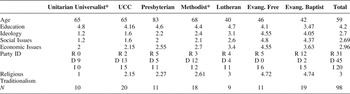
Table 1 reports demographic data from each of the seven groups we interviewed. While the participants in the sample were not randomly selected, Table 1 shows ample face validity with respect to the partisanship, ideological orientation, and religious traditionalism of our participants by their denominational membership as compared to random samples of the population (Smidt et al. Reference Smidt, den Dulk, Froehle, Penning, Monsma and Koopman2010; Layman Reference Layman2001). Those members of churches with a less conservative theological perspective, such as the Unitarian-Universalists and the Congregationalists, were much more liberal, both on social and economic issues, more likely to be Democrats, and more likely to be religious modernists than other Mainline Protestants and Evangelical Protestants. Those on the right end of the table, and the theological Christian spectrum, were more conservative across issue domains, more likely to identify as Republicans, and more likely to be religious traditionalists as compared to the rest of the sample. The Mainline Protestants in the theological “middle” were also in the middle of the sample in terms of party identification, which was much more heterogeneous than the membership of churches at either end of the spectrum, and had more moderate views on economic and social issues. Not surprisingly, their average religious traditionalism score also rested in the middle.
Descriptive Statistics of Focus Groups by Denomination

Education ranges from 1 = high school to 5 = post-graduate; Ideology, Social Issues, and Economic Issues range from strong liberal = 1 to strong conservative = 5; Religious Traditionalism ranges from 1 = Strong Modernist to 5 = Strong Traditionalist.
*One Unitarian-Universalist and one Methodist claimed Green Party Membership.
The Unitarian-Universalists and Congregationalists were the most educated members of our sample, but they also were the oldest and have thus had the most time to complete higher education. Regardless of denomination, our sample was unusually skewed toward those with postgraduate degrees. The sample was almost entirely white and had a higher percentage of Democrats and a lower percentage of Republicans than the urban area from which we sampled.
Turning our attention to a partisan breakdown by religiosity, our sample contained differences between Democrats, Independents, and Republicans in terms of education, ideology, and religious traditionalism. The direction of the differences is consistent with research designs using national random samples of the American population (Layman Reference Layman2001; Wald and Calhoun-Brown Reference Wald and Calhoun-Brown2007; Smidt et al. Reference Smidt, den Dulk, Froehle, Penning, Monsma and Koopman2010). Even so, our measures of religious traditionalism and party identification are capturing correlated, but different things. Although not reported in Table 1, religious modernists are much more likely to be Democrats, but they are less liberal on both social and economic issues than are the population of Democrats in the sample. Religious traditionalists are not as conservative as Republicans on social issues but are more conservative than Republicans on economic issues. In short, despite the traditional limitations of qualitative research with respect to generalizability, our sample shows variance across all of our major independent variables, a crucial point when it comes to our ability to use our analysis to infer (although not demonstrate) causal processes regarding how faith affects political preferences (King, Keohane and Verba Reference King, Keohane and Verba1995; Brady and Collier Reference Brady and Collier2004). Just as important, the political and religious preferences of our sample of 98 church-goers in a mid-sized mid-western city matches up favorably with what large-scale surveys reveal about the political and religious views of the faithful (see Layman Reference Layman2001; Smidt et al. Reference Smidt, den Dulk, Froehle, Penning, Monsma and Koopman2010). We do not claim that the findings produced by our analysis of our sample are nationally representative, but we are comforted by the face validity in Table 1 (Carmines and Zeller Reference Carmines and Zeller1979).
ANALYSIS OF FAITH STATEMENTS
Although geographical influence and cultural heritage play a large role in distinguishing the political effects of belonging, the fundamental division between denominations boils down to a difference in believing. Indeed, the presence of hundreds of Christian denominations is mostly a result of various theological splits since the Reformation. Finke (Reference Finke2004, 31) suggests that, “when denominations hold fast to the core teachings of their religious heritage, they retain a distinctiveness and credibility that ensures members a continuity in the ‘essential’ beliefs and practices of their religion.” Although doctrinal statements may delineate categories of belonging, it is adherence to their content, which generates most social scientists’ measurement of believing. Yet, few scholars have compared individuals’ beliefs with their associated church's faith statement, but instead classified high levels of orthodoxy to those who believe in a literal translation of the Bible or being born again. As Mockabee et al. (forthcoming) found, many of these beliefs (and behaviors, for that matter) are not orthodox for all denominations. To that end, we ask, for the congregations in our sample, do their core teachings address the role of religion in society, and do congregational members seem to uphold these teachings in their discussions? Understanding that a congregation's beliefs, doctrines, and practices extend beyond a summarized creed, we chose to analyze the content of each church's “doctrinal” statement, located on their websites. The Congregationalists and Baptists have unique faith statements, specific to their local church, while the Unitarians, Presbyterians, Lutherans, and Evangelicals display or link to the formal statements established by their denomination. Because the Methodist church does not provide a formal doctrinal piece on their website, we analyzed the church FAQ section as well as the pastor's welcome letter.
Several faith statements had much to say about the work of Christians and the church in the world,Footnote 7 and by extension, politics; while others concentrated more on doctrinal creeds concerning the nature of God and God's relationship to people.Footnote 8 Sharing the gospel with others was a common theme for Lutherans, Evangelicals, Baptists, and Presbyterians, while the Congregationalist and Unitarian statements emphasized the existence of many truths and the acceptance of diverse viewpoints. Concerns for individual piety in this witness to the world were outlined by the Baptists, Evangelicals, and Lutherans, as individuals should aim for “Christ-like living.” The Evangelical statement extended this piety from the individual to society at large by declaring that the Bible is “the ultimate authority by which every realm of human knowledge and endeavor should be judged.”
Beyond the cultivation and transmission of religious belief, several documents entailed a call to action in matters of justice. The Evangelical document exhorted members, “to live out our faith with care for one another, compassion toward the poor and justice for the oppressed;” justice was also mentioned in almost all of the Unitarians’ Seven Principles. Repeating the words of Isaiah, the Presbyterian statement echoed a common social justice message of “preaching good news to the poor and release to the captives … healing the sick and binding up the brokenhearted.” In the Methodist pastor's letter to newcomers, he highlighted the church's “roots which remind us of our inward spiritual connection to God and our outward social action in the world.” The CongregationalistsFootnote 9 emphasized the need to move beyond, “hoping for a better world or pining after justice, but rolling up one's sleeves and starting to feed the hungry, care for the sick and anguished, house the homeless and advocate for a more just society.” Only the Baptists’ Statement of Faith explicitly spoke of the separation of church and state, dedicating an entire section to “religious liberty,” where they note that each human has direct relations with God, and is responsible to God alone in all matters of faith; that each church is independent and must be free from interference by any ecclesiastical or political authority; that therefore Church and State must be kept separate as having different functions, “each fulfilling its duties free from dictation or patronage of the other.” The belief statements make clear that denominations who are often lumped together in analyses (Evangelicals and Mainline Protestants) may share many theological tenets, but their views of the interaction of religion and society — the beliefs that social scientists examine — range from nonexistent to explicitly different. Of course, if congregational members do not purport the beliefs in their doctrinal statements, the latter are merely historic artifacts. As we find below, however, the participants in our study are indeed “holding fast” (Finke Reference Finke2004) to church teachings, but for some, individual interpretation of these teachings results in meaningful differences in political attitudes.
EXPECTATIONS
While most qualitative research does not seek to test empirical hypotheses, we did enter into our investigation with some general expectations regarding what we would find, both in terms of statements from parishioners that fit the mold of the “Three Bs” perspective and regarding elements of people's preferences about the role that religion should play in society that did not match up with the theological restructuring hypothesis specifically, and the “Three Bs” more generally. First, we expected our participants’ political ideology and partisanship to closely mirror their location on our crude scale of religious traditionalism, and their discussion to provide insight into these relationships. Second, in cases where participants behaved against one of their classifications, whether denominational affiliation or level of orthodoxy, their expressed beliefs would not be random or incoherent, but may be dependent on the nature of the inquiry. For certain political attitudes, denominational affiliation may be more influential as an individual's social network will be reinforced by a specified tenet of that church (Kellstedt and Green Reference Kellstedt, Green, Leege and Kellstedt1993; Djupe and Gilbert Reference Djupe and Gilbert2009; Smith et al. Reference Smith, Emerson, Gallagher, Kennedy and Sikkink1998). Regarding other matters, the church may be silent or congregational heterogeneity necessitates limited discussion, resulting in the salience of personal beliefs in preference formation. This is especially true for mainline denominations when it comes to matters of politics (Leege, Wald and Kellstedt Reference Leege, Wald, Kellstedt, Leege and Kellstedt1993; Layman Reference Layman2001; Djupe and Olson n.d.).Thus, exploring individuals preferred role for religion in society, we anticipated that attitudes of those in churches on the theological left and right would best be explained by a belonging perspective, and churches in the theological middle would rely more on individual belief.
FINDINGS
In analyzing qualitative data, analysts read through the text, or transcripts in our case, to determine broad themes and sub-codes that emerge from the group discussion. Accurately reflecting their respective faith statements and reaffirming our understanding of believing and belonging, groups on the left end of the denominational spectrum emphasized social justice and the separation of church and state while groups on the right spoke of sharing truth and a Christ-like effect on society. Some members within all groups, however, underscored the necessity of caring for others, with a religious modernist, Presbyterian Democrat going as far to say, “If you're not concerned about other people, I don't see how you can call yourself a Christian.”
Social Justice
Because five of the sevenFootnote 10 church faith statements mentioned a concern for justice, it was not surprising that many of the groups we interviewed spoke of seeking justice for the marginalized as one of the primary roles of religion in society. For the Methodists, concern for social issues is a “rich tradition” within their church, beginning with their founder, John Wesley. Citing historic involvement in the civil rights movement and continued work on behalf of the poor, a Methodist man explained, “… the purpose of the church is to afflict the comfortable and comfort the afflicted.” This discussion both supported the pastor's online mission statement as well as the local church's theological approach of the Wesleyan Quadrilateral — Scripture, Tradition, Reason, and Experience. The Presbyterian group concurred that Christians should care for others, especially the disenfranchised, effectively echoing their faith statement and summarized by a participant when she said, “I keep going back to the fact that the church here really worries about the marginalized people and that comes out of a faith in a God that worries about marginalized people.” Both Mainline Protestants above were religious modernist Democrats whose views on helping the poor lineup with traditional understandings of believing and belonging. In concordance with their Seven Principles, the Unitarians emphasized the importance of seeking justice for all people, “not just within our own little circle here,” but throughout the world as a way to bridge differences with other faith traditions by taking social action together and “go our separate ways for the faith business but we can get some justice business done.”
According to the Congregationalist group, however, other faith traditions hinder this justice work. When asked about the role of religion in society, the Congregationalists began discussing the negative position occupied by several other denominations. One woman said, “Unfortunately, what we hear religious, so-called religious, people saying, the vocal ones, they're not about social justice.” Another Congregationalist man lamented the decline of liberation theology in the Catholic Church, as the “exciting things going on” for justice became a “dead movement.” Others looked to advocates of limited government as serious obstacles to helping the marginalized because those on the right seem to think of the poor, “it's their problem if they can't get themselves out of poverty.” One man explained, “There's a general view that government is bad or evil … we don't want to pay taxes; we don't want them telling us what to do … I think our general view here is kind of opposed to that. Yes, the government should be involved in social justice issues.” Indeed, the local Congregationalist statement of faith eschewed “pining after justice” in favor of “rolling up one's sleeves … to advocate for a more just society,” which those in our focus group interpreted as achievement through government intervention. These sentiments are not surprising and lineup with what we would expect from theological and political liberals.
The groups in our study were definitely divided on whether faith communities or the government are ultimately responsible for the care of people in need. Participants from most of the churches mentioned special benevolent or charitable funds available through the church that could be used for members facing hardship or others in the community who approach the church with a request. In addition, all of the churches seemed to be involved in various local charitable efforts, from children's backpack programs to homeless shelters and helping refugees. A Presbyterian woman explained, “ … we try to make an effort to keep ourselves informed about various organizations in the community that help people who have various kinds of problems, and then we can suggest those resources to people who need them.” The Evangelicals use small groups to “do a lot more individualized outreach and care for the community,” but emphasize that this outreach should not necessarily be translated into government programs. Most in the Evangelical group agreed that government incompetence was an important reason for faith communities and charitable groups to care for those in need, and the close relationships developed between local parishioners helped the church provide individual assistance to those that they knew were experiencing a tough time while others in the same group believed that people should try to “do the best they can … but that doesn't mean I have to fix it for them so they don't have to take on personal responsibility.” Conversely, one of the most liberal of the Lutheran participants said, “It's my duty to pay taxes to make sure that people who don't have enough to get themselves by can get themselves by … part of the problem is people aren't willing to pay for things.” Citing the gridlock and compromise of politics, other Lutherans said that there are “limitations to what government can provide,” and it is much easier for the church to recognize a hardship and mobilize resources to help. Recalling that the Lutheran statement of faith is silent on issues relating to religion's role in society, it is not surprising that for both religious and political views, the Lutheran group was perhaps the most normally distributed group in our sample. Indeed, the wide degree of variance exhibited by the focus group members and the lack of denominational guidance on this issue comports perfectly with individuals’ locations on our religious traditionalism scale, supporting the restructuring hypothesis.
For the Baptists and some Mainline Protestants, individuals ought not to rely on government to take care of everything so “the church always has a responsibility to step in and lend a hand.” Beyond government, the Baptists the religiously traditionalist Lutherans championed churches addressing spiritual and emotional needs, in addition to financial assistance. Most of the other groups said that although the church is responsible for helping others, government intervention is sometimes necessary. A Congregationalist religious traditionalist said, “While we do everything we can, that doesn't absolve our elected officials from their duty to make us a better society.” From a belonging perspective, this participant reflected the beliefs we would expect from a Congregationalist, but her policy views are “against type” as a traditionalist by favoring government intervention. Future survey questions tapping the salience of one's believing, behaving, and belonging practices, as well as follow-up questions seeking to understand how one views being born again (i.e. in terms of individual piety vs. helping others) could help explain why so many of our participants expressed both homogeneous and heterodox views with their location on a religious traditionalism scale.
Christ-Like Effect
If the churches in the middle and toward the left-end of the theological and political spectrum expressed notions of justice in relation to a Christian concern for others, those toward the right expressed this concern as a way to demonstrate God's love. Several of the Baptist and Evangelical group members spoke of loving people and accepting them “where they're at.” Confirming their faith statement's call for sharing the gospel, a Baptist man said demonstrating this Christ-like love on a society that “exhibits that broken, sin nature” would bring people face-to-face with Christ and hopefully result in “people coming to Christ.” For one Evangelical man, reflecting God in society involved “kingdom ethics” or a “holistic” approach in that “… it's not only about sharing the Gospel with word but living it out in our lives and so meeting the physical, emotional, spiritual needs of people.” These statements reflect how religious traditionalists often take an individualistic view of morality and social change — people need to choose for themselves what is right and work on one-on-one relationship-building to convert others to Christ, then social change will occur (Smith et al. Reference Smith, Emerson, Gallagher, Kennedy and Sikkink1998; Wald and Calhoun-Brown Reference Wald and Calhoun-Brown2007, 234).
Fully supporting their doctrinal stance on church/state separation, members of the Baptist group repeatedly emphasized that the best way to change society for Christ is through love, not rules or government regulation. This sentiment is perhaps best summarized by one man's (a religious traditionalist Independent) explanation:
I wouldn't assume by any stretch that the church ought to become, or to foist its morality, its ethics on culture. Cultures ought to be enticed, won, wooed to authentic Christianity, not buried under somebody's idea of what good moral type of Christian perspective is, and we are, we are a Christian community inside of the larger non-Christian community.
And although the Baptists spoke of “prayerfully” considering issues and ballot box decisions, they seemed to accept that their views might not always prevail because what happens on earth today is not as important as the entirety of God's plan. One man said, “If my perspective doesn't win, I still know that this … this governmental action is not the full force behind redemption in the world … God's still in control.” Most members of the other conservative church, the Evangelicals, did not share this same aversion to legislating morality and instead expressed a God-given responsibility to establish God's truth in society. This is important because by using common measures of believing, the Baptists and Evangelicals would all be classified as religious traditionalists, but for the groups we spoke to, being born again does not necessarily dictate the role of the church in society.
Sharing Truth
Although the Evangelical group agreed they were called to love, accept and help people, there was concern that the truth not be lost in these efforts — supporting their doctrinal call for biblical truth to be the “ultimate authority” in “every realm.” Two women in the group spoke frequently about the necessity of Christians sharing truth in society. One explained, “Our role is to exhibit the glory of God on earth and one of those, part of that means sharing the truth, not just about what Christ did for our sins on the cross but also how to live.” The same Republican religious traditionalist went on to say that is was incumbent upon people of faith to encourage the government to legislate proper moral views. Similarly, the second woman, in reference to the choice of whether to help an illegal immigrant, said it was important to emphasize obedience to the law and point those they are helping toward what was right. Many agreed with these statements, but a few others challenged the ideas. A religious traditionalist and partisan Independent said, “My primary force isn't to change government because I don't believe government can effect change as much as the church when it's actively doing God's will … I'm not waiting on the government to fix all of the social problems.” In this case, believing, behaving, and belonging are held constant, but these individuals have quite disparate views on the intersection of religion and politics.
The majority of the Evangelical group expressed a desire for truth to be joined to the law and referenced using the Constitution as Christians use biblical scriptures to make decisions. Although one Evangelical woman pointed out that, “It's out of compassion for mankind that we share truth, not because we're judgmental or we're busybodies and we, you know, want to control other people's lives.” However, others do not always recognize this compassion as a Congregationalist woman criticized members of the religious right as what she called the “Christian Taliban” who are “all about rules, and our (their) rules.” Another Congregationalist concurred, claiming that much of the truth being shared is “based on one or two obscure texts” and ignores the “social gospel.” The Congregationalist group was generally critical of Catholic and conservative Christian groups who “try and enact its own doctrinal positions into law.” This discussion supported the Congregationalist “doctrine” concerning acceptance of multiple truths.
Separation of Church and State
All of the groups seemed to agree that the role of religion in government is not easily defined. As a religiously traditionalist Presbyterian Republican explained, “If you could only always define the truth, that would be great, but that's why you're always seeking it and different people have different views on what is the truth.” The Presbyterian, Unitarian, Congregationalist, Lutheran, and Methodist groups reiterated that the individual search for truth often complicates how religion should influence society. For the Lutherans, this is one reason faith and politics should be separate because, in the words of a religious modernist Democrat, individuals will arrive at different political viewpoints, depending on how God is working in their lives, and “there's a need for all different kinds of people … those different hands of God working out in the world.” Others suggested that politics may divide a congregation in a negative manner, and Christians probably will not affect society or government with a monolithic voice, accurately reflecting the complete absence of a religious role in society from the Lutheran faith statement. Many Evangelical Christians disagreed, arguing that while faith is an individual search, the goal is to arrive at the same place. One religious traditionalist Republican Evangelical connected this idea to the belief that the government share truth in public policy:
I believe that government not only reflects a community but I also think it helps teach the community and I think that when truth is divorced from public policy, two things can happen, and two things usually do happen, and one is you lose respect for the truth, or you lose respect for the law.
A participant agreed that “the Constitution is so important because look what our country was founded on … faith, hope … charity, and doing these things that were founded on biblical principles … getting back to some of that would do a great deal of good for our society.” There was disagreement, however, as to whether the work of the church should be separated from the state when it comes to economic policies. One of the dissenting voices of the group indicated that “there may be some moral responsibility that we have for our brothers and sisters in Christ who are in impoverished nations … do we as a blessed nation, who are in fortunate circumstances, have a moral, spiritual, theological obligation to help these people?” While others in the group seemed to support private charity to fulfill their church doctrine of “compassion for the poor,” there were no private alternatives provided for the above participant's suggestions on meeting the companion doctrinal statement of “justice for the oppressed.” For example, one of the most conservative (theologically and politically) participants declared a clear division between an individual Christian response and economic policy.
When you start saying as Christians, well, it's okay that our government handles all the costs of this, that's not really, that's not really a spiritual decision, in my opinion. That's placing the responsibility on somebody else. And I don't see the righteousness necessarily in that, and I think that we'll be held accountable as individuals when we help a person, but to say that all the taxpayers of this country are going to pay for another country's problems, that's not voluntary.
The vastly different understandings of Christian obligation to the world cannot be accounted for by believing, behaving, or belonging as both participants are frequent attending, Evangelical Free members who are religious traditionalists that agreed on many matters of faith. Yet, the question of religion's role in politics activated quite disparate interpretations of God's commands — within and across denominations — which illustrates the limitations of traditional measures of religiosity.
DISCUSSION
Our analysis reveals that people's denominational affiliation, religious beliefs, ideology, and political partisanship interact in meaningful, complex ways that affect people's preferences regarding the role of religion and the role of government in society. This is consistent with Lane's (1962) claim that when scholars refrain from predefining the qualities of an appropriate ideological view, we can discover broad and meaningful variation in people's conceptualizations of the political world (see also Theiss-Morse Reference Theiss-Morse1993); for membership in a church provides a sophisticated menu from which parishioners can choose to partake.
There is already evidence that political views are, in part, “menu dependent:” a reflection of the options offered by partisan elites (Sniderman and Bullock Reference Sniderman, Bullock, Saris and Sniderman2004; Sniderman and Theriault Reference Sniderman, Theriault, Saris and Sniderman2004). Our analyses suggest that the current measurement strategies that help explain how religion and politics are connected do not consider the full, relevant range of factors that people select from on their ecclesiastical menu. Below, we offer some specific items for survey researchers to add to their menus of measurement.
Our focus groups seemed to be well aware of the influence of religion in American political life as our question of religion's place in “society” cued them to begin debating this role. The divide in discussion is probably best summarized by a Congregationalist woman's request for clarification, “the role that it ought to have or the role that it does have?” The Evangelicals, Baptists, and Methodists seemed to focus more on the role religion ought to have, while the other groups, except the Lutherans, jumped straight to criticisms of what they saw as religion's current role in American politics. The latter set of participants, all on the theological and political left, expressed deep concern for the political power and influence exerted by those on the right, which led to the emphasis on the separation between church and state. These same groups also seemed to support government intervention for social justice issues, ostensibly informed by their faith, yet they did not see this as legislating their morality. In the Congregationalist group, one of the authors asked, “How do you see that as different, the government instituting social justice, than other religious groups who I've heard you're against instituting their beliefs?” This prompted a discussion on what constitutes a good society, and that faith aside, each of those that spoke would still advocate social justice. That is, caring for the general welfare of others is how society works best, and religious belief need not inform this truth. For those on the theological left, and some in the middle, there seemed to be a clear separation of the influence of religious belief on personal and political preferences. For example, an individual may report her religion plays an important role in day-to-day decision-making, resulting in something like opposition to a personal choice to have an abortion, but this does not necessarily translate to outlawing abortion for all. Delineating individual personal, interpersonal, and political preferences (Alford and Hibbing Reference Alford and Hibbing2007) also may help us understand why a born-again Lutheran could be a Democrat, although theology would predict importance of a pro-life stance and a subsequent identification as a Republican (Adams Reference Adams1997).
We heard similar statements from the Unitarians in that their views on the political world or how society should be organized are more important than and also inform their religious beliefs. The groups on the right expressed the complete opposite — it is their faith and the living out of biblical principles that lead to a good society. These findings support the notion of a religious divide along the lines of individual piety versus a communitarian mission of helping others and emphasize the importance of believing in understanding how people of faith connect the religious with the political (Mockabee et al. forthcoming).
When it comes to sharing Truth, the separation of church and state, and the role of religion in society, we show marked differences between the preferences of members of the denominational religious left and religious right, religious traditionalists and modernists, Republicans and Democrats, and liberals and conservatives. Interestingly, no set of differences between these groups perfectly overlaps another. Introducing analysis of faith statements and our group members’ general verbal adherence to these precepts helped identify possible systematic error rather than random noise that results from relying solely on denominational categorization and measures of conservatism. The “Evangelical” (Steensland et al. Reference Steensland, Park, Rengerus, Robinson, Wilcox and Woodberry2000) groups in our sample were nearly identical in their partisanship, political ideology, and religious traditionalism, and if our attitude of interest was abortion, these established measures would be nearly perfectly predictive. But with an inquiry on the role of religion in society, a quick look at the respective doctrinal statements and the words of our focus group members indicate meaningful differences in perspective. One group seemed to believe God commands them to legislate morality (Evangelical Frees) while the other group (Evangelical Baptist) would like God's laws to rule the land, but it is not their first concern. Indeed, the latter seem to be more attuned with the traditional understanding of Evangelicals as taking a more individualistic view of morality and social change — people need to choose for themselves what is right, and we should work on one-on-one relationship-building to convert others to Christ, then social change will occur (Smith et al. Reference Smith, Emerson, Gallagher, Kennedy and Sikkink1998; Wald and Calhoun-Brown Reference Wald and Calhoun-Brown2007, 234). Our findings suggest that it is important to account for theological differences in belonging and possibly paying more attention to survey questions, such as the following from the 1991 General Social Survey:
Do you agree or disagree with the following statements …
a. Right and wrong should be based on God's laws.
b. Right and wrong should be decided by society.
c. Right and wrong should be a matter of personal conscience.
While there are clear divisions between Unitarian-Universalists and Evangelical Christians on most matters of faith and political preference, and while we do show evidence of how religious denominations vary in terms of partisanship, ideology, and religious traditionalism, the focus groups we interviewed regularly indicated a fair amount of religious, ideological, and partisan heterogeneity within their own denominational ranks. This heterogeneity, however, was more present in the theological middle than it was at the conservative and liberal doctrinal poles, which suggests that some traditional measures of orthodoxy or belief are not only problematic for Catholics but also for Mainline Protestants (Leege et al. Reference Leege, Wald, Krueger and Mueller2002). For example, what is an orthodox Methodist? According to their faith statement, it is someone who balances Scripture, Tradition, Reason and Experience; while an orthodox Evangelical Free individual would seem to strictly adhere to just scripture. Perhaps instead of orthodoxy, we should be asking individuals whether they consider themselves “typical Methodists” to gauge a measure of denominational identity (Theiss-Morse 2009). As Mockabee, Monson and Grant (Reference Mockabee, Monson and Grant2001) point out, the notion of typicality is presently one that has to be inferred by comparing how those of the same faith answer particular questions about issues like whether they practice daily prayer. In terms of religiosity, religious modernists, religious centrists, and Democrats were much more likely to favor government intervention while religious traditionalists and political Independents preferred a reliance on faith, the works of the church, and individualism to address social problems. When religiosity and partisanship were at “odds,” church denomination and partisanship may be the crucial factors affecting the preferences of those in our sample. For example, the religious traditionalist who preferred government intervention to assist those suffering from the recession was both a Democrat and a member of the UCC (see also Smidt et al. Reference Smidt, den Dulk, Froehle, Penning, Monsma and Koopman2010). In our analysis, partisanship and religiosity are not perfectly predictive of the issue attitudes of the faithful. Not only did each church exhibit variance across most of our measures, they did so while all participating in the same regularly meeting group that was clearly an important component of each participant's social network. This suggests that political disagreement survives in religious communication networks in addition to others, and that individuals seem to maintain beliefs about how society should be organized separately from, but perhaps still informed by, their religious beliefs (see Huckfeldt, Johnson and Sprague Reference Huckfeldt, Johnson and Sprague2004). Accounting for intra-group differences may be accomplished through questions of an individual's typification of that denomination, as mentioned earlier, but also in assessing the salience of religious identity. That is, how do denominational members rank their various social identities? Are you a Christian first, then Presbyterian, and finally Democrat? Or is the order reversed? We suspect those on the theological left would place political identity before religious and vice versa for those on the theological right. The ordering of identities for the theological middle may help us tease apart variance in political attitudes, much like Wilcox, Jelen and Leege's (Reference Wilcox1993) work on “Evangelical,” “fundamentalist,” and “charismatic” identities advanced our understanding of the variance in political preferences on the theological right. Stipulating that, we suspect that our participants’ personal answer to the chicken and egg question — does faith affect political views or do political views affect faith? — is somewhat ordered by an interaction between denominational affiliation and religiosity. This affirms Putnam and Campbell's (2010, 145) findings that suggests “politics is driving religious conversion,” as much of religious switching seems to occur with those whose politics do not match up with the church within which they were raised, resulting in stronger political-religious relationships than those who remain in the tradition of their youth. Because liberal churches are the most politically active (Putnam and Campbell Reference Putnam and Campbell2010), future research should explore whether theologically liberal people of faith are more likely to approach their spiritual life as a consequence of their political beliefs while theologically conservative Christians begin from the perspective that their faith affects their political preferences. This may be captured with survey questions inquiring about frequency of party switching and denominational affiliation changes over the life course that could be developed into individual timelines, pointing to temporal causality.
Conclusion
References to “the God Gap,” the “Religious Right,” and the “secular Left” pervade contemporary public discussion regarding the influence of religion in American government. Absent from this discussion is a thorough explication of how people of faith think about the role of religion in politics. This article represents an initial exploration of the black box of assumptions and unknowns that explain why so many carefully measured religious variables regularly affect political attitudes, associations, and behaviors in studies of contemporary American politics (Layman Reference Layman2001; Smidt et al. Reference Smidt, den Dulk, Froehle, Penning, Monsma and Koopman2010; Leege et al. Reference Leege, Wald, Krueger and Mueller2002; Mockabee et al. forthcoming; Campbell Reference Campbell2002). Our mixed methods approach facilitated a wide-ranging, detailed discussion that helped confirm the leading accounts of religion's effect on politics while giving insight into the error term — those occasions when members of particular denominations or people falling into certain categories of orthodoxy think and/or behave against type. Our analysis suggests that survey researchers should search for creative ways to ask what motivates church attendance and denominational affiliation as well as personal adherence to and interpretation of church doctrine to improve the precision with which we measure believing, behaving and belonging.