


1 Introduction
China has been experiencing a surge of medical disputes, sparking widespread concerns among policymakers, medical professionals, and the general public. With the frequent reports of disgruntled patients wreaking havoc in hospitals, violence against doctors has become a familiar occurrence, and drawn international attention. The avalanche of medical disputes in China including many widely reported riots, attacks, and protests in hospitals is a confluence of inappropriate incentives in the health system, the resulting distorted behaviors of physicians, mounting social distrust of the medical profession and institutional failures of the existing legal framework. The detrimental effects of the damaged doctor–patient relationship have emerged, calling for serious policy intervention. Despite the gravity of the situation, rigorous academic studies are scant and thus unable to inform necessary policy adjustment. This article seeks to explain the prevalence of medical disputes in Chinese hospitals with a mixed-method inquiry in Shenzhen, a metropolis in South China.
The contribution of this study is threefold. First, most previous studies in the literature have analyzed the causes of medical disputes by investigating patients’ views and experiences (Hickson et al., Reference Hickson, Clayton, Githens and Sloan1992; Beckman et al., Reference Beckman, Markakis, Suchman and Frankel1994; Levinson et al., Reference Levinson, Roter, Mullooly, Dull and Frankel1997; Cho et al., Reference Cho, Lee, Shon, Yang and Lee1998), while the perspectives of the other side (i.e. physicians) have not been fully taken into account (Franks et al., Reference Franks, Jerant, Fiscella, Shields, Tancredi and Epstein2006). This study provides a fresh overview of Chinese physicians’ perceptions and analysis of the causes of medical disputes with primary qualitative and quantitative data. Second, it examines the factors associated with medical disputes via a mixed-method approach. The sequential exploratory research design chosen is able to strengthen significantly both internal and external validity. Third, ordinary medical disputes and violence – the extreme form of doctor–patient conflict – are both included in quantitative analysis that examines their respective predictors.
Our analysis finds that medical disputes in various forms are disturbingly widespread and reveals that hospitals’ inappropriate internal incentives and the heavy workload of physicians undermine the quality of clinical encounters, which can easily trigger disputes. Moreover, neither hospitals nor patients seem to favor legal resolution of disputes; the former tend to offer under-the-table payments to avoid further escalation of conflicts, while the latter often take advantage of this by demanding greater compensation. This article argues that restoring a healthy doctor–patient relationship is no less important than other institutional aspects of health care reform. Critical interventions are needed.
2 Literature review
The doctor–patient relationship is central to the practice of medicine and vital for the delivery of health services. Many studies have found that a healthy interaction between physicians and patients can greatly enhance the quality of care and patients’ well-being (Conboy et al., Reference Conboy, Macklin, Kelley, Kokkotou, Lembo and Kaptchuk2010; Lee and Lin, Reference Lee and Lin2010). With the remarkable transformation of the doctor–patient relationship from benevolent paternalism to one characterized by contractual consumerism, recent decades have witnessed a surge of medical disputes worldwide (Kaba and Sooriakumaran, Reference Kaba and Sooriakumaran2007). Medical malpractice litigations, a major form of dispute, have proliferated within many health systems, and numerous doctors are being sued by patients (Kessler et al., Reference Kessler, Summerton and Graham2006).
Overall, the remarkable rise of patients’ consumerist attitudes toward health care and the resultant higher expectations, the erosion of social trust in the medical profession, and sensational media coverage have all given rise to various forms of doctor–patient conflict, especially complaints and litigation (Kaba and Sooriakumaran, Reference Kaba and Sooriakumaran2007). Studies in the West have examined the reasons behind patients’ decision to file malpractice claims. Adverse medical outcomes, advice from knowledgeable acquaintances, discovering cover-ups, and seeking monetary compensation have been identified as the crucial factors prompting patients to file a suit (Hickson et al., Reference Hickson, Clayton, Githens and Sloan1992; Bismark et al., Reference Bismark, Dauer, Paterson and Studdert2006).
Another strand of the literature investigates the doctor–patient relationship and doctors’ professional attributes associated with disputes. Communication has been found to be a significant factor. Beckman et al. (Reference Beckman, Markakis, Suchman and Frankel1994) analyzed the depositions of 47 plaintiffs in the United States and identified problematic relationship issues in 71%. The decision to sue a doctor is not necessarily driven by adverse medical outcomes but is often more related to doctors’ communication behaviors, as the issues mainly include devaluing patients’ views, poor delivery of information, and lack of understanding of patients’ concerns (Beckman et al., Reference Beckman, Markakis, Suchman and Frankel1994). Similar studies in the United States further identified both positive (such as doctors ‘used more statements of orientation,’ ‘laughed and used humor,’ and ‘tended to use more facilitation’) and negative communicative attributes (such as doctors ‘would not listen,’ ‘would not talk openly,’ and ‘attempted to mislead them’) of doctors that affect patients’ decision to litigate or not (Hickson et al., Reference Hickson, Clayton, Githens and Sloan1992; Levinson et al., Reference Levinson, Roter, Mullooly, Dull and Frankel1997). Similar findings have been reported in East Asia. Cho et al.’s (Reference Cho, Lee, Shon, Yang and Lee1998) study in South Korea and Aoki et al.s’ (Reference Aoki, Uda, Ohta, Kiuchi and Fukui2008) study in Japan both suggested that miscommunication and poor attitudes were the primary causes of patient dissatisfaction.
There is a broad body of literature investigating the relationship between physicians’ interpersonal competency and patient satisfaction. Studies have found that good interpersonal skills – especially communication skills – lead to increased patient satisfaction (Vick and Scott, Reference Vick and Scott1998; Fan et al., Reference Fan, Burman, McDonell and Fihn2005; Trummer et al., Reference Trummer, Mueller, Nowak, Stidl and Pelikan2006) and are positively associated with a variety of desired patient outcomes including adherence to treatment (Sewitch et al., Reference Sewitch2003; Kim et al., Reference Kim, Kaplowitz and Johnston2004) and a range of improved medical outcomes (Stewart, Reference Stewart1995; Conboy et al., Reference Conboy, Macklin, Kelley, Kokkotou, Lembo and Kaptchuk2010). Conversely, poor doctor–patient interaction may jeopardize patients’ health, interfere with physicians’ therapeutic efforts, and waste health resources (DiMatteo and DiNocola, Reference DiMatteo and DiNocola1982).
Having experienced rapid deterioration in access to and equality of health care services in the last three decades (Hu et al., Reference Hu, Ong, Lin and Li1999; Gao et al., Reference Gao, Tang, Tolhurst and Rao2001), China is not exempt from this wave of rising tension between patients and the medical profession. The ‘unmanaged marketization’ in health care in recent years has created a plethora of perverse incentives on both the supply and demand side (Gu and Zhang, Reference Gu and Zhang2006; He, Reference He2010). The consequent distorted physician behaviors have caused an unprecedented deterioration in the doctor–patient relationship in China. Recent years have seen escalating tension between both sides, leading to a skyrocketing number of medical disputes and even outright violence (The Lancet, 2010), a situation described as a crisis by The Lancet (2014). A series of severe consequences such as brain drain, low morale, and distorted physician behaviors have emerged (Wu et al., 2013; Dong et al., Reference Dong, Ariana and Xiao2013; He, Reference He2014), sounding the alarm among Chinese health policymakers, who are in the midst of an ambitious reform program.
Once worshiped as ‘angels in white,’ members of the medical profession in China are facing unprecedented challenges. Due to the deteriorated public trust during the marketization reforms of the last three decades, Chinese physicians are working in an antagonistic environment. Heavy workload, low remuneration, and tainted social prestige have left millions of physicians feeling undervalued and made medicine a career to be avoided, a situation rarely seen in other Confucian societies (Wu et al., 2013). Suspicion about the ethical standards of the medical profession prevails in the Chinese society. A survey by the China Youth Daily reported that nearly 70% of patients do not trust physicians’ diagnoses and treatments.Footnote 1 Another nationwide survey noted that only 26% of physicians felt that their patients trusted them, and 70.9% would choose to pursue another occupation given the opportunity.Footnote 2 Dong et al. (Reference Dong, Ariana and Xiao2013) found that low remuneration and poor doctor–patient relationships were responsible for the aggravated brain drain in the Chinese health system.
In parallel to patients’ suspicion of physicians, the number of medical disputes has skyrocketed. According to the Chinese Hospital Management Association, the total number of disputes has been increasing by 22.9% per year since 2002, but only a small portion of patients take recourse to litigation for resolution. In contrast to the sharp increase in disputes, the number of medical-related legal actions has risen modestly, even after the enactment of the Tort Liability Law in 2010. For instance, only 19,944 lawsuits were reported in 2014, accounting for merely 17% of the total number of medical disputes recorded in that year, implying that most disputes are resolved via other channels,Footnote 3 while many escalated to violence. On average, each Chinese hospital deals with 27 cases of violence targeted at doctors per year.Footnote 4 The statistics of the Ministry of Health show that the total number of violent incidents targeting medical staff and hospitals jumped sharply from 10,248 in 2006 to 17,243 in 2010, with a 13.9% annual growth (Feng et al., Reference Feng, Li, Han, Xu and Duan2013). Medical staff in several localities reportedly went on strike to condemn violence and appeal for a safe work environment. There were even sensational incidents in which doctors and nurses wore military helmets to work. In a recent survey of physicians in Liaoning Province, 47.2% reported serious dissatisfaction with their relationships with patients, which in turn fueled high levels of occupational stress (Wu et al., 2013).
The consequences of the current ‘crisis’ go beyond the interpersonal because physicians’ behaviors appear to have dramatically changed in response to the damaged relationship with patients. Fearing being sued, physicians in many health care settings have been found engaging in defensive behaviors to avoid potential litigation. Termed ‘defensive medicine,’ these behaviors include the avoidance of risky patients or procedures believed likely to result in malpractice claims, the prescription of unnecessary drugs or clinical tests, unnecessary therapeutic procedures to avoid malpractice claims, and the overutilization of medical services in an effort to forestall negligence claims (Summerton, Reference Summerton1995). Defensive medicine has made no positive contribution to the quality of care but has put tremendous pressure on health care budgets (Hermer and Brody, Reference Hermer and Brody2010; Adwok and Kearns, Reference Adwok and Kearns2013). In a companion article based on the same quantitative data as used in this study, the first author of this paper has revealed empirical evidence of the widespread existence of defensive behaviors among Chinese physicians, undertaken in reaction to deteriorating doctor–patient relationships (He, Reference He2014). Hence, unhealthy doctor–patient relationships mean not just unpleasant clinical encounters for both parties, but also considerable threats to the health system as a whole.
The causes of such a sorry state of affairs are complex and multidimensional. From the macro perspective, first, cutbacks in government funding for health care in the 1980s forced hospitals to become profit-minded in order to make up for the vast financial shortfall (Hsiao, Reference Hsiao1995). Second, various inappropriate incentives – especially revenue-related bonuses – were introduced to motivate physicians to generate income from patients’ pockets by providing over-treatment and over-prescription (Liu and Mills, Reference Liu and Mills2003; Hsiao, Reference Hsiao2008). Third, profit-motivated physicians have been tempted by other sources of income such as drug commissions, test kickbacks, and red packets (hong bao, bribes; Bloom et al., Reference Bloom, Han and Li2001). Last but not least, the badly designed fee schedule of medical services and pharmaceuticals and the reliance on fee-for-service payment to providers have further fueled the rapid inflation of costs and thus increased patients’ financial burden (Liu et al., Reference Liu, Liu and Chen2000; He, Reference He2010). Against this backdrop, this study attempts to unveil the micro dynamics of medical disputes in a Chinese city with mixed methods.
3 Methodology
This study employed the sequential exploratory strategy in its research design. This design involves an initial phase of qualitative data collection and analysis, followed by a second phase of quantitative data collection and analysis that builds on the results of the first qualitative phase (Creswell, Reference Creswell2009). Qualitative findings generated in the first phase are used to inform the analysis of quantitative data for overall analytical interpretation. The strategy of using qualitative results as hypotheses and testing them quantitatively in large n manner helps strengthen both the internal and external validity of inquiries.
The investigation was carried out in Shenzhen City, Guangdong Province in late 2013. Ethical approval was obtained from the Human Research Ethics Committee of the first author’s university. As one of China’s five Special Economic Zones, Shenzhen has been a pioneer in the country’s rapid economic growth since the 1980s. In 2013, Shenzhen’s per capita GDP reached US$22,000, making it one of the richest cities in China. Yet the city’s economic prosperity is not fully reflected in its health system, especially in specialized tertiary care. When it comes to serious illnesses, many residents prefer to seek care in Guangzhou, the provincial capital and medical hub of South China.
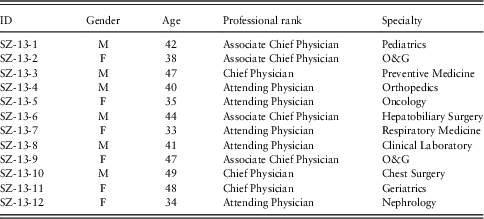
The collection of qualitative data, undertaken through 12 semi-structured in-depth interviews with licensed medical doctors in Shenzhen, took place in November 2013. The sampling was purposive in order to balance gender and seniority of physicians as well as type and level of hospitals, and to avoid missing any major specialty. Informants’ characteristics are outlined in Table 1. The interview framework was structured to probe physicians’ general views as well as personal experiences related to medical disputes and the doctor–patient relationship. Interviews were extended for those who had encountered disputes before. Interviewees were invited to recall and explain incidents as far as they felt comfortable. Transcripts were made and immediately checked to resolve any ambiguity and to identify emerging themes, which were then snowballed in subsequent interviews.
Profiles of interviewees

Note: Attending physician, associate chief physician, and chief physician are technical ranks equivalent to associate consultant, consultant, and senior consultant, respectively.
Source: Authors’ survey.
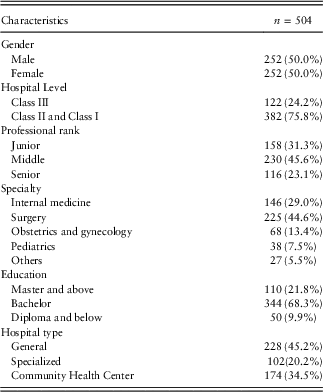
The quantitative survey was undertaken in December 2013 and targeted licensed medical practitioners. The findings revealed by qualitative analysis one month ago were used as hypotheses to be tested in the quantitative phase. When the municipal health bureau was hosting physician training programs, the authors seized the opportunity to distribute questionnaires. Participants had no prior knowledge of the survey. Since the training programs which presented the opportunity to access respondents were available to all physicians working in Shenzhen’s public hospitals, and the authors randomly selected a few sessions from which to draw the sample, the sampling can be considered random, which minimized selection bias and secured representativeness to a great extent. The personal characteristics of respondents in the sample, including professional rank, level of hospital, and age, were also randomly mixed. The authors used a central setting to distribute the questionnaires in order to safeguard confidentiality. Six hundred questionnaires were distributed and 504 were collected (response rate=84.0%). The sample represented 2.1% of all licensed physicians (23,942 as of 2013) in the city. Table 2 presents the profiles of the survey respondents.
Profiles of survey respondents

Note: Based on China’s hospital accreditation system, Class III, Class II, and Class I hospitals roughly correspond to providers of tertiary care, acute care, and primary care, respectively.
Source: Authors’ survey.
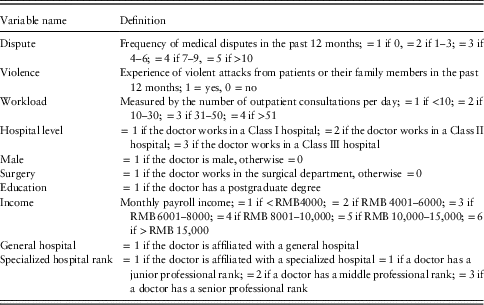
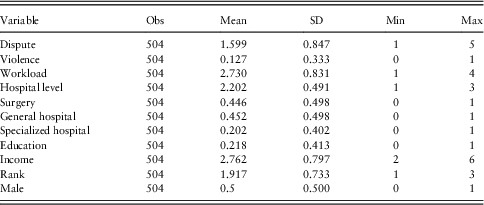
Besides collecting demographic and professional information, the survey focused on measuring three dimensions; (1) income, workload, and morale; (2) general perceptions of the current doctor–patient relationship; and (3) personal experience of disputes with patients and views on the causes of such incidents. The coding and description of key variables are set out in Table 3 and Table 4 respectively. Uni-, bi-, and multivariate methods were used to analyze the data in STATA 12.0.
Variable coding

Source: Authors’ survey.
Description of key variables

Source: Authors’ survey.
4 Qualitative results
All interviewees reported poor doctor–patient relationships and it seems that the situation has hardly improved since the launch of the countrywide health care reform in 2009. Three out of 12 interviewees had personal experience of medical disputes, but none attributed them to malpractice. Their perceived reasons for the intensifying discord of the doctor–patient relationship were in general twofold. On their own side, most interviewees tended to blame hospitals’ internal incentives. The remuneration system, in particular, was said to be an ill-designed hard constraint. Because bonuses account for more than half of their real take-home income (the percentage can be up to 80% in some hospitals, as reflected in interviews) and they are predominantly tied to service volume, physicians face intense pressure to meet the targets assigned by their departments.Footnote 5 This is consistent with He and Qian’s (Reference He and Qian2013) finding that volume-based bonus schemes remain the dominant instrument for motivating frontline physicians’ revenue generation. In physicians’ struggle to meet the imposed targets, the quality of care tends to be undermined by extremely rushed outpatient service. As Dr Huang, a pediatrician, explained:
My bonus is three times my basic salary, and it is calculated by how much instead of how well you work. I’m pressed to attend to as many patients as possible. Medicine ought to be interactive and humane, but in fact it runs like mechanical production here. On average, I have to see 60 outpatients per day; working like this, I can’t guarantee quality. There are so many of them in the queue that if you talk a bit more with one, those behind want to smash your door! In my view, there should be a ceiling for outpatient numbers if you intend to secure quality of care. As far as I’m concerned, it shouldn’t go beyond 40 (outpatient consultations) per day.Footnote 6
Overload inevitably prevents good communication between doctors and patients, further jeopardizing the quality of care and igniting conflicts (Zhang and Sleeboom-Faulkner, Reference Zhang and Sleeboom-Faulkner2011; Xu, Reference Xu2013). Poor communication, rather than malpractice per se, has been consistently ranked top among the leading causes of medical disputes, as reported by many local studies (Zhou et al., Reference Zhou, Li, Huang and Feng2011; Wei et al., Reference Wei, Wei and Bai2013; Wu et al., Reference Wu, Luo and Wang2014). Dr Chen, an orthopedician, who had experienced several disputes before, remarked:
Although the poor doctor-patient relationship is a complex function of various factors, I have to say that we [doctors] should be mainly held responsible. As far as I see, the problems are rooted in communication. The extremely short time that can be allocated to each encounter doesn’t allow me to adequately communicate with patients and their family members. Most conflicts actually result from miscommunication rather than medical accidents. I feel that disputes are most likely to erupt when poor communication is coupled with issues related to fees.Footnote 7
The situation described above is certainly not unique to Shenzhen; abundant evidence has shown the heavy workload, occupational stress, and burnout syndrome of Chinese medical staff, especially physicians in high-tier public hospitals (Wu et al., Reference Wu, Liu, Wang, Gao, Zhao and Wang2010, 2013; Zhang and Feng, Reference Zhang and Feng2011). A survey in Zhejiang Province found that 60% of provincial hospital doctors routinely worked more than 60 hours a week with 23% working more than 30 hours a week in overtime, often on a ‘forced voluntary’ basis (Wu et al., Reference Wu, Luo and Wang2014). Weak gate-keeping mechanisms and hospitals’ insatiable appetite for revenue have fueled the extraordinary growth of patient volume, which in turn makes it rather difficult for physicians to spend sufficient time with patients. The time spent with each outpatient is very limited, usually less than three minutes (The Lancet, 2014). In the survey cited above, 59% of provincial hospital doctors attend over 50 outpatients per day with close to half seeing over 100 a day. Unsurprisingly, 38% of them spent only four minutes or even less on average with each outpatient (Wu et al., Reference Wu, Luo and Wang2014).
Rossner (Reference Rossner2013) has rightly pointed out that overworked, underpaid doctors and access inequality tend to lead to rushed, impersonal, and unsatisfying doctor–patient encounters in China; compounding this is Chinese medical education, which gives little training in interpersonal communication and the social context of medicine (Xu et al., Reference Xu2010). As a heavy workload tends to undermine communication and quality of service, which in turn easily spark disputes, we have the following hypothesis to be tested in quantitative analysis:
Hypothesis 1: An increase in doctors’ workload increases the likelihood of medical disputes.
In the in-depth interviews, the authors also tried to understand the dynamics of medical disputes from the physicians’ perspective. Most interviewees attributed the rising prevalence of disputes to increasingly demanding patients.Footnote 8 Very few interviewees felt that the resolutions of disputes were reasonable and fair, but said that hospitals’ endless concessions to demanding patients were their major source of dissatisfaction.Footnote 9 Dr Zeng, a preventive medicine specialist remarked:
Because the macro political environment attaches paramount importance to the so-called ‘maintenance of social stability,’ hospital managers are very afraid of high-profile incidents because local government may blame them for failing to mitigate the tension. If payment can quench patients’ anger, hospital managers would certainly love to do that, even when the patients are obviously blackmailing them. Patients also know the hospitals’ mentality very well, and actually take advantage of it. Some have chosen to stage farcical protests because doing so best maximized their interests. In fact, they deliberately avoided legal resolution because they knew hospitals would satisfy their monetary demands anyway.Footnote 10
This representative line of response well depicts the broader sociopolitical context. The expectations of Chinese patients regarding quality of service have risen since the introduction of market forces; they often place unrealistically high expectations upon doctors and hospitals. A survey of physicians has suggested that the vast majority felt that patients were becoming more demanding and aggressive in their demands (Wu et al., Reference Wu, Luo and Wang2014). This environment has nurtured the emergence of ‘medical harassers’ (yi nao), radical anti-hospital activists available for hire by unsatisfied patients and families, especially those with financial motives, to disrupt and attack hospitals in order to obtain compensation (Rossner, Reference Rossner2013). Some interviewees in this study reported the involvement of professional medical harassers in disputes.Footnote 11
Despite the existence of a legal framework to resolve medical disputes in China,Footnote 12 the prevalence of litigation remains low, as indicated earlier. The difficulty of suing for malpractice, coupled with the historical mistrust of litigation among Chinese citizens, makes the possibility of recourse to the law an unlikely alternative to physical violence (Kearney, Reference Kearney2012). While most claimants are real victims of malpractice, others, encouraged by medical harassers, often choose to stage protests or even start riots in the hope that either the hospital or local government will offer compensation. Hospitals fear high-profile protests because of potential detrimental impacts on their reputation, which would inevitably affect their income, not to mention the political mandate imposed by local government to avoid mass incidents. They are also generally reluctant to resort to legal channels as litigation will not only ruin their reputation, but also consume a great deal of energy and time.Footnote 13 Many local studies have identified private settlement as the most popular means of resolution, even when patients’ complaints are clearly unreasonable (Song et al., Reference Song, Yu, Xu, Yang and You2013; Wei et al., Reference Wei, Wei and Bai2013). As such, hospitals’ concessions have in fact indulged and encouraged some patients and medical harassers to be more demanding. Some interviewees used expressions such as ‘compromise after compromise,’ ‘unfair,’ and ‘endless concessions’ to describe the typical resolution of medical disputes in their hospitals.Footnote 14 Dr Zhang, a hepatobiliary surgeon, even described the resolution process as simply a matter of ‘price negotiation.’Footnote 15 Dr Li, a geriatrician, noted bitterly that ‘In some incidents, even when the police cracked down on the medical harassers, in the end, hospitals still had to give compensation.’Footnote 16
The analysis thus far has clearly illustrated that in general both hospitals and patients prefer private settlement of disputes to litigation, for various considerations. Anecdotal reports have revealed that professional medical harassers slyly pick big hospitals to stage their protests and even riots,Footnote 17 not only because of the sophistication of the medical procedures performed at big hospitals and the associated risks, but also because their reputation is very valuable and they are able to offer larger private payment to silence protesters. Since the financial ability of hospitals varies, one may hypothesize that high-level hospitals encounter more disputes. The second hypothesis emerging from the qualitative analysis, to be tested in the quantitative analysis, is thus framed as follows:
Hypothesis 2: An increase in the level of a hospital increases the frequency of medical disputes.
5 Quantitative results
In the quantitative survey, 65.9% (n=332) and 23.8% (n=120) of the respondents described the doctor–patient relationship as ‘very tense’ and ‘tense,’ respectively, accounting for a large majority (89.7%) of the sample. As for workload, 63.1% of respondents deemed it ‘heavy’ or ‘too heavy.’ The respondents were then invited to recall the number of medical disputes they had encountered with patients over the previous 12 months. Almost half (44.80%; n=226) had experienced at least one such incident. Those who had experienced medical disputes were then invited to indicate the three most common types. Patients complaining to a hospital or the health bureau was the most frequently reported (n=232), followed by verbal abuse (n=204). Sixty-four physicians in the sample had been physically assaulted over the past 12 months, accounting for 12.7% of the total. As expected, medical malpractice litigation was infrequent, with only 10 cases reported. Echoing the findings of the qualitative analysis, patients’ unreasonable complaints (n=164) and mistrust (n=110) were perceived as key causes of disputes. Remarkably, 118 respondents reflected that medical disputes often originated from communication deficits.
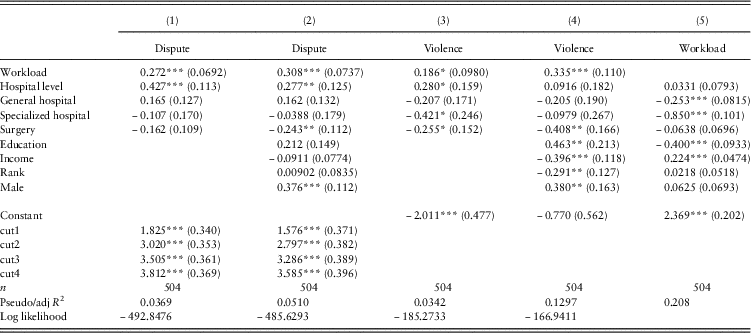
Regression analysis was employed to test the two hypotheses stated above. The results are reported in Table 5. The frequency of medical disputes encountered by respondents in the past 12 months was first regressed by two sets of variables in ordered Probit models. Column (1) is the benchmark regression where we controlled hospital-level variables, such as type of facilities (i.e. general, specialized, or community health centers), since the types of patient in different types of facilities may vary. We also controlled whether the respondent worked for a surgical department, since they are believed to bear greater risks in operations. Column (2) added individual-level control variables such as education, income, professional rank, and gender into the regression. The results reported in Columns (1) and (2) both support our first hypothesis. Respondents’ self-reported workload has significant positive effects on the frequency of disputes, as a higher workload may reduce the quality of clinical encounters and in consequence increase the likelihood of disputes. The regression results reported in Columns (1) and (2) also suggest that the hospital level has significant positive effects on the frequency of disputes, supporting our second hypothesis, that hospitals of higher grade are more vulnerable to disputes, not only because of the greater medical risks associated with their patients, but also because of their financial capacity to offer higher private compensation, as revealed by the qualitative analysis.
Regression results

Note: Standard errors in parentheses; *p<0.1, **p<0.05, ***p<0.01.
Source: Authors’ survey.
The likelihood of violent attacks, the extreme form of conflict, was regressed in Columns (3) and (4). While workload remains a salient predictor in Column (3), its significance further increased after individual-level control variables were added in Column (4). In other words, the workload effect (via quality of clinical encounters) is still present for the occurrence of violent attacks. However, the coefficient of hospital level was significant in Column (3) but not in Column (4), once individual characteristics were controlled. This result is conceivable since most disputes are settled privately before violence occurs. Hospital level in this context may not be a significant determinant for the occurrence of violence. With greater financial resources, higher-level hospitals may have greater capacity to prevent violence before it arises by offering payment, due to considerations related to reputation and social stability, as noted in the qualitative results. Column (4) suggests that individual characteristics of physicians are more closely associated with violent incidents. Junior physicians seem more vulnerable to violent attacks, in view of the negative association between high income and professional rank and frequency of violence. Another remarkable finding is that physicians with higher degrees are more likely to encounter violent attacks. One plausible explanation is that they are more likely to treat patients with more severe conditions.
Column (5) used OLS regression to analyze the predictors of workload. It shows that educational attainment and monthly income are positively associated with workload, suggesting that the remuneration system may have been designed to give physicians monetary incentives to attend to more patients – another finding consistent with the qualitative results presented above. One interesting finding is that the workload of graduate degree holders is lighter than those without. This may make service quality an even more important factor since physicians with lower qualifications actually attend to more patients.
6 Discussion
This article used a mixed-method strategy to analyze primary data collected in Shenzhen City and has provided preliminary explanations for the surge in medical disputes witnessed in China. It found a high frequency of various forms of conflict between Chinese doctors and patients and has sought to explain these medical disputes with micro empirical evidence. Among others, two key reasons have been found to be significant.
First, clearly, heavy workload and inappropriate incentives should be held partly responsible for the declining service quality and the exploding number of disputes. Because government subsidies account for a rather small fraction of hospitals’ operating budget, hospitals must generate income to recover costs, mainly by over-prescribing drugs and abusing profitable tests and procedures. It is common practice for profit-minded hospitals to set a revenue target and break it down to each clinical department. Departments follow the same practice and assign each physician with a target (Hsiao, Reference Hsiao2008). Worse, as physicians are rewarded for the quantity of patients seen, tests ordered, and drugs prescribed, rather than the quality of care rendered, clinical encounters have become a rather unpleasant, rushed experience for most patients. As such, the large volume of patients and profit incentives combine to mean that doctor–patient interactions are extremely brief and follow-up is rare (Liebman, Reference Liebman2013). Frustrated with long waits, short appointments, and poor attitudes, annoyed patients often resort to complaints or radical channels to express their discontent. Both the qualitative and quantitative analyses of this study have demonstrated that overload is closely associated with the likelihood of disputes, of which the victims are not only patients but also doctors.
Despite the proliferation of medical disputes in China, medical litigation remains rare. According to the Chinese Medical Association, more than 80% of medical disputes nationwide are resolved by under-the-table settlement, a majority of cases involving private compensation of patients, regardless of existence of malpractice or not.Footnote 18 While verbal conflicts and complaints are fairly common in most health systems when patients wish to express dissatisfaction or grievances, the widely reported violent attacks seem to be peculiar, if not unique, to China. Why do not disgruntled patients choose to file a malpractice suit? First, due to various deficiencies of the legal mechanisms, there is no credible system for injured patients to seek justice (Harris and Wu, Reference Harris and Wu2005; Wang and Oliphant, 2005). Second, legal proceedings involve so-called ‘medical review boards’ to determine the causal relationship between care and adverse medical outcomes, but patients often do not trust the boards because they are comprised exclusively of local doctors who are suspected of protecting their colleagues and sister hospitals (Liebman, Reference Liebman2013). Empirical evidence suggests a rather different picture, however; on average, 76% of malpractice claims in China are eventually supported at trial, and result in monetary compensation (Li et al., Reference Li, Wu, Sun, Li, Zhao, Liu, Gao, Sun, Zhang and Fan2014), a percentage considerably higher than in the United States (Weeks et al., Reference Weeks, Foster, Wallace and Stalhandske2001; Studdert et al., Reference Studdert, Mello, Gawande, Gandhi, Kachalia, Yoon, Puopolo and Brennan2006).
Despite the fairly high chances of winning compensation via legal channels, litigation appears not to be favored by Chinese patients. This is arguably because of the availability of greater compensation through non-legal channels, such as staging a protest, which also require much less time and expense. This is further compounded by the second major finding of our study. Not only patients but also hospitals seem reluctant to resolve disputes within the legal framework. Hospitals’ concern lies with their reputation and social stability while patients easily learn from numerous past cases that under-the-table negotiation may bring them higher monetary returns. Anecdotal observations, in-depth interviews, and quantitative analysis have all found that bigger hospitals are more vulnerable to disputes, part of the reason being their financial capacity to offer larger compensation. This has, however, encouraged patients and medical harassers to demand more, thus creating a vicious cycle.
7 Concluding remarks
For decades, health policy reform proposals have always put financing reforms, realignment of provider incentives, or organizational restructuring first. However, the crisis in China shows policymakers and advisors the detrimental consequences of hostile interactions between doctors and patients. While it is not unreasonable to expect systemic reforms to restore trust between the two parties, one must bear in mind that it may take much longer than anticipated to see the effects; in the meantime, the dysfunctional doctor–patient relationship continues to deteriorate. More importantly, there is fresh evidence suggesting that unhealthy interaction between doctors and patients has substantively altered the behavioral patterns of Chinese doctors, leading them, for example, toward defensive medicine. In other words, poor doctor–patient relationships are not only the consequence of misaligned incentives but also the cause of new distorted incentives.
The policy implications arising from this study are threefold. First, the dominant way of paying doctors and their heavy workload are clearly inappropriate. Pay-for-performance rather than pay-for-volume should be held up as a central principle in revising public hospitals’ incentive schemes. Second, while doctors’ workload must be normalized, new incentives should be introduced to encourage improvement of the quality of clinical encounters, especially in terms of communication. For instance, at the time of writing this article, the provincial health administration of Anhui announced new regulations aiming to reduce the outpatient quotas of crowded tertiary hospitals while setting a minimum requirement for the duration of each consultation.Footnote 19 Similar initiatives may help improve doctor–patient encounters and reduce medical disputes to some extent. Last but not least, a worrying finding of this study is the unpopularity of legal solutions. While under-the-table payments appear a rational choice for both hospitals and patients, many such dealings have fallen off the radar of the legal framework and are harmful to long-term social interests. The existing flaws of the Tort Liability Law need to be addressed to encourage legal resolution of medical disputes (Kearney, Reference Kearney2012). In the meantime, mandatory reporting of medical disputes should be strengthened and seriously enforced.
This study is not without limitations. First, the sheer size of China precludes the conclusions of any single-city case study being fully generalizable. Second, although the qualitative analysis has elucidated the link between heavy workload and frequency of medical disputes, and the effect has been reinforced by qualitative results, the design of the survey instrument did not allow us to measure the quality of clinical encounters, the intermediary variables related to medical disputes. In other words, the impact of workload on disputes as revealed in this study is indirect. Third, although the outpatient division is indeed a key area vulnerable to disputes, this study has not examined the effects of inpatient service. The use of outpatient consultation as a proxy of workload may not fully represent the quality of services. Last, intended to solicit physicians’ views, this study did not include opinions of patients. These limitations will be addressed in the authors’ future research.
Acknowledgments
This study was funded by the Early Career Scheme of the Research Grants Council (Ref. ECS859213), the Hong Kong SAR Government and the Dean’s Research Funding Scheme of the Faculty of Liberal Arts and Social Science at the Hong Kong Institute of Education (Ref. ECR2). The authors would like to thank Jieyi Luo and Luke Yuankun Luo for excellent research assistance. The authors have no conflicts of interest to disclose.