Over the nineteenth century, the economic gap between Europe and the Middle East widened.Footnote 1 The Ottoman Empire—the region’s largest economy—fell behind the industrialized West. Within the region, Muslims lost competitiveness and largely disappeared from trade; religious minorities—Greeks, Armenians, and Jews—came to enjoy a much larger share of the economy in Istanbul and other commercial centers in the Eastern Mediterranean (Kuran Reference Kuran2004; Artunç Reference Artunç2015). The Ottoman and later Turkish governments viewed Muslims’ disappearance from trade and industry as a critical element within the larger question of economic divergence, and the political elite was convinced that the creation of a Muslim-Turkish middle class was essential to achieve economic modernization and transition into modern economic growth (Toprak Reference Toprak1995).
The goals of development and improving “native” entrepreneurs’ competitiveness in industry and trade were not unique to Turkey; it was part of a nation-building wave across Eastern and Southern Europe, where discriminatory policies and ethnic persecutions also flared in the interwar period. In Turkey, previous discriminatory incidents against minorities—such as boycott campaigns on goods produced by non-Muslims and passing laws favoring Muslims in economic life (Çetinkaya Reference Çetinkaya2014; Akgönül Reference Akgönül, Fortna, Katsikas and Kamouzis2013)—came to a head in 1942 with the imposition of an extraordinary tax called the Wealth Tax (Varlık Vergisi) justified by the exigencies of the war economy.Footnote 2 The war had triggered a severe fiscal crisis as a result of military mobilization and a surge in prices. Much like the taxes other countries introduced at the time, the government issued the Wealth Tax ostensibly to relieve pressure on government finances, battle wartime profiteering and curb inflation.Footnote 3 The law itself had little to say about the rollout. Consistent with its nationalist designs, however, the government gave its officials discretion to charge non-Muslims higher rates (Ökte Reference Ökte1951). However, the lack of accurate information about personal wealth and income led to arbitrary assessments, further increasing non-Muslims’ tax burden and those who could not pay their assessments in time were sent to Aşkale, a labor camp in Eastern Turkey (Ökte Reference Ökte1951). Its arbitrary application and punitive implications made the Wealth Tax a powerful extractive tool.
While there has been a number of studies that relied on anecdotal narratives (Aktar Reference Aktar2000, 2006; Bali Reference Bali2012), a quantitative analysis on the Wealth Tax’s consequences remained absent until now due to data limitations.Footnote 4 Our article takes up the challenge of contributing to this empirical gap by assembling a novel dataset comprising the universe of more than 20,000 enterprises in Istanbul—by far, the largest and most important center of trade, finance, and industry in Turkey—between 1926 and 1950. For each cohort, we show that the tax had a heterogeneous impact on Muslim and non-Muslim businesses by estimating survival probabilities before and after the policy change, controlling for other firm observables. We find that the tax led to a substantial spike in non-Muslim liquidation rates relative to Muslim-owned businesses. It also reduced the formation of new non-Muslim enterprises. Thus, the tax contributed to religious minorities’ disappearance in Istanbul’s commercial life. In addition, the proceeds from the Wealth Tax were used to finance Muslim entrants, further facilitating the nationalization of Turkey’s business life. We show that the law had negative implications for Turkey’s economic growth: it prematurely removed the most productive firms, which were disproportionately owned by non-Muslims and were older, replacing them with less productive Muslim-owned startups that ended up dissolving fast.
Our results contribute to the broader literature on the failure of many non-Western economies, including Turkey and the Middle East, to catch up with Europe despite serious modernization attempts. Our findings show that, in the case of Turkey, the wider institutional framework mattered (North, Wallis, and Weingast Reference North, Wallis and Weingast2009; Acemoglu and Robinson Reference Acemoglu and Robinson2012). The Wealth Tax was an arbitrary, punitive mechanism borne out of nationalist state-making. In so doing, it led to the untimely liquidation of older, productive enterprises that had survived the turbulence of previous decades. We show that even one extractive policy, implemented just for one year, can have lasting consequences for firm dynamics. The government’s discriminatory policy likely created a misallocation of resources, specifically capital, which in other settings have caused low output per worker and low total factor productivity.Footnote 5 Thus, our findings suggest new sources of slow growth in Turkey’s total factor productivity, which drove its lopsided development in the early twentieth century (Owen and Pamuk Reference Owen and Pamuk1998; Altug, Filiztekin, and Pamuk Reference Altug, Filiztekin and Pamuk2008).
Our article is part of a growing literature on the broader economic contributions of minority groups and the consequences of their expulsion. Because Huguenots had occupied important industries such as textile manufacturing, Richard Cantillon (Reference Cantillon1756) argued that their expulsion caused France’s economic decline after 1684. While Cantillon’s argument was not empirical, modern studies support his view on how Huguenot migrants boosted the productivity of certain industries in the destination country (Fourie and von Fintel Reference Fourie and von Fintel2014; Hornung Reference Hornung2014). A similar literature on Jewish communities in Europe (Pascali Reference Pascali2016; Johnson and Koyama Reference Johnson and Koyama2017) show that Italian polities that expelled their Jewish communities in 1541 remained financially underdeveloped or had lower urban growth compared to the cities that did not. Daron Acemoglu, Tarek A. Hassan, and James A. Robinson (Reference Acemoglu, Hassan and Robinson2011), likewise, show that Russian cities and oblasts that experienced the Holocaust more intensely have lower population, wages, and income per capita today. Similar stark disparities between different ethno-religious communities emerged in the Middle East during the nineteenth century (Kuran Reference Kuran2004; Artunç Reference Artunç2015).Footnote 6 By the early twentieth century, non-Muslim minorities had overtaken Muslims in terms of physical and entrepreneurial capital (Kuran Reference Kuran2011). The implications of these differences, however, have rarely been examined.Footnote 7 In this article, we provide more evidence that support the view that Muslim enterprises—lacking the same entrepreneurial know-how—could not effectively replace the liquidated minority firms and exited the market soon after entry. Consistent with Cemal E. Arbatli and Güneş Gokmen (Reference Arbatlı and Gokmen2016), we show that asset transfer alone could not offset the loss of human and entrepreneurial capital.
HISTORICAL BACKGROUND
The Wealth Tax was a part of a broader nationalist state building that sparked a long series of incidents targeting non-Muslims during the painful transition from the empire to nation state. Until the reforms of the nineteenth century, the Ottoman population was divided into millets, separate communities distinguished by religion and ethno-linguistic affiliation. The millet system allowed the three major non-Muslim communities—Greek Orthodox, Armenian, and Jewish—the right to use their religious institutions for civil and personal law, providing them with considerable legal autonomy and authority. In this setting, ethnic identities were merged with the religious ones and constituted one of the bases for social stratification. Non-Muslims could not hold public office or serve in the military, but they enjoyed higher participation rates in trade and finance. The expansion of foreign trade and the distribution of European legal protection to local non-Muslims deepened the economic cleavage between Muslim and non-Muslims (Kuran Reference Kuran2004; Artunç Reference Artunç2015). As a result, by the early nineteenth century, the Ottoman ruling elite had already begun expressing concerns about non-Muslims’ favorable position in trade and the need to create a native mercantile class (Aksan Reference Aksan2007, p. 205). Additionally, religious differences in rural communities were intertwined with rural unrest in the Balkans and fueled proto-nationalist sentiments.Footnote 8 As a result, during the rising tide of nationalism in the nineteenth century, religion played an important role in the establishment of independent states in the Balkans (Cagaptay Reference Cağaptay2006, p. 5). Turkish nationalism developed largely as a response to curb efforts to dismantle the empire (Landau Reference Landau1992).
Following defeat in the Balkan Wars in which the Empire lost most of its European territories, Turkish nationalism turned increasingly hostile toward non-Muslims. Starting as a movement for liberal reform and representation for all ethnic groups of the Empire, the Young Turks transformed into a clique of ethnic nationalists determined to create a “national economy” and a Turkish homeland. The political front of the Young Turks, the Committee of Union and Progress (CUP), undertook policies to destroy the prominent position non-Muslims enjoyed through boycotts and exclusion from employment. During WWI, the CUP consolidated its power in Parliament and became more open in its efforts to achieve ethno-religious homogenization such that in Eastern Anatolia, attacks against Armenians and the accompanying plunder and confiscation of their property led to massive demographic restructuring in 1915,Footnote 9 while in Western Anatolia, many Greeks, pressured by expulsions and forced conscriptions, fled to Greece.
After the war, the nationalist cadres under the leadership of Mustafa Kemal Atatürk, succeeded in transforming the multi-communal Ottoman Empire into a parliamentary republic and a nation state.Footnote 10 To this end, the political elite continued to pursue policies to achieve ethno-religious homogenization. In the Turkish-Greek population exchange agreement following the Treaty of Lausanne, 1.2 million Greeks were forced to leave Anatolia in return for half million Muslims residing in Greece. As a result, by 1925, non-Muslims came to represent only around 2.5 percent of the overall population in Turkey, declining from 17 percent in 1911–1912 (Keyder Reference Keyder1987; McCarthy Reference McCarthy1982, p. 110). During the 1930s, when racist ideologies were on the rise in Central and Eastern Europe, the anti-non-Muslim stance of the Turkish state and the Turkish press became stronger (Cagaptay Reference Cağaptay2004). Thousands of Jews were forced to leave as a result of government-sponsored anti-Semitic propaganda, boycotts, and violent attacks in Eastern Thrace during the 1930s,Footnote 11 with anti-minority pogroms and expulsions continuing up until the late 1960s.Footnote 12
While demographic changes led to a homogenized population in most of modern-day Turkey by the end of the 1920s, policies aimed at creating a Muslim business class were only marginally successful. First, the economy remained dependent on foreign capital in the 1920s and 1930s (Tezel Reference Tezel2015). Second, Istanbul—by far, the definitive and largest center of commercial, industrial, and financial activity—retained most of its non-Muslim population, which continued to have a much larger presence in trade and finance relative to Muslims.Footnote 13 In 1935, Christians and Jews made up 24.6 percent of Istanbul’s population. At the same time, 49.6 percent of Istanbul’s Christian population and 48.5 percent of Jews were involved in industry or trade compared to 25.2 percent of Muslims, who predominantly held occupations in agriculture and administration (Turkey 1936).
Such a gap in economic participation was at odds with the government’s nationalist outlook. The state’s legitimacy depended on an alliance between the military-bureaucratic elite and local Muslim notables, most of whom were landlords and small-town merchants. Both viewed non-Muslims, with their stronger links to international trade networks, as a fifth column.Footnote 14 Moreover, earlier property redistribution in the 1920s from non-Muslims to Muslims proved to the government that similar policies could simultaneously create a “native” bourgeoisie and make it beholden to the state (Keyder Reference Keyder and Hirschon2003, p. 45).Footnote 15 Thus, the Wealth Tax emerged in this context of economic nationalism. While never explicitly stated in its rollout, the tax fulfilled two objectives. By disproportionately targeting non-Muslim businesses, it undermined non-Muslims’ economic prominence; by transferring confiscated capital of non-Muslim firms to Muslims, it boosted the share of Muslim enterprises within all business and industrial establishments.
Although political and economic nationalism were the main motivation for the Wealth Tax, a redistributive economic policy was also in line with the new development strategy that stressed the state’s role in managing the economy. The government launched this state-sponsored approach in response to the country’s dismal economic conditions in the early twentieth century. After the WWI, Turkey was still an agrarian economy with almost no industrial basisFootnote 16 and agriculture and mining were severely depressed due to wartime destruction. Like their Ottoman predecessors, Turkey’s ruling elite strove to facilitate industrialization, but was constrained by low levels of saving and the restrictions imposed on custom duties by the Treaty of Lausanne (Boratav Reference Boratav, Kazancıgil and Özbudun1981). In the 1920s, the government pursued free trade and liberal policies that supported private sector; while there was some industrial growth thanks to post-war recovery, the industrial base remained small.Footnote 17
In 1929, the Lausanne restrictions lapsed, giving the government full discretion over tariff and fiscal policy. But the severe decline in the price of agricultural goods and the deterioration in terms of trade with the Great Depression prompted the government to take a more active role in promoting the industry (Pamuk Reference Pamuk2014, pp. 188–89) leading Turkey to embrace a protectionist policy in international trade. At the same time, the government nationalized foreign-ownership railways and coal mines and established several state-owned enterprises in key sectors as part of the first five-year economic plan of 1934.Footnote 18 As a result, Turkey became a more closed, autarkic economy.Footnote 19
The government’s policy of state-led industrialization and import substitution helped engender a strong economic recovery in the 1930s relative to other countries in the Mediterranean (Pamuk Reference Pamuk2014, pp. 191–98; Gürsel and Pamuk Reference Gürsel, Pamuk, Görmez, Pamuk and Turan2010). These policies also likely played a role in reducing the share of non-Muslims during the interwar period.Footnote 20 In response to the dramatic decrease in trade volume in the 1930s, the state took over certain aspects of international trade. The government directly imported capital goods, imposed import quotas, and dictated which firms could import and distribute imports conditional on these quotas (Tezel Reference Tezel2015, p. 195). The state also extended credit to firms directly and also empowered some businesses for the distribution and retail of goods that state-owned enterprises produced (Tezel Reference Tezel2015, pp. 298–99). Thus, the government selectively favored certain private enterprises. In this context, we can think of the Wealth Tax as one more policy tool that the government could employ to improve Muslims’ competitiveness in the national economy.
The adoption of state-led industrialization as the primary development strategy had three other implications that paved the way for the Wealth Tax. First, the public sector’s expansion required new sources of public financeFootnote 21, such as the Wealth Tax, to raise revenue and transfer resources from the private to the public sector.Footnote 22 Second, statism prescribed extensive regulation and control of private business.Footnote 23 The single-party regime implemented tight restrictions on private enterprise, labor organization, and civic engagement in the 1930s. As such, the statist discourse helped propagate the idea that the private sector had to function in accord with national interests, justified restrictions on private enterprises, and rationalized expropriation.Footnote 24 The Wealth Tax, which served as an instrument of economic nationalization rather than a mere fiscal tool, must be seen within this broader ideological framework.
Third, the Wealth Tax became feasible because of the extraordinary conditions of WWII, whose outbreak created even more room for nationalist policies by plunging the economy into a severe crisis. While Turkish government maintained neutrality up until the very end of the war, it mobilized around one million men in 1939 to defend against a possible German or Soviet invasion (Deringil Reference Deringil1989). To meet the rising defense expenditure, it printed money, which led to inflation, while the breakdown of international trade resulted in acute scarcity and increased prices, for which the foreign trade commissioners and merchants, in particular non-Muslims, were held responsible. The national press accused non-Muslim merchants of profiteering, speculation, hoarding, and participating in the black market. The official justification of the Wealth Tax was to tax the “extraordinary” profits made during the war and reduce the amount of money in circulation. While the law itself did not make any explicit reference to non-Muslims as a distinct taxpayer category, the high-ranking officers’ and taxpayers’ accounts indicate that the bureaucracy assessed the tax burden based on each tax-payer’s ethno-religious identity.Footnote 25
HOW WAS THE TAX IMPOSED?
The Wealth Tax was officially justified with reference to the exigencies of WWII. Yet, in the mainstream press, the accounts of the officials in charge of implementing the tax, and taxpayers’ testimonies reveal that the tax was meant to be more than financial relief. Şükrü Saraçoğlu, who suddenly rose to the position of the prime minister after the unexpected death of his predecessor Refik Saydam on 7 July 1942, presented the law as a tool to eliminate foreigners and place Turkish markets in the hands of the Turks (Aktar Reference Aktar, Fortna, Katsikas and Kamouzis2013, p. 193). Due to the pressures of the foreign consulates, the government eventually came to accept that foreigners pay the same rate as Muslims. Non-Muslims, however, did not. Indeed, Saraçoğlu alleged that his government was targeting only the profiteering non-Muslims (Ökte Reference Ökte1951, p. 53). According to Faik Ökte, the director of finance for the province of Istanbul during this time, the finance department prepared tax assessments based on each taxpayer’s “estimated income” in the previous year. The department then prepared separate lists for non-Muslims, who paid four times the amount Muslims did at same level of assessed income.Footnote 26 The law was quickly promulgated on 11 November 1942. Local commissions were immediately set up to determine tax assessments and published them within a month. Until then, nobody knew their tax burden, or whether they would have to pay the tax at all (Ökte Reference Ökte1951, pp. 141–42). The final list mandated an imposition on 114,368 citizens with a total amount of 465,384,820 Turkish Liras, more than 6 billion U.S. dollars in 2016 prices.Footnote 27 Fifty-four percent of the taxpayers were from Istanbul and the amount they were assigned made up 68 percent of the total tax. The levy was a substantial burden on the average taxpayer, who was forced to pay, within two weeks and in cash, 12 to 15 times the GDP per capita at the time.Footnote 28 Most of the tax was collected from non-Muslims. While even these averages demonstrate the severity of the tax burden, they are somewhat misleading as tax assessments were highly skewed. The highest tax assessment class for non-Muslims comprised only 4 percent of all taxpayers; they ended up paying 54 percent of the entire tax assessment. This group’s tax payment per capita was about 21 times the national average. The amount assigned to all non-Muslims constituted 83 percent of the entire assessment in Istanbul (Aktar Reference Aktar2000, p. 154).
In practice, non-Muslims faced higher payments than the one-to-four ratio specified by the Finance Department.Footnote 29 Four aspects of the tax collection process were critical. First, loopholes in the law created arbitrary practices. The law did not set any standard procedure or objective criteria by which the tax liability could be determined (Ökte Reference Ökte1951, p. 25).Footnote 30 On paper, the officials were supposed to estimate taxpayers’ incomes in the preceding year. These estimations were made with minimal information collected from banks, other merchants, and party-affiliate committees consisting solely of Muslim politicians and tradesmen (Ökte Reference Ökte1951, pp. 47–48).Footnote 31 Hence, most were taxed based on the finance department’s estimates, which were “made out of thin air.” (Ökte Reference Ökte1951, p. 75). This led to arbitrary practices. Taxpayers’ and the Finance Department director’s testimonies indicate that personal animosities and political differences played a large role in determining each taxpayer’s burden (Ökte Reference Ökte1951, p. 95).
Second, taxpayers did not have any legal venue to dispute the taxes. They tried to object by writing petitions to the administrative authorities. According to Ökte, there were 24,316 such petitions, with the result that more than 19 million Turkish liras were deducted from the original assessment until the repeal of the tax on 15 March 1944. Most reductions, however, were due to “error of fact” and “duplicate assignments.” The state simply did not recognize its citizens’ rights in legally disputing fiscal obligations.
Third, the law undermined the security of property rights. If the tax was not paid in time, the authorities could confiscate not only the taxpayers’, but also their co-living relatives’ assets. In the first few weeks of the law, many taxpayers were forced to sell their assets at very low prices which had been one of the objectives of the government (Bali Reference Bali2012, pp. 360–65).
Fourth, the tax had to be paid within two weeks and payments had to be made in cash (Ökte Reference Ökte1951, p. 25). The short deadline for payments created liquidity problems for taxpayers, forcing them to liquidate their assets for less than their market value. Thus, the tax hit those with liquidity constraints—specifically, entrepreneurs whose assets were tied in illiquid investments, paving the way for a substantial wealth transfer.
The arbitrary assessment, the lack of a legal plea process, the unreasonably short time frame for collection, and the expropriation for unpaid taxes made the Wealth Tax an effective instrument for eliminating non-Muslims from the economy and facilitating massive wealth transfer from non-Muslims to Muslim entrepreneurs and the Turkish state.Footnote 32 The Wealth Tax also raised concern about the future co-existence between Muslims and non-Muslims in Turkey. In addition to feelings of injustice and resentment the tax induced in non-Muslim communities, it became a source of humiliation and fear. About 1,400 people—almost all non-Muslim—were sent to labor camps for non-payment (Ökte Reference Ökte1951, pp. 154–58). Additionally, more than 30,000 Jewish and 20,000 Greek Orthodox Christians left Turkey after the Wealth Tax (Okutan Reference Okutan2004, p. 195).Footnote 33
The Wealth Tax was supported by much of the national press during the 16 months it remained in effect with only a few national newspapers raising objections for which they faced political persecution.Footnote 34 The taxation of low income-earners received broad criticism, however, and even the bureaucracy in charge of administering the tax could not justify such assessments. Detailed coverage in the Western press first appeared in September 1943.Footnote 35 Cyrus Sulzberger’s articles in the New York Times likely had considerable influence on the Turkish government.Footnote 36 Only a few days after the articles were published, as a relief to small taxpayers, certain occupational categories (e.g., service providers and travelling salesmen) were pardoned from the tax.Footnote 37 Nevertheless, it was not until 15 March 1944 that the Parliament abolished the tax and wrote the remaining debts off. The practical difficulties in collecting the remaining debt as well as international pressure likely prompted the government to abolish the tax altogether. The course of the global conflict might have also played a role in the timing of the tax’s repeal. The success of the Fascist front in the early years of the war had made it easier for the Turkish administration to pursue a discriminatory, nationalist agenda.Footnote 38 As the Axis powers lost their strongholds in Europe and the international tide turned against nationalism and racism in 1944, the Turkish administration started to improve its relations with the Western Allies and, among other measures it took to this end, it abolished the Wealth Tax (Hale Reference Hale2012, p. 73; Çetiner Reference Çetiner2014, pp. 395–96).
DATA
We assemble a new dataset of enterprises established in Istanbul between 1926 and 1950.Footnote 39 We hand-coded business entries published in the Istanbul Chamber of Commerce’s official directories. Each directory, called Address Book (Adres Kitabı), presents a comprehensive list of all enterprises operating in the year the directory was prepared. As required by the Commercial Code, each business had to register their firm with the courts and the chamber of commerce. When these establishments were liquidated, their registries were struck out. These cross-sections are as close as possible to describing the population of each cross-sectional population.
It is not clear how frequently the Chamber published these directories.Footnote 40 For this article, we consulted the collections of the National Library in Ankara, Beyazıt Library in Istanbul, the archives of the Chamber of Commerce in Istanbul, and the New York Public Library and digitized the directories for the years 1929, 1935, 1938, 1941, 1944, and 1950 (İstanbul Ticaret ve Sanayi Odası 1929, 1935, 1938, 1941, 1950; Çetinkol et al. Reference Çetinkol, Yetiş, Özden and Tosbi1945). We also digitized a list that includes all defunct and active enterprises ever registered before 1926 in Istanbul (İstanbul Ticaret ve Sanayi Odası 1926, 1927). There are two other directories, 1917 and 1923, which we did not use for this study.Footnote 41 Our research did not yield any other similar sources.
Each directory was organized into distinct commercial or industrial activities, which named all firms engaging in that activity. A firm could—and did—participate in multiple activities. For each enterprise, the directory provided the following details: its registration (sicil) number, its name, its address, and its capitalization category. There were five categories of capitalization in ascending order: fourth to first classes and an “exceptional” class (fevkalade). The exceptional class consisted of firms whose capitalization exceeded TL 300,000 at the time. A business was assigned to first class if its capitalization was between TL 200,000 and TL 300,000. Second-class enterprises fell between TL 150,000 and 200,000. Third class was defined for capitalizations between TL 15,000 and 100,000. Anything below TL 15,000 was assigned into fourth class. These cutoffs were valid for all directories through 1941. The directory of 1944 did not report the capital class. The 1950 directory revised the cutoffs as follows: fourth class lower than TL 10,000, third class between TL 10,000 and 50,000, second class between TL 50,000 and 100,000, first class between TL 100,000 and 200,000, and “exceptional” higher than TL 200,000.Footnote 42 Prices were stable until 1941 so capital categories are consistent for directories published before 1944.
We used the directories to tease out more details about ownership characteristics. We assigned each firm an enterprise form based on the naming conventions required by the Commercial Code of 1926. Single proprietorship had to use the owner’s name and nothing else. Partnerships had to either list all partners with unlimited liability (i.e., the general partners) or use one general partner’s name followed by a phrase such as “brothers” (“biraderler”) or “and company” (“ve şürekası”) to indicate multi-ownership. Any private limited liability company’s name had to be appended with the suffix “Limited” (Ltd.). Similarly, any corporation’s name had to contain the phrase “Türk Anonim Şirketi” (T.A.Ş). These rules allowed us to classify each entry as a single proprietorship, partnership, private limited liability company, or corporation.Footnote 43
For single proprietorships and partnerships, we were also able to use the name of the owner(s) to assign each firm an ethno-religious identifier. Differences between Turkish, Greek, Armenian, and Jewish (most of whom were Sephardic) names are evident. As a further robustness check, we also utilized the records of the Istanbul Jewish Genealogy Project, which has collected the surnames of the Jewish community based on more than 35,000 marriage and death records from 1887 onwards.Footnote 44 Our methodology allowed us to designate single proprietorships and partnerships as Turkish (Muslim), Greek, Armenian, Jewish, or Europeans. For partnerships we also have two additional categories: mixed non-Muslim firms made up of partners from different minority or European groups, and mixed Muslims firms comprising at least one Muslim partner and one non-Muslim or European partner.
For limited liability companies and corporations, the best we could do was to distinguish foreign companies from domestic ones. Any PLLC or corporation had to use a Turkish name, but beyond that, these names did not systematically reveal anything about the owners, which is consistent with the nature of incorporated enterprises.
Finally, we exploited the registration numbers themselves to infer years of establishment. In 1926, the new commercial code mandated the assignment of registration (sicil) numbers to each enterprise that ever existed in Istanbul’s registry, whether active or out of business. This list was then published between 1926 and 1927. We were not able to ascertain any pattern to the number assignment for firms established before 1926. Starting from 1926, the numbering was chronological. Furthermore, each city had its own sicil and a particular set of registration numbers. This registration numbering system remained de-centralized until 1956. Since numbering was local, any registration number between 1 (the smallest in our dataset) and 43,125 (the largest) is assigned to a single distinct business in Istanbul. No number was skipped (though they are not necessarily in our dataset), and no number was assigned to a firm whose legal office was outside of Istanbul. By consulting the Chamber’s records, we were able to define cutoff registration numbers for each year, thus yielding a “birth year” for each enterprise.
The directories did not consistently give all this information. The 1929, 1935, and 1938 volumes excluded firms of fourth capitalization class altogether. The 1944 directory did not report capitalization class or sicil numbers. Although the nominal cutoffs for capitalization categories remained constant during our period (except 1950), rampant inflation during WWII makes comparisons between 1941 or earlier registries and 1950 suspect. Moreover, our method does not reveal anything about the identity of limited partners (whose names did not appear in the firm’s legal name). Thus, while unlikely, there could be potentially many more companies whose partners were of different ethno-religious backgrounds. Finally, our ethnic classification cannot identify the small number of Sabbateans (dönmes), who were subject to extraordinary assessments (Ökte 1950, pp. 92, 99). Since dönmes used Muslim names, they have been categorized as Muslims in our analysis. This omission, due to practical difficulties, might bias the results against our hypothesis by overestimating the negative impact of the tax on Muslims.
One might also be concerned about the reliability of de-registrations. Since the de-registration process itself is somewhat costly, most enterprises had no real incentive to strike their names out after they were dissolved. Our sources are not affected by this kind of selection. The point of the commercial directory is to give the most up-to-date information about active businesses. In the comprehensive list of 1926, the cross-section did distinguish between firms that were active, de-registered, and inactive but not de-registered. Inactive firms were not listed with a known address or telephone number. Given this procedure, the directories were unlikely to contain defunct businesses.Footnote 45
OVERVIEW OF ENTERPRISES IN ISTANBUL BETWEEN 1926 AND 1950
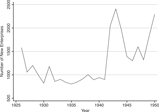
Istanbul had long been the commercial, financial, and industrial heart of the Ottoman Empire. While no longer the capital under the nascent Turkish Republic, the city retained its prominent position as the largest port for international trade, center of commodity trading, and the largest financial market in the country.Footnote 46 As such, Istanbul’s commercial life reflected the broader developments in Turkey’s economy. Figure 2 shows that for much of the interwar period, business entry remained stagnant after falling sharply in 1927. One can easily identify the big jump in 1942 and 1943. As we will show later, this is the Wealth Tax, which led to the liquidation of non-Muslim businesses whose assets were used to finance “Turkish”-Muslim startups.
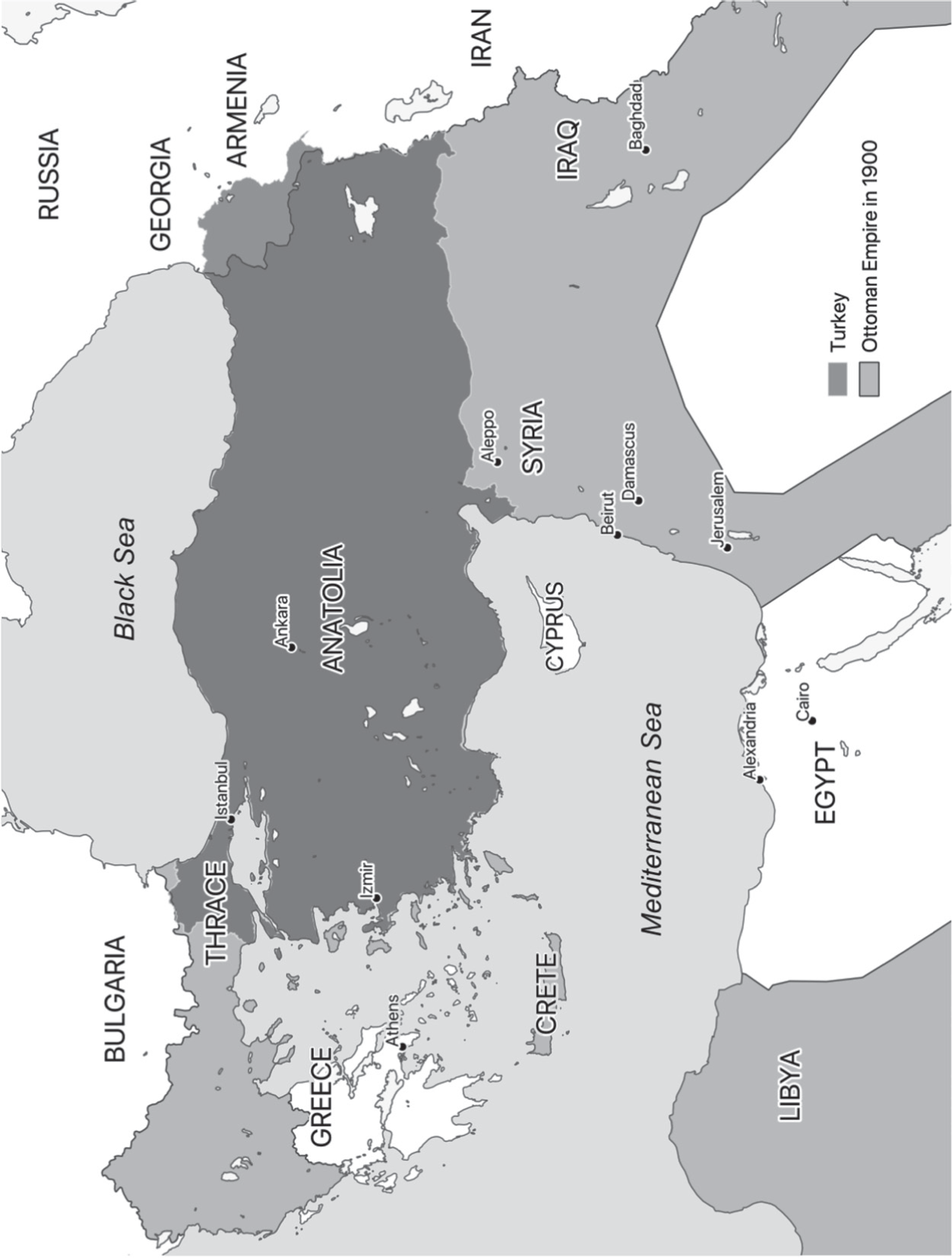
OTTOMAN EMPIRE IN 1900 AND MODERN TURKEY

NEW ENTERPRISES IN ISTANBUL BY YEAR, 1926–1950

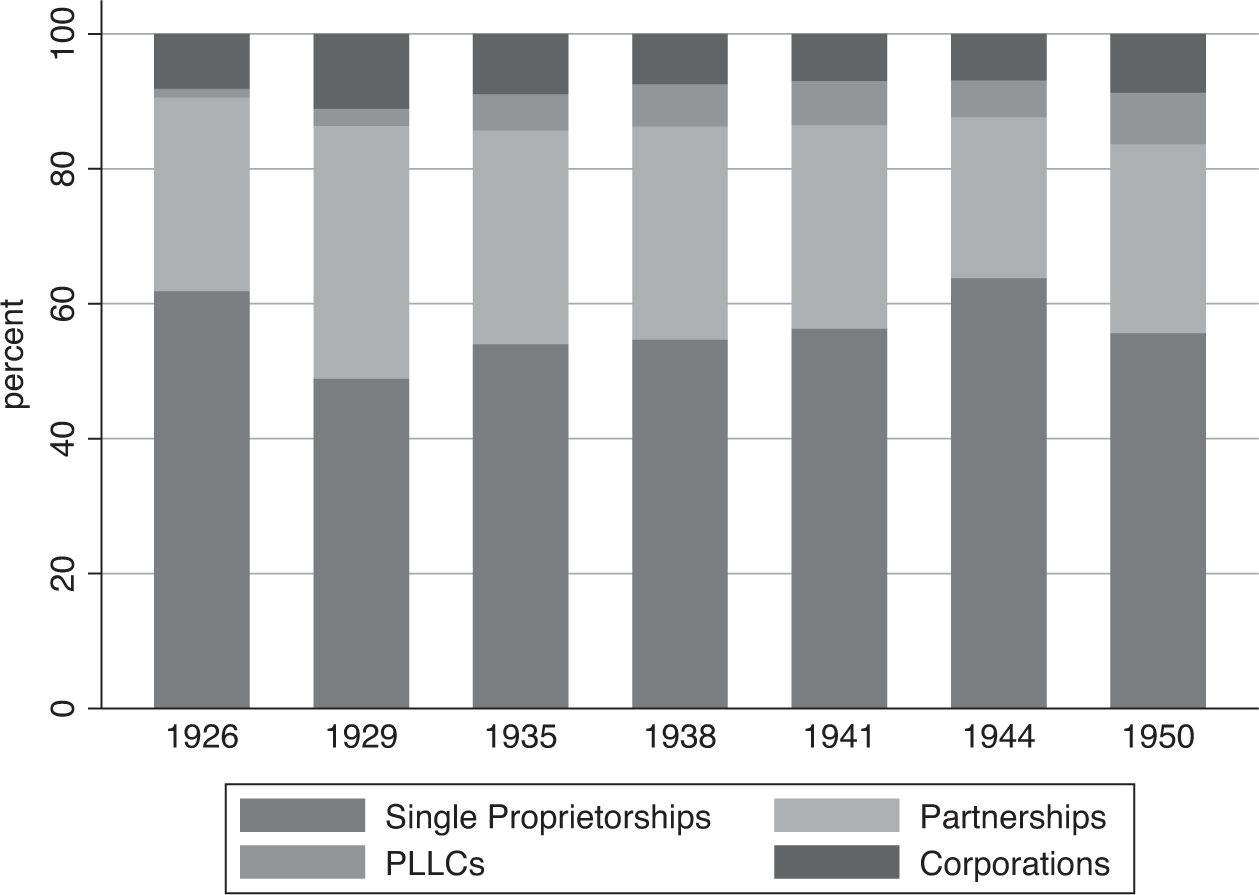
Most firms were also organized as single proprietorships or unincorporated partnerships, as reported in Figure 3. The preponderance of single proprietorships is not surprising as it is a common way to organize small businesses.Footnote 47 What is perhaps more unusual is the lack of popularity of the private limited liability company, which quickly became the dominant legal form in whatever European economy it was introduced.Footnote 48 While this is the subject of a different line of research, restrictions on forming private limited liability companies were likely responsible for their small share in the distribution.Footnote 49
ENTERPRISE FORM DISTRIBUTION OF CROSS-SECTIONS

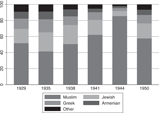
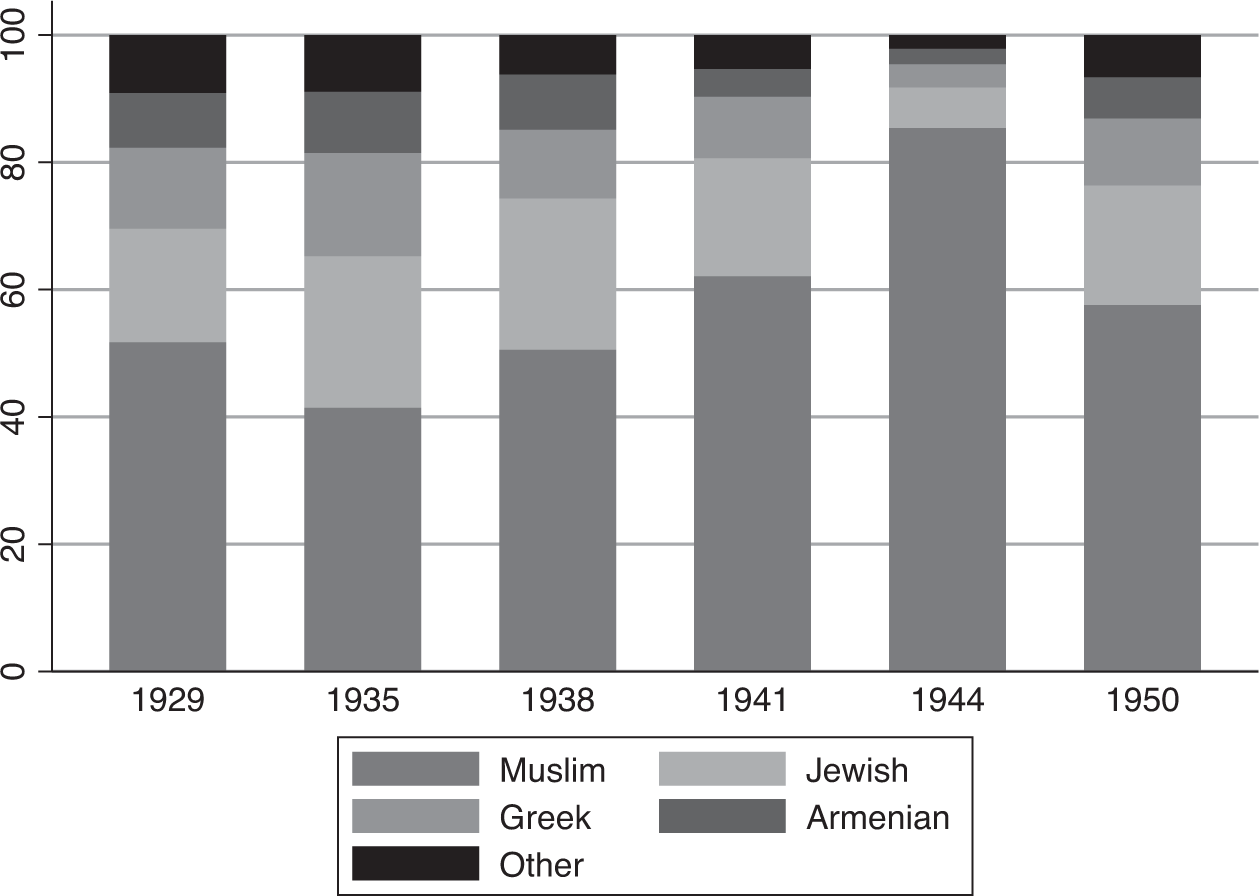
Figure 4 shows the breakdown of single proprietorships and partnerships by ethno-religious identity of the owners across different cross samples. Figure 4 plots a similar ethno-religious distribution among new business entries in each directory. While Muslims were certainly active in trade, minorities enjoyed a much larger share relative to their size. Muslims had between one and two businesses per 1000 Muslims in Istanbul between 1935 and 1950 compared to two to six Christian enterprises per 1000 Christians, and six to 13 Jewish firms per 1000 Jews.Footnote 50 Most companies were fairly homogeneous, overall. The share of Muslim and non-Muslim mixed enterprises among all partnerships remained around 3.3 percent with little change before and after 1944. The share of mixed non-Muslim firms (e.g., a partnership with one Greek and one Armenian partner) was even smaller at about 1.3 percent.
ETHNO-RELIGIOUS DISTRIBUTION OF CROSS-SECTIONS

Figures 4 and 5 reveal salient differences in the evolution of Muslim and minority enterprises. The Great Depression affected Muslim enterprises significantly more severely and led to a sharp decline in Muslim enterprises’ total share. This is due to a much higher rate of liquidation among Muslim enterprises and a similar decline in the share of Muslim entrants. Our regression analysis later shows that these differences are robust to sectoral or size effects.
ETHNO-RELIGIOUS DISTRIBUTION OF ENTRANTS

Throughout the 1930s, Muslim participation in business slowly recovered, possibly due to the government’s statist development strategy that favored Muslim enterprises. However, Muslim entrepreneurs could not displace non-Muslim firms until the second big shock: The Wealth Tax. The levy dramatically altered the make-up of firm owners in Muslims’ favor. Although minority firms reverted back somewhat by 1950, they never fully recovered.
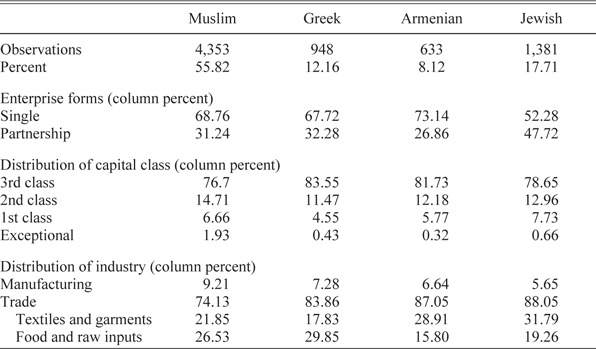
Heterogeneity across enterprises of different ethno-religious groups went beyond a matter of numbers. Table 1 reports ownership characteristics, capitalization, and sectoral distribution of all distinct single proprietorships and partnerships that appear in the directories. These figures remained remarkably stable across directories, justifying a pooling of the data. Consistent with earlier discussion, most businesses were single proprietorships rather than partnerships. Muslims, Greeks, and Armenians were more similar in this regard, while Jewish entrepreneurs were more likely to pool their assets to form partnerships. About half of all Jewish enterprises consisted of partnerships, but partnerships owned by any other group made up 27 to 33 percent of all firms within that community.
FIRM OWNERSHIP, LEGAL FORMS, CAPITAL, AND INDUSTRY, 1926–1950

Notes: The sample includes all cross-sections of single proprietorships and partnerships, with the exclusion of firms with capital class four. Industries are not mutually exclusive. Textiles and garments refer to dry goods that include anything from spun cotton to finished clothing, from plastic shoes to leather hats. Food and raw indicates any food item (fresh or processed), any agricultural good (whether food item or industrial input), skin, untanned leather, mohair, etc.
Source: Authors’ calculations based on data from İstanbul Ticaret ve Sanayi Odası (1926, 1927, 1929, 1935, 1938, 1941, 1950); Çetinkol et al. (Reference Çetinkol, Yetiş, Özden and Tosbi1945).
Second, Muslim companies, on average, had higher capitalization. True, most firms were small. The median business in any group was a single owner with a third-class establishment. However, Muslims had a significantly lower share at this lower tail compared to the other groups. In other words, while Muslim participation was more meager relative to their share in the population, they had a higher proportion of more heavily capitalized firms. Of these larger businesses, 60 percent of first-class and 76 percent of exceptional-class firms were owned by Muslims.
Finally, while most firms were overwhelmingly mercantile establishments, there was partial specialization among ethnic groups. Muslims had a higher concentration in manufacturing and non-Muslims in trade.Footnote 51 Within trade, Muslims and Greeks were relatively more active in trading foodstuff and agricultural products, while Armenians and Jews were found more in the trade of various textiles and garments. Regardless, the idea that entire sectors had been overtaken by one specific group is decidedly false.
THE DIFFERENTIAL IMPACT OF THE WEALTH TAX
The raw data outlines the differences in owner characteristics of each cross-section and how firm ownership in Istanbul changed over time. Even though the evidence suggests that the tax was responsible for the sharp decline of non-Muslim enterprises from 1941 onwards, this section explores the issue in more detail in order to disentangle how much of the tax directly targeted non-Muslims, rather than incidentally affecting them through its impact on other factors.
Ideally, one would undertake a continuous duration model, such as parametric failure-time models or Cox proportional hazards, to estimate the effect of covariates on survival time or time-to-failure. Unfortunately, our data do not permit this technique. We do not observe firms over the entirety of their life cycles. Without knowing the exact formation and liquidation dates, continuous duration models are infeasible. Instead, we focus on linear probability models with fixed effects and treat survival over a certain number of years as a binary outcome, though our results are robust to using logit models.
A challenge arises from the way the samples were published. The directories give snapshots at specific intervals. If the directories were annual, we could have adopted a straightforward interpretation of annual survival. Instead, we interpret our model as either distinct survival events between directories or survival likelihood conditional on having survived the period between establishment and the next closest directory date. The empirical strategy invites some degree of selection. For instance, 779 new firms were added to the directory in 1938. The registration numbers indicate that about 2,700 firms actually entered the market between 1935 and 1938. Hence, our dataset is missing approximately 2,000 enterprises formed and liquidated between the publication of the 1935 and 1938 directories. This selection does not affect the main results since our empirical analysis stresses longer survival windows (three to nine years). In fact, we likely underestimate the baseline dissolution risk of Muslim firms because early dissolutions seem to be predominantly Muslim-owned businesses. Assuming ethnic composition of entrants did not change too much between consecutive years, older firms in each directory’s entrants have a lower share of Muslim firms. More precisely, the share of Muslims enterprises among 2-year-old firms is 5 to 7 percentage points lower relative to firms formed in the very year the directories were published.
The inconsistency of intervals between directory publications raises another potential issue. This interval can be three years (1926–1929, 1935–1938–1941) or six years (1929–1935, 1944–1950). In order to make meaningful comparisons, we restrict attention to survival windows: the likelihood of a firm surviving for three, six, or nine years.
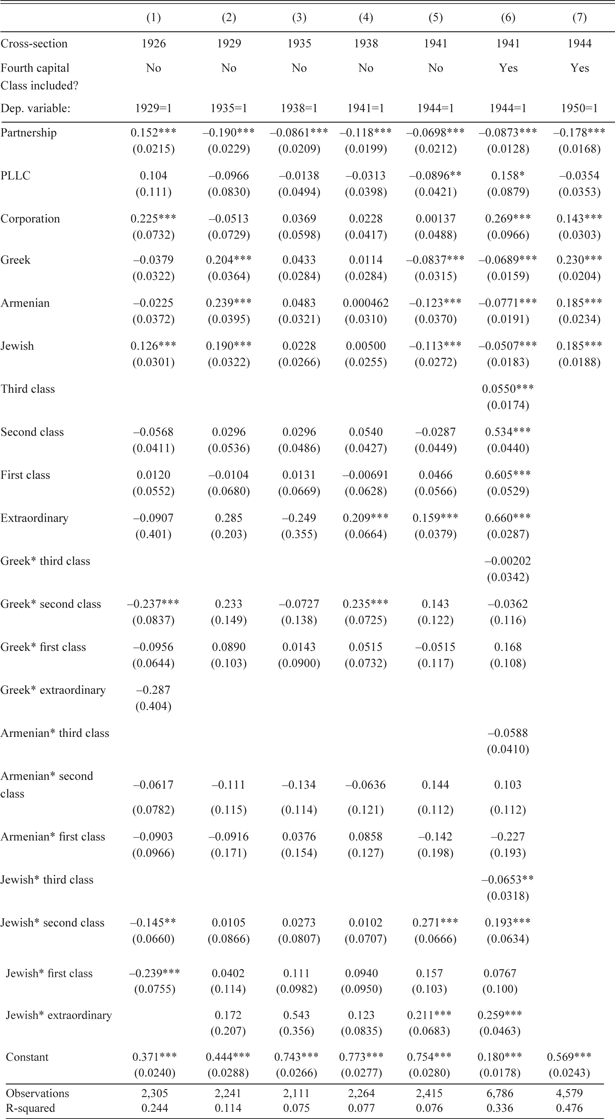
We start by treating surviving into the next subsequent registry as a binary event. This is a linear probability model of survival between any two consecutive directory listings. The set of covariates include dummies for enterprise forms, with the single proprietorship being the reference group, dummies for ethno-religious groups, capital class, industry dummies, and establishment-year dummies (as imputed from the registration number). Our main interest is survival between the directories 1941 and 1944, when the Wealth Tax was imposed. We run two sets of regressions for survival from 1941 to 1944, one that includes firms of the fourth capital class and another without. Firms of this low capital class were not reported in the 1929, 1935, and 1938 cross-sections. The final regression, survival from 1944 to 1950, does include all firms but their capital class is not reported so we do not include the capital dummies in this regression.
Table 2 reports the results of survival estimations across consecutive directories. Enterprises had different survival probabilities based on owner characteristics depending on the period. Muslim firms were 20 percentage points more likely to dissolve during the years of Great Depression, 1929 to 1935. In subsequent periods, ethno-religious groups were not statistically different from each other. All non-Muslim enterprises active in 1941 were on average 8 to 12 percentage points less likely to survive to 1944 relative to Muslim firms. This is the impact of the Wealth Tax.
ESTIMATES OF SURVIVAL ACROSS REGISTERIES

Notes: Columns report the coefficient results of linear probability regressions where the dependent variable is a dummy variable indicating whether a business survived from one directory to the other, as indicated by each column. All estimations include industry and establishment-year dummies as well as other ownership characteristics (e.g., the few firms with mixed non-Muslim owners). Industry categories are banking, insurance, transportation, manufacturing, construction, services (including restaurants, cafés, cinemas, etc.), printing and publishing, mining, commission agents, trade of dry goods (textiles, garments, shoes, etc.), trade of food and raw products (including raw cotton, flax as well as untanned leather, hide, etc.), trade of chemicals, trade of metals and machinery, and trade of fuel. Firms with capital class of four are excluded unless noted otherwise.
Robust standard errors in parentheses.
Significance levels: *** p<0.01, ** p<0.05, * p<0.1
Source: Authors’ calculations based on data from İstanbul Ticaret ve Sanayi Odası (1926, 1927, 1929, 1935, 1938, 1941, 1950); Çetinkol et al. (Reference Çetinkol, Yetiş, Özden and Tosbi1945).
While we have no way of directly estimating firm productivity, we can infer how productivity differed between Muslim and non-Muslim enterprises from exit rates.Footnote 52 This is supported by the literature that has established links between firm age, survival, and productivity. As markets select against firms that consistently perform worse on average, only enterprises that can sustain a persistent competitive advantage through innovation and higher productivity can survive, leading to a “survival bias” (Levinthal Reference Levinthal1991; Brüderl, Preisendörfer, and Ziegler Reference Brüderl, Preisendörfer and Ziegler1992; Baker and Kennedy Reference Baker and Kennedy2002; Bartelsman, Scarpetta, and Schivardi Reference Bartelsman, Scarpetta and Schivardi2005; Bellone et al. Reference Bellone, Musso and Nesta2008). The Wealth Tax removed older non-Muslim firms, which were robust enough to have survived the “cleansing effect” of the Great Depression,Footnote 53 from the market and replaced them with new Muslim enterprises. These Muslim firms, on average, were likely less productive because they were younger and their Muslim owners did not share non-Muslims’ history of entrepreneurship (Kuran Reference Kuran2011). Hence, post-1941 Muslim entrants dissolved quickly, especially during the severe recession of 1943–1945.Footnote 54
A similar pattern emerges on the entry side. A growing literature shows that firm entry rates are cyclical, but the average quality of entrants is counter-cyclical (Moreira Reference Moreira2016; Artunç Reference Artunç2017). Figure 1 shows an overall decline in firm entry during the economic downturns of 1929–1932 and 1944–1945. Figure 5 shows that this decline is driven by a substantial drop in Muslim firms’ entry rates during both periods of recessions in 1929–1935 and 1944–1950. Hence, our results are consistent with the view in the literature that Muslim firms were less productive (Gürpınar 2013, p. 112; Arbatlı and Gökmen Reference Arbatlı and Gokmen2016; Kuran Reference Kuran2011).
Our central thesis is that the arbitrary assessment and collection of the Wealth Tax led to a disproportionately higher exit rates among firms with non-Muslim ownership. However, our period of interest was a turbulent one and there might be other factors driving our main result. First, non-Muslims could have had easier access to raising capital due to better connections to European credit networks.Footnote 55 In theory, this would bias against our hypothesis. Suppose Muslim and non-Muslim firms are drawn from the same productivity distribution. If non-Muslim firms had cheaper access to capital, a greater share of lower-productivity non-Muslim businesses would be able to enter. Thus, non-Muslim firms should have higher dissolution rates overall, especially during recessions, as well as lower entry rates in busts relative to Muslims. This is the exact opposite of what we observe in the data.
In our regressions, presented in Table 2, we include the interaction of ethnicity and capital class dummies to test whether capital class had a differential impact on exit by group. Generally, we cannot reject the hypothesis that the associated coefficients are statistically different from zero. The only exceptions were the Jewish firms, for whom higher capitalization categories (second and extraordinary classes) had a differentially positive effect on survival between 1941 and 1944. The results suggest that Jewish entrepreneurs might have had better access to capital and that it helped them stave off the impact of the tax. These firms made up less than 3 percent of all Jewish firms in 1941 and the main negative effect remains robust. This empirical exercise shows that access to capital was not the main driver of the heterogeneous exit rates between Muslim and non-Muslim businesses.
The fact that the Wealth Tax was implemented in the middle of WWII raises an important concern. Perhaps our findings reveal some other differential impact of the period. Several aspects of the war might have actually helped non-Muslim firms. Conscription mainly affected Muslims and so would have benefited non-Muslim entrepreneurs by reducing competition. The war severely affected the agricultural sector and the trade of primary goods. Distributors and retailers of agricultural products had a higher concentration of Muslims than other sectors so the impact fell more on Muslim firms than non-Muslim firms.Footnote 56 More directly, all regressions fully control for industry categories. While there are some differences in exit rates between industries (e.g., manufacturing and mining firms are more robust), the differential impact of the Wealth Tax on non-Muslim businesses is robust.
Most importantly, the war disrupted global trade. Turkey’s export volume fell precipitously between 1939 and 1946 (Tezel Reference Tezel2015, pp. 136–37). The historical literature suggests that non-Muslims were particularly concentrated in the European export trade (Keyder Reference Keyder and Quataert1994, pp. 139–40). If this is the case, then the negative shock to exports might have affected non-Muslim businesses more than Muslim firms, biasing our results.
We rule out this argument with several pieces of empirical evidence. The fall in exports was part of a broader trend since the Great Depression and had little differential effect on non-Muslim firms. Furthermore, the war’s impact on trade manifested early, in 1939 and 1940, but our regressions reveal no effects on non-Muslim firms between 1938 and 1941 (see columns 4 and 5 in Table 2). Fortunately, export firms were reported in the 1941, 1944, and 1950 samples. So, we can directly test whether export and non-export firms have different ethnic distributions and whether being an export firm had a significant impact on survival. Export firms made up a small part of our sample, accounting for about 20 percent of all enterprises. Furthermore, the ethno-religious distribution of export and non-export firms in 1941 was not statistically different.Footnote 57 Third, when we include the export dummy in our registry-to-registry-survival regressions, reported in the Online Appendix Table A1, we find that the export firms were 12 to 14 percentage points more likely to survive the tax shock, opposite of what the alternative argument suggests.
Alternative Specifications
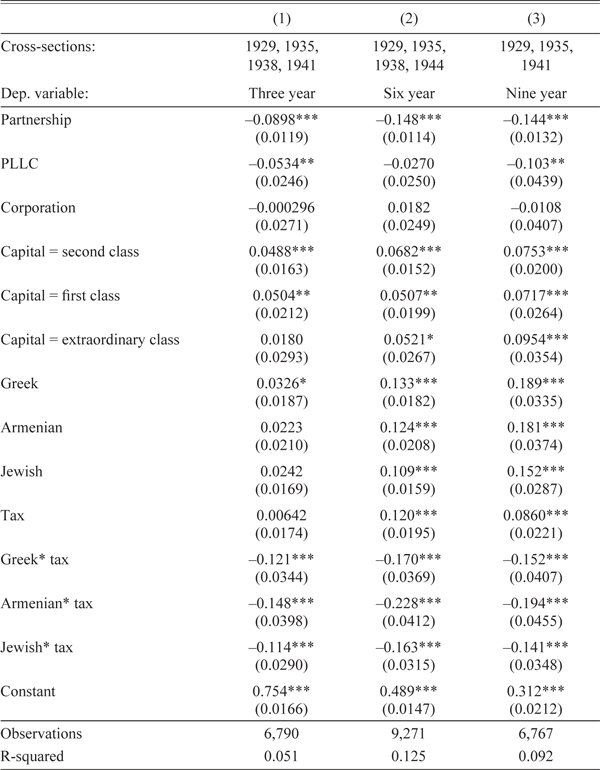
The main point we underline here is robust to other empirical specifications. Our second estimation strategy is essentially difference-in-differences where we focus on three-year, six-year, or nine-year survival windows. Our hypothesis states that the tax had a differential effect on Muslim and non-Muslim firms. We estimate a linear probability model where the dependent variable takes a value of one if the firm survived the fixed period in question. The critical covariates consist of the tax treatment (which indicates whether the timing of the tax was within the estimated survival event), ethno-religious identifiers, and their interactions. We have the usual control variables as before: enterprise form dummies, capital class dummies and their interactions with ethnic identifiers, industry fixed effects, and birth-year dummies.
Table 3 displays the estimation results. On average, non-Muslim enterprises enjoyed lower failure rates than Muslims did, 11 to 18 percentage points depending on the group and the survival window, reflecting these firms’ higher resilience. The tax itself had a positive effect on Muslim businesses, improving the six-year and nine-year survival of Muslim firms by 12 and 9 percentage points, respectively. In contrast, the tax had a substantial and negative effect on minority firms, associated with at least 12 percentage points higher liquidation risk. The differential effect of the tax on non-Muslim firms increased even further for longer survival windows. In other words, the Wealth Tax was particularly effective in raising the attrition of non-Muslim firms over the long run. Table A2 of the Online Appendix repeats the same regressions but also includes ethnicity and capital interactions. The interactions terms are not significant and neither is the triple interaction term of ethnicity, capital, and tax treatment, showing that our results are not driven by differential access to capital.Footnote 58
SURVIVAL ESTIMATES OVER THREE, SIX, AND NINE YEARS

Notes: Columns report the coefficient results of linear probability regressions where the dependent variable is a dummy variable indicating whether a business survived a fixed period of time. This fixed period is three years in column 1, six years in column 2, and nine years in column 3. Each estimation includes (but does not report) the full set of industry dummies, establishment-year dummies, other owner characteristics (e.g., mixed companies) and their interactions with the tax shock (e.g., mixed company interacted with tax treatment).
Robust standard errors in parentheses.
Significance levels: *** p<0.01, ** p<0.05, * p<0.1
Source: Authors’ calculations based on data from İstanbul Ticaret ve Sanayi Odası (1926, 1927, 1929, 1935, 1938, 1941, 1950); Çetinkol et al. (Reference Çetinkol, Yetiş, Özden and Tosbi1945).
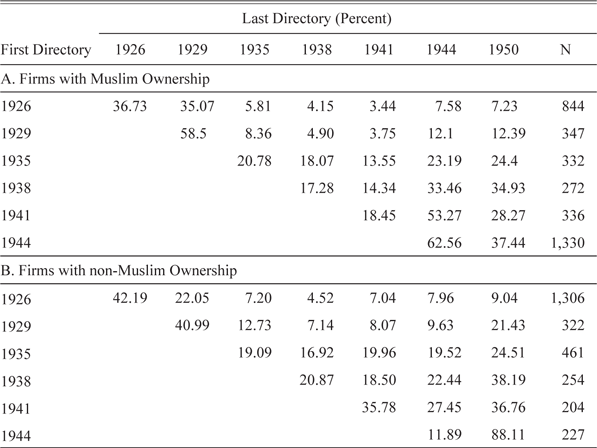
Our final specification treats new entries in each directory as distinct cohorts and estimates cohort-specific survival. In other words, the 1929 cohort describes firms established between 1926 and 1929, the 1941 cohort those that were “born” between 1938 and 1941, etc. The only exception here is the 1926 group, which contains all extant firms in 1926. Descriptive data give a preview of the result. In Table 4, we report the last-directory distribution for each of these cohorts by ownership characteristics. For instance, the first column shows that 18 percent of all Muslim-owned firms that first appeared in 1935 were last listed in the 1938 directory, that is, they did not exist past 1938. Three patterns emerge. First, a much higher proportion of Muslim-owned firms dissolved during the Great Depression within the 1926 or the 1929 cohorts. Second, the Wealth Tax was a severe negative shock on non-Muslim firms, whose survival rates between 1941 and 1944 were 5 to 17 percentage points lower relative to Muslim firms regardless of cohort. Third, non-Muslim enterprises that survived the tax shock or entered the market after the tax was repealed had higher survival rates after 1944, especially the 1944 cohort. Eighty-eight percent of non-Muslim entrants in 1944 survived until 1950 compared to the 37 percent of the Muslim cohort. This group of Muslim entrants was also significantly larger in number compared to any previous cohort. The evidence suggests that the Muslim firms that replaced the dissolved non-Muslim enterprises were not as resilient and dissolved much more quickly.
FIRST AND LAST DIRECTORIES BY OWNERSHIP

Notes: Each row represents a particular “cohort” of firms that first appeared in the indicated cross-section. Columns indicate the last cross-section in which a firm is listed. The cells report the percentage distribution of each cohort across their last directory listings.
Source: Authors’ calculations based on data from İstanbul Ticaret ve Sanayi Odası (1926, 1927, 1929, 1935, 1938, 1941, 1950); Çetinkol et al. (Reference Çetinkol, Yetiş, Özden and Tosbi1945).
We explore cohort-specific survival more rigorously by estimating linear probability models for each cohort separately. We include our previous set of controls but consolidate industry categories into finance (banking and insurance), manufacturing, services, commission agents, trade of dry goods, trade of agricultural products, and a residual category because, otherwise, some cells end up with few observations. Tables A3 to A5 in the Online Appendix provide the full regression results out of a linear probability model that also includes ethnic and capital interactions.Footnote 59
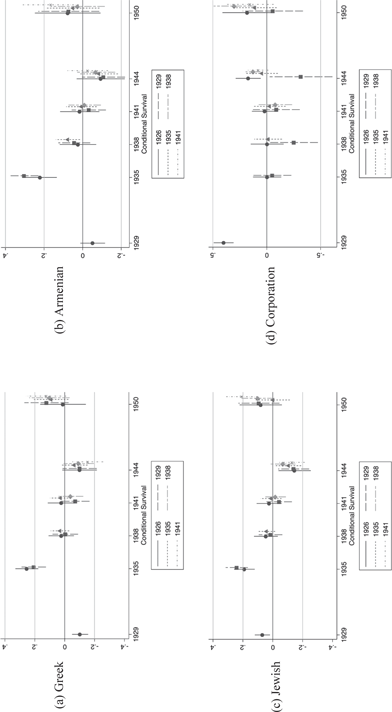
Figure 6 plots the coefficient estimates for ethnic dummies and the corporation dummy. While the cohorts do exhibit some differences, the Wealth Tax had a robust, negative effect on minority firms’ survival relative to Muslim firms, especially for the older cohorts of 1926 and 1929. For each minority group, conditional on having survived up to 1941, the tax lowered survival probability by 12 to 18 percentage points relative to Muslim firms. For younger cohorts, the effect was somewhat less severe, but still statistically significant, at about 9 to 12 percentage points. The Wealth Tax hit the older firms particularly hard.
ESTIMATED COEFFICIENTS WITH 95 PERCENT CI

Our cohort-specific survival estimates also reveal that larger capitalization could not help against the tax’s severe effects unless the firm belonged to the highest, “extraordinary” capital class. In unincorporated firms, capitalization is tightly linked to owners’ wealth so partnerships with large capitalization likely had wealthier owners. Since these firms had better success in surviving the tax shock, our results suggest that the wealthiest individuals could stave off the tax more effectively and protect their firms’ assets. This shielding effect might have emerged for several reasons. The chaos and arbitrariness with which the tax was imposed prevented the assessors from making sound inferences about taxpayers’ wealth. Richer individuals or firms with higher capitalization might have also faced slacker liquidity constraints, and thus could come up with the demanded payments within the required 15-day period. Finally, the firms at the very top end of the capital distribution might have been owned by individuals who had the necessary political connections and clout to secure tax reductions.Footnote 60
Perhaps surprisingly, Figure 6 shows that being a corporation had little effect on firm survival. This goes against the established view that the corporate form allowed the formation of persistent enterprises (Chandler Reference Chandler1977; Cochran Reference Cochran1977; Guinnane et al. Reference Guinnane, Harris and Lamoreaux2007). Our results, once again, highlight the salience of Turkey’s statist agenda. Establishing a corporation had always required permission from the cabinet. After 1929, the government’s control over the incorporation tightened even further; charters were predominantly extended to Muslim entrepreneurs who ran state-affiliated enterprises, worked with the government on commercial or industrial projects, or were otherwise politically connected. Thus, firms that would have benefited the most from the corporate form might have been denied access, which is why the 1935, 1938, and 1941 cohorts of joint-stock companies had fewer entrants and were smaller in terms of capital.
In contrast, the Wealth Tax had differential impacts on the two oldest cohorts of corporations. The 1926 cohort—corporations established before and in 1926—was associated with higher survival rates between 1941 and 1944. Most corporations in this cohort were European and established before 1920.Footnote 61 Foreign ownership probably explains why these firms were able to withstand the tax since European diplomatic representatives succeeded in reducing the rates imposed on foreign entrepreneurs and corporations. On the other hand, the 1929 cohort—corporations established between 1927 and 1929—were mostly founded, owned, and managed by national non-Muslim directors (Keyder Reference Keyder and Quataert1994), which we argue is why the corporate form had a negative survival effect for the 1929 cohort during the taxation period. We hypothesize that if we could control for owner ethnicity in corporations, these effects would vanish. The Wealth Tax essentially purged large-scale, mature enterprises from the market.
A natural question that follows the change in exit rates is whether a similar impact manifested in entry rates as well. Recall the ethno-religious ownership distribution of entrants presented in Figure 5. The share of Muslims in new business entries fluctuated around 50 percent. However, in 1944, the Muslim share jumped to more than 80 percent, before returning to its pre-tax value. The tax thus both removed existing non-Muslim firms from the market and—directly or indirectly—discouraged the formation of new ones. In addition, as Figure 2 indicates, there was a dramatic increase in the number of startups in 1942 and 1943, the overwhelming majority of which had Muslim ownership. The historical evidence suggests that there was a direct link between the reduction of non-Muslim entries and the sharp rise in the formation of Muslim startups as the proceeds made from the liquidation of non-Muslim businesses were used to finance Muslim entrepreneurs. The political environment of 1942 created a hostile environment for Greek, Jewish, and Armenian participation in Istanbul’s commercial life.
Could it be that non-Muslim enterprises were able to circumvent the impositions and the Wealth Tax had little long-run effect on the business composition of Istanbul? The share of non-Muslim firms in new firms between 1944 and 1950 is much closer to pre-tax figures (Figure 5). One could argue that non-Muslim business owners entrusted their firms’ assets to Muslim third parties from 1942 to 1944 in order to shield the firm’s assets from liquidation. Once the tax was abolished, these non-Muslim entrepreneurs re-assumed the ownership of their firms. This would simultaneously explain the high dissolution rates of non-Muslim firms between 1941 and 1944, the high dissolution rates of Muslim firms between 1944 and 1950, and the high entry rate of non-Muslim firms between 1944 and 1950.
This is inconsistent, however, with several pieces of empirical evidence. The government passed the law in haste; the agencies prepared taxpayer lists within weeks.Footnote 62 Assessments appeared with no warning, potential taxpayers did not anticipate any such bill, and they had little time to shield their assets.
Furthermore, the law contained a provision which required all real estate transactions to produce legal proof that the seller was not liable to pay the Wealth Tax.Footnote 63 If the seller had such liability, the tax authorities immediately seized the payment to compensate the seller’s tax burden (Aktar Reference Aktar1999, p. 13). In Beyoğlu, Istanbul’s financial and commercial center, the director of the Revenue Administration put a lien (ihtiyati haciz) on every commercial property deemed to be capable of tax evasion (Ökte Reference Ökte1951, p. 106). Despite these legal measures, there are scattered anecdotes that describe how some non-Muslims entrusted their real estate to Muslims for a year. This practice ultimately failed as these Muslim associates often refused to give back the entrusted properties (Bali Reference Bali2012, p. 89). Aktar’s analysis of real estate transactions in the first six months of the law shows a massive wealth transfer from non-Muslims to Muslims; there is no direct or indirect evidence indicating a subsequent reversal.Footnote 64
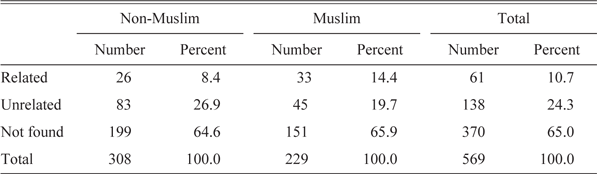
Finally, we provide direct evidence to show that there was no link between the dissolved minority firms and the subsequent entrants. We matched the address or phone number of each firm that ceased to exist after 1941 with new firms in 1944 and 1950. We also searched for possible successor firms by using the last name of the defunct firm’s owner. Table 5 shows that out of all liquidated non-Muslim enterprises, 65 percent could not be located at all. There was no other firm that used the same address or phone number in 1950, nor was there any other firm that shared last names. Twenty-seven percent of all dissolved non-Muslim firms were taken over by completely unrelated enterprises; almost all had Muslim ownership. At least 91 percent of liquidated minority firms simply did not re-appear, proving that they did not temporarily entrust their assets to Muslims, nor did they add Muslim partners to prevent dissolution.Footnote 65 Our evidence suggests that liquidated non-Muslim enterprises were used to finance the entry of Muslim-owned firms, which quickly dissolved since Muslims lacked the entrepreneurial experience and know-how of their non-Muslim counterparts. After the tax was abolished in 1944, a new generation of non-Muslim businessmen entered the market, leading to a recovery in the share of minority firms (which were now decidedly younger) in 1950.
MATCHING FIRMS THAT DISSOLVED IN 1941–1944 AND FORMED IN 1944–1950
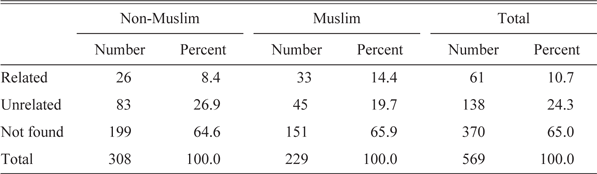
Notes: The table reports the match distribution of firms that last appeared in 1941 and the cross-section of firms in 1950. “Related” refers to firms that appeared in 1950 under the ownership with at least one of the previous partners or at least one owner with the same last name. “Unrelated” indicates firms that appeared at the same address in 1950 but had no relation with the previous company. “Not found” refers to firms that did not match with any enterprise in 1950.
Source: Authors’ calculations based on data from İstanbul Ticaret ve Sanayi Odası (1941, 1950); Çetinkol et al. (Reference Çetinkol, Yetiş, Özden and Tosbi1945).
CONSEQUENCES
The removal of non-Muslim enterprises had a number of implications for the economy. To the extent that Muslim-owned firms were less productive than non-Muslim enterprises, the tax contributed to Turkey’s poor aggregate TFP growth, which Altug, Filiztekin and Pamuk (Reference Altug, Filiztekin and Pamuk2008) show to be the primary reason of Turkey’s poor economic performance in the twentieth century.
The literature has long held the view that religious minorities had better business know-how thanks to decades of entrepreneurial activity (Kuran Reference Kuran2011). One determinant of such difference is the human capital gap between these groups. Indeed, disparities in human capital between Muslims and non-Muslims had persisted well into the Republic, as can be seen from the differences of literacy rates across religious groups in the 1935 census. In Istanbul, the literacy rate among Muslims were 5 to 7 percentage points lower compared to non-Muslim minorities. Some bureaucrats and public figures later tried to legitimize the tax by arguing that the law facilitated urbanization and the transition of Muslim farmers and landowners to modern entrepreneurs.Footnote 66 Some previous research has qualitatively rejected this claim on the grounds that while Muslims had physical capital, they lacked the entrepreneurial skill and experience of the non-Muslims they replaced (Aktar Reference Aktar2000, p. 210).Footnote 67
Our results support this pessimistic view by providing systematic empirical evidence. Muslim firms had lower survival rates overall, much more so during periods of recession, even when we control for other covariates. Furthermore, the entry rates of Muslim-owned enterprises also dropped during economic downturns. Given the cleansing effect of recessions and the pro-cyclicality of entrant productivity, we argue that Muslim businesses were indeed less competitive and efficient.
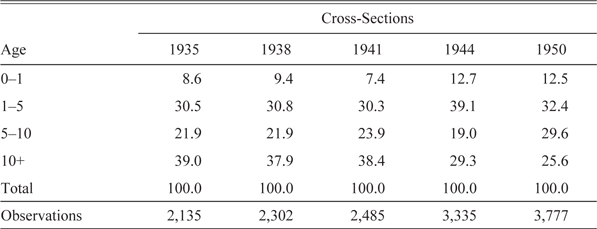
The tax also caused the liquidation of mature enterprises. Table 6 shows that the share of younger firms, especially “startups,” between the ages of zero and one, increased substantially; the share of mature firms older than ten years fell in 1944 compared to the preceding cross-sections. This is simply because the vast majority of these enterprises had non-Muslim ownership: 60 to 65 percent in 1935, 1938, and 1941. Our cohort-specific estimates show that the tax had a severe effect on the older cohorts from 1929 to 1935. Older companies tend to be more productive so their unnecessary liquidation must have been a serious blow to the Turkish economy. This is especially salient in the case of companies established before 1929. As survivors of the Great Depression’s cleansing effect, they likely enjoyed higher productivity.
AGE DISTRIBUTION OF CROSS-SECTIONS (PERCENT)

The tax essentially misallocated resources away from productive businesses into possibly less productive ones. The state also notoriously mismanaged the commercial and industrial properties it confiscated. For instance, the ships of Banzilay and Benjamen Company were “sold” to the Turkish Maritime Lines, a state enterprise which, lacking the technical expertise to operate these ships, left them to rust (Ökte 1950, p. 184).
The method of confiscation also eroded confidence in the security of property rights and further discouraged investment, even by Muslim entrepreneurs. The state’s arbitrariness, so flagrant in its scope, completely disregarded the legal foundations of private property and had a chilling effect on the whole business community (Buğra Reference Buğra1994, p. 115). Edward C. Clark (Reference Clark1972) provides anecdotes about how non-Muslims were apprehensive about a repeat of the Wealth Tax; these entrepreneurs concentrated their activities in non-manufacturing sectors and abroad. Our dataset reveals that the share of manufacturing firms in all entrants dropped by 2 percentage points across all ethnic groups and 10 percentage points for corporations in 1944; these shares did not revert back to pre-1944 levels in 1950. At the same time, non-Muslim entrants as well as corporations in 1944 and 1950 were more concentrated in the export sector, which accounted for 21 to 35 percent of new firms in each group. Before 1944, exporters made up only 4 to 13 percent of entrants. By raising political risk, the Wealth Tax delayed industrial capital formation further and well after its one-time imposition.
CONCLUSION
When the new Turkish state emerged out of the dissolved Ottoman Empire in the 1920s, its ruling elite was determined that economic modernization and development would be a top priority. The policy makers also believed the economy could only modernize if it had a “national” character; this involved the formation and support of a “Turkish” middle class. To this end, the government pursued a state-led industrialization policy coupled with protectionism. This strategy allowed speedy recovery after the Great Depression and helped small-to-medium size private enterprises through import substitution during the interwar years. The state’s interventionist policy particularly favored Muslim entrepreneurs, whose participation rates started to rise. Nevertheless, the persistent entrepreneurial gap between Muslims and non-Muslims remained at odds with the government’s vision of economic development.
Just as nationalism soared and violence against minority ethnic groups erupted in Eastern Europe in the late 1930s, anti-non-Muslim sentiment in Turkey also grew. The fiscal pressures of WWII gave credence to discriminatory discourse. Non-Muslim citizens of Turkey were used as scapegoats for rising food prices and the scarcity of primary goods. The Wealth Tax of 1942 was passed hastily in this turbulent environment. Its vagueness and arbitrariness allowed assessors to charge crippling levies on non-Muslim entrepreneurs.
The consequences were ill-fated. The human cost is obvious. What our findings reveal is the economic cost: the tax was an extractive tool that effectively liquidated older, productive non-Muslim-owned businesses of Istanbul. The expropriated assets were used to finance new Muslim firms, which, lacking the same entrepreneurial know-how, did not stay in business for long. As such, average firm productivity likely decreased. The policy also created uncertainty through its violation of property rights, further decreasing or diverting new investment.
In the end, the attempt to create a “national” economy hurt firm productivity, misallocated resources across entrepreneurs, and reduced security of property rights. Similar to the many historical episodes of ethnic or religious discrimination and expulsions in Europe, minorities’ economic contributions could not be easily replaced. The Wealth Tax succeeded in fulfilling one of the government’s dual objectives in “restoring” the economy to Muslims through transfers and confiscations. In doing so, it postponed the other goal that arguably vexed the government more: economic modernization and convergence with the West.