Electoral politics can be understood as a principal–agent relationship. Voters (the principal) select a politician (the agent) to enact policies on their behalf. If the electorate is not pleased with the enacted policies, the politician is not re-elected for a new term. But this understanding of electoral politics rests on the assumption that voters have sufficient information about the politician's actions to effectively perform the sanctioning task, and that the politician, in turn, responds to such electoral incentives. If information about the performance of politicians is limited, then improving the quality of representation and government requires instead the selection of politicians on the basis of experience and competence.Footnote 1 This view considers elections as mechanisms for selecting suitable candidates for office. Voters may rely on cues about the competence of the representative, such as past political experience, in order to distinguish between ‘good’ and ‘bad’ candidates for office.Footnote 2 Yet such selection considerations are often overlooked in the study of second-order elections.
In this article, we argue that political selection matters in so-called ‘second-order national elections’, such as European Parliament (EP) and local elections. From the US electoral politics literature, we know that the political experience of candidates has significant electoral consequences in elections to Congress.Footnote 3 But we have a limited understanding of whether this phenomenon also occurs in less candidate-centred contexts. This article thus contributes to the largely US-focused literature by investigating the electoral effects of political experience in the party-centred context of European Parliament elections. It also enhances our understanding of electoral behaviour in EP elections.
The European Parliament is the only directly-elected institution in the European Union (EU). Nevertheless, the electoral contests are widely regarded as second-order national elections, where campaigns are fought on national rather than European issues and voters have little or no knowledge of policy making in the Parliament.Footnote 4 Given the lack of information about past performance, these elections provide an apposite case for examining the degree to which political experience matters to voters. We ask the question: ‘To what extent do politically experienced politicians increase the vote share of parties in EP elections? More specifically, we examine whether parties with a very experienced candidate on their list, such as a former government minister, attract more voters. To answer this question, we draw on a rich and original dataset covering eighty-five national elections to the European Parliament between 1979 and 2004. Using multilevel modelling, we demonstrate that parties with a very politically experienced politician at the helm of their campaign gain more votes. Our findings also reveal that voters are more likely to base their vote on candidate quality during the mid-term of the general election cycle.
This article proceeds as follows. First, it discusses the notion of elections as instruments for political selection of ‘good’ candidates and relates it to the extensive US literature on electoral effects of candidate quality. Secondly, we introduce the reader to the extant literature on European Parliament elections before presenting our argument about why selection mechanisms should matter in these elections. In the subsequent section, we present the data and the statistical approach. Thereafter, we present the empirical results. The final section concludes.
Selection and candidate quality
There are two principal mechanisms by which elections may bring about democracy, or rule according to the people: sanctioning and selection.Footnote 5 In the classic tradition of democratic theory, which understands elections as mechanisms of political accountability, elections are inherently a sanctioning device in which voters reward or punish incumbents on the basis of past performance and thereby induce elected officials to be responsive to public preferences.Footnote 6 Alternatively, voters may see elections not as sanctioning devices, but as opportunities to choose a good political representative, i.e. one with personal characteristics such as integrity, shared preferences, experience and skills.Footnote 7 While the sanctioning model is seen as retrospective in nature, the selection or competency model is future-oriented. However, both approaches rely on some knowledge about past behaviour of candidates or parties. Mansbridge refers to the selection type of representation as ‘gyroscopic’, where voters ‘select the representative based on predictions of the representative's future behaviour derived from past behaviour and other cues’, rather than the traditional ‘promissory’ type of representation, which follows the principal–agent format.Footnote 8 In the formal literature on elections, the distinction is implied in the discussion of moral hazard (sanctioning) versus adverse selection (selection).Footnote 9 To distinguish ‘good types’ from ‘bad types’, voters can make use of a variety of signals. ‘Good types’ are those politicians who share voters’ interests, have moral integrity and are competent.Footnote 10 Yet moral integrity and competence are notoriously difficult for voters to observe directly, and the theoretical literature tends to be vague about the specific characteristics that signal the quality of a candidate. As we will discuss further below, one of the most compelling and frequently cited signals of competency is the prior experience of potential agents. As Shepsle and Bonchek put it, ‘before-the-fact protection relies upon the assumption that an agent's reputation is a valuable asset which he or she does not want to depreciate’.Footnote 11 Political experience can thus act as an informative cue about the quality and competence of the candidate.Footnote 12 The literature on electoral democracy has been dominated by a paradigm in which candidates (or parties) are successful mainly because they get policies or policy positions right, and not because of their personal characteristics or other competency signals. Most prominently, the literature on economic voting has modelled vote choices using this sanctioning approach: voters punish incumbents at the polls when past performance is substandard and reward them when the economy is doing well.Footnote 13 It is the concern with re-election that motivates incumbents to avoid shirking their responsibility.Footnote 14
However, the electoral mechanisms of sanctioning and selection can complement each other: voters may punish and reward incumbents for their performance in office and at the same time evaluate the experience and competence of candidates when casting their vote. Recent work has emphasized the importance of politicians’ characteristics in explaining political behaviour. Formal models in the political economy literature have been used to study selection on valence characteristics of politicians, such as competence and honesty, as well as what determines the supply of ‘good’ and ‘bad’ politicians.Footnote 15 Besley, Pande and Rao have argued that selection mechanisms should be given more attention in the literature on electoral behaviour, emphasizing that ‘personal qualities of politicians such as honesty, integrity and competence are potentially important, especially in environments where politicians face limited formal sanctions’.Footnote 16 European Parliament elections clearly represent such an environment, since there is no ‘incumbent’ and formal sanctions are thus limited. Consequently, we should expect that selection mechanisms play an important role in these second-order elections. However, it still raises questions of how voters identify the ‘quality’ of candidates and what impact it has on their vote choices.
In the empirical literature on electoral behaviour, political selection has featured most prominently in studies on ‘incumbent advantage’ in US elections. In these studies, which seek to explain why incumbents in the House, Senate and gubernatorial races win so often, it has been shown that the ‘quality’ of the incumbent as well as the challenger has a strong effect on the re-election chances of the incumbent. The key findings in this literature are twofold. First, the strategic decision to stand as a challenger in an electoral contest is influenced by the quality of the incumbent: high quality incumbents will deter challengers from running. Secondly, voters respond positively to the quality of both the incumbent and the challenger: high quality candidates have more electoral success.Footnote 17 In these studies, ‘candidate quality’ is understood as prior office-holding experience. Clearly, political experience is only an imperfect measure of ‘candidate quality’, understood as the competence and moral integrity of the individual. It is not implausible that certain politicians have been elected to office for reasons that have very little to do with competence and integrity, such as wealth or charisma. Nevertheless, there are good reasons why prior political experience is generally regarded as a useful signal concerning the quality of the politician. First, by selecting a politician with experience, voters are taking cues from other voters who have favoured the candidate in the past. Secondly, if a politician has already been in the public eye for some time, any lapses in terms of honesty and integrity are more likely to have been discovered than if the candidate is a novice. Thirdly, a seasoned politician will bring more experience and knowledge to the office, and is therefore likely to be more competent in the role. In other words, if politicians have delivered in the past, they should be able to deliver in the future. As Squire notes, ‘while there is no consensus on the specific personal characteristics associated with better challengers, there is a strong agreement that whatever those qualities are they are measured in substantial part by the candidate's previous political experience’.Footnote 18
Some scholars use a simple dummy variable which contrasts candidates with and without prior experience in public office,Footnote 19 while other scholars have refined this measure by calibrating the status of the previous offices held.Footnote 20 Other studies have taken an even broader approach to candidate quality, which encompasses both strategic resources (ability to mount a successful campaign) and personal resources (skills, characteristics and qualities).Footnote 21 But regardless of the exact operationalization, these studies all show that political experience has a significant impact on electoral success.Footnote 22 As we describe in our Data and Measurement section below, this article adopts the former approach to candidate quality and focuses on office-holding experience calibrated by the status of the office. Given the low salience of European Parliament elections, we are interested in examining the electoral effects of putting forward a candidate with a prominent national profile of experience and competence, such as a former minister or prime minister. To distinguish between the effect of political experience (which can be argued to signal quality) and the mere effect of name recognition, we also compare the effect of experienced MEPs with the effect of candidates with a high profile public persona but without political experience (such as television personalities).
While office-holding experience has proved important in the context of US elections, relatively little work has been done on the effect of candidate quality outside the US setting. We thus have a limited understanding of whether political selection plays a role in other political contexts. Nevertheless, it is reasonable to expect political experience to matter in elections to second-order legislatures where the assumption that the electorate is sufficiently informed to perform the sanctioning task is problematic. This argument is further elaborated in the next section, where we discuss the role of political selection in the context of elections to the European Parliament.
Selection in European Parliament elections
Despite the fact that the European Parliament has gained increasing legislative powers in the European Union over the past decades, elections of its members remain low-key affairs. Campaigns leading up to EP elections focus more on national than on European policy issues, turnout is low and parties that are in national government tend to perform worse.Footnote 23 The most common explanation of these phenomena is the ‘second-order national election’ thesis. At the heart of the theory of second-order national elections is the proposition that EP elections, like local and regional elections, are of lesser importance than first-order elections for national office.Footnote 24 Given the lower importance of EP elections, parties devote fewer resources to these campaigns and there are generally lower incentives for people to vote and engage with the issues at stake. Hence, citizens are more likely to vote sincerely rather than strategically, and this in turn will tend to favour smaller parties. EP elections also allow voters to express their dissatisfaction with governing parties. The extent to which governments are punished in EP elections depends on the point in the national electoral cycle at which the EP election is held. This argument has roots in theories of mid-term elections in the United States, where the president's party tends to enjoy a comparative disadvantage.Footnote 25 Mid-term losses can either reflect a natural ‘cycle of popularity’ for governing parties, which declines mid-term,Footnote 26 or a negative retrospective judgement of economic performance.Footnote 27 Fundamentally, this view of EP elections rests on a ‘sanctioning’ view of elections. It acknowledges that voters are unlikely to sanction representatives on the basis of their performance in the EP and argues that voters instead use these second-order elections to punish national governments for their performance in the domestic arena.
There are several reasons why it is plausible that voters sanction the performance of national governments rather than their European representatives in EP elections. First, since EP elections do not translate into the formation of a government at the European level, voters cannot use these elections to punish or reward the European executive institutions: the Commission and the Council.Footnote 28 Secondly, voters receive minimal information about the European Parliament through the media and other information channels and it is thus close to impossible for citizens to monitor and evaluate the performance of individual Members of the European Parliament (MEPs) and thereby make informed judgements about whether to re-elect on this basis.Footnote 29 In comparison, information about national incumbents is far more accessible to most voters. Hence, in line with the second-order theory, we would expect that EP elections involve the sanctioning of national rather than European politicians. There is a great deal of evidence showing that governing parties tend to do worse in EP elections relative to their performance in the national general election and that this defection is greatest in mid-term elections.Footnote 30 These studies provide a compelling explanation for patterns of voting behaviour in EP elections. However, this does not exclude the possibility that voters also use EP elections as a selection tool.
None of the existing literature on electoral outcomes in EP elections has examined the role of selection effects. Therefore, we do not know whether political experience matters to voters in EP elections. Only a few studies have examined the characteristics and career paths of MEPs. Scarrow explores how a seat in the EP fits into a domestic political career path. She finds considerable cross-national variation in the background of MEPs, but concludes that the EP is increasingly attracting ‘careerist’ candidates who view that Parliament as their principal political arena.Footnote 31 Norris and Franklin also examine the background of MEPs.Footnote 32 They find that the EP is very socially unrepresentative and that the chance of being selected for a winnable seat in an EP election is more strongly related to supply-side factors, such as gender, incumbency status and motivation, than demand-side factors, such as party rules and selection priorities. These studies give us an important insight into the composition of the European Parliament, but do not explicitly address the question of how MEP background affects electoral outcomes.
The implicit assumption of the second-order approach is that the quality of candidates is generally fairly low, since parties are unlikely to nominate politically experienced and high-profile candidates to a second-order arena. Of course, if all candidates are of similarly low quality, the selection mechanism would not work. Voters would not be able to choose the ‘good representative’ and might opt for the sanctioning of national incumbents instead. The first question we must address is, therefore, to what extent the ‘quality’, or level of political experience, varies across parties and countries. The received wisdom is that MEPs are either young and inexperienced or very old and about to retire.Footnote 33 However, an increasing proportion of MEPs choose Brussels as their main career, while others shift between prominent national positions and representation in the European Parliament. Anecdotal evidence suggests that the political experience of many MEPs is far from negligible, and that this makes a difference in elections. For example, when the Danish Social Democrats (in opposition at the time) nominated the former Danish Prime Minister Poul Nyrup Rasmussen to lead their EP party list in 2004, the party's share of the vote increased by 16 percentage points compared with the previous EP election – an electoral gain which was widely attributed to the ‘Nyrup effect’; that is, the ‘quality’ of this single candidate.
The second question is therefore whether variation in the political experience has an effect on the electoral fortunes of parties. As discussed above, we use the political experience of candidates as a proxy for ‘candidate quality’, as is the norm in the extant literature on candidate quality. Given the limited knowledge that voters have about the second-order arena, i.e. the European Parliament, we focus exclusively on the political experience of the candidates in the first-order arena, i.e. national politics. Moreover, we are primarily interested in the effect that experience of the ‘top candidate’ of each party has on that party's electoral success, rather than candidate-specific effects. While existing empirical studies on political selection have focused on candidate quality, this article examines the political experience represented in parties. In the context of EP elections, it makes more sense to focus on the success of parties rather than individual candidates. First, vote choices in European elections are generally modelled in terms of parties rather than individual candidates.Footnote 34 Secondly, by focusing on the party level we can more easily compare across countries with different ballot structures.Footnote 35 Thirdly, by measuring the experience of a party's top candidate, we limit the selection bias issue associated with the lack of data on unsuccessful candidates.Footnote 36 Finally, a high-profile candidate, such as a former prime minister, is likely to secure votes for the party as a whole and not just to secure his own seat in Parliament. We are thus interested in examining whether the political experience of parties’ top candidates – that is the candidate with the most national political experience – makes voters more likely to reward them in elections.
There are sound theoretical reasons to expect that selection plays a role in EP elections. Taking into consideration voters’ limited ability to hold MEPs to account in EP elections, they might use these elections, at least partially, as an opportunity to select good representatives. Given the agency problems that voters face in EP elections with limited information about the activities of their MEPs, they might be more susceptible to electing candidates on the basis of their perceived quality, rather than to sanctioning them on the basis of past performance. We know from the literature that voters rely on cues and shortcuts when making decisions in elections. According to the signalling literature, one important persuasive cue is ‘observable costly effort’,Footnote 37 and arguably nominating high-profile candidates to the EP represents costly effort. If a party nominates a high-profile (former) minister as a candidate to the EP, he or she will no longer be able to play an active role in national politics, and this signals that the party regards this European chamber as one of high priority. As discussed above, political experience and reputation also provides information to voters that the candidate is a ‘good type’, and this information can be used in the screening process by voters as an ex ante control mechanism. Fearon, for example, has shown formally that when voters perceive any differences in quality between candidates in an election, it is rational for them to vote on the basis of those differences rather than to try to use their vote to sanction incumbents.Footnote 38 Such a ‘selection’ rationale should be even more pertinent in second-order elections where voters have very little information about the past performance of the representatives, and their only sanctioning tool is to punish the government at the national level. Hence, theories of signalling and selection mechanisms would lead us to expect that politically experienced candidates bring about positive electoral feedback for parties. On the basis of this, we can formulate our first hypothesis:
HYPOTHESIS 1: The more politically experienced a party's top candidate, the larger the increase in the party's vote share in European Parliament elections, all other things being equal.
The relative degree to which voters focus on domestic vis-à-vis European issues will depend on the timing of the EP election. European Parliament elections are not synchronized with national general elections, except in Luxembourg, and often take place during the mid-term of the general election cycle. We know from the literature that governing parties tend to do worse during the mid-term period, reflecting the ‘cost of ruling’ and the normal cycle of popularity for incumbents. In contrast, elections to the European Parliament that are held concurrently with the national election will be entirely overshadowed by domestic politics, and voters are unlikely to receive much information about the candidates competing in the European Parliament race. We can thus formulate our second hypothesis:
HYPOTHESIS 2: The effect of political experience on change in parties’ vote share in EP elections is greatest when they are held in the middle of the national electoral cycle.
To test these two hypotheses, we have built a unique dataset on the political experience of successful party candidates in EP elections. This dataset, and our empirical model, is described in further detail below.
Data and measurement
To create a measure of ‘quality’, we collected data on the political experience of successful candidates in all six EP elections between 1979 and 2004 (a total of eighty-five national elections and over 3,000 successful candidates). As mentioned above, candidate quality is often operationalized in terms of whether or not the candidate has any past political experience. In this study, rather than using a simple dummy variable of previous position in office, we have created an additive scale of various aspects of previous experience in the national arena, as weighted by the level of the position.
The index is calculated as follows. If an MEP has been a member of the national parliament (MP), he is given a score of 1; if not, the score is 0. We then add 2 to this score if the MEP has been a minister and 3 to the score if the MEP has been a party leader. Finally, we add 4 to the score if the MEP has been the prime minister or the president. The score ranges from 0 to 10. A party scores 10 if at least one of the elected MEPs had held all of the above-mentioned positions, 0 if none of the elected MEPs had held any of these positions. The data on political experience were obtained by systematically coding the biographies of all MEPs, included in the Times Guide to the European Parliament as well as EP and party websites and other party documents.Footnote 39 As discussed above, we would not expect voters to have detailed knowledge of the background of the less experienced candidates in these low salience elections, and it thus makes most sense theoretically to focus on the political experience of each party's top candidate. For the purpose of our investigation, we define the candidate with the highest score on the index as the party's top candidate in that election. In the previous example of the Danish 2004 EP election, the top candidate for the Social Democrats was Poul Nyrup Rasmussen, and the Danish Social Democrats are thus given a score of 10 in 2004, since Rasmussen has held posts as national MP, minister, party leader and prime minister.
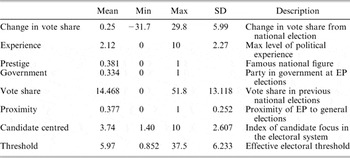
By focusing on the experience of the top candidate, we also address the skewness of the distribution of experience of MEPs. Although most elected MEPs have little or no experience from national politics, most parties have at least one MEP with some experience from national politics. The mean national experience score of the top candidate is 2.12.
As this index focuses on previous political experience, not the unobservable virtues highlighted in some of the theoretical contributions reviewed above,Footnote 40 it is not a direct measurement of ‘quality’ in any normative sense. However, as discussed above, past political experience and important offices provide a visible cue to voters of the competence of party representatives. As Squire points out:
in essence, previous political experience is a surrogate for the positive personal characteristics associated with higher quality challengers because we take it to be a concrete manifestation of them. People who have held elective office – what we typically mean by political experience – have, under most circumstances, already exhibited personal appeal and campaign skills by virtue of their election to that office.Footnote 41
Hence, for both substantive and methodological reasons, the models shown in this article focus exclusively on the experience of the ‘top candidate’ (most experienced) of each party in an election.
Before turning to the distribution of this variable, we must first address two potential concerns about this measure of candidate ‘quality’. The first concern is that our experience variable is merely capturing the effect of simple name recognition, or ‘celebrity status’, rather than any signal of competence. In other words, since EP elections are low salience contexts, voters may choose famous candidates, regardless of whether their ‘fame’ is due to experience from national politics or something else. To be able to distinguish between the effect of political experience and the effect of sheer name recognition, we created a dummy variable that takes the value 1 if at least one of the elected candidates from the party is a well-known national figure, such as a television presenter, singer, author or sports star. This variable is labelled Prestige. If our argument about quality holds, the effect of Experience should be stronger than the effect of Prestige and should not disappear when Prestige is controlled for. Secondly, it may be argued that many experienced candidates either hold dual mandates (i.e. are members of both national and European parliaments, as it was allowed until 2004) or have no intention of serving a full term in the European Parliament, even though they appear on the ballot. In both cases, political experience can be argued to be a poor signal of the contribution that these experienced MEPs will make to the European Parliament. In order to ensure that our results are not driven by these less committed MEPs, we excluded all MEPs with dual mandates and those who did not serve a significant part of their term in the EP from the calculation of the experience score.
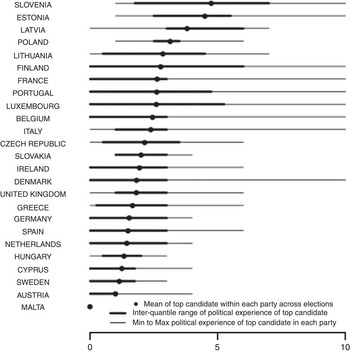
We can now turn to the distribution of political experience among national parties represented in the European Parliament. Looking at Figure 1, there is clearly some between-country variance in MEP experience. Nine of the twenty-five countries have at least one MEP obtaining the highest score on our index. French and Italian parties have sent several former presidents and prime ministers to the EP, for example Jacques Chirac, Edgar Faure, Valéry Giscard D'Estaing and Bettino Craxi. We can also see that several of the former communist countries that joined the EU in 2004 put forward high-profile candidates in their first national elections to the European Parliament. Slovenia, Estonia, Latvia and Poland all had former prime ministers standing as their top candidates on a party list, as well as several other candidates with high national profiles. For countries that have participated in several European Parliament elections since 1979,Footnote 42 cross-national differences in candidate quality are quite stable. For example, parties in Luxembourg have very high quality top candidates across most elections, and Belgian and Portuguese parties also provide high quality candidates. In contrast, parties in Britain, the Netherlands and Germany tend to nominate MEPs with less experience. Recently, the Finnish party system has also produced many high quality candidates. However, our goal is not simply to demonstrate that candidate quality differs across parties and countries. Instead, we want to investigate how this affects election outcomes.Footnote 43
Level of political experience (top EP candidate of parties) by country

Following the standard approach in the literature,Footnote 44 our dependent variable is the percentage change in vote share of each party in EP elections as compared to the results obtained in the previous national elections. This makes our results easily comparable with the existing literature. Furthermore, using the difference in vote share from the previous election takes care of party-specific omitted variables.Footnote 45 We control for the vote share in the most recent national election with the variable Vote share.Footnote 46
Our key independent variable is the political Experience of the top candidate measured at the party level in each election. As discussed above, there are both substantive and methodological advantages to limiting the focus to the candidate with the highest level of political experience within each party.
To examine second-order election effects, we include a Government dummy variable, which takes the value 1 if the party belongs to the national government at the time of the EP elections and 0 if not. This operationalization is in line with previous studies of EP elections, and thus allows us to examine the robustness of previous findings in addition to investigating the effect of political experience by including an interaction between Government and Experience. As described above, one of the most solid findings in the literature is that governing parties tend to do less well in EP elections than in the previous elections that won them the office. It has also been shown that governments are punished most severely by voters when EP elections are held in the middle of the national electoral cycle, i.e. in mid-term elections.Footnote 47 Hix and Marsh capture this effect by multiplying the government dummy with another dummy variable which takes the value 1 if the EP elections were held in the first fifth of a national electoral cycle.Footnote 48 We opt for interacting the government variable with a continuous variable which is 0 at the mid-term between the previous and the next national elections and 1 if the EP and general elections are held in the same month. We calculate this variable by taking the absolute difference between months since last elections and months to next elections. The difference is divided by the maximum value of either of the two variables. Proximity hence captures the effect of the timing of elections for opposition parties while the interaction effect captures the difference between the effect of timing for opposition parties and governing parties. If opposition parties benefit and governing parties suffer from a ‘mid-term’ effect, Government should be negative and Proximity × Government positive. We also test whether the effect of political experience varies over the course of the electoral cycle by including an interaction term between Proximity and Experience. According to our second hypothesis, the coefficient for this interaction should be negative, since the selection mechanism is expected to be more prevalent in the mid-term period.
We include dummies for party family, using the social democratic party family as the reference group. We do this to control for party family specific effects. For example, previous studies have shown that Green parties and Eurosceptic parties do better in EP elections.Footnote 49 If people vote sincerely rather than strategically in EP elections, we may expect Green parties to perform better. Equally, if voters base their vote choices at least partly on European issues, we would expect Eurosceptic parties to gain votes in EP elections.Footnote 50 Our classification of party groups is identical to Hix and Marsh.Footnote 51
Finally, we also need to control for the effect of the electoral system. Although legislation on uniformity of electoral procedures in EP elections was enacted in 2003 (according to which all national elections to the EP shall be held under a proportional representation electoral system), there has been, and continues to be, considerable variation in the ballot structure and district magnitude across countries.Footnote 52 When it comes to examining the impact of candidate quality on the electoral success of parties, the most important aspect of the electoral system is the degree to which the ballot structure allows voters to determine the fate of individual candidates, that is how ‘candidate-centred’ it is.Footnote 53 Farrell and Scully distinguish between open (candidate-centred) systems – in which the candidates’ electoral fates are affected by their personal vote-chasing activities (for example, Single Transferable Vote (STV) in Ireland and Malta and Open list in Finland) – and closed (party-based) systems – in which candidates’ electoral fates are determined by their party list placement (for example, Closed lists in France and Germany).Footnote 54 Since candidate-centred systems give voters greater freedom to choose the candidate of their choice, we would expect that such systems would encourage higher quality candidates to stand. Moreover, such systems may also enhance the effect of experience on vote share. As Farrell and Scully note, ‘electoral systems that are characterized by candidate-orientation tend to produce greater attention to personal vote chasing by politicians and the maintenance of close links with their electorates’.Footnote 55 To test whether this affects the impact of experience on party vote share and change in vote share, we include an interaction between Candidate-centred electoral system and Experience in our model. Following Farrell and Scully, the electoral system has been operationalized as an index ranging from 0 to 10, where 10 indicates the highest degree of openness.Footnote 56 As previous studies have demonstrated that the effective threshold may matter,Footnote 57 the variable Threshold estimates how much of the difference in the vote share from the previous national election is due to electoral system effect related to the effective threshold. The interaction between Threshold and Experience captures whether the effective threshold conditions the effect of candidate experience on party vote share. The descriptive statistics of the variables in our models are summarized in Table 1.
Descriptive Statistics

We use a cross-level hierarchical linear model to estimate the effect of political experience on electoral outcome as our dependent variable is change in party vote share in the EP election compared to the previous national election, and the vote share in the EP election. Variation in the change in the vote share of parties may be due to factors related to the party (such as governing or opposition party, position on salient issues) and factors related to the election itself (for example, when it occurs in the electoral cycle). It thus makes theoretical sense to consider countries and elections as two different nesting groups, both within which party election results are nested, rather than seeing them nested within each other. The systematic element of the model then takes the following form:

We use γj to model the country correlation and δt to model the time-period correlation. Xiβ indicates a matrix of explanatory variables and their coefficients. The effects of most of the coefficients are fixed across both time and countries. The exceptions are the effects of political experience and governing party status. These coefficients are free to vary across countries, but not over time. The stochastic element of the model is yi∼N(μ + γj [i] + δt [i], σy 2) for i = 1,…,n, γj∼N(0,σγ 2) for j = 1,…,J and δt∼N(0,σδ 2) for t = 1,…,T. We estimate a cross-level model rather than a three-level hierarchical model as we expect the effect of time to be common across countries. This is because the European Parliament has substantively increased its power within the European Union, thereby making it more important for policy-seeking political parties to be represented in the institution.Footnote 58 Furthermore, changes in the level of electoral volatility and electoral cost of being in government are common across most member states.Footnote 59 However, there are several country-specific features that do not vary across time, like electoral laws (in most countries) and party systems. We also estimate a linear regression model with fixed year and country effects and panel corrected standard errors. This model is included to guard against our results being driven by omitted variable bias. The results are discussed in the next section.
Results
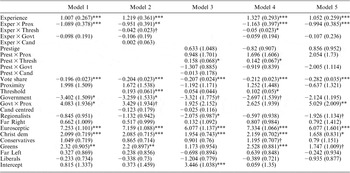
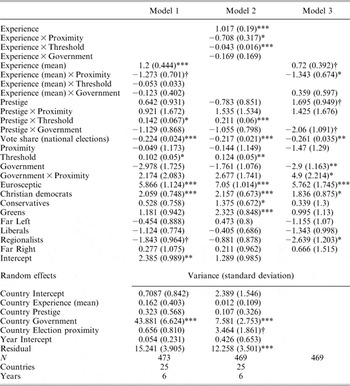
We estimate five alternative models. The first four models are hierarchical models while the fifth is a fixed effects version of the fourth model.Footnote 60 The results are reported in Table 2. The different model specifications give similar substantive results. The reported results are maximum likelihood estimates.
Multilevel Analysis of Party Vote Share in European Parliament Elections

Notes: Values for each variable are followed by standard errors in parentheses, which are robust in the case of Model 5. † p < 0.1, *p < 0.05, **p < 0.01, ***p < 0.001.
Abbreviations: Exper = Experience; Prox = Proximity; Thresh = Threshold; Govt = Government; Cand = Candidate centred electoral system; Vote share = Vote share in national elections; Christ dem = Christian democrats.
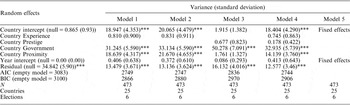
Multilevel Analysis of Party Vote Share in European Parliament Elections

Notes: Values for each variable are followed by standard deviations in parentheses. ***p < 0.001.
Model 1 is the base model. It estimates the unconditional effect of experience as well as how the effect of experience varies over the national electoral cycle. It also investigates to what extent the effect of experience differs between governing and opposition parties and the difference in the effect of the national electoral cycle for governing and opposition parties. Finally, it controls for vote share in the previous national election, governing status and party group affiliation. The coefficients for experience, governing party status and electoral cycle are allowed to vary across countries. For simplicity, and because the residual variation across time is small, none of the coefficients are allowed to vary across time. The residual variance is more than halved compared to the empty model. For all the models where Experience is included, the variances of the country-specific intercept and the country-specific slopes of Government and Proximity are large. The variances in the country-specific slopes of Experience and Prestige are negligible. This implies that the experience of candidates matters to parties’ electoral success in all countries in our study.
The unconditional effect of experience is positive and significant. A one-unit increase on our index increases the vote share by 1 percentage point, with the 95 per cent confidence interval ranging from 0.48 to 1.53. The model predicts that the difference between nominating a former minister with experience from the national parliament and running without anybody with experience from national politics is on average 3 percentage points. This is in line with Hypothesis 1.
We can also see that the effect of national political experience decreases if the EP elections are held close to the national elections. If the elections occur simultaneously, the effect of experience disappears. This makes sense, since voters are more likely to vote in accordance with their national vote choice in EP elections when the two elections occur at the same time. This corroborates Hypothesis 2. The model also shows that the governing parties lose on average 3.4 percentage points compared to the previous elections, if the EP elections occur in the middle of the national electoral cycle. However, as the national elections draw closer, this effect disappears.
Also in line with existing research, we see that larger parties lose in EP elections. On average, the vote share is reduced by 0.2 percentage points per percentage point of the vote share the party received in the previous national election. The 95 per cent uncertainty ranges from −0.24 to −0.15. A large party that received 20 per cent of the vote share in the previous national election is thus expected to receive only 16 per cent of the vote share in the EP elections. We also find that the Greens, Eurosceptic and Christian Democratic parties do better, whereas the Social Democrats perform worse in EP elections, controlling for other variables. It should also be noted that the effects of governing party status and timing of the electoral cycle vary considerably across countries while there is less country-level variation in the effect of experience.
Model 2 adds two electoral system variables and the interaction with experience. Candidate centred electoral system measures the openness of the electoral system and Threshold measures the effective electoral threshold. While there is no effect of the electoral system variable, we see that experience has a smaller effect the higher the electoral threshold. Hence, there is more to gain by nominating experienced politicians the lower the effective electoral threshold. It should, however, be noted that this effect is only significant at the 10 per cent level. We should therefore refrain from reading too much into this finding. The coefficients for the main variables do not change substantively by the inclusion of these system level variables. Both the magnitude and the precision of the estimates remain similar. Indeed, it is not clear whether the inclusion of these system level variables is warranted. The Akaike Information criterion favours Model 2 over Model 1 (Model 1, AIC = 2749 vs model 2, AIC = 2747), while the Bayesian information criterion, which punishes complexity more heavily, favours Model 1 over Model 2 (Model 1, BIC = 2866 versus Model 2, BIC = 2880).
Model 3 is a test of the extent to which our results are simply due to name recognition rather than national political experience. The main effect of experience and its interaction terms are substituted for the Prestige variable, which takes the value of 1 for parties with one or more MEPs who are famous for reasons other than national political experience. All other variables are identical to Model 2. The results strongly suggest that we can dismiss the hypothesis that the effect is due to name recognition rather than experience. Under this specification, only the interaction term between Prestige and Threshold stays significant. However, the direction of this interaction term is positive, the opposite of the interaction between Experience and Threshold. This suggests that name recognition has the largest effect in a system with a high electoral threshold.
In Model 4, we include both Experience and Prestige in the same specification. We have removed the Candidate centred electoral system variable, as it does not seem to have any effect. This specification tests whether the effect of Experience still holds even after controlling for Prestige. The test is affirmative. Experience remains positive and significant. One should nevertheless note that Prestige has a positive effect on the vote share in countries with sufficiently high effective electoral threshold. The conditional effect of effective threshold hence works in opposite directions for Prestige and Experience. The effect of experience is smaller in countries with a high effective electoral threshold. The effect of experience is strongest during the mid-term. Holding all other variables constant, there is no significant difference in the effect of experience for governing and opposition parties. The other coefficients remain similar in effect. Again, the AIC and BIC differ with regard to which model is best. AIC favours Model 4 over Models 1 and 2, whereas BIC favours the parsimonious Model 1 (AIC: Model 1 = 2749, Model 2 = 2747, Model 4 = 2744. BIC: Model 1 = 2866, Model 2 = 2880, Model 4 = 2906). Both AIC and BIC favour Model 4 over Model 3 (AIC: Model 3 = 2836, BIC: Model 3 = 2970).
As we want to reduce the risk that our results suffer from omitted variable bias, Model 5 is a fixed effect specification of Model 4, but without the system-specific effects as these cancel out under the fixed effects specification. We include fixed effects for both country and year, and heteroscedastic-corrected robust standard errors. The results from this model are broadly consistent with the results reported in Models 1 to 4, both in terms of magnitude of the coefficients and level of significance. We can hence be confident in the results obtained from the hierarchical models.
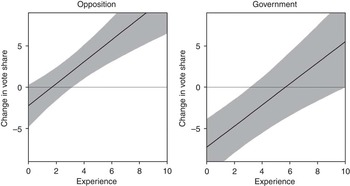
To illustrate the impact of experience on party success, Figure 2 plots the estimated effect of experience for governing and opposition parties of average size in the middle of the electoral term.Footnote 61 The left side of the figure shows the estimated effect of experience in the scenario for opposition parties. The right side of the figure shows the scenario for governing parties. The uncertainty interval around the estimates is created by drawing 10,000 samples from the multivariate normal distribution with the parameter estimates from Model 4. We then plugged in the values for an average sized opposition (left) and government (right) social democratic party in the middle of the electoral cycle.
Predicted effect of experience for opposition and governing parties

We see that the effect of experience is stronger for opposition than for governing parties. For example, while average-sized opposition parties can expect to improve their vote share compared to the previous national elections when nominating somebody scoring at least 3 on our experience index, governing parties need to nominate somebody scoring at least 3 simply not to lose any votes. As the uncertainty of the effect of experience grows somewhat for values beyond 5, we should have more faith in the effect of increasing the experience at lower values. Beyond a certain level, marginal differences in experience may not matter that much.Footnote 62
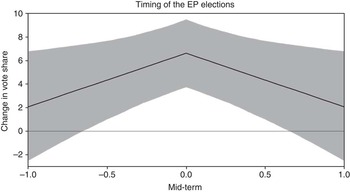
Figure 3 shows how the effect of experience is conditional on when the EP election occurs in the national electoral cycle. In accordance with Hypothesis 2, the figure demonstrates the predicted effect of experience for a hypothetical opposition party where the most experienced candidate scores 4 on our index, i.e. a former MP and party leader. The −1 and 1 endpoints on the x-axis indicate the occurrence of a national election, while the 0 point indicates the middle of the electoral cycle.
Conditioning effect of the electoral cycle

We see that the effect of running with an experienced candidate is significant and positive for most of the electoral cycle. The effect is only indistinguishable from zero in the first and last fifth of the electoral cycle. In the middle of the cycle, running with a former MP and national party leader improves the received vote share with an average of 5 percentage points, with the 95 per cent uncertainty interval covering the 2.5 to 7.5 percentage points region. This shows that, conditional on when in the national electoral cycle the EP election occurs, running with an experienced politician can make a substantive difference to the electoral fortune of a party in the EP elections.
Overall, we find support for our hypotheses. First, parties do better as the national political experience of their top candidate increases. Secondly, the effect of political experience is strongest in the middle of the national electoral cycle. Overall, the findings extend and complement the standard second-order election understanding of EP elections.
Conclusion
Elections perform two main functions: they allow voters to select suitable representatives and to hold the government to account. Yet, since effective sanctioning requires that the electorate is able to monitor the actions of the incumbent, this may not be a viable option in second-order elections. Rather than sanctioning representatives for past performance, voters may instead attempt to select competent representatives. One clear signal of competence is previous political experience. In this article, we have investigated to what extent voters in European Parliament elections reward parties which have chosen politically experienced candidates. Drawing on an original dataset of all elected MEPs in eighty-five national contests, across six election cycles, we show that parties choosing a ‘high quality’ representative are indeed rewarded by voters. This effect is strongest in the middle of the national electoral cycle. Our findings add new insights into the dynamics of European Parliament elections. While the existing literature on EP elections has focused on how voters sanction incumbent parties, our results suggest that the selection mechanism also matters in second-order elections. These results modify one of the main findings in the extant literature: the degree to which governing parties are punished depends not only on the electoral cycle, but also on the experience of their EP candidates. In other words, governing parties could avoid some of the electoral losses in EP elections if they were to send more prominent representatives to the European Parliament.
These findings thus have implications for our understanding of second-order elections more generally, since they suggest that the selection model, combined with the traditional sanctioning model, is a promising theoretical approach for understanding variation in parties’ electoral fortunes. When voters operate in an information-sparse environment, they seem to rely on a mix of retrospective cues about the first-order arena and signals about the competence of EP representatives, depending on which informational shortcuts are most readily available at the time. This article has focused on one proxy for ‘candidate quality’, namely political experience. We have also distinguished between the political experience of candidates and their ‘celebrity status’ (Prestige), and we found that the latter has no significant effect on party vote share. But further research should seek to parse out these selection and sanctioning mechanisms further. Moreover, this article raises the broader question of whether this selection approach is effective in achieving its democratic ends. In other words, do politically experienced representatives in the European Parliament do a better job at serving the interests of European citizens? The European Union is said to have a democratic deficit. This is at least partly because the sanctioning mechanism is unlikely to motivate EP representatives to avoid shirking their responsibility, since voters are not punishing (or rewarding) them for their performance in the EP, but rather that of their colleagues in the national capitals. However, we do not know whether the selection mechanism fares any better.
Alternative Model Specifications

Notes: Values for each variable are followed by standard errors in parentheses.
† p < 0.1, *p < 0.05, **p < 0.01, ***p < 0.001.