Introduction
In the last 50 years, there has been a marked increase in the life expectancy across the developed world (Vaupel etal. Reference Vaupel, Zhang and van Raalte2011). In the United States, it is expected that up to 10 million people will be aged over 90 by 2050 (He & Muenchrath, Reference He and Muenchrath2011). In Ireland, projections indicate that the proportion of those over 80 years will increase by 44% by 2021, and by 250% by 2041 (Barrett & Kenny, Reference Barrett and Kenny2011). As people are living into their 90s and beyond, many are faced with complex health issues, such as increased risk of cognitive impairment and polypharmacy (Wolff etal. Reference Wolff, Starfield and Anderson2002; Hovstadius etal. Reference Hovstadius, Hovstadius, Astrand and Petersson2010; Peltz etal. Reference Peltz, Corrada, Berlau and Kawas2011). Ageing is associated with pharmacokinetic changes in renal and hepatic functioning as well as pharmacodynamic changes such as increased sensitivity to medications (Mangoni & Jackson, Reference Mangoni and Jackson2004).
Nonagenarians and centerians, or those in their 90s or 100s, respectively, are often described as the ‘oldest old’ in the medical literature, although this term sometimes includes those over 80. They represent a distinct subpopulation of the elderly that have achieved longevity. Epidemiological studies have also shown that socio-demographic factors, smoking and obesity lose their importance in predicting mortality in those over 90, being replaced by disability level, physical and cognitive performance (Nybo etal. Reference Nybo, Petersen, Gaist, Jeune, Andersen, McGue, Vaupe and Christensen2003). Nonagenarians and centerians are therefore often grouped together in studies of ageing (Ravaglia etal. Reference Ravaglia, Morini, Forti, Maioli, Boschi, Bernardi and Gasbarrini1997; Wen etal. Reference Wen, Bi-Rong, Chang-Quan, Zhen-Chan, Yuan, Hong-Mei, Yan-Ling, Hui and Ping2010), yet they have not been much studied in terms of treatments offered or tolerance of psychotropic medication. The prevalence of dementia in nonagenarians lies in the range of 25–54% (Carrillo-Alcala & Bermejo-Pareja, Reference Carrillo-Alcala and Bermejo-Pareja2008; Peltz etal. Reference Peltz, Corrada, Berlau and Kawas2011). Dementia is often accompanied by behavioural and psychological symptoms (BPSD), a recent review reported a prevalence of 78% of BPSD in institutionalised elderly (Seitz etal. Reference Seitz, Purandare and Conn2010).
There have been reports of underuse of antidepressants in nonagenarians (Forsell etal. Reference Forsell, Jorm, von Strauss and Winblad1995) and in a subsample of patients over 85 (Brown etal. Reference Brown, Lapane and Luisi2002), but there are also major concerns over the overuse of antipsychotics and sedatives in this age group, particularly to treat BPSD. The first-generation antipsychotics have extrapyramidal, anticholinergic and hypotensive side effects, making their use in the elderly problematic (Lee etal. Reference Lee, Gill, Freedman, Bronskill, Hillmer and Rochon2004). This led to widespread use of atypical antipsychotics, and risperidone now has a specific licence for the treatment of BPSD. However, studies have showed that atypical antipsychotics carry an increased risk of overall mortality in dementia, especially from cerebrovascular events. It is estimated that the absolute risk of death increases by 1% in the short term and is likely to increase with longer-term use (Banerjee, Reference Banerjee2009).
Apart from BPSD, delirium is an off-label indication for short-term antipsychotic use (Catic, Reference Catic2011). A Cochrane review found that low-dose haloperidol, risperidone and olanzapine were similar in efficacy and adverse effects while reducing symptoms of delirium (Lonergan etal. Reference Lonergan, Britton and Luxenberg2007). A concern with the use of antipsychotics in delirium is that, although they appear to be relatively safe in the short-term, they are sometimes not discontinued after the episode of delirium has resolved (Morandi etal. Reference Morandi, Jackson and Ely2009).
Benzodiazepines and hypnotics are associated with an increased risk of fractures, falls (Cumming & Le Couteur, Reference Cumming and Le Couteur2003; Finkle etal. Reference Finkle, Der, Greenland, Adams, Ridgeway, Blaschke, Wang, Dell and VanRiper2011), amnesia (Barker etal. Reference Barker, Greenwood, Jackson and Crowe2004) and dependence. Despite these concerns, they continue to be used frequently in dementia (Lagnaoui etal. Reference Lagnaoui, Moore, Moride, Miremont-Salame and Begaud2003). In the long term, their use is potentially inappropriate and has been associated with a higher risk of delirium (Clegg & Young, Reference Clegg and Young2011).
There is a lack of clinical trials looking specifically at the oldest old, which means prescribing is often based on guidelines derived from younger patient groups (Hilleret etal. Reference Hilleret, Falconnet, Le Saint, Perrenoud, Michel and Vogt-Ferrier2008). Some have commented that the use of these guidelines is essentially flawed, and have proposed the use of prioritisation tools to aid prescribing (Wehling, Reference Wehling2011). Patients recruited to a clinical trial in the geriatric setting are usually not the frailest or sickest, as these would typically be excluded due to their many medical co-morbidities (Blazer, Reference Blazer2000). It is therefore difficult to implement clinical guidelines for prescribing in the oldest old.
Methods
St. Vincent's University Hospital is a major academic teaching hospital in Dublin, Ireland, with 479 in-patient beds. The Department of Old Age Psychiatry cares for the mental health needs of people aged over 65. More than 33 000 people over 65 live in the catchment area.
All patients aged over 90 seen by the department in 2009 were identified from electronic records. This included patients admitted to the acute in-patient ward, liaison consultations to the medical and surgical wards as well as assessments made in nursing homes and the community. A retrospective chart review was carried out to record prescribing information, demographic and diagnostic details for all patients in contact with the service in this period. Diagnostic details included both current and past psychiatric diagnosis. Diagnoses were made according to International Classification of Diseases-10 (ICD-10) criteria, which were recorded in every chart as part of routine clinical practice (WHO, 2004). Prescribing information included dosage and length of time on medication, as well as the number of non-psychotropic medications. We also extracted a Mini Mental State Examination (MMSE) score (Folstein etal. Reference Folstein, Folstein and McHugh1975). If a patient was unable to complete the MMSE due to severe cognitive impairment, they were scored as zero. If MMSE was not completed for any other reasons it was scored as missing.
We found no specific prescribing guidelines for nonagenarians or centerians, but there are several guidelines for prescribing psychotropic agents in the elderly. The British National Formulary (BNF) contains licensed indications and advice on adjustment to dosages for elderly (BMA BMAatRPSoGB, 2011). The Beers Criteria is a list of consensus criteria first published in 1991 (Beers etal. Reference Beers, Ouslander, Rollingher, Reuben, Brooks and Beck1991). It was regarded for many years as the gold standard for identifying medications across the diagnostic spectrum that may be potentially inappropriate in the elderly. These criteria were updated in 2003 (Fick etal. Reference Fick, Cooper, Wade, Waller, Maclean and Beers2003), and there are national alternatives such as the Canadian Criteria (McLeod etal. Reference McLeod, Huang, Tamblyn and Gayton1997) that has also been widely used internationally to assess prescribing practice. To better reflect UK and Irish practice, the STOPP (Screening Tool of Older Persons’ potentially inappropriate Prescriptions) criteria were developed, with an individual section for CNS and psychotropic drugs (Gallagher etal. Reference Gallagher, Ryan, Byrne, Kennedy and O'Mahony2008). Other available consensus guidelines not widely used internationally include the American Expert Consensus Panel (Alexopoulos etal. Reference Alexopoulos, Katz, Reynolds, Carpenter, Docherty and Ross2001; Alexopoulos etal. Reference Alexopoulos, Streim, Carpenter and Docherty2004), the German FORTA guidelines (Frohnhofen etal. Reference Frohnhofen, Michalek and Wehling2011), or guidelines specific to nursing home care, such as the American OBRA (Gurvich & Cunningham, Reference Gurvich and Cunningham2000) legislation. More general guidelines on prescribing that are relevant to the oldest old include the UK NICE guidelines and the American APA guidelines.
There is a consensus across the guidelines that the long-term use of benzodiazepines, particularly long-acting ones, should be avoided. The mortality warning regarding antipsychotics is reflected in the newer guidelines, alongside warnings over their use in certain circumstances. These include their use as a long-term hypnotic, or in patients with a high fall risk or postural hypotension (McLeod etal. Reference McLeod, Huang, Tamblyn and Gayton1997; Gallagher etal. Reference Gallagher, Ryan, Byrne, Kennedy and O'Mahony2008). Antidepressant guidelines highlight the potential hazards of tricyclic antidepressants (TCAs), particularly amitriptyline and imipramine, especially in dementia (Gallagher etal. Reference Gallagher, Ryan, Byrne, Kennedy and O'Mahony2008).
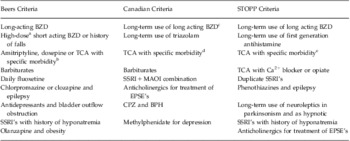
We aimed to compare our results with previous studies of those aged over 90 and clinical guidelines. We also wanted to identify factors associated with the use of psychotropics. Broad guideline targets were derived from the guidelines to compare prescribing in our sample with consensus practice. We compared our findings against the following potentially hazardous prescribing practices (1) long-term (>1 month) use of benzodiazepines, (2) use of TCAs, (3) long-term (>3 month) use of neuroleptics in non-schizophreniform or delusional disorder, (4) other criteria outlined in the Beers, Canadian or STOPP criteria (see Table 1) where information was available.
Potentially inappropriate psychotropic prescribing

BZD, benzodiazepines; TCA, tricyclic antidepressant; SSRI, selective serotonin reuptake inhibitor; MAOI, monoamine oxidase inhibitor; CPZ, chlorpromazine; BPH, benign prostatic hypertrophy.
Long acting = diazepam, flurazepam, chlordiazepoxide, etc.
aLorazepam >3 mg, oxazepam >60 mg, alprazolam >2 mg, triazolam >0.25 mg.
bStress incontinence, arrhythmias, falls, chronic constipation.
cFor insomnia, anxiety or agitation in dementia.
dGlaucoma, postural hypotension, BPH, heart block and any use of imipramine or amitriptyline.
eDementia, glaucoma, cardiac conductive abnormalities, constipation, urinary retention.
Information was recorded anonymously on a pro-forma and entered in a database. Ethical approval was granted by the local ethics board. Statistical analysis was performed using PASW (version 18.0.3, IBM/SPSS Inc. USA, 2009) and R (version 2.13.2, R-project, Vienna, 2008). Baseline characteristics were described as means ± S.D., numbers and percentages. Prescribing by diagnostic categories was explored using two-tailed χ 2-tests and odds ratios. Fisher's exact test was used when values in contingency tables were <5. Student t-tests were performed to compare means of normally distributed data, and Mann–Whitney U-tests were used for non-normally distributed continuous data.
Results
Demographic and diagnostic details
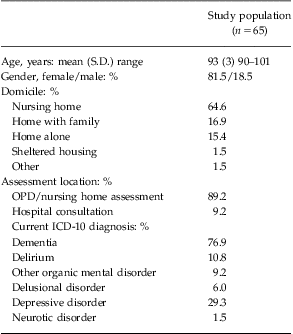
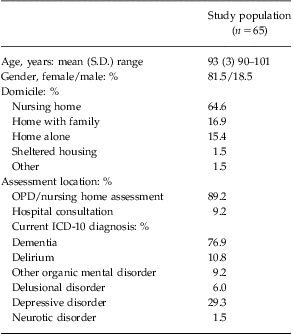
A total of 62 nonagenarians and three centerians came in contact with the service over a 1-year period; all records were identified and reviewed. Baseline characteristics are summarised in Table 2. Mean age was 93 (S.D. 3, range 90–101), 82% were female. The majority (65%) of patients resided in a nursing home, 32% lived at home. Dementia was the most common diagnosis (77%), followed by depressive disorders (29%) and delirium (11%). A third of the sample (32%) had more than one neuropsychiatric disorder.
Baseline clinical and demographic characteristics
The most common subtype of dementia was late-onset Alzheimer's dementia, which accounted for 24 (48%) of the cases. Thirteen (26%) were diagnosed with a vascular form of dementia. Five (10%) were of mixed/atypical type. There were also four cases of mild cognitive disorder and three cases of persistent delusional disorder. Although mood disorders were the second-most common diagnostic group, 44% of this group were currently in remission. Of the 10 cases with a current active depressive episode, seven were diagnosed with a moderately severe episode.
Prescription patterns: psychotropics
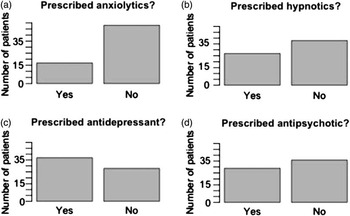
The most commonly prescribed psychotropics were antidepressants. A total of 37 patients (57%) were prescribed one antidepressant, and one patient was on two separate antidepressants. The two most commonly prescribed antidepressants were citalopram and mirtazapine (both n = 10, 27%). The other commonly prescribed antidepressants were escitalopram, (n = 7, 19%), and trazodone (n = 6, 16%). There were no dosages above the recommended BNF limits at the time of the study, although recently the recommended maximum dose of citalopram and escitalopram has been lowered due to concerns over their safety. The maximum dose of citalopram and escitalopram prescribed was 40 and 15 mg, respectively. Forty-two per cent of those prescribed an antidepressant had been on it for more than 12 months, 25% had commenced it in the last 3 months.
In all, 45% of the sample (n = 29) were prescribed an antipsychotic. The most commonly prescribed antipsychotic was quetiapine (n = 20, 69%). Haloperidol was prescribed in eight patients (28%). The majority were prescribed a low dose, with median dose in chlorpromazine equivalents (Woods, Reference Woods2003) being 33 mg (IQR 17–50). Thirty-nine per cent of those prescribed an antipsychotic had been on it for more than 12 months, 32% had commenced it in the last 3 months.
Forty-two per cent of the sample (n = 27) were prescribed a hypnotic. The most commonly prescribed hypnotics were zopiclone (n = 17, 63%), and zolpidem (n = 4, 15%). The remainder were on short-acting benzodiazepines such as lormetazepam or temazepam. Thirty-seven per cent of prescriptions were at a low dose (under half of the maximum recommended by BNF guidelines), and there were no dosages above maximum BNF guidelines. Seventy per cent of those on a hypnotic had been on the medication for more than 12 months, 15% had commenced it in the last 3 months.
Twenty-six per cent (n = 17) were prescribed an anxiolytic. The most commonly prescribed anxiolytic was lorazepam (n = 8, 47%) closely followed by alprazolam (n = 7, 41%). 35% (n = 6) had been on an anxiolytic for longer than 12 months, 35% had commenced it in the last 3 months.
Thirty-one per cent of the sample (n = 20) were prescribed an anti-dementia agent. There was an approximately even split between cholinesterase inhibitors (n = 8) and memantine (n = 7), and five patients were prescribed a combination of the two. Donepezil represented 92% (n = 12) of the cholinesterase inhibitor group. The mean dose of donepezil was 7.9 mg (S.D. 2.6, range 5–10). The mean dose of memantine was 14.6 mg (S.D. 6.9, range 5–20). Thirty per cent (n = 6) had been on an anti-dementia agent for over 12 months. Twenty-five per cent (n = 5) had been commenced on it in the last 3 months (Fig. 1).
Prescribing frequencies of psychotropic medications. This figure shows the relative distribution of nonagenarians that are prescribed (yes) or not prescribed (no) four different classes of psychotropic medications; (a) anxiolytics, (b) hypnotics, (c) antidepressant, (d) antipsychotics.

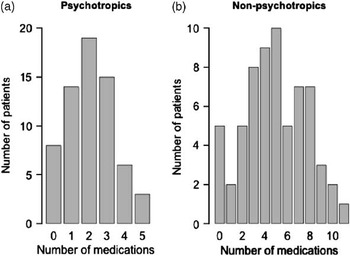
Overall, patients were on a mean of 2.1 (S.D. 1.3, range 0–5) psychotropic medications (Fig. 2a), and 87.5% were prescribed at least one psychotropic medication. There were no significant gender differences in psychotropic prescribing.
Number of medications prescribed per patient. The two graphs in Fig 2 display the total number of patients that were prescribed either psychotropic or non-psychotropic medications (note different scales). (a) Patients were on a mean of 2.1 (S.D. 1.3, range 0–5) psychotropic medications. (b) The mean number of non-psychotropic medications in the sample was 4.9 (S.D. 2.7, range 0–11).

Prescription patterns: non-psychotropics
The mean number of non-psychotropic medications in the sample was 4.9 (S.D. 2.7, range 0–11; Fig. 2b). The most commonly prescribed non-psychotropics were antihypertensives (n = 43, 66%), aspirin (n = 40, 63%), nutritional supplements (n = 30, 47%), protein pump inhibitors (n = 22, 34%) and laxatives (n = 21, 33%). Men received a higher mean number of non-psychotropic medications than women (6.8 v. 4.5, mean difference 2.4, p = 0.006).
Prescribing by diagnostic category
The prescribing of an anti-dementia agent was strongly associated with a diagnosis of dementia (χ 2 = 8.7, p = 0.003). The prescribing of antipsychotics (p = 0.11), anxiolytics (p = 0.17) and hypnotics (p = 0.18) did not reach statistical significant association with a diagnosis of dementia. For patients diagnosed with a mood disorder, there was a strong, statistically significant relationship between a diagnosis of a mood disorder and antidepressant prescribing [χ 2 = 35.9, p = 0.001, OR = 97.9 (11.5–835.1)].
There were no significant correlations for those diagnosed with delirium, schizophreniform, neurotic or organic mental disorder.
MMSE scores
The mean MMSE score in the sample was 15.0 (S.D. 8.1, range 0–28). Age was not a significant predictor of MMSE score, but gender was, with men on average having a lower MMSE score (10.4 v. 15.9, p = 0.026). A diagnosis of dementia (mean MMSE score 13.2 v. 20.9, p < 0.010) or delirium (mean MMSE score 6.4 v. 15.8, p = 0.021) was also associated with lower MMSE scores.
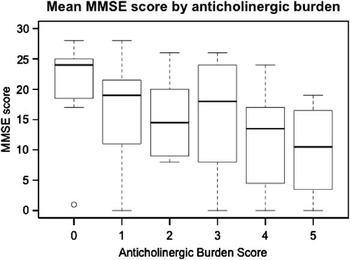
Receiving antipsychotics was associated with a lower MMSE score (12.5 v. 16.7, p = 0.04) but this lost statistical significance when controlling for a diagnosis of dementia and delirium. The mean MMSE of those prescribed anti-dementia agents was 11.4 (S.D. 7.1, range 0–20), in contrast to 16.6 (S.D. 8.0, range 0–28) for those not. An anticholinergic burden score per patient was created using the Anticholinergic Burden scale (Kolanowski etal. Reference Kolanowski, Fick, Campbell, Litaker and Boustani2009). The mean score was 2.34 (S.D. 1.5, range 0–5). Increasing anticholinergic burden was negatively associated with MMSE score (Fig. 3, B = −1.72, p = 0.013).
Mean MMSE score by anticholinergic burden. An anticholinergic burden score per patient was created using the Anticholinergic Burden scale, which scores medications from 0–3. The total of all medications were then added up. The mean score was 2.34 (S.D. 1.5, range 0–5). Increasing anticholinergic burden was negatively associated with MMSE score, B = −1.72, p = 0.013. MMSE, Mini Mental State Examination.

Domicile
Residing in a nursing home was associated with a higher mean number of psychotropics (2.5 v. 1.35, p = 0.001), but not mean number of non-psychotropics. Specifically, there was a higher rate of antidepressant [OR 5.71 (95% CI 1.9–17.4)], anxiolytic [OR 13.5 (95% CI 1.7–110.4)] and antipsychotic [OR 3.4 (95% CI 1.1–10.4)] medication prescribing for nursing home residents.
Potentially inappropriate prescribing
None of the patients were prescribed long-acting benzodiazepines or TCAs. However, 23/65 (35%) were prescribed short or medium-acting benzodiazepines. Of these, 17/23 or 26% of the total cohort had been on them long term. After removing patients with a clear rationale for being on long-term neuroleptics (diagnoses of schizophreniform or delusional disorder), 16/29 (55%) patients prescribed neuroleptics were on them long term (25% of total cohort). With regard to the potentially inappropriate prescribing criteria outlined in Table 1, only a few cases were identified, but many of the qualifying criterion were not available. The Beers criteria identified one person on daily fluoxetine, no patients were identified using the Canadian criteria, and the STOPP criteria identified one patient on long-term first-generation antihistamines. No patients were on other potentially inappropriate treatments identified in Table 1 such as selective serotonin reuptake inhibitor (SSRI)/monoamine oxidase inhibitor (MAOI) or SSRI/SSRI combination, barbiturates, phenothiazines or methylphenidate.
Discussion
Studies on the oldest old are rare, and this is one of the first to survey psychotropic prescribing in a cohort attending old age psychiatry services. This sample is a subgroup of nonagenarians and centerians, likely to represent those with the highest psychiatric morbidity burden. We were able to include all of the patients who did attend the service, and thus the results are likely to be representative of this group.
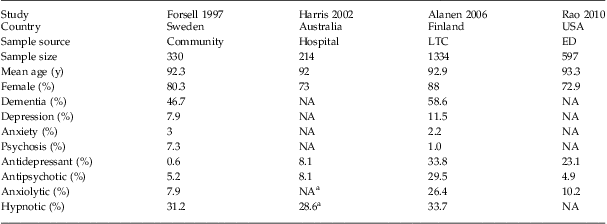
The few studies examining psychotropic prescribing in the oldest old show high variability in prescribing patterns (see Table 3). The studies surveyed different population settings; in the Forsell sample (Forsell & Winblad, Reference Forsell and Winblad1997), three-quarters lived at home, while in the Alanen study, all resided in long-term care (Alanen etal. Reference Alanen, Finne-Soveri, Noro and Leinonen2006). Rao surveyed nonagenarians attending an urban emergency department (Rao & Schears, Reference Rao and Schears2010), and Harris reviewed nonaganerian admissions to a general hospital (Harris etal. Reference Harris, Finucane, Healy and Bakarich2002). Elsewhere, Formiga has reported findings from the NonaSantfeliu study in Spain. A total of 11.8% of their sample of 186 nonagenarians were prescribed antidepressants (Formiga etal. Reference Formiga, Ferrer, Perez-Castejon, Riera-Mestre, Chivite and Pujol2009). The Swedish Gothenburg 95+ study, found a high level of psychotropic use (60%), but this sample only included 95-year-olds (Lesen etal. Reference Lesen, Carlsten, Skoog, Waern, Petzold and Borjesson-Hanson2011).
Existing studies of psychotropic prescribing in oldest old
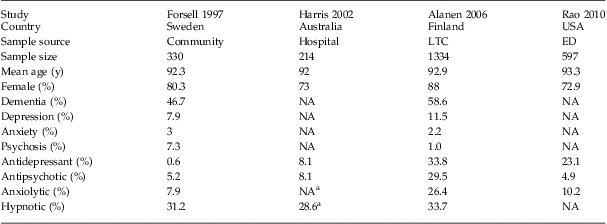
ED = Emergency Department; LTC = long-term care.
aRecorded as benzodiazepine of any type.
When our cohort was compared with the previous studies outlined in Table 2, age and gender distribution was similar. There were, however, major differences in terms of psychiatric morbidity, with our sample having higher levels of dementia (76.9%) and depressive disorder (29.3%). There were no cases of schizophrenia or bipolar affective disorder. This likely reflects referral patterns, where patients with pre-existing psychiatric disorders tend to remain with their general adult services. It may also reflect the lower life expectancy for these disorders (Laursen, Reference Laursen2011). Delirium was common; this had not been assessed in the other studies. Overall, these high rates are not surprising given the specialist nature of the service. The high psychiatric morbidity is likely to have contributed to the high levels of psychotropic prescribing.
Fifty-seven per cent of the sample were prescribed antidepressants. Although only 29% had a current episode of depression, 46% had a history of depression, which would go some way to explain the high use of antidepressants. There is little evidence from this survey to support the view that the oldest old are undertreated in terms of depression. Brown etal. (Reference Brown, Lapane and Luisi2002) found that in a sample of 42 901 adults over 65, 11% met criteria for depression. Of these, 55% received antidepressant therapy, and 32% received sub-recommended doses. The oldest old were identified as one of the groups least likely to receive an antidepressant.
There is some evidence that this may be changing. A recent study from the United States looking at historical trends in prescribing patterns in nursing home residents found that from 1999 to 2007 there was an increase in the rates of diagnosis of depression (from 33.8% to 51.8%) and prescribing of antidepressants (from 71.2% to 82.8%; Gaboda etal. Reference Gaboda, Lucas, Siegel, Kalay and Crystal2011). An analysis of the national prescribing register in Sweden for 2008 found that antidepressants were more commonly prescribed in institutionalised nonagenarians (12.4%) and centerians (11.3%) compared with their community-dwelling counterparts (37.0% and 23.0%; Wastesson etal. Reference Wastesson, Parker, Fastbom, Thorslund and Johnell2011). There was no data on diagnosis in this study, but certainly indicate a higher level of antidepressant prescribing compared with the 1997 Forsell study from Sweden where 0.6% of nonagenarians were prescribed antidepressants. These results, combined with our study, indicate that identification of depression in the elderly may be improving, although antidepressant prescribing is only a proxy measure of this. It may also reflect the improved safety profile of the newer antidepressants. It is possible that trazodone was used off-label for sedation in some instances, which may explain some of the ‘excess’ antidepressant use.
Antipsychotic use was also common (45%). Of concern, 25% of the sample had been on them for longer than 3 months in the absence of a schizophreniform or bipolar affective disorder. The dosages used were typically low, and there was an association between antipsychotic use and lower MMSE scores. The rate of antipsychotic use in the Alanen nursing home sample was also high (29.5%), but the rates seen here are higher still, although our patients are likely to have high levels of BPSD or psychotic symptoms in delirium. It is possible that patients commenced antipsychotics for acute symptoms in hospital are continued on them long term after discharge.
Forty-two per cent of the sample were prescribed a hypnotic, and 26% were prescribed an anxiolytic. The hypnotic rates are similar to, but higher than previous studies. Anxiolytic use was comparable to the Alanen sample, but higher than the other studies. Most of the hypnotics used were the newer ‘Z’ drugs, but overall, 26% of the cohort had been on a short- to medium-acting benzodiazepine for over 1 month. Forty per cent of patients with dementia were prescribed an antidementia agent. This was not recorded in other studies of prescribing in the oldest old making a direct comparison difficult. In other studies of dementia prescribing, the frequencies of antidementia prescribing varies from 5% to 88% (Prasad etal. Reference Prasad, Gupta, Bharath, Prakash, Sivakumar, Kumar and Varghese2009; Huber etal. Reference Huber, Kolzsch, Rapp, Wulff, Kalinowski, Bolbrinker, Hofmann, Scholze, Drager and Kreutz2012) placing our cohort in the median range, but as we did not record failed trials it is difficult to draw further conclusions from this.
There was no major difference in psychotropic use between genders, which differs from previous studies showing higher rates in women. Living in a nursing home was associated with higher levels of psychotropic use, which echoes previous studies in the area.
There was little indication that conditions were being undertreated in this sample, but once a referral to a specialist service has been made, the severity of symptoms is likely to have been high. A key step to treatment is recognition of a disorder, and it is possible that those not being referred to a specialist service are still being undertreated. Our data are a proxy measure of this, as we did not assess severity of symptoms or any other direct measure of the appropriateness of prescribing a particular drug. We were not in a position to comment on the quality of the treatment in place. As expected, there were high levels of polypharmacy, and the association between a high anticholinergic burden score and MMSE score is noteworthy.
The limitations of this study include its retrospective chart review design. We were reliant on the relevant information having been accurately recorded. Some information was not available for all patients, such as medical co-morbidities or falls risk. This limited our analysis, preventing a direct comparison to the full Beers or STOPP criteria. We could also only comment on associations, rather than cause and effect. The lack of a diagnostic interview also limits the validity of the diagnostic classifications, but the team use ICD-10 criteria to diagnose cases as standard practice. We could not assess pro re nata medication and we may have missed some Over-the-Counter medications.
Given the recent concerns regarding morbidity and mortality from antipsychotic and benzodiazepine use, the high rates of long-term antipsychotics and benzodiazepines found in this sample is of concern. In a majority of cases, we could not establish who had initiated specific medications. It was clear from the records that many of the psychotropics were commenced by non-psychiatric teams. Rationalising psychotropic medications is therefore an important task for old age psychiatry teams. Specific recommendations regarding the long-term use of benzodiazepines and antipsychotics from specialised services to follow-up services should be included in discharge summaries and explained to patients and their families.
Despite its limitations, this survey reflects current prescribing practice in a university teaching hospital treating nonagenarians and centerians referred to a specialist old age psychiatry service. Although guidelines can be of use, they have limitations in specialised cohorts like this, with high levels of morbidity. Nonetheless, although these guidelines are usually based on a limited evidence base, this evidence becomes important when one is prescribing off-label.
Observational studies have shown that interventions using criteria such as STOPP can reduce the rates of potentially inappropriate prescribing. These forms of criteria may be especially helpful in the oldest old, who are the most likely to be exposed to polypharmacy, multiple co-morbidities and multiple health providers (Wolff etal. Reference Wolff, Starfield and Anderson2002; Green etal. Reference Green, Hawley and Rask2007; Hovstadius etal. Reference Hovstadius, Hovstadius, Astrand and Petersson2010). Their use as a screening tool on all admissions to a psychiatry of old age service was recently highlighted in a study of elderly patients attending an old age psychiatry service (Wastesson etal. 2011). STOPP criteria were found to detect more potentially inappropriate prescribing practices and were easier to use than the Beers criteria. It should be noted that it does not necessarily follow that higher detection rates of potentially inappropriate prescribing indicates a high quality tool. It may equally indicate that the thresholds are too low. A new RCT using these criteria is due to be completed shortly (O'Mahony, Reference O'Mahony2011). With increasing longevity, more attention will be directed to the prescribing patterns in the oldest old. An increasing awareness among prescribers of the adverse effects of potentially inappropriate prescribing practices may alter prescribing patterns over time. Regular reviews and audits of antipsychotic and benzodiazepine use should be built-in to prescribing practice.
Acknowledgements
None.
Conflict of Interest
None.