Optimal performance is a term that encapsulates aspects of peak performance, peak experiences and flow (Harmison & Casto, Reference HARMISON, CASTO and Murphy2012). Many performers seek optimal experiences in the hope of achieving personal excellence in a given task (Miller & Kerr, Reference MILLER and KERR2002; Harmison & Casto, Reference HARMISON, CASTO and Murphy2012). Peak performances are action-oriented or observable behaviours (Marotto, Rose, & Victor, Reference MAROTTO, ROOS and VICTOR2007) leading to superior functioning (Harmison & Casto, Reference HARMISON, CASTO and Murphy2012). Research suggests that peak experiences are spontaneous, once-in-a-lifetime occurrences that evoke fulfilment and positive emotions, similar to experiences of flow (Maslow, Reference MASLOW1968; Harmison & Casto, Reference HARMISON, CASTO and Murphy2012). Typically defined as an optimal state of consciousness characterised by creativity, automaticity and full immersion in a task (Csikszentmihalyi, Reference CSIKSZENTMIHALYI1990), flow is often associated with certain aspects of both peak experiences and peak performances, but to date it remains an elusive psychological standalone construct due to its varying conceptualisations from scholars (see Obadă, Reference OBADĂ2013). Flow theory (Csikszentmihalyi, Reference CSIKSZENTMIHALYI1990; Jackson & Csikszentmihalyi, Reference JACKSON and CSIKSZENTMIHALYI1999) attempts to explain the flow experience and to provide a framework for measuring the different dimensions of flow in a given task. According to flow theory, flow as an experience consists of nine distinct constructs: (a) transformation of time, (b) balance of challenge and skill, (c) merging of actions and awareness, (d) concentration, (e) unambiguous feedback, (f) autotelic experience, (g) loss of self-consciousness, (h) sense of control and (i) clear goals (Jackson & Csikszentmihalyi, Reference JACKSON and CSIKSZENTMIHALYI1999).
To date, flow has been studied primarily within sports (e.g., Jackson, Reference JACKSON1992; Jackson & Marsh, Reference JACKSON and MARSH1996; Jackson, Martin, & Eklund, Reference JACKSON, MARTIN and EKLUND2008). Although some studies have suggested that athletes experience the specific dimensions of flow to varying degrees (see Jackson, Reference JACKSON1996), all nine dimensions of Csikszentmihalyi’s (Reference CSIKSZENTMIHALYI1990) flow theory have generally been found in athletic populations. Indeed, researchers (e.g., Young & Pain, Reference YOUNG and PAIN1999) have deemed flow states to be ‘a universal phenomenon for athletes across sports’ (Young & Pain, Reference YOUNG and PAIN1999, p. 21).
Compared to the breadth of research on flow and performance in sports, the research on flow in other performance domains, such as music, is still limited. A recent systematic review of flow theory in music (Chirico et al., Reference CHIRICO, SERINO, CIPRESSO, GAGGIOLI and RIVA2015) highlights this dissonance. Existing research has suggested that enjoying and engaging in music are associated with both peak experiences and flow states (Lamont, Reference LAMONT2012). It is also known that the act of engaging in music inherently requires full attention and absorption in the task, which can facilitate flow (Custodero, Reference CUSTODERO2002). It has been suggested that to increase the likelihood of experiencing flow, music educators should employ tasks that represent an adequate balance of challenge and skills to keep their students motivated (O’Neill, Reference O’NEILL1999). One such strategy could be musical collaboration, which, according to St. John (Reference ST. JOHN2006), can teach children how to self-adjust their behaviours to (a) adequately match the required skills necessary for performance, (b) transform the music presented by the teacher and (c) find flow.
Despite the inherent gains a musician can experience from optimal performances, applied research in music performance enhancement is limited, and performance consulting for musicians is still considered to be a ‘novel development’ (Pecen, Collins, & MacNamara, Reference PECEN, COLLINS and MACNAMARA2016, p. 378). This is somewhat surprising, as optimal performance experiences that include flow are exhibited in music activities quite frequently (Lowis, Reference LOWIS2002; Sinnamon, Moran, & O’Connell, Reference SINNAMON, MORAN and O’CONNELL2012). To date, the studies that have examined flow in music have employed a range of research designs, including surveys (i.e., Bloom & Skutnick-Henley, Reference BLOOM and SKUTNICK-HENLEY2005; Wrigley & Emmerson, Reference WRIGLEY and EMMERSON2011), self-report questionnaires (i.e., Fritz & Avsec, Reference FRITZ and AVSEC2007; Gaggioli et al., Reference GAGGIOLI, CHIRICO, MAZZONI, MILANI and RIVA2017), interaction analysis (i.e., Sawyer, Reference SAWYER2003) and deductive interviews within the framework of flow theory (i.e., Swann et al., Reference SWANN, CRUST, KEEGAN, PIGGOTT and HEMMINGS2015). Freer (Reference FREER2009) argued that the future direction of flow research in a music domain should employ qualitative methodologies. With the exception of qualitatively examining flow in groups, such as jam sessions (Hart & Di Blasi, Reference HART and DI BLASI2015), choral performances (Freer, Reference FREER2009) and jazz improvisation (Sawyer, Reference SAWYER2003), in-depth, individual accounts of optimal performance experiences are lacking in the present literature. As such, researchers have called for more qualitative research based on an inductive, phenomenological approach (Sinnamon et al., Reference SINNAMON, MORAN and O’CONNELL2012) to understand the individual lived experience of flow that occurs during an optimal music performance.
Given the apparent lack of research into optimal performance experiences in music (Sinnamon et al., Reference SINNAMON, MORAN and O’CONNELL2012), the purpose of this study was to document the individual lived experience of flow during an optimal music performance. More specifically, the study aimed to gain insights into the following research question: How do musicians experience optimal performance?
Methods
Design
To better comprehend the essence or common experiences of the ‘lived’ experience as it relates to flow that occurs during an optimal performance, a phenomenological qualitative design was used (see Merriam, Reference MERRIAM2009). A phenomenological approach is concerned with exploring the essence of a shared phenomenon (e.g., flow) through in-depth interviews (Patton, Reference PATTON1990). Phenomenology explores a deeper understanding of meaning; the truth of the event is subjective and understood through one’s perception (Starks & Brown Trinidad, Reference STARKS and BROWN TRINIDAD2007).
Participants
Following theoretical saturation, when no new data emerged from the participants interviewed, a final sample of 15 (M age = 19; 53% male; M years of music experience = 9.57) undergraduate music students from a private college in upstate New York with self-identified previous experiences of optimal performances participated in our study. Students were seeking either a Bachelor of Arts degree in Music or a Bachelor of Music degree in Music Education and/or Performance. To ensure anonymity, we cannot divulge more details of the participants.
Interview guide
Consistent with a phenomenological approach, the grand tour question in the semi-structured interview guide asked participants to describe an optimal music performance experience (‘describe an optimal performance experience, one you would consider the most satisfying personally and which you will remember for the rest of your life’). This question was modelled on Jackson’s qualitative flow study (Reference JACKSON1992). The probing questions that followed related to (a) the quality of the experience, (b) familiarity with the concept of flow, (c) the most important factors for the participants to get into flow, (d) what the experience of flow meant to the participant and (e) any other relevant information the participant was willing to share. We piloted the interview at the early stages of development with the purpose of controlling for biases in the questions (e.g., avoiding leading questions, establishing question order) and within the researcher (e.g., consistent body language, tone of voice). A pilot interview was conducted by the first author with a graduate student unaffiliated with the study. No significant changes were made, as it was determined that the interview questions elicited responses that related to the participants’ unique experience, rather than the interviewers’.
Procedure
Pollio, Henley, and Thompson’s (Reference POLLIO, HENLEY and THOMPSON1997) steps for conducting phenomenological research informed the procedure. Following Institutional Review Board approval from the second author’s university, we approached the participants in compulsory undergraduate music classes (e.g., required music ensembles and music theory courses) for both performance and music education majors. Prior to recruitment, none of the researchers had any previous contact with the musicians. Although the second author is an associate professor at the campus in which the students were recruited, she is affiliated with a different department on campus. For reflexivity purposes, it is to be noted that all three authors have a music performance background. The first author conducted the interviews with participants, and her music performance background was bracketed via a reflexive diary to aid the researcher in recognising her own potential biases and assumptions (Nadin & Cassell, Reference NADIN and CASSELL2006).
During recruitment, we gave the students a demographic background questionnaire that inquired about their name, age, gender, race/ethnicity, major, year in school, years of experience, whether or not they were familiar with the term flow (yes/no) and, if yes, whether they experienced flow during a performance (yes/no). Those interested in participating returned the questionnaire to the first author. Those who self-identified as having had experiences of optimal performances and showed an interest in participating were provided further details of the study. Following informed consent, we scheduled the interviews on a first-come, first-served basis. All interviews were audio recorded and conducted in a private, reserved classroom on campus at a mutually convenient time. At the start of the interview, the participants also completed a background questionnaire consisting of contact information, basic demographic information, questions related to musician type (e.g., vocalist, instrument) and years of music experience. The recorded interviews (M time = 55 minutes) were then transcribed verbatim by the first author.
Data analysis
We transcribed and analysed each interview independently before proceeding to the next. We read and re-read the data to ensure that the essence of each participant’s lived experience was represented in the results. Indicative of methods suggested by Merriam (Reference MERRIAM2009), the interview content was first inductively analysed using open coding. During this process, any observations, remarks or relevant data components that emerged were documented (Merriam, Reference MERRIAM2009). Data were then clustered into themes (Merriam, Reference MERRIAM2009). This process continued until no new themes or concepts emerged, and the data were therefore saturated. After triangulation, or the crosschecking of data from various sources (i.e., multiple researchers, a reflexive journal; Denzin, Reference DENZIN1978), we compiled the final themes together in a meaningful way to draw relevant inferences about what the data reflect (Strauss & Corbin, Reference STRAUSS and CORBIN1998).
To establish trustworthiness, the first author kept a research journal to document any questions pertinent to the research question, various hypotheses, interesting notations and definitions of ideas and codes to create a ‘living’ document (Corbin & Strauss, Reference CORBIN and STRAUSS2008, pp. 117–118). The journal helped decipher the concepts relevant to the research question, account for bracketing and serve as an audit trail (Starks & Brown Trinidad, Reference STARKS and BROWN TRINIDAD2007). Peer debriefing was conducted by a colleague impartial to the study who independently reviewed the transcripts and coding structure (Creswell, Reference CRESWELL2007). Any significant feedback to the authors’ interpretation of the transcript was noted and adjusted accordingly. For member checking, we returned a transcribed draft of the interview to each participant for review. No major changes were made to the interview transcripts by any of the participants.
Results
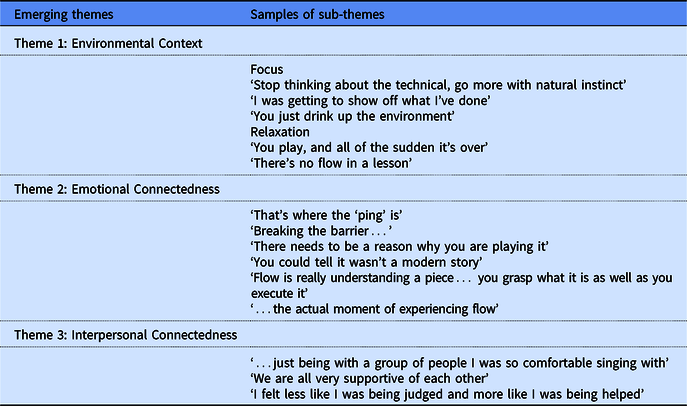
The analysis revealed three overarching themes that characterised the lived experiences of flow that occurs during an optimal music performance: environmental context, emotional connectedness and interpersonal relationships (see Table 1). Pseudonyms (e.g., Amy, Ben, Courtney, Danielle, Eva, Frank, Greg, Henry, Isabel, Jennifer, Kyle, Luke, Mason, Ned, Olivia) were used to protect the identity of the participants.
Emerging Themes and Samples of Sub-themes

Theme 1: Environmental Context
The psychological and physical environment before, during and after a particular performance influenced the flow experience. In essence, the participants spoke about how various aspects of focus were necessary for an optimal performance, such as ‘being fixated on the one thing… [where] nothing else matters’ (Amy). They also discussed how their ability to worry less about the technical aspects of a performance and play with natural instinct influenced the optimal performance experience: ‘you… just have to get out of your sheet music and play’ (Frank). Some musicians articulated that they performed optimally if they felt that a performance was an opportunity ‘to show off what I’ve done’ (Isabel). For example, Jennifer noted: ‘I am really ready to do this… I’m ready to show off what I’ve done and what I can do’. The psychological environment required for optimal performance also consisted of a relaxed mental and physical state prior to going on stage. When playing music, some noted that ‘nervous energy’ did not work; ‘it makes you rush, it makes you fumble a bit and it kills you’ (Amy). There appears to be an optimal level of arousal that musicians seek in order to put on a great performance; ‘you need to be “in the zone” but nervous just enough…but not too much where you start to mess up’ (Amy). One musician noted that simply getting ‘past the first page’ was all she needed to relax and get ‘in the zone’ (Eva). Moreover, the participants also discussed how during some optimal experiences, time sometimes sped up or slowed down. One musician mentioned, ‘it was like you stayed in that moment for a lot longer than it actually was. It was like two beats or something, but it felt so exaggerated to us’ (Olivia). Another stated, ‘we played probably an hour and a half, and it felt like ten minutes’ (Frank).
Two subthemes related to the physical environment also emerged. Some performers discussed how simply being on stage helped facilitate an optimal performance. On stage, ‘you just drink up the environment’ (Ned) and ‘being on stage is the best place to be’ (Frank). Ned illuminated how certain types of stage environments evoke flow:
It’s very comfortable when you sing in there. It sort of opens out to you as opposed to [another venue], which is like a block. You have so much space. I feel like in the [optimal venue] I can …move around and gesture and feel like space a little better. Being comfortable in your environment is really critical (Ned).
In contrast to the physical performance stage environments that evoke optimal performances, some participants also stated that flow was not something they commonly experienced during a practice session. For example, Luke stated, ‘there’s no flow in a lesson. You start to play and you get stopped’.
Theme 2: Emotional connectedness
The participants also characterised optimal performances via an emotional connection. Some participants noted the need to relate to the music on a personal level to find flow, or ‘the “ping”’ (Ned). Others noted a sense of vulnerability (Jennifer), modesty (Ned) or a spiritual personal connection, such as ‘being lifted’ (Olivia) during an optimal performance. Jennifer stated, ‘it’s like we are going to just lay it all out there. We call it “pouring”. It’s like we pour ourselves into everything musically that we do. We just go there and give of ourselves 110%’. Optimal performances also involved an emotional connection between the audience and the performer. For example, Greg stated, ‘you have to be able to break that barrier of “okay you’re sitting, you’re listening”…[instead] it’s like “this is what I have to say; so take this and interpret it as you will”’. Another commented that ‘in front of a live audience…if I know I am being watched…I’ll just rid of all doubts that I have and just do it’ (Ben).
In order to perform optimally, performers also noted the importance of identifying a ‘reason why you are playing’ (Amy). For many of the participants, they were not able to be ‘in the zone’ if they could not relate to the piece in some way, find the meaning in the song, or convey the emotion to others. Danielle found meaning by ‘putting myself in somebody else’s shoes, whether it’s like a character…or a musical or an opera… or a random song…and being able to tap into that character completely’.
Conversely, musicians had trouble connecting to stories that took place in classical settings in comparison to modern contemporary settings. Others had trouble finding flow when singing in another language. Frank commented on the differentiation between contemporary music and classical music:
I think playing contemporary music…is way different because the worries that you have are different. In orchestra you’re worried about if you come in correctly, and if you’re with a conductor, and if you’re blending, and these weird classical phenomena.
It is evident that participants in this study perceived personally relatable and less technical aspects of contemporary performances as more enjoyable, which in turn positively influenced performance. However, even if a performer was playing all the notes to the song correctly, if they did not ‘grasp’ the piece itself, then it was difficult to perform optimally. Many of the participants in this study found flow by connecting to the meaning of the lyrics or the meaning of the composed music. One musician noted, ‘we are all feeling what Tchaikovsky wrote here and we are helping whoever is listening get a hold of what we were feeling’ (Greg).
Many of the participants noted how the moment of being ‘in the zone’ was emotional in itself; using words such as ‘fun’, ‘excited’, ‘empowering’ and ‘satisfying’ to describe the overall experience. For example, when they had a difficult task to complete but felt as though they had the talent and necessary skills to meet the challenge, they often performed optimally, felt that the experience was rewarding (Jennifer) and had fun performing (Frank). One musician stated, ‘I was freaked out but I really liked it. I was so “in the zone” and I just didn’t care about anything else’ (Courtney). Amy noted, ‘it was such a gratifying moment, like this is my last band song, and this is for me… I think it’s very fun and empowering’. Ben commented, ‘it was hard work paid off… I felt really good after… it’s always satisfying when you are worried or doubtful…and then you get on stage and it is just what you expected’.
Theme 3: Interpersonal Connectedness
The people involved in the participants’ performance often influenced the flow experience. The interpersonal connections amongst these people, whether they were professors, adjudicators, vocal instructors, performers/cast members or other music students at the college, often played an influential role in an optimal performance.
The majority of the participants discussed a preference for and comfortability performing in a group; however, one noted that he also enjoyed performing alone (Henry). Another mentioned, ‘being in a group with a bunch of knowledgeable musicians who cared as much as I did really helped…everyone had such a drive for it, and that was electric for me’ (Ned). Furthermore, musicians often found that the support from fellow classmates helped achieve optimal performances; ‘we are all very supportive of each other… [and are] willing to help each other out’ (Isabel); and ‘I wasn’t worried about what other people thought of me because I knew that everyone was in this supportive environment’ (Ben). Some participants noted that the professors, adjudicators, directors, etc., that they interacted with determined their ability to find flow. One musician noted, ‘my teacher was very old [and] strict…I was more critical of myself’ (Henry). Henry also noted that he ‘felt less like I was being judged and more like I was being helped’ when he performed optimally in front of a different professor. When a professor was too focused on preventing mistakes, the musicians were harder on themselves and did not enjoy playing as much. When discussing her optimal performance, Eva noted, ‘I knew that if I messed up the teacher wouldn’t mind and my parents wouldn’t mind’. Ned described a choral director that helped him perform optimally; ‘he motivated in a way that I never saw a choral director motivate before…he could take the best out of a choir’. It is clear that the characteristics of the professors, adjudicators, instructors, etc., who interact with certain musicians played a role in the flow experience.
Discussion
The purpose of this study was to document the lived experiences of flow during an optimal music performance. The results from the inductive analyses revealed that during an optimal performance, musicians experienced flow through three main themes: environmental context, emotional connectedness and interpersonal connectedness. More specifically, the physical and psychological environment often influenced the participants’ optimal performance. Some examples, such as the size of the performance stage as well as amount of focus and relaxation, influenced the performance experience. Additionally, participants often felt a deep emotional connection to the words of a song and/or audience during an optimal performance experience. Many participants further noted that the relationships with vocal coaches, other music students and adjudicators were factors influencing an optimal performance. This study adds to a sparse body of literature that phenomenologically explores optimal performance experiences in musicians.
Theme 1: Environmental context
Although music performance is a highly subjective experience (Juslin & Lindström, Reference JUSLIN, LINDSTRÖM, Hallam, Cross and Thaut2016), it is important to discuss the importance of the antecedents to flow that the participants discussed during the present study. In terms of the environmental context, Barker’s Behaviour Settings Theory (BST; Reference BARKER1968) elucidates the interaction between a person and their perception of the environment. Similar to other ecological theories, BST is a theoretical system underpinned by the notion that to understand human behaviour, we have to consider the setting in which the behaviour took place (Popov & Chompalov, Reference POPOV and CHOMPALOV2012). BST suggests that behavioural traits become the ‘standard’ in certain places and situations (Armstrong, Reference ARMSTRONG2015), and this was evident in those participants who found flow by simply being on a stage and/or getting an opportunity to ‘show off’ in a performance setting. BST asserts that a musician’s previous experiences with a venue or space can also influence his or her perception of an upcoming performance (Armstrong, Reference ARMSTRONG2015), although this may be mediated by other factors, such as a musician’s personality traits. Conversely, a previous flow experience may influence a musician’s perception of the venue. The musicians’ appraisal of an optimal performance may include a positive interaction between the physical environment and musicians’ perception of the performance. Additionally, the psychological antecedents to flow that were mentioned by participants and associated with environmental context, such as focus, relaxation and intensity regulation, are all teachable mental skills that can be incorporated into music educational studies and performance practice, which can be tailored to the specific needs of the musician.
Theme 2: Emotional connectedness
The overarching theme of emotional connectedness is impactful, as it signifies a potential divergence between flow states in a music context and flow states in a sport context (Sinnamon et al., Reference SINNAMON, MORAN and O’CONNELL2012). The evocation and expression of emotion are important, primarily among aesthetic sports, but is not as heavily investigated or valued in a sport context as compared to music performance context, respectively (e.g., Sinnamon et al., Reference SINNAMON, MORAN and O’CONNELL2012). Emotionally expressive characteristics are deemed the most important criterion for aesthetic value in music performance (Juslin & Isaksson, Reference JUSLIN and ISAKSSON2014, as cited in Juslin & Lindström, Reference JUSLIN, LINDSTRÖM, Hallam, Cross and Thaut2016). Marin and Bhattacharya (Reference MARIN and BHATTACHARYA2013) note that a musician’s ability to regulate emotions may ‘underlie the proneness of achieving a flow state’ (p. 10). Although it is suggested that much is not known about the association between music and emotions (e.g., Marin & Bhattacharya, Reference MARIN and BHATTACHARYA2013), our results suggest that a musician’s personality as well as how the piece is perceived by the listener/performer could be influential to emotional connectedness. In support, Whaley, Sloboda, and Gabrielsson (Reference WHALEY, SLOBODA, GABRIELSSON, Hallam, Cross and Thaut2009) noted that emotional or ‘peak’ experiences in music performances are found amongst those who can relate to their own performance and to the listeners of the performance, which seemed to be important to many musicians in the present study. Since personal growth (e.g., self-reflection, improved self-esteem, heightened awareness) may occur because of a flow experience (see Elliott, Reference ELLIOTT1995), the current findings have pedagogical implications for music educators responsible for selecting appropriate material for their students. To evoke an optimal performance, music educators should encourage musicians to seek meaning in the words or composition of a piece, communicate appropriate emotions effectively and/or relate to the piece in a meaningful way.
Theme 3: Interpersonal connectedness
Consistent with previous research (Lamont, Reference LAMONT2012), the results also revealed that the influence of other musicians through the theme of interpersonal connectedness also seemed to be an impactful motivator to continued engagement and enjoyment in a performance context, both of which relate to flow experiences. In a musical group jam session, Hart and Di Blasi (Reference HART and DI BLASI2015) posited that musicians exhibited various constructs of flow, as well as a shared sense of empathy towards each other, potentially leading to increased intrinsic motivation to perform. It is known that musicians who feel as though they belong (Lamont, Reference LAMONT2012), who have an opportunity to connect to other people (Davidson, Reference DAVIDSON, Clarke and Cook2004) and who work with musicians they respect (Ford & Davidson, Reference FORD and DAVIDSON2003) tend to have better performance experiences (Sawyer, Reference SAWYER2006).
Similarly, Bakker (Reference BAKKER2005), in line with emotional contagion theory (Hatfield, Cacioppo, & Rapson, Reference HATFIELD, CACIOPPO and RAPSON1994), found that the frequency of flow experiences reported by music teachers was associated with similar frequencies of flow in their respective students (e.g., ‘flow contagion’). Therefore, there is evidence to imply that aspects of flow can crossover amongst music educators and students. This relates to musicians’ responses in the present study as the support of fellow classmates and the reassuring attitudes and actions of instructors/adjudicators seemed to influence the performance experience. Musicians are therefore encouraged to seek out others who can serve as a social support for the performance process, as having positive experiences with others can help formulate a social musical identity, which is associated with decreased performance anxiety and an improved performance (Lamont, Reference LAMONT2012).
Flow theory
When placing the current results in to existing theoretical context, it appeared that with the exception of clear goals, all of the constructs of the flow theory (Csikszentmihalyi, Reference CSIKSZENTMIHALYI1990) were supported in the interview transcripts. Because the state of flow is associated with aspects of peak experience and aspects of peak performance (Harmison & Casto, Reference HARMISON, CASTO and Murphy2012), participants were able to tap into specific characteristics of flow when first enumerating an optimal performance. For example, an autotelic experience was described as follows:
I just remember it wasn’t like doing a job. It was like breathing. It was natural and it just felt so good to be up there. And you are just in your element…I was like, ‘I can’t see myself doing anything else and working so hard for anything else’. (Jennifer)
Other examples of flow constructs mentioned by participants included, ‘this [role] was…totally different for me. It was probably one of the things…that has really taken me out of my comfort zone and really, really, really challenged me and pushed me’ (Jennifer; challenge-skill balance); ‘even our conductor remembered saying after, “that just felt like [a] totally no effort performance”’ (Frank; merging of actions and awareness); ‘because sometimes if you don’t get an immediate reaction you are like, “oh no, are we doing okay?”’ (Courtney; unambiguous feedback); ‘I feel like I am blocking everything else out…I remember one tip that I’ve always gotten was “don’t look all over the place when you are singing, just find a spot on the wall”’ (Ben; concentration); ‘…if you are in flow, nothing can touch you. If a baby starts to cry you just kind of think that’s cool. Of course the baby would cry. Why would it interrupt me?’ (Frank; sense of control); ‘I only want to be conscious that the person I am playing is a person. [If] you are thinking about your own stuff, your own little issues… than you are not a character, you are playing a character’ (Ned; loss of self-consciousness), and ‘it’s like you lose track of time. You play, and all of the sudden it is over… if you are not in flow you play and you are like, “…when is this piece going to be over?”’(Henry; time transformation).
Unlike the other eight flow constructs above, evidence of ‘clear goals’ was not discussed amongst any of the participants in the present study. This could be due to few things: first, musicians were not explicitly asked to discuss preparation processes leading up to an optimal performance but rather to just discuss the performance itself. Second, existing research has suggested that only a small amount of seasoned musicians are intrinsically motivated to better their craft; only a threat of an upcoming performance informs practice and goal attainment (Hallam, Reference HALLAM, Jorgensen and Lehmann1997; Lehmann, Sloboda, & Woody, Reference LEHMANN, SLOBODA and WOODY2007), and as such, setting goals may have not been a pertinent factor for the participants. Lastly, Hart and Di Blasi (Reference HART and DI BLASI2015) asserted that musicians participating in group jam sessions and/or experiencing ‘group flow’, often fail to establish clear goals due to the improvisational nature of the performance. Musicians describing improvisational performance experiences therefore may not have expressed evidence of clear goals in the present study.
Flow theory in sport and in music
Despite the divergences in emotional connectedness between sport and music (Sinnamon et al., Reference SINNAMON, MORAN and O’CONNELL2012), many similarities were also found in both domains. Since the current results support flow theory, they also provide sustenance for Martin and Jackson’s (Reference MARTIN and JACKSON2008) assertion that aspects of flow theory are important in any performance, despite its validation and initial use in sport settings. When considering the individual constructs of flow, the present study also mirrors Wrigley and Emmerson’s (Reference WRIGLEY and EMMERSON2011) overall conclusion that flow in a music performance is similar to findings of flow in a sport performance. Examining flow theory with musicians gives light to Jackson, Eklund, and Martin’s (Reference JACKSON, EKLUND and MARTIN2010) claim in the current Flow Manual; ‘assessing this experience across different settings [outside of sport] is an exciting next phase’ (p. 19). As flow is noted to be especially important in artistic performance areas leading to an optimal performance (Csikszentmihalyi, Abuhamdeh, & Nakamura, Reference CSIKSZENTMIHALYI, ABUHAMDEH, NAKAMURA, Elliot and Dweck2005) and that current research found no evidence of the clear goal construct of flow theory, further research is warranted.
Thus far, certain research on optimal performance experiences with musicians suggests that evoking flow in a music performance is important in order to improve present moment focus, decrease anxiety and eliminate distraction (Kirchner, Reference KIRCHNER2011). Given the current lack of research into the flow experience and mental skills training (Wrigley & Emmerson, Reference WRIGLEY and EMMERSON2011), and/or the ‘cherry-picking and adapting some of the most successful training techniques found in sports settings’ that are ‘at least partially applicable to the performance of music’ (Sinnamon et al., Reference SINNAMON, MORAN and O’CONNELL2012, p. 21), music, as a performance domain, provides an ideal context to conduct applied research into flow. Existing literature into mental skills training programs traditionally employed with athletes to achieve an optimal performance (e.g., confidence, motivation, optimal arousal) has demonstrated ‘versatility and adaptability in other domains’ (Steyn, Reference STEYN2013, p. 26) and can therefore be useful interventions with musicians. In conceptualising flow within the context of performance, intrinsic motivation, enjoyment and total absorption in the task seem to appear consistently (Bakker, Reference BAKKER2005). While it is feasible that interventions can be employed with musicians to achieve optimal performance (see Clark & Williamon, Reference CLARK and WILLIAMON2011) that are underpinned by fostering intrinsic motivation, enjoyment and total absorption in the task, the nuanced differences amongst both sport and music populations (see Pecen et al., Reference PECEN, COLLINS and MACNAMARA2016) provide too many consequences for consultants. For example, Sinnamon and colleagues (Reference SINNAMON, MORAN and O’CONNELL2012) noted that ‘the expression of emotion, presentation, communication and rapport with an audience, evocation of emotion in others, duty to a composer’s wishes through communication of music to an audience, and the production of sound’ are more conducive to optimal performance in music rather than sport (p. 9). While some of these aforementioned characteristics may be important to sport, they have not been examined as extensively in a performance context (Sinnamon et al., Reference SINNAMON, MORAN and O’CONNELL2012). However, the inductive themes and participant responses in the present study can perhaps serve as a foundation for the development of interventions appropriate for a music performance population.
Limitations
While the goal of qualitative analyses is not generalisability (Creswell, Reference CRESWELL2007), limitations to the study are important to discuss. For example, all musicians in the sample are collegiate performers and classically trained. Although flow experiences are subjective in nature (Csikszentmihalyi & Csikszentmihalyi, Reference CSIKSZENTMIHALYI and CSIKSZENTMIHALYI1988), research examining optimal performance experiences with musicians of varying abilities and backgrounds is warranted.
Music Educator Implications
Given that instances of flow may involve a peak experience, which can occur once-in-a-lifetime, it may seem futile to place all responsibility on the music educators to facilitate optimal performances among musicians. However, the musicians interviewed in the present study seemed to challenge many assumptions associated with classical music (e.g., timing, blending). Thus, the overarching role of the music educator in facilitating flow may be to encourage creativity in the expression of classical music, rather than enforce a duty or ‘police state’ to what is written by the composer (Leech-Wilkinson, Reference LEECH-WILKINSON2016, p. 330). Leech-Wilkinson (Reference LEECH-WILKINSON2016) argues that the musical intentions of composers represent a period of time and a location that is amenable and open to unlimited possibilities by each respective performer. Empowering the music student to be a co-creator of the piece, rather than a passive interpreter, may promote autonomy and creativity, and ultimately, flow. There is no singular way, or perfect way, to play a piece, yet the culture of obedience inherent in classical music culture (e.g., ‘duty to the composer’) facilitates these myths and can potentially impede flow. Challenging the systemic assumptions of classical music performance may be an impactful first step for music educators to facilitate optimal performances, respectively.
Summary
Optimal performance experiences in this study were characterised by knowing the music well, liking the music one is performing, relating to it/seeking meaning, fully immersing oneself into a character or concept, relinquishing worry about ‘getting it right’ or being too technical, focus/relaxation, receiving positive feedback from the audience, executing what is rehearsed and surrounding oneself with those who provide support and motivation. This study further demonstrated the relative consistency of flow theory constructs within a music performance population and showed that being in flow can, in fact, facilitate optimal performance in a music setting. However, given the nuanced differences between the sociocultural environment of a flow experience typical in sport and the flow experiences related to music, additional research into the divergences of domains is warranted. Such research can help performance consultants, musicians and music educators best facilitate optimal performance experiences.
In addition, based on the pedagogical implications of the current study, music educators are encouraged to (a) foster autotelic environments through musician autonomy, (b) provide assignments that demonstrate an adequate balance of challenge and skill, (c) integrate fun and creativity into practice sessions, (d) foster social support, (e) provide constructive feedback, (f) encourage musician self-reflection and the pursuit of meaning during performance, (g) practice in the venues/manner in which students are to perform and (h) seek psychological skills training from performance psychology professionals who are trained to implement psychological skills training techniques with musicians. Performance psychology professionals can work with both music educators and musicians themselves to develop the mental skills associated with enhanced performance.