Introduction
The Fifth Edition of the Diagnostic and Statistical Manual of Mental Disorders (DSM-5) 1 includes a considerably revised section on eating disorders (ED), now defined as “Feeding and Eating Disorders.”
We can summarize the major changes of DSM-5 for EDs into 3 categories:
-
1. Diagnostic criteria require a lesser symptom severity to make diagnosis, eg, we can now make diagnosis of a specific ED in anorexic patients without amenorrhoea or in bulimic patients with only 1 binge episode per week, thus reducing the prevalence of EDNOS patients.
-
2. Binge eating disorder (BED) is now recognized as an “official” ED.
-
3. The new lifespan approach of DSM-5,Reference Hoek 2 which reflects the growing evidence on continuity between child, adolescent, and adult psychopathology,Reference Uher and Rutter 3 eliminated the DSM-IV chapter “Feeding Disorders” and integrated all Feeding and Eating Disorders into a single category. Particularly, the formerly defined “Feeding Disorder of Infancy or Early Childhood” expanded diagnostic criteria to adults and was renamed “Avoidant/Restrictive Food Intake Disorder” (ARFID).
In the next paragraphs, we will consider, as a first step, the EDNOS issue—that is, the frequent use of the residual “Not Otherwise Specified” category for EDs when strictly applying the ICD-10 4 or DSM-IV 5 criteria. Then we will summarize the main characteristics of anorexia nervosa, bulimia nervosa, and binge eating disorder, comparing the ICD-10 with the new DSM-5 classification.
For reasons of space, feeding disorders will not be considered in this review.
EDNOS: The No Man’s Land
According to an extensive literature,Reference Strober, Freeman and Morrell 6 – Reference Machado, Goncalves and Hoek 11 EDNOS cases according to DSM-IV 5 and “atypical” anorexia and bulimia nervosa according to ICD-10 account for 40–60% of patients seeking treatment at ED facilities. Moreover, EDNOS may be even more common in non-specialized settings and in the community.
Common types of EDNOS according to DSM-IV include anorexia nervosa without amenorrhoea, bulimia nervosa without compensatory behaviors, and bulimia nervosa with bingeing episodes occurring less than twice a week. Such an etherogeneous group, an indirect sign of too rigid criteria for EDs, was unhelpful for research aims (eg, to define homogeneous cathegories for clinical trials) and even more unhelpful for clinical utiliy (eg, implications for treatment selection).
So, the DSM-5 proposal of broadening diagnostic criteria for anorexia and bulimia nervosa significantly reduced the proportion of EDNOS casesReference Machado, Goncalves and Hoek 11 , Reference Mancuso, Newton, Bosanac, Rossell, Nesci and Castle 12 and improved clinical utility in both research areas and everyday clinical practice.
As reported in Table 1, DSM-5 split the residual category of EDNOS into 2 categories: Other Specified Feeding or Eating Disorders (OSFED) and Unspecified Feeding or Eating Disorders (UFED).
Similarities and differences between DSM-IV Eating Disorders Not Otherwise Specified (EDNOS), DSM-5 Other Specified Feeding or Eating Disorders (OSFED), and Unspecified Feeding or Eating Disorders (UFED)

In OSFED, the clinician chooses to specify the reason that the specific criteria are not met, and the reported examples are substantially different from DSM-IV. First of all, there is no more anorexia nervosa without menses or binge eating disorder, as they are now considered as specific disorders. In the second place, DSM-5 reports purging disorder (see the “Bulimia Nervosa” section for more details) and night eating syndrome, a syndrome not yet well-defined in clinical researchReference Hartmann, Gorman and Sogg 13 and in which an excessive food comsumption occurs after dinner and/or after awakening from sleep. Finally, the DSM-IV example of “chewing and spitting out, but not swallowing, large amounts of food” is now included in DSM-5 as rumination disorder.
Different from OSFED, the UFED residual category is mainly used when there is insufficient information to make a more specific diagnosis (eg, in emergency settings).
Anorexia Nervosa: Diagnose Earlier, Diagnose Better
One of the most common issues in clinical practice of anorexia nervosa (AN) is the delay between the onset of the first symptoms and the beginning of a suited treatment. Especially among early-onset patients, the duration of an untreated illness could be more than 2 years.Reference Neubauer, Weigel and Daubmann 14 So, the broadened diagnostica criteria for AN, in which less severe cases are immediately classified as full syndromes, can help to timely detect clinically significant cases, and to direct them to the most appropriate treatment settings.
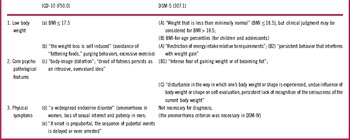
We can summarize the main differences between ICD-10 and DSM-5 diagnostic criteria for AN into 4 categories (see Table 2): (1) low body weight, (2) psychopathological features, (3) physical symptoms, and (4) additional features.
Diagnostic criteria in anorexia nervosa: similarities and differences between ICD-10 and DSM-5

Low body weight
Both ICD-10 and DSM-5 use low body mass index (BMI) as a diagnostic threshold, but DSM reports more lenient values. Not only can we make diagnosis of AN with a BMI more than 17.5, but also, according to clinical judgment, with BMI more than 18.5. In addition, DSM-5 uses BMI to specify severity. For instance, in cases of “extreme” (BMI<15) anorexia nervosa, clinicians can specifically refer patients to a more intensive (ie, inpatient) treatment setting.
Psychopathological features
In both ICD-10 and DSM-5, we recognize 2 core psychopathological features: the “dread of fatness/fear of gaining weight” and the “body image distortion/disturbance in the way in which one’s body weight or shape is experienced.”
The fear of gainig weight is widely recognized as a core feature of AN,Reference Habermas 15 but its dependence on development, culture, and illness stage questions the clinical utility of weight phobia as a diagnostic criterion.Reference Uher and Rutter 3 Many studies reported that the fear of gaining weight may be dependent on many aspects, including developmental variablesReference Bravender, Bryant-Waugh and Herzog 16 (eg, child and early adolescent anorexics often deny fear of gaining weight, probably because of a not-yet-developed abstract reasoning ability), cross-cultural variablesReference Becker, Thomas and Pike 17 , Reference Lee, Lee, Ngai, Lee and Wing 18 (eg, anorexic patients in non-Western countries may complain about “digestive” symptoms, but not report fears about weight); and stage-related variables (eg, the fear of gaining weight often emerges during the initial treatment phases, when the weight restorations begins).
For such reasons, DSM-5 extends the “fear” criterion to include “fearless” anorexia: either “intense fear of gaining weight or of becoming fat” or “persistent behavior that interferes with weight gain” can make us diagnose a typical AN.
On the other hand, ICD-10 provides a more “psychopathological” definition of fears: it states that the “dread of fatness persists as an intrusive, overvalued idea,” suggesting a link, as evidenced in the literature,Reference Cassidy, Allsopp and Williams 19 – Reference Godier and Park 23 between AN and obsessive-compulsive spectrum disorders.
As for body image distortion, it is a fundamental aspect of AN psychopathology, and both ICD-10 and DSM-5 require it as a diagnostic criterion.
In addition, DSM-5 hints at a poor insight about body image distortion (“persistent lack of recognition of the seriousness of the current body weight”), but neither ICD-10 nor DSM-5 investigate the prospective clinical usefulness of insight as a predictor of outcome in AN.Reference Steinglass, Eisen, Attia, Mayer and Walsh 24 – Reference Hartmann, Thomas, Wilson and Wilhelm 26 In order to better evaluate insight in AN, specific rating scales such as the Yale–Brown Cornell Eating Disorders Scale (YBC-EDS)Reference Mazure, Halmi, Sunday, Romano and Einhorn 27 and the Brown Assessment of Beliefs Scale (BABS)Reference Konstantakopoulos, Varsou and Dikeos 28 could be helpful.
Physical symptoms
Amenorrhoea, described in ICD-10 inside the broader category of “a widespread endocrine disorder involving the hypothalamic–pituitary–gonadal axis,” is traditionally considered a milestone in the diagnosis of AN.
However, many factors, including the widespread use of oral contraceptives among women, the early (ie, pre-pubertal) or late (ie, post-menopausal) onset patients, the small but significant percentage of male anorexics, and, most of all, the significant minority of women who menstruate but otherwise fulfil criteria for AN, lessened the clinical usefulness of amenorrhoea, and so the requirement of amenorrhoea as a diagnostic criterion was eliminated in DSM-5.
Additional features
More than the “differential diagnosis” paragraph in ICD-10, DSM-5 points out many other clinically useful associated features in AN and, as a rule, in any of the Feeding and Eating Disorders: developmental issues, risk and prognostic factors, culture-related diagnostic issues, diagnostic markers, suicide risk, differential diagnosis, and comorbidity.
Bulimia Nervosa: Lower Frequency of Binges, Same “large” Amounts of Food
The main change in DSM-5 was the reduction in the required minimum average frequency of both binge eating and compensatory behaviors, from twice to once a week for 3 months (see Table 3). On the other hand, ICD-10 simply required binge eating and compensatory behaviors to be “repeated,” whereas ICD-10 Diagnostic Criteria for Research 29 required “recurrent episodes of overeating at least two times per week over a period of three months.” Apart from frequency of binge episodes, there are some other differences between ICD-10 and ICD-10 Diagnostic Criteria for Research in bulimia nervosa: ICD-10 specifies differential diagnosis with upper gastrointestinal disorders, personality disorders, and depressive disorders, and, on a longitudinal perspective, emphasizes the frequent history of an earlier episode of anorexia nervosa in bulimic patients.
Diagnostic criteria in bulimia nervosa: similarities and differences between ICD-10 and DSM-5

As for bulimic patients with a lower binge/purge frequency, in one studyReference le Grange, Binford and Peterson 30 the distinction between “full” BN and subthreshold BN accounted for only <5% of the criterion variance in general psychopathology measures. Another studyReference Rockert, Kaplan and Olmsted 31 reports that, although the subthreshold BN had significantly lower scores on the scales that measured psychological disturbance (eg, drive for thinness, ineffectiveness, interoceptive awareness, depressive symptoms), both patient groups scored within the range of severity characteristics of clinical samples. A review studyReference Wilson and Sysko 32 does not equally show significant differences between full and subthreshold BN in body shape and weight concerns, and associated personality and psychiatric comorbidity, suggesting a once-weekly threshold for diagnosis of BN by similar factors of family history, history of treatment-seeking for weight or eating problems, clinical characteristics, personality, and response to treatment.
As a whole, these data are consistent with clinical practice, especially in community samples, showing that the DSM-IV 5 and ICD-10 Diagnostic Criteria for Research could exclude from diagnosis subjects who in every other way resemble patients with full BN.
As for the clinical characteristics of the single binge episode, an open question in bulimia nervosa is, to define a binge-eating episode, how large should the amount of food be? Both ICD-10 and DSM-5 state that the amount of food should be objectively larger, but there is increasing evidenceReference Pratt, Niego and Agras 33 – Reference Mond, Latner, Hay, Owen and Rodgers 36 that subjective and objective binge-eaters do not have clinically meaningful differences regarding psychiatric comorbidity, socio-demographic characteristics, current levels of eating disorder psychopathology, general psychological distress, impairment in global functioning, health service utilization, and use of psychotropic medications. In addition, the removal of the “large amount of food” criterion may substantially reduce the prevalence of EDNOS category among bulimic patients.
So, future revisions of ICD and DSM could consider the “sense of lack of control” as the foremost clinical characteristic of binge-eating episodes in BN. At present, “subjective” BN could be diagnosed in DSM-5 as purging disorder, ie, “ recurrent purging behavior to influence weight or shape (eg, self-induced vomiting; misuse of laxatives, diuretics, or other medications) in the absence of binge eating.”
There are other minor but significant changes regarding subtyping and severity specifying in DSM-5:
Subtyping
The distinction in DSM-IV between purging and non-puging BN was eliminated in DSM-5, due to literatureReference van Hoeken, Veling, Sinke, Mitchell and Hoek 37 that has shown poor clinical utility of such a distinction.
Severity
Unlike ICD-10, DSM-5 specifies 4 levels of severity according to the presence of inappropriate compensatory behaviors, from “mild” (1–3 episodes of compensatory behaviors per week) to “extreme” (14 or more episodes per week).
In addition, it could be useful in the clinical assessment of severity of BN to consider the presence of “multi-impulsive” behaviors (eg, shoplifting, substance abuse, and, most of all, self-damaging behaviors). Some dataReference Corstorphine, Waller, Lawson and Ganis 38 , Reference Myers, Wonderlich and Crosby 39 have shown evidence that multi-impulsive BN could be a distinct subtype of bulimia, with different etiopathogenetic (eg, childhood trauma in multi-impulsives), prognostic (eg, a poorer treatment outcome), and theraputic implications (eg, the possibile benefits of a dialectical behavior therapyReference Sipos, Bohus and Schweiger 40 , Reference Wisniewski and Ben-Porath 41 ).
Binge Eating Disorder: At Last, an “Official” Eating Disorder
In ICD-10, the F50.4 diagnosis “Overeating associated with other psychological disturbances” partially describes binge eating symptomatology, eg, a “reactive obesity” related to bereavements, accidents, surgical operations, and emotionally distressing events.
From the ICD-10 non-specific F50.4 category, binge eating disorder (BED) was cited in DSM-IV in Appendix B (“Criteria Sets and Axes Provided for Further Study”) and was coded as EDNOS.
In DSM-5, BED is acknowledged as a typical eating disorder, along with AN and BN. Its diagnostic criteria remain essentially the same as listed in DSM-IV, except the severity criterion has been reduced to require an average of 1 binge-eating episode per week over a 3-month period.
At first glance, BED could look like a subtype of BN, in which there are binge-eating episodes with no evidence of inappropriate compensatory behaviors. However, extensive research dataReference Tanofsky-Kraff, Bulik and Marcus 42 , Reference Wonderlich, Gordon, Mitchell, Crosby and Engel 43 have documented the clinical utility and validity of BED as a distinct disorder. For instance, BED patients are often obese, are usually older, show different comorbidities (eg, bipolar disorders), and, most of all, show a higher prevalence of men than anorexic and bulimic patients.Reference Davis 44
Future Perspectives: Toward ICD-11
The World Health Organization (WHO) is currently preparing the eleventh revision of the International Classification of Diseases (ICD-11), which is scheduled for release in 2017.
In recent literature,Reference Uher and Rutter 3 , Reference Thiels 45 , Reference First, Reed, Hyman and Saxena 46 recommendations for the revised classification of EDs in ICD-11 were reported. Many of them seem to resemble most of the DSM-5 revised guidelines, eg, the integration of weight categories for AN, the merging of feeding and eating disorders, the inclusion of BED as a distinct disorder, the definition of less rigid criteria for AN and BN, and, in the Standard Format for ICD-11 Clinical Descriptions, the inclusion of comorbidities, culture-related features, and developmental presentations.
Such convergence between ICD and DSM classification will hopefully foster the exchange of clinical and research information between different countries and, on the whole, improve the clinical utility of diagnostic guidelines for feeding and eating disorders.
Disclosures
Stefano Erzegovesi and Laura Bellodi do not have anything to disclose.