In the United States, laws that permit carrying firearms in universities and colleges divide students, teachers, and staff along ideological and political lines. For many, however, it is not simply a matter of being either pro-gun or antigun, but a complex negotiation of risks and benefits, “like a double-edged sword.”Footnote 1 In February 2019, two and a half years after the Campus Carry law came into effect in the state of Texas, undergraduates from The University of Texas at Austin, Austin Community College (ACC), and St. Edward's University were asked to participate in research.Footnote 2 As public institutions, UT Austin and ACC were required to implement Campus Carry and allow concealed handguns on their premises, while St. Edward's, as a private university, could – and did – opt out. The students were asked to write or draw freely about their experiences and sentiments on the law. Overall, more were against the policy than for it, although a significant number were avid supporters and many felt conflicted. In this essay, we explore the various meanings that the students assigned to guns in relation to their sense of security.
Much of the existing research on Campus Carry either aims to provide answers about the effectiveness of these laws in reducing violence or uses surveys to track the attitudes of campus communities toward such policies. Quantitative studies show that Campus Carry is mostly unpopular among students and faculty alike, but opinions vary greatly between different demographics and ideological leanings.Footnote 3 Yet survey responses can also present mere surface data and even discrepancies, which warrant further attention and explanation. Anonymous, open-ended testimonials offer space for unfiltered reflection, which makes them an invaluable resource for exploring complexities of opinion. As far as we are aware, this type of resource has not been previously utilized within the context of Campus Carry research. From the undergraduates’ personal stories, rationalizations, poems, and drawings we can see how guns make them feel, how they see gun carriers, how they understand the risks present in the world around them, and how these factors ultimately inform their attitudes toward the policy.
The students were asked to reflect on the Texas law, and their testimonials cover a broad range of themes and topics – from US gun culture and national politics to firearms training and mental health services. We analyze the testimonials through two different yet overlapping viewpoints that emerged: guns as a threat and as a form of protection. The polarization around issues related to personal firearms extends from questions of who should be allowed to own guns in the first place to where they should be permitted. Battle lines have been drawn, with one side categorically opposing civilians carrying on campus, due to the risks it poses, and the other side protesting that Campus Carry is the only way to keep students safe amidst increased risks of violent attacks, like mass shootings. Our exploration shows that the processes of meaning-making and positioning oneself in the debate about guns on campus are not without inconsistencies, nor are they always tied to overarching ideologies.
EXPERIENCING CAMPUS CARRY AS A THREAT
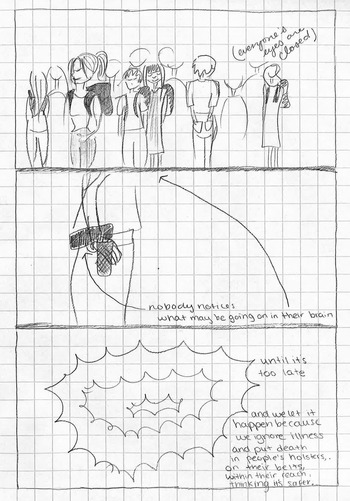
The students who are against Campus Carry justify their stance by identifying a number of risks that they perceive to be ingrained in the policy. These include accidents, such as an unintended discharge when holders of a license to carry (LTC) handle their firearms, or guns getting into the wrong hands due to negligence. For example, one student mentions incidents from 2018, when in the scope of two days two different guns were found unattended in bathrooms at UT Austin.Footnote 4 The students worry about their peers’ mental stability and are afraid that the combination of a stressful campus environment and the anxieties many young adults grapple with could cause a gun owner to suddenly snap and turn their weapon on themselves or others. Figure 1 shows a comic strip by a student who links gun violence to mental illness, criticizing society for neglecting “mentally ill, misguided people.”Footnote 5 In the drawing, a person carrying a gun ends up pulling the trigger (it is unclear whether the target is the shooter or the surrounding people), while others are oblivious to what is going on until it is too late. The final frame drives the point home: “and we let it happen because we ignore illness and put death in people's holsters, on their belts, within their reach, thinking it's safer.” The undergraduates also voice fears of premeditated shootings, by either a fellow student or an outsider, and argue that permitting guns on campus makes it too easy for an individual to carry out a planned attack. Many mention by name some of the schools where such atrocities have taken place in the last decades.
Excerpt from testimonial. Courtesy of the John Morton Center for North American Studies.

In the eyes of these students, the implementation of the Campus Carry law poses a threat to them and the campus community as a whole. While ultimately sharing the same stance regarding the policy, they each arrive at that conclusion in conspicuously different ways. For some, personal firearms are synonymous with violence, and they see guns – along with the individuals who carry them – as inherently suspicious. Others understand the desire to arm oneself for defensive purposes, but question the ability of gun owners to handle possible active-shooter situations, successfully protecting themselves and others. These students are not convinced by the oft-repeated argument that the only way to stop a bad guy with a gun is a good guy with a gun. Instead, they are concerned whether the “good guys” pulling out their weapons would only exacerbate the risks for all involved:
In the confusion of a mass shooting, how is the person supposed to know where the bullets are coming from? What if he shoots the wrong person? What if someone thinks he's the shooter? … I don't feel safe thinking about having my life in the hands of anyone licensed because I can't be assured of the quality of their training … I don't trust people around me to stay level-headed.Footnote 6
Many of the students regard guns as an important means of self-defense but also feel that they do not belong in educational settings. Some of these undergraduates claim to be experienced with or to own guns themselves, but disagree with Campus Carry because they feel that their peers are too unstable to handle firearms. Others describe universities and colleges as places where people should be able to teach, inquire, and converse freely. The presence of weapons is seen as casting a shadow of fear over the campus community, stifling these scholarly objectives and thus threatening the very mission of their institutions. Several students argue that campuses should be places where people can feel protected without having to take matters into their own hands. Instead of personal weapons, they call for more police officers and rigorous mental health programs to improve campus safety. Importantly, many who object to civilians carrying guns are nevertheless in favor of armed security officers. Although the notion that “guns don't kill people, people do” is generally attributed to the rhetorical arsenal of the pro-gun faction,Footnote 7 even the students against Campus Carry ultimately perceive guns either as a threat or as a source of security, depending on the person carrying them.
The testimonials often describe guns as an intrinsic part of US culture, for better or for worse. While Campus Carry poses a very concrete and ubiquitous perceived threat that affects students’ daily lives, the law is also seen as symptomatic of a larger cultural crisis and a societal failure. In the words of one student, “Mass shootings are expected. Police brutality is the norm. Large companies and political leaders fund/are funded by the NRA. Guns are under-regulated. People are dying daily. Campus Carry only continues to promote that these things are normal and okay.”Footnote 8 Students who oppose Campus Carry perceive it as a reflection of issues that plague the nation as a whole: the lax regulation related to firearms, the national epidemic of gun violence, and the discrepancy between public opinion and political actions.
SELF-PROTECTION: A RIGHT AND RESPONSIBILITY
Unsurprisingly, a significant number of the students supporting the Campus Carry policy are either LTC holders themselves or otherwise experienced and familiar with firearms. Used to being around guns, they feel that guns give them the power to be in charge of their own safety, or they trust other gun carriers to keep them safe. People who have grown up around guns see LTC holders as a community of law-abiding citizens, who have been trained to protect themselves and their loved ones. Individuals who engage with gun culture, either themselves or through their family members, often learn attitudes and beliefs about the world that go beyond simply owning a gun.Footnote 9 These students, much like the students against Campus Carry, are afraid because they perceive the world to be uncertain and dangerous. For them, even campus does not represent a safe haven and imagining it to be so is naive. The possibility of a violent incident is always present:
There are bad people in this world. There will never be a day without bad people. I want people like me and others with similar experiences to be the ones with weapons no matter the location. You can only fight fire with fire … No matter how civilized we want to pretend we are, this is still a dog eat dog world. There is no way I want to forfeit my right to defend myself or those around me from piece of shit human beings.Footnote 10
The possibility of assault is a driving force for people to acquire a gun – indeed, gun carrying for self-protection surpasses all other reasons why people reportedly own a gun.Footnote 11 Gun owners often see themselves as citizen protectors, who not only have the right but a duty to protect their community from those who mean harm.Footnote 12 Guns are the tools people need to perform their rights and duties and are an extension of justice in the right hands. Part of this mentality is the aforementioned notion that it is not only the gun that kills but the person pulling the trigger. In a world envisioned as consisting of good guys and bad guys, it is not a difficult moral dilemma to determine whose life is more valuable:
The concept of armed citizenship is deeply connected to individualism and the belief that individuals in the US are responsible for their own successes and failures. Having the freedom to defend one's safety is considered an unalienable right that makes one “American.” Some of the undergraduates express doubt about the abilities of police officers to fully protect them. They would rather have the LTC holders, whom they view as having the integrity and expertise to handle a gun in a serious situation, be there just in case:
People who have the motive to harm someone with a gun will find ways to procure one, leaving the law abiding citizens out of luck if banned. Rather than trying to more closely involve the government, there may be a more feasible or effective alternative to keep the larger, gun populated US “in line.”Footnote 14
Not only is the government seen as unable to provide adequate protection, but also some fear that it will one day become the threat that citizens need to arm themselves against. Despite the fact that the possibility of citizens successfully rising up against the full military might of the US government seems to have little basis in reality, to this day the idea persists: “I believe it is the inherent right of every citizen to own firearms as it is the last line of defense against tyranny. I also believe that every citizen is entitled to the protection of their life, liberty, and property.”Footnote 15 Armed citizenship in the streets and on campuses is perceived as a deterrent that checks the hand of the government, mentally ill would-be school shooters, and lone wolves with bad intentions.
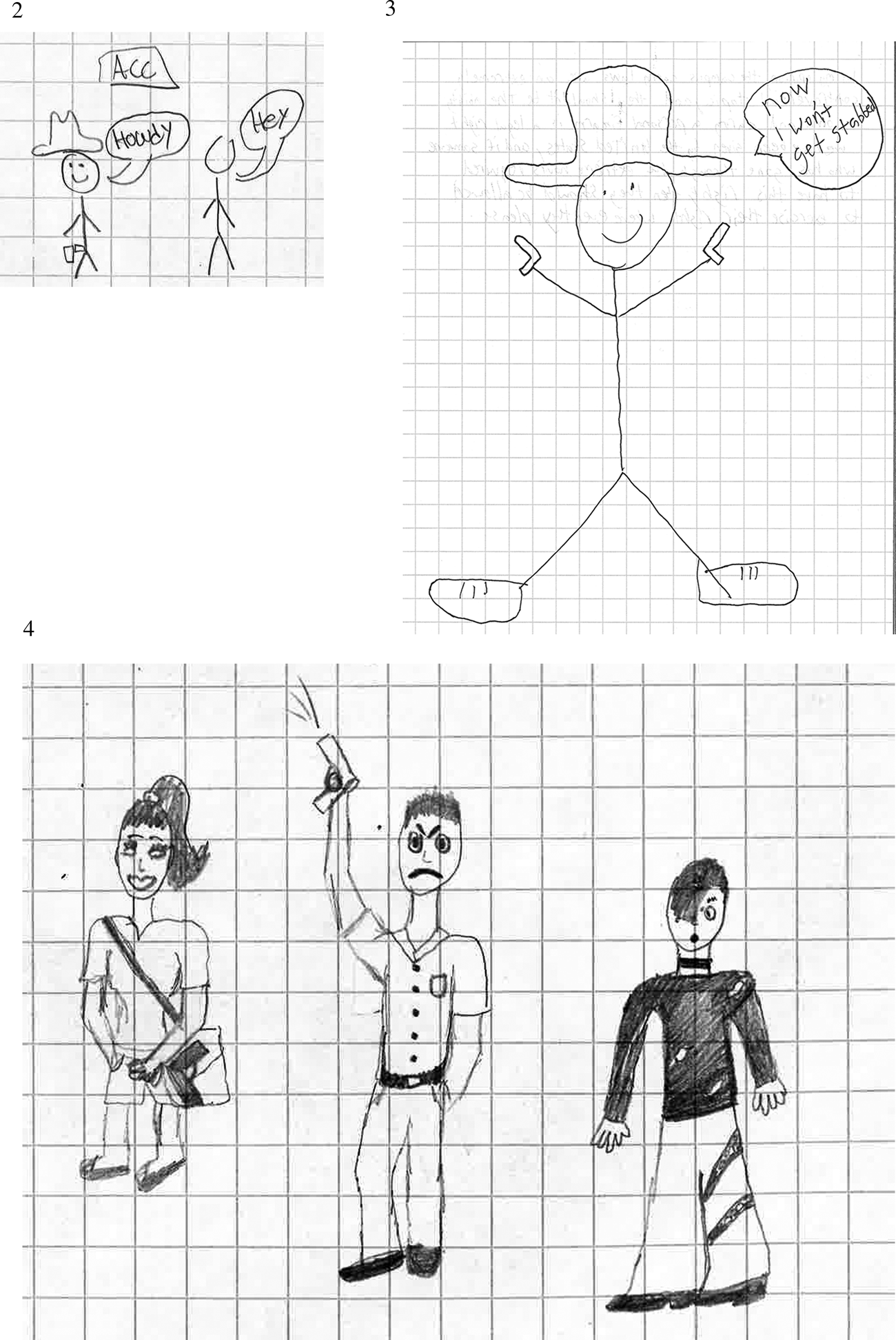
There are other aspects to gun carrying as well, which have little to do with protection or freedom. Guns can also bring their owners joy in very concrete ways. The “happiness” that guns bring can even be a very physical experience: “guns attract me because of the sound, and the smell of the smoke that comes out.”Footnote 16 While happiness with guns is rarely explicitly mentioned in the testimonials, in their pictures students often depict gun owners as happy. Such drawings (Figures 2, 3, and 4) are childlike in their simplicity, and in this simplicity it is the happiness associated with holding a gun that comes through the clearest. One student draws a positive interaction with a stereotypical gun owner (a cowboy) and (presumably) someone who does not own a gun (Figure 2),Footnote 17 while another portrays a happy gun owner whose firearms protect them against attackers (Figure 3).Footnote 18 Figure 4 depicts the conflicting feelings that some students express: guns bring comfort (the happy gun owner), but gun ownership should also be more regulated (the angry person firing a gun) and not knowing who is carrying a concealed firearm can feel daunting (the person on the left).Footnote 19
Excerpts from testimonials. Courtesy of the John Morton Center for North American Studies.

The last figure exposes the root of an issue that divides the students. The question of who should be allowed to own guns plagues the minds of supporters of Campus Carry, just as it does those who are against it: “There isn't a problem with properly trained people who have passed background checks carrying weapons … If gun laws and regulations can ensure that only strictly qualified people carry weapons, then I don't see why they can't carry them on campus.”Footnote 20 What, then, constitutes a strictly qualified person? Many supporters of Campus Carry seem to be less concerned about the quality of the training that LTC holders receive and more about the character of the gun owner. Their support is based on making sure that only “mature and responsible” persons, who are mentally stable, are able to acquire an LTC.Footnote 21
Thus much of the support for Campus Carry depends on whether one believes that the requirements for an LTC are sufficient. Currently, Texas is a “shall-issue” state, which grants permits to all citizens who meet the requirements. Applicants must complete four to six hours of firearms training and pass a written exam, be at least twenty-one years old, and have no criminal convictions, involuntary admissions to a mental institution, or “mental defects determined by a lawful authority.”Footnote 22 It is uncertain whether the students calling for adequate LTC requirements in the testimonials are familiar with the Texas law. What is clear is that students set varying qualifications for citizens to be able to exercise their Second Amendment rights.
CONFUSION AND CONTRADICTIONS
There are a number of misconceptions in the testimonials, which explain some of the contradicting statements made by the students. A number of undergraduates mistake Campus Carry to mean that it is legal to carry an openly visible firearm on campus.Footnote 23 For example, one respondent writes that they are against the policy because they do not wish to see guns on campus, while another believes that nobody is carrying because they have not seen any guns: “Open carry should be a topic that worries most. However, ever since it has been allowed that is not the first thing I think about when I set foot on campus. To my knowledge I have yet to witness anyone carrying a gun on campus or in class.”Footnote 24 Misconceptions and contradictions intertwine in the testimonials:
I'm pro-gun use. I don't believe we should have rules regulating the visibility of guns but just the types of guns allowed (i.e., no ARs). If someone is not allowed to have a gun on school grounds it impedes on our individual freedoms as Americans. Therefore I believe we need to get rid of campus carry.Footnote 25
This student is against Campus Carry because it only allows concealed carry. Later in the testimonial they appear to indicate that banning open carry from campus is a blanket ban on all gun carrying: “One of my dear friends, a UT student, had a justifiable cause to carry a gun on school grounds but because of this law she couldn't.”Footnote 26 They advocate for open carrying on campus – a radical idea that not even the Republican Texas State Legislature has been ready to champion. Yet they also express support for a ban on assault rifles, which conservatives critique as a left-wing idea that is ineffective and impossible to execute without limiting all guns. Some of the students struggle with keeping track of which areas are limited and which are not, while others find it hard to form an opinion due to the politics of it all. One student starts by expressing apprehension about Campus Carry but then veers into listing all their favorite guns: “When I first heard that colleges were going to have firearms I was a little bit scared … Myself, I love guns, in fact my favorite gun is the .45, rifle is the AK-47, the Uzi, double barrel.”Footnote 27 They claim to love guns but clearly also find them intimidating in the hands of their peers. By enabling students to express these complex trains of thought, the testimonials open up new avenues for Campus Carry research.
We set out to explore what the testimonials can reveal of the meanings that Texas students assign to guns in relation to their sense of safety. Regardless of the objective risks, people need to feel safe. In fact, there is often little connection between objective risks and how people perceive their level of safety.Footnote 28 The perceived threat of violent attacks, influenced both by previous experiences of victimization and by generalized beliefs about the level of dangerous crime in the world, frequently motivates the actions people take to ensure their personal security. Media coverage of school shootings and gun-related activism keeps these issues in the public eye, affecting students’ views of campus safety. Despite the fact that campuses are among the safest places in the United States, it is clear that students are concerned about violence in the world in a way that translates into anxiety and fear about their own everyday safety. Statistical probabilities do not make the experiences of fear and vulnerability any less real or the recurrence of school shootings any less horrific.
Students make sense of guns on campuses by reflecting on their own relationship with firearms, their perception of the people who own them, and how they see the role of guns in US society and culture. Students can and do have complicated relationships with all of these factors, and their reasoning is not always clear-cut or in line with the grand ideological narratives promoted by political parties and activist groups. Some students view guns as symbolizing nothing but violence, being a plague on US culture, and they perceive gun owners as untrustworthy and dangerous. Others believe that carrying guns is an unalienable right etched in the foundation of the United States, and trying to restrict that right is tantamount to tyranny. In between, one can find students who are scared of guns but trust gun owners, and gun owners who do not trust their peers to carry. Others wish guns were not part of their culture but are resigned to the fact that they are. The Campus Carry policy thus resembles a double-edged sword, which can protect its wielder but also inflict harm upon them, the same way a single gun can be used for either good or evil. While the law essentially pertains to where guns are permitted, the students often extend their deliberation to who should be allowed to carry, putting less emphasis on the guns and more on the people who carry them.
The threat of violence is a reality most students today need to live with while acquiring an education in the United States. Some confront their fears by arming themselves, finding comfort in the weight of a gun in their backpack or on their hip. For these students, knowing that citizen protectors are among the campus community brings solace. To others, the guns carried by their peers are but another manifestation of a looming threat. They turn their anger toward lawmakers for allowing guns to trespass on campus space. There is middle ground to be found between the two sides, with most students – regardless of gun ownership or ideological leaning – agreeing that there should be more restrictions on who gets to own a gun. However, with an increasingly scared and anxious youth, the Campus Carry policy debate threatens to become a river too wide for the two sides to cross.Footnote 29