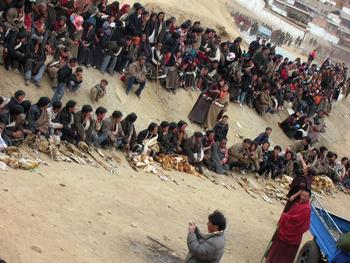
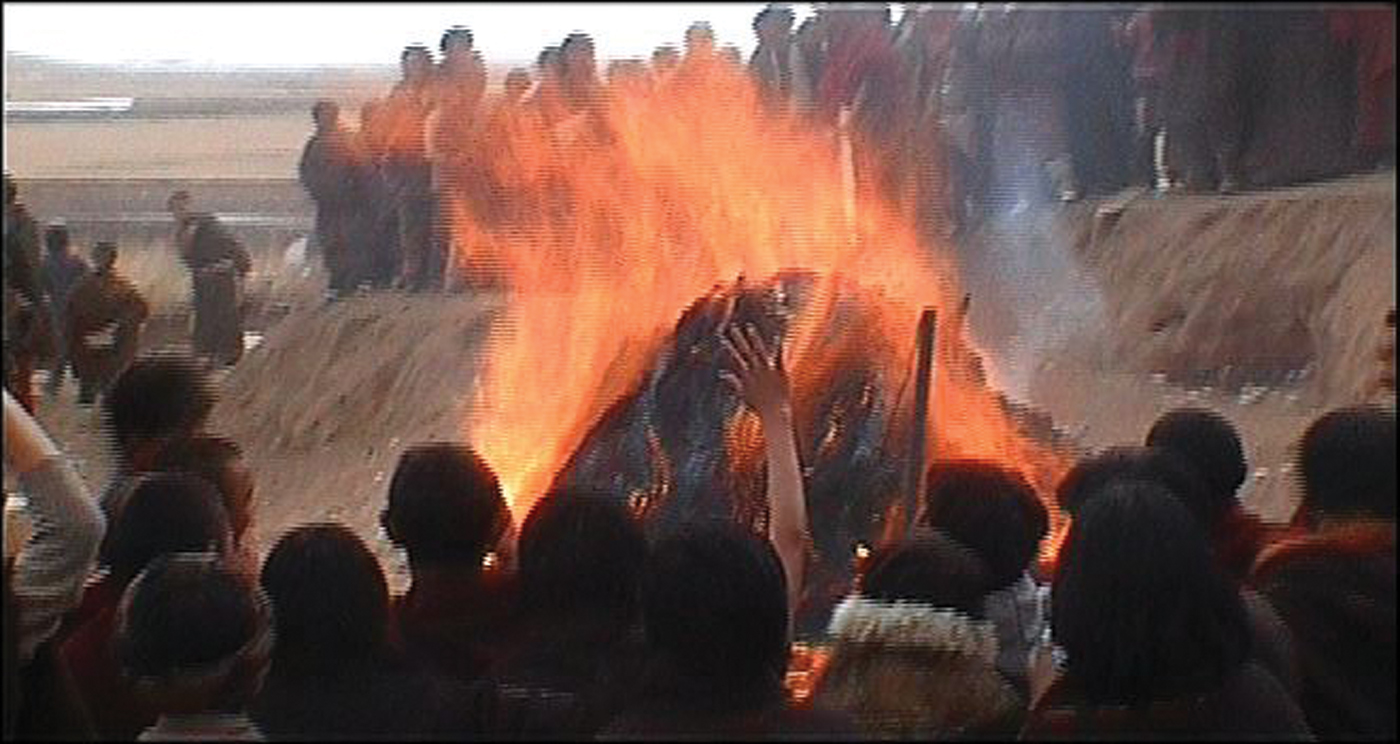
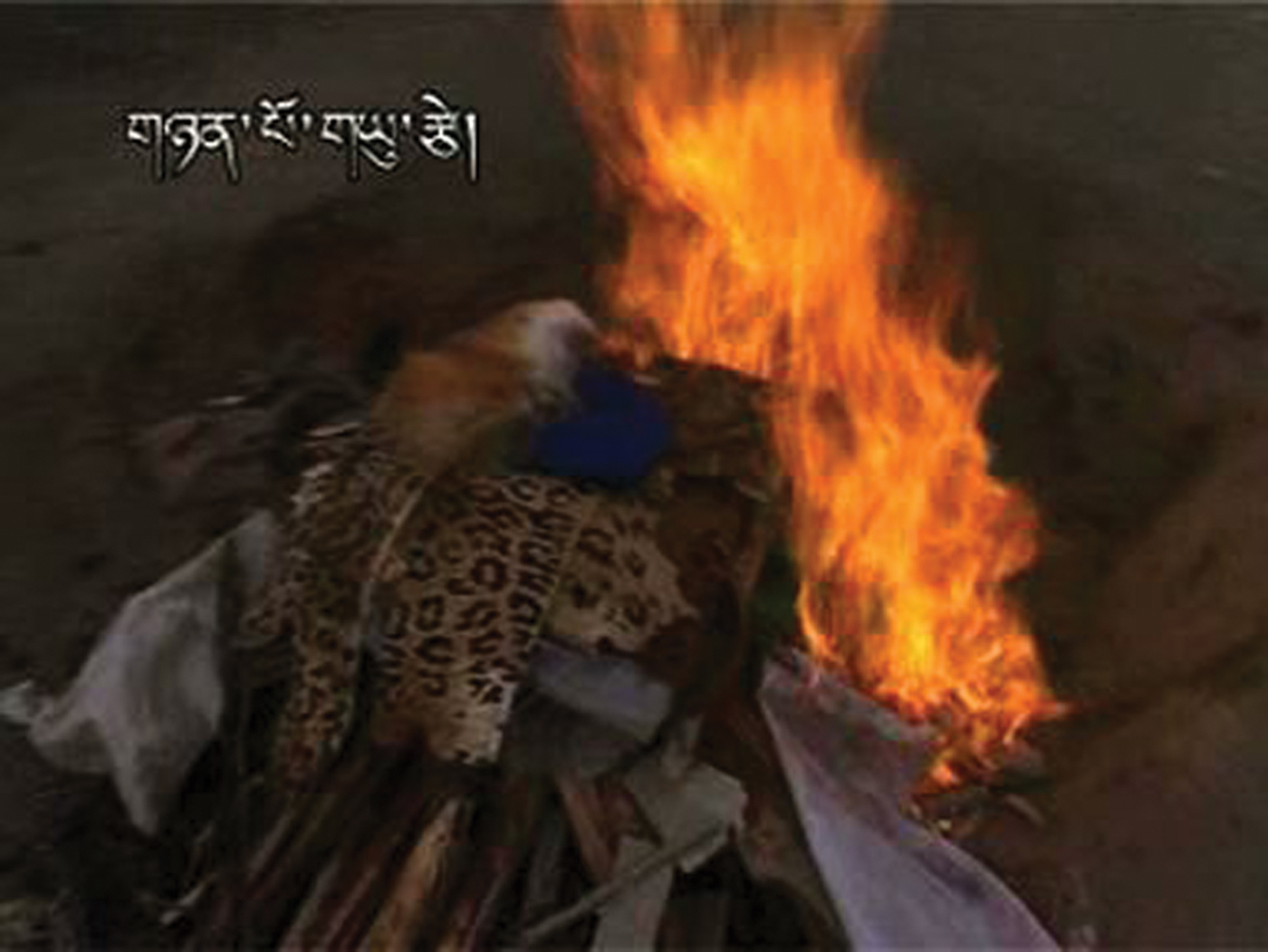
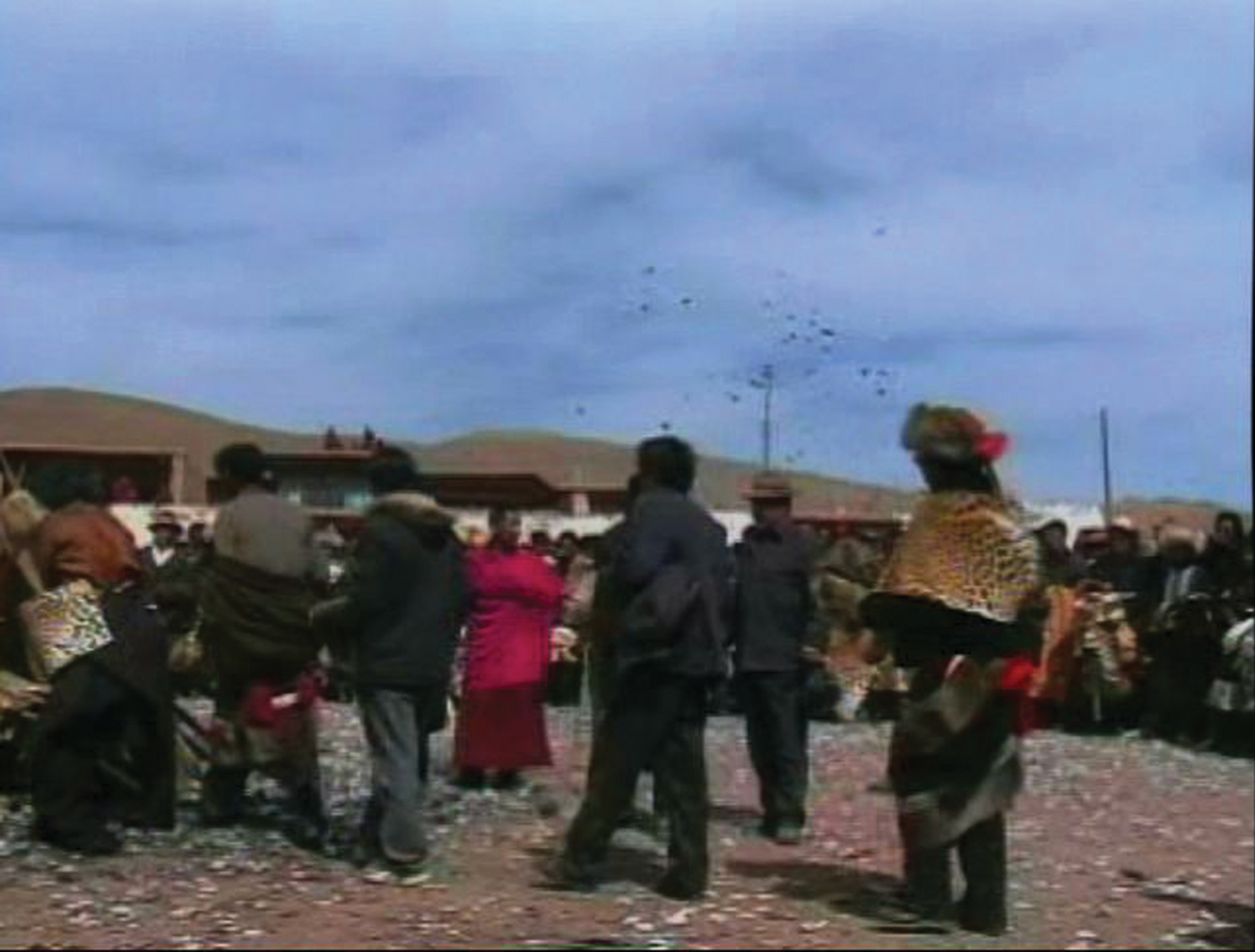
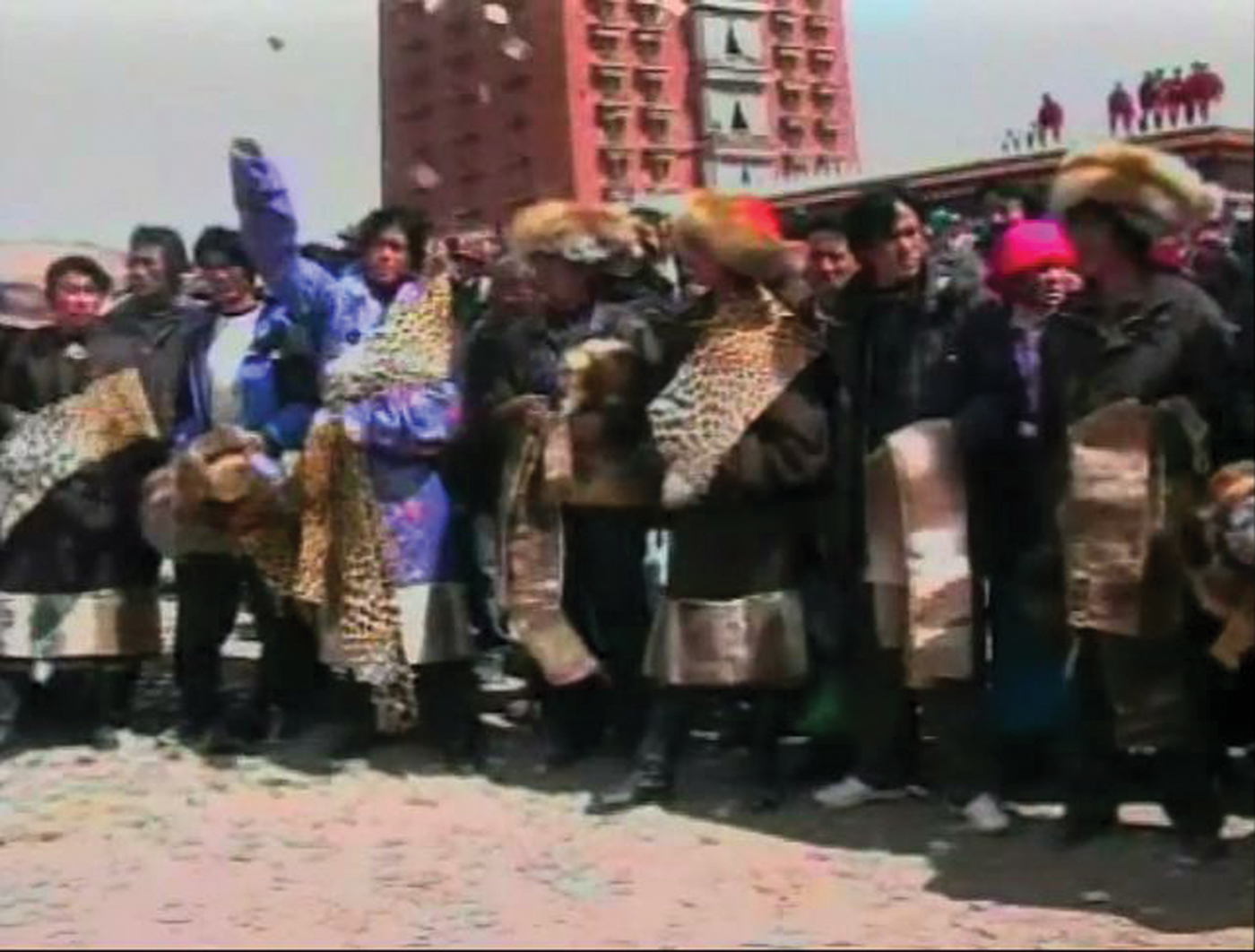
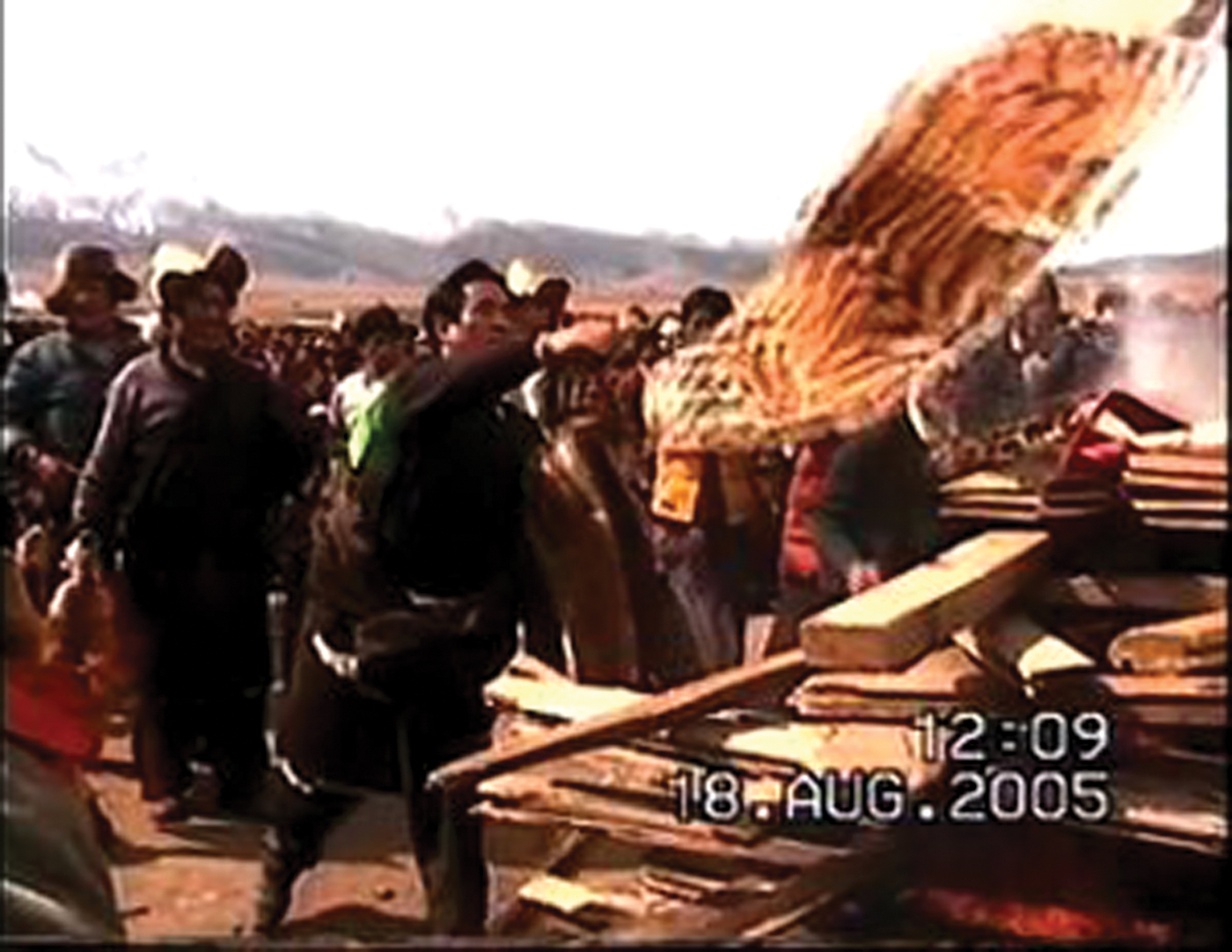
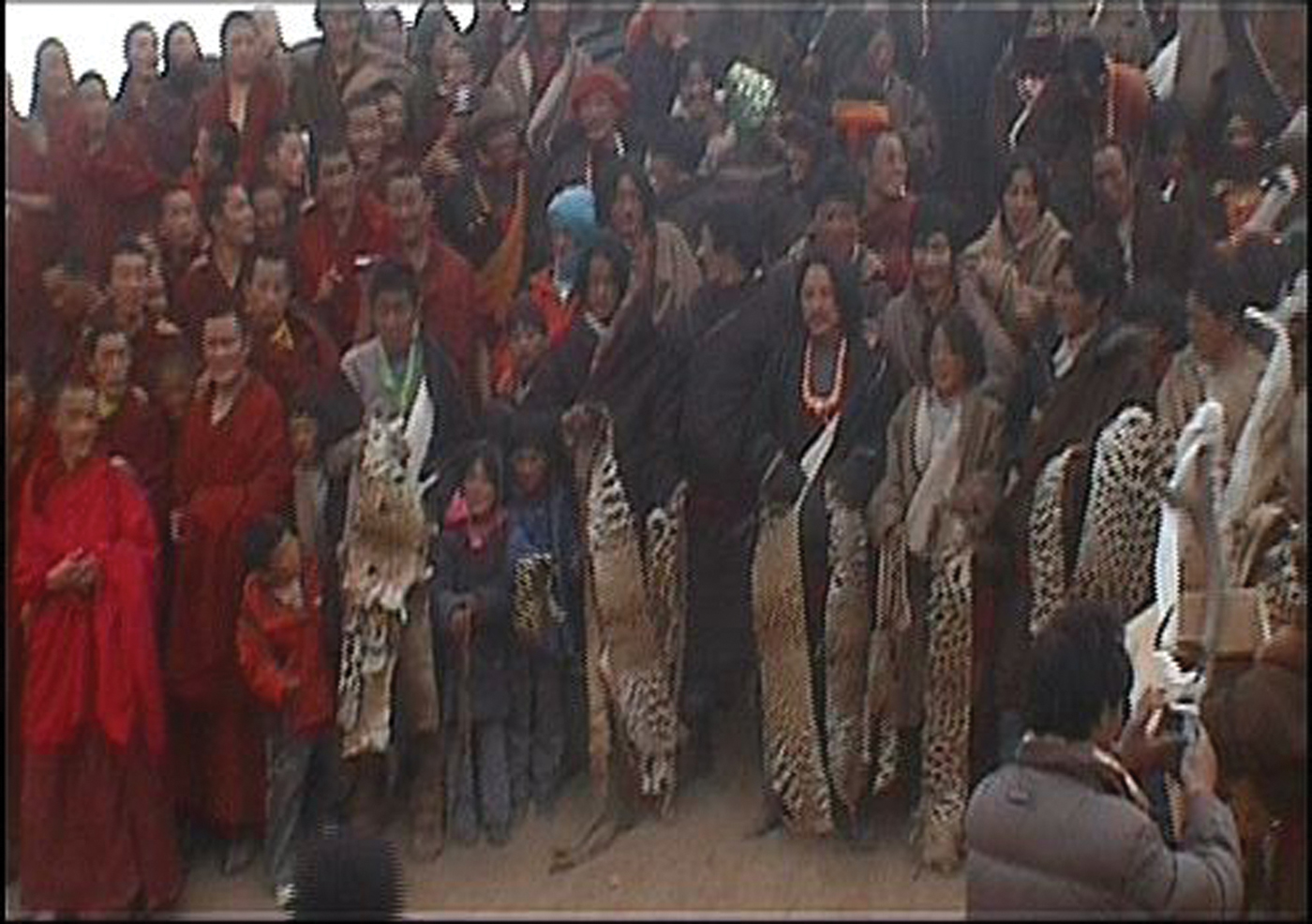
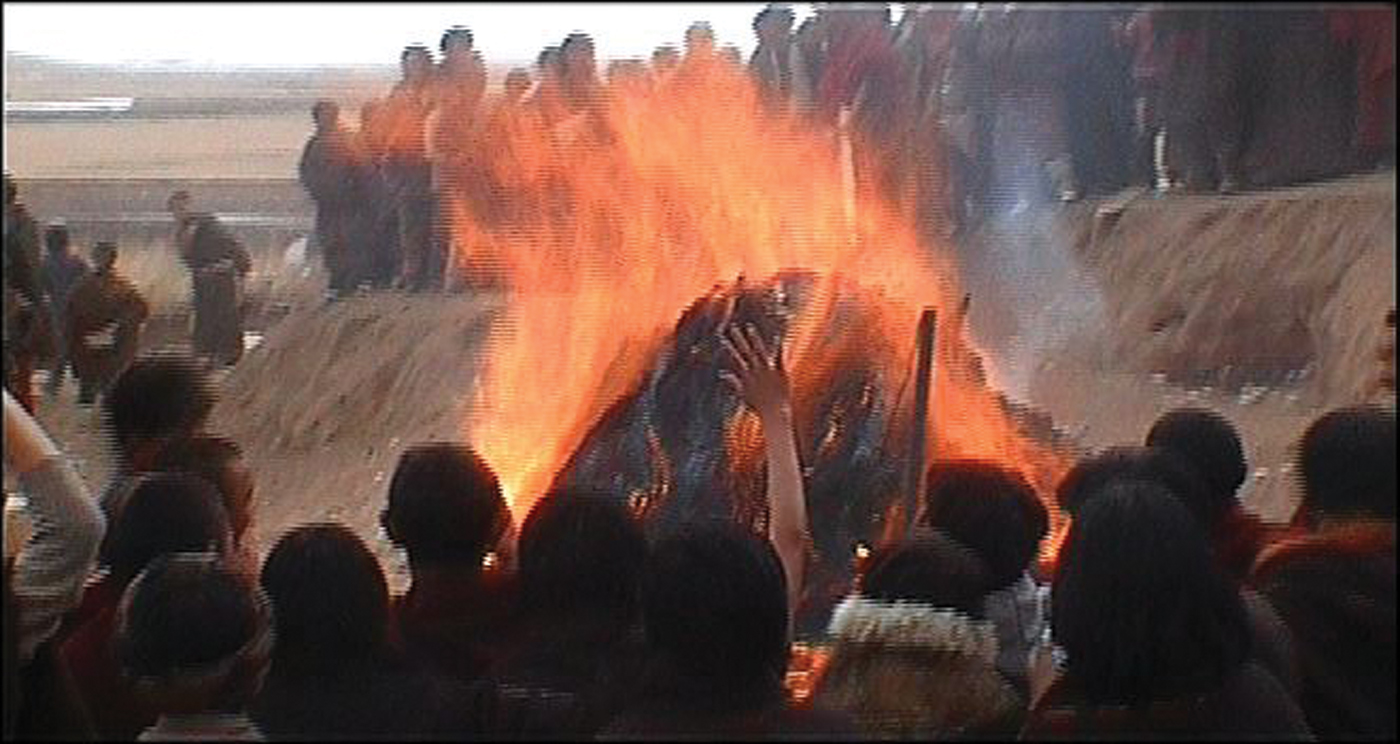
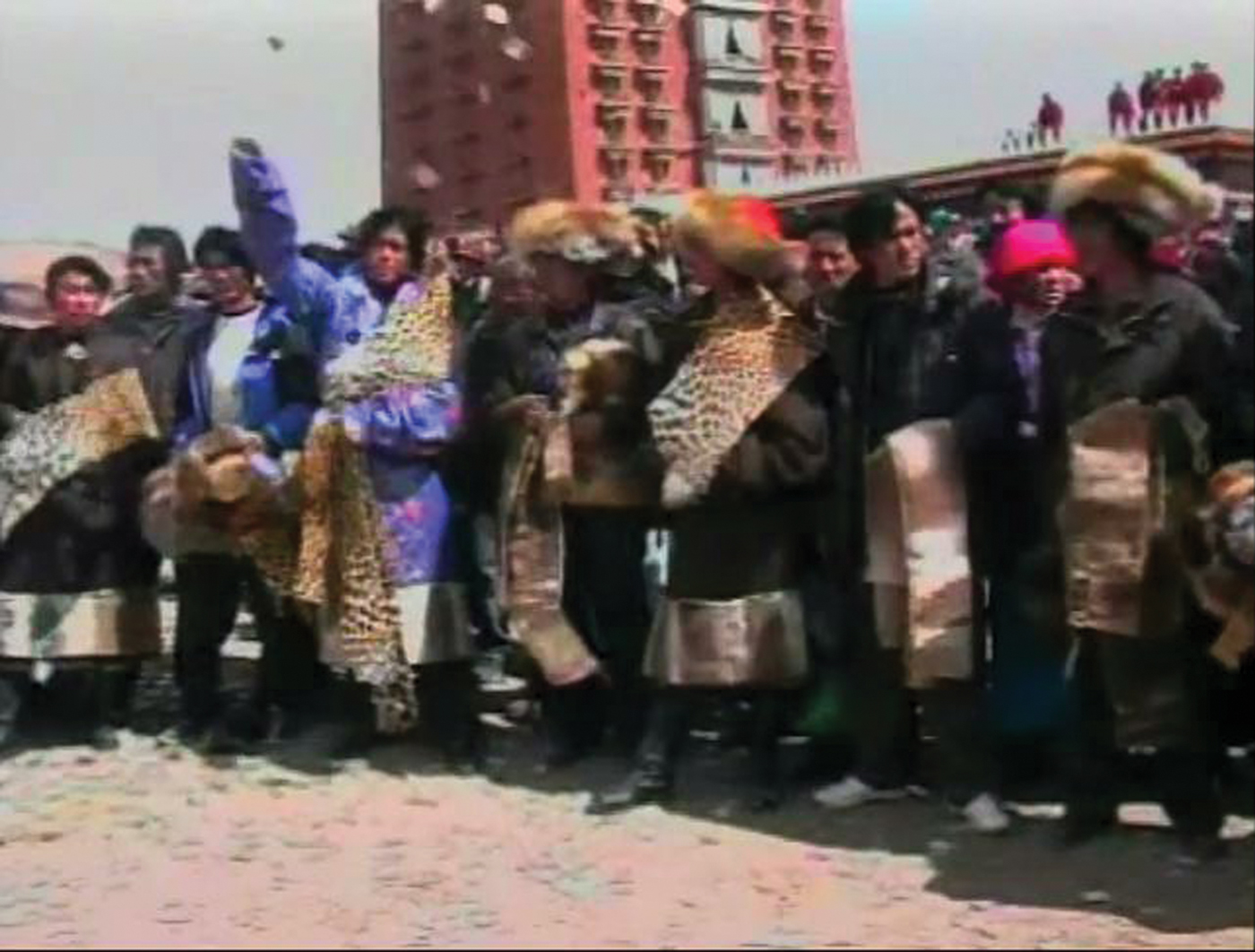
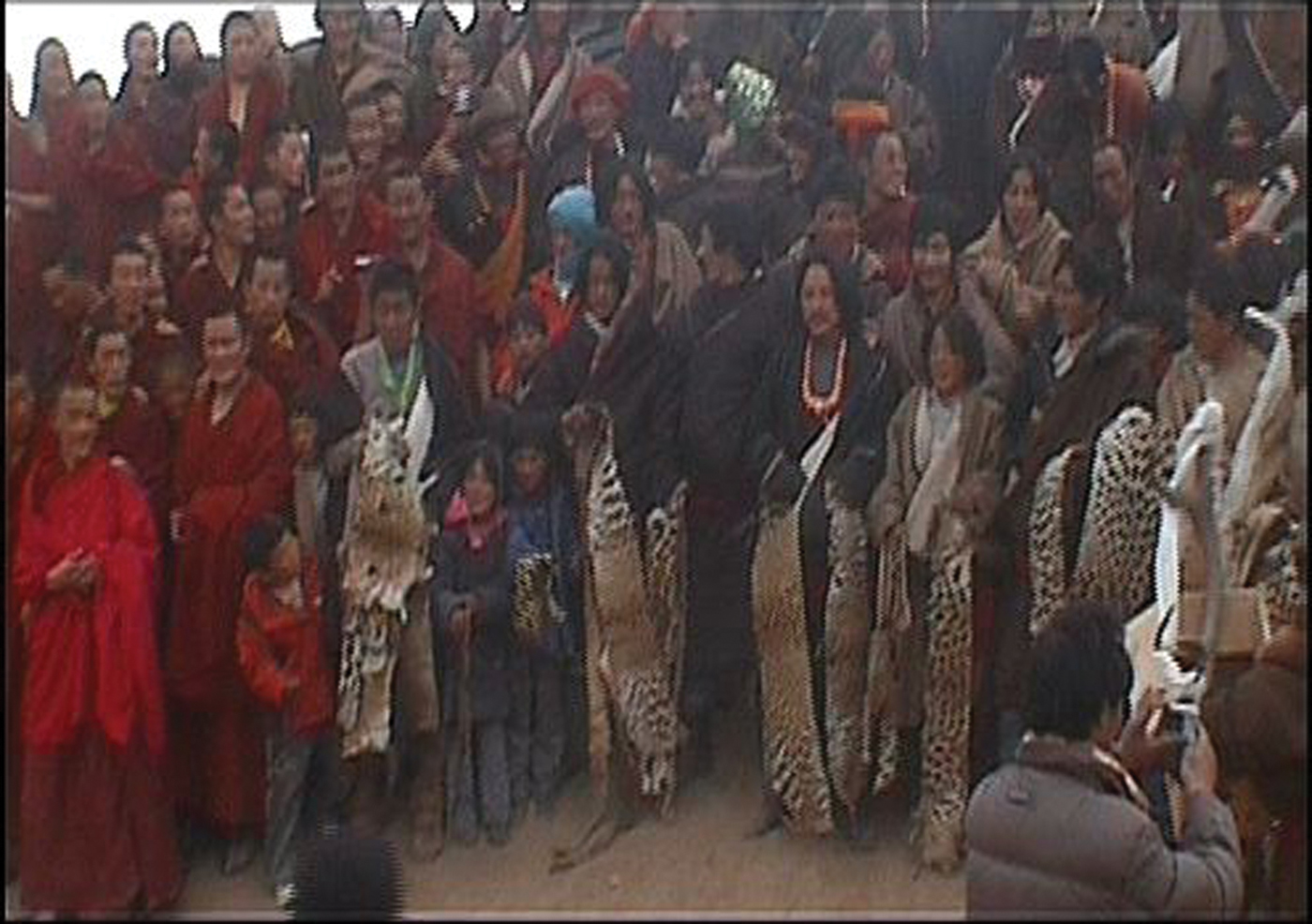
On February 13, 2006, the herders of Tangkor (Wylie: Thang skor) Township in Sichuan Province's Dzögé (Mdzod dge, Ch: Ruoergai) County gathered together to publicly burn what they estimated to be one million U.S. dollars worth of pelts of endangered animals, including tiger, leopard, and otter.Footnote 1 In an area where average per capita annual income is officially estimated at roughly 400 U.S. dollars, these pelts, which were used to decorate Tibetan robes, were in some cases investments made with a family's life savings (see figure 1; see also video 1).Footnote 2 This was only one of many such bonfires across culturally Tibetan areas of the People's Republic of China (PRC) in the spring of 2006.
Participants in Tangkor lined up with their pelts before burning them.

Burning in Tangkor, as participants shout “Tashi Delek!”. (view video here)
The burnings were a response to the fourteenth Dalai Lama's request at the thirtieth Kalachakra Initiation Ceremony, held in Amaravati, India, in January 2006, that Tibetans cease wearing such pelts. Roughly eight thousand Tibetans from the PRC managed to attend despite restrictions on cross-border movement, and through them the news spread and the burnings ensued. Enraged by this evidence of loyalty to the Dalai Lama, officials arrested organizers of the burnings and began to force Tibetan government employees to participate in summer festivals and appear on television broadcasts wearing pelts of animals whose sale in China is illegal. China's accession to the Convention on International Trade in Endangered Species in 1981 and its 1993 national environmental law banning all domestic trade in tiger parts were enacted in part to bolster its sovereignty by increasing its international standing through environmental stewardship. However, when the Dalai Lama's environmentalist message converged with China's own laws, the state was caught in the contradictions of entanglements of sovereignty and environmental stewardship.
Two years after the burnings, in the lead-up to the Beijing Olympics, the Tibetan Plateau witnessed an unprecedented wave of more than 100 protests. In hindsight, the pelt burnings have been interpreted as little more than a warm-up for, or harbinger of, the main nationalist events to come. However, this obscures more than it reveals; it flattens out the complexity of participants' motivations, erases the role of environmental activism as well as capitalist development, and is complicit with the state's discursive practices in its reduction of the fullness of Tibetan subjectivity to a binary stance on the status of the nation. While I will explore the important role that loyalty to the Dalai Lama and nationalism played in the burnings, I seek to avoid what Michel Foucault called “de-eventalization,” the ascription of a unitary, inevitable, and self-evident character to what are in fact contingent processes. He advocated instead “eventalization,” a procedure of analyzing an event “according to the multiple processes which constitute it” and requiring a rediscovery of “the connections, encounters, supports, blockages, plays of forces, strategies and so on” that establish what later appears self-evident (Foucault Reference Foucault and Lotringer1996, 277–78).
Based on Tibetan- and Chinese-language interviews conducted during two months of fieldwork across the Amdo and Kham Tibetan cultural regions as well as the Tibet Autonomous Region (TAR) during the summer of 2006, interviews conducted in Dharamsala, India, in 2007, and readings of secondary reports, radio broadcasts, and Chinese and Tibetan-language blogs, I seek to “eventalize” the burnings through a discussion of the many debates that took place among Tibetans, showing that neither the burnings nor how they were subsequently deployed were self-evident or inevitable. Elsewhere I have argued that transnational environmental advocacy around saving the wild tiger was a major impetus for the Dalai Lama's Kalachakra speech, though one that was obscured to most Tibetans (Yeh Reference Yeh2012). Here I focus on the question of why Tibetans burned their pelts. I examine how the burnings began and spread after the Dalai Lama's speech, and how they were subsequently signified, contested, and debated through a variety of competing interpretive frameworks. Rather than conclude that the burnings were definitively about one issue rather than another, I view them as conjunctural, a contingent coming together of multiple processes, movements, memories, and forces. These included not just environmentalism and nationalism, but also contested regimes of value and commodification that have intensified in Tibetan areas with the Open up the West campaign. I also explore the embodied, emotional, and visual dimensions of the events, suggesting that the performativity of the burnings contributes to an understanding of the burnings as a struggle over value in the context of state development efforts. Their spectacular nature, combined with the importance of the circulation of local film-making efforts in spreading the burnings and in capturing how the organizers and participants wished to represent themselves, make videos an especially relevant complement to the ethnographic material presented through text.
The Kalachakra Speech
The fourteenth Dalai Lama's statement about pelt-wearing at the 2006 Kalachakra empowerment ceremony was not the first time he or other Tibetan Buddhist leaders had taken up this issue. The Dalai Lama first began to speak and write publicly and directly about environmental protection in the mid-1980s, through linkages made between the Tibetan Government in Exile and transnational environmental institutions, at a time of the rise of global discourses of indigeneity, traditional ecological knowledge, and the relationship between religion and environment (Huber Reference Huber and Korom1997, Reference Huber, Dodin and Räther2001). However, pelts did not become a major concern until the early 2000s, when transnational conservation organizations identified Tibetan consumption of pelts as the major new obstacle to the survival of the wild tiger. In particular, the new emphasis on tourism and the commodification of Tibetan culture as a strategy for development that accompanied China's Open up the West campaign had significant implications for tigers, and the otters and leopards whose pelts generally accompanied those of tigers in illicit trade routes (Cooke Reference Cooke2003; Kolås Reference Kolås2007; Oakes Reference Oakes, Weston and Jenson2007). The Open up the West campaign coincided with new representations of Tibetans within China as “simple and spiritual,” and of Tibetan areas as being romantic utopias, paradises where Han Chinese tourists could seek natural beauty and exotic culture.
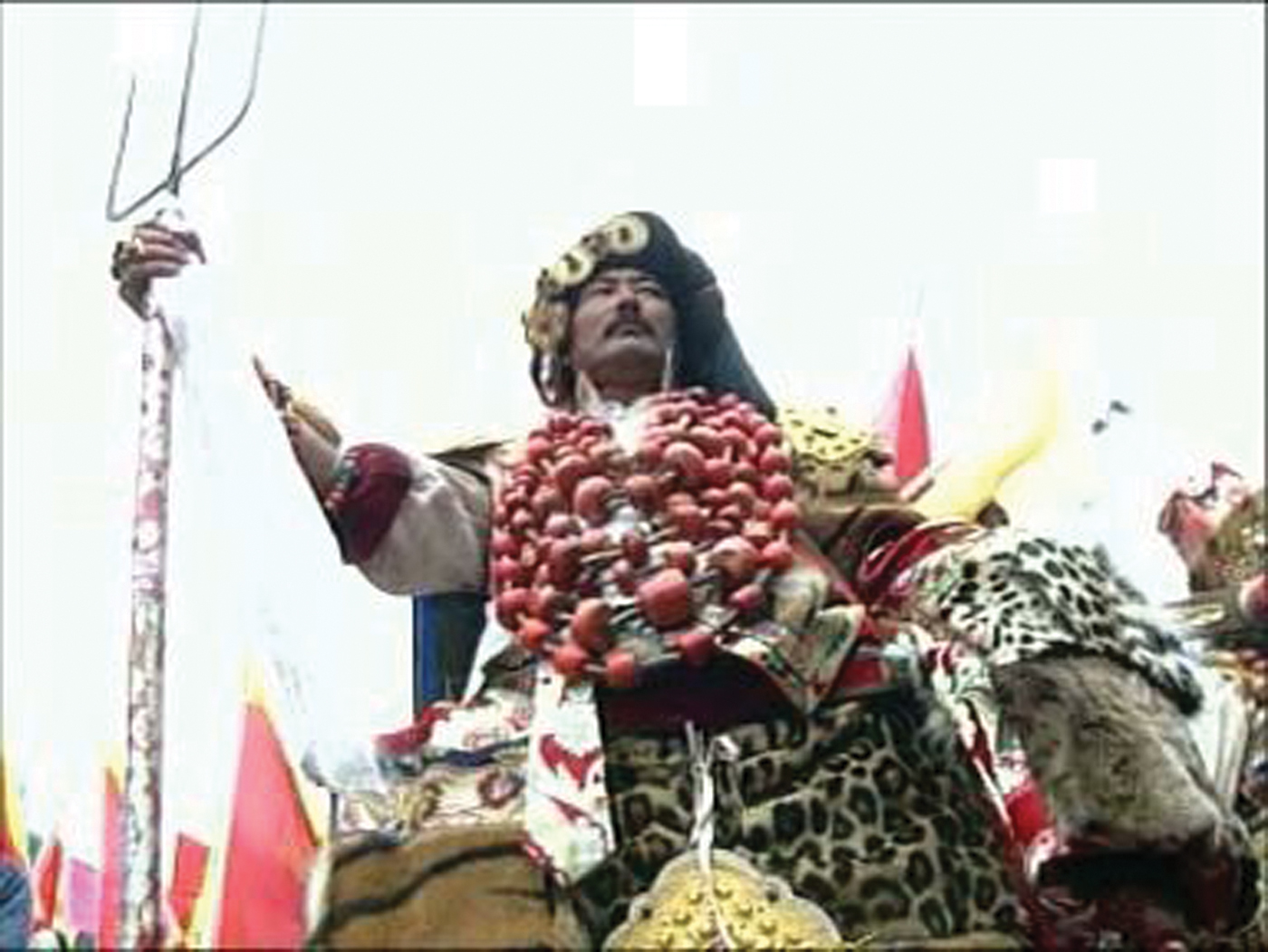
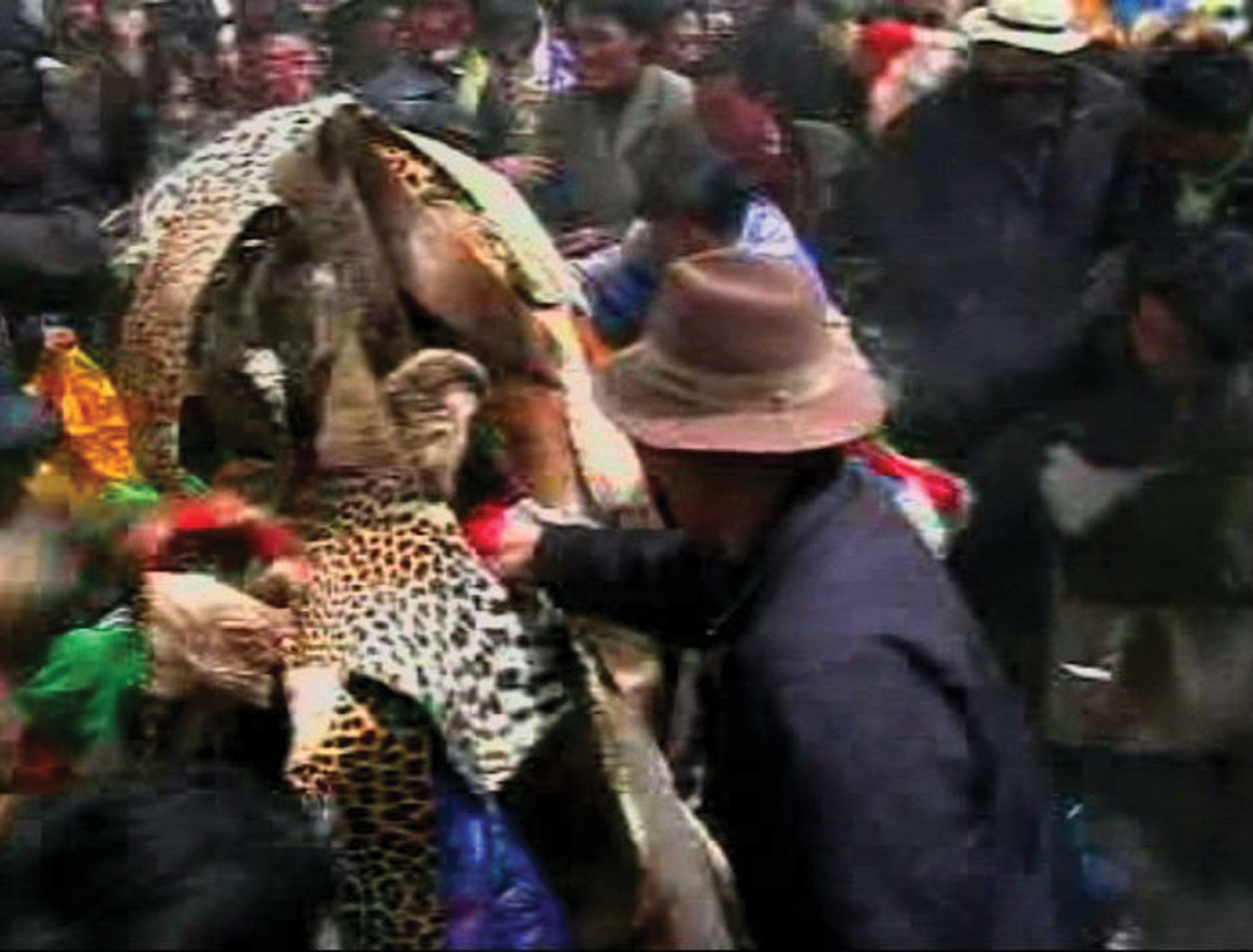
County and prefectural governments in Tibetan areas began to organize horse-racing festivals at which participants were asked to come decked out in specific quantities of coral necklaces and pelt-lined chubas (phyu pa; Tibetan robes), which became part of the exotic image sold to tourists. Borrowing was necessary, as no single family owned as much as was typically worn on such occasions. This became standard at events such as the Khampa Arts festival, the first of which was held in Zhongdian (Rgyal thang, subsequently renamed Shangri-la) in 1997, and at which counties in the Tibetan cultural region of Kham, spread across four provinces, competed to show off their wealth and development status through the hyperbolic display of jewelry and pelts on the bodies of their Tibetan participants, often so much that participants had trouble walking under their weight (Kolås Reference Kolås2007, 95; see video 2). The late 1990s also saw an explosion of Tibetan music DVDs in which popular Tibetan singers began to don outfits with ever-wider pelt trims. These new fashions, together with the deepening of market reforms and the rising availability of cash, particularly from sales of caterpillar fungus, fueled competitive pressures to purchase ever more and larger pelts. They became requisite features of weddings, summer festivals, and the New Year.
Participants of the fourth Khampa Arts festival, Kardzé Prefecture, in 2004, heavily adorned with jewelry and pelts. Clip from Meili Ganzi (Enchanting Ganzi), Sichuan Publishing Group. (view video here)
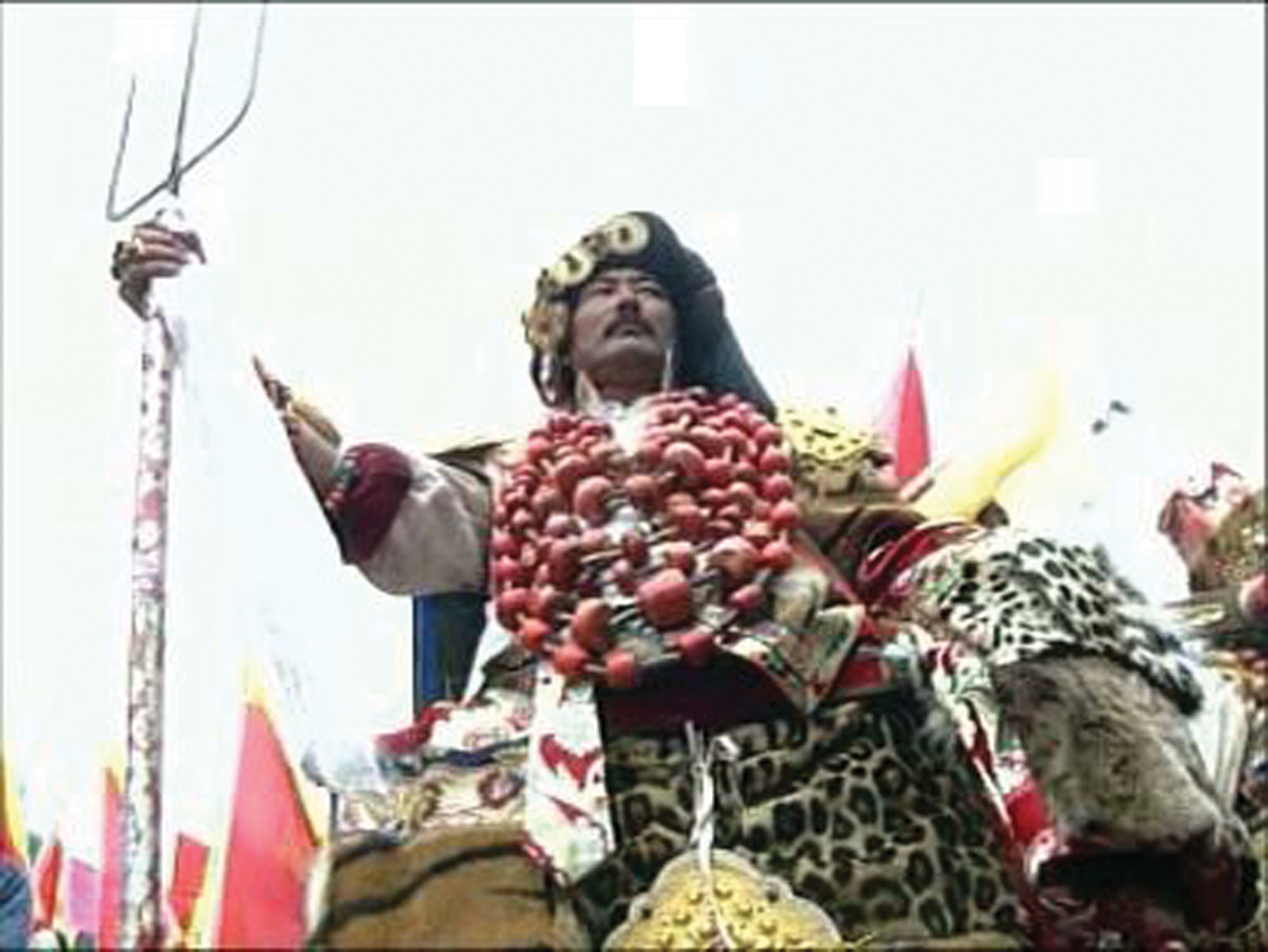
Transnational conservation groups on both sides of the Himalayas noticed this surge in poached tigers and leopards displayed upon Tibetan bodies (Yeh Reference Yeh2012). Undercover investigations in Tibet produced material for news conferences and media coverage in India, leading Indian politician and environmentalist Maneka Gandhi to call for throwing all Tibetans out of India. This generated considerable concern among Tibetan exiles, dependent as refugees and noncitizens upon the goodwill of the Indian government and its citizens. In October 2005, the Dalai Lama gave a speech at the Tibetan Children's Village stating that he had seen photos of such pelts being worn in Tibet: “To be honest, I am embarrassed! Real ornaments should be the knowledge and wisdom one possesses inside, not what one wears.”
The Dalai Lama's speech at the Kalachakra several months later was very similar to several previous ones, with two exceptions. First, many of his remarks were directed specifically at the Tibetans from the PRC, mostly Qinghai, Gansu, and Sichuan, who managed to attend despite restrictions on passports. Second, the message was delivered with unprecedented strength:
As I get older, if Tibetans' behavior continues to worsen, then I sometimes feel that it makes no difference if I continue to stay any longer.… If the personality, behavior and reputation of Tibetans continue to worsen, then I have no confidence in my rebirth and whether it will be of any use. I am not being boastful; this is what I truly feel sometimes.
Tibetans in the audience wept as they heard this, as did those who watched videos of the speech later. Their emotional outpouring was a reaction to his calling into question not only how much longer he would remain alive, but also the very possibility of future reincarnations of the Dalai Lama—manifestation of Avalokiteśvara, bodhisattva of compassion, patron and protector of the land of Tibet—and thus their connection to the historical past and to a symbol of the Tibetan nation itself. The disgrace of wearing pelts, he suggested, jeopardized all of these.
The Dalai Lama also made more lighthearted but still pointed references to national identity:
[In addition to wearing pelts] there are some who show off their wealth by wearing two or three large gold rings on their fingers. It's to the point where they cannot even bend their fingers to knead their own tsampa.…
Tsampa, roasted barley flour typically mixed with yak butter and tea and kneaded into balls of dough, is the Tibetan staple, and a potent marker of Tibetan-ness, shared across regions of the Tibetan Plateau with vastly different dialects, livelihoods, dress, religious schools, calendars, and histories of political rule. Indeed, “tsampa-eaters” is a synonym for “Tibetans” and the phrase “calling all tsampa-eaters” has been used to mobilize Tibetans in protest against Chinese rule from 1959 through the demonstrations of 2008 (Barnett Reference Barnett and Barnett1994; Shakya Reference Shakya1993). In not so many words, then, the Dalai Lama called the wearing of pelts and large rings un-Tibetan, acts that reject rather than reinforce a Tibetan national identity.
Intertwined with this message about Tibetans' potential forfeiting of their national identities was a strong focus on the reputation of Tibetans. Labeling their jewelry and pelt-wearing a disgrace, the Dalai Lama stated, “You should tell them in Tibet that because of foolish activities such as the craving for ostentatious jewelry and the making of garments out of carnivore pelts, the collective Tibetan reputation is being ruined, and the Dalai Lama is ashamed.” This concern about Tibetans' collective reputation is acute for exiles given their precarious positions as noncitizens of India. The global reputation of Tibetans with regard to environmental protection has also been a key component of the struggle over the legitimacy of Chinese rule in Tibet. At the same time, the reputation of Tibetans is also very relevant to Tibetans inside Tibet, struggling with their constant positioning at the bottom of the ethnic hierarchy in the “family” of nationalities (minzu).
Back Across the Himalayas
The Dalai Lama's message spread very quickly, as Kalachakra participants called and returned home, bringing with them DVDs and audio tapes of the event, as well as environmental flyers and posters that were passed out by conservation NGOs there. Tibetans also heard the news through Voice of America and Radio Free Asia. The first reported burnings took place on January 31, in Kardzé (Dkar mdzes) and Tawu (Rta'u) Counties in Kardzé (Dkar mdzes; Ch: Ganzi) Prefecture.
A week later, another burning took place in the Amdo county of Repkong (Reb kong), Qinghai, begun by a prominent local businessman who had attended the Kalachakra. The same day as the Dalai Lama's speech, he arrived at a tent where a Tibetan environmental organization had been passing out posters and encouraging participants to take oaths to stop wearing pelts. Along with about 3,000 others, he took the oath. He also stated in public, “I have 40,000-some renminbi worth of otter pelts, and I swear that I will burn them as soon as I get home.” Arriving back in Repkong on February 6, he discussed his plans with his family late into the night. The following morning, he brought 48,000 renminbi worth of his family's otter pelts, most of which he had purchased just the year before, to the courtyard of Rongwu Monastery. After speaking briefly about his reasons to the crowd that had gathered, he burned his pelts. Three families joined in, and the spectators donated 7,000 renminbi in support, which they used to purchase butter lamps to light around the monastery for the lives of the animals that had been killed for their pelts. A much larger burning was planned for six days later, but the local government banned the event; some families subsequently burned their pelts, but in private.
News about the Repkong burning spread quickly by word of mouth as well as through a number of Internet sites, including Tibetan writer Woeser's blog,Footnote 3 where an active discussion about this and other burning incidents ensued. Among those who heard about the Repkong burnings were eight young Tibetan men in Ngawa (Rnga ba; Ch: Aba) County, Sichuan, all local intellectuals, including a doctor, a teacher, and two herders. Deciding that they too should do something, they debated amongst themselves whether to simply burn their own pelts in private or to make an impression in public. Settling on the latter, they chose the most heavily attended day of the Monlam Chenmo festival at Kirti Monastery, so that their actions would have a larger impact on those who might witness them. To prepare, they downloaded relevant Chinese environmental protection laws and wildlife photographs from the Internet. On the flyers announcing the burnings, they wrote, “Protection of the environment and wildlife is the responsibility of all in the People's Republic of China. The imbalance of the ecosystem brings about a sense of fear and insecurity to mankind” (Tibet Info Net 2006a).
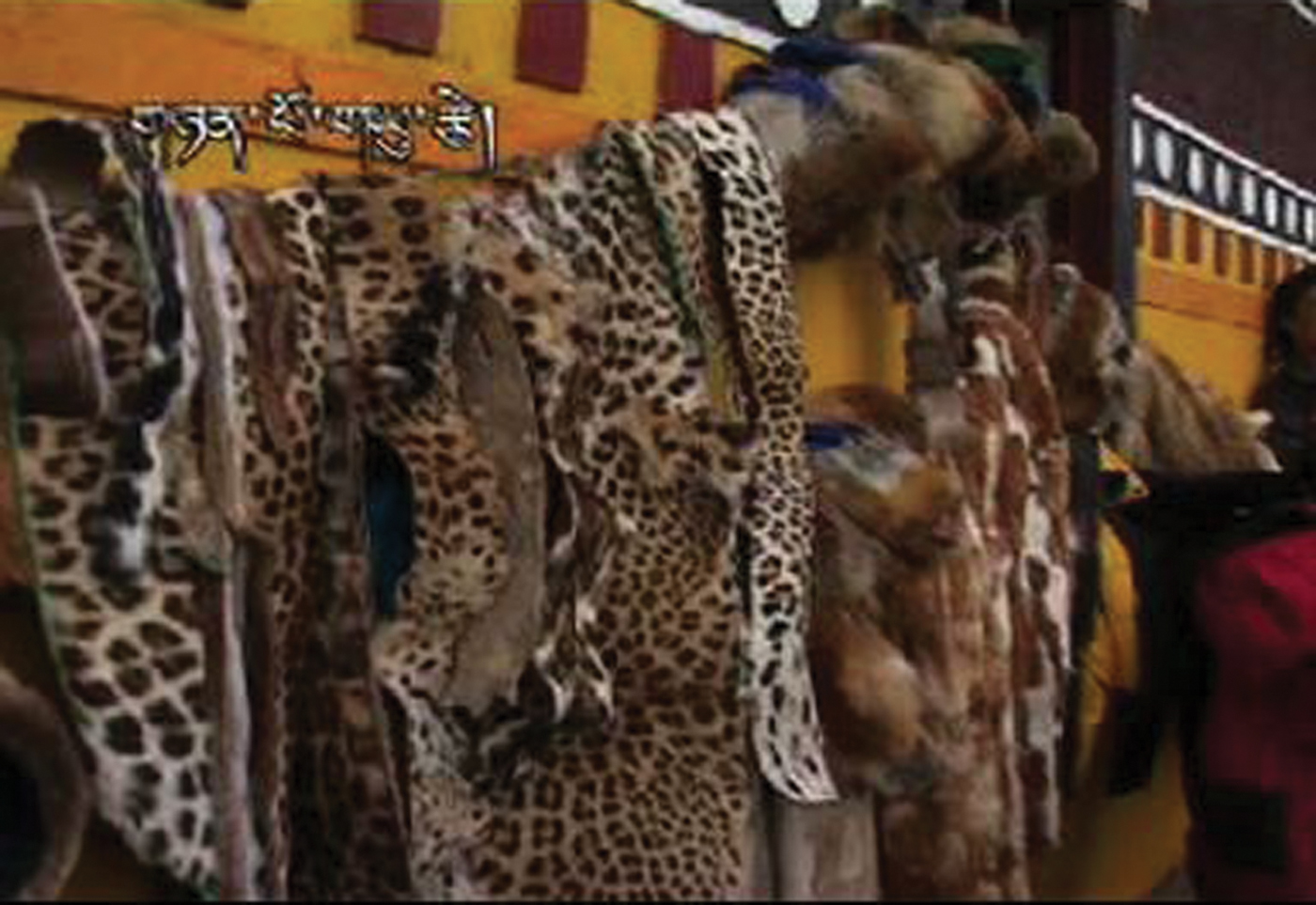
The film that a ninth man produced about the Ngawa burnings (see video 3) begins with shots of the posters made by the eight, such as a photo of a forlorn tiger cub crying, “Mother! Mother! Whose body is your skin ornamenting?” These images of anthropomorphized, tragic megafauna, not unfamiliar from globally circulating idioms of environmental protection, are followed by shots of the framed PRC wildlife protection law, the announcement in Tibetan about the need for environmental protection and the plans for the bonfire, and then pelts hung from a rope strung along the side of Kirti Monastery, on display before burning. The rest of the video, which was widely distributed, features the crowd looking on and cheering as a pyre is built, the fire lit, and leopard, otter, and other pelts offered and burned (see video 4). Afterward, the organizers were arrested and detained for fifteen days.
Beginning of the 18-minute video produced by organizers in Ngawa. (view video here)
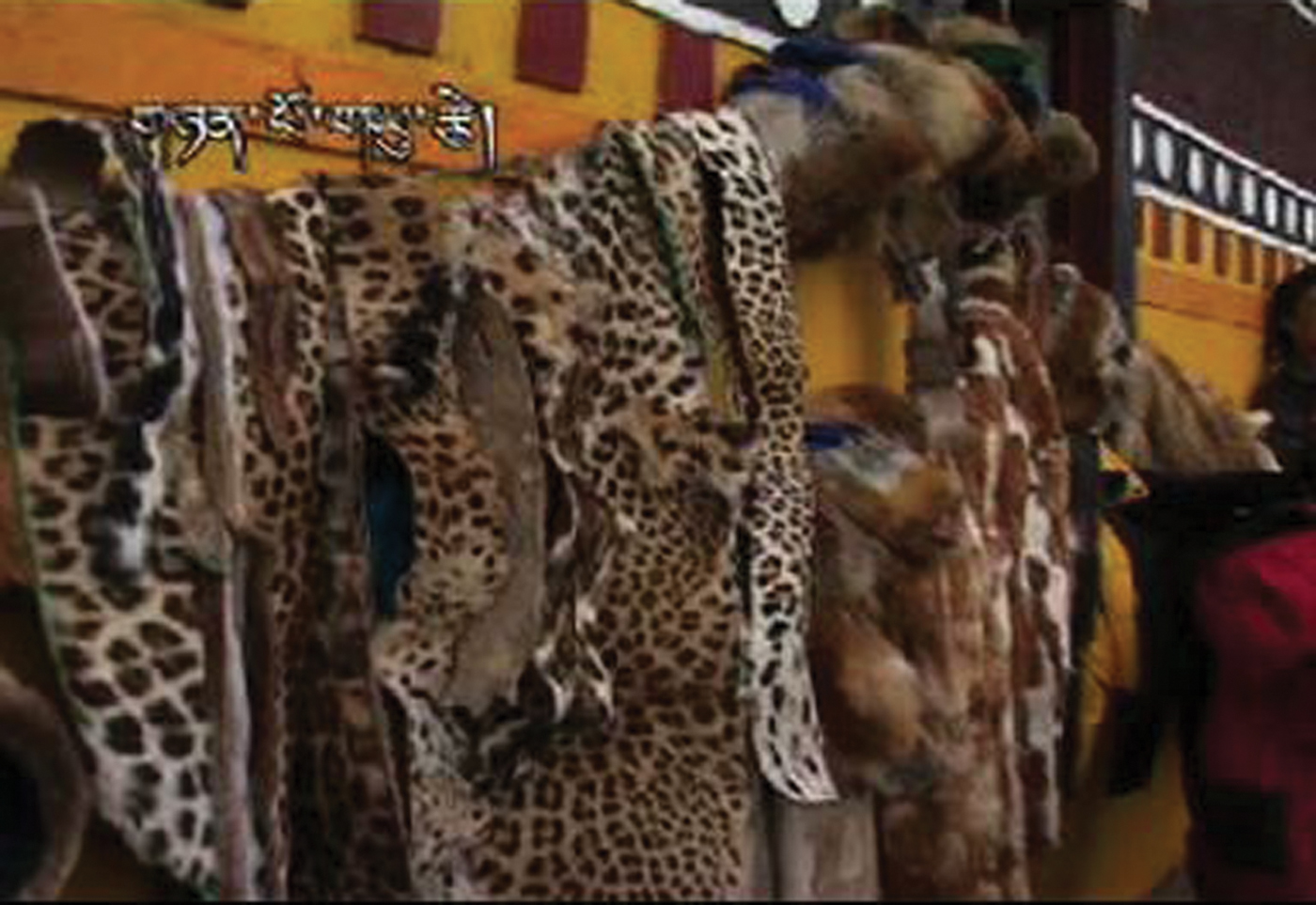
The crowd watching and participating in burning in Ngawa. (view video here)
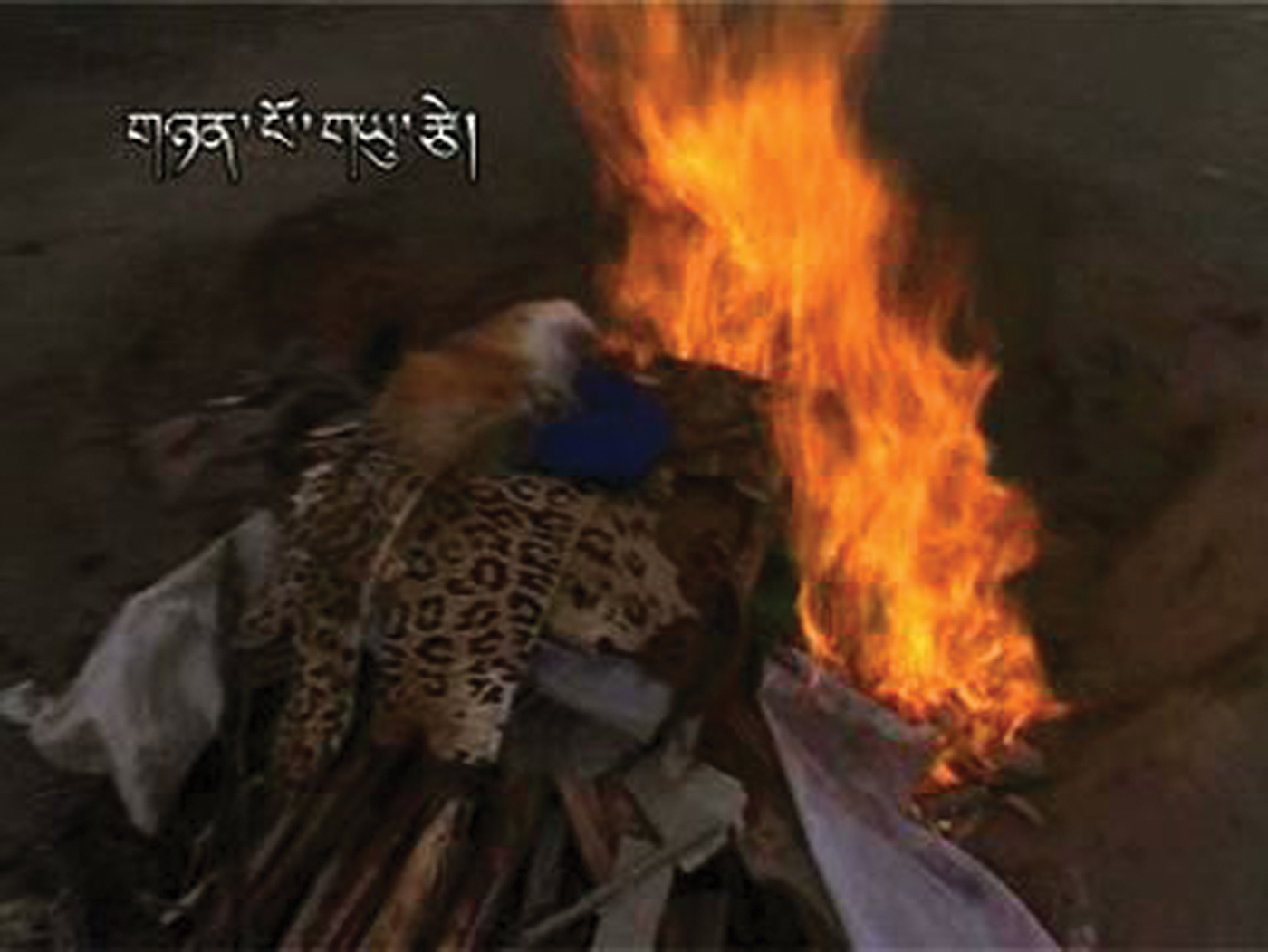
A number of herders from nearby Tangkor Township attended the Monlam festival in Ngawa. The organizers there, who learned about the Dalai Lama's speech and the Repkong burning from the Internet and phone calls, initially faced some skepticism from other villagers about whether these were just rumors. Villagers' witnessing of and participation in the Ngawa event overcame their doubts and encouraged many of them to burn their pelts in Tangkor two days later. A few days prior to the date they chose, the organizers had also begun to wear leopard skin trims, draped around their backs, around the township as a way to publicize their plan. They received permission from the local monastery to hold the event just outside its courtyard, where many people would be gathered for the Monlam festival. The magnitude of the burning far exceeded the expectations of the organizers, who had earlier considered burning their own pelts in private because they feared others would not participate.
Several monks from Tangkor who were studying at Tsö (Gtsos, Ch: Hezuo) Monastery in Gansu had come home for the Monlam festival. They brought images back to Tsö, which was subsequently the site of one of the biggest burning events on the Plateau, lasting four to seven days according to different accounts (see videos 5 and 6). Again, the photographs and videos from Tangkor helped convince many to participate. Among the organizers and key participants in Tsö were monks, including monastic leaders, and local government cadres. Participants estimated the market value of pelts burned within the first two days at over two million U.S. dollars (Tibet Info Net 2006b).
Piling on pelts about to be burned in Tsö. (view video here)
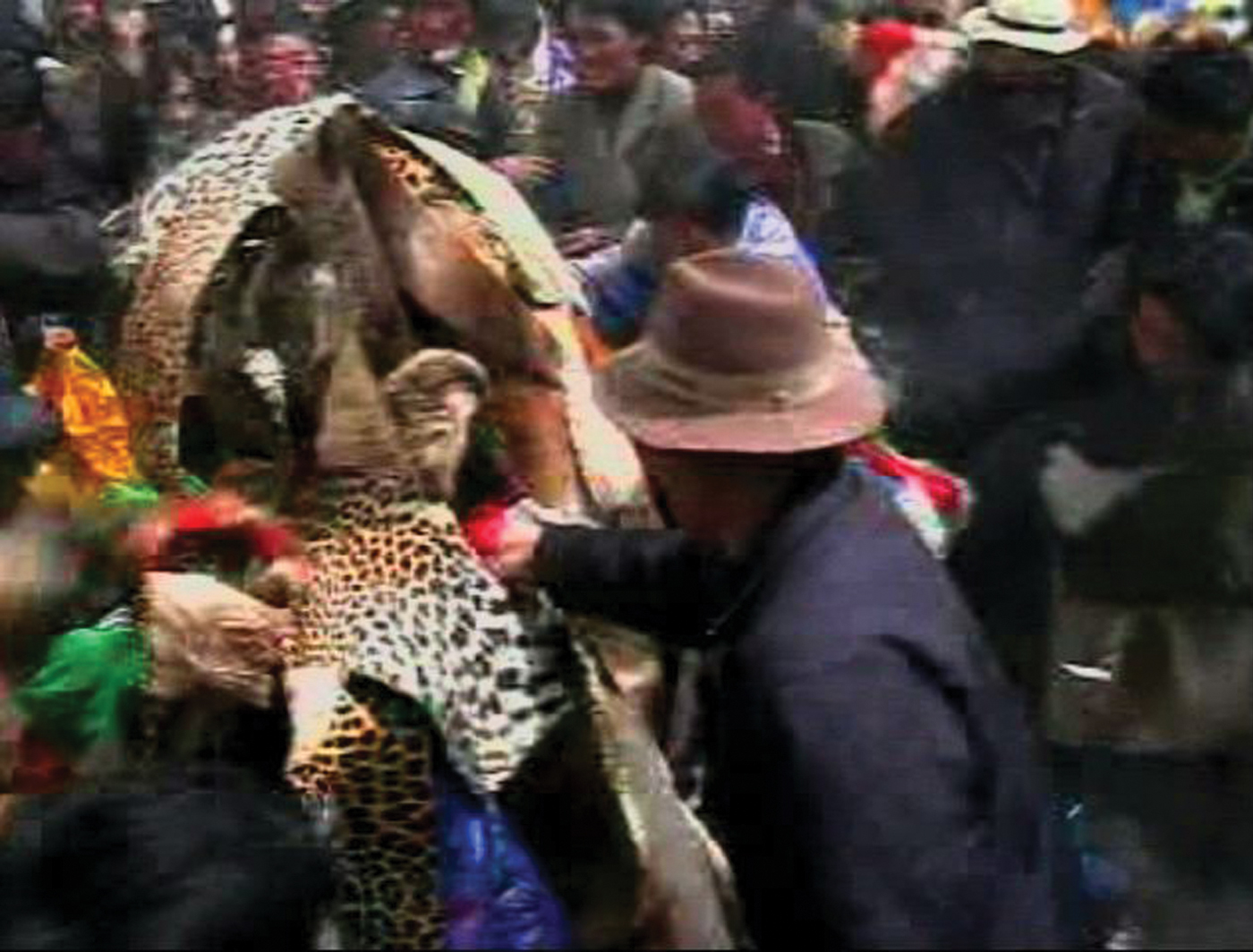
Men lining up to burn leopard pelts in Tsö. (view video here)
Burnings were not confined to Amdo. Several events were reported in Lhasa, and many in Kham, including parts of Nakchu (Nag chu; Ch: Naqu), TAR, and Kardzé Prefecture in Sichuan. One of the larger burnings in Kardzé took place in Litang (Li thang) County, where the annual horse-racing festivals had previously been occasions of some of the most extravagant pelt displays on the Tibetan Plateau. It was also the site of a 2005 undercover investigation by the London-based Environmental Investigation Agency, photos and videos from which were subsequently used in publicity campaigns and shown to the Dalai Lama prior to the Kalachakra. One image displayed a young man wearing an almost complete tiger pelt that his father, a wealthy caterpillar fungus businessman, had purchased for about 10,000 U.S. dollars. When, at the Kalachakra, his father saw the photograph of his son featured on a poster connecting the pelts to the demise of the tiger, he felt deeply embarrassed and called home saying, “That pelt must be burnt!” Their family was the first to burn in their village, where residents burned ivory and coral jewelry alongside pelts. As with Ngawa, the organizers focused on the bonfire as an act of environmental protection, in accordance with PRC laws.
Performing Spectacular Spaces of Surplus
The burnings were spectacles. As I discuss below, their spectacularity was crucial to participants' efforts to destroy the commodity-nature of the pelts. The visual character of these events was reinforced by their widespread capture in still photographs and digital video, generally by the participants themselves. Their films were part of a broader trend since the late 1990s of Tibetans producing home and civic videos both for their own consumption and to circulate for a wider global audience (Barnett Reference Barnett2010). Though many of these efforts produced only raw footage, often of poor quality (see video 5), others were set to music and edited to present a clear message (see, e.g., video 3). Some who filmed described their desire to show the world through their videos that Tibetans were no longer so backwards in their environmental consciousness compared to other ethnic groups, and to serve as an inspiration for other Tibetans. Others sought to get their videos delivered to the Dalai Lama, to present evidence that Tibetans still heeded his teachings.
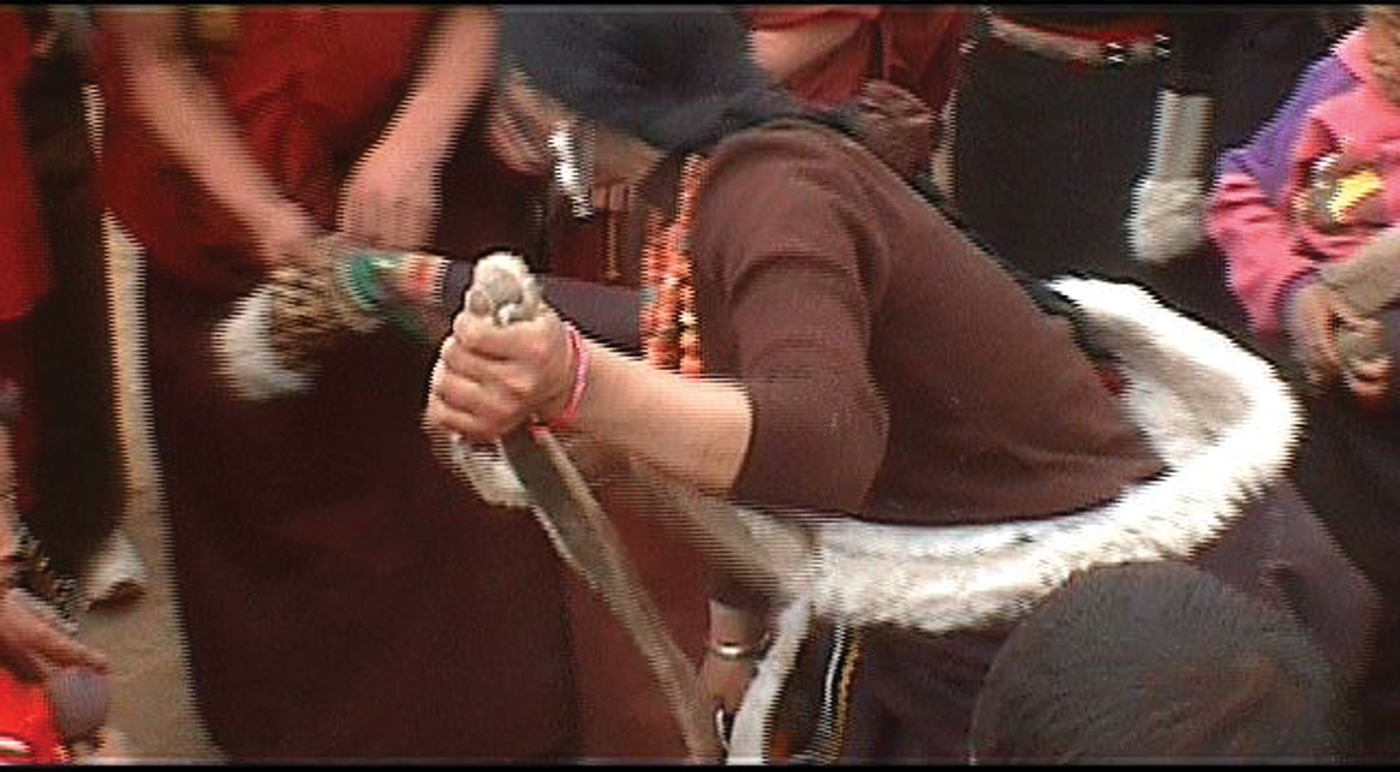
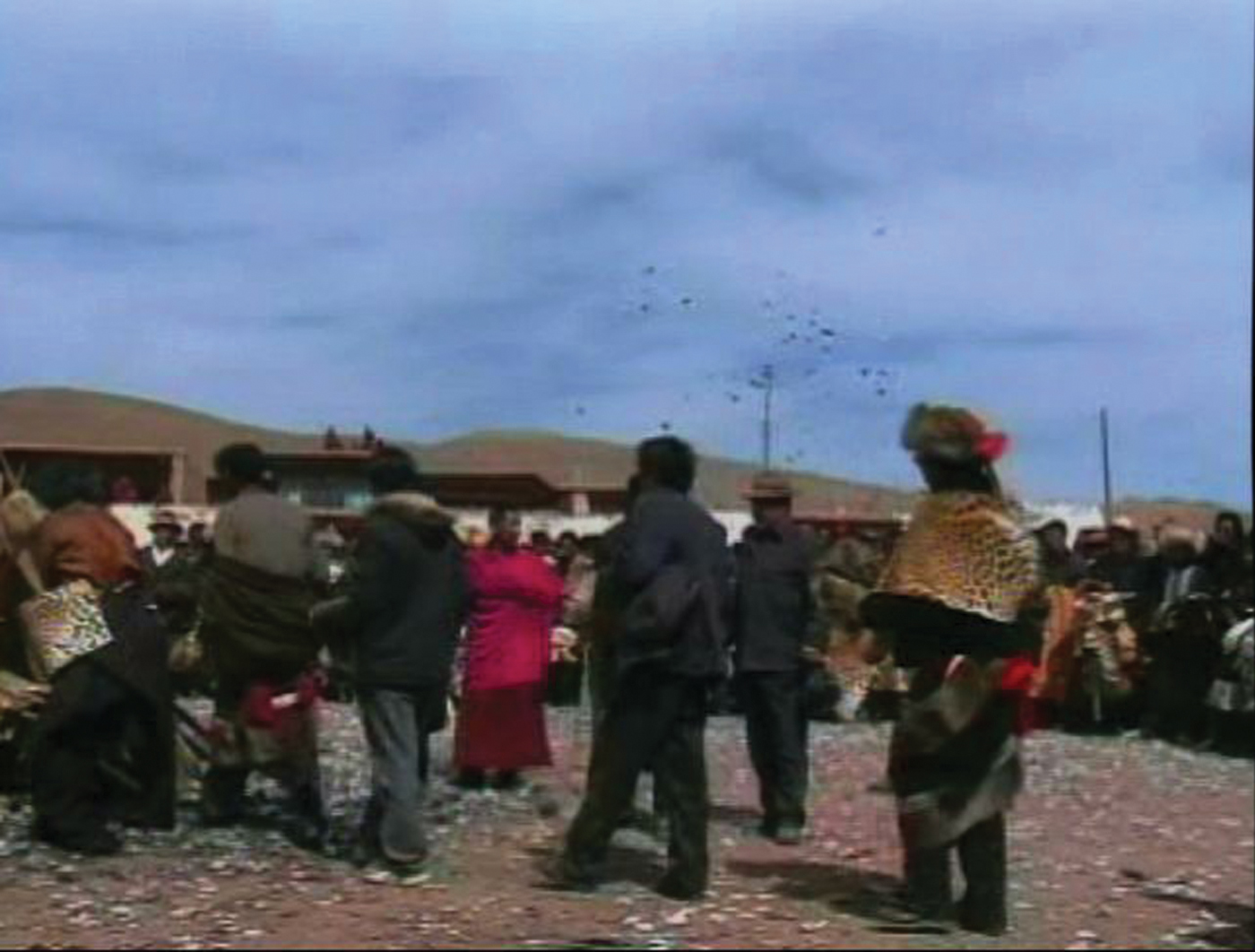
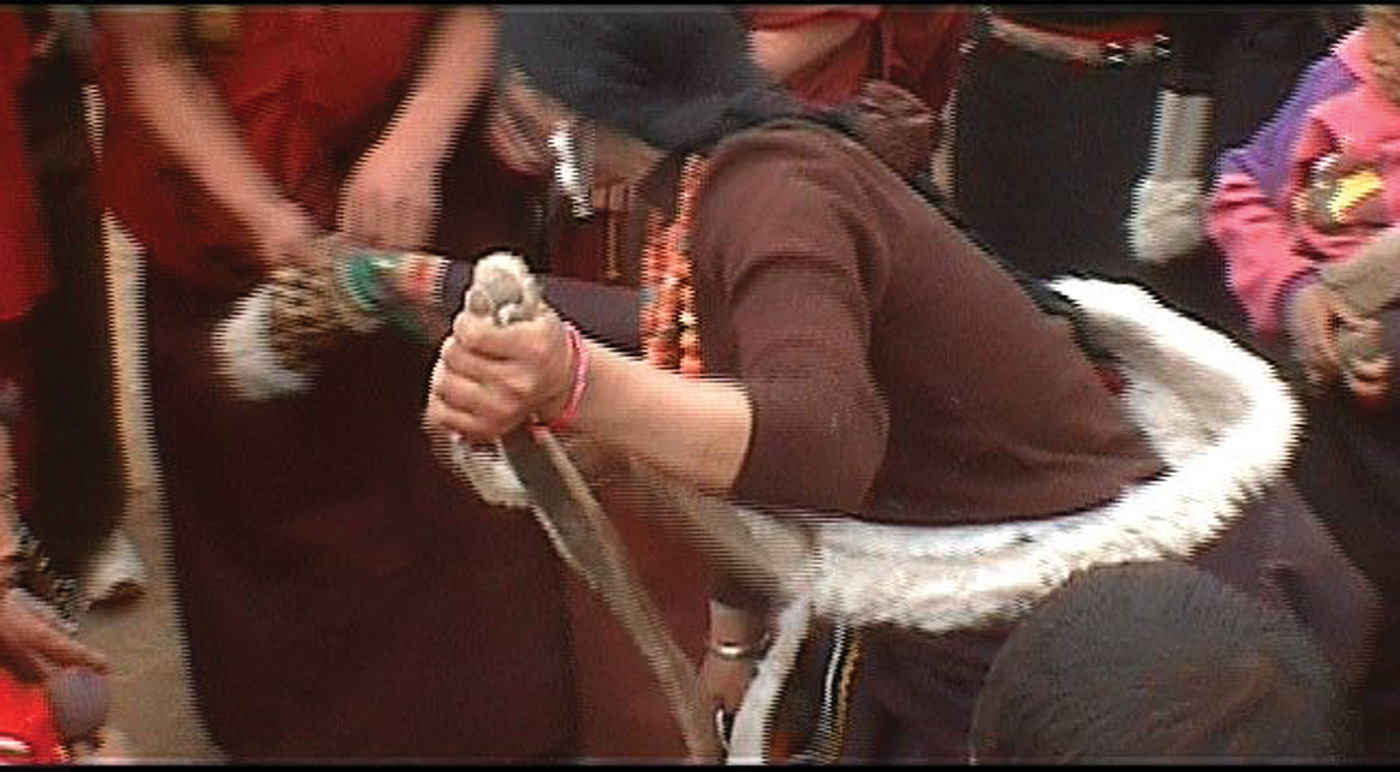
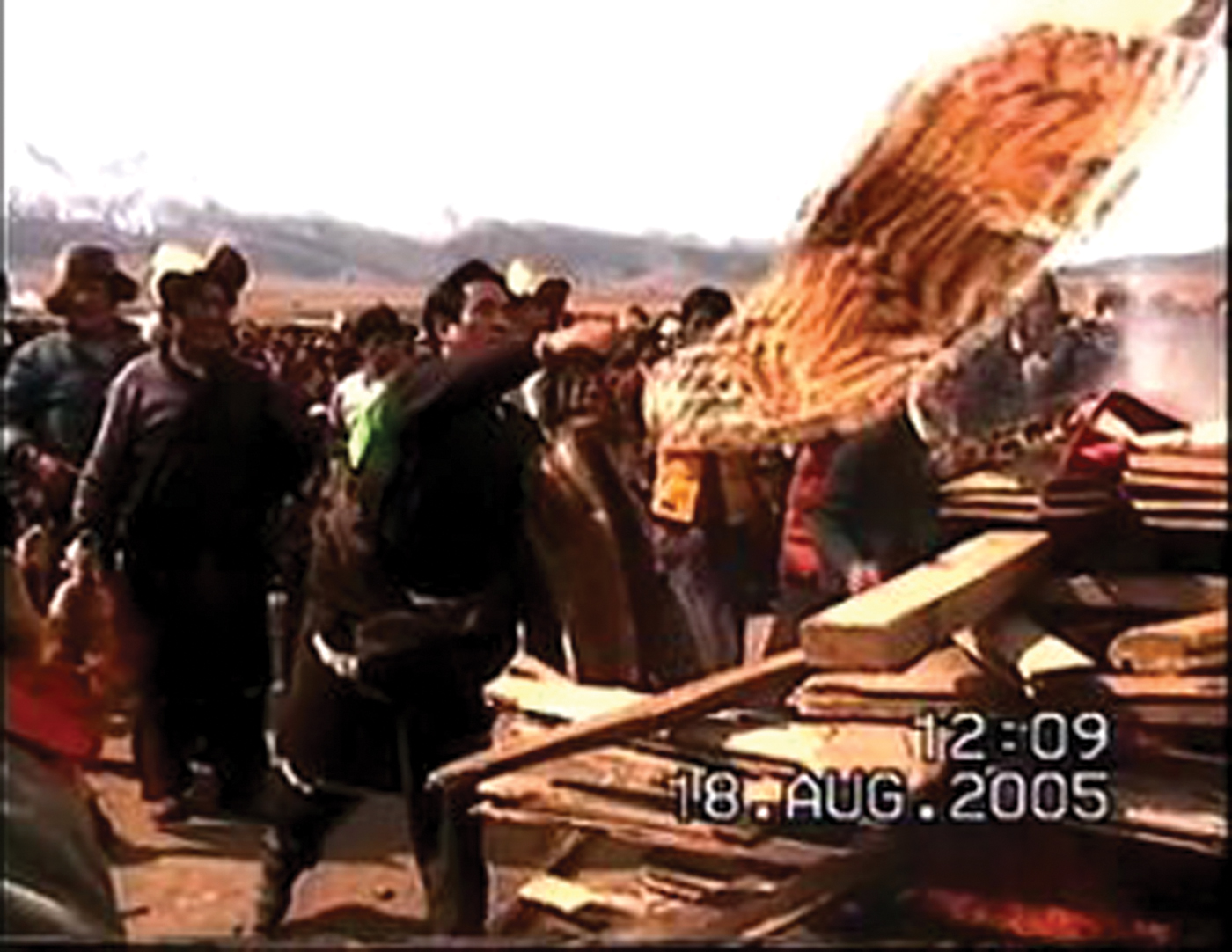
In addition to being dramatic, visual events, the burnings were also bodily performances. Given an understanding of space not simply as a container in which social action unfolds but rather as produced through specific performances, what kinds of unique spaces did the burnings bring into being (cf. Gregson and Rose Reference Gregson and Rose2000, 441)? First, the spaces were characterized by the privileging of the (male) embodiment of pelts. Women, for the most part, watched and tore small trims off of their chubas, but did not make a dramatic show of the burnings (see video 7). Men, on the other hand, spectacularly exhibited the pelts upon their bodies before sacrificing them.Footnote 4 In Tsö, rows of men stood in the public square, wearing their fox hats, with otter and wide leopard pelts draped upon and encircling their bodies; some were adorned with pelts literally from head to toe (see video 8). They stood for significant periods of time, the center of attention as they modeled the soon-to-be-burned pelts, before swaggering forward slowly to the flames. In Litang, men lined up to approach the bonfire (see video 9). At each man's turn, he carefully unfolded and threw his pelts into the flames, sometimes in a long, graceful arc that seemed to suspend the skins momentarily in mid-air, so that all gathered could witness his sacrificial moment. Cheers and claps followed each turn, and afterwards, monks on the other side of the pyre presented each man with a ceremonial scarf.
Women in Tangkor tearing off pelt trims. (view video here)
Men displaying pelts on their bodies before burning. (view video here)
Men burning pelts and receiving scarves in Litang. (view video here)
Furthermore, these were emotionally charged spaces, made so in part through spectacle and the multiple layers of meaning read into the events. As Tolia-Kelly (Reference Tolia-Kelly2006, 215) remarks, “collectivities of affect are engendered, shaped and empowered through visual and social registers.” In Tangkor, a cacophony of whoops and cheers preceded the burning, as participants sat and stood in rows displaying their pelts and chubas, and calling out “Chod!” or “Offering!” (see video 10). After the fire had been going for a while, several monks led the crowd in pumping their fists in the air, shouting again and again “Tashi Delek!”—a phrase connoting auspiciousness and joy (see video 1). In Tsö (see videos 5 and 6), a gargantuan pile of pelts formed as participants threw their contributions onto the pyre as they yelled and whooped, while firecrackers were set off and lungta (confetti-like pieces of colored paper inscribed with prayers) rained down, creating spaces suffused with emotion, not as the property or possession of single individuals, but rather as a relational force, the fulfillment of each participant's capacity to both affect and be affected (Deleuze Reference Deleuze1988; Pile Reference Pile2010; Tolia-Kelly Reference Tolia-Kelly2006). Participants later described the events with phrases such as “the happiest day of my life,” as they recalled the surfeit of feeling that their embodied performances brought into being. As one put it, “I was so happy—I felt the power of Tibet. Everyone was united.” Far from “disembodied, transparent space,” as public spaces are often conceptualized (Longhurst Reference Longhurst2000, 455), these were embodied and suffused with a conviction for their participant-producers, however fleeting, of Tibetan community and unity.
Participants in Tangkor shouting “Offering!” (view video here)
Alternative Framings and Orientations
The euphoric spaces and embodied emotions produced in the events did not, however, indicate agreement on the essence of the act of burning. The herders, farmers, businessmen, students, monks, and intellectuals who participated inscribed a diverse set of meanings and motivations to the bonfires. The rationales they offered and the debates that ensued show that, even as the burnings would not have happened without the Dalai Lama's speech, neither would they have happened in the absence of a convergence of other processes, conditions, and pressures. Furthermore, though the rejection of pelts occurred expansively across cultural Tibet, it was not universal. Both the presence or absence of burnings and the fierce debates about them in their aftermath reveal schisms within Tibetan society and the complex cultural politics of contemporary Tibetan-ness.
Religious and National Loyalty
Loyalty to the fourteenth Dalai Lama first and foremost as a religious leader but also as a form of national loyalty was a key motivation for most if not all Tibetans who chose to burn their pelts. His questioning of his continuation on this earth in both this and future lifetimes had a potent impact. As a participant from Repkong put it, “We [Tibetans] are saying, ‘even though we cannot see you [the Dalai Lama], we are waiting for your command.’” A monk from Tangkor who helped organize the burnings there described his reaction, in Tibetan, after watching a video of the Kalachakra speech:
It made a big impression on our feelings, because if the world's sun [i.e., the Dalai Lama] disappears, then everything will be plunged into darkness. If Bodhisattva is not here, the world would experience a huge loss.… I thought, whether or not I am capable, I need to do something.
Another lay participant stated, also in Tibetan:
I was so excited, I couldn't control myself. I shouted, “May He live 10,000 years!” I had to shout this a few times before people started to chant with me. Of course, I didn't actually mention his name, but everyone knew who I meant. I just couldn't control myself [despite the danger].
That religious loyalty to the fourteenth Dalai Lama was a key motivation for the burnings is also evident given the places where Tibetans did not burn, and where ordinary villagers (not just cadres) continued to wear pelts several years after the events despite the widespread taboos that had developed around them. No Bönpo villages in Nakchu, in the northern TAR, burned their pelts though Buddhist villages did. Indeed, one young Bönpo man in Nyenrong (Gnyan rong) County who reported buying new leopard skins in 2008 after their prices had dropped drastically because of the burnings stated, “The Buddhists burned their pelts and now their fortune is gone; now it is the Bönpos' turn to build up their wealth, which we can do because we have the best caterpillar fungus-harvesting areas [which provides substantial income].”Footnote 5
Another exception that confirms the importance of religious loyalty is Dritö (‘Bri stod), a remote and very sparsely populated pastoral county on the upper reaches of the Yangtze River in Qinghai. Gongsar Monastery, the only monastery throughout the entire county of more than 80,000 square kilometers, is a center for the worship of Dorje Shukden, the Geluk protector deity that has been at the center of an intense controversy since the 1990s, when the Dalai Lama spoke out forcefully against its worship (see Dreyfus Reference Dreyfus1999; Lopez Reference Lopez1998). In the diaspora, those who continue this practice have been ostracized and labeled a cult; they in turn have accused the Dalai Lama of violating human rights and religious freedom. Within China, Shukden worshippers are looked upon askance by most Tibetans, but have been supported by the Chinese government (Hillman Reference Hillman2005). This creates quandaries for its worshippers. In 2011, I was told by a young driver in Dritö who propitiated Shukden that I could offer no proof that the Dalai Lama had ever said not to wear pelts. He told me, “All Tibetans like the Dalai Lama. The Dalai Lama is a king, so of course he would never say such a thing. Those who say so are lying.” His odd stance attempted to uphold a kind of national identity of Tibetans through the Dalai Lama, while rejecting his religious teachings by denying their existence.
Equality
Even among those who burned their pelts, a wide variety of motivations and meanings far exceeded both the original message in the Dalai Lama's speech and the interpretations ascribed by observers. Among the most important of these was the argument that destroying the pelts was necessary for creating greater social harmony and reducing visible signs of jealousy due to wealth differentiation that had been growing with the deepening of economic reforms. The Repkong businessman who played the pivotal role there emphasized that his primary motivation was to eliminate the social difficulties engendered by the wearing of pelts. He argued that social pressure to display ever-larger pelts on chubas during festival occasions was causing tremendous rivalry among and within families, and that the annual Lürol festival had become a scene of constant evaluation: who was wearing what, and who had borrowed what from whom? These competitive pressures were leading, he argued, not only to jealousy within families but also to processes of indebtedness, as poorer families began to perform extra labor for wealthier ones so that they could borrow a pelt or jewelry to wear. Villagers were increasingly making decisions to spend meager incomes on pelts rather than agricultural inputs in order to avoid the embarrassment of pelt-free outfits at festival time.
Many attendees of summer horse-racing festivals in 2006 told me that it was more enjoyable than in the past because “now everybody is wearing the same kind of outfit.” “Now there is no difference between rich and poor people. Everyone is equal now.” Numerous participants framed the pelt burnings as an action that helped close the gap between rich and poor, and contributed to poverty alleviation by relieving social pressure upon poorer families. When I asked about the benefits of the burnings, one herder replied, “First, the animals that are in danger of going extinct can now recover. Second, Tibetans have very little money, but spend all of it borrowing money to buy pelts for weddings and so forth. Even poor families had to do this. It's good that we don't have to do this anymore.”
In other words, for many participants, the burnings encapsulated a critique of deepening inequality from a perspective congruent with socialist ideologies of egalitarianism. Starting in 2005, Chinese leaders Hu Jintao and Wen Jiabao began to break from the “growth at all costs” model of economic development, calling instead for the construction of a “harmonious society” and a “new socialist countryside” to address growing inequalities and rural welfare. The aims of many of the pelt-burning participants were well-aligned with these goals. Indeed, one monk-organizer sought to convince others to participate in the burnings by saying to them:
Many Tibetans do not eat well…. Our arms and legs hurt; our backs are bent-over. But instead of using our money to address this [through medical treatment] we use it on pelts. What do you think, is this good or bad? If we give up wearing these, we could use the money to send our children to school, or to go to the hospital when we need to.Footnote 6
Despite the convergence of Tibetan desires with the stated aims of Hu Jintao's “scientific development,” however, Tibetans’ understandings of their own actions as motivated by a desire for greater social harmony and equality in the context of deepening capitalist relations were roundly ignored or rejected by state officials because of the association of the burnings with the Dalai Lama.
National-Historical Orientation
Like Chinese officials, Tibetan exiles and observers read the burnings as definitive proof of Tibetans' orientation toward the diaspora. However, some Tibetans in the PRC interpreted and framed their own actions through references to Chinese, rather than Tibetan or Indian, history and culture, revealing the complexities of Tibetan subjectivity in the PRC.Footnote 7 Responding to critics who suggested that the pelts should have been placed in a museum rather than burned, Pema, an intellectual and one of the eight organizers arrested in Ngawa, argued to me, in a conversation that mixed Tibetan and Chinese:Footnote 8
I say no. Human memory is a museum.… Some things which are put in a building are forgotten. Some things that are not memorialized in this way will nevertheless always be remembered. For example, Lu Xun. The Lu Xun Museum is not important, not one bit.… The reason he lives on in the hearts of the Han people—indeed, the reason he lives on in my heart, is because of human memory.
Pema's references to Lu Xun, the most influential writer of China's May Fourth movement, are integral to his interpretation of the pelt-burning movement in terms of modern Chinese history. He argued that calling it the “incident of pelt-burning” was a mistake, obscuring the true meaning of the event. Pelts themselves were not important, he said. “Rather, it was a cultural movement. It is just like the Han minzu's May Fourth movement.Footnote 9 It is a cultural movement of Tibetans in contemporary times.” In associating the burnings with the famous 1919 Chinese movement, Pema implied that they were not a blind following of a traditional religious leader, but rather a nationalist and anti-imperialist Tibetan awakening to science, democracy, and modernity.
Pema also unapologetically aligned his views with those of Zhokdung (Zhogs dung), the widely known, radical modernist Amdo intellectual who was very controversial at the time for arguing that Tibetans needed to modernize and abandon many elements of traditional culture, customs, and values in order to overcome their dejected state. Zhokdung had also written about environmental protection prior to the Dalai Lama's speech, and Pema credited his own knowledge and original inspiration to protect the environment—a key element of the public presentation of the burnings in Ngawa (see video 3)—to Zhokdung's works. Zhokdung was highly unpopular with both monks and lay Tibetans, who often interpreted his writings as calling for a complete eradication of Tibetan language and culture (Hartley Reference Hartley and Huber2002). For example, in his controversial article “Blood-letting That Will Overcome the Tumor of Ignorance: Against the Old Decaying Propensities,” published in an official 1999 volume commemorating the centenary of Lu Xun's death, Zhokdung argued:
We have no choice but to stubbornly destroy and discard our old propensities.… The ancient religion of worldly deities … the [Buddhist] teachings of no-self and karma—such views … are the old propensities about which we are talking. (Hartley Reference Hartley and Huber2002, 19)
Indeed, many saw him, at least until his arrest in 2010, as following official Chinese Communist Party (CCP) lines.Footnote 10 Residents of Ngawa were similarly wary of Pema's views. Calling them Zhokdungwa (followers of Zhokdung), they argued that Pema and his co-organizer friends knew little about Buddhism. Yet they were the ones who successfully organized a very large burning at Kirti Monastery, showing how very different subject-positions came together contingently and collaboratively.
Despite its apparent opposition to traditional culture, Pema's stance was clearly resonant with that of the fourteenth Dalai Lama's Kalachakra speech in its strong concern for Tibetans' global reputation. Noting that Tibetan areas were now the world's primary sites of tiger, leopard, and otter consumption, Pema stated:
If we say something that doesn't sound good about Tibetans—and I say this as a Tibetan—then [if we compare the earth to a body] Tibetans are just like blood-sucking parasites on a person. They suck away that thing which has the most value, the most nutrition.
Like the Dalai Lama, he was sharply critical of Tibetans. However, his critique was framed in terms and analogies most familiar within a Chinese social context:
On this, Tibetans are profoundly ugly.… This is my own analysis of my own minzu, like a doctor putting a patient on an operating table.… It's difficult for me to bear, but one must accept the reality.… The only hope is to let the whole world see that the minzu that sits on the roof of the world is one that is going upward, one that once criticized will reform itself.
Pema's remarks about the “ugly Tibetan” echo Taiwan-based intellectual Bo Yang's ([1985] Reference Bo1992) well-known polemic on Chinese national character, as the “ugly Chinese,” which was published in the PRC in 1986. Pema critiques Tibetans as a minzu, a classificatory category that makes sense only within the context of the PRC. He poses his criticisms from a stance of standing apart from Tibetans as a group, dissecting their faults as an impartial scientific observer, a surgeon. The vision is a radical modernist one, not unlike Zhokdung's. His reading of the pelt burnings as a new May Fourth movement also suggests a great sense of hope that a new Tibetan political consciousness can develop. Thus, he presents a narrative of the burnings that is nationalist, in the sense of a deep pride in Tibetan national identity, but not religious, and not of unquestioning loyalty derived from tradition. This narrative is informed by and steeped in references to a specifically Chinese cultural history, rather than being oriented toward India or the dominant narratives and ideologies of Tibetans in exile.
Why Burn? The Debate Over Culture
Tibetans who burned their pelts in 2006 thus brought with them variegated understandings of why it was important, or necessary, to destroy that for which they had (in many cases, recently) paid so dearly. Exigencies of environmentalism, national identity, religious loyalty, and social inequality came together contingently in the event of the burnings, and just as quickly, broke apart. Even as burnings were ongoing, new debates emerged about what they meant, and whether or not they should have happened. One of the most prominent was an argument about whether Tibetans were destroying their own culture, and the related question of whether the pelts should have been burned, or instead put in a museum or simply not worn.
The extent to which the wearing of tiger, leopard, and other pelts was an important marker of “Tibetan culture” was a major flashpoint for this dispute among Tibetans (as well as between participants and state authorities). The outlines of the broad history are generally accepted. During the Tibetan Imperial period of the 600s–700s CE, tiger pelts were presented to war heroes after victories in major battles. Leopard pelts, not as prestigious, were a secondary award (Dawa Reference Dawa2004). However, these traditions were limited to parts of Kham, and ordinary people who could not afford such luxuries did not wear tiger, leopard, and otter (though fox hats were more common). As a result, many Tibetans, particularly in Amdo where such pelts were not traditional, expressed outrage after 2006 when the government began to insist that television broadcasters and ordinary citizens wear pelts in order to preserve traditional Tibetan culture.
At the same time, though, some Tibetans insisted that the burning of pelts was devastating to Tibetan culture. For them the pelts are Tibetan culture, and thus by burning them, Tibetans were destroying their own heritage. As discussed above, many participants expressed relief and satisfaction at the elimination of the compulsion to wear pelt-lined outfits at horse-racing festivals and thus of competitive pressure and jealousy. However, although many festival-goers replaced their pelt-lined chubas with beautiful brocades, many others, particularly men, came to the festivals wearing jeans and button-down shirts. Thus some argued that the burning of pelts accelerated the demise of Tibetan cultural identity.
One cadre in Jyekundo, Yulshul (Ch: Yushu) Prefecture, Qinghai, articulated this position very strongly to me at the horse-racing festival there in 2006. Unlike Amdo and parts of Central Tibet, this Kham area had a strong historical tradition of wearing pelts. It is also one of the few major places of Shukden worship, and has a long-standing reputation of leaning more favorably toward China and the CCP than areas such as Lhasa or Kardzé. The cadre defended the wearing of pelts by asking rhetorically, in Chinese, “Who doesn't like their own minzu's traditions and costumes?” In a mirror image of Pema from Ngawa, this cadre combined a spirited defense of Tibetan tradition with an incisive critique of contemporary Tibetans: in a few years' time, Tibetans would assuredly be spending yet more hard-earned money to buy and wear pelts “because, as they say, we Tibetans have no brains.” Thus, he said, Tibetans could not hold firm in their resolve against the irresistible pull of the beauty of traditional outfits for long. Parroting official discourse, he also praised the CCP, arguing that its benevolence is what had allowed so many Tibetans to be able to afford to wear pelts—unlike in the past when only elites and war heroes could do so. In other words, it is thanks to the CCP that Tibetans can fully express and participate in their own culture. Yet even as he seemed to simply mime the official narrative, he also departed from the most important issue in state and party discourse by refusing to criticize the fourteenth Dalai Lama. Instead, like those in Dritö, he claimed not only that the Dalai Lama had not asked Tibetans to burn their pelts, but also that “the Dalai Lama said that Tibetans are crazy for burning their pelts and destroying things of value.” That is, he attempted to stake out a position in which loyalty to the Dalai Lama was perfectly congruent with the ideology of the CCP and with the defense of Tibetan cultural tradition—rejecting in his own creative way the demands of both the Chinese party-state (to disavow the Dalai Lama) and the Tibetans who burned their pelts (to renounce what he viewed as Tibetan culture).
The debate about Tibetan culture raged online as well, where the act of burning was often associated with the Cultural Revolution. The following entries are taken from different contributors to Woeser's Chinese-language blog in February and March 2006, where many observed (correctly) that the Dalai Lama had never mentioned burning the pelts, and suggested that while the pelts should not be worn, neither should they be violently destroyed:Footnote 11
Since some people agree with such extreme actions [as burning] and others even crush their agate jewelry, let me bring up another suggestion: Let's erase our own history. Let's bring out all people who have participated in the killing of endangered animals and put big hats on them, parade them in public. Doesn't it sound cool?… There are thousands of years of history of Tibetans wearing pelts. This is our minzu culture, so why are we denying it all, changing it into a sin?… Is it necessary to burn, destroy, and deny all that history?
Such savage actions as burning—how is that different from burning cultural relics to destroy the Four Olds during the Cultural Revolution?
I'm an ordinary Tibetan. I agree that Tibetans should not wear these pelts but I don't agree with burning…. During [Tibetan emperor] Songtsen Gampo's time, Tibetans had magnificent architectural technology, but everything was burned during the Cultural Revolution and cannot be recovered. It's the same now.… [We should] put them in museums.
For these contributors, the spectacular destruction of the pelts by fire amounted to a second Cultural Revolution, a furious wave of destruction that Tibetans were unleashing upon themselves. Like those who burned their pelts, those who objected saw their position as one that promoted Tibetan cultural and national identity, but for them, having clothing that distinguished them from the Han was of paramount importance. Their frequent appeals to the Cultural Revolution index not only the importance of modern Chinese history as an interpretive anchor for contemporary Tibetan intellectuals, but also how fraught the terrain of “culture” has become. Some contributors also suggested that the violence of burning would run against the global reputation of Tibetans as being of a “peaceful and intelligent nature” and further that the act of burning did not match the Dalai Lama's orientation toward nonviolence. In this view, burning was aligned not with the Dalai Lama, but with the Cultural Revolution as the apotheosis of a long-standing process of the destruction of Tibetan culture.
Echoing concerns about the reputation and shame of Tibetans as a people, a number of commentators suggested that the pelts should have been put in museums, as a lesson for future generations and others around the world, a reminder that Tibetans had once worn these pelts to show off their wealth, and more importantly, that they had now come to see the error of their ways. Other critics suggested that the pelts should be donated to monasteries, in the manner that guns and knives have traditionally been offered as a symbolic gesture of regret and an oath for the donor to never use such implements again.
Defenders of the burnings, however, argued that it would be too dangerous because Tibetans' “short memory” would soon lead to their wearing of pelts again, defying the fourteenth Dalai Lama and resulting in the extinction of wild animals. Like the cadre in Yulshul who cynically predicted that Tibetans would start buying and wearing pelts again in a few short years, their position was anchored in a strong, modernist self-critique of Tibetans. However, the solution for them was to destroy the pelts so that the temptation would be removed for good. A similar debate played out over the wearing of synthetic pelts. Some felt this was a perfect solution, obviating the further killing of wild animals while allowing Tibetans to perform their unique cultural identity through bodily adornment, while others feared that this would be a slippery slope back toward the consumption of real pelts.
Spectacular Decommodification and Regimes of Value
Aside from culture, the other major point of contention was over whether burning had been a terrible waste of money and valuable resources. As one online commentator on Woeser's blog put it, “They didn't steal, they didn't rob. They earned the pelts through their hard work, through a lifetime of labor.… Why burn? They could just not wear them.” Another argued, “I think it's really too much of a waste to burn them. Why can't we exchange them for money? We can donate that money to temples or keep it for our families. We have already spent money on the pelts, why do we want to end up with nothing?” A third asked, “If we really need to sacrifice personal benefit for the environment, then why can't we donate our pelts to bring warmth to poor people?”
Those in favor of the burnings invoked several rationales to rebut these critiques. First, they argued that the spectacle of the burnings was necessary to motivate other Tibetans. Only witnessing something so visually dramatic could affect and move many Tibetans. Indeed, those who initiated burnings invoked this logic of the spectacle. The intellectuals in Ngawa decided to make a statement in public to “make an impression” and offer a “lesson” to observers. The Repkong businessman stated that without burning in public, all there would be was “talk, talk, talk.” His purpose was to let people watch in order to mobilize them: “If I burn my pelts in front of you and you are still wearing them, then naturally you will become embarrassed and think about why you are still wearing pelts.”
To this, he added, “by burning them, I reduce them to zero.” Burning was a performative declaration that “this is trash, this is worthless; it has no value whatsoever.” In arguing for the need to visually demonstrate the reduction of the value of the pelts to zero, he invoked a logic of decommodification that was significant among the competing motivations and interpretations. The burnings were a deliberate act of decommodification in the sense that they destroyed the exchange value of the pelts, along with their symbolic and use values. Tibetans confronted with critiques about burning as a shameful waste rejected this argument by in effect rejecting the very possibility that they should have had value in the first place. Only by destroying exchange value, they suggested, could the possibility of the future circulation of value through the pelts be eliminated. The need to nullify exchange value also explained why they argued against putting the pelts in museums. Indeed within a few days of the first burnings, pelt prices were reported to have dropped by a factor of ten.Footnote 12
Returning to the visual images of the embodied events, we can see the burnings as spaces both of destruction—of exchange value—and production—of moral worth and of a surplus of feeling. Those who looked on at the burnings bore witness to the destruction of monetary exchange value but, in doing so, facilitated its conversion into the value of a collective recognition of those who participated as pious bearers of righteousness and moral worth. Burning effectively converted exchange to moral value, trading one regime of value for another.
In addition to the value of the pelts themselves, the burnings were also an act of decommodification in a broader sense of a “political, social or cultural process that reduces the scope and influence of the market in everyday life” (Fridell Reference Fridell2007; Vail Reference Vail2010, 313; Wallerstein Reference Wallerstein2002). Like other forms of decommodification, the act of burning was a search for and an attempt to promote a more egalitarian agenda and to illuminate the true costs of consumption desires, in this case, their social costs of strife, jealousy, and impoverishment, and the costs to the lives of endangered animals. It also sought to effect an ethical and emotional transformation to realign preferences with a new collective ethos (Vail Reference Vail2010).
Thus, in response to critiques by both Tibetans and local Chinese officials that the burnings were a shame because they were such a waste of money, one Tibetan participant stated, “They say ‘why can't you all think clearly?’ But they are the ones who cannot think clearly. All they think about is money.” Or, as one organizer in Ngawa put it:
Those who arrested us said, “What a shame to burn all these pelts! Why not sell them?” Their psyches have only one thing in it, and that is money, nothing else. If you should be able to see 10 kilometers away but have nothing but money in the world of your mind, your vision will be reduced to one kilometer.… You will only lead your minzu in the wrong direction. Being too focused on money clouds one's vision, making one unable to think about what is good for one's people.
From this perspective, the deliberate and spectacular decommodification of the pelts can be understood as an attempt to articulate a vision of a moral economy—a set of moral sentiments and norms that should influence, rather than be overridden by, economic forces (Sayer Reference Sayer2003, Reference Sayer2007). This moral economy is articulated specifically in response to the entrenchment of a capitalist regime of value in post-reform China. Since the 1980s, and particularly since the Open up the West campaign and the deepening of neoliberal reforms in the 2000s, state legitimacy in Tibet has been increasingly linked to the provision of commodities and the satisfaction of consumer desires. Statist development efforts across China have prioritized the increased circulation of commodities and the cultivation of a “commodity consciousness” or “vision of commodity production” (shangpin yishi, shangpin shengchan yanguang) as a necessary prerequisite for becoming modern Chinese citizens suitable for China's growing global power (Makley Reference Makley2007, 48; Yan Reference Yan2008, 120). The horse-racing festivals at and through which the wearing of endangered animal pelts had been encouraged were but one of many venues in which Tibetan culture has been increasingly commodified, even while Tibetans themselves have been urged to learn to “turn themselves into commodities” to generate income from tourism (Hayes Reference Hayes2008; Kolås Reference Kolås2007).
Some Tibetans commented directly about the commodification of culture as a performance for tourism dollars, stating that horse-racing festivals “give a huge false impression of Tibetan economic development and improvement of people's living standard. Tibet is still poor!” But the deeper rejection was not of a false representation of living standards, but of the very terms on which the project of development has been offered—one in which Tibetans must be forever grateful and compelled to perform their loyalty by cultivating themselves as subjects with the proper commodity consciousness. In deliberately seeking to obliterate the commodity-nature of the pelts, Tibetans were in effect refusing what anthropologist Charlene Makley has called their “politics of conversion” to both loyal Chinese citizen and the ascendant model of homo economicus, who is now supposed to represent China's path to its historical destiny as a world power (Anagnost Reference Anagnost1997; Makley Reference Makley2006; Won Reference Won2005).
Conclusion
Burnings of a very different kind swept across the Tibetan Plateau in 2011–12: a horrifying series of self-immolations by Tibetans, both lay and monastic, many young. An extreme tendency among state authorities to react to all Tibetan agency as a direct challenge to state sovereignty fueled a greatly intensified militarization, particularly in Ngawa, provoking Tibetans to take their own lives in a fiery reclamation of their sovereignty over their own bodies.Footnote 13 But protest against the Chinese state was not the singular hidden intention of those who burned their pelts in 2006. Those who participated generally saw no contradiction between their acts and their Chinese citizenship insofar as their actions were in accordance with Chinese national environmental law. Indeed, there was no contradiction until one was created by state officials after the burnings. The reading of the pelt burnings through a whole set of assumptions about Tibetans and their motivations is characteristic of the narrowing of space for Tibetan identity within the PRC that has fueled further protests. In approaching the pelt burnings as an event, a product of contingent, multiple, and sometimes contradictory processes, connections, and meanings, this paper has been written against the tendency toward the simplification of Tibetan subjectivities, aspirations, and desires that characterize opposing positions on the Tibet Question.
Why, then, did Tibetans burn their pelts? I have argued that there was a complex cultural politics to the burning, a set of interpretations, debates, and motivations that far surpassed the imaginations of both the Chinese state and the transnational Tibet movement. Religious loyalty to the Dalai Lama was clearly central to the events. The choice not only not to burn, but also to continue wearing pelts in Dritö and parts of Nakchu reveals religious fault lines within Tibetan society. Religious loyalty was closely intertwined with, but not the same as, burning as an assertion of Tibetan national identity. On the one hand, some were greatly inspired by and supported the burnings as a show of Tibetan national unity; on the other, those who opposed the burnings pointed out that the Dalai Lama had, after all, never told anyone to burn their pelts. Some even argued that the Dalai Lama had never told Tibetans to cease wearing pelts, and that Tibetans should wear them to maintain their distinction from the Han.
Even those who supported the burnings brought a wide range of motivations to the events. Some found inspiration in lessons from modern Chinese history and its intellectuals, particularly those of the early twentieth-century May Fourth movement. For many, burning was a deeply modernist, reflexive act of self-critique as well as self-salvation, an indictment of Tibetans' moral standing among the ethnic groups of the world and a path toward the restoration of Tibetans' fallen reputation. This focus on reputation echoed the Kalachakra speech, but also both mimics and seeks to subvert the Chinese state's official positioning of Tibetans as an always backward, underdeveloped minzu in need of the benevolent state and the “older brother” Han to help them catch up. Some even surmised that state officials had encouraged Tibetans to wear pelts precisely to ruin their reputation and make them look bad in the eyes of the world.
Others, however, framed their participation in and support for the burnings in terms of religious rationales, the need to protect innocent wild animals, and, more commonly, the desire to address the social strife that was increasing with wealth disparities in the context of China's neoliberalizing political economy. For them, the display of wealth through pelts was both a false semblance of development and a cause of new conflicts. Destroying the pelts was thus beneficial to the cause of social harmony—a clearly stated goal of the central government since 2006. This logic also dictated that the pelts could only be destroyed, not donated to museums, as only this could destroy their commodity-nature, breaking the possibility of the circulation of exchange value. Unlike the original bonfire of the vanities, the spectacle of fire here did not destroy objects that might be occasions of sin, but rather was a deliberate attempt to halt the future circulation of exchange value through these objects. The embodied performances of the burnings created spaces in which the acts of pious sacrifice were witnessed and converted into a moral value sanctioned by those present, striving toward an alternative regime of value than that ruled by homo economicus.
Still others argued that the pelts should not have been destroyed because doing so was ultimately a violation of Tibetan culture and tradition. State officials adopted this position after the burnings as they required some Tibetans to wear pelts at festivals and on television in the name of Tibetan culture, highlighting the way in which culture is a malleable and unstable surface upon which politics is practiced and fought. In a sense, those who burned their pelts adopted a more flexible view of culture as something that can change to fit evolving circumstances. In this view, which also characterized the Dalai Lama's speech, Tibetans should pick and choose from among their traditions, defining new forms of cultural identity in the face of new circumstances and knowledge. Those who opposed the burnings took a more conservative position, one that also defended cultural identity, but in a way that privileged concerns about Sinification and the Cultural Revolution-like destruction of Tibetan culture by Tibetans themselves. Ultimately, those who participated in and debated the burnings asked: is there a right way to be Tibetan in the contemporary world, and if so, what is it?
Acknowledgments
This piece could not have been written without the assistance of numerous Tibetans in Tibet who unfortunately cannot be named. I am also grateful to Hu Zhiying for assistance during the research process and to Kunga Lama for video editing. The paper was improved significantly by comments from audiences where I presented earlier versions of this paper, at AAG, University of British Columbia, Simon Fraser University, University of Toronto, CU Boulder, Duke, University of Wisconsin, and UC Santa Cruz. Thanks too to Holly Gayley, Nicole Willock, Jeff Wasserstrom, and the anonymous reviewers for comments on earlier drafts of the paper. The video component of this publication was made possible by funding from the Shelly & Donald Rubin Foundation.