INTRODUCTION
In participatory crop improvement farmers can identify acceptable new farm technologies by testing new interventions under their usual levels of applied inputs on their own fields (Joshi and Witcombe, Reference Joshi and Witcombe1996; Witcombe et al., Reference Witcombe, Joshi, Joshi and Sthapit1996, Reference Witcombe, Joshi, Gyawali, Musa, Johansen, Virk and Sthapit2005). Horsegram (Macrotyloma uniflorum) is an important rainfed kharif pulse crop, particularly in eastern India (Virk et al., Reference Virk, Chakraborty, Ghosh and Harris2006). In western India, it is locally important as a sole crop in southeastern Gujarat, western Madhya Pradesh (MP) and southern Rajasthan, but its adoption is not widespread. Where it is popular, farmers grow landraces because attempts to provide seed of improved varieties have been very limited. However, horsegram could contribute greatly to improving the farming system. The crop requires few inputs and is easily grown on low-fertility, undulating lands. Intercropping it with maize, the most important staple crop in this region, is a potentially attractive option.
We describe here participatory research conducted by a non-governmental organization, the Gramin Vikas Trust (GVT) and three State Agricultural Universities (SAUs) in collaborative projects funded by GVT. In this innovative research model, the SAUs provided scientific staff and access to improved germplasm, and the GVT provided access to farmers and its prior experience of participatory research on the crop. Technical support was provided by CAZS-Natural Resouces.
The experiments described were designed to meet the needs of farmers and formed part of a participatory rural development project. Before the experiments were conducted, many approaches were used by the project to understand livelihood strategies, farming systems and the role of gender. Maize was the staple crop, but most farming families were maize-deficient. Clearly, low productivity of the staple maize crop was a problem, but investing more inputs in a maize crop that could fail or give little yield clearly presented a high risk for resource-poor farmers. Repeated observations of farmers' fields showed that sole maize crops were often planted at excessively high densities and that weeds were a problem. Weeding was a gender issue as it was most often done by women and by hand. Researchers then identified an intervention – intercropping maize with horsegram – that could provide a low cost, low risk method of increasing yields while being consistent with local knowledge. All communities were familiar with the concept of intercropping (such as maize with black gram, pigeonpea or rice), and some were familiar with horsegram as a crop. Intercropping was an indirect means of introducing two further agronomic improvements that had been identified from observing farmers' crops: row planting (for farmers that broadcast) and lower plant densities. We report here on the results of these maize intercropping trials with new varieties of horsegram.
MATERIAL AND METHODS
The GVT began work in 1990 on improving the livelihoods of low-resource farmers in the adjoining districts of southeastern Gujarat, western Madhya Pradesh and southern Rajasthan (Joshi and Witcombe, Reference Joshi and Witcombe1996). Research on horsegram was a continuing component of this work although the resources invested have varied greatly over time.
Intercropping
Over 100 farmers conducted intercropping experiments during the rainy season of 2003 using AK-21 horsegram and Navjot maize in Rajasthan, and AK-42 horsegram and GDRM-186-1 maize in MP. GDRM-186-1 maize is derived from the same population as the variety GM-6 that was bred using participatory methods (Witcombe et al., Reference Witcombe, Joshi and Goyal2003). The experiments were conducted on the farmers' fields and the levels of applied inputs and management (apart from the intervention of intercropping) were as the farmers' customary practices. One row of horsegram was intercropped with each row of maize. Farmers were asked to sow the maize with a row-to-row distance of 60 cm and horsegram with a row-to-row distance of 60 cm, i.e. a row distance of 30 cm between the horsegram and maize. ‘Farm walks’ where participating farmers and researchers visited the crop at different growth stages were conducted. Twenty-two farmers were interviewed: Patda (4) and Haldupura (6) villages, Banswara district, Rajasthan; Chagola (5), Kanjwani (6) and Miyati (1) villages, Jhabua district, MP. The interviews took place after harvest using a structured questionnaire on: crop management, e.g. the quantity of seed sown, number of intercultivations and weedings; the total amount of horsegram harvested, and the amounts resown, sold, consumed as food or used as cattle feed; whether the maize yield was affected or not; effect on fodder availability due to reduced weeding; and whether the horsegram was used as a green fodder or dry fodder. Their intentions for next year were also determined: would they grow horsegram again, and if so, would it be as a sole crop or an intercrop. Finally, their overall impressions of the intercrop versus the sole crop were recorded.
Varietal trials of horsegram as a sole crop
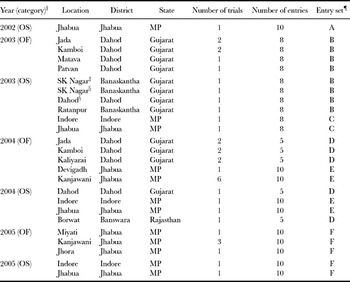
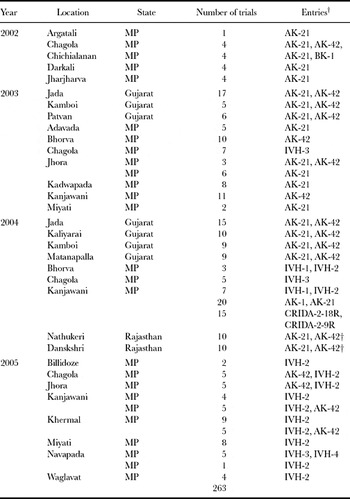
Farmers or scientists conducted two types of trials: all-variety trials (mother trials, Tables 1 and 2) and trials of one or two varieties against the local control (baby trials, Table 3). The nomenclature of ‘mother’ and ‘baby’ trials follows that of Snapp (Reference Snapp1999). The mother trials comprised all of the test entries and the control, and each trial was a single replicate of randomized entries with the replication across farmers' fields. Scientists also conducted mother trials on research stations, and in this case the trials were in a three-replicate randomized block design. The baby trials had either three entries (two test entries and a local control) or two entries (one test entry and the local control). For MP and Rajasthan, the seed yield per kilogram of seed planted was obtained from farmer interview. For baby trials in Gujarat, perceptions were recorded for yield, earliness, quality and overall preference relative to the local control variety.
Details of 12 on-station and 30 on-farm horsegram mother trials, Gujarat, Madhya Pradesh (MP) and Rajasthan, 2002–2005.

†OS: on-station; OF: on-farm.
‡Average fertility.
§High fertility.
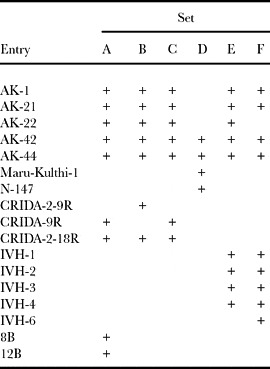
¶For details of entry sets, see Table 2.
The sets of test horsegram entries in the mother trials.

Details of 263 horsegram baby trials in Jhabua district, Madhya Pradesh (MP), Banswara district, Rajasthan, and Dahod district, Gujarat, 2002–2005. Only the baby trials for Rajasthan and MP have data for yield. Perception data were analysed for the trials in Gujarat.

†No local entry in Rajasthan baby trial. All other trials included a local control variety.
Statistical analysis
Combined analysis of all the mother and baby trials across states and years were computed (after the exclusion of entries 12B and 8B that were tested only at a single site without replication) using general linear modelling (GLM) methods of MINITAB 14 (MINITAB, 2003). The least square mean grain yield values from the GLM analysis with fixed effects for varieties were compared with the same GLM estimates for the local control by a t-test (Snedecor and Cochran, Reference Snedecor and Cochran1973). Standard errors for the least square estimates of means from the MINITAB output were used to compute the standard error of the difference (s.e.d.) from the control as: s.e.d. = √(s.e. of variety 1)2 + (s.e. of control)2 where s.e. = standard error of variety mean from GLM analysis.
The t-value for any variety was compared to the control = (variety mean – control mean)/s.e.d.
The MINITAB GLM procedure did not permit the estimation of entry × state and entry × year interactions because the data were highly non-orthogonal.
RESULTS
Intercropping trials
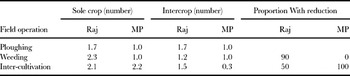
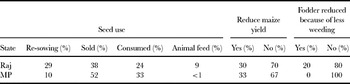
In the intercropping trials, the crop management was more intensive in Rajasthan than MP (Table 4). Intercropping reduced the need for agricultural operations at the post-sowing stage but, as expected, there was little or no difference in the pre-sowing operation of ploughing. In Rajasthan, weedings were done more often in the sole crop, but nine out of the 10 farmers reported fewer weedings in the intercrop. In Rajasthan and particularly in MP, the frequency of inter-cultivation was reduced (Table 4). Most farmers reported that the yield of maize was not reduced by intercropping with horsegram (Table 5).
Frequency of cultural operations reported in sole and intercropped maize by 22 farmers Rajasthan (Raj) and Madhya Pradesh (MP), rainy season 2003.

Perception of use of horsegram seed and the effect of horsegram on main crop yield by 22 farmers Rajasthan (Raj) and Madhya Pradesh (MP), rainy season 2003.

From the 2 kg of AK-21 horsegram given to each farmer in Rajasthan, farmers harvested about 10 times as much seed (19.8 kg on average). In MP, less AK-42 seed was given to the farmers (0.5 kg each) and they harvested 17 times as much seed (8.6 kg on average). In both states, farmers sold more in the market than was used for home consumption and resowing with the smallest proportion being used as animal feed (Table 5). Less green fodder from weeds was produced in Rajasthan where the number of weedings was reduced. Most farmers reported that fodder availability was not reduced because they obtained nutritive fodder from the horsegram stover; all farmers used horsegram as a dry fodder after threshing the seed and none reported harvesting before grain production for fodder.
Varietal trials
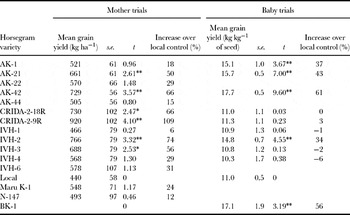
The results of the horsegram mother and baby trials were in good agreement as the same varieties were significantly better than the control in both sets of trials (Table 6). However, there were differences in yield advantage between the two types of trials, and these were dependent on the duration of the variety. Later maturing entries, such as CRIDA-2-18R and CRIDA-2-9R, had the greatest advantage in the better-managed mother trials than the baby trials that were grown under more representative conditions (Table 6). The better management of the mother trials compared with the baby trials was unintended, but it seems inevitable that most farmers take better than average care of a mother trial, which they consider to be more important than their usual crop. In eastern India, Virk et al. (Reference Virk, Singh, Kumar, Prasad, Gangwar and Witcombe2003) also found that yields of rice were higher in mother trials.
Least square estimates of horsegram variety mean grain yields from the combined analysis of mother and baby trials across states and four years. The mean values were compared with the local control variety by a t-test.

*p < 0.05; **p < 0.01.
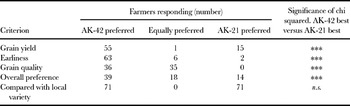
The three best varieties were clearly AK-21, AK-42 and IVH-2 (a new variety from Jawaharlal Nerhu Krishi Vishwa Vidhyalaya and GVT), as they all performed well for their combination of grain yield and maturity in both the mother and the baby trials. AK-21 and AK-42 were compared directly in a set of baby trials in Gujarat for several important traits. Overall, farmers had an overwhelming preference for AK-42; all farmers preferred AK-42 for earliness and grain quality and most reported it yielded more than AK-21 (Table 7). Better grain quality was related to grain size since farmers reported a preference for the larger grain size of AK-42.
Perceptions from 71 farmers (28 in 2003 and 43 in 2004) on two improved varieties of horsegram for five criteria rainy season, Gujarat, 2003 and 2004.

***p<0.001.
Sixteen farmers who grew AK-42 in Gujarat in 2003 were asked about seed transactions. After harvest, 10 of them (60%) distributed an average of 2 kg of seed to friends, relatives and neighbours by sale, gift and exchange. Since these were early adopters the quantities of seed available for distribution would have been limited.
DISCUSSION
GVT had earlier tried interventions with a local variety (landrace) of horsegram in participatory trials, but these had met with limited success. No improved horsegram variety was available to the project and the landrace that was supplied to farmers did not yield enough grain to make intercropping a profitable or attractive option. However, introducing the improved varieties of horsegram into the farming system has many potential benefits including improved human nutrition. The grain, which is used as dal by the indigenous tribal peoples of the hill areas of the region, is of high nutritional quality (Bravo et al., Reference Bravo, Siddhuraju and Saura-Calixto1999) making it suitable for more extensive use and the essential amino acid tryptophan is not limiting (Gupta et al., Reference Gupta, Parab, Mehta and Goyal2001).
On the upper slopes where productivity is inherently low, crops are managed extensively because the risk of low or negative returns from supplying inputs, whether purchased or family labour, is too high. Hence, improved agronomy needs to be low cost and not involve an increased demand for labour. Weeds are a major constraint in maize production in the area; often labour-intensive methods such as hand weeding by women using sickles are employed and these are constrained by the supply of labour. Farmers found that intercropping reduced labour since less weeding was required but, in most cases, did not have a yield-reducing impact on their maize crop or on the availability of fodder. There were other likely benefits that we did not have the resources to quantify: reduced soil erosion from more ground cover; improved soil fertility as the result of including a legume in the maize crop; and a lower, more optimal plant density in the maize.
The participatory trials, even though they were not orthogonal in design, could be statistically analysed to identify AK-42 rapidly and cost-effectively as a higher yielding variety than AK-21 and to show that both yielded considerably more (over 60% in the case of AK-42) than the local landraces. Perception data from the baby trials quickly revealed the preference for both AK-42 and AK-21 over the local variety – in both cases there was a 100% preference for the modern variety (Table 7). The baby trials that included both entries convincingly showed that AK-42 was the most preferred. The intercropping trials were done using variety AK-21 in Rajasthan, so the acceptance of intercropping can be expected to increase further if AK-42 is used. Moreover, AK-42 matures earlier so it more closely matches the maturity of the maize. Variety Indore Vikas Horsegram-2 (IVH-2) was even better than AK-42. It did not differ significantly from AK-42 in grain yield but was earlier to mature by at least 15 days (about 75 days compared with about 90 days for AK-42) and has larger, and therefore more preferable, seeds of the same colour as AK-42. The earlier maturity makes this variety ideal for intercropping as it matures at about the same time as the maize crop.
The market for horsegram grain is poorly developed so the grain price that farmers obtained in the market was not high. With increased supply and co-ordinated marketing by farmer groups a higher grain price could be achieved. Varieties AK-42 and IVH-2 had better grain quality and over time this should be reflected in a higher price in the market.
Using participatory approaches farmers could judge the technology for themselves and when they found it suitable they could immediately adopt it. Overall, the attractiveness of the intervention was confirmed by its high take up. All of the participating farmers intended to continue with the cultivation of the improved horsegram variety. In some cases, this was as a sole crop on the upper slopes where it could be observed to provide excellent ground cover and greatly reduce soil erosion. Even though seed quantities were limited at an early stage of adoption, farmers distributed seed of the improved variety of horsegram to other farmers so the impact of the research spread beyond those immediately involved. Nonetheless, the adoption of improved horsegram varieties is clearly constrained by access to seed, and both the public- and private-sectors currently neglect the provision of seed of this promising but underutilized crop.
Acknowledgements
We wish to thank Mr Amar Prasad and Mr K. S. Sandhu of Gramin Vikas Trust, India for facilitating this research and to Dr D. S. Virk of CAZS- Natural Resources, UK, for his help in data analysis and comments on the manuscript. The co-operation of many farmers in India is gratefully acknowledged.