INTRODUCTION
Epidemiological, pharmacological and observational studies have shown that there is wide variability in the response to standard drug therapy between patients (Bosch, Reference Bosch2008), varying from failure to respond to a drug to life-threatening adverse reactions. These differences in response between individuals to standard doses may include the nature and severity of the disease being treated, nutritional status, individual age and race, organ function, concomitant therapy and illness. Although such factors are known to be important, genetic differences between individuals within otherwise uniform subsets of the population (i.e. same racial background, age, sex, etc.) are thought to be perhaps the most important factor in influencing the efficacy and toxicity of medications (Evans and Johnson, Reference Evans and Johnson2001). For many medications, these differences between individuals are now known to be attributable to polymorphisms in genes encoding drug metabolizing enzymes, drug transporter and/or drug targets, but historically clinical observations on inherited differences in drug efficacy were first documented in the 1950s (Alving et al. Reference Alving, Carson, Flanagan and Ickes1956).
Most of the literature available for pharmacogenetics centres around drugs that are absorbed into the blood stream and less is known about the pharmacogenetics of drugs which act directly in the lumen of the intestine (Evans and Relling, Reference Evans and Relling2004). Among those that have been studied are omeprazole (an antacid treatment), which is used for treatment of peptic ulcers and heartburn, and Irinotecan for treatment of colon and rectal cancer. These medications, however, have different modes of action when compared with the enzymes in papaya latex supernatant (PLS) which are restricted to the intestinal lumen after oral delivery, and directly attack the cuticle of resident nematode parasites. We have shown already that papaya latex extract (PLX) and PLS have powerful anthelmintic effects on Heligmosomoides bakeri, removing more than 90% of the parasites after 5 doses, and 68% after just a single dose (Stepek et al. Reference Stepek, Lowe, Buttle, Duce and Behnke2007a ; Luoga et al. Reference Luoga, Mansur, Buttle, Duce, Garnett and Behnke2012). Throughout our work, the mice used were male C3H strain although, in an earlier study, Satrija et al. (Reference Satrija, Nansen, Murtini and He1995) used female mice of the BALB/c strain to assess the anthelmintic activity of papaya latex and also obtained high levels of efficacy. However, to-date there has been no systematic study comparing mouse strains of known contrasting genotype.
Livestock on farms usually comprise well known and productive breeds, but although breeds differ genetically from each other, within breeds there is still considerable genetic variation, allowing farmers to further select breeding stock and to improve breed quality with respect to production traits such as meat, milk, wool, etc. If the efficacy of PLS is dependent on host genotype, differences in efficacy might be expected between animals within breeds on farms where the therapy will be applied in the future, and some evidence of variation in the efficacy of PLS between hosts has already been observed in treated sheep (Buttle et al. Reference Buttle, Behnke, Bartley, Elsheikha, Bartley, Garnett, Donnan, Jackson, Lowe and Duce2011). Thus the variation arising from genetic differences between animals is clearly an important issue to assess, and comparisons of efficacy in different inbred mouse strains offer one possibility for exploring genetic influences on drug efficacy. Inbred mouse strains are expected to be more than 99% homozygous at all genetic loci, as a result of brother-sister mating for at least 20 generations and thus despite each strain having experienced a different selection history, within strains no significant genetic variation is expected (Tsang et al. Reference Tsang, Sun, Luke, Stewart, Lum, Gregory, Wu, Subleski, Jenkins, Copeland and Munroe2005; Didion and de Villena, Reference Didion and de Villena2014; http://jaxmice.jax.org).
Unlike drugs that are absorbed by the host, orally administered cysteine proteinases (CPs) mostly stay in the lumen of the intestine where they act on worms directly (Behnke et al. Reference Behnke, Buttle, Stepek, Lowe and Duce2008). In this case therefore, between-host variation in drug efficacy could arise from polymorphic genes that influence the exact physiological conditions within the intestine, such as pH, host digestive enzyme concentrations, time of passage of drug through the gut, etc. The concentration of drugs in the intestinal site where they are required to target worms may also vary due to differences in the size and volume of the intestine attributable to variation in host body size and weight.
Therefore, in this paper we tested the hypothesis that host genotype, as reflected by genetically distinct mouse strains, plays a critical role in determining the extent of the anthelmintic efficacy of papaya latex in mice. We also assessed whether the blockade of acid secretion in mouse strains that responded poorly to PLS treatment would improve efficacy and we compared the availability of CP activity along the length of the intestinal tract after treatment with PLS in mouse strains showing good and poor drug responses to treatment. Finally, we also compared pH and trypsin activity between two mouse strains that showed contrasting drug efficacy to try to identify the genetic factor/s that determine high vs poor levels of anthelmintic activity after the oral administration of PLS.
MATERIALS AND METHODS
Enzyme preparation
The enzymes used in this study were CPs derived from an extract of papaya latex (PLX; Stepek et al. Reference Stepek, Lowe, Buttle, Duce and Behnke2007a ), and the supernatant of papaya latex (PLS; Buttle et al. Reference Buttle, Behnke, Bartley, Elsheikha, Bartley, Garnett, Donnan, Jackson, Lowe and Duce2011; Luoga et al. Reference Luoga, Mansur, Buttle, Duce, Garnett and Behnke2012, Mansur et al. Reference Mansur, Luoga, Buttle, Duce, Lowe and Behnke2014) containing chymopapain, glycyl endopeptidase, caricain and papain (in order of relative abundance (Buttle et al. Reference Buttle, Dando, Coe, Sharp, Shepherd and Barrett1990)). The molar concentration of the active cysteine proteinase was measured by active site titration adapted from Barrett et al. (Reference Barrett, Kembhavi and Hanada1981) and Zucker et al. (Reference Zucker, Buttle, Nicklin and Barrett1985), with increasing concentrations of the cysteine proteinase specific inhibitor, L- trans-epoxysuccinyl-L-leucylamido-(4-guanidino) butane (E-64) (Apollo Scientific Ltd, UK) and with 4 mm L-cysteine as a reducing agent and N-α-benzoyl-arginine-p-nitroanilide (BAPNA) (Bachem Ltd, UK) as the substrate.
Experimental infections
The different strains of mice used in this work were purchased from B&K Universal Ltd., UK (BKW mice), Charles River Ltd, UK (C3H, C57/BL10, BALB/c, CBA/ca), and Harlan, UK (NIH, CD1), at 5 weeks of age. Mice were given a minimum of a week to adjust to animal house conditions before infection at 6 weeks of age, and were provided throughout with food and water ad libitum.
Mice were infected by oral gavage with their natural rodent GI nematode, H. bakeri (previously known as Nematospiroides dubius, Heligmosomoides polygyrus and H.p. bakeri (Cable et al. Reference Cable, Harris, Lewis and Behnke2006; Behnke and Harris, Reference Behnke and Harris2010). Each mouse was given a suspension of L3 of H. bakeri in 0·2 mL of distilled water on day 0 (doses varied between experiments as detailed below but were usually either 150 or 200 L3s). At days 14, 16, 18, 21, 23 and 25 post-infection fecal egg counts (FEC) were measured by collecting fecal samples from each individual mouse separately in the morning and the number of eggs present in each sample was counted using the McMaster technique modified from Behnke and Parish (Reference Behnke and Parish1979) and adjusted to give the eggs per gram of feces (EPG). Briefly, feces were collected from individual mice, weighed and then 10 mL of saturated NaCl were added to each vial containing the feces. The pellets were broken up for 1 h using a rotary mixer, and then washed through a sieve (diameter of 5 cm with 800 × 800 μm square apertures) with 50 mL of saturated NaCl. The eggs were counted using a 2-chamber McMaster slide, each chamber holding a volume of 0·15 mL and the number of EPG was calculated accordingly. For the recovery of worms, mice were culled by exposure to increasing concentrations of CO2 and dissected. The small intestines were removed in their entirety, opened longitudinally with a pair of blunt-ended dissecting scissors and were incubated at 37 °C for 4 h while suspended in gauze in a 50 mL beaker of Hanks’ saline in a water bath. The tissues were checked for any remaining worms, the supernatant was discarded carefully and the worms that had collected in the bottom of the beakers were counted with the aid of a dissecting microscope.
Cimetidine treatment
The antacid cimetidine (from the Pharmacy at the Queen's Medical Centre, Nottingham at 64 mg mL−1 water; Buttle et al. Reference Buttle, Behnke, Bartley, Elsheikha, Bartley, Garnett, Donnan, Jackson, Lowe and Duce2011) was administered 20 min before PLS to animals that received both treatments, each mouse being given 0·2 mL of the solution, containing 12·8 mg of cimetidine, equivalent to 427 mg kg−1 body weight for a mouse of 30 gm weight.
Ethical considerations
The authors assert that all procedures contributing to this work comply with the ethical standards of the national guides on the care and use of laboratory animals in the UK (The Animals (Scientific Procedures) Act 1986) and were locally approved by the Animal Welfare and Ethical Review Body of the University of Nottingham. All animal procedures were carried out under UK Home Office licence numbers 40/2942 and 40/3138 and under the regulations of the Animals (Scientific Procedures) Act 1986. Importantly, all work was conducted within a recognized culture of care and compliance to meet the expectations of both the University and the UK Home Office Inspectorate.
Experimental design
Experiment 1: comparison of efficacy of PLX in five different strains of mice
Five strains of mice, three inbred (BALB/c, C3H and CBA/ca) and two outbred (BKW and CD1), were used for this experiment, with ten mice of each strain other than CD1 mice (n = 16 mice for CD1). All mice were given 200 H. bakeri infective larvae (L3) on day 0. The mice in each strain were divided into two groups of five mice, except CD1 (two groups of eight mice). The first group of mice in each strain was treated with 0·2 mL ultra-filtered distilled water containing 330 nmol of CP in PLX and the second group was given 0·2 mL of ultra-filtered distilled water daily for 7 days starting on day 19. All mice were fasted for 6 h prior to treatment but had ad libitum access to water. Fecal samples were collected on days 14, 16 and 18 (pre-treatment) and on days 19, 21, 23 and 25 (during treatment) post infection for quantification of parasite eggs, and the mice were autopsied on day 25.
Experiment 2: comparison of efficacy of PLS in four different strains of mice
To broaden the range of mouse strains tested we next compared the efficacy of treatment with papaya latex CP enzymes in two further strains of mice, C57/BL10 and NIH, which are known to show contrasting immune responses to H. bakeri (Behnke and Robinson, Reference Behnke and Robinson1985). BALB/c and C3H strains were used as comparisons, as they had shown contrasting results in Experiment 1 (C3H showing a marked reduction in both FEC and worm counts while BALB/c demonstrated a relatively poor change in both parameters). The experimental design was similar to that of Experiment 1, except that mice were infected with 150 H. bakeri larvae instead of 200 L3, were not fasted before treatment this time (see Luoga et al. Reference Luoga, Mansur, Buttle, Duce, Garnett and Behnke2012 for full explanation) and were treated with 0·2 mL of PLS, containing 240 nmol active enzyme, daily for 5 days. PLS is a more consistent, better tolerated and highly effective agent compared to PLX used in our preliminary experiments, requiring a shorter period of treatment to achieve virtually complete clearance of worms from C3H mice in 5 rather than 7 days (Luoga et al. Reference Luoga, Mansur, Buttle, Duce, Garnett and Behnke2012).
Experiments 3: effect of blocking gastric acid secretion by treatment with cimetidine
One possibility for the poor efficacy of PLS in some strains of mice may be higher acidity in the stomach, since it is known that plant-derived CPs are inactivated in acid (Huet et al. Reference Huet, Looze, Bartik, Raussens, Wintjens and Boussard2006). Ten NIH mice were divided into two groups: the first group was given cimetidine 15 min prior to treatment with 0·2 mL PLS containing 240 nmol of active enzyme while the second group was only given cimetidine. The experiment was also controlled by inclusion of sex and age-matched NIH and C3H mice treated with water (n = 5 in both cases), and NIH and C3H mice treated with PLS (n = 5 in both cases).
Experiment 4: assessment of CP activity along the length of the intestine in C3H and BALB/c mice
This experiment was designed to assess the activity of CPs along the GI tract in poor (BALB/c) and higher responder (C3H) strains of mice. Twelve uninfected mice (six from each strain) with free access to both water and food were treated orally with 0·2 mL PLS containing 240 nmols of active enzyme and then one mouse from each strain was killed after the following time intervals: 10, 20, 60, 90, 120 and 180 min. The entire GI tract from the stomach to the large intestine was removed from each mouse, briefly washed in a Petri dish of PBS and then divided into five sections: the stomach, the upper half of small intestine (duodenum), lower half of small intestine (ileum), caecum and the large intestine (colon). These sections were opened longitudinally and washed individually with 1 mL of PBS before the contents were filtered using muslin cloth. The enzyme activity in each section was determined by activity assays using BAPNA (Bachem Ltd, UK) as the substrate, with and without E-64. E-64 was used in order to distinguish between the activity of CPs and that of trypsin and other intestinal enzymes, which can also cleave BAPNA. To ensure complete inactivation of CPs, 100 μL of 2·0 nm E-64 were incubated with 10 μL of 1·6 nm PLS enzyme solution. Enzyme activity was calculated using the molar extinction coefficient at 410 nm for the p-nitroaniline product (8800 M−1 cm−1; Mole and Horton, Reference Mole and Horton1973), where 1 unit is the enzyme activity producing 1 nmol min−1. CP activity is then the amount of the total activity that is blocked by E-64.
Experiment 5: measurement of pH activity along the length of the intestine in C3H and BALB/c mice
This experiment was conducted to test whether the reduced efficacy of PLS in some strains of mice could be due to local pH differences between strains, with resultant inhibition of enzyme activity. Ten mice (five BALB/c and five C3H) were used for this experiment and all had free access to food and water. Immediately after culling, each mouse was rapidly dissected, and the intestinal tract was removed and divided into sections: stomach, upper small intestine (duodenum), lower small intestine (ileum), caecum and colon. A small cut was made in the middle of the gut wall in each section, into which a 6 mm electrode of a pH meter was inserted and the pH was read when stability was achieved. Measurements were made in sequence from the stomach to the colon. The electrode was rinsed with distilled water between each reading. The same procedure was repeated on all mice taking 3–5 min to complete on each animal.
Experiment 6: measurement of trypsin activity along the length of the intestine in C3H and BALB/c mice
The aim of this experiment was to determine the activity of trypsin along the length of the intestinal tract downstream from the stomach in BALB/c and C3H mice (strains showing extremes of PLS efficacy against H. bakeri in this study). Eight untreated mice were killed (four BALB/c and four C3H) and the entire intestinal tract from the stomach to the large intestine was removed from each mouse, briefly washed in a Petri dish containing 20 mm Tris buffer and then divided into five sections: the stomach, the upper half of the small intestine (duodenum), lower half of small intestine (ileum), caecum and colon. The sections were opened longitudinally and washed individually with 1 mL of Tris buffer before the contents were filtered using muslin cloth. Trypsin activity was determined by an assay with BAPNA as the substrate. Briefly 10 μL of intestinal fluid were added to 12·5 μL of 100 mm BAPNA solution and the assay was made up to 1 mL with 20 mm tris buffer (pH 7·5) containing 5 mm CaCl2. The production of p-nitroaniline and units of enzyme activity were measured by spectrophotometry using the procedure in Experiment 4 above. Readings from the stomach were used as a negative control.
Data analysis
FEC were log10(EPG+25) transformed and were analysed by repeated measures (rm) General Linear Models (GLMs), fitting TIME (day on which FEC were carried out) as the within-subject factor and TREATMENT (2 levels, PLS, or water) and STRAIN (5 or 4 strains respectively in Experiments 1 and 2) as the between-subject factors. The Huynh–Feldt adjustment to the degrees of freedom was used to interpret significance on the side of caution when the data did not meet the requirements of Mauchly's Test of Sphericity. Worm counts were analysed by 1-way GLMs on log10(worm burden+10) transformed data, and enzyme availability and pH by 2-way linear mixed models (TREATMENT and TIME) with repeated measures (SITE = section of the intestine in which pH or enzyme concentration was measured in different individual animals) nested within individual mice. All parametric statistical models were checked for approximately normal distribution of residuals. When the groups being compared were too small to assess reliably whether the distribution of residuals met the expectations of the Gaussian distribution, we employed the non-parametric Mann–Whitney U test. In all cases, P = 0·05 was considered as the cut-off for statistical significance.
RESULTS
Comparison of efficacy of PLX in five strains of mice
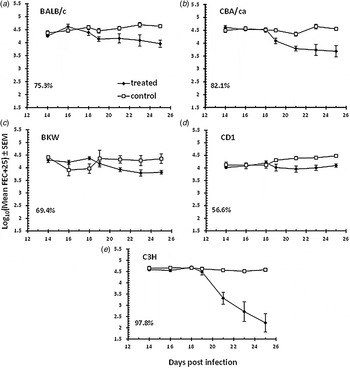
There was a marked difference in the response to treatment among the five strains of mice (Figs 1 and 2; rmGLM with TIME (after infection) as the within-subject measure, and TREATMENT (PLX or water) and STRAIN as between-subject measures, on log10 (FEC+25), for the 2-way interaction between TREATMENT × STRAIN F 4,44 = 5·14, P < 0·05). There was a significant 2-way interaction of TIME × TREATMENT (F 4.3,190.7 = 45·31, P < 0·001), indicating that as a result of treatment FEC diverged with time. The greatest reduction in FEC was observed in C3H mice (97·8%), followed by CBA/ca mice (82·1%), BALB/c mice (75·3%) and BKW (69·4%), with the weakest response among the CD1 mice. The main effect of TREATMENT was also highly significant (F 1,44 = 52·13, P < 0·001) indicating that, overall, PLX had a potent effect on FECs and, as expected, there was a significant overall effect of time (main effect of TIME, F 4·3, 264 = 22·88, P < 0·001), mainly arising from the falling FEC in treated mice.
Experiment 1, comparison of efficacy of PLX in different strains of mice. The figure shows FEC in five strains of mice infected with 200 L3 of H. bakeri, treated on each of days 19–25 after infection, with PLX in water (dose = 330 nmol) or distilled water. The strains are indicated in each panel and the reduction in FEC of the treated group relative to the control group on day 25 pi is shown in the bottom left corner of each panel. The legend to treatment is given in panel A. For statistical analysis, see text.

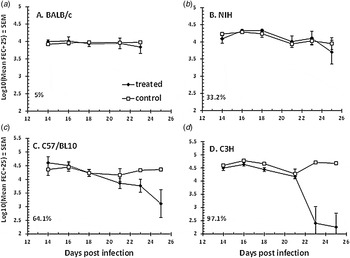
Experiment 2, comparison of efficacy of PLS in different strains of mice. The figure shows FEC in four strains of mice infected with 150 L3 of H. bakeri, treated on each of days 19–25 after infection with PLS in distilled water (dose = 240 nmol) or distilled water. The strains are indicated in each panel and the reduction in FEC of the treated group relative to the control group on day 25 pi is shown in the bottom left corner of each panel. The legend to treatment is given in panel A. For statistical analysis, see text.

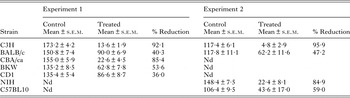
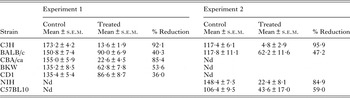
As with FEC, there was a marked effect on worm burdens of treatment with PLX (GLM with TREATMENT and STRAIN on raw worm counts, for the main effect of TREATMENT, F 1,46 = 189·3, P < 0·001) but the extent of the reduction in worm burdens varied substantially between strains of mice (2-way interaction STRAIN × TREATMENT, F 4,46 = 7.13, P < 0·001). The strain with the greatest response to treatment was C3H (Table 1; 92·1% reduction in worm burden) and the poorest were BALB/c and CD1 (40·3 and 36·0%, respectively). Post hoc analysis by the Tukey HSD indicated that post treatment worm burdens in PLX-treated C3H mice were significantly different from those in BALB/c and CD1 strains (P < 0·05 and P < 0·001, respectively).
Comparison of the efficacy of PLS on adult H. bakeri in vivo in seven strains of mice, as assessed by worm counts (± standard error of the mean) and percentage reduction in worm burdens in the treated group relative to the control group
Nd, not done.
Comparison of efficacy of PLS in four strains of mice
In this experiment and all remaining experiments, we used PLS, rather than PLX, as explained in the Materials and Methods section. Again, there was a highly significant effect of treatment with papaya latex CPs (PLS in this case) (main effect of TREATMENT, F 1,32 = 9·3, P = 0·005, P < 0·005), but with marked differences between mouse strains (2-way interaction STRAIN × TREATMENT, F 3,32 = 6·3, P = 0·002) and significant divergence in the response of treated and control mice over time (TIME × TREAMENT, F 2·7, 87 = 8·1, P < 0·001) and between strains over time (TIME × STRAIN, F 8·2,87 = 3·4, P = 0·002). Based on arithmetic means, there was considerable variation in the extent of the reduction in FEC following treatment (Fig. 2), with reduction being weakest in BALB/c (5%), intermediate in NIH and C57/BL10 (33·2 and 64·2%, respectively) and greatest in C3H (97·1%) mice. Post hoc Tukey HSD analysis indicated a significant decline in FEC in C3H and C57/BL10 mice (P < 0·001 and P = 0·003, respectively) when compared with BALB/c.
There was also marked variation in worm burdens between strains of mice (Table 1). Following treatment with PLS, reduction in worm burdens was greatest in C3H (95·9%) followed by C57/BL10 (84·9%) then NIH (59·0%) and least in BALB/c mice (47·2%). Analysis by 2-way GLM indicated a significant effect of TREATMENT (F 1,32 = 158, P < 0·001) and a significant interaction between TREATMENT and STRAIN of mice (F 3,32 = 6.16, P < 0·002) indicating that the outcome of treatment depended significantly on the strain of mice being treated.
Effect of blocking gastric acid by treatment with cimetidine
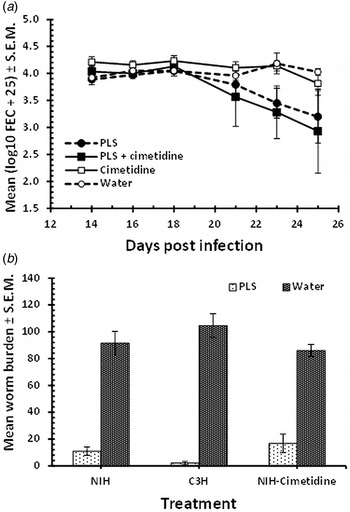
Confining the analysis to NIH mice (Fig. 3A), FEC data were analysed by rmGLM with CIMETIDINE (Cimetidine or water) and PLS (PLS or water) as the between-subject factors and TIME as the within-subject factor. The results showed a significant main effect of PLS (F 1,14 = 19·0, P = 0·001), much as expected; however, there was no effect of CIMETIDINE (F 1, 14 = 0·8, P = 0·4) or interactions involving CIMETIDINE and PLS (F 1,14 = 0·03, P = 0·9). Therefore, cimetidine had no effect on FEC irrespective of treatment with PLS, and there was no evidence of an enhanced effect of PLS following pre-treatment with cimetidine. Although FEC drifted significantly downwards with TIME (F 2·6,37 = 4·5, P = 0·012), there were no other interactions involving TIME.
Experiment 3, effect of blocking gastric acid secretion by treatment with cimetidine. FEC in mice infected with 150 L3 of H. bakeri and treated on each of days 20–24 after infection with 240 nmol PLS in distilled water, water, pre-treated with cimetidine (12·8 mg permouse) followed by water or pre-treated with cimetidine followed by PLS (A). The worm counts for the same groups plus C3H control mice given PLS or water are shown in B.

Figure 3B shows the worm burdens recovered at autopsy and includes C3H mice as reference controls. Analysis of worm burdens, confined to NIH mice, by 2-way GLM gave a significant main effect of PLS treatment (F 1,16 = 143·8, P < 0·001), but the effect of cimetidine was not significant (F 1,16 = 0·021, P > 0·9) nor was the 2-way interaction with cimetidine (F 1,16 = 1·1, P > 0·3). This indicates that the efficacy of PLS in removing worms from NIH mice was not enhanced by pre-treatment with cimetidine
Assessment of CP activity along the length of the intestine in C3H and BALB/c mice
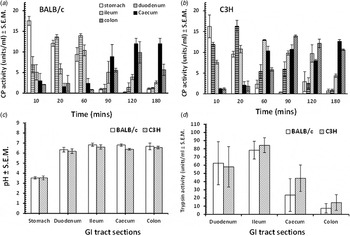
The results of this experiment are illustrated in Fig. 4A and B and show that following treatment with PLS, there was essentially a very similar pattern of variation in enzyme activity along the length of the intestinal tract in both mouse strains (BALB/c and C3H), with only very minor differences between these two strains at particular time intervals after dosing. In both, CP activity was initially highest in the stomach but rapidly declined over 90 min, by which time only negligible levels of enzyme activity remained. CP activity in the anterior small intestine, where H. bakeri usually aggregate, rose steadily in the first 60 min after dosing and then declined rapidly so that by 90 min, minimum activity remained in the upper small intestine. Concurrently, CP activity increased steadily in the caecum and colon, although in C3H mice, CP activity in the lower intestine (the ileum) remained higher than in BALB/c mice until 120 min. In summary, CP enzyme activity in both strains of mice decreased gradually in the stomach and small intestine over the first 90 min and then increased steadily in the caecum and colon to 180 min, the majority of enzyme activity by then accumulating in the large intestine, particularly in the caecum.
Experiment 4, comparison of CP activity in different sections of the intestinal tract in BALB/c (A) and C3H (B) mice at intervals over 3 h after oral administration of PLS (240 nmol). Key to the patterns in the columns is given in A. Experiment 5 (C), variation in pH in different sections of the intestine in naïve BALB/c and C3H mice. Experiment 6 (D), variation in trypsin activity in different sections of the intestine in naïve BALB/c and C3H mice.

Measurement of pH activity along the length of the intestine in C3H and BALB/c mice
The pH values recorded in each of the different sections of the intestines of both BALB/c and C3H are shown in Fig. 4C. As expected, the lowest pH value was recorded in the stomachs of both strains (BALB/c = 3·53 and C3H = 3·54) and then the pH increased steadily from the duodenum to the colon. The lower part of the small intestine had marginally higher pH values than any other parts of the GI tract (6·83 for BALB/c and 6·61 for C3H). Statistical analysis was by a 2-way linear mixed model, with individual mouse nested within strain and fitted as a random term. The pH varied significantly along the GI tract sections (main effect of SITE, F 4,28 = 94·5, P < 0·001); however there was no significant difference in pH between the two strains of mice (main effect of STRAIN, F 1,7 = 2·4, P < 0·17), and no interactions between mouse strain and location along the length of the intestine (SITE × STRAIN, F 4,28 = 0·33, P = 0·85). Therefore, it is clearly evident that the two mouse strains do not show any marked differences in pH that might possibly explain the contrasting efficacy of PLS.
Measurement of trypsin activity along the length of the intestine in C3H and BALB/c mice
As expected, high trypsin activity was found in the small intestine of both strains of mice particularly in the lower part of the small intestine (Fig. 4D). Statistical analysis was by a 2-way linear mixed model, with individual mouse nested within strain and fitted as a random term. This showed that there was a highly significant difference in trypsin activity between the four sections of the intestine (main effect of SITE, F 3,18 = 12·8, P < 0·001), but no difference between the two mouse strains (main effect of STRAIN, F 1,6 = 0·5, P = 0·5), and no interaction between strain and intestinal section (SITE × STRAIN, F 3,18 = 0·36, P = 0·8). These results suggest that any variation in trypsin activity between the two mouse strains is unlikely to explain the contrasting efficacy of PLS in BALB/c and C3H mice.
DISCUSSION
The results reported in this paper clearly show that the efficacy of PLS in removing H. bakeri from mice varies markedly between mouse strains, suggesting a strong host genetic effect underlying this phenomenon. The range of efficacy varied from the extremely high levels recorded consistently in C3H mice (always >90%) to considerably weaker efficacy when BALB/c mice were treated with the same dose as that given to C3H mice, and a range of intermediate levels of efficacy in the other inbred and outbred mouse strains that were surveyed. This variation between mouse strains in the efficacy of PLS was not explained by variation in pH along the length of the intestinal tract of mice, and indeed neutralizing stomach acidity by treatment with cimetidine gave no improvement in NIH mice in which usually PLS had a weaker effect than in C3H. Finally, after administration of a standard dose of PLS, there was no difference in the availability of active CPs along the length of the intestine between two mouse strains showing the most extreme polarization of efficacy (BALB/c and C3H), nor were there differences between these strains in the availability of endogenous trypsin.
In the first experiment, C3H and CBA/ca strains were shown to have more marked responses to drug treatment with PLX than the other strains and, in all the subsequent experiments, C3H mice consistently showed high (>90%) efficacy of PLS. In support of a genetic basis, the similarity of the drug responses of C3H and CBA/ca to PLX and PLS treatment is probably because these two strains are closely related, originating from the same ancestral stock. They were developed from crossing a Bagg albino female and a DBA male by Strong in 1920, followed by selection for high incidence of mammary tumours in the case of C3H and low incidence of mammary tumours for CBA/ca (http://jaxmice.jax.org).
In contrast to C3H and CBA mice, BALB/c mice had a relatively weak response to drug treatment with poor reduction in worm counts. These results conflict with Satrija et al. (Reference Satrija, Nansen, Murtini and He1995), who reported a reduction in worm burden in female BALB/c mice of 84·5% after just 3 days of treatment with papaya latex. Unfortunately, it is not possible to compare directly the doses of papaya latex that we administered to those given by Satrija et al. (Reference Satrija, Nansen, Murtini and He1995), because these authors did not measure proteinase activity but relied purely on reporting the dose in terms of grams per kg body weight of the recipients. We found that BALB/c mice were less tolerant to PLS, as evidenced by some toxicity, and this became especially apparent towards the end of the period of treatment. The PLS treated BALB/c mice showed loss of coat integrity and some loss of body weight and, due to concerns about their wellbeing, the mice in this group were terminated 1 day before the end of the experiment. For this reason, the strain was excluded from subsequent experiments where repeated delivery of PLS was required.
Any genetic explanation for variation in the efficacy of PLS between mouse strains may hinge on genetically controlled differences in the physiological environment in the intestine including, for example pH in the stomach and the duodenum, gut food and drug transit times, host digestive enzymes, etc. An acidic environment, reflected by pH values <4·0, is known to denature CPs and abolish activity (Huet et al. Reference Huet, Looze, Bartik, Raussens, Wintjens and Boussard2006) and other host enzymes may well digest the orally delivered CPs. Therefore, we next assessed whether acidity in the stomach was a crucial factor in blocking/inhibiting the efficacy of PLS further along the intestine and whether pH along the length of the intestine varied sufficiently between strains to explain their contrasting responses to drug treatment. The former experiment was encouraged by the results of Huet et al. (Reference Huet, Looze, Bartik, Raussens, Wintjens and Boussard2006) who reported that papaya proteinases that had been incubated with pepsin at low pH became unstable and were easily degraded irreversibly by pepsin. The hypothesis we tested was that the weaker responding strains may provide a more acid environment in the stomach that inactivates the PLX and PLS to a greater extent than in C3H mice, resulting in less active enzyme surviving the passage to the duodenum and upper small intestine where H. bakeri lives. However, blocking stomach acidity by concurrent treatment with cimetidine did not improve efficacy in the intermediate responder strain, contrasting with the results of Stepek et al. (Reference Stepek, Lowe, Buttle, Duce and Behnke2007b ) who found that administration of cimetidine improved the efficacy of PLS against stomach-resident adult female P. muricola worms.
Another possibility was that differences between strains in pH along the length of the intestinal tract might have contributed to the different responses of the poor and high drug responding strains to PLS treatment. However, our results showed that there was no significant difference in pH along the GI tract between two mouse strains that showed the extremes of high and very poor drug efficacy. However, our values for pH along the length of the intestinal tract differ from those recorded by McConnell et al. (Reference McConnell, Basit and Murdan2008), who found that even in the distal ileum and colon, the mean pH in BALB/c mice was acid with values not exceeding 5·5. If not differences in pH, then conceivably variation between strains in the availability of potent endogenous upper intestinal tract proteolytic enzymes such as trypsin may be a factor, but our results showed that this was also an unlikely explanation, at least in the case of trypsin. However, we cannot rule out the possibility that variation in levels of other digestive proteinases, such as chymotrypsin and pancreatic elastase, may be the key factor. Finally, we wondered whether CP activity following oral delivery varies between strains in different sections of the intestine, but our data also failed to provide support for this idea as an explanation. A very similar pattern of CP enzyme activity along the length of the intestine was reported by Stepek et al. (Reference Stepek, Lowe, Buttle, Duce and Behnke2007b ).
In this work, we have clearly established that mouse strains varied markedly in their drug response to PLS, and this has important implications for any future implementation of PLS-treatment as a therapy for worm infections in domestic animals and even human beings. Moreover, we have eliminated variation between strains in availability of CP activity along the intestinal tract, pH and tryptic activity as likely explanations of this variation between hosts of different genotype. CPs require a reducing environment for activation and although it is known that the GI tract of animals provides reducing conditions (Smith et al. Reference Smith, Rocha, Paster, Dworkin, Falkow, Rosenberg, Schleifer and Stackebrandt2006), it is not clear if all the animals have the same reducing environment, so this may be one more avenue to explore in future work. Alternatively, it may be that the mucosal interactions of the adult H. bakeri which coil around intestinal villi, vary between mouse strains in such a way as to impair access of CPs to the worm surface. Another possibility may be an interaction with the host immune response to H. bakeri. The mouse strains employed in this work vary enormously in their immune responses to H. bakeri. Interestingly, the two mouse strains in which PLS activity was the highest (C3H and CBA) are both strains showing very poor immune responses to the worms (Behnke and Robinson, Reference Behnke and Robinson1985). In contrast, NIH and BALB/c mice generate better immune responses that clear adult worms faster from mice with primary infections, and these two strains showed poorer drug efficacy. C57/BL10 mice also show poor immune responses to H. bakeri (Robinson et al. Reference Robinson, Wahid, Behnke and Gilbert1989); however, PLS was far less effective in this strain compared with C3H mice.
Finally, our data show clearly that there is extensive between-mouse variation in the efficacy of a standard dose of PLS in removing worms and we suggest that the most likely explanation resides in genetic differences between the mouse strains that were tested. Our results therefore warrant some caution in developing this therapy for wider scale use in the livestock industry, and even in human medicine. Moreover, since inbred mouse strains are so unique in their genotypes, with fixed gene combinations through their extensive homozygosity, and a far cry from the typical naturally bred animal, including domestic livestock and humans (Tsang et al. Reference Tsang, Sun, Luke, Stewart, Lum, Gregory, Wu, Subleski, Jenkins, Copeland and Munroe2005; Didion and de Villena, Reference Didion and de Villena2014), future mouse-based work in this field, building on our results, should exploit a range of mouse strains that show the contrasting responses that we have demonstrated in this paper, or at the very least use those showing opposite polarized drug responses, to give a more realistic picture of the possible outcomes of treatment. The ultimate challenge in this area of research is to identify ways in which the poor drug responders can be made to be more sensitive to drug treatment, so that all can benefit from treatment. Notwithstanding, there is strong evidence that PLS works remarkably well in domestic animals despite within-breed genetic polymorphism. Recent studies in sheep (Greyface crosses) infected with Haemonchus contortus showed that despite some variation in the intensity of the surviving worm burdens after treatment with PLS, overall 98% clearance was achieved (Buttle et al. Reference Buttle, Behnke, Bartley, Elsheikha, Bartley, Garnett, Donnan, Jackson, Lowe and Duce2011). Another recent series of experiments gave up to 99% reduction in Trichuris suis worm burdens in pigs (Rattlerow Senghers hybrids; Levecke et al. Reference Levecke, Buttle, Behnke, Duce and Vercruysse2014).
ACKNOWLEDGEMENT
We dedicate this paper to Dr Wenceslaus Luoga who sadly was killed in a road accident in July 2013 shortly after returning to Tanzania on the successful completion of his post-graduate studies at the University of Nottingham.
FINANCIAL SUPPORT
WL was supported by a postgraduate studentship from the Government of Tanzania and FM by the government of Malaysia.