1. INTRODUCTION
1.1. Computational creativity
Computational creativity is an area of artificial intelligence focused on two functions. One function is generation, in which creative artifacts are synthesized using combination, transformation, and exploration algorithms (Boden, Reference Boden1991). The other function is evaluation, in which creative artifacts are analyzed using mathematical, psychological, and biological approaches (Galanter, Reference Galanter, McCormack and d'Inverno2012).
Many computer systems have been developed to generate creativity, with their developers serving as evaluators of the resulting artifacts. In that case, the feedback loop from evaluation to generation lies in the head and hand of the developer, so it is not clear how much of an artifact's creativeness can be attributed to the computer (Boden, Reference Boden2009; Burns & Maybury, Reference Burns, Maybury, Argamon, Burns and Dubnov2010; Jennings, Reference Jennings2010). It is also not clear how creativity is evaluated in the minds of developers or other critics (Gero, Reference Gero, Taura and Nagai2010; Brown, Reference Brown2013). What is clear is that artificial intelligence will require a capability to evaluate creativity, such as that embodied in natural intelligence, if systems are to credibly generate artifacts that humans will agree are creative.
The development of evaluative methods can be informed by disciplines outside engineering, especially the fields of fine and applied art, where creativity is highly valued. In the arts as well as other areas of creative endeavor, humans do not usually consider their cogitations to be computations. However, computational models and measures of psychological processes are needed for artificial intelligence to create and critique its own artifacts along with those of natural intelligence. Thus, the present study is aimed at a computational understanding of how humans evaluate the creativeness of applied artworks, in a domain of advertising design.
Although advertising is not engineering, it involves creative design and its artifacts can be analyzed using computational methods of the kind that engineering employs. Moreover, advertising applies to all engineered artifacts that are promoted in communications aimed at selling, trading, or giving products to users. When creativity is important to consumers, then it is also important in advertising so that consumers can experience some of the creative spirit (before getting the product) as a basis for wanting the product (Walvis, Reference Walvis2008).
1.2. Engineering evaluations
In the realm of engineering design and analysis, researchers have recognized that evaluations of creativity are judgments relative to personal and cultural norms, and have explored the factors that underlie such judgments (for a recent review, see Brown, Reference Brown2013). Although a number of different models have been proposed for evaluating creativity, most involve the same or similar factors as outlined below.
An early and influential example is the creative product analysis model (CPAM; Besemer & Treffinger, Reference Besemer and Treffinger1981), which assesses creativity using human judgments of three factors (each involving several subfactors). The first factor is novelty: the extent of newness in a product compared to existing products. The second factor is resolution: the degree to which a product meets the needs of a problematic situation, which other models more commonly call value or utility. The third factor is style: the degree to which a product combines unlike elements into a refined, developed, coherent whole. This notion of unity (a coherent whole) amid variety (unlike elements) is akin to what other authors refer to as aesthetics or beauty (Blinderman, Reference Blinderman1962; Hofstadter & Kuhns, Reference Hofstadter and Kuhns1964; Berlyne, Reference Berlyne1971).
CPAM relies on human judgments to quantify each factor, so it does not specify how any factor can be computed from features of an artifact itself. Similarly, the SAPPhIRE model (Srinivasan & Chakrabarti, Reference Srinivasan and Chakrabarti2010; Sarkar & Chakrabarti, Reference Sarkar and Chakrabarti2011) solicits human judgments about functional, behavioral, and structural aspects of a product. These judgments are combined to obtain measures of novelty and utility, which are then combined to obtain a measure of creativity. However, a key difference compared to CPAM is that SAPPhIRE does not address the aesthetic style of an artifact.
Other authors (Ritchie, Reference Ritchie2001, Reference Ritchie2007; Maher, Reference Maher2010; Maher & Fisher, Reference Maher and Fisher2012; Grace et al., Reference Grace, Maher, Fisher, Brady and Gero2014, in press) have proposed computational models in which factors that contribute to creativity can be quantified directly from features of artifacts, without human judgments. However, unlike the conceptual models cited above, these computational models have not been tested against human judgments of the individual factors or overall creativity itself. The computational models have also not addressed aesthetic style, although some of these models include surprise (Maher, Reference Maher2010; Maher & Fisher, Reference Maher and Fisher2012; Grace et al., Reference Grace, Maher, Fisher, Brady and Gero2014, in press) as a third factor along with novelty and value (utility).
1.3. Addressing aesthetics
A computational model for evaluating creativity would ideally specify how contributing factors are combined in an overall measure of creativeness, including interdependencies. For example, novelty and surprise are not independent factors, because novel artifacts are usually surprising when one encounters them. Similarly, value or utility may depend on surprise and novelty, especially when the underlying value judgments include aesthetics.
Psychological theories and empirical testing suggest that aesthetic pleasure is a hedonic value (Berlyne, Reference Berlyne1970) produced from arousal and appraisal (Berlyne, Reference Berlyne1971; Parsons, Reference Parsons1987; Scherer, Reference Scherer, Dalgleish and Power1999; Oatley, Reference Oatley, Davidson, Scherer and Goldsmith2003; Silvia, Reference Silvia2005), where arousal stems from surprise in sensing stimuli that exhibit novelty, complexity, incongruity, uncertainty, and so on (Berlyne, Reference Berlyne1957, Reference Berlyne1963, Reference Berlyne1970; Silvia, Reference Silvia2006). Thus aesthetic value depends on surprise, which in turn depends on novelty. This aesthetic value, produced by a pleasing form (Postrel, Reference Postrel2003; Norman, Reference Norman2004), is in addition to any pragmatic value or utility associated with an artifact's function.
In sum, there seems to be some consensus that novelty and utility are two factors that contribute to judgments of creativity, but other factors like aesthetic style and surprise are also important. Computational models have been developed to quantify some of these factors, but they have not addressed aesthetics, nor accounted for how individual factors may interact, nor been benchmarked against human judgments of creativity or contributing factors. Artificial intelligence is in need of computational models that can overcome these limitations, in engineering as well as the arts, because empirical studies have demonstrated the importance of an affective (aesthetic) factor in human judgments of creative product designs (Besemer & Treffinger, Reference Besemer and Treffinger1981; Besemer & O'Quin, Reference Besemer and O'Quin1986; O'Quin & Besemer, Reference O'Quin and Besemer1989; Besemer, Reference Besemer1998; Besemer & O'Quin, Reference Besemer and O'Quin1999; Horn & Salvendy, Reference Horn and Salvendy2006).
Aesthetics apply to any artifact, but are especially important in fine art and applied arts such as architecture and advertising. Thus, the present paper develops and validates a computational model of aesthetics for evaluating creativity in a domain of advertising design. In addition to aesthetic style, the computational model also addresses novelty, utility, surprise, value, and other factors that can affect assessments of creativity, including personal and cultural differences between individuals.
1.4. Amusing advertisements
Within the realm of advertising design, the present study deals with amusing advertisements known as Burma-Shave jingles (Rowsome, Reference Rowsome1965). This genre was chosen because it employs humor in compact verses that are conducive to analyses and experiments, which are required for rigor in modeling and measuring aesthetic experiences. As a practical matter, humor is often employed by natural intelligence for the purpose of persuasion in advertisements (Weinberger & Gulas, Reference Weinberger and Gulas1992; Sternthal & Craig, Reference Sternthal and Craig1973), and computational humor remains a difficult challenge for artificial intelligence (Binstead, Reference Binstead2006).
Burma-Shave was a shaving cream sold in jars and tubes, containing essential oils from the Malay peninsula and Burma. When it was sold during the mid-1900s, the product was an innovative alternative to other shaving lathers that had to be worked up and applied with a wet shaving brush. Equally innovative was Burma-Shave's unique approach to advertising, known as The Verse By the Side of the Road (Rowsome, Reference Rowsome1965).
Each verse was a short jingle written in five lines followed by a sixth line that said simply “Burma-Shave.” Each line was painted on its own sign in plain text, and signs were spaced at uniform intervals along roadways such that it took about 3 s to proceed from one sign to the next. The short pauses built suspense as readers anticipated each next line, and the effort was usually rewarded with a surprising twist in the fifth line, which served as the punch line of the jingle. This advertising approach actively engaged a reader for about 15 s, which was far longer than most newspaper or magazine ads could accomplish. An example is the following jingle from 1939:
past
schoolhouses
take it slow
let the little
shavers grow
This verse is prototypical in eliciting two feelings that often arise in humor (Roeckelein, Reference Roeckelein2002). First, there is a feeling of surprise from incongruity, when the reader reaches the punch line. Second, there is a feeling of success and superiority, when the reader resolves the surprise. Together the arousal from surprise and appraisal of success produce an experience that people find pleasurable, and this aesthetic is pragmatic in making advertisements more persuasive (Meyers-Levy & Malaviya, Reference Meyers-Levy and Malaviya1999).
The remainder of this article presents analyses and experiments with a focus on such advertisements, as follows: Section 2 derives a computational model of aesthetic creativity, informed by psychological science and employing mathematical theories of Bayesian inference and Shannon information; Section 3 dissects a prototypical Burma-Shave jingle and quantifies an audience's aesthetic experience using the computational model; Section 4 details the results of an experiment to validate the model's formulation of aesthetic creativity, by comparing the model to human judgments (as well as to competing models); and Section 5 explains how the model can advance artificial intelligence in the arts and improve the evaluation of engineering artifacts.
2. FORMULATION
Aesthetic experiences involve feelings that arise as an audience assigns meanings to signals. In particular, it is important to distinguish signals, such as the lines of a Burma-Shave jingle, from the meaning that may be assigned to those signals. The signals are evidence, observed with certainty, whereas meaning is a hypothesis, subject to uncertainty. It is also important to distinguish a feeling from the meaning of a signal; the feeling is a consequence of the media experience, rather than a hypothesis (meaning) or evidence (signal). These distinctions are highlighted here because they are important in the derivation that follows.
2.1. Bayesian inference
Bayesian inference (Bayes, Reference Bayes1763; McGrayne, Reference McGrayne2011) is the rational method for updating confidence in competing hypotheses as evidence is obtained. For example, assume that a reader initially has two hypotheses about the possible meanings, A and B, of a signal. Here A and B are hypothesized meanings, so the terms hypothesis and meaning will be used interchangeably below. Similarly, the terms evidence and signal are synonymous and will be used interchangeably below.
Before receiving any evidence a reader has prior confidence in each hypothesis, which can be measured by the probability that each meaning is true. Note that A and B are competing hypotheses, which means they are exclusive (only one hypothesis, A or B, can actually be true) and exhaustive (the probabilities of A and B sum to 1). With these assumptions, Bayes' rule specifies how the probability of each hypothesis should be updated in light of evidence, based on likelihoods of the evidence assuming the truth of each hypothesis.
Mathematically, Bayes' rule is expressed as follows:
 $$P\lpar{{H_i} \vert e} \rpar= P\lpar{H_i } \rpar\times P\lpar{e \vert {H_i} } \rpar / P \rpar \comma \;$$
where P(H i|e) is the posterior probability of a hypothesis (H i) after receiving some evidence (e); P(H i) is the prior probability of the hypothesis before receiving the evidence; P(e|H i) is the conditional likelihood of the evidence assuming the hypothesis is true; and P(e) is the marginal probability of the evidence over all hypotheses in the set {H i} of mutually exclusive and exhaustive hypotheses. This marginal probability P(e) is a normalizing factor computed as the following sum of numerators in Bayes' rule:
 $$P\lpar e\rpar = \mathop{\sum}_i P\lpar{H_i } \rpar\times P\lpar{e\vert H_i } \rpar.$$
Now consider the case of a Burma-Shave advertisement, or any other media experience in which an audience is attempting to understand the meaning of the signals that are received. The meaning is not known for certain, especially early in the message when few or no signals have been received as evidence. Therefore, various meanings are the hypotheses, M i, and various signals are the evidence, s j. Using Bayes' rule, we can compute confidence in hypothesized meanings given evidential signals, and we can do so incrementally as signals are received sequentially. That is, the posteriors after one signal become the priors before the next signal, and so forth.
Of course this requires more than just Bayes' rule, because priors and likelihoods are needed as input in order to compute posteriors as output. For human audiences with natural intelligence, these inputs will come from past experience and associated background knowledge about possible meanings M i with prior probabilities P(M i), as well as knowledge about the likelihoods P(s j|M i) of various signals s j given the truth of each possible meaning M i. Clearly this knowledge of semantic categories M i and probabilistic quantities P(M i) and P(s j|M i) is critical. Armed with these inputs (from natural intelligence if not from artificial intelligence), Bayes' rule provides a principled method for modeling how meanings are assigned to signals by an audience engaged in reading an advertisement.
2.2. Beyond inference
Although Bayes' rule is useful for modeling how humans assign meanings to signals, it says nothing about how feelings arise in the process. As such, Bayes' rule addresses only half of the problem, from advertisements (signals) to understanding (meaning), and another approach is needed to address the remaining half of the problem, from understanding (meaning) to aesthetics (feelings).
The second half of the problem is addressed by a theory dubbed EVE′ (Burns, Reference Burns2006a), which postulates a psychological progression of expectation (E), violation (V), and explanation (E′) as the essence of every aesthetic experience. This theory is grounded in the ecological assumption that the brain evolved to reward itself with pleasure for successes in expectations and explanations, because these successes would help humans survive and thrive in the natural world. The pleasure of explanation is especially important because it serves as a biological reward for experiential learning. That is, if an organism only experienced pleasure when expectations were satisfied, then the organism would have no affective motivation for seeking out and learning from unexpected stimuli.
EVE′ holds that humans are constantly forming expectations of signals that might possibly be received, as well as forming explanations of meaning for the signals that are actually received. The aesthetic feeling of pleasure by which an audience gauges beauty or creativity is thus computed as the sum of two terms: pleasure that arises when an expectation is satisfied, that is, when one receives a signal that is consistent with one's expectation (E); and pleasure-prime that arises after a violation of expectation, if and when the violation is resolved by an explanation (E′).
Per EVE′, the psychological arousal produced by a violation of expectation is modeled mathematically by Shannon's measure of surprisal (Shannon & Weaver, Reference Shannon and Weaver1949) and computed as a marginal entropy equal to −log P(s j). This is a positive quantity that increases as P(s j) decreases. Here and hereafter, the log is assumed to be log2 such that entropy is measured in bits of information. Note that this Shannon entropy is a function of the signal probability P(s j), which is not the same as the Bayesian posterior probability P(M i|s j) or prior probability P(M i) that other authors have used to model a notion of “Bayesian surprise” (Itti & Baldi, Reference Itti and Baldi2009). Instead, EVE′ uses the Bayesian probability as a measure of meaning (discussed below), and uses the Shannon entropy of a signal as a measure of surprise.
By this model, if a signal s j is expected at probability P(s j), then when s j is received, there is a violation measured as V = −log P(s j). Conversely, expectation E is measured as the additive inverse of violation V, such that E = log P(s j). Finally, an explanation E′ of the violation V is modeled using a Bayesian measure of meaning, computed as the posterior probability P(M i|s j) for the hypothesized meaning M i with the highest posterior probability. This probability is a number between zero and one, so EVE′'s measure of explanation E′ is given by the fraction of the violation V that is resolved,
 $$E^{\prime} = V \times P \lpar{M_i} \vert {s_j}\rpar=-{\rm log} \;P\lpar{s_j}\rpar\times P\lpar{M_i}\vert{s_j}\rpar.$$
Using the above expressions, aesthetic pleasure (X) is computed as a weighted combination of E and E′ as follows:
 $$\eqalign{X & = {\it G} \times E + G^{\hskip .5pt\prime} \times E^{\hskip .5pt\prime} \cr & = {\it G} \times \log \;P \lpar{s_j } \rpar-G^{\hskip .5pt\prime} \times \log \;P \lpar{s_j } \rpar\times P \lpar{M_i \vert s_j } \rpar\comma \; }$$
where the first term in the sum models pleasure from successful expectation (E) scaled by a factor G, and the second term in the sum models pleasure-prime from successful explanation (E′) scaled by a factor G′. These scaling factors, G and G′, are used to model personal preferences for the two types of pleasure, which may vary between individuals.
The parameters G and G′ are limitations of the EVE′ model, because numerical values must be provided as input in order to compute X as output. This limitation is similar to the priors and likelihoods (described above) that are also required as input to the model. However, all of these model limitations are useful in the sense that they specify what would be required as input (in the form of natural knowledge and personal factors) for artificial intelligence to feasibly and credibly compute aesthetics and judgments of creativeness.
Although the EVE′ model itself does not provide numerical values for G and G′, the underlying theory of expectation–violation–explanation does suggest that values will generally satisfy the inequality G′ > G (assuming both are positive values). This is because a gain of pleasure-prime from explanation can only be obtained at the cost of pleasure from expectation, so the brain would need to have evolved some incentive for giving up a unit of pleasure at E (scaled by G) in order to gain a fractional unit of pleasure-prime at E′ (scaled by G′). In EVE′, this incentive is captured by the ratio G′/G > 1, which represents a person's drive or desire for arousal, akin to the personality trait known as sensation seeking.
Sensation seeking, defined as “the seeking of varied, novel, complex, and intense sensations and experiences” (Zuckerman, Reference Zuckerman1994), is a personality trait that has been found to affect aesthetic judgments as well other behavioral preferences (Demaree et al., Reference Demaree, DeDonno, Burns and Everhart2008). In particular, high sensation seekers tend to prefer more abstract art (Zuckerman, Reference Zuckerman1994) and nonsensical humor (Ruch, Reference Ruch1988), whereas low sensation seekers tend to prefer less abstract art and more conventional humor. These personal preferences are captured by EVE′'s ratio G′/G, where higher G′/G implies a preference for less predictable stimuli, and lower G′/G implies a preference for more predictable stimuli.
Besides magnitude, the valence (sign) of G′/G may also vary between individuals depending on the meaning M i of the signal s j. For instance, one person may be offended by the meaning of a signal that another person would find amusing, based on cultural background and/or personal values that differ between the two individuals. A specific example of this is provided later, in Section 3.4.
Now, returning to the previous equation and rearranging terms, EVE′'s equation for aesthetics (X) can be expressed as follows:
 $$X = -\!\log \;P \lpar{s_j } \rpar\times [ G^{\,\prime} \times P \lpar{M_i \vert s_j } \rpar-G] = Y \times Z.$$
In this form, we can see that X is the product of two terms, X = Y × Z, where Y = −log P(s j) is a Shannon-entropy measure of surprise, and Z = [G′ × P(M i|s j) − G] is a Bayesian-probability measure of meaning.
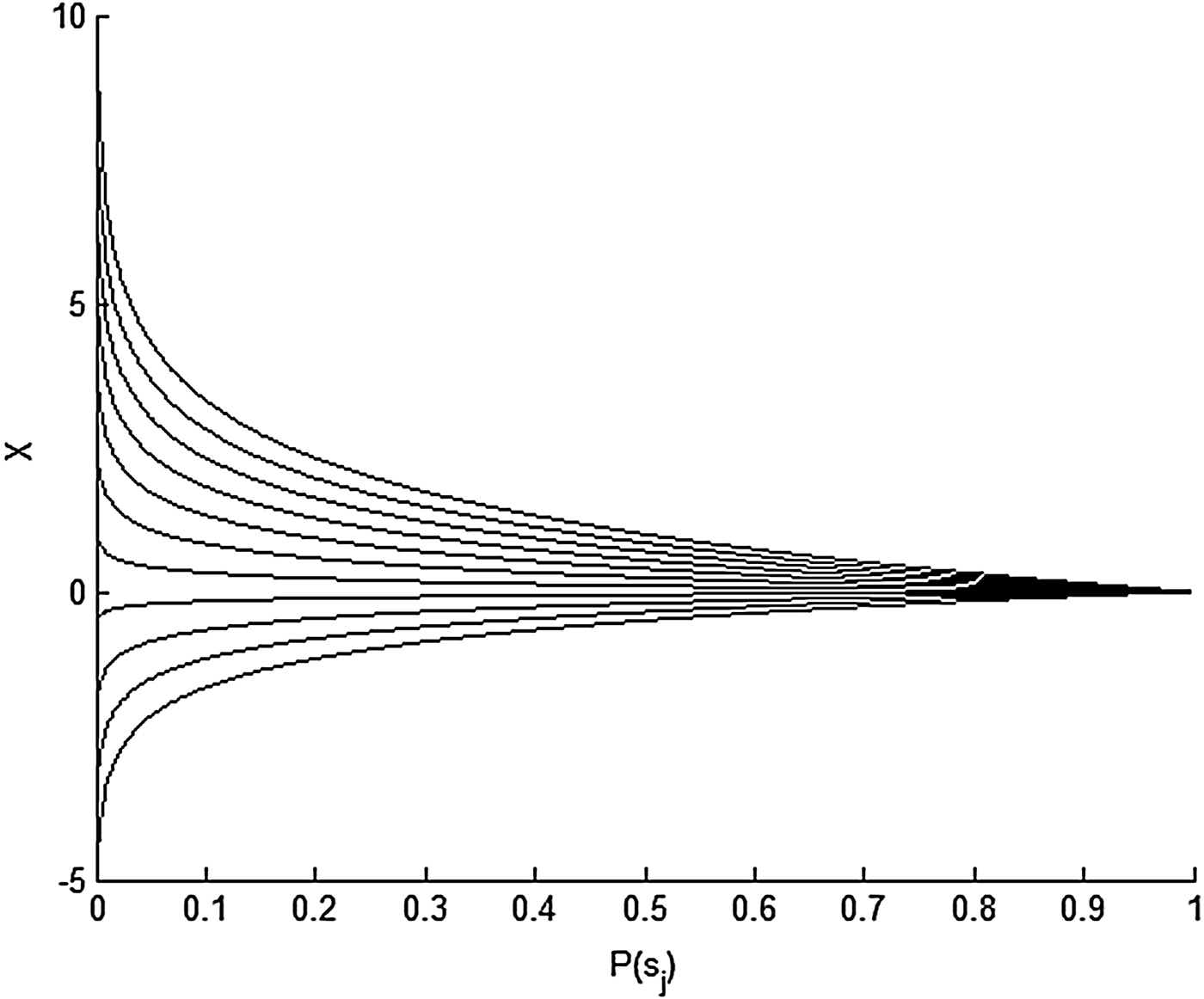
Figure 1 offers more insight into the equation, by plotting a family of curves for X versus P(s j), with each curve representing a different value of P(M i|s j) in the range 0 to 1 (in 0.1 increments). On the left side of Figure 1, P(s j) is small so the surprise of receiving s j is large. In that case, we find both the most positive and the most negative aesthetic X, depending on the meaning as measured by P(M i|s j). When P(M i|s j) is high, then X is very positive (pleasurable), and when P(M i|s j) is low, then X is negative (displeasurable). Moving to the right of Figure 1, surprise Y decreases as P(s j) increases, so the product X = Y × Z is less affected by the meaning Z, although higher and lower values of P(M i|s j) at a given P(s j) still cause higher and lower X values, respectively.
Plot of EVE′'s equation X = Y × Z = –log P(s j) × [G′ × P(M i|s j) – G], assuming G′ = 1.5 and G = 0.5. The family of curves varies P(M i|s j) from 0.0 (lowest curve) to 1.0 (highest curve) in increments of 0.1.

3. DEMONSTRATION
As a concrete example of how EVE′ applies to amusing advertisements, this section analyzes the earlier Burma-Shave jingle about little shavers. In performing the analysis, I will parse the jingle into three signals (evidence) as follows: s 1 = past schoolhouses take it slow, s 2 = let the little, and s 3 = shavers grow. In the analysis, I will consider four meanings (hypotheses), to be denoted A, B, C, and D.
The analysis will show how the most likely meaning progresses from A to A to C as the signals proceed from s 1 to s 2 to s 3. As such, the verse can be characterized as an AAC version of the AAB pattern that is common in humor and music (Rozin et al., Reference Rozin, Rozin, Appel and Wachtel2006). A similar pattern applies to humor in haiku form, which has also been analyzed by EVE′ (Burns, Reference Burns2012).
Based on the computed confidence in meanings at each stage of signal processing, the three signals can be characterized as: a setup (s 1), after which A is the most probable meaning; a buildup (s 2), after which A is even more probable; and a punch line (s 3), after which C is the most probable meaning. Although the punch line is rather obvious as the last line, the preceding four lines of the jingle might be grouped differently into a setup and buildup (or perhaps more or less stages). However, it is reasonable to assume the setup ends at the word slow, because this word rhymes with the last word of the punch line (grow); hence, the intervening line acts as a bridge (buildup). Moreover, a different grouping of lines into setup and buildup signals would not change the main point of the Bayesian analysis below, namely, that the aesthetic experience is driven by a reversal in meaning after the punch line is read.
Similarly, the hypothesized meanings A, B, C, and D are certainly debatable and probably impoverished compared to the set of possible meanings being considered by human readers. However, again those details would not change the main thrust of the analysis, which illustrates a reversal of the most likely meaning based on the perceived intent of the message.
3.1. The setup: s 1 = past schoolhouses take it slow
To begin, assume a reader has read the first signal, s 1 = past schoolhouses take it slow. The reader will wonder why he should drive slowly past schoolhouses, and an obvious reason is that children who attend school may be coming or going or playing nearby. Thus, the reader forms the hypothesis A = drive slowly past schoolhouses to avoid harming schoolchildren. At the same time, however, the reader realizes there are other possible meanings, captured in a hypothesis B = not A, which includes all other reasons why one should take it slow past schoolhouses.
The signal s 1 gives no hint of reasons other than to avoid harming schoolchildren, so a reader will infer that A is relatively probable. In contrast, there are many other possible meanings included in B, and the reader knows that further signals (which may support different meanings) are yet to come. Thus, the reader may think P(A|s 1) > P(B|s 1), but these probabilities would be moderate (i.e., close to 0.5) rather than extreme (i.e., close to 0.0 or 1.0). Here and hereafter, I will assume numbers for probabilities in order to make the analysis more concrete. In doing so, I am not suggesting that readers are explicitly thinking in terms of numbers, or that the assumed numbers are exactly the ones implicitly represented in cognitive processing. Instead, I assume numbers (based on introspection) as approximate and representative values in order to illustrate the computational model more clearly and specifically.
Here I assume P(A|s 1) = 0.60 and P(B|s 1) = 0.40, consistent with the logic outlined above, as initial probabilities that a reader assigns to meanings A and B after receiving the first signal, s 1. These values then become prior probabilities for a Bayesian update to be performed after the next signal, s 2, is received.
In addition to the meanings A and B, which serve as explanations of the signal s 1, a reader will also be forming expectations about the next signal, s 2, to be received as evidence. Per EVE′, the reader is a bounded-Bayesian whose working memory (Baddeley, Reference Baddeley1992; Cowan, Reference Cowan2001) cannot possibly represent all possible signals, just as his working memory cannot possibly represent all possible meanings that may be recalled or constructed from long-term memory. Instead, a reader's working memory is assumed to represent classes of signals that are consistent with the currently held meanings, A and B. This assumption is an important aspect of the EVE′ model, discussed further in Section 3.5.
In light of the two hypothesized meanings, A and B, there are two diagnostic and therefore meaningful classes to which the next signal (s 2) might belong: signals in class a (consistent with A) that are likely if A is true but unlikely if B is true; and signals in class b (consistent with B) that are likely if B is true but unlikely if A is true. Using P = 0.90 to represent “likely” and P = 0.10 to represent “unlikely,” the likelihoods for these two classes of signals can be expressed as follows:
 $$P \lpar{a \vert {\rm A} \comma \; s_1 } \rpar= 0.90 \comma \quad P \lpar{a \vert {\rm B} \comma \; s_1 } \rpar= 0.10 \comma \;$$
 $$P \lpar{b \vert {\rm A} \comma \; s_1 } \rpar= 0.10 \comma \quad P \lpar{b \vert {\rm B} \comma \; s_1 } \rpar= 0.90.$$
Finally, the priors and likelihoods together can be used to compute the marginal probabilities of signals in classes a and b that might be received next, as follows:
 $$\eqalign{& P \lpar{a \vert s _1} \rpar= P \lpar{ a \vert {\rm A} \comma \; s_1} \rpar\times P \lpar{{\rm A} \vert s_1} \rpar+ P \lpar{a \vert {\rm B} \comma \; s_1} \rpar\times P \lpar{{\rm B} \vert s_1} \rpar\cr & \quad \quad \quad = 0.90 \times 0.60 + 0.10 \times 0.40 = 0.58}\comma$$
 $$\eqalign{& P \lpar{b \vert s_1} \rpar= P \lpar{b \vert {\rm A} \comma \; s_1} \rpar\times P \lpar{{\rm A} \vert s_1} \rpar+ P \lpar{b \vert {\rm B} \comma \; s_1} \rpar\times P \lpar{{\rm B} \vert s_1} \rpar\cr & \quad \quad \quad = 0.10 \times 0.60 + 0.90 \times 0.40 = 0.42.}$$
In words, after receiving s 1 the next signal, s 2, is expected to be in class a with probability 0.58 and is expected to be in class b with probability 0.42.
3.2. The buildup: s 2 = let the little
When the second signal is received, the reader will recognize that s 2 = let the little is consistent with not harming children per meaning A, and does not suggest any other meaning B. That is, the signal s 2 is in class a rather than class b. Based on this new evidence, the reader will update his prior confidence in each meaning across the set of hypotheses {A, B}, using the likelihoods of evidence s 2 = a noted above. These likelihoods are P(s 2|A, s 1) = 0.90 and P(s 2|B, s 1) = 0.10, and the priors are P(A|s 1) = 0.60 and P(B|s 1) = 0.40, so the Bayesian update produces posteriors as follows:
 $$P \lpar{{\rm A} \vert s_2 \comma \; s_1 } \rpar= P \lpar{{\rm A} \vert s_1} \rpar\times P \lpar{s_2 \vert {\rm A} \comma \; s_1 } \rpar/P \lpar{s_2 \vert s_1 } \rpar= 0.93\comma$$
 $$P \lpar{ {\rm B} \vert s_2 \comma \; s_1 } \rpar= P \lpar{{\rm B} \vert s_1 } \rpar\times P \lpar{s_2 \vert {\rm B} \comma \; s_1} \rpar/P \lpar{s_2 \vert s_1 } \rpar= 0.07.$$
In other words, the reader's confidence in A increases from a prior 0.60 before s 2 to a posterior 0.93 after s 2. According to EVE′, the consequence of this Bayesian update is a feeling of pleasure, computed as the product of surprise (Y 2) and meaning (Z 2). Per the model, Y 2 = −log P(s 2|s 1), because s 2 was the new signal received, and Z 2 = [G′ × P(A|s 2, s 1) − G], because A is the most likely posterior meaning after s 2 is received. The marginal probability of s 2 (conditional on s 1), needed to compute surprise, is given by the earlier equation for P(a|s 1), i.e., P(s 2|s 1) = P(a|s 1) = 0.58. Thus we obtain the following equation:
 $$\eqalign{X_2 = Y_2 \times Z_2 & = {-}{\log}\ P \lpar{s_2 \vert s_1 } \rpar\times [ G^{\prime} \times P \lpar{A \vert s_2 \comma \; s_1 } \rpar- G ] \cr & = {-}{\log}\ 0.58 \times [ G^{\prime} \times 0.93-G ].}$$
To compute a final number, we can assume G′ = 1.5 and G = 0.5, consistent with the ratio G′/G = 3 used in previous studies (Burns, Reference Burns2006a, Reference Burns2012; Burns & Dubnov, Reference Burns and Dubnov2006) and illustrated in Figure 1. With these values, we obtain X 2 = 0.70. Therefore, after receiving and processing s 2, the reader has experienced 0.70 bits of pleasure as a product of arousal (surprise) and appraisal (meaning).
Here as before, the posteriors become priors for a Bayesian update to be performed after the next signal, s 3, is received. At this point as well, the reader is forming expectations about possible signals that might be received next as s 3. Because there are only two hypotheses, A and B, we can assume the reader is expecting a signal in class a or a signal in class b, with the same likelihoods as his earlier expectations before s 2. However, here after s 2 the reader has different priors than before s 2, so the probabilities of potential signals s 3 (in classes a and b) are computed as follows:
 $$\eqalign{& P \lpar{a \vert s_2\comma \; s_1} \rpar= P\lpar{a \vert {\rm A}\comma \; s_2\comma \; s_1} \rpar \times P\lpar{{\rm A} \vert s_2\comma \; s_1} \rpar\cr & \quad \quad \quad \quad \quad + P \lpar{a \vert {\rm B}\comma \; s_2\comma \; s_1} \rpar \times P\lpar{{\rm B} \vert s_2\comma \; s_1} \rpar \cr & \quad \quad \quad \quad = 0.90 \times 0.93 + 0.10 \times 0.07 = 0.84\comma \cr & P\lpar{b \vert s_2\comma \; s_1} \rpar= P\lpar{b \vert {\rm A}\comma \; s_2\comma \; s_1} \rpar \times P\lpar{{\rm A} \vert s_2\comma \; s_1} \rpar\cr & \quad \quad \quad \quad \quad + P\lpar{b \vert {\rm B}\comma \; s_2\comma \; s_1} \rpar \times P\lpar{{\rm B} \vert s_2\comma \; s_1} \rpar \cr & \quad \quad \quad \quad= 0.10 \times 0.93 + 0.90 \times 0.07 = 0.16.}$$
In words, after receiving s 2, the next signal, s 3, is expected to be in class a with probability 0.84 and is expected to be in class b with probability 0.16.
3.3. The punch line: s 3 = shavers grow
When the third signal, s 3, is received, the reader recognizes it as being in class b that is consistent with B and inconsistent with A, because schoolchildren do not shave and because shaving by little adults appears to have nothing to do with child safety near schoolhouses. The signal s 3 = b was quite unexpected (P(b|s 2, s 1) = 0.16 ≪ 1), so s 3 produces a large violation of expectation. Fueled by this arousal, a reader with a good sense of humor who readily makes creative associations will think of two things based on his background knowledge. First, he will recall that children are fondly referred to as little shavers by adults using slang language. Second, he will realize that children who grow up and shave are potential customers of Burma-Shave. Thus, he will see that the punch line shavers grow implies a compound meaning for the jingle, which is C = drive slowly past schoolhouses to avoid harming schoolchildren and to avoid harming future profits of Burma-Shave.
This recognition of the compound meaning C represents a creative leap by the reader, much like the creative leap of the writer who authored the jingle in the first place. As is typical in humor (Roeckelein, Reference Roeckelein2002), understanding the meaning of the jingle and appreciating the author's intent gives the reader a feeling of dominance or superiority, which is shared by others who also understand and appreciate the jingle. This makes humor, when used appropriately, an effective tool for building a brand in the field of advertising (Walvis, Reference Walvis2008). In contrast, humor must be used carefully because failed attempts can do more harm than good (Weinberger & Gulas, Reference Weinberger and Gulas1992; Sternthal & Craig, Reference Sternthal and Craig1973), as illustrated by negative values of X in Figure 1 and as exemplified in Section 3.4.
A reader who recognizes the compound meaning is effectively abducting (Thagard, Reference Thagard, Feeney and Heit2007) a hypothesis C that was previously not explicit in his frame of discernment {A, B}. The result is a revised set of hypotheses, {A, C, D}, where A is the same as before and C is as described above. The third hypothesis, D = not A or C, replaces the previous B = not A.
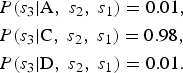
Notice that C includes two different reasons for driving slowly past schoolhouses, whereas A includes only one reason. In addition, C captures specific reasons, whereas D (= not A or C) includes only unspecified reasons that are not included in A or C. These features of C compared to A and D affect the relative likelihoods of s 3, which are estimated as follows:
 $$\eqalign{& P\lpar{s_3 \vert {\rm A} \comma \; s_2\comma \; s_1} \rpar= 0.01\comma \cr & P \lpar{s_3 \vert {\rm C }\comma \; s_2\comma \; s_1} \rpar= 0.98\comma \cr & P \lpar{s_3 \vert {\rm D} \comma \; s_2\comma \; s_1} \rpar= 0.01.}$$
Here the likelihoods P(s 3|A, s 2, s 1) = P(s 3|D, s 2, s 1) = 0.01 are assumed to be “very unlikely” and hence an order of magnitude lower than the previous likelihood P(b|A, s 1) = 0.10. This reflects the specificity of s 3 = shavers grow and its inconsistency with the single meaning of A or the other unspecified meanings captured by D. However, the signal s 3 = shavers grow is completely consistent with child safety and Burma-Shave's future profits, so s 3 is “very likely” if the compound meaning C is true.
Besides these likelihoods, the use of Bayes' rule to update beliefs requires a prior probability for each hypothesis. Because C and D together capture a scope of meaning that was previously covered by B, we can split the magnitude of P(B|s 2, s 1) = 0.07 between C and D to obtain P(C|s 2, s 1) = P(D|s 2, s 1) = 0.035. The priors are then updated via Bayes' rule, using likelihoods for s 3 as noted above, to obtain the following posteriors:
 $$\eqalign{& P \lpar{\rm A} \vert s_3\comma \; s_2\comma \; s_1 \rpar= P\lpar {\rm A} \vert s_2\comma \; {\rm s}_1 \rpar \times P \lpar s_3 \vert {\rm A}\comma \; s_2\comma \; s_1 \rpar /P \lpar s_3 \vert s_2\comma \; s_1 \rpar = 0.21\comma \cr & P \lpar {\rm C} \vert s_3\comma \; s_2\comma \; s_1 \rpar = P\lpar {\rm C} \vert s_2\comma \; s_1 \rpar \times P\lpar s_3 \vert {\rm C} \comma \; s_2\comma \; s_1 \rpar / P \lpar s_3 \vert s_2\comma \; s_1 \rpar = 0.78\comma \cr & P \lpar {\rm D} \vert s_3\comma \; s_2\comma \; s_1 \rpar = P\lpar {\rm D} \vert s_2\comma \; s_1 \rpar \times P \lpar s_3 \vert {\rm D} \comma \; s_2\comma \; s_1 \rpar / P \lpar s_3 \vert s_2\comma \; s_1 \rpar = 0.01.}$$
In words, the reader's abduction of new meaning C causes a reversal in his beliefs: from A being the most probable hypothesis P(A|s 2, s 1) = 0.93 before s 3; to C being the most probable hypothesis P(C|s 3, s 2, s 1) = 0.78 after s 3. The same sort of reversal and recognition is common in comedy, as articulated by Aristotle in his Poetics (Butcher, Reference Butcher1951) and as analyzed in more modern studies of Mathematics and Humor (Paulos, Reference Paulos1980).
To complete the analysis, recall from above that the marginal probability of a signal s 3 = b (conditional on s 2 and s 1), before receiving the signal s 3, was P(s 3|s 2, s 1) = P(b|s 2, s 1) = 0.16. Thus we obtain the following aesthetic measure:
 $$X_3 = Y_3 \times Z_3 = {-}{\log}\ 0.16 \times [ G^{\prime} \times 0.78 - G ].$$
Assuming the same values of G′ = 1.5 and G = 0.5 used earlier, we obtain X 3 = 1.8. In words, after s 3 the reader experiences 1.8 bits of pleasure, on top of the 0.7 bits of pleasure already experienced after s 2. Taken together, the reader has experienced a total of X = X 2 + X 3 = 2.5 bits of pleasure from reading the jingle, with most of this pleasure coming after the punch line.
3.4. When humor fails
Now returning to the punch line, s 3 = shavers grow, consider the aesthetic experience of a reader who does not know that little shavers is a slang term for children. Although this reader might realize that shavers are customers of Burma-Shave, he would not understand why little adults who shave would be near schoolhouses, or what that has to do with careful driving or child safety. In effect, the reader is left with confusion, rather than an explanation that resolves the violation. For example, the confused reader might be considering five hypotheses and assign a roughly equal probability to each hypothesis, that is, P(M i|s 3, s 2, s 1) ≈ 0.2, because none of the hypotheses stands out as being particularly probable.
In that case, the factor Z would be negative, Z 3 = [1.5 × 0.2 − 0.5] = −0.2, such that any amount of surprise Y would cause the resulting X = Y × Z to be negative. In other words, the reader would feel displeasure rather than pleasure after reading the punch line, and displeasure would increase as the amount of surprise increases. This is consistent with the annoyance one feels after reading a punch line that is surprising but cannot be resolved in a meaningful manner.
Here I assume that surprise for a reader who did not understand the punch line is the same as for a reader who did understand the punch line, because surprise is a function of the signal probability P(s 3|s 2, s 1) before the punch line, s 3, is received. Thus, we obtain X 3 = Y 3 × Z 3 = −log 0.16 × [1.5 × 0.2 − 0.5] = −0.53 bits of pleasure, which represents 0.53 bits of displeasure.
A similar but potentially much larger displeasure arises when one understands the punch line and does not appreciate the author's intent. EVE′ captures this effect via the valence of G′, which scales the affective consequence of a person's explanation. For example, a reader who personally knows of a child hurt by reckless driving may find it offensive that Burma-Shave is joking about child safety in order to promote corporate profits. In that case, the reader's Bayesian inference would be the same as other readers who understand the jingle, but the G′ factor would be negative. Assuming G′ = −1.5 rather than the previous G′ = 1.5, EVE′'s aesthetic measure would be computed as X 3 = Y 3 × Z 3 = −log 0.16 × [−1.5 × 0.78 − 0.5] = −4.4 bits, which is 4.4 bits of displeasure.
As described above, the EVE′ model predicts three modes in which humor can fail, with each mode corresponding to a specific model parameter. First, humor fails when there is little or no surprise (modeled by EVE′'s factor Y), regardless of how much meaning can be extracted from the signal. Section 4.2.5 provides a specific example of this failure mode. Second, humor fails when there is little or no meaning (modeled by EVE′'s factor Z), regardless of how surprising the signal may be. An example was given above, and Section 4.2.5 provides another example of this failure mode. Third, humor fails when the intent of the author, per the meaning inferred by the audience, is contrary to the value structure of the audience (modeled by EVE′'s parameter G′). A specific example of this failure mode was provided above.
The third failure mode, involving intent, appears to be especially challenging for artificial intelligence to address (Dennett, Reference Dennett1987). The reason is that humans have mental models of how they and others would act, and what they and others would want, in various situations, as shaped by cultural norms and personal goals. These mental models include rich representations of norms and goals, which machine systems would need to model as well. The same problem poses challenges to human artists who write advertisements (Sternthal & Craig, Reference Sternthal and Craig1973; Weinberger & Gulas, Reference Weinberger and Gulas1992), because audience responses can be sensitive to gender, age group, cultural background, financial status, political party, religious beliefs, and so on. However, given the long-term success of Burma-Shave's advertising campaign, it is reasonable to assume that the humor in its ads was generally effective across individuals. Therefore, EVE′'s analysis in the above demonstration and in the below validation (Section 4) is focused on the other two modes in which humor can fail. That is, humor fails when there is little surprise Y or little meaning Z, because for humor to succeed there must be both high surprise and high meaning, X = Y × Z.
3.5. EVE′'s advantages
The EVE′ model is not alone in assuming that expectations and violations are essential aspects of aesthetic experiences. Similar ideas have been advanced by other authors, primarily in the domains of music (Meyer, Reference Meyer1956; Narmour, Reference Narmour1992; Huron, Reference Huron2006) and humor (Rozin et al., Reference Rozin, Rozin, Appel and Wachtel2006). In addition, in the domain of music, Bayesian methods have been used by others (Temperley, Reference Temperley2007) to analyze how explanations of deeper structure (akin to EVE′'s meaning) can be inferred from surface features (akin to EVE′'s signals). However, EVE′ has been applied across domains, to graphics (Burns, Reference Burns2006a, Reference Burns2014), humor (Burns, Reference Burns2012), and music (Burns & Dubnov, Reference Burns and Dubnov2006), with unique advantages as discussed further below.
3.5.1. EVE′'s probabilities
EVE′ offers an overall equation X = Y × Z for how factors of surprise (Y) and meaning (Z) are combined to compute the magnitude of aesthetic experience (X), that is, as a measure of beauty or creativity. EVE′ also offers equations Y = −log P(s j) and Z = [G′ × P(M i|s j) − G] that specify how each factor, Y and Z, is computed. In particular, Z is computed from the most probable posterior probability, P(M i|s j), along with scaling factors G′ and G, that depend on an individual's personal preferences; whereas Y is computed as the marginal entropy of the signal s j on which the meaning M i is conditioned.
These aspects of EVE′ can be contrasted to a notion of Bayesian surprise, which has been used by others (Itti & Baldi, Reference Itti and Baldi2009) in modeling low-level visual attention and has been suggested as a factor for assessing creativity (Maher & Fisher, Reference Maher and Fisher2012). More specifically, Bayesian surprise is computed (Itti & Baldi, Reference Itti and Baldi2009) as the relative entropy (Kullback & Leibler, Reference Kullback and Leibler1951) between a posterior distribution (over a set of hypotheses) and a prior distribution (over the same set of hypotheses). EVE′ differs in computing Shannon surprise as the marginal entropy of a signal, Y = −log P(s j), because expectations (E) and violations (V) refer to signals, not to posterior and/or prior meanings of signals. EVE′ then models Bayesian meaning as a posterior probability, which measures how completely the surprise of a violation (V) is resolved by an explanation (E′).
In addition, with respect to surprise, and different from other models, EVE′'s expectations and violations are governed by the probabilities of signal classes in the context of causal meanings, rather than by the probabilities of individual signals in isolation. This feature of the model is discussed further in Section 3.5.2 below, but first it is useful to highlight why signal classes and causal meanings are important from a psychological perspective. As a simple example, assume a fair coin is tossed six times, and consider the probability of getting an all-heads sequence “hhhhhh” as opposed to the mixed sequence “hhthtt.” Mathematically, these two sequences are equally probable, because any single sequence of six outcomes has a probability of 2−6 = 0.016. However, psychologically most people think the mixed sequence is much more probable, based on a heuristic known as representativeness (Tversky & Kahneman, Reference Tversky and Kahneman1974; Kahneman et al., Reference Kahneman, Slovic and Tversky1982; Kahneman, Reference Kahneman2011) that reflects classes of outcomes and causes for outcomes.
More specifically, consider a set of two possible causes {A, B} for the sequence of coin tosses, where A indicates tosses are random and B indicates tosses are rigged (i.e., by some nonrandom property such as a weighted coin). Based on our knowledge of the outcomes that are likely to be produced by each cause, we expect A would produce sequences in class a that do not exhibit the regularity of all-heads (i.e., sequences like “hhthtt” that are representative of A), whereas we expect B would produce sequences in class b that do exhibit the regularity of all-heads (i.e., sequences like “hhhhhh” that are representative of B). Thus, using the numbers for “likely” and “unlikely” that were assumed in the earlier analysis of a Burma-Shave jingle, our subjective likelihoods for signals in classes a and b conditional on each of the causes A and B are as follows:
 $$\eqalign{& P \lpar{a \vert {\rm A}} \rpar= 0.90\comma \; \quad P \lpar {a \vert \rm B} \rpar= 0.10\comma \; \cr & P \lpar {b \vert \rm A} \rpar= 0.10\comma \; \quad P \lpar {b \vert \rm B} \rpar = 0.90.}$$
Now assuming the coin tosses are fair, which implies that A is true (and B is not true), the above likelihoods lead us to believe that an all-heads (class b) sequence is much less probable than a mixed (class a) sequence. That is, P(b|A) = 0.10 ≪ 0.90 = P(a|A). Therefore, psychologically, we would be quite surprised to see “hhhhhh” (class b), and not surprised to see “hhthtt” (class a), even though mathematically the two sequences are equally probable.
Now returning to the case of a Burma-Shave jingle (or any other media experience), human expectations and violations of expectations are governed by the same sorts of subjective probabilities (i.e., likelihoods of signal classes in the context of causal meanings). The only difference is that, unlike coin tosses, the causes are more complex in the case of artist–audience communications that involve meaning (intent). That is, an artist has some meaning that he intends to convey, but his artwork provides only a signal of that meaning. The audience, in turn, must infer the most likely meaning, and in so doing, the audience is inferring the most likely cause (intent) of the effect (artwork).
3.5.2. EVE′'s computability
As described above, EVE′'s modeling of surprise can be distinguished from other models that do not address signal classes and causal meanings. A relevant example comes from a study (Coulson & Kutas, Reference Coulson and Kutas2001) to test the two-stage theory of jokes characterized as “surprise followed by reestablishment of coherence” (Suls, Reference Suls, Goldstein and McGhee1972). The study attempted to control for surprise in one-line jokes versus nonjokes by replacing the last word b (which was the punch word of the one-liner) with another word a that was equally surprising, for example, as follows: “When I asked the bartender for something cold and full of rum, he recommended his . . . [a or b],” where b = “wife” for the joke and a = “daiquiri” for the nonjoke.
To obtain these two endings, the study asked a group of people to read the one-liner without the last word, and then to report the first word that came to mind as an ending. Apparently, wife and daiquiri were each reported at approximately the same low frequency (≈3%), so researchers assumed that these two endings had equal probabilities and hence were equally surprising. Clearly the two endings are not equally surprising. That is, after we read the setup that implies A = bartender is thinking about a cold rum cocktail, the last word wife (in class b, consistent with meaning B = not A) produces a large violation of expectation whereas the last word daiquiri (in class a) is consistent with our expectation.
In short, surprise is not a signal that can be measured and modeled in a task of generation. Rather, surprise is a feeling that must be measured and modeled in a task of evaluation. That is why EVE′ models surprise Y as a violation of expectation, computed as a marginal entropy −log P(s j), where P(s j) is a marginal probability computed from likelihoods of signal classes in the context of causal meanings. EVE′ also models the inferred meaning by which a surprise is resolved, that is, as a posterior probability P(M i|s j). Finally, EVE′ models the aesthetic measure of a media experience (humorous or otherwise) as the product of surprise and meaning, in a formulation unlike others in that EVE′'s individual factors and overall equation X = Y × Z are actually computable.
With respect to being computable, the frame-shifting theory of humor (Coulson et al., Reference Coulson, Urbach and Kutas2006) is said to involve “semantic and pragmatic reanalysis in which elements of the existing message-level representation are mapped into a new frame retrieved from long-term memory.” However, this theory does not specify what variables are represented by a frame retrieved from long-term memory, or how those variables relate to the elements of message-level representations, or how any of these variables can be computed. Similarly, others have proposed functional requirements for a computational system to experience humor (Hurley et al., Reference Hurley, Dennett and Adams2011, p. 121), which are outlined as involving “time-pressured, involuntary heuristic search for valid expectations, which generates mental spaces in which elements are constantly being tested.” This theory also includes a notion of epistemic commitment, but once again there is no formal specification of what is computed or how it is computed.
EVE′'s advantage lies in mathematical modeling of variables and operations needed to compute an aesthetic experience, including hypothetical meanings, evidential signals, and associated conditional and marginal probabilities, all in a bounded-Bayesian framework of signal classes and causal meanings. This makes EVE′'s model computable, at least in principle, as demonstrated by the earlier analysis of a prototypical Burma-Shave jingle.
4. VALIDATION
A comprehensive test of EVE′ would begin by computing Y, Z, and X, much like Section 3, but for a number of Burma-Shave jingles. The model-predicted values Y m, Z m, and X m for each jingle would then be compared to human-reported judgments Y h, Z h, and X h for that jingle. However, this approach is not currently feasible because of the inputs required to compute Y m and Z m. As explained in Section 2.1, the inputs include categorical knowledge of possible meanings (M i), as well as numerical values of prior probabilities P(M i) and likelihoods P(s j|M i), for all signals (s j) in the sample of jingles to be tested. These input requirements are beyond what today's artificial intelligence systems can provide, and that is why the probabilities needed for model demonstration in Section 3 were developed from natural intelligence via introspection. However, as one test of EVE′, it is feasible to compute model-predicted values X m given human-reported values Y h and Z h as inputs. The resulting predictions X m = Y h × Z h can then be tested against human ratings of creativeness X h across a sample of Burma-Shave jingles.
Clearly this is only a partial test of the model, because it addresses the overall equation X = Y × Z without addressing the underlying computation of factors Y and Z. However, the test is not trivial, and it is valuable for several reasons. First, meaning (Z) has not previously been featured as a factor in other computational models of creativity, so the test will help support or refute a role for this factor. Second, EVE′ assumes that novelty is captured by surprise (Y), and that meaning (Z) is an informatic utility by which surprise is resolved. Thus, the test will establish whether EVE′ can predict human ratings of creativeness without additional measures of novelty and utility like those of other computational models. Third, a test that measures surprise (Y h) and meaning (Z h) directly would provide useful data for future research in validating computational models of the factors Y m and Z m.
Another reason for testing in the manner described above is that EVE′'s equation differs markedly from an early theory of aesthetics that remains influential even today (Rigau et al., Reference Rigau, Feixas, Sbert, Cunningham, Meyer and Neumann2007; Phillips et al., Reference Phillips, Norman and Beers2010; Galanter Reference Galanter, McCormack and d'Inverno2012). According to this theory, proposed by Birkhoff (Reference Birkhoff1933), aesthetic measure denoted M is equal to O/C, where O is a measure of order (i.e., symmetry or harmony) and C is a measure of complexity. Birkhoff's formula M = O/C has been tested in numerous psychological experiments, with mixed results in predicting the magnitude of aesthetic pleasure experienced by human participants (Eysenck, Reference Eysenck1941, Reference Eysenck1942, Reference Eysenck1957; Kreitler & Kreitler, Reference Kreitler and Kreitler1972). Unfortunately, none of these studies tested the equation M = O/C directly, because the factors O and C were computed by experimenters using ad hoc assumptions (some similar to and some different from Birkhoff's own assumptions), rather than obtaining ratings of O and C from the same humans who are providing ratings of M. In effect, the tests have confounded how experimenters compute measures of O and C with how participants combine judgments of O and C into an overall judgment of M.
Conceptually, Birkhoff's variables can be mapped to EVE′'s variables as follows: M corresponds to EVE′'s X as a measure of aesthetic pleasure (i.e., beauty or creativity); O corresponds to EVE′'s Z as a measure of meaning (i.e., symmetry or harmony); and C corresponds to EVE′'s Y as a measure of surprise (i.e., entropy), which has often been used as a measure of complexity by others who adopted or adapted Birkhoff's model (Bense, Reference Bense1965; Moles, Reference Moles1966; Rigau et al., Reference Rigau, Feixas, Sbert, Cunningham, Meyer and Neumann2007). With this mapping, an experiment that collects human judgments X h, Y h, and Z h can be used to test EVE′'s model X = Y × Z against Birkhoff's model X = Z/Y and an inverse model X = Y/Z, as well as simpler models X = Y and X = Z.
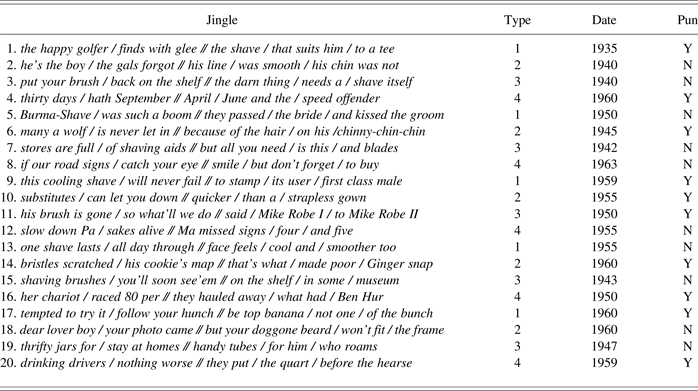
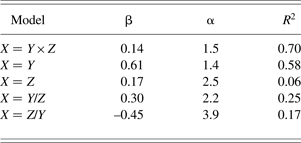
Thus, my approach to empirical testing is as follows: A number of Burma-Shave jingles are chosen as stimuli (see Table 1) for use in a survey of human judgments. Then, human subjects are asked to provide ratings of surprise (Y h), meaning (Z h), and creativeness (X h) for each jingle. Next, for each jingle, the average human ratings for surprise (Y h) and meaning (Z h) are used to compute model-predicted values of creativeness (X m) for five models, including EVE′ (see Table 2). Finally, across jingles, model-predicted X m are compared to human-reported X h as a test of how well each model matches the data for judgments of creativeness.
Burma-Shave jingles used in the survey
Note: A double slash (//) is used to delineate the two rhyming phrases, and a single slash (/) is used to delineate the two or three lines within each of those phrases.
Regression coefficients for EVE′'s model (X = Y × Z) and other models
4.1. Methods
A sample of 20 jingles (Table 1) was taken from a collection of 600 published verses (Rowsome, Reference Rowsome1965) based on three criteria. The first criterion relates to the general topics of jingles. A review of all published verses found that each could be fit into one of the following four categories: good things that happen to people who use Burma-Shave; bad things that happen to people who do not use Burma-Shave; distinguishing characteristics of Burma-Shave compared to its competitors; or public service messages that Burma-Shave provides to promote safe driving practices, such as the example jingle about little shavers. Thus, the sample of 20 jingles was chosen to include 5 jingles of each type.
The second criterion was to include jingles that appeared during all four decades of the long-running ad campaign, including the 1930s to the 1960s. The order in which jingles are presented in the survey is roughly chronological within each topic type, except for an additional constraint on puns. That is, 10 of the jingles involve puns, and 5 of these jingles are placed in the first half of the survey and the remaining half are placed in the last half of the survey.
A third criterion deals with the line-by-line rhythm of the verses. At the highest level, all 600 jingles are organized in two phrases that rhyme. At a lower level, some jingles have three lines in the first phrase (and two lines in the second phrase), whereas others have two lines in the first phrase (and three lines in the second phrase). Roughly half of the 600 verses are of each type, and the jingle about little shavers analyzed in Section 3 is an example of the former type with three lines in the first phrase. For the survey, all 20 jingles were selected to be of the latter type with two lines in the first phrase. This helps to control for differences in ratings that may arise from variations in rhythmic structure between jingles. It also equalizes the number of lines in the setup (two lines) and the buildup (two lines), under the assumption that the setup ends in a word that rhymes with the last word of the punch line.
Each page of the survey presented one jingle in five lines, double-spaced, using all uppercase lettering to be consistent with how the jingles were originally painted on road signs. Beneath each jingle were three questions that subjects were asked to answer, after reading the jingle, on a 5-point scale as follows: very slightly, slightly, moderately, strongly, or very strongly. The three questions were the following: Did you understand the verse? Did the ending surprise you? and Is the jingle creative? Responses to these questions correspond to the modeled variables Z, Y, and X, respectively.
The 20 jingles were presented one at a time to each participant in an online survey, which was prefaced by background on Burma-Shave's product and ad campaign. This background included a description of the four hallmark topics and the example jingle about little shavers (which fits the fourth topic). All 20 jingles were presented in the same order to all participants. No counterbalancing was performed because the jingles were purposely arranged roughly chronologically (within each topic type) and because the object of the survey was to obtain ratings while holding the context for each rating as constant as possible across all human judges.
Along with a balanced testing of four topics over four decades of the ad campaign, the survey was also designed to explore the effectiveness of puns (Pollack, Reference Pollack2011) in the realm of creative advertising (van Mulken et al., Reference van Mulken, van, Dijk and Hoecken2005). Although a comedian's use of puns may often receive groans from the audience, many clever and funny jokes use puns with much success. This suggests that puns may be a particularly sensitive test of creativity, leading to some of the best and worst results depending on how surprising and how meaningful an audience finds a pun. Puns and other wordplay frequently (by some estimates up to 40%; see Leigh, Reference Leigh1994) appear in advertisements, so insight into what makes a good pun or a bad pun from an evaluative perspective would have practical implications for writing better ads from a generative perspective.
4.2. Results
4.2.1. Validating the EVE′ model
The survey of 20 Burma-Shave jingles was taken by 81 adult volunteers, including 52 females and 29 males, aged 18 to 87 years with a median age of 48. The analysis here is focused on average ratings across genders and ages, computed by converting the qualitative ratings to quantitative values as follows: very slightly = 1, slightly = 2, moderately = 3, strongly = 4, and very strongly = 5.
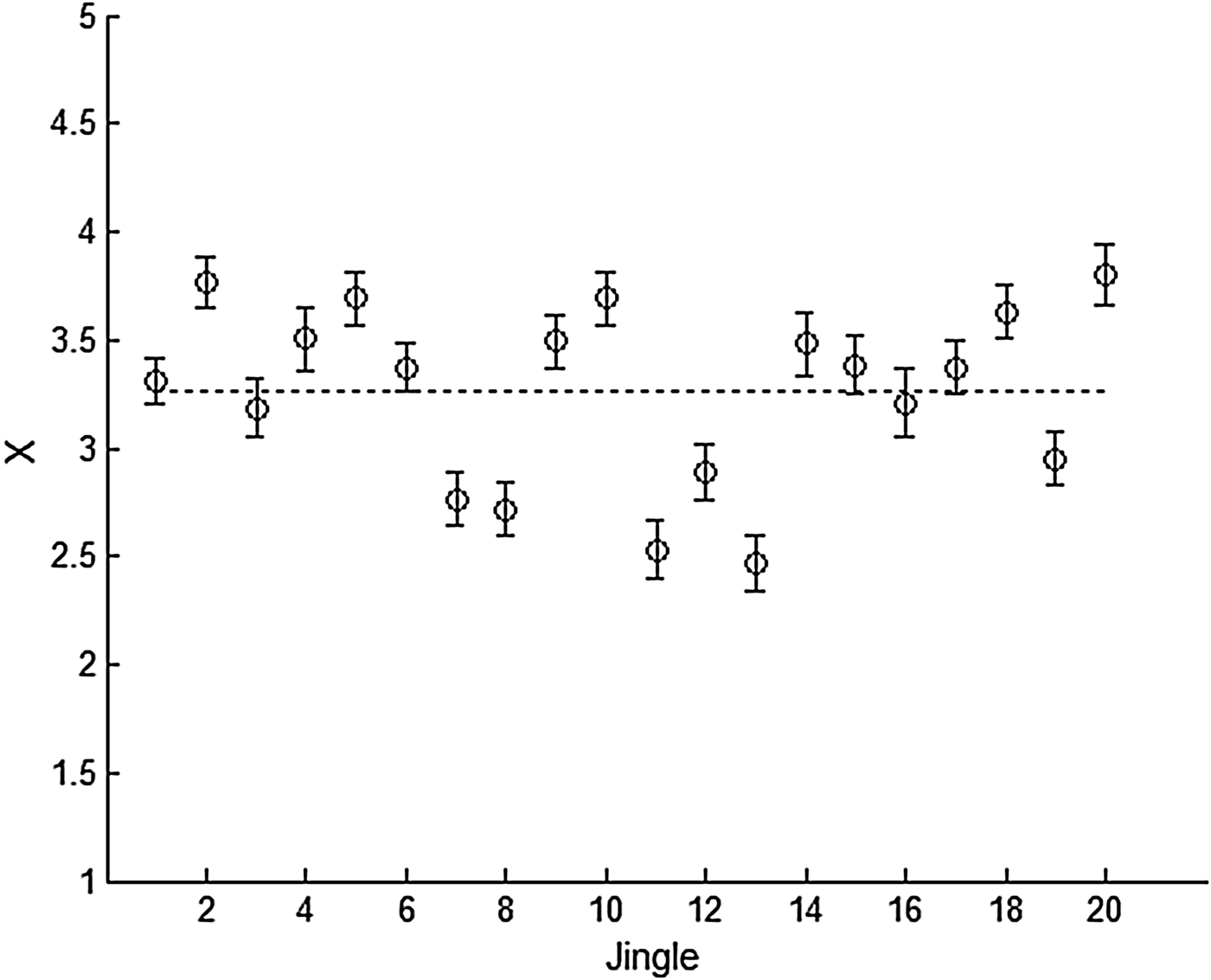
Figure 2 shows the mean ratings of creativeness (X h) for all 20 jingles, with error bars representing standard errors of the means. The ratings varied across participants, with individual ratings ranging from 1 to 5 for each jingle. However, one-way analysis of variance for each variable (X h, Y h, Z h) showed a significant difference in mean ratings (each p < 1E-06) across the 20 jingles. Therefore, mean ratings for creativeness (X h), surprise (Y h), and meaning (Z h) are the human data used to test various models (X m) listed in Table 2.
Mean human ratings for creativeness (X h) of 20 Burma-Shave jingles, across 81 human participants. Error bars represent standard errors of the means. Dotted line is mean rating across all 20 jingles.
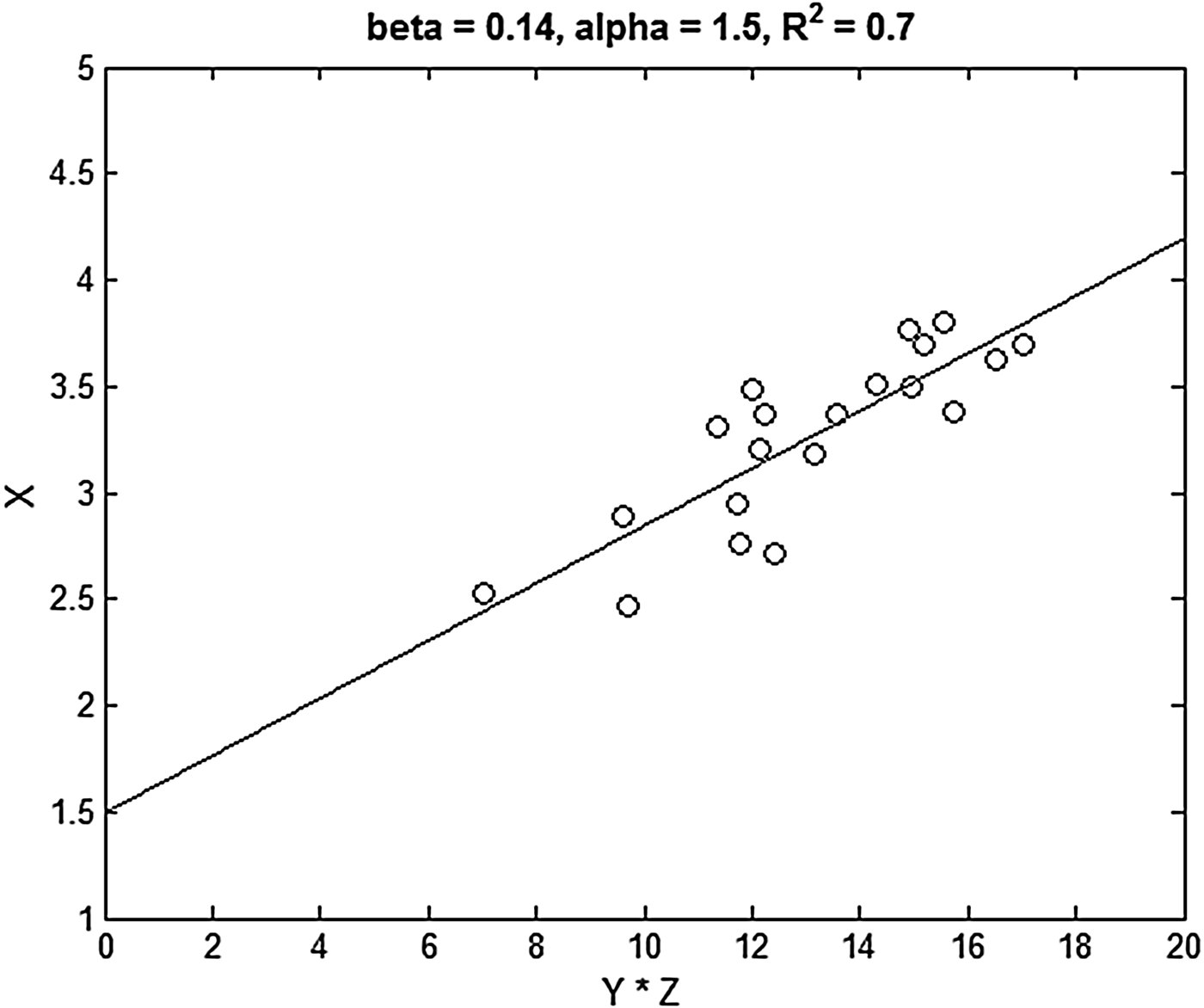
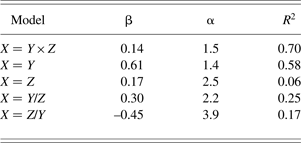
Model comparisons require a consistent approach to control for the arbitrary scale of 1–5 used in converting qualitative ratings to quantitative values. Therefore, for the set of 20 jingles, human data X h are regressed onto modeled values X m in the same manner for each model. The regression results include two coefficients, β and α, along with a goodness-of-fit (coefficient of determination) statistic R 2. For example, the regression equation for EVE′'s model is X m = β × (Y h × Z h) + α, and the associated R 2 measures how much of the variability in the data (X h) across jingles can be accounted for by the model X m = Y h × Z h. The regression results for this model, and other models, are presented in Table 2.
As seen in Figure 3, EVE′'s model of creativeness (X m) accounts for R 2 = 70% of the variability in mean ratings (X h) reported by human judges. As shown in Table 2, this is better or much better than the R 2 for other models tested in the same manner. Further comparisons to the other models are made below.
Results of regressing human data for creativeness (X h) onto EVE′'s model (X m = Y h × Z h).
4.2.2. Examining simpler models
The model X = Y implies that creativeness is solely a function of surprise. This model scores R 2 = 58%, which is less than EVE′ but still high and better than all other models in Table 2. These results suggest that surprise is by far the most important factor in judgments of creativeness, but that conclusion must be tempered by two further observations. First, most of the Burma-Shave jingles received high ratings for meaning (mean Z = 4.18), as one would expect because the jingles were actual advertisements. All of the jingles were selected over the years by Burma-Shave's officers and directors, based on thousands of entries submitted each year in response to an annual jingle-writing contest. Presumably, the executives were primarily interested in jingles that would be coherent to consumers, and secondarily interested in the surprise factor. In that case, EVE′'s model X = Y × Z would be approximated by X = Y. Second, the surprise of reading a punch line is made possible by a strong meaning that is set up and built up before being reversed in the punch line. Therefore, although surprise is clearly a very important factor, meaning is an equally important factor that cannot be ignored in the assessment of creativeness (Martindale et al., Reference Martindale, Moore and Borkum1990).
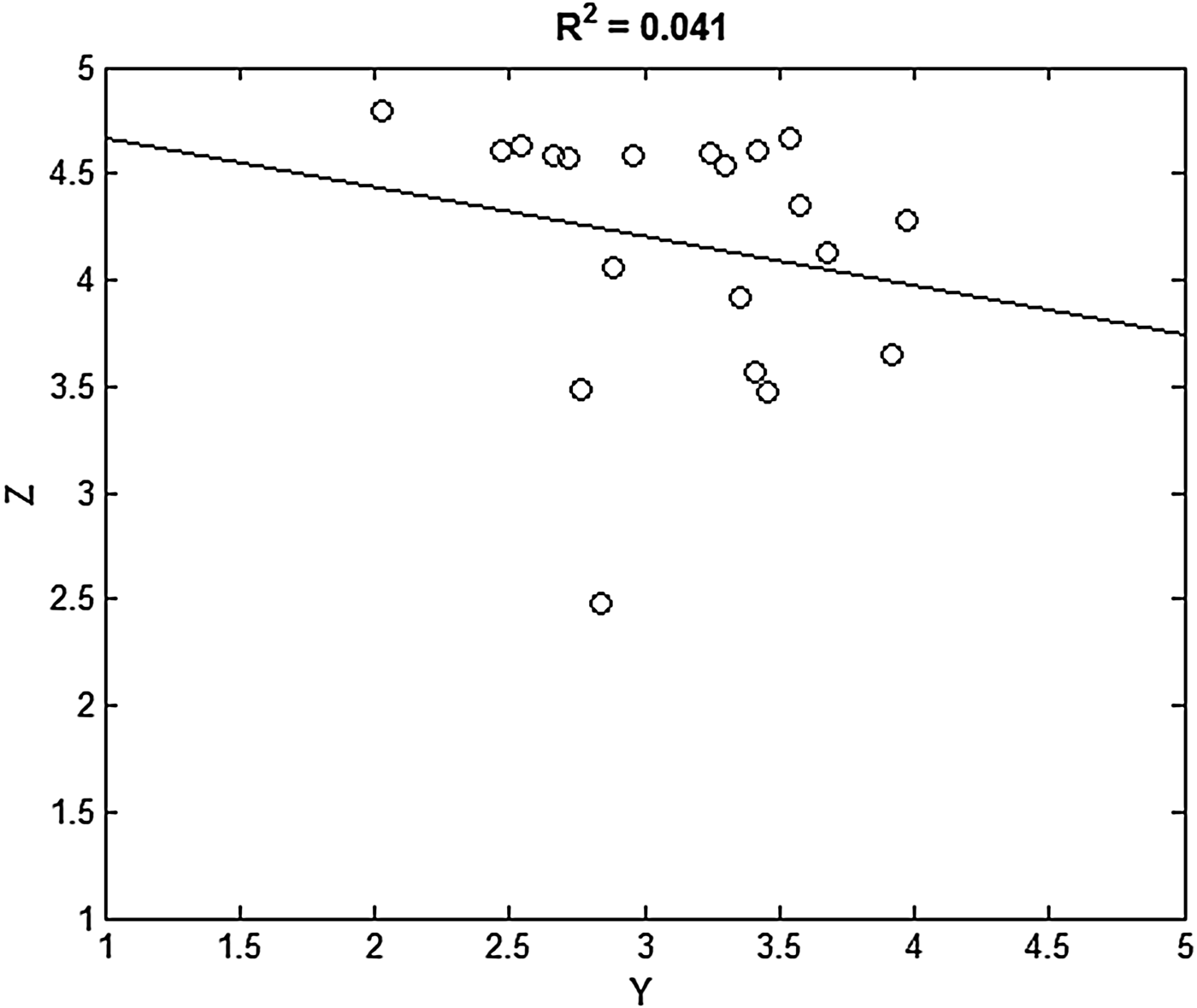
Now with a focus on meaning, Table 2 shows that the model X = Z performs much worse than the model X = Y, scoring only R 2 = 6%. One reason for this is that increased creativeness is strongly predicted by increased surprise (discussed above), and in general it is more difficult for an audience to extract meaning as surprise is increased. Figure 4 shows this inverse relation between meaning and surprise, by plotting the mean values of Z h versus Y h for all 20 jingles. The regression of Z onto Y exhibits a negative slope, showing that meaning (Z) tends to decrease as surprise (Y) increases.
Results of regressing human ratings of meaning (Z) onto human ratings of surprise (Y).
Thus, meaning has both a direct effect and an indirect effect on judgments of creativeness. The direct effect (independent of surprise) is that creativeness increases as meaning increases. The indirect effect (dependent on surprise) is that creativeness increases as meaning decreases. This is because creativeness increases as surprise increases (see β = 0.61 > 0 for X = Y in Table 2) and meaning decreases as surprise increases (see Fig. 4). Although the direct effect is stronger (see β = 0.17 > 0 for X = Z in Table 2), the two effects act in opposition, which helps to explain why Z alone accounts for little of the variability in X (see R 2 = 6% in Table 2). Nevertheless, the regression of Z onto Y in Figure 4 shows an R 2 of only 4%, so surprise (Y) accounts for little of the variability in meaning (Z). As such, surprise and meaning can be treated as relatively independent factors in the equation X = Y × Z. This independence is necessary, if some Burma-Shave jingles are to be judged as highly creative, because a strong inverse relation between Y and Z would imply that only one factor (Y or Z) could be high for any given jingle.
4.2.3. Critiquing Birkhoff's model
Table 2 presents the results of two additional models. One is Birkhoff's model X = Z/Y, and the other is an inverse model X = Y/Z. Table 2 shows that the inverse model X = Y/Z scores R 2 = 25%, which is much worse than the EVE′ model and even worse than the simple model X = Y that ignores Z.
Table 2 also shows that Birkhoff's model X = Z/Y scores R 2 = 17%, but with a highly negative coefficient β, which follows from the positive coefficient β of the inverse model X = Y/Z. This means that Birkhoff's model is negatively correlated with the human data, such that model-predicted creativity X m = Z h/Y h increases when the human-reported creativity X h decreases, and vice versa. Therefore, of all the above models, Birkhoff's model is by far the worst, even worse than a null model with β = 0. This poor performance is driven by the fact that complexity (modeled by surprise Y) appears in the denominator of Birkhoff's equation, whereas the human data clearly show a highly direct (not inverse) relation between surprise and creativeness. Upon reflection, it seems clear that complexity cannot possibly appear in the denominator of the equation for aesthetic measure, because that would imply the very simplest (i.e., extremely predictable) stimuli would be judged as having the greatest beauty and creativity.
Birkhoff proposed M = O/C as a measure of aesthetic beauty or pleasure, rather than a measure of creativity per se. However, it is hard to imagine cases where aesthetic beauty and creativity would be seen as opposites rather than correlates, and yet Birkhoff's model is implying exactly such an opposition. Moreover, even for judgments of beauty rather than creativity, Eysenck (Reference Eysenck1941, Reference Eysenck1942Reference Eysenck1957) reviewed how well Birkhoff's model performed in a wide range of human experiments across diverse media (graphics, sculpture, music, and poetry). Based on his review, Eysenck suggested that M = O × C was a better model than M = O/C. Note that M = O × C is analogous to EVE′'s model X = Y × Z, per the above-noted mapping of Y to C and Z to O.
4.2.4. Creating fun for readers
An underlying assumption of EVE′ in this study is that aesthetic pleasure provides a gauge by which humans judge the creativeness of advertisements. As a test of this assumption, the survey included a final question after all jingles were rated: Would you say the most creative jingles were also the most amusing? The answer was reported on the same 5-point scale as that used to rate jingles themselves (i.e., 1 = very slightly, 5 = very strongly). The mean response was 4.42, so clearly participants felt quite strongly that their judgments of creativeness were correlated with the amusement they experienced. Of course, this does not prove that feelings of pleasure caused judgments of creativeness to vary as they did from jingle to jingle. However, that conjecture seems more plausible than the opposite, which would imply that judgments of creativeness (made in some unspecified fashion) somehow preceded and affected feelings of amusement.
In short, EVE′ predicts that arousal from surprise and appraisal of meaning together give rise to aesthetic pleasure, which in turn forms the basis for judgments of beauty and creativity. Although the present study cannot prove the postulated causality, empirical findings strongly support an association between feelings of amusement and judgments of creativeness.
4.2.5. Analyzing the case of puns
A final analysis of the human data was performed to test for differences between verses with and without puns. As noted earlier, the survey of 20 jingles was designed to include 10 jingles with puns and 10 jingles without puns. The mean rating of creativeness was found to be higher for jingles with puns (X = 3.38) than for jingles without puns (X = 3.14), although a Student t test showed no significant difference (p = 0.21) between the two means.
This result suggests that puns and wordplay are not inherently more or less creative than other forms of wit and humor (Pollack, Reference Pollack2011). Instead, feelings of amusement and judgments of creativeness are predicted by the product of surprise and meaning, regardless of the linguistic mechanism (Ritchie, Reference Ritchie2004) employed by the author to provoke surprise and evoke meaning. Two insightful examples are jingle #13 (without a pun) and jingle #11 (with a pun), which were the two jingles that received the lowest ratings for creativity. Results for these two jingles are compared below, to show how each fails for a different reason: one because it is not surprising and the other because it is not meaningful.
Jingle #13 reads as follows: one shave lasts / all day through // face feels / cool and / smoother too. The ending of this jingle was judged as having the least surprise of any jingle (Y = 2.02, mean = 3.14). Thus, consistent with the EVE′ model, even if jingle #13 is perfectly understood, it should be judged as having very little creativity. This jingle received the highest rating for meaning (Z = 4.79, mean = 4.18) and the lowest rating for creativity (X = 2.47, mean = 3.26). In addition, in answer to a question at the end of the survey, none of the 81 subjects chose jingle #13 as being one of the three most creative jingles.
These results for jingle #13 (without a pun) can be contrasted to those for jingle #11 (with a pun), which reads as follows: his brush is gone / so what'll we do // said / Mike Robe I / to Mike Robe II. This jingle received the second-lowest rating of all jingles for creativity (X = 2.53), which was only slightly higher than the rating of jingle #13 (X = 2.47). However, unlike jingle #13, which received the highest rating for meaning (Z = 4.79), jingle #11 received the lowest rating for meaning (Z = 2.48). This Z rating was far lower than for any other jingle (see the lowest point in Fig. 4). Based on posttest interviews with selected participants, it was clear that most readers simply did not understand the pun. That is, they did not recognize that “Mike Robe” could be a “microbe” living in a damp shaving brush.
However, some of the 81 subjects did understand the pun of “Mike Robe,” and their ratings provide a further and more focal test of the EVE′ model. According to EVE′, subjects who do decipher the obscure pun should feel especially pleased at their explanatory success, and therefore find jingle #11 to be one of the most creative jingles. Consistent with that conjecture, 6 subjects chose jingle #11 as being one of the three most creative jingles in answer to a question at the end of the survey. For this jingle, the mean ratings of Z = 3.67 and X = 3.67 by these 6 subjects were much higher than the average ratings (across all 81 subjects) of Z = 2.48 and X = 2.53, respectively.
To recap, it is the product of surprise and meaning that governs feelings of pleasure and judgments of creativeness. These two factors pose a design trade-off to artists, which makes creativity challenging, because in general it is more difficult for an audience to extract large amounts of meaning from signals that present large amounts of surprise. The trade-off is illustrated in Figure 1, where we see that signals with very large surprise are especially risky but potentially most rewarding. On the left of Figure 1, the large surprise brings an audience high pleasure if they can find much meaning in it, but low pleasure (or even displeasure) if they cannot find much meaning in it. For jingle #11 about “Mike Robe,” only a few subjects extracted much meaning from the pun and hence made it to the upper left of Figure 1. Instead, most subjects were stuck on the lower left of Figure 1, so the mean rating of creativeness across all subjects was very low. On the right of Figure 1, small surprise holds little potential for aesthetic pleasure even if the meaning is completely understood. This occurred for jingle #13, so the mean rating of creativeness was very low, but for a different reason (i.e., not surprising) than for jingle #11.
5. DISCUSSION
5.1. Contributions
This paper makes two contributions to the computational study of creativity. The first is a computational model of how humans evaluate the creativeness of aesthetic artifacts. This model, dubbed EVE′, combines concepts of Shannon entropy and Bayesian probability into an integrated theory of aesthetic beauty and artistic creativity. The second contribution is empirical testing of how humans judge the creativeness of amusing advertisements. The results show that creativity is computed as a product of surprise and meaning, which substantiates the model's main equation X = Y × Z and differentiates it from other models of aesthetics and creativeness.
These contributions have implications for advancing computational creativity in artificial intelligence and engineering evaluations, as discussed in Section 5.3.
5.2. Objections
One objection to my approach might be that humans do not carry probability estimates around in their heads. However, humans do carry such estimates, as the strengths of associative memories between causes and effects. That is, signals are evidential effects and meanings are hypothetical causes of those effects, so the vast store of cause-and-effect knowledge that humans possess is representing exactly the sorts of likelihoods needed as input to a Bayesian model, that is, the probability P(s j|M i) that a meaning (M i) will cause a signal (s j).
Another objection is that a Bayesian approach computes posterior probabilities by combining prior probabilities P(M i) with conditional likelihoods P(s j|M i), such that temporal and contextual effects will arise. Actually that is a strength of the model, rather than a weakness. The reason is that all judgments are made in the context of background knowledge and current beliefs, so context-invariant approaches are not adequate to model how humans evaluate creativity (Martindale, Reference Martindale1990).
A related objection might be that, even if the model is theoretically plausible, it would be impossible to obtain estimates for the likelihoods required as input. However, Section 3 demonstrated how these inputs can be obtained from natural intelligence, via introspection, based on intuitive notions like the consistency of signal classes to what would be expected if various causal meanings were true.
Finally, one might object to a Bayesian framework for cognitive modeling because humans are not perfectly rational. However, my approach does not imply that humans are perfect Bayesians, and EVE′ includes important aspects of bounded rationality that are well established from previous research on heuristics and biases (Tversky & Kahneman, Reference Tversky and Kahneman1974; Kahneman et al., Reference Kahneman, Slovic and Tversky1982; Kahneman, Reference Kahneman2011). The analysis of Section 3 demonstrated, in a bounded-Bayesian fashion, that incomplete representations of probabilities in working memory are actually necessary for an audience to achieve the aesthetic experience. Thus, there is nothing inconsistent about using a bounded-Bayesian formulation to model human-heuristic cogitations. In addition, as discussed in Section 3.5, the bounded-Bayesian framework of EVE′ offers important advantages over informal theories that do not specify how cognitive processes (such as expectation and explanation) and affective responses (such as surprise and pleasure) can be modeled computationally.
5.3. Applications
The subsections below offer specific suggestions as to how EVE′'s computational model and empirical findings can be applied in artificial intelligence and engineering evaluations.
5.3.1. Artificial intelligence
EVE′ is a computational model of aesthetics, which may be implemented in machine systems for evaluating (and generating) creativity in domains of fine and applied arts. The present study did not implement such a system, because the purpose was to motivate the model's formulation, demonstrate the model's computations, and validate the model's predictions (at least to some extent) against human judgments of creativeness. Based on these contributions, EVE′ illustrates what would be needed for a machine system to compute aesthetics, and thereby evaluate the creativity of artworks generated by man or machine.
According to EVE′, a system for evaluating artistic creativity would require rich semantic knowledge, including conceivable intentions of the artist (Dennett, Reference Dennett1987; Cohen, Reference Cohen, Argamon, Burns and Dubnov2010), in the form of hypothetical meanings M i for evidential signals s j that an audience might extract from artworks. A system would also require probabilistic knowledge representing prior (before signal) confidences in meanings, P(M i), and likelihoods of signal classes assuming the truth of each causal meaning, P(s j|M i), in order to compute the marginal probabilities of signals: P(s j) = ∑iP(s j|M i) × P(M i). The system could then use EVE′'s equations to compute marginal entropies of signals (Y = fn(P(s j))), posterior probabilities of meanings (Z = fn(P(M i|s j))), and aesthetic beauty (X = Y × Z) as a measure of artistic creativity. Examples of all these semantic and probabilistic inputs and outputs of EVE′ were provided in Section 3.
By explicating these knowledge requirements, EVE′ is useful for understanding the inherent difficulties of evaluating creativity, and for identifying domains of design in which they might feasibly be addressed by artificial intelligence. For example, elsewhere EVE′ has been implemented (and further validated) in a system to evaluate and generate abstract artworks composed of Mondrian-like grid-line patterns (Burns, Reference Burns2014). The grid-line constraint on these artworks greatly reduced the semantic and probabilistic knowledge required as input to EVE′, and thereby enabled machine implementation of the model.
Music is another area where practical applications appear promising. Much like the “lines” of an abstract visual design, the “notes” of a musical composition are signals that do not refer to objects or other aspects of a world outside the artwork itself. This can be contrasted to figurative art and narrative verse, where the meanings of signals do pertain to a world outside the artwork, which exacerbates the semantic and aesthetic problems of understanding and appreciating the artwork (Parsons, Reference Parsons1987; Danto, Reference Danto2013).
In music, it is currently possible to construct probabilistic models from signal statistics computed within and across compositions (Dubnov, Reference Dubnov, Argamon, Burns and Dubnov2010). Using these knowledge models, surprise can be computed as a marginal entropy for each signal s j as it is received in the temporal sequence of a musical score. Using the same knowledge models, contextual sequences of adjacent signals S i can be used to compute conditional probabilities that measure how completely the surprise of each signal s j is resolved. Music compositions have been evaluated in this manner, using EVE′'s equations and an equivalent formulation whereby an “information rate” models the magnitude of an audience's emotion (Burns & Dubnov, Reference Burns and Dubnov2006; Dubnov et al., Reference Dubnov, McAdams and Reynolds2006; Dubnov, Reference Dubnov, Argamon, Burns and Dubnov2010).
5.3.2. Engineering evaluations
The present study provided computational modeling and empirical testing of how humans assess aesthetic creativeness. The testing was limited to an artistic domain of advertising design, so the empirical results cannot establish the relative importance of aesthetic form and pragmatic function(s) for engineered artifacts in which both form and function contribute to creativity. However, EVE′'s computational model does offer unifying insights into how humans assess the creativeness of any artifact as discussed below.
One insight is that aesthetics can be pragmatic (i.e., when a consumer's emotional response to an artifact accomplishes a practical function intended by the creator of the artifact). For example, the pleasure arising from an amusing advertisement can persuade consumers to buy a product, which satisfies the main function of advertising. Similarly, in the entertainment industry, aesthetic form and pragmatic function are one in the same because the purpose of entertainment is to engage audiences in pleasurable experiences.
Another insight is that the evaluation of creativity is a judgment (Brown, Reference Brown2013) and hence governed by psychological processes. According to EVE′, the processes of arousal and appraisal combine to produce a feeling of pleasure, which is how a person gauges the creativeness of an artifact. This model is consistent with how humans make judgments of other quantities involving probabilities (surprise) and utilities (value), based on feelings or affect (Finucane et al., Reference Finucane, Alhakami, Slovic and Johnson2000; Gilovich et al., Reference Gilovich, Griffin and Kahneman2002; Kahneman, Reference Kahneman2011).
Thus, EVE′ suggests that the creativeness of engineered artifacts and artworks are evaluated using the same psychological processes. The main difference lies in the dimension of utility, which for some artifacts will include pragmatic functions as well as aesthetic form. However, the same basic product of arousal × appraisal applies to each aspect of utility, regardless of whether it involves a pragmatic function or an aesthetic form.
This insight points to the importance of modeling and measuring psychological phenomena. Existing computational models for evaluating creativity (Ritchie, Reference Ritchie2001, Reference Ritchie2007; Maher, Reference Maher2010; Maher & Fisher, Reference Maher and Fisher2012; Grace et al., Reference Grace, Maher, Fisher, Brady and Gero2014, in press) have not modeled cognitive–affective processes, and they have not been tested against human judgments of creativeness or contributing factors. The present study differs in modeling psychological processes and performing empirical testing. The resulting model suggests how factors of novelty, utility, surprise, and value can be combined to compute judgments of creativeness as outlined below.
Some computational models (Grace et al., Reference Grace, Maher, Fisher, Brady and Gero2014, in press) assume that novelty measures the difference(s) between an artifact and other artifacts, whereas surprise measures the difference(s) between an artifact and expectations formed from previously experienced artifacts. However, it is also important to acknowledge that surprise always occurs in the context of an experience. Specifically, if an artifact exhibits novelty and is experienced by an evaluator, then the perceived novelty is what produces surprise. Similarly, human judgments of utility are always made relative to personal and cultural wants and needs, so utility is a value judgment made by the one who is experiencing the artifact and evaluating creativity.
In that light, I would suggest the terms surprise and value can serve as synonyms for subjective novelty and subjective utility, respectively. I would also suggest that judgments of novelty and utility are always subjective, because they are judgments and hence dependent on the knowledge and experiences of the one(s) doing the judging. Finally, for aesthetics, EVE′'s model suggests that the utility of concern is an informatic value, which represents the semantic meaning by which surprise is resolved. With that terminology, EVE′'s product of arousal × appraisal = surprise × value can be extended to an equation for evaluating the creativity of any artifact, as follows:
 $${\rm Creativity} = \sum \limits_k {\rm Applicability}_k \times {\rm Novelty}_k \times {\rm Utility}_k\comma \;$$
where the sum is taken over all k aspects of an artifact that are judged to be applicable to that artifact, including various pragmatic functions as well as aesthetic form. Each term in this equation is a subjective assessment (i.e., a judgment) and hence sensitive to the knowledge and experiences of the one(s) evaluating creativity.
Referring to the three factors in this equation, applicability is a subjective assessment of weighting (i.e., fraction of a total 1.0) or importance for aspect k relative to other aspects of the artifact. For example, aesthetic form might have a weight of 1.0 for an artwork but lower weight for an engineered artifact in which pragmatic functions are important. Novelty is a subjective assessment of surprise that quantifies arousal with respect to aspect k (and may be different for each aspect k). Utility is a subjective assessment of value that quantifies appraisal with respect to aspect k. The product of arousal × appraisal = surprise × value, with respect to some aspect k, is a measure of the pleasure or other positive affect that is used to gauge the creativeness of the artifact with respect to that aspect k. The weighted sum, over all k applicable aspects, represents an overall measure of creativity for the artifact.
For pragmatic functions, the applicable aspects of utility may include efficacy, efficiency, usability, affordability, reliability, and other properties that are valued by consumers. For aesthetic form, the applicable utility is an informatic value, which represents semantic meaning and is of ultimate importance in the appreciation of artworks (Parson, Reference Parsons1987; Danto, Reference Danto2013). Actually, the same sort of informatic utility applies to many engineered artifacts with pragmatic functionality, such that aesthetics may be pragmatic in engineering much like in advertising and entertainment. A case in point is the engineering of information systems, where the artifacts of interest include the outputs computed by systems and consumed by users. These outputs provide users with information that is relevant to task demands, hence meaningful; and not readily available from other sources or systems, hence surprising. Therefore, in some sense the information systems are analogous to synthetic artists who create aesthetic messages that combine surprise and meaning.
Of course, it is arguable to what extent such systems are aesthetic or creative in their computations. However, the analogy is useful here because it suggests how research on aesthetic creativity can be applied to the engineering of systems designed for informatic functionality. A relevant example comes from the field of intelligence analysis (George & Bruce, Reference George and Bruce2008), where informatic creativity is of critical importance. Intelligence analysts often speak of “anticipating surprise” (Grabo, Reference Grabo2004) as they seek to create knowledge in the form of indications and warnings for use by strategic policy makers and tactical commanders. This requires the identification and analysis of available information in order to explain the causes of world events that have occurred (or are occurring) and predict the courses of future events. Information systems are designed to support analysts who create such actionable intelligence in a process known as “sensemaking” (IARPA, 2010; Klein et al., Reference Klein, Moon and Hoffman2006a; Reference Klein, Moon and Hoffman2006b).
The underlying psychology of sensemaking has been previously characterized by a “data-frame” theory (Klein et al., Reference Klein, Phillips, Rall, Peluso and Hoffman2007), much like the notion of frame-shifting that others have used to explain humor (see Section 3.5.2). However, like frame-shifting theories of humor, the data-frame theory does not specify how sensemaking can be computed, as needed for validation in human experiments and implementation in artificial intelligence. A computational model of sensemaking has been developed more recently (Burns, Reference Burns, Montgomery, Lipshitz and Brehmer2005, Reference Burns2011, in press-a) using the Bayesian framework employed by EVE′. This model has been used to engineer software systems for administering and analyzing human experiments, on problems that pose cognitive challenges of intelligence analysis (Burns, Reference Burns2011, in press-b). The model has also been used to identify facets of sensemaking that might feasibly be accomplished by artificial intelligence, and to guide the design of advanced information systems that can support the analytical efforts of natural intelligence (Burns, Reference Burns2006b, in press-a). A key function of these systems is to help humans extract all the certainty that is available from uncertain sources of information (Edwards et al., Reference Edwards, Phillips, Hayes and Goodman1968; Edwards, Reference Edwards, Kahneman, Slovic and Tversky1982), and thereby obtain the informatic utility needed for anticipating surprise.
6. CONCLUSION
This article addressed the computational evaluation of creativity, focusing on the aesthetics of amusing advertisements. A formal model was developed to analyze these applied artworks, and the model was extended beyond aesthetics to include pragmatic aspects of engineered artifacts. In this model, judgments of creativeness are computed as a product of subjective novelty (surprise) and subjective utility (value), over all applicable aspects of an artifact, including form and function(s).
For aesthetic form, the model has been tested against human judgments in the present study of amusing advertisements and in another study of abstract artworks (Burns, Reference Burns2014). For pragmatic functions, other authors have proposed a similar product of novelty and utility to evaluate the creativeness of engineered artifacts (Srinivasan & Chakrabarti, Reference Srinivasan and Chakrabarti2010; Sarkar & Chakrabarti, Reference Sarkar and Chakrabarti2011). Thus, one direction for future research is to test the present model on artifacts for which pragmatic function(s) and aesthetic form both contribute to judgments of creativity (i.e., as a sum of novelty × utility over all applicable aspects of form and function).
Another direction for future research is to specify and validate how subjective novelty (surprise) and subjective utility (value) can be computed for various pragmatic functions, as well as for various aesthetic forms. The present study was limited to one form of applied artworks, and the testing required that human judgments of contributing factors (i.e., surprise and meaning) be input to the model. Future research might attempt to construct the knowledge and value structures needed to compute these inputs directly, using artificial intelligence without support from natural intelligence.
Like the present research, future research in either direction would require human judgments of creativeness and contributing factors, in order to establish that the artificial intelligence can compute judgments consistent with those of natural intelligence.
Kevin Burns is a Principal Scientist at the MITRE Corporation and holds engineering degrees from the Massachusetts Institute of Technology. His interests are in cognitive computing as applied to hazardous operations, intelligence analysis, interactive entertainment, and artistic endeavors.