Introduction
Population ageing triggered by a rise in life expectancy is a common feature of developed countries. In Sweden, for example, life expectancy at birth increased from 50 years of age in 1900 to 75 years of age among men and 80 among women in 2000 (Avramov and Moskava Reference Avramov and Maskova2003). Moreover, in 1900 life expectancy at age 65 was 11.3 for males and 12.0 for females, while in 2000 it had increased to 15.6 and 20.1, respectively. By 2080, it is expected to grow to 18.5 and 23.7 (Hurd Reference Hurd1990). As a consequence of this demographic development, the share of the total population age 65 and over in more developed regions is constantly growing: from just 7.9 per cent in 1950 to 14.4 per cent in 2000 to an expected 26.2 per cent in 2050.Footnote 1 The mandatory retirement age in many countries is 65. Therefore, time allocation decisions made by people age 65 and older generates great interest,Footnote 2 especially because older people after retirement are productive.
Productivity following retirement
Productivity following retirement has received great attention in the literature. Caro and Bass (Reference Caro and Bass1997) showed that a considerable amount of productivity occurs in the post-retirement years, but most of it unpaid. Several studies found that older persons are remarkably active in volunteering, child care, informal help to relatives, care-giving and paid work (e.g. Caro and Bass Reference Caro, Bass and Bass1995; Glass et al. Reference Glass, Seeman, Herzog, Kahn and Berkman1995; Herzog et al. Reference Herzog, Kahn, Morgan, Jackson and Antonucci1989; Klumb and Baltes Reference Klumb and Baltes1999). Others investigated whether specific types of productive activity later in life cluster together (Moen, Robison and Fields Reference Moen, Robison and Fields1994). Specifically, they studied whether these activities compete with or complement each other (Gallagher Reference Gallagher1994).
Burr et al. (2005: S247) tried to determine whether informal care-giving among older adults is related to formal volunteer service. They defined formal volunteering as ‘Activity involving a person's time and effort that is not compensated by regular payment or monetary reward, but is freely undertaken and produces goods and service for organisations and by extension, for other individuals’.Footnote 3 They argued that care-giving, unlike volunteering, is an obligatory activity and is undertaken in private as opposed to public venues. They suggested that care-givers receive assistance from organisations, which produces a sense of gratitude among care-givers who may feel motivated to repay this debt by volunteering. Moreover, the social networks of care-givers link them to other volunteers and expose them to information about volunteering. Their hypothesis was that caring for a parent or a child would result in more volunteering. To evaluate their hypothesis they analysed panel data from the Americans’ Changing Lives (ACL) survey. The results supported the hypothesis that care-givers are more likely to be volunteers than non-care-givers, and they report more hours of volunteering.
Using data from the ACL survey, Burr, Mutchler and Caro (Reference Burr, Mutchler and Caro2007) also showed that as people get older, participation in activities outside the home decreases, while participation in activities around the home increases. They explained this by noting that as people age they experience a reduction in biological, mental and social reserves. As a result, older people reduce the number of domains in which they function.
It seems that volunteering is an important activity for older people and linked to other activities in their life, even though it is not an obligatory activity. Morrow-Howell (Reference Morrow-Howell2010: 461) wrote: ‘Volunteering has historically been one of the few formal roles available to older adults after exiting the workforce as well as a clear-cut strategy to maintain the involvement promoted by activity theory’.
Sociological approaches that explain volunteering
Several sociological approaches explain volunteering before and after retirement. The theory of planned behaviour (Ajzen Reference Ajzen1991; Ajzen and Fishbein Reference Ajzen and Fishbein1980), which is based on the theory of reasoned action (Ajzen and Fishbein Reference Ajzen and Fishbein1980), contends that certain behaviours involve rational decision-making processes. This explains volunteer behaviour that involves a ‘reasoned decision’ (Clary and Snyder Reference Clary, Snyder and Clark1991). The theory also takes into consideration the influence of personal evaluations, subjective norms, perceived social pressure, and perceived control for predicting the intention to perform a given behaviour (Ajzen Reference Ajzen1991; Ajzen and Fishbein Reference Ajzen and Fishbein1980; Young et al. Reference Young, Lierman, Powell-Cope, Kasprzyk and Benoliel1991). Social and demographic variables were not considered integral to the prediction of behaviour but rather seen as external variables.
Warburton and Terry (Reference Warburton and Terry2000) tested the utility of a revised theory of planned behaviour for predicting the intentions of older people to volunteer, using findings from a study of volunteer intentions and behaviour in a random sample of people aged 65–74 years living in an Australian capital city. As predicted by the revised theory of planned behaviour, intention to volunteer predicted subsequent reported volunteer behaviour. Intention was predicted by social norms, perceived behavioural control, and moral obligation. Warburton et al. (Reference Warburton, Terry, Rosenman and Shapiro2001) examined differences between volunteers and non-volunteers in a random sample of older people residing in Brisbane, Australia. Their study included an assessment of the benefits and costs associated with volunteering; beliefs concerning factors that would prevent individuals from volunteering; and beliefs about the extent to which volunteering was affected by the views of others. They found that volunteering has the potential to offer a range of benefits to older people. Volunteers were more likely to feel that volunteering was a pleasurable and worthwhile activity that offered them important benefits. Some of the benefits were altruistic such as helping others, and others were more self-oriented motivations such as feeling useful, gaining pleasure, satisfaction, and meeting people.
Wilson (Reference Wilson2000: 215), who defined volunteering as, ‘Any activity in which time is given freely to benefit another person, group or cause’, suggested two approaches to explain why people volunteer. The first one is based on subjective approaches to sociological explanation. This approach indentifies how motives, values and beliefs drive volunteering. He claimed that the relationship between values and volunteering is weak and inconsistent, and that values are less important for discerning who volunteers than for discerning what volunteering means to the people who do volunteer. The second approach is a behaviourist perspective, which suggests that the decision to volunteer is based on rational weighing of its costs and benefits. According to this approach, the decision to volunteer depends on resources such as education, time, and alternative income. According to Wilson, the motivation to volunteer can also be explained by social resources such as social networks and family relations.
Butricia, Johnson and Zedlewski (Reference Butricia, Johnson and Zedlewski2009) examined volunteer transitions among older adults. They use the theory of economic welfare maximisation for explaining the choice to volunteer. According to this theory individuals choose from among alternative actions to minimise expected costs and maximise expected benefits. In this context, factors that increase benefits from volunteering, relative to costs, will encourage non-volunteers to start volunteering, and dissuade volunteers from quitting. On the other hand, factors that increase the cost of volunteering, relative to benefits, will discourage non-volunteers from starting volunteer activities, and cause volunteers to quit. Using data from the Health and Retirement Study (HRS), they examined entries into and exits from formal volunteer activities by adults aged 55–65. The results reveal that older adults are more likely to stop volunteering than to start. Non-volunteers are more likely to start volunteering if they have been uninvolved for few years, and their spouses volunteer. In general, many of the same variables that predict volunteer exits have an opposite impact on the probability that non-volunteers start volunteering consistent with their hypothesis.
Chambre and Einolf (Reference Chambre and Einolf2008) present three paradigms for volunteerism: work, pro-social behaviour, and a leisure activity. They used empirical data from the Midlife in the United States (MIDUS) survey to test the adequacy of each model in predicting volunteerism by older adults. There was only partial support for the idea that volunteering is a work substitute or operates in a compensatory manner during retirement. There was greater support for the paradigms of volunteerism as pro-social behaviour and as a leisure activity.
In addition to the sociological approaches to volunteering after retirement, the rationale for older people's willingness to stay involved de facto in productive activities without pecuniary quid pro quo is of great economic interest, so we now turn our attention to economic approaches to volunteering after retirement, including the approach examined in this paper.
Economic approaches to volunteering
Volunteering after retirement is of economic interest for several reasons. First, it affects the social cost of retirement, since older people have the potential to make some contribution to production (e.g. Morrow-Howell, Hinterlong and Sherraden Reference Morrow-Howell, Hinterlong and Sherraden2001; O'Reilly and Caro Reference O'Reilly and Caro1994). Second, the literature reports that volunteering has a positive effect on wellbeing later in life (Chambre Reference Chambre1987; Hunter and Linn Reference Hunter and Linn1980–81; Morrow-Howell et al. Reference Morrow-Howell, Hinterlong, Razario and Tang2003; Thoits and Hewitt Reference Thoits and Hewitt2001; Van Willigen Reference Van Willigen2000). Older volunteers also have higher socio-economic status and a larger social network than non-volunteers (Chambre Reference Chambre1987; Choi Reference Choi2003; Davis Smith Reference Davis Smith1992; Warburton, Le Brocque and Rosenman Reference Warburton, Le Brocque and Rosenman1998; Warburton et al. Reference Warburton, Terry, Rosenman and Shapiro2001).
Whereas non-economic literature suggests at least two competing theoretical explanations for the linkage between volunteering and retirement from paid work, i.e. the substitution and complementary hypotheses (Mutchler, Burr and Caro Reference Mutchler, Burr and Caro2003), economic literature is mainly interested in the motivations of younger volunteers. For example, Menchick and Weisbrod (Reference Menchik and Weisbrod1987) provide an investment model that suggests that through voluntary activities people accumulate human capital. In other words, the worker acquires certain types of skills, and develops networks that increase future earning power. Katz and Rosenberg (Reference Katz and Rosenberg2005) provide a theoretical model of volunteering associated with signalling: through volunteering individuals emit a signal of altruism that characterises them as productive workers. Therefore, they are more likely to be hired at a higher wage.
In this paper, we fill this gap in the literature by suggesting an economic explanation for the volunteer behaviour of individuals who have reached the stage in their lifecycle when they retire from paid work. Particularly, we focus on two questions: First, do people who did not supply unpaid work during the work stage choose to start volunteering after retirement? Second, do those who did both paid and unpaid work during the work stage change their preferences for volunteering when they retire?
Our explanation is based on a two-fold argument. First, we suggest that work per se carries consumption value. This notion has emerged from multidiscipline perspectives (e.g. Applebaum Reference Applebaum1992; Erikson Reference Erikson1959; Frey Reference Frey1997; Heilbroner Reference Heilbroner1985; Jahoda Reference Jahoda1981; Levitan and Johnson Reference Levitan and Johnson1982; Schumacher Reference Schumacher1973; Scitovsky Reference Scitovsky1976; Spencer Reference Spencer2009a; Thomas Reference Thomas1999). Menchik and Weisbrod (Reference Menchik and Weisbrod1987) present a consumption model according to which individuals participate in unpaid work because they wish to increase their present consumption.Footnote 4 The second is based on Franco Modigliani's lifecycle hypothesis (1986) which contends that people wish to maintain even consumption over work and retirement periods. We suggest two extensions to the classic model: first, consumption consists of two products – material, represented by monetary income, and immaterial, representing all of the non-pecuniary aspects associated with work. These products are fundamentally different: first, individuals can save their income, thereby maintaining level material consumption over life, but people are unable to save a portion of the immaterial product. This product is produced and consumed simultaneously while working. Second, at the statutory retirement age a person retires only from paid work, but can choose to participate in volunteer work.
We argue that the desire to maintain total consumption during retirement implies that the retired worker will either start doing unpaid work or increase the amount of volunteer work done. The rationale is that the immaterial product of volunteer work substitutes for the immaterial product produced by the paid work. Our theoretical explanation supports the hypothesis that volunteering and paid work are substitute activities.
The remainder of this paper is organised as follows: in the next section, we present literature supporting the hypothesis that work per se carries a consumption value, and that the immaterial product of volunteer work substitutes for the immaterial product produced by the paid work; next, we describe the extended form of Modigliani's lifecycle hypothesis and its implications on volunteering during the retirement period. After the theoretical analysis, we present empirical evidence supporting the predictions of our argument, and the last section concludes.
The consumption value of work per se
The basis of our argument is the assumption that work carries a consumption value. The link between work and wellbeing is complex, and there are different views on this link, as explained by Heilbroner (Reference Heilbroner1985: 9), ‘Work is the focusing lens for so much of human experience. Work conjures up joy and despair, fulfilment and anaesthesia, creativity and drudgery’. Throughout the history of economic thought the ‘disutility’ aspects associated with work have been underscored. In mainstream economics, it has been commonplace to assume, ‘Work is what workers do to earn a living and would be avoided if there was no desire to earn and spend’ (Spencer Reference Spencer2009b: 39). The ‘work as bad’ thesis, however, has been challenged by several economists, including Stanley Jevons and Alfred Marshall who sought to capture the non-pecuniary aspects of work using utility theory (Spencer Reference Spencer2009a).
Work is carried out for both extrinsic as well as intrinsic motivations (Frey Reference Frey1997). The extrinsic motivation is obvious from an economic perspective, whereas the intrinsic motivation is based on sociological, psychological and philosophical perspectives. From a sociological point of view, the desire to work is part of human nature: we are driven by a ‘work instinct’ (Levitan and Johnson Reference Levitan and Johnson1982); people work because of their instinct to be active and their instinct to play (de Man Reference de Man1929).Footnote 5 Moreover, work involves sociability, personal relationships, and indispensable human contact. Sigmund Freud expressed the inherently social importance of work to human satisfaction:
Laying stress upon importance of work has a greater effect than any other technique of living in the direction of binding the individual more closely to reality; in his work he is at least securely attached to a part of reality, the human community. Work is no less valuable for the opportunity it and the human relations connected with it provide for a very considerable discharge of libidinal impulses, narcissistic, aggressive and even erotic, than because it is indispensable for subsistence and justifies existence in a society. (1930, in Thomas Reference Thomas1999: 133)
In that sense, building friendly relationships during the work period positively affects wellbeing, implying that the total level of consumption is higher than the pecuniary gains associated with work. The need to be part of a social network is a relational motivation for volunteering (Prouteau and Wolff Reference Prouteau and Wolff2008).
Acquiring work is a psychological necessity as expressed by David Hume (Reference Hume1741): ‘There is no craving or demand of the human mind more constant and insatiable than that for exercise and employment; and this desire seems the foundation of most of our passions and pursuits’. According to modern social psychology perspectives, work is a crucial condition for a successful moving from adolescence to adulthood; work is important for healthy development of ego and self-esteem (Erikson Reference Erikson1959; Maslow Reference Maslow1943). Jahoda (Reference Jahoda1981) suggests that people derive utility from five latent consequences of employment: imposition of a time structure on the waking day; regularly shared experiences and contacts with people outside the nuclear family; defining aspects of personal status and identity; enforced activity; and linking individuals to goals and purposes that transcend their own. The positive link between psychological wellbeing and employment status has been discussed extensively in the economic literature (Clark and Oswald Reference Clark and Oswald1994; Darity and Goldsmith Reference Darity and Goldsmith1996; Meier and Statzer Reference Meier and Stutzer2008; Van Praag and Carnbonell Reference Van Praag and Carbonell2002).
The assumption that work per se is a normal utility-bearing good is persuasively described by philosopher and economist J. C. Kumarappa who claims, ‘If the nature of work is properly appreciated and applied, it will stand in the same relation to the higher faculties as food is to the physical body. It nourishes and enlivens the higher man’ (in Schumacher Reference Schumacher1973: 59). Educational theorist John Bellers expressed a similar sentiment: ‘Labour being as proper for the body's health as eating is for its living’ (1696, in Thomas Reference Thomas1999: 126).
We suggest that the immaterial product of volunteer work substitutes for the immaterial product produced by the paid work. Empirical evidence demonstrates, ‘The more hours of volunteer work, the greater a person's happiness, life satisfaction, self-esteem, sense of mastery, and physical health, and the lower his or her depression’ (Thoits and Hewitt Reference Thoits and Hewitt2001: 126).
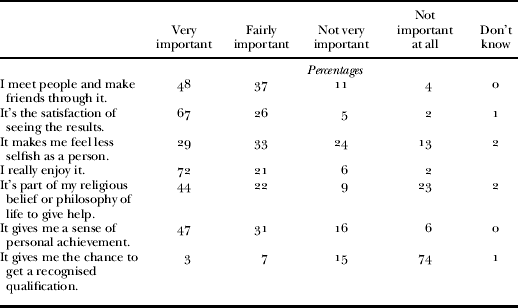
Descriptive analyses, presented in Table 1, show some of the intrinsic benefits associated with volunteering (from Frey and Stutzer Reference Frey and Stutzer2002b). The evidence provides empirical support for the immaterial product of volunteer work. The most highly ranked benefits of doing volunteer work are enjoyment (72 per cent ranked it very important) and satisfaction of seeing the results (67 per cent ranked it very important). It seems that other benefits are less important when doing volunteer work. Fewer than 50 per cent ranked benefits such as meeting people, getting a sense of personal achievement, feeling less selfish, and following a personal religious belief as very important.
The benefits of doing volunteer work in the United Kingdom
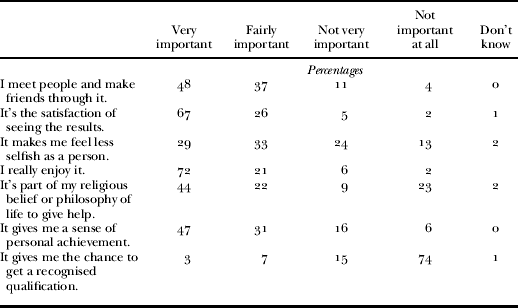
Source: Frey and Stutzer (Reference Frey and Stutzer2002b).
Regarding older people participating in unpaid work, Morrow-Howell et al. (Reference Morrow-Howell, Hinterlong, Razario and Tang2003: 138) argued, ‘Volunteering contributes to improved well-being outcomes for older volunteers’. Mutchler, Burr and Caro (Reference Mutchler, Burr and Caro2003) used data from the ACL survey and found that although work has little impact on volunteer retention, stopping work increases the likelihood that non-volunteers will start volunteering. They state, ‘This substitution helps to maintain subjective well-being and morale’ (2003: 1271). This argument is in line with the paradigm proposed by Chambre and Einolf (Reference Chambre and Einolf2008: 13), which considers volunteerism to be work. Although their results only partially support this paradigm, they suggest that retired people,
May see volunteering as a way of recapturing the achievements and the psychological and social satisfactions they derived in their work lives, which they now miss in retirement. These could include social networks, prestige, a feeling of being useful and valued, and engagement in meaningful, productive activity. (Chambre and Einolf Reference Chambre and Einolf2008: 13)
This is also consistent with the findings of Musick and Wilson (Reference Musick and Wilson2008) that fully retired people put in more volunteer hours than those who work part-time in retirement as well as those who are not retired. People who are fully retired have a greater need to maintain the immaterial product produced by the paid work than others. Hardill and Baines (Reference Hardill and Baines2009) suggest four sets of explanations for volunteering, two with strong group components and two more individualised. They conducted case studies at volunteer organisations, employing a range of social research techniques (within the overall case study approach) including interviews, collecting documentary evidence, observing day-to-day activity and significant events, and two focus groups with volunteers. Among other reasons for volunteering, the subjects report, ‘They entered volunteering as a response to a milestone life event and that it fills something missing or an emotional gap in their life’ (Hardill and Baines Reference Hardill and Baines2009: 43). The authors suggest, ‘Although retirement can be thought of in terms of the loss of a social role, it is now widely recognised that it entails the opportunity to acquire new roles (such as volunteer, part-time worker) and to continue other roles (parent, friend)’ (2009: 43). They also argue, ‘In preparation for retirement, some people seek to develop new sets of social contacts, drawing on attachments based in religious, voluntary, community, and leisure associations’ (2009: 43). This is consistent with our argument that that the immaterial product of volunteer work substitutes for the immaterial product produced by the paid work.
Next, we describe the extended form of Modigliani's lifecycle hypothesis and its implications for volunteering during the retirement period.
Lifecycle hypothesis and volunteering
The basis for the lifecycle hypothesis is, ‘Income varies systematically over people's lives and that savings allows consumers to move income from those times in life when income is high to those times when it low’ (Mankiw Reference Mankiw2001: 447). One of the fundamental reasons for this variation is retirement. To maintain material consumption after retirement, a person must save during his or her working years. Let us consider the simplest lifecycle model. Suppose that the adult life of each individual is L years, which is divided into two periods: N describes the work period, and L − N describes the retirement period. The individual expects to earn annual monetary income while working, represented by Y. The interest rate is assumed to be zero. The person chooses to maintain an even level of consumption in both periods of life and adds savings to initial wealth W. The budget constraint of a person (t) years old is:
 $$C \times (L - t) = W(t) + (N - t) \times Y$$
Equation (1) implies that a person desires to maintain an even level of consumption for the rest of his or her life (L − t), given that wealth is a function of age (t) and the years to work until retirement (N − t). The consumption function is:
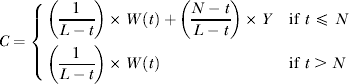 $$C = \openup3\left\{ {\matrix{ {\left( {\displaystyle{1 \over {L - t}}} \right) \times W(t) + \left( {\displaystyle{{N - t} \over {L - t}}} \right) \times Y} \hfill & {{\rm if}\;t \leqslant N} \hfill \cr {\left( {\displaystyle{1 \over {L - t}}} \right) \times W(t)} \hfill & {{\rm if}\;t \gt N} \hfill \cr}} \right.$$
The key feature of Equation (2) is that in order to maintain an even level of material consumption after retirement, the marginal propensity to consume should be smaller than 1 (N<L) and an increase in one's wealth in period t, winning the lottery for example, increases present consumption by
 $$\displaystyle{{\Delta W} \over {L - t}}.$$
Volunteering after retirement from paid work
In order to discuss the preferences of older people regarding volunteer activities, we suggest two supplements to the classic model. First, total consumption consists of both material goods and the immaterial product of work. According to the standard assumptions, people are able to save part of their monetary income and, therefore, have the opportunity to continue consuming the material goods after they retire. The unique properties of the immaterial product, i.e. unobservable and subjective good, prevent saving it for retirement. The first supplement implies that total consumption in time (t) is:
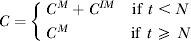 $$C = \openup3\left\{ {\matrix{ {C^M + C^{IM}} & {{\rm if}\;t \lt N} \cr {C^M}\hfill & {{\rm if}\;t \geqslant N} \cr}} \right.$$
In Equation (3) CM represents the consumption of material goods, whereas Equation (2) describes the magnitude of consumption. CIM represents the immaterial product whereas its properties are described before (see the section on the consumption value of work per se). The meaning of (3) is straightforward: during work period (t<N) people become accustomed to a higher level of consumption, compared to the standard lifecycle model. The additional part is obtained by the subjective gains associated with work per se. Moreover, if a person retires from paid work and does not participate in unpaid work, then total consumption is decreased. The desire to maintain consumption of the immaterial product of work provides an economic motivation to participate in unpaid work during the retirement period. Therefore, the second supplement is: at the statutory age individuals retire only from paid work. They can choose to participate in volunteer activities.
We suggest that the preferences of older people regarding volunteer work depend on their volunteer behaviour during the work period. Let us consider two scenarios: first, the retired person did not participate in volunteer activities during the work period, participating only in paid work. These supplements to the lifecycle model predict that in order to maintain the level of total consumption during the retirement period, people will consider starting to volunteer. The rationale is:
 $$C_w = f\{ C_W^M, C_W^{IM} \} = C_R = f\{ C_R^M, C_R^{IM} \} $$
In Equation (4) C W (C R) describes total consumption during work (retirement) periods. Suppose that the behaviour regarding material consumption is described by Equation (2) meaning that material consumption during the work period (C WM) equals material consumption during the retirement period (C RM). Now, if work carries a consumption value, meaning that during the work period total consumption is according to Equation (3), then in order to maintain immaterial consumption during the retirement period, people should participate in unpaid work. The immaterial product of work which is obtained from volunteer activities (C RIM) supplements the amount of immaterial product that was produced by the paid work (C WIM). In that sense, the higher the level of immaterial product consumption one was used to during the work period, the stronger motivation he or she has to start volunteering after retirement from paid work. This is consistent with some findings showing that stopping work increases the likelihood that non-volunteers will start volunteering (e.g. Chambre and Einolf Reference Chambre and Einolf2008; Mutchler, Burr and Caro Reference Mutchler, Burr and Caro2003).
In the second scenario, let us consider an individual who participated in paid as well as unpaid work during the work period. The supplements to the lifecycle model predict that this person will consider increasing his or her volunteer activities after retirement from paid work. The rationale is similar to that given by Equation (4): during the work period total consumption consists of material goods and immaterial product which are produced by paid as well as unpaid work, meaning:
 $$C_W = f\{ C_W^M, C_W^{IM} (W,V_W )\} $$
Equation (5) implies that total consumption during work period (C W) is a positive function of material consumption (C WM) and immaterial product (C WIM). The latter product is a positive function of working in paid work (W) and unpaid work (V W). In order to maintain an even level of consumption after retirement from paid work one has to increase the intensity of volunteering. The rational is:
 $$C_R = f\{ C_R^M, C_R^{IM} (V_R )\} = C_W $$
In Equation (6) total consumption during retirement period (C R) is a positive function of material consumption (C RM) and immaterial consumption that is a function of unpaid work (V R) only. Now, Equation (2) implies that C WM=C RM; in order to maintain an even level of immaterial consumption one has to supplement the immaterial product produced by paid work by increasing his or her volunteer time: V R>V W. The increase in volunteer activities depends positively on the amount of immaterial product produced by paid work. In a case that immaterial product is only produced by unpaid work, meaning C WIM=f(V W), then one can maintain an even level of immaterial consumption without changing volunteering intensity, meaning V R=V W.
Several studies found that people who volunteer in midlife tend to continue their involvement as they age (Moen, Dempster-McClain and Williams Reference Moen, Dempster-McClain and Williams1992; Moen and Fields Reference Moen and Fields2002). Butricia, Johnson and Zedlewski (Reference Butricia, Johnson and Zedlewski2009) suggest, based on their findings, that an increase in the number of volunteer hours and the number of years spent volunteering reduce the probability that a person will stop volunteering. For non-volunteers, the longer they have abstained from volunteer activities, the less likely they are to start volunteering. It is possible that longer years and more volunteer hours increase the immaterial product and, as a result, the need to continue volunteering after retirement. Non-volunteers only need to compensate for the immaterial product of work. If the value of the immaterial product of work is low, the probability that they will start volunteering after retirement is low.
A graphic description
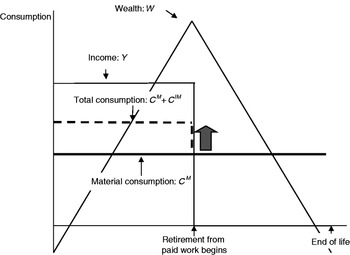
Figure 1, based on Mankiw (Reference Mankiw2001: figures 12–16), describes consumption over the lifecycle. During the work period people earn annual monetary income (Y) and their wealth (W) is increased. At age 65, they retire from paid work (Y=0) and their wealth is reduced. According to Equation (2), people maintain an even level of material consumption over both periods. Total consumption (the dashed line) is higher than material consumption, where in a special case it might exceed the level of income.Footnote 6 Both scenarios predict that after a person retires from paid work, total consumption decreases. Therefore, in order to maintain the pre-retirement level of consumption, people consider starting to volunteer or increasing the amount they volunteer.
Work, income, wealth and total consumption over the lifecycle. Source: Based on Mankiw (Reference Mankiw2001: figures 12–16).

Empirical evidence
Results from studies on the ‘economics of happiness’ provide empirical support for the assumption that people derive non-pecuniary benefits from work (Frey Reference Frey2008; Frey and Stutzer Reference Frey and Stutzer2002a; Layard Reference Layard2006). For example, it has been found that volunteers report greater life satisfaction than non-volunteers (Meier and Stutzer Reference Meier and Stutzer2008), and that people working in non-profit firms derive other kinds of utility from work, not only pecuniary reward (Benz Reference Benz2005; Lanfranch, Narcy and Larguem Reference Lanfranch, Narcy and Larguem2010). Even more interesting is the finding that the average psychological benefit derived from working constitutes about 46 per cent of the monetary income (Van Praag and Carnbonell Reference Van Praag and Carbonell2002).
Scitovsky (Reference Scitovsky1976) suggests two means for supporting the hypothesis that a person derives positive satisfaction not only from work as whole, but also on the margin. First is volunteer work that people do without a pecuniary quid pro quo; second is philanthropy. For example, Giving USA (2010) reports that the total estimated giving for 2009 was 2.1 per cent of Gross Domestic Product, 75 per cent from private individuals (US $1,940 per household). Since this study focused on philanthropic donations made by active people during their lifetime in the United States of America (USA), the gifts are given by people who have themselves earned the sums they are donating. These people's willingness to give a very large sum of moneyFootnote 7 shows that such funds are in excess of what their owners need, and can use for their own purposes. This means,
They enjoy their work for itself, as well as the act of making the money or the exercise of their skill at making it, and that it is satisfaction of their work which keeps them at it long after all their needs for money and for all the things that money will buy are fully satisfied. (Scitovsky Reference Scitovsky1976: 97)
The literature on the economics of happiness also underscores the negative connections between unemployment and subjective wellbeing. Based on findings from both cross-sectional and longitudinal studies, Layard, Nickell and Jackman (Reference Layard, Nickell and Jackman2005: XXXIX) concluded, ‘Becoming unemployed is one of the worst experiences a person can have – similar in its impact to divorce or bereavement’.Footnote 8 Moreover, people fear unemployment even when they are employed. When general unemployment goes up, it has a major impact on the happiness of everybody (Di Tella, MacCulloch and Oswald Reference Di Tella, MacCulloch and Oswald2001). In a subsequent study, Di Tella, MacCulloch and Oswald (Reference Di Tella, MacCulloch and Oswald2003), reject the hypothesis that the negative effect of unemployment is due to loss of income. Winkelmann and Winkelmann (Reference Winkelmann and Winkelmann1998) also provide evidence implying reverse causality, i.e. people who are less happy become unemployed more often. A more satisfactory explanation has been attributed to psychological and social costs (for surveys see Darity and Goldsmith Reference Darity and Goldsmith1996; Frey Reference Frey2008; Frey and Stutzer Reference Frey and Stutzer2002b).
Data from the Bureau of Labour Statistics (2009) show that older people prefer to use their free time by engaging in volunteer activities. In 2009, 23.9 per cent of the population aged 65 and over in the USA participated in volunteer activities. The rate is even higher in other western countries. For example, data from the Citizenship Survey (2008–09) in the United Kingdom reveals that the proportion of people aged 65–74 who took part in regular formal (informal) volunteering is 30 (38) per cent. The Australian Bureau of Statistics (2006) found that the volunteer rate for people aged 65–74 is 32.6 per cent, while 39 per cent of those aged 65–74 in Canada volunteered in 2004 (Statistics Canada 2006). Micro-data from the 2004 Survey of Health, Ageing and Retirement in Europe (SHARE) indicate that the rate of volunteers age 65 and over in Sweden, Denmark, Netherlands and France exceeds 30 per cent and the proportion of volunteers aged 65–74 is higher than the share of those aged 50–64 (Erlinghagen and Hank Reference Erlinghagen and Hank2006). Next, we present evidence that support the predictions of the two scenarios.
From paid worker to volunteer
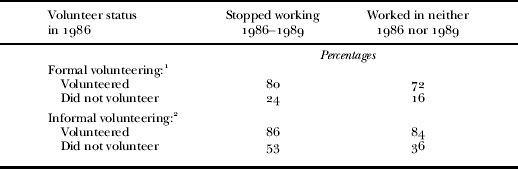
Mutchler, Burr and Caro (Reference Mutchler, Burr and Caro2003) examine volunteer behaviour of people aged 55–74 associated with changes in employment status. Their analysis is based on data taken from the ACL survey, collected in 1986 and 1989. Descriptive analyses, presented in Table 2, show that 24 per cent of the individuals who did not participate in formal volunteering in 1986 and stopped working between 1986 and 1989, started to volunteer in 1989. Of the individuals who did not participate in informal volunteering in 1986 and stopped working between 1986 and 1989, 53 per cent started to volunteer in 1989. Moreover, the change in employment status had little impact on volunteer activity among those who are already engaged in volunteering, Eighty per cent of the individuals who participate in formal volunteering and 86 per cent of the individuals who participate in informal volunteering continued volunteering after they stopped working. Interestingly, the share of volunteers who changed work status is higher than the share of volunteers who worked in neither 1986 nor 1989. This result may indicate that a reduction in immaterial product of work consumption positively affects the desire to start filling the gap by doing unpaid work. Logistic and Tobit regressions led Mutchler, Burr and Caro (Reference Mutchler, Burr and Caro2003: 1285) to conclude, ‘The effect of paid work status and changes in status are most substantial for individuals who reported no volunteer activities at earlier interview’.
Percentage volunteering in 1989 by work status and 1986 volunteer status, individuals aged 55–74
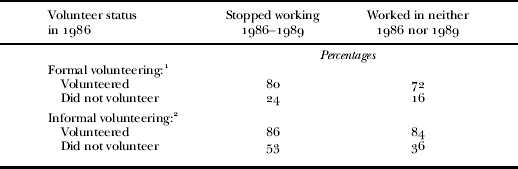
Notes: 1. Participation in unpaid work for national or local organisations. 2. Helping friends, neighbours or relatives for which one did not receive pays.
Source: Mutchler, Burr and Caro (Reference Mutchler, Burr and Caro2003: table 3).
The evidence presented in Table 2 provides preliminary empirical support for the prediction of the first scenario, which states that people who do not volunteer during the work period start participating in unpaid work after they retire from paid work.
Change in volunteer time
According to the prediction of the second scenario, individuals who were employed in paid as well as unpaid work during the work period consider increasing volunteer time after retiring from paid work. Chambre (Reference Chambre1984) used the American Volunteer–1974 survey to analyse volunteer participation and commitments of volunteers (frequency and hours spent in volunteer work). She found that the commitment scores of retirees were significantly higher than those of respondents who were in the labour force, indicating that among volunteers, the lack or loss of work roles is associated with greater time commitment.
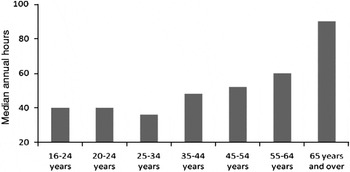
The Bureau of Labor Statistics (2009) supplies empirical evidence supporting this conjecture. Figure 2 shows a significant increase in annual hours of volunteer activities for individuals age 65 and over: the median annual hours of those 25 years and over is 52, whereas over the age of 65 (the mandatory retirement age) individuals volunteer 90 hours per year. The data for 2009 is consistent with reports for 2003, 2004, 2005 and 2008. A similar trend for time spent on regular and formal volunteering is reported for England (Citizenship Survey 2008–09: table 8), Canada (Katz and Rozenberg Reference Katz and Rosenberg2005: table 3) and Australia (Australian Bureau of Statistics 2006: table 1). In the case of Australia, the average hours per week for volunteer work done by retired men (women) is 5.9 (3.5), whereas employed men (women) volunteer only 2.2 (2.2) hours per week. The substantial increase in volunteer time after retirement demonstrates that the change in labour force status – from employment to retirement – affects positively the motivation to engage in volunteer activities during the retirement period.

Conclusion
This paper offers an economic explanation for the substitution hypothesis (Mutchler, Burr and Caro Reference Mutchler, Burr and Caro2003): older individuals choose to start volunteering after retirement from paid work. Previous studies published in economic journals dealt mainly with the behaviour of younger volunteers (Hackel, Halla and Pruckner Reference Hackel, Halla and Pruckner2007; Katz and Rosenberg Reference Katz and Rosenberg2005; Menchick and Weisbrod Reference Menchik and Weisbrod1987). Explanations such as investment in their own human capital or altruism may explain why young adults prefer to participate in volunteer activities, but are inadequate to explain why a growing share of the older population, aged 65 and over, chooses to volunteer.
Our explanation synthesises the notion of non-pecuniary gains associated with work per se and the classic lifecycle model (Modigliani Reference Modigliani1986). We predicted that the desire to maintain the level of consumption leads individuals to start participating in unpaid work after retirement from paid work. This prediction is based on the assumption that during the work period people become accustomed to a level of consumption that consists of both the material and immaterial products of their work. The loss of the immaterial product after retirement motivates people to fill the gap by reproducing the benefits of work by participating in unpaid work. Moreover, we predicted that people who were volunteers during the work period would increase their volunteer time after they cease working in paid work. We presented evidence to support both of these predictions. Our model suggests that people who worked in a job with low immaterial product are less likely to volunteer after retirement. There is evidence that older adults with more education and income are more likely to volunteer (Chambre Reference Chambre1984; Tang Reference Tang2006; Wilson and Musick Reference Wilson and Musick1997; Zedlewski and Schaner Reference Zedlewski and Schaner2006). One possible explanation is that older people with higher income and education have more resources for retirement and, therefore, have more time to volunteer. However, it is also likely that older people with higher education and higher income worked in better jobs throughout their life with higher immaterial value. As a result, they need higher compensation in their retirement and find it in volunteering activity.
Our economic model is a new perspective on volunteering after retirement. Most of the empirical and theoretical literature on volunteering is in the field of the social sciences and there were no previous economic models. We suggest adopting more economic models to explain the decision to volunteer specifically after retirement. With the growing literature in behavioural economics and the integration between economics and psychology, this would seem to be a suitable development. Certainly, more empirical work is needed to test our model. The results from empirical studies might help us to develop our model further, and include more economic research tools.
Our economic explanation and the de facto share of older volunteers have implications for policy. Older individuals leaving the world of paid work represent a potential pool of productive volunteers who prefer to continue participating in non-market activities. Providing them the opportunity to volunteer is a win–win situation: older volunteers contribute to macro-economic outcomes and volunteering improves their subjective wellbeing (Morrow-Howell et al. Reference Morrow-Howell, Hinterlong, Razario and Tang2003; Thoits and Hewitt Reference Thoits and Hewitt2001). Both consequences reduce the social cost associated with retirement and an ageing population. Decreasing social costs associated with retirement should be of great interest to economists, especially as the population of older people grows. On the micro-economic level, the analysis of utility after retirement is affected by the willingness to volunteer. On the macro-economic level, the potential pool of productive volunteers can contribute positively to market production outcomes.