Introduction
The subjective well-being (SWB) is conceptualized as a broad category phenomenon that includes people's emotional responses, domain satisfactions, and global judgments of life satisfaction (Giacomoni, Reference Giacomoni2004). Scorsolini-Comin and Santos (Reference Scorsolini-Comin and Santos2010) have concluded that the concept should be applied in practice and that attention should be focused on defining the extent to which a technique or intervention can contribute to the improvement of people's SWB, which directly involves the assessment of quality of life and, therefore, health.
SWB refers to how people experience their quality of life, including both emotional reactions and cognitive judgments (Diener, Reference Diener1984). Some authors believe that health and SWB may mutually and positively influence each other (Okun et al., Reference Okun, Stock, Haring and Witter1984). When someone tries to understand the positive affect of well-being, there is often an attempt to relate it to the absence of dissatisfaction with aspects of everyday life in general. According to some authors (Diener and Chan, Reference Diener and Chan2011), the SWB refers to people's evaluations, which may include judgments such as satisfaction with life and evaluations based on moods and emotions. When one experiences a sad mood or a happy emotion, it means he/she feels that life is going bad or well, respectively.
One of the criteria for identifying a healthy older person is the preservation of their natural and functional dentition. Lost teeth lead to difficulty in chewing food, generate dissatisfaction with dental aesthetics and embarrassment, decrease self-esteem, and hinder the maintenance of good social and emotional relationships (Malkin, Reference Malkin2009). Additionally, the mouth is assumed to reflect a person's health and well-being throughout life, i.e. oral diseases can have an impact on many aspects of general health, and health conditions can in turn have an impact on oral health (Griffin et al., Reference Griffin, Jones, Brunson, Griffin and Bailey2012).
Thus, the oral healthcare of older people requires more than clinical dentistry. Health professionals should incorporate knowledge from the various fields of science in order to develop and implement treatment plans and therapeutic approaches based on interdisciplinarity (Saintrain and Vieira, Reference Saintrain and Vieira2008).
Given the above, the present research aimed to identify the relationship between oral discomfort and SWB in older people. The attempt to establish relationships between psychological factors of well-being and oral health is thought to contribute to discussions and reflections about the way public policies can foster health-promoting actions to improve quality of life.
Methods
This is a quantitative analytical cross-sectional research conducted in four Reference Centers for Social Welfare (Centros de Referência de Assistência Social – CRAS) run by the Health Secretariat of the city of Fortaleza. A census was held and interviews were carried out with all the older people (n = 246) enrolled in the CRAS located in the following neighborhoods: Conjunto Palmeiras, Jardim das Oliveiras, Castelão, and João Paulo II.
Inclusion criteria were people aged 60 years or older attending the CRAS. Patients with physical or mental limitations that hindered the completion of the questionnaire and who were not accompanied by someone who could answer it were excluded.
Data were individually collected from the participants using a semi-structured questionnaire addressing sociodemographic data (age, gender, skin color, marital status, education, and income) and oral discomfort data (dry mouth, difficulty chewing and swallowing food, problems with the taste of food, burning mouth sensation, pain for no apparent reason, and mouth swelling). The SWB scale was also used. Additionally, the Community Oral Health Indicator (Indicador Comunitário de Saúde Bucal – ICSB) was applied. This validated indicator (Saintrain and Vieira, Reference Saintrain and Vieira2012) checks the number of teeth, visible dental cavities, presence of tartar, gingival inflammation, residual root, soft tissue injuries, use of and need for dental prosthesis, use of toothbrush and toothpaste, and visits to the dentist. The examinations were performed under natural light using a wooden spatula (tongue depressor) and examiners wore personal protective equipment.
CRAS are public facilities that offer social assistance follow-up through educational workshops, support groups for older people, and psychosocial support programs aimed at preventing poverty-related risk situations (Ministério do Desenvolvimento Social e Combate à Fome, 2009). The city of Fortaleza has an estimated population of 2,551,805 inhabitants (Instituto Brasileiro de Geografia e Estatística, 2010) and is the fifth largest city in the country.
The SWB scale is a scientific method of research in various areas of health and should be listed as a form to measure public health (Diener and Chan, Reference Diener and Chan2011). This scale has been validated in Brazil (Albuquerque and Tróccoli, Reference Albuquerque and Tróccoli2004), and it comprises components relating to satisfaction with life, positive affect, and negative affect (Andrews and Withey, Reference Andrews and Withey1974). The assessment is a psychometric five-point Likert-like scale. The items numbered 1–47 (subscale 1) refer to the positive affect and the negative affect. The level of agreement or disagreement is measured by assigning a score from 1 (strongly disagree) to 5 (strongly agree). The components of the numbers 48–62 (subscale 2) are used to measure satisfaction or dissatisfaction with life. The level of agreement or disagreement in this subscale is measured by assigning a score from 1 (strongly disagree) to 5 (strongly agree).
The total score was the sum of scores assigned to all the 62 items of the SWB scale. Mean and standard deviation were calculated, and the Kolmogorov–Smirnov test was used to verify the normality of the data. The test showed no normality (p = 0.004). Because of that, non-parametric tests were used to check for differences between means. The Mann–Whitney test was used for comparisons between two categories, and the Kruskal–Wallis test was used for comparisons between more than two categories.
The quantitative analysis was performed using the Statistical Package for the Social Sciences, version 21 (SPSS Inc., Chicago, IL, USA) with a significance level set at 5%.
Without any conflict of interest, this research was approved by the Research Ethics Committee of the University of Fortaleza (UNIFOR) under Approval no. 200/2009. Written informed consent was obtained from all the participants prior to data collection.
Results
A total of 246 people aged 60–89 years, with mean age of 69 years (SD ± 6.9), participated in the study. There was a predominance of women (n = 199; 80.9%). Participants’ sociodemographic characteristics included: incomplete elementary education (n = 161; 65.4%); income of up to one minimum wage (n = 182; 74%); retirement (n = 169; 68.7%); white skin color (n = 100; 40.7%), pardos – mixed-race Brazilians – (n = 67; 27.2%); no partner (n = 177; 72%). To be enrolled at CRAS, elderly people have to attend its activities and, therefore, are not bedbound. As all elderly people were able to answer the questions of the questionnaire, a few (n = 3) with the aid of an accompanying person (to remind them of their age), there were no exclusions, and data were collected from all elderly people that agree to participate in the study.
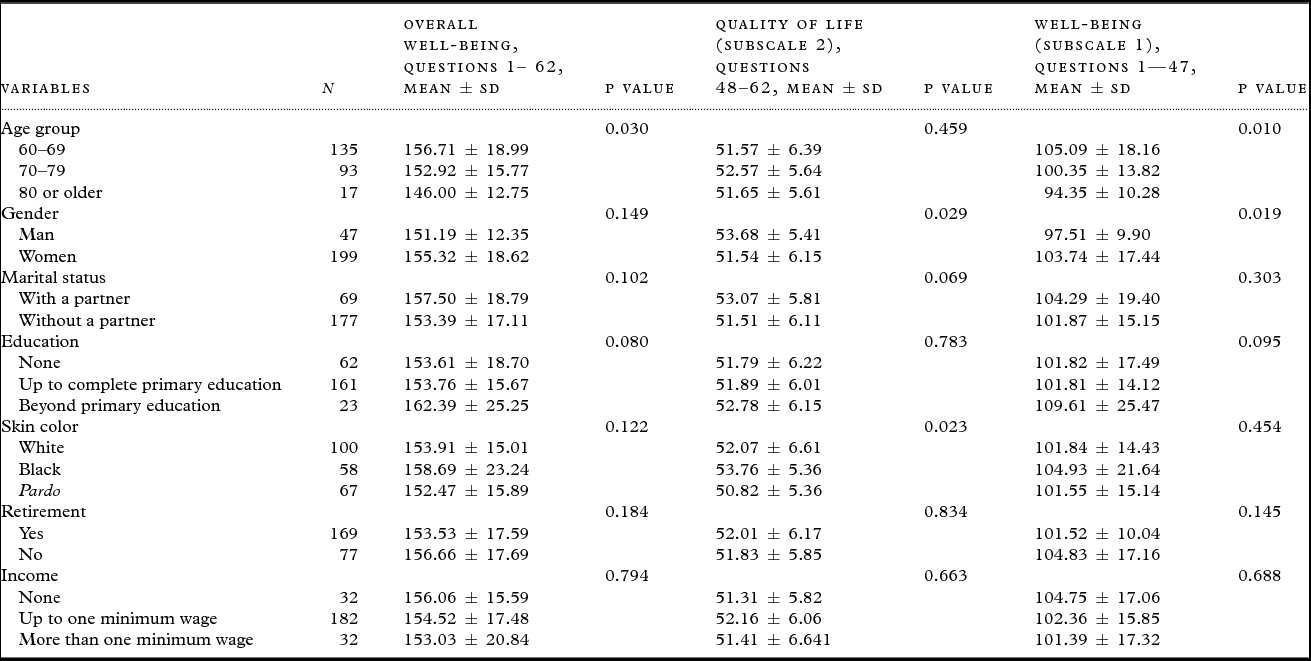
Table 1 shows the inferential analysis and frequency distribution of the respondents’ mean SWB score and socioeconomic variables. The SWB score (subscale 1) was statistically significantly associated with age (p = 0.010) and gender (p = 0.019).
Frequency distribution and inferential analysis of the relationship between mean subjective well-being scores and socioeconomic variables in older people (Fortaleza, Ceará, Brazil, 2016)

The mean SWB score (subscale 2) was also statistically significantly associated with gender (p = 0.029) and skin color (p = 0.023). Interestingly, the overall SWB score (subscale 1 + subscale 2) was statistically significantly associated with age (p = 0.030) only – older individuals presented lower SWB scores.
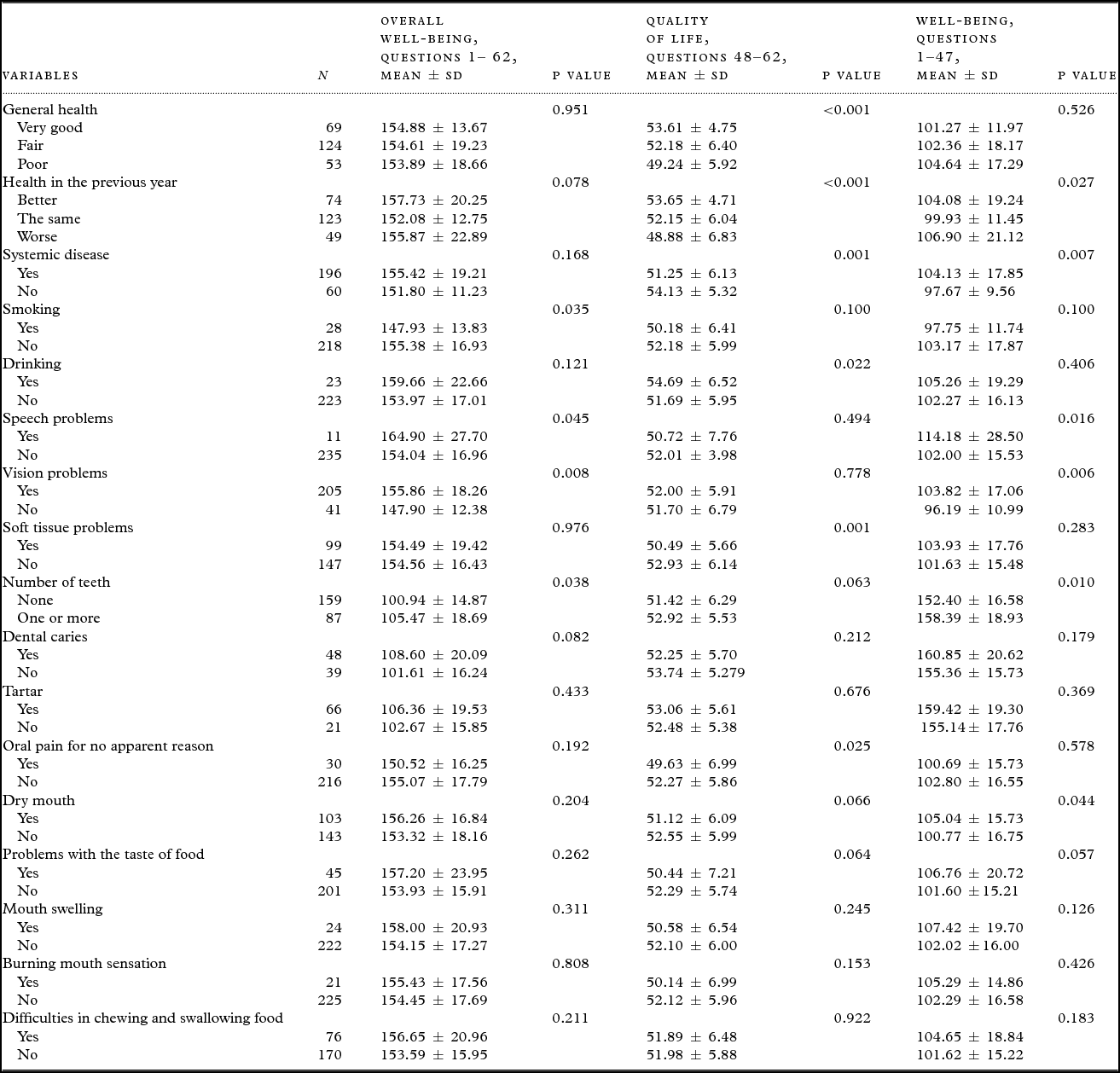
Table 2 displays the inferential analysis of the mean SWB score and self-reported health variables. The SWB score (subscale 1) was associated with health in the past year (p = 0.027), systemic diseases (p = 0.007), speech problems (p = 0.016), vision problems (p = 0.006), number of teeth (p = 0.010), and dry mouth (p = 0.044). The SWB score (subscale 2) was also associated with general health (p < 0.001), health in the past year (p < 0.001), systemic diseases (p = 0.001), drinking (p = 0.022), soft tissue problems (p = 0.001), and pain for no apparent reason (p = 0.025). The overall SWB score (subscale 1 + subscale 2) was associated with smoking (p = 0.035), speech problems (p = 0.045), vision problems (p = 0.008), and number of teeth (p = 0.038).
Frequency distribution and inferential analysis of the relationship between the mean subjective well-being scores and health variables in older people (Fortaleza, Ceará, Brazil, 2016)

Discussion
The fact that oral health is an integral part of general health is often neglected. The indicators used in oral health surveys almost always refer to specific studies for detecting dental caries, periodontal diseases, and use of or need for prostheses. The present study, which assessed the relationship between SWB and self-reported oral health (oral discomfort) in older people, differs from others for triggering reflection on this set of factors.
The study population has a disadvantaged socioeconomic status, which is confirmed by the prevalence of low income and low education. In Brazil, a low-income population refers to people who receive less than two minimum wages (MW) per month (1 MW is approximately US$ 260) (Instituto Brasileiro de Geografia e Estatística, 2010). The range of income in the present study was very small. Only 214 out of 246 individuals earned up to 1 MW, which limited the analysis of the relationship between income and SWB. This situation may explain why the variable “income” did not seem to interfere with SWB.
The predominance of older people without partners (single, divorced, and widowed) indicates a potential overload of daily activities, which can induce dissatisfaction with everyday life. Such circumstance is corroborated by the fact that one in seven older people live alone, the majority being women (United Nations, 2005). In Brazil, aging is also marked by the feminization of old age as women live on average seven years longer than men (Instituto Brasileiro de Geografia e Estatística, 2010). However, it does not mean that women enjoy a better health status (Organisation mondiale de la Santé, 2009), which is confirmed by the finding that the female gender was associated with lower SWB values than the male gender. Although women live longer than men because of biological and behavioral advantages, they present a higher incidence of chronic diseases that can lead to dependency (Organisation mondiale de la Santé, 2009). Therefore, they demand greater attention to their health, which may explain their lower values for SWB. Women are culturally more responsible for household chores and traditionally play an important role in supporting their families (Organisation mondiale de la Santé, 2009), which may negatively influence their SWB. The search for support in the labor market and the overload of family care and duties creates, most of the time, a more turbulent and stressful lifestyle for the women due to the many tasks they have to perform. All these factors can hinder a continuous and appropriate oral healthcare.
In Japan, the authors of a subjective assessment of oral health and medical expenses in community-dwelling elderly persons suggested that oral health status is an important parameter when elucidating the factors contributing to increased medical expense among older people (Harada et al., Reference Harada2012). It is known that medical expenses have a great impact on older people's income, and that high medical expenses (including oral care expenses) represent less money for other life necessities, including leisure, which can negatively influence SWB. In this context, there is a need to encourage the valorization of oral health and to raise people's awareness of health rights as they can drive changes toward the promotion of healthy aging. Therefore, the promotion of new perceptions, values, attitudes, and beliefs concerning the oral healthcare of older people may change the way oral health is perceived. Thus, people will start to see oral health as a human right (Mello et al., Reference Mello, Moysés and Castro2009) and as an important condition for a good overall health.
In this study, women's score in the subscale 1, which assesses personality/history of life, was higher than that of men. However, in the subscale 2, which assesses what the person is going through at the moment, women's score was lower than that of men's. The scores of the overall SWB scale (subscale 1 + subscale 2) were not statistically different between genders. Thus, it should be noted that some details can only be perceived if the subscales are observed separately.
The analysis of the association between SWB and oral and general health variables depicted in Table 2 shows interesting differences between the two subscales. Both subscale 1 and subscale 2 are associated with general health and oral health variables. However, a larger number of general health variables, compared to the oral health variables, present significant differences between the groups, which may indicate that general health plays a more important role in the participants’ well-being. Nevertheless, it is clear that oral health variables also present significant differences, which shows that these aspects cannot (and should not) be discarded when assessing older people's well-being.
The analysis of the relationship between the mean SWB scores (overall and or subscales 1 and 2) and oral discomfort revealed that soft tissue problems, number of teeth, pain for no apparent reason, and dry mouth influence SWB. These findings are corroborated by a study (Locker et al., Reference Locker, Matear, Stephens and Jokovic2002) that assessed quality of life and oral health in older people and detected the lack of teeth, dry mouth, and limitations in chewing capacity as major problems. Besides that, a third of the respondents considered their oral health fair or poor and 20% were dissatisfied with their oral health status. The authors have also identified that all oral health indicators were significantly associated with quality of life, indicating that those with poor self-perceived oral health had lower morale, more stress, and lower levels of satisfaction with life.
Additionally, oral health problems get worse in older people given the cumulative nature of the consequences of oral diseases. Therefore, poor oral health can restrict food choices and decrease the pleasure of eating, affect the masticatory efficiency, limit social contact and intimacy, affect speech, cause pain, and compromise the physical appearance. Also, the combination of other covariates such as diabetes, cardiovascular diseases, and polypharmacy remains associated with a decrease in saliva, a common manifestation in older people (World Health Organization, 2011). All these problems can negatively affect the health and well-being of a person (Muramatsu et al., Reference Muramatsu2007; Crispim et al., Reference Crispim, Saupe and Boing2009; CDC National Center for Chronic Disease Prevention Health Promotion, 2013) and have an influence on self-care and on the presence of depression (Saintrain et al., Reference Saintrain, Guimarães, Honório, Almeida and Vieira2013). An example of this relationship is observed in a research demonstrating that the decrease in appetite in patients with depression is associated with low-quality diet and decreased self-esteem (German et al., Reference German, Feldblum, Bilenko, Castel, Harman-Boehm and Shahar2008).
Other studies on the relationship between SWB and oral discomfort corroborate some of the findings of the present research. For instance, an in-depth subjective assessment of oral health showed a relationship between SWB and chewing capacity. In addition, the subjective assessment was related to the status of oral cleaning, temporomandibular disorders, and denture fitting (Muramatsu et al., Reference Muramatsu2007). A recent Japanese study (Hara et al., Reference Hara, Miura, Yamasaki, Morisaki and Osaka2015) has found that verbal communication is an important component of health and well-being, i.e. the well-being of older people who were “very satisfied” or “satisfied” with their verbal communication was significantly higher than that of those who said they were “neither satisfied nor dissatisfied,” “dissatisfied,” or “very dissatisfied.” It should be noted that tooth loss poses limitation on communication (Saintrain and Souza, Reference Saintrain and Souza2012). Likewise, edentulism and use of non-functional complete dentures are important factors related to the negative self-perception of oral health and have an impact on quality of life (Lemos et al., Reference Lemos, Zanin, Jorge and Flório2013). Therefore, it is clear that oral health requires more than clinical dentistry measures. It calls for a comprehensive and multidisciplinary approach to people's care, which requires from public health policy-makers and health professionals a different and more integrated approach to improve older people's health and well-being.
Despite the limitations posed by the complexity of carrying out an inferential analysis of the relationship between SWB and oral health problems, as well as the potential influence of other variables, the preset research highlights clear evidence that the poor preservation of teeth in older people generate physical, psychological, and/or social problems that directly interferes with their well-being. The subjective assessment of oral health can assist in the planning of public health actions as it is a comprehensive and reflective index. Such assessment can also reveal the real needs of a population and therefore serves as a basis for providing older individuals with better social support and health systems with a view to improving oral health quality.
Conclusion
The relationship between oral discomfort and SWB reveals that the poor preservation of teeth in older people generates physical, psychological, and/or social problems that directly interfere with their well-being.
Conflict of interest
None.
Description of authors’ roles
MVLS, LLP, APGFV, and RMS contributed to conception and design, acquisition of data, and analysis and interpretation of data. TMMB, FSS, and SVS contributed to the acquisition and interpretation of data and participated in drafting the paper.