Introduction
Living kidney donation to a family member or a partner has become common practice. However, the idea of donating one of your kidneys to a patient on the waiting list for transplantation and who you don't know, is one step further. A thirty-year-old man decided to do so: ‘It is about the feeling you get if you are able to do something for someone else in a meaningful way’ (Daily newspaper: De Limburger, Wednesday, 16 November 2005).
An important clinical question is the validity of such motivation: is the motivation a well thought out aspiration, or is it a sign of mental instability? A careful psychological evaluation to distinguish between the two is necessary if society wishes to proceed with ‘Samaritan donation’. This article describes a review of the literature on how such evaluation can best be performed.
The shortage of kidneys for transplantation is widely considered to be a problem for patients with end-stage renal disease. In The Netherlands, the waiting list for deceased donor kidney transplantation has increased. Average waiting times nowadays range from 2 years for patients with blood type AB to 5 years for patients with blood type O (Dutch Transplant Foundation, 2006). In the meantime patients are dependent on dialysis treatment, which is associated with severely lowered quality of life, morbidity and mortality (Lumsdaine et al. Reference Lumsdaine, Wray, Power, Jamieson, Akyol, Andrew Bradley, Forsythe and Wigmore2005); approximately 25% of all Dutch patients die while waiting for a transplant (Renine Foundation, 2006).
Living kidney donation has alleviated the long waiting time. In the past, only the patients' close relatives were considered as living donors. However, as non-related living donors' kidneys proved to have similar good outcomes, the proportion of non-related donors such as spouses and friends has increased significantly over the past years (Terasaki et al. Reference Terasaki, Cecka, Gjertson and Takemoto1995, Reference Terasaki, Cecka, Gjertson and Cho1997). Recently, another type of living donation is becoming more acceptable to the transplant community – the ‘Samaritan donation’. Samaritan donors are people who are willing to donate to patients they do not know. The idea and use of Samaritan donors goes back as early as 1971, when Sadler et al. first described a sample of Samaritan donors. Despite this early report, up until recently there has been great reluctance to accept the offers of Samaritan donors. The most important reason for this reluctance is the possibility that these donors may not be mentally stable (Henderson et al. Reference Henderson, Landolt, McDonald, Barrable, Soos, Gourlay, Allison and Landsberg2003). Although a case has been reported where the donor saw giving away all his body parts as an inevitable necessity (Truog, Reference Truog2005), feelings and fears of donor instability often proved not to be true (Sadler et al. Reference Sadler, Davison, Carroll and Kountz1971; Landolt et al. Reference Landolt, Henderson, Gourlay, McDonald, Soos, Barrable and Landsberg2003; Jacobs et al. Reference Jacobs, Roman, Garvey, Kahn and Matas2004; Morrissey et al. Reference Morrissey, Dube, Gohh, Yango, Gautam and Monaco2005; Jendrisak et al. Reference Jendrisak, Hong, Shenoy, Lowell, Desai, Chapman, Vijayan, Wetzel, Smith, Wagner, Brennan, Brockmeier and Kappel2006). Over the past few years, the reluctance towards Samaritan donors seems to be decreasing. Some transplant centres have started to publish their initial results on Samaritan donation, and other centres have started to develop protocols for their planned Samaritan donation programmes (Crowley-Matoka & Switzer, Reference Crowley-Matoka and Switzer2005). A recent survey has shown that, in the absence of a common ‘Samaritan donor protocol’, centres seem to be developing their own separate protocols (Crowley-Matoka & Switzer, Reference Crowley-Matoka and Switzer2005). Many local protocols appear to share the basic existing ‘regular’ living kidney donation protocols, giving special attention to the psychological and/or psychiatric evaluation of the Samaritan donor. At present, however, information is scarce about how this specific psychological/psychiatric evaluation can best be constructed. The purpose of this article was to systematically review the existing literature about the psychological/psychiatric evaluation of Samaritan donors. The rationale for a well-defined psychodiagnostic tool to screen Samaritan donors is to rule out cases where the psychological risks of donation are larger than the benefits. This is especially important because psychological benefits are generally seen as a major moral justification for the surgical practice of living donor nephrectomies (Abecassis et al. Reference Abecassis, Adams, Adams, Arnold, Atkins, Barr, Bennett, Bia, Briscoe, Burdick, Corry, Davis, Delmonico, Gaston, Harmon, Jacobs, Kahn, Leichtman, Miller, Moss, Newmann, Rosen, Siminoff, Spital, Starnes, Thomas, Tyler, Williams, Wright and Youngner2000).
Method
As ‘Samaritan donation’ is a specific form or subcategory of ‘living kidney donation’, we first studied the commonly-used current guidelines and consensus reports for the psychological evaluation of directed living kidney donors (such as parents or spouses). By including these guidelines, we can examine to what extent protocols for the psychological evaluation of Samaritan donation can or should differ from the psychological evaluation of the more traditional living kidney donors. In April 2007, we performed a systematic literature search in Pubmed, ISI Web of Science and PsycINFO. We used the search terms: ‘Samaritan’ or ‘anonymous’ or ‘nondirected’ or ‘non-directed’ or ‘altruistic’ and ‘kidney donation’. We did not make time restrictions with respect to publication dates. We screened all articles found for a detailed description of the contents of the psychological/psychiatric evaluation of Samaritan kidney donors and checked whether psychological exclusion criteria for donation were reported. We also screened the studies found for reports of rejections of Samaritan donors on psychological grounds. Where articles referred to articles on Samaritan donation that we had missed as a result of our initial choice of search terms, we included these articles as well (i.e. the snowball method). In all articles, we studied how each clinical group in practice approaches the question about eliminating psychopathology or eliminating patients with poor motivation.
Results
Guidelines and consensus reports for psychological evaluation for ‘conventional’ living kidney donation
Before presenting the results for the Samaritan kidney donor evaluation, we first present the results for conventional living kidney donation. The best descriptions or guidelines for the psychological evaluation of ‘conventional’ living kidney donation were found in three types of documents: (1) consensus statements, (2) guidelines and (3) scientific reports. For each type, we included two documents: the consensus statement on the live organ donor and the Amsterdam Forum reports (Abecassis et al. Reference Abecassis, Adams, Adams, Arnold, Atkins, Barr, Bennett, Bia, Briscoe, Burdick, Corry, Davis, Delmonico, Gaston, Harmon, Jacobs, Kahn, Leichtman, Miller, Moss, Newmann, Rosen, Siminoff, Spital, Starnes, Thomas, Tyler, Williams, Wright and Youngner2000; Ethics Committee of the Transplantation Society, 2004; Delmonico et al. Reference Delmonico2005); the current US and UK guidelines (Kasiske et al. Reference Kasiske, Ravenscraft, Ramos, Gaston, Bia and Danovitch1996; British Transplantation Society and the Renal Association, 2005); and the studies of Olbrisch et al. (Reference Olbrisch, Benedict, Haller and Levenson2001) and Leo et al. (Reference Leo, Smith and Mori2003). There was considerable agreement about the headings of the contents of such an evaluation. We identified five common elements: (1) the purpose of the evaluation is to uncover clinical psychiatric disorders that would preclude donation, (2) the assessment of psychosocial stability, (3) to asses whether the donor comprehends all risks and benefits involved, and is capable of making an informed decision. Both the morbidity/mortality risks for the donor and the likelihood of success for the recipient should be discussed; (4) the absence of pressure or coercion to donate and, in most instances; (5) the donor's relationship with the recipient and within the context of the wider family. Some documents explicitly included the motivation to donate as a topic for the evaluation (Olbrisch et al. Reference Olbrisch, Benedict, Haller and Levenson2001; Leo et al. Reference Leo, Smith and Mori2003), whereas for others, motivational issues fell under the exploration of the voluntary nature of the decision. There were differences between the documents with respect to the inclusion of third parties in the evaluation procedure. Two documents mentioned the inclusion of third parties: Olbrisch et al. (Reference Olbrisch, Benedict, Haller and Levenson2001) included a collateral spousal interview in their evaluation procedure, and Abecassis et al. (Reference Abecassis, Adams, Adams, Arnold, Atkins, Barr, Bennett, Bia, Briscoe, Burdick, Corry, Davis, Delmonico, Gaston, Harmon, Jacobs, Kahn, Leichtman, Miller, Moss, Newmann, Rosen, Siminoff, Spital, Starnes, Thomas, Tyler, Williams, Wright and Youngner2000) reported that for potential donors undergoing mental health treatment, the mental health professional caring for this patient should contribute to the evaluative process. Another difference between the documents concerns informing the potential donor of the psychological risks and benefits associated with kidney donation. Although all documents state that a well-informed decision should be made (thereby implicitly including the psychological risks and benefits of a donation procedure), Kasiske et al. (Reference Kasiske, Ravenscraft, Ramos, Gaston, Bia and Danovitch1996) are the only researchers who explicitly describe these psychological risks: ‘A small minority of patients may, at some time, become depressed as a result of kidney donation’, ‘rare cases in which the donor committed suicide after the kidney they had donated failed’ and possible adverse effects on marriage. Benefits, which are much more common, include superior psychological health compared to the rest of the population, increase in self-esteem, and improvement of the relationship with the donor (Kasiske et al. Reference Kasiske, Ravenscraft, Ramos, Gaston, Bia and Danovitch1996). Furthermore, there exists considerable difference between the extent to which the different documents describe the kind of psychopathology that could be a contra-indication for living kidney donation. In this respect, the study of Leo et al. (Reference Leo, Smith and Mori2003) provides the most concrete descriptions. This study includes a table of poor prognostic factors that may be identified in presurgical psychological evaluation of prospective living kidney donors. These factors are: psychotic disorders, major mood disorders, major depression, bipolar disorder, substance abuse/dependence, severe personality disorders, risks for suicide, issues influencing the decision to donate (coercion, monetary gain, economic factors, desire to enlist the organ recipient in a reciprocal relationship, desire to create indebtness in the organ recipient). The study of Olbrisch et al. (Reference Olbrisch, Benedict, Haller and Levenson2001) does not proceed from diagnoses, but rather from questions such as ‘Is the donor sufficiently emotionally stable to cope with stresses which may come up before, during and after the donation? Is there overt or indirect evidence that the wish to be a donor reflects self-destructive or suicidal feelings? What is the potential that the donor will develop somatization symptoms that could result in high medical resource utilization, prolonged disability, chronic pain, attention seeking, or other secondary gain as a result of undergoing an elective surgery? Is the donor prepared to handle medical complications that either the donor or the recipient might experience?’ Despite the differences, what is commonly described in these documents is that decisions on rejecting or accepting living kidney donors on psychological grounds should be made on a case-by-case basis, and that there is not a ‘diagnosis-based recipe’ for these decisions.
Literature review: psychological evaluation for Samaritan kidney donation
Using our search terms, we found 84 articles on Samaritan donation by using Pubmed, 75 in ISI Web of Science and three in PsycINFO. After controlling for overlap between the results found, 111 articles remained. Only five of these included detailed descriptions of the contents of the psychological/psychiatric evaluation of the donors (Jacobs et al. Reference Jacobs, Roman, Garvey, Kahn and Matas2004; Gilbert et al. Reference Gilbert, Brigham, Batty and Veatch2005; Morrissey et al. Reference Morrissey, Dube, Gohh, Yango, Gautam and Monaco2005; Jendrisak et al. Reference Jendrisak, Hong, Shenoy, Lowell, Desai, Chapman, Vijayan, Wetzel, Smith, Wagner, Brennan, Brockmeier and Kappel2006; Dew et al. Reference Dew, Jacobs, Jowsey, Hanto, Miller and Delmonico2007). Typically, this evaluation starts as soon as the interested potential Samaritan donor telephones the transplant centre. During this telephone conversation, the transplant coordinator or transplant nurse performs an initial evaluation to rule out those people with obvious medical or psychosocial contra-indications. Following this evaluation, if candidates are deemed eligible for donation, they receive an information pack of donor educational information. Next, if after reading the information the donor candidate is still interested in donation, he or she has to contact the transplant centre again to make arrangements for further donor evaluation. For all five articles found, a consultation with either a psychiatrist (Gilbert et al. Reference Gilbert, Brigham, Batty and Veatch2005; Morrissey et al. Reference Morrissey, Dube, Gohh, Yango, Gautam and Monaco2005) or a psychologist (Jacobs et al. Reference Jacobs, Roman, Garvey, Kahn and Matas2004; Jendrisak et al. Reference Jendrisak, Hong, Shenoy, Lowell, Desai, Chapman, Vijayan, Wetzel, Smith, Wagner, Brennan, Brockmeier and Kappel2006) is a standard part of the donor evaluation procedure. This evaluation consists of an interview and, in most instances, additional psychometric testing. The interview consists of a variety of topics. The articles found differ in regard to the extent they describe the topics of the interview. The shortest description of interview topics is provided by Jendrisak et al. (Reference Jendrisak, Hong, Shenoy, Lowell, Desai, Chapman, Vijayan, Wetzel, Smith, Wagner, Brennan, Brockmeier and Kappel2006) : ‘a standard psychiatric interview using DSM IV criteria for major psychiatric disorders such as depression, anxiety, mania, schizophrenia, substance abuse, and other disorders along with a MMSE. Donor motivation is also addressed in-depth during the interview.’ Gilbert et al. (Reference Gilbert, Brigham, Batty and Veatch2005) also provide a compact description of the interview contents: ‘motivation, decision-making process, health concerns during and after donation, expectations of the relationship with the recipient, family members' viewpoint on the donation and health expectations for the recipient. An Axis I, II or III impression is given and also a recommendation about whether or not to proceed with the donation.' Jacobs et al. (Reference Jacobs, Roman, Garvey, Kahn and Matas2004) and Dew et al. (Reference Dew, Jacobs, Jowsey, Hanto, Miller and Delmonico2007) provide the most detailed description of the topics assessed during the interview. In addition to the interview topics already named above, they include: ‘history and current status’ (Dew et al. Reference Dew, Jacobs, Jowsey, Hanto, Miller and Delmonico2007), employment, cultural background, religious beliefs and practices, history of volunteering and charitable deeds, and also information about the financial situation of the donor in their evaluation interview (Jacobs et al. Reference Jacobs, Roman, Garvey, Kahn and Matas2004; Dew et al. Reference Dew, Jacobs, Jowsey, Hanto, Miller and Delmonico2007). Morrissey et al. (Reference Morrissey, Dube, Gohh, Yango, Gautam and Monaco2005) refer to Jacobs et al. (Reference Jacobs, Roman, Garvey, Kahn and Matas2004) in their description of interview contents. Only Jendrisak et al. (Reference Jendrisak, Hong, Shenoy, Lowell, Desai, Chapman, Vijayan, Wetzel, Smith, Wagner, Brennan, Brockmeier and Kappel2006) suggest using a standard DSM-IV interview for the evaluation of psychiatric disorders. Gilbert et al. (Reference Gilbert, Brigham, Batty and Veatch2005) state that an Axis I, II or III impression is given, but do not say how this was accomplished. Along with the interview, psychometric testing forms an important part of the psychological evaluation of Samaritan donors. Both Jacobs et al. (Reference Jacobs, Roman, Garvey, Kahn and Matas2004) and Jendrisak et al. (Reference Jendrisak, Hong, Shenoy, Lowell, Desai, Chapman, Vijayan, Wetzel, Smith, Wagner, Brennan, Brockmeier and Kappel2006) make use of the Minnesota Multiphasic Personality Inventory-2 (MMPI-2; Butcher et al. Reference Butcher, Dahlstrom, Graham, Tellegen and Kraemmer1989). In addition, Jendrisak et al. (Reference Jendrisak, Hong, Shenoy, Lowell, Desai, Chapman, Vijayan, Wetzel, Smith, Wagner, Brennan, Brockmeier and Kappel2006) apply the Temperament and Character Inventory (TCI) and the Mini-Mental State Examination (MMSE). Gilbert et al. (Reference Gilbert, Brigham, Batty and Veatch2005) state that the psychiatrist used standard psychiatric tools to assess the competence of the donor in making an informed judgment, the presence of social or medical concerns that would place an undue burden on the individual or their family during the post-donation period, and the presence of psychiatric illness. However, the nature of these ‘psychiatric tools’ is not described. In the study of Morrissey et al. (Reference Morrissey, Dube, Gohh, Yango, Gautam and Monaco2005), the use of psychometric testing is not mentioned. Four out of the five studies recommend that a family member of the potential donor should take part in the evaluation procedure (Jacobs et al. Reference Jacobs, Roman, Garvey, Kahn and Matas2004; Gilbert et al. Reference Gilbert, Brigham, Batty and Veatch2005; Jendrisak et al. Reference Jendrisak, Hong, Shenoy, Lowell, Desai, Chapman, Vijayan, Wetzel, Smith, Wagner, Brennan, Brockmeier and Kappel2006; Dew et al. Reference Dew, Jacobs, Jowsey, Hanto, Miller and Delmonico2007).
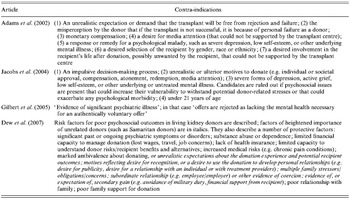
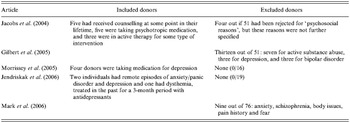
The five articles vary in their description of contra-indications or exclusion criteria for Samaritan donation (summarized in Table 1), except for Morrissey et al. (Reference Morrissey, Dube, Gohh, Yango, Gautam and Monaco2005), who follow Jacobs et al. (Reference Jacobs, Roman, Garvey, Kahn and Matas2004) in their description of contra-indication on psychological grounds (although they do not mention the age restriction), and Jendrisak et al. (Reference Jendrisak, Hong, Shenoy, Lowell, Desai, Chapman, Vijayan, Wetzel, Smith, Wagner, Brennan, Brockmeier and Kappel2006) do not explicitly describe contra-indications for Samaritan donation. In addition to these five articles, our literature review found a paper by Adams et al. (Reference Adams, Cohen, Danovitch, Edington, Gaston, Jacobs, Luskin, Metzger, Peters, Siminoff, Veatch, Rothberg-Wegman, Bartlett, Brigham, Burdick, Gunderson, Harmon, Matas, Thistlethwaite and Delmonico2002), stating that contra-indications to Samaritan donation are the same as for directed donation. They list a number of reasons for donor exclusion, which are also summarized in Table 1. Given these contra-indications, we studied how many Samaritan donor candidates were reported to have been rejected for donation on psychological/psychiatric grounds so far. Our literature survey yielded five reports on the outcomes of Samaritan kidney donation programmes. These results are summarized in Table 2, which also includes the results for those donors who were receiving counselling or psychotropic medication, but nevertheless were accepted for donation. There were no adverse psychological consequences after donation reported for these donors.
Contra-indications for Samaritan donation

Donor exclusion on psychological grounds

In addition to the studies described above, we found three more studies that did not describe the clinical evaluation procedure of Samaritan donor candidates in particular, but rather could be described as research into the personality characeristics of (possible) Samaritan donors (Henderson et al. Reference Henderson, Landolt, McDonald, Barrable, Soos, Gourlay, Allison and Landsberg2003; Landolt et al. Reference Landolt, Henderson, Gourlay, McDonald, Soos, Barrable and Landsberg2003; Boulware et al. Reference Boulware, Ratner, Troll, Chaudron, Yeung, Chen, Klein, Hiller and Powe2005). Landolt et al. (Reference Landolt, Henderson, Gourlay, McDonald, Soos, Barrable and Landsberg2003) found that people likely to volunteer as Samaritan donors were more likely to ascribe humanitarian reasons for their action and less likely to be influenced by the external costs of donation. Their Samaritan donor candidates completed the Revised NEO Personality Inventory (NEO PI-R), a self-report instrument measuring five major personality domains (Costa & McCrae, Reference Costa and McCrae1992; Costa & Widiger, Reference Costa and Widiger1994). The results showed that they were more likely to score highly on the NEO PI-R subscales ‘openness to experience’, indicating a certain willingness to question authority and to entertain new ethical, social and political ideas. They were also more likely to score highly on ‘agreeableness’, indicating qualities such as kind-heartedness, friendliness, benevolence, empathy and a belief in the fundamental goodness of others (Landolt et al. Reference Landolt, Henderson, Gourlay, McDonald, Soos, Barrable and Landsberg2003). The study of Jendrisak et al. (Reference Jendrisak, Hong, Shenoy, Lowell, Desai, Chapman, Vijayan, Wetzel, Smith, Wagner, Brennan, Brockmeier and Kappel2006) also included a validated questionnaire on personality traits, namely the TCI (Cloninger et al. Reference Cloninger, Przybeck, Svrakic and Wetzel1994). They found that Samaritan donors were not thrill seekers, and were less harm-avoidant than the general population. They scored lower on self-transcendence than the general population, suggesting that as a group they were not especially tied to organized religion or spirituality. Boulware et al. (Reference Boulware, Ratner, Troll, Chaudron, Yeung, Chen, Klein, Hiller and Powe2005) found that potential stranger donors were willing to undergo greater risks associated with donation (compared to the general population), but that there were no differences with respect to prevalence of depression and anxiety symptoms, and no differences with respect to altruistic or religious attitudes. Regarding religious motives, the results of the various studies are not in agreement. Contrary to the studies of Jendrisak et al. (Reference Jendrisak, Hong, Shenoy, Lowell, Desai, Chapman, Vijayan, Wetzel, Smith, Wagner, Brennan, Brockmeier and Kappel2006) and Boulware et al. (Reference Boulware, Ratner, Troll, Chaudron, Yeung, Chen, Klein, Hiller and Powe2005), Henderson et al. (Reference Henderson, Landolt, McDonald, Barrable, Soos, Gourlay, Allison and Landsberg2003) suggest that people likely to volunteer as Samaritan donors are more likely to have a spiritual belief system. The study of Jacobs et al. (Reference Jacobs, Roman, Garvey, Kahn and Matas2004) provides evidence that at least some of the Samaritan donors are motivated by religion, as nearly a third of the 49 candidates assessed in their study had strong religious and/or Christian convictions and believed that donating was an act of living out their faith and their dedication to serving others.
Discussion
The evaluation of Samaritan donors should at a minimum include the same issues as the evaluation of conventional living donors (Adams et al. Reference Adams, Cohen, Danovitch, Edington, Gaston, Jacobs, Luskin, Metzger, Peters, Siminoff, Veatch, Rothberg-Wegman, Bartlett, Brigham, Burdick, Gunderson, Harmon, Matas, Thistlethwaite and Delmonico2002; Dew et al. Reference Dew, Jacobs, Jowsey, Hanto, Miller and Delmonico2007). In addition, a consultation with a psychologist or psychiatrist is a standard procedure in many transplant centres. Compared to the procedures for conventional living kidney donors, we found that motivational issues played a more prominent role in the evaluation of Samaritan donors. In conventional donation, the donor motivation is evaluated more in terms of absence of pressure (and good reasons for donation are more or less taken for granted), whereas the evaluation of the motivation of Samaritan donors is more extensive. Thus, in the case of Samaritan donation, the psychologist/psychiatrist is called in to evaluate psychopathology, the motivation for donation, and the possible relationship between psychopathology and motivation. As reported in the results section, we found no uniform description of what type(s) of psychopathology should preclude either a conventional living kidney donation or a Samaritan donation. Possibly because of this lack of standardization, it was revealed that in one study three people were rejected on grounds of depression (Gilbert et al. Reference Gilbert, Brigham, Batty and Veatch2005), whereas in another study four people with depression and on medication were accepted for donation (Morrissey et al. Reference Morrissey, Dube, Gohh, Yango, Gautam and Monaco2005). There we no psychological complaints reported for these four donors after donation (Morrissey et al. Reference Morrissey, Dube, Gohh, Yango, Gautam and Monaco2005). With respect to the methods used to uncover mental illness, one study showed that a standard DSM-IV interview for the evaluation of psychiatric disorders is used (Jendrisak et al. Reference Jendrisak, Hong, Shenoy, Lowell, Desai, Chapman, Vijayan, Wetzel, Smith, Wagner, Brennan, Brockmeier and Kappel2006), or that at least an Axis I, II or III impression was given by the psychiatrist (Gilbert et al. Reference Gilbert, Brigham, Batty and Veatch2005). We would recommend a standardized interview (for example, the Mini-International Neuropsychiatric Interview; Sheehan et al. Reference Sheehan, Lecrubier, Sheehan, Amorim, Janavs, Weiller, Hergueta, Baker and Dunbar1998), but we think that in clinical practice the experience and preference of the treating psychologist/psychiatrist will be decisive. In addition, psychometric testing is used for the evaluation of Samaritan donors. The MMPI-2 is part of the evaluation protocol in the studies of Jacobs et al. (Reference Jacobs, Roman, Garvey, Kahn and Matas2004) and Jendrisak et al. (Reference Jendrisak, Hong, Shenoy, Lowell, Desai, Chapman, Vijayan, Wetzel, Smith, Wagner, Brennan, Brockmeier and Kappel2006) (see also Roman et al. Reference Roman, Jacobs, Garvey and Matas2006). An important reason for including this instrument is that it is difficult for the respondent to anticipate the ‘correct’ answers because it is almost impossible to know what the right or wrong answers are. We think such a feature is helpful because in some cases the Samaritan donor might try to conceal something he or she thinks would be a contra-indication for donation (Olbrisch et al. Reference Olbrisch, Benedict, Haller and Levenson2001). It is also known from other studies that the way in which people fill out questionnaires is influenced by the specific context and, consciously or unconsciously, may bias the results (Passchier et al. Reference Passchier, Hunfeld, Jelicic and Verhage1993). The TCI is also used in the psychological evaluation of Samaritan donors (Jendrisak et al. Reference Jendrisak, Hong, Shenoy, Lowell, Desai, Chapman, Vijayan, Wetzel, Smith, Wagner, Brennan, Brockmeier and Kappel2006). Although the TCI adds to the evaluation of Samaritan donors, we question whether it is necessary to include this instrument as a standard in the clinical psychological evaluation of Samaritan donors. This instrument may be better suited for research into personality or other characteristics of Samaritan donors. We found that for the psychometric instruments described earlier, cut-off scores were lacking. Although Jendrisak et al. (Reference Jendrisak, Hong, Shenoy, Lowell, Desai, Chapman, Vijayan, Wetzel, Smith, Wagner, Brennan, Brockmeier and Kappel2006) reported that the scores of the evaluated donors were within normal ranges, we are not clear whether this implies that donors would have been rejected if scores were significantly lowered or elevated. This can be compared to the situation of conventional living kidney donation evaluations, where decisions are also made on a case-by-case basis. To cite Dew et al. (Reference Dew, Jacobs, Jowsey, Hanto, Miller and Delmonico2007) : ‘The safety and well-being of each donor will be maximized only by considering (a) the unique circumstances that led the individual to come forward for donation and (b) the unique set of psychosocial risk and protective factors that the individual brings’.
Contrary to the open descriptions of unacceptable psychopathology, rules or criteria for evaluating the motivation of Samaritan donors seem to be much stricter. Adams et al. (Reference Adams, Cohen, Danovitch, Edington, Gaston, Jacobs, Luskin, Metzger, Peters, Siminoff, Veatch, Rothberg-Wegman, Bartlett, Brigham, Burdick, Gunderson, Harmon, Matas, Thistlethwaite and Delmonico2002) name seven categories of ‘unacceptable donor expectancies’ (Table 1). We think that several of these ‘unacceptable expectancies’ also apply to conventional, directed donation, such as expecting ‘monetary compensation’. Unacceptable donor expectations that apply exclusively to Samaritan donation are: ‘a desire for media attention (that could not be supported by the transplant center)’, ‘a response or remedy for a psychological malady’ and ‘a desired selection of the recipient by gender, race or ethnicity’. With respect to the latter issue, a full discussion of this issue is beyond the scope of this manuscript. In this respect we refer to the study of Hilhorst (Reference Hilhorst2005), which provides a detailed discussion of the pros and cons of Samaritan donors being able to direct their donation. Regarding media attention, this motivation is also defined as unacceptable by Jacobs et al. (Reference Jacobs, Roman, Garvey, Kahn and Matas2004) and Morrissey et al. (Reference Morrissey, Dube, Gohh, Yango, Gautam and Monaco2005). They name as untolerable motivations: individual or societal approval, compensation, atonement and redemption. They explicitly state that in such instances the offer would be declined (Jacobs et al. Reference Jacobs, Roman, Garvey, Kahn and Matas2004; Morrissey et al. Reference Morrissey, Dube, Gohh, Yango, Gautam and Monaco2005). We think that one of the most important ‘unacceptable expectancies’ that Adams et al. (Reference Adams, Cohen, Danovitch, Edington, Gaston, Jacobs, Luskin, Metzger, Peters, Siminoff, Veatch, Rothberg-Wegman, Bartlett, Brigham, Burdick, Gunderson, Harmon, Matas, Thistlethwaite and Delmonico2002) describe is a response to, or a motive stemming from, a psychological malady. In addition to the psychological maladies named above, the possibility of borderline personality disorder deserves careful attention (APA, 1994). Typical of persons suffering from borderline personality disorder is a very weak sense of self-existence and self-boundary, resulting in feelings of inner emptiness and difficulty in relating to other people. Patterns of self-mutilation and suicide are common in this group. Someone suffering from this condition might want, for example, to donate a kidney to fill this inner emptiness with meaningful behaviour, or to cross physical body borders as an extreme attempt to become connected to some other person. Other conditions that could possibly influence the motivation to donate a kidney are psychosomatic disorders, especially factitious disorder and body integration identity disorder (Vandereycken et al. Reference Vandereycken, Hoogduin and Emmelkamp1994; Furth & Smith, Reference Furth and Smith2000; Horn, Reference Horn2004).
Finally, a comment on the inclusion of third parties in the psychological evaluation of Samaritan donors. Jacobs et al. (Reference Jacobs, Roman, Garvey, Kahn and Matas2004), Gilbert et al. (Reference Gilbert, Brigham, Batty and Veatch2005), Jendrisak et al. (Reference Jendrisak, Hong, Shenoy, Lowell, Desai, Chapman, Vijayan, Wetzel, Smith, Wagner, Brennan, Brockmeier and Kappel2006) and Dew et al. (Reference Dew, Jacobs, Jowsey, Hanto, Miller and Delmonico2007) are positive about including a spouse or significant other of the donor in the evaluation process. We are supportive of this idea, and we think that it should be up to the psychologist/psychiatrist to decide in each specific situation whether he/she thinks it is necessary to include ‘a significant other’ of the potential donor. Furthermore, although the articles described in the earlier section on psychological evaluation for Samaritan kidney donation do not mention this procedure, like Abecassis et al. (Reference Abecassis, Adams, Adams, Arnold, Atkins, Barr, Bennett, Bia, Briscoe, Burdick, Corry, Davis, Delmonico, Gaston, Harmon, Jacobs, Kahn, Leichtman, Miller, Moss, Newmann, Rosen, Siminoff, Spital, Starnes, Thomas, Tyler, Williams, Wright and Youngner2000) we would encourage the psychologist/psychiatrist to contact the former/present mental health professionals of the Samaritan donor, if applicable. This information should be seen and considered in the broader context of the whole evaluation procedure.
Why do we subject potential Samaritan kidney donors to a stricter psychological evaluation procedure than conventional living kidney donors? The underlying reason could be that we have insufficient data available yet that describe the differences between the conventional and the Samaritan donation experience. At present, data seem to be accumulating that support the view that Samaritan donation leads to satisfactory outcomes in terms of the psychological health of these donors (Jacobs et al. Reference Jacobs, Roman, Garvey, Kahn and Matas2004; Gilbert et al. Reference Gilbert, Brigham, Batty and Veatch2005; Morrissey et al. Reference Morrissey, Dube, Gohh, Yango, Gautam and Monaco2005; Garvey et al. Reference Garvey, Jacobs, Roman and Matas2006; Jendrisak et al. Reference Jendrisak, Hong, Shenoy, Lowell, Desai, Chapman, Vijayan, Wetzel, Smith, Wagner, Brennan, Brockmeier and Kappel2006). Nevertheless, data are still limited, and numbers are not large enough to be fully convincing of the absence of adverse psychological outcomes for Samaritan donors. Furthermore, most experience in this field is from the USA. Professionals from Europe seem more conservative about this type of donation, and consequently fewer results have been published (Hoyer, Reference Hoyer2003; Omnell Persson et al. Reference Omnell Persson, Broström, Persson and Hermerén2007; Zuidema et al. Reference Zuidema, Kranenburg, Tronchet, Hilhorst, Erdman, Ijzermans and Weimar2007). Whatever our decisions as to whether or not to accept someone as a Samaritan kidney donor, and whatever the consequences of these decisions, we would like to encourage the exchange of information so that we can learn from each other's experiences in this developing clinical field in regard to the criteria that can best be applied for the evaluation of Samaritan donors.
Acknowledgements
We thank Wim Snellen and Lonneke Prins from GGZ Altrecht, Utrecht, Department of Psychodiagnostics and Somatoform Disorders for sharing their expertise in psychodiagnostics and psychopathology with us during the expert meetings. We also thank them for their constructive comments on earlier drafts of this manuscript. The formulated opinions expressed and remaining errors remain the responsibility of the listed authors only.
Declaration of Interest
None.